
Introduction
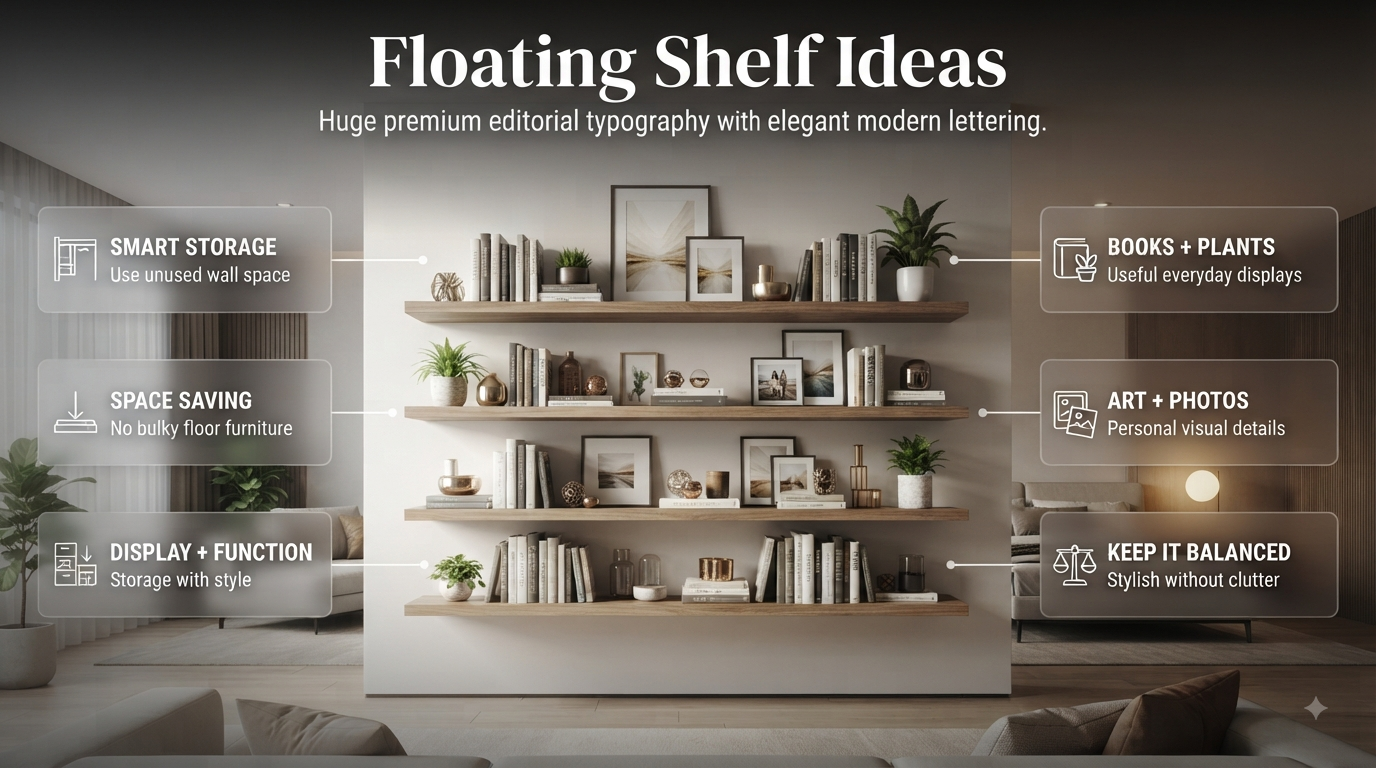
Floating Shelf Ideas | An empty wall can make a room feel unfinished, but adding another cabinet or bulky piece of furniture isn’t always the right solution. Floating shelf ideas offer a smarter alternative by turning unused wall space into useful storage and attractive display space without taking up valuable floor area.
A well-designed floating shelf can hold books, plants, artwork, kitchenware, photographs, collectibles, or everyday essentials. More importantly, it can become part of the room’s overall design rather than looking like an afterthought.
For broader inspiration on creating beautiful and functional spaces, visit DesignMode24 Interior Design.
In this guide, you’ll discover practical floating shelf ideas for living rooms, bedrooms, kitchens, bathrooms, home offices, entryways, and small spaces. You’ll also learn how to choose the right shelf size and material, style shelves without creating clutter, install them safely, avoid common mistakes, and make inexpensive shelving look polished and intentional.
What Are Floating Shelves?
Floating shelves are wall-mounted shelves designed with concealed or minimally visible support hardware. Instead of seeing traditional brackets underneath, the shelf appears to extend directly from the wall, creating a clean and lightweight appearance.
This simple construction makes floating shelves especially useful in modern homes where homeowners want storage without the visual bulk of a cabinet or bookcase.
They can be made from natural wood, engineered wood, metal, glass, or combinations of different materials. Their design can be simple and minimalist or bold enough to become a major focal point.
Floating shelves are particularly useful for:
- Displaying decorative accessories
- Organizing frequently used items
- Adding storage to small rooms
- Filling empty wall areas
- Creating a focal point
- Showing artwork and photographs
- Displaying books and plants
- Reducing the need for bulky furniture
The most important thing to remember is that a floating shelf is both a design element and a functional storage solution. Its appearance matters, but its intended load and installation method matter just as much.
Why Are Floating Shelves So Popular?
Floating shelves have remained popular because they solve several common interior-design problems at once.
First, they use vertical space. Most rooms have walls that extend far above the level of tables, cabinets, and other furniture, so floating shelves allow you to make better use of that otherwise unused area.
Second, they have relatively little visual weight. A large bookcase can dominate a small room, whereas several carefully positioned floating shelves can provide useful storage while keeping the floor visible.
Third, they are highly adaptable. The same basic shelf concept can look completely different depending on the material, color, length, styling, and placement.
They can suit:
- Minimalist homes
- Contemporary interiors
- Japandi spaces
- Scandinavian rooms
- Rustic homes
- Industrial interiors
- Traditional rooms
- Eclectic spaces
For a wider look at practical improvements around the house, explore Home Improvement.
💡 Pro Tip: Don’t begin with the question, “What shelf should I buy?” Start with, “What problem should this shelf solve?” That answer will help you determine its size, depth, material, location, and styling.
What Are the Best Floating Shelf Ideas for Every Room?
The best floating shelf design depends on the room, the available wall space, and what you need the shelf to do. A living-room shelf may be primarily decorative, while a kitchen shelf needs to be practical and easy to clean.
Below are some of the most useful and versatile ideas.
1. Long Floating Shelf Above a Sofa
A long shelf positioned above a sofa is one of the easiest ways to give a large blank wall a sense of structure.
The shelf creates a horizontal line that visually connects the wall with the furniture beneath it. It can hold framed photographs, books, plants, ceramics, or a small collection of decorative objects.
Try to keep the styling balanced rather than filling the shelf from end to end.
For example, place a plant toward one side, several books toward the center, and a framed picture or vase toward the opposite side.
The empty sections between these groups are important because they allow the wall and shelf itself to remain visible.
2. Two Floating Shelves Above a Console
Two shelves above a console table can create a layered display without making the wall feel too busy.
Use the lower shelf for larger or frequently viewed pieces and the upper shelf for lighter decorative items.
This arrangement works especially well in:
- Living rooms
- Dining rooms
- Hallways
- Entryways
You can keep the shelves identical for a structured look or choose different lengths for a more relaxed arrangement.
3. Staggered Floating Shelves
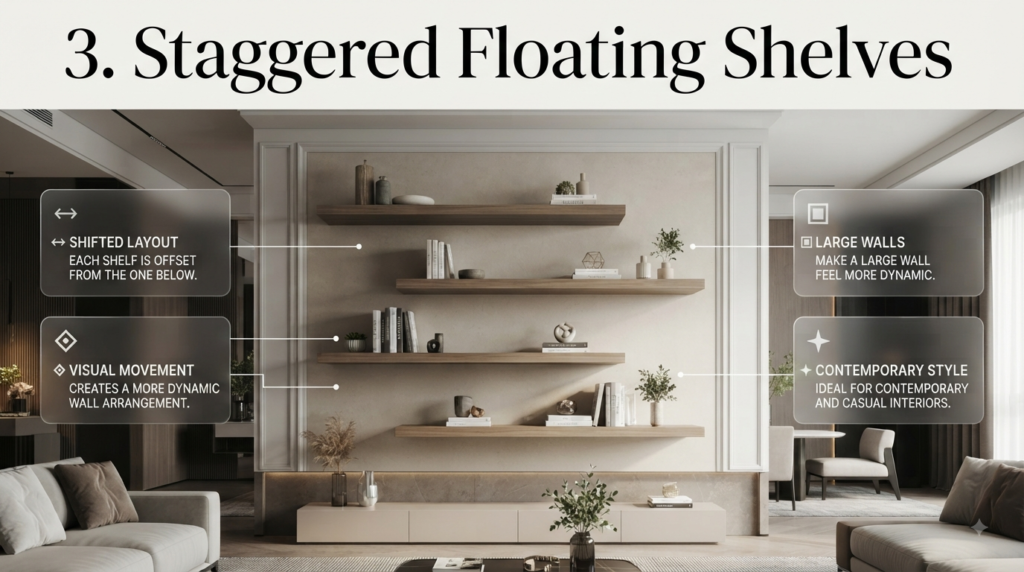
Staggered shelves are ideal when you want something less formal than a symmetrical layout.
Instead of placing each shelf directly above the previous one, shift them slightly.
A simple arrangement might look like this:
        ─────────────────

              ───────────────

        ───────────────

                 ─────────────
The staggered arrangement creates movement and can make a large wall feel more dynamic.
It’s particularly suitable for contemporary and casual interiors.
4. Corner Floating Shelves
Corners are often wasted spaces, especially in small rooms.
Corner shelves can turn an awkward wall junction into useful display or storage space.
Use them for:
- Small plants
- Books
- Photos
- Collectibles
- Candles
- Small baskets
- Decorative ceramics
Corner shelves work particularly well in bedrooms, home offices, and hallways where every bit of wall space can be valuable.
5. Floating Shelves Around the TV
A television can sometimes look visually isolated when mounted on a large empty wall.
Floating shelves can help integrate the television into the overall room design.
You can place shelves:
- On both sides of the TV
- Above the TV
- Below the TV
- In an asymmetrical arrangement around it
Avoid filling every available area with accessories. The television is already a strong visual element, so the surrounding shelves should support rather than compete with it.
6. Floating Shelves Behind a Sofa
If your sofa is positioned away from the wall, the wall behind it can become an opportunity for additional decoration.
A shallow floating shelf can hold artwork, photographs, books, or greenery.
However, be careful with shelf depth and height. You don’t want the shelf to interfere with people sitting down or standing up.
Floating Shelf Ideas for the Kitchen
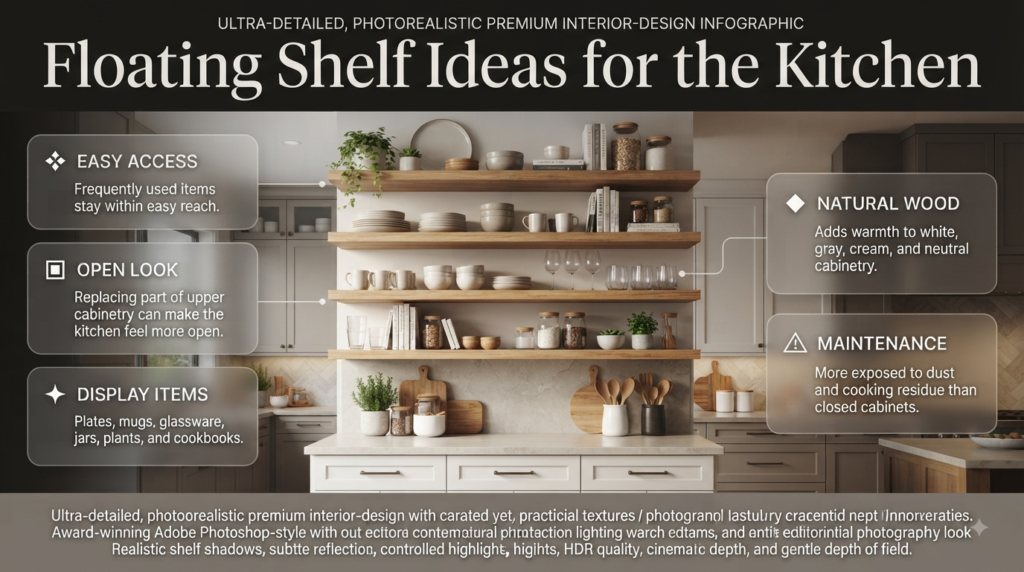
The kitchen is one of the most useful places for floating shelves because open shelving can keep frequently used items within easy reach.
7. Open Kitchen Shelving
Replace one section of upper cabinets with floating shelves to make a kitchen feel more open.
You can display:
- Plates
- Bowls
- Mugs
- Glassware
- Cookbooks
- Jars
- Plants
- Wooden utensils
Natural wood is particularly effective in kitchens because it adds warmth to white, gray, cream, or neutral cabinetry.
The main disadvantage is maintenance. Open shelving is more exposed to dust and cooking residue than closed cabinets.
For broader room-planning inspiration, explore Interior Design.
8. Floating Spice Shelf
A narrow shelf near the cooking area can create a dedicated spice station.
Keep frequently used spices at a comfortable height and arrange them in a consistent way.
Matching containers can make the shelf look cleaner, while labels make it easier to find what you need.
Don’t install a spice shelf so close to the stove that it is constantly exposed to excessive heat, grease, or splashes.
9. Floating Coffee Station
A small floating shelf above or near a coffee machine can turn an unused wall into a compact coffee station.
Display:
- Coffee mugs
- Coffee containers
- Spoons
- Small trays
- Coffee accessories
- Decorative items
If you have enough vertical space, install a second shelf above the first for additional mugs or containers.
This is especially helpful in compact kitchens where countertop space is limited.
10. Floating Shelves for Cookbooks
Cookbooks can be both useful and decorative.
Arrange some vertically and stack others horizontally to introduce different heights.
Place a small plant, bowl, or decorative object on top of a horizontal stack.
The result feels more relaxed than simply lining every book up in a row.
Floating Shelf Ideas for the Living Room
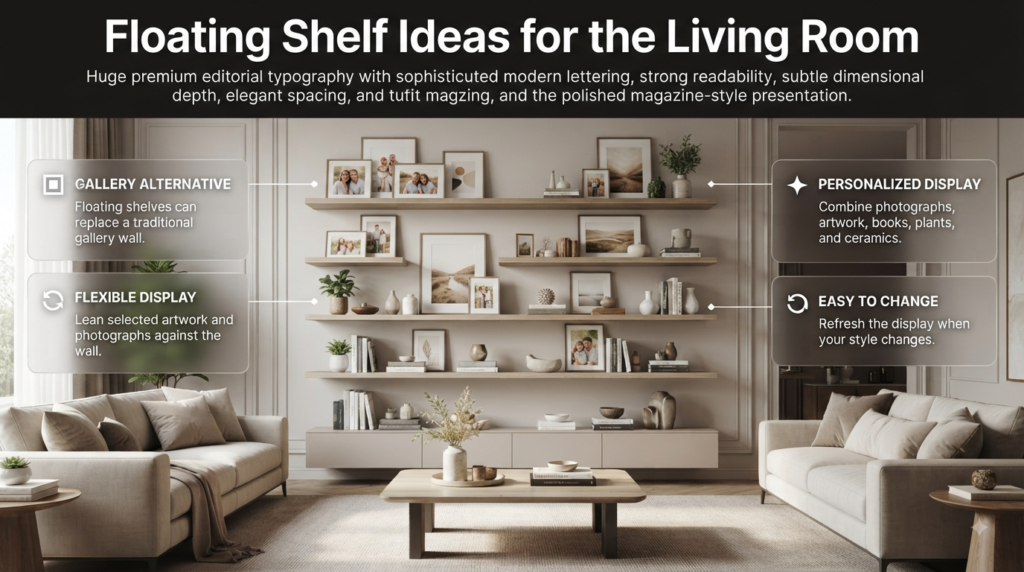
The living room usually provides the largest opportunity for decorative shelving.
11. Gallery-Style Floating Shelves
Floating shelves can work as an alternative to a traditional gallery wall.
Instead of permanently hanging every frame, lean selected artwork and photographs against the wall.
This makes it easy to change the display when your style changes.
Combine:
- Family photographs
- Small artwork
- Books
- Plants
- Ceramics
- Decorative objects
For another creative way to personalize walls, explore DIY Wall Art.
12. Floating Shelves With Plants
Plants are excellent for floating shelves because their organic shapes soften the straight lines of the shelving.
Use plants according to the light conditions in the room.
A trailing plant can create movement by extending downward from the shelf, while a compact plant can provide a small burst of greenery without taking up much space.
Don’t place too many plants together unless you’re deliberately creating a plant-focused display.
13. Book-Focused Floating Shelves
For readers, books can become the primary decorative feature.
Mix vertical and horizontal arrangements.
For example:
Group 1: Five books standing vertically
Group 2: Three books stacked horizontally
Group 3: One small plant
This creates different visual heights without requiring many decorative accessories.
14. Statement Floating Shelf
Instead of using several small shelves, choose one thick, high-quality shelf that becomes a feature.
A substantial natural-wood shelf can create warmth and character.
A dark shelf can provide contrast against a light wall.
A painted shelf can become an accent color.
This approach works particularly well in rooms inspired by Statement Interiors.
Floating Shelf Ideas for the Bedroom
Bedrooms often have limited floor space, so floating shelves can provide practical storage without adding another piece of furniture.
15. Floating Bedside Shelf
A floating shelf beside the bed can replace a traditional nightstand.
It can hold:
- Phone
- Book
- Glasses
- Small lamp
- Alarm clock
- Small decorative item
This is particularly useful in narrow bedrooms.
Make sure the shelf is positioned comfortably for everyday use and securely mounted.
16. Floating Shelf Above the Bed
A shelf above the bed can become a decorative feature, but this location requires extra care.
Avoid placing heavy, unstable, or breakable objects above where someone sleeps.
If you choose this arrangement, use lightweight decorations and make sure the shelf and mounting system are properly secured.
17. Floating Shelves for Children’s Rooms
Floating shelves can organize children’s books, toys, photographs, and decorative pieces.
However, safety should take priority over appearance.
Secure the shelves properly and avoid placing heavy objects where children can reach and pull them down.
Floating Shelf Ideas for the Bathroom
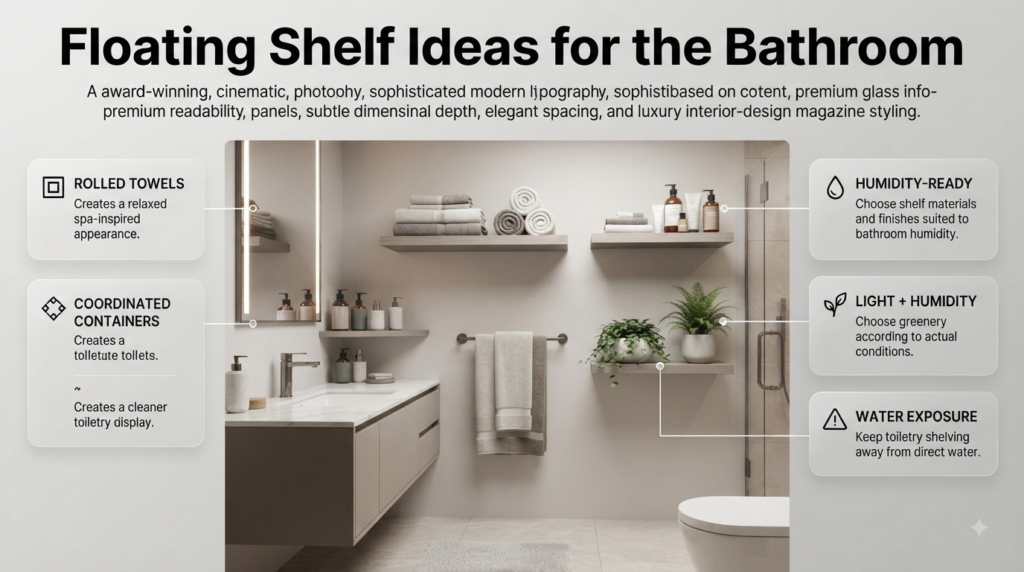
Bathrooms often have limited storage, so wall-mounted shelving can be extremely practical.
18. Floating Towel Shelf
A floating shelf can hold neatly folded or rolled towels.
Rolling towels can create a relaxed spa-inspired appearance.
Choose materials and finishes that can tolerate the bathroom’s humidity.
19. Bathroom Toiletry Shelf
A narrow shelf near the vanity can keep everyday toiletries accessible.
If you want a cleaner appearance, use coordinated containers rather than displaying dozens of differently colored product bottles.
Keep the shelf far enough away from direct water exposure to prevent unnecessary damage.
20. Bathroom Shelf With Greenery
A moisture-tolerant plant can soften the hard surfaces commonly found in bathrooms.
Choose plants based on the actual light and humidity conditions rather than simply choosing one because it looks attractive.
Floating Shelf Ideas for the Home Office
A home office needs organization without creating visual distraction.
21. Floating Book Shelves
Install shelves above or beside your desk.
Use them for:
- Reference books
- Notebooks
- Files
- Storage boxes
- Plants
- Decorative objects
Keep frequently used materials within easy reach.
22. Minimalist Office Shelves
If you want a calmer workspace, use a limited number of objects.
A simple display might include:
- Three books
- One plant
- One framed print
- One storage box
This approach keeps the workspace visually clean while still giving the room personality.
For more inspiration, explore Minimalist Interior Design.
23. Floating Shelves for Creative Supplies
Artists, crafters, and people who work on DIY projects can use floating shelves to organize materials.
Place small supplies inside attractive boxes or baskets.
Label containers clearly so organization remains practical rather than becoming purely decorative.
Floating Shelf Ideas for the Entryway
The entryway can benefit from a small floating shelf because it provides a convenient place for everyday items.
24. Key and Wallet Shelf
A narrow shelf near the entrance can act as a drop zone for:
- Keys
- Wallet
- Sunglasses
- Small accessories
Add hooks underneath if you need additional storage for lightweight bags or other items.
25. Entryway Shelf With Mirror
Place a mirror above the shelf to create a complete entryway feature.
The mirror adds visual interest while the shelf provides practical storage.
Keep the styling simple so the entrance doesn’t become cluttered.
Floating Shelf Ideas for Small Spaces
Small rooms require careful planning because every inch matters.
26. Vertical Floating Shelf Arrangement
Instead of installing one large shelf, stack several smaller shelves vertically.
This allows you to use wall height without requiring much horizontal space.
27. Narrow Floating Shelves
Narrow shelves are useful in:
- Hallways
- Small bedrooms
- Compact kitchens
- Bathrooms
- Narrow walls
They provide storage while maintaining walking clearance.
28. Floating Shelf Instead of a Nightstand
This is one of the simplest ways to free floor space in a small bedroom.
A compact shelf can hold the essentials without requiring a full table.
29. Floating Shelves Above a Desk
Use the wall above your desk for books, stationery, plants, and storage containers.
This keeps the desk surface available for actual work.
30. Floating Shelf in an Awkward Wall Area
Sometimes a small unused section of wall isn’t large enough for conventional furniture.
A custom-sized floating shelf can fit that space without forcing an oversized piece into the room.
How Do You Choose the Right Floating Shelf Size?
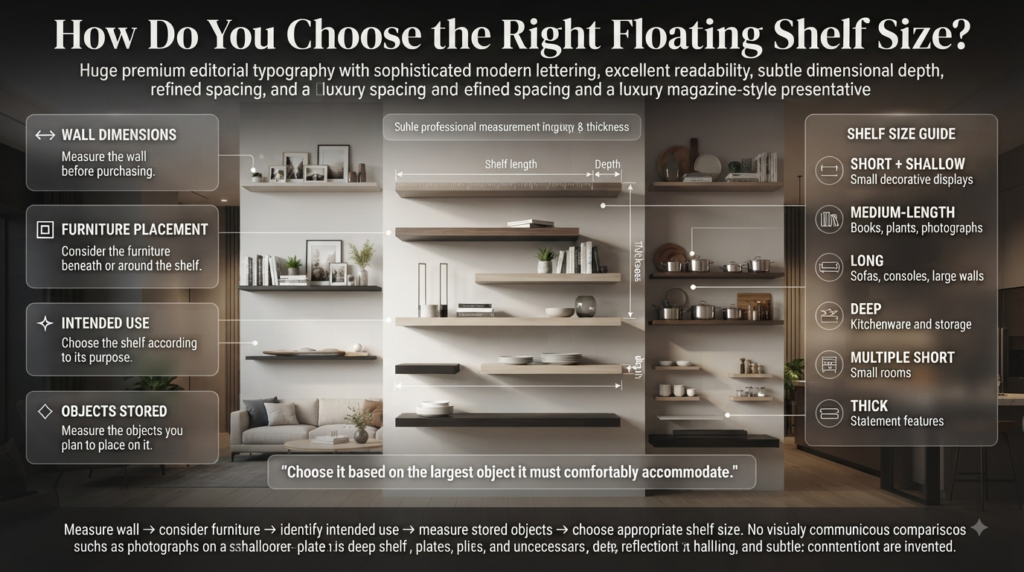
The correct shelf size depends on four main factors:
- Wall dimensions
- Furniture placement
- Intended use
- Objects being stored
Measure the wall before purchasing the shelf.
Then measure the objects you plan to place on it.
A shelf that’s perfect for photographs may be too shallow for books. A shelf suitable for plates may be unnecessarily deep for a hallway.
Floating Shelf Size Guide
| Shelf Type | Best Use |
|---|---|
| Short and shallow | Small decorative displays |
| Medium-length | Books, plants, photographs |
| Long | Sofas, consoles, large walls |
| Deep | Kitchenware and storage |
| Multiple short shelves | Small rooms |
| Thick shelves | Statement features |
📌 Quick Tip: Don’t choose a shelf based only on wall size. Choose it based on the largest object it must comfortably accommodate.
Which Materials Are Best for Floating Shelves?
The material affects the shelf’s appearance, durability, maintenance, and overall style.
Natural Wood
Natural wood is one of the most versatile options.
Oak, walnut, maple, and other durable woods can create warmth and texture.
Wood works particularly well with:
- Japandi interiors
- Scandinavian design
- Rustic rooms
- Contemporary spaces
- Natural interiors
For more inspiration, explore Natural Wood Interior.
Engineered Wood
MDF and other engineered materials can provide a smooth, consistent finish and are often suitable for decorative applications.
Painted engineered wood can also be customized to match or complement the room.
Metal
Metal shelving works well in industrial, contemporary, and modern interiors.
It can create a more architectural appearance than wood.
Glass
Glass shelves have a lightweight visual effect and can help small spaces feel open.
However, they show fingerprints and dust more easily and should be installed with appropriate hardware.
How Do You Choose the Right Floating Shelf Color?
The best shelf color depends on the colors already present in the room.
You can either make the shelf blend into the wall or intentionally make it stand out.
Match the Wall
A shelf close to the wall color creates a subtle appearance.
Contrast the Wall
A dark shelf against a light wall can become a focal point.
Match Existing Wood
If your room already contains wood furniture, choose a shelf finish that complements the existing wood rather than necessarily matching it exactly.
Repeat an Accent Color
A painted shelf can repeat a color already found in cushions, artwork, rugs, or other accessories.
If you’re planning a broader color update, explore Paint Color for additional inspiration.
How Do You Style Floating Shelves Without Creating Clutter?
Styling is one of the most important parts of a successful floating shelf project.
A shelf can be perfectly installed and still look unattractive if it’s overloaded with random objects.
A simple formula is:
Tall object + books + small object + greenery + empty space
This creates variation while maintaining visual breathing room.
Mix Different Heights
Don’t place five objects of identical height next to each other.
Combine:
- Tall vase
- Medium frame
- Short bowl
- Small plant
Different heights create a more interesting composition.
Combine Different Textures
Use a mixture of:
- Wood
- Ceramic
- Glass
- Metal
- Fabric
- Greenery
Texture adds depth.
Create Small Groups
Instead of spreading objects evenly across the shelf, create small visual clusters.
For example:
Cluster A: Plant + two books
Cluster B: Frame + ceramic vase
Leave a noticeable gap between the groups.
Repeat Colors
If every object has a different color, the shelf may look chaotic.
Choose two or three dominant colors and repeat them.
What Is the Rule of Three for Floating Shelf Styling?
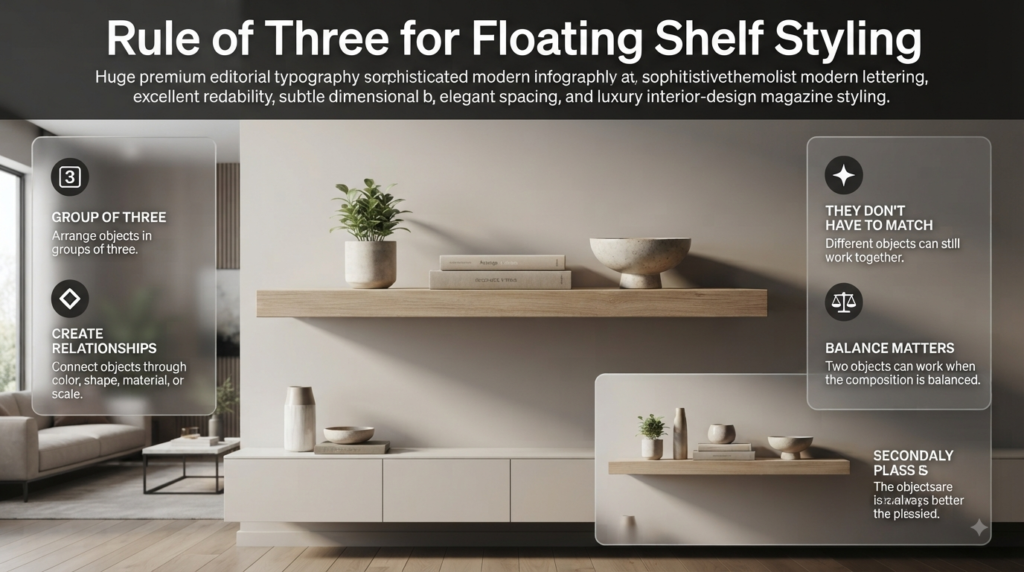
The rule of three means arranging objects in groups of three to create a visually appealing composition.
For example:
- A small plant
- Two stacked books
- A decorative bowl
The objects don’t have to match.
They simply need to have some relationship through color, shape, material, or scale.
However, don’t treat the rule as a strict decorating law. Two objects can work perfectly when the overall composition is balanced.
How Can You Make Floating Shelves Look Expensive?
You don’t need expensive shelves or accessories to achieve a polished appearance.
Focus on:
- Proportion
- Quality-looking materials
- Limited colors
- Good spacing
- Clean installation
- Intentional styling
- Negative space
A simple natural-wood shelf with three thoughtfully chosen objects can look more sophisticated than an expensive shelf covered with twenty unrelated decorations.
The key is editing.
Before adding another object, ask whether the display actually needs it.
For ideas about refreshing existing furniture and coordinating it with new shelving, explore Furniture Makeovers.
Floating Shelves for Different Interior Design Styles
Floating shelves are versatile because their appearance can change dramatically according to the interior style.
Minimalist Floating Shelf Ideas
Minimalist shelving should be clean and restrained.
Choose:
- Thin profiles
- Neutral colors
- Simple accessories
- Natural materials
- Plenty of empty space
The objective isn’t to make the shelf look empty. It’s to make every object feel intentional.
Contemporary Floating Shelf Ideas
Contemporary interiors work well with clean lines and subtle contrast.
Consider:
- Dark wood
- Matte finishes
- Geometric objects
- Neutral artwork
- Sculptural accessories
For more inspiration, explore Contemporary Interior Design.
Japandi Floating Shelf Ideas
Japandi combines simplicity, functionality, natural materials, and calm colors.
Choose:
- Natural wood
- Neutral ceramics
- Simple greenery
- Handmade-looking accessories
- Warm neutral colors
For a deeper look at this design approach, explore Japandi Interior Design.
Rustic Floating Shelves
Rustic spaces can benefit from thicker wood shelves with visible grain or natural imperfections.
Pair them with:
- Woven baskets
- Ceramic pieces
- Vintage objects
- Greenery
- Neutral textiles
Industrial Floating Shelves
Wood combined with metal works well in industrial interiors.
Dark finishes, simple accessories, and exposed textures can reinforce the style.
Scandinavian Floating Shelves
Light wood, white finishes, clean forms, and practical objects work particularly well.
The overall display should remain bright, simple, and functional.
For more ideas on coordinating shelf designs with different decorating approaches, explore Interior Design Styles.
How Do You Install Floating Shelves Safely?
Installing a floating shelf isn’t simply a matter of drilling two holes into a wall.
The shelf’s actual load capacity depends on:
- Shelf construction
- Shelf thickness
- Bracket design
- Wall material
- Anchors
- Fasteners
- Installation quality
- Weight distribution
Step 1: Identify the Wall Type
Determine whether the wall is:
- Drywall
- Plaster
- Brick
- Concrete
- Masonry
- Stud-supported construction
Different surfaces require different fixing methods.
Step 2: Locate Structural Support
Where possible, attach the shelf support to wall studs or another suitable structural surface.
Step 3: Select Appropriate Hardware
Use hardware designed for the actual wall type and expected load.
Don’t assume that ordinary screws will safely support a heavy shelf.
Step 4: Mark the Position
Use a pencil, measuring tape, and spirit level.
Painter’s tape can also help you visualize the shelf position before drilling.
Step 5: Install the Support
Follow the shelf manufacturer’s instructions carefully.
Step 6: Check the Level
A shelf that is slightly tilted can become very noticeable once books or decorative objects are placed on it.
Step 7: Load It Gradually
Don’t immediately put the maximum expected weight on the shelf.
Check the installation and make sure everything feels secure.
⚠ Common Mistake: People often spend more time choosing the shelf finish than choosing the correct mounting hardware. The strongest-looking shelf can still be unsafe if it isn’t properly attached to the wall.
For more hands-on decorating and renovation inspiration, explore DIY Home Projects.
What Are the Most Common Floating Shelf Mistakes?
1. Choosing the Shelf Before Measuring
Why it happens: The shelf looks attractive while shopping.
Why it’s a problem: It may not fit the wall or furniture properly.
How to avoid it: Measure the wall first.
2. Choosing the Wrong Depth
A shelf that’s too shallow won’t hold the objects you need.
A shelf that’s too deep can become an obstacle, particularly in narrow hallways.
Always consider the room’s circulation.
3. Overloading the Shelf
Books, plates, ceramics, and storage containers can become much heavier than expected.
How to avoid it: Follow the manufacturer’s load rating and use appropriate installation hardware.
4. Filling Every Inch
Many beginners think an empty area means something is missing.
In professional styling, empty space can be just as important as decoration.
5. Ignoring Wall Structure
A shelf installed without considering the wall can become unstable.
Identify the wall material and select suitable anchors and fixings.
6. Using Too Many Colors
A shelf containing unrelated colors can make the entire wall feel chaotic.
Use a controlled palette.
7. Making Everything Symmetrical
Perfect symmetry can sometimes make a display feel stiff.
Balanced asymmetry often creates a more natural appearance.
8. Ignoring the Furniture Below
A shelf should relate to the sofa, console, desk, bed, or cabinet below it.
Otherwise, it can appear visually disconnected.
9. Mixing Too Many Design Styles
A rustic wooden shelf covered with unrelated modern, traditional, industrial, and colorful objects may lack cohesion.
Choose a dominant style and allow small variations.
10. Using Decorative Shelves as Heavy Storage
Not every floating shelf is designed for heavy items.
A shelf intended for photographs isn’t automatically suitable for a large collection of books.
Floating Shelves vs Closed Cabinets: Which Is Better?
Neither option is universally better.
The right choice depends on what you need to store.
| Feature | Floating Shelves | Closed Cabinets |
| Visual weight | Light | Heavier |
| Display | Excellent | Limited |
| Accessibility | Very easy | Moderate |
| Dust protection | Low | High |
| Floor space | Minimal | More |
| Styling importance | High | Lower |
| Best for | Display and accessible items | Hidden storage |
Floating shelves are best when you want your belongings to contribute to the room’s appearance.
Closed cabinets are better when your priority is hiding clutter or protecting belongings from dust.
Many homes benefit from combining both.
How Can Floating Shelves Improve Small Rooms?
Small rooms benefit from vertical thinking.
Instead of adding another floor-standing cabinet, consider whether the wall can perform the same function.
A vertical shelving arrangement might look like this:
             ──────────────
             Books + Plant

                  ────────
                  Artwork

             ──────────────
             Storage Boxes

             ──────────────
             Small Objects
This approach keeps the floor visible and makes the room feel less crowded.
Use lighter finishes and avoid excessive decoration if the room is already visually busy.
For additional room-planning ideas, explore Home Design Ideas.
Can Floating Shelves Work With Energy-Efficient Home Design?
Floating shelves don’t directly make a home more energy efficient, but thoughtful wall planning can support a better-performing and more comfortable space.
For example, avoid positioning shelves where they block natural daylight, interfere with ventilation, or obstruct heating and cooling equipment.
Wall-mounted storage can also help maintain flexible floor layouts around windows and doors.
If you’re interested in broader ideas for efficient homes, explore Energy-Efficient Homes.
How Can You Use DIY Decor on Floating Shelves?
One of the best ways to make floating shelves feel personal is to display items you’ve created or customized yourself.
Ideas include:
- Handmade artwork
- Painted frames
- DIY ceramics
- Upcycled containers
- Handmade decorative boxes
- Small craft projects
- Repurposed accessories
This approach prevents the shelf from looking like a collection of generic store-bought decorations.
For more creative inspiration, explore DIY Home Decor Crafts.
How Can Decorative Finishes Improve Floating Shelf Walls?
The shelf doesn’t have to be the only design feature on the wall.
The background can also contribute to the final appearance.
For example, you could combine:
- Natural wood shelves with warm neutral paint
- White shelves with a soft accent wall
- Dark shelves with a lighter textured background
- Minimal shelves with subtle wall finishes
The relationship between the shelf and its background can create much more depth than the shelf alone.
For additional ideas, explore Decorative Finishes.
How Many Floating Shelves Should You Put on One Wall?
There is no universal number.
The right number depends on:
- Wall size
- Shelf length
- Room function
- Amount of storage needed
- Furniture arrangement
- Desired visual density
As a general guide:
One shelf: Good for a simple statement.
Two shelves: Excellent for balanced displays.
Three shelves: Good for layered styling.
Four or more: Better for large walls or serious storage requirements.
Don’t add shelves simply because the wall has empty space.
How Do You Know When a Floating Shelf Is Too Crowded?
A shelf is probably overcrowded when:
- Objects overlap unnecessarily
- You can’t see much of the shelf
- Every item is placed at equal distances
- There are too many colors
- Nothing visually stands out
- You have to constantly move objects
- The wall feels heavier than the rest of the room
The easiest solution is often editing.
Remove two or three objects and step back.
You may discover that the shelf immediately looks better.
How Can You Use Floating Shelves as Home Styling Features?
Floating shelves can become more than storage when they’re intentionally connected to the room’s colors, textures, furniture, and accessories.
For example, if your room uses warm beige walls, natural wood furniture, and cream textiles, a walnut or oak shelf with neutral ceramics can reinforce that visual direction.
Similarly, a contemporary room with black metal accents can use dark shelves and simple geometric accessories.
The goal is to create a relationship between the shelf and the rest of the room.
For more ideas, explore Home Styling.
Expert Advice for Professional-Looking Floating Shelves
Professional-looking shelves usually come down to proportion, editing, and consistency.
Before buying accessories, evaluate the wall.
Consider the wall
Is it wide, narrow, tall, or awkward?
Consider the furniture
What sits beneath or beside the shelf?
Consider the purpose
Is the shelf primarily decorative, functional, or both?
Consider visual weight
Should the shelf blend into the room or become a focal point?
Consider color
Which colors already exist in the room?
Consider materials
Which materials support the room’s design style?
⭐ Expert Tip: Take a photograph of the entire wall before finalizing the shelf arrangement. A display that looks perfect when you’re standing directly in front of it may look too heavy or unbalanced when viewed from across the room.
How Can You Coordinate Floating Shelves With a Larger Interior Design Plan?
Floating shelves work best when they’re considered as part of a larger room rather than as an isolated project.
Look at the:
- Wall color
- Flooring
- Furniture
- Curtains
- Lighting
- Artwork
- Rugs
- Decorative accessories
- Existing wood tones
For example, if the room already has several natural wood elements, another wood shelf can strengthen the connection between them.
If the room is dominated by neutral colors, a dark shelf can create a controlled point of contrast.
The important thing is consistency.
A shelf doesn’t have to match everything. It simply needs to make sense with the surrounding design.
How do you make floating shelves look stylish and expensive?
The secret to making floating shelves look expensive isn’t the price of the shelf or the accessories. It’s how deliberately everything is arranged. Start with one larger anchor piece, then add smaller objects with different heights, textures, and shapes. Books, ceramic pieces, framed artwork, and greenery work especially well because they create visual variety without making the arrangement feel random.
Professional-looking shelves also need negative space. Don’t cover the entire shelf from one end to the other. Leaving some of the shelf visible gives the display room to breathe and prevents it from looking like a storage rack. Current shelf-styling advice also favors curated, meaningful displays over collections of unrelated decorative objects.
Practical styling points:
Start with one large or tall object.
Add books to introduce height and structure.
Use one plant or organic element for softness.
Repeat one or two colors already present in the room.
Mix materials such as wood, ceramic, glass, and metal.
Leave intentional empty space.
Step back and remove anything that feels unnecessary.
⭐ Expert Tip: Style the shelf in groups rather than placing objects at equal distances. A group of three related pieces usually looks more natural than six objects spaced perfectly apart.
What should you put on floating shelves?
The best objects for floating shelves depend on the room and the shelf’s purpose. In a living room, books, framed photographs, plants, ceramics, candles, and small artwork create an attractive display. In a kitchen, plates, bowls, mugs, cookbooks, jars, and frequently used utensils are more practical. In a bedroom, you might use books, photographs, small plants, and personal keepsakes.
The important distinction is between decorating a shelf and filling a shelf. You don’t need to use every available inch. A well-designed arrangement normally combines useful items with a few decorative pieces, allowing the shelf to feel personal without becoming visually crowded.
Good choices include:
Books and magazines
Framed photographs
Small artwork
Ceramic vases
Indoor plants
Decorative bowls
Candles
Collectibles
Small storage boxes
Travel souvenirs
Handmade objects
For a more personal result, include a few items that actually mean something to you rather than buying a complete collection of matching accessories.
📌 Quick Tip: Choose your largest object first. Once you know where the visual anchor belongs, it’s much easier to decide what should go beside it.
How high and how far apart should floating shelves be?
Shelf height and spacing should be based on what you’re displaying and what’s underneath the shelves, rather than following one measurement for every room. For general displays, around 10–18 inches of vertical spacing is a useful starting range, while smaller decorative objects can work with tighter spacing. Books and dishes generally need more room.
For example, two living-room shelves might need more separation than two bathroom shelves displaying small toiletries. Similarly, kitchen shelves should leave enough room for the objects being used and for comfortable access.
Before drilling, place painter’s tape on the wall to represent the proposed shelves. Stand several feet away and look at the arrangement from different angles. This simple step can reveal whether the shelves are too high, too low, too close together, or poorly aligned with the furniture underneath.
Use this planning checklist:
Measure the objects you intend to display.
Consider the height of furniture underneath.
Keep shelves visually aligned.
Leave enough clearance for everyday use.
Check the arrangement from across the room.
Use a level before permanently installing anything.
⚠ Common Mistake: Don’t automatically space every shelf at exactly the same distance. Uniform spacing can work for a minimalist arrangement, but different heights may create a more natural composition when you’re displaying objects of different sizes.
How much weight can a floating shelf hold?
A floating shelf doesn’t have one universal weight limit. Its capacity depends on the shelf material, shelf depth, bracket design, fasteners, wall construction, and where the bracket is attached. A properly installed shelf secured to structural support can carry substantially more weight than one relying only on unsuitable drywall anchors.
This is particularly important in kitchens and home offices, where books, dishes, jars, equipment, and other objects can become surprisingly heavy. The deeper the shelf, the more leverage the load can place on the wall connection, so a strong-looking shelf isn’t automatically a strong installation.
For substantial loads, mounting into wall studs or other appropriate structural support is generally the safer approach. Installation guidance from major home-improvement sources also recommends locating studs and using appropriate anchors when studs aren’t available.
Before loading a floating shelf:
Check the manufacturer’s stated capacity.
Identify the wall construction.
Locate studs where applicable.
Use hardware rated for the wall type.
Consider the shelf’s depth as well as its length.
Distribute heavy objects rather than concentrating them in one area.
Never exceed the recommended load.
⭐ Professional Advice: Treat the advertised weight rating as part of a complete installation system, not simply a number printed on the shelf packaging. The wall, bracket, fasteners, and shelf all have to work together.
Are floating shelves a good idea for small spaces?
Floating shelves are one of the most practical storage options for small rooms because they use vertical wall space instead of valuable floor space. Unlike a bookcase or cabinet, they can provide storage and display space without making the floor plan feel as crowded.
They’re particularly useful in compact bedrooms, narrow hallways, small kitchens, bathrooms, apartments, and home offices. A shallow shelf beside a bed can replace a traditional nightstand, while shelves above a desk can move books and supplies off the work surface.
The key is to avoid turning a small room into a wall of clutter. Use fewer shelves, keep their depth appropriate for the room, and choose accessories that don’t overwhelm the available space. This is consistent with the broader 2026 preference for shelving that provides storage while maintaining a lighter, more intentional visual feel.
Best small-space approaches:
Choose shallow shelves for narrow walls.
Use vertical arrangements to maximize wall height.
Keep the color palette controlled.
Display fewer, more useful objects.
Leave visible wall space around the shelves.
Use shelves above desks and furniture where floor space is limited.
Avoid oversized shelves in tight walkways.
💡 Designer Tip: In a small room, don’t ask how many things you can fit on the shelf. Ask which few things deserve to be visible. That shift alone can make the entire space feel cleaner and more spacious.
Conclusion
The best floating shelf ideas do more than fill an empty wall—they add practical storage, personality, and visual balance to your home. Whether you’re styling a living room, organizing a small bedroom, upgrading a kitchen, or creating a functional home office, the right shelf can make unused vertical space genuinely useful.
The key is to plan before you install. Choose a shelf size that fits the wall and the items you want to display, select a material that complements your interior style, and use mounting hardware appropriate for the wall and expected weight. Safety should always come before appearance, especially when shelves will hold books, dishes, or other heavy objects.
Styling also makes a major difference. Combine different heights, textures, books, greenery, artwork, and personal pieces, but don’t feel the need to fill every inch. Negative space is part of good design. A few carefully selected objects will usually create a more polished result than a shelf overloaded with decoration.
For more inspiration and practical ideas for creating beautiful, functional spaces, explore DesignMode24 Interior Design.
Most importantly, let your floating shelves support the way you actually live. When functionality, proportion, safety, and personal style come together, even a simple shelf can become an attractive and useful part of the room rather than just another decoration.
Leave a Reply