
Introduction
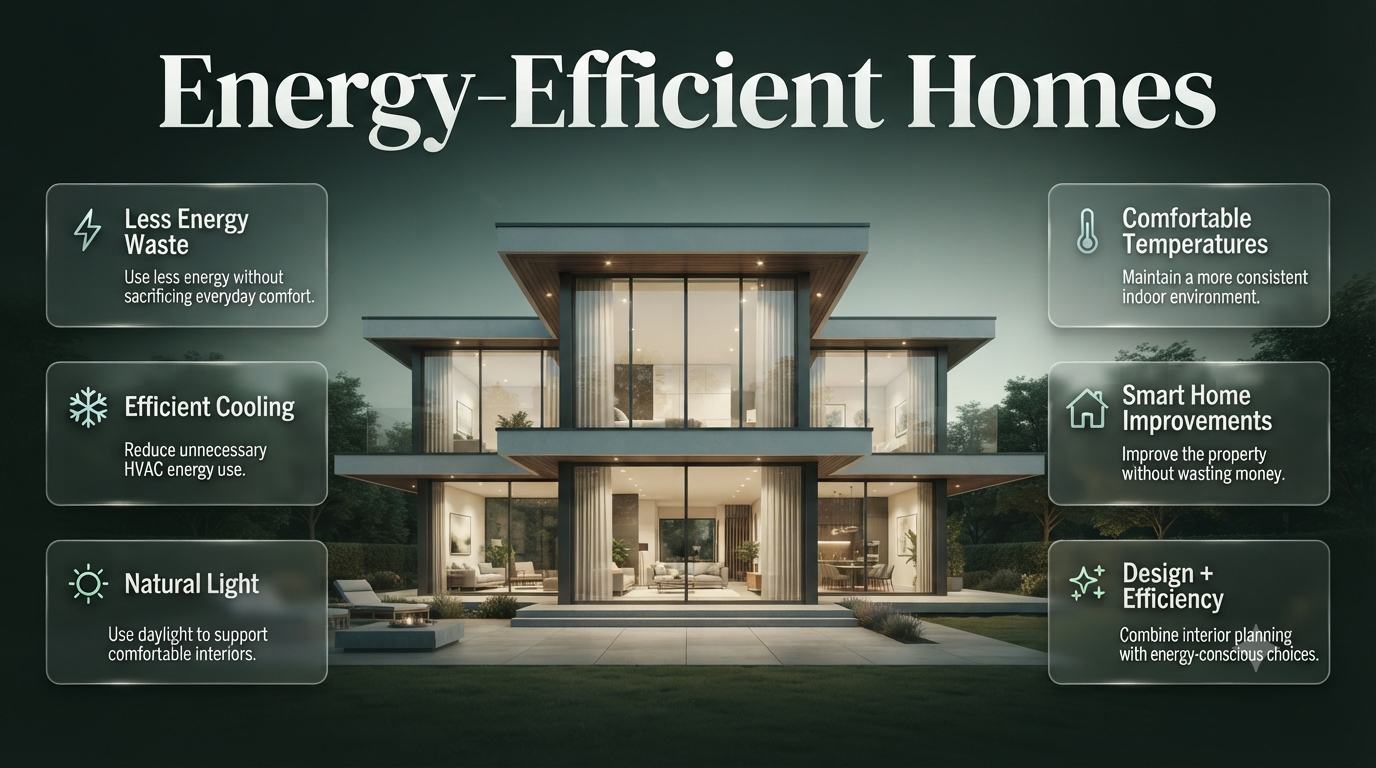
Energy-Efficient Homes | Have you ever noticed that your electricity bill keeps increasing even though your daily routine hasn’t changed much? Maybe your air conditioner runs for hours, some rooms feel hotter than others, sunlight turns certain spaces into heat traps, or your home loses its comfortable temperature soon after the heating or cooling system switches off.
These aren’t always signs that you need a more powerful HVAC system or expensive smart technology. In many cases, the real problem is that the home is wasting energy.
Energy-efficient homes are designed to use less energy while maintaining comfortable temperatures, good lighting, healthy indoor conditions, and practical everyday living. The idea isn’t to make a home feel cold, dark, or overly technical. It’s about designing and improving the property so that energy isn’t wasted unnecessarily.
For homeowners planning a renovation, efficiency can also become part of the overall design strategy. DesignMode24 Interior Design offers a useful starting point for exploring interior planning, home improvement, styling, and design ideas that can work alongside energy-conscious decisions.
In this guide, we’ll look at what makes a home energy efficient, which improvements matter most, how interior design can support efficiency, what upgrades are worth considering, common mistakes homeowners make, and how to create a practical improvement plan without wasting money.
What Is an Energy-Efficient Home?
An energy-efficient home is a property that provides the required level of comfort and functionality while consuming less energy than a comparable home with unnecessary energy losses.
This doesn’t simply mean using energy-efficient appliances.
A genuinely efficient home considers the relationship between its:
- Building envelope
- Insulation
- Windows and doors
- Heating and cooling systems
- Lighting
- Appliances
- Ventilation
- Water heating
- Solar exposure
- Interior layout
- Occupant behavior
- Smart controls
The important distinction is between using less energy because something works efficiently and using less energy because the home doesn’t need as much energy in the first place.
For example, replacing an old air conditioner with a highly efficient model can help. But if the room has poor insulation, major air leaks, and direct afternoon sun entering through uncovered windows, the new system may still have to work extremely hard.
A better strategy addresses the building first and equipment second.
Why does this matter?
Energy efficiency affects much more than monthly utility bills.
A well-planned home can provide:
- More stable indoor temperatures
- Fewer uncomfortable hot or cold areas
- Reduced HVAC workload
- Better use of daylight
- Lower unnecessary electricity consumption
- Improved long-term operating costs
- Better use of natural resources
- Greater comfort throughout the year
The exact savings vary from property to property. A small apartment with modern construction will have different opportunities from an older detached house with poor insulation.
That’s why there isn’t one universal “best energy-efficient home upgrade.”
The best upgrade is the one that solves the biggest problem your particular home has.
Why Are Energy-Efficient Homes Becoming More Important?
Energy costs, climate conditions, building standards, and homeowner expectations are all influencing the way people think about residential design.
But there is another reason efficiency matters: comfort.
People often assume energy efficiency is mainly about saving money. In practice, comfort can be just as important.
Consider a bedroom that becomes extremely warm every afternoon. The occupant may lower the thermostat, increase fan speed, close curtains, and run the air conditioner for longer periods.
The energy problem may not be the thermostat.
It could be:
- Poor roof insulation
- Uncontrolled solar heat gain
- Inefficient windows
- Air leakage
- Poor duct distribution
- An incorrectly sized HVAC system
Fixing the underlying issue can make the room more comfortable while reducing the amount of energy required to maintain that comfort.
⭐ Expert Tip: When a room is consistently uncomfortable, don’t immediately assume you need more heating or cooling. First ask why the room becomes uncomfortable.
What Makes a Home Energy Efficient?
Energy efficiency is best understood as a system rather than a single product.
Several parts of the property work together.
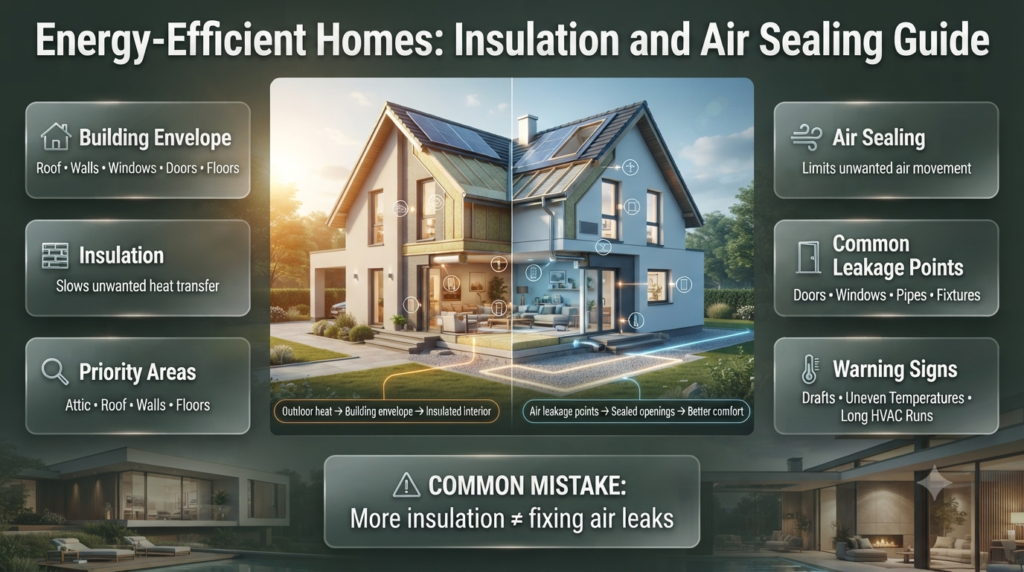
1. A Well-Insulated Building Envelope
The building envelope separates indoor living space from outdoor conditions.
It includes:
- Roof
- Exterior walls
- Windows
- Exterior doors
- Floors
- Foundation areas
Insulation helps slow heat transfer through these components.
In a hot climate, good insulation can reduce the amount of outdoor heat entering the home. In a cold climate, it helps keep indoor heat from escaping.
However, insulation has to be installed correctly.
Gaps, compression, moisture problems, and poorly treated junctions can reduce its effectiveness.
Where should insulation receive attention?
Common priority areas include:
- Attics
- Roof assemblies
- Exterior walls
- Floors above garages or unconditioned areas
- Areas around ducts
- Ceiling penetrations
If you’re already planning broader renovation work, energy improvements can often be integrated into your Home Improvement strategy rather than handled as a completely separate project.
2. Proper Air Sealing
Air sealing is different from insulation.
Insulation slows heat transfer. Air sealing limits unwanted movement of air through cracks and gaps.
Common leakage points include:
- Around doors
- Window frames
- Plumbing penetrations
- Electrical openings
- Ceiling fixtures
- Attic access doors
- Duct connections
- Pipe penetrations
One small gap doesn’t necessarily create a major problem.
The problem is cumulative.
A home may contain dozens or even hundreds of small leakage points. Together, they can affect comfort and energy consumption.
How do you know if air leakage is a problem?
You may notice:
- Drafts near windows or doors
- Rooms that are difficult to heat or cool
- Dust entering around gaps
- Uneven indoor temperatures
- HVAC systems running for long periods
Professional testing can identify air leakage more accurately, but homeowners can also begin by inspecting obvious problem areas.
⚠ Common Mistake: Adding more insulation while leaving significant air leaks untreated. Insulation and air sealing should be considered together.
How Do Windows Affect Energy Efficiency?
Windows can be one of the most important parts of a home’s energy performance.
They allow daylight and views into the home, but they can also allow unwanted heat gain or heat loss.
The performance of a window depends on factors such as:
- Glass type
- Number of panes
- Frame material
- Air leakage
- Solar heat gain
- Orientation
- Shading
- Installation quality
Are expensive windows always worth it?
Not necessarily.
If existing windows are structurally sound but have small air leaks, weatherstripping and sealing may solve part of the problem.
If the glass is severely inefficient, damaged, or causing major solar heat gain, replacement may make more sense.
The right decision depends on the condition of the existing windows and the home’s climate.
Window treatments matter too
Energy efficiency doesn’t stop at the glass.
Curtains, blinds, shades, and exterior shading can influence how much solar heat enters a room.
A thoughtfully designed window treatment can therefore support both comfort and interior appearance.
How Does Natural Light Help Energy-Efficient Homes?
Natural daylight can reduce dependence on artificial lighting during daylight hours.
But good daylight design isn’t simply about putting large windows everywhere.
Too much direct sunlight can increase indoor heat, especially in warm climates.
The objective is to create a balance between:
Daylight + Glare Control + Solar Heat Management + Visual Comfort
For example, a living room with controlled daylight may need less artificial lighting during the day while avoiding excessive heat from direct sunlight.
This is where design decisions become important.
When choosing colors and finishes, homeowners can also explore Paint Color ideas that complement natural and artificial lighting.
Lighter surfaces can help distribute available light, while carefully selected finishes can create visual depth without requiring excessive decorative lighting.
How Can Interior Design Support Energy Efficiency?
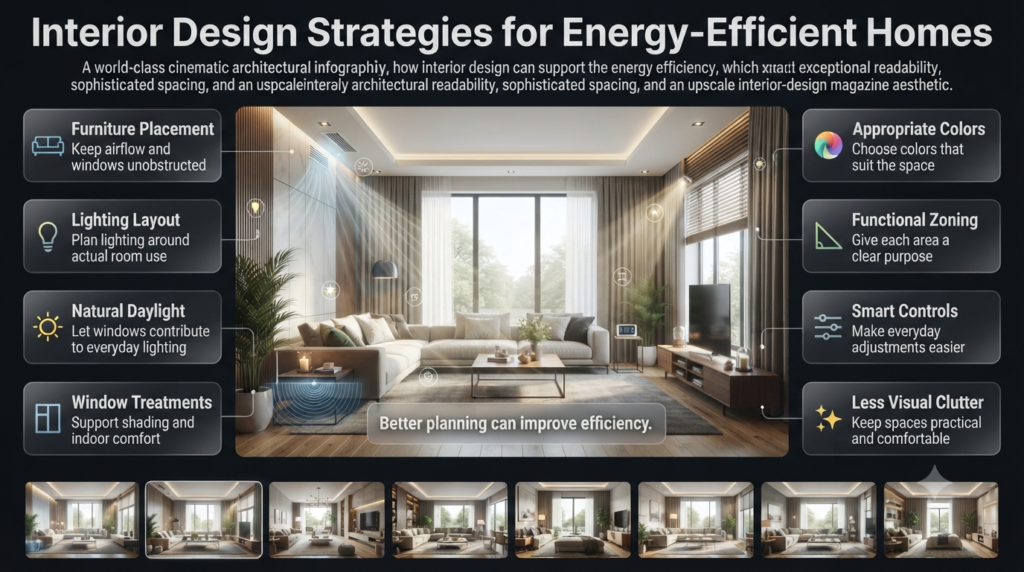
Interior design and energy efficiency don’t have to be separate projects.
A well-planned interior can support energy-conscious living through:
- Better furniture placement
- Efficient lighting layouts
- Window treatments
- Natural materials
- Appropriate colors
- Reduced visual clutter
- Functional room zoning
- Smart controls
- Comfortable layouts
For example, a sofa placed directly in front of an HVAC vent may interfere with airflow. A large piece of furniture blocking a window can reduce the usefulness of daylight.
These are small design decisions, but they demonstrate an important principle:
Efficiency often comes from better planning rather than simply buying better products.
If you’re developing the overall appearance of a home, Home Styling can be approached alongside practical decisions about lighting, shading, furniture placement, and comfort.
What Are the Best Energy-Efficient Home Improvements?
Not every improvement provides the same value.
A sensible approach is to prioritize improvements according to:
- Energy impact
- Existing condition
- Installation cost
- Expected lifespan
- Maintenance requirements
- Climate
- Household usage
Here’s a practical comparison.
| Improvement | Main Purpose | Typical Priority |
|---|---|---|
| Air sealing | Reduce unwanted airflow | High |
| Insulation | Reduce heat transfer | High |
| HVAC maintenance | Improve system operation | High |
| LED lighting | Reduce lighting energy | High |
| Efficient HVAC | Reduce heating/cooling demand | High |
| Smart thermostat | Improve temperature scheduling | Medium |
| Efficient appliances | Reduce appliance consumption | Medium |
| Window upgrades | Improve thermal performance | Medium |
| Solar panels | Generate electricity | Property-dependent |
| Smart controls | Automate energy management | Medium |
The table isn’t a universal ranking.
For one home, insulation might provide the biggest opportunity. For another, an old HVAC system may be the main problem.
How Can You Make an Existing Home More Energy Efficient?
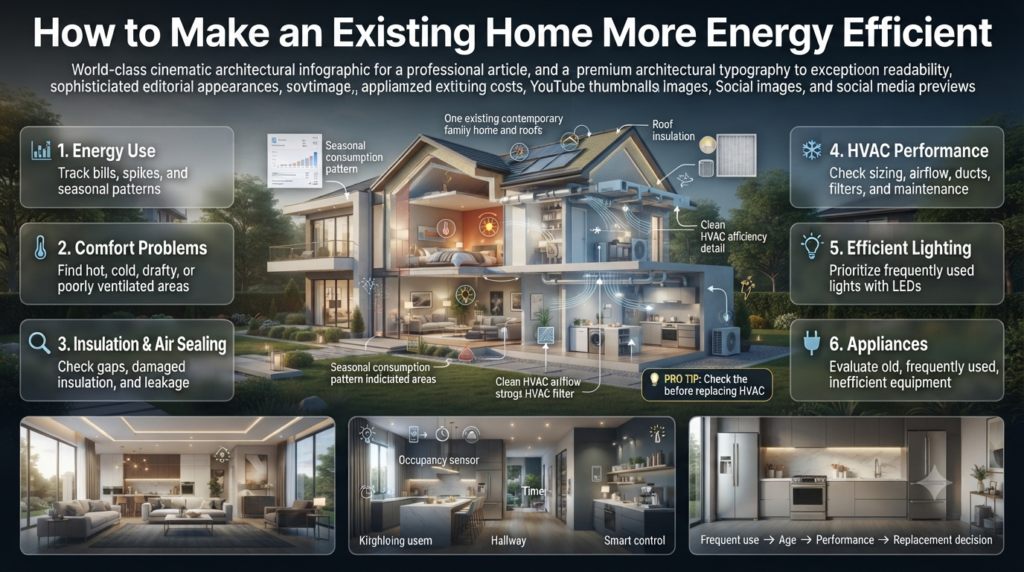
You don’t need to demolish or completely remodel a home to improve its energy performance.
A phased approach is often more practical.
Step 1: Understand Your Current Energy Use
Begin with your utility bills.
Look for:
- Seasonal increases
- Unusual spikes
- Long periods of high consumption
- Changes after appliance purchases
- Changes after renovation
Don’t just look at the total amount.
Look for patterns.
If consumption jumps dramatically during the hottest months, cooling may be a major contributor.
If usage remains unusually high even when weather is mild, appliances, water heating, lighting, or other electrical loads may deserve investigation.
Step 2: Identify Uncomfortable Areas
Walk through the home and ask:
- Which rooms are hottest?
- Which rooms are coldest?
- Where does sunlight hit hardest?
- Are some areas difficult to ventilate?
- Are doors or windows drafty?
- Does one floor behave differently from another?
These observations can reveal weaknesses in the home’s design or envelope.
Practical example
Imagine a second-floor bedroom becomes extremely hot every afternoon.
Before replacing the entire HVAC system, investigate:
- Roof insulation
- Window orientation
- Solar shading
- Window seals
- Duct airflow
- Room ventilation
The problem may be localized rather than whole-house.
Step 3: Check Insulation and Air Sealing
This is one of the most important stages.
Inspect accessible areas for:
- Missing insulation
- Damaged insulation
- Gaps
- Air leakage
- Poorly sealed openings
- Duct leakage
Professional energy assessments can provide more reliable information where problems are difficult to identify visually.
Step 4: Improve HVAC Performance
Heating and cooling systems can consume substantial energy.
Efficiency isn’t only determined by the equipment’s rating.
Performance also depends on:
- Correct sizing
- Maintenance
- Airflow
- Duct condition
- Thermostat settings
- Filter condition
- Outdoor unit cleanliness
Why does HVAC sizing matter?
A larger system isn’t automatically better.
An oversized system may cycle on and off more frequently instead of operating in an efficient, stable way.
A properly designed system should match the home’s actual heating and cooling requirements.
💡 Pro Tip: Before replacing HVAC equipment, investigate insulation, ductwork, airflow, and room-specific comfort problems. Otherwise, you may spend money treating the symptom rather than the cause.
Step 5: Upgrade Lighting
LED lighting is one of the simplest efficiency improvements.
Prioritize lights that operate frequently.
For example:
- Kitchen lighting
- Living room lighting
- Hallway lighting
- Outdoor security lighting
- Workspaces
You can combine efficient bulbs with:
- Occupancy sensors
- Timers
- Dimmers
- Smart controls
A light that automatically switches off when nobody is present can prevent wasted electricity without requiring people to remember anything.
Step 6: Evaluate Appliances
When an appliance reaches the end of its useful life, consider replacing it with a more efficient model.
Focus on appliances that:
- Operate frequently
- Consume significant electricity
- Are old
- Require frequent repairs
- Have poor performance
Don’t replace a perfectly functioning appliance solely because a newer model exists.
The environmental and financial benefits of replacement depend on the energy savings, purchase cost, and remaining useful life of the existing product.
What Are the Best Budget-Friendly Energy Efficiency Ideas?
You don’t have to begin with a major renovation.
Low-cost improvements
Start with:
- LED bulbs
- Door weatherstripping
- Window sealing
- HVAC filter maintenance
- Smart scheduling
- Turning off unused equipment
- Better curtain use
- Reducing unnecessary standby loads
Medium-cost improvements
Next consider:
- Additional insulation
- Duct sealing
- Smart thermostats
- Better window treatments
- Efficient appliances
- Occupancy sensors
Major improvements
Longer-term projects may include:
- Window replacement
- Roof improvements
- HVAC replacement
- Solar systems
- Whole-house insulation upgrades
- Major building-envelope improvements
The important thing is not to confuse expensive with effective.
A $50 improvement that solves a major air leak can be more useful than a $1,000 smart-home device that doesn’t address any meaningful source of energy waste.
How Does Home Design Influence Energy Efficiency?
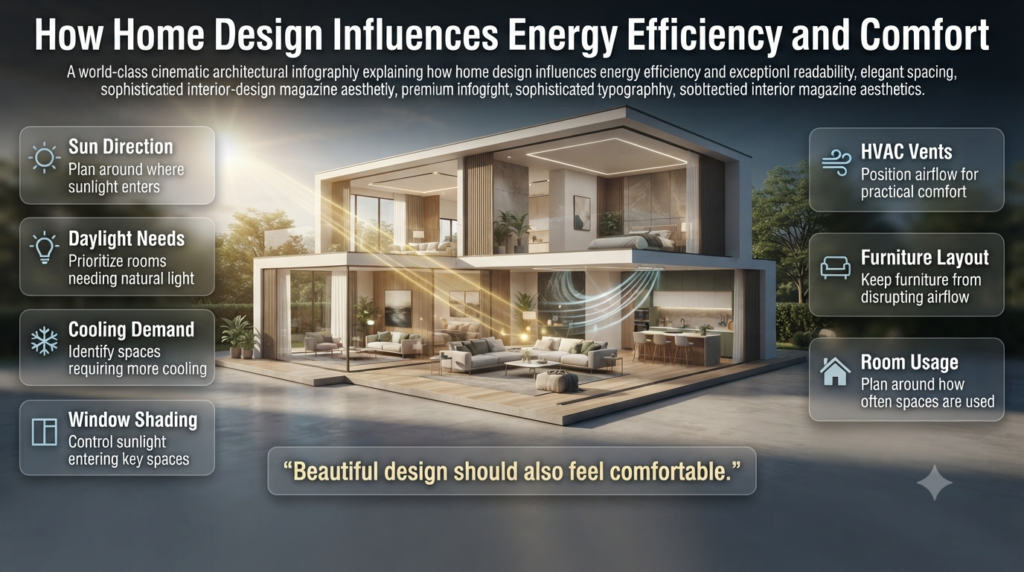
Home orientation, layout, windows, shading, and room placement can all influence energy performance.
When designing or renovating a property, consider:
- Where the sun enters
- Which rooms need the most daylight
- Which spaces require the most cooling
- Where HVAC vents are positioned
- How furniture affects airflow
- How windows are shaded
- How frequently each room is used
This is one reason good Home Design Ideas should consider function as well as appearance.
A beautiful room that is uncomfortable to use isn’t successful design.
Can Minimalist Design Help Energy Efficiency?
Minimalism doesn’t automatically make a home energy efficient, but some minimalist principles can support practical efficiency.
A simpler interior can make it easier to:
- Use natural light
- Keep vents unobstructed
- Reduce unnecessary decorative lighting
- Maintain clean airflow paths
- Organize spaces efficiently
- Avoid excessive equipment
A Minimalist Interior Design approach can therefore work well with energy-conscious planning when the focus remains on functionality rather than simply aesthetics.
Similarly, Minimalist Home Design can encourage homeowners to think carefully about what each item contributes to the space.
The goal isn’t to own as little as possible.
It’s to make the home work better with less unnecessary complexity.
Can Contemporary Homes Be Energy Efficient?
Absolutely.
Modern homes can combine:
- Efficient HVAC systems
- Smart controls
- LED lighting
- High-performance windows
- Energy-conscious materials
- Automated shading
- Efficient appliances
- Clean interior layouts
Contemporary Interior Design can provide a useful framework for integrating technology without making the home look overly technical.
The best technology should feel almost invisible.
A thermostat that automatically adjusts temperatures is useful because it quietly improves daily operation.
Can Japandi Design Work With Energy-Efficient Homes?
Yes.
Japandi-inspired spaces often emphasize simplicity, natural materials, calm interiors, and functional furniture.
Those qualities can complement energy-conscious design.
For example, natural wood, controlled lighting, simple layouts, and carefully selected furniture can create a comfortable environment without excessive decorative energy use.
Homeowners interested in this direction can explore Japandi Interior Design for visual inspiration.
A more modern interpretation can also be developed through Modern Japandi Interior concepts.
The important point is that style and efficiency don’t compete. They can be designed together.
How Do Natural Materials Fit Into Energy-Efficient Interior Design?
Natural materials can contribute to a home’s visual comfort and durability, although material choice alone doesn’t make a home energy efficient.
Wood, stone, natural textiles, and other materials can be selected based on:
- Durability
- Maintenance
- Local availability
- Embodied impact
- Indoor comfort
- Visual character
A Natural Wood Interior can create warmth without requiring excessive decorative elements.
However, don’t assume that every natural material is automatically environmentally superior. Responsible sourcing, manufacturing, transportation, durability, and maintenance all matter.
What Role Does Scandinavian Design Play?
Scandinavian interiors are often associated with simplicity, natural light, functional furniture, and practical materials.
These characteristics can complement energy-conscious homes because they encourage thoughtful use of daylight and efficient layouts.
Scandinavian Interior Design can therefore inspire a practical aesthetic where functionality isn’t hidden behind excessive decoration.
But again, style alone doesn’t determine energy performance.
A Scandinavian-style room with poor insulation is still an inefficient room.
Can Decorative Finishes Be Energy Conscious?
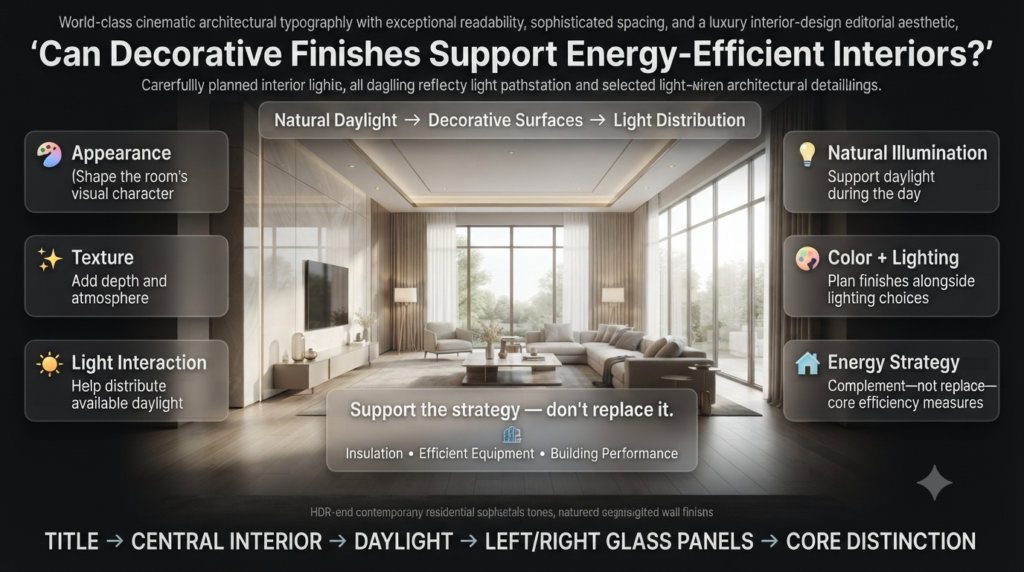
Decorative finishes primarily affect appearance, texture, and atmosphere rather than directly determining energy consumption.
However, finishes can influence how a room interacts visually with available light.
For example, certain reflective or light-colored surfaces can help distribute daylight and reduce the need for artificial illumination during the day.
If you’re planning a renovation, Decorative Finishes can be considered alongside lighting and color decisions.
The important distinction is that decorative finishes should support the energy strategy rather than be presented as a substitute for insulation, efficient equipment, or proper building performance.
What Are the Most Common Energy-Efficiency Mistakes?
Mistake 1: Buying technology before diagnosing the problem
Smart thermostats, solar systems, sensors, and efficient appliances can all be useful.
But they aren’t automatically the first thing a home needs.
Why it happens: Technology is easy to see and easy to market.
Why it’s harmful: Major energy losses can remain untreated.
Better approach: Diagnose the building first.
Mistake 2: Assuming bigger HVAC equipment is better
A larger air conditioner may sound more powerful.
But efficiency isn’t simply about capacity.
The system needs to be appropriately sized and installed for the property.
Mistake 3: Ignoring windows and shading
A room with large sun-facing windows can experience significant heat gain.
Even a strong HVAC system has to fight that heat.
Shading and appropriate glazing can reduce the problem at its source.
Mistake 4: Replacing everything at once
Whole-house renovations can become expensive very quickly.
Instead, create phases:
Phase 1 → Diagnose
Phase 2 → Fix major energy losses
Phase 3 → Upgrade equipment
Phase 4 → Add automation
Phase 5 → Consider renewable energy
This approach helps prevent unnecessary spending.
Mistake 5: Treating energy efficiency as a one-time project
Homes change.
Equipment ages.
Insulation can deteriorate.
Windows can develop leaks.
Appliances become less reliable.
Efficiency should therefore be treated as an ongoing process.
How Can You Combine Energy Efficiency With Interior Style?
The strongest interiors don’t make efficiency look like an engineering project.
Instead, the technology and performance improvements are integrated into the design.
For example:
- Efficient LED lighting can be part of a layered lighting scheme.
- Smart thermostats can use clean, discreet controls.
- Window shading can become part of the room’s visual design.
- Natural materials can create warmth.
- Efficient appliances can be selected in finishes that match cabinetry.
- Furniture can be positioned to support airflow.
- Daylight can become part of the design concept.
This approach makes the home feel intentional rather than technical.
For homeowners working across different design directions, Interior Design Styles can help establish the visual foundation before integrating efficiency-focused details.
Should You Use Smart Home Technology?
Smart technology is useful when it solves a real problem.
Good applications include:
Smart thermostats
They can automate temperature schedules and reduce unnecessary heating or cooling when the home is empty.
Occupancy sensors
These can switch lighting off when rooms are unoccupied.
Smart plugs
They can help manage devices that consume standby electricity.
Automated blinds
They can respond to sunlight and time of day, helping manage glare and solar heat.
Energy monitoring
Monitoring systems can reveal which appliances or periods consume the most electricity.
⚠ Common Mistake: Installing smart devices everywhere without changing inefficient habits or fixing building-performance problems.
Automation is valuable when it changes behavior or prevents waste.
Can Solar Panels Make a Home Energy Efficient?
Solar panels and energy efficiency are related, but they are not the same thing.
Energy efficiency reduces how much energy a home needs.
Solar power produces electricity.
Imagine two homes.
Home A wastes substantial energy because of poor insulation and inefficient cooling but has solar panels.
Home B has excellent insulation, efficient HVAC equipment, controlled lighting, and lower energy demand.
Adding solar to Home B may require a smaller system to meet the remaining electricity needs.
That’s why efficiency can come before renewable energy.
A practical sequence is:
Reduce waste → improve efficiency → lower demand → consider renewable generation
How Do You Know Which Upgrade Should Come First?
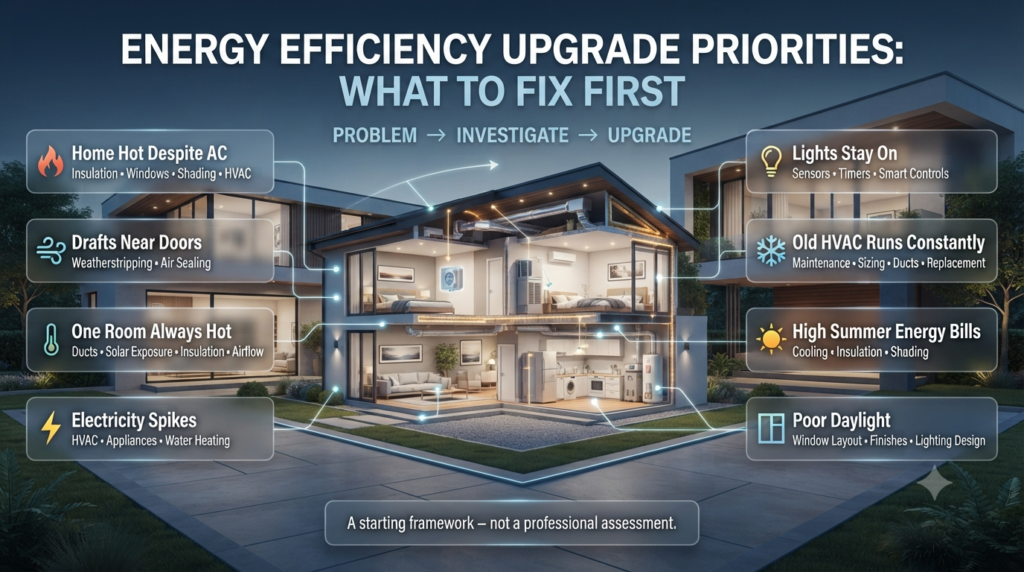
Use a simple decision framework.
| Problem | First Area to Investigate |
| Home is hot despite AC | Insulation, windows, shading, HVAC |
| Drafts near doors | Weatherstripping and air sealing |
| One room is always hot | Ducts, solar exposure, insulation, airflow |
| Electricity spikes | HVAC, appliances, water heating |
| Lights stay on | Sensors, timers, smart controls |
| Old HVAC runs constantly | Maintenance, sizing, ducts, replacement |
| High summer energy bills | Cooling, insulation, shading |
| Poor daylight | Window layout, finishes, lighting design |
This isn’t a replacement for professional assessment, but it provides a useful starting point.
What Is an Energy-Efficient Home Checklist?
Before starting a major project, use this checklist.
Building envelope
- Roof inspected
- Insulation assessed
- Exterior walls considered
- Doors checked for air leaks
- Windows inspected
- Gaps and penetrations sealed
Heating and cooling
- HVAC filters maintained
- Ductwork checked
- Thermostat settings reviewed
- Outdoor unit inspected
- System sizing considered
- Uneven room temperatures investigated
Lighting
- Frequently used bulbs upgraded
- Occupancy sensors considered
- Timers used where appropriate
- Daylight utilized
- Decorative lighting kept purposeful
Appliances
- Old appliances identified
- High-use appliances prioritized
- Energy ratings compared
- Replacement timing considered
Interior design
- Furniture doesn’t block vents
- Window treatments manage sunlight
- Daylight is used effectively
- Lighting is layered
- Layout supports comfortable use
What Should You Consider Before Starting an Energy-Efficiency Renovation?
Before spending money, ask five questions.
1. What is the actual problem?
Don’t start with the product.
Start with the problem.
2. How much energy does the problem waste?
Not every inconvenience has a meaningful energy impact.
3. What will the improvement cost?
Include installation and maintenance, not just purchase price.
4. How long will the improvement last?
A durable improvement may be more valuable than a cheaper short-lived solution.
5. Will the improvement solve the cause or the symptom?
This is perhaps the most important question.
A larger air conditioner may treat an overheated room.
Better insulation or shading may address why the room overheats.
How Can Bespoke Design Support Energy-Conscious Homes?
Standard products don’t always work perfectly in unusual rooms.
A window may have an uncommon size. A built-in cabinet may need to avoid an HVAC vent. Storage may need to fit around existing architectural elements.
In those situations, customized solutions can sometimes make it easier to integrate functional requirements.
Bespoke Design can be particularly useful when standard furniture or built-in elements don’t fit the home’s dimensions or intended use.
The key is to customize for a reason.
Bespoke design shouldn’t mean making everything custom simply because it can be done.
The best custom element solves a specific problem.
Practical Example: Improving an Overheated Living Room
Imagine a living room that becomes uncomfortable every afternoon.
The homeowner initially believes the air conditioner is too weak.
Instead of immediately replacing it, they investigate.
They discover:
- Large west-facing windows
- Weak window shading
- Poor air sealing around one door
- Furniture partially blocking an air vent
- Aging HVAC filters
The improvement plan becomes:
- Replace the filters.
- Correct furniture placement.
- Seal the door.
- Improve window shading.
- Assess insulation.
- Check HVAC performance.
- Replace the HVAC only if testing shows it is actually inadequate.
This approach can be much more sensible than buying a larger air conditioner immediately.
It also demonstrates a broader principle:
Energy efficiency works best when problems are diagnosed before solutions are purchased.
What is the most effective way to make a home more energy efficient?
The most effective approach is to reduce energy waste before investing in expensive equipment or smart technology. Start by identifying where your home loses or unnecessarily uses energy. In many properties, insulation, air sealing, windows, shading, and heating or cooling performance have a greater impact than small technology upgrades. Once the building envelope is performing properly, efficient appliances, LED lighting, smart thermostats, and other improvements can deliver better results.
A practical improvement order is:
Inspect insulation and air leakage first.
Check HVAC performance and ductwork.
Improve window sealing and solar shading.
Replace frequently used inefficient lighting with LEDs.
Upgrade old, high-consumption appliances when replacement makes sense.
Add smart controls to automate energy-saving habits.
Professional insight: Don’t choose an upgrade simply because it has an “energy-efficient” label. Choose it because it solves a measurable problem in your home.
How much can an energy-efficient home reduce electricity bills?
There isn’t a single percentage that applies to every property because energy savings depend on the home’s size, age, climate, insulation, HVAC system, appliances, occupancy, and existing energy consumption. A poorly insulated home with an inefficient cooling system may have considerably more savings potential than a recently constructed property that already performs well.
The most useful approach is to focus on the largest sources of energy consumption rather than expecting one upgrade to transform the entire bill.
For example, homeowners can potentially reduce unnecessary consumption by:
Improving insulation and air sealing.
Reducing excessive heating or cooling.
Maintaining HVAC equipment properly.
Using efficient lighting.
Replacing inefficient appliances at the right time.
Controlling solar heat through windows and shading.
Eliminating unnecessary standby electricity.
Professional insight: Track energy consumption before and after major improvements. Looking at actual usage gives you a much clearer picture than relying on advertised savings from individual products.
Are energy-efficient home upgrades worth the investment?
Energy-efficient upgrades can be worth the investment when they’re selected according to the property’s actual needs, expected energy savings, installation cost, lifespan, and maintenance requirements. The mistake is assuming that every expensive efficiency upgrade automatically provides a good return.
For example, sealing a major air leak may be relatively inexpensive while solving a significant comfort problem. On the other hand, replacing perfectly functional windows with premium models may require a much larger investment and may not be the first priority if insulation or HVAC performance is poor.
Before investing, consider:
Upfront cost: What will installation actually cost?
Energy impact: How much energy could realistically be saved?
Lifespan: How long should the improvement last?
Maintenance: Will it require ongoing servicing?
Comfort: Will it solve temperature or airflow problems?
Replacement timing: Does the existing equipment need replacement anyway?
Professional insight: The best upgrade isn’t always the one with the highest efficiency rating. It’s the one that provides the strongest combination of energy savings, comfort, durability, and reasonable cost.
Which home improvements save the most energy?
The highest-impact improvement varies from one home to another, but insulation, air sealing, efficient heating and cooling, and proper window or solar-heat management are often important areas to investigate. Heating and cooling can represent a major portion of household energy use, particularly in climates with extreme temperatures.
A sensible priority list is:
Building envelope: Check insulation, roof areas, walls, doors, and air leaks.
HVAC system: Assess efficiency, sizing, filters, airflow, and duct condition.
Windows and shading: Address drafts, poor glazing, and excessive solar heat.
Lighting: Replace frequently used inefficient bulbs with LEDs.
Appliances: Prioritize old and heavily used equipment.
Smart controls: Automate lighting and temperature management where useful.
Renewable energy: Consider solar after reducing unnecessary energy demand.
Professional insight: Avoid treating the home as a collection of individual products. Energy performance is interconnected. Improving the building envelope can make your HVAC system’s job easier, while better shading can reduce cooling demand.
How can I make my existing home energy efficient without a major renovation?
You can make meaningful improvements without completely remodeling the property. Start with changes that address everyday energy waste and gradually move toward larger upgrades when the budget and condition of the home justify them.
Begin with relatively simple improvements such as LED lighting, door and window weatherstripping, HVAC filter maintenance, thermostat scheduling, improved window coverings, and sealing obvious gaps. After that, investigate insulation, ductwork, HVAC performance, appliances, and windows.
A practical phased approach looks like this:
Phase 1: Identify the biggest sources of energy waste.
Phase 2: Seal obvious air leaks and improve basic maintenance.
Phase 3: Address insulation and shading problems.
Phase 4: Improve or replace inefficient HVAC equipment.
Phase 5: Upgrade appliances and lighting.
Phase 6: Add smart controls where they provide genuine value.
Phase 7: Consider solar or other renewable-energy options.
Professional insight: You don’t need to make your entire home energy efficient in one weekend—or one renovation. A phased strategy lets you invest where the improvement matters most and prevents unnecessary spending.
Conclusion
Creating energy-efficient homes isn’t about making a property complicated or filling it with expensive technology. It’s about making smarter decisions that reduce energy waste while improving everyday comfort. From insulation and air sealing to efficient HVAC systems, better window treatments, LED lighting, and thoughtful interior planning, even small improvements can contribute to a better-performing home.
The most important step is to understand what your home actually needs before spending money on upgrades. A home with poor insulation may benefit more from improving the building envelope than installing another smart device. Similarly, a room that overheats may need better shading or window management rather than a larger air conditioner.
Energy efficiency and good interior design can also work together. A carefully planned layout, effective use of natural light, functional furniture placement, suitable colors, and well-chosen materials can create a home that feels comfortable, attractive, and practical without unnecessary energy consumption.
If you’re improving an existing property, you don’t have to do everything at once. Start with the biggest sources of energy waste, make improvements in stages, and monitor the results. This approach helps you control costs while making decisions based on actual performance rather than trends.
Ultimately, the goal is simple: use less energy without compromising the way you live. When efficiency, comfort, and thoughtful design are planned together, your home can become more economical to operate, more comfortable throughout the year, and better prepared for the future.
Leave a Reply