
Introduction
Decorative Finishes: Transform Your Home in Style | A room can have beautiful furniture, carefully selected colors, expensive flooring, and excellent lighting and still feel incomplete. The reason is often much simpler than people expect: the surfaces themselves don’t have enough character.
This is where decorative finishes can make a major difference.
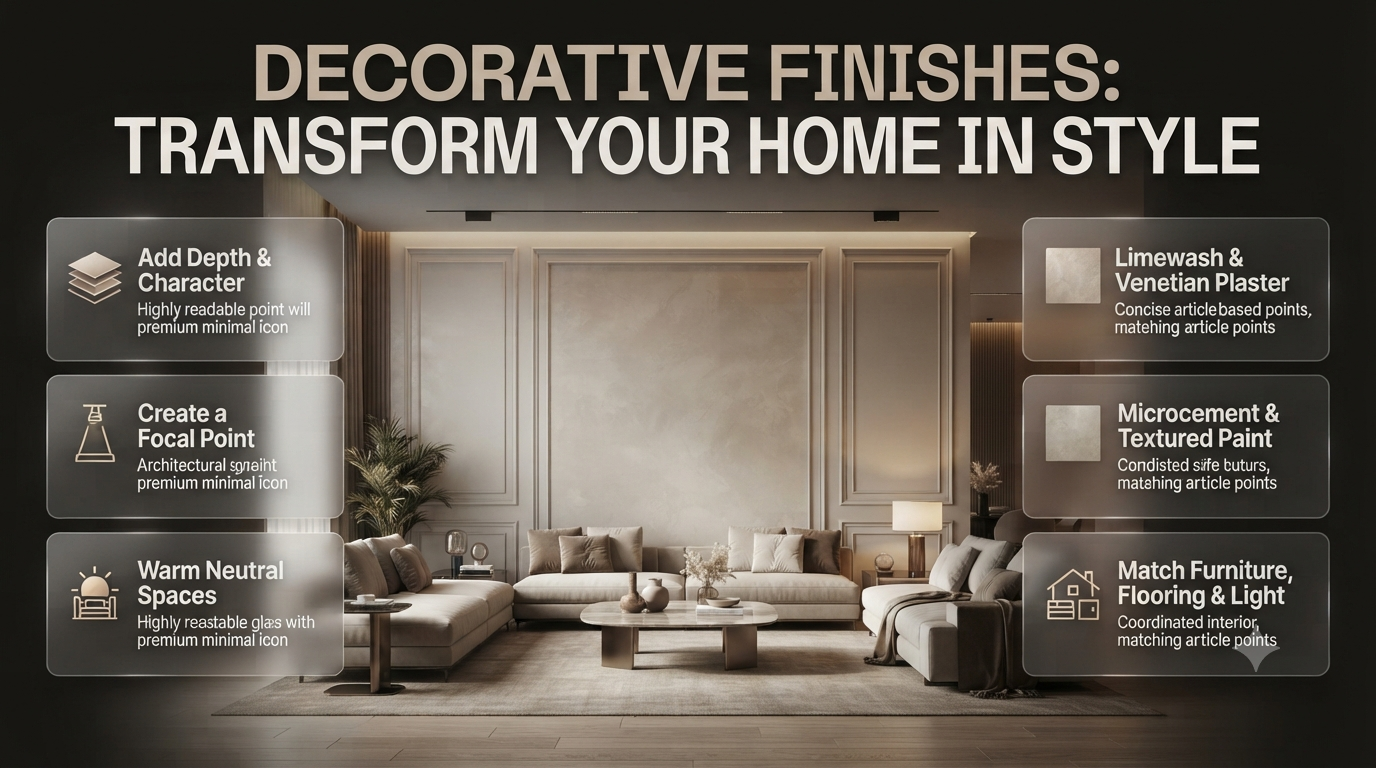
A decorative finish can turn an ordinary wall into a subtle focal point, make a modern room feel warmer, add depth to a neutral palette, or give a plain architectural feature a more refined appearance. From limewash and Venetian plaster to textured paint, microcement, decorative panels, metallic effects, and natural-material treatments, there are more options available today than ever before.
But having many choices creates another problem. Not every attractive finish belongs in every room.
A surface treatment that looks sophisticated in a luxury hotel may feel too formal in a family living room. A heavily textured wall may add personality to a large open space but make a small bedroom feel visually crowded. Even a beautiful finish can look wrong when it conflicts with the flooring, furniture, lighting, or architectural style.
This complete guide explains what decorative finishes are, how they work, which types are most useful, where to use them, how to combine them, how to choose the right one for your home, what mistakes to avoid, and how professionals approach the selection process.
The goal isn’t simply to make your home look decorated. It’s to create surfaces that support the entire interior and continue to look intentional over time.
What Are Decorative Finishes?
Decorative finishes are specialized surface treatments used to change or enhance the visual character, texture, depth, color, sheen, or material appearance of an interior surface.
They can be applied to walls, ceilings, floors, cabinetry, doors, columns, furniture, fireplaces, niches, and other architectural elements.
Unlike standard paint, which primarily provides color and a selected level of sheen, decorative finishes can create movement, texture, patterns, material effects, and visual depth.
Examples include:
- Venetian plaster
- Polished plaster
- Limewash
- Textured paint
- Faux concrete
- Microcement
- Metallic finishes
- Decorative wall panels
- Wood-effect finishes
- Stone-effect surfaces
- Glazing
- Distressed finishes
- Antiqued finishes
- Stucco-inspired finishes
- Decorative molding
- Layered paint effects
The term is broad because decorative finishes aren’t limited to one material or technique.
A finish can be almost invisible from a distance but still make a room feel richer because it changes how light moves across the surface.
Why Are Decorative Finishes Different From Ordinary Paint?
Standard paint creates a relatively consistent surface. Decorative finishes often introduce another layer of visual or physical information.
For example, two walls may both be warm beige.
One may be painted with a flat matte coating and appear completely uniform.
The other may use limewash, producing subtle tonal movement across the surface.
The color is similar, but the experience is completely different.
That’s the real value of decorative finishes: they can create depth without necessarily adding more objects to the room.
This is particularly useful in contemporary, minimalist, Japandi, Scandinavian, and other design styles where decoration is intentionally restrained.
For broader interior inspiration, explore Interior Design to see how finishes can become part of a complete design strategy.
Why Are Decorative Finishes Important in Interior Design?
Walls and ceilings represent some of the largest uninterrupted surfaces in a home. If every surface is completely flat and visually identical, even a well-furnished room can sometimes feel one-dimensional.
Decorative finishes introduce another layer.
They can:
- Add depth to flat walls
- Create a focal point
- Make neutral interiors more interesting
- Add tactile quality
- Highlight architectural details
- Introduce visual contrast
- Reinforce a design style
- Make spaces feel more sophisticated
- Create continuity between different materials
- Reduce the need for excessive decorative objects
The important point is that a decorative finish shouldn’t exist simply because the wall looks empty.
It should solve a design problem.
Perhaps the room lacks warmth.
Perhaps a large wall needs visual structure.
Perhaps the architecture is beautiful but currently unnoticed.
Perhaps the space has too many hard, smooth surfaces and needs texture.
The best finish addresses one of these needs.
💡 Pro Tip: Before selecting a finish, complete this sentence: “I want this finish to make the room feel ______.” If you can’t answer that clearly, you’re probably choosing the material before understanding the design goal.
What Are the Main Types of Decorative Finishes?
There are many decorative techniques, but several categories are particularly useful for residential interiors.
Venetian Plaster
Venetian plaster is one of the best-known decorative wall treatments for creating depth and a refined, polished appearance.
Traditional techniques use multiple thin layers that are worked and polished to create variation, movement, and sometimes a marble-like effect.
The final result can range from soft and understated to highly polished and luxurious.
Where Does Venetian Plaster Work Best?
It can be particularly effective in:
- Formal living rooms
- Dining rooms
- Entryways
- Feature walls
- Fireplace surrounds
- Luxury bedrooms
- Boutique-inspired interiors
- Architectural niches
Its biggest strength is depth.
A well-executed surface can appear to change subtly as light moves across it.
Advantages
- Luxurious appearance
- Strong visual depth
- Can look highly customized
- Works with classic and contemporary interiors
- Can create a stone-like effect without using large stone slabs
Drawbacks
- Skilled application is important
- Preparation can be demanding
- Repairs may require matching the original technique
- Some highly polished finishes can emphasize imperfections
Venetian plaster is therefore best treated as a specialist decorative treatment rather than a casual DIY painting project.
Limewash
Limewash creates a soft, naturally varied appearance rather than a perfectly uniform painted surface.
Its cloudy movement and tonal variation are part of its appeal.
It works particularly well when you want a room to feel:
- Calm
- Organic
- Relaxed
- Warm
- Handmade
- Naturally aged
Limewash is especially compatible with natural materials such as timber, linen, stone, rattan, and woven textiles.
Best Rooms for Limewash
Consider it for:
- Bedrooms
- Living rooms
- Dining rooms
- Reading areas
- Hallways
- Home offices
- Accent walls
It also works beautifully in interiors influenced by Mediterranean, Scandinavian, rustic-modern, Japandi, and organic-modern aesthetics.
For a related design direction, explore Japandi Home Design, where soft texture and natural materials play an important role.
Textured Paint
Textured paint provides a practical way to add physical variation to a surface without moving into highly specialized plaster techniques.
Depending on the product and application method, texture can be subtle or pronounced.
It can be used to:
- Add dimension to a plain wall
- Create an accent surface
- Introduce a handcrafted appearance
- Reduce the visual flatness of large surfaces
- Add character to otherwise simple interiors
A subtle texture is usually easier to integrate than an extremely heavy pattern.
When Should You Choose Textured Paint?
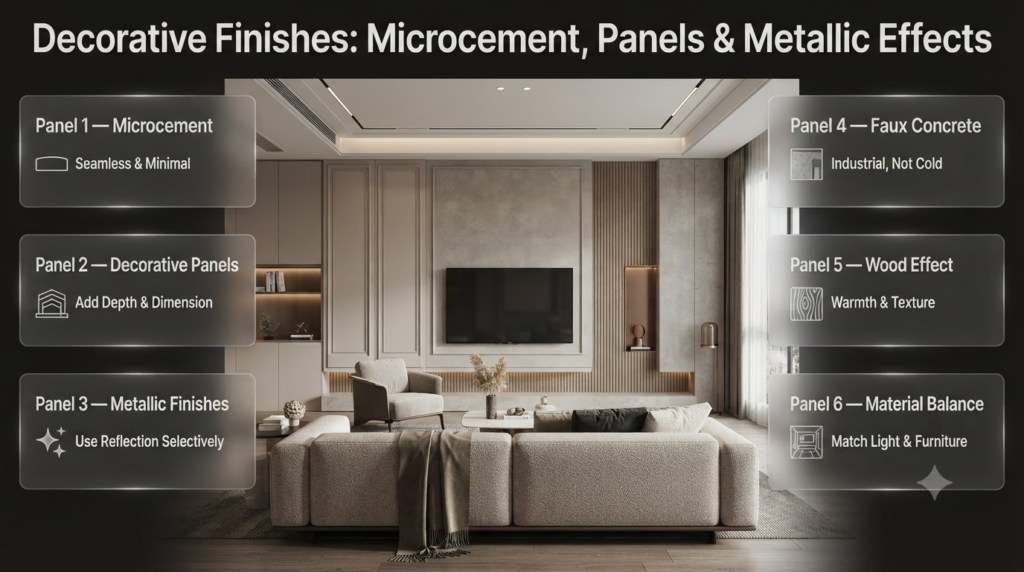
It’s particularly useful when you want something more interesting than ordinary paint but don’t necessarily need a luxury plaster treatment.
It can also be useful for homeowners who want a decorative project with a more accessible installation process.
📌 Quick Tip: If the room already has patterned curtains, artwork, flooring, or furniture, choose a quieter texture. The finish should add another layer—not compete with everything else.
Microcement
Microcement has become increasingly popular in contemporary interiors because it can create a continuous, minimal, concrete-inspired appearance.
Its seamless visual character can make rooms feel architectural and uncluttered.
It can be used on suitable prepared surfaces such as:
- Walls
- Floors
- Bathrooms
- Kitchens
- Shower areas
- Built-in furniture
- Feature surfaces
Why Is Microcement Popular?
The main appeal is continuity.
Traditional construction often creates visual breaks between materials. Microcement can reduce some of those visual interruptions, creating a more unified appearance.
This works particularly well in:
- Contemporary interiors
- Industrial-inspired spaces
- Minimalist homes
- Modern bathrooms
- Modern kitchens
However, installation quality matters significantly.
The substrate, preparation, application system, curing, and protective finish all influence performance.
Never assume that a decorative microcement system automatically solves waterproofing requirements. Wet areas still need appropriate waterproof construction beneath the decorative layer.
Decorative Wall Panels
Decorative wall panels are another effective way to create depth.
Depending on the design, they can imitate:
- Natural wood
- Stone
- Concrete
- Fluted surfaces
- Geometric patterns
- Slatted architecture
- Fabric
- Architectural molding
Panels are particularly useful when a large wall feels empty but you don’t want to rely entirely on paint.
Where Can Panels Be Used?
Common applications include:
- TV walls
- Bedhead walls
- Entryways
- Dining rooms
- Home offices
- Hallways
- Built-in storage
- Reception areas
Vertical paneling can also visually emphasize ceiling height.
Horizontal treatments can make a wall feel wider.
The important consideration is proportion.
A pattern that works on a large wall may look cramped when squeezed onto a narrow surface.
Metallic Decorative Finishes
Metallic finishes introduce reflective qualities through effects inspired by:
- Gold
- Bronze
- Copper
- Silver
- Brass
- Aged metal
They’re often associated with luxury interiors, but they don’t have to be dramatic.
A soft bronze effect inside a niche may be enough.
A brushed metallic detail on cabinetry may provide subtle contrast.
A small metallic accent wall can become a focal point without overwhelming the entire room.
The Main Risk With Metallic Finishes
Reflection increases visual intensity.
If a room already contains mirrors, glossy furniture, glass, polished stone, and strong lighting, adding a highly reflective wall can push the space beyond balance.
Use metallic finishes selectively.
Faux Concrete Finishes
Faux concrete treatments are designed to create the appearance of concrete without necessarily using structural concrete.
They can provide an industrial or architectural feel while remaining more flexible for interior applications.
They’re often paired with:
- Black metal
- Natural wood
- Neutral textiles
- Warm lighting
- Minimal furniture
A concrete effect doesn’t need to make a room feel cold.
Warm timber, textured fabrics, and soft lighting can balance it effectively.
Wood-Effect Decorative Finishes
Wood-effect treatments can introduce the appearance or texture of timber without using solid wood across every surface.
They can be useful for:
- Feature walls
- Ceilings
- Cabinetry
- Media walls
- Room dividers
- Accent panels
However, natural wood generally has a more authentic grain variation than printed or artificial finishes.
If the budget allows, use real wood where tactile quality and longevity are important and consider wood-effect alternatives where coverage or budget makes them more practical.
For ideas on using timber naturally, explore Natural Wood Interior.
How Do You Choose the Right Decorative Finish?
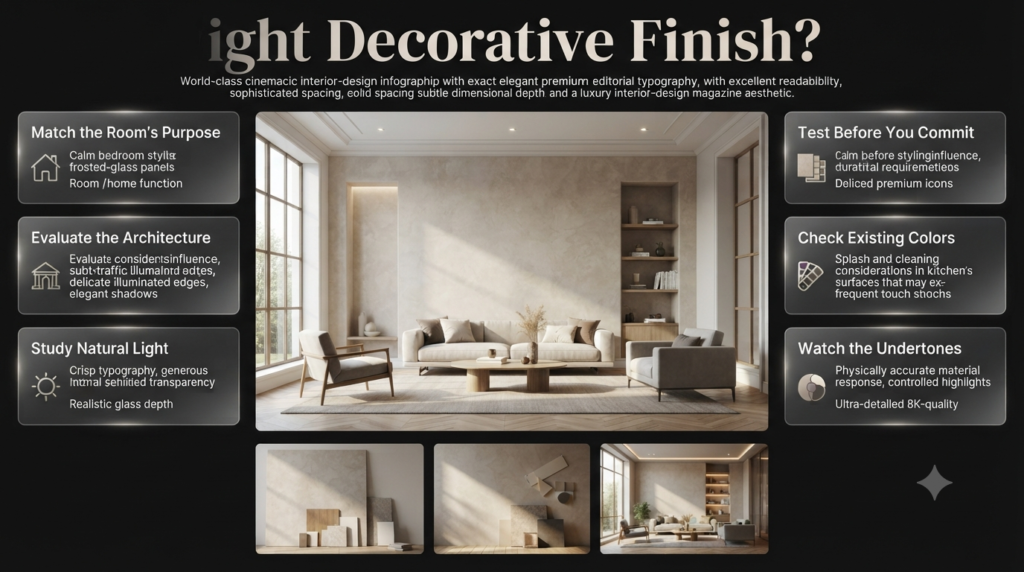
Choosing the right finish is more complicated than selecting a color you like.
A professional decision considers the entire room.
Start With the Purpose of the Room
Every room has a different practical requirement.
A bedroom can prioritize calmness.
A hallway may prioritize durability.
A dining room can tolerate more visual drama.
A bathroom requires moisture-conscious material selection.
A kitchen requires careful consideration of cleaning and splashes.
Before selecting the finish, ask:
- How frequently will the surface be touched?
- Is it exposed to moisture?
- Will children or pets regularly interact with it?
- Is furniture likely to rub against it?
- Does the room receive strong sunlight?
- Does the surface need frequent cleaning?
This prevents an attractive but impractical choice.
Evaluate the Architecture
The architecture should influence the finish.
A room with:
- High ceilings
- Deep window reveals
- Arched openings
- Columns
- Fireplaces
- Built-in shelving
- Wall niches
already has architectural character.
Decorative finishes can emphasize these features.
For example, applying a contrasting plaster finish inside a niche can make it more noticeable without adding furniture.
Likewise, a subtle ceiling treatment can emphasize a coffered or tray ceiling.
Study the Natural Light
Natural light changes throughout the day.
A finish may appear:
- Warm in the morning
- Bright at midday
- Dramatic in the evening
- Darker under artificial lighting
This is why online photographs can be misleading.
A finish photographed under professional lighting may look very different inside your home.
Test Before You Commit
Create a sample large enough to evaluate.
Ideally:
- Apply the finish to a portable board or test area.
- Place it where the final finish will be installed.
- Observe it in daylight.
- Observe it after sunset.
- Turn on the room’s normal lights.
- Compare it against flooring and furniture.
- Check it from different viewing distances.
This simple process can prevent expensive mistakes.
Consider Existing Colors
Color coordination is essential.
A decorative finish should relate to the existing palette.
For example:
Warm white walls + oak + beige linen + soft plaster
creates a calm, cohesive environment.
But:
Cool gray plaster + orange-toned oak + yellow lighting
may create an unwanted color conflict.
The issue isn’t that any one color is bad.
The issue is undertones.
For more guidance on building a cohesive palette, explore Paint Color.
How Do You Match Decorative Finishes With Interior Design Styles?
A decorative finish becomes more effective when it supports the design language of the room.
Modern Interiors
Modern interiors usually benefit from:
- Microcement
- Smooth plaster
- Fine textures
- Matte surfaces
- Architectural panels
- Concrete-inspired effects
The goal is usually clean structure with controlled texture.
Avoid overly ornate decorative effects unless the architecture specifically supports them.
Contemporary Interiors
Contemporary interiors offer more flexibility.
Suitable finishes include:
- Textured plaster
- Large-format panels
- Stone effects
- Metallic accents
- Microcement
- Sophisticated painted surfaces
Contemporary design often combines different materials while keeping the overall composition controlled.
Explore Contemporary Interior Design for additional ideas.
Minimalist Interiors
Minimalism doesn’t mean every surface must be completely plain.
In fact, subtle texture is often one of the best ways to make minimalist interiors interesting.
Consider:
- Soft plaster
- Limewash
- Matte paint
- Natural wood
- Fine-grain textures
- Minimal architectural panels
The texture provides interest without adding visual clutter.
Japandi Interiors
Japandi design combines Japanese restraint with Scandinavian warmth.
Decorative finishes should therefore feel natural and understated.
Good choices include:
- Limewash
- Clay-inspired finishes
- Soft plaster
- Natural wood
- Matte surfaces
- Warm neutral tones
Avoid overly glossy finishes and highly decorative patterns.
Scandinavian Interiors
Scandinavian spaces typically benefit from light, soft, tactile finishes.
Think:
- Warm whites
- Pale wood
- Fine textures
- Matte surfaces
- Soft plaster
- Natural-looking finishes
The objective is to create warmth without making the room feel heavy.
Explore Scandinavian Interior Design for a broader understanding of this aesthetic.
Which Decorative Finishes Work Best in Each Room?
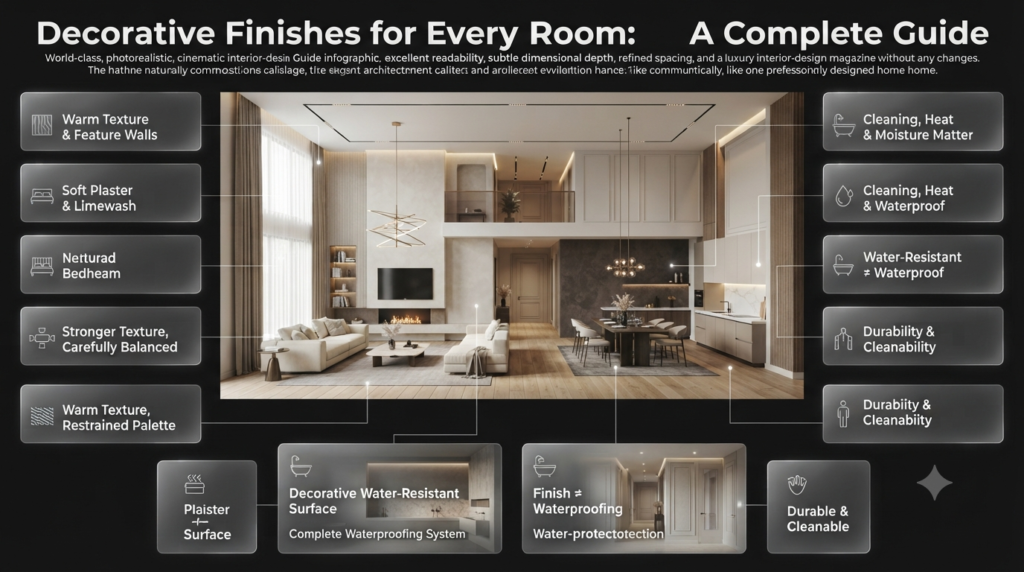
Different rooms require different approaches.
Living Room Decorative Finishes
The living room is often the most flexible space.
Potential applications include:
- Fireplace wall
- TV feature wall
- Main seating wall
- Built-in shelving
- Architectural niche
A large living room can handle stronger texture.
A smaller living room may benefit from subtle plaster or limewash.
Practical Example
Imagine a living room with warm oak flooring, cream upholstery, and a neutral sofa.
Instead of adding another color, use a warm-toned plaster finish behind the television or fireplace.
The result adds depth while keeping the palette restrained.
Bedroom Decorative Finishes
Bedrooms generally benefit from softer visual movement.
Good options include:
- Limewash
- Soft plaster
- Matte textured paint
- Fabric-inspired panels
- Natural wood
The wall behind the bed is often the logical location for a feature treatment.
Avoid highly reflective finishes directly opposite the bed if they create uncomfortable glare at night.
Dining Room Decorative Finishes
Dining rooms can tolerate stronger decorative treatments because they’re often used for entertaining.
Consider:
- Venetian plaster
- Dark textured paint
- Metallic accents
- Decorative molding
- Architectural panels
The finish should work with the dining table and lighting fixture.
A highly decorative wall combined with an ornate chandelier and patterned chairs may create too much competition.
Kitchen Decorative Finishes
Kitchen surfaces have practical requirements.
For walls away from direct splashes, decorative paint or plaster may be suitable depending on the product.
Near cooking zones, choose surfaces designed for the environment.
Consider:
- Easy cleaning
- Grease exposure
- Steam
- Moisture
- Heat
- Sealing
Decorative appearance should never replace functional performance.
Bathroom Decorative Finishes
Bathrooms need even more careful planning.
Moisture can damage unsuitable finishes.
Always distinguish between:
Decorative water-resistant surface
and
complete waterproofing system.
They are not the same thing.
A decorative finish may be suitable for a bathroom wall while still requiring a properly constructed waterproof substrate.
Microcement systems, specialized plaster systems, tiles, stone, and other materials all have different installation requirements.
Hallways and Entryways
These are excellent spaces for decorative finishes because they’re transitional zones.
A hallway can become more memorable with:
- Fine textured paint
- Limewash
- Decorative molding
- Vertical panels
- Subtle plaster
Because these areas receive frequent traffic, durability and cleanability should be considered carefully.
How Do You Combine Multiple Decorative Finishes?
Combining finishes is where many homeowners make mistakes.
The problem isn’t usually that the individual materials are unattractive.
It’s that there are too many visual voices speaking at the same time.
A better approach is to establish hierarchy.
Use One Primary Finish
Choose the surface that should attract the most attention.
For example:
Primary: Venetian plaster
Secondary: Natural wood
Background: Matte warm-white paint
Or:
Primary: Fluted wood panel
Secondary: Brushed metal
Background: Soft neutral paint
This creates a clear visual order.
Don’t Match Everything
Interior design isn’t about making every material identical.
Instead, create relationships.
For example:
- Warm plaster + warm oak
- Cool microcement + black metal
- Limewash + linen
- Stone + natural wood
- Metallic detail + warm lighting
Materials can differ while still sharing undertones, texture, or visual weight.
Balance Hard and Soft Surfaces
A room full of hard surfaces can feel cold.
A room full of soft textures can feel visually vague.
Combining:
- Plaster
- Wood
- Stone
- Fabric
- Metal
creates a more complete sensory experience.
This is particularly important in contemporary interiors.
What Is the Best Color Strategy for Decorative Finishes?
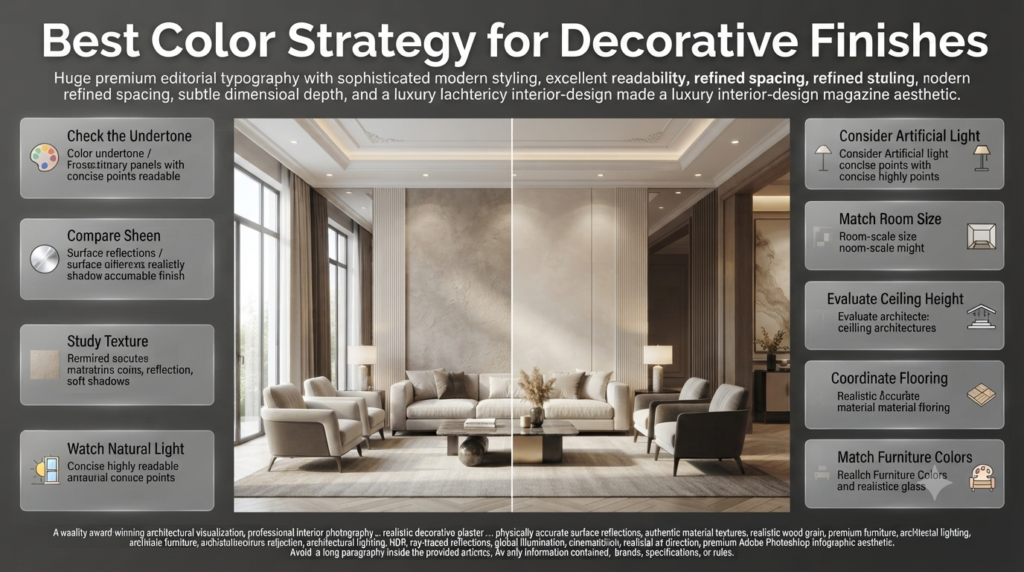
Color selection should happen after understanding the finish.
A highly textured surface may appear darker than a smooth surface in the same color because shadows accumulate within the texture.
Likewise, polished surfaces can appear lighter because they reflect more light.
Consider These Factors
- Undertone
- Sheen
- Texture
- Natural light
- Artificial light
- Room size
- Ceiling height
- Existing flooring
- Furniture colors
A neutral finish is not automatically boring.
Warm beige, soft taupe, greige, clay, sand, muted olive, warm white, and soft gray can all become sophisticated when combined with texture.
For additional color planning, explore Home Design Ideas.
Decorative Finishes and Texture: Why Texture Matters
Texture is one of the most powerful tools in interior design.
Imagine a room where everything is:
- Smooth
- Glossy
- Flat
- Uniform
Even if the colors are beautiful, the room may lack depth.
Now introduce:
- Rough plaster
- Grainy wood
- Woven fabric
- Natural stone
- Brushed metal
The same color palette suddenly feels much richer.
Texture doesn’t always need to be physically rough.
Visual texture can also come from tonal variation.
Limewash is a good example.
The surface may remain relatively smooth to touch, but its uneven color distribution creates visual movement.
Decorative Finishes for Neutral Interiors
Neutral interiors are often criticized for being boring, but the real issue is usually lack of layering.
A neutral room can be extremely sophisticated when it combines several related textures.
For example:
Warm white walls
Limewashed feature surface
Natural oak furniture
Linen curtains
Stone accessories
Brushed metal lighting
There may be very little strong color, but the room still feels rich.
This is one reason neutral interiors continue to work so well in modern homes.
The focus shifts from color contrast to material contrast.
How Can Decorative Finishes Make a Small Room Look Better?
Small rooms require restraint.
A dramatic finish can sometimes make a compact space feel smaller, but a subtle treatment can create depth.
Better Choices for Small Spaces
Consider:
- Light limewash
- Fine plaster
- Soft matte texture
- Subtle vertical paneling
- Light natural wood
- Tonal decorative finishes
Avoid combining several high-contrast finishes.
A small room generally benefits from continuity.
For example, using a similar tone on the walls and ceiling can reduce visual interruption.
Use Vertical Texture Carefully
Vertical panels can make a ceiling appear higher.
However, don’t automatically assume more lines equal more height.
The panel scale must match the room.
A very narrow, repetitive pattern can make the room feel busy.
Decorative Finishes for Large Rooms
Large rooms present the opposite problem.
A huge blank wall can feel cold even when the furniture is attractive.
This is where stronger decorative finishes can be valuable.
Large rooms can support:
- Venetian plaster
- Large decorative panels
- Faux concrete
- Stronger limewash variation
- Large-scale molding
- Architectural wall treatments
The key is scale.
A large wall needs a finish with enough visual presence to hold its own.
How Lighting Changes Decorative Finishes
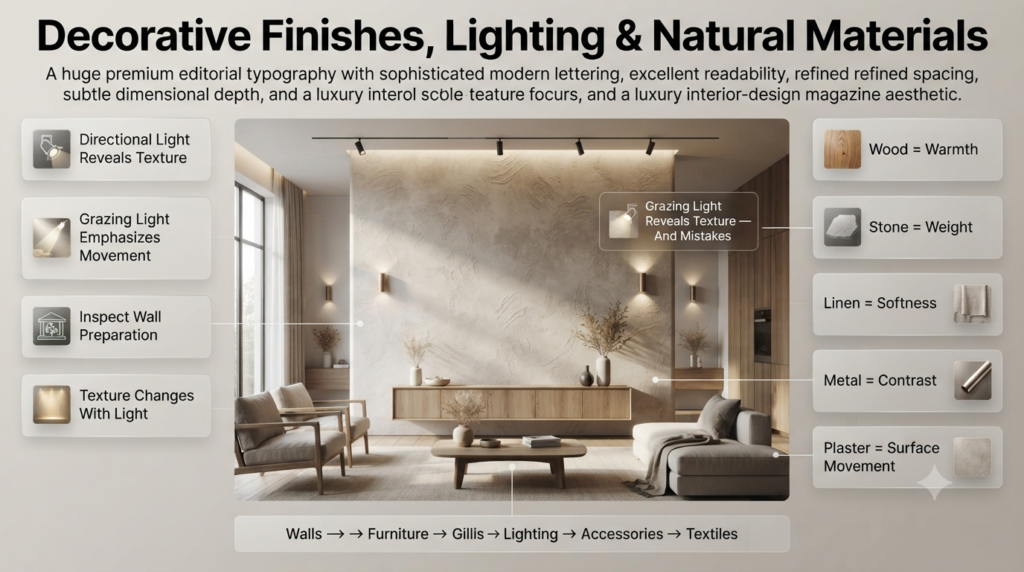
Lighting and surface treatment should be considered together.
Directional light creates shadows.
Those shadows reveal texture.
This means a textured wall can look completely different under:
- Ceiling lights
- Wall sconces
- Track lighting
- Natural daylight
- LED strips
Grazing Light
Grazing light is particularly powerful because it travels across a surface at a shallow angle.
It can emphasize:
- Plaster movement
- Wall panel profiles
- Molding
- Texture
- Surface imperfections
This can be beautiful when intentional.
It can also expose poor workmanship.
⭐ Expert Tip: If you’re planning strong wall-washing or grazing lights, inspect the wall preparation carefully. Lighting that highlights texture will also highlight mistakes.
Decorative Finishes and Natural Materials
One of the safest ways to make decorative finishes feel sophisticated is to combine them with natural materials.
Natural wood provides warmth.
Stone provides weight.
Linen provides softness.
Metal provides contrast.
Plaster provides surface movement.
Together, these materials create a layered interior without needing excessive decoration.
This approach works particularly well with Japandi, Scandinavian, contemporary, minimalist, and organic-modern spaces.
For related inspiration, explore Japandi Home Decor and Modern Japandi Interior.
Decorative Finishes and Home Styling
A decorative finish should influence how you style the rest of the room.
If the wall already has strong texture, don’t automatically add large patterned artwork.
If the finish is subtle, artwork can become the main focal point.
This is where surface treatment connects with styling.
A good design considers the relationship between:
Walls → Furniture → Lighting → Accessories → Textiles
No element should be selected completely independently.
Explore Home Styling for more ideas about bringing the finished space together.
Can Decorative Finishes Be Used on Ceilings?
Yes.
Ceilings are often ignored, but they can become an important part of the interior.
Possible treatments include:
- Soft paint effects
- Plaster
- Wood panels
- Decorative molding
- Subtle color
- Textured finishes
- Architectural paneling
The key is proportion.
A dramatic ceiling works best when the room has enough height and architectural character to support it.
In a low room, a heavy dark treatment may make the ceiling feel even lower.
Decorative Finishes for Architectural Features
Decorative finishes are particularly useful for highlighting existing architecture.
Consider applying a different finish to:
- Fireplace surrounds
- Arches
- Niches
- Columns
- Alcoves
- Built-in shelves
- Window reveals
- Stair walls
This can create definition without adding unnecessary decoration.
For example, a warm plaster finish inside a niche can make that niche feel intentional.
A wood panel around a built-in cabinet can transform a basic storage unit into an architectural feature.
How Do Decorative Finishes Work With Minimalist Design?
Minimalism isn’t about removing every visual detail.
It’s about removing unnecessary detail.
That distinction matters.
A minimalist room can still have:
- Beautiful plaster
- Natural wood
- Soft texture
- Architectural lighting
- Subtle color variation
The difference is that each element has a purpose.
A textured wall can replace several decorative accessories.
A natural wood panel can become the focal point instead of a collection of wall art.
This creates a cleaner environment without making it sterile.
Explore Minimalist Home Design for more ideas on using restraint effectively.
Decorative Finishes and Contemporary Design
Contemporary interiors often mix old and new ideas.
A modern sofa may sit against a handmade plaster wall.
A sleek kitchen may use natural timber.
A minimalist room may include a slightly imperfect limewash finish.
This contrast is important.
Perfectly manufactured surfaces can sometimes feel impersonal.
Hand-applied finishes introduce variation.
That variation makes a space feel more human.
Common Decorative Finish Mistakes
Choosing the finish is only half the job.
How you use it matters just as much.
Mistake 1: Using Too Many Finishes
This is one of the most common problems.
A room may contain:
- Patterned wallpaper
- Textured plaster
- Fluted panels
- Metallic paint
- Marble
- Glossy furniture
- Patterned curtains
Every element may be beautiful individually.
Together, they compete.
How to Avoid It
Choose one primary finish.
Use other materials as supporting elements.
Mistake 2: Ignoring Scale
A tiny pattern may disappear on a huge wall.
A large pattern may overwhelm a narrow hallway.
Always evaluate the relationship between finish scale and surface size.
Mistake 3: Choosing Based Only on Photos
Online images often use professional lighting and photography.
Your room won’t look identical.
Always test samples.
Mistake 4: Ignoring Undertones
Two neutral colors can clash because one is warm and the other is cool.
This is especially noticeable when decorative surfaces are combined with flooring and cabinetry.
Mistake 5: Forgetting Maintenance
A surface that requires specialist cleaning may not be practical for a busy family home.
Ask about maintenance before installation.
Mistake 6: Applying Decorative Finishes to Damaged Walls
Decorative treatment isn’t a substitute for proper wall repair.
Moisture, cracks, unstable plaster, or structural movement should be addressed first.
Mistake 7: Choosing Trends Instead of Longevity
Some finishes become fashionable quickly.
That’s not necessarily a reason to avoid them.
But ask yourself whether you’ll still appreciate the treatment after several years.
Mistake 8: Poor Installation
Even the best product can look cheap when poorly applied.
Uneven transitions, visible joints, inconsistent texture, and inadequate preparation can ruin the result.
⚠ Common Mistake: Saving money on skilled installation while spending heavily on premium materials is often false economy. The workmanship is a major part of the finished appearance.
How to Prepare a Wall Before Applying a Decorative Finish
Preparation depends on the finish, but the general process involves several important stages.
Step 1: Inspect the Surface
Check for:
- Cracks
- Holes
- Moisture
- Loose paint
- Dust
- Uneven areas
- Previous coatings
Step 2: Repair Problems
Fill holes.
Repair suitable cracks.
Remove loose materials.
Address moisture before continuing.
Step 3: Clean the Surface
Dust and grease can interfere with adhesion.
Kitchen surfaces may require particularly thorough cleaning.
Step 4: Prime When Required
Some systems require primers or bonding coats.
Follow the specific manufacturer’s system rather than improvising.
Step 5: Test the Finish
Apply a sample.
Evaluate:
- Color
- Texture
- Sheen
- Lighting response
- Compatibility
Step 6: Apply the Full Finish
Only after the sample is approved should the full surface be completed.
How Should Decorative Finishes Be Maintained?
Maintenance depends on the material.
Some finishes can simply be dusted or gently wiped.
Others require specific cleaning products or periodic resealing.
Before Installation, Ask:
- What cleaner is recommended?
- Can the surface be scrubbed?
- Does it require resealing?
- Can small scratches be repaired?
- Can the finish be touched up?
- How does it react to moisture?
- What happens if furniture damages the surface?
Knowing these answers beforehand makes long-term ownership easier.
How Long Do Decorative Finishes Last?
There isn’t one universal lifespan.
Durability depends on:
- Material quality
- Surface preparation
- Application quality
- Environmental conditions
- Cleaning practices
- Moisture exposure
- Sunlight
- Physical contact
A well-installed decorative finish can remain attractive for many years.
A poorly prepared surface can fail much sooner.
The installation system matters just as much as the visible product.
Are Decorative Finishes Expensive?
The cost varies significantly.
Pricing depends on:
- Material
- Surface area
- Labor
- Preparation requirements
- Number of coats
- Complexity
- Specialist skill
- Protective coatings
- Repair requirements
A simple decorative paint technique may be relatively affordable.
A specialist polished plaster system may require significantly more labor.
Decorative wall panels can also vary widely depending on whether they’re made from real timber, veneer, composite materials, or other products.
Instead of asking only, “How much does it cost per square meter?” ask:
What is the total installed cost, and what preparation does it require?
That gives a more realistic picture.
How Can You Save Money Without Making the Interior Look Cheap?
You don’t need decorative finishes everywhere.
This is one of the easiest ways to control costs.
Instead of treating four walls, choose one.
Instead of applying an expensive finish throughout the house, use it in the entryway or living room.
Then support it with simpler finishes elsewhere.
For example:
Luxury plaster on one feature wall + premium matte paint elsewhere
can look more sophisticated than:
Budget decorative finish on every wall
The first approach creates hierarchy.
When Should You Hire a Professional?
Professional installation is strongly worth considering when:
- The finish requires multiple technical layers
- The surface is large and highly visible
- The material requires specialist tools
- Waterproofing is involved
- The finish is difficult to repair
- The project has complicated architectural details
- You want a high-end polished result
DIY can be appropriate for simpler decorative painting techniques.
But if the finished wall will become the main focal point of the room, mistakes will be visible every day.
What Are the Most Popular Decorative Finishes for Walls?
The most popular decorative finishes for walls include limewash, Venetian plaster, textured paint, microcement, decorative wall panels, and concrete-effect finishes. The right choice depends on the look you want, the room’s lighting, maintenance requirements, and your existing materials. Current interiors increasingly favor finishes that add natural texture and depth without making the room feel overly decorated.
For a warm, relaxed interior, limewash and soft plaster are excellent choices. For a more luxurious appearance, Venetian plaster creates subtle movement and a polished, sophisticated surface. Microcement works particularly well in contemporary and minimalist interiors, while wood or fluted wall panels can add architectural structure.
What to consider before choosing:
Limewash: Soft, natural, slightly imperfect appearance
Venetian plaster: Luxurious depth and refined texture
Microcement: Seamless, contemporary appearance
Textured paint: Practical way to add subtle dimension
Wall panels: Strong architectural and decorative impact
Concrete effect: Modern, industrial character
The important point is not to choose a finish simply because it’s trending. It should complement your furniture, flooring, lighting, and overall interior style.
How Do I Choose the Right Decorative Finish for My Home?
Choosing the right decorative finish starts with understanding the room rather than the product. Consider how the space is used, how much natural light it receives, what materials are already present, and how much maintenance you’re willing to handle. A finish that looks beautiful in a showroom may look completely different under the lighting and conditions of your home.
Start by deciding what you want the finish to accomplish. If the room feels flat, texture can introduce depth. If it feels cold, a warm plaster or natural-looking finish can soften it. If a large wall feels empty, a decorative panel or stronger surface treatment may create the focal point you need.
Use this quick selection checklist:
Check the room’s natural and artificial lighting.
Compare the finish with your flooring and furniture.
Consider moisture and cleaning requirements.
Test a large sample before installation.
Check whether the finish requires professional application.
Think about whether you’ll still like it several years from now.
A professional approach is to select the finish and color together with the surrounding materials, rather than treating the wall as an isolated design element.
Are Decorative Finishes Suitable for Modern and Minimalist Interiors?
Yes, and they’re often one of the best ways to add character to a modern or minimalist interior without creating visual clutter. Minimalist design doesn’t require every surface to be completely plain. Instead, it focuses on using fewer elements with greater purpose. A subtle plaster texture, limewash wall, or microcement surface can provide visual depth while maintaining clean lines.
This is particularly effective when the room has a restrained color palette. Instead of introducing several decorative objects, you can let the wall itself become part of the design.
Decorative finishes that work especially well:
Soft limewash
Fine plaster
Microcement
Matte textured paint
Natural wood panels
Subtle concrete effects
For a minimalist space, avoid combining several highly dramatic finishes. One carefully selected feature surface is usually more sophisticated than treating every wall differently.
The goal is texture without clutter and character without sacrificing the simplicity that makes minimalist interiors attractive.
What Decorative Finish Is Best for a Feature Wall?
The best decorative finish for a feature wall depends on the room’s style, size, lighting, and existing materials. Venetian plaster, limewash, microcement, textured paint, natural wood panels, and fluted wall treatments can all work exceptionally well when used in the right setting.
For a luxury living room, Venetian plaster can create a sophisticated focal point behind a fireplace or seating area. In a contemporary space, microcement or concrete-effect finishes can provide a clean architectural appearance. For bedrooms, a softer limewash or wood treatment behind the bed can create warmth without becoming visually aggressive.
Good feature-wall locations include:
Behind the bed
Behind a television
Around a fireplace
Behind a dining table
Inside a large architectural niche
Along an entryway
Behind built-in shelving
One professional rule is particularly useful: the feature wall should have a reason to exist. Don’t decorate a wall simply because it’s empty. Use the finish to emphasize an important architectural or functional area.
Are Decorative Finishes Worth the Cost?
Decorative finishes can absolutely be worth the investment when they solve a genuine design problem and are properly installed. Unlike ordinary paint, many decorative treatments add texture, depth, craftsmanship, and material character that can significantly change how a room feels. However, the value isn’t determined by price alone.
A premium finish applied poorly can look disappointing, while a relatively simple limewash or textured treatment can look highly sophisticated when it is carefully selected and professionally executed.
Before investing, consider the total installed cost, not just the material price. Surface preparation, primers, labor, protective coatings, specialist application, and future maintenance can all affect the final budget.
Before approving a decorative finish, check:
Material and labor costs
Surface preparation requirements
Installation time
Maintenance needs
Repairability
Expected durability
Compatibility with the room
Whether the finish adds genuine visual value
The smartest approach is often to use an expensive finish selectively—for example, on one major feature wall—while keeping surrounding surfaces simpler. This creates a premium effect without unnecessarily increasing the overall project cost.
Conclusion
Decorative finishes can completely change the character of an interior without requiring a complete renovation. From soft limewash and textured paint to Venetian plaster, microcement, natural wood panels, and other architectural treatments, the right finish can add depth, warmth, texture, and personality to an otherwise ordinary space.
The key is to choose a finish based on the room’s purpose, natural lighting, existing materials, maintenance requirements, and overall design style rather than simply following a trend. A beautiful finish should complement the furniture, flooring, colors, and architecture instead of competing with them.
Whether you’re creating a calm minimalist bedroom, a sophisticated living room, a contemporary dining area, or a welcoming entryway, thoughtful surface treatment can make the entire space feel more intentional and refined. Even one carefully selected feature wall can often create more impact than decorating every surface.
For more practical inspiration, ideas, and guidance on creating beautiful, functional interiors, visit DesignMode24 Interior Design.
Ultimately, the best decorative finish isn’t necessarily the most expensive or dramatic option. It’s the one that fits your home, supports your design vision, and continues to look beautiful as your space evolves. Choose carefully, test your finish before committing, and focus on quality application—because when texture, color, materials, and lighting work together, even a simple room can feel remarkably sophisticated.
Leave a Reply