
Introduction
DIY Home Decor Crafts | Walking into a room that feels plain doesn’t always mean you need new furniture or an expensive renovation. Sometimes, the space simply needs a few thoughtful details. An empty wall, an old vase, a tired side table, or a forgotten corner can often be transformed with a little creativity and a few basic materials.
That’s where DIY home decor crafts come in.
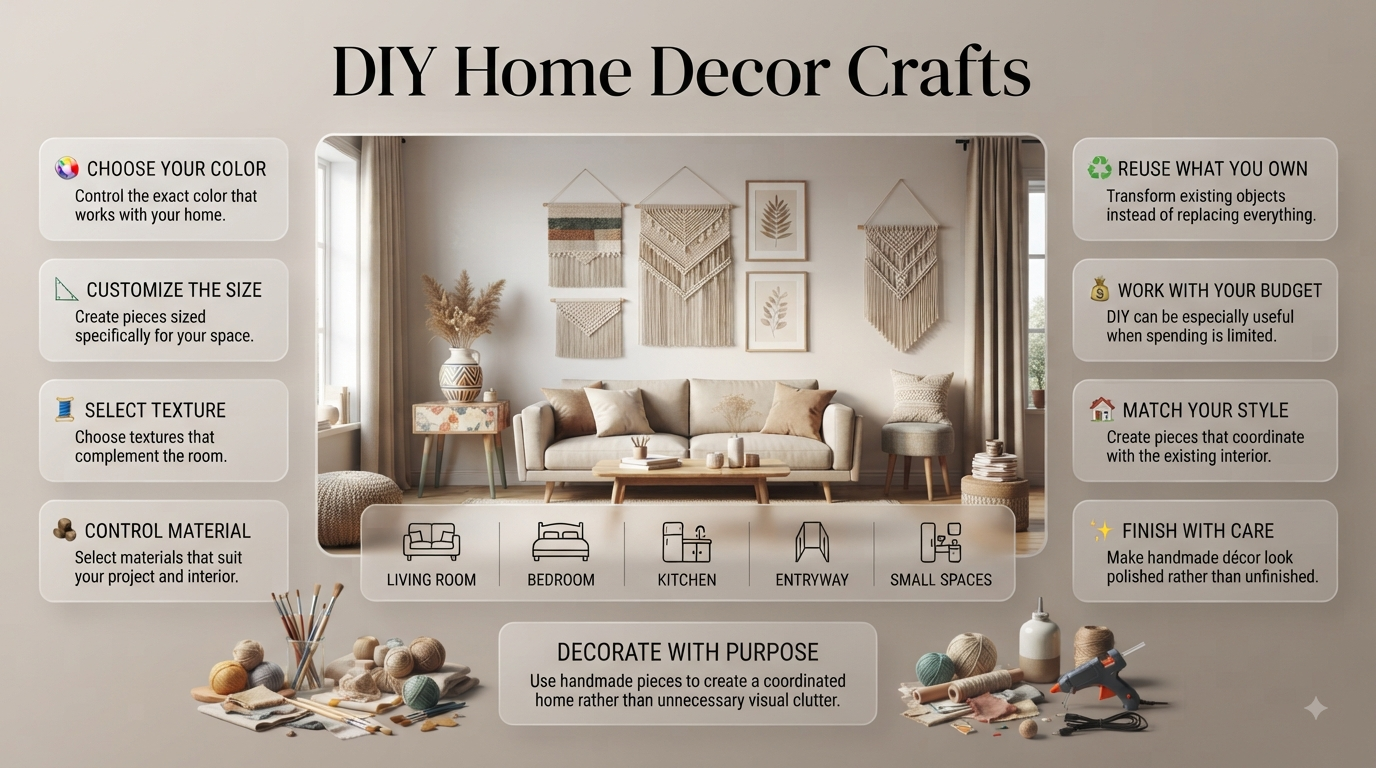
Making your own decor gives you something store-bought accessories often can’t: complete control. You can choose the exact color, size, texture, material, and style that works with your home. You can also reuse things you already own, which makes DIY decorating especially useful when you’re working with a limited budget.
If you’re looking for practical inspiration beyond individual crafts, DesignMode24 Interior Design offers broader ideas for creating a home that feels coordinated rather than simply filled with decorations.
This guide covers practical DIY home decor crafts for living rooms, bedrooms, kitchens, entryways, and small spaces. You’ll also learn which materials work best, how to make handmade pieces look polished, how to choose crafts for different interior styles, which mistakes beginners commonly make, and how to decorate without creating unnecessary clutter.
What Are DIY Home Decor Crafts?
DIY home decor crafts are decorative or functional items that you make yourself to improve the appearance, atmosphere, or organization of your home. These projects can range from simple painted objects and handmade artwork to upcycled furniture, decorative storage, wall hangings, planters, trays, and customized accessories.
Unlike a standard home improvement project, a DIY decor craft usually focuses more on appearance, personalization, and small-scale changes.
You might create a decorative piece because:
- A wall feels empty.
- A room lacks color.
- Your shelves look unfinished.
- Existing furniture feels outdated.
- You need inexpensive accessories.
- You want to reuse old materials.
- You want your home to feel more personal.
- You can’t find a store-bought item with the right size or style.
The most successful DIY projects aren’t necessarily complicated. They’re the ones that solve a specific problem in the room.
Why Do DIY Home Decor Crafts Matter?
A handmade object can give a room character without requiring a complete redesign.
For example, imagine a neutral living room with a beige sofa, simple curtains, and plain walls. Instead of replacing the sofa, you could create a large abstract artwork using colors already present in the room. Add a handmade wooden tray and a textured plant basket, and the room can immediately feel more finished.
That’s the real value of DIY decorating: small changes can have a surprisingly large visual effect when they’re planned properly.
What Are the Best DIY Home Decor Crafts for Beginners?
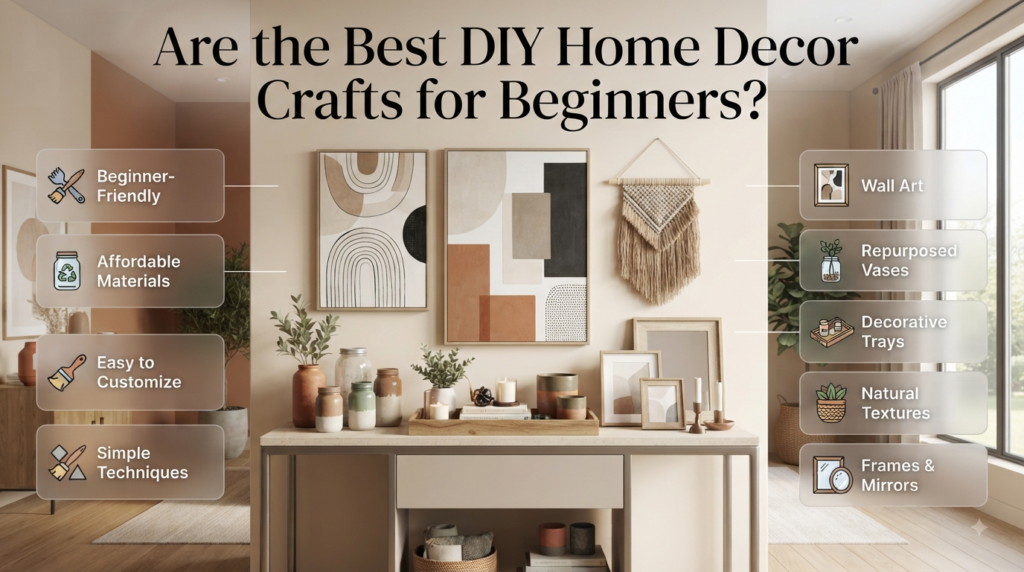
The best beginner projects are affordable, forgiving, and easy to customize. You don’t need a workshop full of equipment to start decorating creatively.
Here are some of the most useful projects.
1. DIY Abstract Wall Art
Blank walls are one of the easiest places to make a noticeable change.
You can create abstract artwork using a canvas, acrylic paint, leftover wall paint, painter’s tape, brushes, sponges, or palette knives.
Don’t worry about creating a complicated painting. Simple forms often work better in interiors.
Try:
- Organic curved lines
- Large geometric blocks
- Neutral color combinations
- Minimal black-and-white designs
- Soft brush textures
- One oversized accent shape
Before painting, look at the room’s existing colors.
If your furniture uses warm beige, brown, and cream, repeating those tones in your artwork creates cohesion.
If you want to explore color combinations before starting, the Paint Color collection can provide additional inspiration.
Professional approach: Paint a small sample first. Colors can look dramatically different depending on daylight, artificial lighting, wall color, and surrounding materials.
2. Painted Glass Jar Vases
Old glass jars are surprisingly useful for DIY decorating.
Remove the labels, clean the glass thoroughly, and allow it to dry completely. You can leave the glass transparent or paint the exterior.
For a contemporary appearance, consider:
- Matte white
- Warm beige
- Charcoal
- Soft gray
- Terracotta
- Muted green
Group three jars of different heights together instead of placing one in isolation.
This creates a simple visual arrangement without requiring expensive accessories.
3. DIY Decorative Tray
A tray isn’t just decorative. It helps organize small objects.
You can purchase an unfinished wooden tray or repurpose an old one.
Paint it, stain it, or add simple handles. Once finished, use it to organize:
- Candles
- Books
- Small plants
- Decorative bowls
- Coffee accessories
- Perfume bottles
- Bedroom essentials
A tray is particularly useful on coffee tables because it visually groups several small objects into one organized composition.
4. Handmade Plant Pots
Plants already add life to a room, but the planter can become part of the design.
Try decorating plain terracotta pots with:
- Paint
- Rope
- Stencils
- Natural textures
- Simple geometric patterns
- Fabric
- Wooden details
Avoid decorating every plant pot differently.
A coordinated set of two or three planters usually creates a more sophisticated appearance.
For homes that emphasize natural materials, Natural Wood Interior ideas can help you combine wood, plants, ceramics, and earthy finishes.
5. DIY Textured Wall Hanging
Textured wall hangings are useful when you want visual interest without strong colors.
You can make one using:
- Cotton cord
- Jute
- Yarn
- Fabric strips
- Wooden dowels
- Macramé cord
Natural fibers work especially well in bedrooms, reading corners, and calm living spaces.
Keep the color palette simple if your furniture already contains patterns.
6. Customized Picture Frames
An old frame can become a completely different decorative object with paint, texture, or new hardware.
You can:
- Clean the frame.
- Sand it lightly if necessary.
- Apply primer where appropriate.
- Paint it.
- Add a protective finish.
- Insert new artwork or a photograph.
Try creating a group of frames using the same finish.
This works particularly well for gallery walls.
7. DIY Decorative Mirror Frame
If you have a basic mirror that looks too plain, create a custom frame around it.
Wooden strips, rope, molding, or lightweight decorative materials can transform a basic mirror into a stronger focal point.
Always make sure the frame and hanging hardware are appropriate for the mirror’s weight.
8. Handmade Candle Holders
Simple candle holders can be made from ceramic containers, glass vessels, wood, or other heat-appropriate materials.
However, safety matters.
Keep candles away from:
- Curtains
- Paper
- Loose fabrics
- Dry decorative materials
- Overhanging shelves
- Children’s reach
Never use a decorative material near an open flame unless it’s specifically suitable for heat exposure.
How Can You Make DIY Home Decor Crafts Look Expensive?
This is one of the biggest challenges with DIY decorating.
A project can have a great idea behind it but still look unfinished. The difference usually comes from preparation, proportions, and restraint.
Focus on Surface Preparation
Before painting or finishing anything, clean the surface.
Depending on the material, you may need to:
- Sand it
- Remove grease
- Fill holes
- Remove loose paint
- Apply primer
- Repair cracks
Skipping preparation often results in peeling paint, uneven finishes, or visible imperfections.
Keep the Color Palette Controlled
Using six or seven colors in one craft rarely makes it look more sophisticated.
Instead, try:
One dominant color + one supporting color + one neutral.
For example:
- Cream + olive + natural wood
- White + charcoal + oak
- Terracotta + beige + brown
- Black + warm white + brass
Pay Attention to Scale
A tiny piece of artwork can disappear on a large wall.
A huge decorative object can overwhelm a narrow shelf.
Measure the surrounding furniture before deciding the size.
Finish the Edges
This is where many beginner projects lose quality.
Look carefully for:
- Uneven paint
- Visible glue
- Rough wood
- Frayed fabric
- Unfinished edges
- Dust trapped in finishes
The final inspection can make a major difference.
💡 Pro Tip: If a project looks “almost right,” don’t immediately add another decorative element. First ask whether the problem is proportion, spacing, color, or finishing.
What DIY Home Decor Crafts Can You Make From Recycled Materials?
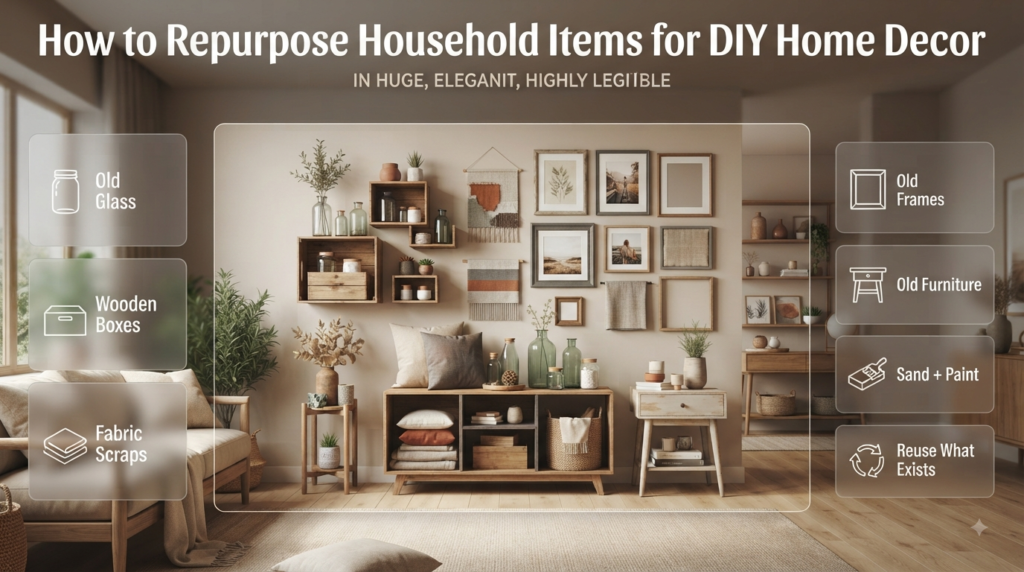
You don’t need to buy everything from a craft store.
Some of the most useful materials may already be sitting in your home.
Old Glass Containers
Use jars and bottles as:
- Vases
- Storage containers
- Decorative displays
- Pen holders
- Bathroom organizers
Old Wooden Boxes
Wooden boxes can become:
- Wall shelves
- Display boxes
- Storage units
- Plant stands
- Decorative containers
Leftover Fabric
Fabric scraps can become:
- Cushion covers
- Small wall hangings
- Table runners
- Decorative panels
- Textile artwork
Old Frames
Old frames can be repainted and reused for:
- Artwork
- Photographs
- Mirrors
- Fabric displays
- Empty-frame gallery walls
Old Furniture
Instead of immediately replacing an old side table or cabinet, consider whether the structure is still useful.
A simple combination of sanding, paint, new hardware, and repair can give an outdated piece a completely different appearance.
This is where DIY decorating becomes more sustainable: you’re improving something that already exists instead of automatically buying something new.
How Do You Choose DIY Crafts for Your Interior Style?
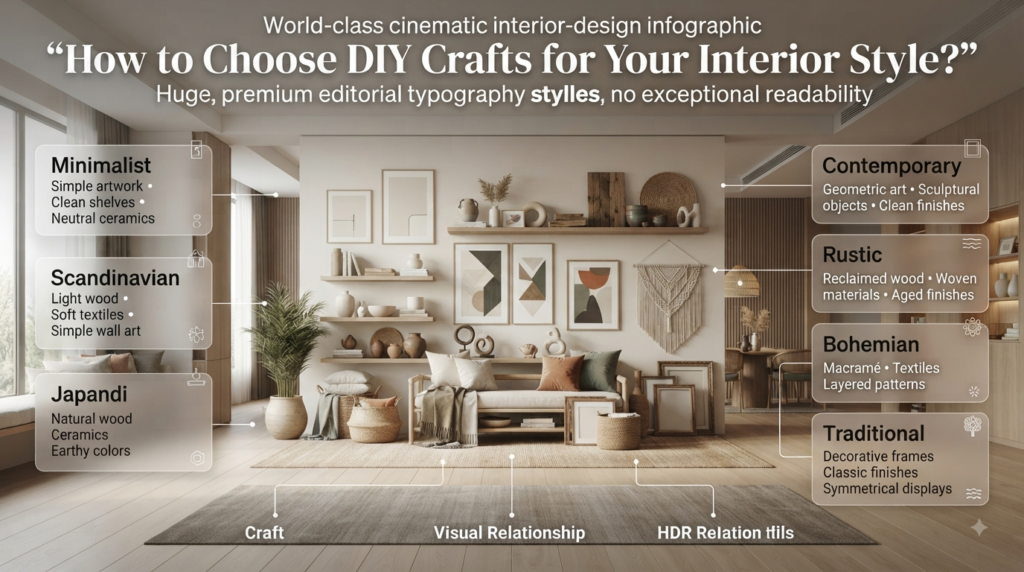
A craft should feel like part of the room.
It doesn’t need to match everything exactly, but it should share some visual relationship with the surrounding environment.
| Interior Style | Suitable DIY Ideas |
|---|---|
| Minimalist | Simple artwork, clean shelves, neutral ceramics |
| Scandinavian | Light wood, soft textiles, simple wall art |
| Japandi | Natural wood, ceramics, earthy colors |
| Contemporary | Geometric art, sculptural objects, clean finishes |
| Rustic | Reclaimed wood, woven materials, aged finishes |
| Bohemian | Macramé, textiles, layered patterns |
| Traditional | Decorative frames, classic finishes, symmetrical displays |
If you’re exploring the overall direction of your space, Interior Design Styles can help you understand how individual crafts fit into larger design approaches.
For a quieter and less cluttered appearance, Minimalist Interior Design principles are particularly useful.
What DIY Crafts Work Best for Minimalist Homes?
Minimalist decorating doesn’t mean your home has to contain nothing handmade.
The key is choosing fewer pieces.
Good minimalist DIY projects include:
- One large abstract artwork
- A simple wooden shelf
- A handmade ceramic-style object
- A neutral textile wall hanging
- A simple planter
- A customized storage box
Avoid creating several unrelated decorative objects just because you can.
A minimalist room benefits from negative space.
One carefully designed piece can be more effective than a collection of ten small crafts.
What DIY Crafts Work Best for Contemporary Homes?
Contemporary interiors usually benefit from clean lines and controlled decoration.
Try:
- Geometric wall art
- Monochrome artwork
- Minimal wooden shelves
- Sculptural paper decorations
- Matte ceramic containers
- Simple metal-and-wood accessories
- Oversized decorative pieces
A contemporary room doesn’t require every object to look handmade.
In fact, one carefully selected DIY piece can create contrast against cleaner manufactured furniture.
The Contemporary Interior Design approach can help you understand how simplicity, materials, and proportion work together.
What DIY Crafts Work Best for Japandi Interiors?
Japandi interiors combine simplicity with warmth.
That makes them particularly suitable for DIY projects involving natural materials.
Consider:
- Light wood
- Neutral textiles
- Handmade-style ceramics
- Simple woven baskets
- Clay-colored objects
- Minimal wall art
- Natural fiber decorations
Avoid excessive ornamentation.
The objective is to create warmth without visual noise.
For additional inspiration, explore Japandi Interior Design.
What DIY Crafts Work Best for Scandinavian Homes?
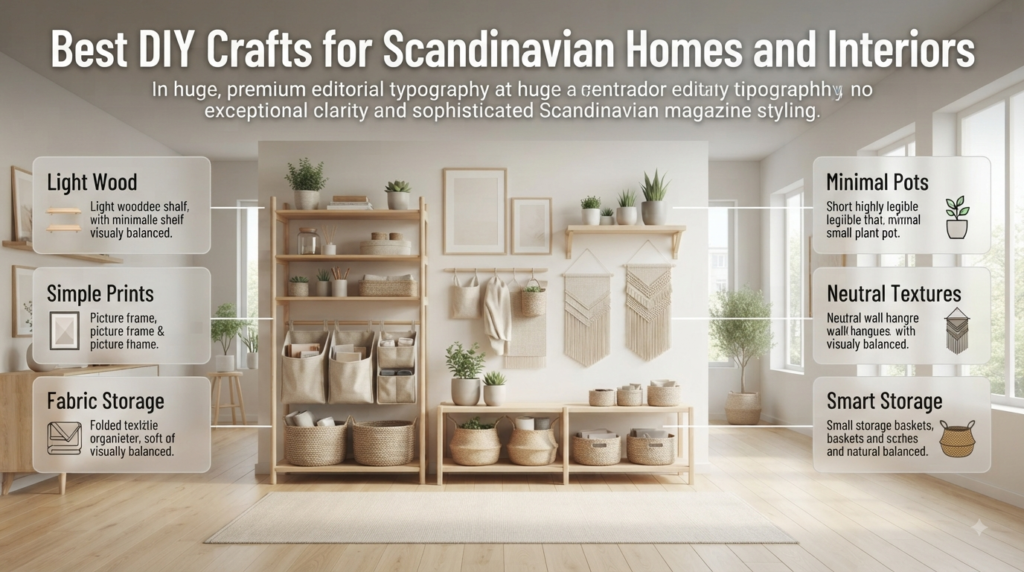
Scandinavian-inspired interiors generally benefit from simplicity, function, natural materials, and light colors.
Good DIY ideas include:
- Light wooden shelves
- Simple framed prints
- Fabric organizers
- Minimal plant pots
- Neutral wall hangings
- Small storage baskets
Function should remain important.
If a handmade object can both decorate and organize your home, it’s often a better choice than something that simply occupies space.
You can explore Scandinavian Interior Design for broader ideas about materials, color, and visual balance.
What DIY Home Decor Crafts Are Best for Small Spaces?
Small rooms require more discipline.
You don’t want to solve an empty-wall problem by creating a clutter problem somewhere else.
Try multifunctional DIY projects
A handmade wall shelf can provide:
- Storage
- Display space
- Vertical organization
- A decorative focal point
A customized storage box can hide clutter while contributing to the room’s appearance.
A decorative tray can organize several small objects into one defined area.
Use vertical space
Walls are often underused in small homes.
Consider:
- Narrow shelves
- Hanging planters
- Wall-mounted organizers
- Framed artwork
- Vertical textile pieces
📌 Quick Tip: Before creating a new storage craft, remove five things you no longer use. Good organization starts with reducing unnecessary belongings.
What DIY Crafts Are Good for Living Rooms?
Living rooms usually provide the largest opportunity for decorative projects.
Large wall art
A large canvas can become the main visual focus.
Decorative trays
Use trays to organize coffee tables.
Plant stands
Raise plants to different heights to create visual variation.
Customized side tables
Refresh a basic table with paint, stain, or new hardware.
Textured wall pieces
Use woven or fabric elements to soften large blank walls.
Decorative shelves
Shelves provide both display and storage.
The important point is to avoid filling every available surface.
If the sofa, rug, curtains, artwork, and accessories are all competing for attention, the room can quickly feel chaotic.
What DIY Crafts Are Best for Bedrooms?
Bedrooms need a slightly different approach.
The atmosphere should generally feel calm and comfortable.
Useful DIY projects include:
- Fabric wall hangings
- Neutral artwork
- Handmade bedside trays
- Decorative storage
- Customized picture frames
- Small plant containers
- Soft textile accessories
Avoid sharp visual contrasts if you’re trying to create a restful environment.
Natural textures can be particularly effective.
A simple combination of wood, linen-style textiles, neutral paint, and soft artwork can make a bedroom feel warmer without adding excessive decoration.
What DIY Crafts Can You Make for the Kitchen?
Kitchen decor needs to be attractive but practical.
Try:
- Customized spice labels
- Painted storage containers
- Wooden serving boards
- Decorative utensil holders
- Wall-mounted organizers
- Simple herb planters
- Refinished wooden shelves
However, kitchen materials must be selected carefully.
Anything that touches food should be made from materials and finishes that are appropriate for food contact.
Don’t use ordinary decorative paint or unknown sealers on food-preparation surfaces.
What DIY Crafts Work Well in Entryways?
The entryway creates the first impression of your home.
Useful DIY projects include:
- Key holders
- Small shelves
- Decorative mirrors
- Storage baskets
- Wall organizers
- Customized signs
- Small artwork
A good entryway craft should ideally provide either function or visual focus.
A handmade key rack, for example, can look attractive while solving a daily organizational problem.
How Can DIY Crafts Add Texture to a Room?
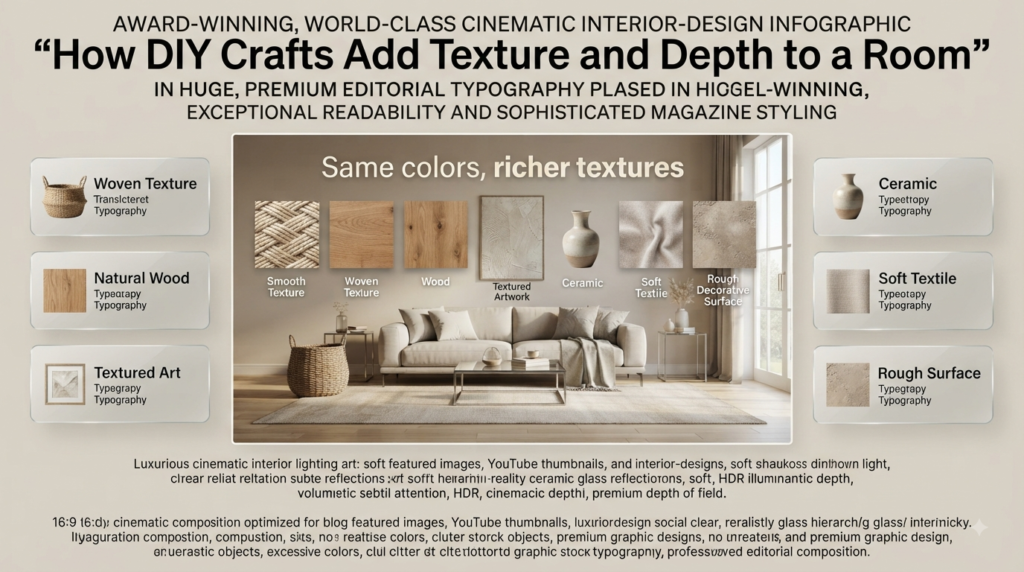
Texture is one of the easiest ways to make a room feel more layered.
This becomes especially important when the room already has neutral colors.
Imagine a room with:
- Smooth painted walls
- A plain sofa
- Glass furniture
- Polished flooring
It may look clean but feel visually flat.
Now introduce:
- Woven basket
- Natural wood
- Textured artwork
- Ceramic vase
- Soft textile
- Rougher decorative surface
The colors can remain almost identical while the room becomes much more interesting.
This is also where Decorative Finishes can provide useful inspiration for creating more depth without relying only on color.
How Can You Use DIY Decor in Home Styling?
DIY crafts should be treated as part of the entire room.
Instead of asking:
“What can I make?”
ask:
“What does this room need?”
Maybe the answer is:
- More height
- More texture
- A focal point
- Better organization
- More warmth
- Less visual clutter
- A connection between two colors
That question changes the quality of your projects.
A handmade object becomes much more useful when it has a clear role.
For broader styling principles, Home Styling can help you think about accessories, furniture placement, color, and texture together.
How Can DIY Crafts Improve Home Design?
DIY decorating becomes more effective when it supports the architectural and functional qualities of a room.
For example, a narrow hallway may benefit from vertical artwork and a slim shelf.
A large empty living-room wall may need one substantial artwork instead of many tiny pieces.
A small bedroom may benefit more from handmade storage than another decorative object.
Good Home Design Ideas start with understanding the space rather than filling it randomly.
Can DIY Crafts Be Used for Statement Interiors?
Yes, but statement decoration requires restraint.
A statement piece needs room to be noticed.
You could create:
- Oversized abstract artwork
- A sculptural wall hanging
- A dramatic painted cabinet
- A large decorative mirror
- A bold textured panel
Don’t place several major statement pieces next to each other.
One strong element can establish the room’s identity.
For additional inspiration, Statement Interiors explores how carefully selected elements can create visual impact.
How Can Bespoke DIY Decor Feel More Personal?
One of the biggest advantages of making your own decor is customization.
You can create something around:
- Your favorite color
- A meaningful photograph
- A travel memory
- A family object
- A specific room dimension
- A material you personally like
This is different from buying generic accessories.
A bespoke piece doesn’t necessarily need to be expensive.
It simply needs to be designed specifically for the person and space using it.
The idea of Bespoke Design can be useful here because the principle is the same: designing around specific needs rather than forcing a standard solution into the space.
How Do You Make DIY Decor More Sustainable?
Sustainable DIY starts with what you already have.
Before purchasing materials, inspect your home.
You may find:
- Old picture frames
- Leftover wood
- Unused paint
- Glass containers
- Fabric scraps
- Old baskets
- Furniture that needs refreshing
- Hardware from previous projects
Reuse should come before buying more.
Also consider durability.
If a craft will be handled frequently, use a finish appropriate for that level of use.
If it will be exposed to sunlight or moisture, choose materials accordingly.
Sustainability isn’t just about using recycled materials. It’s also about creating things that last.
How Can DIY Decor Support Energy-Efficient Homes?
Decorative crafts themselves don’t usually make a home energy efficient, but some DIY projects can support comfort and better everyday use.
For example, you might create:
- Draft-blocking textile accessories
- Simple window treatments
- Insulating curtain liners
- Shading solutions
- Organization that keeps heating or cooling areas unobstructed
However, anything involving electrical wiring, permanent insulation changes, structural work, or heating and cooling equipment should be approached differently from a simple craft.
For broader principles, explore Energy-Efficient Homes.
What Are the Biggest DIY Home Decor Mistakes?
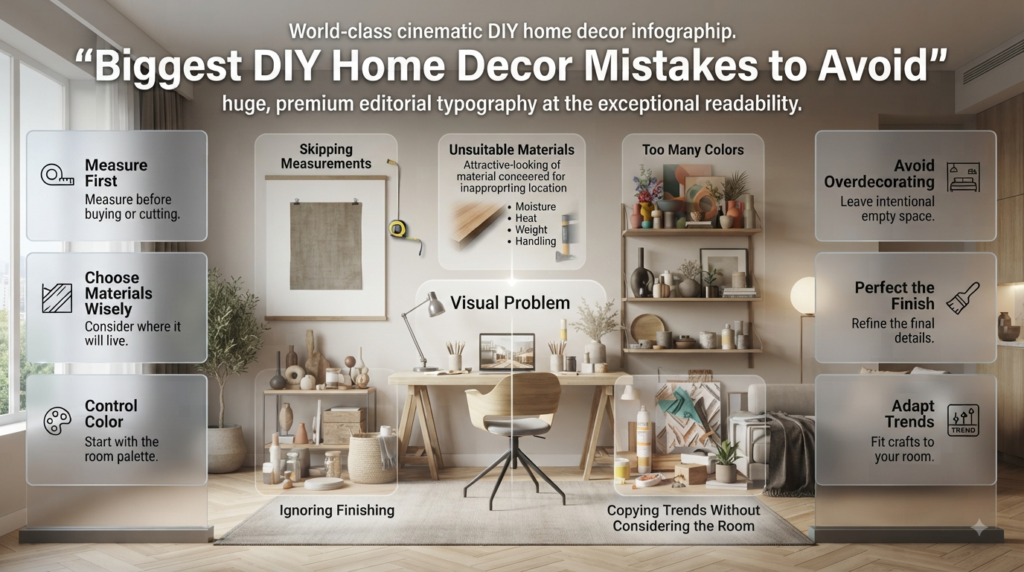
Mistake 1: Skipping Measurements
You make a beautiful wall hanging only to discover that it’s too large for the available wall.
Why it happens: The maker focuses on the craft rather than the room.
How to avoid it: Measure before buying or cutting materials.
Mistake 2: Choosing Materials Only Because They Look Good
A material may look attractive but be unsuitable for moisture, heat, weight, or frequent handling.
Better approach: Think about where the finished object will live.
Mistake 3: Using Too Many Colors
Beginners often assume more color means more creativity.
It usually creates visual confusion.
Better approach: Start with the existing room palette.
Mistake 4: Overdecorating
After making one successful craft, it’s tempting to create five more.
But a room needs empty space too.
Better approach: Step back and evaluate the whole room after each project.
Mistake 5: Ignoring Finishing
A project can be 90% complete and still look unfinished.
Visible glue, rough edges, uneven paint, and poorly attached hardware reduce quality.
Better approach: Spend meaningful time on the final details.
Mistake 6: Copying Trends Without Considering the Room
A craft can be popular online and still look wrong in your home.
Better approach: Adapt the technique to your architecture, colors, furniture, and lifestyle.
What Do Professionals Consider Before Adding DIY Decor?
Experienced designers don’t usually begin with accessories.
They consider the entire composition.
Proportion
How large is the object compared with the wall or furniture?
Balance
Does the room feel visually heavier on one side?
Repetition
Does the craft repeat an existing color, shape, or material?
Contrast
Does it provide enough difference to be noticed?
Function
Does the object solve a practical need?
Negative Space
Is there enough empty space around it?
These principles can turn an ordinary craft into a deliberate design feature.
⭐ Expert Tip: If you aren’t sure whether a room needs another decorative item, remove one existing object first. If the room immediately feels better, the problem wasn’t a lack of decoration.
A Simple DIY Home Decor Craft Planning Process
Before starting your next project, use this process.
Step 1: Find the problem
Identify one specific area that needs improvement.
Step 2: Measure
Record the available width, height, and depth.
Step 3: Check the room
Look at existing colors, furniture, flooring, lighting, and materials.
Step 4: Choose the craft
Select something that solves the identified problem.
Step 5: Test the idea
Create a small sample or temporary version.
Step 6: Build carefully
Don’t rush cutting, painting, attaching, or assembling.
Step 7: Finish properly
Sand, seal, clean, and inspect.
Step 8: Style with restraint
Give the finished piece enough space.
This simple process prevents one of the most common DIY mistakes: creating something attractive that doesn’t actually work in the room.
DIY Home Decor Crafts on a Budget: Where Should You Spend Money?
DIY doesn’t mean every material should be the cheapest possible.
Some supplies are worth buying properly.
Spend more attention on:
- Good paintbrushes
- Quality sandpaper
- Reliable adhesive
- Appropriate primer
- Protective finishes
- Strong hanging hardware
- Durable base materials
Save money on:
- Decorative extras
- Reusable containers
- Simple fillers
- Temporary templates
- Materials you already have
The objective is not to make the project cost almost nothing.
The objective is to get the best result for the money you spend.
DIY Home Decor Crafts: Quick Comparison
| Project | Cost | Skill Level | Time | Best For |
| Painted jars | Low | Beginner | 1–2 hours | Shelves, tables |
| Abstract artwork | Low–Medium | Beginner | 2–4 hours | Empty walls |
| Decorative tray | Low–Medium | Beginner | 2–4 hours | Coffee tables |
| Plant pots | Low | Beginner | 1–2 hours | Living rooms |
| Wall hanging | Low–Medium | Beginner | 2–5 hours | Bedrooms |
| Upcycled furniture | Medium | Intermediate | 1–2 days | Living rooms |
| Floating shelf | Medium | Intermediate | Several hours | Small spaces |
| Mirror frame | Medium | Intermediate | Several hours | Entryways |
Time varies depending on drying, curing, preparation, and the materials involved.
10 Quick DIY Home Decor Ideas to Try This Weekend
If you don’t want to start with a large project, choose one of these:
- Paint three matching glass jars.
- Create a small abstract canvas.
- Refinish an old picture frame.
- Make a decorative tray.
- Create a simple plant pot.
- Turn an old wooden box into a shelf.
- Make a small textile wall hanging.
- Create a handmade key holder.
- Refresh a small side table.
- Build a simple gallery wall from existing frames.
Choose only one or two.
Completing a small project properly is better than starting six projects and finishing none.
How Can You Avoid DIY Clutter?
DIY can accidentally encourage overdecorating because making things is fun.
Set a simple rule:
Every new decorative object should have a clear reason for being there.
Ask:
- Does it improve the room?
- Does it provide useful function?
- Does it add texture or color that the room needs?
- Does it have personal meaning?
- Does it work with the existing design?
If the answer is no to all five, don’t make it simply because you can.
This is particularly important in minimalist and contemporary homes.
What Are the Most Profitable Home Décor Crafts to Make and Sell From Home?
The most profitable home décor crafts are usually products that are inexpensive to produce, easy to customize, visually appealing, and simple to ship. Personalized wall art, decorative trays, candle holders, planters, textured wall hangings, wooden signs, storage baskets, painted vases, and customized frames can all work well because buyers are often willing to pay more for unique designs than for generic accessories.
The key isn’t simply choosing a popular craft. You need to calculate your material cost, labor time, packaging, shipping, platform fees, and desired profit margin before setting a price.
Good products to consider include:
Personalized signs and wall art
Handmade decorative trays
Painted or textured vases
Macramé and woven wall hangings
Customized picture frames
Wooden organizers and shelves
Decorative plant pots
Seasonal home decorations
Upcycled furniture and accessories
Professional tip: Products that can be personalized with names, colors, sizes, or messages often have stronger perceived value. However, avoid making every order completely different because excessive customization can increase production time and reduce your actual profit.
How Do I Make Cheap Home Décor Look Expensive Using DIY Techniques?
Affordable décor can look considerably more expensive when you focus on finishing quality, proportion, color, and material coordination. Expensive-looking design usually isn’t about adding more decoration; it’s about making simple pieces appear intentional and well finished.
Start by choosing a restrained color palette. Neutral shades such as warm white, beige, charcoal, taupe, muted green, or earthy brown can create a sophisticated foundation. Then introduce one contrasting material such as natural wood, brushed metal, textured fabric, or ceramic.
A few techniques make a major difference:
Sand surfaces before painting.
Use primer when the material requires it.
Apply several thin coats instead of one thick coat.
Choose matte or satin finishes for a refined appearance.
Replace cheap-looking hardware with simple quality hardware.
Hide visible glue and rough edges.
Keep proportions appropriate for the room.
Use repetition of colors and materials across several objects.
Expert tip: If a DIY piece looks cheap, don’t immediately add more decoration. First check whether the problem is an uneven finish, poor proportions, excessive colors, or low-quality hardware.
What Are the Best Eco-Friendly and Sustainable Materials for Home Crafting?
The best sustainable materials are generally those that are durable, reusable, recycled, renewable, or responsibly sourced. You don’t necessarily need to purchase specialized “eco” products. One of the most sustainable approaches is to reuse materials that already exist.
Useful options include:
Reclaimed or responsibly sourced wood
Recycled glass
Natural cotton
Linen
Jute
Bamboo
Cork
Recycled paper and cardboard
Natural fibers
Repurposed fabric
Recycled metal
Upcycled furniture
For example, an old wooden box can become a wall shelf, while a glass jar can become a vase or storage container. Fabric scraps can be transformed into cushion covers, textile artwork, or decorative hangings.
Also consider durability. A product that lasts for many years can be more sustainable than a cheap item that needs frequent replacement.
When choosing paints, adhesives, stains, and finishes, check the manufacturer’s environmental and safety information rather than assuming a product is sustainable simply because its packaging uses words like “natural” or “green.”
Which Essential Tools Do Beginners Need to Start Making Home Décor Crafts?
Beginners don’t need a professional workshop. A small collection of reliable basic tools is enough for most decorative projects.
Start with:
Measuring tape
Pencil and ruler
Utility knife
Quality scissors
Screwdriver set
Sandpaper in different grits
Paintbrushes
Small foam rollers
Craft cutting mat
Clamps
Hot-glue gun
Strong craft adhesive
Level
Protective gloves
Safety glasses
Drop cloth or protective work surface
If you’re working with wood, a few additional tools can become useful, such as a hand saw, drill, drill bits, and wood clamps.
Don’t buy every tool at once. Build your collection according to the projects you’re actually making.
Beginner advice: Spend more on tools you use repeatedly, such as measuring equipment, brushes, screwdrivers, and cutting tools. Accurate tools can prevent mistakes and reduce material waste.
For projects involving electricity, structural installation, heavy objects, or specialized machinery, don’t treat them like ordinary decorative crafts. Use appropriate equipment and professional help where necessary.
How Do I Seal and Protect Handmade Home Decor Items for Long-Term Durability?
The right protective finish depends on the material, location, level of handling, moisture exposure, and desired appearance. There isn’t one sealer that works perfectly for every DIY project.
For painted wood and decorative furniture, common options include polyurethane, polycrylic, wax, or other manufacturer-approved protective coatings. For certain painted decorative objects, a compatible clear coat can protect the surface from scratches and handling.
Before sealing:
Make sure the surface is completely clean.
Allow paint or stain to cure according to the manufacturer’s instructions.
Choose a compatible sealer.
Test it on a hidden or spare area first.
Apply thin, even coats.
Allow sufficient drying and curing time between coats.
Avoid heavy use until the finish has fully cured.
For high-use surfaces such as trays or furniture, choose a finish designed for that level of wear. For objects exposed to moisture, use a product specifically rated for the environment.
⚠️ Important: “Dry” doesn’t always mean “fully cured.” A surface can feel dry while still being vulnerable to scratches, moisture, or pressure. Follow the product’s curing instructions rather than using the item immediately.
Best practice: Always read the finish manufacturer’s instructions for surface compatibility, ventilation, application method, drying time, and safety requirements.
Conclusion
Making and selling home décor crafts from home can be both creative and profitable when you approach it with the right strategy. The strongest results usually come from choosing products that are affordable to produce, easy to personalize, visually appealing, and durable enough to provide genuine value to buyers.
You don’t need expensive materials or a professional workshop to create impressive pieces. With basic tools, thoughtful DIY techniques, sustainable materials, and proper finishing, simple items can be transformed into attractive décor with a much higher perceived value.
Whether you’re creating handmade wall art, decorative trays, planters, textile pieces, personalized accessories, or upcycled furniture, focus on quality, originality, functionality, and consistency. Take time to prepare surfaces, choose suitable materials, apply protective finishes correctly, and package finished products carefully if you’re selling them.
Most importantly, don’t try to make everything at once. Start with a small collection, understand what customers respond to, improve your techniques, and gradually develop a recognizable style. A well-made handmade product isn’t valuable simply because it was created by hand—it’s valuable because it solves a need, looks beautiful, lasts well, and gives the buyer something they can’t easily find elsewhere.
Leave a Reply