
Introduction
Contemporary Living Solutions: Smart Ideas for Modern Homes | A home can look beautiful and still feel frustrating to live in. Maybe the living room feels cramped, storage is always running out, furniture blocks movement, or every room seems to serve only one purpose. These are everyday problems that traditional decorating alone doesn’t always solve.
Contemporary living solutions focus on making a home work better while keeping it comfortable, attractive, and current. Instead of adding more furniture or following every design trend, the goal is to use space intelligently, choose flexible pieces, improve storage, and create interiors that support real daily life.
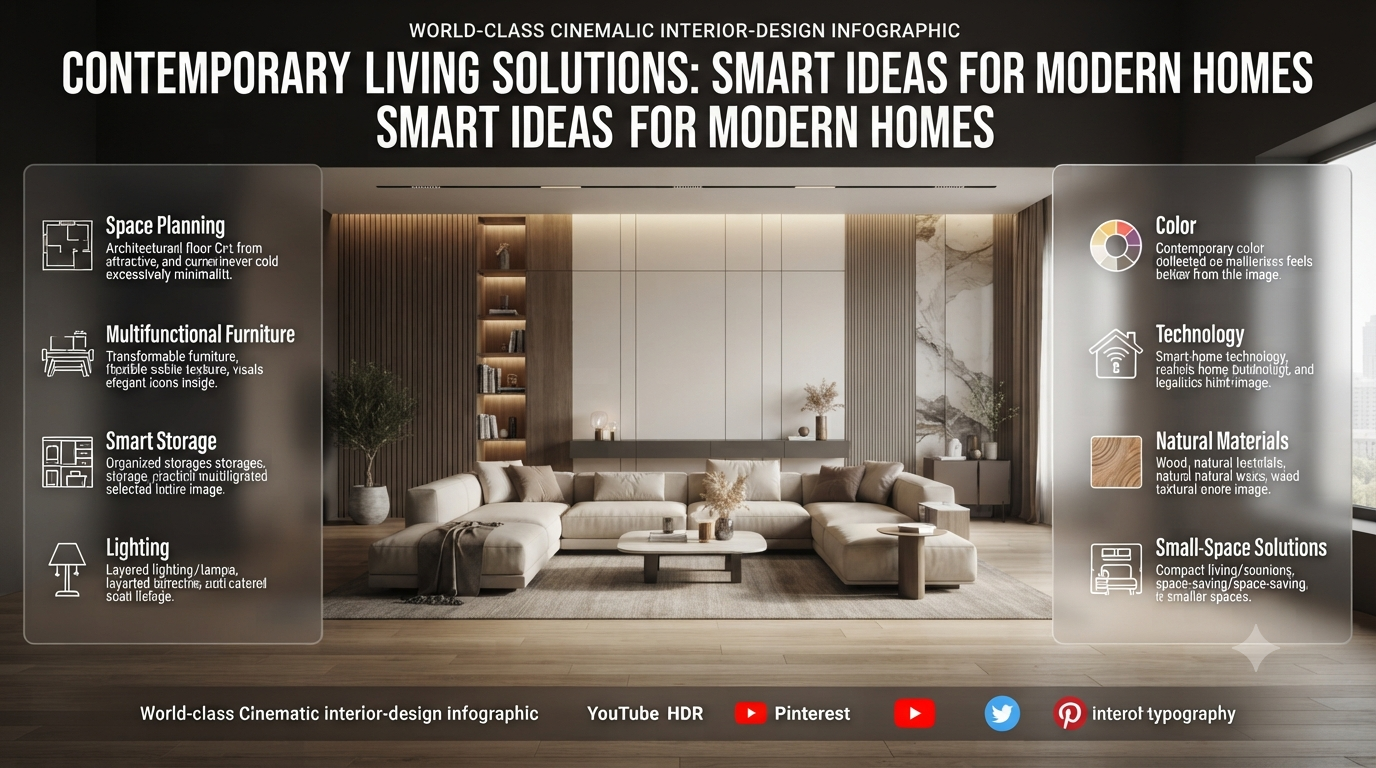
In this guide, you’ll learn how to make a contemporary home more functional without making it feel cold or overly minimalist. We’ll cover space planning, multifunctional furniture, storage, lighting, color, technology, natural materials, small-space solutions, common mistakes, and practical design decisions that work in real homes.
What Are Contemporary Living Solutions?
Contemporary living solutions are practical design approaches that make modern homes more functional, flexible, comfortable, and visually balanced. They combine smart space planning, multifunctional furniture, efficient storage, thoughtful lighting, technology, and modern materials to solve everyday household problems.
The important point is that contemporary living isn’t simply about having expensive furniture or a fashionable interior. It’s about designing the home around how people actually live.
For example, a dining table that doubles as a workspace may be more valuable than a larger decorative table. A built-in storage wall may be more useful than several separate cabinets. A movable sofa can make a small living room more adaptable.
This is where contemporary design becomes practical rather than purely decorative.
For additional inspiration, explore these Home Design Ideas and see how different approaches can be adapted to your own space.
Why Are Contemporary Living Solutions Important?
Modern homes often have to accommodate several activities within limited space. A living room may need to function as a place for relaxing, entertaining, working, watching television, reading, and sometimes even dining.
Contemporary living solutions help solve this problem by making individual spaces more adaptable.
They can help you:
- Make better use of limited floor space
- Reduce visual clutter
- Create more storage
- Improve movement between rooms
- Make furniture serve multiple purposes
- Improve natural and artificial lighting
- Create comfortable work-from-home areas
- Make rooms easier to maintain
- Give small homes a more spacious appearance
- Add technology without making interiors look complicated
The best solution isn’t always the most expensive one. Often, changing the layout or removing one unnecessary piece of furniture can make a bigger difference than buying five new accessories.
What Are the Key Elements of Contemporary Living?
A successful contemporary home usually combines several elements rather than relying on one particular trend.
1. Flexible Space Planning
Space planning is the foundation of functional contemporary interiors.
Before buying furniture, think about how people move through the room. A beautiful sofa positioned in the wrong location can make an entire living room uncomfortable.
Consider:
- Main walking paths
- Door and window positions
- Furniture proportions
- Conversation areas
- Natural light
- Storage requirements
- Television placement
- Work areas
- Clearance around furniture
A useful approach is to identify the primary function of each area first and then add secondary functions.
For example:
Living room → Relaxation + entertainment + occasional work
Instead of:
Living room → Sofa + TV + random furniture
That small change in thinking produces much better results.
For a deeper look at the planning process, visit Interior Design.
2. Multifunctional Furniture
Multifunctional furniture is one of the most useful contemporary living solutions for apartments and smaller homes.
Examples include:
- Storage ottomans
- Sofa beds
- Extendable dining tables
- Nesting tables
- Fold-down desks
- Modular sofas
- Beds with built-in drawers
- Wall-mounted desks
- Benches with hidden storage
The advantage is simple: one item performs several jobs.
A storage ottoman, for example, can function as seating, a footrest, a coffee-table surface, and hidden storage.
💡 Pro Tip: Before buying multifunctional furniture, ask whether you’ll realistically use all of its functions. A complicated piece that is difficult to operate can become more annoying than useful.
How Can You Make a Small Home Feel Bigger?
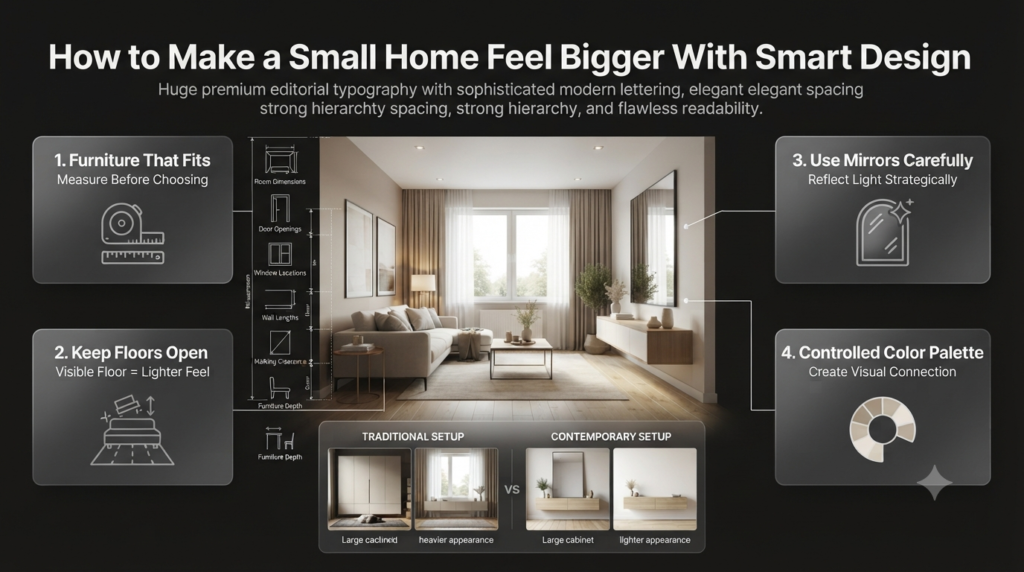
You don’t necessarily need a larger house to create a more spacious feeling. Better visual organization can dramatically change how a room feels.
Use Furniture That Fits the Room
Oversized furniture is one of the most common reasons small rooms feel cramped.
Instead of choosing furniture based only on appearance, measure:
- Room dimensions
- Door openings
- Window locations
- Wall lengths
- Walking clearance
- Furniture depth
A compact sofa with clean lines can often work better than a deep sectional.
Keep the Floor Visually Open
Furniture with visible legs can create a lighter visual effect because more of the floor remains visible.
Wall-mounted furniture can also help.
For example:
Traditional setup
Large cabinet → floor space occupied → heavier appearance
Contemporary setup
Floating cabinet → visible floor → lighter appearance
Use Mirrors Carefully
Mirrors can reflect light and make a room appear larger, particularly when positioned opposite a window or another bright area.
However, more mirrors don’t automatically mean a better result. One well-positioned mirror can be more effective than covering multiple walls.
Choose a Controlled Color Palette
A consistent palette helps rooms feel visually connected.
Soft neutrals, warm whites, muted earth tones, and understated contrast can create a calm contemporary environment.
If you’re selecting wall colors, explore Paint Color ideas before making a final decision.
Contemporary Living Solutions for Open-Plan Homes
Open-plan layouts provide flexibility, but they can also create a common problem: everything starts looking like one large room with no clear purpose.
The solution isn’t necessarily to build walls.
Instead, use visual zoning.
How to Create Zones Without Walls
You can separate activities using:
- Area rugs
- Furniture positioning
- Pendant lights
- Different lighting levels
- Console tables
- Open shelving
- Changes in texture
- Accent colors
- Ceiling treatments
For example, a sofa can face away from the dining area to visually define the living zone.
A rug underneath the seating arrangement creates another layer of separation.
Example of an Open-Plan Layout
Kitchen → Dining → Living
Instead of allowing all three areas to blend together:
Kitchen
Cooking + storage
↓
Dining
Meals + occasional work
↓
Living
Relaxation + entertainment
Each area remains visually connected while having a clear purpose.
This approach works particularly well in apartments where every square meter matters.
How Can Smart Storage Improve Contemporary Living?
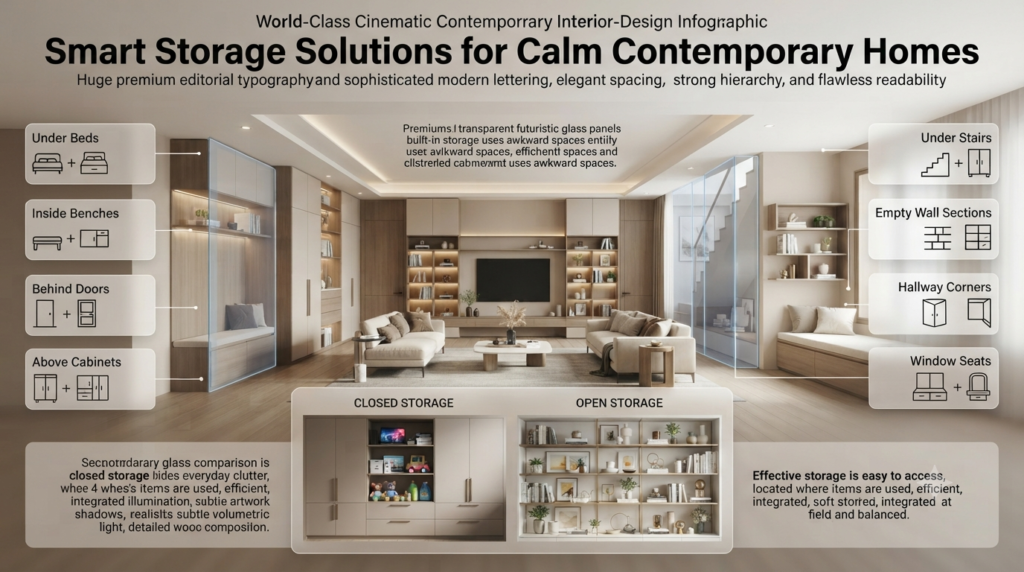
Storage is often the difference between a calm contemporary home and a permanently cluttered one.
The most effective storage isn’t necessarily the largest. It is storage that is easy to access and located where items are actually used.
Use the Space You Already Have
Look at overlooked areas such as:
- Under beds
- Inside benches
- Behind doors
- Above cabinets
- Under stairs
- Empty wall sections
- Hallway corners
- Window seats
Built-in storage can be particularly effective because it uses awkward spaces more efficiently.
Hide Everyday Clutter
Not everything needs to be displayed.
Contemporary interiors usually benefit from a balance between open and closed storage.
Closed storage: electronics, paperwork, toys, cleaning products
Open storage: books, artwork, ceramics, plants, selected decorative objects
This creates a cleaner visual environment without making the home feel empty.
For practical home upgrades, you can also explore Home Improvement.
Which Materials Work Best in Contemporary Interiors?
Contemporary interiors often combine several materials rather than relying on a single finish.
Popular combinations include:
| Material | Best Use | Visual Effect |
|---|---|---|
| Natural wood | Furniture, flooring, cabinetry | Warm and organic |
| Glass | Tables, partitions, doors | Light and open |
| Metal | Lighting, frames, hardware | Clean and refined |
| Stone | Countertops, flooring, accents | Durable and sophisticated |
| Linen | Curtains, cushions, upholstery | Soft and relaxed |
| Ceramic | Accessories, surfaces | Handmade and tactile |
| Concrete | Floors, walls, accents | Architectural and modern |
Natural materials are especially useful when a contemporary room begins to feel too sterile.
For example, a room with white walls, glass, and metal can feel cold. Adding oak furniture, woven textiles, and natural stone introduces warmth without abandoning the contemporary aesthetic.
Is Contemporary Living the Same as Minimalist Living?
No. Contemporary and minimalist interiors can overlap, but they aren’t identical.
| Contemporary Living | Minimalist Living |
| Focuses on modern functionality | Focuses strongly on reducing excess |
| Can include decorative objects | Usually limits visual decoration |
| Allows greater material variety | Often uses a restrained palette |
| Flexible and adaptable | Simple and highly controlled |
| Can feel warm and layered | Often feels clean and understated |
A contemporary home doesn’t have to look empty.
You can have artwork, books, plants, textured fabrics, and decorative objects while maintaining a clean visual structure.
If you prefer a more restrained approach, explore Minimalist Interior Design.
How Does Lighting Improve Contemporary Living?
Lighting isn’t simply a finishing touch. It changes how a room works and feels.
A good contemporary lighting plan usually includes three layers:
Ambient Lighting
This provides general illumination.
Examples include:
- Ceiling fixtures
- Recessed lights
- Large pendants
Task Lighting
This supports specific activities.
Examples include:
- Desk lamps
- Reading lights
- Under-cabinet lighting
- Kitchen worktop lights
Accent Lighting
This highlights architectural or decorative features.
Examples include:
- Artwork lighting
- Wall washers
- Shelf lighting
- Decorative lamps
Using all three layers gives you more control throughout the day.
A living room can have bright ambient lighting for cleaning, focused task lighting for reading, and softer accent lighting for evening relaxation.
How Can Technology Be Integrated Without Ruining the Design?
Smart-home technology can make contemporary living easier, but visible cables and excessive devices can create visual clutter.
Consider integrating:
- Smart lighting
- Automated blinds
- Wireless speakers
- Smart thermostats
- Hidden charging stations
- Cable-management systems
- Smart security devices
The goal should be invisible convenience.
For example, a charging drawer can keep phones and cables organized while maintaining a clean countertop.
⚠ Common Mistake: Buying smart devices without planning where they’ll be installed. Technology should support the room’s function rather than become the visual focus.
How Can You Make Contemporary Interiors Feel Warmer?
One criticism of contemporary design is that it can sometimes feel too cold or impersonal.
The solution is not to abandon contemporary principles. Instead, introduce warmth strategically.
Use:
- Natural wood
- Soft rugs
- Linen curtains
- Textured cushions
- Warm lighting
- Indoor plants
- Handmade ceramics
- Earthy colors
- Organic shapes
A useful formula is:
Clean architecture + natural materials + soft textures = comfortable contemporary interior
This is also why styles such as Japandi have become useful references for homeowners who want modern simplicity without sacrificing warmth.
You can explore Japandi Home Design for more ideas.
Contemporary Living Solutions for Different Room Types
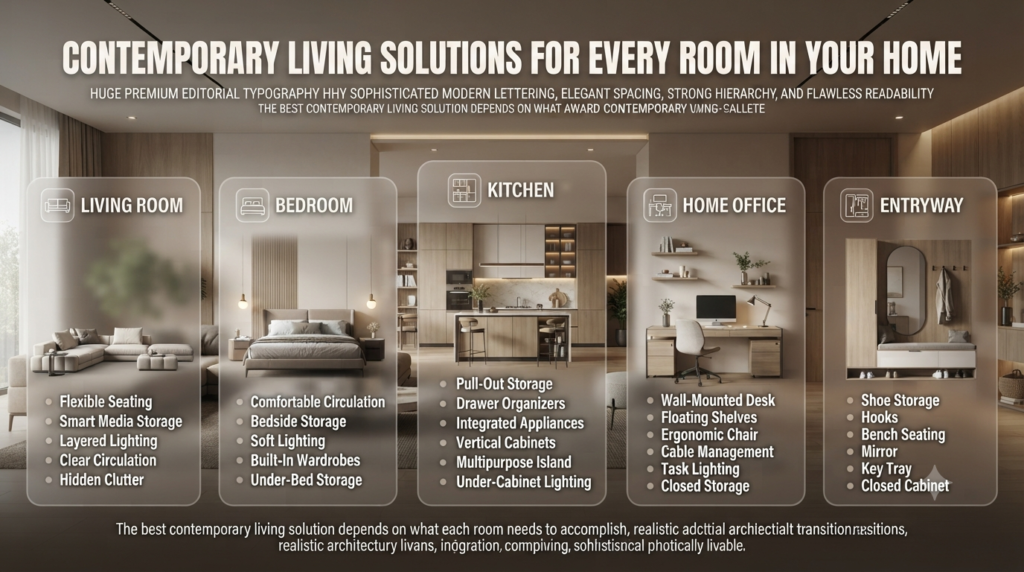
The best solution depends on what each room needs to accomplish.
Living Room
Focus on:
- Flexible seating
- Smart media storage
- Layered lighting
- Clear circulation
- Hidden clutter
A modular sofa can be especially useful when the room’s needs change frequently.
Bedroom
Prioritize:
- Comfortable circulation
- Bedside storage
- Soft lighting
- Built-in wardrobes
- Under-bed storage
Avoid filling the bedroom with unnecessary furniture. The room should support rest first.
Kitchen
Useful solutions include:
- Pull-out storage
- Drawer organizers
- Integrated appliances
- Vertical cabinets
- Multipurpose islands
- Under-cabinet lighting
Home Office
A dedicated room isn’t always necessary.
A compact workstation can be created using:
- Wall-mounted desk
- Floating shelves
- Ergonomic chair
- Cable management
- Task lighting
- Closed storage
Entryway
Don’t underestimate this small area.
A practical entryway can include:
- Shoe storage
- Hooks
- Bench seating
- Mirror
- Small tray for keys
- Closed cabinet for bags
This prevents everyday clutter from spreading into the rest of the home.
Contemporary Living Solutions for Renters
Renters often assume they can’t make meaningful design changes because they can’t renovate.
That’s not true.
Focus on reversible improvements such as:
- Freestanding storage
- Removable wallpaper
- Large rugs
- Plug-in wall lights
- Temporary shelving
- Curtains
- Artwork
- Modular furniture
- Decorative screens
Avoid making permanent changes without checking your lease first.
A renter can achieve a highly contemporary interior through furniture, lighting, textiles, and organization alone.
For smaller DIY upgrades, see DIY Projects.
What Are the Most Common Contemporary Interior Design Mistakes?
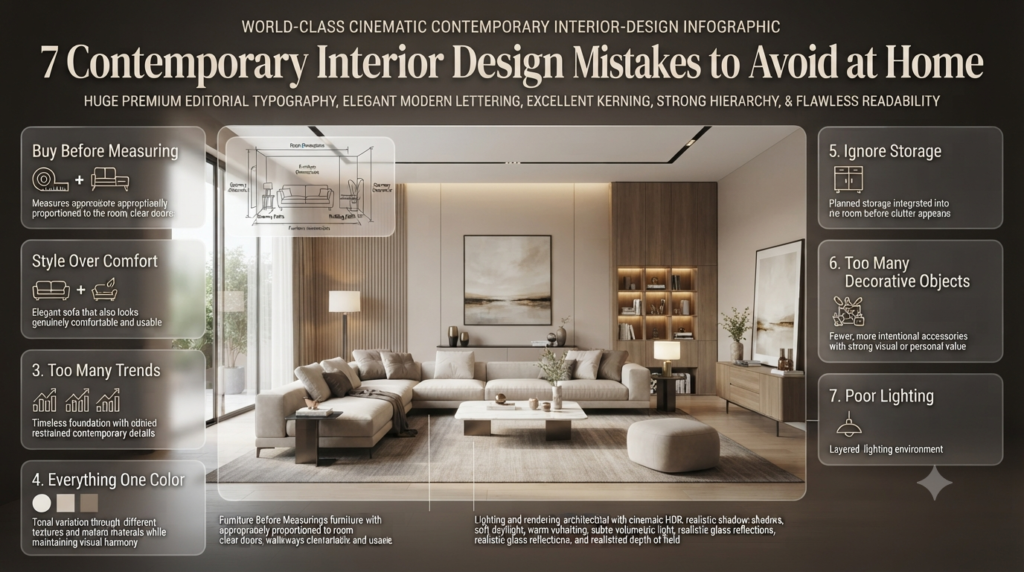
Even a well-planned concept can fail when practical details are ignored.
1. Buying Furniture Before Measuring
Why it happens: The furniture looks perfect online or in a showroom.
Why it’s harmful: It may overwhelm the room or block doors and walkways.
How to avoid it: Measure the room and the furniture before purchasing.
2. Choosing Style Over Comfort
A beautiful sofa is useless if nobody wants to sit on it.
Better approach: Test furniture whenever possible and prioritize comfort for pieces used daily.
3. Using Too Many Trends
Following every current trend can make an interior look inconsistent.
Better approach: Build around timeless foundations and add trends through smaller, replaceable elements.
4. Making Everything the Same Color
A monochromatic room can become flat.
Better approach: Use tonal variation through texture, materials, and subtle contrast.
5. Ignoring Storage
Decorating without planning storage usually creates clutter later.
Better approach: Determine where everyday items will live before finalizing the layout.
6. Overusing Decorative Objects
More accessories don’t automatically create a better interior.
Better approach: Display fewer pieces with stronger visual or personal value.
7. Poor Lighting
One ceiling fixture rarely creates a comfortable room.
Better approach: Combine ambient, task, and accent lighting.
How Should You Plan Contemporary Living Solutions Step by Step?
If you’re redesigning a room, don’t start by shopping. Start with the problem.
Step 1: Identify the Problem
Ask:
- What isn’t working?
- Where does clutter collect?
- Which activities compete for space?
- What feels uncomfortable?
Step 2: Measure the Room
Record:
- Length
- Width
- Ceiling height
- Doors
- Windows
- Built-ins
- Electrical outlets
Step 3: Define the Main Functions
Decide what the room must support.
For example:
Living room = relaxation + guests + occasional work
Step 4: Create the Furniture Layout
Place the largest pieces first.
Then consider:
- Walking paths
- Conversation areas
- Sightlines
- Storage
- Lighting
Step 5: Add Storage
Solve practical problems before adding decoration.
Step 6: Build the Lighting Plan
Decide where ambient, task, and accent lighting are needed.
Step 7: Choose Materials and Colors
Only after the functional structure is working should you finalize finishes and decorative elements.
Step 8: Add Personality
Finish with artwork, plants, books, ceramics, textiles, and objects that actually mean something to you.
📌 Quick Tip: If you can’t explain why an item belongs in a room, don’t automatically buy it. Contemporary design becomes stronger when every major element has a purpose.
Contemporary vs. Other Modern Interior Styles
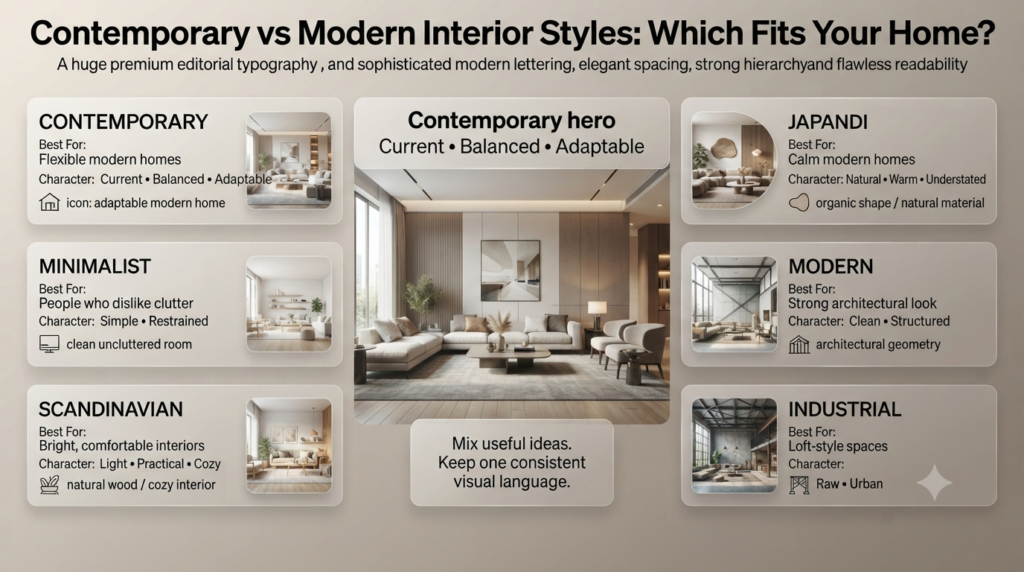
Different styles can solve different lifestyle needs.
| Style | Best For | Main Character |
| Contemporary | Flexible modern homes | Current, balanced, adaptable |
| Minimalist | People who dislike clutter | Simple and restrained |
| Scandinavian | Bright, comfortable interiors | Light, practical, cozy |
| Japandi | Calm modern homes | Natural, warm, understated |
| Modern | Strong architectural look | Clean and structured |
| Industrial | Loft-style spaces | Raw and urban |
You don’t have to follow one style perfectly.
Many successful homes borrow useful ideas from several styles while maintaining one consistent visual language.
Explore Interior Design Styles if you’re still deciding which direction suits your home.
Expert Advice: What Professionals Prioritize
When designing a contemporary home, professionals usually think beyond what looks good in photographs.
Prioritize Function Before Decoration
A room should work before it looks finished.
Invest in High-Use Items
Spend more carefully on:
- Sofa
- Mattress
- Dining chairs
- Lighting
- Frequently used storage
Save money on decorative items that can easily be replaced.
Design for the Future
Ask how the room might change over the next few years.
Will you need:
- A home office?
- More storage?
- Additional seating?
- Child-friendly furniture?
- Better accessibility?
Flexible design prevents expensive redesigns later.
Don’t Ignore Natural Light
Observe the room at different times of day before choosing colors and finishes.
A paint color that looks soft in a showroom may look completely different in strong afternoon sunlight.
Create Visual Breathing Room
Not every wall needs furniture.
Empty space isn’t wasted space when it improves movement, balance, and visual calm.
How Do Natural Materials Fit Into Contemporary Living?
Natural materials bring depth and warmth to modern interiors without making them look traditional.
Natural wood is especially versatile. It can be used for flooring, furniture, wall details, shelving, cabinetry, or decorative accents.
Pairing wood with stone, glass, metal, and soft fabrics creates contrast without excessive decoration.
For more inspiration, explore Natural Wood Interior.
Scandinavian and Japandi approaches also demonstrate how natural materials can make contemporary spaces feel more relaxed.
See Scandinavian Interior Design and Modern Japandi Interior for related approaches.
What are the best contemporary living solutions for small spaces?
Small homes don’t need to feel crowded. The most effective approach is to make every part of the room serve a clear purpose while keeping the floor visually open. Instead of filling the space with smaller pieces, choose fewer, better-proportioned items that offer flexibility or storage.
Practical solutions include:
Use multifunctional furniture, such as storage ottomans, sofa beds, nesting tables, and extendable dining tables.
Choose wall-mounted or floating storage where appropriate to free up floor space.
Use vertical areas for shelving and cabinets instead of spreading storage across the room.
Keep walking paths clear so the room feels easier to move through.
Choose furniture with visible legs to create a lighter visual appearance.
Use mirrors strategically to reflect natural light and increase the sense of openness.
Professional advice: Don’t assume that small furniture automatically makes a small room look bigger. Too many small pieces can actually make the space feel busy. One properly scaled sofa and a compact multifunctional table may work much better than several undersized items.
How can I make my home look contemporary without renovating?
You don’t need to knock down walls or replace the entire interior to create a contemporary home. In many cases, the biggest improvement comes from changing the layout, lighting, storage, color palette, and furniture, rather than carrying out structural work.
Start by removing furniture that isn’t serving a useful purpose. Then reorganize the remaining pieces to improve circulation and create clearer zones. Replace outdated lighting with layered lighting, introduce contemporary textiles, and use a restrained color palette to create visual consistency.
High-impact changes include:
Repositioning furniture
Adding modern lighting fixtures
Updating curtains and rugs
Introducing natural wood elements
Replacing bulky storage with cleaner alternatives
Reducing unnecessary decoration
Adding contemporary artwork
Improving cable management
Professional advice: Make functional improvements before buying decorative accessories. A room with better circulation and storage will usually feel more contemporary than a room simply filled with fashionable décor.
What furniture is best for contemporary living?
The best contemporary furniture isn’t simply furniture with a modern appearance. It should be comfortable, appropriately scaled, durable, and capable of supporting the way you actually use the room.
Multifunctional and flexible furniture is particularly valuable because contemporary homes often need to accommodate several activities. A modular sofa can change configuration, an extendable table can accommodate guests, and a storage bench can provide both seating and hidden organization.
Look for furniture with:
Clean but comfortable shapes
Practical proportions
Durable materials
Hidden or integrated storage
Flexible configurations
Easy-to-maintain upholstery
Neutral foundations that can work with changing décor
A useful rule: Spend more time selecting the sofa, bed, dining chairs, and other frequently used pieces than choosing decorative accessories. These items have a much greater effect on everyday comfort.
How do you make a contemporary home feel warm and cozy?
Contemporary design can sometimes feel too cold when it relies heavily on hard surfaces, stark colors, and minimal decoration. The solution isn’t to abandon the contemporary look; it’s to balance clean lines with natural materials, soft textures, warm lighting, and personal details.
Natural wood is particularly effective because it introduces warmth without making the room look traditional. Rugs, linen curtains, textured cushions, plants, ceramics, and warm-toned lighting can then add additional layers.
Try combining:
Natural wood + neutral walls
Soft textiles + structured furniture
Warm lighting + clean architectural lines
Plants + contemporary materials
Handmade accessories + simple surfaces
Earthy tones + subtle contrast
Professional advice: Warmth comes from layering, not from adding clutter. You don’t need dozens of accessories. A few tactile materials used consistently can make a contemporary room feel significantly more comfortable.
What are the biggest mistakes to avoid in contemporary interior design?
The biggest mistake is designing a home around appearance rather than real-life use. A room may look impressive in photographs but become frustrating when there isn’t enough storage, seating, lighting, or space to move comfortably.
Another common problem is buying furniture before measuring the room. An oversized sofa, dining table, or cabinet can quickly destroy the balance of a carefully planned interior.
Avoid these mistakes:
Buying furniture without measuring first
Choosing style over comfort
Using too many competing trends
Ignoring storage requirements
Relying on one ceiling light
Making every surface decorative
Using an overly restrictive color palette
Blocking natural light or walking routes
Purchasing technology without planning cable management
Copying a showroom instead of designing for your lifestyle
Professional advice: Before purchasing anything, ask one simple question: “What problem does this solve?” If the answer is unclear, the item probably isn’t necessary. Contemporary living works best when every major design decision has a practical reason behind it.
Conclusion
Contemporary living solutions are not about filling your home with the latest furniture or making every room look like a design showroom. They’re about creating a space that feels comfortable, organized, flexible, and genuinely suited to the way you live.
The strongest contemporary interiors begin with practical decisions. Good space planning improves movement, multifunctional furniture makes limited areas more useful, smart storage keeps clutter under control, and layered lighting creates the right atmosphere throughout the day. Natural wood, soft textiles, plants, and carefully selected accessories can then add warmth and personality without overwhelming the clean character of the space.
Most importantly, don’t try to change everything at once. Identify the biggest problem in your home first—whether it’s poor storage, an awkward layout, insufficient lighting, or unused space—and solve that problem before moving on to decoration.
Keep these principles in mind:
- Choose function before decoration.
- Invest in furniture you use every day.
- Make storage part of the design from the beginning.
- Keep furniture proportional to the room.
- Use lighting to create both function and atmosphere.
- Mix contemporary materials with natural textures for warmth.
- Avoid following trends that don’t suit your lifestyle.
- Leave enough visual and physical space for comfortable movement.
A successful contemporary home doesn’t simply look modern. It makes everyday life easier. When your layout, furniture, storage, lighting, and décor all work together, the result is a home that feels stylish today while remaining practical for years to come.

Leave a Reply