
Introduction
Questions to Ask an Interior Design Consultant | Choosing an interior design consultant can be exciting until you realize how many decisions are involved. You might want a more comfortable living room, a practical kitchen, a peaceful bedroom, or a complete home renovation. But without the right guidance, even a generous budget can be wasted on unsuitable furniture, poor layouts, unnecessary purchases, and finishes that don’t match your everyday needs.
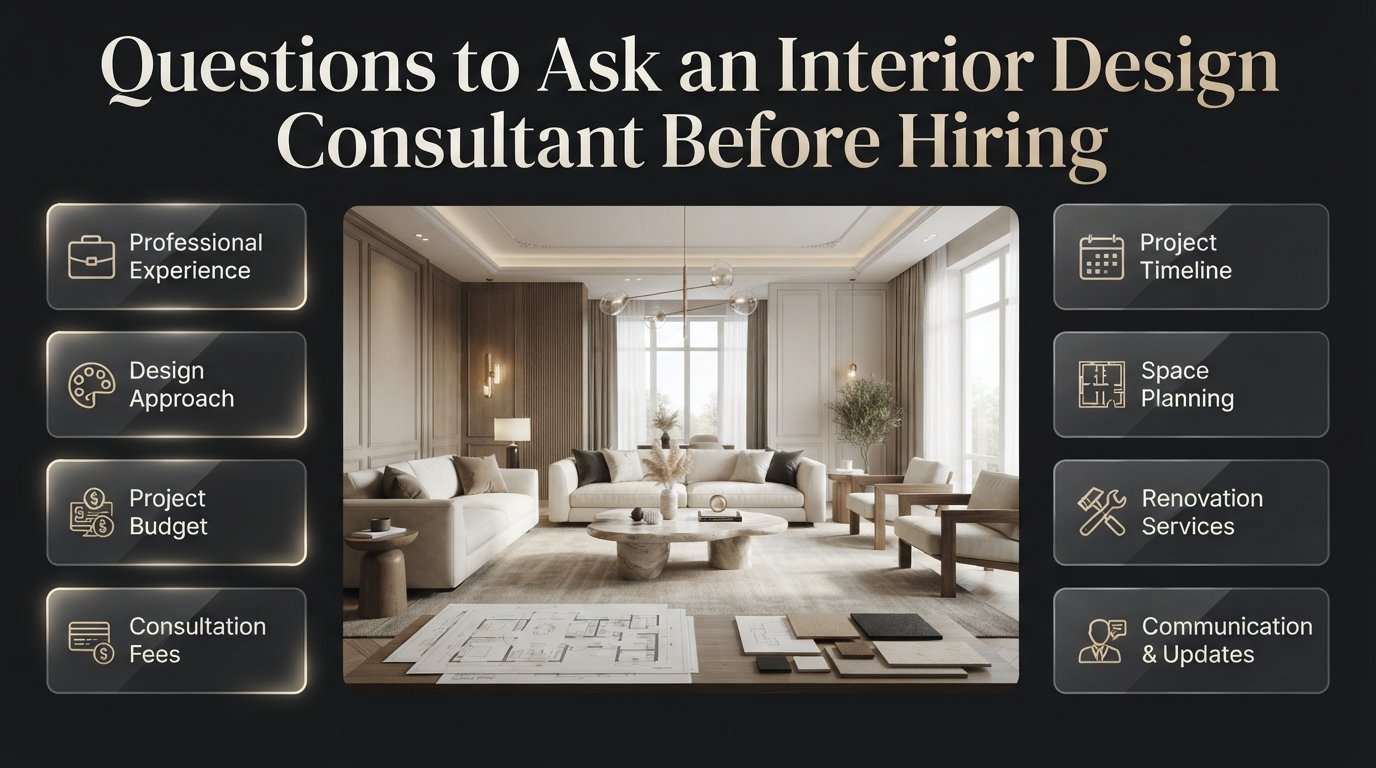
The smartest way to avoid these problems is to prepare the right questions to ask an interior design consultant before hiring one. A useful consultation should help you understand the professional’s experience, design approach, fees, project responsibilities, and ability to turn your ideas into a workable plan.
Whether you’re decorating a single room or improving an entire property, asking thoughtful questions helps you compare professionals fairly and make informed decisions. This guide covers what to ask, what good answers should include, which warning signs to watch for, and how to prepare for a productive consultation.
For more practical inspiration before planning your project, explore DesignMode24 Interior Design.
Why Is It Important to Ask Questions Before Hiring an Interior Design Consultant?
Asking questions before hiring an interior design consultant helps you understand whether their expertise, working methods, fees, and services match your project. It also establishes clear expectations about the final design, project timeline, purchasing decisions, and responsibilities before money is committed.
A consultant’s portfolio can show beautiful rooms, but photographs alone cannot tell you whether the professional manages budgets effectively, understands your lifestyle, or communicates clearly when problems arise.
Imagine hiring someone to redesign a small apartment. Their portfolio features spacious luxury homes, and you love the appearance of their work. However, your apartment needs additional storage, better natural light, and furniture that leaves enough room to move comfortably. If the consultant doesn’t understand these priorities, the finished space might look impressive without solving your actual problems.
That is why the first conversation should focus on more than appearance.
Before your meeting, clarify three things:
- Your priorities: Identify what isn’t working in your current space and what you want to improve.
- Your limitations: Establish your spending limit, available space, schedule, and maintenance preferences.
- Your expectations: Decide whether you need professional advice, design drawings, furniture recommendations, purchasing assistance, or complete project coordination.
The more clearly you communicate these points, the easier it becomes to evaluate the consultant’s recommendations.
1. What Questions Should You Ask About an Interior Design Consultant’s Experience?
Ask about the consultant’s completed projects, specialist knowledge, design philosophy, and experience with spaces similar to yours. The most useful answers explain how the professional solved real problems, not simply how attractive their previous projects looked.
Have You Worked on Projects Similar to Mine?
This question helps you determine whether the consultant understands your property’s size, layout, intended use, and likely challenges.
A professional who regularly designs compact apartments may be particularly skilled at space-saving furniture and clever storage. Someone experienced in kitchen renovations may have stronger knowledge of cabinetry layouts, work surfaces, appliance placement, and coordination with technical professionals.
Ask about projects involving:
- Similar property types and room dimensions.
- Comparable budgets and design expectations.
- Your preferred interior style.
- Similar renovation or furnishing requirements.
- Challenges such as awkward corners, limited daylight, or insufficient storage.
What a good answer looks like: The consultant describes a relevant project, explains the client’s original problem, and demonstrates how the proposed solution improved the space.
Can I See Completed Projects Rather Than Only Design Renderings?
A portfolio is important, but completed photographs provide different evidence from computer-generated visualizations.
A rendering shows what a proposed design is intended to look like. Photographs of a finished project help you evaluate how the design translated into a real environment.
Ask to see examples of finished rooms, before-and-after images, furniture arrangements, and material selections where available.
Pay attention to details such as:
- Whether furniture fits comfortably.
- Whether storage is practical and accessible.
- Whether lighting supports the room’s intended activities.
- Whether finishes appear consistent.
- Whether the overall arrangement looks usable rather than merely decorative.
⭐ Expert Tip: Ask the consultant to explain one difficult decision from a completed project. Their reasoning can reveal whether they understand practical design challenges or rely mainly on visual trends.
What Types of Interior Design Projects Do You Specialize In?
Some professionals focus on residential interiors, while others specialize in kitchens, bathrooms, commercial spaces, lighting, sustainable materials, or luxury properties.
Your choice should depend on the work you need.
For example, if you want to redesign several connected rooms, look for someone who understands how colors, furniture proportions, materials, and lighting can create a consistent atmosphere throughout the home.
If you are renovating a kitchen, relevant experience with storage, workflow, cabinetry, and appliance integration may be more important than general decorating experience.
Who Will Actually Work on My Project?
At larger design firms, the person who conducts your initial consultation may not complete every stage of the work.
Ask who will develop your design, prepare the drawings, coordinate purchasing, and respond to questions during implementation.
Also clarify who your main contact will be and whether the senior designer will review important decisions.
This question is especially useful when comparing a small independent consultant with a larger studio.
2. What Questions Should You Ask About Your Design Goals and Lifestyle?
Ask how the consultant will understand your household’s routines, personal preferences, storage needs, and long-term plans. A successful interior should support the way you live instead of simply copying a fashionable room or an attractive online reference image.
How Will You Understand My Lifestyle and Requirements?
Every household uses its rooms differently.
A family with young children may prioritize washable surfaces and durable furniture. Someone who works from home may need comfortable seating, suitable task lighting, and a quiet work area. A frequent host may want flexible seating and enough space for guests.
Explain your daily routines and ask how the consultant will incorporate them into the design.
Discuss:
- Who uses each room.
- Your preferred furniture arrangements.
- Storage and organization requirements.
- Children, pets, or frequent visitors.
- Cleaning and maintenance expectations.
- Accessibility and movement requirements.
- Existing belongings you want to retain.
A good consultant should listen carefully before recommending products or finishes.
Can You Work With My Preferred Interior Design Style?
You may prefer modern minimalism, contemporary luxury, traditional interiors, Japandi, industrial design, or a colorful eclectic look.
Ask how the consultant translates your preferred style into a cohesive plan.
Instead of sharing dozens of unrelated inspiration images, select a few examples and identify what attracts you to them. You might appreciate their warm lighting, natural textures, balanced furniture arrangements, or restrained color palettes.
This distinction matters because combining favorite elements without a clear plan can create an interior that feels visually disconnected.
How Will You Balance Style With Everyday Functionality?
A room can look beautiful while remaining uncomfortable or inconvenient to use.
An oversized sofa may restrict movement. Decorative pendant lights may leave work surfaces poorly illuminated. Floor-to-ceiling cabinets may provide storage but make a narrow room feel crowded.
Ask how the consultant will evaluate:
- Furniture dimensions and walking routes.
- Door openings and access to windows.
- Storage capacity and accessibility.
- Natural and artificial lighting.
- Cleaning and maintenance needs.
- Relationships between adjacent rooms.
For example, a smaller sofa with an appropriate seat depth may provide comfortable seating while preserving circulation in a compact living room. Understanding sofa seat depth selection can help you evaluate these recommendations.
Can You Incorporate My Existing Furniture and Decorations?
Replacing everything is rarely necessary.
You might own a high-quality dining table, a comfortable sofa, a family heirloom, or artwork that has personal meaning. Ask whether these pieces can become part of the new design.
The consultant should assess their dimensions, condition, style, color, and suitability for the planned layout.
Some pieces may work perfectly with new surroundings. Others might need different upholstery, refinishing, relocation, or replacement.
A professional who considers these possibilities can help you avoid unnecessary spending while creating a more personal home.
3. What Questions Should You Ask About the Interior Design Process?

Ask the consultant to explain the project from the initial assessment through design development, purchasing, installation, and final handover. Understanding each stage helps you identify when decisions are required, what documents you will receive, and how changes will be managed.
What Steps Are Included in Your Design Process?
The exact process varies by professional, but a residential project may include the following stages.
| Project stage | Typical activities | Questions to ask |
|---|---|---|
| Initial consultation | Discuss goals and requirements | Is the meeting paid? |
| Site assessment | Measure and inspect the space | Who verifies measurements? |
| Concept development | Establish layout and design direction | How many concepts are included? |
| Design development | Refine furniture, finishes, and lighting | How many revisions are allowed? |
| Documentation | Prepare plans and specifications | Which drawings will I receive? |
| Purchasing and coordination | Source products and coordinate suppliers | Are these services included? |
| Installation and handover | Arrange final placement and review | Who checks the completed work? |
Not every consultant offers every service. Some provide advice and recommendations only, while others manage several parts of the project.
Ask for a written list of included and excluded services.
Will You Provide Floor Plans, 3D Visualizations, and Material Boards?
The documents you need depend on the project’s complexity.
A simple bedroom refresh might require a furniture layout, color palette, and shopping list. A kitchen renovation may require detailed cabinetry plans, lighting layouts, elevations, and technical coordination.
Possible deliverables include:
- Dimensioned furniture layouts.
- Color and material selection boards.
- Lighting recommendations.
- Three-dimensional renderings.
- Furniture and fixture schedules.
- Elevations and detailed drawings.
- Product specifications and purchasing lists.
Ask whether these documents are included in the quoted fee or charged separately.
Remember that a 3D visualization communicates design intent. It does not automatically replace construction drawings, verified measurements, or technical documents prepared by appropriately qualified professionals.
How Many Design Revisions Are Included?
A revision is a change to a design after you have reviewed it.
Ask how many revision rounds are included, what qualifies as a revision, and how additional changes are priced.
Changing a paint color may be straightforward. Moving kitchen plumbing after drawings have been approved could require additional design work and coordination.
💡 Pro Tip: Collect feedback from everyone involved in the project before submitting your revision requests. A single, organized list reduces confusion and helps prevent unnecessary back-and-forth.
How Will You Explain Your Design Recommendations?
You should understand why the consultant recommends a particular layout, finish, product, or furniture arrangement.
Ask whether presentations will explain the practical benefits, drawbacks, maintenance requirements, and estimated costs of important choices.
A useful design presentation gives you enough information to make a decision confidently.
If you don’t understand a recommendation, ask for clarification before approving it.
4. What Questions Should You Ask About Interior Design Fees and Budget?
Ask for a written breakdown of the consultant’s fee structure, included services, exclusions, payment schedule, and potential additional charges. Understanding the full financial picture helps you compare proposals accurately and avoid discovering important costs halfway through the project.
How Do You Charge for Interior Design Services?
Interior design consultants may use different pricing structures.
| Fee structure | How it works | Common application |
|---|---|---|
| Hourly rate | Payment is based on time spent | Advice and smaller tasks |
| Fixed fee | A fee is agreed for a defined scope | Clearly defined projects |
| Percentage-based fee | The fee is calculated using an agreed project-cost basis | Some larger projects |
| Consultation fee | Payment covers an initial meeting or assessment | Professional advice |
| Package pricing | A defined set of services has a set price | Predictable project requirements |
Some professionals combine more than one structure.
For example, an initial consultation may be charged separately from a later design package. A consultant may also charge separately for purchasing assistance or site visits.
Ask what happens if the scope changes and whether there is a way to estimate or limit additional fees.
What Is Included in Your Fee, and What Costs Extra?
A low initial quote can be misleading if it excludes important services.
Request a breakdown covering:
- Design and consultation fees.
- Drawings and 3D visualizations.
- Furniture and decorative items.
- Materials, fixtures, and delivery.
- Contractor and installation expenses.
- Project supervision and site visits.
- Applicable taxes and other charges.
- Additional revisions and out-of-scope work.
Keep the consultant’s professional fee separate from the total project budget.
A proposal that includes design, procurement, and coordination should not be compared directly with one that covers only initial recommendations.
Can You Work Within My Actual Budget?
Give the consultant a realistic spending limit and explain what it needs to cover.
If your budget includes furniture, materials, labor, installation, and professional fees, make that clear from the beginning.
Ask how they would prioritize spending and which improvements would have the greatest impact.
For example, a living room might benefit more from a comfortable, appropriately sized sofa and better lighting than from expensive decorative accessories.
📌 Quick Tip: Divide your budget into essential improvements, desirable upgrades, and optional finishing touches. This makes it easier to adjust the plan without losing sight of your main goals.
How Do You Handle Unexpected Expenses?
Renovation projects can reveal hidden plumbing problems, damaged wiring, uneven floors, or other conditions that were not visible during the initial inspection.
Ask the consultant how unexpected expenses will be documented and approved.
A clear process should include:
- Identifying the problem and explaining its impact.
- Presenting possible solutions.
- Providing a revised estimate.
- Explaining any effect on the timeline.
- Obtaining your approval before additional work proceeds, except where urgent action is needed to address an immediate safety issue.
For broader renovation planning, explore the Home Improvement category.
Do You Receive Commissions or Discounts From Suppliers?
Furniture and material purchasing arrangements can affect your total spending.
Ask whether the consultant receives supplier commissions, trade discounts, procurement fees, or markups, and how those arrangements are reflected in your invoices.
These arrangements are not automatically a problem. The important issue is transparency.
You should understand who supplies the products, who invoices you, whether discounts are passed on, and what additional charges apply.
5. What Questions Should You Ask About Project Timelines?
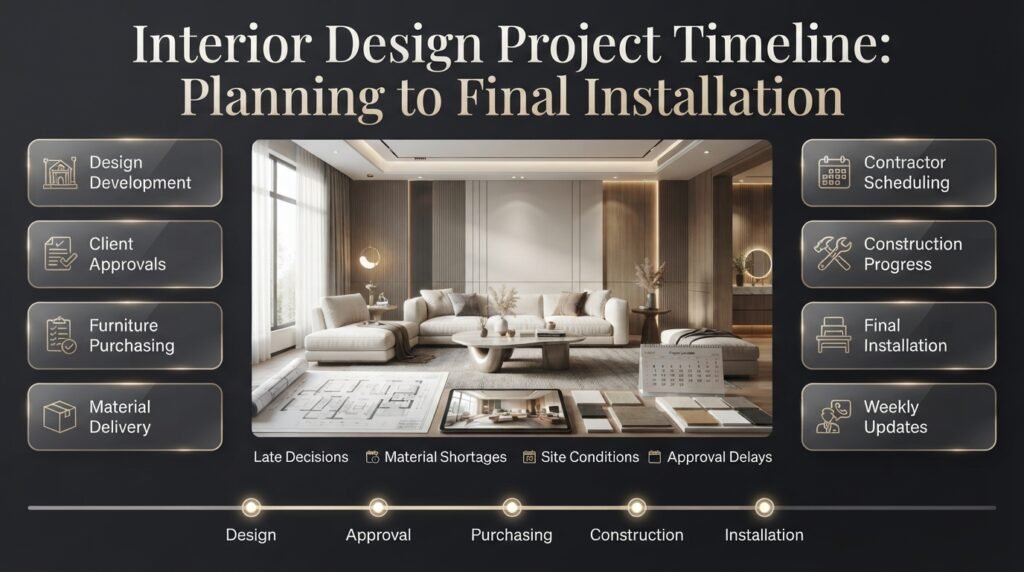
Ask for a realistic schedule that covers design development, approvals, purchasing, delivery, construction, and installation. You should also understand which decisions may delay progress and how changes will be communicated.
How Long Will My Project Take?
The timeline depends on the size of the project, existing conditions, the complexity of the design, and the availability of materials and contractors.
A decorative refresh may be completed relatively quickly. A renovation involving plumbing, electrical modifications, custom cabinetry, or structural changes generally requires more coordination.
Ask for a stage-by-stage estimate instead of relying on one completion date.
Clarify whether the schedule begins at contract signing, the first consultation, design approval, or another milestone.
What Could Delay the Project?
Common causes include:
- Late client decisions.
- Unavailable furniture or finishes.
- Custom manufacturing lead times.
- Contractor scheduling conflicts.
- Unexpected site conditions.
- Building-management or permit approvals.
- Changes after design approval.
Ask which decisions must be made early and whether suitable alternatives can be approved if a product becomes unavailable.
How Will You Keep Me Updated?
Agree on the preferred communication method, frequency, and person responsible for updates.
For example, you might request a weekly email covering completed work, upcoming decisions, outstanding purchases, and possible delays.
Important approvals should be recorded in writing, even when you usually communicate through calls or messages.
This creates a reliable record if questions arise later.
6. What Questions Should You Ask About Materials, Furniture, and Finishes?
Ask how the consultant evaluates material quality, durability, maintenance, availability, and price. The best recommendations should suit your design preferences and budget while performing well under the conditions in which they will be used.
How Do You Select Materials and Finishes?
A material that works well in a lightly used guest bedroom may not be suitable for a busy family living room.
Ask the consultant to compare recommended materials according to their intended use.
Consider:
- Durability and expected wear.
- Cleaning and maintenance requirements.
- Moisture and heat exposure.
- Texture, color, and appearance.
- Availability and replacement options.
- Purchase and installation costs.
For example, a household with young children may prioritize washable wall finishes and durable upholstery. A bathroom requires materials suitable for moisture exposure and appropriate slip resistance.
You can explore interior design guidance to learn more about coordinating materials and finishes.
Are the Recommended Products Durable and Easy to Maintain?
Avoid relying on descriptions such as premium, luxury, or commercial grade without checking the actual specifications.
For upholstery, ask about fabric construction, abrasion resistance, stain treatment, and cleaning instructions.
For flooring, consider wear resistance, moisture exposure, slip resistance, and repair requirements.
For cabinetry, examine hardware quality, surface durability, and the availability of replacement parts.
Ask whether you can review physical samples in your home before making major purchases.
Can You Suggest Alternatives at Different Price Points?
A professional should be able to explain where a higher-priced product provides a meaningful benefit and where a more affordable option may be sufficient.
For example, a custom-made side table may fit an unusual corner perfectly, while a ready-made alternative may deliver similar functionality at a lower cost.
Ask for alternatives that preserve the essential dimensions, performance, and appearance of the original recommendation.
This approach helps you control spending without compromising the parts of the design that matter most.
How Will You Create Visual Balance Between Furniture and Finishes?
A cohesive interior doesn’t require every room to look identical. It needs a sensible relationship between color, material, furniture proportions, lighting, and visual emphasis.
A large dark sofa can dominate a small room, while several small decorative pieces may look disconnected when grouped without a clear arrangement.
Ask how the consultant will balance large and small objects, distribute color, and coordinate finishes across adjoining spaces.
The principles explained in Visual Weight in Interior Spaces can help you understand why certain arrangements feel balanced while others appear crowded.
7. What Questions Should You Ask About Lighting and Smart Home Features?
Ask how the consultant will plan general illumination, task lighting, accent lighting, natural light, and any smart-home features you want. Lighting should support everyday activities while contributing to the mood and functionality of the room.
How Will You Plan Lighting for Each Room?
Different activities require different lighting conditions.
A kitchen needs useful task lighting around work surfaces. A bedroom benefits from comfortable ambient lighting and focused reading lights. A home office needs appropriate illumination that helps reduce glare on screens.
Ask whether the consultant will consider fixture placement, light distribution, color temperature, dimming, and the relationship between natural and artificial light.
The aim is to make lighting practical as well as attractive.
Can You Incorporate Smart Lighting and Automated Controls?
If you want dimmers, scheduled lighting, automated blinds, or app-controlled systems, discuss these features early.
Ask about compatibility, installation requirements, costs, maintenance, and whether the controls will be straightforward for everyone in the household.
Some systems require electrical planning or coordination with other devices, so adding them late may create unnecessary work.
Explore intelligent lighting for ideas about integrating lighting into a modern interior.
How Will You Prevent Glare and Poor Lighting Placement?
Poorly positioned fixtures can create shadows on work surfaces, uncomfortable glare, or uneven illumination.
Ask whether the lighting plan will account for windows, reflective surfaces, furniture positions, and the intended use of each area.
For instance, a pendant light centered in a room may not illuminate a desk placed near one wall effectively.
A good consultant considers furniture and lighting together instead of treating them as unrelated decisions.
8. What Questions Should You Ask About Storage and Furniture Placement?

Ask how the consultant will calculate storage needs, preserve walking space, and select furniture that fits the room. Effective space planning should make everyday activities easier while avoiding unnecessary clutter.
How Will You Calculate My Storage Requirements?
Storage needs depend on what you own, how often you use it, and where you need access to it.
Ask the consultant to consider everyday items rather than simply recommending the largest available cabinets.
A practical entryway, for example, might need space for shoes, coats, bags, keys, and cleaning supplies. A bedroom may require different combinations of hanging space, drawers, shelves, and seasonal storage.
Explore entryway storage capacity planning for ideas about organizing one of the busiest areas of the home.
Can You Make Use of Unusual or Underused Spaces?
Awkward corners, narrow walls, alcoves, and spaces beneath stairs can sometimes provide useful opportunities.
Ask whether these areas can accommodate shelving, compact furniture, or custom storage without making circulation difficult.
The answer depends on dimensions, access, safety, and how the space will be used.
For example, wall-mounted shelves may create storage without occupying valuable floor area. Review these wall shelves ideas when considering vertical storage.
How Will You Ensure Furniture Fits Properly?
Ask whether the consultant will measure the room and confirm the dimensions of major furniture items before purchase.
Measurements should account for door openings, window access, walking routes, and the space required to use drawers and cabinets.
A sofa might physically fit against a wall but still leave insufficient space for a coffee table or comfortable movement.
Confirming dimensions early can prevent expensive returns and frustrating layout changes.
9. What Questions Should You Ask About Kitchen and Bathroom Design?
Ask whether the consultant understands the functional requirements of kitchens and bathrooms, including workflow, storage, moisture exposure, lighting, and coordination with qualified trades. These rooms often require more technical planning than a straightforward decorative refresh.
How Will You Improve My Kitchen Layout?
A kitchen should support food preparation, cooking, cleaning, storage, and movement between work areas.
Ask how the proposed layout will accommodate appliances, work surfaces, cabinets, lighting, and the people using the room.
If you cook frequently, you may prioritize preparation space and accessible storage. If the kitchen doubles as a family gathering area, seating and circulation may be equally important.
The consultant should explain the reasoning behind the arrangement rather than recommending a layout simply because it looks fashionable.
For inspiration, explore Celebrity Kitchen Layout Features and consider which ideas are practical for your own space.
What Should I Know About Bathroom Materials and Fixtures?
Bathrooms require materials and fixtures suited to moisture, cleaning, and regular use.
Ask how the consultant will consider slip resistance, ventilation, waterproofing requirements, fixture placement, storage, and maintenance.
Also clarify who will coordinate technical details such as plumbing changes, electrical work, and waterproofing.
A decorative design proposal should not be treated as a substitute for the technical planning and installation work required for a safe, durable bathroom.
Can You Help Me Choose Between Custom and Ready-Made Cabinetry?
Custom cabinetry may provide a better fit for unusual dimensions or specific storage needs. Ready-made options can be more economical and may offer shorter delivery times.
Ask the consultant to compare the alternatives using:
- Available dimensions.
- Storage capacity.
- Material quality.
- Hardware and finish options.
- Installation requirements.
- Total cost and lead time.
The right choice depends on the space and your priorities, not on the assumption that custom work is always better.
10. What Questions Should You Ask About Contractors and Project Management?
Ask who will coordinate contractors, manage purchasing, review work, and resolve problems during implementation. Design advice and construction supervision are different services, so you should know exactly which responsibilities the consultant will accept.
Do You Manage Contractors or Only Provide Design Advice?
Some consultants prepare layouts, concepts, and specifications but leave construction coordination to the client.
Others offer procurement, contractor coordination, or project management under a separate agreement.
Clarify who will:
- Obtain and compare contractor quotations.
- Coordinate schedules and site access.
- Confirm measurements and specifications.
- Track deliveries and installation.
- Communicate design changes.
- Review completed work against the agreed design.
Don’t assume that hiring a designer automatically includes construction management.
Do You Work With Reliable Contractors and Suppliers?
Ask whether the consultant regularly works with carpenters, electricians, plumbers, installers, and furniture suppliers.
Recommendations can be useful, but you should still evaluate relevant qualifications, references, insurance where applicable, pricing, and contractual responsibilities.
Ask whether the consultant has any financial arrangement with recommended suppliers and whether it will be disclosed.
Who Is Responsible if Something Goes Wrong?
Responsibility should be defined in the relevant contracts.
For example, the designer may be responsible for agreed design deliverables within their scope, while the contractor may be responsible for workmanship and site safety under the construction agreement.
The exact allocation depends on the contracts, applicable law, and the services provided.
Ask how incorrect deliveries, defective work, installation problems, and disagreements will be reported and resolved.
11. What Questions Should You Ask About Contracts and Professional Credentials?
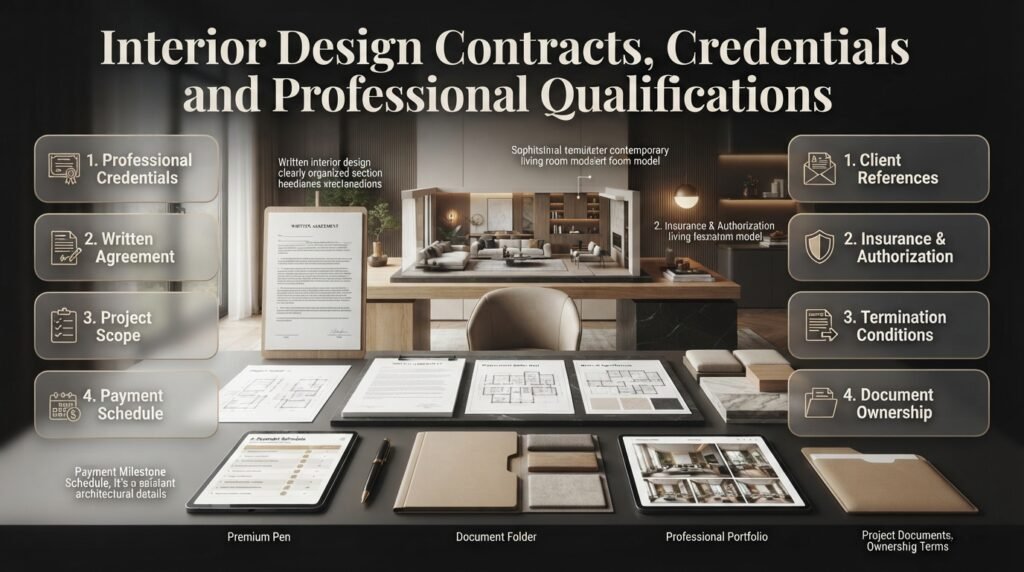
Ask for a written agreement defining the project scope, deliverables, fees, exclusions, payment schedule, revision policy, and responsibilities. Verify any professional credentials, insurance, registration, or approvals required for the services being provided in your location.
Are You Qualified and Properly Authorized for This Work?
Requirements vary by location and project type. Interior decoration, interior design, architecture, and engineering can involve different professional responsibilities.
Ask about relevant education, experience, professional memberships, registrations, and insurance.
If your project involves structural alterations, electrical changes, plumbing, or other regulated work, confirm that appropriately qualified professionals will handle the relevant technical responsibilities.
A portfolio alone does not establish that someone is authorized to perform every part of a renovation.
Will I Receive a Written Contract?
A written agreement helps prevent misunderstandings by recording what both parties have agreed to.
Before signing, check that it covers:
- The exact project scope.
- Included deliverables and revision limits.
- Fees, deposits, and payment milestones.
- Estimated dates and project dependencies.
- Purchasing and cancellation policies.
- Ownership or permitted use of design documents.
- Photography permissions, where relevant.
- Procedures for additional work and disputes.
- Termination conditions and outstanding payments.
Read the agreement carefully and ask for clarification before accepting unclear terms.
For a detailed checklist, review Interior Designer Contract Essentials.
Can I Contact Previous Clients?
References can help you understand how the consultant works after the initial presentation.
If possible, ask previous clients about communication, budget management, problem-solving, schedule changes, and whether the final result matched the agreed scope.
One or two relevant references may provide useful information that isn’t visible in a portfolio.
What Happens if I Want to End the Agreement?
This is an uncomfortable question, but it’s sensible to ask before committing.
Clarify what happens to deposits, completed work, outstanding invoices, purchased products, and design documents if either party terminates the agreement.
A clear termination clause helps both sides understand their obligations and reduces the risk of disputes.
12. What Questions Should You Ask Before Making Your Final Decision?
Before hiring a consultant, review the proposal, communication style, financial terms, and understanding of your priorities. The right professional should make the process clearer, not leave you uncertain about costs, responsibilities, or the next steps.
Ask these final questions:
- What makes your approach suitable for my project?
- What information do you still need from me?
- What challenges do you anticipate?
- Which decisions must I make first?
- What happens after I approve the proposal?
- How will we measure whether the project is successful?
- Can you summarize the scope, fees, exclusions, and next steps in writing?
How Can You Compare Two Interior Design Consultants?
Use the same evaluation criteria for each proposal instead of choosing solely on price or visual style.
| Evaluation factor | What to compare |
|---|---|
| Relevant experience | Similar completed projects |
| Design approach | How well the proposal addresses your needs |
| Total estimated cost | Fees, materials, and excluded services |
| Communication | Responsiveness and clarity |
| Timeline | Milestones and assumptions |
| Deliverables | Drawings, visualizations, and specifications |
| Project coordination | Defined responsibilities |
| Contract | Payment terms and change procedures |
A higher quote may include detailed drawings, purchasing assistance, and regular site visits. A lower quote may cover only consultation and concept development.
Compare the actual services and expected value before making a decision.
13. What Are the Most Common Mistakes When Hiring an Interior Design Consultant?
The most common mistakes include choosing a consultant based only on photographs, hiding budget limitations, overlooking contract details, and assuming that all design services include project management. These errors can create unnecessary expenses and disagreements.
Choosing a Consultant Based Only on Portfolio Images
Attractive images don’t necessarily demonstrate reliable project delivery or practical problem-solving.
How to avoid it: Review completed projects, ask about comparable work, and discuss how the consultant handled challenges.
Hiding Your Real Budget
Some clients share an unrealistically low budget because they fear the consultant will charge more.
This prevents the professional from making appropriate recommendations and can lead to major compromises later.
How to avoid it: Share your realistic spending limit and explain which expenses it must cover.
Ignoring Contract Details
Verbal promises can be difficult to resolve when disagreements arise over revisions, deliverables, or additional fees.
How to avoid it: Confirm important terms in writing before work begins.
Approving Materials Without Seeing Samples
Colors and finishes can look different under showroom lighting, natural daylight, and warm indoor illumination.
How to avoid it: Review physical samples in the actual room whenever possible. Consider how each material looks alongside neighboring finishes.
Making Major Changes Too Late
Changing a layout after furniture has been ordered or construction drawings have been approved can increase costs and delay progress.
How to avoid it: Review the concept carefully, collect feedback, and approve major decisions before purchasing or installation.
Assuming the Designer Will Handle Everything
Design consultation, purchasing, construction supervision, and contractor management are separate services unless the agreement specifies otherwise.
How to avoid it: Request a written responsibility list and identify who will manage each stage.
14. What Do Interior Design Experts Recommend Before Your First Consultation?
The most productive consultations begin with clear priorities, realistic financial limits, and a basic understanding of the problems you want to solve. Preparing these details helps the consultant provide relevant recommendations instead of spending the meeting guessing what you need.
Prepare a Simple Project Brief
Write a short summary covering:
- The rooms you want to improve.
- The problems you experience today.
- Your preferred style and reference images.
- Your approximate budget.
- Your target completion date.
- Furniture or decorations you want to retain.
- Household and maintenance requirements.
Basic photographs and approximate measurements can also be helpful.
You don’t need to prepare professional drawings. The purpose is to communicate your needs clearly.
Separate Essential Needs From Design Preferences
Create two lists before the meeting.
Essential requirements might include adequate wardrobe storage, comfortable seating, suitable task lighting, safe circulation, or a functional home office.
Design preferences might include decorative wall panels, a particular paint color, premium accessories, or a statement light fixture.
This distinction helps protect functionality if the budget becomes tight.
Ask for Reasons, Not Just Recommendations
Instead of asking, “Which sofa should I buy?” try asking, “Which sofa dimensions will preserve comfortable circulation while giving us enough seating?”
The second question encourages a solution based on your room rather than a particular product.
Use the same approach when discussing paint colors, lighting, storage, flooring, and furniture arrangements.
Consider Future Needs
Think about how your household might change over the next few years.
You may need a flexible guest room, additional storage, a work-from-home area, or more accessible movement between rooms.
Discussing these possibilities early can help prevent expensive redesigns later.
Document Decisions as You Go
Keep a shared record of approved layouts, finish selections, quotations, purchase decisions, and outstanding questions.
This habit reduces confusion when several people are involved and makes it easier to identify changes to the original plan.
If you enjoy tackling smaller improvements yourself, explore DIY Home Projects for ideas that may complement your consultant’s recommendations.
For decorative finishing touches, DIY Home Decor Crafts can provide inspiration for personalizing your space without redesigning everything.
What Questions Should I Ask an Interior Design Consultant Before Hiring One?
Before hiring an interior design consultant, ask about their experience, previous projects, design process, fees, estimated timeline, and the services included in their proposal. These questions help you understand whether the professional can meet your expectations, work within your budget, and create a design that suits your lifestyle. Don’t focus only on portfolio photographs; ask how they approach practical challenges and handle unexpected changes during a project.
Important questions to ask include:
Have you completed projects similar to mine?
What services and design deliverables are included in your fee?
How do you develop a design around my needs and budget?
How many revisions are included in the agreement?
Will you coordinate contractors, purchasing, and installation?
Can I review your contract and contact previous clients?
A consultant who answers these questions clearly makes it easier to establish realistic expectations before the project begins.
How Much Does an Interior Design Consultant Cost?
The cost of an interior design consultant depends on the project’s size, location, complexity, professional experience, and required services. Some consultants charge an hourly rate or a fixed consultation fee, while others offer packages or calculate their fees using an agreed percentage of the project cost. A consultation for furniture placement will generally involve a different level of work from a complete home renovation.
Before agreeing to a price, request a written estimate that explains what is included and which expenses are separate. Remember that professional design fees are not necessarily the same as your total project budget.
To avoid unexpected expenses, clarify these points:
Consultation and design fees: Confirm the cost of meetings, concepts, drawings, and revisions.
Furniture and materials: Establish whether purchasing costs are included in the estimate.
Additional services: Ask about site visits, contractor coordination, and installation supervision.
Unexpected expenses: Discuss how extra work is priced and approved.
The best proposal isn’t always the cheapest one. Compare the actual services, deliverables, and responsibilities before making your decision.
How Do I Know If an Interior Design Consultant Is Right for My Project?
The right interior design consultant understands your priorities, communicates clearly, explains design decisions, and recommends solutions that suit your space and budget. Their portfolio should demonstrate relevant experience, but their ability to listen and solve practical problems is equally important. A professional should be willing to discuss limitations, alternatives, and realistic expectations rather than promising results without understanding your requirements.
During the initial consultation, pay attention to how the consultant responds to your questions. Do they ask about your daily routine, storage requirements, preferred style, and maintenance needs? Can they explain why a particular layout or material would work better than another?
Use these points to evaluate their suitability:
Review completed projects similar to your own.
Ask for references from previous clients where available.
Evaluate the clarity of their proposal and communication.
Confirm that their approach respects your budget and preferences.
Check relevant qualifications and professional requirements for the work.
Make sure you feel comfortable discussing concerns and requesting clarification.
A good working relationship should be based on clear communication, realistic expectations, and mutual understanding—not simply an attractive portfolio.
What Should Be Included in an Interior Design Consultant’s Contract?
An interior design consultant’s contract should clearly describe the services being provided, the agreed fees, project deliverables, payment schedule, revision limits, estimated timeline, and responsibilities of both parties. It should also explain how additional work, purchasing arrangements, cancellations, and disputes will be handled. A written agreement helps prevent misunderstandings and gives you a clear reference throughout the project.
Before signing, read the document carefully and ask for clarification if any term is unclear. For example, a proposal may include design concepts but exclude detailed construction drawings or contractor supervision. Knowing this in advance helps you plan for any additional professional services you may need.
Check that the contract addresses:
Scope of work: Which rooms and services are covered?
Fees and payments: When are deposits and subsequent payments due?
Design revisions: How many changes are included, and what do extras cost?
Project responsibilities: Who handles contractors, orders, and site coordination?
Timeline and delays: What are the estimated milestones, and how are changes communicated?
Termination and disputes: What happens if either party needs to end the agreement?
For additional guidance, review Interior Designer Contract Essentials before committing to a professional service.
Can an Interior Design Consultant Help Me Stay Within My Budget?
An interior design consultant can help you manage your budget by prioritizing essential improvements, comparing materials, selecting appropriately sized furniture, and identifying where spending more provides meaningful value. Professional guidance can also help you avoid expensive mistakes, such as purchasing furniture that doesn’t fit or selecting finishes that aren’t suitable for your household’s needs.
However, staying within budget requires clear communication and timely decisions from both you and the consultant. Share your actual spending limit at the beginning and explain whether it includes professional fees, furniture, materials, labor, delivery, and installation. This gives the consultant a realistic basis for developing recommendations.
To manage your spending more effectively:
Prioritize essential improvements: Address functional problems before optional decorative upgrades.
Reuse suitable furniture: Retain quality items where they work with the new design.
Compare alternatives: Request products with similar performance at different price points.
Approve purchases in advance: Review costs before placing orders.
Plan for unexpected expenses: Set aside an appropriate contingency based on the project’s risks.
Consider a phased approach: Complete the most important work first and postpone nonessential upgrades.
The goal isn’t simply to spend less. It’s to make informed decisions so that your money supports a comfortable, functional, and cohesive interior.
Conclusion
Choosing the right interior design consultant starts with asking the right questions. Before making a decision, take time to understand the consultant’s experience, design process, pricing structure, communication style, project timeline, and approach to managing unexpected challenges. These conversations help you determine whether the consultant understands your vision, respects your budget, and can deliver practical solutions that suit your lifestyle.
A professional consultation should give you more than attractive design ideas. It should help you make informed decisions about space planning, furniture selection, lighting, materials, functionality, and long-term value. Whether you are updating a single room or planning a complete home transformation, clear expectations from the beginning can reduce misunderstandings, unnecessary expenses, and costly changes later. Reviewing the agreement carefully is equally important, as it establishes the responsibilities, deliverables, payment terms, and boundaries of the project.
If you are exploring ideas before hiring a professional, visit DesignMode24 Interior Design for practical inspiration and guidance to help you plan a space that reflects your preferences. Compare your options carefully, discuss your priorities openly, and choose a consultant who listens to your needs rather than simply promoting a particular design style.
Ultimately, the best interior design consultant is someone who combines creativity with practical knowledge, transparent communication, and a clear understanding of your goals. By asking thoughtful questions before committing, you can build a stronger working relationship, make confident design decisions, and create an interior that feels comfortable, functional, and genuinely yours.