
Introduction
Intelligent Lighting | Imagine coming home in the evening and finding your hallway softly illuminated without touching a switch. The living room lights are already at a comfortable level, the bedroom is using a warmer glow, and the kitchen becomes brighter when you start preparing dinner.
This is the practical side of intelligent lighting.
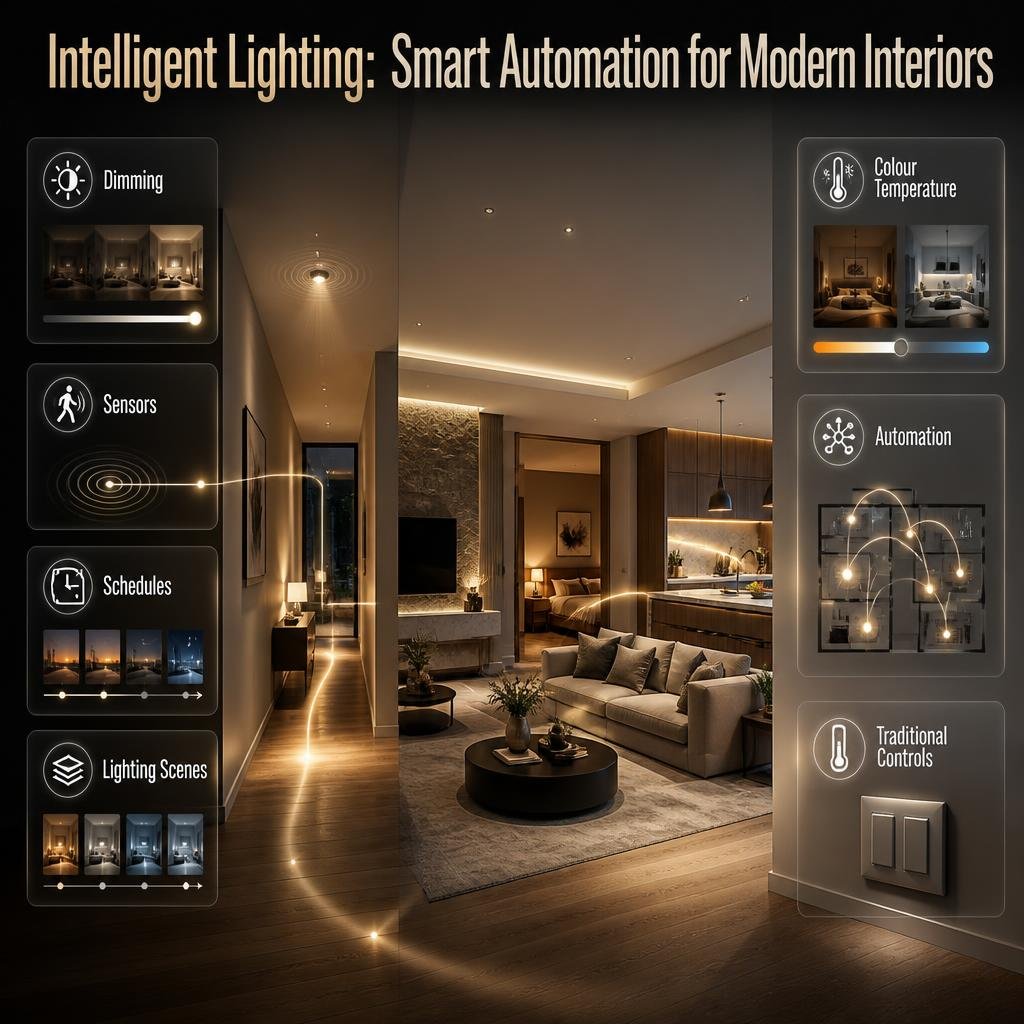
It isn’t simply about putting smart bulbs throughout a house or controlling lights from a phone. Intelligent lighting is about creating a lighting environment that responds to the way you live. It can combine dimming, sensors, schedules, lighting scenes, colour temperature, automation, and traditional controls to make rooms more functional and comfortable.
For homeowners planning a modern interior, lighting also has a much bigger role than simply making a room visible. It can influence how colours appear, highlight architectural details, make furniture look more refined, and change the atmosphere of an entire space.
In this guide, you’ll learn how intelligent lighting works, where it makes the most sense, how to plan it room by room, what features are genuinely useful, which mistakes to avoid, and how to integrate smart lighting with an elegant interior without making the home feel overly technical.
What Is Intelligent Lighting?
Intelligent lighting is a lighting system that uses connected technology, automation, sensors, controls, or programmed settings to manage light more intelligently than a conventional on/off system.
Instead of treating every light as an isolated fixture, intelligent lighting allows different lights and controls to work together.
Depending on the system, you may be able to control:
- Brightness
- Colour temperature
- Light schedules
- Motion activation
- Multiple fixtures together
- Lighting scenes
- Remote operation
- Voice commands
- Day and night routines
- Occupancy-based lighting
A traditional light generally follows a simple instruction:
Switch on → Light on
An intelligent system can follow a more useful sequence:
Detect movement → Check time → Check lighting conditions → Activate appropriate brightness → Turn off automatically
That difference is what makes intelligent lighting useful in everyday life.
The technology can be simple or highly advanced. A single dimmable smart bulb can be considered part of an intelligent lighting setup, while a whole-home system may connect dozens of fixtures, sensors, switches, curtains, and other controls.
For homeowners developing a wider design strategy, DesignMode24 Interior Design can also provide a useful starting point for connecting lighting decisions with the overall interior rather than treating lighting as a separate project.
Why Is Intelligent Lighting Important in Interior Design?
Lighting is one of the elements that can completely change how an interior feels.
You can have beautiful furniture, carefully selected wall colours, expensive flooring, and attractive accessories, but poor lighting can make the entire room feel flat or uncomfortable.
Intelligent lighting gives you more control over that experience.
A living room, for example, doesn’t perform one function throughout the day. In the morning, you may need brighter general illumination. In the afternoon, natural daylight might do most of the work. In the evening, you may want softer, warmer light for relaxing.
A conventional lighting system can make those changes difficult.
An intelligent system can create different settings for different situations.
This is especially valuable in homes where one room serves several purposes.
A living room might function as:
- A family room
- A reading area
- A television space
- A place for entertaining
- A work area
- A quiet evening space
The lighting should be able to respond to those activities.
How Does Intelligent Lighting Work?
Most intelligent lighting systems combine several components rather than relying on one device.
A basic setup can include:
Smart light → Wireless connection → App or switch → User control
A more advanced system might work like this:
Sensor → Control system → Automation rule → Light response
For example, imagine a hallway after sunset.
A motion sensor detects someone entering.
The system checks the time.
Because it’s nighttime, the automation activates the hallway light at a lower brightness rather than using the full daytime setting.
After the person leaves, the light turns off automatically.
That is a simple example, but the same principle can be expanded across an entire home.
Intelligent lighting can respond to:
- Time
- Motion
- Occupancy
- User commands
- Preset schedules
- Daylight conditions
- Other connected systems
The exact capabilities depend on the equipment and control platform.
Does Intelligent Lighting Need an App?
Not necessarily.
An app can be useful for configuration and remote control, but a well-planned system shouldn’t force you to use a phone every time you want to turn on a light.
Physical switches, dimmers, sensors, and voice controls can all be part of an intelligent lighting strategy.
This is particularly important in family homes.
Guests shouldn’t have to download an application just to turn on a bedroom light.
A good system makes advanced features available while keeping basic controls familiar.
What Are the Main Benefits of Intelligent Lighting?
1. Better Control Over Brightness
One of the simplest but most useful intelligent lighting features is dimming.
A room doesn’t always need the same amount of light.
You might need brighter lighting while cleaning but prefer a softer level while watching television.
Dimming gives you control over the atmosphere without changing fixtures.
This can also help a room transition naturally between daytime and evening use.
2. More Comfortable Atmosphere
Lighting can affect how relaxed or energetic a room feels.
Bright lighting may be useful for active tasks, while softer illumination can create a calmer evening environment.
Intelligent lighting allows these changes to happen without physically replacing lamps or fixtures.
3. Automation
Automation can remove small repetitive tasks.
For example:
- Hallway lights activate when someone enters.
- Exterior lights follow a schedule.
- Bedroom lighting gradually increases in the morning.
- Selected lights switch off at bedtime.
- Living-room lighting changes in the evening.
These small improvements can make a home feel easier to operate.
4. Better Use of Different Rooms
A room can have several lighting settings for different activities.
This is particularly useful in open-plan interiors where one area may need to support multiple functions.
5. Potential Energy Savings
Automation can help prevent lights from being left on unnecessarily.
Motion sensors, schedules, and occupancy-based controls can reduce unnecessary usage.
However, intelligent lighting doesn’t automatically make a home energy efficient. Efficient fixtures, appropriate brightness, good habits, and sensible automation still matter.
6. Improved Interior Appearance
Light can highlight textures, artwork, furniture, shelves, plants, architectural features, and decorative details.
Instead of illuminating everything equally, intelligent lighting can direct attention toward the elements that deserve it.
That makes lighting part of the design rather than simply an electrical requirement.
What Are the Different Types of Intelligent Lighting?
There isn’t just one type of intelligent lighting.
Different technologies solve different problems.
Smart Bulbs
Smart bulbs replace conventional bulbs and add connected controls.
They are useful when you want a relatively simple upgrade without changing the entire electrical system.
They can provide features such as:
- Dimming
- Scheduling
- Colour temperature adjustment
- Colour control
- Remote access
- Voice control
They are particularly useful for lamps, bedrooms, small upgrades, and situations where permanent electrical changes aren’t desirable.
Smart Switches
Smart switches replace conventional wall switches and control lighting circuits.
They can be useful when you want the normal wall-switch experience while adding automation.
They’re often suitable for permanent installations, although wiring and electrical compatibility must be checked before installation.
Smart Dimmers
Smart dimmers provide more precise control over brightness.
They’re especially useful in:
- Bedrooms
- Living rooms
- Dining rooms
- Media rooms
- Relaxation areas
Motion Sensors
Motion sensors activate lights when movement is detected.
They’re particularly practical in:
- Hallways
- Staircases
- Bathrooms
- Storage rooms
- Wardrobes
- Entrances
Daylight Sensors
Daylight-sensitive systems can adjust lighting based on natural light conditions.
This can be useful in rooms with large windows where artificial lighting requirements change throughout the day.
Smart Bulbs vs Smart Switches: Which Should You Choose?
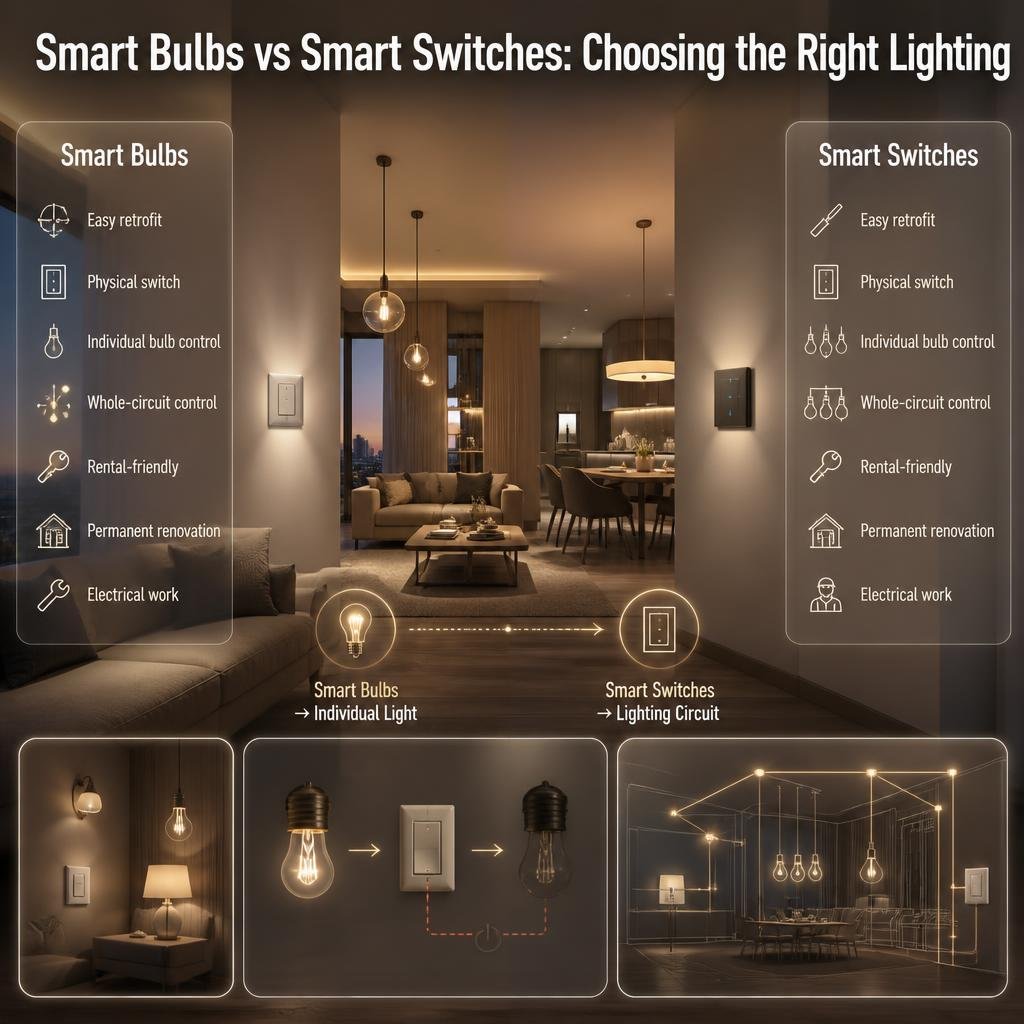
The decision depends on how permanent and comprehensive you want your lighting system to be.
| Feature | Smart Bulbs | Smart Switches |
|---|---|---|
| Easy retrofit | Usually easier | May require installation |
| Physical switch | Existing switch may remain | Integrated |
| Individual bulb control | Excellent | Depends on circuit |
| Whole-circuit control | Limited | Strong |
| Rental-friendly | Often suitable | Usually less suitable |
| Permanent renovation | Useful in selected areas | Often practical |
| Electrical work | Usually minimal | May require professional installation |
For a rental property or simple upgrade, smart bulbs can be convenient.
For a new-build or major renovation, smart switches and planned circuits may provide a cleaner long-term solution.
⚠ Common Mistake: Don’t buy smart bulbs for every fixture without thinking about the physical switches. If someone repeatedly switches the wall control off, the smart bulb loses power and becomes unavailable.
How Should Intelligent Lighting Be Planned Room by Room?
The best approach is to start with what happens in the room.
Don’t ask:
“Where can I put smart lights?”
Ask:
“What does this room need the lighting to do?”
That small change in thinking produces a much better result.
Intelligent Lighting for the Living Room
Living rooms usually benefit from layered lighting rather than one powerful ceiling fixture.
A balanced setup can include:
- General ceiling lighting
- Floor lamps
- Table lamps
- Accent lighting
- Wall lighting
- Decorative lighting
- Dimmable fixtures
Intelligent controls allow these layers to work together.
For example, a reading scene might provide stronger light near a chair while keeping the rest of the room softer.
A movie scene could reduce general lighting while leaving subtle accent lighting active.
An entertaining scene could create balanced illumination across seating and circulation areas.
The goal is flexibility.
For homeowners working on the overall character of the space, Elegant Spaces offers useful inspiration for creating interiors where lighting contributes to a refined atmosphere.
Intelligent Lighting for the Bedroom
Bedroom lighting needs to support both practical activities and relaxation.
A strong bedroom lighting plan may include:
- General ceiling lighting
- Bedside lighting
- Wardrobe lighting
- Accent lighting
- Low-level nighttime lighting
- Dimmable fixtures
Intelligent controls can make these layers easier to manage.
A morning scene can gradually increase brightness.
An evening scene can reduce brightness and use warmer illumination.
A nighttime setting can leave only a subtle pathway light active.
This approach works particularly well when lighting is planned alongside the furniture and circulation of the bedroom.
For a complete room-design approach, explore Bedroom Interior Design.
If you’re deciding where the bed, wardrobes, switches, lamps, and lighting should be positioned, Bedroom Planning and Layout can help connect those decisions.
For a more contemporary aesthetic, Modern Bedroom Design can also complement the discussion of clean, integrated lighting.
Intelligent Lighting for the Kitchen
The kitchen requires functional lighting first.
Decorative effects are useful, but they should never replace good task lighting.
Important lighting layers include:
- General illumination
- Countertop lighting
- Cabinet lighting
- Sink lighting
- Dining lighting
- Pantry lighting
Under-cabinet lighting can be particularly valuable because overhead fixtures can create shadows across work surfaces.
Intelligent controls can allow different zones to operate independently.
For example:
Cooking → bright task lighting
Breakfast → moderate general lighting
Evening → softer dining lighting
This is much more useful than simply installing colour-changing bulbs throughout the kitchen.
Intelligent Lighting for the Bathroom
Bathroom lighting needs to be practical and comfortable.
Important areas include:
- General illumination
- Mirror lighting
- Shower-area lighting where appropriate
- Low-level nighttime lighting
Mirror lighting deserves particular attention because poorly positioned lights can create shadows across the face.
Intelligent controls can provide brighter lighting during grooming while allowing softer illumination at night.
Always consider appropriate electrical requirements and fixture ratings when planning bathroom lighting.
Intelligent Lighting for a Home Office
A home office needs lighting that supports concentration without creating unnecessary glare.
Intelligent lighting can provide different settings for:
- Focused work
- Reading
- Video calls
- Evening work
- Break periods
The light should illuminate the working surface without creating distracting reflections on screens.
Colour temperature can also influence the visual character of the workspace, so adjustable lighting can be useful when the room is used at different times.
Intelligent Lighting for Hallways and Stairs
Hallways are one of the strongest applications for automation.
People often pass through them briefly and don’t want to search for switches.
A motion sensor can activate the light when someone enters and switch it off after a defined period.
Nighttime settings can use reduced brightness so that the light provides visibility without becoming unnecessarily harsh.
This can be particularly useful for:
- Children
- Older adults
- Guests
- Late-night movement
- Staircases
How Does Colour Temperature Affect Intelligent Lighting?
Colour temperature describes the visual warmth or coolness of a light source.
Warm lighting generally feels softer and more relaxing.
Neutral lighting can provide a balanced appearance for everyday activities.
Cooler lighting can appear more crisp and may suit certain task-focused environments.
The important point is that there isn’t one perfect colour temperature for every room.
A bedroom may benefit from warmer evening light.
A kitchen work area may need a more neutral appearance.
A home office may require lighting that provides clear visibility without excessive warmth.
Intelligent systems can make these transitions easier when the fixtures support adjustable colour temperature.
Why Does Intelligent Lighting Matter for Paint Colours?
Light and paint are closely connected.
The same wall colour can look noticeably different under:
- Natural daylight
- Warm artificial light
- Neutral artificial light
- Cooler lighting
- Dimmed lighting
- Accent lighting
This is why paint should never be judged from a tiny sample under only one lighting condition.
If you’re working on colour planning, the Paint Color section can provide broader ideas for coordinating colours and lighting.
💡 Pro Tip: Test important paint samples at different times of day. A colour that looks perfect at noon may look significantly warmer or darker under evening lighting.
How Can Intelligent Lighting Work With Wall Treatments?
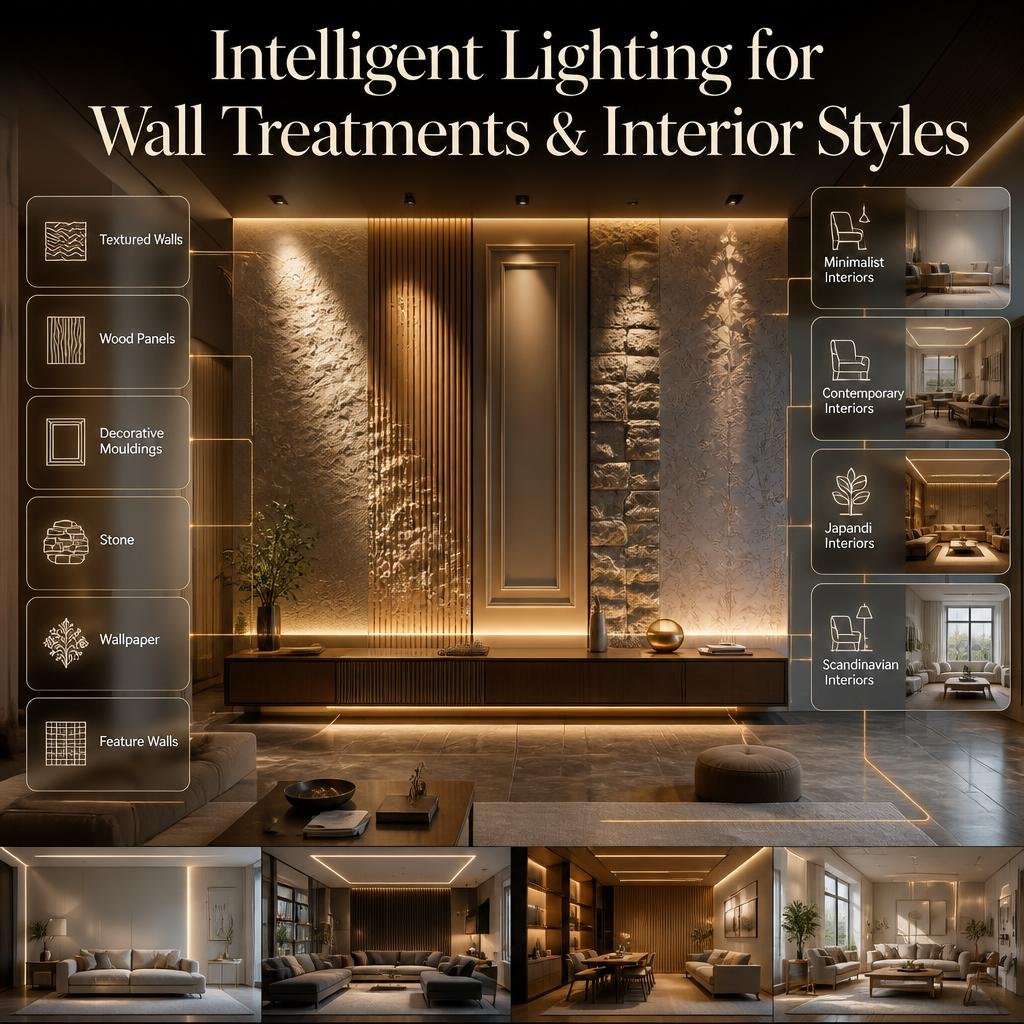
Wall treatments often depend heavily on light.
Textured surfaces, wood panels, decorative mouldings, stone, wallpaper, and feature walls can look completely different depending on where the light comes from.
A light positioned directly toward a textured wall may reveal its depth.
A light positioned at an angle can create stronger shadows and make texture more dramatic.
This is where intelligent lighting becomes particularly valuable.
You can use different lighting levels depending on whether you want the wall treatment to be subtle or prominent.
When planning these combinations, Wall Treatments provides useful context for understanding how surfaces become part of the overall room composition.
Can Intelligent Lighting Work With Different Interior Styles?
Yes.
Intelligent lighting isn’t limited to futuristic interiors.
It can work with almost any design direction.
Minimalist Interiors
Minimalist spaces benefit from clean lighting and reduced visual clutter.
Intelligent controls can help keep the room visually simple by reducing the need for multiple visible control devices.
The technology can remain largely invisible.
For additional inspiration, see Minimalist Interior Design.
Contemporary Interiors
Contemporary interiors often work well with integrated lighting, recessed fixtures, linear lighting, concealed LEDs, and clean controls.
The technology can become part of the architecture rather than appearing as an add-on.
Japandi Interiors
Japandi spaces rely heavily on warmth, simplicity, natural materials, and controlled visual elements.
Lighting is especially important because it helps create warmth without adding unnecessary decoration.
A carefully programmed intelligent lighting system can support this atmosphere by creating softer evening settings and balanced daytime illumination.
Scandinavian Interiors
Scandinavian-inspired interiors often depend on natural light and comfortable artificial lighting.
Intelligent controls can help respond to changing daylight and create warmer settings during darker periods.
Can Natural Materials Be Combined With Smart Lighting?
Absolutely.
Technology doesn’t mean a room has to look cold or futuristic.
Natural wood, stone, linen, textured fabrics, plants, and warm finishes can work beautifully with modern lighting.
In fact, controlled lighting can make natural materials look even more attractive.
For example, warm directional lighting can emphasize the grain of wood.
Soft illumination can bring out texture in stone.
Accent lighting can highlight natural decorative elements.
If you’re interested in this relationship, Natural Wood Interior provides useful design inspiration for combining natural materials with modern interiors.
What Is a Lighting Scene?
A lighting scene is a predefined combination of lighting settings designed for a particular activity or moment.
Instead of controlling each fixture separately, you activate one scene.
Useful examples include:
Morning Scene
- Gradually increase bedroom brightness
- Illuminate circulation areas
- Provide comfortable kitchen lighting
Relax Scene
- Reduce ceiling lighting
- Increase lamp lighting
- Use warmer illumination
- Highlight selected decorative features
Dinner Scene
- Moderate dining lighting
- Softer surrounding illumination
- Accent lighting where appropriate
Movie Scene
- Reduce general brightness
- Keep pathways visible
- Use subtle accent lighting
Night Scene
- Minimal illumination
- Low-level pathway lighting
- Reduced bedroom brightness
⭐ Expert Tip: Don’t create dozens of scenes just because your system allows them. Three to six genuinely useful scenes are usually easier for a household to understand and use.
How Do You Plan Intelligent Lighting Step by Step?
Step 1: Audit Existing Lighting
Walk through every room.
Write down:
- Which lights are frequently used
- Which lights are rarely used
- Which areas are too dark
- Which areas are too bright
- Which switches are inconvenient
- Which lights are commonly forgotten
This identifies actual problems.
Step 2: Identify the Purpose of Each Light
Every fixture should have a reason.
Ask whether it provides:
- Ambient lighting
- Task lighting
- Accent lighting
- Decorative lighting
- Safety lighting
If you can’t explain what a fixture is doing, reconsider whether you need it.
Step 3: Plan Lighting Layers
Avoid depending on a single light source.
Combine different levels and directions of illumination.
For example:
Ambient + Task + Accent = Flexible Room
Step 4: Decide Which Lights Need Automation
Not every fixture needs to be smart.
Prioritize lights where automation genuinely improves the experience.
Step 5: Select the Control Method
Choose between:
- Physical switches
- Dimmers
- Smart bulbs
- Sensors
- App controls
- Voice controls
- Scenes
Step 6: Check Compatibility
Before buying products, confirm that your selected devices work together.
Check:
- Voltage
- Fixture requirements
- Switch compatibility
- Wireless technology
- Hub requirements
- App support
- Voice platform support
Step 7: Install and Test
Test every lighting zone.
Check the brightness, colour, automation, sensor response, and physical controls.
Step 8: Simplify
After living with the system, remove unnecessary automations.
The final system should feel easier than the original one.
What Are the Biggest Intelligent Lighting Mistakes?

Mistake 1: Making Every Light Smart
Why it happens: Homeowners assume more technology means a better system.
Why it’s harmful: More devices mean more setup, maintenance, and potential compatibility problems.
Better approach: Automate important areas first.
Mistake 2: Ignoring Basic Lighting Design
Why it happens: Smart features receive more attention than fixture placement.
Why it’s harmful: A smart light positioned badly is still badly positioned.
Better approach: Plan light direction, brightness, glare, and function first.
Mistake 3: Using One Lighting Setting All Day
Why it happens: It seems easier.
Why it’s harmful: Morning, afternoon, evening, and nighttime have different lighting requirements.
Better approach: Create simple time-based or activity-based scenes.
Mistake 4: Using Too Many Colours
Why it happens: Colour-changing lighting looks exciting.
Why it’s harmful: Constant colour changes can make a sophisticated interior feel visually chaotic.
Better approach: Use colour lighting selectively and prioritize comfortable white-light settings for everyday use.
Mistake 5: Forgetting Physical Controls
Why it happens: Homeowners focus heavily on apps and voice control.
Why it’s harmful: Guests and family members may prefer conventional switches.
Better approach: Keep intuitive manual controls available.
Mistake 6: Ignoring Glare
Why it happens: Brightness is confused with good lighting.
Why it’s harmful: Excessive glare can make a room uncomfortable.
Better approach: Position fixtures carefully and use diffused or indirect light where appropriate.
Mistake 7: Adding Lighting After Furniture Planning
Why it happens: Lighting is treated as the final decorative step.
Why it’s harmful: Furniture may block light, create shadows, or make switches difficult to reach.
Better approach: Coordinate lighting and furniture layouts together.
Mistake 8: Installing Technology Without Considering the Rest of the Interior
Why it happens: Smart products are purchased independently.
Why it’s harmful: Visible wires, mismatched controls, and poorly positioned devices can disrupt an otherwise polished interior.
Better approach: Consider technology as part of the complete design.
How Can Furniture Planning Improve Intelligent Lighting?
Furniture changes how people move through a room and where lighting is required.
A reading chair needs useful light.
A dining table needs appropriate illumination.
A bed needs accessible controls.
A sofa may require ambient lighting behind or beside it.
A kitchen island needs task lighting.
This is why furniture placement and lighting should be coordinated rather than planned separately.
For example, if a floor lamp is intended to provide reading light, the chair should be positioned where the lamp can actually serve it.
Similarly, a bedside light should be reachable without forcing someone to get out of bed.
This sounds simple, but these small decisions have a major impact on everyday comfort.
Can Intelligent Lighting Support a DIY Home Project?
Some intelligent lighting upgrades can be suitable for DIY work, particularly removable products such as certain smart bulbs, lamps, plugs, and battery-powered sensors.
However, fixed electrical work is different.
Anything involving permanent wiring, new circuits, electrical panels, or complex installations should be approached appropriately and, where required, handled by a qualified professional.
If you’re interested in combining technology with practical home projects, DIY Home Projects can provide broader inspiration.
The key is knowing the difference between a simple technology upgrade and electrical work that requires specialist knowledge.
How Can Intelligent Lighting Support Garden and Outdoor Spaces?
Outdoor lighting can benefit significantly from automation.
Useful applications include:
- Entrance lighting
- Pathway lighting
- Patio lighting
- Garden feature lighting
- Security lighting
- Outdoor entertaining areas
Motion sensors can be useful around entrances and side paths.
Scheduled lighting can create a welcoming appearance during the evening.
Accent lighting can highlight trees, planting, walls, or architectural features.
The important principle is restraint.
Outdoor lighting should improve visibility and atmosphere without creating unnecessary glare or excessive brightness.
For broader outdoor design ideas, Robert MyGardenAndPatio can provide related garden and patio inspiration.
Can Intelligent Lighting Help You Design Your Own Garden?
Yes, especially when you’re thinking about how the garden will be used after sunset.
Consider:
- Where people walk
- Where seating is located
- Which plants deserve highlighting
- Where safety lighting is required
- Where decorative lighting would be appropriate
- Which areas should remain darker
You don’t need to illuminate every corner.
A combination of pathway lighting, selected feature lighting, and comfortable patio illumination can create a much more natural outdoor environment.
If you’re planning the garden yourself, Can I Design My Own Garden Kdagardenation provides additional planning context.
How Can Intelligent Lighting Support Connected Living?
Lighting becomes even more useful when it works alongside other home systems.
For example:
Arrive Home
→ Entry lighting activates
→ Selected interior lights switch on
→ Curtains adjust
→ Climate settings change
Movie Night
→ Main lights dim
→ Accent lights remain active
→ Curtains close
→ Entertainment system activates
Good Night
→ Selected lights switch off
→ Bedroom lighting becomes softer
→ Security settings activate
This type of coordination is part of a broader connected-home approach.
The goal isn’t to automate every possible action. It’s to connect systems where doing so creates a smoother experience.
For more ideas on integrating technology with everyday home life, see Connected Living.
How Does Intelligent Lighting Affect Luxury Interiors?

Luxury isn’t simply about expensive fixtures.
A luxurious room usually feels carefully controlled.
Lighting contributes heavily to that perception.
A room can feel more sophisticated when:
- Light sources aren’t overly harsh
- Decorative features are highlighted selectively
- Brightness changes according to activity
- Fixtures don’t compete visually
- Shadows are controlled
- Different layers work together
Intelligent lighting can help achieve that level of control.
But the technology should remain subtle.
A room shouldn’t look expensive because it contains lots of smart devices. It should feel refined because everything works together naturally.
How Can Lighting Highlight Accessories?
Accessories often provide the finishing character of an interior.
Artwork, vases, sculptures, books, plants, mirrors, and decorative objects can all benefit from carefully directed light.
However, don’t illuminate everything equally.
Select a few focal points.
This creates hierarchy.
For example:
Primary focal point → strongest emphasis
Secondary elements → moderate illumination
Background → softer ambient light
This approach prevents a room from looking visually noisy.
For broader inspiration on finishing a room, Home Accessories can help connect decorative choices with the overall interior composition.
How Can Intelligent Lighting Work With Different Finishes?
The finish of a surface changes how it reflects light.
Glossy materials can create reflections.
Matte finishes absorb more light.
Textured surfaces create shadows.
Metallic finishes can become highly reflective.
Natural wood can look warmer under warm illumination.
Therefore, lighting should be tested against actual materials before final installation.
This is particularly important for high-end interiors where small visual differences matter.
A beautiful material can look completely different under an inappropriate light source.
Should Intelligent Lighting Be Planned During Construction?
Ideally, yes.
Early planning provides more flexibility for:
- Electrical wiring
- Switch positions
- Recessed fixtures
- Ceiling lighting
- Sensors
- Cabinet lighting
- Hidden LED strips
- Speaker locations
- Network points
Trying to add everything after construction is complete can create unnecessary compromises.
This is particularly important for bedrooms, kitchens, media rooms, and built-in furniture.
If you’re already planning a bedroom during construction, lighting should be discussed at the same time as sockets, wardrobes, bed position, ceiling design, and furniture dimensions.
What Is the Difference Between Decorative Lighting and Intelligent Lighting?
Decorative lighting focuses primarily on visual appearance.
Intelligent lighting focuses on control, responsiveness, and automation.
They can overlap.
A decorative pendant can be connected to an intelligent dimmer.
A concealed LED strip can become part of an automated scene.
A wall light can be scheduled.
The important point is that technology doesn’t replace design.
A beautiful fixture still needs to be placed correctly.
How Can Intelligent Lighting Make Small Rooms Feel Better?
Small rooms need careful control because excessive brightness or too many fixtures can make them feel visually busy.
A better approach is to create layers.
For example:
- Soft ambient lighting
- Focused task lighting
- Selective accent lighting
Dimming is particularly useful because it allows the same fixtures to produce different atmospheres.
Indirect lighting can also make a compact room feel softer and less visually crowded.
Avoid filling every wall and ceiling area with lighting.
The objective is controlled illumination, not maximum illumination.
Can Intelligent Lighting Make Large Rooms Feel More Comfortable?
Large open spaces often have the opposite problem.
One powerful central light can make the room feel flat.
Multiple lighting zones can create more visual structure.
For example:
Seating area → softer lighting
Dining area → stronger focused lighting
Artwork → accent lighting
Circulation → moderate lighting
Intelligent controls allow these zones to operate independently or together.
This can make a large room feel more intimate without changing its physical layout.
How Should Beginners Start With Intelligent Lighting?
Start small.
You don’t need to automate an entire home immediately.
Choose one room where lighting creates a genuine problem.
A good starting point might be:
- Bedroom
- Living room
- Hallway
- Home office
- Kitchen
Install a small number of compatible devices.
Live with them.
Notice what you actually use.
Then expand the system based on experience.
This prevents you from spending money on features that sound impressive but don’t improve your daily routine.
What Should You Check Before Buying Intelligent Lighting?
Use this checklist:
Lighting Quality
- Is the light bright enough?
- Can it be dimmed?
- Is the colour temperature appropriate?
- Does it create glare?
- Does it suit the fixture?
Compatibility
- Does it work with your chosen control platform?
- Is a hub required?
- Does it work with your existing switches?
- Can different devices communicate?
Installation
- Is the product suitable for the existing wiring?
- Does it require professional installation?
- Is the fixture appropriate for the room?
Everyday Use
- Can everyone operate it?
- Is there a physical control?
- What happens if the internet fails?
- What happens if the power fails?
Design
- Does the fixture fit the interior?
- Will the light highlight the right surfaces?
- Does it work with the room’s colours?
- Is the technology visually discreet?
What Are the Most Useful Intelligent Lighting Automations?
The best automation is usually the one you don’t have to think about.
Examples include:
Hallway Automation
Motion detected after sunset → soft light activates → light turns off after a short period.
Bedroom Morning Routine
Scheduled time → bedroom lighting gradually becomes brighter.
Evening Living Room
Sunset → living-room lights activate at a comfortable level.
Outdoor Lighting
Scheduled evening time → selected exterior lights activate.
Leaving Home
No occupants → selected lights switch off.
These routines are simple, predictable, and useful.
That is exactly what good automation should be.
How Can Intelligent Lighting Support a More Elegant Home?
Elegant interiors usually depend on balance.
Too much lighting can make a room feel harsh.
Too little can make it feel dull.
Too many visible fixtures can create clutter.
Too many colours can reduce visual harmony.
Intelligent lighting provides control over these relationships.
Instead of using every feature available, use technology to protect the room’s visual balance.
A sophisticated lighting plan often looks simple from the outside.
That’s a good sign.
What Are the Key Lessons to Remember?
Before investing in intelligent lighting, remember these principles:
- Start with the room’s purpose.
- Solve real problems instead of adding technology for novelty.
- Plan fixture placement before automation.
- Use multiple lighting layers.
- Keep physical controls available.
- Choose colour temperature according to the activity.
- Use dimming wherever it provides genuine flexibility.
- Keep lighting scenes simple.
- Check compatibility before purchasing.
- Consider furniture placement.
- Test lighting against actual wall colours and materials.
- Plan wiring early during construction or renovation.
- Don’t automate every fixture.
- Use sensors where they provide practical value.
- Treat privacy and security seriously.
- Keep the technology visually integrated with the interior.
- Start small and expand based on real experience.
What is intelligent lighting and how does it work?
Intelligent lighting is a lighting system that uses smart controls, sensors, automation, schedules, or connected devices to change how lights operate according to the user’s needs. Instead of relying only on a traditional on/off switch, the system can adjust brightness, colour temperature, timing, and sometimes even individual lighting zones automatically.
A simple setup might use a smart bulb controlled through an app, while a more advanced system can combine motion sensors, daylight detection, dimmers, schedules, scenes, and voice controls. Modern intelligent lighting can therefore respond not only to a command but also to conditions such as time of day or whether someone is using a room.
Useful features to consider:
Smart bulbs or integrated smart fixtures
Dimmable lighting
Motion and occupancy sensors
Automatic schedules
Adjustable colour temperature
Preset lighting scenes
App and voice control
Integration with other smart-home systems
The important point is that intelligent lighting isn’t simply about having an app for your lights. A genuinely useful system should make everyday lighting easier, more comfortable and more adaptable.
What are the benefits of intelligent lighting for a modern home?
The biggest benefit of intelligent lighting is flexibility. A room doesn’t need the same brightness or atmosphere from morning until bedtime, so intelligent controls allow the lighting to adapt to different activities and times of day.
For example, a bedroom can use brighter illumination during morning routines and transition to softer, warmer lighting in the evening. A living room can have one setting for reading, another for watching television and another for entertaining guests. Motion-controlled lighting can also make hallways, stairs and other short-use areas more convenient.
Current residential lighting trends are increasingly focused on layered, flexible and human-centred lighting, rather than simply making rooms brighter.
Key benefits include:
Better control over brightness
More comfortable evening ambience
Automatic on/off operation
Custom lighting scenes
Easier control of multiple fixtures
Potential reduction in unnecessary lighting use
Better integration with interior design
Greater flexibility for multi-purpose rooms
The real value comes from choosing automation that solves an actual problem. A motion sensor in a hallway can be more useful than adding complicated colour-changing effects to every room.
What colour temperature is best for intelligent lighting?
There isn’t one colour temperature that is ideal for every room. Colour temperature is measured in Kelvin (K), with lower values generally producing warmer-looking light and higher values producing cooler-looking light.
For residential interiors, warm light is commonly used for relaxing spaces and evenings, while more neutral lighting can be useful for kitchens, home offices and other task-oriented areas. Intelligent lighting becomes especially useful when fixtures support tunable white, because the same light can be adjusted rather than being permanently locked to one colour temperature.
A practical starting point is:
Lighting Character
Typical Use
Warm white
Bedrooms, lounges, dining and evening ambience
Neutral white
Everyday living and many task areas
Cooler white
Focused work or utility-oriented spaces
The exact choice should also consider wall colours, flooring, furniture, natural daylight and the purpose of the room.
Professional tip: Don’t choose lighting temperature simply because a bulb is advertised as “brighter.” Brightness and colour temperature are different things. A cooler light may appear visually sharper, but that doesn’t automatically make it more appropriate for a bedroom or relaxing living room.
For a sophisticated interior, consistency matters too. Mixing noticeably different colour temperatures within the same visual zone can make an otherwise carefully designed room feel disconnected.
Is intelligent lighting worth it, or is it better to use normal lighting?
Intelligent lighting can be worthwhile when its features solve genuine everyday problems, but not every light in a home needs to be smart.
A homeowner who frequently forgets hallway lights may benefit from motion sensors. Someone who wants different evening and daytime atmospheres may benefit from dimming and scheduled scenes. A person renovating a new home may benefit from planning smart switches and lighting zones from the beginning.
On the other hand, adding smart technology to a rarely used storage-room light may provide little practical benefit.
The better question isn’t “Should everything be smart?” It’s “Which lighting problems would automation actually solve?”
Intelligent lighting makes particular sense when you want:
Automated schedules
Dimming
Multiple lighting scenes
Motion-based activation
Adjustable colour temperature
Remote control
Integration with a wider smart-home system
Smart lighting is also increasingly being positioned around comfort, personalisation and adaptive lighting, rather than technology for its own sake.
A practical approach: Start with one or two rooms. Test the system, see which functions you actually use, and expand gradually.
That approach usually produces a more useful home than purchasing dozens of smart devices at once.
How should I choose intelligent lighting for my home?
Choose intelligent lighting by starting with the room and activity, not with the smart feature list.
First, decide what the room needs the lighting to accomplish. A kitchen needs effective task illumination. A bedroom needs comfortable evening lighting and accessible controls. A hallway may benefit from motion detection. A living room may need several dimmable lighting layers for different activities.
Then evaluate the technology.
Before buying, check:
Brightness: Is the fixture powerful enough for the room?
Dimming: Can you comfortably reduce the brightness?
Colour temperature: Does it suit the room’s purpose?
Compatibility: Will the bulbs, switches and control system work together?
Connectivity: Does the system depend on Wi-Fi, Bluetooth, a hub or another protocol?
Physical controls: Can people still operate the lights without a phone?
Automation: Are the schedules and sensors genuinely useful?
Installation: Does the product work with your existing electrical setup?
Design: Does the fixture complement the interior rather than compete with it?
Compatibility deserves particular attention because a smart lighting system can become frustrating when individual devices don’t communicate properly. Current smart-lighting buying guidance also places increasing emphasis on ecosystem compatibility, response time, colour-temperature control and local versus cloud-dependent operation.
A professional way to plan it is:
Room purpose → Lighting layers → Fixture placement → Brightness → Colour temperature → Controls → Automation
This order prevents a common mistake: buying smart products first and then trying to make the interior design work around them.
The best intelligent lighting system isn’t necessarily the one with the most features. It’s the one that gives you the right amount of control while keeping everyday life simple.
Conclusion
Intelligent lighting is no longer simply about turning lights on and off from a phone. It is about creating a home that responds naturally to how you live, work, relax, and move through each space. With smart controls, sensors, dimming, scheduling, adjustable colour temperature, and personalised scenes, lighting can become more flexible without making your home feel overly technical.
The most important thing is to design the system around your daily needs. A bedroom may benefit from soft, warm evening lighting, while a kitchen needs brighter task lighting and a living room may require several different scenes for relaxing, entertaining, or watching television. Layering ambient, task, and accent lighting also helps create depth and prevents a room from depending on one harsh source of illumination.
Current lighting design is increasingly moving toward adaptive, human-centred systems that respond to time, activity, and personal preferences. This makes intelligent lighting particularly useful for modern interiors where comfort, atmosphere, functionality, and technology need to work together.
However, smarter does not always mean better. You do not need every bulb, switch, or fixture to be connected. Start with the areas where automation will genuinely improve your routine, choose compatible products, keep manual controls where they are useful, and plan the lighting layers before selecting decorative fixtures.
Ultimately, the best intelligent lighting system is one you barely have to think about. It provides the right light at the right time, supports the purpose of each room, complements your interior design, and makes everyday living more comfortable. When technology is carefully integrated with good lighting design, the result is not just a smarter home—it is a more comfortable, functional, and beautifully consi