
Introduction
Connected Living | A modern home can look beautiful and still feel disconnected. The lights may need separate switches, entertainment equipment may have different remotes, charging cables may be everywhere, and everyday routines can involve far more small tasks than they should. This is where Connected Living becomes useful.
Connected living isn’t simply about buying smart bulbs, speakers, cameras, or appliances. It’s about creating a home where technology, interior design, comfort, functionality, and everyday routines work together naturally. The goal is not to make a house look futuristic. The goal is to make it easier to live in.
For homeowners planning a renovation, refreshing an existing room, or simply trying to make their home more comfortable, connected living offers a practical way to bring different parts of the home together. From lighting and climate control to storage, security, entertainment, garden spaces, and room layouts, the right approach can make technology feel almost invisible.
If you’re looking for a broader design perspective before planning connected features, DesignMode24 Interior Design provides a useful starting point for thinking about how technology can fit into the overall character of a home.
This guide explains what connected living really means, how it works with interior design, where it provides the most value, what mistakes to avoid, and how to build a connected home without creating unnecessary complexity.
What Is Connected Living?
Connected living is an approach to home design and daily life where different technologies, spaces, and systems work together to improve comfort, convenience, functionality, security, and control.
Instead of thinking about lighting, heating or cooling, entertainment, security, appliances, blinds, storage, and outdoor spaces as completely separate elements, connected living considers how they interact.
For example, imagine arriving home in the evening. Instead of walking into a dark hallway, searching for several switches, adjusting the temperature, closing blinds, and turning on entertainment equipment separately, a simple routine could coordinate several of these actions.
The important point is that technology is serving the person.
A connected home isn’t successful because it contains the largest number of devices. It’s successful when the homeowner notices that everyday life has become easier.
What Does Connected Living Include?
Connected living can include:
- Smart and automated lighting
- Connected appliances
- Climate control
- Motorized blinds and curtains
- Smart locks
- Security sensors
- Entertainment systems
- Home networking
- Energy monitoring
- Automated storage lighting
- Voice control
- Occupancy sensors
- Outdoor and garden technology
- Integrated charging stations
- Home-office technology
Not every home needs all of these.
The best solution depends on the household, the property, the budget, and the routines that actually matter.
Why Is Connected Living Becoming More Important?
Homes are becoming more multifunctional.
A living room might be used for relaxing, working, watching films, exercising, reading, entertaining guests, or spending time with family. A kitchen can function as a cooking area, dining space, homework station, and social zone.
Because rooms have more responsibilities, homeowners need greater flexibility.
Connected living can help a room change according to the activity taking place in it.
For example, one lighting arrangement might be suitable for working, while another works better for dinner. A third setting may create a softer atmosphere for evening relaxation.
This is more useful than simply adding technology for novelty.
The same principle applies to storage, furniture placement, lighting, and decorative elements. A well-designed home should respond to the way its occupants actually live.
How Does Connected Living Work?
A connected home generally combines physical devices, communication networks, control systems, and user interfaces.
A simple model looks like this:
PERSON
   ↓
Switch / Phone / Voice / Sensor
   ↓
CONTROL SYSTEM
   ↓
CONNECTED DEVICES
   ↓
Lighting • Climate • Security • Entertainment • Appliances
The communication layer can involve different technologies depending on the system. Some devices rely on Wi-Fi, while others may use Bluetooth, Thread, Zigbee, Z-Wave, Ethernet, or proprietary systems.
Homeowners don’t necessarily need to understand every technical standard.
What matters more is compatibility.
If several products are expected to work together, they should be selected as part of a system rather than as isolated purchases.
What Makes a Connected Home Successful?
A successful connected home should be:
- Easy to understand
- Reliable
- Flexible
- Expandable
- Visually integrated
- Comfortable
- Appropriate for the household
- Simple enough for guests to use
- Supported by sensible infrastructure
The technology should make the home feel more natural, not more complicated.
💡 Pro Tip: Before buying any smart product, identify the daily problem you want to solve. If you can’t identify the problem, you probably don’t need the device yet.
Connected Living and Interior Design
One of the biggest mistakes homeowners make is treating technology as something that comes after interior design.
In reality, connected technology can influence electrical planning, furniture placement, lighting, cabinetry, wall composition, window treatments, and even room layouts.
For example, installing a wall-mounted television affects:
- Viewing distance
- Furniture positioning
- Power outlets
- Cable management
- Wall design
- Lighting reflections
- Storage
Similarly, motorized blinds affect window treatments and electrical planning.
Smart lighting affects switch positions and circuit planning.
Integrated speakers affect ceiling and wall design.
This is why connected living works best when considered early.
For broader ideas about combining technology with functional spaces, Interior Design can be useful when developing the overall design direction.
Which Rooms Benefit Most From Connected Living?
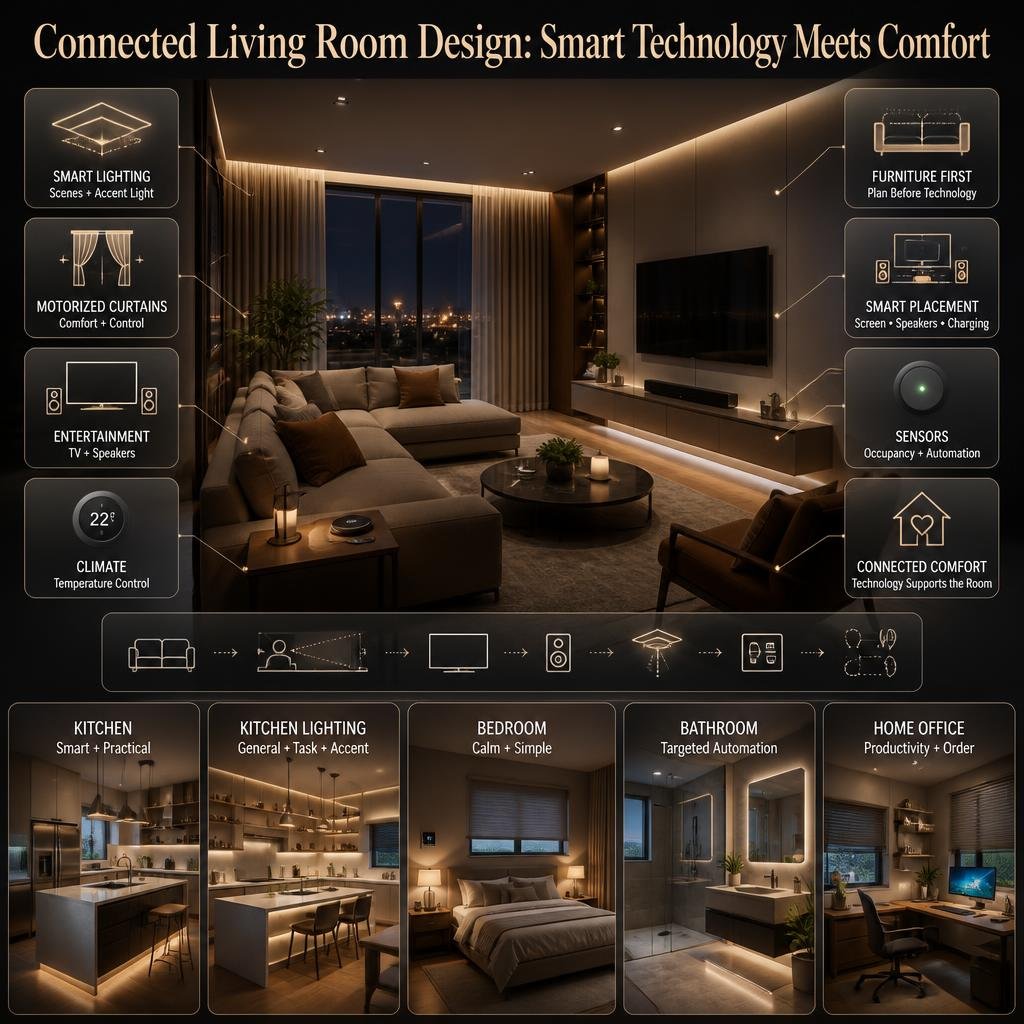
Not every room needs the same technology. A good connected-home strategy starts by understanding what each space needs.
Connected Living Room
The living room is usually one of the strongest candidates for connected features because it combines lighting, entertainment, comfort, and social activities.
Useful features can include:
- Smart lighting scenes
- Motorized curtains
- Smart television control
- Integrated speakers
- Temperature control
- Occupancy sensors
- Voice control
- Automated accent lighting
A simple evening scene could reduce bright overhead lighting, activate accent lights, adjust curtains, and prepare the entertainment area.
The important thing is that the technology shouldn’t overpower the room.
A beautiful living room should still feel like a living room.
Designing Technology Around Furniture
Furniture placement should come before final technology positioning.
Consider the sofa first.
Then determine:
- Viewing direction
- Screen position
- Speaker locations
- Lighting glare
- Charging points
- Side-table access
- Walking routes
This prevents the common situation where technology dictates the room instead of supporting it.
Connected Kitchen
The kitchen can benefit from connected technology when it solves practical problems.
Examples include:
- Smart appliances
- Under-cabinet lighting
- Motion-activated lighting
- Leak sensors
- Energy monitoring
- Connected ventilation
- Appliance notifications
- Integrated charging
However, technology shouldn’t interfere with the kitchen’s primary purpose.
Work surfaces, storage, circulation, appliance access, and lighting remain fundamental.
A smart refrigerator can’t compensate for a badly planned kitchen layout.
Connected Kitchen Lighting
Lighting is particularly important.
A kitchen generally benefits from multiple layers:
- General lighting
- Task lighting
- Cabinet lighting
- Accent lighting
- Dining lighting
Connecting these layers can make the room more flexible.
A bright cooking scene can provide strong task illumination, while a softer evening scene can make the kitchen feel warmer after dinner.
Connected Bedroom
A connected bedroom should focus on comfort and simplicity.
Useful options include:
- Adjustable lighting
- Motorized blackout blinds
- Bedside controls
- Temperature management
- Charging points
- Gentle morning lighting
- Occupancy-based lighting
The bedroom shouldn’t become another technology hub.
The goal is to create a calm environment where technology supports rest rather than demanding attention.
Connected Bathroom
Bathrooms can benefit from targeted automation.
Possible features include:
- Motion-sensitive lighting
- Heated floors
- Demisting mirrors
- Ventilation controls
- Leak sensors
- Adjustable lighting
Because bathrooms contain water and moisture, equipment must be suitable for its environment and installed correctly.
Good planning matters more than the number of smart features.
Connected Home Office
A home office needs technology that improves productivity without creating visual clutter.
Consider:
- Task lighting
- Adjustable blinds
- Temperature control
- Reliable networking
- Cable management
- Charging stations
- Video-conferencing equipment
- Occupancy-based lighting
The office should also support good ergonomics.
A smart desk in an uncomfortable workspace isn’t a successful connected solution.
How Does Connected Living Improve Lighting?
Lighting is one of the most valuable areas for connected-home planning because it affects almost every room.
A connected lighting system can allow homeowners to control:
- Brightness
- Timing
- Color temperature
- Individual zones
- Scenes
- Occupancy response
- Outdoor lighting
Instead of one ceiling fixture doing everything, multiple lighting layers can work together.
For example:
Morning: brighter, functional lighting.
Afternoon: balanced task and ambient lighting.
Evening: softer, warmer lighting.
Entertainment: reduced ambient light with controlled accent lighting.
This approach makes the home feel responsive without requiring constant manual adjustment.
For homeowners exploring finishes and how lighting interacts with surfaces, Refined Finishes offers a useful design connection between material choices and the finished appearance of a room.
How Does Connected Living Work With Color and Materials?
Technology can change how colors and materials appear.
A wall that looks balanced under daylight may look completely different under cool artificial lighting.
Glossy surfaces can create glare.
Dark finishes can absorb light.
Metallic materials can reflect connected lighting in unexpected ways.
Therefore, connected lighting should be tested against the actual interior palette.
This is especially important when selecting:
- Paint
- Flooring
- Wall finishes
- Cabinet materials
- Upholstery
- Curtains
- Decorative surfaces
For broader guidance on color decisions, Paint Color can complement the connected-living planning process.
Can Connected Living Improve Home Improvement Projects?
Yes, particularly when technology is included during the planning stage.
A renovation is an opportunity to reconsider:
- Electrical outlets
- Switch positions
- Lighting circuits
- Network cabling
- Television locations
- Speaker locations
- Charging points
- Storage
- Equipment spaces
- Window treatments
Instead of installing technology after everything has been finished, homeowners can plan the infrastructure first.
That usually creates a cleaner and more integrated result.
For homeowners managing broader renovation work, Home Improvement provides a natural supporting resource.
Can DIY Projects Be Part of Connected Living?
Some connected-home projects are suitable for DIY work, while others should be handled professionally.
Simple projects may include:
- Installing compatible smart bulbs
- Setting up smart plugs
- Organizing charging areas
- Creating basic app-based routines
- Installing certain battery-powered sensors
More complex work involving electrical wiring, structural changes, networking infrastructure, or specialist equipment may require professional assistance.
The key is knowing the difference.
A DIY project should never compromise electrical safety or the reliability of the wider home system.
For homeowners interested in practical projects and smaller improvements, DIY Home Projects can be incorporated into a broader connected-home strategy.
What Role Does Home Upgrading Play in Connected Living?
Home upgrades don’t always need to involve major construction.
Sometimes a few carefully selected changes can significantly improve how a home functions.
For example:
- Replace inefficient lighting
- Add smart switches
- Improve network coverage
- Create a dedicated charging station
- Install sensors in problem areas
- Add automated window treatments
- Improve cable management
- Upgrade old controls
The best upgrades are those that improve something homeowners already find inconvenient.
Rather than asking, “What technology can I add?” ask:
“What isn’t working well in this home?”
That question usually produces better results.
A resource such as Home Upgrading Mintpalment can fit naturally into this broader home-upgrade conversation.
How Can Connected Living Improve Home Organization?
Connected living isn’t only about electronics.
Organization is an important part of the experience.
When devices, chargers, cables, remotes, appliances, and controls aren’t organized, even expensive technology can make a home feel messy.
Consider dedicated areas for:
- Device charging
- Remote controls
- Network equipment
- Smart-home hubs
- Entertainment equipment
- Small appliances
- Cables
Cabinetry can often conceal technology while maintaining ventilation and accessibility.
This is where connected living overlaps with practical storage design.
What Is Connected Living Outside the Main House?
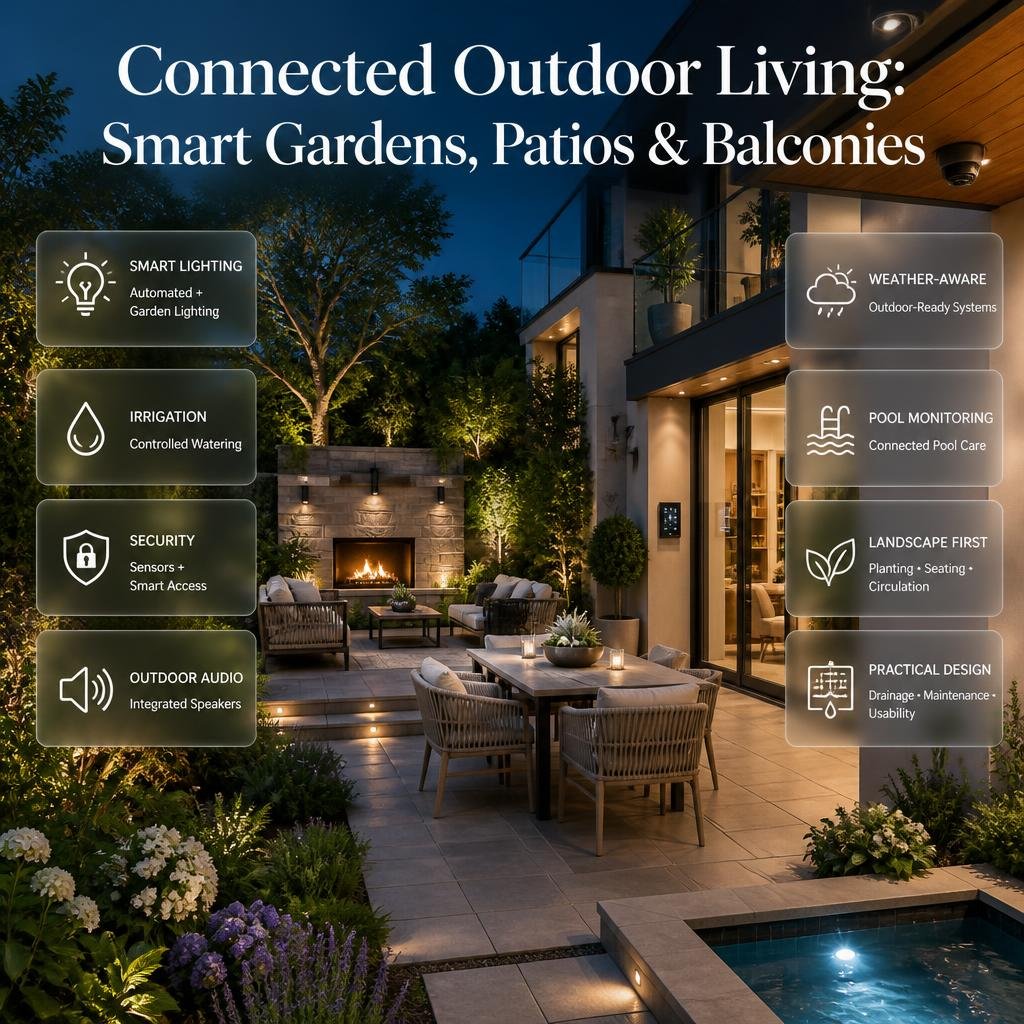
Connected living can extend into balconies, patios, gardens, garages, and outdoor entertainment areas.
Outdoor spaces can use:
- Automated lighting
- Irrigation controls
- Security sensors
- Outdoor speakers
- Weather-aware systems
- Smart access controls
- Pool monitoring
- Garden lighting
However, outdoor technology needs appropriate weather protection.
The garden should still be designed around planting, circulation, seating, drainage, maintenance, and usability.
Technology should enhance the outdoor experience rather than become the focus.
For broader garden and patio planning ideas, Robert MyGardenAndPatio can provide another relevant perspective.
Can Connected Living Make a Small Home Feel Better?
Absolutely.
Small homes often benefit from smart planning because every area needs to perform more than one function.
A connected lighting system can help a single room shift between:
- Work mode
- Dining mode
- Relaxation mode
- Entertainment mode
Motorized blinds can improve privacy without taking up additional floor space.
Integrated charging can reduce countertop clutter.
Under-cabinet lighting can make compact kitchens more functional.
Sensors can reduce unnecessary lighting in areas such as hallways and storage spaces.
The objective isn’t to make a small home more technological.
It’s to make the limited space more adaptable.
How Does Technology Affect Home Styling?
Connected living should be considered alongside the visual identity of the home.
Technology has its own physical language.
Switches, screens, speakers, sensors, outlets, thermostats, and charging equipment can all become visible design elements.
If they’re chosen without considering the room, they can create visual noise.
Good styling considers:
- Finish
- Size
- Position
- Proportion
- Visibility
- Material
- Color
- Cable management
For homeowners balancing practical technology with decorative choices, Home Hacks Decoradtech is naturally relevant to the broader discussion of practical home solutions.
How Can Connected Living Support Modern Lifestyles?
Modern households often have different schedules.
One person may work from home while another works outside the house. Children may use bedrooms for studying and entertainment. Weekends may involve guests, cooking, outdoor activities, or relaxation.
Connected systems can help rooms adapt.
For example, a home office can use brighter task lighting during working hours, while the same area can switch to softer ambient lighting later.
A living room can shift from family use to entertainment mode.
Outdoor lighting can respond to schedules.
The home becomes more adaptable without physically changing the room.
For readers exploring how current design thinking affects modern homes, Latest News DecoratorAdvice can sit naturally within this discussion of changing home lifestyles and design ideas.
What Are the Most Useful Connected Home Technologies?
| Technology | Main Benefit | Best Location |
|---|---|---|
| Smart Lighting | Flexible atmosphere and control | Whole home |
| Smart Switches | Familiar physical control | Main rooms |
| Motion Sensors | Automatic activation | Hallways, bathrooms |
| Smart Blinds | Privacy and daylight control | Bedrooms, living rooms |
| Smart Thermostats | Climate management | Living and sleeping areas |
| Leak Sensors | Early warning | Kitchens, bathrooms |
| Smart Locks | Convenient access | Entrances |
| Energy Monitoring | Usage awareness | Whole home |
| Smart Speakers | Voice control | Shared areas |
| Networked Equipment | Reliable connectivity | Whole home |
The table illustrates an important point: every technology should have a specific purpose.
What Are the Advantages of Connected Living?

Greater Convenience
Repeated tasks can become simpler.
A single scene can control multiple devices instead of requiring separate actions.
Better Comfort
Lighting, temperature, blinds, and entertainment can be adjusted to suit different activities.
Improved Accessibility
Voice control, automated blinds, smart switches, and sensors can make some home functions easier to operate.
Better Organization
Properly integrated technology can reduce visible cables, chargers, remotes, and equipment.
Greater Awareness
Sensors and notifications can help homeowners notice issues such as unusual activity, water leaks, or unexpected device behavior.
Flexible Spaces
Rooms can change function through lighting and environmental settings without physical remodeling.
What Are the Drawbacks of Connected Living?
Connected living isn’t perfect.
Initial Cost
A well-integrated system may require more investment than conventional controls.
Compatibility Issues
Different products may not communicate properly.
Maintenance
Connected systems can require updates, battery replacements, troubleshooting, and account management.
Internet Dependence
Some cloud-dependent services may lose functionality during connectivity problems.
Privacy
Connected devices can collect data about household activity, depending on the product and settings.
Complexity
Too many devices can make a home harder to operate.
The solution isn’t avoiding connected technology.
It’s selecting it carefully.
What Are the Biggest Connected Living Mistakes?
Mistake 1: Buying Devices Before Creating a Plan
Why it happens: A product looks useful or attractive.
Why it’s harmful: The device may not fit the wider system.
Better approach: Define the problem first.
Mistake 2: Automating Everything
Why it happens: Modern systems make automation possible.
Why it’s harmful: Unnecessary automation can become frustrating.
Better approach: Automate repetitive tasks that have obvious value.
Mistake 3: Ignoring Network Infrastructure
Why it happens: Homeowners focus on visible devices.
Why it’s harmful: Poor connectivity can make the entire experience unreliable.
Better approach: Plan network coverage and equipment locations early.
Mistake 4: Forgetting Manual Controls
Why it happens: Automation appears more advanced.
Why it’s harmful: Guests and household members may struggle.
Better approach: Keep important functions simple and accessible.
Mistake 5: Allowing Cables to Become an Afterthought
Why it happens: Cable planning happens after furniture and equipment are installed.
Why it’s harmful: Visible cables create clutter.
Better approach: Plan outlets, routes, charging points, and equipment locations before final finishes.
Mistake 6: Designing the Room Around Technology
Why it happens: Smart devices become the center of the planning process.
Why it’s harmful: The room may become technically impressive but uncomfortable.
Better approach: Start with people, circulation, furniture, light, storage, and comfort.
How Can You Make Connected Technology Look Elegant?

The most attractive connected homes usually hide or minimize technology.
Consider:
- Concealed wiring
- Built-in charging
- Integrated speakers
- Recessed screens
- Discreet sensors
- Coordinated switches
- Cabinet-mounted equipment
- Minimal control panels
Technology should become part of the architecture.
For example, a television can be integrated into a carefully designed wall rather than simply mounted wherever an outlet exists.
A speaker can be incorporated into a ceiling rather than placed visibly on every surface.
A charging station can be built into cabinetry.
This approach creates a cleaner visual environment.
What Should You Plan Before a Connected Home Renovation?
Before walls are closed and finishes are installed, consider:
Electrical Planning
Determine where outlets, switches, lighting controls, and dedicated circuits are needed.
Network Planning
Identify where routers, access points, Ethernet connections, and network equipment will be located.
Furniture Planning
Determine where people will sit, work, sleep, eat, and move.
Lighting Planning
Map ambient, task, accent, decorative, and automated lighting.
Window Planning
If motorized blinds or curtains are planned, consider power and control requirements early.
Equipment Storage
Provide suitable locations for hubs, routers, media equipment, and other devices.
Future Expansion
Leave enough flexibility to add or replace technology later.
⭐ Expert Tip: Infrastructure usually ages more slowly than gadgets. Invest in flexible wiring, power, networking, and physical space rather than trying to predict exactly which device you’ll buy years from now.
How Can Connected Living Support Different Home Styles?
Connected technology doesn’t require a futuristic interior.
It can work with:
- Minimalist interiors
- Contemporary homes
- Traditional spaces
- Scandinavian interiors
- Japandi-inspired rooms
- Luxury interiors
- Rustic homes
- Transitional design
The technology should adapt to the design language.
In a minimalist room, controls may be extremely discreet.
In a traditional interior, technology may be concealed within cabinetry.
In a luxury space, integrated lighting and audio can become part of the architectural experience.
The technology doesn’t determine the style.
The design determines how technology is presented.
How Can Connected Living Support Better Home Decisions?
One of the biggest advantages of thinking in terms of connected living is that it encourages homeowners to consider the entire home instead of making isolated decisions.
For example, choosing a new sofa isn’t only about appearance.
It affects:
- Viewing distance
- Lighting
- Charging
- Side-table placement
- Speaker positioning
- Circulation
- Storage
Similarly, choosing curtains can affect:
- Daylight
- Privacy
- Temperature
- Automation
- Lighting conditions
A connected approach encourages these decisions to be considered together.
For a broader source of current home ideas and design-related inspiration, Blog Home Ideas TheHomeTrotters can complement the planning process.
How Can You Use Connected Living in DIY-Friendly Improvements?
Not every improvement requires a complete renovation.
A homeowner can gradually improve a home by focusing on small, controlled projects.
For example:
Stage 1: Improve lighting.
Stage 2: Add smart switches or compatible controls.
Stage 3: Improve charging organization.
Stage 4: Strengthen network coverage.
Stage 5: Add sensors.
Stage 6: Create simple scenes.
Stage 7: Expand only where the previous changes provide genuine value.
This staged approach keeps costs manageable and allows homeowners to learn what works.
What Role Does Home Inspiration Play?
Technology should never replace inspiration.
Before making decisions, look at complete rooms rather than isolated smart products.
Pay attention to:
- How lighting changes the atmosphere
- How technology is concealed
- How furniture is arranged
- How materials interact
- How storage is integrated
- How rooms transition into one another
For broader home inspiration and changing design approaches, Latest News DecoratorAdvice – Second Resource can support the wider research process.
The objective isn’t to copy another home.
It’s to understand what makes a space work.
Can Connected Living Extend Into the Garden?
Yes.
Outdoor connected living can create a smoother transition between indoor and outdoor spaces.
Consider:
- Garden lighting
- Patio lighting
- Outdoor speakers
- Irrigation
- Security
- Automated gates
- Weather monitoring
- Pool systems
However, outdoor automation should be designed around practical outdoor use.
A garden still needs:
- Comfortable seating
- Clear paths
- Appropriate planting
- Good drainage
- Shade
- Maintenance access
- Safe lighting
Technology should improve these functions rather than compete with them.
If you’re considering whether a garden can be designed personally or through a more structured approach, Can I Design My Own Garden Kdagardenation provides a relevant connection to the outdoor side of connected living.
Why Is Room-by-Room Planning Important?
A connected home shouldn’t be designed as one giant technology project.
Each room has different needs.
The bedroom prioritizes rest.
The kitchen prioritizes function.
The living room prioritizes flexibility.
The home office prioritizes productivity.
The bathroom prioritizes comfort and safety.
Outdoor areas prioritize weather resistance and usability.
This room-by-room approach prevents unnecessary technology.
For example, a bedroom may need only lighting, blinds, climate control, and charging.
A living room may require considerably more integration.
A room-by-room strategy also makes budgeting easier.
You can identify which areas deserve investment and which can remain simple.
How Do You Create a Connected Living Plan?
A practical planning process can be divided into seven stages.
Step 1: Observe the Home
Spend several days identifying what feels inconvenient.
Don’t immediately buy anything.
Step 2: List the Problems
Write down recurring issues such as:
- Poor lighting
- Too many remotes
- Cable clutter
- Difficult temperature control
- Forgotten lights
- Weak network coverage
- Poor charging access
Step 3: Prioritize
Rank problems according to frequency and impact.
Step 4: Select Technology
Only after identifying the problems should you choose products or systems.
Step 5: Check Compatibility
Make sure products can work together.
Step 6: Integrate With Design
Plan outlets, furniture, lighting, storage, and equipment locations.
Step 7: Test and Refine
Live with the system before expanding it.
This final step is important.
A connected home should evolve according to real experience.
Connected Living for a More Personalized Home
Personalization is another important part of connected living.
Different households have different routines.
One family may need early-morning lighting.
Another may prioritize evening entertainment.
Someone working from home may need automated office lighting.
Someone who frequently entertains guests may value flexible scenes.
This means there is no universal connected-home formula.
The best design reflects the people who use the home.
The technology should adapt to them—not the other way around.
How Can You Keep Connected Living Simple?
Simplicity should remain the guiding principle.
Ask these questions before adding a new feature:
- What problem does it solve?
- How often will I use it?
- Can everyone in the home understand it?
- Does it work with the existing system?
- Does it require constant maintenance?
- What happens if the internet fails?
- Can I operate the function manually?
- Does it improve the room or make it more complicated?
If the answers aren’t convincing, don’t install the technology simply because it is available.
Connected Living and Whole-Home Design
The strongest connected-home projects don’t treat rooms as isolated boxes.
The hallway connects to the living room.
The living room connects to the dining area.
The kitchen may open into the garden.
The home office may double as a guest room.
Technology can support these transitions.
Lighting scenes can move from one zone to another.
Audio can extend across multiple areas.
Security can cover entrances and outdoor spaces.
Climate controls can respond to occupancy.
The result is a home that feels coherent rather than fragmented.
This is one reason a whole-home design perspective is valuable.
Practical Connected Living Decision Table
| If Your Main Problem Is… | Consider… |
|---|---|
| Dark rooms | Connected lighting |
| Too many switches | Scenes or centralized controls |
| Cable clutter | Integrated charging and storage |
| Poor temperature comfort | Smart climate control |
| Privacy concerns | Motorized blinds |
| Forgotten lights | Sensors or schedules |
| Security concerns | Sensors and connected locks |
| Too many remotes | Integrated entertainment control |
| High energy awareness needs | Energy monitoring |
| Poor outdoor usability | Connected garden lighting |
The important word is consider.
These aren’t universal requirements.
Your actual home should determine the solution.
Key Takeaways
- Connected living is about creating a home that works together.
- It isn’t simply about purchasing smart gadgets.
- Start with real household problems.
- Plan technology alongside interior design.
- Lighting is one of the most useful areas for connected-home planning.
- Compatibility should be checked before buying multiple devices.
- Good network infrastructure matters.
- Manual controls should remain available for important functions.
- Cable management should be planned early.
- Connected technology can work with almost any interior style.
- Small homes can benefit significantly from flexible lighting and automation.
- Outdoor spaces can also become part of connected living.
- Don’t automate tasks simply because automation is possible.
- Build flexible infrastructure for future upgrades.
- The best connected homes prioritize people, comfort, and usability.
How Can Connected Living Make a Home More Comfortable and Convenient?
Connected living can make a home more comfortable by allowing lighting, temperature, blinds, entertainment, security, and other systems to work around your daily routines. Instead of controlling every device separately, homeowners can create simple scenes or automated routines for common situations such as waking up, leaving home, relaxing in the evening, or preparing for sleep. The real benefit isn’t having more technology; it’s reducing small repetitive tasks and making the home easier to manage.
Practical points:
Use automated lighting for morning, evening, and relaxation routines.
Connect climate controls to schedules or occupancy where appropriate.
Use motorized blinds to manage daylight and privacy.
Create simple scenes instead of dozens of complicated automations.
Keep important controls accessible to everyone in the household.
Professional advice: Start with the routines you repeat every day. If an automation doesn’t save time, improve comfort, or solve a genuine problem, there’s little reason to add it.
What Smart Home Features Are Most Worth Adding for Connected Living?
The most useful connected-home features are generally the ones that improve everyday functions rather than simply adding novelty. Smart lighting, climate control, security sensors, automated blinds, reliable networking, organized charging, and carefully selected entertainment controls can provide practical benefits because they’re used frequently. The right combination depends on the home, but homeowners usually get more value from a few well-integrated systems than from filling every room with smart gadgets.
Features worth considering:
Smart lighting: flexible brightness, schedules, and scenes.
Climate control: easier temperature management and scheduling.
Security sensors: useful awareness around doors, windows, and other areas.
Motorized blinds: privacy and daylight management.
Energy monitoring: better understanding of household consumption.
Integrated charging: less visible cable clutter.
Smart locks: convenient access when properly configured.
Professional advice: Before purchasing anything, write down the problem you want the device to solve. This simple step prevents connected living from turning into an expensive collection of gadgets that rarely get used.
How Do You Integrate Smart Technology Into Interior Design Without Making the Home Look Too Technical?
The best way to integrate smart technology is to plan it as part of the interior from the beginning rather than adding devices after the room is finished. Cables, outlets, speakers, screens, sensors, switches, charging points, and equipment storage should be considered alongside furniture, lighting, cabinetry, finishes, and circulation. When technology is properly integrated, it can remain highly functional while being visually discreet.
Design strategies that work well:
Conceal cables inside walls or planned furniture routes where appropriate.
Create dedicated charging drawers or charging zones.
Use built-in or discreet speakers where suitable.
Coordinate visible switches and controls with the room’s finishes.
Plan television and equipment locations before finalizing furniture.
Provide ventilation for enclosed networking and electronic equipment.
Avoid placing multiple unnecessary devices on visible surfaces.
Professional advice: Think about technology during the electrical and lighting-planning stage, not after the decorative work is complete. Retrofitting cables, outlets, and controls later can be considerably more disruptive.
Is Connected Living Worth It for a Small Home or Apartment?
Connected living can be particularly useful in smaller homes because thoughtful automation can help one space perform several functions without adding physical clutter. Instead of installing more furniture or equipment, homeowners can use adaptable lighting, motorized blinds, organized charging, occupancy sensors, and integrated entertainment to make the same room work differently throughout the day. The key is choosing compact, purposeful technology rather than trying to automate everything.
Useful small-home solutions:
Use layered lighting to create separate work, dining, and relaxation moods.
Install compact charging solutions to keep surfaces clear.
Use smart blinds where privacy and daylight are difficult to manage.
Add occupancy-based lighting in hallways and bathrooms.
Integrate entertainment equipment into existing storage.
Improve Wi-Fi coverage before adding numerous connected devices.
Professional advice: In a small home, every device should earn its place. If a smart product adds another control, cable, hub, or maintenance requirement without providing a meaningful benefit, it may actually make the space less efficient.
What Should You Consider Before Creating a Connected Home?
Before creating a connected home, consider your daily routines, technology compatibility, network reliability, electrical infrastructure, privacy, manual controls, future expansion, and the overall interior design. The biggest planning mistake is choosing individual products without considering how they will work together. A connected home should be treated as a complete environment, even if you build it gradually.
Before starting, check:
What everyday problems are you trying to solve?
Which rooms actually need connected features?
Are your chosen devices compatible?
Is your Wi-Fi or wired network reliable enough?
Where will hubs, routers, and equipment be stored?
Are enough power outlets available?
Can important functions still be controlled manually?
What happens if the internet connection fails?
What data does each connected device collect?
Can the system be expanded or replaced later?
Professional advice: Spend more time planning the infrastructure than shopping for gadgets. Electrical outlets, network access, cable routes, equipment storage, and good room planning can remain useful for years, while individual smart devices will eventually be replaced or upgraded.
Conclusion
Connected living isn’t about filling your home with smart devices. It’s about creating a home that works better for the way you actually live. When lighting, entertainment, security, climate control, storage, work areas, and everyday routines are planned together, technology becomes part of the home rather than something that dominates it.
The most successful connected homes balance function, comfort, aesthetics, and simplicity. A smart lighting system should make a room easier to use. Well-planned charging points should reduce clutter. Automated blinds or climate controls should improve comfort without adding unnecessary complexity. Even small changes can make a noticeable difference when they are planned around real daily habits.
Before upgrading your home, start with the problems you want to solve. Think about where clutter builds up, which routines feel inconvenient, where lighting could improve, and which spaces need more flexibility. From there, choose technology and design solutions that support those needs rather than buying features simply because they are popular.
A connected home should also feel personal. Materials, furniture, colors, lighting, artwork, and architectural details still matter just as much as technology. The goal is not to make your home look futuristic; it is to make it feel comfortable, organized, responsive, and genuinely yours.
Ultimately, connected living works best when technology quietly supports everyday life in the background. With thoughtful planning, the result can be a home that is easier to manage, more comfortable to live in, visually cohesive, and ready to adapt as your needs change.

Leave a Reply