
Introduction
Wall Treatments | A room can have beautiful furniture, expensive flooring, and carefully selected lighting, yet something can still feel unfinished. Very often, the problem is the walls.
A completely plain wall isn’t necessarily bad, but when the rest of the room has been thoughtfully designed, large empty surfaces can make the space feel flat, cold, or incomplete. This is where wall treatments become useful. Instead of treating a wall as nothing more than a surface for paint, you can use colour, texture, moulding, wallpaper, wood, panelling, plaster, tile, or other finishes to give the room more depth and personality.
The challenge is knowing which wall treatment actually suits your room.
A dramatic fluted panel may look fantastic in a large living room but feel overwhelming in a small bedroom. Traditional moulding can make one interior look elegant while appearing completely out of place in a minimalist space. Even wallpaper that looks beautiful online may feel too busy once it’s installed across four walls.
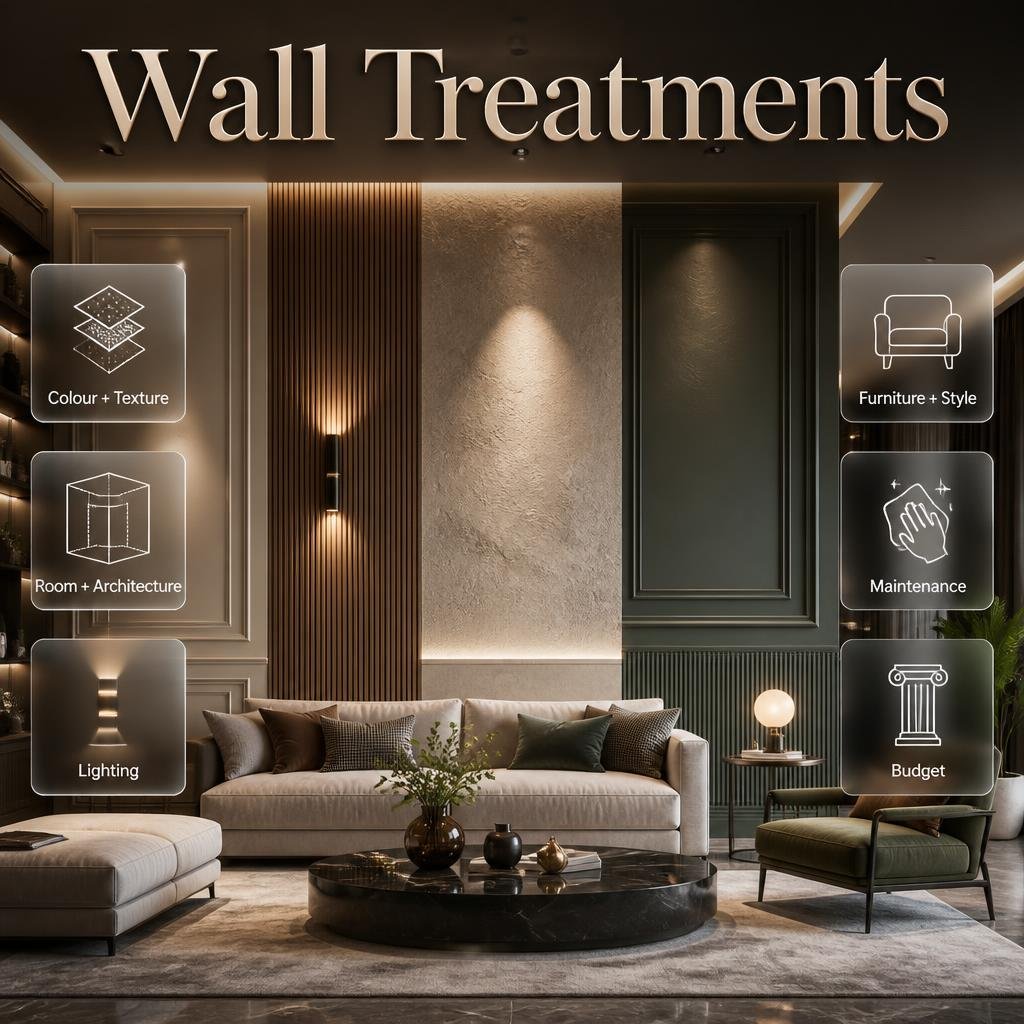
This guide explains how to choose wall treatments based on the room, architecture, lighting, furniture, maintenance needs, budget, and design style.
If you’re planning a wider interior update, DesignMode24 Interior Design can also help you think about wall treatments as part of the complete room rather than as an isolated decorative feature.
What Are Wall Treatments?
Wall treatments are decorative, architectural, textured, or functional finishes applied to a wall to change its appearance, character, texture, or performance.
Common examples include paint, wallpaper, wall moulding, wainscoting, wood panelling, fluted panels, board and batten, brick, stone, decorative plaster, wall tiles, fabric panels, and murals.
The important distinction is that a wall treatment isn’t simply about making a wall look “fancy.”
A good treatment should solve a design problem.
It might:
- Add warmth to a cold-looking room
- Give a plain wall architectural character
- Create a visual focal point
- Make a low ceiling feel taller
- Add texture without adding strong colour
- Protect walls in high-traffic areas
- Introduce pattern
- Hide minor surface imperfections
- Improve the relationship between furniture and architecture
- Give a newly renovated room a more finished appearance
The right wall treatment can therefore be decorative and practical at the same time.
Why Are Wall Treatments So Important in Interior Design?
Walls occupy a large percentage of the visible surface inside a home. Because of this, changing the walls can affect the entire visual identity of a room.
Think about the difference between these two spaces.
Room A: plain white walls, standard furniture, basic lighting, no architectural detail.
Room B: the same furniture and floor, but with warm wall colour, carefully proportioned moulding, layered lighting, and a textured focal area.
The furniture hasn’t necessarily changed. The wall has changed the context in which the furniture is experienced.
That is the real power of wall treatments.
They create a relationship between:
Walls → Furniture → Lighting → Flooring → Accessories → Overall atmosphere
This is also why a wall treatment shouldn’t be selected by looking at the wall alone.
You need to consider the complete room.
What Are the Most Popular Types of Wall Treatments?
The most popular wall treatments include paint, wallpaper, wood panelling, decorative moulding, wainscoting, board and batten, fluted panels, slatted walls, decorative plaster, stone, brick, tiles, fabric panels, and murals.
Each material creates a different visual and practical effect.
| Wall Treatment | Best For | Main Strength | Main Concern |
|---|---|---|---|
| Paint | Almost any room | Affordable and flexible | Colour can look different in lighting |
| Wallpaper | Bedrooms, living rooms, dining areas | Pattern and personality | Installation and maintenance |
| Wood Panelling | Bedrooms, lounges, offices | Warmth and depth | Material and installation |
| Wainscoting | Traditional and transitional interiors | Architectural character | Needs accurate proportions |
| Board & Batten | Modern/classic rooms | Vertical structure | Spacing must be precise |
| Fluted Panels | Contemporary spaces | Texture and rhythm | Can become repetitive |
| Wall Moulding | Elegant interiors | Architectural detail | Poor layouts look cheap |
| Stone | Feature walls | Natural texture | Heavy visual impact |
| Brick | Industrial/rustic interiors | Character | Can dominate a room |
| Decorative Plaster | Luxury/organic interiors | Subtle depth | Specialist workmanship |
| Wall Tile | Kitchens/bathrooms | Durability | Grout and installation |
| Fabric Panels | Bedrooms/offices | Softness and acoustics | Cleaning |
| Murals | Statement spaces | Strong personality | Can overwhelm small rooms |
There isn’t one universally correct treatment.
The best choice depends on what the wall needs to do.
How Do You Choose the Right Wall Treatment?

Before choosing a material, ask five questions:
- What is the purpose of this wall?
- How much natural light reaches it?
- What furniture will sit against it?
- How much maintenance can I realistically handle?
- Does the treatment support the room’s overall design?
This simple process prevents one of the most common mistakes: choosing a wall finish simply because it looks attractive in a photograph.
Start With the Room’s Function
A bedroom has different requirements from a hallway.
A bathroom has completely different requirements from a living room.
A dining room may benefit from elegant moulding, while a busy family hallway may need a more durable and washable surface.
Always start with function.
Look at Natural Light
Light changes the appearance of almost every wall treatment.
A textured surface may appear subtle in morning light and dramatically different under warm evening lighting.
Dark finishes can create a cosy atmosphere, but in a poorly lit room they may also feel heavy.
Glossy finishes reflect light, while matte surfaces generally create a softer appearance.
Consider the Existing Materials
Don’t choose your wall independently from the rest of the room.
Look at:
- Flooring
- Doors
- Cabinetry
- Furniture
- Curtains
- Countertops
- Ceiling
- Metal finishes
- Lighting
For example, if your room already contains strong wood flooring and wooden furniture, adding another dramatic wood wall may be unnecessary.
Sometimes the best wall treatment is the one that creates balance.
Paint as a Wall Treatment
Paint is still one of the simplest and most flexible ways to transform a room.
It doesn’t add much physical depth, but colour can dramatically change the atmosphere.
You can use paint for:
- Full-room colour
- Accent walls
- Colour blocking
- Two-tone walls
- Half-wall effects
- Tonal schemes
- Dark feature areas
- Soft neutral backgrounds
- Decorative painted arches
- Faux concrete or mineral-inspired effects
The biggest advantage is flexibility.
If your taste changes later, repainting is usually much easier than removing fixed wall panelling.
For colour planning and related ideas, explore the Paint Color section.
When Is Paint the Better Choice?
Paint is particularly useful when:
- You want a low-cost transformation
- You expect your style to change
- The wall already has good proportions
- You want colour without texture
- You’re working with a rental or temporary space
- You want to keep the room visually minimal
Paint is also useful when other elements are already visually strong.
If you have patterned flooring, statement furniture, artwork, and decorative lighting, a simple wall colour may provide the visual breathing room the room needs.
Wallpaper as a Wall Treatment
Wallpaper allows you to introduce pattern, texture, colour, imagery, and visual depth that would be difficult to achieve with paint.
It can create anything from a quiet textured background to a dramatic statement.
Modern wallpaper can feature:
- Botanical patterns
- Geometric designs
- Abstract artwork
- Scenic landscapes
- Textured neutrals
- Metallic details
- Large-scale florals
- Stripes
- Traditional motifs
Current 2026 design coverage shows wallpaper being used more selectively in places such as ceilings, niches, built-ins, and framed areas rather than automatically covering every wall.
Where Does Wallpaper Work Best?
Wallpaper can be especially effective in:
- Bedrooms
- Dining rooms
- Living rooms
- Home offices
- Entryways
- Powder rooms
- Reading corners
A small powder room, for example, can handle a stronger pattern because it is a compact experience rather than a large room where you spend all day.
Wallpaper Mistake to Avoid
Don’t select wallpaper only from a small online image.
A pattern can look delicate on a screen and extremely dominant when repeated across a large wall.
Always consider scale.
Wood Wall Panelling
Wood panelling brings warmth, texture, and architectural depth to an interior.
It can be used in modern, contemporary, Scandinavian, Japandi, rustic, transitional, and traditional interiors.
Common options include:
- Natural timber
- Wood veneer
- MDF panels
- Slatted panels
- Fluted panels
- Tongue-and-groove panels
- Decorative battens
- Reclaimed wood
Panelling remains prominent in 2026, but current design thinking is moving toward more intentional applications that respond to the architecture rather than simply putting panels on a wall because they are fashionable.
Should You Panel Every Wall?
Usually, there is no need.
A better approach is to identify the architectural or functional area that deserves emphasis.
For example:
Bed → panel behind bed
TV → panel around media wall
Fireplace → frame fireplace
Built-in shelving → panel inside or around shelving
Dining table → treatment that defines dining zone
This creates purpose.
Fluted Wall Panels
Fluted panels are characterised by repeated vertical grooves or ridges.
They’re popular because they add texture without requiring a complicated decorative pattern.
They work particularly well behind:
- Beds
- Sofas
- TVs
- Consoles
- Dining areas
- Reception desks
- Home offices
Their vertical rhythm can also draw the eye upward.
However, too much fluting can become visually repetitive.
If the room already contains vertical furniture, heavily patterned curtains, and other linear elements, consider whether another strong vertical pattern is actually necessary.
Slatted Wall Treatments
Slatted walls use repeated narrow strips separated by gaps.
They can create a warm, contemporary appearance and work particularly well when paired with indirect lighting.
For example:
Wood slats + warm LED lighting + neutral furniture
can create a comfortable modern atmosphere without requiring multiple decorative accessories.
Slatted walls can also be used selectively to define zones without physically constructing a partition.
Wainscoting
Wainscoting is a classic wall treatment involving decorative panels, rails, moulding, or other structured detailing, traditionally used on part of a wall.
It remains useful because it adds architecture to otherwise flat surfaces.
Common applications include:
- Dining rooms
- Hallways
- Bedrooms
- Living rooms
- Entryways
A lower section can also provide some protection against everyday bumps and marks.
Modern wainscoting doesn’t have to look ornate.
Simple rectangular panels painted in the same colour as the wall can create a much more contemporary result.
Board and Batten
Board and batten uses vertical boards or battens combined with horizontal framing elements.
It is useful when you want:
- Vertical rhythm
- Architectural structure
- A taller visual impression
- A simple DIY-friendly design
The most important factor is spacing.
If one gap is noticeably different from another, the entire wall can look poorly planned.
Before cutting anything, account for:
- Wall width
- Corners
- Doors
- Windows
- Sockets
- Switches
- Furniture
- Skirting
- Ceiling height
Accuracy is what makes a simple design look professional.
Wall Moulding and Picture-Frame Panels
Wall moulding creates visual frames on an otherwise flat wall.
One of the most recognisable approaches is picture-frame moulding, where rectangular trim creates a series of balanced panels.
It can work especially well in:
- Formal living rooms
- Dining rooms
- Bedrooms
- Corridors
- Entryways
The secret isn’t expensive material.
It’s proportion.
A simple moulding profile with excellent spacing can look more sophisticated than an elaborate design with poor measurements.
Should Wall Moulding Be a Different Colour?
Not necessarily.
Same-colour moulding creates subtle shadow and architectural depth.
Contrasting moulding creates stronger definition.
For a restrained luxury appearance, try:
Cream wall + slightly warmer cream moulding
rather than automatically using bright white trim.
Decorative Plaster and Textured Walls
Decorative plaster provides depth without creating the obvious repetitive pattern of moulding or panelling.
Possible finishes include:
- Limewash-inspired finishes
- Venetian-inspired plaster
- Mineral textures
- Concrete effects
- Hand-trowelled surfaces
- Microcement-style finishes
The appeal comes from variation.
Instead of a repeated geometric pattern, the surface itself becomes the visual feature.
This can work particularly well with soft lighting because shadows reveal the texture.
Stone Wall Treatments
Stone is a strong material that immediately introduces natural texture.
It can work in:
- Living rooms
- Fireplace areas
- Entryways
- Dining spaces
- Luxury interiors
- Rustic interiors
Stone should generally be used with restraint.
If the stone is dramatic, allow other surfaces to become quieter.
A common mistake is combining a strong stone wall with heavily patterned furniture, bold wallpaper, busy flooring, and multiple decorative materials.
The result can feel crowded.
Brick Wall Treatments
Brick adds character and works especially well in industrial, rustic, loft-inspired, and urban interiors.
It can be used as:
- Exposed brick
- Brick slips
- Decorative brick panels
- Painted brick
- Whitewashed brick
Real brick can be heavy and structurally significant, so decorative alternatives may be more practical for some interiors.
Wall Tiles
Wall tiles are particularly valuable where durability and moisture resistance matter.
They’re common in:
- Bathrooms
- Kitchens
- Utility spaces
- Mudrooms
- Splashback areas
But tile can also be used decoratively.
Large-format tiles can create a quieter appearance because there are fewer grout lines.
Smaller tiles create more visual rhythm.
The important thing is to plan the layout before installation.
Don’t wait until installation begins to discover that awkward cuts will appear around sockets, windows, corners, or fixtures.
Fabric Wall Panels
Fabric panels create softness and can also contribute to acoustic comfort.
They’re particularly suitable for:
- Bedrooms
- Home offices
- Media rooms
- Reading spaces
- Hospitality-inspired interiors
The disadvantage is maintenance.
Fabric collects dust differently from painted walls, so the material should be chosen according to how the room is actually used.
How Can Wall Treatments Make a Room Look Bigger?

Wall treatments can influence how the eye interprets the dimensions of a room.
Use Vertical Details to Emphasise Height
Vertical battens, tall panels, and floor-to-ceiling treatments encourage the eye to move upward.
This can help a low-ceilinged room feel taller.
Use Horizontal Details to Emphasise Width
Horizontal lines can visually emphasise width.
This can be useful in narrow rooms, although excessive horizontal detailing can also make ceilings feel lower.
Use Light Colours Carefully
Light wall colours generally reflect more light, which can contribute to an airy appearance.
But don’t assume every small room needs to be completely white.
A small room can also look beautiful with a deeper colour when the goal is to create intimacy.
The key is intentionality.
Wall Treatments for Living Rooms
The living room usually provides enough space for more substantial wall treatments.
Good choices include:
- Picture-frame moulding
- Fluted TV walls
- Wood panelling
- Decorative plaster
- Stone
- Wallpaper
- Large-scale artwork combined with subtle wall texture
Instead of automatically choosing the biggest empty wall, identify the room’s natural focal point.
This may be:
- Fireplace
- TV
- Sofa
- Artwork
- Architectural opening
- Built-in shelving
The wall treatment should reinforce that feature.
Wall Treatments for Bedrooms
Bedrooms benefit from treatments that create comfort rather than visual chaos.
Good choices include:
- Soft moulding
- Upholstered panels
- Warm wood
- Fluted panelling
- Subtle wallpaper
- Muted textured finishes
- Full-height treatment behind the bed
The wall behind the bed is naturally important because the bed is usually the room’s main visual anchor.
For a broader bedroom design strategy, see Bedroom Interior Design.
You can also explore Bedroom Planning and Layout when deciding exactly how the wall treatment should interact with the bed, wardrobes, circulation space, and other furniture.
For a more contemporary direction, Modern Bedroom Design can help connect the wall treatment with modern furniture and styling choices.
Additional bedroom-focused inspiration can also be found through Preppyroom.
Wall Treatments for Kitchens
Kitchen walls need to balance appearance and practicality.
The surface may experience:
- Grease
- Steam
- Water
- Food splashes
- Frequent cleaning
- Heat
Suitable treatments include:
- Ceramic tile
- Porcelain tile
- Stone slabs
- Glass
- Washable paint
- Appropriate moisture-resistant panels
Don’t choose a kitchen wall finish only because it looks good.
Ask how it will behave after hundreds of cleaning cycles.
Wall Treatments for Bathrooms
Bathrooms have stricter material requirements.
Moisture exposure means that waterproofing, substrate preparation, ventilation, and installation quality matter as much as appearance.
Popular options include:
- Porcelain tile
- Ceramic tile
- Large-format tile
- Stone
- Waterproof wall systems
- Suitable microcement-style finishes
Decorative wallpaper may work in carefully selected bathroom areas, but it should not be treated as automatically suitable for direct wet zones.
Wall Treatments for Hallways
Hallways are excellent candidates for wall treatments because they often contain long, visually empty surfaces.
Useful options include:
- Wainscoting
- Picture-frame moulding
- Half-wall panelling
- Durable paint
- Wallpaper
- Narrow vertical battens
A lower wall treatment can also help protect against everyday contact.
This is one place where decorative detail can have a practical reason to exist.
Wall Treatments for Home Offices
Home offices need to look good on camera as well as in person.
A wall behind the desk often becomes part of video calls, so consider:
- Wood slats
- Simple moulding
- Shelving
- Soft wallpaper
- Neutral textured plaster
- Built-in cabinetry
Avoid creating a wall so visually busy that it competes with your face during meetings.
For broader ideas around connected and modern spaces, explore Connected Living.
How Should Wall Treatments Work With Interior Design Styles?
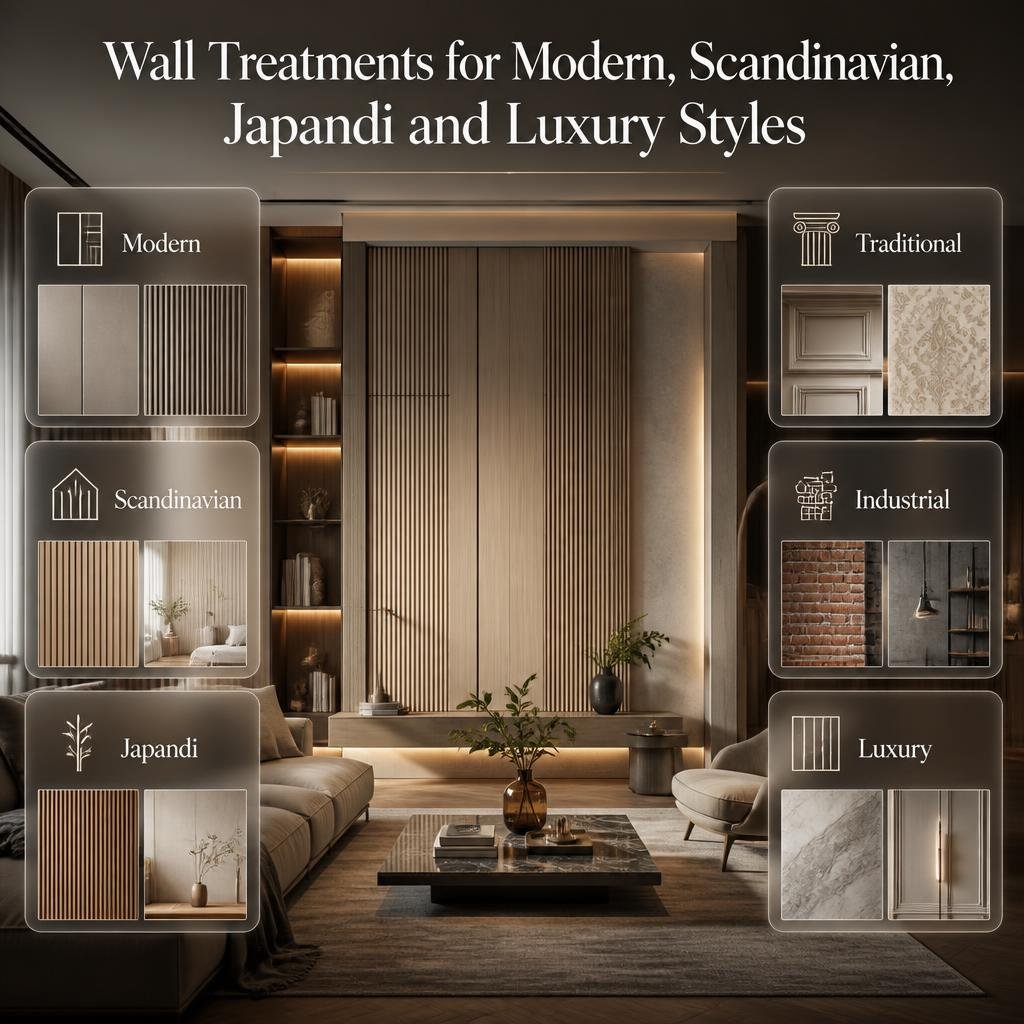
A wall treatment should support the visual language of the room.
Modern Interiors
Choose:
- Clean lines
- Large panels
- Minimal moulding
- Fluted surfaces
- Neutral colours
- Controlled texture
Scandinavian Interiors
Consider:
- Light timber
- Soft whites
- Warm neutrals
- Simple panelling
- Natural textures
Japandi Interiors
Consider:
- Natural wood
- Quiet colours
- Simple vertical details
- Organic texture
- Minimal decorative framing
Traditional Interiors
Consider:
- Wainscoting
- Picture-frame moulding
- Classic wallpaper
- Decorative trim
- Richer colours
Industrial Interiors
Consider:
- Brick
- Concrete effects
- Dark metal
- Raw timber
- Strong texture
Luxury Interiors
Consider:
- Natural stone
- Refined wood
- Decorative plaster
- Large-scale panels
- Layered lighting
- Restrained colour palettes
The important word is support.
A wall treatment shouldn’t be chosen to announce a design style by itself.
It should work with the furniture, lighting, flooring, accessories, and architecture.
Can Wall Treatments Be Used to Divide Open-Plan Spaces?
Yes.
You don’t always need a physical wall to visually divide an open-plan room.
A different wall finish can identify a separate zone.
For example:
Living zone → warm textured plaster
Dining zone → decorative moulding
Work zone → wood slat treatment
This creates visual zoning without blocking light or movement.
For more ideas about how design choices can improve the function and experience of a home, see Why Home Improvement Is Important.
How Do Wall Treatments Work With Garden and Outdoor-Inspired Interiors?
Indoor spaces increasingly borrow visual ideas from nature.
Natural timber, stone textures, earthy colours, botanical wallpaper, and organic plaster finishes can create a stronger connection between interior and exterior spaces.
If your design concept includes outdoor living, natural materials can help create continuity.
For garden-related inspiration, see Robert MyGardenAndPatio and Can I Design My Own Garden Kdagardenation.
The goal isn’t to put garden materials randomly inside the house.
Instead, repeat subtle ideas.
For example:
Outdoor stone → indoor stone texture
Garden greenery → botanical artwork
Timber decking → warm timber wall detail
This creates visual connection without making the interior feel like an outdoor room.
How Much Wall Treatment Should You Use?
This is one of the most important questions.
Not every wall needs to be a feature.
A room needs visual hierarchy.
Think of it as:
Primary feature → supporting elements → quiet surfaces
For example:
- One main wall with panelling
- One wall with artwork
- Two quiet painted walls
This gives the room somewhere for the eye to rest.
If every surface contains texture, pattern, moulding, stone, or strong colour, nothing feels particularly special.
⭐ Expert Tip: Before treating a wall, stand in the doorway and look at the whole room. If your eyes don’t know where to settle, the room may already contain enough visual information.
How Do You Make Wall Treatments Look Expensive?
You don’t necessarily need expensive materials.
A sophisticated result usually comes from:
Proportion + restraint + craftsmanship + lighting + material consistency
A basic MDF moulding system can look elegant if:
- Spacing is accurate
- Corners are clean
- Paint is smooth
- Panels align
- Furniture is properly positioned
- Lighting creates subtle shadows
At the same time, expensive stone can look disappointing if the installation is poorly planned.
This is why professional-looking design is often more about execution than price.
What Are the Biggest Wall Treatment Mistakes?
Mistake 1: Copying a Wall From Pinterest
A photograph may show a room with different:
- Ceiling height
- Wall width
- Windows
- Lighting
- Furniture
- Flooring
- Architectural proportions
Copying the wall exactly can therefore produce a completely different result.
Better approach: Copy the principle rather than the photograph.
Mistake 2: Treating Every Wall as a Feature
This is one of the fastest ways to create visual overload.
A feature needs contrast.
If everything is a feature, nothing is.
Mistake 3: Ignoring Furniture Placement
A beautiful panel design may disappear behind a large sofa or become awkwardly interrupted by a television.
Plan the wall around what will actually sit in front of it.
Mistake 4: Forgetting Electrical Points
Sockets, switches, wall lights, TVs, speakers, and other electrical elements need to be considered before installation.
Mistake 5: Poor Measurements
A difference of a few centimetres can become obvious when repeated across multiple panels.
Measure carefully.
Mistake 6: Choosing the Wrong Material for Moisture
Not every panel or decorative finish is suitable for bathrooms, kitchens, or damp areas.
Always check the manufacturer’s specifications.
Mistake 7: Using Too Many Materials
Wood + stone + wallpaper + moulding + bold tile + patterned furniture may be too much.
Choose a hierarchy.
Mistake 8: Forgetting Lighting
Texture without appropriate lighting can disappear.
Conversely, harsh lighting can make subtle textures look unnecessarily dramatic.
Mistake 9: Selecting Material Before Defining the Design Goal
Don’t start with:
“I want fluted panels.”
Start with:
“I want the wall behind the bed to feel warm and architectural.”
Then decide whether fluted panels are actually the best solution.
How Can You Plan a Wall Treatment Step by Step?
Step 1: Identify the Purpose
Ask:
What problem am I solving?
Is the wall:
- Too plain?
- Too cold?
- Too short-looking?
- Lacking architectural detail?
- Difficult to decorate?
- Visually disconnected from the furniture?
Step 2: Measure the Wall
Record:
- Height
- Width
- Doors
- Windows
- Sockets
- Switches
- Radiators
- Furniture
- Skirting
Step 3: Identify the Focal Point
Choose what should receive the most attention.
Step 4: Select the Visual Direction
Decide whether you want:
- Colour
- Texture
- Pattern
- Warmth
- Architecture
- Luxury
- Minimalism
Step 5: Compare Materials
Don’t choose the first option.
Compare:
- Appearance
- Durability
- Maintenance
- Installation
- Cost
- Moisture resistance
- Future flexibility
Step 6: Test Samples
Look at samples under:
- Morning light
- Afternoon light
- Evening light
- Artificial lighting
Step 7: Coordinate Lighting
Decide whether the wall will use:
- Wall sconces
- Downlights
- Spotlights
- LED strips
- Ambient lighting
Step 8: Plan Installation
Confirm:
- Panel spacing
- Corners
- Edges
- Joints
- Electrical points
- Furniture position
Step 9: Keep Supporting Walls Quiet
Don’t let the feature consume the entire room.
Can DIY Wall Treatments Look Professional?
Yes, but preparation matters.
Many wall treatments are visually simple.
The challenge is getting every measurement and finish correct.
For DIY projects, focus on:
- Accurate measuring
- Level lines
- Clean cuts
- Proper adhesive
- Consistent spacing
- Smooth filling
- Good sanding
- Proper priming
- Even painting
A simple design installed accurately usually looks better than a complicated design installed badly.
You can find additional project inspiration in DIY Home Projects.
📌 Quick Tip: Don’t rush directly into cutting panels. Dry-plan the complete wall first. Mark every important measurement on the wall before installation begins.
What Wall Treatments Are Best for Different Budgets?
| Budget Approach | Suitable Options | Design Strategy |
|---|---|---|
| Lower | Paint, simple colour blocking | Use colour and proportion |
| Moderate | Wallpaper, simple moulding | Create one strong focal point |
| Mid-range | MDF panels, fluted panels | Use texture strategically |
| Higher | Veneer, stone, custom millwork | Focus on craftsmanship |
| Premium | Natural stone, specialist plaster, custom joinery | Prioritise material quality and installation |
A limited budget doesn’t mean the room has to look unfinished.
Good design is often about deciding where to spend and where to simplify.
For example, instead of panelling four walls, you might panel one important wall and spend the remaining budget on better lighting and furniture.
How Do Wall Treatments Work With Accessories?
Wall treatment and accessories should not compete.
If you already have dramatic moulding, you may not need ten pieces of artwork on the same wall.
If the wallpaper is highly patterned, simpler furniture can provide balance.
If the wall is subtle, artwork can provide the visual drama.
This is why wall design shouldn’t be considered separately from home styling.
The wall is part of the larger composition.
How Can You Combine Wall Treatments?
You can combine treatments when there is a clear reason.
For example:
Half-height panelling + wallpaper above
can create architectural structure while introducing pattern.
This approach is especially useful in dining rooms, bedrooms, hallways, and selected bathroom applications where suitable materials are used.
Another example is:
Wood panel + painted wall + integrated lighting
The materials don’t need to compete.
They can create layers.
The key is to limit the number of dominant elements.
What Are the Most Popular Wall Treatment Ideas for 2026?
In 2026, wall treatments are moving toward more intentional, architectural, and personalised designs rather than simply covering every wall with decorative panels. Homeowners are increasingly using wall treatments to highlight specific areas such as the wall behind a bed, fireplace, TV unit, dining space, alcove, or built-in shelving. Popular choices include fluted and slatted panels, simple wall moulding, textured plaster, wallpaper, natural wood, and carefully selected stone finishes.
The important trend is selective application. Instead of making every wall a feature, designers are using one strong treatment and allowing the surrounding walls to remain quieter. This creates better visual hierarchy and generally makes the room feel more sophisticated.
Useful points:
Use vertical panels when you want to emphasise ceiling height.
Choose textured plaster for a softer, organic appearance.
Use wallpaper when pattern or personality is the priority.
Consider wood when warmth and depth are needed.
Use moulding when you want architectural detail without a heavily textured finish.
Don’t choose a trend simply because it’s popular; consider whether it suits your room.
Which Wall Treatment Is Best for a Living Room?
The best living room wall treatment depends on the room’s architecture, furniture arrangement, lighting, and the feature you want to emphasise. Decorative moulding, wood panelling, fluted panels, textured plaster, wallpaper, and stone can all work well, but they create very different atmospheres.
For example, a large living room with a fireplace may benefit from stone or refined plaster around the fireplace, while a modern media wall may work better with wood or fluted panelling. In a more traditional interior, picture-frame moulding can add character without making the room feel overly busy.
The most professional approach is to identify the living room’s natural focal point first and then choose a treatment that strengthens it.
Useful points:
Don’t automatically treat the largest empty wall.
Consider the position of the sofa and television before installing panels.
Use lighting to highlight texture.
Keep surrounding walls quieter if the feature wall is dramatic.
Match the treatment with the flooring, furniture, and existing architectural details.
Are Wall Panels Still in Style in 2026?
Yes, wall panels remain an important interior design option in 2026, but the way they’re being used is becoming more selective. Instead of automatically covering entire rooms, designers are increasingly using panels to frame architectural features, create focal points, add texture, and define specific zones.
Fluted panels, wider slats, natural wood, simple geometric panels, and clean architectural moulding can all work in contemporary interiors. The key is proportion. A panel design that is too repetitive, too narrow, or too heavily applied can quickly make an interior feel dated.
The more timeless approach is to use panelling because it solves a specific design problem rather than using it simply because it’s currently fashionable.
Useful points:
Use panelling behind a bed to strengthen the bedroom focal point.
Use it around a TV to integrate the screen into the room.
Use vertical panels to create a taller visual effect.
Choose wider, simpler profiles for a more contemporary appearance.
Avoid combining heavily patterned panels with too many other decorative finishes.
What Is the Best Wall Treatment for a Small Room?
For a small room, the best wall treatment is one that adds character without making the space feel visually crowded. Light paint, subtle wallpaper, simple moulding, slim vertical panelling, and carefully selected textured finishes can all work effectively.
Vertical details can draw the eye upward, while lighter colours can help reflect available light. However, a small room doesn’t automatically need completely white walls. A darker colour or richer textured finish can work beautifully when the goal is to create a cosy, intimate atmosphere.
The key is scale and restraint. A complicated wall design with many small panels can make a compact room feel even busier.
Useful points:
Consider vertical lines when the ceiling feels low.
Avoid oversized patterns unless you’re deliberately creating drama.
Use one feature wall rather than treating every surface.
Test colours under both natural and artificial lighting.
Keep furniture and accessories relatively controlled when the wall treatment is strong.
How Do You Choose the Right Wall Treatment for Each Room?
The right wall treatment should be selected according to the room’s function, moisture exposure, lighting, furniture, maintenance requirements, architecture, and design style. There isn’t one material that works equally well everywhere.
For bedrooms, warm wood, soft wallpaper, moulding, or upholstered panels can create a comfortable atmosphere. Living rooms offer more freedom for moulding, stone, plaster, wallpaper, or feature panelling. Kitchens and bathrooms require finishes that can tolerate moisture, cleaning, and everyday use. Hallways benefit from durable finishes such as washable paint or wainscoting.
A professional selection process starts with the purpose of the wall, not the material. Ask what you want the wall to achieve, then choose the finish that delivers that result.
Useful points:
Bedroom: prioritise comfort, softness, and a calming focal point.
Living room: focus on architecture, focal points, and visual balance.
Kitchen: prioritise durability, cleaning, and moisture resistance.
Bathroom: choose appropriate waterproof/moisture-resistant systems.
Hallway: consider impact resistance and easy maintenance.
Home office: choose a background that adds character without distracting from the workspace.
Conclusion
Wall treatments can completely change the character of a room, but the best results don’t come from simply choosing the most expensive material or following every new design trend. The real difference comes from understanding what the wall needs to achieve and selecting a treatment that works naturally with the room around it.
Whether you choose paint, wallpaper, wood panelling, fluted panels, decorative moulding, textured plaster, stone, or another finish, consider the room’s lighting, proportions, furniture, maintenance requirements, and overall design style before making a decision. A treatment that looks beautiful in one space may feel too heavy, busy, or impractical in another.
The strongest interiors also understand restraint. You don’t need to transform every wall. One carefully planned feature can create more impact than several competing treatments. Pay attention to spacing, scale, installation quality, lighting, and the relationship between the wall and the furniture placed in front of it.
Ultimately, a successful wall treatment should feel like it belongs to the architecture of the room. It should add depth, improve the atmosphere, and support the way the space is used rather than simply becoming another decorative layer.
Take time to plan the wall before choosing the material, test your finishes in the actual lighting, and focus on quality rather than quantity. When the treatment, furniture, lighting, colour, and architecture work together, even a simple wall can become one of the most memorable parts of an interior.