

Introduction
Interior Designer Contract Essentials | Hiring an interior designer can make a home renovation feel exciting instead of overwhelming. You have someone helping with layouts, materials, furniture, lighting, finishes, and the dozens of small decisions that can otherwise consume your time. But there is another part of the process that deserves just as much attention as the design itself: the contract.
A beautiful portfolio doesn’t tell you what happens when you request a major redesign, a selected sofa goes out of stock, a contractor causes a delay, or the project costs more than expected. Those questions belong in the agreement. Understanding the interior designer contract essentials before signing can save you from confusion, unexpected costs, and difficult conversations later.
For broader interior design planning and practical home guidance, DesignMode24 Interior Design provides additional resources covering different areas of residential design, renovation, furniture, lighting, and home improvement.
A good contract should make the working relationship easier to understand. It should explain the services, fees, responsibilities, revisions, purchasing arrangements, timelines, approvals, and exit terms in plain enough language that both sides know what they have agreed to.
In this guide, we’ll walk through the most important clauses one by one, explain why they matter, show you what to look for, and give you a practical checklist you can use before signing an interior design agreement.
What Is an Interior Designer Contract?
An interior designer contract is a written agreement that defines the relationship between the designer and the client, including the project’s scope, deliverables, fees, responsibilities, timeline, purchasing arrangements, and other terms.
In practical terms, it answers a simple question:
“Who is doing what, for how much, by when, and under what conditions?”
That question becomes surprisingly complicated once a project moves beyond basic decorating.
A single-room refresh might involve furniture selection, paint, accessories, lighting, and styling. A whole-home renovation could involve space planning, drawings, custom cabinetry, contractors, procurement, deliveries, installation, and specialist consultants.
The contract needs to match the complexity of the project.
A useful agreement doesn’t need to be unnecessarily complicated. It simply needs to be specific enough to prevent two people from having completely different expectations.
💡 Pro Tip: Don’t think of the contract as something designed to protect only the designer. A well-written agreement protects the client too because it gives you something concrete to refer back to when questions arise.
Why Do Interior Design Contracts Matter So Much?
Most interior design disagreements don’t begin with a dramatic argument. They usually start with a small assumption.
The client thinks:
“I thought the designer was going to handle that.”
The designer thinks:
“That wasn’t included in the agreed scope.”
Both people may genuinely believe they’re right.
That’s exactly why a written agreement matters.
A contract creates a shared reference point for decisions that could otherwise become subjective.
It can clarify:
- Which rooms are included
- Which services are included
- Which services are excluded
- How many design revisions are allowed
- How fees are calculated
- When payments are due
- Who purchases products
- Who manages contractors
- How changes are priced
- What happens when products are unavailable
- What happens when the client cancels
- Who owns design documents
- Whether project photographs may be published
For larger projects, these details become even more important because several people and companies may be involved.
A strong contract doesn’t eliminate every possible problem. What it does is reduce the number of situations where people have to rely on memory, assumptions, or informal conversations.
What Should an Interior Designer Contract Include?

A professional interior design agreement should cover the complete working relationship rather than simply stating a design fee.
At minimum, look for these major sections:
| Contract Section | What It Should Clarify |
|---|---|
| Parties | Who is entering the agreement |
| Project Details | Property and project location |
| Scope | Services included and excluded |
| Deliverables | What the client receives |
| Fees | How the designer is compensated |
| Payment Schedule | When money is due |
| Revisions | Number and cost of changes |
| Procurement | Who buys and manages products |
| Timeline | Expected project stages |
| Client Duties | Approvals and information required |
| Contractors | Who manages construction work |
| Changes | How extra work is approved |
| Delays | Responsibility for schedule changes |
| Intellectual Property | Ownership and permitted use |
| Photography | Portfolio and publication rights |
| Termination | How the agreement can end |
| Disputes | What happens if a disagreement occurs |
These aren’t simply legal formalities. Each section solves a practical problem that can occur during a real project.
1. Identify the Client, Designer, and Property Clearly
The contract should begin by identifying exactly who is entering the agreement.
That usually means including:
- Full legal name of the client
- Designer’s or design firm’s legal name
- Business address
- Contact information
- Project property address
- Agreement date
- Relevant company information if a business is involved
If more than one person owns the property, don’t assume one person can automatically make decisions for everyone.
For example, if a couple owns a home together, the agreement should make it clear who is the client and who has authority to approve design decisions.
The property should also be identified accurately.
A designer working on a client’s primary residence, investment property, vacation home, or commercial space may have completely different responsibilities depending on the project.
2. Define the Scope of Services in Detail
The scope of work is arguably the most important part of the entire contract.
A vague statement such as:
“Interior design services for the home”
doesn’t tell you much.
A stronger scope might state:
“Design services for the living room, dining area, and primary bedroom, including space planning, furniture selection, lighting recommendations, material selection, color development, and two rounds of design revisions.”
Now the boundaries are much clearer.
A professional scope can include:
- Initial consultation
- Site measurement
- Space planning
- Furniture layouts
- Concept development
- Mood boards
- Color palettes
- Material selection
- Lighting plans
- Furniture specifications
- Custom furniture concepts
- 3D visualizations
- Technical drawings
- Procurement
- Contractor coordination
- Installation supervision
- Styling
The contract should also specify what isn’t included.
That’s just as important.
For example, structural engineering, architectural services, permit applications, plumbing design, electrical engineering, or specialist construction work may be outside the designer’s scope.
Clear exclusions are one of the best ways to prevent scope creep.
Why Scope Creep Causes Problems
Scope creep happens when the project gradually becomes larger than what was originally agreed.
Imagine a client hires a designer to redesign a living room.
After the project begins, the client asks:
- Can you also redesign the hallway?
- Can you select new bedroom curtains?
- Can you help choose bathroom tiles?
- Can you redesign the TV wall?
- Can you speak with the contractor about the kitchen?
Each individual request may seem small.
Together, they can become a completely different project.
A detailed scope allows the designer to say:
“That’s outside the current agreement, but we can add it through a change order.”
That is much healthier than arguing about whether the request is “small enough” to be included.
3. Define the Deliverables
The contract should tell the client what they will actually receive.
Don’t settle for a phrase such as “complete design package” without further explanation.
Depending on the project, deliverables may include:
- Furniture floor plans
- Reflected ceiling plans
- Elevations
- Joinery drawings
- Lighting layouts
- Material boards
- Finish schedules
- Furniture specifications
- Product lists
- Color schedules
- 3D renderings
- Shopping lists
- Installation instructions
The number of drawings can matter too.
For example, “three-dimensional visuals included” is less precise than “one 3D rendering for the living room and one for the primary bedroom.”
The more expensive and complex the project, the more useful detailed deliverables become.
4. Understand the Interior Designer’s Fee Structure

One of the biggest areas of confusion is how the designer actually gets paid.
Interior designers can use different pricing structures depending on the project.
Flat Fee
A fixed amount is charged for a defined scope.
This can provide predictability when the project’s requirements are clear.
Hourly Fee
The client pays for the designer’s time.
This can work well for consultations, smaller projects, or situations where the scope may change frequently.
Percentage-Based Fee
The designer charges a percentage related to a defined project cost.
This can be used on larger projects, although the exact basis of the percentage should be clearly stated.
Cost-Plus
The client pays underlying costs plus an agreed markup or service charge.
This is particularly relevant when procurement is involved.
Hybrid Pricing
Some designers combine several methods.
For example:
Design fee + procurement fee + hourly charges for additional services
There is no single structure that is automatically best.
The important thing is transparency.
You should know what the quoted fee covers before approving the agreement.
5. Check the Payment Schedule
Knowing the total fee isn’t enough.
You also need to know when you’re expected to pay it.
A project might use a schedule such as:
- Initial retainer at signing
- Concept-stage payment
- Design-development payment
- Procurement payment
- Final payment
The contract should state the amount or percentage due at each stage.
Also check what happens if payment is late.
Possible provisions may cover:
- Late fees
- Suspension of services
- Delayed purchasing
- Reimbursement of collection costs
- Restart fees after suspension
Payment terms should be clear enough that neither side has to guess when an invoice becomes due.
6. Understand Deposits and Retainers
A deposit or retainer is often paid before design work begins.
But don’t assume that every deposit works the same way.
The agreement should explain:
- Amount of the deposit
- When it is due
- What it covers
- Whether it is refundable
- When it becomes earned
- How cancellation affects it
- Whether it can be applied to later services
For example, a designer may reserve project time, decline other work, begin research, and prepare concepts after receiving a retainer.
If the client cancels immediately afterward, the financial treatment may therefore be different from cancelling before any work begins.
The contract should make this clear.
7. Pay Close Attention to Revision Limits
This is one of the most important interior designer contract essentials.
A client should know how many design changes are included before additional fees apply.
A contract might include:
- One concept
- Two rounds of revisions
- Final approved design
Another designer might structure the project differently.
Neither approach is automatically wrong.
The problem is when the contract says “revisions included” without defining what that means.
A revision might mean changing a paint color.
A redesign might mean moving walls, replacing furniture, changing the floor plan, and developing an entirely different concept.
Those aren’t equivalent amounts of work.
⚠ Common Mistake: Never assume that “unlimited revisions” means unlimited major redesigns at no additional cost. Ask exactly how the designer defines a revision.
8. Know What Happens When You Change Your Mind
Clients are allowed to change their minds. Interior design is visual, and sometimes an idea that looked perfect on paper doesn’t feel right in the actual room.
The contract should provide a fair process for handling this.
A practical change process might look like:
Client requests change → Designer evaluates impact → Cost/timeline explained → Client approves → Work proceeds
This gives both sides control.
For example, changing a cushion fabric may be a simple adjustment before ordering.
Changing the entire living-room layout after technical drawings have been completed could require substantial additional work.
The agreement should distinguish between those situations.
9. Understand Procurement and Purchasing
Procurement is often where design projects become financially complicated.
The designer may be responsible for sourcing:
- Sofas
- Dining tables
- Beds
- Rugs
- Lighting
- Curtains
- Artwork
- Accessories
- Cabinet hardware
- Appliances
- Decorative objects
But who actually purchases those products?
There are several possibilities.
Client Purchases Directly
The designer provides specifications and the client places the order.
Designer Purchases for the Client
The designer manages the purchasing process.
Trade Purchasing
The designer may purchase through trade suppliers and charge an agreed fee or markup.
The contract should explain which arrangement applies.
It should also address:
- Shipping
- Storage
- Delivery
- Damage
- Returns
- Restocking fees
- Taxes
- Installation
- Product warranties
A contract should never leave major procurement responsibilities to assumption.
10. Clarify Who Bears the Risk for Products
Imagine the designer orders a custom console table.
The supplier delivers it with a damaged corner.
Who contacts the supplier?
Who pays for return shipping?
Who arranges replacement?
What happens if the replacement takes eight weeks?
These are practical questions, not theoretical legal issues.
The agreement should explain how product problems are handled and whether the designer is acting as an agent, purchaser, coordinator, or simply recommender.
For expensive custom products, these details become particularly important.
11. Materials and Finish Approvals
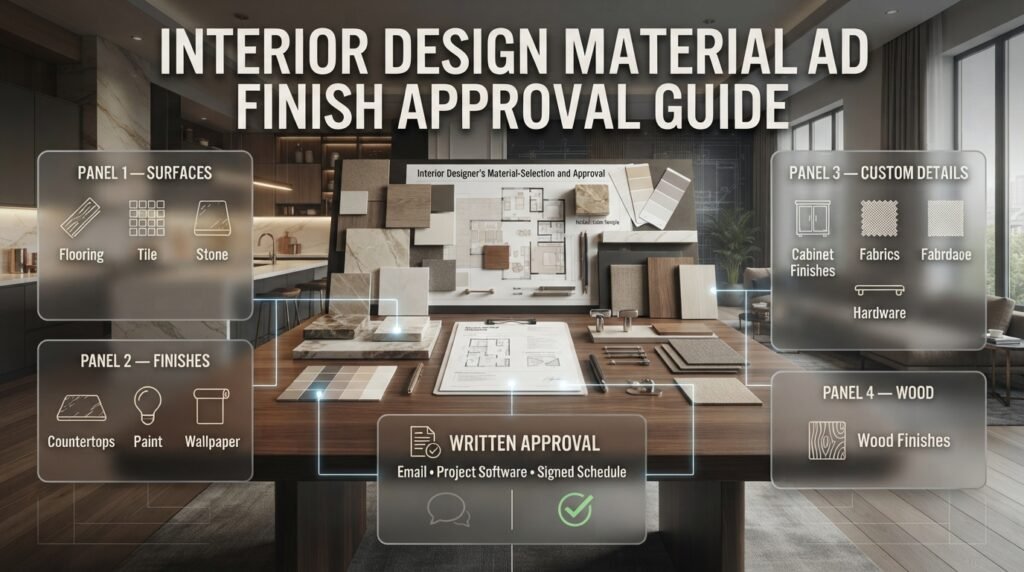
Interior design contracts should establish how important selections are approved.
Materials can include:
- Flooring
- Tile
- Stone
- Countertops
- Paint
- Wallpaper
- Cabinet finishes
- Fabrics
- Hardware
- Wood finishes
Clients should understand whether selections are considered approved through email, project software, signed schedules, or another method.
This becomes especially important when several materials are being ordered simultaneously.
For example, a designer may recommend three stone options. The client chooses one verbally during a meeting. Weeks later, the client says they wanted another option.
Written approval creates a much clearer record.
If you’re reviewing the design side of color and finish decisions, the Paint Color section can be useful for understanding how color choices fit into the broader planning process.
12. Furniture Specifications Should Be Precise
Furniture isn’t simply about appearance.
A designer needs to consider:
- Width
- Depth
- Height
- Door clearance
- Circulation
- Seat height
- Wall position
- Window location
- Power outlets
- Delivery access
A sofa can look perfect in a showroom and still be completely wrong for the room.
That is why measurements and specifications should be part of the design process.
The same principle applies when reviewing Sofa Seat Depth Selection, especially when comfort and room proportions are important.
A contract may not need to specify every furniture dimension, but it should make clear who is responsible for verifying dimensions before purchase.
13. Understand the Project Timeline
An interior design contract should provide a realistic timeline or at least explain the major project stages.
Typical stages can include:
| Stage | Main Activity |
|---|---|
| Brief | Client requirements |
| Concept | Design direction |
| Development | Detailed selections |
| Documentation | Drawings/specifications |
| Approval | Client sign-off |
| Procurement | Product ordering |
| Installation | Delivery and setup |
| Completion | Final review |
The timeline should also identify dependencies.
For example, the designer may be unable to finalize furniture specifications until the client approves the layout.
Likewise, procurement may not begin until a deposit has been received.
A professional timeline isn’t simply a promise of a completion date. It is a sequence of connected decisions.
14. Understand How Delays Are Handled
Interior design projects involve many things outside the designer’s direct control.
A supplier may delay a shipment.
A contractor may discover a hidden problem.
A custom item may take longer to manufacture.
The client may take longer than expected to approve a design.
The contract should explain how these events affect the schedule.
A realistic agreement shouldn’t promise that every project will finish on an exact date regardless of circumstances.
Instead, it should establish how schedule changes are communicated and managed.
15. Define the Client’s Responsibilities
A contract isn’t only about what the designer must do.
The client also has responsibilities.
These may include:
- Providing accurate property information
- Giving measurements where required
- Providing timely decisions
- Making payments
- Providing site access
- Approving drawings
- Approving materials
- Communicating changes
- Hiring required specialists
- Obtaining necessary permissions
Imagine the designer submits a furniture layout on Monday and asks for approval before Friday.
If the client doesn’t respond for two weeks, the project schedule may obviously move.
The agreement should explain that approvals are part of the client’s responsibility.
16. Contractor Responsibilities Must Be Clear
Interior designers and contractors are not automatically responsible for the same things.
A designer may create the concept and specifications while a contractor performs the physical construction.
Depending on the agreement, the designer might:
- Recommend contractors
- Coordinate communication
- Review progress
- Attend site meetings
- Check design intent
- Review shop drawings
But that doesn’t necessarily mean the designer guarantees the contractor’s workmanship.
The contract should clearly explain the designer’s role.
For major renovations, this distinction matters enormously.
If you’re planning renovation work, it is also useful to understand the separate issue of Renovation Projects That Require Permits. Permit responsibilities shouldn’t be assumed simply because an interior designer is involved.
17. Site Visits and Supervision
Some clients assume an interior designer will be on site every day.
That may not be the service being purchased.
A contract should explain:
- Number of site visits
- Purpose of visits
- Expected duration
- Whether additional visits cost extra
- Whether site supervision is included
- Whether construction quality is inspected
There’s a major difference between:
Design consultation
and
Full construction supervision
Those services require very different levels of involvement.
If you want daily site management, make sure it is explicitly included.
18. Change Orders Are Essential
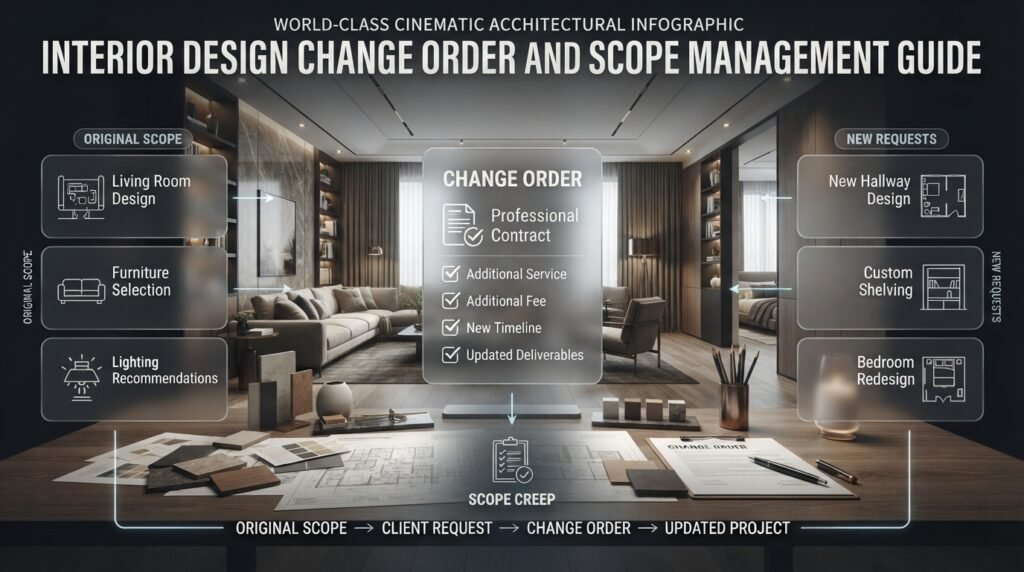
A change order is a documented modification to the agreed project scope.
It becomes useful when something changes after the contract has been signed.
For example:
Original scope:
- Living room design
- Furniture selection
- Lighting recommendations
Client later requests:
- New hallway design
- Custom shelving
- Bedroom redesign
Instead of casually adding the work, the designer can document:
- Additional service
- Additional fee
- New timeline
- Updated deliverables
This keeps the project organized.
A clear change-order procedure is one of the strongest protections against scope creep.
19. What Happens If a Product Is Discontinued?
Product availability can change.
A selected tile may become unavailable.
A furniture manufacturer may discontinue a color.
A lighting fixture may be backordered.
The contract should explain how substitutions are handled.
Ideally, major substitutions should require client approval.
The replacement should also be evaluated for:
- Price
- Dimensions
- Finish
- Quality
- Availability
- Compatibility
A replacement shouldn’t automatically be treated as equivalent simply because it serves the same basic purpose.
20. Intellectual Property and Design Ownership
Interior designers create original intellectual property.
That may include:
- Floor plans
- Drawings
- Renderings
- Mood boards
- Concepts
- Specifications
- Custom furniture designs
The contract should explain who owns those materials and what the client is allowed to do with them.
For example, paying for a design service doesn’t necessarily mean the client can automatically reproduce the designer’s drawings for commercial purposes or distribute them to other parties.
The agreement may instead provide a license for using the design for the specific property.
This is an area where wording can vary considerably by jurisdiction, so complicated or high-value projects may justify professional legal review.
21. Photography and Portfolio Rights
Designers often want to photograph completed projects.
They may use photographs for:
- Website portfolios
- Social media
- Publications
- Awards
- Marketing
- Case studies
Clients should understand this before signing.
If privacy is important, the agreement can address:
- Whether photographs are permitted
- Whether the client’s name can be published
- Whether the address can be disclosed
- Whether personal belongings may appear
- Whether images can be used commercially
A simple photography clause can prevent an uncomfortable disagreement after the project is complete.
22. Confidentiality and Privacy
Interior designers may learn sensitive information about a client’s home and lifestyle.
That can include:
- Security arrangements
- Household routines
- Property information
- Financial considerations
- Personal preferences
A confidentiality provision can establish how sensitive information is treated.
This can be especially valuable for high-profile clients, luxury properties, or projects where privacy is a major concern.
23. Cancellation and Termination Terms
Every contract should explain how the relationship can end.
Don’t wait until there’s a problem to discover the cancellation rules.
Check:
- Who can terminate
- Required notice
- Outstanding fees
- Treatment of deposits
- Purchased products
- Unpaid invoices
- Design documents
- Third-party commitments
- Work completed before termination
Termination doesn’t necessarily mean someone did something wrong.
Sometimes circumstances simply change.
The client may sell the property. The budget may change. The designer may become unavailable. The project may be postponed indefinitely.
A clear termination clause makes these situations easier to manage.
24. Dispute Resolution
Even well-written agreements cannot guarantee that disagreements will never occur.
That’s why a contract should explain what happens when the parties disagree.
A process might involve:
- Direct discussion
- Written notice
- Negotiation
- Mediation
- Arbitration or court proceedings, where appropriate
The exact process depends on the contract and jurisdiction.
For a major project, legal review can help ensure that the dispute provisions are appropriate for the location and type of work.
25. Insurance and Liability
For larger projects, clients should understand what insurance the designer carries and what risks are outside the designer’s responsibility.
Depending on the business and jurisdiction, relevant coverage may include professional liability, general liability, or other commercial insurance.
The contract can also distinguish between:
- Design errors
- Contractor workmanship
- Product defects
- Manufacturer warranties
- Delivery damage
- Site conditions
The goal is to avoid treating every project problem as automatically being the designer’s responsibility.
26. Warranties and Defective Work
A contract should explain how warranties are handled.
There can be several different warranties involved:
- Designer service warranty
- Contractor workmanship warranty
- Manufacturer product warranty
- Installer warranty
These aren’t necessarily interchangeable.
If a cabinet hinge fails, for example, the manufacturer or installer may be responsible rather than the designer.
The contract should make the responsibility chain as clear as possible.
27. Final Inspection, Snagging, and Handover
The project shouldn’t simply end when furniture arrives.
A final review can identify:
- Missing items
- Damaged products
- Incorrect finishes
- Installation issues
- Outstanding work
- Small defects
- Unfinished details
A professional handover process may include a snagging list or punch list.
The contract can establish how these items are recorded and who is responsible for resolving them.
This is especially useful for projects involving multiple suppliers and contractors.
28. Taxes and Additional Expenses

Don’t overlook expenses that sit outside the headline design fee.
Depending on the project, additional costs may include:
- Taxes
- Delivery
- Shipping
- Storage
- Installation
- Travel
- Printing
- Samples
- Special-order fees
- Rush charges
- Contractor costs
The agreement should explain which expenses are included and which are reimbursable.
A client who understands the complete cost structure is much less likely to be surprised later.
How to Review an Interior Designer Contract Before Signing
Don’t read the contract like a novel.
Review it strategically.
Step 1: Start With the Scope
Ask:
What exactly am I buying?
Identify the rooms, services, phases, and exclusions.
Step 2: Review Every Financial Term
Write down:
- Design fee
- Deposit
- Payment dates
- Hourly rates
- Procurement fees
- Markups
- Additional charges
- Reimbursable expenses
Step 3: Check Revision Rules
Find out how many revisions are included and what happens after the limit.
Step 4: Review Procurement
Understand who buys, who pays, who receives deliveries, and who handles problems.
Step 5: Check Timeline Dependencies
Look for client approvals, supplier lead times, construction dependencies, and potential delays.
Step 6: Review Cancellation
Know your financial obligations if the project ends early.
Step 7: Check Ownership
Understand what happens to drawings, renderings, specifications, and other design materials.
Step 8: Ask Questions Before Signing
Don’t sign first and ask later.
If something matters to you, get it clarified before the agreement becomes effective.
Common Interior Designer Contract Mistakes to Avoid
Mistake 1: Choosing the Cheapest Contract
A cheap contract isn’t necessarily a good contract.
If important services are excluded, the final project can become much more expensive.
Better approach: Compare scope, deliverables, responsibilities, and additional fees—not just the headline price.
Mistake 2: Relying on WhatsApp or Verbal Promises
A designer may say something during a meeting that never makes it into the formal agreement.
Why this causes trouble: People remember conversations differently.
Better approach: Ask for important changes and commitments to be documented.
Mistake 3: Ignoring Exclusions
Clients often read the included services but skip the exclusions.
Why it matters: Exclusions define where the designer’s responsibility stops.
Better approach: Read the exclusions as carefully as the scope.
Mistake 4: Assuming Procurement Is Included
Selecting a product isn’t the same as purchasing it.
Better approach: Clarify who places the order, who pays the supplier, and who manages delivery.
Mistake 5: Not Understanding Revision Limits
A project can become unprofitable for a designer when endless changes are treated as free.
Better approach: Establish the revision process before design work begins.
Mistake 6: Treating the Timeline as a Guarantee
Interior projects depend on suppliers, contractors, approvals, and site conditions.
Better approach: Understand which dates are estimates and which milestones are contractual.
Mistake 7: Ignoring Design Ownership
A client may assume that paying the invoice automatically gives unrestricted ownership of every drawing.
Better approach: Read the intellectual-property section carefully.
Where Interior Design Resources Fit Into the Contract Process
A contract shouldn’t dictate your aesthetic choices, but it creates the framework within which those choices are made.
For example, if the scope includes DIY-related styling or smaller finishing projects, DIY Home Projects can provide useful inspiration while the contract defines which work is actually being handled professionally.
For smaller tasks that don’t require a full design service, Easy Weekend DIY Projects for Your Home can be useful inspiration for projects a homeowner may choose to handle independently.
Storage can also become part of a larger interior planning conversation. If wall-mounted storage is included in the design scope, Wall Shelves Ideas can help demonstrate the kinds of functional decisions that may need to be specified.
For decorative finishing, DIY Home Decor Crafts can provide ideas that are separate from professional design services.
The important point is to keep these activities conceptually separate.
If a client decides to take on a DIY project, it shouldn’t automatically become an additional responsibility for the designer unless the contract says so.
Why Room-Specific Scope Is Better Than Vague Scope
Consider two contract descriptions.
Version A
Interior design services for residential property.
Version B
Interior design services for the living room, dining area, entryway, and primary bedroom, including space planning, furniture selection, material recommendations, lighting concepts, and two rounds of revisions.
Version B is much easier to understand.
Room-specific scope also becomes valuable when different rooms require different services.
For example, an entryway may require detailed storage planning rather than furniture styling alone. If your project includes this type of work, Entryway Storage Capacity Planning is a useful example of how a seemingly simple space can involve detailed functional decisions.
Likewise, a kitchen project can involve a different level of planning from a bedroom refresh. The design contract should reflect those differences rather than treating every room as identical.
What Does a Professional Interior Design Workflow Look Like?
A contract becomes easier to understand when you see how it fits into the actual project.
A typical workflow looks like this:
Consultation
↓
Project Brief
↓
Scope Confirmation
↓
Contract + Initial Payment
↓
Concept Development
↓
Client Approval
↓
Detailed Design
↓
Revisions
↓
Final Approval
↓
Procurement
↓
Installation
↓
Final Inspection
↓
Handover
The contract establishes the rules for this entire sequence.
That’s why signing the agreement isn’t simply an administrative step. It establishes the framework for every stage that follows.
A Practical Contract Checklist for Homeowners
Before signing, ask yourself:
Project
- Is the property clearly identified?
- Are the exact rooms listed?
- Is the project type clear?
Scope
- What services are included?
- What services are excluded?
- Are deliverables specified?
- Are drawings clearly described?
Money
- What is the design fee?
- What deposit is required?
- When are payments due?
- Are there hourly charges?
- Are procurement fees disclosed?
- Are expenses reimbursable?
Revisions
- How many rounds are included?
- What qualifies as a revision?
- What qualifies as a redesign?
- What happens after the included rounds?
Procurement
- Who purchases products?
- Who pays suppliers?
- Who handles delivery?
- Who handles damaged goods?
- What happens with returns?
Timeline
- What is the expected schedule?
- What can cause delays?
- How are delays communicated?
Construction
- Who hires contractors?
- Who supervises them?
- What does the designer actually inspect?
Ownership
- Who owns the drawings?
- How can the client use them?
- Can the designer use project photographs?
Exit
- Can either party terminate?
- What notice is required?
- What happens to outstanding payments?
- What happens to purchased products?
If you can’t answer these questions from the contract, ask for clarification.
What should an interior designer contract include before you sign it?
A professional interior designer contract should clearly explain the scope of work, deliverables, fees, payment schedule, revisions, timeline, procurement responsibilities, approvals, additional charges, ownership of design materials, termination terms, and dispute procedures. The most important point is that the contract should describe the actual project rather than rely on general phrases such as “full interior design services.”
Before signing, make sure the agreement answers practical questions such as:
Which rooms or areas are included?
What drawings, plans, renders, or specifications will you receive?
How many design revisions are included?
Are site visits included?
Who purchases furniture, lighting, fixtures, and materials?
Are procurement fees or markups charged separately?
What happens if you request additional work?
What happens if the project is delayed?
Who owns the final drawings and design concepts?
How can either party terminate the agreement?
A good contract should leave very little room for “I thought that was included.” If an important service, cost, responsibility, or limitation was discussed during the consultation, it is safer to have it reflected in the written agreement.
Professional takeaway:
The contract should be detailed enough that someone who was not present during the initial meetings could read it and understand exactly what the designer is providing and what the client is paying for.
How are interior designer fees and payments usually handled in a contract?
Interior designer fees can be structured in several ways, including flat fees, hourly rates, percentage-based fees, retainers, milestone payments, or hybrid arrangements. The important issue is not simply the amount of the fee; it is whether the contract clearly explains how that fee is calculated, when it becomes payable, and what services it covers.
A well-written payment section should identify:
Initial consultation or booking fees
Retainer or deposit amount
Payment milestones
Invoice due dates
Hourly or additional-service rates
Procurement or management fees
Furniture and material markups
Reimbursable expenses
Taxes, where applicable
Consequences of late payment
For example, a fixed design fee may cover concept development and drawings, while furniture procurement, additional site visits, or extra revisions may be billed separately. Those distinctions should be visible before the project begins rather than appearing unexpectedly on a later invoice.
💡 Expert Tip:
Do not judge a contract only by whether the designer’s fee seems reasonable. Look at the complete financial structure. A lower design fee can become expensive if procurement markups, additional revisions, site visits, or project-management charges are poorly defined.
How many revisions should be included in an interior design contract?
A professional contract should state how many revision rounds are included in each design phase and what happens when the client requests additional changes. This is important because interior design is naturally collaborative, but unlimited revisions can significantly change the amount of work originally agreed upon.
For example, the agreement might define a certain number of concept revisions and another number for developed drawings. It should also distinguish between a normal revision and a completely new design direction.
Consider the difference:
Normal revision:
The client likes the proposed living-room concept but wants a different fabric, paint color, or coffee table.
Major scope change:
The client approves the living-room concept and later decides to redesign the entire layout, add built-in cabinetry, change the lighting plan, and introduce additional furniture.
The second situation may require additional design hours, drawings, sourcing, coordination, and project time. A clear variation or additional-services clause gives both parties a fair way to handle that change.
⚠ Common Mistake:
Never assume that “a few small changes” automatically means there will be no additional charge. Ask the designer to explain exactly what is considered an included revision and what becomes additional work.
Who is responsible for furniture, materials, purchasing, and supplier problems?
This is one of the most important sections to read carefully because designing a product and purchasing or managing that product are not necessarily the same responsibility. The contract should explain whether the designer is simply recommending products, sourcing them, purchasing them on the client’s behalf, or managing delivery and installation.
Pay particular attention to:
Furniture and lighting purchasing
Material sourcing
Designer markups
Trade discounts
Shipping charges
Delivery delays
Damaged products
Returns and restocking fees
Custom-made items
Installation responsibility
Supplier warranties
Who carries the risk while goods are being transported
For example, if a custom sofa arrives with the wrong fabric, the contract should help establish who contacts the supplier, who pays for replacement shipping, and whether the designer’s responsibility is limited to coordinating the correction.
The same principle applies to materials. If the designer specifies a tile but a contractor installs it incorrectly, that may be a different issue from the designer selecting the wrong product. Clear responsibility prevents these situations from becoming personal disputes.
📌 Quick Tip:
If furniture or materials represent a significant part of the project budget, read the procurement and purchasing section as carefully as the design-fee section. This is often where unexpected costs or responsibilities become visible.
What happens if the client or interior designer wants to terminate the contract?
A strong interior design agreement should explain how either party can end the relationship, what notice is required, how completed work is paid for, what happens to deposits or retainers, and how purchased products or unfinished work are handled. Termination terms are important even when everyone expects the project to go smoothly.
Projects can end for many legitimate reasons. A client’s budget may change, construction may be postponed, the property may be sold, or the designer-client relationship may simply stop working. The contract should provide a structured way to deal with that situation.
Before signing, check whether the agreement explains:
Required termination notice
Outstanding invoices
Treatment of deposits or retainers
Payment for completed design work
Cancellation of product orders
Restocking or cancellation charges
Ownership or use of completed drawings
Return of samples or documents
Handover of project information
Dispute-resolution procedures
⭐ Expert Advice:
Do not treat a termination clause as a negative sign. A clear exit process can actually make the entire professional relationship more comfortable because both sides understand their rights and responsibilities if circumstances change.
The strongest contracts are not designed to create conflict; they are designed to prevent uncertainty before conflict begins. Scope, payment terms, revisions, procurement, approvals, and termination should all be understandable before the first major design decision is made.
Note: contract requirements vary by country and project type, so for a significant renovation or high-value agreement, having the final contract reviewed by a qualified local attorney is sensible.
Conclusion
An interior designer contract is much more than a document that confirms a design fee. It is the foundation for a clear and professional working relationship between the client and designer. When the agreement explains the scope of work, deliverables, payment terms, revision limits, procurement responsibilities, project timeline, approvals, additional services, and termination conditions, both sides have a much clearer understanding of what to expect.
Before signing, take time to read the contract carefully rather than focusing only on the overall price. A professional agreement should make it easy to understand what is included, what is excluded, who is responsible for each stage of the project, and what happens when circumstances change. This becomes especially important when a project involves contractors, custom furniture, expensive materials, multiple suppliers, or significant renovation work.
The best contracts also leave room for realistic changes. Interior projects rarely follow a perfectly straight path, so the agreement should explain how design revisions, material substitutions, delays, additional site visits, and change orders will be handled. Clear procedures make these situations easier to manage without turning normal project changes into unnecessary disagreements.
Key points to remember
- Read the complete contract before making a payment or signing.
- Confirm that every major service discussed is included in the written scope.
- Understand exactly how the designer’s fee and additional charges are calculated.
- Check the number of included design revisions.
- Clarify who handles purchasing, deliveries, installations, and supplier issues.
- Make sure project responsibilities and timelines are realistic.
- Ask how changes to the original scope will be priced and approved.
- Review termination, refund, cancellation, and dispute-resolution provisions.
- Keep written records of important approvals and changes throughout the project.
Ultimately, a good interior designer contract should provide clarity rather than confusion. It should protect the designer’s time and professional work while also giving the client confidence about costs, responsibilities, deliverables, and expectations.
When both parties understand the agreement before the project begins, design decisions become easier, communication becomes more professional, and the entire renovation or decorating process has a stronger foundation for success.