
Introduction
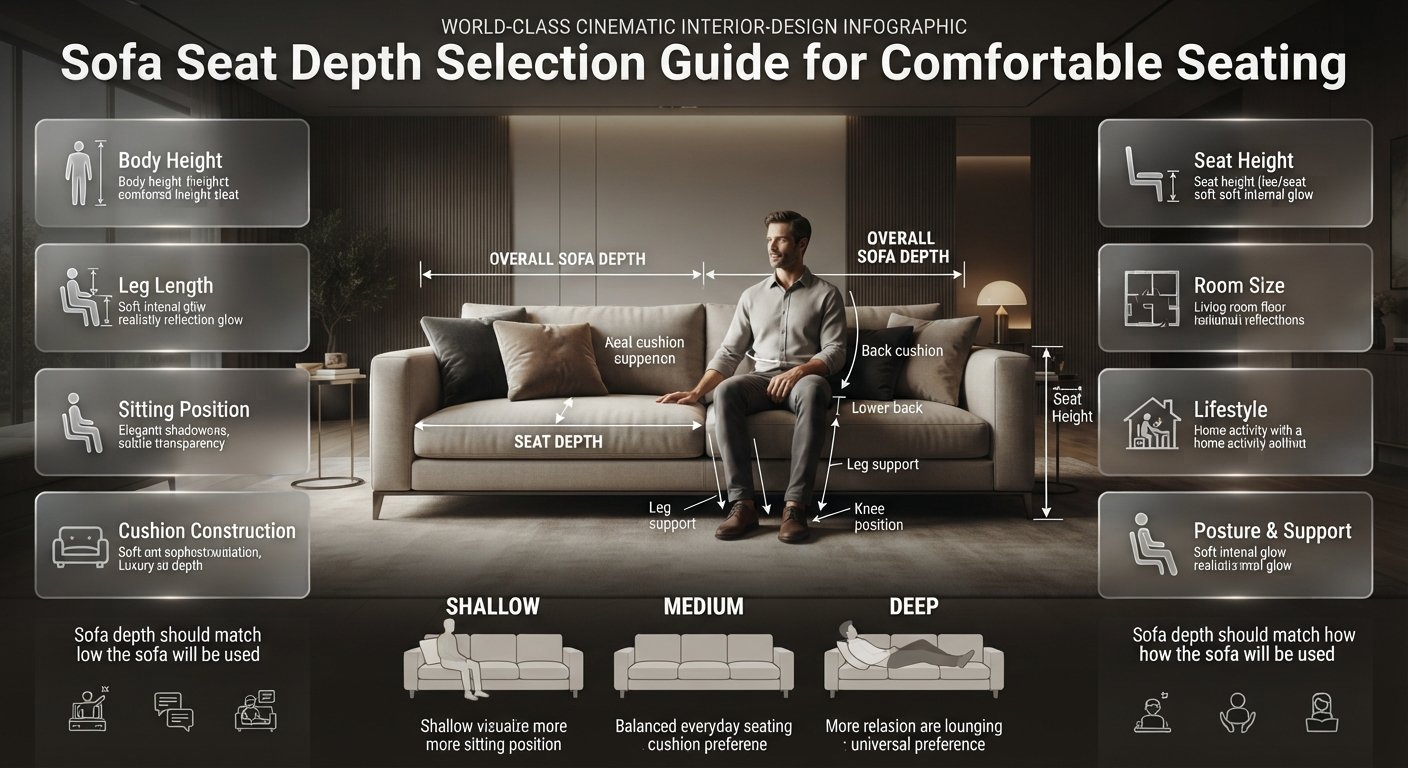
Sofa Seat Depth Selection | A sofa can look perfect in a showroom and still feel wrong after a few days at home. Maybe your feet don’t sit comfortably on the floor. Maybe you have to lean forward because the seat is too deep, or perhaps your knees extend beyond the cushion because it’s too shallow. In many cases, the problem isn’t the fabric, color, or overall size. It’s the sofa seat depth selection.
Seat depth determines how far your body sits into the sofa and has a major influence on posture, leg support, lower-back comfort, and the way you use the room. A sofa designed for relaxed movie nights shouldn’t necessarily have the same depth as one intended for formal conversation or daily reading.
The important thing is that there isn’t one perfect measurement for everyone. Your height, leg length, preferred sitting position, cushion construction, seat height, room size, and lifestyle all matter.
In this guide, you’ll learn how to choose sofa seat depth confidently, how to distinguish seat depth from overall sofa depth, what measurements work for different users, how cushions change the actual sitting experience, and how to avoid the expensive mistake of choosing a sofa that looks good but doesn’t feel right.
What Is Sofa Seat Depth?
Sofa seat depth is the usable distance from the front edge of the sitting cushion to the point where the seat meets the back cushion or backrest. It is different from the sofa’s total front-to-back measurement because the overall depth also includes the back structure and cushions.
This distinction is important because two sofas can have the same overall depth but feel completely different when you sit on them. A thick back cushion can consume several inches of the available space, while a thinner back can leave considerably more room for your legs.
For example, imagine two sofas that are both 38 inches deep overall. One might provide approximately 21 inches of usable seat depth, while another provides 25 inches. They occupy almost the same floor area but create noticeably different sitting positions.
Why does seat depth matter?
Seat depth determines where your hips, knees, lower back, and feet naturally sit. A shallow seat encourages a more upright position, while a deeper seat generally supports a relaxed posture.
It affects:
- Lower-back support
- Thigh support
- Foot contact with the floor
- Ease of standing
- Reclining position
- Reading comfort
- Television viewing
- Conversation posture
- Overall room proportions
Current furniture guides commonly place conventional usable seat depth around 20–24 inches, while deeper lounge seating can extend beyond that range. These are useful shopping references rather than universal standards.
Sofa Depth vs. Seat Depth: What Is the Difference?
Overall sofa depth tells you how much floor space the furniture occupies. Seat depth tells you how much usable sitting space your body receives.
Think of the measurements like this:
              BACK CUSHION
          ┌─────────────────┐
          │                 │
          │                 │
          └─────────────────┘
                 ↓
       ←── USABLE SEAT DEPTH ──→
       ┌────────────────────────┐
       │                        │
       │      SEAT CUSHION      │
       │                        │
       └────────────────────────┘
                         ↑
                     FRONT EDGE

       ←──── OVERALL DEPTH ────→
Overall depth is important for room planning, while usable seat depth is critical for comfort.
A sofa with an overall depth of 40 inches isn’t automatically a 40-inch seat. The back cushions, frame, angle, and construction consume part of that measurement.
What should you ask a furniture retailer?
Don’t simply ask:
“How deep is this sofa?”
Ask:
“What is the usable seat depth with the back cushions in their normal position?”
That’s a much more useful question.
What Is the Standard Sofa Seat Depth?
A conventional sofa often has a usable seat depth of approximately 20–24 inches. Around 20–22 inches generally produces a more upright everyday sitting position, while 23–24 inches offers a somewhat more relaxed feel.
There isn’t one regulated furniture standard, so manufacturers use different terminology. Some call 23 inches deep, while others don’t use the word “deep” until 25 inches or more.
| Seat depth | Typical sitting experience | Best suited to |
|---|---|---|
| 18–20 in | Compact and upright | Small spaces |
| 20–22 in | Supportive and upright | Reading, conversation |
| 22–24 in | Balanced and relaxed | Everyday living |
| 24–27 in | Deep and lounge-friendly | TV rooms, taller users |
| 27–30+ in | Very relaxed | Lounging, reclining, large rooms |
These numbers should be treated as starting points rather than rules. Cushion softness and back construction can change how the same measurement feels.
How Do You Choose the Right Sofa Seat Depth?
The best sofa seat depth is the one that allows you to sit naturally with your back supported, your feet comfortably positioned, and your thighs adequately supported without pressure behind your knees.
Start with these five questions:
- Who will use the sofa most often?
- How tall are the regular users?
- Do you prefer upright sitting or lounging?
- What will you mainly do on the sofa?
- How much floor space can the room realistically give to the sofa?
A useful sofa selection process is therefore:
Body → Sitting style → Sofa construction → Room → Final measurement
Don’t start with appearance alone.
A sofa can be beautiful and still be completely wrong for your body.
How Does Height Affect Sofa Seat Depth?
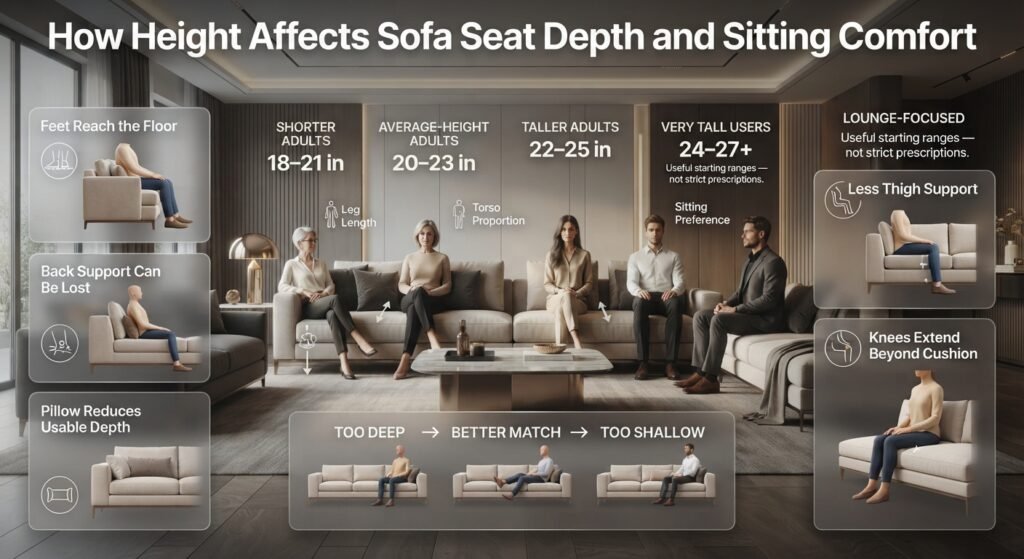
Height is useful when narrowing your options, but it shouldn’t be the only measurement you consider. Two people of the same height can have different leg lengths, torso proportions, and sitting preferences.
As a practical starting point:
| User | Useful starting range |
|---|---|
| Shorter adults | 18–21 in |
| Average-height adults | 20–23 in |
| Taller adults | 22–25 in |
| Very tall users | 24–27+ in |
| Lounge-focused users | 24–30+ in |
Current furniture guidance similarly treats roughly 19–21 inches as a useful starting range for shorter users, around 21–23 inches for many average-height adults, and deeper seating for taller users or lounging.
These aren’t strict ergonomic prescriptions. They simply help you identify which sofas deserve a closer look.
What happens when a sofa is too deep?
A short user may slide forward to reach the floor comfortably.
Once they slide forward, their lower back may lose contact with the back cushion.
Then they may add a decorative pillow behind their back.
After that, the usable sitting area becomes much smaller than the sofa’s advertised seat depth.
That’s why “deeper” doesn’t automatically mean “more comfortable.”
What happens when a sofa is too shallow?
A tall person may feel that their thighs aren’t adequately supported.
They may sit with their knees extending too far beyond the front of the cushion or feel as though they’re perched on the sofa rather than sitting into it.
For taller users, a moderate-to-deep sofa often provides a more natural relaxed position.
How Can You Measure Your Ideal Seat Depth?
One of the easiest ways to understand your personal preference is to measure a chair or sofa you already find comfortable.
Step 1: Sit naturally
Don’t sit unnaturally straight just for the measurement.
Sit the way you normally sit when relaxing.
Step 2: Move your back against the backrest
Your lower back should have the support you normally expect.
Step 3: Keep your feet comfortable
If your feet naturally reach the floor, that’s a useful reference point.
Step 4: Measure from your back to the front edge
Measure the horizontal sitting surface from the back support to the front edge beneath your thighs.
Step 5: Check the knee gap
There should be comfortable clearance between the front of the seat and the area behind your knees.
A useful showroom test is to sit fully back and see whether you can comfortably place a small gap between the cushion edge and the back of your knees. A current furniture guide also recommends using your seated body measurement as a starting reference rather than relying solely on generic sofa categories.
The Two-Finger Test for Sofa Depth
Here’s a simple test you can use when shopping.
Sit all the way back into the sofa.
Place your feet naturally on the floor.
Now check the space between the front edge of the cushion and the back of your knees.
You don’t want the cushion pushing hard against the back of your knees. At the same time, you don’t want a huge unsupported section of thigh extending beyond the cushion.
If the sofa feels comfortable but your feet don’t reach the floor, try sitting with a lumbar cushion behind you.
If that immediately improves the fit, the sofa may be slightly deeper than ideal for your body but still workable.
If you need a large stack of pillows just to sit normally, choose a different depth.
How Does Seat Height Affect Seat Depth?
Seat height and seat depth should always be evaluated together.
A deeper seat can feel very different depending on how high or low it sits from the floor.
For example:
Deep + low = relaxed lounge position
Shallow + higher = upright, easier-to-rise position
Medium + medium = balanced everyday seating
Many current sofa specifications place conventional seat height around 17–19 inches, although manufacturers vary considerably.
Why does this matter?
Imagine a sofa with a 26-inch seat depth and a very low seat height.
You may naturally slide backward and recline.
That can be excellent for movie nights.
Now imagine the same depth with a higher seat and a firm back.
The sofa may feel surprisingly awkward because the body geometry is different.
That’s why comparing depth alone can lead to poor decisions.
What Sofa Seat Depth Is Best for Upright Sitting?
If you mainly use your sofa for conversation, reading, working with a laptop, or sitting upright, a shallower-to-medium seat depth is usually easier to live with.
Around 20–22 inches is a useful starting point for this type of furniture.
A more upright sofa makes it easier to:
- Keep your feet on the floor
- Maintain back contact
- Face another person
- Stand up naturally
- Read comfortably
- Hold a drink or book
This is especially relevant in formal living rooms where people aren’t expected to lie back or stretch out.
For homes where the sofa serves both formal and casual purposes, something around 21–24 inches can provide a practical compromise.
What Sofa Seat Depth Is Best for Lounging?
If your sofa is primarily a place to relax, watch movies, nap, or stretch your legs, deeper seating can make sense.
A usable depth around 24–27 inches or more can create a distinctly lounge-oriented experience.
Deep seating works especially well in:
- Media rooms
- Family rooms
- Large open-plan spaces
- Casual living rooms
- Home theaters
- Reading lounges
But remember that a deep sofa requires enough room around it.
A 28-inch seat can feel wonderful in a large room but unnecessarily bulky in a narrow apartment.
What Is the Best Sofa Depth for Watching TV?
Television viewing usually benefits from a medium-to-deep seat because people tend to relax rather than sit perfectly upright.
For many homes, approximately 22–25 inches of usable seat depth is a reasonable starting range.
However, the correct choice depends on your preferred viewing posture.
If you sit upright and frequently get up, a shallower seat may work better.
If you recline during movies and spend long periods on the sofa, a deeper seat may be more comfortable.
Also consider the entire TV layout.
The sofa should not be so deep that it forces the coffee table into an awkward position or blocks the walking route through the room.
What Is the Best Sofa Depth for Reading?
Reading generally favors a supportive seat rather than an extremely deep lounge seat.
A depth around 19–22 inches can work well for people who prefer an upright reading position.
The ideal setup allows:
- Your feet to rest naturally
- Your lower back to remain supported
- Your shoulders to stay relaxed
- Your book or tablet to remain at a comfortable height
- Easy movement when getting up
A deeper sofa can still work if you use a supportive lumbar cushion.
The important thing is not the number itself but the posture the sofa creates.
How Do Back Cushions Change the Effective Seat Depth?
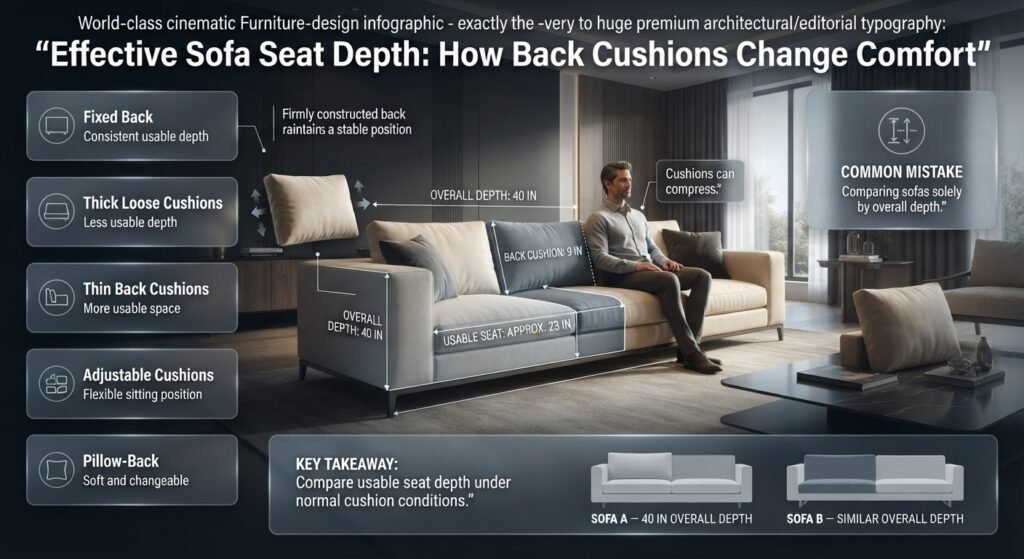
Back cushions are one of the biggest reasons sofa dimensions can be misleading.
Suppose a sofa has:
- Overall depth: 40 inches
- Back cushion: 9 inches
- Usable seat: approximately 23 inches
The sofa occupies 40 inches of floor depth, but you don’t sit on 40 inches.
Back cushions may also compress when you sit against them.
Loose cushions can move backward or forward.
Firm fixed backs tend to provide a more consistent sitting position.
| Back construction | Typical effect |
|---|---|
| Fixed back | Consistent usable depth |
| Thick loose cushions | Less usable depth |
| Thin back cushions | More usable space |
| Adjustable cushions | Flexible sitting position |
| Pillow-back | Soft and changeable |
⚠ Common Mistake: Comparing two sofas solely by their overall depth.
Always compare the usable seat depth under normal cushion conditions.
How Does Cushion Firmness Affect Seat Depth?
A firm cushion and a soft cushion with the same dimensions can feel completely different.
A soft cushion compresses under your weight and can allow your body to sink deeper into the sofa.
A firm cushion keeps you closer to the surface and often creates a more supportive feeling.
This means you shouldn’t ask:
“Is 24 inches comfortable?”
Instead ask:
“Is 24 inches comfortable with this seat height, cushion firmness, back angle, and my preferred posture?”
That is a much better way to evaluate furniture.
Deep Sofa vs Standard Sofa: Which Is Better?
Neither is universally better.
The right choice depends on your room and lifestyle.
| Feature | Standard-depth sofa | Deep-seat sofa |
|---|---|---|
| Upright sitting | Excellent | Moderate |
| Lounging | Good | Excellent |
| Reading | Excellent | Good with support |
| Tall users | Good | Excellent |
| Short users | Usually easier | May require cushions |
| Small room | Better | Can be difficult |
| Movie nights | Good | Excellent |
| Formal conversation | Better | Less formal |
| Floor-space efficiency | Better | Lower |
A recent furniture comparison similarly emphasizes that deeper seating is more appropriate for lounging and taller users, while standard depth is generally more versatile for everyday sitting.
How Does Sofa Seat Depth Affect a Small Living Room?
In a small room, sofa depth becomes a space-planning decision rather than simply a comfort decision.
A deep sofa can consume valuable floor area.
That may leave less space for:
- Coffee table clearance
- Walking paths
- Side tables
- Floor lamps
- Storage furniture
- Entry routes
For a compact living room, a sofa with approximately 20–23 inches of usable seat depth can often provide a better balance.
But don’t look only at the seat.
Slim arms can save several inches of overall width.
Raised legs can make a sofa visually lighter.
A lighter upholstery color can reduce visual heaviness.
And a compact sofa can sometimes provide more practical comfort than an oversized sectional because it leaves room for movement.
How Much Clearance Should You Leave Around a Sofa?
A sofa should never be measured in isolation.
A useful starting point for the space between a sofa and coffee table is approximately 14–18 inches, depending on the room and furniture proportions.
The goal is to create enough room for legs without turning the gap into a walking corridor.
Before ordering, measure:
- Sofa footprint
- Coffee-table footprint
- Side-table locations
- Main walking paths
- Door swings
- Cabinet openings
- Window access
- TV viewing position
For a more complete approach to planning the entire interior, the Interior Design section can be useful when the sofa is part of a larger room redesign rather than a standalone furniture purchase.
Why Should You Tape the Sofa Footprint on the Floor?
This is one of the easiest ways to catch a furniture mistake before spending money.
Use painter’s tape to mark:
- The sofa’s full width
- Its full overall depth
- Arm positions
- Coffee-table location
- Main walking route
Then walk around the room.
Sit in a chair where the sofa would be.
Ask someone else to walk through the space.
Open nearby doors and drawers.
The exercise takes only a few minutes but reveals problems that a product photograph cannot show.
Weekend measurement project
If you’re preparing the room yourself, turn it into a simple Easy Weekend DIY Projects for Your Home task.
You don’t need to build anything.
You’re simply testing proportions before making a major furniture purchase.
How Does Sofa Depth Affect Room Balance?
Furniture isn’t only about measurements. It also has visual weight.
A deep sofa naturally appears more substantial than a shallow one.
If the room already contains:
- Large cabinets
- Thick curtains
- Heavy coffee tables
- Dark flooring
- Oversized lamps
an extra-deep sofa may make the entire room feel crowded.
On the other hand, a large open room can handle deeper furniture without looking overloaded.
This is why sofa selection should be considered as part of the broader Home Improvement process when you’re changing the room rather than simply replacing one old sofa.
How Do Wall Shelves Work With a Deep Sofa?
A deep sofa changes the relationship between seating and the wall behind it.
If you have wall-mounted storage or decorative shelving, check that the sofa doesn’t make the shelves feel visually cramped.
For example, Wall Shelves Ideas can be useful when you’re trying to add vertical storage without introducing another floor-standing cabinet.
The principle is simple:
More sofa depth on the floor can make vertical storage more valuable.
Instead of adding another bulky piece of furniture, you can use the wall for display or lightweight storage while keeping the floor relatively open.
Should Sofa Depth Influence Your Color Choices?
It can.
A very deep sofa already has significant visual presence. If you combine that with extremely dark upholstery and heavy surrounding furniture, the seating group can dominate the room.
Lighter upholstery, exposed legs, slimmer arms, and controlled contrast can make the same physical sofa feel visually less imposing.
Your Paint Color choices can also influence how large or compact the room feels.
The paint doesn’t change the sofa’s dimensions, of course.
It changes the visual relationship between the sofa and the surrounding surfaces.
Can a Deep Sofa Work in an Open-Plan Room?
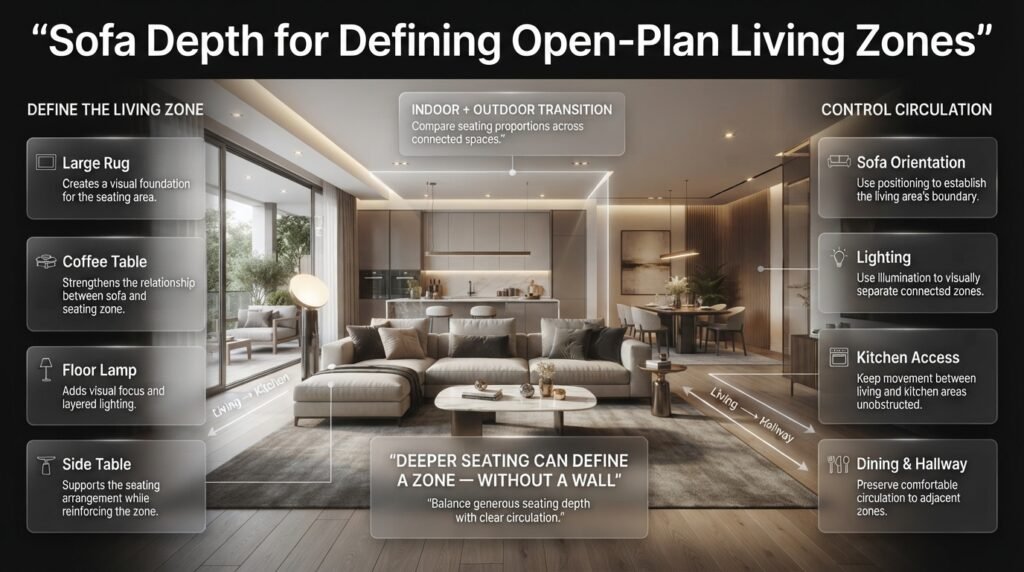
Yes, and this is one situation where deeper seating can be particularly effective.
Open-plan rooms often have enough floor area to accommodate larger furniture.
A deep sofa can help create a defined living zone without requiring a wall.
You can use:
- A large rug
- Coffee table
- Floor lamp
- Side table
- Sofa orientation
- Lighting
to establish the living area.
The sofa becomes a spatial boundary.
However, make sure its depth doesn’t interfere with circulation between the kitchen, dining area, hallway, and other zones.
For inspiration beyond a typical indoor living room, Robert MyGardenAndPatio can also provide a useful reference point when thinking about how seating proportions transition between indoor and outdoor areas.
What About Sofa Depth in Formal Living Rooms?
Formal living rooms usually benefit from a more moderate seat depth.
Guests tend to sit upright rather than curl up.
A depth around 20–23 inches can create a comfortable but composed posture.
Very deep seating may encourage people to sink backward, which can make face-to-face conversation feel less natural.
This is particularly important if the room is designed for:
- Guests
- Tea or coffee conversations
- Formal entertaining
- Short visits
- Multiple conversation groups
A sofa doesn’t have to look stiff to be formal.
The right proportions can make it comfortable while still keeping the room visually polished.
What About Celebrity-Style Oversized Sofas?
Oversized furniture often photographs beautifully because large rooms, wide camera angles, and carefully styled spaces make generous proportions appear luxurious.
But copying that exact furniture scale into an ordinary living room can create problems.
For example, a deep celebrity-inspired sofa may look impressive online but leave very little circulation in a typical home.
If you’re studying furniture proportions alongside broader layout ideas, Celebrity Kitchen Layout Features is useful as a reminder that high-end spaces often have considerably more room to work with than ordinary residential layouts.
The lesson isn’t to avoid oversized furniture.
It’s to scale it to your actual room.
How Does Lighting Affect the Sofa Experience?
Seat depth affects posture, while lighting affects how comfortable the room feels visually.
If your sofa is primarily used for reading, you need task lighting positioned so that it illuminates the reading area without creating glare.
If it’s used for television, ambient lighting should be controlled so that the room isn’t excessively bright or visually harsh.
For a broader look at lighting as part of interior planning, Modern Bedroom Design offers useful context about how intelligent lighting can support the atmosphere and function of a room.
The principle applies beyond bedrooms: furniture comfort and lighting should work together.
Can a Deep Sofa Be Comfortable for Short People?
Yes, but only if the construction and support system allow it.
A shorter person can often use a moderately deep sofa with:
- A lumbar pillow
- Adjustable back cushions
- A firm support cushion
- An ottoman
- A footstool
However, there’s a limit.
If you always need to place a large cushion behind your back, the sofa is effectively too deep for your natural sitting position.
In that situation, you’re paying for seat depth you’re not actually using.
A better approach is to select a sofa with a moderate depth and use additional cushions only for occasional lounging.
What If Two People Have Very Different Heights?
This is one of the most difficult sofa-selection situations.
Imagine:
- Person A: 5’2″
- Person B: 6’3″
A very shallow sofa may feel cramped to the taller person.
A very deep sofa may feel uncomfortable to the shorter person.
The best compromise is usually a medium-depth sofa with flexible back support.
Look for:
- Removable back cushions
- Adjustable cushions
- Moderate seat height
- Supportive lumbar pillows
- Separate lounge chair or ottoman
The goal isn’t to make one sofa perfect for two completely different bodies.
It’s to find a sofa that creates an acceptable sitting position for both users.
What Sofa Depth Is Best for Families?
Family rooms usually need flexibility.
Children may sit sideways, adults may recline, guests may sit upright, and someone may eventually fall asleep on the sofa during a movie.
That’s why an extremely specialized sofa isn’t always ideal.
A medium-to-deep seat around 22–25 inches can provide a practical compromise for many households.
Focus on durability as much as depth.
Look for:
- Strong frame construction
- Durable upholstery
- Removable covers where practical
- Supportive cushions
- Easy-clean fabrics
- Comfortable arm height
If you’re changing more than the sofa itself, accessories and small improvements can be handled through DIY Home Decor Crafts rather than buying completely new furniture every time you want to refresh the room.
How Does Sofa Depth Affect Entry and Delivery?
A sofa can fit perfectly in the room and still fail before it reaches the room.
This is particularly important with deep sectionals and oversized sofas.
Measure:
- Front door width
- Door height
- Hallway width
- Staircase width
- Stair landing
- Elevator dimensions
- Tight corners
- Balcony access if applicable
Also consider the sofa’s packaged dimensions.
If you’re reorganizing an entry area to accommodate a large sofa delivery, the principles discussed in Entryway Storage Capacity Planning can help you think about circulation and usable entry space rather than treating the doorway as an afterthought.
Do You Need a Sofa Depth Different From Your Sectional?
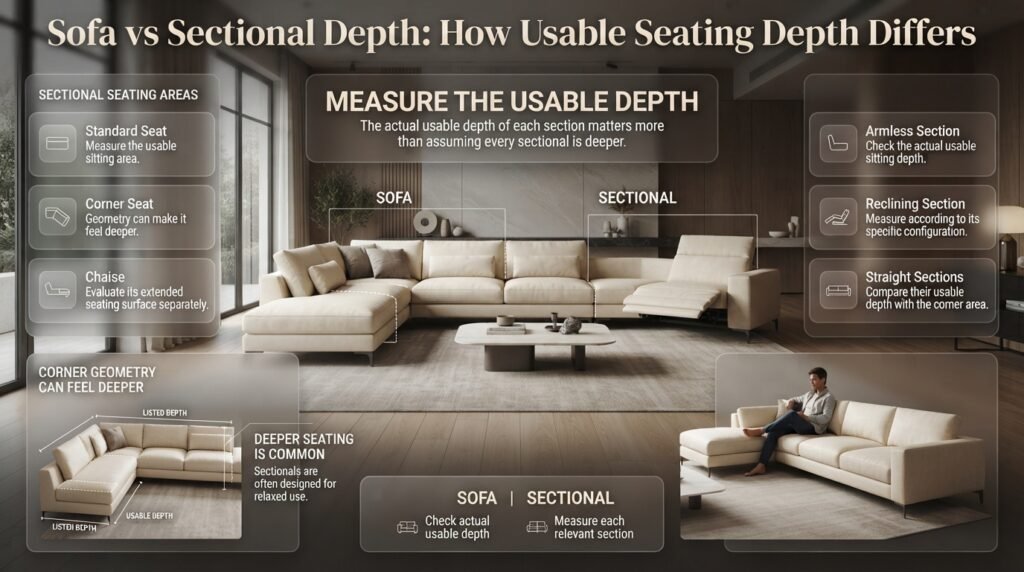
Not necessarily.
Sectionals are often designed for more relaxed use, so deeper seating is common.
However, a sectional can also be built with relatively conventional seat depth.
The important measurement is the actual usable depth of the specific model.
For a sectional, measure each relevant section:
- Standard seat
- Corner seat
- Chaise
- Armless section
- Reclining section
A corner section can feel deeper because of its geometry even when the listed seat depth looks similar to the straight sections.
How Do Recliners Change Sofa Depth Selection?
Reclining furniture requires a different approach.
When upright, the seat needs to support your normal sitting position.
When reclined, the mechanism changes your body angle.
Therefore, you should test the sofa in both positions.
Check:
- Footrest position
- Back support
- Knee angle
- Head support
- Wall clearance
- Reclining clearance
- Walking space
Don’t buy a reclining sofa based solely on its closed dimensions.
The usable footprint can increase significantly when the mechanism is activated.
Does Sofa Seat Depth Matter for Older Adults?
It can be especially important for people who want easy sitting and standing.
An excessively deep, low sofa can require more effort to get up from.
For users who prioritize easy access, a moderate seat depth combined with an appropriate seat height and supportive cushions can be more practical.
The best setup should allow the person to:
- Sit down without falling backward
- Keep feet stable
- Maintain back support
- Push up naturally
- Stand without excessive effort
Comfort isn’t just about sinking into furniture.
Sometimes good comfort means being able to move easily.
Common Sofa Seat Depth Selection Mistakes
Mistake 1: Buying the deepest sofa because it feels luxurious
A showroom encourages relaxation.
You sit down for five minutes and think, “This is incredibly comfortable.”
But daily use is different.
Better approach: Test upright sitting, reading, standing, and longer sitting positions.
Mistake 2: Confusing overall depth with seat depth
A 40-inch sofa isn’t necessarily a 40-inch sitting surface.
Better approach: Ask for the usable seat depth.
Mistake 3: Ignoring seat height
A sofa can have the perfect depth but the wrong height.
Better approach: Test foot contact and standing effort.
Mistake 4: Designing around the sofa instead of the room
People sometimes buy the biggest sofa that fits a wall.
That doesn’t mean it fits the room.
Better approach: Plan sofa depth, coffee-table clearance, side furniture, and walking paths together.
Mistake 5: Choosing for guests instead of daily users
A tall guest may love an extra-deep sofa.
That doesn’t mean your family should live with it every day.
Better approach: Prioritize regular users.
Mistake 6: Ignoring cushion compression
A soft sofa may feel deeper after you sit down.
Better approach: Test the actual cushions rather than relying on measurements alone.
Mistake 7: Forgetting delivery access
A sofa can fit your floor plan and fail at the staircase.
Better approach: Measure the complete delivery route before ordering.
When Should You Choose a Shallow Sofa?
A shallow sofa is a strong choice when:
- The room is small
- Users prefer upright sitting
- The sofa is for formal conversation
- Reading is a major activity
- Users are shorter
- Easy standing is important
- You need more circulation
A shallow sofa can also visually open a room because it doesn’t project as far into the space.
When Should You Choose a Deep Sofa?
A deep sofa makes sense when:
- Lounging is the main activity
- Users are taller
- The room is large
- You watch television frequently
- You like reclining
- You want a casual atmosphere
- You regularly stretch your legs out
Deep sofas work particularly well when there is enough space to preserve circulation around them.
How Can You Use the Sofa Depth as Part of a Complete Design?
The sofa should not be selected independently from the rest of the room.
Think about:
Sofa → Coffee table → Rug → Lighting → Storage → Walking path → Accent furniture
Each element needs enough space to perform its function.
This is why a room-planning resource such as Room-by-Room Design Hub can be useful when you’re considering the sofa as part of a complete home rather than a single isolated purchase.
And if you’re starting a larger design project, DesignMode24 Interior Design can serve as the broader reference point for coordinating furniture, materials, layout, and room function.
What Should You Check Before Ordering a Sofa Online?
Online shopping makes seat-depth selection more complicated because you can’t immediately test the furniture.
Before ordering, collect these measurements:
Sofa dimensions
- Overall width
- Overall depth
- Overall height
- Seat depth
- Seat height
- Arm width
- Back height
Room dimensions
- Wall length
- Available depth
- Walking paths
- Coffee-table area
- Door clearance
- Window clearance
Delivery dimensions
- Door width
- Hallway width
- Staircase
- Elevator
- Turns and corners
Never rely on a single product photograph.
The most useful current sofa-buying guides consistently recommend separating overall depth from usable seat depth and considering cushion construction and room circulation together.
A Simple Sofa Depth Decision Guide
Use this quick decision process.
If you mainly sit upright:
Choose approximately 20–22 inches as your starting range.
If you want everyday comfort with occasional lounging:
Start around 21–24 inches.
If you’re tall:
Explore approximately 23–26 inches.
If you mainly lounge:
Consider 24–28+ inches.
If your room is small:
Favor approximately 20–23 inches and protect circulation.
If your household has mixed heights:
Choose a moderate depth with flexible back support.
If you have a large media room:
A deeper sofa or sectional can be appropriate.
Sofa Seat Depth Selection Checklist
Before placing your order, check every item below:
- I know the usable seat depth.
- I know the overall sofa depth.
- I’ve checked the seat height.
- My feet can sit comfortably.
- My lower back remains supported.
- The cushion doesn’t press behind my knees.
- I’ve considered the tallest regular user.
- I’ve considered the shortest regular user.
- I know how the sofa will mainly be used.
- I’ve measured the room.
- I’ve marked the sofa footprint.
- I’ve checked coffee-table clearance.
- I’ve protected the main walking path.
- I’ve measured the delivery route.
- I’ve checked cushion thickness.
- I’ve tested the actual sofa if possible.
- I haven’t selected it solely because it looks luxurious.
Expert Tips for Getting Sofa Depth Right
⭐ Expert Tip: Prioritize regular users
Design around the people who sit on the sofa every day rather than occasional visitors.
💡 Pro Tip: Measure a sofa you already love
Your existing comfortable chair or sofa is one of the best references available.
📌 Quick Tip: Ask for usable depth
If the retailer only gives you overall depth, ask for the measurement from the front of the seat cushion to the front of the back cushion.
⚠ Common Mistake: Don’t assume deeper equals better
Depth is a design characteristic, not a comfort score.
⭐ Expert Tip: Test the sofa for several positions
Sit upright, recline, read, watch television, and stand up.
💡 Pro Tip: Use painter’s tape
Mark the full sofa footprint before purchasing. It’s one of the cheapest ways to avoid a very expensive furniture mistake.
What is the most comfortable sofa seat depth?
For most adults, a usable seat depth of around 20–24 inches provides a good balance between upright support and relaxed comfort. Around 20–22 inches generally feels more supportive for everyday sitting, while 23–24 inches gives you additional room to relax. The right choice ultimately depends on your height, leg length, seat height, cushion firmness, and how you normally use the sofa.
A deeper sofa isn’t automatically more comfortable. If the seat is too deep for your body, you may slide forward to keep your feet on the floor, which can leave your lower back unsupported. A slightly shallower sofa may actually feel better for long periods of sitting.
Key points to consider:
20–22 inches: better for upright sitting and conversation
22–24 inches: versatile for everyday family use
24+ inches: better suited to relaxed lounging and taller users
Always check usable seat depth rather than total sofa depth
Test the sofa with your feet on the floor before buying
Is a 24-inch sofa seat too deep?
A 24-inch seat isn’t necessarily too deep; for many people, it’s a comfortable middle ground between standard and lounge-style seating. It can work particularly well for average-to-taller adults who like to relax but don’t want an extremely deep sofa. The deciding factor is whether you can sit all the way back with proper support while keeping your feet comfortably positioned.
For shorter users, however, 24 inches may feel deeper than expected. If you find yourself moving forward or placing a large cushion behind your back every time you sit down, the sofa is probably deeper than your natural sitting position requires.
Before choosing 24 inches, check:
Your feet should rest comfortably on the floor.
Your lower back should remain supported.
The cushion shouldn’t press uncomfortably behind your knees.
You shouldn’t need several pillows to sit normally.
Consider the seat height together with the depth.
What sofa seat depth is best for short and tall people?
Shorter and taller users often need different seat depths because their leg proportions aren’t the same. Shorter people generally find approximately 18–21 inches more manageable, while taller users may prefer around 23–26 inches or more for better thigh support. These ranges are starting points rather than strict rules because individual proportions and sitting habits vary.
The biggest mistake is choosing a sofa based only on the tallest person in the household. If a shorter person uses the sofa every day, an extremely deep seat can become uncomfortable very quickly. A medium-depth sofa with movable back cushions or a lumbar pillow can often provide a better compromise for households with mixed heights.
For mixed-height households:
Measure the sitting position of regular users.
Look for movable or adjustable back cushions.
Avoid extremely deep seats unless the room is mainly for lounging.
Consider lumbar cushions for shorter users.
Prioritize everyday comfort over occasional guest preferences.
What is the difference between sofa depth and seat depth?
Overall sofa depth is the complete distance from the front edge of the sofa to its back, while seat depth is the usable sitting area from the front of the seat cushion to the back cushion or backrest. This distinction is essential when shopping because a sofa can have a large overall depth while providing a surprisingly normal-sized sitting surface.
For example, a sofa may be 40 inches deep overall but have only 22–23 inches of usable seat depth after accounting for its back cushions. Another sofa with a similar overall measurement may have a much deeper sitting area because it uses thinner cushions or a different back construction.
When comparing sofas, check:
Overall depth
Usable seat depth
Seat height
Back cushion thickness
Cushion firmness
Backrest angle
Chaise or sectional depth, if applicable
Professional tip: Don’t ask a retailer only, “How deep is the sofa?” Ask specifically for the usable seat depth with the back cushions in their normal position.
How do you choose the right sofa seat depth for a small living room?
For a small living room, start by looking for a sofa with a moderate usable seat depth, often around 20–23 inches, while paying even closer attention to the sofa’s total depth. A deep seat may be comfortable, but if the entire sofa projects too far into the room, it can reduce walking space and make the coffee table feel cramped.
Before buying, mark the sofa’s complete footprint on the floor using painter’s tape. Include the arms, full depth, coffee table, and main walking paths. This gives you a much more realistic idea of whether the sofa will work than looking at product photographs.
For a compact room:
Prioritize overall footprint as well as seat depth.
Look for slimmer sofa arms.
Maintain comfortable coffee-table clearance.
Protect the main walking routes.
Avoid oversized sectionals unless the layout genuinely supports them.
Consider raised legs to create a lighter visual appearance.
Measure doorways, hallways, stairs, and elevators before delivery.
A sofa that is slightly smaller but correctly proportioned will usually make a small room feel more comfortable than an oversized sofa that technically fits but leaves no breathing room.
Conclusion
Choosing the right sofa seat depth is less about finding one “perfect” measurement and more about matching the sofa to the people, posture, room, and way the space will actually be used. A sofa can look beautiful in a showroom or photograph, but if its seat is too deep to support comfortable upright sitting—or too shallow for relaxed lounging—it will quickly become frustrating in everyday use.
For many homes, a usable seat depth around 20 to 24 inches is a practical starting point. However, shorter users may prefer a shallower seat, while taller people or households that prioritize lounging may be more comfortable with a deeper design. Cushion thickness, back-cushion construction, seat height, firmness, and the angle of the backrest can also change how a particular depth feels.
Before buying, measure your available floor space and compare the actual seat depth, not just the sofa’s overall front-to-back dimensions. Sit on the sofa in the position you use most often, check whether your feet rest comfortably on the floor, and make sure the back cushion does not push you too far forward or leave excessive unsupported space behind your knees.
The best sofa is ultimately one that supports your lifestyle as naturally as it fits your room. Take the time to measure, test, and compare before purchasing, and your choice of seat depth can improve both everyday comfort and the overall balance of your living space.