
Introduction
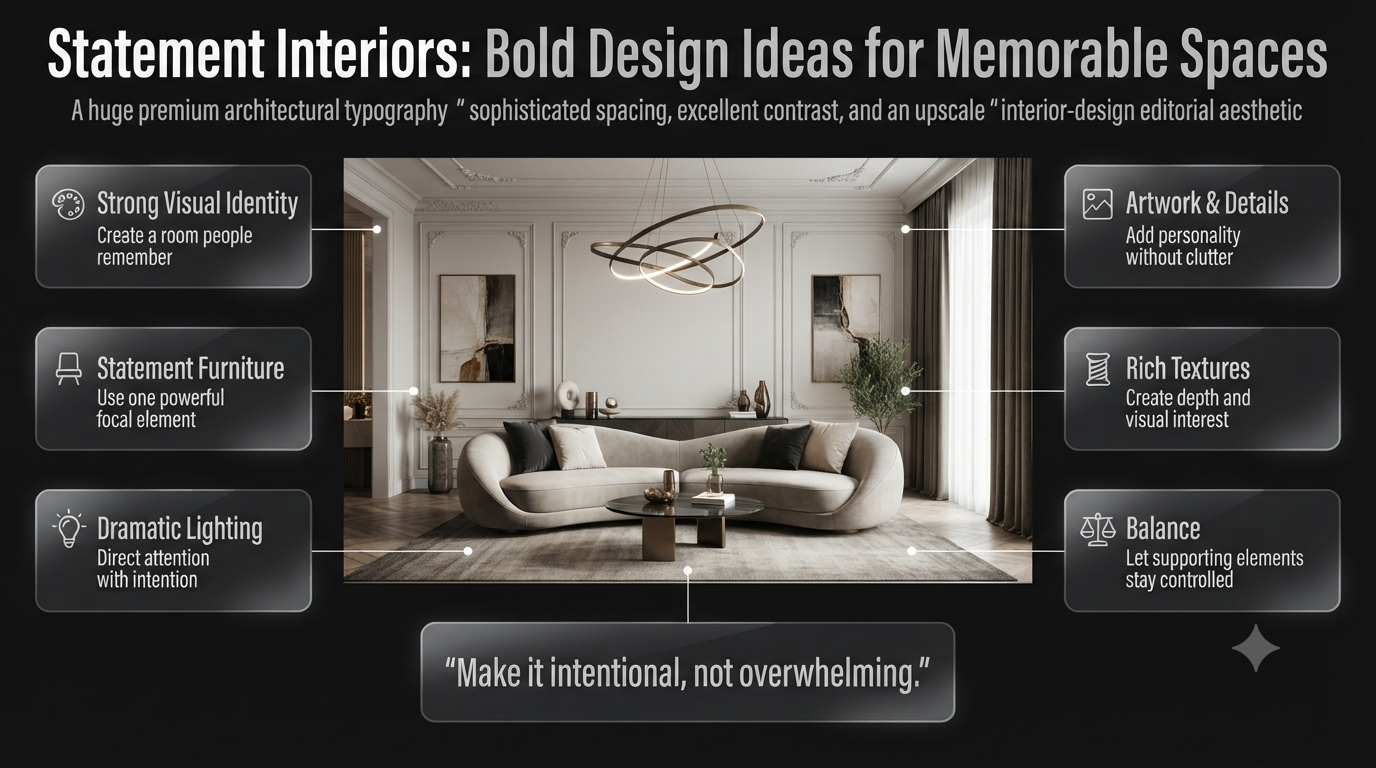
Statement Interiors | Have you ever walked into a room that looked expensive, memorable, and full of personality without feeling crowded? Usually, the secret isn’t having more furniture or decorating with every trend at once. It’s creating one or two elements that immediately capture attention and allowing everything else to support them.
That’s the idea behind Statement Interiors.
Statement interiors use carefully selected architectural details, furniture, colors, lighting, artwork, textures, or decorative features to give a room a strong visual identity. The goal isn’t simply to make a space dramatic. It’s to make it intentional, balanced, personal, and memorable.
If you’re planning a home makeover, start by exploring DesignMode24 Interior Design for broader ideas, then use the principles in this guide to decide what deserves attention in your own space.
This guide explains how statement interiors work, what makes a statement piece successful, how to balance bold elements, which rooms benefit most from this approach, common mistakes to avoid, and how professionals create dramatic spaces without making them feel chaotic.
What Are Statement Interiors?
Statement interiors are interior spaces designed around one or more visually distinctive elements that immediately attract attention and establish the room’s character. These elements may include a dramatic sofa, oversized artwork, sculptural lighting, a feature wall, unusual furniture, rich materials, architectural details, or a striking color combination.
The important point is that a statement interior isn’t simply a “bold room.” It is a room with a clear visual hierarchy.
A successful space tells your eye where to look first, where to look second, and where to rest.
For example, imagine a living room with:
- One large sculptural pendant light
- A simple neutral sofa
- Warm timber flooring
- Minimal side tables
- A restrained rug
- One large artwork
The pendant may be the statement element, while the rest of the room gives it room to breathe.
That is much more sophisticated than filling the same room with several dramatic lamps, patterned chairs, colorful walls, oversized artwork, and decorative objects.
💡 Pro Tip: Think of a statement feature as the “lead actor” in a room. The supporting elements should make it look better, not compete with it.
Why Are Statement Interiors So Popular?
People increasingly want homes that feel personal rather than copied directly from furniture showrooms or social-media trends.
Statement design responds to that demand by giving homeowners an opportunity to express personality through the environment.
A statement element can also solve a practical design problem.
A large artwork can fill an awkward empty wall. A dramatic pendant can visually define a dining area. A textured feature wall can add depth to a plain room. A distinctive headboard can turn a basic bedroom into a more finished space.
This approach works particularly well when the existing architecture is simple.
Instead of changing everything, you can introduce one strong design decision and allow it to transform the atmosphere.
For homeowners still developing their overall approach, understanding different Interior Design Styles can also help determine whether a statement approach should feel contemporary, minimalist, Scandinavian, Japandi, classic, or eclectic.
What Makes a Good Statement Piece?
A good statement piece has more than visual impact. It should also have a reason for being there.
1. Scale
Large rooms can often support oversized furniture, artwork, lighting, or architectural features.
But scale isn’t only about size. A relatively small object can become a statement when it has unusual form, color, craftsmanship, or placement.
A huge artwork above a tiny sofa may look disconnected. A medium-sized artwork correctly positioned above a substantial sofa can feel perfectly proportioned.
2. Contrast
Statement elements become noticeable because they contrast with their surroundings.
Contrast can come from:
- Color
- Shape
- Texture
- Material
- Pattern
- Scale
- Light
- Placement
A black sculptural chair against a warm neutral background creates contrast without requiring an extremely colorful palette.
3. Character
The strongest statement pieces usually have something distinctive about them.
It could be an unusual silhouette, handmade finish, vintage character, natural material, architectural quality, or artistic detail.
4. Relevance
A statement piece should make sense within the room.
A dramatic marble table may look beautiful, but if the room is designed around soft natural textures and relaxed Scandinavian furniture, the table needs to connect visually with those elements.
5. Breathing Space
This is one of the most overlooked principles.
A statement element needs visual space around it.
If every wall, surface, and corner contains something attention-grabbing, nothing feels special anymore.
How Do You Create Statement Interiors Without Making a Room Look Too Busy?
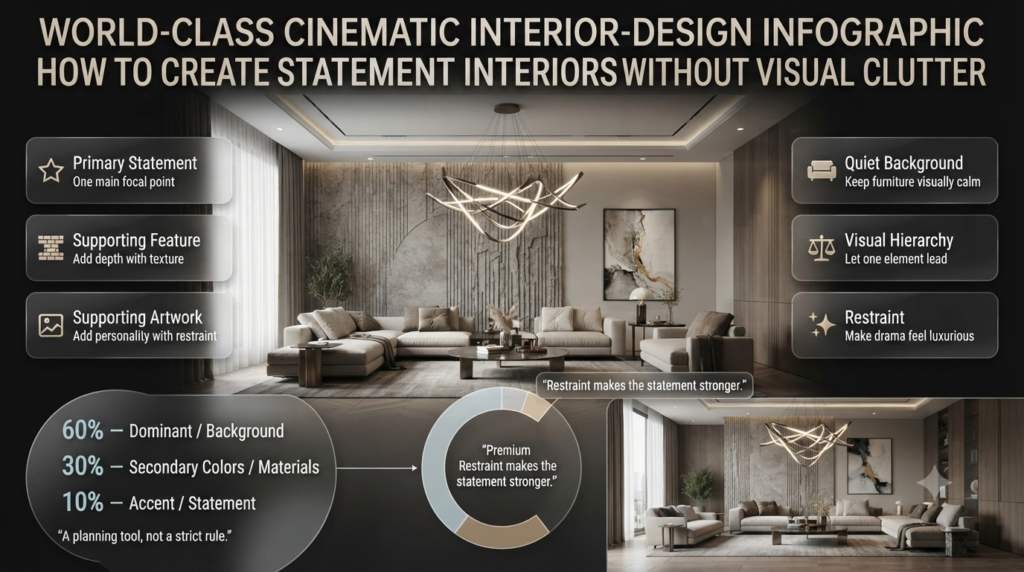
The easiest approach is to establish a visual hierarchy before buying anything.
Choose:
One primary statement → two or three supporting features → quiet background elements.
For example:
| Design Element | Example | Visual Role |
|---|---|---|
| Primary statement | Sculptural chandelier | Main focal point |
| Supporting feature | Textured wall | Adds depth |
| Supporting feature | Artwork | Adds personality |
| Background | Neutral sofa | Creates balance |
| Background | Simple flooring | Prevents visual competition |
This creates rhythm without visual overload.
A room doesn’t need to be boring because most of its elements are restrained. In fact, restraint often makes the dramatic feature look more luxurious.
The 60-30-10 Principle
A useful starting point is to divide visual emphasis approximately into:
- 60% dominant/background elements
- 30% secondary colors or materials
- 10% accent or statement elements
This isn’t a strict mathematical rule. It’s a planning tool.
If your statement color occupies 50% of the room, it may stop functioning as an accent and become the dominant palette.
Which Elements Work Best in Statement Interiors?
Different statement elements create different types of impact.
Statement Furniture
A distinctive sofa, armchair, dining table, bed, or console can become the visual anchor.
Furniture works especially well because it combines aesthetics with function.
Look for:
- Sculptural silhouettes
- Interesting upholstery
- Distinctive proportions
- Natural materials
- High-quality craftsmanship
- Unusual but comfortable forms
Don’t choose something dramatic simply because it looks impressive in a photograph. Furniture has to work in real life.
Statement Lighting
Lighting is one of the easiest ways to create drama.
A large pendant over a dining table or sculptural chandelier in a double-height entrance can immediately change the character of a space.
Lighting also has an advantage over decorative objects: it influences the room after dark.
Use statement lighting where the fixture can be appreciated from several viewpoints.
⭐ Expert Tip: Before purchasing oversized lighting, check the ceiling height, table dimensions, viewing distance, and fixture proportions. A beautiful light can look awkward when its scale is wrong.
Statement Walls
A statement wall can introduce depth, color, pattern, or texture without redesigning the entire room.
Options include:
- Bold paint
- Decorative plaster
- Wood paneling
- Stone
- Wallpaper
- Textured finishes
- Artistic murals
If you’re considering a color-led statement wall, explore Paint Color ideas before committing to a strong shade.
For texture-driven spaces, Decorative Finishes can offer more sophisticated alternatives to simply painting a wall a darker color.
Statement Artwork
Oversized artwork can make a room feel curated almost immediately.
The biggest mistake is choosing artwork based only on whether it matches the sofa.
Instead, consider:
- Emotional response
- Scale
- Composition
- Frame style
- Wall proportion
- Relationship to surrounding colors
Art doesn’t always need to “match.” It needs to belong.
Statement Materials
Stone, natural wood, metal, glass, leather, plaster, and textured fabrics can all become focal elements.
A dramatic veined stone island, for example, can become the central feature of a kitchen while cabinetry remains relatively quiet.
Likewise, a beautifully finished timber wall can provide enough character that additional decoration becomes unnecessary.
For warmer spaces, Natural Wood Interior principles can help you use timber as a meaningful design feature rather than simply adding random wooden accessories.
How Do You Choose the Right Statement Feature for Each Room?
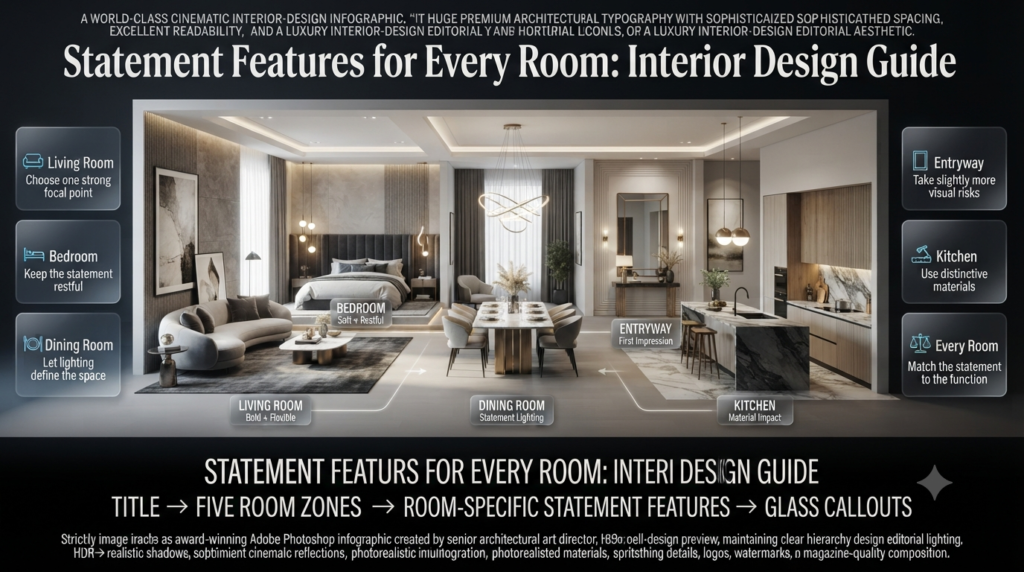
Different rooms need different types of visual emphasis.
Living Room
The living room usually has the greatest flexibility.
Potential statement features include:
- Sculptural sofa
- Oversized artwork
- Feature fireplace
- Large pendant
- Statement coffee table
- Textured wall
- Dramatic rug
Choose one main focal point and position the furniture so the room naturally directs attention toward it.
Bedroom
Bedrooms generally benefit from softer statements.
A dramatic headboard, textured wall, unusual pendant lights, or beautiful bedding can create impact without making the room feel energetic.
The bedroom should still feel restful.
Dining Room
Dining rooms are excellent places for statement lighting.
A chandelier or oversized pendant positioned correctly above the dining table creates a natural focal point.
The table itself can also become the statement through material, shape, or craftsmanship.
Entryway
The entrance establishes the first impression of the home.
A statement mirror, console, artwork, lighting fixture, or architectural wall can make a relatively small space memorable.
Because visitors often see the entrance briefly, you can take slightly more visual risks here.
Kitchen
Kitchens can use statement materials particularly effectively.
Examples include:
- Dramatic stone island
- Distinctive backsplash
- Statement pendant lights
- Fluted cabinetry
- Natural timber
- Contrasting hardware
The key is keeping the practical work surfaces visually manageable.
Should Statement Interiors Be Colorful?
Not necessarily.
One of the biggest misconceptions about statement design is that it requires bright colors.
A neutral room can be extremely dramatic when it uses:
- Strong architectural forms
- Layered textures
- Sculptural furniture
- Oversized artwork
- Natural stone
- Dark wood
- Dramatic lighting
- Strong contrast
A monochromatic room with different textures can often feel more sophisticated than a room containing many unrelated colors.
If you prefer quieter interiors, Neutral Color Schemes can provide a strong foundation for statement furniture, artwork, materials, or lighting.
How Can You Combine Bold Colors Without Creating Chaos?
Use a hierarchy instead of treating every color equally.
For example:
Warm white walls → deep green sofa → muted brass → natural oak → small burgundy accents
Here, green is the strongest visual color, while burgundy appears only in controlled amounts.
Another useful approach is to repeat the statement color subtly.
If you have a deep blue sofa, you might repeat a small amount of blue in artwork, cushions, or a decorative object.
The repetition creates connection.
📌 Quick Tip: Don’t introduce a new accent color every time you feel a room needs “something more.” Repeat existing colors first.
Statement Interiors vs Minimalist Interiors
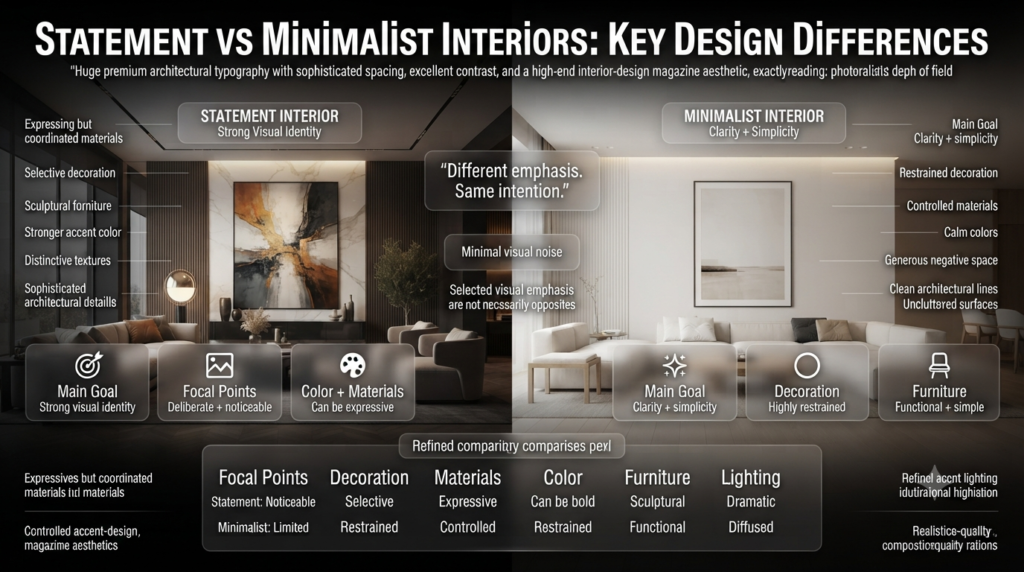
Statement design and minimalism aren’t opposites.
In fact, a minimalist room can contain a very powerful statement element.
The difference is that minimalist design generally reduces visual noise, while statement design intentionally increases emphasis around selected features.
| Feature | Statement Interior | Minimalist Interior |
| Main goal | Strong visual identity | Clarity and simplicity |
| Focal points | Deliberate and noticeable | Limited and subtle |
| Decoration | Selective | Highly restrained |
| Materials | Can be expressive | Usually controlled |
| Color | Can be bold | Often restrained |
| Furniture | Can be sculptural | Usually functional and simple |
A minimalist room with one oversized artwork is still minimalist if the overall composition remains restrained.
For readers who prefer simplicity, Minimalist Interior Design provides useful principles that can be combined with statement elements.
Can Statement Interiors Still Feel Comfortable?
Yes. Statement design shouldn’t sacrifice comfort.
This is especially important in homes because rooms aren’t galleries. People sit on the furniture, eat at the table, work, relax, and move around.
A beautiful chair that nobody wants to sit in isn’t necessarily a successful design choice.
When selecting statement furniture, evaluate:
- Comfort
- Ergonomics
- Maintenance
- Durability
- Traffic flow
- Cleaning requirements
- Daily use
A family living room needs different decisions from a formal reception room.
The best statement interiors make visual impact feel effortless rather than fragile.
What Are the Most Common Statement Interior Mistakes?
Mistake 1: Making Everything a Statement
This happens when homeowners fall in love with too many dramatic pieces.
Why it fails: Your eye doesn’t know where to rest.
Better approach: Select one dominant feature and make surrounding elements quieter.
Mistake 2: Ignoring Scale
A statement piece can be beautiful but still wrong for the room.
Why it fails: Proportion affects how expensive and intentional a space feels.
Better approach: Measure the room before purchasing large furniture, artwork, mirrors, or lighting.
Mistake 3: Copying a Showroom
A showroom is designed to sell products, not necessarily to represent your lifestyle.
Why it fails: The finished room may look staged rather than personal.
Better approach: Borrow principles, not entire room arrangements.
Mistake 4: Following Trends Too Literally
A trendy color or shape can become dated quickly.
Why it fails: The statement piece becomes associated with a particular trend rather than your personal taste.
Better approach: Use trends in smaller, replaceable elements and invest more carefully in permanent features.
Mistake 5: Forgetting the Background
People often focus so much on the statement piece that they neglect everything surrounding it.
Why it fails: The focal point cannot look intentional without supporting elements.
Better approach: Consider wall color, flooring, lighting, negative space, furniture placement, and sightlines together.
Mistake 6: Buying Before Planning
This is perhaps the most expensive mistake.
Why it happens: A homeowner finds something beautiful and wants to build the room around it immediately.
Better approach: Measure first, define the focal point, establish the palette, then shop.
How Do Professionals Plan a Statement Interior?
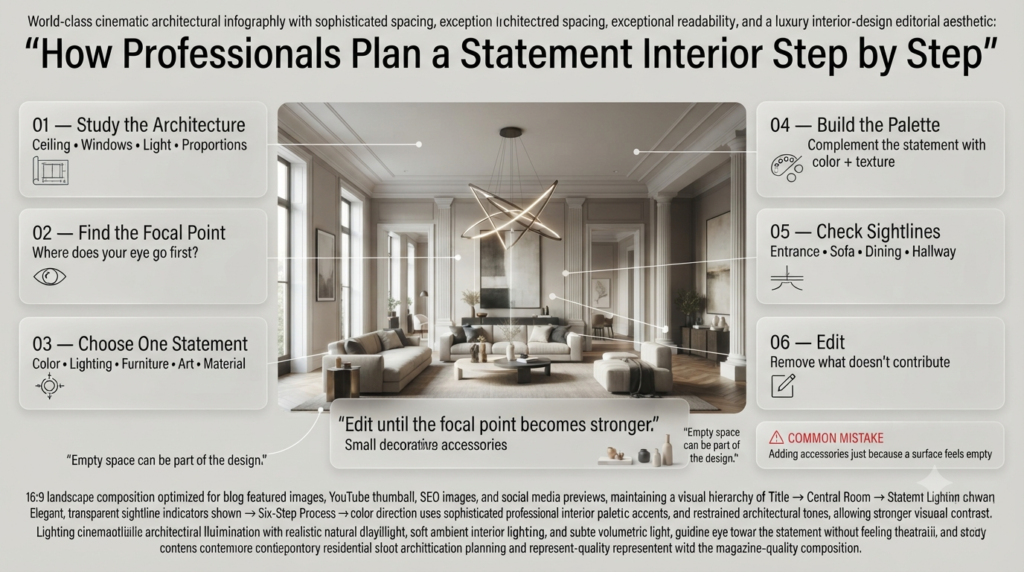
A professional approach usually starts with the room rather than the product.
Step 1: Study the Architecture
Look at:
- Ceiling height
- Window positions
- Natural light
- Doorways
- Columns
- Existing architectural details
- Room proportions
The architecture determines what the room can comfortably support.
Step 2: Identify the Best Focal Point
Ask:
Where does my eye naturally go when I enter?
If there is already an attractive architectural feature, enhance it instead of competing with it.
Step 3: Choose the Statement
Select one major visual idea.
It might be:
- Color
- Lighting
- Furniture
- Artwork
- Material
- Architecture
Step 4: Build the Supporting Palette
Choose colors and materials that complement the statement.
This is where texture becomes particularly useful.
A neutral palette doesn’t have to be flat if it includes timber, linen, stone, plaster, metal, wool, and glass.
Step 5: Check Sightlines
A statement piece should be visible from the positions where people actually experience the room.
Consider the view from:
- The entrance
- Sofa
- Dining table
- Hallway
- Adjacent rooms
Step 6: Edit
Remove anything that doesn’t contribute.
This final step often makes the biggest difference.
⚠ Common Mistake: Adding accessories because a surface feels empty can weaken a carefully designed focal point. Empty space is sometimes exactly what the room needs.
When Should You Use Bespoke Statement Design?
Bespoke design becomes valuable when standard furniture or finishes cannot achieve the right proportions or function.
This might happen when:
- A wall has an unusual dimension
- Storage needs are specific
- You want a one-of-a-kind furniture piece
- The architecture has difficult angles
- A feature needs to perform several functions
- Standard products look visually undersized
Understanding Bespoke Design can help when a statement feature needs to be designed specifically for your space.
The advantage isn’t simply uniqueness. A bespoke feature can be proportioned precisely to the room.
How Can Statement Interiors Work With Japandi or Scandinavian Design?
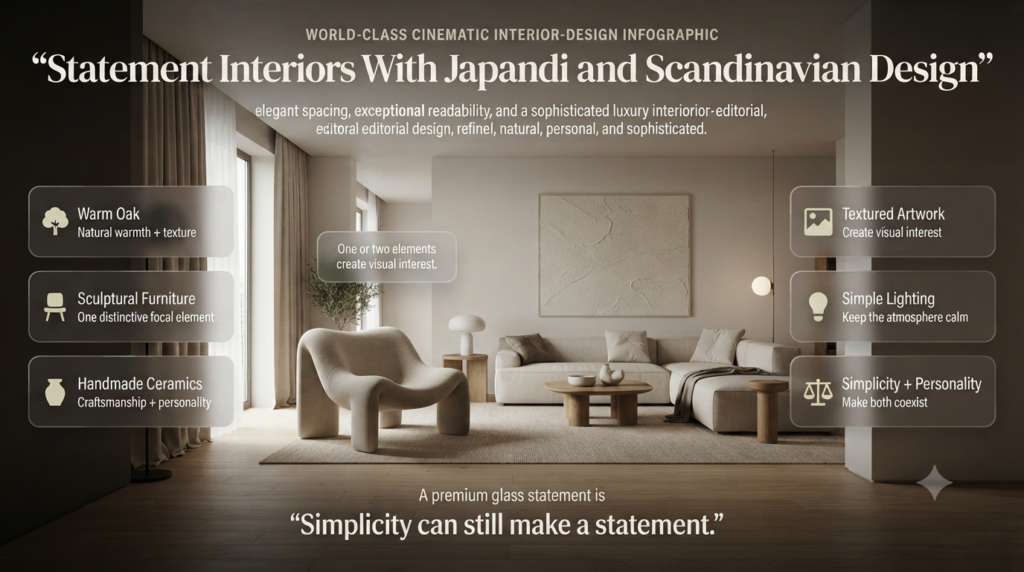
Statement interiors don’t require maximalism.
Japandi and Scandinavian spaces can use statement principles through carefully selected materials, furniture, lighting, and craftsmanship.
For example, a Japandi living room might use:
- Warm oak
- Soft neutral walls
- One sculptural chair
- Handmade ceramics
- A large textured artwork
- Simple lighting
The room remains calm, but one or two elements create visual interest.
You can explore Japandi Interior Design and Scandinavian Interior Design for approaches that demonstrate how simplicity and personality can coexist.
How Do You Create Statement Interiors on a Budget?
You don’t need a complete renovation.
Start with the element that will create the biggest visual improvement for the least investment.
Good budget-friendly options include:
- Repainting one wall
- Installing a distinctive mirror
- Replacing basic lighting
- Creating a gallery wall
- Adding one strong accent chair
- Updating curtains
- Introducing layered textiles
- Repositioning existing furniture
- Removing unnecessary decoration
- Improving lighting temperature and placement
A DIY project can also work when the task is appropriate for your skill level. For manageable upgrades, DIY Projects can help you approach smaller transformations strategically.
The most important lesson is that impact doesn’t always come from cost.
A well-positioned mirror can sometimes transform a room more effectively than an expensive collection of accessories.
How Do You Know When a Statement Room Is Finished?
Stop when the room feels balanced.
A useful test is to stand at the entrance and ask:
- What do I notice first?
- Is that the feature I intended to highlight?
- Is anything competing with it?
- Does the room still feel comfortable?
- Can I identify a clear color and material relationship?
- Is there enough empty space?
- Does the room feel like my home?
If you can’t identify the focal point because everything is demanding attention, it’s probably time to edit.
What Are Statement Interiors and How Do They Work?
Statement interiors are designed around one or more distinctive features that immediately attract attention and give a room its personality. The statement can come from a sculptural sofa, oversized artwork, dramatic lighting, a bold wall, natural stone, unusual furniture, or an architectural feature.
The important part is visual hierarchy. A room should have something that naturally catches the eye first, while the surrounding elements support that feature instead of competing with it. This is what separates a sophisticated statement interior from a room that simply contains too many bold decorations.
Key points to remember:
Choose one main focal point for the room.
Use quieter furniture and finishes around dramatic features.
Consider scale and proportion before buying large pieces.
Leave enough negative space around the statement element.
Make sure the feature reflects your personal style and lifestyle.
A successful statement interior doesn’t necessarily look expensive or extravagant. It looks intentional, balanced, and memorable.
How Do You Create a Statement Interior Without Making the Room Look Too Busy?
The best way to create a statement interior without visual clutter is to establish a clear hierarchy. Start with one dominant feature, then introduce only a few supporting elements. If the sofa, walls, artwork, lighting, rug, and accessories are all competing for attention, the room quickly loses its sense of direction.
For example, an oversized artwork can become the main statement in a living room. The sofa can remain relatively simple, the rug can use a restrained pattern, and accessories can repeat one or two colors from the artwork. This creates connection without making everything equally noticeable.
A practical approach:
Select one primary statement.
Add two or three supporting details.
Keep the background relatively calm.
Repeat colors or materials for cohesion.
Remove anything that doesn’t contribute to the overall design.
Remember, negative space is part of the design. A statement feature becomes more powerful when it has room around it.
What Are the Best Statement Pieces for Modern Interior Design?
The best statement pieces are those that combine strong visual character with practical value. In modern interiors, sculptural lighting, oversized artwork, distinctive sofas, dramatic coffee tables, textured walls, natural stone, and architectural furniture are particularly effective.
Lighting is often one of the easiest options because a large pendant or sculptural chandelier can become a focal point without taking up valuable floor space. Artwork is another flexible choice because it can introduce personality and color without requiring a major renovation.
Popular statement options include:
Sculptural pendant lights
Oversized artwork
Distinctive sofas or accent chairs
Large mirrors
Natural stone surfaces
Textured or decorative walls
Statement rugs
Bespoke furniture
Feature fireplaces
Architectural shelving
Choose based on the room rather than following a trend. A dramatic piece that suits your architecture and proportions will usually remain more successful than an expensive item that simply happens to be fashionable.
Can Statement Interiors Work in Small Rooms and Apartments?
Statement interiors can work extremely well in small spaces, provided the statement element is chosen according to the room’s scale. A small room doesn’t need several decorative features to feel interesting. In many cases, one carefully selected focal point creates more impact than numerous smaller accessories.
An oversized mirror can make a compact room feel brighter and visually larger. A distinctive pendant can draw attention upward and emphasize ceiling height. A carefully chosen feature wall can add depth without taking away floor space.
For small rooms, consider:
One strong artwork instead of several small pieces.
A statement mirror to increase visual depth.
Wall-mounted lighting to save floor space.
Multifunctional furniture with distinctive design.
Vertical features that draw the eye upward.
A restrained color palette around the focal point.
The key is to avoid confusing statement design with visual clutter. In a compact room, editing becomes even more important.
How Do You Make Statement Interiors Look Luxurious and Timeless?
Luxury in statement interiors comes less from expensive decoration and more from proportion, material quality, craftsmanship, lighting, and restraint. A room can contain costly furniture and still look ordinary if the pieces are poorly scaled or compete with one another.
For a timeless result, choose statement features that have strong shapes, quality materials, and a genuine connection to your personal taste. Keep permanent elements relatively adaptable and use smaller accessories to experiment with changing trends.
For a more timeless statement interior:
Prioritize quality over quantity.
Use natural materials where appropriate.
Pay close attention to proportions.
Combine textures rather than adding excessive decoration.
Use lighting to highlight important architectural features.
Avoid filling every surface with accessories.
Choose statement pieces you would still enjoy without a current trend attached to them.
The most sophisticated interiors usually have a sense of confidence and restraint. They don’t need to prove that they’re expensive; the quality of the design speaks for itself.
Conclusion
Statement interiors are not about making every part of a room bold. They’re about choosing the right feature, giving it enough space to stand out, and creating a balanced environment around it. Whether the focal point is a sculptural light, oversized artwork, distinctive furniture, a textured wall, natural stone, or a carefully selected color, the strongest results come from intentional decisions rather than excessive decoration.
The key is to design around the way you actually live. Consider the room’s proportions, natural light, existing architecture, comfort, materials, and overall atmosphere before introducing a dramatic feature. A statement element should enhance the space, not make it difficult to use or maintain.
When bold design is combined with restraint, proportion, and personality, the result can feel sophisticated without becoming overwhelming. Start with one feature that genuinely represents your style, build supporting elements around it, and edit anything that competes for attention.
A memorable interior doesn’t need more decoration—it needs better decisions.
Leave a Reply