
Introduction
Sustainable Home Design | A home can look beautiful and still waste a surprising amount of energy, water, and materials. Poor insulation can make rooms difficult to heat or cool. Old appliances can quietly increase electricity consumption. Leaking fixtures waste water, while inexpensive furniture and finishes may need replacing far sooner than expected.
That’s where sustainable home design becomes valuable.
Sustainable design isn’t about making your home look a certain way or filling every room with expensive green technology. It’s about making thoughtful decisions that help a home use fewer resources, perform better, stay comfortable, and remain useful for many years.
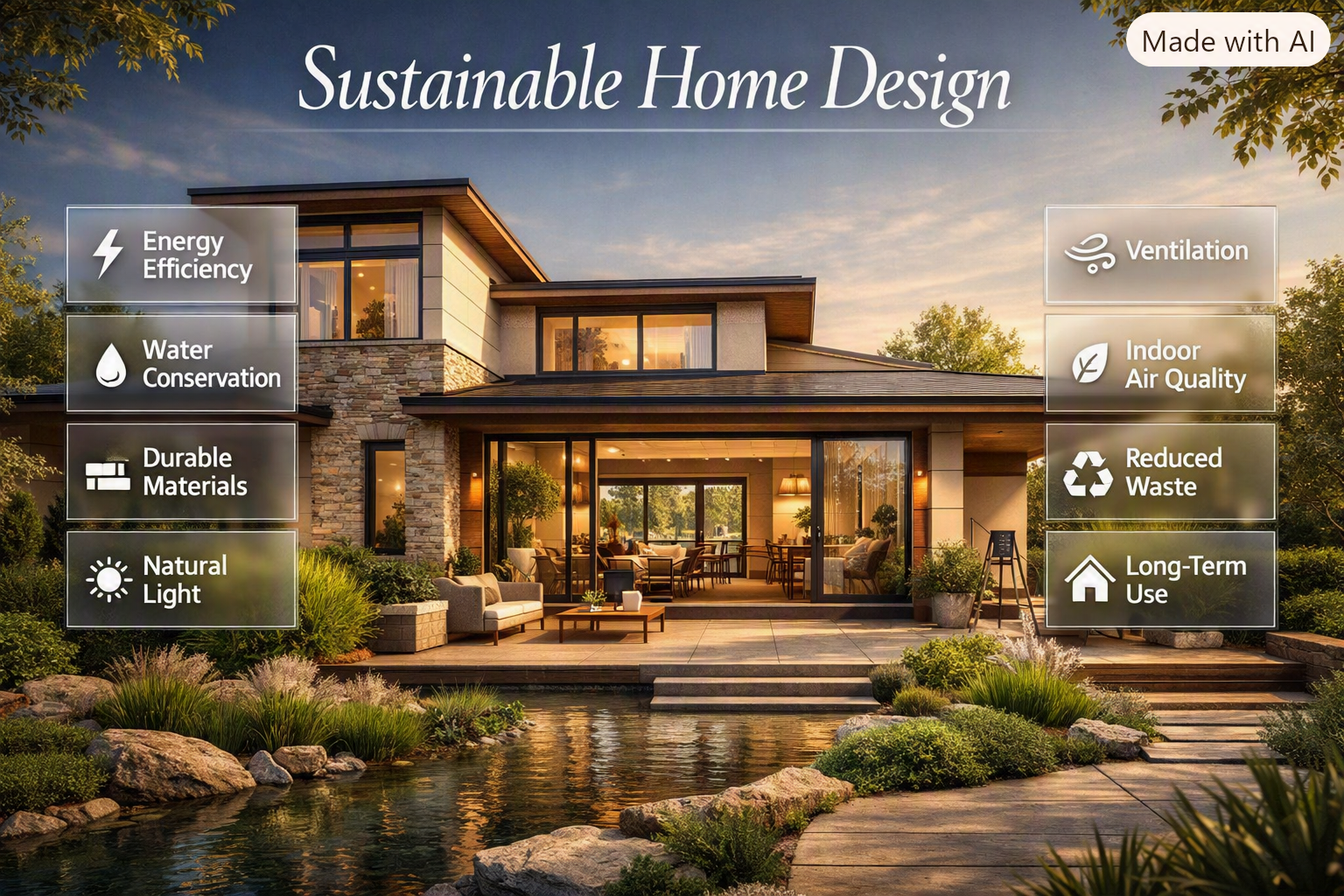
A sustainable home can be modern, traditional, luxurious, minimalist, colorful, or completely personal. The difference is that its design considers more than appearance. It considers energy efficiency, water use, material durability, indoor air quality, natural light, ventilation, waste, maintenance, and the long-term needs of the people living there.
If you’re planning a new home, renovating an existing property, redecorating a room, or simply looking for practical ways to reduce household waste and utility costs, this guide will help you make better decisions without turning sustainability into an overwhelming project.
For additional ideas about creating a practical and attractive home, you can also explore DesignMode24 Interior Design as a broader resource for home and interior planning.
What Is Sustainable Home Design?
Sustainable home design is the practice of planning, building, renovating, and furnishing a home in ways that reduce unnecessary environmental impact while improving efficiency, durability, comfort, and indoor living conditions.
Instead of considering a home only as a collection of rooms, sustainable design looks at how the entire property works together.
That includes the building envelope, heating and cooling systems, windows, lighting, appliances, plumbing fixtures, furniture, finishes, landscaping, construction waste, and maintenance requirements.
A sustainable home may include:
- High-quality insulation
- Effective air sealing
- Energy-efficient windows
- Exterior shading
- Efficient heating and cooling
- LED lighting
- Energy-efficient appliances
- Water-saving plumbing fixtures
- Natural daylight
- Climate-appropriate ventilation
- Durable flooring and finishes
- Responsibly sourced materials
- Reclaimed or recycled materials
- Low-emission paints and finishes
- Renewable energy where appropriate
- Efficient landscaping
- Flexible and adaptable rooms
However, there isn’t a single checklist that makes every house sustainable.
A design that works extremely well in a cold climate may be inappropriate in a hot and humid region. Likewise, a material that is sustainable in one location may be difficult to source or transport efficiently somewhere else.
The best sustainable design responds to the home’s location, climate, structure, occupants, budget, and long-term needs.
Why Is Sustainable Home Design Important?
Sustainable home design matters because homes consume resources every day.
Heating, cooling, lighting, cooking, hot water, appliances, transportation-related infrastructure, construction materials, and household products all contribute to a home’s overall environmental footprint.
But sustainability isn’t only about protecting the environment.
A well-designed sustainable home can also provide practical benefits such as:
- Lower energy consumption
- Reduced water waste
- Better indoor comfort
- More consistent temperatures
- Improved daylight
- Better ventilation
- Reduced maintenance
- Longer-lasting materials
- Lower replacement frequency
- Healthier indoor conditions
- Greater resilience to changing energy costs
For homeowners, these everyday benefits can be more meaningful than the sustainability label itself.
Imagine two homes with the same floor area. One has poor insulation, inefficient windows, outdated appliances, and excessive air leakage. The other has good insulation, efficient equipment, controlled solar gain, durable finishes, and thoughtfully planned ventilation.
Even if both homes look similar, their operating costs and comfort levels can be dramatically different.
That is the real value of sustainable design: good design makes the home work better.
What Are the Main Principles of Sustainable Home Design?
Sustainable homes usually follow several connected principles rather than relying on one particular product or technology.
Reduce Resource Consumption
The first goal is to avoid unnecessary consumption.
A home that needs less energy for heating and cooling is generally more efficient than one that relies heavily on mechanical systems to compensate for poor design.
The same principle applies to water, materials, and household waste.
Improve Efficiency
After reducing unnecessary demand, improve the efficiency of the systems that remain.
This can include efficient HVAC equipment, appliances, lighting, water fixtures, and controls.
Choose Durable Materials
A material that lasts for decades can avoid repeated replacement, manufacturing, transportation, and disposal.
Durability should therefore be treated as a sustainability feature.
Reuse Whenever Practical
Not everything needs to be replaced.
Existing cabinets, doors, furniture, flooring, fixtures, and structural components may sometimes be repaired, refinished, or reused.
Design for Adaptability
A room that can serve multiple purposes is less likely to become obsolete as the household changes.
Flexible furniture, movable storage, adaptable rooms, and timeless finishes can extend the useful life of an interior.
Consider the Whole Life Cycle
A product shouldn’t be judged only by what it looks like on the day it is installed.
Consider where it comes from, how it was manufactured, how long it will last, how much maintenance it requires, and what happens when it eventually reaches the end of its useful life.
How Can You Make an Existing Home More Sustainable?
You don’t have to build a new house to benefit from sustainable design.
In fact, improving an existing home can be a highly practical approach because you can preserve the structure while targeting the areas that need improvement.
Start with an assessment.
Look for:
- Drafts around windows and doors
- Poor attic or wall insulation
- Old heating or cooling equipment
- Inefficient lighting
- Water leaks
- Aging appliances
- Excessive solar heat
- Poor ventilation
- Moisture problems
- Furniture that could be repaired rather than replaced
Once you’ve identified the biggest problems, prioritize them.
For example, if a home becomes extremely hot every afternoon because of uncontrolled sunlight, replacing decorative furniture won’t solve the main problem. Exterior shading, better window treatments, insulation, or improved glazing may have a much greater effect.
You can find additional practical renovation ideas in the Home Improvement section.
How Can Insulation Improve Sustainable Home Design?
Insulation reduces the rate at which heat moves through a building’s walls, roof, floor, and other parts of the envelope.
In cold conditions, insulation helps keep indoor heat inside. In hot conditions, it can help slow the movement of outdoor heat into conditioned spaces.
The most important areas depend on the home’s construction, but may include:
- Roofs and attics
- Exterior walls
- Floors above unconditioned areas
- Basements
- Foundation walls
- Around certain building penetrations
Good insulation doesn’t mean simply adding the thickest material available.
The correct solution depends on climate, building structure, moisture conditions, ventilation, and local construction requirements.
💡 Pro Tip: Before spending heavily on new technology, make sure the building envelope is performing properly. Efficient equipment can’t fully compensate for major insulation or air-leakage problems.
Why Is Air Sealing Important?
Insulation and air sealing are related but different.
Insulation slows heat transfer. Air sealing reduces uncontrolled movement of air through gaps and cracks.
Common leakage points can include:
- Door frames
- Window frames
- Plumbing penetrations
- Electrical openings
- Attic access points
- Utility penetrations
- Duct connections
- Construction joints
Air leakage can make conditioned spaces less comfortable and increase the workload on heating and cooling systems.
However, sealing a home must be done thoughtfully. Ventilation still matters, and combustion appliances may require specific ventilation and safety considerations.
A sustainable home should be controlled, not simply sealed without a ventilation strategy.
How Do Windows Affect Sustainable Home Design?
Windows have several jobs.
They provide daylight, views, ventilation, solar heat, and connections to outdoor spaces. At the same time, they can become major sources of unwanted heat gain or heat loss.
Good window selection considers:
- Climate
- Orientation
- Glass performance
- Frame performance
- Window size
- Shading
- Operability
- Interior comfort
- Daylight requirements
A common mistake is assuming that larger windows automatically make a home more sustainable.
Large windows can provide excellent daylight, but poorly positioned or unshaded glazing can also create glare and overheating.
The goal is useful daylight without unnecessary thermal problems.
How Can Natural Light Make a Home More Sustainable?
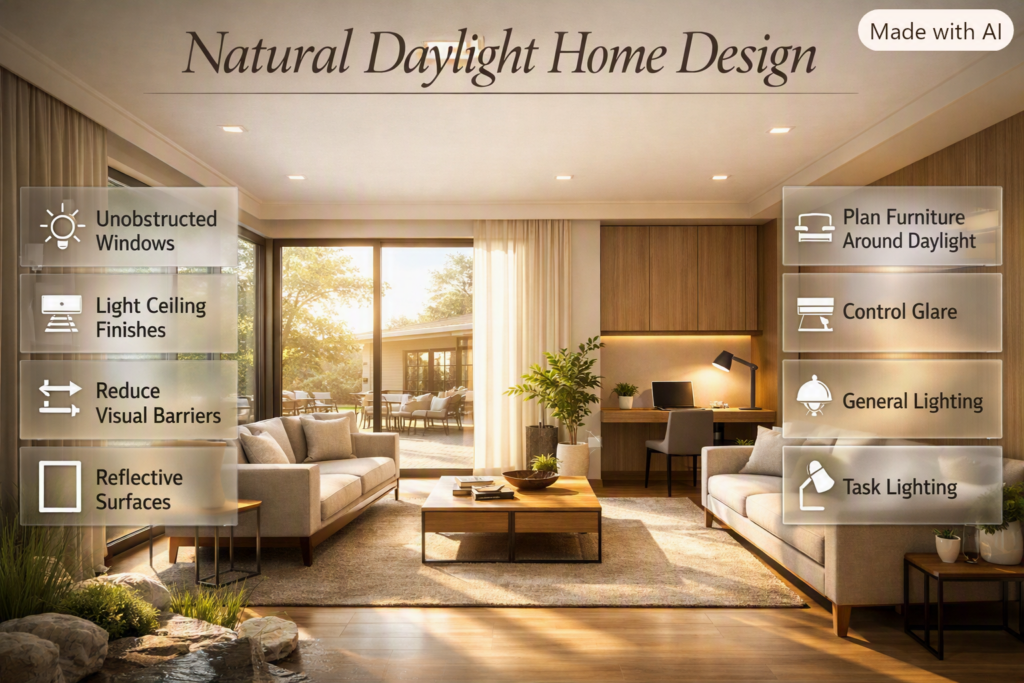
Natural daylight can reduce dependence on electric lighting during suitable hours.
But daylight also affects the emotional quality of a room.
A well-lit space can feel more open, calm, and inviting without requiring excessive decorative lighting.
To improve daylight:
- Keep windows unobstructed where practical.
- Use lighter ceiling finishes.
- Avoid unnecessary visual barriers.
- Consider room depth.
- Use reflective surfaces carefully.
- Plan furniture around daylight availability.
- Control glare with appropriate shades.
Natural light works particularly well when combined with task lighting.
Instead of illuminating an entire room at maximum brightness, provide general light where needed and stronger task lighting at work surfaces.
For broader room-planning ideas, the Home Design Ideas category can be useful when considering how layout and natural light work together.
Can Natural Ventilation Make a Home More Sustainable?
Natural ventilation can reduce dependence on mechanical cooling in climates and conditions where outdoor air is suitable.
Cross-ventilation is one of the simplest strategies.
Air can enter through one opening and move through the room before exiting through another opening.
Outdoor air → Entry opening → Living space → Exit opening → Outdoor air
The effectiveness depends on:
- Window placement
- Building orientation
- Outdoor temperature
- Wind direction
- Humidity
- Air quality
- Room layout
- Shading
Natural ventilation isn’t always appropriate.
During very hot, humid, dusty, polluted, or extremely cold conditions, opening windows may reduce comfort rather than improve it.
A sustainable home uses natural ventilation when it works and efficient mechanical systems when it doesn’t.
How Can Shading Reduce Energy Use?
Shading can be one of the simplest ways to control unwanted solar heat.
Useful strategies include:
- Exterior overhangs
- Awnings
- Shutters
- Blinds
- Curtains
- Pergolas
- Trees
- Exterior screens
Exterior shading can be particularly effective because it can prevent sunlight from reaching the glass in the first place.
Interior curtains still help with glare and heat, but once sunlight has entered through the glazing, some solar energy has already reached the interior.
Climate and orientation should guide the solution.
What Role Does Energy-Efficient Lighting Play?
Lighting is an easy area for improvement because modern LED lighting can provide high-quality illumination with relatively low energy consumption.
However, sustainable lighting isn’t simply about changing bulbs.
Good lighting design asks:
- What activity happens here?
- How much light is actually required?
- Can daylight handle part of the demand?
- Does the light need to stay on continuously?
- Can task lighting replace excessive general lighting?
- Can controls reduce unnecessary operation?
For example, a desk may need strong task lighting while the rest of the room can remain more softly illuminated.
This creates a better visual environment while avoiding unnecessary energy use.
How Can Sustainable Home Design Save Water?
Water conservation begins with preventing waste.
A sustainable bathroom or kitchen may use:
- Efficient faucets
- Low-flow showerheads
- Efficient toilets
- Leak detection
- Water-efficient appliances
- Properly designed irrigation
- Climate-appropriate landscaping
But water efficiency isn’t just about fixtures.
Behavior and maintenance matter too.
A dripping faucet, running toilet, broken irrigation line, or leaking pipe can waste water continuously.
That’s why sustainable homes need routine inspection and maintenance.
How Can You Design a Sustainable Kitchen?
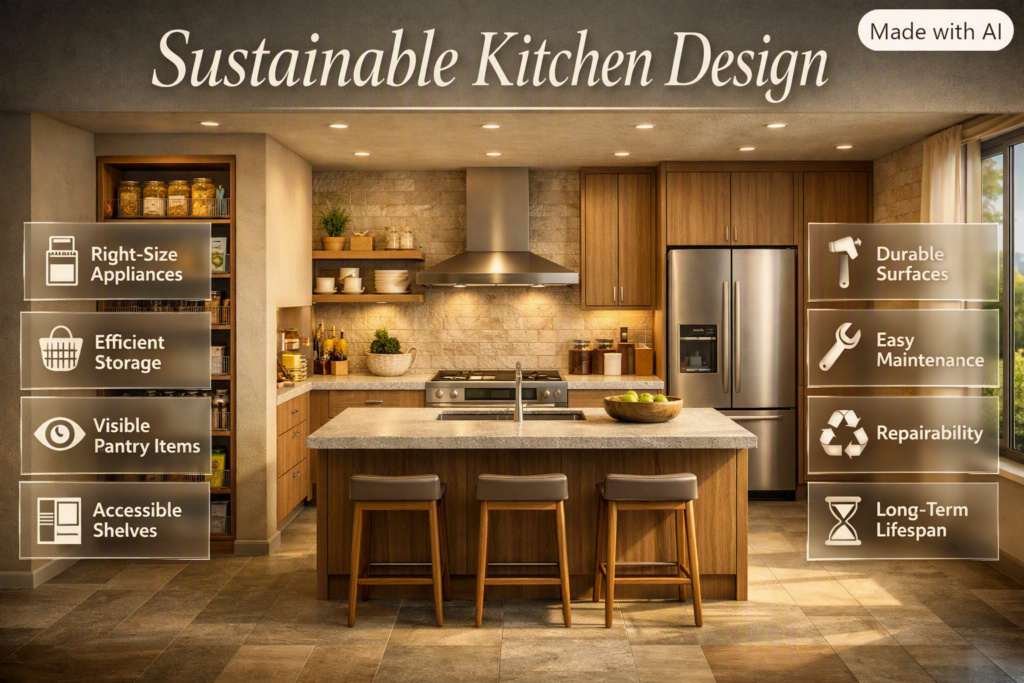
The kitchen is one of the most resource-intensive rooms in a home.
It uses electricity or gas, water, refrigeration, cooking equipment, lighting, materials, and storage.
A sustainable kitchen begins with good planning.
Choose Appropriately Sized Appliances
Bigger isn’t automatically better.
Choose refrigerator, oven, dishwasher, and other appliances according to the household’s actual needs.
Oversized equipment may consume more resources without delivering meaningful benefits.
Plan Storage Carefully
Efficient storage can reduce food waste and prevent duplicate purchases.
A well-organized pantry allows homeowners to see what they already own.
Drawer organization, accessible shelves, and logical storage zones can make everyday tasks easier.
Choose Durable Surfaces
Countertops, cabinets, flooring, and backsplashes should be evaluated for:
- Durability
- Maintenance
- Repairability
- Expected lifespan
- Material sourcing
Sustainable kitchen design isn’t about choosing the most fashionable material. It’s about choosing materials that make sense for long-term use.
For more kitchen planning inspiration, explore Kitchen Design.
How Can You Make a Sustainable Bathroom?
Bathrooms provide excellent opportunities to combine efficiency with comfort.
Water-efficient fixtures can reduce consumption without making the room feel less luxurious.
Durable tile, properly installed waterproofing, moisture-resistant materials, and good ventilation can also extend the lifespan of the space.
Important considerations include:
- Shower fixture efficiency
- Toilet efficiency
- Faucet performance
- Ventilation
- Moisture control
- Lighting
- Durable finishes
- Repairable fixtures
- Efficient storage
When remodeling, avoid selecting every component separately without considering the whole room.
The floor height, drainage, waterproofing, vanity dimensions, lighting, ventilation, and tile layout should work together.
For more planning help, see Bathroom Remodeling and Bathroom Inspiration.
What Are the Best Sustainable Materials for a Home?
There is no single material that is automatically the most sustainable.
Material selection should consider the complete context.
Potential choices include:
| Material | Potential Benefit | Things to Consider |
|---|---|---|
| Reclaimed wood | Reuses existing material | Source, treatment, condition |
| Bamboo | Rapidly renewable | Manufacturing and sourcing |
| Recycled metal | Durable and recyclable | Production and transportation |
| Recycled glass | Reuses waste material | Application and manufacturing |
| Cork | Renewable and resilient | Source and finish |
| Natural stone | Long service life | Extraction and transportation |
| Recycled-content products | Reduces use of virgin materials | Actual recycled percentage |
The key question isn’t simply, “Is this material green?”
Ask instead:
How long will it last, how much maintenance will it require, where does it come from, and what happens when it is no longer needed?
Is Reclaimed Wood a Good Sustainable Choice?
Reclaimed wood can be an excellent choice because it gives existing material another useful life.
It can work well for:
- Flooring
- Furniture
- Shelving
- Feature walls
- Ceiling details
- Cabinet elements
But reclaimed wood should still be inspected carefully.
Depending on its origin, it may require cleaning, treatment, testing, or professional preparation.
A material shouldn’t be considered sustainable simply because it is old. Its condition and suitability for the new application matter.
Is Bamboo Sustainable for Interiors?
Bamboo is often discussed as a sustainable material because some species grow rapidly.
It can be used for flooring, cabinetry, furniture, and other interior applications.
However, sustainability depends on sourcing and manufacturing practices.
When evaluating bamboo products, consider:
- Where the material was grown
- How it was harvested
- Manufacturing methods
- Adhesives and finishes
- Transportation
- Expected lifespan
The same principle applies to almost every “eco-friendly” product.
How Can Furniture Become More Sustainable?
One of the simplest ways to make an interior more sustainable is to keep useful furniture in service longer.
Before replacing a chair, table, cabinet, or sofa, ask whether it can be:
- Repaired
- Refinished
- Reupholstered
- Repainted
- Moved
- Repurposed
Secondhand furniture can also extend the life of existing products.
When buying new furniture, prioritize solid construction, repairability, replaceable components, and timeless design.
A trendy item that looks outdated after two years may create more waste than a classic piece that remains useful for twenty years.
⭐ Expert Tip: Sustainability often starts with buying less, not buying more sustainable versions of everything.
How Does Sustainable Interior Design Work?
Sustainable interior design combines environmental responsibility with good space planning, comfort, durability, and aesthetics.
It doesn’t require a specific style.
You can create a sustainable:
- Modern interior
- Traditional home
- Minimalist space
- Industrial room
- Contemporary apartment
- Luxury residence
- Family home
The focus should be on thoughtful choices.
For example, instead of installing inexpensive flooring that needs replacement frequently, choose a durable surface that can handle the household’s actual lifestyle.
Instead of buying large quantities of decorative objects, select a smaller number of meaningful pieces.
Instead of replacing cabinets because the color feels outdated, consider whether they can be refinished.
For additional inspiration, visit Interior Design.
How Can a Living Room Be More Sustainable?
A sustainable living room should balance comfort, daylight, ventilation, durability, and flexibility.
Consider:
- Durable upholstery
- Efficient lighting
- Natural daylight
- Flexible furniture
- Repairable pieces
- Low-emission finishes
- Appropriate window shading
- Efficient heating and cooling
Furniture placement also matters.
Don’t block useful ventilation paths or natural light with unnecessarily large furniture.
A flexible layout allows the same room to support conversation, reading, work, relaxation, or family activities without requiring constant remodeling.
Explore Living Room Design for ideas that can be adapted to a sustainable layout.
How Can You Create a Sustainable Home Office?
Home offices are relatively small spaces, which makes them easy to optimize.
Start with daylight.
If possible, place the desk where natural light can support daytime work without causing screen glare.
Use task lighting rather than illuminating the entire room unnecessarily.
Choose durable furniture and avoid buying storage products before understanding what actually needs to be stored.
Energy-saving strategies can also include:
- Efficient computer equipment
- Power management
- Smart charging habits
- LED task lighting
- Natural ventilation where appropriate
For workspace inspiration, see Home Office Design.
How Can You Make a Sustainable Dining Room?
A dining room doesn’t need complicated technology to be sustainable.
Choose durable furniture that can handle regular use.
A solid dining table that can be repaired or refinished may provide decades of service.
Lighting should be designed around the dining experience rather than simply maximizing brightness.
Pendant lights or focused fixtures can illuminate the table while allowing surrounding areas to remain softer.
For broader planning ideas, visit Dining Room Design.
How Can a Laundry Room Become More Efficient?
Laundry rooms use significant amounts of water and energy, especially when washers and dryers are used frequently.
Energy- and water-efficient appliances can reduce resource consumption.
Good ventilation and moisture management are also important.
The room should include practical storage for:
- Detergents
- Cleaning supplies
- Laundry baskets
- Drying equipment
- Reusable cleaning products
Leak protection is particularly valuable around washing machines because hose or connection failures can cause serious water damage.
More room-planning ideas are available through Laundry Room Design.
How Can You Make a Kids’ Room More Sustainable?
Children’s rooms change quickly, so adaptability is especially important.
Instead of designing the room around one age group, choose furniture and storage that can evolve.
Consider:
- Adjustable furniture
- Flexible storage
- Washable finishes
- Durable flooring
- Low-emission paints
- Natural daylight
- Repairable furniture
A room designed to transition from toddler years to school years can reduce the need for repeated renovations.
For more ideas, explore Kids’ Room Design.
How Does Sustainable Home Design Affect Home Styling?
Sustainable styling doesn’t mean leaving your home empty or making it look unfinished.
Instead, focus on quality and intention.
Choose:
- Fewer decorative pieces
- Durable textiles
- Natural or responsibly sourced materials
- Secondhand accessories
- Meaningful artwork
- Plants where appropriate
- Furniture that serves multiple purposes
A well-styled home doesn’t need hundreds of objects.
A carefully chosen combination of texture, proportion, lighting, color, and material can create a much stronger result.
For additional styling inspiration, see Home Styling.
What Role Does Bathroom Storage Play in Sustainability?
Storage may not seem like an environmental issue, but good organization can reduce unnecessary purchases and make better use of existing products.
In a bathroom, practical storage can keep toiletries visible and prevent duplicate purchases.
Useful solutions include:
- Vanity drawers
- Recessed niches
- Vertical cabinets
- Open shelves
- Hidden organizers
- Pull-out storage
The goal is to make frequently used items accessible while keeping less-used items organized.
For more practical ideas, explore Bathroom Storage.
Should You Build a New Sustainable Home or Renovate an Existing One?
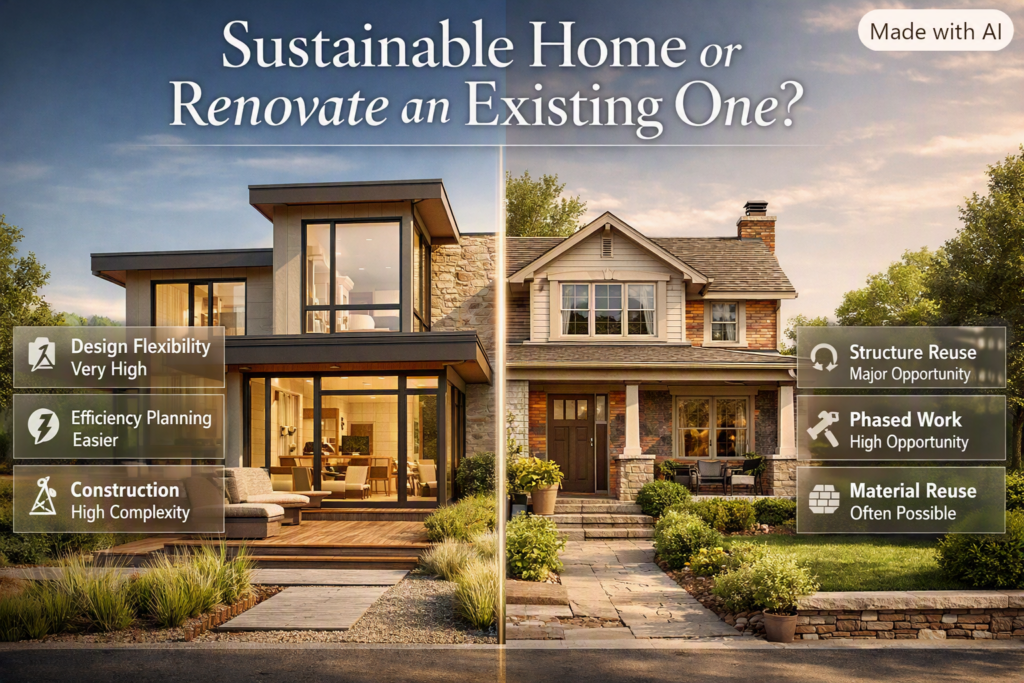
Both options can work.
| Consideration | New Home | Existing Home |
| Design flexibility | Very high | Depends on structure |
| Whole-home efficiency planning | Easier | Requires assessment |
| Reuse of existing structure | Limited | Major opportunity |
| Construction complexity | High | Varies |
| Opportunity for phased work | Lower | High |
| Material reuse | Less likely | Often possible |
A new home allows sustainability to be integrated from the beginning.
An existing home, however, already contains a structure that can potentially be preserved.
Renovating and extending the life of an existing building can therefore be a strong sustainability strategy when the building is structurally suitable.
What Is the Most Cost-Effective Sustainable Home Improvement?
There isn’t one answer for every property.
The best investment depends on what is currently wrong with the home.
A useful decision process is:
Identify the problem → Estimate its impact → Compare solutions → Consider lifespan → Choose the practical option
For example, if your home has major air leakage, spending heavily on decorative sustainable materials may not be the best first move.
If your appliances are already near the end of their useful lives, replacing them with efficient models may make more sense.
Sustainability should be treated as a priority system rather than a shopping list.
What Are the Most Common Sustainable Home Design Mistakes?
Mistake 1: Treating Sustainability as a Decorating Style
Sustainability isn’t a visual style.
A room doesn’t become sustainable simply because it contains wood, plants, neutral colors, or natural textures.
Why it happens: These features are strongly associated with eco-friendly marketing.
Why it’s harmful: Homeowners may spend money on appearance while ignoring major performance problems.
Better approach: Evaluate energy, water, materials, durability, and maintenance.
Mistake 2: Buying Products Without Identifying the Problem
A homeowner may purchase smart thermostats, solar accessories, eco-friendly furniture, and other products without understanding the home’s biggest weaknesses.
Better approach: Assess first. Buy second.
Mistake 3: Replacing Useful Materials Too Early
Replacing functional cabinets, furniture, flooring, or fixtures simply because they’re no longer fashionable can create unnecessary waste.
Better approach: Repair, refinish, repurpose, or reuse whenever practical.
Mistake 4: Assuming Natural Means Sustainable
Natural materials can still have significant environmental impacts.
Extraction, transportation, processing, durability, and maintenance all matter.
Mistake 5: Ignoring Climate
A sustainable strategy must respond to local weather.
Window placement, shading, ventilation, insulation, and HVAC strategies should be appropriate for the climate.
Mistake 6: Forgetting Maintenance
An efficient home can become less efficient when equipment isn’t maintained.
Filters, seals, plumbing fixtures, ventilation systems, appliances, and cooling equipment all need appropriate care.
⚠ Common Mistake: Don’t treat sustainable design as a one-time renovation. The way a home is operated and maintained affects its performance for years afterward.
How Should Beginners Start Sustainable Home Design?
If you’re new to the subject, don’t try to change everything simultaneously.
Use this sequence.
Step 1: Assess the Home
Identify obvious inefficiencies.
Look for drafts, leaks, poor insulation, inefficient equipment, excessive heat gain, and unnecessary lighting.
Step 2: Fix Maintenance Problems
Repair leaks, damaged seals, broken fixtures, and other issues before adding new products.
Step 3: Improve the Building Envelope
Address insulation, air sealing, windows, and shading where appropriate.
Step 4: Upgrade Efficiency
Replace inefficient lighting, appliances, plumbing fixtures, and equipment as needed.
Step 5: Improve Materials
When normal replacement becomes necessary, choose durable and responsibly sourced options.
Step 6: Add Renewable Technology Where Practical
Solar energy and other renewable technologies can be valuable after basic efficiency improvements have been addressed.
Step 7: Maintain the Improvements
Monitor performance and keep systems functioning correctly.
What Should You Consider Before Choosing a Sustainable Material?
Ask these questions:
- How long will it last?
- Can it be repaired?
- Where was it produced?
- How far must it travel?
- What resources were required to manufacture it?
- Does it require specialized maintenance?
- Does it contain potentially problematic emissions?
- Can it be reused or recycled?
- Is it appropriate for the room?
- Does it genuinely solve a design need?
This prevents sustainability from becoming a marketing exercise.
How Can You Reduce Waste During a Home Renovation?
Renovation waste can become substantial when materials are removed without a reuse plan.
Before demolition, determine whether anything can be retained.
Potentially reusable items include:
- Doors
- Hardware
- Cabinets
- Fixtures
- Flooring
- Shelving
- Furniture
- Wood
- Stone
- Lighting
Donate usable items where appropriate and follow local requirements for disposal and recycling.
Careful measurements can also reduce waste because ordering the correct quantity prevents unnecessary leftover materials.
For practical DIY-related ideas, see DIY Home Projects.
What Is a Sustainable Room-by-Room Design Strategy?
Every room has different priorities.
Kitchen: appliances, water, storage, durable surfaces.
Bathroom: water efficiency, ventilation, moisture control, durable finishes.
Living room: daylight, furniture durability, flexible layout, efficient lighting.
Bedroom: comfort, ventilation, low-emission finishes, durable furniture.
Home office: daylight, task lighting, efficient equipment, adaptable storage.
Laundry room: efficient appliances, water management, ventilation.
Dining room: durable furniture, focused lighting, flexible use.
Kids’ room: adaptability, durability, low-emission finishes, storage.
This room-by-room approach prevents you from applying the same solution everywhere.
For a broader overview of room planning, the Room-by-Room Design Hub can help you connect individual design decisions into a more cohesive home.
Can Sustainable Home Design Still Feel Comfortable and Luxurious?
Absolutely.
Comfort and sustainability often complement each other.
A comfortable home typically needs:
- Stable temperatures
- Good lighting
- Low glare
- Appropriate humidity
- Fresh air
- Quiet spaces
- Comfortable furniture
- Functional storage
Many of these qualities are also associated with good sustainable design.
Luxury doesn’t have to mean excessive consumption.
A high-quality natural material, carefully designed lighting, custom storage, durable furniture, and thoughtful architectural details can create a luxurious interior without filling the home with disposable products.
The key is quality over unnecessary quantity.
How Can You Make Sustainable Design More Affordable?
The biggest mistake is assuming sustainability requires an expensive whole-house renovation.
Instead, phase the work.
Low-Cost Improvements
- LED lighting
- Leak repairs
- Weatherstripping
- Efficient faucet aerators
- Better use of daylight
- Reusing furniture
- Smart power management
- Appropriate window coverings
Medium-Cost Improvements
- Insulation upgrades
- Efficient appliances
- Better plumbing fixtures
- Improved ventilation
- Durable flooring
- Window improvements
Larger Investments
- HVAC replacement
- Solar systems
- Major window upgrades
- Comprehensive energy retrofits
- Structural improvements
- New high-performance construction
The correct order depends on the home’s current condition.
What Do Professionals Look for When Evaluating Sustainability?
Professionals generally need to look beyond individual products.
A useful framework is:
Performance → Durability → Maintenance → Cost → Resource Use → Long-Term Value
Suppose a homeowner wants to replace an existing countertop because a new product is marketed as environmentally friendly.
If the existing countertop is durable, functional, and likely to last another fifteen years, replacing it immediately may create more waste than keeping it.
On the other hand, if an appliance is failing and needs replacement anyway, selecting a more efficient model may be a sensible sustainability decision.
The important question is not:
“Is this product green?”
The better question is:
“Is this the most responsible solution to the actual problem?”
What Are the Best Sustainable Home Design Ideas for 2026?
Modern sustainable design is becoming more focused on practical performance rather than novelty.
Useful priorities include:
Passive Design
Use orientation, shading, insulation, thermal mass, daylight, and ventilation to reduce mechanical demand.
Electrification Where Appropriate
Depending on local energy systems and building conditions, efficient electric equipment can be part of a lower-emission strategy.
Smart Energy Management
Smart controls can help homeowners understand and manage energy use, but they should support efficient design rather than replace it.
Durable Interiors
Long-lasting flooring, cabinetry, furniture, and finishes reduce replacement cycles.
Adaptive Design
Rooms that can change function are less likely to require major remodeling.
Better Indoor Environmental Quality
Ventilation, moisture management, low-emission materials, and daylight should be treated as part of overall home performance.
What Is the Most Effective Way to Make a Home More Sustainable?
The most effective approach is to reduce the home’s energy and resource demand before adding new technology. Start by improving insulation and air sealing, controlling unwanted heat through shading and efficient windows, upgrading inefficient lighting and appliances, fixing water leaks, and choosing durable materials when replacements are actually needed. This whole-home approach is generally more useful than simply buying individual products marketed as “eco-friendly.” Current sustainable housing research increasingly emphasizes reducing energy and material demand while maintaining comfort and well-being.
For an existing home, don’t assume you need a complete renovation. First identify where the property is wasting the most energy, water, or materials. A home that overheats because of poor roof insulation or unshaded windows may benefit more from passive cooling improvements than from adding another smart device.
Key points to prioritize:
Improve roof, wall, or floor insulation where needed.
Seal unnecessary air leakage.
Use external shading to control unwanted solar heat.
Choose efficient lighting and appliances.
Repair plumbing leaks quickly.
Reuse furniture and existing materials where practical.
Select durable, repairable products when replacement becomes necessary.
Professional advice: Think of sustainability as a hierarchy: reduce demand → improve efficiency → use renewable energy → maintain performance. This prevents homeowners from spending heavily on technology while leaving basic building-performance problems unresolved.
How Can Passive Design Make a Home More Energy Efficient?
Passive design makes a home more efficient by using the building’s orientation, windows, shading, insulation, ventilation, and other architectural features to improve comfort before mechanical heating or cooling does all the work. Instead of depending entirely on air conditioning or heating, the building itself helps control heat, light, and airflow.
This is particularly important in climates with significant summer heat. Strategic shading, roof insulation, appropriate window placement, and cross-ventilation can reduce unwanted heat gain and improve indoor comfort. Pakistan’s Green Building Code also recognizes passive solar design, natural ventilation, energy efficiency, water conservation, and sustainable materials as important components of green construction.
For example, a west-facing room with large unshaded windows can become extremely hot in the afternoon. Simply increasing air-conditioning capacity doesn’t address the underlying problem. Exterior shading, better glazing, roof insulation, and appropriate ventilation can reduce the amount of heat entering the room in the first place.
Key passive-design strategies include:
Position windows according to climate and orientation.
Use exterior shading where strong sunlight creates heat gain.
Insulate the roof because it can be a major source of heat transfer.
Create cross-ventilation where outdoor conditions are suitable.
Use daylight to reduce unnecessary artificial lighting.
Consider thermal mass and building materials appropriate to the climate.
Combine passive strategies with efficient mechanical systems rather than treating them as alternatives.
Expert tip: Passive design doesn’t mean avoiding air conditioning. It means designing the home so cooling equipment doesn’t have to fight unnecessary heat gain all day. Recent architectural guidance continues to emphasize the combination of orientation, shading, ventilation and insulation for heat resilience.
What Are the Best Sustainable Materials to Use in a Home?
The best sustainable material isn’t necessarily the one with the most impressive environmental label. A better choice is usually a material that is durable, appropriately sourced, repairable, suitable for the application, and capable of remaining useful for a long time.
Popular options can include reclaimed wood, responsibly sourced timber, bamboo, cork, recycled metal, recycled glass, natural stone, and other recycled or bio-based materials. However, each material should be evaluated individually. Transportation distance, manufacturing processes, finishes, adhesives, maintenance requirements, durability, and end-of-life options can all affect its overall environmental impact.
There’s also growing interest in healthier materials and reducing unnecessary exposure to emissions from certain paints, adhesives, finishes, and synthetic products. Current design discussions increasingly connect sustainability with indoor environmental quality rather than treating environmental impact and occupant health as completely separate issues.
Before choosing a material, ask:
How long is it expected to last?
Can it be repaired or refinished?
Where was it produced?
How far does it need to travel?
Does it require intensive maintenance?
What finishes or adhesives are involved?
Can it be reused or recycled?
Is it genuinely suitable for the room?
Professional advice: Don’t remove a perfectly good, durable material simply because a newer product has a stronger “eco-friendly” marketing message. Extending the life of existing materials can itself be a highly sustainable decision.
Is Sustainable Home Design Expensive?
Sustainable home design can be expensive, but it doesn’t have to be. The cost depends on whether you’re making small efficiency upgrades, renovating individual rooms, improving the building envelope, or constructing a high-performance home from scratch.
Low-cost improvements can include LED lighting, weatherstripping, leak repairs, efficient faucet fixtures, better shading, smart energy habits, and reusing existing furniture. Medium-cost improvements may involve insulation, efficient appliances, improved windows, ventilation upgrades, or durable flooring. Larger investments can include HVAC replacement, solar systems, major envelope improvements, or comprehensive energy retrofits.
The important point is to consider value over the entire life of the home, not just the initial purchase price. A more durable material or efficient system may cost more upfront but require less maintenance, replacement, or energy over time.
A practical budget strategy:
Fix leaks and maintenance problems.
Identify major sources of energy loss.
Improve insulation and air sealing.
Improve shading and window performance where necessary.
Replace inefficient equipment when replacement is due.
Choose durable materials during normal renovation cycles.
Consider renewable energy after efficiency improvements.
Key consideration: Don’t spend thousands on sustainable finishes while ignoring an inefficient HVAC system, major air leakage, poor insulation, or excessive solar heat gain. Sustainable design works best when money is directed toward the home’s biggest performance problems.
Can I Make My Existing Home Sustainable Without Completely Remodeling It?
Yes. In many cases, improving an existing home gradually is more practical than starting over. You can make meaningful sustainability improvements through maintenance, targeted upgrades, better operation, and smarter purchasing decisions without demolishing the entire interior.
Start by looking at the home’s current condition. Check for air leaks, poor insulation, inefficient appliances, water leaks, excessive heat gain, outdated lighting, ventilation problems, and materials that are already reaching the end of their useful life.
Then make improvements as part of normal maintenance and replacement cycles. When an old appliance finally needs replacement, choose a more efficient model. When a room is being repainted, consider a lower-emission finish. When flooring needs replacement, compare durable options rather than choosing the cheapest product.
Practical upgrades include:
Improve roof or attic insulation where appropriate.
Add effective window shading.
Seal obvious drafts and air leaks.
Replace inefficient lighting with LEDs.
Repair leaking faucets and toilets.
Install water-efficient fixtures.
Maintain HVAC equipment properly.
Refinish or repair furniture instead of replacing it.
Choose durable materials during future renovations.
Use natural daylight and ventilation when conditions allow.
This approach is particularly valuable because sustainable housing is increasingly moving toward retrofit, longevity, repairability, and whole-home performance, rather than treating sustainability as something reserved for new construction.
Conclusion
Sustainable home design isn’t about creating a perfect eco-friendly house overnight. It’s about making smarter decisions that improve how your home uses energy, water, materials, and space while keeping it comfortable and practical for everyday life.
The best place to start is with the fundamentals: improve insulation, control air leakage, use natural light and ventilation where appropriate, manage solar heat, choose efficient appliances, reduce water waste, and maintain the systems you already have. When materials need replacing, prioritize durability, repairability, responsible sourcing, and long-term value rather than choosing products simply because they’re marketed as green.
You also don’t need to remodel your entire home to make a difference. Small improvements can be completed gradually, while larger upgrades can be planned around your budget and the natural replacement cycle of your home’s systems and finishes.
Ultimately, sustainable home design is about doing more with less—less wasted energy, less unnecessary water use, less disposable furniture, less material waste, and fewer short-lived design decisions.
A truly sustainable home is one that works efficiently, feels comfortable, lasts for years, and continues to meet the needs of the people living in it. Start with one meaningful improvement, build from there, and let sustainability become a natural part of how you design, maintain, and enjoy your home.
Leave a Reply