
Introduction
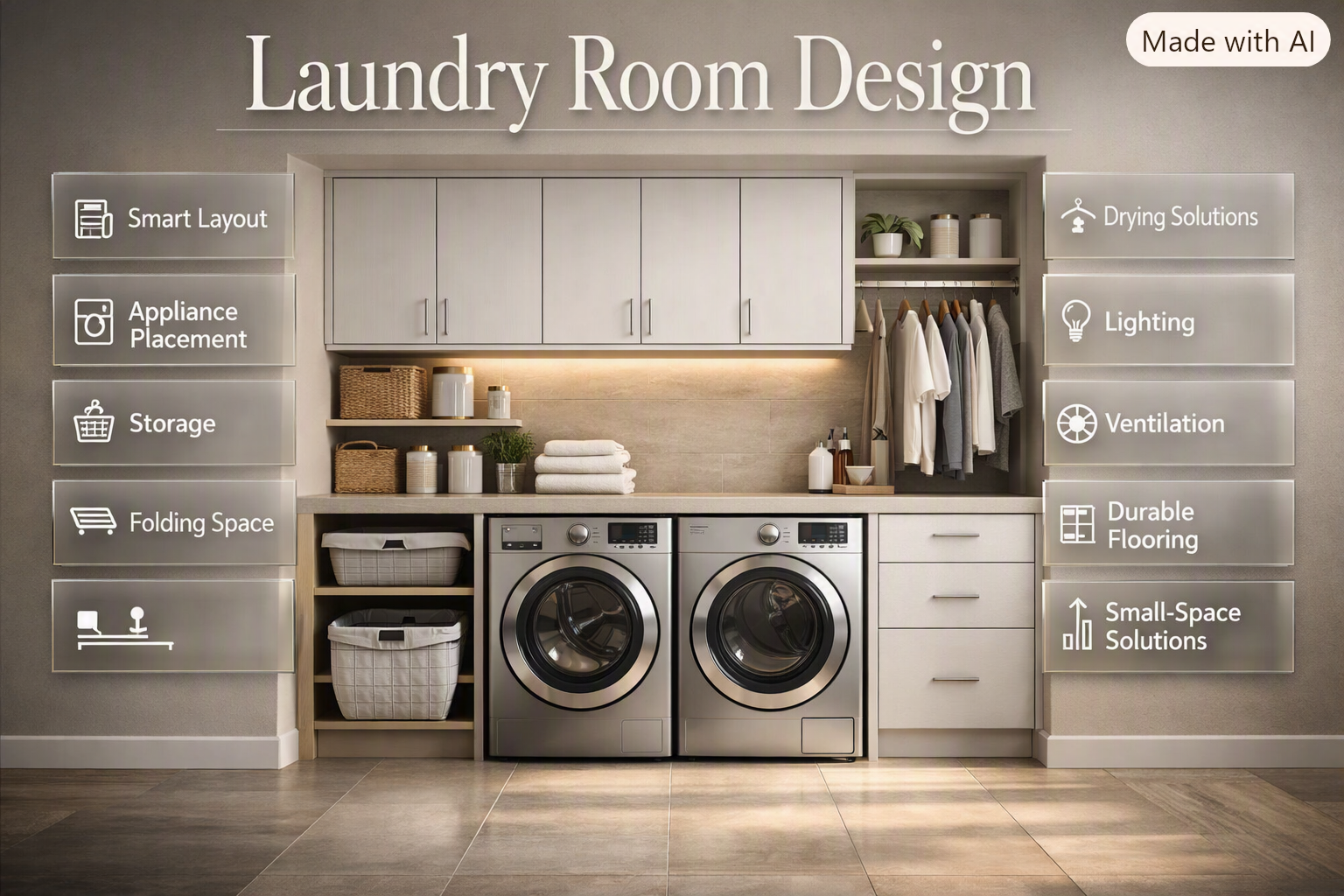
Laundry Room Design | A laundry room has a simple job: make washing, drying, sorting, folding, and storing clothes easier. Yet this space is often one of the most poorly planned areas in a home. A washer and dryer may fit perfectly, but there may be nowhere to fold clothes, no sensible place for laundry baskets, inadequate storage for supplies, or barely enough room to open an appliance door.
That is where thoughtful laundry room design makes a real difference.
A well-designed laundry room doesn’t need to be huge or expensive. What matters is how intelligently the available space is used. A narrow utility room can become highly functional with vertical storage and a compact drying solution, while a larger room can accommodate a sink, folding counter, hanging area, cabinets, and additional household storage without feeling crowded.
Whatever the size of the room, the dryer vent behind the machine should stay clean and easy to reach. Regular cleaning from Dryer Vent Cleaning San Diego keeps lint from building up, helps loads dry faster, and lowers the risk of a dryer fire.
If you’re planning improvements throughout your home, DesignMode24 Interior Design can also provide broader inspiration for connecting individual rooms into a more cohesive interior.
This guide explains how to plan a laundry room from the ground up, including layouts, appliance placement, storage, countertops, lighting, ventilation, flooring, colors, small-space solutions, organization, safety, common mistakes, and practical ways to make the room look attractive without sacrificing function.
What Makes a Laundry Room Design Work Well?
A successful laundry room design balances three things: workflow, storage, and comfort. The room should allow laundry to move logically from dirty clothes to washing, drying, folding, hanging, and finally storage. At the same time, everyday supplies should remain accessible without covering every surface.
The most useful laundry rooms are designed around actual household habits rather than an idealized picture.
For example, if your family sorts clothes before washing, the room needs sorting space. If you frequently air-dry delicate garments, it needs a drying rack or hanging rod. If you fold clothes immediately after drying, a proper counter becomes more important than decorative shelving.
A useful laundry workflow looks like this:
Dirty Clothes → Sort → Wash → Dry → Fold → Hang → Store
The closer your physical layout follows this sequence, the less unnecessary movement you’ll make.
What Should You Consider Before Designing the Room?
Before selecting colors, cabinets, countertops, or decorative accessories, identify the practical requirements of the room.
Consider:
- Washer and dryer dimensions
- Appliance opening direction
- Water supply and drainage
- Electrical requirements
- Dryer ventilation requirements
- Gas connections where applicable
- Door and window locations
- Ceiling height
- Available walking space
- Storage requirements
- Folding space
- Hanging space
- Sink requirements
- Lighting
- Ventilation
- Cleaning and maintenance access
This initial planning stage prevents one of the most common renovation problems: creating a beautiful room that doesn’t function properly.
How Do You Plan a Laundry Room Layout?
The best laundry room layout starts with the appliances because their position usually determines the rest of the room. Once the washer and dryer are correctly positioned, you can build storage, countertops, drying areas, and circulation around them.
Don’t begin by asking, “Where should I put the cabinets?”
Start with:
“How will laundry move through this room?”
If dirty clothes enter from a hallway or mudroom, place sorting and hamper storage near the entrance. If clean laundry will be folded immediately, position the folding surface close to the dryer. If clothes need hanging directly after drying, put a rod or rack within easy reach.
This approach creates a room that supports behavior rather than forcing behavior around the furniture.
Which Laundry Room Layout Is Best?
There isn’t one universal layout. The right arrangement depends on the room’s dimensions and the number of tasks you want it to perform.
| Layout | Best For | Advantages | Limitations |
|---|---|---|---|
| Side-by-side | Medium and large rooms | Easy access and large counter potential | Requires wider wall |
| Stacked | Small rooms | Saves floor space | Less counter space |
| Galley | Narrow rooms | Efficient use of long walls | Can feel tight |
| L-shaped | Corner rooms | Separates work zones | Requires thoughtful cabinet planning |
| U-shaped | Large rooms | Maximum storage | Can reduce circulation |
| Closet | Apartments and compact homes | Extremely space efficient | Limited functionality |
Side-by-Side Appliances
Side-by-side washers and dryers are popular because they create an opportunity for a continuous countertop above the machines.
This setup works particularly well when folding laundry is performed in the same room.
You can also place storage cabinets on either side, creating a balanced built-in appearance.
The main requirement is sufficient width. Don’t sacrifice comfortable circulation simply to fit side-by-side appliances.
Stacked Washer and Dryer
Stacking is particularly useful when floor space is limited.
A stacked configuration can free enough room for:
- A tall storage cabinet
- Laundry hampers
- A folding station
- A utility sink
- A drying rack
However, appliance compatibility matters. Not every washer and dryer can safely be stacked, and manufacturer-approved installation methods should be followed.
Galley Laundry Room
A galley laundry room uses two opposing walls, similar to a narrow kitchen.
One side may contain the washer and dryer while the other holds cabinets, shelving, hampers, and a folding counter.
The key is circulation.
If both sides become too deep or heavily furnished, the room can feel cramped very quickly. Keep the center path practical rather than filling every available inch with storage.
How Much Space Should You Leave Around Laundry Appliances?
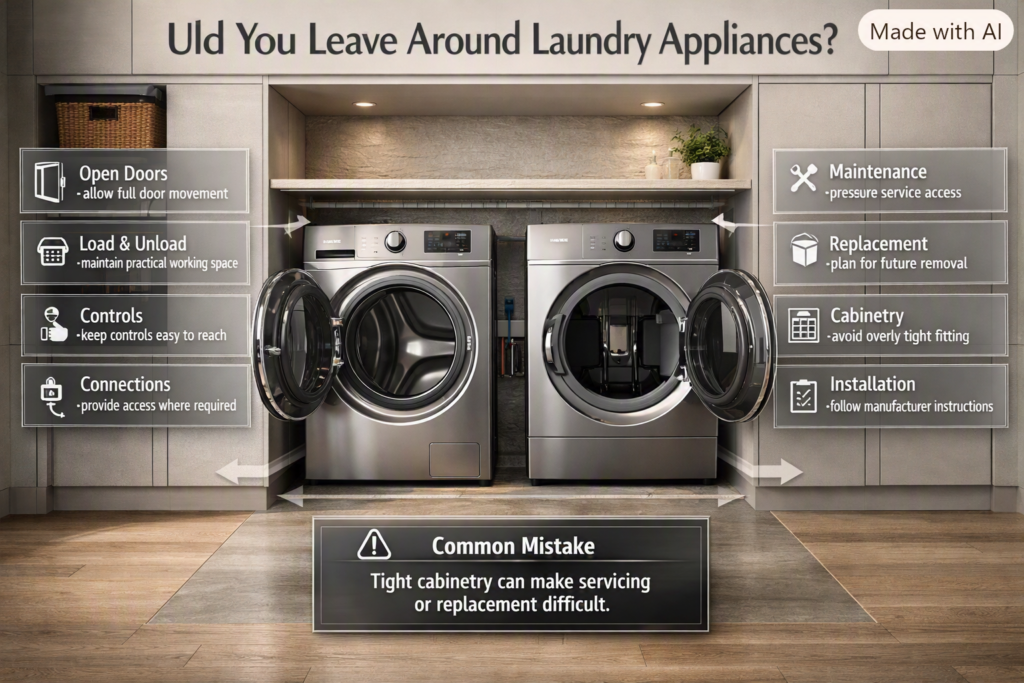
The exact clearance requirements depend on the appliance manufacturer and installation method, so the manufacturer’s instructions should always take priority.
However, planning should account for more than simply making the appliances physically fit.
You need enough space to:
- Open doors fully
- Load and unload clothes
- Reach controls
- Access water connections
- Access electrical connections where required
- Perform maintenance
- Remove appliances when replacement becomes necessary
This last point is frequently overlooked.
A laundry room can function perfectly for years until an appliance needs to be replaced. If cabinetry has been built around it with no consideration for removal, a relatively simple replacement can become a major project.
⚠ Common Mistake: Designing the cabinetry so tightly around current appliances that future servicing or replacement becomes difficult. A professional-looking installation should still allow practical access to important connections and equipment.
Should You Put a Countertop Over the Washer and Dryer?
When side-by-side appliances are used and the installation permits it, a countertop above them can be one of the most useful features in the room.
It creates a dedicated folding area without requiring additional floor space.
A counter can also be used for:
- Sorting clothes
- Placing laundry baskets
- Folding towels
- Organizing clean clothes
- Temporary storage
- Treating stains
- Preparing clothes for ironing
The countertop should be planned around the appliance configuration rather than installed simply because it looks attractive.
Make sure the installation accounts for vibration, appliance removal, plumbing access, and manufacturer requirements.
What Is the Best Laundry Countertop Material?
Laundry countertops are exposed to moisture, cleaning products, lint, occasional spills, and constant everyday use.
Common options include:
- Quartz
- Solid surface
- Laminate
- Porcelain
- Sealed stone
- Appropriately finished wood
Quartz offers a polished appearance and relatively straightforward maintenance. Laminate can provide a practical and economical solution. Solid surfaces can create a seamless appearance and are useful where easy cleaning is a priority.
Wood can bring warmth into an otherwise hard-working utility space, but it requires more attention around water.
💡 Pro Tip: Don’t choose a countertop only according to how it looks under showroom lighting. Think about how visible lint, detergent residue, water marks, and dust will be on the surface after several days of normal use.
How Do You Design a Small Laundry Room?
Small laundry rooms need discipline. Instead of trying to include every feature found in a large laundry room, identify the tasks that matter most and use vertical space to support them.
A compact room may only need:
- Washer
- Dryer
- Detergent storage
- Laundry basket storage
- Folding surface
- Hanging solution
- Basic cleaning storage
Stacked appliances can dramatically reduce the footprint.
Wall-mounted shelves can replace bulky floor cabinets. A retractable drying rack can provide drying space when needed and disappear when it isn’t being used.
A narrow rolling cart can fit between appliances or cabinets and provide surprisingly useful storage for detergent and smaller supplies.
How Can You Make a Tiny Laundry Room Feel Larger?
Visual space matters almost as much as physical space.
To make a compact laundry room feel more open:
- Use lighter wall colors
- Keep the floor visually continuous
- Reduce countertop clutter
- Use closed storage strategically
- Install adequate lighting
- Keep the center of the room clear
- Use vertical rather than horizontal storage
- Choose simple cabinet fronts
- Avoid excessive decorative accessories
Mirrors can sometimes help visually, although they aren’t necessary in every laundry room.
The bigger improvement usually comes from reducing visual clutter.
📌 Quick Tip: If there isn’t enough room for a permanent folding counter, don’t force one into the layout. A pull-out surface or a folding station immediately outside the laundry room can be more practical.
How Do You Add Storage Without Making the Room Crowded?
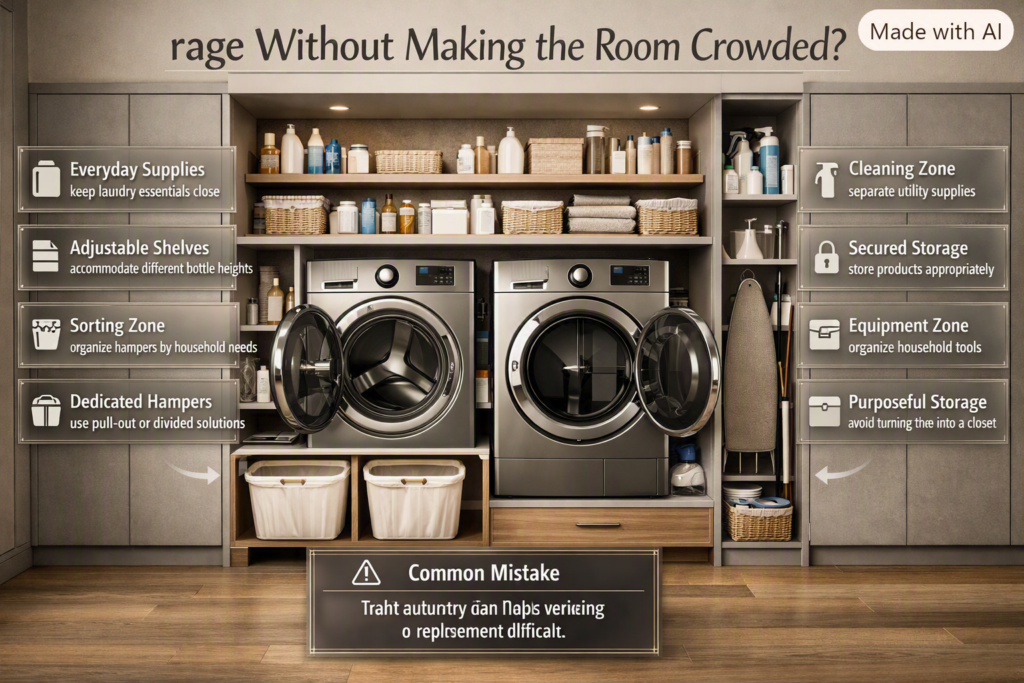
Storage should be planned according to categories rather than simply filling walls with cabinets.
A useful laundry room storage system separates items into zones.
Everyday Laundry Supplies
These include:
- Detergent
- Stain remover
- Fabric-care products
- Laundry bags
- Measuring accessories
Keep these items close to the washing machine.
A cabinet with adjustable shelves is often more useful than one with fixed shelves because bottles vary significantly in height.
Hampers and Sorting
If laundry is sorted before washing, provide dedicated hamper space.
Possible solutions include:
- Pull-out hampers
- Tall divided baskets
- Rolling laundry carts
- Open sorting bins
- Built-in drawers
The right choice depends on household size and available space.
A family that sorts whites, darks, colors, and delicate items may benefit from multiple compartments.
A smaller household may need only one or two.
Cleaning Supplies
If the laundry room also functions as a utility area, create a separate storage zone for cleaning supplies.
Keeping cleaning chemicals scattered around the room makes organization harder and can create avoidable safety concerns.
Store products according to their labels and keep them appropriately secured where children or pets could access them.
Household Equipment
Laundry rooms often become convenient storage areas for household equipment.
You may need space for:
- Iron
- Ironing board
- Mop
- Cleaning cloths
- Vacuum attachments
- Broom
- Dustpan
- Extra towels
- Spare household supplies
However, don’t let the room become a general-purpose storage closet.
Every item should have a reason for being there.
Should Laundry Rooms Have Upper Cabinets?
Upper cabinets can provide valuable storage without consuming floor space. They work particularly well above countertops or alongside stacked appliances.
They are useful for items you don’t need every few minutes, such as:
- Backup detergent
- Seasonal products
- Extra towels
- Specialty laundry products
- Household supplies
Open shelving can be better for frequently used baskets and visually attractive storage containers.
A combination of open and closed storage is often more flexible than choosing one exclusively.
How Should You Organize Laundry Room Cabinets?
The most efficient approach is to organize storage according to frequency of use.
Easy-to-Reach Storage
Use for:
- Daily detergent
- Stain treatment
- Laundry bags
- Frequently used cloths
Medium-Height Storage
Use for:
- Ironing supplies
- Extra towels
- Specialty products
- Household cleaning items
Higher Storage
Use for:
- Backup products
- Seasonal items
- Infrequently used accessories
This simple hierarchy prevents daily items from being buried behind things you rarely use.
For broader practical home improvement ideas, Home Improvement can also help when your laundry renovation becomes part of a larger home project.
What Colors Work Best in a Laundry Room?
Laundry rooms can use almost any color, but the best choice depends on natural light, room size, cabinetry, flooring, and the style of nearby spaces.
Popular choices include:
- Warm white
- Soft gray
- Beige
- Greige
- Muted blue
- Soft green
- Taupe
- Charcoal accents
Light colors can help a small room feel more spacious, but a laundry room doesn’t have to be white to look clean.
Medium tones can actually be practical because they may hide small amounts of dust and lint better than very pale surfaces.
If you want a stronger color, use it strategically on:
- Cabinets
- One accent wall
- Backsplash
- Door
- Decorative accessories
For additional guidance, explore Paint Color ideas before committing to a final palette.
Should the Laundry Room Match the Rest of the House?
It doesn’t need to match exactly.
Instead, aim for visual connection.
For example, you could repeat:
- Cabinet color
- Wood tone
- Hardware finish
- Wall color
- Flooring
- Countertop material
If the laundry room sits beside a kitchen, repeating the kitchen’s cabinet tone can create a natural transition.
If it connects to a hallway, the flooring may be the best element to carry through.
What Flooring Is Best for a Laundry Room?
Laundry room flooring should be durable, easy to clean, and appropriately resistant to the moisture conditions expected in the space.
Common choices include:
- Porcelain tile
- Ceramic tile
- Luxury vinyl products rated for the intended application
- Other manufacturer-approved moisture-resistant flooring systems
Porcelain tile offers excellent durability and many visual options.
Vinyl can provide a softer feel underfoot and may be useful when comfort is important.
The installation matters just as much as the material. Water-resistant flooring does not automatically solve problems caused by poor subfloor preparation or plumbing leaks.
Think about the real situations the floor may experience:
- Water from a supply hose
- Detergent spills
- Wet towels
- Mud
- Cleaning products
- Damp footwear
- Drain problems
A practical laundry room should be designed with these possibilities in mind.
How Important Is Ventilation in a Laundry Room?
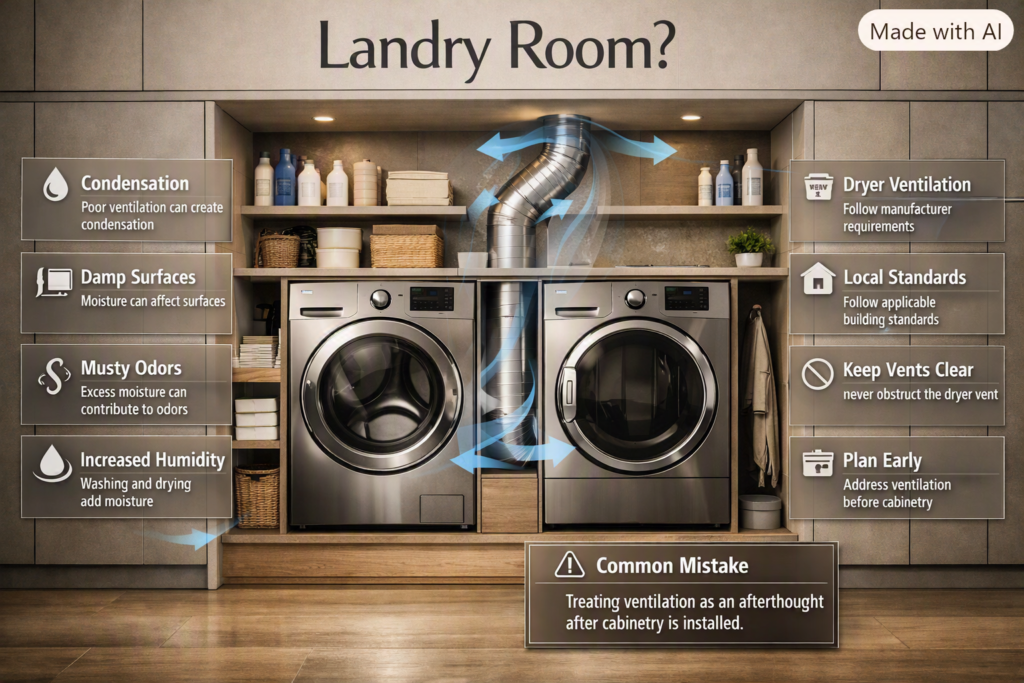
Ventilation is an important part of laundry room planning because washing and drying introduce heat and moisture into the environment.
A poorly ventilated room can experience:
- Condensation
- Damp surfaces
- Musty odors
- Increased humidity
- Moisture-related deterioration
Dryer ventilation is particularly important.
Follow the dryer manufacturer’s requirements and applicable local building standards. Never modify or obstruct a dryer vent simply because the vent location makes cabinetry more difficult.
⚠ Common Mistake: Treating ventilation as something to solve after the cabinets have been installed. Utility and ventilation requirements should be addressed during the planning stage.
What Lighting Does a Laundry Room Need?
Laundry rooms benefit from layered lighting.
A single ceiling light may technically illuminate the room, but it doesn’t always provide enough light exactly where you need it.
Consider:
General Lighting
Ceiling fixtures provide overall illumination.
Task Lighting
Use task lighting around:
- Folding counters
- Sorting areas
- Sink
- Ironing station
Cabinet Lighting
Under-cabinet lighting can make countertops easier to use and can improve visibility inside the room.
Good lighting is particularly useful when checking clothing for stains or reading garment-care labels.
Natural light is a bonus, but artificial lighting should still be sufficient for evening use.
Should a Laundry Room Have a Sink?
A sink can be extremely useful, but it isn’t mandatory.
It is particularly valuable for households that frequently:
- Soak stained clothes
- Hand-wash delicate garments
- Clean muddy shoes
- Wash pet-related items
- Handle gardening clothes
- Perform utility cleaning
If space is limited, however, a sink may take up valuable counter or storage space.
When Is a Laundry Sink Worth It?
| Situation | Sink Value |
| Large laundry room | High |
| Family with children | High |
| Pets | High |
| Frequent stains | High |
| Gardening | High |
| Small laundry closet | Low |
| Rare hand washing | Moderate to low |
| Utility room combination | Very high |
The sink should support the room rather than dominate it.
Where Should a Laundry Sink Go?
If you have a countertop run, placing the sink beside the washer and dryer can create a practical work zone.
Keep frequently used supplies nearby.
A sink should also have enough surrounding counter space to prevent it from becoming an isolated feature that interrupts the room’s workflow.
If a sink is installed, think about splash protection and wall finishes from the beginning.
Do You Need a Drying Rack?
For many households, yes.
Not every item should go directly into a dryer. Delicate fabrics, sweaters, certain sportswear, and garments with specific care instructions may require air drying.
Useful options include:
- Wall-mounted drying racks
- Retractable racks
- Ceiling-mounted systems
- Folding floor racks
- Hanging rods
- Fold-down drying bars
A retractable option is particularly useful in small laundry rooms because it provides functionality without permanently occupying valuable space.
Should a Laundry Room Have a Hanging Rod?
A hanging rod can be one of the simplest and most valuable additions.
It lets you move shirts, dresses, jackets, and other garments directly from the dryer to hangers.
This can reduce wrinkles and eliminate the need to carry damp or freshly dried clothes into another room.
Place the rod where it doesn’t interfere with appliance doors, cabinets, or circulation.
How Can You Make a Laundry Room Look More Stylish?
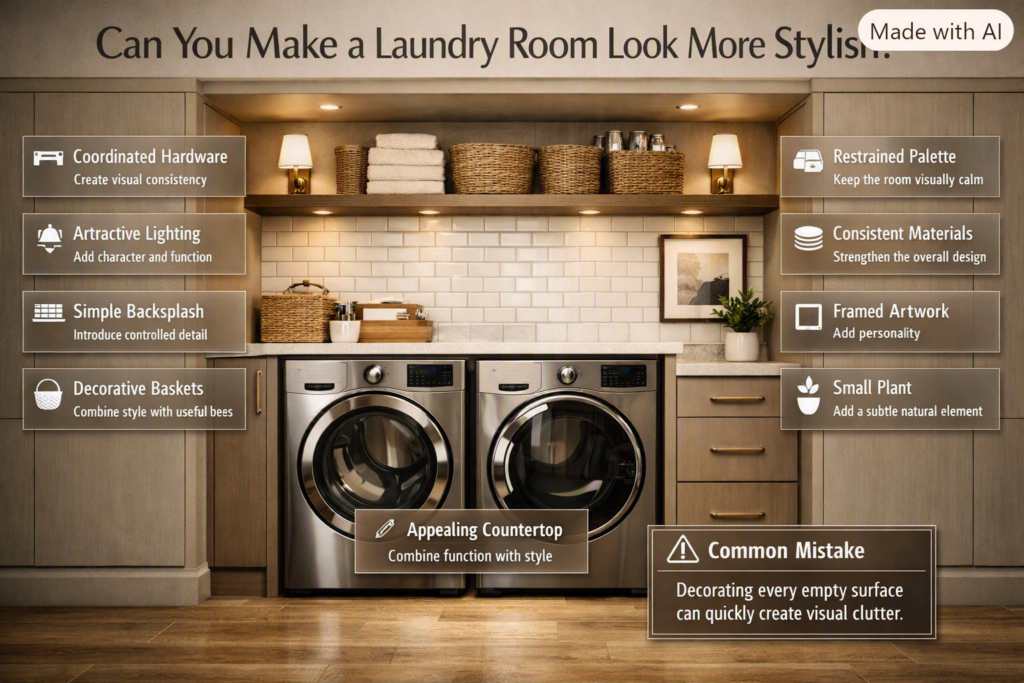
A laundry room can be highly functional without looking purely utilitarian.
The key is controlled styling.
Consider:
- Coordinated cabinet hardware
- Attractive lighting
- A simple backsplash
- Decorative baskets
- A restrained color palette
- Consistent materials
- Framed artwork
- A small plant where conditions allow
- A visually appealing countertop
Avoid decorating every empty surface.
Laundry rooms already contain many functional objects, so excessive accessories can quickly create visual clutter.
For broader ideas about coordinating functional and decorative elements, Interior Design offers a useful starting point.
How Can You Create a Built-In Look?
A built-in appearance comes from consistency.
Matching cabinet fronts, repeated materials, concealed storage, and a continuous visual line can make standard appliances feel intentionally integrated.
You don’t necessarily need custom cabinetry.
You can achieve a polished appearance through:
- Similar cabinet widths
- Consistent hardware
- Matching shelf finishes
- A continuous counter
- Concealed detergent storage
- Coordinated flooring
- Properly integrated lighting
The goal is not to make the laundry room look like a showroom.
It should look like a room that was deliberately designed.
How Can You Connect the Laundry Room to Nearby Rooms?
The transition between rooms matters, especially when the laundry room is visible from a hallway or another living area.
You can create continuity by repeating a material or color rather than copying the entire design.
For example, if the nearby kitchen has warm wood cabinetry, a similar wood tone in the laundry room can create a visual relationship.
If the laundry room opens toward an entryway, continuing the same flooring may make the entire area feel more cohesive.
For broader room-by-room inspiration, the Room-by-Room Design Hub can help you think about the laundry room as part of the home’s larger design system.
How Can a Laundry Room Work With a Kitchen?
In many homes, the kitchen and laundry room share similar practical requirements: durable surfaces, efficient storage, easy cleaning, and strong lighting.
If the rooms are adjacent, consider carrying over one or two kitchen elements.
You might repeat:
- Cabinet color
- Countertop tone
- Hardware
- Flooring
- Backsplash material
You don’t need identical rooms.
In fact, making the laundry room slightly simpler often works better.
If you’re planning both spaces together, Kitchen Design ideas can help with storage planning, cabinet organization, and durable work surfaces.
Can a Laundry Room Double as a Mudroom?
Yes, when the available space and circulation support both functions.
A combined laundry-mudroom can be particularly useful near a home’s main entrance.
A practical arrangement might include:
Entry → Bench/Hooks → Laundry Sorting → Washer/Dryer → Folding/Utility Area
A combined space can include:
- Hooks
- Bench
- Shoe storage
- Laundry hampers
- Washer
- Dryer
- Tall cabinets
- Cleaning storage
- Hanging space
The challenge is preventing the room from becoming overloaded.
Each activity needs its own zone.
For entryway planning ideas that can complement a combined space, see Entryway & Hallway Ideas.
Can a Laundry Room Include a Home Office Function?
In some homes, yes, although this requires careful planning.
A small desk may work in a large laundry or utility room if there is sufficient separation between work and household activities.
However, noise from appliances, vibration, heat, and interruptions can make this arrangement less comfortable.
If the room needs to serve both functions, consider:
- A fold-down desk
- Closed storage
- Acoustic separation
- A quieter appliance location
- Strong task lighting
- Cable management
If you’re considering a dedicated workspace elsewhere, Home Office Design provides a better framework for separating work-related requirements from utility functions.
How Does a Laundry Room Fit Into the Overall Home Design?
A laundry room may be a utility space, but it still contributes to the overall character of a home.
When the room is visible from other areas, design consistency becomes more important.
You can connect it to the home’s broader style through:
- Similar colors
- Matching hardware
- Repeated textures
- Coordinated flooring
- Related cabinetry
- Consistent lighting temperature
A modern home might use flat-panel cabinets, simple hardware, and clean surfaces.
A traditional home might use framed cabinetry and warmer materials.
A relaxed home could combine natural wood, woven baskets, and muted colors.
The laundry room doesn’t need a separate personality that conflicts with the rest of the house.
How Can You Make Laundry Storage More Efficient?
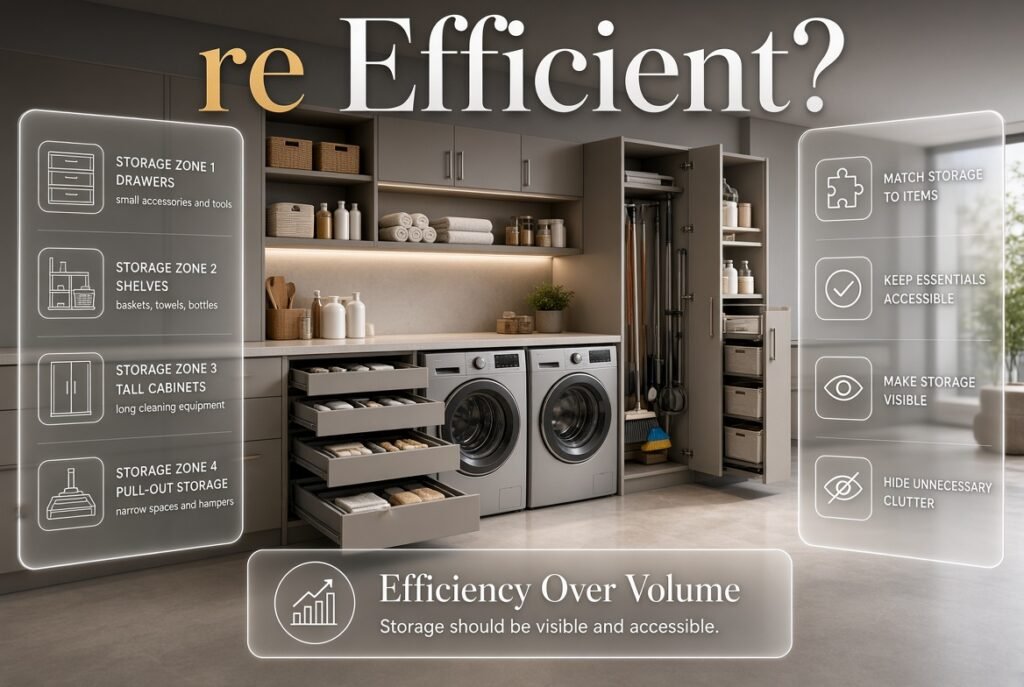
Efficiency is usually more important than storage volume.
A huge cabinet isn’t automatically useful if items disappear into the back.
Use the storage method that matches the item.
Drawers
Good for:
- Small laundry accessories
- Stain-treatment tools
- Cleaning cloths
- Ironing accessories
Shelves
Good for:
- Baskets
- Towels
- Bottles
- Containers
Tall Cabinets
Good for:
- Brooms
- Mops
- Vacuum attachments
- Long cleaning tools
Pull-Out Storage
Good for:
- Narrow spaces
- Hampers
- Frequently used bottles
The goal is to make storage visible and accessible without exposing unnecessary clutter.
How Should You Organize a Laundry Room for a Large Family?
Large households generate more laundry volume, which means the room needs better sorting and temporary storage.
Consider:
- Multiple hamper sections
- Larger folding space
- Separate hanging areas
- Clearly labeled baskets
- Dedicated clean-laundry zones
- Additional detergent storage
- A utility sink if space permits
One useful strategy is to separate unfinished laundry from finished laundry.
For example, a basket waiting to be folded should never be mixed with clean clothing that is already sorted for family members.
This small distinction can prevent repeated handling.
How Can You Prevent Laundry Clutter?
Clutter usually comes from two problems: insufficient storage and undefined storage.
If a product doesn’t have a home, it ends up on the counter.
If a basket doesn’t have a place, it ends up on the floor.
If clothes don’t have a clear destination, they remain in piles.
The solution isn’t always more cabinets.
Sometimes the better solution is a more precise system.
Create homes for:
- Dirty clothes
- Clean clothes
- Items waiting to be folded
- Items waiting to be hung
- Detergent
- Cleaning supplies
- Ironing equipment
- Spare supplies
Then maintain the system.
⭐ Expert Tip: The best organization system is one that requires almost no thought. If putting an item away takes several steps, people are more likely to leave it on the counter.
What Are the Most Common Laundry Room Design Mistakes?
Designing Only for the Current Appliances
Appliances eventually need replacement.
A layout that fits today’s washer and dryer perfectly may become difficult when the next models have slightly different dimensions.
Better approach: Allow practical flexibility.
Using Every Inch of Wall Space
More storage isn’t always better.
A room packed with cabinets can feel narrow and make routine maintenance difficult.
Better approach: Leave breathing room where it improves movement.
Forgetting Door Swings
A cabinet may technically fit but become unusable when an appliance door opens.
Better approach: Draw appliance doors on the floor plan before finalizing cabinetry.
Ignoring the Folding Process
Many laundry rooms focus entirely on washing and drying.
The problem appears afterward.
Better approach: Give clean laundry somewhere to go.
Putting Frequently Used Items Too High
Daily detergent should not require reaching into the highest cabinet.
Better approach: Reserve convenient storage for daily products.
Choosing Style Over Durability
A delicate surface may look beautiful but become difficult to maintain.
Better approach: Choose materials based on actual use.
Forgetting Ventilation
A beautifully finished room can still develop moisture problems if ventilation isn’t properly addressed.
Better approach: Plan ventilation before finishes.
Allowing the Laundry Room to Become General Storage
Because laundry rooms often contain cabinets, they can become convenient places to hide unrelated clutter.
Better approach: Define what belongs in the room before adding storage.
What Should You Avoid in a Small Laundry Room?
In a small space, avoid anything that consumes valuable floor area without providing frequent value.
Be cautious with:
- Oversized sinks
- Deep cabinets
- Large decorative furniture
- Too many open shelves
- Bulky ironing boards
- Excessive accessories
- Unnecessary seating
- Multiple freestanding carts
Instead, favor:
- Wall-mounted solutions
- Fold-down features
- Stacked appliances
- Slim cabinets
- Pull-out storage
- Retractable racks
- Multi-purpose surfaces
Small rooms reward precision.
How Do You Make a Laundry Room Easier to Clean?
Choose materials and storage systems that reduce dirt traps.
Useful choices include:
- Easy-clean flooring
- Smooth countertops
- Wipeable cabinet surfaces
- Minimal exposed clutter
- Closed storage
- Accessible appliance areas
- Properly sealed surfaces where appropriate
Avoid creating narrow gaps where lint and dust collect but can’t be reached easily.
This is one reason professional planning should consider maintenance from the beginning.
A room isn’t truly functional if cleaning it becomes a weekly frustration.
How Do You Plan a Laundry Room Renovation on a Budget?
You don’t need to renovate everything at once.
Prioritize improvements according to their impact.
High-Impact Improvements
- Better appliance placement
- Improved storage
- Folding counter
- Better lighting
- Improved ventilation
- Drying rack
- Organized hampers
Medium-Impact Improvements
- Cabinet hardware
- Backsplash
- Paint
- Shelving
- Countertop upgrade
Decorative Improvements
- Artwork
- Baskets
- Plants
- Accessories
If your existing appliances are still appropriate and functioning well, there’s often no reason to replace them simply to achieve a new look.
Instead, design the surrounding environment more intelligently.
For practical renovation projects, DIY Home Projects can provide additional inspiration, although electrical, plumbing, gas, ventilation, and other regulated work should be handled according to applicable requirements and by qualified professionals where necessary.
How Can You Make the Laundry Room Feel Less Like a Utility Space?
A laundry room can feel comfortable without losing its practical character.
Use a small number of intentional details.
For example:
- Warm cabinet colors
- Natural wood accents
- Soft lighting
- Coordinated baskets
- A patterned backsplash
- Attractive hardware
- A simple piece of wall art
You can also soften hard surfaces with texture.
Woven baskets, wood accents, and fabric elements can make the room feel less clinical.
The trick is restraint.
Too much decoration becomes another cleaning task.
How Can You Coordinate the Laundry Room With the Living Room?
If the laundry room is close to a living area, use a shared color or material rather than attempting to copy the living room.
For example, a warm neutral from the living room could become the laundry cabinetry color.
A wood tone from nearby furniture could appear on a shelf.
This approach creates a visual relationship without making the utility space look like a living room.
For ideas on creating a coordinated residential interior, Living Room Design can help when choosing colors, materials, and visual transitions.
Can Bathroom Design Ideas Influence a Laundry Room?
Yes, particularly when both rooms need to handle moisture and frequent cleaning.
You can borrow practical ideas such as:
- Easy-clean surfaces
- Moisture-conscious materials
- Good task lighting
- Simple storage
- Durable flooring
- Effective ventilation
However, the two rooms still have different functions.
A laundry room needs appliance access, folding space, and clothing-related storage, while a bathroom prioritizes personal hygiene and fixtures.
For moisture-conscious finish ideas, Bathroom Design can offer useful inspiration without requiring you to copy a bathroom layout.
Can a Laundry Room Be Attractive Without Being Trendy?
Absolutely.
In fact, avoiding short-lived trends can make a laundry room more practical over time.
Choose timeless foundations:
- Simple cabinet shapes
- Durable countertops
- Neutral or adaptable colors
- Quality lighting
- Practical hardware
- Easy-clean flooring
Then introduce personality through elements that are easy to change.
For example, baskets, artwork, wall color, and small accessories can evolve without requiring a complete renovation.
What is the best layout for a functional laundry room?
The best laundry room layout is the one that supports a natural workflow: sort → wash → dry → fold → hang. Instead of placing the washer and dryer wherever the plumbing happens to be, plan the room around how you actually use it. Side-by-side machines work particularly well when you have enough width for a continuous countertop above them, while stacked units are more practical when floor space is limited.
A well-planned laundry room should also leave enough comfortable movement around the machines. If possible, include a folding surface, laundry basket storage, and a hanging or drying area close to the appliances. This reduces unnecessary movement and keeps clean clothes from ending up on the floor or being carried to another room just to be folded.
Important design points:
Arrange the room according to the actual laundry workflow.
Use side-by-side machines when folding-counter space is a priority.
Choose stacked washer and dryer units for narrow rooms or laundry closets.
Keep frequently used supplies within easy reach.
Plan storage and drying areas before finalizing cabinetry.
How can you maximize storage in a small laundry room?
In a small laundry room, the smartest approach is to use vertical space rather than filling the floor with cabinets and baskets. Tall cabinets, wall-mounted storage, pull-out drawers, and concealed compartments can provide substantial storage without making the room feel crowded. Current small-space laundry designs increasingly focus on making every inch serve a specific purpose.
Storage should also be divided according to what you actually keep in the room. Detergent, stain removers, cleaning products, towels, ironing equipment, laundry baskets, and spare supplies do not necessarily need the same type of storage. Closed cabinets are particularly useful for hiding visual clutter, while a small amount of open shelving can keep everyday items accessible.
Smart storage ideas:
Install floor-to-ceiling cabinets where the layout allows.
Use pull-out hampers for sorting clothes.
Add narrow vertical cabinets beside stacked machines.
Consider retractable drying racks instead of permanent floor racks.
Keep less frequently used supplies in higher cabinets.
Use closed storage when you want a cleaner, more organized appearance.
What features should every modern laundry room have?
A modern laundry room should combine practicality, organization, durability, and convenience rather than simply looking attractive. One of the most useful upgrades is a dedicated folding counter, particularly over front-loading machines. A utility sink can also be valuable for soaking clothes, treating stains, hand-washing delicate items, and cleaning household equipment.
Drying and hanging space is another feature that is often overlooked. A wall-mounted rod, pull-out drying rack, or retractable system can make the room considerably more useful without consuming permanent floor space. In 2026, flexible laundry spaces are also becoming more popular, with some designs combining laundry functions with mudrooms, pet-care areas, or household organization zones.
High-value features to consider:
A durable folding countertop
Deep utility sink
Hanging rod for clothes
Pull-out or retractable drying rack
Dedicated laundry-sorting area
Closed cabinetry for detergents and supplies
Good task lighting over work areas
Durable, moisture-resistant flooring and surfaces
What flooring and materials are best for a laundry room?
Laundry rooms need materials that can tolerate water, humidity, detergent spills, frequent cleaning, and everyday wear. This makes material selection more important than choosing finishes purely for appearance. Porcelain or other suitable water-resistant tile flooring is a practical choice, while durable countertop materials such as quartz or solid surfaces can provide an easy-to-clean work area.
The goal is not to make the room look overly industrial. Modern laundry room design increasingly combines durable materials with warmer colors, natural textures, and finishes that visually connect the laundry area with the rest of the home. Designers are also moving toward warmer, more character-rich palettes rather than relying exclusively on cold gray or stark white schemes.
Material choices worth considering:
Porcelain tile: durable and suitable for areas exposed to moisture.
Quartz or solid-surface countertops: practical for folding and sorting.
Moisture-resistant paint: helps maintain the finish in a humid environment.
Durable cabinetry: important because laundry rooms experience frequent daily use.
Slip-conscious flooring: especially valuable around sinks and appliances.
What are the biggest laundry room design trends in 2026?
The biggest trend is the transformation of the laundry room from a purely utilitarian space into a purpose-designed part of the home. Current 2026 designs emphasize concealed appliances, flexible work zones, smarter storage, warmer finishes, and multifunctional layouts.
One particularly useful trend is hidden laundry, where appliances are integrated behind cabinetry or doors so the room can maintain a cleaner architectural appearance. Another is multifunctional design: a laundry room may also function as a mudroom, pet-washing area, household command center, or additional storage zone. Houzz’s 2026 popular laundry-room projects also show strong interest in accessible drying systems, decorative backsplashes, patterned flooring, and spaces designed around specific household needs.
Trending ideas for 2026:
Concealed washer and dryer cabinetry
Warm, natural and neutral color palettes
Built-in folding and sorting stations
Retractable or pull-out drying systems
Laundry + mudroom combinations
Laundry + pet-care zones
Decorative backsplashes and patterned flooring
More intentional lighting and cabinetry
Space-efficient stacked appliances
Professional takeaway: The strongest laundry room designs are not simply the most beautiful ones. They are the spaces where layout, storage, appliance placement, materials, and daily workflow work together. That is what makes a laundry room feel genuinely well-designed rather than merely decorated.
Conclusion
A successful laundry room design should make everyday household tasks easier while maintaining a clean, organized, and attractive appearance. The most effective designs begin with a practical layout and then build around the homeowner’s real needs, whether that means adding more storage, creating a dedicated folding station, incorporating a utility sink, or making better use of a compact space.
Modern laundry rooms are also moving beyond basic utility areas. Thoughtful cabinetry, durable materials, efficient lighting, flexible drying solutions, and multifunctional zones can turn an ordinary laundry room into a highly useful part of the home. The key is to prioritize function first, storage second, and aesthetics in a way that supports both.
Ultimately, the best laundry room is not necessarily the largest or most expensive one. It is the space where every element has a purpose, the workflow feels effortless, and daily laundry becomes more organized and manageable.
Leave a Reply