
Introduction
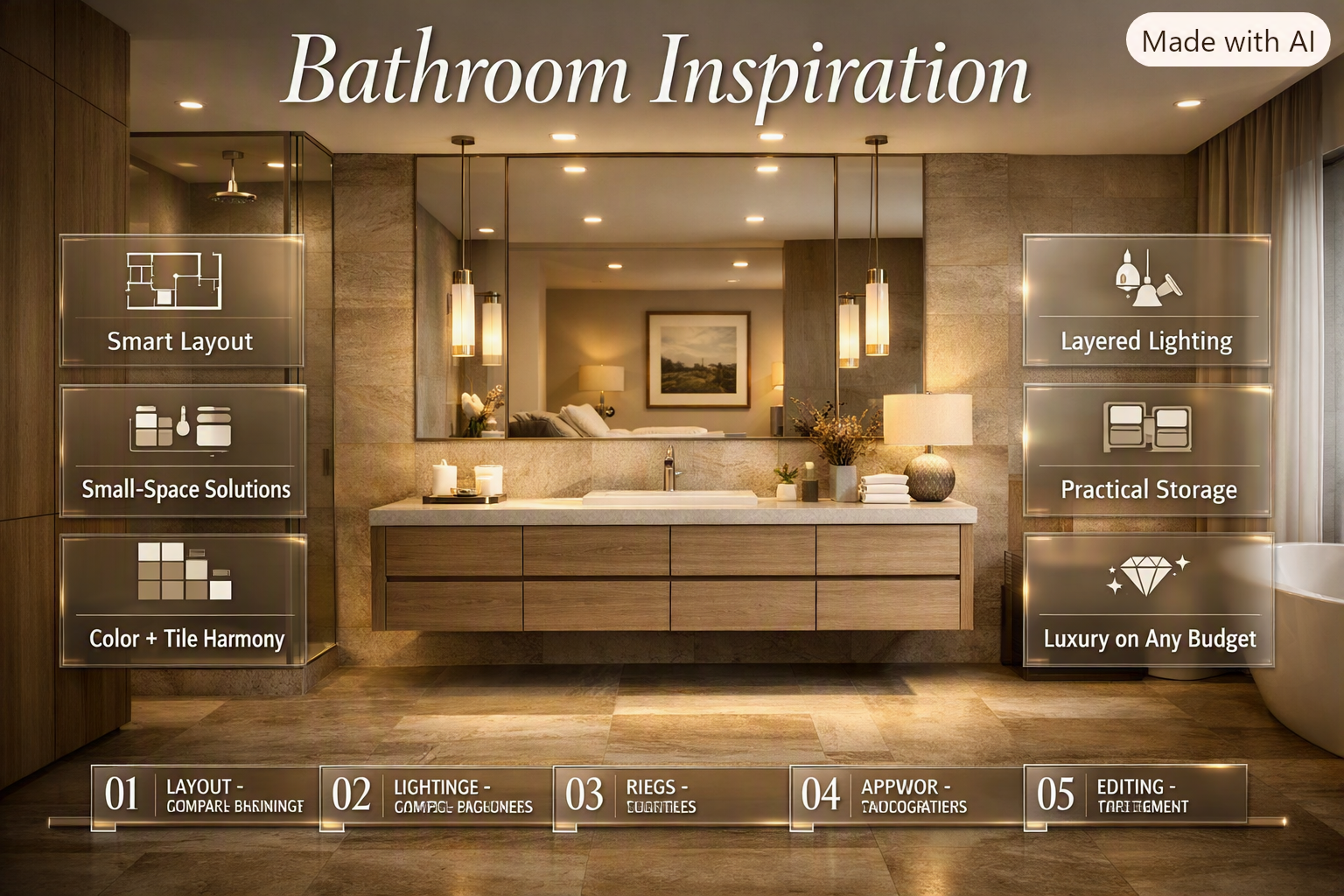
Bathroom Inspiration | A bathroom can have beautiful tiles, expensive fixtures, and stylish accessories and still feel completely wrong. The vanity may be too large for the room, the lighting may create harsh shadows, or there may simply be nowhere to put the products you use every day. On the other hand, even a modest bathroom can feel polished and comfortable when the layout, colors, materials, lighting, and storage work together.
That is what makes good Bathroom Inspiration so valuable. It isn’t about copying a picture from Pinterest or choosing whatever bathroom style happens to be trending. It’s about finding practical ideas that fit your space, lifestyle, budget, and the overall character of your home.
If you’re planning a renovation, decorating a new bathroom, or simply trying to make an existing space look better, this guide will help you make smarter decisions. You’ll find modern bathroom ideas, small bathroom solutions, color schemes, tile inspiration, lighting advice, storage ideas, luxury touches, budget-friendly upgrades, common mistakes, and practical planning advice.
For a broader look at how individual rooms can work together, explore DesignMode24 Interior Design. A bathroom shouldn’t feel like a completely separate world from the rest of your home; the strongest interiors usually have a subtle visual connection from room to room.
What Does Good Bathroom Inspiration Really Mean?
Good bathroom inspiration gives you more than attractive photographs. It helps you understand how a successful bathroom uses space, color, lighting, materials, storage, fixtures, and decoration to create a room that is both beautiful and practical.
A design can look impressive in a photograph but fail in everyday life. A tiny vanity may look elegant but offer almost no storage. A freestanding bathtub may look luxurious but leave too little room to walk around. Dark tiles can create a dramatic atmosphere but make a poorly lit bathroom feel smaller.
Before saving an inspiration image, ask yourself why you like it.
Is it the color palette?
The lighting?
The vanity?
The tile pattern?
The clean layout?
The natural materials?
The overall atmosphere?
Once you identify the specific feature you like, you can adapt the idea instead of trying to reproduce the entire room.
Why Does Bathroom Inspiration Matter Before Shopping?
Bathroom renovations involve many permanent decisions. Tiles, flooring, sanitaryware, plumbing fixtures, cabinetry, and lighting aren’t things you want to replace every few months.
A clear design direction helps you avoid buying individual products that look attractive separately but clash when they’re placed together.
For example, you might love a black faucet, a brass mirror, a heavily patterned floor, and a colorful vanity individually. Put all four into one small bathroom and the result could become visually overwhelming.
Good inspiration helps you edit.
Featured answer: The best bathroom inspiration combines visual appeal with practical planning. It should help you decide on a layout, color palette, materials, lighting, storage, and style before you spend money. The goal isn’t to copy another bathroom; it’s to understand the design decisions that make a bathroom comfortable and cohesive.
💡 Pro Tip: Save inspiration according to categories instead of creating one huge collection. Keep separate ideas for tiles, vanities, lighting, mirrors, storage, colors, and accessories. This makes your final design much easier to organize.
How Do You Choose the Right Bathroom Style?
The easiest way to choose a bathroom style is to start with the feeling you want the room to create. Once you know that, select materials, fixtures, colors, and accessories that support the same direction.
You don’t need to choose a strict design label. A bathroom can combine modern and traditional elements, or Scandinavian simplicity with warm natural materials.
The most important thing is consistency.
Modern Bathroom Inspiration
Modern bathrooms usually emphasize clean lines, simple forms, uncluttered surfaces, and a controlled material palette.
A modern bathroom might include a floating vanity, frameless shower glass, large-format tiles, a simple mirror, concealed storage, and minimal hardware.
Popular modern combinations include:
- White with natural wood
- Warm beige with brushed brass
- Soft gray with black hardware
- Cream with stone textures
- Charcoal with warm timber tones
The secret is not adding as many modern features as possible. It is choosing a few strong features and allowing them to breathe.
A wall-mounted vanity, for example, can create a cleaner visual line while also making floor cleaning easier.
Minimalist Bathroom Inspiration
Minimalism is especially useful when you want a bathroom to feel calm and organized.
A minimalist design may use one primary tile, simple cabinetry, concealed storage, and a limited color palette. Instead of decorating every surface, it relies on proportion and texture.
That doesn’t mean everything has to be white.
Warm beige, pale gray, muted green, soft blue, and natural wood can all work beautifully in minimalist spaces.
The biggest mistake is confusing minimalism with emptiness. A room without texture can feel cold. Introduce depth through natural materials, subtle tile variation, textiles, and warm lighting.
Spa-Inspired Bathroom Ideas
A spa-inspired bathroom focuses on relaxation rather than visual drama.
Natural textures, warm neutrals, soft lighting, greenery, stone finishes, wood tones, and uncluttered surfaces can create this atmosphere.
You don’t need a huge bathtub or expensive stone to achieve it.
Try this combination:
Warm neutral walls + natural wood + soft lighting + stone texture + organized storage
The result can feel relaxing without being excessively luxurious.
Scandinavian Bathroom Inspiration
Scandinavian-inspired bathrooms are useful for homeowners who prefer bright, practical interiors.
White and pale gray can be combined with light wood, simple fixtures, black accents, and soft textiles.
The design works because it balances functionality with warmth. Every item has a purpose, but the room doesn’t feel sterile.
Traditional Bathroom Inspiration
Traditional bathrooms rely on classic proportions, timeless colors, decorative details, and familiar materials.
White ceramic, classic tile shapes, framed mirrors, elegant lighting, and traditional cabinetry can create a bathroom that doesn’t depend heavily on current trends.
This can be a smart choice when you plan to keep the bathroom for many years.
Japandi Bathroom Inspiration
Japandi combines Japanese simplicity with Scandinavian warmth.
The style works particularly well in bathrooms because both influences favor natural materials, calm colors, uncluttered spaces, and functional design.
Think:
- Warm beige
- Soft gray
- Natural wood
- Stone textures
- Simple silhouettes
- Soft lighting
- Minimal decoration
The result is quiet rather than flashy.
For homeowners interested in applying similar principles across other areas, the broader Home Design Ideas can provide useful direction.
What Are the Best Small Bathroom Ideas?
Small bathrooms require careful editing. The goal isn’t to squeeze as many features as possible into the room. It’s to make every element earn its place.
Featured answer: The best small bathroom ideas focus on preserving floor space, reducing visual clutter, improving storage, and maximizing light. Floating vanities, large mirrors, clear glass shower screens, wall-mounted fixtures, recessed niches, light colors, and vertical storage can make a compact bathroom feel more open without sacrificing functionality.
1. Use a Floating Vanity
A floating vanity leaves visible floor underneath, which can make the room appear more spacious.
It also simplifies cleaning because you can access the floor beneath the cabinet.
If storage is important, choose drawers rather than a purely decorative basin unit.
2. Install a Large Mirror
A mirror can visually double the amount of reflected light in a room.
In a small bathroom, don’t automatically choose a small mirror. A wider mirror can create a stronger sense of openness and make the vanity wall feel more substantial.
3. Use Clear Shower Glass
Heavy frames and opaque shower curtains create visual boundaries.
Clear glass allows the eye to travel through the shower area, helping the bathroom feel like one continuous space.
4. Use Vertical Space
When floor space is limited, look upward.
Useful vertical storage includes:
- Tall cabinets
- Narrow shelving
- Wall-mounted medicine cabinets
- Recessed niches
- Towel hooks
- Over-door storage
5. Continue the Same Flooring
Using one continuous floor material throughout the room can reduce visual interruptions.
Large-format flooring can create an especially clean effect because there are fewer grout lines.
6. Keep the Color Palette Controlled
You don’t have to make a small bathroom completely white. However, too many contrasting colors can visually break up the room.
A simple palette of two or three closely related colors usually works better.
📌 Quick Tip: If your bathroom is very small, prioritize visual continuity over decoration. One excellent mirror, a clean vanity, good lighting, and attractive tile can do more than ten small accessories.
How Can You Make a Large Bathroom Feel Cozy?
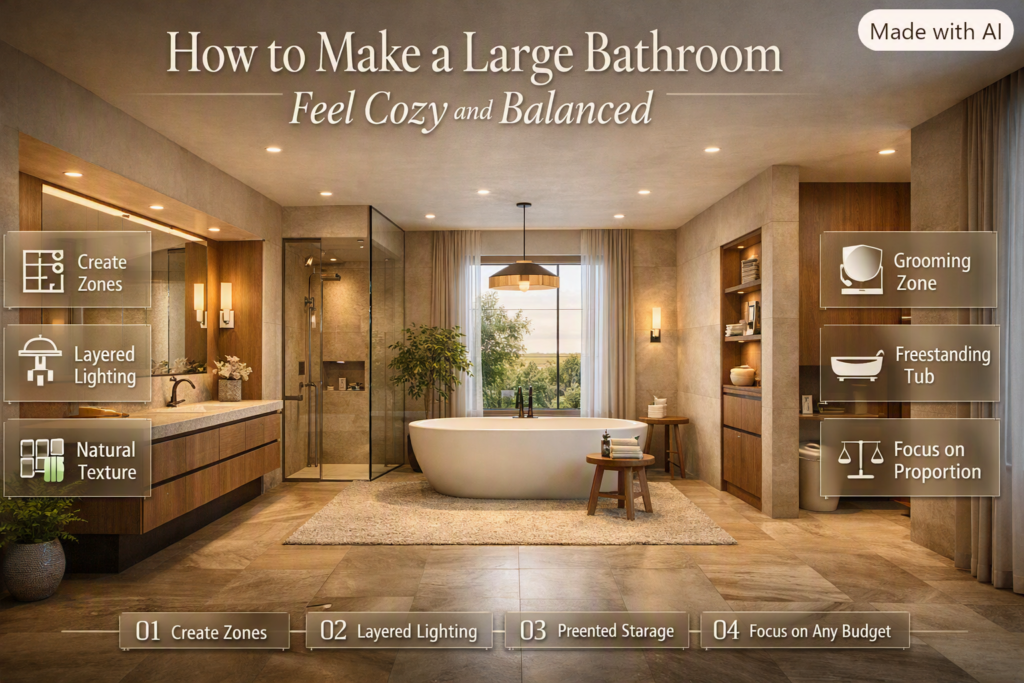
Large bathrooms need balance. When everything is pushed against the walls, the center can feel empty and the room may lose its sense of comfort.
Create zones instead.
You might have:
- A grooming zone around the vanity
- A shower zone
- A bathtub zone
- A toilet zone
- A storage zone
A freestanding bathtub can work well as a focal point when there is enough surrounding space.
A larger vanity can also provide both visual weight and useful storage.
Use Lighting to Define Zones
Large bathrooms offer more opportunities for layered lighting.
Use general ceiling lighting for overall visibility, task lighting around the mirror, and accent lighting around architectural features or niches.
This allows different parts of the room to have different visual roles.
Add Natural Texture
Large rooms can handle stronger materials.
Natural stone, wood finishes, textured tiles, woven accessories, and plants can prevent the space from feeling too clinical.
⭐ Expert Tip: Large bathrooms don’t need more furniture simply because they have more floor area. Focus on proportion. One large, well-designed vanity often looks better than several small storage units scattered around the room.
Which Bathroom Color Schemes Work Best?
Bathroom colors should respond to the room’s size, natural light, existing materials, and desired mood.
Light colors can make a room feel brighter, but warm neutrals are often better at creating comfort than pure white.
White and Natural Wood
This combination creates a clean but warm appearance.
White reflects light while wood introduces natural texture.
It works especially well in modern, Scandinavian, and minimalist bathrooms.
Beige and Cream
Beige has become a popular alternative to cool gray because it creates a softer atmosphere.
Cream walls with beige stone-look tiles and warm wood can produce a relaxed, timeless bathroom.
Gray and Black
Gray provides a neutral foundation while black creates contrast.
This combination works well in contemporary bathrooms, particularly when balanced with warm lighting.
Sage Green and White
Muted green tones can create a natural, calming atmosphere.
Pair them with white sanitaryware, light wood, or natural stone.
Navy and Brass
Navy can create a dramatic effect when used carefully.
Brass hardware adds warmth and prevents the room from feeling too cold.
Terracotta and Cream
For a warmer, Mediterranean-inspired atmosphere, terracotta can be paired with cream, beige, or natural wood.
The key is controlling saturation. Very strong colors can become tiring when used over large permanent surfaces.
If you’re considering a broader home color strategy, the Paint Color section can help you think about color relationships beyond the bathroom.
How Do You Choose Bathroom Tiles?
Tiles should be chosen based on appearance, durability, moisture suitability, maintenance, scale, and the location where they’ll be installed.
Don’t select a tile simply because it looks beautiful in a showroom.
Ask where it will be used and how the surface will behave in real life.
Large-Format Tiles
Large tiles create fewer grout lines and can make surfaces look more continuous.
They’re particularly effective in modern bathrooms.
However, large tiles require accurate installation because uneven walls or floors become more noticeable.
Subway Tiles
Subway tiles are flexible and timeless.
Their final appearance depends heavily on:
- Grout color
- Tile orientation
- Tile finish
- Surrounding fixtures
- Lighting
A white subway tile with dark grout can feel graphic and contemporary, while white tile with matching grout can appear softer.
Patterned Floor Tiles
Patterned tiles can add personality without covering the entire room in visual detail.
They’re particularly effective on bathroom floors when walls and major fixtures remain relatively simple.
Stone-Look Tiles
Stone-look porcelain and ceramic tiles can provide the appearance of natural stone while offering practical maintenance advantages.
They can work well in contemporary, transitional, and spa-inspired bathrooms.
⚠ Common Mistake: Choosing a highly detailed wall tile, patterned floor, decorative vanity, bold hardware, and statement lighting all at once. Each feature may look good independently, but together they can compete for attention.
What Type of Bathroom Flooring Is Best?
Bathroom flooring should be selected for moisture resistance, durability, maintenance, appearance, and appropriate traction.
The floor is one of the surfaces that receives the most daily wear, so it deserves more attention than purely decorative elements.
Consider:
- Porcelain tile
- Ceramic tile
- Natural stone where appropriate
- Other bathroom-suitable flooring systems
Don’t choose flooring based only on color.
Think about grout maintenance, cleaning, wet conditions, and how the surface feels underfoot.
For wider home improvement planning and renovation ideas, see Home Improvement.
How Important Is Bathroom Lighting?
Bathroom lighting is critical because the room serves different purposes throughout the day.
You need enough light for cleaning and movement, but you also need good illumination around the mirror for grooming.
Featured answer: The best bathroom lighting combines ambient, task, and accent lighting. Ceiling fixtures provide general illumination, while wall sconces or properly designed mirror lighting improve visibility around the face. Accent lighting can add atmosphere around niches, architectural features, or decorative areas.
Ambient Lighting
Ambient lighting provides general illumination.
Recessed ceiling lights, suitable ceiling fixtures, or other appropriately installed fixtures can serve this role.
Task Lighting
Task lighting is especially important at the vanity.
The objective is even illumination rather than dramatic shadows.
Lighting from the sides of a mirror can often produce better facial illumination than a single fixture positioned directly overhead.
Accent Lighting
Accent lighting can emphasize:
- Shower niches
- Wall textures
- Artwork
- Architectural details
- Freestanding tubs
The goal isn’t to illuminate every corner equally. It’s to create a useful and comfortable lighting hierarchy.
What Bathroom Storage Ideas Actually Work?
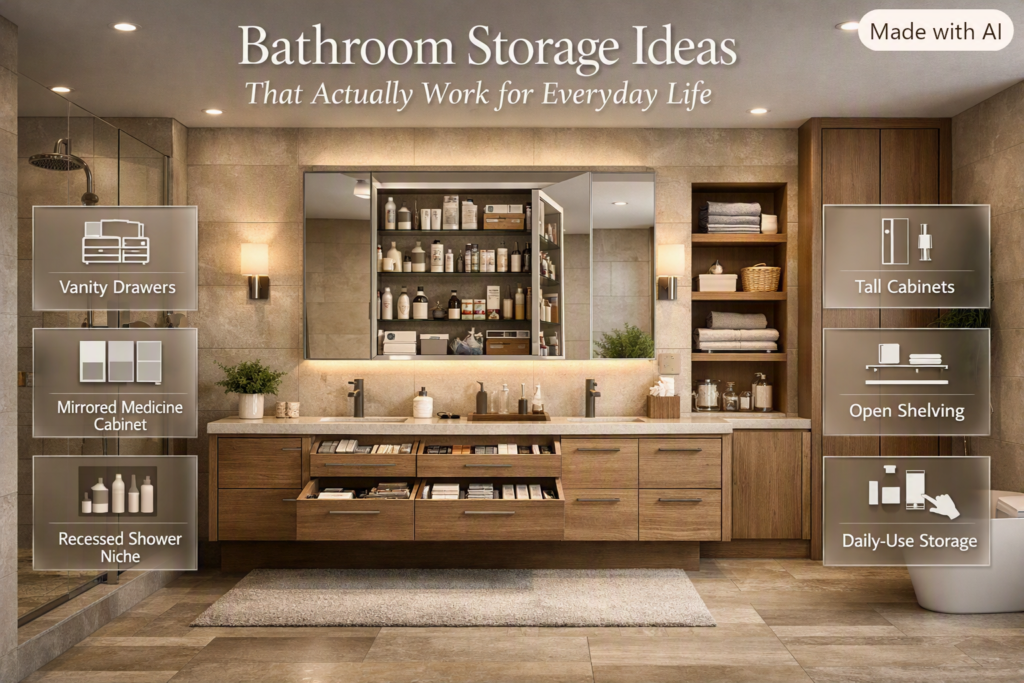
Bathroom storage needs to reflect real life.
Think about what you use every morning, not what looks good in a staged photograph.
A family bathroom may need space for towels, toiletries, cleaning products, toilet paper, hair tools, children’s products, and personal-care items.
Vanity Drawers
Drawers are often easier to organize than deep cabinets.
You can separate products by category and access them without moving everything in front.
Mirrored Medicine Cabinets
A mirrored cabinet can combine two functions: reflection and storage.
This is especially useful in small bathrooms.
Recessed Shower Niches
A shower niche keeps bottles organized and prevents them from sitting on the floor.
It should be planned during construction or renovation rather than treated as a last-minute decoration.
Tall Cabinets
Tall units take advantage of vertical space and can provide significant storage without consuming a large floor footprint.
Open Shelving
Open shelves can look attractive, but they work best when used selectively.
Store towels, baskets, and a few decorative items rather than every bottle you own.
📌 Quick Tip: Keep daily-use products between waist and eye level. Less frequently used items can occupy higher shelves or deeper storage.
How Do You Make a Bathroom Look More Luxurious?
Luxury doesn’t always come from expensive materials. It often comes from visual discipline.
A bathroom feels more refined when the fixtures, materials, colors, lighting, and accessories appear to have been selected together.
Use Fewer but Better Details
Instead of covering the room with decorative objects, choose a few strong details.
For example:
- One beautiful mirror
- One coordinated hardware finish
- Quality-looking lighting
- A substantial vanity
- High-quality towels
- One natural decorative element
Hide Visual Clutter
Open bottles, cleaning products, spare toilet paper, and miscellaneous items can quickly make an otherwise expensive bathroom look unfinished.
Closed storage has a surprisingly strong effect on perceived quality.
Coordinate Finishes
You don’t necessarily need every metal to be identical, but the combination should feel deliberate.
If you choose brushed brass for the faucet, consider repeating the finish through lighting, cabinet hardware, or another small detail.
This creates visual rhythm.
For related styling principles that can be applied throughout the home, explore Home Styling.
How Can You Make a Bathroom Feel Warmer?
Bathrooms naturally contain hard surfaces: tile, glass, porcelain, stone, and metal.
Without softer elements, they can feel cold.
Warmth can be added through:
- Natural wood
- Warm beige
- Cream textiles
- Woven baskets
- Warm lighting
- Plants
- Natural stone textures
- Soft towels
- Textured accessories
You don’t need to redesign the entire bathroom.
Replacing cool white lighting with a more comfortable warm-neutral lighting approach, adding a wood-toned vanity, and introducing textiles can significantly change the atmosphere.
How Do You Create a Cohesive Bathroom?
A cohesive bathroom doesn’t require everything to match. Instead, different elements should share visual relationships.
For example, a bathroom might use:
Beige tile + natural wood + brushed brass + cream textiles
The elements are different, but they belong to the same visual family.
Another bathroom might use:
Soft gray + black hardware + white fixtures + charcoal accessories
Again, the room feels coordinated without being repetitive.
Repeat Materials Carefully
If wood appears on the vanity, you can repeat warmth through a small shelf or accessory.
If brass appears on the faucet, it can be echoed in the mirror frame or lighting.
Repetition creates cohesion.
Don’t Match Everything
A bathroom where every object has exactly the same finish can feel overly staged.
A little variation creates character.
The goal is coordination rather than duplication.
How Do You Choose the Right Bathroom Vanity?
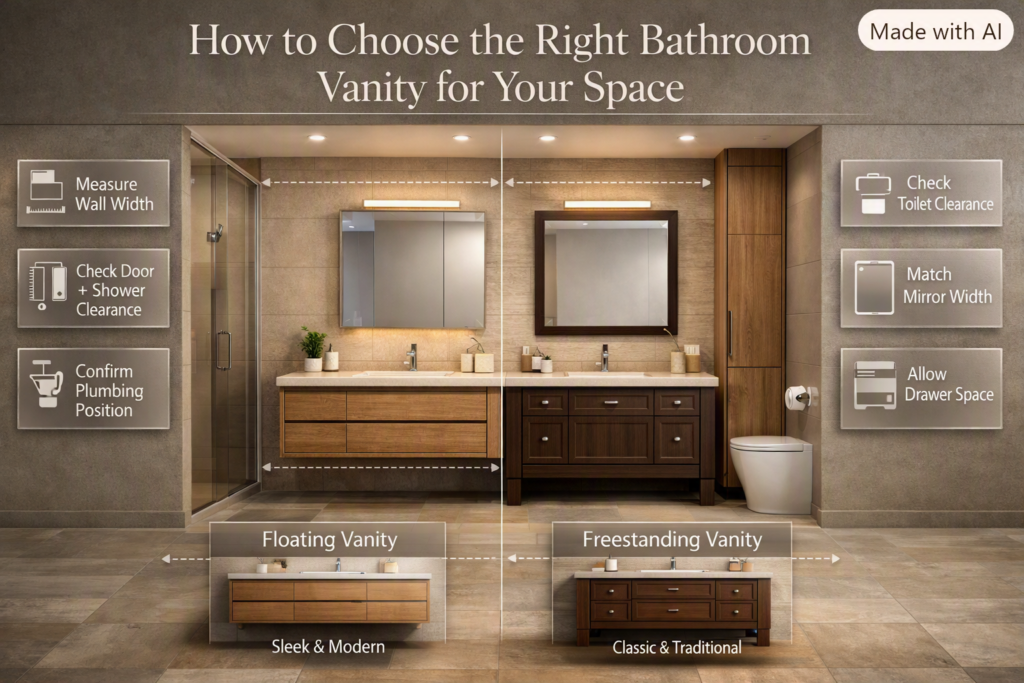
The vanity should be selected according to the room’s dimensions, storage requirements, sink configuration, plumbing, and visual style.
Before buying one, measure:
- Available wall width
- Door swing
- Shower clearance
- Toilet clearance
- Plumbing position
- Mirror width
- Drawer opening space
A vanity that technically fits may still be too large for comfortable movement.
Floating vs Freestanding Vanity
| Feature | Floating Vanity | Freestanding Vanity |
|---|---|---|
| Visual effect | Light and modern | Traditional and substantial |
| Floor visibility | Higher | Lower |
| Cleaning | Easier underneath | More enclosed |
| Storage | Depends on design | Often generous |
| Best for | Modern/small rooms | Traditional/larger rooms |
Neither option is automatically better.
The right choice depends on your room and priorities.
How Should You Choose a Bathroom Mirror?
The mirror should relate to the vanity in width, proportion, shape, and style.
A rectangular mirror works naturally with a rectangular vanity, while a round mirror can soften a room dominated by straight lines.
Consider:
- Vanity width
- Ceiling height
- Lighting position
- Cabinet storage
- Frame material
- Overall style
A mirror is not just a functional object. It can become one of the bathroom’s strongest visual features.
What Are the Best Bathroom Ideas on a Limited Budget?
You don’t need to renovate every surface to refresh a bathroom.
Start with the changes that have the greatest visual impact.
Budget-Friendly Improvements
1. Replace old lighting
Lighting can dramatically change how tiles and colors appear.
2. Upgrade the mirror
A better-proportioned mirror can make the vanity wall feel completely different.
3. Change hardware
Cabinet pulls, towel bars, and other small details can refresh an outdated room.
4. Add textiles
New towels and a suitable bath mat can introduce color and softness.
5. Improve organization
Removing visible clutter is one of the cheapest ways to make a bathroom look more polished.
6. Repaint suitable surfaces
A carefully chosen wall color can alter the room’s atmosphere without replacing permanent finishes.
7. Add greenery
A suitable plant can bring natural texture into an otherwise hard-surfaced room.
For homeowners who enjoy hands-on updates, DIY Home Projects can be useful when deciding which improvements are suitable for a DIY approach.
What Should You Spend More Money On?
Spend carefully on elements that are difficult to replace, frequently used, or responsible for long-term performance.
Worth Prioritizing
- Waterproofing
- Plumbing quality
- Ventilation
- Durable flooring
- Quality installation
- Functional vanity construction
- Appropriate lighting
- Reliable fixtures
Easier Places to Save
- Decorative accessories
- Seasonal textiles
- Small artwork
- Baskets
- Trend-based objects
- Easily replaceable accents
This approach protects your renovation budget while still leaving room for personality.
How Do You Plan a Bathroom Renovation Step by Step?
A bathroom renovation becomes easier when decisions are made in the right order.
Step 1: Measure the Room
Record the dimensions of walls, doors, windows, and existing fixtures.
Why it matters: You can’t make reliable layout decisions without accurate measurements.
Professional advice: Draw the room on paper or use a simple digital floor plan.
Common mistake: Measuring only the wall width and forgetting door swings or clearance areas.
Step 2: Define Your Priorities
Decide what matters most.
Is it:
- More storage?
- A larger shower?
- Better lighting?
- A bathtub?
- Easier cleaning?
- A more modern appearance?
Why it matters: Every bathroom has space and budget limitations.
Step 3: Establish a Budget
Separate the budget into:
- Fixtures
- Materials
- Labor
- Lighting
- Storage
- Accessories
- Contingency
A contingency amount can help absorb unexpected construction issues.
Step 4: Finalize the Layout
Choose fixture positions before selecting decorative finishes.
Why it matters: Moving plumbing or changing layout later can be expensive.
Step 5: Choose Permanent Materials
Select flooring, wall tile, vanity, sanitaryware, and other difficult-to-replace elements.
Keep the long-term appearance in mind.
Step 6: Plan Lighting
Decide where ambient, task, and accent lighting will go.
Don’t leave lighting until the very end.
Step 7: Add Storage
Plan around actual household needs.
Step 8: Select Accessories Last
Towels, baskets, artwork, plants, and decorative items should complement the finished room.
⭐ Expert Tip: If you’re unsure about a design decision, postpone the replaceable item rather than rushing into it. It’s easier to live with a blank wall temporarily than to spend money on something you don’t actually like.
What Are the Most Common Bathroom Design Mistakes?
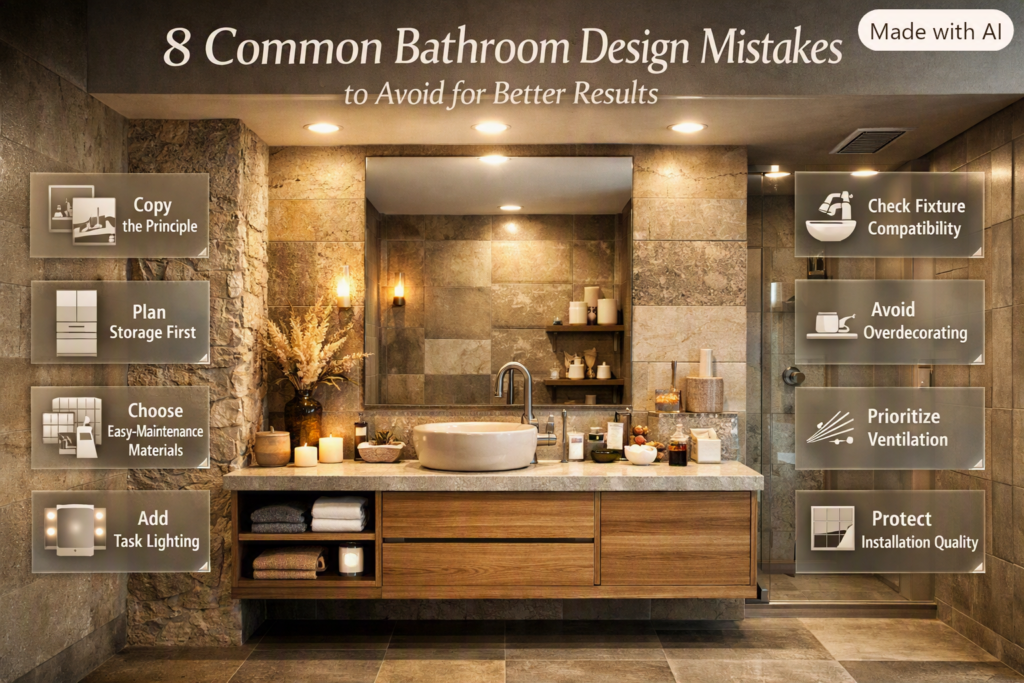
Even experienced homeowners can make bathroom decisions that look good initially but create problems later.
Mistake 1: Copying a Photograph Exactly
An inspiration image may show a bathroom with different dimensions, lighting, ceiling height, plumbing, and lifestyle requirements.
Why it happens: The image already looks finished.
Why it’s harmful: Your room may require completely different proportions.
Better approach: Copy the principle, not the room.
Mistake 2: Ignoring Storage
A beautiful bathroom becomes messy quickly without adequate storage.
Better approach: Design storage before decoration.
Mistake 3: Choosing Materials Without Considering Maintenance
Highly textured surfaces can collect dirt and require more cleaning.
Better approach: Consider your willingness to maintain the material before purchasing it.
Mistake 4: Using Only Overhead Lighting
This can create shadows and make grooming uncomfortable.
Better approach: Add task lighting around the mirror.
Mistake 5: Choosing Fixtures Based Only on Appearance
A stylish faucet isn’t useful if it performs poorly or doesn’t suit the sink.
Better approach: Consider compatibility, quality, maintenance, and practical use.
Mistake 6: Overdecorating
Bathrooms are already visually complex because of tiles, fixtures, mirrors, and storage.
Better approach: Leave some surfaces visually quiet.
Mistake 7: Forgetting Ventilation
Poor moisture management can cause long-term problems.
Better approach: Treat ventilation as part of the design rather than an afterthought.
Mistake 8: Underestimating Installation Quality
Even excellent materials can look poor when poorly installed.
Better approach: Prioritize accurate installation, waterproofing, alignment, sealing, and finishing.
How Can Your Bathroom Connect With the Rest of Your Home?
A bathroom doesn’t need to look identical to your living room or bedroom, but subtle connections can make the entire home feel more intentional.
For example, if your home uses warm wood and soft neutral colors, carrying those tones into the bathroom can create continuity.
If your home uses black accents, repeating black through bathroom hardware can establish a visual connection.
This doesn’t mean every room needs the same furniture or colors.
Instead, repeat selected characteristics.
Your Living Room Design ideas can use the same broader principles of proportion, texture, lighting, and color balance that apply to bathroom design.
Likewise, materials and color relationships used in the Kitchen Design can influence your bathroom palette without making the rooms look identical.
How Can You Create Better Bathroom Inspiration From Your Own Home?
The best starting point may already be inside your house.
Look at the materials and colors you already love.
Maybe your living room has warm oak furniture. Perhaps your kitchen uses matte black fixtures. Maybe your bedroom uses cream, beige, and muted green.
Instead of creating an unrelated bathroom, use one or two of these visual cues.
This approach is particularly useful when the bathroom is part of an open or visually connected home.
Build a Simple Mood Board
Collect:
- One main tile
- One floor material
- One vanity finish
- One hardware finish
- One mirror
- One lighting style
- One textile color
- One decorative material
Put them together before purchasing anything.
If they look harmonious as a group, you have a stronger starting point.
How Do You Make a Bathroom Feel More Personal?
A bathroom can be practical without feeling generic.
Personal character can come through:
- Artwork
- Vintage mirrors
- Unique lighting
- Handmade ceramics
- Plants
- Distinctive textiles
- Natural materials
- Favorite colors
You don’t need to make permanent elements unusual.
A timeless bathroom can become personal through details that are easy to change.
Use Accessories Strategically
A small ceramic container can add character.
A framed print can introduce personality.
A woven basket can add warmth.
A plant can bring life.
The important thing is not quantity.
One carefully selected object can have more impact than ten random accessories.
How Do You Balance Trends With Timeless Design?
Trends are useful because they introduce new materials, colors, shapes, and ideas. The problem begins when every permanent element is chosen according to a short-term trend.
A safer approach is:
Timeless foundation + current accents
For example:
Timeless:
Neutral tile + simple vanity + classic sanitaryware
Current:
Statement mirror + trendy towel color + contemporary lighting
If your preferences change later, the second category can be updated without rebuilding the room.
What Should You Consider Before Choosing Black Bathroom Fixtures?
Black fixtures create strong contrast and can look excellent in modern bathrooms.
However, they require thoughtful coordination.
Black can work especially well with:
- White tile
- Warm beige
- Natural wood
- Concrete-look surfaces
- Soft gray
- Green
- Cream
Too much black in a small, poorly lit room can make the bathroom feel heavier.
Also consider maintenance. Dark finishes can make certain deposits or marks more noticeable depending on the water and surface.
Is Brass Still a Good Bathroom Finish?
Warm metallic finishes can add sophistication and warmth.
Brass works particularly well with neutral tiles, natural wood, cream, beige, green, and darker colors.
The important decision is not whether brass is fashionable. It’s whether it supports your overall palette.
If you choose brass, repeat it intentionally rather than using one isolated brass fixture surrounded by unrelated metals.
How Do You Use Plants in Bathroom Design?
Plants can soften a bathroom’s hard surfaces and introduce a natural element.
However, the bathroom’s humidity, temperature, ventilation, and available light should be considered before choosing a plant.
If the room has limited natural light, don’t assume every plant will thrive there.
Use plants where they are practical rather than forcing greenery into every bathroom.
What Makes a Bathroom Look Cluttered?
Visual clutter usually comes from too many small objects, exposed products, conflicting colors, excessive open shelving, and poorly organized storage.
A simple test is to stand at the bathroom entrance and look across the room.
If your eyes immediately jump between many unrelated objects, the room probably needs editing.
Try removing half of the decorative items temporarily.
You may be surprised by how much better the room looks.
How Can You Improve an Existing Bathroom Without a Full Renovation?
A full renovation isn’t always necessary.
Start with the most visually important elements.
Quick Bathroom Refresh
First: Remove unnecessary clutter.
Second: Improve lighting.
Third: Replace or update the mirror.
Fourth: Introduce a coordinated towel color.
Fifth: Add one or two natural textures.
Sixth: Replace outdated accessories.
Seventh: Reorganize storage.
Eighth: Consider repainting suitable walls.
These changes can significantly improve the appearance without disturbing plumbing or replacing every finish.
What Should You Consider for a Family Bathroom?
A family bathroom needs more than attractive styling.
It should be easy to clean, easy to organize, and capable of handling multiple users.
Consider:
- Durable surfaces
- Generous storage
- Easy-to-clean flooring
- Towel hooks for each user
- Practical vanity storage
- Adequate lighting
- Accessible toiletries
- Good ventilation
A family bathroom may benefit from more closed storage than a guest bathroom because it typically contains many more products.
What Should You Consider for a Guest Bathroom?
A guest bathroom can prioritize simplicity and visual impact.
Guests don’t usually need extensive personal storage, so you can focus more heavily on:
- Attractive lighting
- A beautiful mirror
- Quality towels
- A simple vanity
- Coordinated accessories
- A pleasant scent
- Easy-to-understand fixtures
The design should feel welcoming rather than overly personal.
What Should You Consider for an Ensuite Bathroom?
An ensuite should work as an extension of the bedroom.
If the bedroom uses warm neutrals and natural wood, carrying those elements into the ensuite can create a more connected experience.
Because ensuites are often compact, storage and circulation deserve particular attention.
A floating vanity, clear glass shower, large mirror, and efficient storage can be particularly effective.
How Can You Keep a Bathroom Looking Good Over Time?
A bathroom stays attractive when it is easy to maintain.
That means choosing materials you can realistically clean, providing enough storage, controlling moisture, and avoiding decorative decisions that create unnecessary work.
Create simple routines:
- Dry wet surfaces when necessary.
- Keep products organized.
- Clean grout regularly.
- Check seals periodically.
- Keep ventilation effective.
- Remove unnecessary clutter.
- Replace worn textiles.
Good design isn’t only about the first day after installation. It should make everyday maintenance easier.
What Bathroom Inspiration Ideas Are Worth Copying?
The best ideas to borrow are usually principles rather than exact products.
Worth Copying
- Layered lighting
- Floating storage
- Large mirrors
- Cohesive color palettes
- Clear shower screens
- Recessed niches
- Natural textures
- Concealed clutter
- Consistent hardware
- Strong focal points
Think Twice Before Copying
- Extremely unusual layouts
- Trend-heavy permanent colors
- Oversized fixtures
- High-maintenance surfaces
- Decorative features with little practical value
- Designs that require constant styling
A photograph captures a moment.
Your bathroom has to support years of everyday use.
Bathroom Inspiration Decision Table
| If Your Main Problem Is… | Consider… |
| Bathroom feels too small | Large mirror, clear glass, visual continuity |
| Bathroom feels cold | Warm lighting, wood, beige, textiles |
| Bathroom looks cluttered | Closed storage, fewer accessories |
| Bathroom feels outdated | New mirror, lighting, hardware, paint |
| Not enough storage | Tall cabinets, vanity drawers, recessed niches |
| Poor grooming visibility | Layered mirror lighting |
| Large room feels empty | Functional zones and focal points |
| Design feels disconnected | Repeat colors, materials, or finishes |
| Renovation budget is limited | Prioritize lighting, storage, mirror, and accessories |
| Bathroom feels too trendy | Simplify permanent finishes |
Expert Bathroom Design Advice
Professional-looking bathrooms usually come from good decisions made in the correct order.
Don’t begin by choosing accessories.
Begin with the structure.
Layout → plumbing → storage → permanent materials → lighting → fixtures → decoration
This order reduces mistakes because each decision influences the next.
A professional also considers the bathroom at different times of day.
Morning sunlight can make colors appear different from evening artificial lighting. A tile that looks warm in a showroom may appear cooler at home.
That’s why samples should be viewed in the actual room whenever possible.
⭐ Expert Tip: Never judge a bathroom finish under showroom lighting alone. Place a sample near the window, under the planned artificial lighting, and beside the other materials you intend to use. Color relationships become much clearer when everything is viewed together.
Bathroom Inspiration for Different Budgets
Your budget determines how much you can change, but it doesn’t determine whether the bathroom can look good.
Lower Budget
Focus on:
- Decluttering
- Paint
- Lighting
- Mirror
- Towels
- Accessories
- Storage organization
Medium Budget
Consider:
- Vanity replacement
- New hardware
- Improved lighting
- Better mirror
- Selected tile updates
- Storage upgrades
Higher Budget
Consider:
- Complete layout changes
- New plumbing
- Custom cabinetry
- Premium tile
- Walk-in shower
- Freestanding tub
- Architectural lighting
- Built-in storage
The important point is to spend according to impact.
A small bathroom with excellent lighting and a well-designed vanity can look more successful than an expensive bathroom with poor proportions.
The biggest bathroom trend for 2026 is the move away from cold, purely functional bathrooms toward spaces that feel warmer, more natural, comfortable, and personal. Designers are increasingly combining warm neutral colors, natural-looking materials, tactile surfaces, wood vanities, layered lighting, and spa-inspired features. Wellness is also becoming a major part of bathroom planning, with larger showers, built-in seating, steam features, and relaxing lighting gaining attention.
Rather than copying one trend from a showroom, choose elements that will still work several years from now.
Popular ideas to consider:
- Warm white, beige, taupe, and earthy neutrals
- Sage and olive green
- Natural wood or wood-faced vanities
- Large-format floor tiles
- Matte and brushed hardware
- Walk-in or curbless showers
- Layered bathroom lighting
- Natural stone and stone-look finishes
- Soft, tactile tile textures
- Spa-inspired shower areas
Professional advice: Use trends mainly on elements that can be changed easily. Keep expensive permanent features—such as flooring, major tilework, and cabinetry—relatively timeless, then introduce current trends through mirrors, lighting, hardware, paint, textiles, and accessories.
What are the biggest bathroom design trends for 2026?
The biggest bathroom trend for 2026 is the move away from cold, purely functional bathrooms toward spaces that feel warmer, more natural, comfortable, and personal. Designers are increasingly combining warm neutral colors, natural-looking materials, tactile surfaces, wood vanities, layered lighting, and spa-inspired features. Wellness is also becoming a major part of bathroom planning, with larger showers, built-in seating, steam features, and relaxing lighting gaining attention.
Rather than copying one trend from a showroom, choose elements that will still work several years from now.
Popular ideas to consider:
Warm white, beige, taupe, and earthy neutrals
Sage and olive green
Natural wood or wood-faced vanities
Large-format floor tiles
Matte and brushed hardware
Walk-in or curbless showers
Layered bathroom lighting
Natural stone and stone-look finishes
Soft, tactile tile textures
Spa-inspired shower areas
Professional advice: Use trends mainly on elements that can be changed easily. Keep expensive permanent features—such as flooring, major tilework, and cabinetry—relatively timeless, then introduce current trends through mirrors, lighting, hardware, paint, textiles, and accessories.
How can I make a small bathroom look bigger?
A small bathroom feels larger when you reduce visual interruptions and make the available space work harder. Large mirrors, clear shower glass, floating or narrow vanities, continuous flooring, good lighting, and vertical storage can make a compact bathroom feel noticeably more open. Current designer advice also emphasizes keeping fixtures appropriately scaled rather than filling every available area.
The important thing is to avoid treating a small bathroom as a miniature version of a large one. Oversized fixtures, bulky cabinets, and too many decorative features can make the room feel even tighter.
The most effective changes include:
Use a large or wide mirror.
Choose a floating or slim vanity.
Install clear shower glass where practical.
Continue similar flooring through the shower area.
Use wall-mounted storage.
Take advantage of vertical space.
Keep the color palette controlled.
Use layered lighting instead of one harsh ceiling fixture.
Reduce unnecessary objects on countertops.
A useful design rule: In a small bathroom, try to preserve as much visible floor and uninterrupted wall area as possible. The eye reads continuous surfaces as more spacious.
Professional advice: Don’t assume that every small bathroom needs to be white. A carefully designed small bathroom can use beige, muted green, blue, or even darker colors. The real issue is how the color interacts with natural light, artificial lighting, materials, and visual clutter.
What bathroom colors are trending in 2026?
Bathroom color trends in 2026 are moving strongly toward warm, calming, nature-inspired shades rather than the cool gray and stark-white combinations that dominated many recent interiors. Warm whites, beige, tan, earthy neutrals, sage, olive, clay-inspired shades, and selected blue-charcoal tones are receiving significant attention.
This doesn’t mean bright or dramatic colors have disappeared. Instead, designers are using stronger colors more intentionally, often as an accent wall, vanity color, tile feature, or carefully controlled focal point.
Strong bathroom color combinations include:
Warm white + natural wood — clean but comfortable
Beige + cream — soft and timeless
Sage green + warm white — natural and relaxing
Olive + light stone — earthy and sophisticated
Taupe + brushed brass — warm and refined
Charcoal blue + cream — dramatic but balanced
Terracotta + beige — Mediterranean and inviting
Professional advice: Don’t choose bathroom colors from a tiny digital swatch alone. Lighting can dramatically change how a color looks. View samples in the actual bathroom, preferably at different times of day.
For a long-term renovation, I would generally put stronger trends into paint, accessories, towels, or a vanity rather than committing to an entire room of highly fashionable tile.
How can I make my bathroom feel like a luxury spa?
A spa-like bathroom is created through atmosphere, comfort, organization, lighting, and sensory details, not simply through expensive materials. In 2026, wellness-focused bathrooms are becoming a major design direction, with homeowners increasingly interested in larger showers, seating, steam features, natural materials, calming colors, and layered lighting.
The most effective approach is to make everyday routines feel more comfortable.
Start with these elements:
A spacious walk-in shower where the layout allows
A built-in shower niche for products
Comfortable, layered lighting
Warm neutral colors
Natural stone or stone-look surfaces
Wood or wood-look cabinetry
Soft towels and textiles
Minimal countertop clutter
A comfortable shower seat where appropriate
A rainfall or multi-function shower system if it suits your needs
Natural elements such as suitable plants
The emerging “slow shower” concept is a good example of this change: bathrooms are increasingly being designed around relaxation rather than simply getting through a morning routine quickly.
Professional advice: Don’t spend your entire budget on one luxury feature. A beautiful rainfall shower won’t make the bathroom feel luxurious if the lighting is poor, storage is inadequate, and the room is cluttered.
A better formula is:
Good layout + quality lighting + natural materials + comfortable shower + organized storage = luxury feeling
What is the best bathroom lighting for a modern bathroom?
The best bathroom lighting is layered, meaning the room uses different types of lighting for different purposes instead of relying on one central ceiling fixture. Ambient lighting illuminates the room, task lighting supports activities such as shaving or applying makeup, and accent lighting adds atmosphere or highlights architectural details. This layered approach is one of the strongest bathroom design directions for 2026.
A modern bathroom can look fantastic during the day but feel completely different at night if the lighting hasn’t been planned properly.
A practical lighting setup can include:
Ceiling lighting for general illumination
Vertical lights or sconces beside the mirror
An illuminated mirror for additional task lighting
Shower-area lighting where appropriate
Soft accent lighting around niches or cabinetry
Dimmable lighting where suitable
The vanity area deserves particular attention. A single light directly above your head can create unwanted facial shadows, which isn’t ideal for grooming.
Professional advice: Think about bathroom lighting in layers rather than brightness alone. You want enough light to see clearly, but you also want the ability to create a softer atmosphere when the bathroom is being used for relaxation.
Conclusion
The best Bathroom Inspiration isn’t about filling a room with expensive fixtures or copying the latest design trend. It’s about creating a space that feels comfortable, looks intentional, and works naturally with your everyday routine. The strongest bathrooms balance practical planning with personality, using the right combination of layout, lighting, storage, materials, colors, and textures.
Whether you’re working with a compact bathroom or a spacious master suite, start with the things that are difficult to change. Get the layout right, plan enough storage, choose durable materials, and make sure the lighting supports both everyday tasks and relaxation. From there, you can add warmth through natural wood, soft neutrals, textured surfaces, greenery, attractive mirrors, and carefully selected accessories.
Current bathroom design is moving toward warmer, more personal, wellness-focused spaces, but that doesn’t mean you need to follow every trend. Choose ideas that genuinely suit your home and lifestyle. A timeless foundation gives you the freedom to update smaller details later without another expensive renovation.
Most importantly, design your bathroom for real life—not just photographs. Think about rushed mornings, storage, cleaning, lighting, moisture, and how the room will feel after years of use. When practical function and thoughtful design come together, even a simple bathroom can become one of the most comfortable and attractive spaces in your home.
Leave a Reply