
Introduction
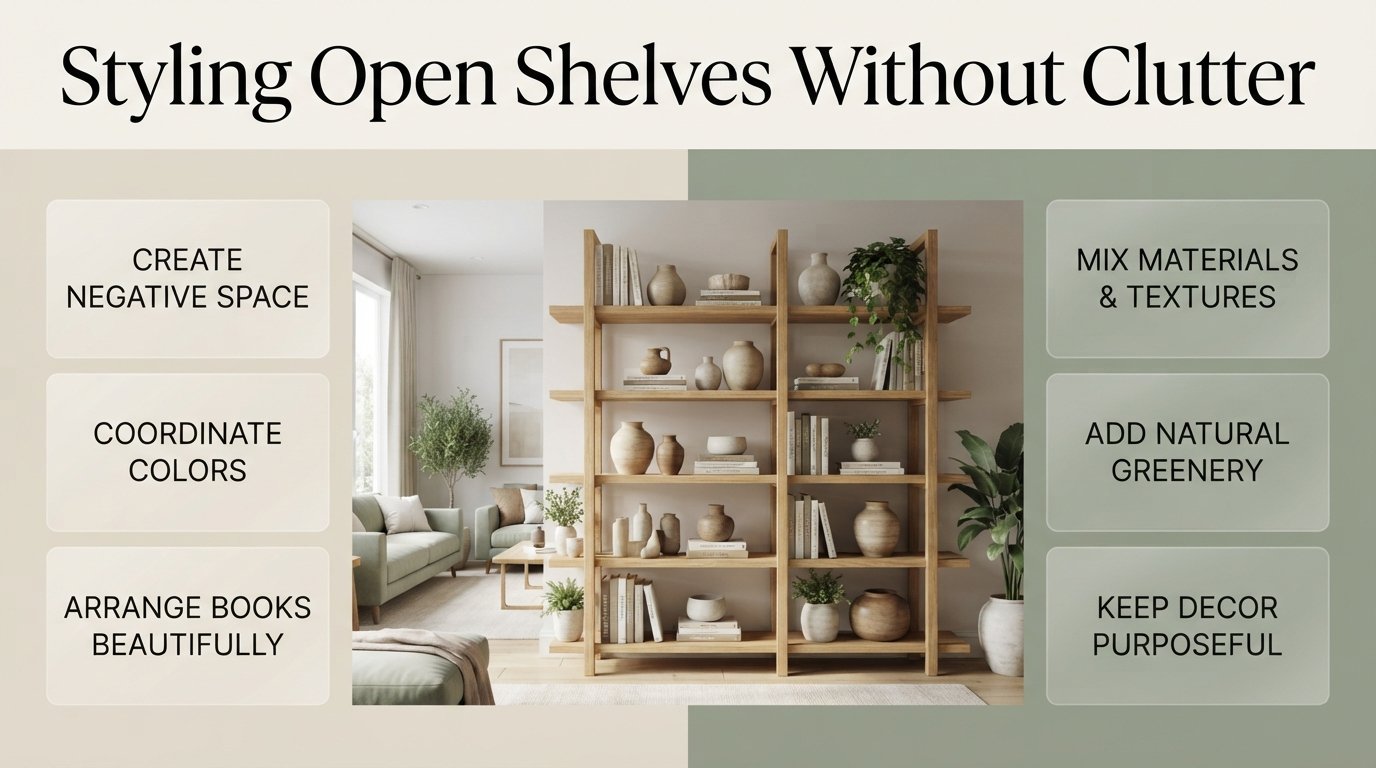
Styling Open Shelves Without Clutter | Open shelves can make a home feel more spacious, personal, and thoughtfully designed. Yet they can also become one of the easiest places for clutter to accumulate. A few books, decorative objects, framed photographs, and everyday essentials may look attractive individually, but when everything is displayed together without a plan, the shelves can quickly appear crowded and disorganized.
The solution is not necessarily buying more storage containers or removing every decorative item. Styling open shelves without clutter requires a better understanding of proportion, visual balance, color coordination, negative space, and practical organization. When these elements work together, open shelving can provide useful storage while contributing to the overall character of your home.
Whether you’re styling floating shelves in a small apartment, organizing a kitchen display, refreshing a living room bookcase, or improving a home office, the right approach can make a noticeable difference. You can create a polished arrangement with belongings you already own instead of spending money on unnecessary accessories.
At DesignMode24 Interior Design, thoughtful interior design means making everyday spaces more functional, comfortable, and visually appealing. This guide explains how to choose the right objects, arrange books, combine materials, introduce plants, create negative space, and maintain an attractive display without making your home feel staged or impractical.
You’ll also learn room-specific styling methods, professional design techniques, common mistakes to avoid, and simple steps for transforming crowded shelves into organized features that suit your lifestyle.
1. What Does Styling Open Shelves Without Clutter Really Mean?
Styling open shelves without clutter means arranging useful and decorative objects so that each item has enough space to be seen, the overall display feels balanced, and everyday belongings remain easy to access. The aim is not to leave every shelf empty but to create a deliberate relationship between storage, decoration, and available space.
Open shelving exposes its contents, unlike closed cabinets that conceal everyday items behind doors. As a result, the arrangement affects the appearance of the entire room.
A shelf containing neatly arranged books, a ceramic vase, and a meaningful photograph can feel inviting. The same shelf may look untidy if unrelated objects, loose paperwork, tangled cables, and numerous small ornaments compete for attention.
The difference comes from selection and arrangement rather than the value of the objects.
Understand the difference between a full shelf and a cluttered shelf
A full shelf contains many items, but those items have a clear purpose and a recognizable arrangement. A cluttered shelf lacks visual organization, making it difficult to distinguish the important pieces from the less useful ones.
For example, a kitchen shelf filled with coordinated plates, bowls, and glasses may look organized because the objects belong together. A living room shelf containing the same number of unrelated souvenirs, tiny ornaments, and loose papers may feel much busier.
Before styling, ask yourself three questions:
- Does this item serve a practical purpose or have personal meaning?
- Does it complement the surrounding colors, materials, and furniture?
- Can I reach it, clean around it, and return it to its place easily?
If an object offers no real benefit, consider storing it elsewhere.
Why negative space matters
Negative space is the empty area around displayed objects. It allows individual pieces to stand out and prevents the arrangement from feeling compressed.
You don’t need to leave a fixed percentage of every shelf empty. A bookshelf, kitchen shelf, and decorative floating shelf have different storage requirements.
Instead, look for opportunities to create visible gaps between groups of objects. These gaps help the eye move naturally across the display and make the arrangement easier to understand.
Professional recommendation: Start with fewer items than you think you need. It is much easier to introduce one or two useful pieces later than to correct an arrangement that already feels overcrowded.
2. How Should You Plan Your Open Shelving Before Styling It?
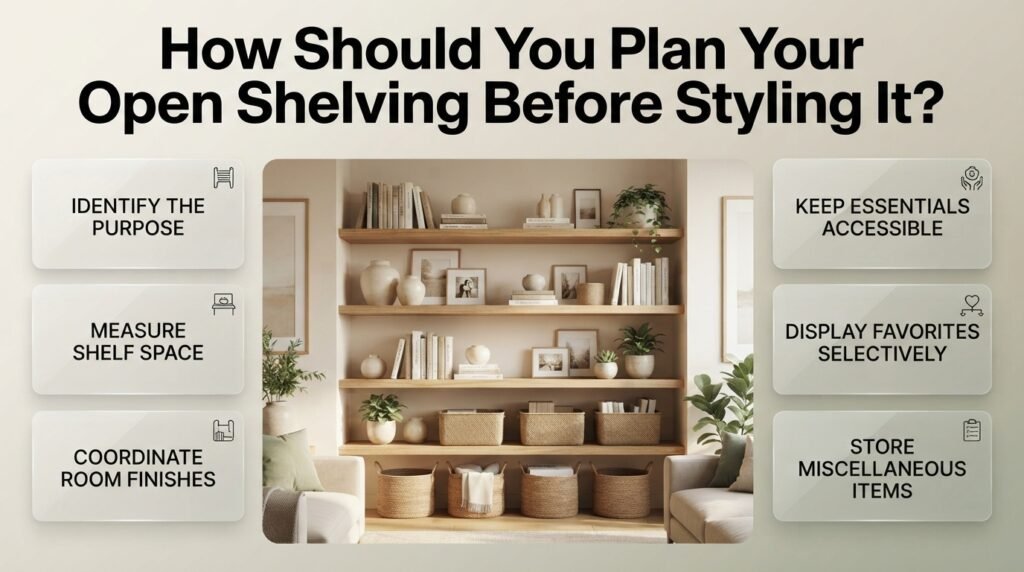
Plan your open shelving by identifying its purpose, measuring the available space, considering the surrounding furniture, and deciding which belongings deserve to remain visible. This preparation prevents unnecessary purchases and helps you create a display that supports your daily routine rather than becoming another area that needs constant attention.
Identify the primary function
Every shelving unit should have a clear purpose, even if it serves more than one need.
A living room bookcase may combine books, personal photographs, and a small amount of decorative storage. Kitchen shelving may prioritize plates, glasses, and frequently used ingredients. Home office shelves may need to accommodate reference books, files, and supplies.
Deciding on the main function makes it easier to determine which items belong there.
Measure before choosing accessories
Measure each shelf’s width, depth, and usable height. Consider the size of the largest items you intend to display, including framed artwork, baskets, books, and decorative vessels.
Check the available height above tall objects. An accessory that fits on the shelf may still look cramped if it nearly touches the shelf above it.
For floating shelves, also consider the wall’s condition, the mounting system, and the manufacturer’s load limits. Heavy books and ceramic objects require secure support.
Consider the surrounding room
Shelves should feel connected to the rest of the interior.
Look at the color of the walls, nearby furniture, flooring, curtains, and lighting. These elements provide clues about which materials and shades will work best.
For example, shelves in a room with warm oak furniture may look cohesive with cream ceramics, natural woven materials, and a few muted green accents. A contemporary room with black metal furniture may benefit from darker accessories, glass, and restrained metallic finishes.
For broader ideas about creating a coordinated home, explore Interior Design.
Make a practical inventory
Before arranging objects, sort your belongings into three categories.
| Category | Examples | Recommended action |
|---|---|---|
| Everyday essentials | Frequently used books, dishes, office supplies | Keep accessible |
| Decorative favorites | Ceramics, photographs, selected souvenirs | Display selectively |
| Occasional or miscellaneous items | Spare cables, packaging, paperwork, duplicates | Store elsewhere |
This simple exercise prevents you from treating every available surface as a place for anything that needs putting away.
3. How Do You Choose the Right Objects for Open Shelves?
Choose objects that combine usefulness, visual appeal, and appropriate scale. A successful arrangement usually includes a mixture of functional belongings and a few carefully selected decorative pieces. Rather than displaying an entire collection, choose the items that contribute most to the room’s appearance or make everyday activities easier.
Start with the essentials
Place the items you genuinely need on the shelves first. This establishes how much space remains for decoration.
For example, a home office might require several reference books, labeled storage boxes, and a container for frequently used supplies. These essentials should determine the arrangement before decorative accessories are introduced.
The same principle applies in a kitchen. Plates and glasses need enough room to be removed safely, so decorative objects shouldn’t occupy the most convenient positions.
Choose meaningful decorative pieces
Personal objects make interiors feel individual rather than generic.
A framed photograph, a handmade ceramic vessel, or a souvenir from a memorable trip can provide character. However, displaying every meaningful possession at once can dilute the impact of each item.
Rotate collections when necessary. Keep a few favorites visible and store the rest safely until you want to change the arrangement.
Consider scale and visual weight
Visual weight describes how strongly an object attracts attention. Large, dark, textured, or unusually shaped pieces often have greater visual weight than small, pale, simple objects.
A large black vase may dominate a shelf even when it occupies little physical space. Several small white ornaments may have less individual impact but can create clutter when grouped together.
Balance these differences rather than relying only on the number of objects.
Apply a simple editing rule
After placing your essential items, add decorative pieces gradually.
- Choose one main focal object.
- Add a smaller item that complements it.
- Introduce a different texture or shape if the display needs contrast.
- Step back and assess the arrangement.
- Remove anything that doesn’t improve the result.
This method is especially useful when working with existing belongings because it encourages thoughtful editing instead of unnecessary shopping.
4. How Can You Arrange Open Shelves With Better Visual Balance?
Create visual balance by distributing objects of different sizes, shapes, and colors across the shelving unit. Use larger items as anchors, combine upright and horizontal arrangements, and vary the amount of empty space between groups. The objective is to make the entire display feel connected without making every shelf identical.
Begin with larger objects
Larger objects establish the basic structure of a shelf.
These might include framed artwork, substantial book collections, woven baskets, or a decorative vessel. Position them first, then arrange smaller items around them.
Avoid concentrating all the visually heavy objects on one side of a bookcase. If one shelf contains a large dark object, the shelves nearby may need a more substantial arrangement to maintain balance across the unit.
However, perfect equality is unnecessary. The goal is a comfortable overall composition.
Combine vertical and horizontal arrangements
Books provide a useful way to introduce different shapes.
Place some books upright with bookends, then arrange a short stack horizontally on a nearby shelf. A small bowl or ceramic object may sit beside the stack, provided it doesn’t make the arrangement feel cramped.
This creates visual variation without requiring numerous decorative accessories.
Use the visual triangle principle
The visual triangle is a simple arrangement technique in which objects of different heights create an implied triangular shape.
Imagine a tall vase, a medium-height stack of books, and a low decorative bowl. Their differing heights guide the eye across the shelf instead of creating a rigid horizontal line.
You can repeat this principle throughout a bookcase while changing the direction of the arrangement.
For instance, a tall object might sit on the left of one shelf and on the right of another. This introduces movement without sacrificing cohesion.
Avoid making every shelf look the same
Consistency doesn’t require repetition of the exact same arrangement.
You can repeat colors, materials, or shapes while varying the contents. One shelf might feature books and a photograph, another a basket and a ceramic vessel, and another a simple collection of books.
This creates rhythm while allowing each shelf to serve its own purpose.
For additional guidance on choosing suitable object sizes, read Understanding Furniture Proportions.
5. Which Colors Make Open Shelves Look Organized?
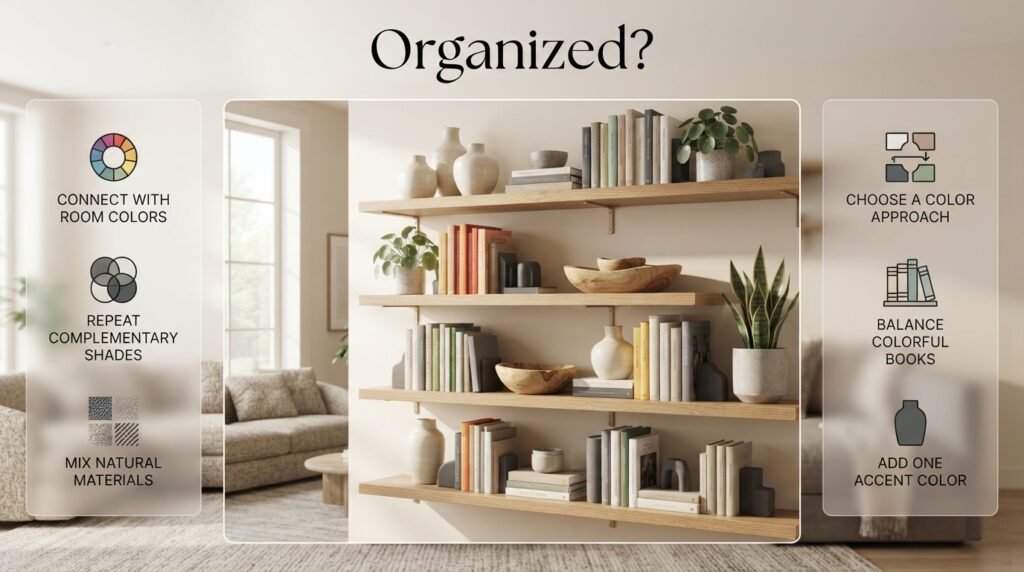
A limited color palette usually makes open shelves look more cohesive because it reduces visual competition between objects. Start with colors already present in the room, then repeat a few complementary shades across the display. You can introduce contrast through one accent color instead of relying on numerous unrelated colors.
Choose colors that connect with the room
Begin with the wall color and the finishes of nearby furniture.
Warm interiors may suit cream, beige, natural wood, muted green, or terracotta. Cooler contemporary rooms may work well with white, charcoal, gray, glass, and restrained metallic details.
These are starting points rather than strict rules. A colorful home can still have beautifully organized shelves when its accessories are arranged thoughtfully.
Use repetition to create cohesion
Repeat one or two materials or colors throughout the shelving unit.
For example, natural wood may appear in bookends, a bowl, and a storage box. A muted green accent may appear in a plant pot and the cover of a decorative book.
The repeated elements connect the display without requiring every object to match.
Compare different color approaches
| Color approach | Appearance | Suitable setting |
|---|---|---|
| Neutral and natural | Calm and understated | Bedrooms and relaxed living rooms |
| Monochromatic | Clean and coordinated | Minimalist interiors |
| Neutral with one accent | Focused and expressive | Small spaces and floating shelves |
| Dark colors with warm metallic details | Dramatic and refined | Contemporary interiors |
| Several coordinated bright colors | Energetic and playful | Creative rooms and informal spaces |
What if your books have many different colors?
You don’t need to hide books simply because their covers don’t match.
Group them by subject or size, then arrange similar colors together where practical. Alternatively, let the books provide the color and keep surrounding accessories relatively neutral.
For more ideas on choosing shades that complement your home, visit Paint Color.
6. How Do You Style Bookshelves Without Visual Clutter?
Style bookshelves by organizing books into manageable groups, mixing vertical and horizontal arrangements, and adding only a few accessories. Keep useful books easy to find and allow decorative pieces enough room to remain visible. A well-organized bookcase should support reading, learning, or storage while contributing to the room’s overall design.
Organize books according to how you use them
Arrange frequently used books where they’re easy to reach.
You might group cookbooks together in the kitchen, design references in a home office, or novels by subject or author in a living room.
If appearance is the main priority, grouping books by color can create a coordinated display. If accessibility matters more, organizing by subject is generally more practical.
You can also combine both methods.
Add decorative objects selectively
A small sculpture or ceramic vessel can break up a long row of books.
However, avoid placing a decorative object on every horizontal book stack. Repeated decorations can make the bookcase feel crowded and reduce the usefulness of the available space.
Choose accessories that fit the surrounding books. A compact stack works well with a small bowl or low object, while a large sculptural piece may need a more open shelf.
Use baskets for small belongings
Coordinated baskets can conceal small items that would otherwise create visual noise.
They’re useful for remote controls, stationery, charging accessories, and other belongings that need a designated home.
Choose baskets that fit the shelf comfortably and can be removed easily. Overfilled containers can become inconvenient, so the storage system should match the amount of material you actually need to keep.
7. How Can You Combine Materials and Textures Without Overcrowding?
Combine a few contrasting materials, such as wood, ceramic, glass, metal, and woven fibers, to make shelves visually interesting without adding more objects. Different textures create depth and variety, especially when the color palette is restrained. The key is to use material contrast thoughtfully rather than introducing a new decorative piece for every texture.
Mix smooth and textured surfaces
A shelf filled with glossy objects may feel visually flat. Introducing a matte ceramic vase, a woven basket, or a natural wood bowl adds variety.
Consider these combinations:
- Natural wood with matte white ceramics.
- Black metal with warm wooden accessories.
- Clear glass with linen and neutral books.
- Stone-colored pottery with woven storage containers.
- Smooth surfaces balanced by ribbed or tactile finishes.
These combinations work because the objects differ in texture while sharing a coherent visual direction.
Use texture to reduce the need for decoration
If a shelf already contains enough objects, changing their materials may be more effective than adding new accessories.
For example, replacing a smooth plastic container with a natural woven basket can introduce warmth and texture while improving storage.
This is especially useful in minimalist rooms, where excessive decoration can undermine the intended simplicity.
For further ideas about combining finishes thoughtfully, read Layering Textures Without Overcrowding.
Consider practical maintenance
Material selection should also reflect the room’s conditions.
In kitchens, smooth surfaces may be easier to clean than intricate accessories that collect grease. In bathrooms, materials need to tolerate the available humidity. In sunny rooms, some materials and finishes may fade or change color over time.
Choose accessories that suit the environment instead of focusing exclusively on their appearance.
8. Should You Add Plants and Natural Elements to Open Shelves?
Plants and natural materials can soften the straight lines of shelving, introduce color, and make a room feel more welcoming. A compact plant, wooden accessory, or woven basket may provide enough natural texture to balance books and ceramics. Choose elements that suit the available light, shelf capacity, and maintenance requirements.
Select plants according to the location
A trailing plant can work well on a high shelf when its leaves have room to hang without interfering with the objects below.
A compact upright plant may suit a desk shelf or kitchen display where space is limited.
Before choosing a plant, consider the following:
- The amount of natural light available.
- The plant’s watering requirements.
- The weight of the pot and its contents.
- Whether leaves will obstruct nearby objects.
- The risk of water damaging the shelf surface.
If natural light is limited, choose a plant suited to those conditions or consider a realistic artificial alternative.
Avoid the crowded plant collection effect
Several small pots placed close together can make a narrow shelf feel busy.
Instead, position one plant near books or a ceramic object, leaving space around the leaves. If you want to display a collection, group the plants intentionally and avoid spreading them across every available shelf.
Natural materials can provide a similar effect without requiring additional plants. A wooden bowl, woven container, or textured ceramic vessel may be sufficient.
9. How Do You Style Open Shelves in Different Rooms?
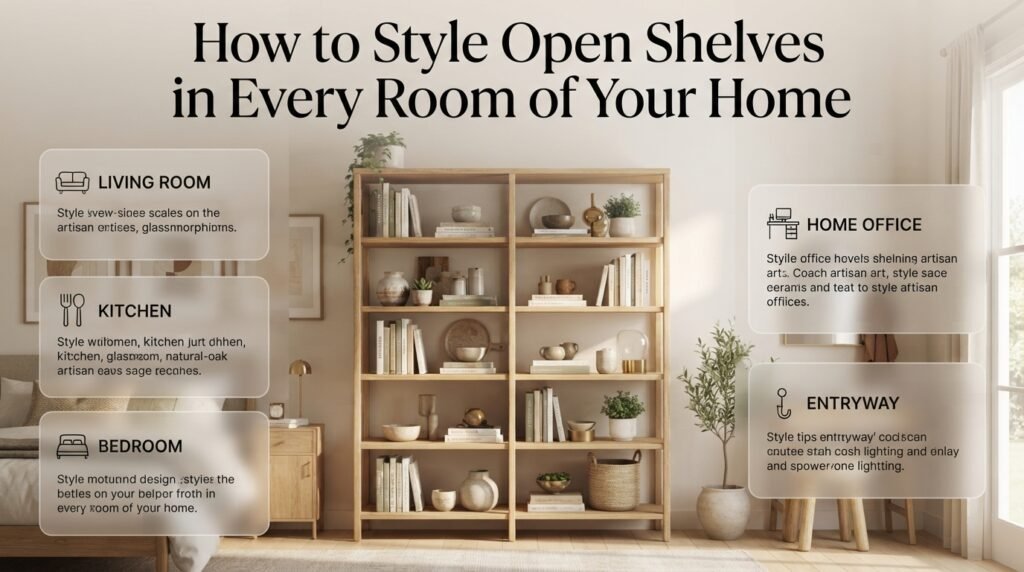
The best shelf arrangement depends on the room’s purpose, the objects you need to store, and the visual atmosphere you want to create. Living rooms can accommodate books and personal accessories, kitchens benefit from accessible essentials, bedrooms usually suit calmer displays, and home offices need practical organization that supports concentration.
Living room shelves
Living room shelving often acts as both storage and a decorative focal point.
Start with books, selected photographs, and a few accessories that reflect the room’s style. If the shelves are part of a larger media wall, consider the television, surrounding cabinetry, and nearby seating when distributing visual weight.
Avoid concentrating too many decorative objects around the television, as this can create a competing focal point.
A few meaningful objects generally provide more character than numerous unrelated ornaments.
Kitchen shelves
Kitchen shelves should be attractive without making cooking more difficult.
Display items that you use frequently, such as plates, bowls, glasses, and selected cooking ingredients. Store unnecessary packaging, spare utensils, and rarely used appliances in closed cabinets.
Use consistent containers where they improve organization, but don’t feel obliged to transfer every ingredient into a matching jar.
Open shelving can be less practical near cooking areas where grease accumulates. Consider how often the items need cleaning and whether closed storage would provide better protection.
Bedroom shelves
Bedroom shelving usually benefits from a quieter, more restrained arrangement.
Choose a small selection of books, a framed photograph, a ceramic accessory, or a compact plant. Avoid turning every shelf into a place for loose personal belongings.
If shelves are positioned above a bed, secure them properly and avoid displaying heavy or fragile objects where they could fall onto the sleeping area.
Home office shelves
Home office shelving should support both productivity and appearance.
Group reference books, documents, and supplies according to their purpose. Use coordinated storage containers for small items that would otherwise become visually distracting.
Keep frequently accessed materials within easy reach and move archived documents to suitable storage.
Lighting and equipment placement also matter. Leave sufficient access for cables and devices, and avoid arrangements that make the workspace difficult to maintain.
Entryway shelves
Entryway shelving often needs to accommodate keys, small bags, mail, and everyday essentials.
The challenge is preventing these items from turning the display into a collection point for miscellaneous belongings.
Give frequently used objects designated locations, and use a tray or small container for items that need to remain accessible. Move paperwork, spare accessories, and unrelated belongings elsewhere.
If your entryway needs more systematic organization, explore Entryway Storage Capacity Planning.
10. How Can You Make Open Shelves Work in Small Spaces?
In small rooms, use appropriately sized accessories, limit unnecessary objects, and take advantage of vertical space without filling every shelf. Open shelving can provide useful storage while maintaining a lighter appearance than bulky furniture, but the contents must be carefully organized to avoid making the room feel visually crowded.
Use vertical space strategically
Tall shelving can increase storage capacity without taking up additional floor space.
However, a larger shelving unit doesn’t automatically create better organization. If every shelf becomes a place for unrelated belongings, the wall can look busier and the room may feel smaller.
Place frequently used items at comfortable heights. Store occasional items higher up when they can be reached safely, and avoid placing heavy objects in difficult-to-access positions.
Choose accessories that fit the shelf
Oversized objects can dominate a narrow shelf, while too many small objects create a scattered appearance.
Measure the available depth before choosing accessories. Consider whether an object will interfere with nearby furniture, doors, or movement through the room.
A slim floating shelf above a desk may need only a short book stack and one small framed print. A wider bookcase can support larger groupings.
Balance open and closed storage
Open shelves are useful for belongings that look attractive or need regular access. Closed storage works better for miscellaneous items, paperwork, and objects that don’t benefit from being displayed.
Combining the two creates a practical balance.
If you are planning built-in shelving around an existing wall feature, consider the structure before making changes. The guide to Designing Around Structural Walls offers relevant planning considerations.
11. What Are the Most Common Mistakes When Styling Open Shelves?
The most common mistakes include overcrowding, inconsistent colors, poorly sized accessories, repetitive arrangements, and choosing appearance over everyday function. These problems often occur when objects are added without considering the entire shelving unit. A clear plan, careful editing, and practical storage choices can prevent most of them.
Mistake 1: Filling every empty space
Why it happens: Empty space can make people feel that the arrangement is unfinished.
Why it’s harmful: Filling every gap removes visual breathing room and makes it harder to appreciate individual objects.
How to avoid it: Leave some areas intentionally open. Add another item only when it improves the balance or usefulness of the shelf.
Mistake 2: Buying accessories before measuring
Why it happens: Decorative objects may look smaller or more suitable in a shop than they do at home.
Why it’s harmful: Oversized pieces can overwhelm shelves, while undersized pieces may disappear among larger belongings.
How to avoid it: Measure the shelf and compare the dimensions of potential purchases with the items already displayed.
Mistake 3: Using too many unrelated colors
Why it happens: Accessories are often purchased individually without considering the room’s existing palette.
Why it’s harmful: The display can feel fragmented even when every item is attractive on its own.
How to avoid it: Repeat a few complementary colors throughout the shelves and let one or two pieces provide contrast.
Mistake 4: Making every shelf identical
Why it happens: Repetition feels safe and seems easier to arrange.
Why it’s harmful: The shelving unit may look rigid and overly staged.
How to avoid it: Repeat materials and colors, but vary object heights, group sizes, and the amount of negative space.
Mistake 5: Ignoring everyday function
Why it happens: Styling decisions are made for appearance without considering how the shelves will be used.
Why it’s harmful: Frequently used objects become difficult to reach, and the arrangement may be disrupted every day.
How to avoid it: Position essential belongings where they’re convenient to access and return. Keep decorative accessories away from the most practical storage areas.
Mistake 6: Displaying too many small accessories
Why it happens: Small objects seem harmless individually, so additional pieces are added gradually.
Why it’s harmful: Numerous miniature decorations can create visual noise and require more cleaning.
How to avoid it: Group related objects selectively and remove pieces that don’t contribute to the composition.
Mistake 7: Ignoring safety and shelf capacity
Why it happens: The appearance of the finished display receives more attention than the mounting system or load requirements.
Why it’s harmful: Heavy objects can damage shelves or create a falling hazard if the unit is inadequately supported.
How to avoid it: Follow the manufacturer’s load limits, use appropriate fixings, and secure shelves correctly for the wall type.
Professional reminder: When a shelf looks overcrowded, the first solution should usually be editing, not purchasing another organizer.
12. What Professional Techniques Make Open Shelves Look More Refined?
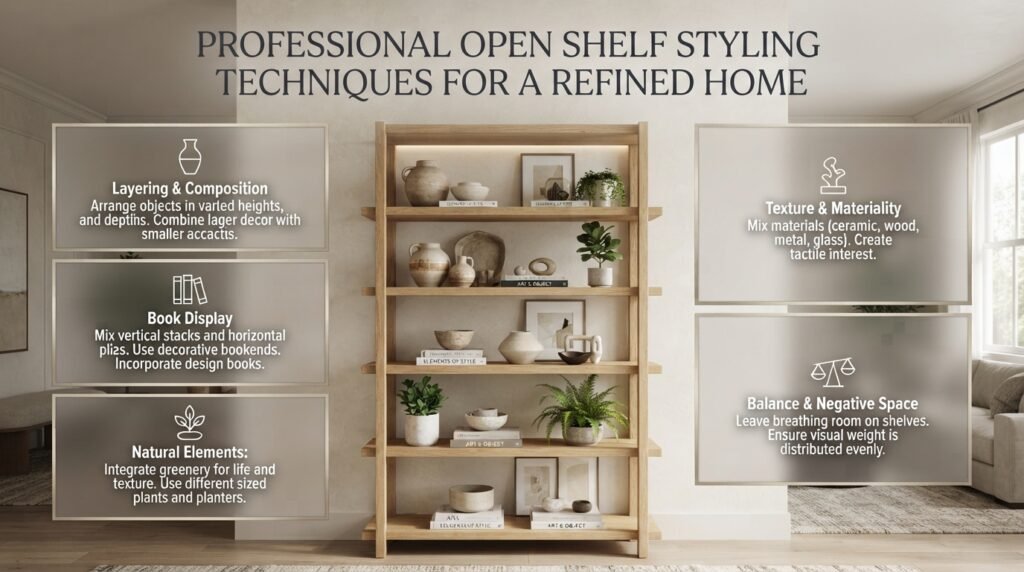
Professional-looking shelves rely on proportion, repetition, controlled contrast, meaningful focal points, and careful editing. You don’t need expensive accessories to achieve this result. A few well-chosen pieces, supported by a consistent design approach, can look more refined than a costly collection without a clear arrangement.
Create one focal point per visual group
A focal point gives the eye somewhere to settle.
It might be a distinctive vase, a framed artwork, a sculptural object, or a meaningful souvenir.
Surround the focal point with simpler pieces so it remains visible. Avoid placing several large statement objects together unless the shelf is spacious enough to accommodate them comfortably.
Repeat finishes across the shelving unit
Repeating a material helps connect objects that are otherwise different.
For example, a warm metal finish might appear in a small frame and a nearby decorative bowl. Natural wood might be repeated in bookends and a storage container.
The objects don’t need to match exactly. A consistent material or color provides enough visual connection.
Mix affordable and special pieces
A refined display doesn’t require luxury accessories on every shelf.
Combine everyday books, simple ceramics, a meaningful keepsake, and one distinctive object. The special piece provides character while the simpler items keep the arrangement grounded.
Before buying something new, try moving your existing accessories to different shelves. A change in position can alter visual balance without increasing the number of objects.
Consider the lighting
Lighting can reveal texture and make displayed objects easier to appreciate.
If shelves are near a window, consider how natural light changes throughout the day. For darker areas, suitable integrated lighting can improve visibility and highlight selected pieces.
Choose a lighting arrangement that suits the room’s function, avoids uncomfortable glare, and keeps wiring neatly managed.
For more information about coordinating lighting with your home, explore Whole Home Automation Planning.
Choose materials with indoor air quality in mind
If you’re installing new shelves or refinishing existing ones, consider the materials and finishes used.
Products with lower volatile organic compound emissions may be worth considering, depending on the application and available product documentation. Follow manufacturer instructions for installation, ventilation, and curing.
Read Low VOC Interior Finishes for additional guidance on interior finish choices.
13. How Do You Style Floating Shelves Without Making the Wall Look Busy?
Style floating shelves by limiting the number of objects, coordinating their colors with the room, and allowing the wall to remain visible around each arrangement. Because floating shelves have little surrounding structure, their contents are especially noticeable. A restrained display often looks more intentional than a row filled with numerous small accessories.
Start with the shelf’s proportions
A long floating shelf can support a larger arrangement than a narrow one, but it doesn’t need to be filled from end to end.
Consider the width of the wall, the height of nearby furniture, and the distance between shelves.
If the shelf is above a sofa, desk, or console, ensure the objects relate visually to the furniture beneath them without creating a cramped appearance.
Use a small number of distinct objects
A framed print, a low stack of books, and a ceramic vessel may be enough for a narrow shelf.
On a longer shelf, create two or three separate groupings rather than a continuous line of accessories.
Keep objects stable and avoid placing heavy or fragile pieces where they could fall onto people or furniture below.
Pay attention to the wall itself
The wall provides part of the composition.
A contrasting shelf may already be a strong design feature, while a shelf that matches the wall can create a quieter effect. The right choice depends on the intended atmosphere and surrounding finishes.
Avoid adding numerous accessories merely because the wall looks empty. Sometimes the visible wall space is exactly what makes the display feel balanced.
14. How Can You Keep Open Shelves Organized Long-Term?
Keep open shelves organized by giving belongings designated places, returning items after use, and removing objects that no longer serve a purpose. A short maintenance routine prevents small amounts of clutter from accumulating and reduces the need for repeated restyling.
Establish a simple weekly routine
Spend a few minutes reviewing the shelves.
- Return misplaced belongings to their designated locations.
- Straighten books and storage containers.
- Remove unnecessary packaging and paperwork.
- Wipe surfaces when dust becomes visible.
- Check plants for fallen leaves or water spills.
- Make sure frequently used objects remain accessible.
The routine should be short enough to maintain consistently.
Rotate decorative accessories
You don’t need to display every accessory at once.
Store seasonal decorations and less frequently used pieces safely, then rotate them when you want a different look. This introduces variety without increasing the number of objects on display.
Reassess the storage system when clutter returns
If the same items repeatedly accumulate on a shelf, the problem may be the storage arrangement rather than your styling.
For example, if mail always collects on an entryway shelf, a designated paper tray or another suitable storage location may solve the problem. If office supplies repeatedly spread across a bookcase, a closed container may be more practical.
For additional projects that improve everyday organization, explore DIY Home Projects.
15. How Can You Refresh Open Shelves Without Buying New Decorations?
Refresh open shelves by rearranging existing objects, changing the balance between books and accessories, removing unnecessary pieces, and introducing a different arrangement of familiar colors and textures. A successful refresh often requires better editing rather than additional purchases.
Try a complete rearrangement
Remove the objects and return them in a different order.
Move taller items to another shelf, combine previously separate book groups, and reposition the focal object. Small changes can make familiar belongings feel different.
Change the visual weight
If the shelving unit feels too heavy, remove some dark or oversized objects and introduce more open space.
If the display feels flat, use an existing textured object or a horizontal book stack to introduce contrast.
Don’t add more pieces until you’ve evaluated the arrangement with what you already own.
Make one deliberate purchase only when necessary
Sometimes a missing storage container, suitable bookend, or appropriately sized decorative object can improve the display.
However, make the purchase after identifying the specific problem. Buying accessories without a clear purpose can recreate the clutter you were trying to eliminate.
If a larger room refresh involves selecting furniture or coordinating several spaces, Find Expert Ideas for Every Room in Your Home can help you explore broader design considerations.
16. A Step-by-Step Process for Styling Open Shelves Without Clutter
The most reliable way to style open shelves is to begin with an empty surface, establish the practical requirements, arrange the largest objects first, and introduce smaller pieces gradually. Finish by assessing the complete display from different positions in the room and removing anything that distracts from the overall balance.
Step 1: Empty and clean the shelves
Remove books, ornaments, containers, and everyday belongings. Clean the surfaces and inspect the shelf supports.
This creates a fresh starting point and helps you identify any damage or installation concerns.
Step 2: Sort belongings by purpose
Separate everyday essentials, decorative favorites, and items that belong elsewhere.
Be selective about what stays visible. The goal is to display useful or meaningful objects rather than everything you own.
Step 3: Choose a color direction
Use the surrounding room as a reference.
Select a few complementary shades and identify the materials you want to repeat, such as natural wood, ceramic, glass, or metal.
Step 4: Position the largest objects
Place substantial books, baskets, framed artwork, or statement accessories first.
These objects establish the visual structure. Smaller pieces can be added around them without forcing you to rearrange the entire unit later.
Step 5: Group related items
Arrange books by purpose, place similar dishes together, or combine accessories that share a color or material.
Clear groupings make shelves easier to understand and maintain.
Step 6: Introduce variation
Combine vertical books with horizontal stacks. Vary object heights and allow some shelves to remain lighter than others.
Use different textures where needed, but avoid adding items solely to fill gaps.
Step 7: Check access and safety
Make sure frequently used items are easy to reach and that heavy belongings are properly supported.
For kitchen and office shelves, consider how items will be removed and returned during everyday activities.
Step 8: Step back and edit
View the shelving unit from the entrance to the room and from the main seating or working position.
Remove objects that appear distracting, block access, or compete with the focal point. Check the overall balance instead of judging each shelf separately.
Step 9: Maintain the arrangement
Return items to their designated places and review the display regularly.
If clutter returns quickly, reconsider the storage system rather than repeatedly styling the same objects.
How Do You Style Open Shelves Without Making Them Look Cluttered?
The best way to style open shelves without making them look cluttered is to combine carefully selected objects, a consistent color palette, and enough empty space between decorative groups. Instead of filling every shelf, decide which items deserve to be displayed and arrange them according to their size, purpose, and visual appeal. A few well-positioned books, a ceramic vase, and a meaningful decorative object can create a more attractive display than numerous unrelated accessories.
Start by removing everything from the shelves and sorting your belongings into everyday essentials, decorative favorites, and items that can be stored elsewhere. Place practical items first, then introduce decorations gradually. This approach helps you maintain functionality without sacrificing the appearance of your interior.
Practical tips:
Leave visible gaps between groups of objects to create visual breathing room.
Combine tall, medium, and low accessories instead of arranging everything at the same height.
Repeat two or three complementary colors to create a coordinated appearance.
Remove objects that compete for attention or make everyday items difficult to reach.
Review the complete shelving unit from across the room before making final adjustments.
What Should You Put on Open Shelves to Make Them Look Stylish and Organized?
The most effective open-shelf displays combine functional belongings with a small selection of decorative pieces. Books, ceramic vessels, framed photographs, compact plants, attractive storage baskets, and meaningful keepsakes can all work well when their sizes, colors, and materials complement one another. The right combination depends on the room and how the shelving will be used.
For example, a living room bookcase might feature books, a framed photograph, and a sculptural accessory, while kitchen shelves may look best with neatly grouped dishes, glasses, and frequently used ingredients. In a home office, coordinated containers and reference books can provide both practical storage and visual structure.
The important thing is to avoid choosing accessories simply because they look attractive individually. Each object should contribute to the overall arrangement or serve a useful purpose. If an item doesn’t improve the display or support your routine, consider placing it elsewhere.
Practical tips:
Use books to introduce structure, color, and different shapes.
Choose one or two decorative focal points instead of displaying numerous statement pieces.
Incorporate natural materials, such as wood, woven baskets, or matte ceramics, for added texture.
Keep frequently used items within comfortable reach.
Use closed storage for paperwork, loose cables, packaging, and miscellaneous belongings.
How Do You Arrange Books and Decorative Objects on Open Shelves?
Arrange books and decorative objects by establishing the largest items first, grouping related belongings together, and introducing smaller accessories where they improve the balance. Combining upright books with short horizontal stacks creates visual variation, while carefully selected decorative pieces prevent the shelving from looking like a continuous wall of book spines.
Begin by organizing books according to their purpose, subject, or size. If appearance is particularly important, you can also group books with similar cover colors. Place a small decorative bowl or sculptural object beside a horizontal stack, but leave enough space for the books to remain accessible.
Balance is more important than making every shelf symmetrical. A taller vase on one side can work well with a wider group of books on the other, provided the entire arrangement feels visually comfortable. Avoid placing an accessory on every book stack, as this can make the display look unnecessarily busy.
Practical tips:
Alternate vertical book arrangements with occasional horizontal stacks.
Use bookends to keep upright books stable and organized.
Position larger objects first, then add smaller pieces selectively.
Vary the arrangement between shelves instead of repeating an identical pattern.
Leave some shelves lighter than others to create contrast and negative space.
What Colors and Materials Make Open Shelves Look More Expensive?
Open shelves often look more refined when their colors and materials complement the surrounding interior. Neutral shades such as cream, beige, warm gray, and white can create a calm foundation, while natural wood, matte ceramics, glass, and subtle metallic finishes introduce texture and contrast. However, an expensive-looking display doesn’t require every object to be luxurious or perfectly matched.
Start with the existing colors in your room, including the walls, flooring, furniture, and soft furnishings. Repeat a few shades across the shelving unit to establish visual continuity. For example, oak shelves can work beautifully with cream ceramics, natural woven accessories, and a restrained green accent. In a contemporary interior, black shelving combined with wood and a few warm metallic details may create a more dramatic effect.
Material variety also matters. A display containing only smooth, glossy objects can feel flat, while a combination of matte ceramics, textured fabrics, and natural wood creates greater depth. Choose contrasting finishes carefully rather than adding more objects whenever the shelves feel visually plain.
Practical tips:
Select two or three main colors that complement the room.
Repeat a few materials or finishes to connect different objects.
Mix smooth and textured surfaces to create depth without overcrowding.
Use one distinctive accessory as a focal point instead of buying multiple statement pieces.
Rearrange existing decorations before investing in new accessories.
How Can You Keep Open Shelves Organized and Dust-Free Over Time?
Keeping open shelves organized requires a simple maintenance routine and a storage system that reflects your everyday habits. Because open shelving exposes its contents, dust and misplaced belongings become more noticeable than they would be inside closed cabinets. The most effective solution is to reduce unnecessary objects, assign belongings specific places, and clean the shelves regularly.
Start by deciding which items genuinely benefit from being displayed. Books, attractive dishes, and selected decorative objects may deserve visible positions, while spare cables, paperwork, packaging, and miscellaneous supplies are often easier to manage in closed storage. When everyday belongings have designated places, they’re less likely to accumulate randomly across the shelves.
Dusting is easier when the display isn’t overcrowded. Leave enough room to clean around objects, and choose accessories that can be moved without dismantling the entire arrangement. In kitchens, consider grease exposure and clean displayed dishes or containers as needed. If dust accumulates quickly in your home, reducing the number of accessories can make maintenance considerably easier.
Practical tips:
Spend a few minutes each week returning misplaced items to their proper locations.
Dust accessible surfaces regularly using cleaning methods suitable for the shelf material.
Use coordinated baskets or containers for small belongings that need to remain nearby.
Rotate seasonal decorations instead of displaying every accessory simultaneously.
Reassess the arrangement whenever clutter repeatedly returns to the same shelf.
The goal is to create shelves that remain attractive through ordinary daily use, not a display that looks perfect only immediately after styling.
Conclusion
Styling open shelves without clutter is about creating a thoughtful balance between practicality, visual appeal, and personal expression. Rather than filling every available space with books, accessories, and decorative objects, focus on selecting items that serve a purpose or contribute to the overall design. A few well-chosen pieces can make a stronger impression than a crowded arrangement, especially when each shelf has enough breathing room to let its contents stand out.
Start by removing unnecessary items, grouping similar objects, and varying heights, shapes, and textures to create a natural visual rhythm. Use a consistent color palette that complements your room, incorporate baskets or decorative boxes for smaller essentials, and leave some areas intentionally empty. These simple choices help open shelves feel organized without making them look overly staged or impersonal.
It is equally important to consider how your shelves function in everyday life. Frequently used items should remain accessible, heavier objects should be placed securely, and decorative arrangements should be easy to maintain. Regularly reviewing what you display will prevent clutter from returning and allow your shelves to evolve as your needs and preferences change.
For more practical inspiration, explore designmode24 interior design to discover ideas for creating a cohesive, comfortable, and stylish home. With a clear plan and a selective approach, open shelving can become a beautiful feature that displays your personality while keeping your space calm, balanced, and functional.