

Introduction
Low VOC Interior Finishes | A newly renovated home should feel fresh, comfortable, and inviting. However, after painting walls, installing new flooring, or fitting new cabinets, homeowners sometimes notice chemical odors that linger for days or even longer. These smells can be especially uncomfortable in bedrooms, small apartments, and rooms with limited ventilation.
Choosing low VOC interior finishes is a practical way to reduce certain chemical emissions associated with interior renovation. VOCs, or volatile organic compounds, are chemicals that can evaporate into the air from paints, adhesives, coatings, and other building materials. Depending on the compound and exposure level, some VOCs can contribute to indoor air quality problems and cause irritation or other health effects.
The good news is that reducing VOC exposure doesn’t mean sacrificing beautiful interiors, durable surfaces, or your preferred design style. Today’s market includes many lower-emission paints, wood finishes, flooring systems, sealants, and decorative materials suitable for modern homes.
For homeowners exploring healthier design choices, DesignMode24 Interior Design provides a starting point for thinking about how materials, functionality, and aesthetics work together.
This guide explains how to select low-VOC materials, compare product specifications, identify useful certifications, avoid common purchasing mistakes, and create attractive interiors without relying on unsupported environmental claims.
1. What Are Low VOC Interior Finishes?
Low VOC interior finishes are paints, coatings, adhesives, sealants, and other finishing materials formulated to contain or release relatively low amounts of volatile organic compounds compared with relevant alternatives.
They are used on walls, ceilings, floors, cabinets, furniture, and decorative surfaces to improve appearance and protect materials while helping reduce certain sources of indoor chemical emissions.
Common examples include:
- Low-VOC interior wall paints and primers.
- Water-based wood stains and clear coatings.
- Flooring products with documented low emissions.
- Low-emission adhesives and sealants.
- Engineered wood products with verified emissions performance.
- Selected wallpapers and decorative wall coverings.
- Interior finishes certified under relevant emissions standards.
It’s important to distinguish between a product’s VOC content and its VOC emissions. Content describes the amount of VOCs present in a product under a stated measurement method, while emissions describe chemicals released into the surrounding air under specified conditions.
A product with low VOC content may still release some chemicals during application and curing. Similarly, a product described as natural, environmentally friendly, or low odor is not automatically free from potentially concerning substances.
The most reliable approach is to assess the complete product formulation, relevant emissions information, intended application, and installation requirements.
Why are these finishes becoming important?
Modern homes often contain numerous manufactured materials, including flooring, cabinetry, wall coatings, insulation, furniture, and decorative panels. Each material can contribute to the indoor environment.
When several products are installed during a renovation, their combined emissions may become more relevant than any single material considered independently.
Low-VOC alternatives allow homeowners to make more informed decisions without needing to replace every conventional material or abandon their preferred interior style.
They are particularly useful when planning bedrooms, nurseries, home offices, living rooms, and other frequently occupied spaces.
2. How Do VOCs Affect Indoor Air Quality?
Volatile organic compounds are a broad group of carbon-containing chemicals that can evaporate into the air at room temperature. Their sources include building materials, cleaning products, furniture finishes, paints, and many household products.
Not every VOC has the same properties. Some cause irritation at particular concentrations, while others present different health concerns depending on the amount and duration of exposure.
Potential symptoms associated with exposure to certain VOCs include eye, nose, or throat irritation, headaches, dizziness, and discomfort. The effects depend on the specific compound, exposure level, ventilation, and individual susceptibility.
Some VOCs are associated with more serious long-term health risks. Formaldehyde, for example, is an important indoor pollutant that may be released from certain composite wood products and other sources.
Which rooms deserve special attention?
Although lower-emission finishes can be useful throughout a home, some spaces deserve particular consideration.
Bedrooms: People spend many hours sleeping, making the selection of wall paint, flooring, and furniture materials worthwhile.
Nurseries and children’s rooms: Choose products with reliable emissions documentation and follow application and occupancy instructions carefully.
Home offices: When a room is occupied for long periods, controlling avoidable pollution sources can support a more comfortable working environment.
Small apartments: Limited air circulation can make it harder to disperse emissions generated during renovation.
Kitchens and bathrooms: Select finishes that balance lower emissions with moisture resistance, cleanability, and durability.
Does a strong smell mean a product is dangerous?
Not necessarily. Odor intensity is not a reliable measurement of toxicity. Some chemicals have noticeable smells at relatively low concentrations, while others may not be easily detected by smell.
Likewise, a product that has little odor is not automatically safe or emission-free.
Instead of relying on smell, check technical documentation, safety information, and relevant emissions certifications. Provide suitable ventilation during installation and follow the manufacturer’s recommendations for drying, curing, and occupancy.
Expert tip: If an odor remains unusually strong after the expected drying period, investigate the source rather than masking it with air fresheners. Check for incomplete curing, moisture problems, or other materials that may be contributing to the smell.
3. Which Low VOC Paints Are Best for Interior Walls?
Paint is one of the most straightforward places to begin reducing avoidable VOC exposure during renovation. Walls and ceilings cover large areas, and paint is commonly applied in bedrooms, living rooms, hallways, and other occupied spaces.
Water-based acrylic and latex paints are widely available in lower-VOC formulations. They are often practical alternatives to conventional solvent-based coatings, although actual performance and emissions depend on the formulation.
Choosing the right paint finish
The finish affects both appearance and maintenance.
Matte paint: Works well on many living room and bedroom walls because it creates a soft appearance and reduces reflected glare. Some matte formulations are less washable than tougher finishes.
Eggshell paint: Offers a subtle sheen and can be a useful choice for family rooms, dining areas, and moderate-traffic spaces.
Satin paint: Often provides better cleanability, making it useful for busy hallways and other surfaces that need regular maintenance.
Semi-gloss paint: Can suit selected trim, doors, and surfaces requiring frequent cleaning. Check the specific product’s emissions and performance information.
The best option depends on the room, lighting conditions, substrate, and cleaning requirements.
What should you check before purchasing paint?
Compare products using the following criteria:
- Declared VOC content and the applicable measurement method.
- Availability of independent emissions testing.
- Compatibility with the primer and surface.
- Coverage per liter or gallon.
- Number of coats required.
- Scrub resistance and cleanability.
- Drying and curing requirements.
- Color and tinting limitations.
A low-VOC paint that requires several extra coats may not be the most economical choice. Similarly, a coating that performs poorly under regular cleaning may need replacement sooner.
Do primers matter?
Yes. Primers can contain VOCs and other ingredients that affect the overall finishing system.
For the best results, select a compatible primer and topcoat with suitable documentation. Confirm that the primer is appropriate for the substrate, particularly when covering stains, repairing damaged drywall, or painting previously coated surfaces.
Avoid choosing a primer solely because it has a low VOC figure if it cannot perform the required sealing or bonding function.
For more ideas on coordinating wall finishes and room colors, explore the Paint Color category.
4. Low VOC Wood Finishes for Furniture, Doors, and Floors

Wood finishes protect surfaces against moisture, dirt, abrasion, and everyday wear. They also influence color, sheen, and texture.
Traditional solvent-based stains and varnishes can release VOCs during application. Lower-emission alternatives are available, but the right choice depends on the wood species, intended use, and required level of protection.
Common lower-emission wood finish options
| Finish type | Typical applications | Important considerations |
|---|---|---|
| Water-based clear coat | Furniture, trim, and selected wood surfaces | May raise the wood grain or require careful preparation |
| Waterborne polyurethane | Wood floors, tables, and frequently used surfaces | Confirm abrasion, water, and chemical resistance |
| Lower-VOC wood stain | Doors, cabinets, and decorative timber | Color and penetration vary by formulation |
| Plant-oil-based finish | Selected furniture and timber applications | Some products contain solvents and require extended curing |
| Low-emission lacquer | Selected cabinetry and furniture | Verify the complete formulation and application requirements |
A plant-based finish is not automatically safer than a synthetic coating. Natural oils, resins, and solvents can still produce emissions or cause irritation.
How should you select a finish for furniture?
Start with the intended use.
A dining table needs resistance to spills and repeated cleaning. A bedroom bedside table may require less intensive protection. A timber floor needs a coating that withstands abrasion and foot traffic.
Check the manufacturer’s specifications for:
- Surface preparation.
- Recommended application thickness.
- Drying and curing periods.
- Resistance to water and abrasion.
- Cleaning and maintenance requirements.
- Ventilation and protective equipment.
Common mistake: Assuming a coating is ready for heavy use because it feels dry. Drying describes the loss of liquid or formation of a surface film, while curing involves further development of the coating’s properties. These processes do not always finish at the same time.
For a long-lasting result, follow the full curing schedule before placing heavy objects on the surface or exposing it to regular use.
5. How to Choose Low VOC Flooring
Flooring decisions deserve careful attention because a floor can cover most of a room’s horizontal surface. However, the flooring material itself is only one part of the installation system.
Underlayments, adhesives, primers, moisture barriers, sealants, and protective coatings may also contribute to indoor emissions.
Solid hardwood flooring
Solid hardwood can be a durable option when sourced and installed appropriately. Mechanically fastening the boards may reduce the need for certain adhesives, depending on the installation method.
However, stains, surface coatings, and other treatments can still release VOCs. Check the documentation for the complete system.
Engineered wood flooring
Engineered wood combines a real-wood surface with multiple underlying layers. It can offer dimensional stability and a range of finishes.
When selecting engineered flooring, review its emissions information and the manufacturer’s specifications. Composite wood products may also require separate consideration of formaldehyde emissions.
Ceramic and porcelain tiles
Ceramic and porcelain tiles are useful in kitchens, bathrooms, entryways, and other areas where moisture resistance is important.
The tile surface itself may contribute relatively little in the way of VOC emissions, but the installation system still matters. Select compatible adhesives, grouts, sealers, and moisture-management products.
Natural linoleum
Natural linoleum can be an option for some residential interiors. Its composition may include materials such as linseed oil, wood flour, and mineral fillers.
Nevertheless, product formulations vary, and adhesives or protective treatments may contribute emissions. Verify the documentation for the exact product.
Carpet and resilient flooring
Carpet, vinyl, and other resilient flooring products should be evaluated individually. Their backing, adhesives, plasticizers, manufacturing processes, and installation methods may influence indoor air quality.
Where appropriate, look for recognized emissions certifications and documentation covering the specific flooring system.
Flooring comparison table
| Flooring type | Potential advantages | What to verify |
|---|---|---|
| Solid hardwood | Repairable and long-lasting in suitable conditions | Finish, installation method, and maintenance |
| Engineered wood | Stable construction and varied appearance | Product emissions and formaldehyde documentation |
| Ceramic tile | Durable and moisture-resistant | Adhesive, grout, and sealant |
| Natural linoleum | Available in a range of colors and designs | Emissions information, adhesive, and care instructions |
| Carpet | Soft underfoot and useful for acoustic comfort | Carpet, backing, padding, and adhesive emissions |
| Resilient flooring | Available in many designs and price ranges | Product-specific emissions and installation requirements |
A practical flooring example
Imagine you’re renovating a small apartment bedroom. You choose an engineered wood floor with suitable emissions documentation but install it using an adhesive that has not been evaluated.
The finished system may not provide the emissions performance you expected.
A better approach is to compare the flooring, underlayment, adhesive, and any surface treatment together. Confirm compatibility and allow the recommended ventilation and curing time before regular occupancy.
For more practical renovation ideas, visit the Home Improvement category.
6. Low VOC Adhesives, Caulks, and Sealants
Adhesives and sealants are often overlooked because they may be hidden behind flooring, cabinets, wall panels, or trim. Nevertheless, they can contribute to indoor emissions.
Their performance also affects the durability of the finished surface. An adhesive that releases fewer VOCs is not useful if it fails to bond correctly or cannot tolerate the intended moisture conditions.
Where are these products used?
Common applications include:
- Installing flooring and underlayments.
- Attaching decorative wall panels.
- Securing interior trim.
- Assembling cabinetry.
- Sealing joints around windows and doors.
- Installing wall coverings.
- Sealing selected kitchen and bathroom surfaces.
How should you compare adhesive products?
Check the product’s VOC content, emissions information where available, bonding strength, substrate compatibility, moisture resistance, and curing requirements.
Water-based adhesives are often useful in suitable applications, but they cannot replace every solvent-based or reactive adhesive.
Some silicone sealants, construction adhesives, and specialty products have different chemical compositions and application requirements. Select according to the intended use rather than choosing solely by a general low-VOC claim.
Professional recommendation: Ask the installer to identify the exact adhesive or sealant specified for the project. If a substitution is necessary, request the replacement product’s documentation before approving it.
7. Low VOC Cabinets and Engineered Wood Products

Cabinets, wardrobes, shelving, and fitted furniture can introduce several types of materials into a room. These may include solid timber, plywood, particleboard, MDF, laminates, adhesives, and surface coatings.
Some engineered wood products use adhesives that can release formaldehyde. Formaldehyde should be assessed separately from general VOC content because it has its own health concerns and relevant emissions standards.
What should homeowners look for?
When selecting cabinetry or fitted furniture, ask suppliers about:
- Formaldehyde emissions testing.
- Applicable regulatory compliance.
- Third-party certification where available.
- Surface coatings and laminates.
- Exposed edges and unfinished surfaces.
- Adhesives used during fabrication, where information is available.
- Installation and ventilation recommendations.
Is solid wood always the better choice?
Not necessarily. Solid wood can reduce reliance on some composite wood components, but its stains, finishes, and adhesives may still contribute emissions.
A properly documented engineered wood product can also be a reasonable choice. Cost, stability, durability, moisture resistance, and repairability all influence the decision.
How does cabinet design affect material selection?
Well-planned storage can reduce the need for unnecessary cabinetry and decorative components.
For example, a wardrobe designed around the actual clothing and storage needs of a household may require fewer additional units. This can reduce material use while creating a more functional room.
For a practical approach to storage planning, read Entryway Storage Capacity Planning.
The same principle applies to bedroom wardrobes, hallway storage, and living room built-ins: plan the function before selecting the materials.
8. Low VOC Wallpaper and Decorative Wall Coverings
Wallpaper can introduce color, pattern, and texture without requiring multiple coats of decorative paint. However, its emissions profile depends on the complete product and installation system.
The surface, backing, printing inks, adhesive, protective coatings, and any applied treatments may all be relevant.
Which wall coverings are worth considering?
Potential options include paper-based wall coverings, nonwoven wallpaper, and selected PVC-free products with suitable documentation.
PVC-free does not automatically mean low-emission, and a paper-based covering is not necessarily free of chemical additives.
Compare the exact product’s specifications rather than relying on a material description alone.
What about moisture resistance?
In bathrooms, kitchens, and other humid areas, the wall covering must tolerate the conditions in which it will be used.
A product that absorbs moisture or loses adhesion may require early replacement. Moisture trapped behind a wall covering can also contribute to building damage or mold growth.
Choose a product that is suitable for the room, and confirm that the wall surface is dry, stable, and correctly prepared.
How can you achieve a premium appearance?
You don’t need to cover every wall with a decorative finish. A carefully chosen feature wall can add character while keeping material use under control.
For example, a subtle textured covering behind a bed can work with simple bedding, timber furniture, and coordinated lighting. The overall effect can feel sophisticated without introducing numerous competing patterns.
Explore Layering Textures Without Overcrowding for more ideas on balancing texture and visual interest.
9. How to Read VOC Labels and Product Certifications
Product labels can make comparison easier, but only when you understand what each claim actually measures.
Terms such as low VOC, zero VOC, low odor, environmentally friendly, and non-toxic are not interchangeable.
VOC content versus VOC emissions
VOC content generally describes the amount of volatile organic compounds present in a product, often expressed in grams per liter for coatings.
VOC emissions testing measures chemicals released into the air under defined test conditions. Depending on the method, testing may examine emissions over a specified period after installation or application.
These measurements provide different information.
A low-VOC paint may have low VOC content but still release certain chemicals while drying. A flooring product may have a separate emissions profile that is not fully described by its raw material composition.
Understanding common product claims
| Label or claim | What it may tell you | What to check |
|---|---|---|
| Low VOC | The product meets a stated low-content or emissions criterion | Applicable definition and measurement method |
| Zero VOC | The product meets a particular zero-content claim or threshold | Tinting, added ingredients, and labeling rules |
| Low odor | The product may have a less noticeable smell | Actual emissions documentation |
| Formaldehyde compliant | The product meets a relevant formaldehyde requirement | Standard, test method, and product category |
| Third-party certified | A separate organization has evaluated the product | Certification scope and current product listing |
| Natural or plant-based | Some ingredients come from natural sources | Solvents, additives, and emissions performance |
Which certifications are useful?
Depending on the product category and market, several established programs may help.
GREENGUARD Gold: Evaluates qualifying products against chemical emissions criteria, including stricter limits intended to support sensitive indoor environments.
Green Seal: Provides environmental standards for selected product categories, including certain paints and coatings.
FloorScore: Evaluates indoor air emissions for qualifying hard-surface flooring products and related materials.
CDPH Standard Method: Provides a recognized framework for testing emissions from indoor building materials and furnishings.
Applicable formaldehyde standards: These are particularly relevant for composite wood products, cabinetry, and certain furniture components.
Certification criteria, availability, and eligible product categories vary. Always verify that the exact product is covered and that the certification remains current.
What if the supplier cannot provide documentation?
Treat unsupported claims cautiously. Ask for a technical data sheet, safety data sheet, emissions report, or certification details.
If the supplier cannot explain what a low-VOC claim means or provide relevant evidence, compare the product with alternatives offering clearer information.
Quick tip: Keep product records after purchasing materials. This makes it easier to verify substitutions, follow maintenance requirements, and identify the materials used during a future renovation.
10. How to Choose Low VOC Finishes Step by Step
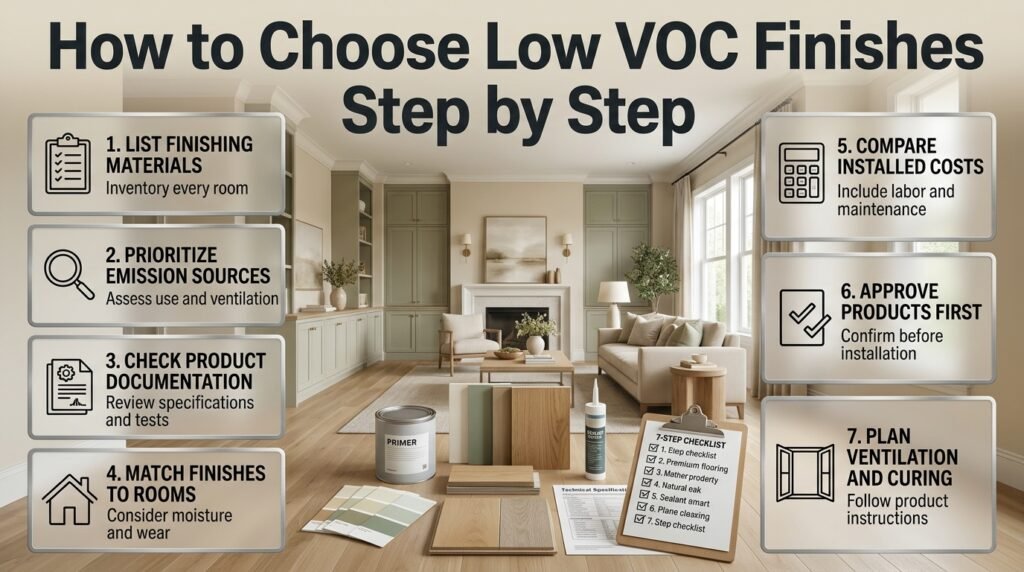
Selecting healthier materials is easier when you establish a process before purchasing begins.
Step 1: List every finishing material
Create a room-by-room inventory of paint, primer, flooring, adhesive, cabinetry, sealants, stains, and decorative coatings.
This helps identify products that might otherwise be overlooked.
Step 2: Prioritize the most significant sources
Consider the amount of each product used, its expected emissions, the size of the treated surface, and the room’s ventilation.
Large areas of flooring or paint may deserve attention before a small decorative accessory, but the actual priority depends on the materials involved.
Step 3: Request technical documentation
Ask suppliers for the relevant product specifications, VOC content, safety data, emissions test reports, and certifications.
Check that the documents match the exact product and formulation.
Step 4: Match performance to the room
Choose finishes based on the conditions in which they’ll be used.
- Bedrooms need appropriate surface durability and documented emissions information.
- Kitchens require finishes that tolerate cleaning and occasional splashes.
- Bathrooms need moisture-resistant materials and compatible installation systems.
- Hallways benefit from durable, washable surfaces.
- Children’s rooms require careful product selection and adherence to occupancy instructions.
Step 5: Compare the complete installed cost
Consider product price, coverage, number of coats, labor, installation requirements, maintenance, and expected service life.
A product with a higher purchase price may offer better long-term value if it lasts longer or requires less maintenance. However, cost alone does not prove better emissions performance.
Step 6: Approve materials before installation
Give contractors a written specification of acceptable products. Ask for approval before any substitution.
This is especially important when a project depends on a particular emissions certification or material composition.
Step 7: Plan ventilation and curing
Follow the manufacturer’s instructions for ventilation, application, drying, curing, and occupancy.
Where practical, avoid applying multiple high-emission products simultaneously in poorly ventilated spaces. Do not assume that a product is ready for normal use just because the surface feels dry.
11. Are Low VOC Interior Finishes More Expensive?
The cost varies by product category, brand, location, quality, and availability. Some lower-emission products cost more than conventional alternatives, while others are competitively priced.
The most useful comparison is the total cost of the finished surface rather than the price of one container or package.
What affects the overall price?
Coverage: A paint with better coverage may require fewer coats.
Preparation: Damaged walls or uneven floors may require additional materials and labor.
Installation: Some finishes require specialized tools, trained installers, or longer preparation periods.
Durability: A coating that resists wear may reduce the need for early replacement.
Maintenance: Surfaces that are easier to clean may lower ongoing maintenance costs.
Availability: Certified products may cost more in areas where distribution is limited.
How can you manage the budget?
Start by identifying the surfaces and materials that matter most. Compare documented products within the same category and avoid paying extra solely for vague environmental marketing.
Ask suppliers to quote the complete system, including primers, adhesives, and protective coatings.
If your budget is limited, you can prioritize major renovation materials first and make further improvements over time.
12. How to Design Stylish Interiors With Low VOC Materials
Health-conscious material selection doesn’t mean every room needs to look plain or clinical. Many lower-emission finishes are available in contemporary colors, subtle textures, and attractive natural-looking designs.
Create a coordinated color palette
Choose your main wall color, flooring tone, cabinetry finish, and accent colors before purchasing materials.
Warm whites, muted greens, soft gray-beiges, and earthy shades can work with timber, stone, ceramic accessories, and woven fabrics.
A consistent palette helps the room feel intentional without requiring numerous decorative coatings.
Combine materials thoughtfully
Different textures can make a room feel richer and more comfortable.
For example, matte painted walls can complement timber furniture, woven cushions, and ceramic accessories. The combination adds visual interest without depending on excessive surface treatments.
Consider each material’s maintenance requirements and emissions information rather than assuming natural-looking products are automatically preferable.
Avoid unnecessary decorative layers
More finishes don’t necessarily create a better interior. Multiple wall coatings, decorative panels, adhesives, and protective layers can increase cost and complicate maintenance.
Choose materials that serve a clear design or functional purpose.
For broader inspiration on planning cohesive rooms, explore Interior Design.
Balance proportions and visual weight
Material choices also affect how a room feels. Large areas of dark timber or strongly patterned wall coverings can dominate a small space, while lighter finishes may make the same room appear more open.
Consider how color, texture, and surface area work together before committing to expensive finishes.
A balanced design often requires fewer materials and less decorative layering, helping you control both the budget and the complexity of the renovation.
13. What Common Mistakes Should You Avoid?
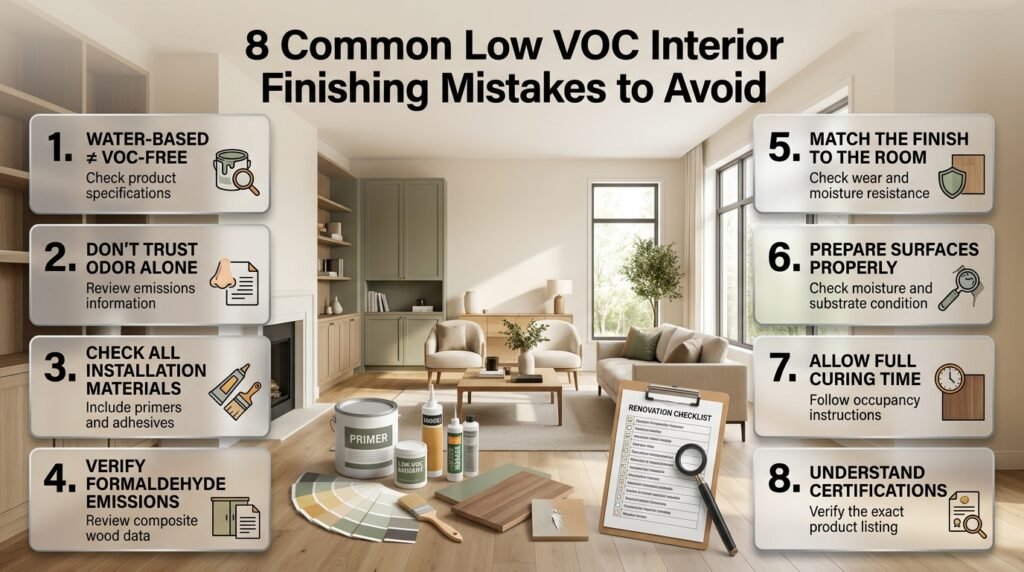
A successful low-emission renovation depends on selecting the right products and installing them correctly.
Mistake 1: Assuming water-based means VOC-free
Water-based products often have lower VOC content than comparable solvent-based alternatives, but their formulations vary.
Why it happens: Buyers rely on broad product descriptions instead of checking the specifications.
How to avoid it: Compare the exact product’s VOC information and relevant emissions documentation.
Mistake 2: Choosing products by smell
A mild odor does not prove that a product has low emissions.
Why it matters: Some chemicals may not be easily detected by smell.
How to avoid it: Use documented product information and follow ventilation recommendations.
Mistake 3: Ignoring adhesives and primers
Homeowners often focus on paint or flooring while overlooking supporting materials.
Why it matters: The entire installation system contributes to the finished result.
How to avoid it: Include adhesives, primers, sealants, and underlayments in your product review.
Mistake 4: Overlooking formaldehyde
Composite wood products can be a separate source of concern even when a supplier promotes general low-VOC characteristics.
How to avoid it: Request applicable formaldehyde emissions documentation for cabinetry, wardrobes, and engineered wood.
Mistake 5: Choosing a finish that cannot handle the room
A product may have attractive emissions characteristics but fail under moisture, abrasion, or frequent cleaning.
How to avoid it: Match the product to the room’s actual conditions and intended use.
Mistake 6: Ignoring moisture before installation
Applying coatings or installing flooring over damp surfaces can cause adhesion problems and material damage.
How to avoid it: Check substrate conditions and follow the manufacturer’s preparation requirements.
Mistake 7: Returning to the room too early
A surface may be dry to the touch before the product has fully cured.
How to avoid it: Follow the recommended curing and occupancy instructions rather than relying on appearance alone.
Mistake 8: Treating certification as a universal guarantee
A certification applies to defined criteria and product categories.
How to avoid it: Verify the exact product listing and understand what the certification does and does not evaluate.
14. Professional Advice for Better Material Decisions
Experienced designers and contractors consider emissions alongside installation quality, durability, aesthetics, and the practical needs of the household.
Specify materials before construction starts
Prepare a written schedule listing approved paints, flooring, adhesives, cabinetry, and coatings. Include product names and relevant documentation.
This reduces the chance of a contractor replacing a specified product with an unverified alternative.
Evaluate the whole installation system
A floor, for example, may include a subfloor treatment, moisture barrier, adhesive, underlayment, surface material, and protective coating.
The system should be compatible, suitable for the room, and supported by appropriate product information.
Consider the full life cycle
A finish that needs frequent replacement may create additional waste and cost. Durability and repairability should therefore be part of the decision.
This does not mean choosing the hardest or most expensive product in every situation. It means matching the material’s expected service life to the room’s actual demands.
Pay attention to indoor ventilation
Ventilation helps disperse indoor pollutants, but the correct approach depends on the building, outdoor air quality, weather, and product instructions.
Provide appropriate outdoor-air ventilation during renovation where practical. Do not direct fumes into occupied spaces or neighboring rooms.
Maintain moisture control
Low-VOC finishes cannot compensate for persistent dampness or poor building maintenance. Moisture can damage materials and contribute to mold growth.
Repair leaks, dry affected areas, and identify the cause of dampness before applying a new finish.
Keep product documentation
Retain specifications, safety data, certification records, and installation information. These documents help with maintenance, future renovations, and checking that substitutions meet the original requirements.
For additional professional planning guidance, read Questions to Ask an Interior Design Consultant.
15. How Can You Create a Low VOC Renovation Plan for the Whole Home?
A whole-home approach helps prevent inconsistent material decisions from room to room. Instead of selecting every product independently, create a coordinated plan based on how each space will be used.
Begin with the rooms that matter most
Identify bedrooms, children’s rooms, frequently used living areas, and spaces with limited ventilation.
Review the materials planned for those rooms and prioritize products with clear emissions documentation.
Create a material schedule
A simple schedule might include:
| Area | Materials to assess | Main selection priorities |
|---|---|---|
| Bedrooms | Paint, flooring, wardrobes | Emissions documentation and suitable durability |
| Living room | Paint, floor finish, furniture coatings | Emissions, maintenance, and appearance |
| Kitchen | Cabinetry, sealants, wall coatings | Moisture resistance, cleaning, and emissions |
| Bathroom | Tile adhesive, grout, sealants | Moisture compatibility and product performance |
| Home office | Paint, flooring, shelving | Indoor emissions and durability |
| Hallway | Paint, trim coatings, flooring | Wear resistance and cleanability |
Coordinate colors and materials
Once you identify suitable products, compare their colors, textures, and finishes together. This avoids purchasing materials that meet individual requirements but clash visually.
Request samples where available and test them under the room’s lighting conditions.
Confirm installation requirements
Before work begins, check surface preparation, ventilation, curing time, and occupancy guidance for each product.
A coordinated schedule makes it easier to manage contractors and reduce last-minute substitutions.
Review the result after installation
Once the work is complete, inspect the finishes for defects, moisture problems, and incomplete curing. Follow the manufacturer’s maintenance instructions and investigate persistent unusual odors.
If occupants experience symptoms during or after renovation, leave the affected area when appropriate, increase safe ventilation if possible, and seek relevant professional advice rather than assuming the cause from the odor alone.
For additional project ideas, explore DIY Home Projects, especially when planning manageable improvements that do not require a full renovation.
What are the best low VOC interior finishes for a healthier home?
The best low VOC interior finishes are products that combine lower chemical emissions with the durability and performance required for everyday use. For most residential projects, start by comparing low-VOC interior paints, water-based wood coatings, low-emission flooring systems, suitable adhesives, and cabinetry with documented formaldehyde emissions performance.
The right choice depends on the room. Bedrooms benefit from carefully selected paints and flooring, while kitchens and bathrooms require finishes that can withstand moisture, cleaning, and regular use. Rather than relying on a product’s marketing claims, review its technical specifications and relevant third-party certifications.
What to prioritize when choosing materials:
Interior paint: Look for verified VOC content and suitable washability.
Flooring: Assess the floor, underlayment, adhesive, and protective coating together.
Cabinetry: Check emissions documentation, including formaldehyde information for composite wood.
Wood finishes: Compare water resistance, durability, VOC content, and curing requirements.
Are low VOC paints and finishes completely safe for children and pets?
Low VOC paints and finishes can help reduce certain chemical emissions in the home, making them worth considering for children’s bedrooms, nurseries, and other frequently occupied spaces. However, low VOC does not mean chemical-free or automatically safe for every person or animal. Some products contain other ingredients that may cause irritation or require specific handling precautions.
The most important factors are the exact formulation, application method, ventilation, and time allowed for drying and curing. Keep children and pets away from renovation areas, follow the manufacturer’s occupancy instructions, and store products securely. Pay particular attention to the safety information for primers, adhesives, stains, and sealants, not just the final paint.
Practical precautions for families:
Choose products with clear emissions documentation.
Ventilate the area appropriately during application and curing.
Follow the manufacturer’s instructions before allowing normal occupancy.
Never assume that a product is safe to ingest or touch simply because it has a low VOC rating.
How can I identify genuinely low VOC interior finishes when shopping?
To identify genuinely low VOC interior finishes, compare product documentation rather than relying only on labels such as eco-friendly, natural, green, or low odor. These descriptions do not necessarily establish how much VOC a product contains or how much it releases into indoor air.
Start with the technical data sheet, which may state VOC content in grams per liter (g/L). Then look for relevant emissions testing or third-party certification, where available. Remember that VOC content and VOC emissions are different measurements: a product with low VOC content can still release some chemicals after application.
Before purchasing, check these details:
The stated VOC content and the measurement method used.
Whether the product has a relevant indoor emissions certification.
Whether tinting, mixing, or adding a hardener changes the formulation.
Whether the documentation applies to the exact product being sold.
Whether the finish meets your room’s cleaning, moisture, and durability requirements.
A supplier who can provide clear documentation makes it easier to compare products and avoid unsupported environmental claims.
Which flooring and wood materials are best for low-emission interiors?
The best flooring and wood materials are those with documented emissions performance, suitable durability, and an installation system designed for the room. Solid hardwood, ceramic tile, natural linoleum, and qualifying engineered wood products can all be suitable options, depending on their specifications.
Flooring is particularly important because it covers a large surface area. However, the finished floor includes more than the visible material. Adhesives, underlayments, moisture barriers, stains, and protective coatings may also contribute to indoor emissions. For cabinetry and wardrobes, formaldehyde emissions from certain composite wood products deserve separate attention.
A practical material-selection checklist:
Compare flooring emissions information and applicable certifications.
Ask for formaldehyde emissions documentation for relevant engineered wood products.
Check adhesives and underlayments rather than evaluating the flooring alone.
Confirm moisture resistance and compatibility with the subfloor.
Consider durability and maintenance to avoid premature replacement.
The most expensive or natural-looking material isn’t necessarily the best option. Product-specific evidence and correct installation are more useful guides.
How long should I wait before using a room after applying low VOC finishes?
The waiting period depends on the product, the amount applied, the room’s temperature and humidity, ventilation, and the manufacturer’s curing instructions. Some paints become touch-dry within hours, while their full curing process takes longer. Wood coatings, flooring adhesives, sealants, and specialty finishes may require different periods before normal use.
A low VOC label does not mean a room can be occupied immediately after application. Ventilation helps disperse airborne chemicals, but it doesn’t replace the product’s recommended drying, curing, or occupancy requirements. Similarly, the disappearance of an odor does not prove that emissions have stopped.
How to manage the room safely:
Follow the manufacturer’s stated drying and curing times.
Provide appropriate ventilation during and after installation.
Keep children and pets away for the period specified by the manufacturer.
Avoid placing furniture on newly finished floors until the coating has cured sufficiently.
Investigate persistent unusual odors rather than masking them with air fresheners.
Planning renovation work around these requirements helps protect the finish itself while allowing the room to return to normal use appropriately.
conclusion
Conclusion: Creating a Healthier Home with Low VOC Interior Finishes
Choosing low VOC interior finishes is a practical step toward creating a healthier, more comfortable, and visually appealing home. From paints and primers to flooring, cabinetry, adhesives, and protective coatings, the materials used throughout an interior can influence indoor air quality, especially in rooms with limited ventilation. By understanding product labels, comparing emission levels, and selecting suitable finishes for each surface, homeowners can reduce unnecessary exposure to certain indoor pollutants without compromising on style or durability.
The most effective approach is to consider the entire interior rather than focusing on a single product. Look for verified low-emission materials, allow adequate ventilation during and after installation, and follow the manufacturer’s instructions for curing and room use. Remember that low VOC does not automatically mean zero emissions or completely risk-free, so product composition, installation quality, and maintenance all matter.
When planning your next renovation, prioritize finishes that balance health considerations, long-term performance, and your preferred design style. Thoughtful material selection can help you create an interior that feels fresh, functions well, and supports everyday comfort. With careful planning and informed decisions, low VOC interior finishes can become an important part of a more responsible and welcoming home.