
Introduction
Classic Nightstand | A bedroom can have beautiful bedding, elegant lighting, and carefully chosen furniture, yet still feel slightly unfinished. Often, the missing piece is surprisingly small: the nightstand. A well-chosen classic nightstand can make the entire bedroom feel more balanced while giving you a practical place for a lamp, book, phone, glasses, and other everyday essentials.
The challenge is that not every bedside table works equally well. A nightstand can be attractive but too low, stylish but too large, or beautifully finished but completely wrong for the room’s proportions. Choosing the right one requires more than simply picking a piece that looks good in a photograph.
If you’re planning a bedroom refresh, the broader principles covered by DesignMode24 Interior Design can help you think about furniture as part of the room rather than as isolated pieces.
This guide explains what makes a nightstand classic, how to choose the correct size and material, which storage options make sense, how to match it with your bed, how to style it without creating clutter, and which common mistakes are worth avoiding.
What Is a Classic Nightstand?
A classic nightstand is a bedside table designed around timeless proportions, practical storage, and traditional or transitional detailing rather than short-lived furniture trends. It commonly features wood construction, drawers or cabinets, balanced proportions, and finishes that work with a variety of bedroom styles.
The word “classic” doesn’t necessarily mean old-fashioned. A classic nightstand can look traditional, transitional, elegant, or quietly contemporary depending on its finish, hardware, shape, and surrounding furniture.
Typical characteristics include:
- Balanced rectangular or gently curved proportions
- Wood or wood-look construction
- One or more drawers
- A cabinet compartment or open shelf
- Traditional or understated hardware
- Neutral, natural, stained, or painted finishes
- A design that doesn’t depend on a temporary trend
The strongest classic designs are easy to live with. They provide storage without dominating the room and look appropriate even when other decorative elements change.
Why Does a Classic Nightstand Still Work in Modern Bedrooms?
A timeless bedside table works because it doesn’t rely heavily on decorative trends. Instead, it uses proportion, material, craftsmanship, and restrained detailing.
This makes it especially useful for homeowners who don’t want to replace bedroom furniture every few years.
For example, a simple oak nightstand can work with:
- Traditional bedding
- Modern upholstered beds
- Farmhouse bedrooms
- Transitional interiors
- Soft minimalist spaces
- Contemporary rooms with warm materials
That flexibility is one of the biggest advantages of buying a classic piece.
What Should You Consider Before Buying a Classic Nightstand?
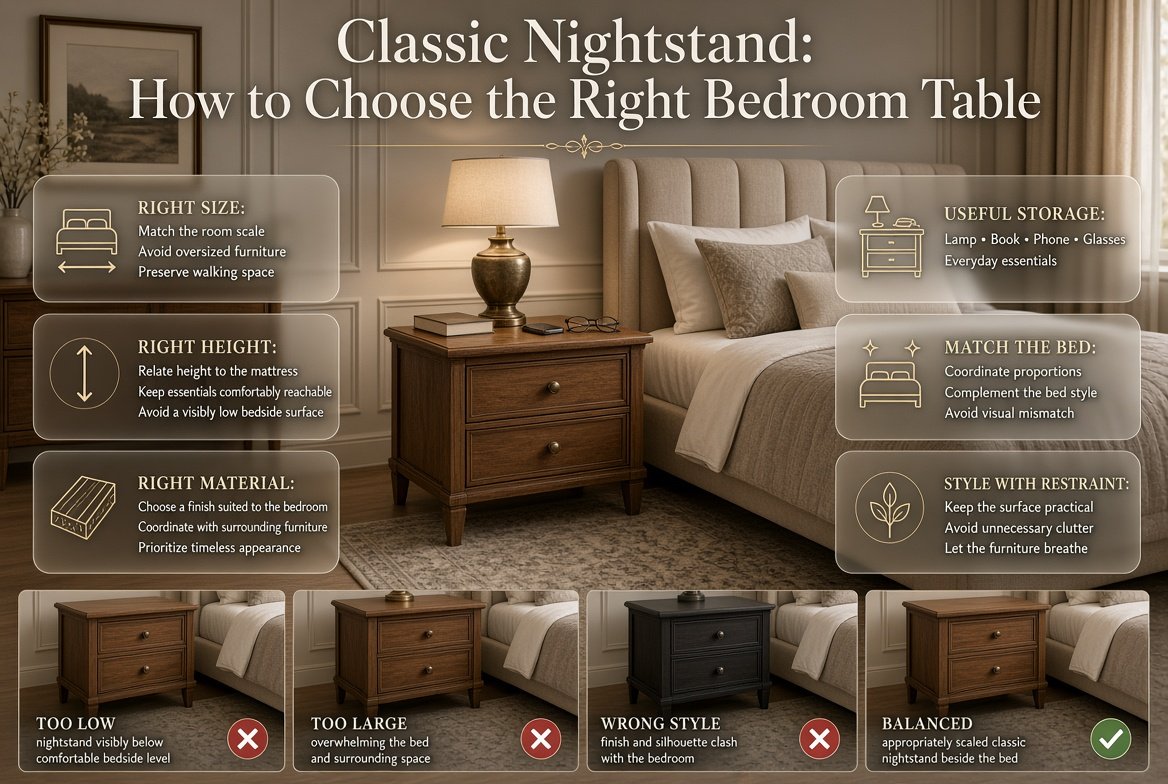
Before choosing a nightstand, measure the bedroom and consider how you actually use the space. The correct piece should fit beside the bed comfortably, align with the mattress area, provide enough surface space, and offer storage that matches your routine.
Don’t begin by choosing a finish or decorative style.
Start with function.
Ask yourself:
- How much space is available beside the bed?
- How tall is the mattress?
- What needs to stay on the nightstand?
- Do you need drawers or only an open surface?
- Does the room need additional storage?
- Which furniture pieces should the nightstand coordinate with?
- How much visual weight can the room handle?
These questions prevent one of the most common bedroom-furniture mistakes: buying something attractive before checking whether it actually works.
How Tall Should a Classic Nightstand Be?
A nightstand generally works best when its top is close to the height of the mattress, or slightly above or below it depending on the bed design and personal preference. A common target is roughly the mattress-top height, because this makes lamps, phones, books, and drinks easier to reach.
The exact measurement matters less than the relationship between the bed and table.
For example, if your mattress is unusually high because of a thick mattress and box spring, a standard low nightstand may look awkward and become inconvenient.
A Simple Height Check
Measure from the floor to the top of your mattress.
Then compare that measurement with the nightstand height.
Ideally:
Nightstand height ≈ mattress-top height
A difference of a few inches can still look intentional, especially when the bed itself has a tall headboard or unusual frame.
💡 Pro Tip: Sit on the bed and imagine reaching for your phone or switching off the lamp. If you have to lean noticeably downward or stretch upward, the height deserves another look.
How Wide Should a Classic Nightstand Be?
The ideal width depends on the available wall space and the size of the bed.
A small bedside table may be enough for a narrow bedroom, while a larger bed can usually support a wider nightstand visually.
As a practical starting point:
| Bed Size | Typical Nightstand Relationship |
|---|---|
| Twin | Compact nightstand |
| Full | Small to medium |
| Queen | Medium |
| King | Medium to wide |
| California King | Medium to wide, depending on room |
The important point is proportion.
A tiny table beside a substantial upholstered king bed can look lost. On the other hand, an oversized cabinet beside a small bed can make the room feel crowded.
Should Both Nightstands Match?
Matching nightstands are not mandatory, but they are usually the easiest way to create a balanced bedroom.
Two identical classic nightstands create visual symmetry, particularly when positioned on both sides of a centered bed.
However, mismatched pieces can work when they share important characteristics such as:
- Similar height
- Similar visual weight
- Related wood tones
- Compatible hardware
- Similar proportions
- A common design language
For example, one side could have a traditional three-drawer chest while the other uses a smaller cabinet, provided both pieces feel intentionally related.
When Should You Use Matching Nightstands?
Choose matching pieces when:
- You prefer symmetry.
- The bedroom has a formal appearance.
- The bed is centered on the main wall.
- You want the room to feel calm and organized.
- You don’t want furniture differences to become a focal point.
When Does Mismatching Work Better?
Mismatched nightstands can be useful when the room is more relaxed or collected.
They can also solve practical problems when one side of the bed has less available space than the other.
⭐ Expert Tip: When mismatching nightstands, match their visual weight rather than trying to make every detail identical.
What Materials Work Best for a Classic Nightstand?

Wood remains one of the safest choices for a timeless bedroom.
Oak, walnut, maple, cherry, mahogany-inspired finishes, painted wood, and other durable wood tones can all create a classic appearance.
The best material depends on the room and the desired atmosphere.
Solid Wood
Solid wood is valued for durability, repairability, and natural character.
It can also age beautifully when maintained properly.
Its main drawback is that quality solid wood furniture can be heavier and more expensive than engineered alternatives.
Wood Veneer
A good wood veneer can provide an authentic wood appearance while allowing manufacturers to control cost and stability.
Quality matters, however. Poor construction can make inexpensive veneer furniture feel less substantial.
Engineered Wood
Engineered materials can be perfectly practical for a nightstand, particularly when the design is well constructed.
Look closely at:
- Drawer movement
- Edge finishing
- Hardware
- Back panels
- Joinery
- Surface durability
The material alone doesn’t tell you the entire quality story.
Which Classic Nightstand Style Is Right for Your Bedroom?
“Classic” covers several design directions. Choosing between them becomes easier when you understand the visual differences.
Traditional Classic Nightstand
Traditional designs often feature:
- Detailed drawer fronts
- Turned or tapered legs
- Decorative hardware
- Rich wood finishes
- Raised panels
- Curved details
These work especially well in formal bedrooms.
Transitional Nightstand
Transitional designs sit between traditional and contemporary.
They may feature:
- Straight lines
- Simple hardware
- Warm wood
- Limited ornamentation
- Clean drawer fronts
This is often the most versatile choice for modern homeowners who want timeless furniture without excessive decoration.
Farmhouse Classic Nightstand
Farmhouse-inspired nightstands typically use:
- Natural or distressed finishes
- Simple hardware
- Shaker-style detailing
- White, cream, gray, or natural wood
- Practical storage
The look works particularly well with textured bedding and relaxed accessories.
If you’re developing a farmhouse-inspired bedroom, you can also explore farmhouse pillow covers to understand how smaller textile choices can support the furniture style.
Classic Painted Nightstand
A painted nightstand can make a bedroom feel lighter.
White, cream, beige, muted gray, and soft green can all work, depending on the surrounding palette.
Painted furniture is particularly useful when the room already contains several wood tones and you want to introduce contrast.
How Much Storage Should a Classic Nightstand Have?
The right amount of storage depends on what you keep beside your bed.
If your nightstand usually holds only a phone and reading glasses, a single drawer may be enough.
If you store medication, books, charging accessories, personal items, or electronics nearby, two or three drawers can be more practical.
Common Storage Configurations
| Configuration | Best For |
|---|---|
| Open shelf | Books and decorative objects |
| One drawer | Minimal bedside storage |
| Two drawers | Everyday essentials |
| Three drawers | More substantial storage |
| Drawer + cabinet | Mixed concealed storage |
| Cabinet only | Larger objects and visual simplicity |
A nightstand shouldn’t become a miniature junk drawer.
The purpose of storage is to keep the room visually calm while keeping frequently used items accessible.
Is an Open Shelf Better Than Drawers?
Neither is universally better.
Open shelving makes books and decorative objects easy to access, but everything remains visible.
Drawers conceal clutter and usually create a cleaner appearance.
A combination can be ideal.
For example:
Top surface → lamp + small object
Drawer → phone accessories + personal items
Lower shelf → books
This creates a useful division between things you need regularly and things you want to keep visually hidden.
How Do You Match a Classic Nightstand With Your Bed?
The nightstand doesn’t need to be an exact match for the bed.
Instead, coordinate the two pieces through proportion, finish, color, and style.
A traditional wood bed can pair naturally with a similar wood nightstand, but a wood nightstand can also look excellent beside an upholstered bed.
Consider the Headboard First
The headboard usually has more visual importance than the nightstand.
If the headboard is highly detailed, choose a quieter nightstand.
If the headboard is simple, the nightstand can introduce additional texture or traditional character.
This approach prevents the bedroom from becoming visually overloaded.
How Do Wood Tones Work Together?
Matching every wood tone isn’t necessary.
In fact, a bedroom can look more sophisticated when two or three related wood tones are used intentionally.
The key is repetition.
For example:
- Walnut nightstand
- Warm wood picture frame
- Wooden bench
- Small wood decorative object
The repeated material makes the differences feel intentional.
⚠ Common Mistake: Using several unrelated wood colors without repeating any of them can make the bedroom feel accidental rather than designed.
How Should You Style a Classic Nightstand?
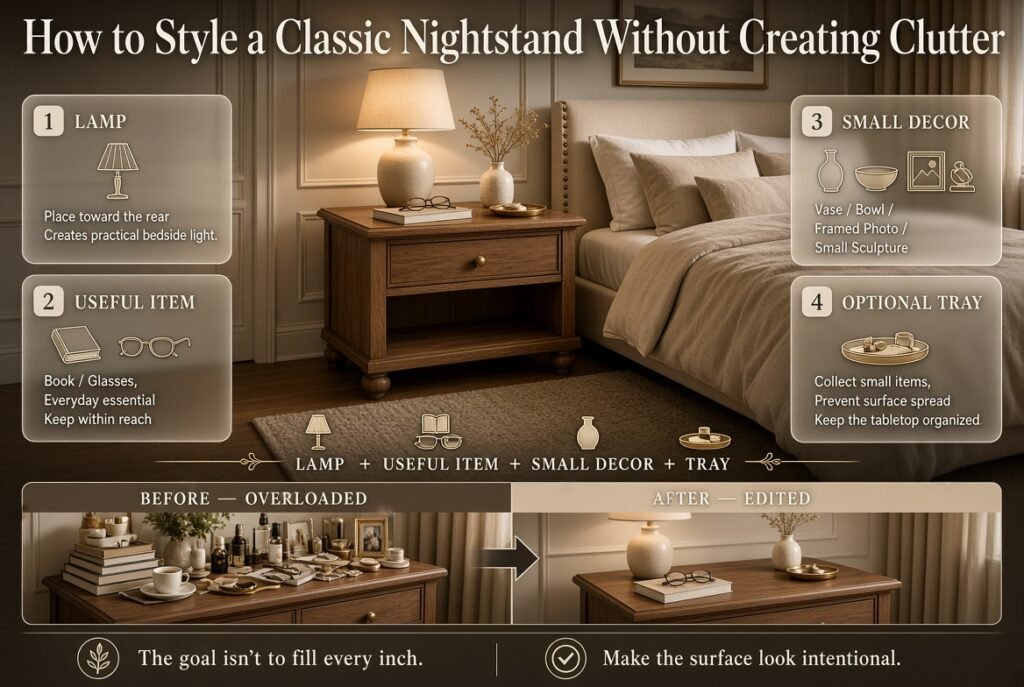
A beautifully designed nightstand can still look messy if the surface is overloaded.
A practical arrangement usually needs only a few elements:
Lamp + small decorative object + useful everyday item
A book, small tray, ceramic piece, framed photograph, or plant can provide personality without creating visual clutter.
A Simple Styling Formula
Try this arrangement:
1. Lamp
Place the lamp toward the rear of the nightstand.
2. Useful item
Keep your book, glasses, or other regularly used object within easy reach.
3. Small decorative element
Add one object such as a small vase, bowl, framed photo, or sculpture.
4. Optional tray
A tray can collect small items and stop them from spreading across the surface.
The goal isn’t to fill every inch.
The goal is to make the surface look intentional.
Can a Classic Nightstand Work in a Minimalist Bedroom?
Absolutely.
The classic appearance should come from the furniture’s proportions and material rather than excessive decoration.
Choose a nightstand with:
- Simple drawer fronts
- Limited hardware
- One warm finish
- Clean proportions
- Minimal decorative carving
Then keep the styling restrained.
Two or three carefully chosen objects can make the space feel complete without undermining the minimalist approach.
For more guidance on balancing warmth and simplicity, neutral throw pillows can provide useful ideas about creating a restrained bedroom palette.
How Can You Make a Classic Nightstand Look More Modern?
You don’t necessarily need new furniture.
Small changes can update the appearance of a traditional piece.
Try:
- Replacing ornate hardware with simpler pulls
- Using a modern lamp
- Pairing it with contemporary bedding
- Introducing a clean-lined mirror
- Removing excessive decorative objects
- Using a restrained color palette
This creates a transitional look without sacrificing the timeless quality of the nightstand.
How Does Lighting Affect a Classic Nightstand?
Lighting is one of the most important elements around a bedside table.
A nightstand lamp should provide enough illumination for reading without overpowering the room.
Consider:
- Lamp height
- Shade width
- Light direction
- Bulb warmth
- Nightstand width
- Headboard height
A very small lamp can look lost on a large nightstand. An oversized lamp can overwhelm a narrow table.
For broader ideas about coordinating lighting with furniture and ceiling elements, see Lighting and Ceiling Ideas as part of a larger room-planning approach.
What Should You Keep on a Nightstand?
The best nightstand setup depends on your routine.
Useful items may include:
- Reading glasses
- A book
- Phone
- Charging cable
- Alarm clock
- Small lamp
- Water
- Small tray
- Hand cream
- Decorative object
Not everything belongs on the surface.
If you have to move several objects every night before going to sleep, the setup is probably too complicated.
📌 Quick Tip: Keep the items you touch every night closest to your dominant hand and move less frequently used objects into drawers.
How Can You Hide Charging Cables?
Visible charging cables can make even an elegant bedroom look untidy.
If possible, position the nightstand close to an outlet and route the cable behind the furniture.
Cable clips or simple cord-management solutions can prevent wires from falling onto the floor.
If the nightstand has a rear opening, use it to route charging cables discreetly.
For a cleaner result, consider where the outlet is located before finalizing the nightstand position.
Should a Classic Nightstand Have a Built-In Charging Station?
A built-in charging station can be useful, but it isn’t essential.
Modern charging features can improve convenience, particularly if you regularly charge a phone, smartwatch, or other devices beside the bed.
However, technology can eventually become outdated.
A traditional nightstand with accessible power nearby may offer more flexibility over the long term.
This is one reason timeless furniture remains valuable: you can update the technology around it without replacing the furniture itself.
How Does a Classic Nightstand Fit Into a Complete Bedroom Design?
A nightstand should be considered as part of the entire bedroom composition.
Look at the relationship between:
Bed → Nightstands → Lamps → Rug → Window Treatments → Bedding → Accessories
If these elements have no visual relationship, the room can feel disconnected even when every individual item is attractive.
For a broader approach to coordinating a complete room, the Interior Design section offers a useful starting point for thinking about furniture, color, layout, and decoration together.
How Can Color Improve a Classic Nightstand?
Color should support the room rather than compete with it.
A dark wood nightstand can add depth to a light bedroom.
A painted cream or white piece can make a darker room feel softer.
A medium natural wood finish can act as a bridge between contrasting colors.
Think about the visual weight of the piece.
Dark furniture generally appears heavier, while pale finishes tend to feel lighter.
This doesn’t mean dark furniture should be avoided in small rooms. It simply means the rest of the room should provide enough visual breathing space.
For additional color planning ideas, Paint Color can help when coordinating furniture with the surrounding walls.
How Can You Refresh a Bedroom Without Replacing the Nightstand?
Sometimes the nightstand is already good; the room simply needs better coordination.
Before buying new furniture, consider changing:
- Bedding
- Lamp shades
- Hardware
- Wall color
- Decorative objects
- Artwork
- Curtains
- Throw pillows
A carefully selected nightstand can remain useful for many years while the surrounding accessories evolve.
This approach is especially practical for homeowners working with a limited decorating budget.
If you’re considering a broader update, Room Refresh offers another useful way to think about changing a room without completely starting over.
What Are the Most Common Classic Nightstand Mistakes?
Even experienced homeowners can make simple furniture-placement mistakes.
Choosing the Wrong Height
A nightstand that’s dramatically lower or higher than the mattress can be inconvenient.
Why it happens: People often buy furniture based on appearance alone.
How to avoid it: Measure the mattress before shopping.
Buying Too Much Furniture
A large nightstand can provide storage, but too much furniture can make movement difficult.
Why it happens: Storage needs encourage people to choose the largest available piece.
How to avoid it: Measure the walking clearance around the bed first.
Matching Everything Too Closely
A bedroom doesn’t need every piece to come from the same collection.
Why it happens: Matching furniture feels safe.
How to avoid it: Coordinate style and proportion instead of demanding identical finishes.
Overloading the Surface
A nightstand can quickly become a storage area for everything.
Why it happens: It’s conveniently located.
How to avoid it: Give every item a designated drawer or storage location.
Ignoring Scale
A small table beside a massive bed can disappear visually.
Why it happens: The nightstand looks appropriate by itself.
How to avoid it: Evaluate the nightstand beside the entire bed rather than alone.
Choosing Trendy Details Over Quality
A fashionable finish may look impressive temporarily.
Why it happens: Trends are highly visible online.
How to avoid it: Prioritize construction, proportion, and materials first.
How Can You Use a Classic Nightstand in a Small Bedroom?
Small bedrooms need furniture that performs more than one job.
Look for a compact piece with vertical storage rather than excessive width.
A narrow nightstand with two drawers can often provide enough capacity without consuming valuable floor space.
You can also consider:
- Wall-mounted lighting
- Smaller lamps
- Slim furniture
- Under-bed storage
- Reduced decorative accessories
The objective is to preserve useful bedside function without making the room feel crowded.
For broader space-saving strategies, Smart Storage and Organization Ideas can help you think beyond the nightstand itself.
Can You Use a Classic Nightstand in a Guest Bedroom?
A classic nightstand is particularly useful in a guest bedroom because its timeless design works for different visitors and decorating preferences.
Keep the setup simple.
A guest room nightstand should ideally provide:
- A reading lamp
- Space for a phone
- A drawer
- A charging option
- A little open surface area
Avoid filling it with personal items.
The guest should immediately understand what the furniture is for and have enough space for their own belongings.
What Nightstand Features Are Actually Worth Paying For?

Not every upgrade is equally valuable.
Prioritize features that improve daily use.
Worth Paying For
- Solid drawer construction
- Smooth drawer slides
- Durable finish
- Quality hardware
- Stable construction
- Useful storage
- Proper proportions
Less Important
- Excessive decorative detailing
- Trend-specific finishes
- Features you’ll never use
- Oversized furniture simply because it offers more storage
The best purchase is rarely the piece with the longest feature list.
It’s the piece that performs its job reliably.
How Can DIY Changes Improve an Older Nightstand?
An older nightstand may only need cosmetic improvement.
Simple updates can include:
- Cleaning and refinishing
- Replacing hardware
- Painting
- Adding drawer liners
- Improving cable management
- Updating the lamp
- Simplifying the surrounding decor
Before making structural changes, check whether the furniture is worth restoring.
Solid, well-built furniture can often justify more effort than inexpensive flat-pack construction.
If you’re interested in practical home projects, DIY Home Projects can provide additional ideas for making useful changes without replacing everything.
How Do Pillows and Bedding Affect the Appearance of a Nightstand?
Although the nightstand is a furniture piece, the surrounding textiles strongly influence how it looks.
A traditional nightstand paired with highly modern bedding can feel transitional.
A simple wood nightstand with layered textured bedding can feel relaxed and welcoming.
Color repetition also matters.
For example, if the nightstand has a warm wood finish and the bedding includes warm beige and cream tones, the entire arrangement feels more connected.
You can introduce color through accessories without changing the furniture itself. For example, Blue and Green Pillows can demonstrate how controlled accent colors can influence the overall mood of a room.
How Can You Make a Classic Bedroom Feel Expensive?
An expensive-looking bedroom isn’t necessarily filled with expensive furniture.
The appearance usually comes from coordination.
Focus on:
- Proper furniture scale
- Consistent spacing
- Layered lighting
- High-quality-looking textiles
- Limited decorative clutter
- Repeated materials
- Intentional color choices
A classic nightstand can contribute significantly because it gives the bed area structure.
The difference between a polished room and a random collection of furniture often comes down to small relationships.
For broader styling principles, Easy Decorating Tips for Every Budget is useful when you want a polished result without treating every item as a luxury purchase.
What Can a Nightstand Tell You About the Rest of the Room?
Furniture choices often reveal the design direction of a bedroom.
A heavily carved nightstand suggests traditional styling.
A simple oak cabinet suggests a warmer transitional approach.
A painted shaker-style piece can lean farmhouse.
A clean walnut table can feel contemporary while still being timeless.
This is why the nightstand should not be selected in isolation.
It should support the room’s overall visual language.
How Do You Create Balance With Two Different Nightstands?
If you prefer an eclectic bedroom, different nightstands can create personality.
The trick is to control the differences.
For example:
Left side: dark wood three-drawer nightstand
Right side: painted cabinet
To make this combination work, use lamps with similar heights and keep the bed centered.
You might also repeat a shared material elsewhere in the room.
This creates balance without forcing symmetry.
What Role Does Artwork Play Around a Classic Nightstand?
Artwork can make the bedside area feel finished, but it should be proportionate.
A small piece above a large nightstand may feel insignificant.
A huge artwork can overpower the bed.
Consider the entire wall composition rather than judging the artwork by itself.
A pair of similarly sized artworks can work well when each is positioned above its respective nightstand.
Alternatively, one large artwork centered over the bed can create a stronger focal point.
How Does Flooring Affect the Choice of Nightstand?
Flooring is another factor people often overlook.
Dark flooring combined with dark furniture can create a dramatic bedroom, but the room may need lighter textiles and walls to maintain balance.
Light flooring gives you more flexibility with darker nightstands.
Wood flooring also introduces another wood tone, so don’t automatically assume the nightstand needs to match it exactly.
Instead, look for undertones.
Warm flooring generally works better with warm furniture finishes, while cooler finishes may complement gray or neutral flooring.
For more ideas about coordinating the floor with walls and furniture, explore Flooring and Wall Design Inspiration.
How Do You Know When a Classic Nightstand Is the Right Choice?
A classic nightstand is a strong choice when you want furniture that remains useful even as your decorating preferences evolve.
It’s especially suitable when you value:
- Timeless design
- Practical storage
- Flexible styling
- Durable materials
- Easy coordination
- Long-term use
It’s less suitable if your goal is a highly experimental room where every piece is deliberately unconventional.
Even then, a classic nightstand can provide a stable foundation while accessories create the personality.
Can Celebrity Bedrooms Teach You Anything About Classic Furniture?
Looking at high-end or celebrity interiors can be useful when you focus on design principles rather than trying to copy a specific room.
Luxury interiors often rely on:
- Scale
- Symmetry
- Material repetition
- Layered lighting
- Restrained accessories
- Strong focal points
For example, examining the design decisions discussed in Mark Cuban House can provide inspiration for how larger interiors use furniture, space, and visual hierarchy.
The lesson isn’t that you need celebrity-level furniture.
It’s that proportion and composition often matter more than price.
How Does a Classic Nightstand Support Whole-Home Design?
A bedroom shouldn’t feel disconnected from the rest of the house.
If your home uses warm wood, neutral colors, classic hardware, and restrained decoration in other rooms, repeating those principles in the bedroom creates continuity.
This is where whole-home planning becomes useful.
For room-by-room ideas, Find Expert Ideas for Every Room in Your Home can help you think about the bedroom as part of a larger interior rather than an isolated project.
Similarly, Home Improvement can be useful when your bedroom project involves changes beyond furniture, such as walls, flooring, lighting, or layout.
When Should You Replace Your Existing Nightstand?
Replacement makes sense when the furniture no longer meets your needs.
Consider replacing it if:
- The drawers no longer function properly.
- The piece is unstable.
- The height is inconvenient.
- Storage is inadequate.
- The proportions are wrong for your new bed.
- The finish is badly damaged.
- The style conflicts with the room.
- It creates circulation problems.
Don’t replace a perfectly functional piece simply because a new trend appeared.
Timeless furniture earns its value by remaining useful.
What Is the Best Way to Shop for a Classic Nightstand?
Shopping becomes easier when you create a checklist before looking at products.
Measure First
Record:
- Available width
- Maximum depth
- Mattress height
- Outlet position
- Walking clearance
Define Storage Needs
Decide whether you need:
- One drawer
- Multiple drawers
- Cabinet storage
- Open shelving
- Mixed storage
Choose the Design Direction
Decide whether you prefer:
- Traditional
- Transitional
- Farmhouse
- Minimal classic
- Painted
- Natural wood
Check Construction
Look beyond photographs.
Check:
- Drawer quality
- Hardware
- Stability
- Finish
- Back construction
- Weight
- Assembly requirements
Think Long Term
Ask whether the piece would still work if you changed:
- Bedding
- Wall color
- Lamp
- Rug
- Headboard
- Decorative accessories
If the answer is yes, you’ve probably found a more flexible design.
What Are the Biggest Benefits of a Classic Nightstand?
The strongest advantage is versatility.
A well-designed classic nightstand can move through different decorating phases without becoming unusable.
Main Benefits
- Timeless appearance
- Practical storage
- Easy coordination
- Strong resale or long-term value potential
- Works with multiple bedroom styles
- Can be updated through hardware and accessories
- Provides visual balance beside the bed
Potential Drawbacks
Classic furniture isn’t perfect for everyone.
Some designs can be:
- Heavier
- More traditional-looking
- More expensive when made from quality materials
- Less compact than modern minimalist alternatives
The key is choosing the right interpretation of classic rather than assuming every classic design is ornate.
How Do You Create a Cohesive Nightstand Arrangement?
Think in layers instead of isolated objects.
Start with the largest element:
Bed
Then establish:
Nightstand → Lamp → Bedding → Rug → Artwork → Accessories
Each layer should relate to the previous one.
For example, a warm wood nightstand can connect with a wood-framed mirror. The lamp can repeat the metal finish of the bed hardware. Bedding can introduce a color found elsewhere in the room.
This type of repetition creates cohesion without requiring identical furniture.
What Is the Ideal Height for a Classic Nightstand?
The ideal height for a classic nightstand is usually close to the top of your mattress. In most bedrooms, keeping the nightstand level with the mattress or slightly above it makes the piece easier to use and visually balanced. Common nightstand heights often fall around 24–28 inches, but your actual mattress height should always take priority over a standard measurement.
A nightstand that’s too low can make you reach downward for your phone, lamp, or glass of water. A piece that’s dramatically taller can feel awkward and may interfere visually with the bed and headboard.
Points to consider:
Measure from the floor to the very top of the mattress, including any topper.
Aim for a tabletop that is approximately level with the mattress.
A difference of an inch or two is generally easy to work with.
Consider the height of the bed frame and headboard, not just the mattress.
Sit or lie on the bed and imagine reaching for the lamp or phone before making the final decision.
Professional tip: Don’t choose a classic nightstand simply because its listed dimensions look “standard.” Bedroom furniture is highly dependent on proportions. Measure your actual bed first, then shop around that measurement.
What Size Classic Nightstand Should You Choose for a Queen or King Bed?
For most queen and king bedrooms, a classic nightstand in the medium-to-wide range provides the best combination of proportion, storage, and usable surface space. Typical nightstands are often around 21–28 inches wide, while larger options can work particularly well beside king-size beds when the room has enough clearance.
The important factor isn’t simply the size of your bed. You also need to consider the available wall space, walking clearance, lamp size, and how much you actually keep beside the bed.
A narrow table may look elegant in a photograph but become frustrating if there’s only enough room for a tiny lamp and phone. Conversely, an oversized nightstand can make a bedroom feel cramped.
Points to consider:
Queen beds generally work well with medium-sized nightstands.
King beds can visually support wider nightstands.
Measure the available space between the bed and the wall.
Check the depth so drawers don’t interfere with movement.
Leave enough room to walk comfortably around the bed.
Consider the size of your bedside lamp before selecting the tabletop.
Professional tip: Think about the nightstand as part of a three-piece composition: bed + nightstand + lamp. If one element is dramatically smaller or larger than the others, the arrangement can feel unbalanced even when each item looks good individually.
Should Classic Nightstands Match the Bed and Dresser?
A classic nightstand doesn’t have to exactly match the bed or dresser. In fact, coordinating furniture through similar finishes, proportions, hardware, or design details often creates a more sophisticated bedroom than using an identical furniture set throughout the room.
Matching pieces are still a strong option when you want a symmetrical, traditional bedroom. Two identical nightstands on either side of the bed can immediately establish order and make the room feel calm.
However, exact matching isn’t the only way to create cohesion.
For example, a walnut nightstand can work with a lighter wood bed if the room repeats warm wood tones elsewhere. Similarly, a painted nightstand can work beside an upholstered bed when the colors and proportions are thoughtfully connected.
Points to consider:
Match the overall design language rather than every detail.
Repeat wood tones somewhere else in the bedroom.
Coordinate hardware finishes when possible.
Keep mismatched nightstands at similar visual heights.
Use matching lamps to create symmetry when the furniture differs.
Avoid introducing too many unrelated finishes.
Professional tip: If you’re using different nightstands, match their visual weight rather than forcing them to be identical. Two pieces can have completely different designs and still feel balanced when their height, scale, and surrounding accessories are carefully controlled.
Are Classic Nightstands Still Stylish in Modern Bedrooms in 2026?
Classic nightstands remain highly relevant because their strongest qualities—good proportions, useful storage, natural materials, and timeless construction—don’t depend on short-lived decorating trends. Current bedroom design is also moving toward spaces that feel more personal, tactile, comfortable, and less like perfectly matched showroom sets.
This makes a classic nightstand particularly useful in a modern bedroom. You can combine a traditional wood nightstand with contemporary bedding, a simple upholstered bed, modern lighting, or minimalist accessories.
The result is often a transitional look: traditional enough to feel warm and established, but clean enough to feel current.
The key is choosing the right version of “classic.” An extremely ornate piece with heavy decorative details may create a strongly traditional look, while a simple wood nightstand with clean drawer fronts can move easily between traditional and contemporary interiors.
Points to consider:
Choose natural wood for warmth and longevity.
Keep decorative accessories relatively restrained.
Pair traditional furniture with clean-lined lighting.
Use modern bedding to update an older-looking piece.
Avoid combining too many competing furniture styles.
Let one classic piece become a character element instead of filling the room with matching antiques.
Professional tip: Don’t try to make a classic nightstand look trendy. Instead, surround it with a few current elements. A contemporary lamp, textured bedding, modern artwork, or restrained accessories can update the entire composition without sacrificing the timeless character of the furniture.
How Do You Style a Classic Nightstand Without Making It Look Cluttered?
The best classic nightstand styling combines function with restraint. Start with the items you genuinely use every night, then add only one or two decorative elements. A lamp, small tray, book, and single decorative object are usually enough to create a finished appearance without turning the bedside table into a storage zone.
This approach is particularly relevant to current bedroom design, where designers are increasingly emphasizing calm, tactile spaces and reducing unnecessary visual stimulation.
A practical arrangement might place the lamp toward the back of the table, a small tray toward the front for everyday items, and a book or decorative object beside it. Keep frequently used items accessible and move everything else into drawers.
Points to consider:
Start with the bedside lamp.
Add one useful everyday item.
Use a small tray to organize loose objects.
Keep decorative accessories limited.
Leave some visible empty tabletop space.
Hide charging cables whenever possible.
Use drawers for items that don’t need to remain visible.
Professional tip: Empty space is part of the styling. You don’t need to fill the entire surface to make the nightstand look complete. In many well-designed bedrooms, the negative space around a few carefully selected objects is what makes the arrangement look expensive and intentional.
A Simple Styling Formula
Classic Nightstand
↓
Lamp
↓
Useful everyday item
↓
Small decorative accent
↓
Clear surface space
This gives you a bedside area that feels designed rather than decorated for the sake of decoration.
Conclusion
A classic nightstand is more than a convenient place to keep a lamp, book, or phone. When chosen carefully, it can bring balance, storage, comfort, and a timeless sense of style to the entire bedroom. The best choice depends on practical details such as the nightstand’s height, width, storage needs, material, finish, and relationship to the bed.
You do not need perfectly matching furniture to create a polished bedroom. A well-proportioned classic nightstand can work beautifully with traditional, farmhouse, transitional, modern, or contemporary interiors. The key is to create visual connection through materials, colors, hardware, and overall proportions rather than making every piece identical.
When styling the surface, keep the arrangement intentional. A useful lamp, a small decorative object, a book, and a simple tray can provide enough function and personality without creating unnecessary clutter. For smaller bedrooms, choosing the right dimensions and keeping the bedside area visually light can make the space feel considerably more comfortable.
Ultimately, the right classic nightstand should support the way you actually use your bedroom while complementing its design. Choose quality over unnecessary decoration, prioritize useful storage, maintain comfortable proportions, and allow the piece to add character rather than compete with the rest of the room. Done well, a classic nightstand can remain stylish and functional for years while giving your bedroom a more complete and thoughtfully designed appearance.

Leave a Reply