
Introduction
Blue and Green Pillo | A sofa can be comfortable, the walls can be beautifully painted, and the furniture can be well chosen, yet the room may still feel unfinished. One of the easiest ways to change that feeling is to introduce the right combination of color, texture, and pattern through decorative pillows.
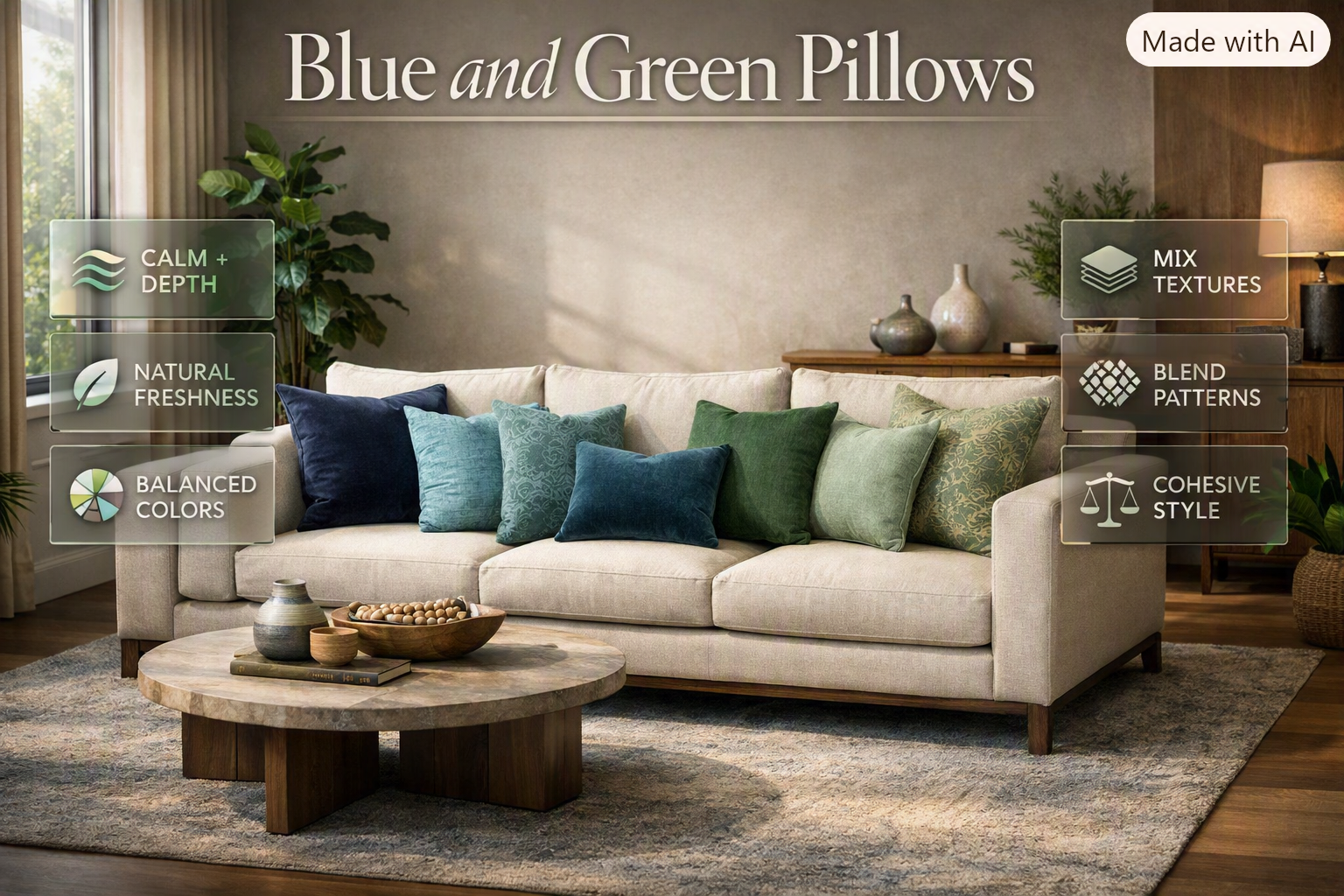
Blue and green pillows are especially effective because they bring two naturally compatible colors into the room without making the space feel unnecessarily complicated. Blue can add calmness and depth, while green introduces freshness and an organic connection to nature. Depending on the shades and fabrics you choose, the same palette can feel modern, elegant, coastal, earthy, traditional, or relaxed.
The challenge isn’t simply finding blue and green pillows. It’s knowing which shades belong together, how many pillows to use, what colors to pair with them, how to mix patterns, and how to make the entire arrangement feel intentional.
If you’re planning a broader interior update, DesignMode24 Interior Design can also provide a useful starting point for thinking about how individual decorative choices fit into the overall design of a room.
This guide explains how to choose, arrange, and coordinate blue and green pillows so they complement your sofa, rug, walls, furniture, and overall interior style.
Why Do Blue and Green Pillows Work So Well Together?
Blue and green work together because they have a natural visual relationship. They can create contrast while still feeling connected, especially when you choose shades with similar depth or saturation. Navy with sage, dusty blue with eucalyptus, and teal with olive are examples of combinations that feel coordinated rather than accidental.
The relationship between these colors is also flexible. You can make blue the dominant color and use green as an accent, or reverse the arrangement. You can choose pale shades for a soft room or deep shades for a dramatic, sophisticated space.
That’s what makes this palette useful: there isn’t just one way to use it.
A navy pillow with a muted sage cushion can create a completely different impression from a turquoise pillow paired with bright emerald green. Both are blue-and-green combinations, but they suit very different interiors.
What Does Blue Add to a Room?
Blue generally contributes a calm, stable, and composed feeling. Dark blues can add visual weight and sophistication, while lighter blues can make a room feel airy and relaxed.
Common choices include:
- Navy blue
- Dusty blue
- Denim blue
- Powder blue
- Sky blue
- Teal
- Turquoise
- Slate blue
The darker the blue, the more visual authority it tends to have.
What Does Green Add to a Room?
Green brings an organic quality that connects naturally with plants, wood, stone, and other natural materials.
Popular options include:
- Sage
- Olive
- Moss
- Eucalyptus
- Forest green
- Emerald
- Seafoam
- Leaf green
Muted greens tend to be easier to decorate with, while emerald and brighter greens create more energy.
💡 Pro Tip: If you’re decorating for the first time, start with a muted green such as sage or olive. These shades are forgiving and usually easier to coordinate with existing furniture.
How Do You Choose the Right Blue and Green Pillow Shades?
The easiest mistake to make is choosing colors based only on whether you personally like them. A pillow can look beautiful in a store and still look completely different in your living room.
Start with the colors already present in the space.
Look at:
- Sofa upholstery
- Wall color
- Flooring
- Curtains
- Area rug
- Artwork
- Wood finishes
- Existing decorative accessories
- Natural light
You don’t need every item to match. You simply want the pillows to have a relationship with the existing palette.
Blue and Green Combination Guide
| Blue shade | Green shade | Design character |
|---|---|---|
| Navy | Sage | Elegant and relaxed |
| Navy | Emerald | Rich and dramatic |
| Dusty blue | Eucalyptus | Soft and contemporary |
| Denim | Olive | Casual and earthy |
| Sky blue | Seafoam | Light and coastal |
| Teal | Olive | Sophisticated and organic |
| Slate blue | Moss | Mature and understated |
| Turquoise | Leaf green | Bright and energetic |
| Royal blue | Emerald | Bold and luxurious |
| Powder blue | Sage | Gentle and calming |
For most neutral living rooms, navy and sage are particularly easy to work with. They provide enough contrast to be noticeable without overwhelming the room.
What Color Sofa Looks Best With Blue and Green Pillows?

The sofa is the foundation of your pillow arrangement, so its color should influence your choices.
Blue and Green Pillows on a White Sofa
White creates a clean background and allows blue and green to become the main visual accents.
You can use:
- Navy and sage
- Sky blue and eucalyptus
- Teal and emerald
- Blue-green botanical prints
- Cream textures alongside darker colors
If the room already feels very bright, darker blue and green pillows can add useful depth.
Blue and Green Pillows on a Cream Sofa
Cream is warmer than pure white, so it works especially well with earthy greens and softer blues.
Try:
Cream sofa + sage + dusty blue + beige texture
or:
Cream sofa + navy + olive + ivory pattern
The second option creates more contrast, while the first feels softer.
Blue and Green Pillows on a Gray Sofa
Gray is one of the most flexible sofa colors for this palette.
A medium-gray sofa can support navy and sage beautifully. A charcoal sofa can handle stronger colors such as emerald and teal.
If the gray has a distinctly cool undertone, consider adding olive, moss, beige, or warm wood elsewhere in the room to prevent the overall design from becoming too cold.
Blue and Green Pillows on a Beige Sofa
Beige provides warmth, so it naturally complements green.
Sage, olive, eucalyptus, denim blue, and navy are particularly useful choices.
This combination works well when you’re aiming for an earthy, comfortable living room rather than a highly dramatic one.
For additional ideas about improving a home’s overall visual foundation, explore the Home Improvement section.
Blue and Green Pillows on a Blue Sofa
A blue sofa doesn’t mean every pillow should be blue.
In fact, adding green can create the contrast the sofa needs.
For example:
Navy sofa → sage pillow → cream pillow → blue-green patterned pillow → olive accent
The different colors and textures stop the sofa from looking like one large block of blue.
Blue and Green Pillows on a Green Sofa
If your sofa is green, blue can become the supporting color.
An olive sofa can work beautifully with navy and dusty blue. A darker forest-green sofa may need lighter blue, cream, or gray accents to keep the arrangement from becoming visually heavy.
How Many Blue and Green Pillows Should You Put on a Sofa?
There isn’t a universal rule, but the size and depth of your sofa matter.
A typical three-seat sofa often looks balanced with three to five pillows. A larger sectional can accommodate more, but the arrangement should still leave comfortable seating space.
For example:
3 pillows
- Large navy
- Patterned blue and green
- Sage
5 pillows
- Large navy
- Textured cream
- Blue-green botanical
- Sage
- Olive or muted blue
The important thing is not the exact number. It’s the relationship between the pieces.
If every pillow is colorful and patterned, the arrangement can quickly become visually noisy. If every pillow is identical, it can look flat.
📌 Quick Tip: Think in terms of visual roles rather than simply counting pillows. One pillow can provide color, another texture, another pattern, and another balance.
Should Blue or Green Be the Dominant Color?
Choose the dominant color according to the mood you’re trying to create.
Make Blue the Main Color If You Want:
- A calm atmosphere
- A classic appearance
- More visual depth
- A cooler palette
- A sophisticated living room
For example:
Navy 50% → Sage 30% → Cream 20%
This doesn’t need to be mathematically exact. It’s simply a visual guideline.
Make Green the Main Color If You Want:
- A natural atmosphere
- An earthy feeling
- A connection with plants and wood
- A softer organic look
- More visual freshness
For example:
Sage 50% → Dusty blue 30% → Beige 20%
The dominant color should normally appear more than once, but it doesn’t need to cover the entire sofa.
How Do You Mix Patterns With Blue and Green Pillows?
Pattern mixing is one of the best ways to make a pillow arrangement feel collected rather than purchased as a matching set.
The safest formula is:
Large pattern + small pattern + solid color + texture
For example:
- Large blue-green botanical pillow
- Small navy geometric pillow
- Solid sage pillow
- Cream woven pillow
The patterns don’t need to be identical.
What matters is that they share a visual connection.
A botanical pillow containing navy, sage, ivory, and muted green can connect solid navy and sage pillows even if those pillows have completely different textures.
Why Pattern Scale Matters
If every pattern is large and bold, nothing has a visual resting point.
If every pillow is plain, the arrangement can look lifeless.
Try mixing:
- Large floral or botanical print
- Small geometric design
- Fine stripe
- Solid color
- Textured neutral
⭐ Expert Tip: When you find one patterned pillow you love, use it as the color map for the rest of the arrangement. Pull one blue and one green from that pattern instead of choosing unrelated colors.
Which Pillow Fabrics Work Best With Blue and Green?

Fabric affects how color is perceived.
Velvet
Velvet makes dark shades look deeper and richer. Navy, emerald, forest green, and teal can look especially luxurious in velvet.
Use it selectively. If every pillow is velvet, the arrangement can feel too heavy.
Linen
Linen gives blue and green a relaxed, natural quality.
Sage, eucalyptus, dusty blue, and washed denim are particularly suitable.
Cotton
Cotton is practical for everyday living spaces and works with almost any style.
It’s a good choice when comfort, maintenance, and versatility matter.
Bouclé
Bouclé adds tactile interest. A cream bouclé pillow can provide a useful contrast against smooth navy or green cushions.
Woven Textures
Woven fabrics work particularly well in coastal, earthy, casual, and organic interiors.
The strongest arrangements often combine different textures rather than relying on color alone.
How Do Blue and Green Pillows Work With Different Interior Styles?
The colors themselves don’t determine the style. The surrounding furniture, fabric, pattern, and accessories do.
Modern Interior
For a modern room, keep the palette controlled.
Good choices include:
- Navy
- Slate blue
- Sage
- Olive
- Teal
- Charcoal
Use clean patterns and structured fabrics.
Avoid filling the sofa with many small decorative pillows because modern interiors usually benefit from visual simplicity.
Contemporary Interior
Contemporary rooms can handle stronger contrast.
Try:
Deep navy + emerald + cream
or:
Teal + olive + charcoal
A geometric pattern can add structure without making the space feel traditional.
Coastal Interior
Coastal interiors naturally welcome blue and green.
Use lighter colors such as:
- Sky blue
- Seafoam
- Aqua
- Soft sage
- Pale green
Combine them with linen, cotton, woven textures, light wood, and warm neutrals.
Traditional Interior
Traditional rooms can support deeper colors and more detailed patterns.
Consider:
- Navy velvet
- Forest green
- Emerald
- Botanical prints
- Stripes
- Classic geometric patterns
The richer palette works especially well with traditional wood furniture.
Japandi-Inspired Interior
For a restrained Japandi atmosphere, avoid highly saturated colors.
Choose:
- Muted blue
- Sage
- Eucalyptus
- Soft gray-green
- Warm beige
Natural textures and simple forms are more important than decorative complexity.
If you’re exploring different approaches to interiors, the Interior Design section can help you think about the wider relationship between furniture, color, materials, and styling.
How Do You Arrange Blue and Green Pillows Like a Professional?
A professional-looking arrangement usually has hierarchy.
Don’t place pillows randomly and hope they work.
Step 1: Start With the Largest Pillows
Place your largest cushions toward the back.
They establish the foundation.
Step 2: Add Your Dominant Color
If blue is dominant, introduce one or two blue pillows in different shades or textures.
Step 3: Add Green
Bring green forward as the supporting color.
Don’t necessarily put both green pillows beside each other.
Step 4: Introduce a Connecting Pattern
A patterned pillow containing both colors helps visually connect the arrangement.
Step 5: Add a Neutral
Cream, ivory, beige, taupe, or gray can give the eye a place to rest.
Step 6: Look at the Arrangement From a Distance
This step is often skipped.
Walk away from the sofa and look at it from several feet away.
Ask:
- Is one color dominating too much?
- Are all patterns competing?
- Does one pillow look disconnected?
- Is there enough texture?
- Can people still comfortably sit down?
⚠ Common Mistake: Styling pillows only from close range. A pillow arrangement should work from across the room, not just when you’re standing directly in front of the sofa.
How Can You Make Blue and Green Pillows Look Expensive?
The expensive appearance usually comes from proportion and material rather than price.
A simple pillow arrangement can look sophisticated when:
- The inserts are full
- The fabrics have visible texture
- The colors are coordinated
- Patterns are used selectively
- Pillow sizes vary
- Neutral space is maintained
- The sofa isn’t overcrowded
Avoid buying five pillows simply because they all look attractive individually.
Think about the collection as a whole.
A high-quality arrangement often contains one “hero” pillow that catches attention, while the remaining pillows support it.
This principle also applies to the broader room. If you’re looking for ways to make decorative decisions feel more intentional, the Beautiful Interior guide can provide useful inspiration.
How Do Blue and Green Pillows Work With Neutral Decor?
Neutral rooms are actually some of the best environments for this color combination.
If your room is mostly:
- Beige
- Cream
- White
- Taupe
- Gray
- Natural wood
blue and green can introduce enough color to make the room feel finished without requiring major furniture changes.
Soft Neutral Combination
Cream + sage + dusty blue + natural wood
This is ideal for a relaxed room.
Sophisticated Neutral Combination
Taupe + navy + olive + ivory
This creates more depth.
Dramatic Neutral Combination
Charcoal + navy + emerald + cream
This works well when you want a stronger visual statement.
If you prefer to understand how neutral accessories can be balanced with stronger colors, the Neutral Throw Pillows guide is a useful related resource.
How Do You Coordinate Blue and Green Pillows With a Rug?
Your pillows don’t have to match the rug exactly.
Instead, look for one repeated color.
For example, if your rug is cream with small navy and green details, you can use:
- Solid navy pillow
- Solid sage pillow
- Blue-green patterned pillow
- Cream textured pillow
The rug provides the background connection.
The same principle works with artwork.
If a piece of artwork contains a small amount of green, repeating that green in one pillow can create cohesion without making the room look overly coordinated.
How Can You Coordinate Blue and Green Pillows With Curtains?
Curtains are usually larger visual elements, so you should be careful about adding another strong pattern.
If your curtains are neutral, pillows can carry most of the color.
If your curtains already contain blue and green, use simpler pillows.
For example:
Blue-green patterned curtains → solid navy + sage + cream pillows
Rather than:
Blue-green patterned curtains → three more large patterned pillows
The second arrangement can become too busy.
Can Blue and Green Pillows Work With Wood Furniture?
Yes, and this is one of the strongest combinations for an organic interior.
Wood has natural warmth, while blue and green provide color.
Olive, sage, forest green, navy, dusty blue, and denim can all work beautifully with wood.
Lighter woods tend to work well with softer blue and green shades. Darker woods can support richer navy, emerald, and forest green.
If your room already contains plenty of wood, you don’t need to introduce another strong accent color. Let blue and green provide enough variation.
How Can You Refresh a Room With Blue and Green Pillows?

Replacing decorative pillows is one of the simplest ways to refresh a room without replacing major furniture.
Start by removing the existing pillows.
Then evaluate the room before buying anything.
Ask Yourself:
- Is the sofa too plain?
- Does the room need more color?
- Is the existing palette too cool?
- Does the room already have strong patterns?
- Are there colors in the rug or artwork worth repeating?
Then build your new arrangement around those answers.
For a simple refresh, try:
1 patterned blue-green pillow + 1 solid blue + 1 solid green + 1 neutral texture
That’s often enough to change the visual character of a sofa.
For a more substantial update, you can combine pillow changes with ideas from a Room Refresh strategy.
And if the sofa is part of a larger makeover, Living Room Transformation ideas can help you think beyond accessories.
How Can You Use Blue and Green Pillows in Different Rooms?
Although the living room is the most obvious location, this palette can work elsewhere.
Bedroom
Use softer shades such as:
- Dusty blue
- Sage
- Eucalyptus
- Cream
- Muted teal
Avoid excessive pattern if you want the bedroom to remain restful.
Reading Area
A navy pillow with olive or sage can create a comfortable, sophisticated reading corner.
Add a textured throw and warm lighting.
Home Office
Use fewer pillows and more structured patterns.
A navy lumbar pillow with a muted green accent can bring personality without making the workspace feel decorative.
Entryway Bench
One or two pillows can make a bench more welcoming.
Because the area is smaller, don’t use too many colors.
Blue vs. Green: Which Pillow Color Should You Choose?
| Your goal | Better starting color |
|---|---|
| Calm and classic | Blue |
| Natural and organic | Green |
| Sophisticated | Navy |
| Earthy | Olive |
| Soft and relaxed | Sage |
| Luxurious | Emerald |
| Coastal | Sky blue |
| Bold | Teal |
| Casual | Denim |
| Minimalist | Dusty blue |
This doesn’t mean you have to choose only one. It simply helps identify which color should lead the arrangement.
What Are the Most Common Mistakes With Blue and Green Pillows?
Using Too Many Different Shades
Blue and green each have a huge range of shades.
Navy, turquoise, cobalt, teal, mint, emerald, olive, and lime can technically belong to the same broad color family, but that doesn’t mean they automatically look good together.
Why it happens: People buy pillows separately.
Why it’s a problem: There is no clear visual hierarchy.
Better approach: Select a controlled palette before purchasing.
Matching Everything Too Closely
A complete matching set can look predictable.
Why it happens: Matching feels safe.
Why it’s a problem: The room loses texture and individuality.
Better approach: Match the palette, not every pillow.
Using Only Bright Colors
Bright blue and bright green can quickly dominate a room.
Better approach: Balance stronger shades with muted colors and neutrals.
Ignoring Pillow Size
Five identical 18-inch pillows can look repetitive.
Mixing sizes gives the arrangement more depth.
Choosing Style Before Considering Comfort
A beautiful sofa covered in pillows isn’t useful if nobody can comfortably sit on it.
Always leave practical seating space.
Forgetting the Room’s Undertones
A warm beige sofa and a cool gray wall may require different blue and green shades.
Don’t select colors based solely on online images.
What Should You Avoid When Mixing Blue, Green, and Neutral Colors?
Neutral colors are useful, but the wrong neutral can make the palette feel disconnected.
For example, a very yellow beige can sometimes fight with icy blue.
If your blue is cool and clean, consider:
- Soft white
- Cool gray
- Ivory
- Muted taupe
If your green is earthy and warm, consider:
- Beige
- Sand
- Warm cream
- Natural wood
The goal is to keep the temperature of the overall room reasonably balanced.
How Can You Use Blue and Green Pillows on a Budget?
You don’t need to replace the entire room.
Start with the largest visual problem.
If the sofa looks plain, pillows may be enough.
If the room already has too many accessories, don’t add more. Instead, replace a few existing pieces.
A practical budget arrangement could contain:
- One patterned pillow
- One solid blue pillow
- One solid green pillow
- One inexpensive neutral textured pillow
The patterned pillow becomes the connector, while the solid colors provide repetition.
For more practical decorating strategies, explore Easy Decorating Tips for Every Budget.
How Can You Use DIY Ideas With Blue and Green Pillows?
If you’re comfortable with simple home projects, you can also customize the arrangement rather than buying everything ready-made.
For example, you might:
- Replace old pillow covers
- Sew a simple lumbar cover
- Add a textured fabric
- Reuse neutral pillow inserts
- Mix vintage and new covers
- Create a simple decorative accent
The important part is maintaining the same color story.
A DIY project shouldn’t introduce a completely unrelated color just because the material is available.
For practical project inspiration, see the DIY Home Projects section.
How Do You Know When Your Pillow Arrangement Is Finished?
This is easier than it sounds.
Stop adding pillows when the arrangement has:
Color balance + texture + pattern + comfortable seating
You don’t need to fill every empty space.
In fact, leaving some visual breathing room can make the arrangement look more sophisticated.
Stand back and check the sofa from the doorway.
If you notice the sofa first and the pillows second, you’ve probably achieved a good balance.
If the pillows are the first and only thing you notice, remove one or two pieces.
How Can You Build a Complete Color Story Around Blue and Green?
Pillows shouldn’t be treated as isolated decorations.
Imagine the room as a connected visual system.
For example:
Blue-green pillow → blue detail in artwork → green plant → natural wood → neutral rug
Each element reinforces another.
This doesn’t require exact matching.
A small amount of repeated color is often enough to make a room feel intentional.
This approach is especially useful when you’re planning several rooms. Instead of choosing colors independently, develop a broader palette and allow different rooms to interpret it differently.
For more room-by-room inspiration, explore the Room-by-Room Design Hub.
What Can You Learn From High-End Interior Styling?
Luxury interiors rarely depend on one expensive object.
They usually succeed because of:
- Proportion
- Material quality
- Color control
- Layering
- Lighting
- Negative space
- Consistency
The same principle applies to pillows.
A $30 pillow can look better than a $100 pillow if it has the right texture, size, and color relationship with the rest of the room.
Think about the arrangement rather than the individual price tag.
Even celebrity interiors often rely on the same fundamental principles: controlled palettes, carefully selected materials, strong focal points, and repetition of subtle details. If you’re interested in how high-profile homes use these ideas, you can explore Mark Cuban House for a broader look at luxury-home inspiration.
Blue and Green Pillow Ideas for Different Moods
Calm
Use:
- Dusty blue
- Sage
- Cream
- Linen
- Soft textures
Elegant
Use:
- Navy
- Emerald
- Ivory
- Velvet
- Subtle patterns
Earthy
Use:
- Denim
- Olive
- Moss
- Beige
- Woven textures
Coastal
Use:
- Sky blue
- Seafoam
- Sand
- White
- Linen
Dramatic
Use:
- Deep navy
- Forest green
- Emerald
- Charcoal
- Rich textures
The mood changes dramatically even though the basic blue-and-green concept remains the same.
A Simple Blue and Green Pillow Shopping Checklist
Before buying a pillow, ask:
- Does this shade work with my sofa?
- Does it connect with another color in the room?
- Do I already have too many patterns?
- Is the fabric appropriate for the room?
- Does the pillow add a new texture?
- Is the size appropriate?
- Can I combine it with at least two existing pieces?
- Will it still look good when the room is viewed from a distance?
If you can’t answer most of these questions, don’t buy the pillow yet.
A little planning can prevent a lot of mismatched purchases.
Do blue and green pillows go together?
Absolutely. Blue and green pillows can create one of the most balanced and versatile color combinations for a living room, bedroom, or reading area. The reason the pairing works so well is that both colors are strongly associated with nature, from blue skies and water to green plants and foliage. Together, they can make a room feel calm, fresh, layered, and visually connected rather than overly decorated.
The important part is not simply choosing any blue pillow and any green pillow. The shades need to relate to the rest of the room. For example, navy and emerald create a richer, more dramatic look, while dusty blue and sage green produce a softer and more relaxed atmosphere. If the room already contains warm beige, cream, or natural wood, muted blue and earthy green can create a particularly comfortable combination.
Professional styling points:
Pair navy with sage for an elegant but relaxed appearance.
Try emerald with deep blue when you want a richer, more luxurious mood.
Use dusty blue with eucalyptus or muted sage for a softer contemporary room.
Combine olive green with denim blue when the space has natural wood or earthy finishes.
Use cream, beige, white, or warm gray between stronger colors to prevent the arrangement from becoming visually heavy.
Repeat one of the pillow colors somewhere else in the room, such as artwork, a rug, curtains, or a decorative object.
A common mistake is assuming that the colors must match perfectly. They do not. A better approach is to make the shades feel related while allowing differences in tone, pattern, and texture. Current interior styling also favors layered combinations rather than perfectly coordinated sets.
What colors go best with blue and green pillows?
Blue and green pillows work particularly well with neutral colors because neutrals give the two accent colors room to stand out without competing for attention. Cream, beige, white, taupe, soft gray, and natural wood are among the easiest choices.
If your sofa is beige or cream, blue and green pillows can provide the color and personality the seating area needs. On a gray sofa, deeper navy, teal, sage, or emerald can create more contrast. On a white sofa, almost any blue-green combination can work, from pale coastal shades to dramatic jewel tones.
You can also introduce a small third accent color. The key is keeping that third color controlled rather than adding several unrelated shades.
Good supporting colors include:
Cream: softens strong blue and green shades.
Beige: adds warmth and works beautifully with olive and navy.
White: creates a clean, fresh appearance.
Warm gray: balances brighter blue and green without feeling stark.
Tan and camel: introduce warmth into cooler color combinations.
Natural wood: gives blue and green an organic, grounded appearance.
Brass or antique gold: works especially well with navy, emerald, and teal.
Terracotta: adds a warm earthy contrast to muted blue and green.
For example, imagine a cream sofa with two navy pillows, one sage pillow, one blue-and-green patterned pillow, and a textured beige lumbar cushion. The arrangement feels colorful without becoming chaotic.
A simple rule to remember:
Blue + Green + Neutral = Balanced
You do not need to introduce another strong color simply because the sofa feels empty. In many rooms, the neutral element is what makes the blue and green combination look sophisticated.
How many blue and green pillows should I put on my sofa?
The right number depends on the sofa’s size, depth, and overall decorating style, but the goal should always be to maintain both visual balance and usable seating.
For an average three-seat sofa, around 3 to 5 pillows is usually a practical starting point. A larger sectional can handle more, while a compact loveseat may look better with just two or three. The important thing is that pillows should enhance the sofa rather than make it difficult to sit down.
For a balanced blue and green arrangement, you could try:
Option 1 – Simple and modern
2 blue pillows
1 green pillow
1 neutral textured pillow
Option 2 – Layered and designer-inspired
1 large blue patterned pillow
2 solid blue pillows
1 green textured pillow
1 neutral lumbar pillow
Option 3 – Relaxed and natural
1 dusty blue pillow
2 sage green pillows
1 cream or beige pillow
1 small patterned accent
The biggest mistake is filling every available space simply because the sofa is large. Too many pillows can make the furniture look crowded and can reduce its practical comfort.
Professional advice:
Start with fewer pillows than you think you need. Arrange them, step back, and look at the sofa from several angles. If the seating still feels empty, add another layer. It is much easier to create a polished arrangement by building gradually than by starting with too many pieces.
Also pay attention to pillow size. Larger sofas generally benefit from larger cushions, while small sofas can quickly become overwhelmed by oversized pillows. Interior designers increasingly emphasize proportion, layering, and quality inserts rather than simply counting cushions.
How do I style blue and green pillows so they look expensive?
Expensive-looking pillow styling is less about the price of the pillows and more about proportion, texture, fabric quality, color control, and arrangement.
A sofa can have inexpensive cushions and still look professionally styled if the colors are intentional and the pillows have enough visual variation. On the other hand, expensive pillows can look ordinary when every cushion is the same size, fabric, and pattern.
Start with your largest pillows toward the back. Add medium pillows in front and finish with a smaller accent or lumbar cushion. Then mix textures rather than relying entirely on color differences.
For example:
Back layer:
Large navy velvet pillows
Middle layer:
Sage green linen or woven pillows
Front layer:
A blue-and-green patterned cushion
Finishing layer:
Cream or beige textured lumbar pillow
This creates depth without requiring a complicated color scheme.
Materials that work particularly well
Velvet adds depth and a slightly luxurious appearance.
Linen creates a relaxed, natural feeling.
Cotton is practical and versatile.
Bouclé introduces softness and visual texture.
Woven fabrics work well in earthy or casual interiors.
Embroidered fabrics can add detail without requiring a brighter color.
The insert also matters. A good-quality insert helps a pillow maintain its shape and prevents the cushion from looking flat or underfilled.
Expert tip: Don’t make every pillow compete for attention. One pillow can carry the main pattern while the others support it through solid color and texture.
The most successful arrangements usually have a clear hierarchy: one dominant pillow, supporting colors, varied textures, and enough negative space to keep the sofa comfortable.
What are the best blue and green pillow combinations for different interior styles?
The best combination depends on the atmosphere you want to create. Blue and green are flexible enough to work across modern, contemporary, coastal, traditional, transitional, and nature-inspired interiors, but the specific shades and fabrics should change with the design style.
For a modern living room, consider navy, slate blue, sage, or muted emerald. Keep patterns relatively simple and use clean shapes.
For a coastal interior, try sky blue, seafoam, aqua, soft teal, and pale green. Pair these with white, cream, light wood, or natural woven materials.
For a traditional room, deeper navy, olive, forest green, and muted teal can work beautifully with classic patterns such as stripes, botanicals, or subtle geometrics.
For a Japandi-inspired space, avoid overly bright colors. Choose dusty blue, muted sage, eucalyptus, moss, and warm neutrals. Natural linen, cotton, woven fabrics, and wood can reinforce the calm aesthetic.
For a luxury or dramatic room, navy, emerald, deep teal, and jewel-toned blue can create more visual depth. Velvet and other rich-looking textures can strengthen the effect.
For a casual family room, denim blue, olive, sage, and softer greens are practical choices. Add washable covers and durable fabrics if the sofa receives heavy everyday use.
Conclusion
Blue and green pillows are an easy way to add personality, depth, and a more finished look to a room without changing the entire interior. The combination works because it offers plenty of flexibility—from soft sage and dusty blue for a calm atmosphere to navy and emerald for a richer, more dramatic appearance.
The key is to focus on balance rather than perfect matching. Consider your sofa, wall color, rug, curtains, furniture, lighting, and existing décor before choosing the final shades. Mix solid colors with patterns and different textures, and use neutral pillows to give stronger blue and green tones enough breathing space.
Most importantly, choose pillows according to the mood and style you want to create. A thoughtful combination of color, size, fabric, and arrangement can make even a simple sofa feel more comfortable and professionally styled.
When you approach blue and green pillows as part of the entire room rather than as isolated accessories, they become much more than decorative cushions—they can tie the color palette together and give the space a cohesive, welcoming finish.

Leave a Reply