
Introduction
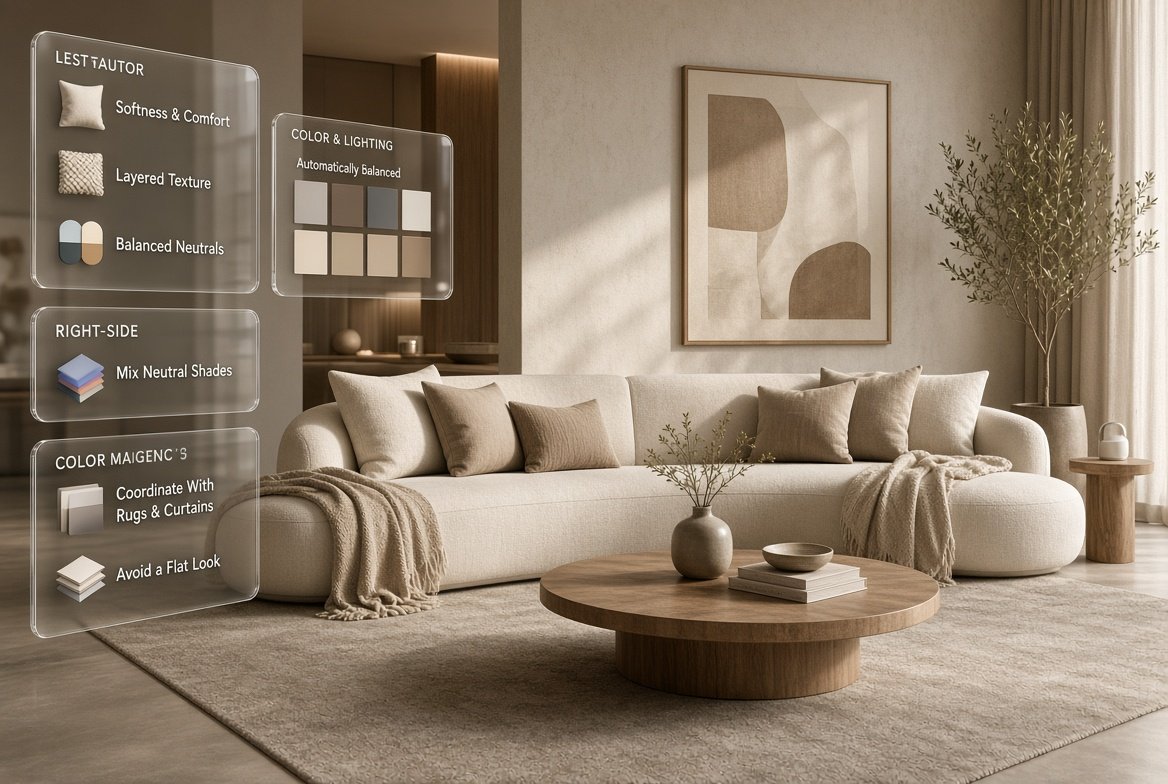
Neutral Throw Pillows | A sofa can have the right shape, the right color, and even the right rug underneath it, yet still feel unfinished. Often, the missing detail is surprisingly simple: neutral throw pillows. They add softness, depth, comfort, and visual balance without forcing a room into a specific color scheme.
The challenge is knowing which neutrals to choose, how many pillows are enough, which textures work together, and how to prevent a neutral arrangement from looking flat or boring.
If you are planning a broader room update, Design Mode 24 Interior Design offers a useful starting point for exploring interior design ideas and practical ways to build a more cohesive home.
This guide explains how to choose neutral throw pillows, combine colors and textures, style them on different sofas, coordinate them with rugs and curtains, and create a polished designer-inspired look without overspending.
What Are Neutral Throw Pillows?
Neutral throw pillows are decorative cushions in understated shades such as white, ivory, cream, beige, taupe, greige, brown, gray, and soft earthy tones.
They are called neutral because they generally do not dominate the room’s color palette. Instead, they support larger design elements such as sofas, rugs, curtains, flooring, wall colors, artwork, and furniture.
Neutral does not necessarily mean plain.
A cream pillow with a woven pattern can be far more visually interesting than a solid bright-colored cushion. Likewise, a beige linen pillow, a textured ivory bouclé pillow, and a taupe geometric cushion can create a layered arrangement while staying within a restrained palette.
The real strength of neutral pillows is their flexibility.
You can change them seasonally, move them between rooms, or combine them with stronger accent colors without replacing the entire decorating scheme.
Featured snippet: Neutral throw pillows are decorative cushions in colors such as cream, beige, ivory, taupe, gray, greige, and brown. They create a calm, layered appearance and work particularly well with modern, minimalist, farmhouse, Scandinavian, coastal, and organic-modern interiors.
Why Do Neutral Throw Pillows Work So Well?
Neutral pillows work because they provide visual support rather than competing for attention.
Imagine a living room with a beige sofa, oak coffee table, cream rug, and warm white walls. Adding six brightly colored pillows may introduce too many competing focal points. A combination of ivory, oatmeal, taupe, and soft brown pillows can create much more sophisticated depth.
They also make decorating easier.
A neutral foundation gives you freedom to introduce color elsewhere. For example, you can add green plants, black lighting, brass accessories, or muted blue artwork without worrying that every pillow has to match.
This flexibility makes neutral cushions especially useful when you are slowly updating a home rather than redesigning an entire room at once.
For broader ideas about creating a cohesive space, explore our Interior Design resources.
The biggest advantages include:
- Easy coordination with existing furniture
- Timeless visual appeal
- Greater flexibility when changing accessories
- Ability to layer several textures
- Suitable for many interior styles
- Easy seasonal updates
- Strong compatibility with natural materials
- Excellent option for rental homes
- Useful for both minimalist and layered rooms
💡 Pro Tip: Do not ask whether every pillow matches. Ask whether the pillows belong together. Similar undertones, complementary textures, and controlled contrast usually create a better result than identical colors.
Which Neutral Colors Are Best for Throw Pillows?
Not all neutrals look the same.
Choosing the right neutral depends on your sofa, wall color, flooring, lighting, and existing accessories.
Warm White and Ivory
Warm white is softer than stark white and usually works beautifully with natural materials.
Ivory cushions are particularly effective in rooms containing:
- Light wood
- Beige furniture
- Natural rugs
- Brass finishes
- Cream walls
- Warm lighting
They create brightness without making the room feel cold.
Beige and Oatmeal
Beige remains one of the easiest colors to decorate with because it sits comfortably between white and brown.
Oatmeal is slightly more textured visually and often works well with linen, cotton, woven fabrics, and natural fibers.
Taupe
Taupe combines characteristics of brown and gray.
It is useful when you want a sophisticated neutral that feels deeper than beige but softer than charcoal.
Greige
Greige combines gray and beige. It is particularly helpful in contemporary homes where a traditional beige may appear too warm.
Soft Gray
Soft gray works best when the room already has cool undertones.
However, gray pillows can appear disconnected in a strongly warm room if they contain blue or icy undertones.
Brown and Camel
Brown cushions introduce warmth and grounding.
Camel is especially attractive with:
- Cream
- Ivory
- Tan
- Walnut
- Black
- Cognac leather
Earthy Neutrals
Clay, mushroom, sand, stone, and muted olive can function almost like neutrals.
They provide more personality while maintaining a calm visual foundation.
How Do You Choose the Right Neutral for Your Room?
The easiest mistake to make is choosing a pillow color in isolation.
Instead, look at the room as a complete palette.
Start with the sofa. Then consider the wall color, flooring, rug, curtains, coffee table, and major decorative pieces.
Step 1: Identify the Room’s Undertone
Every neutral has an undertone.
A beige can lean:
- Yellow
- Pink
- Peach
- Green
- Gray
A gray can lean:
- Blue
- Green
- Purple
- Warm beige
These subtle differences become noticeable when two nearby colors sit next to each other.
⚠ Common Mistake: Buying a cool gray pillow for a warm beige sofa simply because both colors are technically neutral.
The result can look accidental rather than intentional.
Step 2: Study the Natural Light
Natural light changes how fabric colors appear.
A pillow that looks creamy in a showroom may appear almost white near a bright window. A taupe fabric can become considerably darker in a poorly lit corner.
Before purchasing several cushions, test one pillow in the actual room.
Step 3: Compare the Pillow With Permanent Features
Your flooring, sofa, cabinetry, and wall paint are expensive or inconvenient to replace.
Your pillows are not.
Therefore, use pillows to complement those permanent elements rather than forcing permanent features to accommodate your accessories.
For additional ideas involving walls and color relationships, browse the Paint Color section.
How Many Neutral Throw Pillows Should You Use?
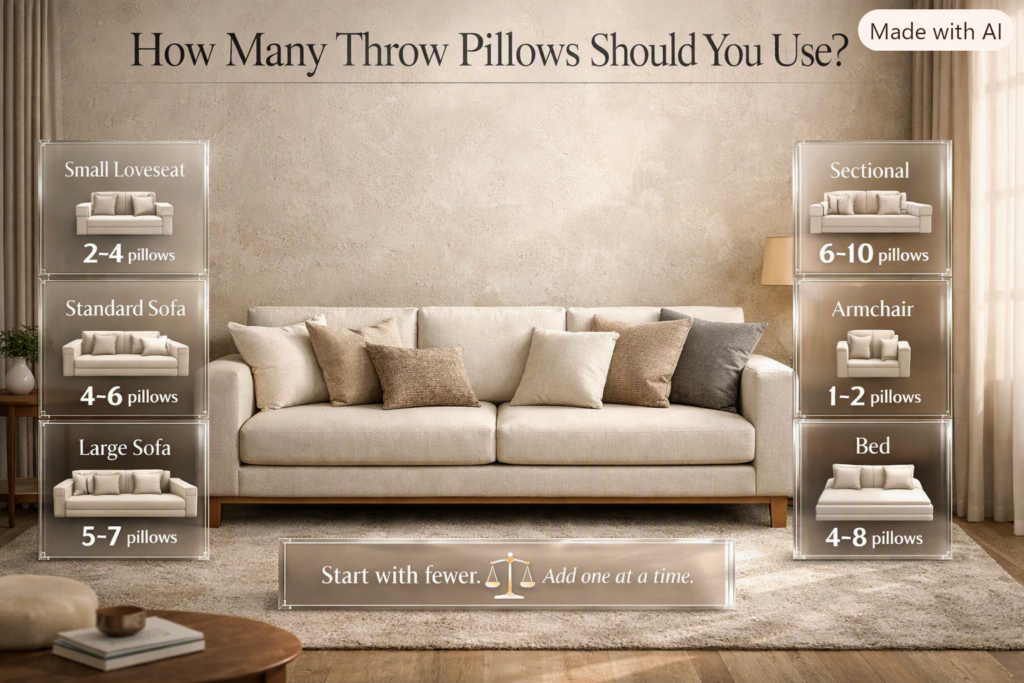
There is no universal number, but proportion matters.
A small two-seat sofa can look crowded with eight cushions, while a large sectional may need a much fuller arrangement.
| Seating | Suggested Pillow Range |
|---|---|
| Small loveseat | 2–4 |
| Standard sofa | 4–6 |
| Large sofa | 5–7 |
| Sectional | 6–10 |
| Armchair | 1–2 |
| Bed | 4–8 depending on layering |
The goal is not to fill every available space.
You want enough pillows to create comfort and visual rhythm while leaving usable seating.
A practical rule is to begin with fewer pillows and add one at a time.
If the sofa still feels empty, continue layering. If you cannot sit comfortably without moving half the cushions, you have probably gone too far.
What Pillow Sizes Should You Use?
Using several identical pillow sizes can make a sofa look flat.
A more polished arrangement usually combines different dimensions.
For example:
24″ square → 20″ square → lumbar pillow
The largest pillow creates the foundation. Medium pillows add layering, while the lumbar pillow provides shape variation.
For a standard sofa, a useful combination might be:
- Two 22–24 inch pillows
- Two 20 inch pillows
- One lumbar pillow
For a smaller sofa:
- Two 20 inch pillows
- One lumbar pillow
For a sectional:
- Two or three larger pillows at each end
- Several medium pillows
- One or two lumbar pillows for variation
⭐ Expert Tip: Slightly oversized pillows often look more luxurious because they create generous visual volume. Very small cushions can make a large sofa look under-accessorized.
How Do You Mix Neutral Pillow Colors?
The secret is controlled variation.
You do not need five shades of beige.
Instead, choose a narrow family of colors and create contrast through value and texture.
For example:
Ivory + oatmeal + taupe + warm brown
Or:
Cream + greige + soft gray + charcoal
Or:
Sand + camel + mushroom + muted olive
A useful strategy is the 60-30-10 approach, adapted for accessories.
- 60% dominant neutral
- 30% secondary neutral
- 10% deeper or contrasting neutral
This does not have to be mathematically exact. It simply prevents every pillow from having equal visual importance.
How Do You Mix Textures in Neutral Throw Pillows?
Texture is one of the most important tools in neutral decorating.
When color contrast is limited, texture prevents the arrangement from becoming visually dull.
Consider combining:
- Linen
- Cotton
- Bouclé
- Velvet
- Knitted fabric
- Woven fabric
- Canvas
- Faux leather
- Wool
- Chenille
Imagine a sofa with:
- Cream linen pillow
- Taupe bouclé pillow
- Oatmeal woven pillow
- Brown leather lumbar pillow
The colors remain restrained, but the room feels layered.
A Simple Texture Formula
Try:
Smooth + woven + nubby
For example:
Cotton + basket weave + bouclé
This creates contrast without introducing another strong color.
💡 Pro Tip: When your color palette is very quiet, texture becomes your decoration.
Should Neutral Throw Pillows Have Patterns?
Absolutely.
A neutral pillow can have stripes, checks, geometric shapes, botanical motifs, abstract designs, or subtle embroidery.
The key is to keep the pattern controlled.
If the sofa, rug, curtains, and artwork already contain patterns, use mostly solid pillows.
If the room is extremely simple, one or two patterned neutral cushions can provide the visual movement it needs.
Good Neutral Pattern Combinations
Try pairing:
- Solid cream + subtle stripe
- Beige + small geometric
- Taupe + organic botanical
- Ivory + black pinstripe
- Oatmeal + tonal check
Avoid using several large-scale patterns together.
One dominant pattern is usually enough.
What Is the Best Pillow Layering Formula?
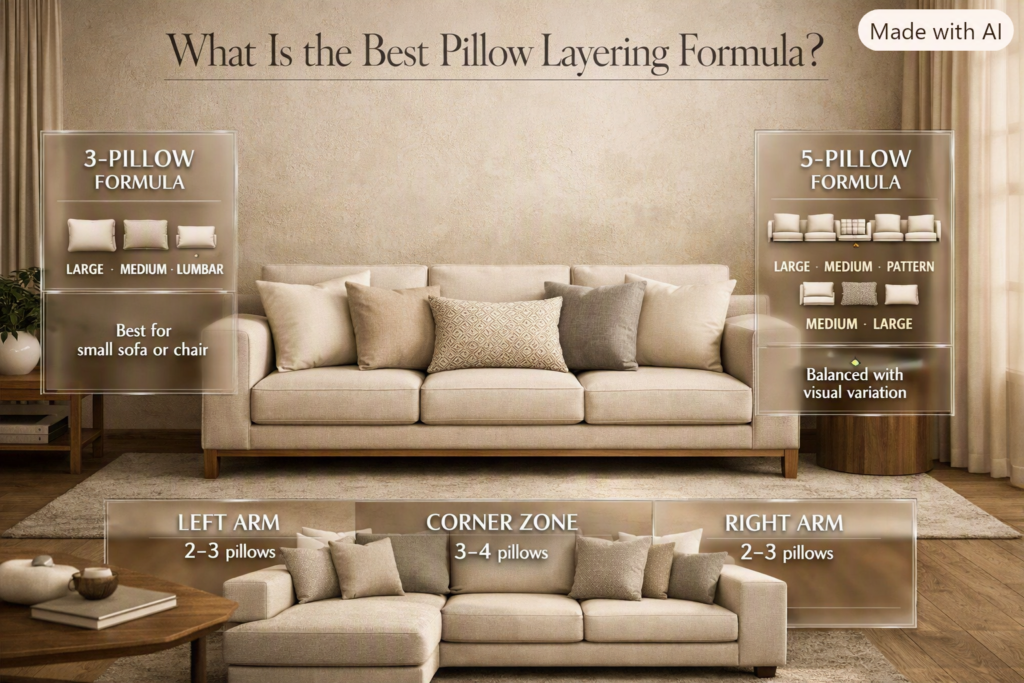
A professional-looking arrangement often follows a simple visual hierarchy.
The Three-Pillow Formula
For a small sofa or chair:
Large → Medium → Lumbar
Start with the largest pillow at the back. Place a slightly smaller cushion in front, then finish with a lumbar pillow.
The Five-Pillow Formula
For a standard sofa:
Large → Medium → Pattern → Medium → Large
The exact sequence can change depending on the sofa.
The important principle is symmetry with enough variation to avoid looking overly formal.
The Sectional Formula
Do not treat a sectional as one enormous sofa.
Instead, create separate pillow zones.
For example:
Corner zone: 3–4 pillows
Left arm: 2–3 pillows
Right arm: 2–3 pillows
This makes the sectional feel intentionally styled rather than randomly filled.
How Should You Style Neutral Throw Pillows on a Beige Sofa?
A beige sofa provides an excellent foundation for neutral cushions.
However, using beige pillows that are almost identical to the sofa can make everything visually disappear.
Instead, introduce contrast through:
- Cream
- Ivory
- Taupe
- Brown
- Camel
- Black accents
- Textural fabrics
For a warm beige sofa, try:
Ivory + oatmeal + camel + dark brown
For a cooler beige sofa:
Cream + greige + mushroom + soft charcoal
The goal is to create enough difference for each layer to remain visible.
How Should You Style Neutral Pillows on a Gray Sofa?
Gray sofas benefit from carefully selected warm or cool neutrals.
For a cool gray sofa, consider:
- Soft white
- Stone
- Greige
- Light gray
- Charcoal
For a warm gray sofa, consider:
- Cream
- Taupe
- Mushroom
- Camel
- Warm brown
A common mistake is assuming that all gray sofas require cool gray accessories.
They do not.
A warm gray sofa can become much more inviting when paired with cream and natural brown textures.
How Should You Style Neutral Pillows on a White Sofa?
White sofas offer tremendous flexibility.
You can create an almost monochromatic arrangement using:
White + ivory + cream + beige
Or introduce deeper contrast:
Cream + camel + taupe + brown
If the room feels too pale, add one darker pillow rather than introducing multiple bright colors.
A charcoal, espresso, or muted black accent can provide just enough definition.
How Should You Style Neutral Pillows on a Brown or Leather Sofa?
Brown leather sofas already provide strong visual weight.
Soft textiles can balance their structured appearance.
Try:
- Ivory linen
- Cream bouclé
- Beige woven fabric
- Oatmeal knit
- Camel suede-inspired texture
Avoid covering every part of the leather sofa with dark brown pillows. The combination can become visually heavy.
Instead, use lighter cushions to create contrast.
How Should You Style Neutral Pillows on a Colorful Sofa?
Neutral pillows can calm a strong sofa color.
For example, a deep green sofa can work beautifully with:
Cream + oatmeal + tan + natural brown
A navy sofa can pair with:
Ivory + beige + camel + soft gray
A rust-colored sofa can work with:
Cream + sand + taupe + warm brown
This approach lets the sofa remain the focal point while the pillows provide supporting layers.
How Do Neutral Throw Pillows Work With Different Interior Styles?
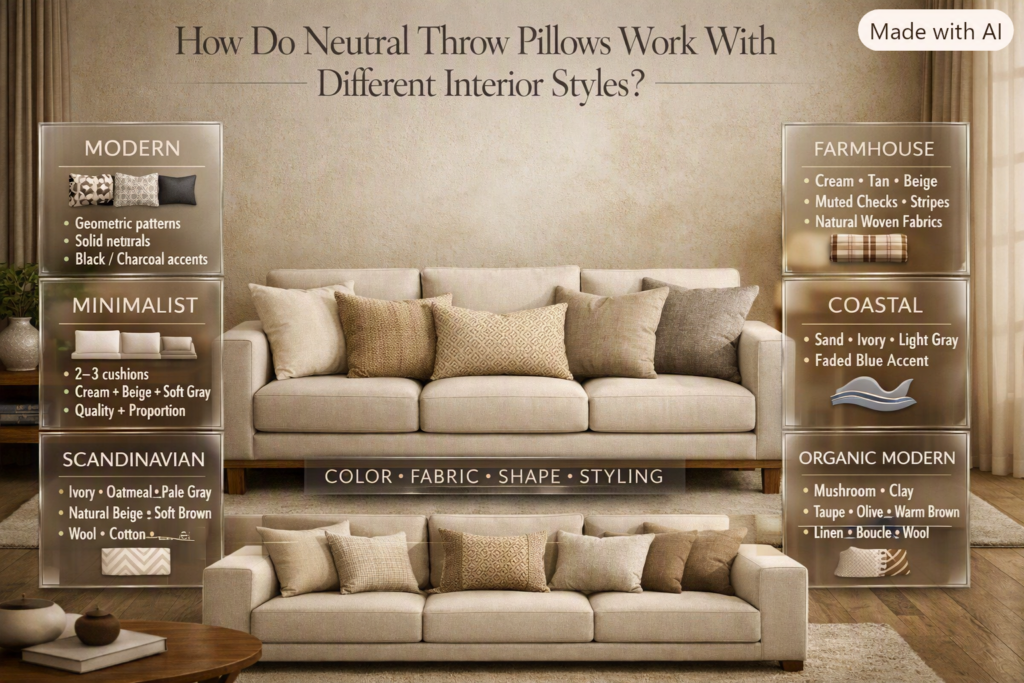
Neutral pillows are unusually adaptable because their appearance depends heavily on fabric, shape, and styling.
Modern Interiors
Choose:
- Clean geometric patterns
- Solid neutrals
- Structured fabrics
- Minimal contrast
- Black or charcoal accents
Keep the arrangement intentional and relatively uncluttered. For a more refined and cohesive look, explore our guide to modern interior design and learn how to balance materials, colors, furniture, and decorative elements effectively.Keep the arrangement intentional and relatively uncluttered.
Minimalist Interiors
Minimalism does not mean an empty sofa.
Choose two or three carefully selected cushions rather than a large collection.
Use:
Cream + beige + soft gray
Focus heavily on fabric quality and proportion. For more ideas on creating a balanced and uncluttered space, explore our guide to minimalist interior design.
Scandinavian Interiors
Scandinavian rooms often benefit from:
- Ivory
- Oatmeal
- Pale gray
- Natural beige
- Soft brown
Wool, cotton, linen, and knitted textures work particularly well. For more ideas on creating a warm, functional, and uncluttered space, explore our guide to Scandinavian interior design.
Farmhouse Interiors
Try:
- Cream
- Tan
- Beige
- Soft brown
- Muted checks
- Stripes
- Natural woven fabrics
The arrangement should feel comfortable, relaxed, and welcoming. For more inspiration on creating a warm and timeless space, explore our guide to farmhouse interior design.
Coastal Interiors
Coastal design does not require obvious blue-and-white nautical patterns.
A softer approach uses:
- Sand
- Ivory
- Natural beige
- Warm white
- Light gray
- Faded blue as a restrained accent
Organic Modern Interiors
This style is particularly well suited to neutral pillows.
Use:
- Mushroom
- Clay
- Cream
- Taupe
- Olive
- Warm brown
Combine these colors with linen, bouclé, wool, cotton, and woven materials.
For more inspiration on creating visually balanced spaces, explore Beautiful Interior.
How Do Neutral Throw Pillows Fit Into a Complete Home Decorating Plan?
Pillows should not be the first thing you choose.
Start with the room’s major elements.
A practical decorating sequence is:
Walls → Flooring → Sofa → Rug → Curtains → Lighting → Artwork → Pillows → Accessories
Pillows come toward the end because they help connect everything already established.
If you are working through a room from scratch, our guide on How to Set Up My Home Decor can help you think about the broader order of decorating decisions.
How Do You Coordinate Neutral Pillows With Rugs and Curtains?
Your pillows do not need to match the rug.
In fact, exact matching can make a room feel overly coordinated.
Instead, repeat one characteristic.
For example:
A rug contains beige and brown.
Your pillows could use:
- Cream
- Taupe
- Brown
But the fabrics and patterns can be completely different.
Likewise, if your curtains are warm white, you can repeat warm white in one pillow while using taupe and camel for the others.
Think of the room as a conversation between colors rather than a matching set.
How Can Neutral Throw Pillows Make a Room Feel Warm Instead of Bland?
Neutral rooms sometimes fail because everything is the same.
If your sofa, walls, rug, curtains, and pillows are all pale beige with smooth surfaces, the room may feel flat.
The solution is not necessarily more color.
Instead, introduce:
Contrast
Use one darker neutral such as brown, charcoal, or muted black.
Texture
Combine smooth, rough, woven, and soft fabrics.
Shape
Mix squares with lumbar pillows.
Natural Materials
Introduce:
- Wood
- Rattan
- Stone
- Ceramic
- Linen
- Wool
- Plants
Light
Use layered lighting instead of relying on one ceiling fixture.
These principles are useful beyond pillows and form part of broader Home Improvement decisions.
How Can You Make Neutral Throw Pillows Look Expensive?
Luxury is rarely about having the most expensive cushions.
It is more often about proportion, material, restraint, and presentation.
Choose Better Inserts
A high-quality insert gives a pillow a fuller appearance.
Use Larger Sizes
Oversized cushions often look more substantial.
Mix Textures
A combination of linen, bouclé, wool, and woven materials feels richer than five identical cotton pillows.
Avoid Excessive Matching
A complete matching pillow set can look generic.
Maintain Negative Space
Do not cover every inch of the sofa.
Use One Strong Accent
A single deep brown, charcoal, or textured cushion can create more impact than several competing colors.
⭐ Expert Tip: Designer-looking rooms usually have fewer competing ideas, not more. Edit the pillow arrangement until every piece has a reason to be there.
What Pillow Inserts Should You Choose?

The insert determines how a pillow feels and how well it holds its shape.
Down and Feather
These inserts provide a soft, luxurious feel and can be shaped easily.
They are excellent for a relaxed, high-end appearance.
Down Alternative
These are useful for people who prefer synthetic filling while still wanting softness.
Polyester
Polyester inserts are usually affordable and widely available.
However, some lower-quality versions can appear flat over time.
Foam-Filled Options
Foam provides more structure and is useful when you prefer a firm decorative cushion.
For a premium appearance, the insert should generally be slightly larger than the pillow cover.
For example:
20-inch cover → approximately 22-inch insert
This creates a fuller silhouette.
Which Fabrics Are Best for Neutral Throw Pillows?
Different fabrics create different moods.
| Fabric | Best For | Visual Effect |
|---|---|---|
| Linen | Coastal, organic, modern | Relaxed |
| Bouclé | Modern, organic | Soft and tactile |
| Velvet | Glamorous, sophisticated | Rich |
| Cotton | Everyday homes | Practical |
| Wool | Scandinavian, cozy | Warm |
| Woven | Farmhouse, organic | Natural |
| Chenille | Comfortable family rooms | Soft |
| Leather | Modern, masculine | Structured |
Choose fabrics based on how the room is used.
A decorative pillow in delicate fabric may not be ideal for a household where cushions are constantly used.
How Can Neutral Throw Pillows Work in the Bedroom?
Neutral pillows are not limited to living rooms.
They can create a calm, layered bed arrangement.
A simple bedroom formula is:
Sleeping pillows → Euro pillows → decorative square pillows → lumbar cushion
Keep the colors related rather than identical.
For example:
- White sleeping pillows
- Cream Euro pillows
- Beige square cushions
- Taupe lumbar pillow
The result feels coordinated without looking like a matching bedding set.
Neutral bedroom pillows are especially effective when the walls, bedding, and furniture already have strong visual character.
For broader room-by-room ideas, visit the Room-by-Room Design Hub.
How Can You Use Neutral Throw Pillows for a Living Room Transformation?
You do not always need new furniture to make a living room feel dramatically different.
Changing the pillows can alter the room’s visual balance within minutes.
For example, imagine a tired beige sofa with three old cushions.
Replace them with:
- Two oversized ivory pillows
- Two textured taupe pillows
- One patterned lumbar cushion
- One deeper brown accent
Then add a soft throw and adjust the coffee-table accessories.
The furniture has not changed, but the room can feel considerably more intentional.
For a broader approach to changing the entire space, explore Living Room Transformation.
How Can Neutral Pillows Refresh a Room Without a Full Redecoration?
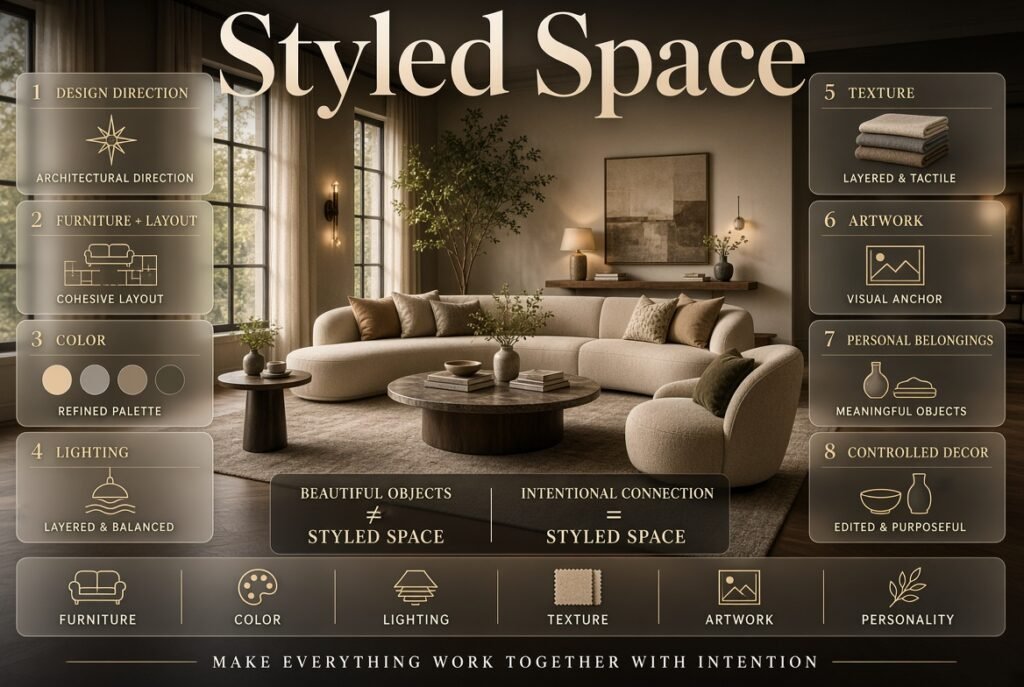
One of the best things about neutral accessories is their ability to support small updates.
Instead of replacing a sofa, repainting the room, and buying new furniture, start with removable elements.
Try changing:
- Throw pillows
- Blankets
- Curtains
- Artwork
- Vases
- Decorative objects
- Small lamps
- Table accessories
This is particularly effective when the permanent elements are still in good condition.
For more practical ideas, see Room Refresh.
A refresh works best when you change several small elements that support one another rather than buying one isolated decorative object.
Can Neutral Throw Pillows Work With Luxury Interior Design?
Yes, and restraint is often what makes them effective in sophisticated interiors.
Luxury spaces frequently depend on subtle differences in tone.
Instead of using bright colors everywhere, a room might combine:
Ivory + cream + taupe + walnut + black
The richness comes from material quality, scale, lighting, and craftsmanship.
If you enjoy studying high-end residential aesthetics, our Mark Cuban House feature provides another design reference for thinking about how understated palettes can support a more elevated home aesthetic.
The important lesson is not to copy a celebrity interior literally. Study the principles: proportion, material contrast, visual restraint, and consistency.
How Can You Create Neutral Pillow Arrangements on a Budget?
You do not need a large budget to create a sophisticated arrangement.
Start with the pillow covers rather than buying completely new cushions.
Changing covers allows you to reuse existing inserts.
Look for:
- Cotton covers
- Linen blends
- Woven fabrics
- Neutral stripes
- Tonal patterns
- Simple textured designs
You can also create your own covers if you enjoy sewing or other small home projects.
Explore DIY Home Projects for ideas that can complement a practical decorating approach.
Another useful strategy is to buy neutral pillows gradually.
Start with two quality foundation cushions. Add another pair later. Finish with one distinctive lumbar pillow.
For more cost-conscious decorating ideas, see Easy Decorating Tips for Every Budget.
What Are the Most Common Neutral Pillow Styling Mistakes?
Even simple decorating choices can go wrong.
Mistake 1: Everything Is the Same Shade
Five beige pillows can look lifeless.
Fix: Introduce tonal variation.
Mistake 2: Everything Is the Same Texture
Five smooth cotton cushions lack depth.
Fix: Add woven, nubby, knitted, or bouclé fabrics.
Mistake 3: Too Many Pillows
A sofa should still be comfortable.
Fix: Remove one or two and reassess.
Mistake 4: Ignoring Undertones
Warm beige and cool gray may clash.
Fix: Compare fabrics under actual room lighting.
Mistake 5: Every Pattern Is Competing
Multiple bold patterns create visual noise.
Fix: Choose one main pattern and keep the rest quieter.
Mistake 6: Pillows Are Too Small
Tiny cushions can disappear on a large sofa.
Fix: Use appropriately scaled pillows.
Mistake 7: Everything Matches Exactly
Matching sets can make a room look staged.
Fix: Coordinate instead of matching.
Mistake 8: Ignoring the Sofa Shape
A deep sectional requires different styling from a narrow loveseat.
Fix: Scale your arrangement to the furniture.
How Do You Style Neutral Throw Pillows Step by Step?
If you are starting from an empty sofa, use this simple process.
Step 1: Start With the Largest Pillows
Place two large pillows at the back corners.
Step 2: Add Medium Cushions
Layer slightly smaller cushions in front.
Step 3: Introduce Texture
Add one woven, bouclé, knitted, or velvet cushion.
Step 4: Add a Pattern
If the room needs movement, introduce one subtle patterned pillow.
Step 5: Add a Lumbar Pillow
Place a lumbar cushion toward the center or slightly off-center.
Step 6: Step Back
Do not judge the arrangement from six inches away.
Walk across the room.
Look at the sofa from the entrance.
Check whether the pillows create balance.
Step 7: Remove Something
This is the step many people skip.
If one pillow does not contribute color, texture, shape, or comfort, remove it.
⭐ Professional Advice: Good styling often involves editing rather than adding.
What Is the Best Neutral Throw Pillow Formula for Different Sofas?
| Sofa Type | Recommended Approach |
|---|---|
| Small loveseat | 2–4 pillows, simple layering |
| Standard sofa | 4–6 pillows, mixed sizes |
| Deep sofa | Oversized pillows with soft inserts |
| Sectional | Separate pillow zones |
| Leather sofa | Light textiles for softness |
| Patterned sofa | Mostly solid neutrals |
| Neutral sofa | Stronger texture and tonal contrast |
| Colorful sofa | Quiet neutral supporting pillows |
The formula is a starting point, not a rigid rule.
Your room’s architecture and personal preference should ultimately guide the arrangement.
How Do You Make Neutral Pillows Feel More Personal?
Neutral decorating can sometimes become too generic.
The easiest way to prevent this is to introduce objects with meaning.
Consider:
- A handmade woven cushion
- A vintage textile
- A pillow made from meaningful fabric
- A locally crafted piece
- A subtle family-inspired pattern
- A cushion connected to travel memories
The color can remain neutral while the object itself carries personality.
This is an important distinction.
A neutral room does not need to be impersonal.
How Should You Change Neutral Throw Pillows by Season?
Neutral pillows are ideal for seasonal decorating because the basic palette can remain constant.
Spring
Use:
- Ivory
- Soft beige
- Pale green
- Lightweight linen
Summer
Try:
- Sand
- Cream
- White
- Natural woven textures
Autumn
Introduce:
- Camel
- Warm brown
- Mushroom
- Clay
- Muted olive
Winter
Use:
- Cream
- Taupe
- Deep brown
- Wool
- Bouclé
- Chunky knits
You do not need four completely different pillow collections.
Changing two or three covers can create enough seasonal variation.
How Can Neutral Throw Pillows Support a Whole-Home Color Scheme?
If several rooms share related neutral tones, your home can feel more connected.
For example:
Living room: Cream + taupe + brown
Bedroom: Ivory + beige + mushroom
Home office: Warm white + greige + walnut
The rooms do not need to look identical.
They simply need to feel like they belong to the same visual family.
This is especially useful in open-plan homes where one room flows directly into another.
What Is the Professional Checklist for Choosing Neutral Throw Pillows?
Before buying, ask:
Color
- Does the neutral match the room’s undertone?
- Is there enough contrast against the sofa?
Size
- Are the cushions properly scaled?
- Do you have at least two different sizes?
Texture
- Are the fabrics visually different?
- Does the arrangement include tactile interest?
Pattern
- Does the room need a pattern?
- Is there already too much pattern elsewhere?
Comfort
- Can people still sit comfortably?
- Are the inserts soft enough?
Style
- Do the pillows support the overall interior style?
- Do they look intentional rather than randomly collected?
Budget
- Can you reuse existing inserts?
- Would covers provide a more economical update?
A Practical Neutral Throw Pillow Example
Consider a medium-sized living room with:
- Warm white walls
- Beige sofa
- Oak coffee table
- Cream rug
- Linen curtains
- Black floor lamp
- Green plants
A strong pillow arrangement could be:
Back layer:
Two 24-inch oatmeal pillows
Middle layer:
Two 20-inch cream textured pillows
Accent layer:
One taupe geometric pillow
Center:
One camel lumbar cushion
This arrangement works because the colors repeat the room’s existing palette while the textures prevent the sofa from appearing flat.
Notice that there is no requirement for every item to match.
The oak table introduces warmth.
The black lamp introduces contrast.
The plants add organic color.
The pillows simply connect these elements.
How Do Neutral Throw Pillows Improve a Small Living Room?
In smaller spaces, accessories need to be carefully controlled.
Too many pillows can make the sofa look crowded and reduce the room’s sense of openness.
Choose:
- Two large pillows
- One medium pillow
- One lumbar cushion
Keep the palette light.
Cream, ivory, soft beige, and light taupe can help maintain an airy appearance.
Avoid using several very dark cushions unless the room needs a deliberate visual anchor.
In a small space, texture often provides more value than additional color.
How Do You Style Neutral Pillows in an Open-Plan Home?
Open-plan spaces need visual continuity.
If the living room contains cream and taupe while the dining area uses entirely different colors, the space may feel disconnected.
Neutral throw pillows can act as a bridge.
For example:
Living room:
Cream + taupe + walnut
Dining area:
Cream upholstery + walnut furniture
Kitchen:
Warm white + taupe accessories
The repeated neutral tones create a subtle connection without making every area identical.
Can Neutral Throw Pillows Work With Bold Artwork?
Yes.
In fact, they can be the best choice when artwork is already dramatic.
Suppose your living room has a large abstract painting containing navy, rust, black, and cream.
You do not necessarily need pillows in all four colors.
Instead, use:
Cream + oatmeal + taupe
Then perhaps introduce one pillow with a restrained version of the artwork’s strongest color.
This allows the artwork to remain the focal point.
How Do You Know When the Pillow Arrangement Is Finished?
There is a simple test.
Sit on the sofa.
If the cushions make you uncomfortable, remove some.
Then stand across the room.
If the arrangement looks balanced from a distance, it is probably working.
Finally, look at the entire room rather than the sofa alone.
Ask:
Does the pillow arrangement support the room, or is it trying to become the room?
The best neutral styling usually feels effortless.
You notice the atmosphere first and the individual pillows second.
What are the best neutral throw pillow colors for a sofa?
The best neutral throw pillow colors depend on the sofa’s existing color, undertone, lighting, and the overall mood you want to create. Cream, ivory, oatmeal, beige, taupe, greige, camel, mushroom, soft gray, and brown are among the most versatile choices. However, the most sophisticated arrangement rarely uses one neutral shade repeatedly. Instead, it combines two or three related tones to create subtle contrast.
For example, a beige sofa can look much richer with ivory, oatmeal, taupe, and warm brown rather than several pillows in exactly the same beige. Similarly, a cool gray sofa may benefit from soft white, greige, stone, and charcoal.
In 2026, neutral decorating is also moving beyond flat beige toward warmer, more dimensional shades and tactile materials. Rich browns, caramel-like tones, earthy neutrals, and warm creams are increasingly being used to make neutral interiors feel more inviting rather than sterile.
Useful styling points:
Choose colors that relate to your sofa rather than copying it exactly.
Check whether your existing neutrals are warm or cool.
Use one lighter, one middle, and one deeper neutral for contrast.
Consider the wall color, flooring, rug, and curtains before choosing pillows.
Use texture when you want contrast without introducing a new color.
Professional tip: If you are unsure between two neutral shades, choose the one that already appears somewhere else in the room. Repeating an existing undertone makes the pillow arrangement feel intentional rather than randomly selected.
How many neutral throw pillows should you put on a sofa?
The right number depends on the size and depth of the sofa, but a standard three-seat sofa usually looks balanced with around four to six pillows. A smaller loveseat may need only three or four, while a large sectional can comfortably accommodate six to nine or more when the arrangement is properly distributed.
The important point is that the number of pillows should support the furniture rather than overwhelm it. A sofa should still look comfortable and usable after it has been styled.
For a standard sofa, a practical arrangement might include two larger pillows at the back, two medium cushions in front, and one lumbar pillow for shape variation. Larger sectionals can be divided into separate styling zones instead of treating the entire sofa as one continuous surface.
Current styling guidance also emphasizes scale and proportion, with larger 20- or 22-inch cushions commonly used as substantial foundation pieces before smaller pillows are layered in front.
A simple guide:
Loveseat: 3–4 pillows
Standard sofa: 4–6 pillows
Large sofa: 5–7 pillows
Sectional: 6–9 pillows
Armchair: 1–2 pillows
Professional tip: Start with fewer pillows than you think you need. Add them gradually and step back several feet to judge the arrangement. If the sofa looks crowded before anyone sits down, remove one or two.
The goal is layered comfort, not maximum quantity.
How do you mix neutral throw pillows without making the room look boring?
The secret is to stop relying on color alone. When a room uses neutral colors, texture, scale, pattern, shape, and tonal contrast become much more important.
Instead of buying five beige pillows with identical fabric, combine materials that respond differently to light and touch. For example, pair a smooth cotton cushion with a chunky woven pillow, a linen cover, and a soft bouclé piece. The colors can remain within the same neutral family while the surfaces create visual depth.
This is one reason neutral interiors can look expensive when they are styled correctly. The eye notices subtle differences even when the overall color palette remains restrained.
A strong combination might be:
Ivory linen + oatmeal weave + taupe bouclé + camel lumbar
Another option is:
Cream cotton + beige stripe + mushroom texture + chocolate brown accent
Current 2026 pillow trends continue to emphasize tactile richness, with designers and trend coverage highlighting materials such as bouclé, linen, wool, woven textiles, and other dimensional surfaces rather than relying exclusively on bold color.
Ways to add interest without adding loud color:
Mix smooth and rough textures.
Combine square pillows with lumbar shapes.
Use different shades within the same neutral family.
Add one subtle stripe or check.
Mix matte and slightly lustrous fabrics.
Introduce natural materials such as linen, wool, or woven fibers.
Professional tip: If every pillow is the same color, make the fabrics noticeably different. If every pillow is the same texture, introduce more tonal variation.
That simple balance keeps a neutral sofa calm without allowing it to become flat.
Should neutral throw pillows match the sofa, rug, and curtains?
Neutral throw pillows should coordinate with the room rather than match everything exactly. Exact matching can make a space feel overly staged, while thoughtful repetition creates a more natural and sophisticated result.
For example, if your sofa is beige and your rug contains cream, taupe, and brown, you do not need beige pillows that reproduce the rug’s pattern. Instead, choose an ivory pillow, a taupe textured cushion, and a brown lumbar piece. The colors relate to the room, but the materials and patterns remain independent.
Think of your room as a visual conversation.
The sofa provides the foundation. The rug establishes another layer. Curtains influence the vertical color balance. Pillows then connect selected elements without copying them.
A good coordination formula is:
Sofa color → dominant pillow tone
Rug color → secondary pillow tone
Wood, metal, artwork, or accessories → accent pillow tone
This creates repetition without creating a matching set.
Avoid:
Buying pillows in exactly the same fabric as the curtains.
Repeating the rug pattern on every cushion.
Using identical beige shades throughout the room.
Matching every decorative item to the sofa.
Professional tip: Pick one or two colors already present in the room and reinterpret them through different fabrics. A taupe color in the rug might become a linen pillow, while a brown tone in the coffee table might appear as a leather or woven lumbar cushion.
That approach produces coordination that feels curated rather than manufactured.
What are the biggest mistakes people make when styling neutral throw pillows?
The biggest mistake is assuming that neutral decorating means everything should be beige, identical, and perfectly symmetrical. In reality, a successful neutral arrangement depends on contrast, proportion, texture, and editing.
One common problem is using pillows that are too small for the sofa. A large, deep sofa can make tiny cushions look insignificant. Another mistake is choosing several pillows with nearly identical shades and fabrics, which removes the depth that makes neutral styling attractive.
Overfilling is another issue. A sofa covered from arm to arm with cushions may look impressive in a photograph but become inconvenient in everyday life.
The most common mistakes include:
Using only one neutral shade
Five almost identical beige cushions can disappear against a beige sofa.
Better approach: Mix cream, oatmeal, taupe, camel, or brown.
Ignoring texture
A neutral palette needs surface variation.
Better approach: Combine linen, woven fabrics, bouclé, cotton, wool, or velvet.
Choosing pillows that are too small
Small cushions can look undersized on deep or oversized furniture.
Better approach: Use larger foundation pillows and layer smaller cushions in front.
Using too many patterns
Several competing patterns can make even a neutral room feel visually chaotic.
Better approach: Use one noticeable pattern and keep the surrounding pillows quieter.
Matching everything perfectly
A complete matching set can look generic.
Better approach: Coordinate colors while varying fabric, shape, and scale.
Ignoring undertones
A blue-gray pillow can look disconnected beside a warm beige sofa.
Better approach: Compare the actual fabrics in the room’s natural and artificial lighting.
Forgetting comfort
Decorative styling should not make the sofa difficult to use.
Better approach: Leave some seating space clear and choose comfortable inserts.
Professional tip: After styling the sofa, remove one pillow and look at it again. If the arrangement becomes cleaner without losing balance, the extra cushion was probably unnecessary.
The most successful neutral interiors are not necessarily the ones with the most decoration. They are the ones where every pillow has a clear purpose—color, texture, scale, comfort, or visual balance.
Conclusion
Neutral throw pillows may seem like a small decorating detail, but the right combination can completely change how a room feels. They can soften a strong sofa, add warmth to a minimalist space, create visual balance, and make an ordinary seating area feel much more considered.
The key is not to make every pillow identical. Instead, work with a controlled palette of creams, beige, taupe, ivory, soft gray, brown, or other complementary neutrals, then create interest through texture, size, shape, and subtle pattern. A linen pillow beside a woven cushion, a soft boucle accent, or a lightly patterned piece can give a neutral arrangement far more depth than a collection of matching cushions.
Think about the room as a whole before choosing your pillows. Consider the sofa, rug, curtains, walls, flooring, artwork, lighting, and natural materials already present. Your pillows should connect these elements rather than compete with them.
Most importantly, choose comfort as carefully as appearance. Quality inserts, practical fabrics, appropriate proportions, and thoughtful layering will make the finished arrangement look polished while still feeling inviting.
If your room currently feels flat, overly plain, or unfinished, you do not necessarily need a major redesign. Sometimes a carefully edited collection of neutral throw pillows is enough to introduce the warmth, texture, and personality the space has been missing.
A beautiful neutral interior is rarely about having less. It is about choosing better, layering thoughtfully, and giving every detail a purpose.

Leave a Reply