
Introduction
Farmhouse Interior Design | A home can have beautiful furniture, expensive finishes, and carefully selected accessories but still feel cold, uncomfortable, or strangely impersonal. The problem is often not the budget. It’s the way materials, colors, furniture, lighting, and personal details work together.
That’s where farmhouse interior design stands out.
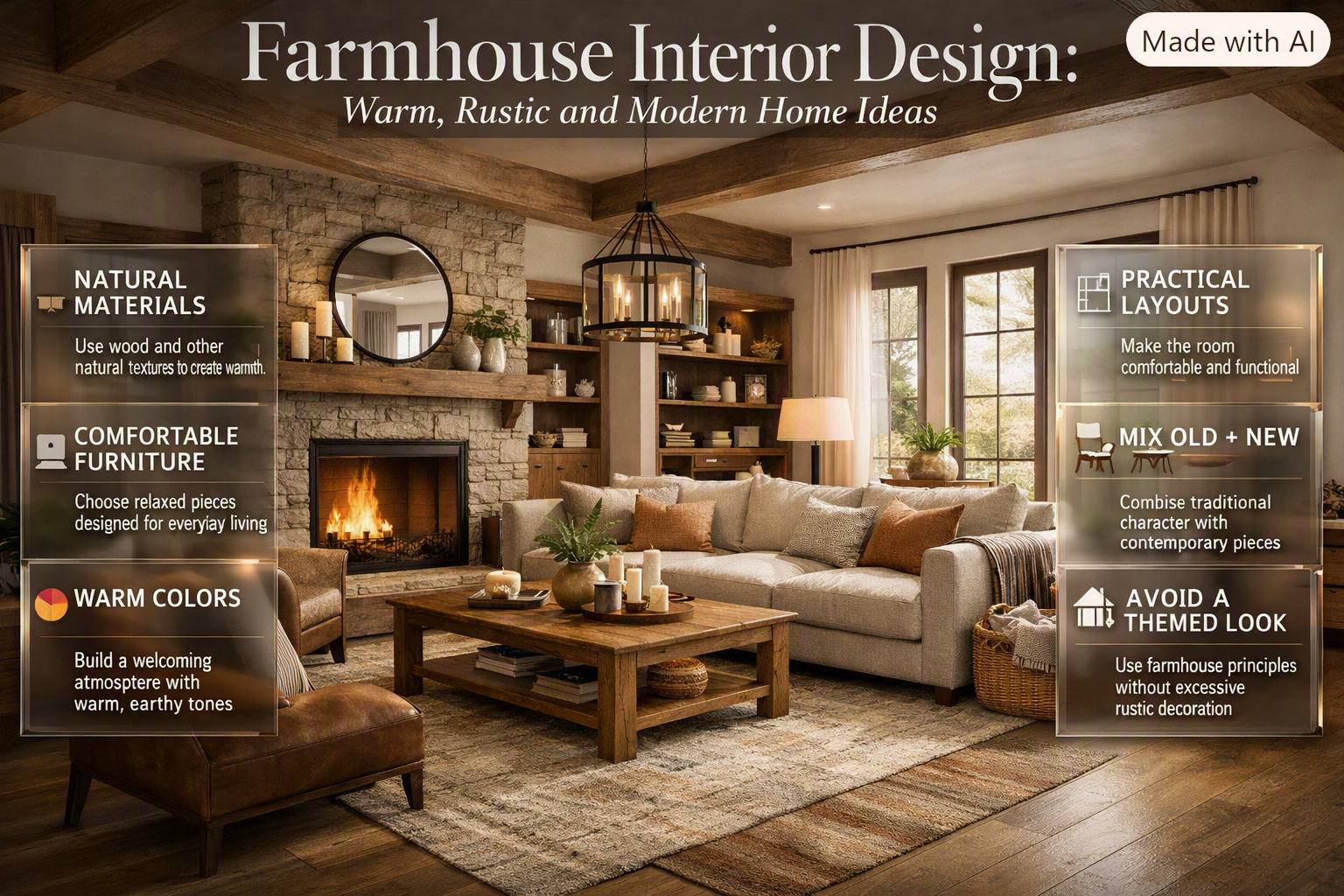
Farmhouse style creates a relaxed atmosphere by combining natural materials, comfortable furniture, warm colors, practical layouts, and details that feel collected over time. It can be rustic and traditional, but it can also be clean, sophisticated, and contemporary. Modern farmhouse interiors especially have become popular because they provide warmth without making a home look old-fashioned.
The important thing is not to copy a farmhouse room from a photograph. Instead, understand the principles behind the style and adapt them to your own home, lifestyle, architecture, and budget.
In this complete guide, you’ll learn what farmhouse interior design really means, how to choose the right colors and furniture, how to design farmhouse living rooms, kitchens, bedrooms, and bathrooms, how to mix old and new pieces, how to decorate without creating a themed look, and which mistakes can make farmhouse interiors feel dated.
If you’re planning a complete home transformation, DesignMode24 Interior Design can also be a useful starting point for exploring practical ideas for interior spaces, home styling, colors, and improvements.
What Is Farmhouse Interior Design?
Farmhouse interior design is a decorating approach based on comfort, practicality, natural materials, simple forms, and a relaxed sense of character. Traditional farmhouse interiors were shaped by rural living, where furniture and household objects needed to be useful as well as durable. Modern interpretations keep those qualities while introducing cleaner lines and more contemporary finishes.
A farmhouse room shouldn’t feel like a museum or a themed restaurant.
It should feel like a real home.
Think about a living room with a comfortable sofa, a worn wooden table, linen curtains, a woven basket, warm lighting, a few books, and artwork collected over time. Nothing needs to scream “farmhouse.” Yet the combination immediately feels relaxed and welcoming.
The strongest farmhouse interiors usually include:
- Natural wood
- Warm neutral colors
- Comfortable furniture
- Linen and cotton textiles
- Woven materials
- Ceramic accessories
- Simple lighting
- Vintage or handmade pieces
- Practical storage
- Personal objects
- A mixture of old and new
The style works because these elements create an atmosphere rather than simply following a decorative formula.
What Is the Difference Between Farmhouse and Rustic Design?
Farmhouse and rustic design overlap, but they aren’t exactly the same.
Rustic design tends to emphasize rough, raw, rugged, and heavily natural materials. Farmhouse design focuses more strongly on comfort, practicality, and everyday domestic living.
A rustic room may feature large reclaimed beams, raw stone, distressed wood, and heavy textures.
A farmhouse room might use a contemporary sofa, smooth oak furniture, linen curtains, simple artwork, and one weathered wooden table.
This distinction is useful if you want farmhouse warmth without making the entire house feel rugged.
Why Is Farmhouse Interior Design Still Popular?
Farmhouse style has remained relevant because its most important qualities aren’t based on short-lived trends.
People still want:
- Comfortable homes
- Practical furniture
- Natural materials
- Warm lighting
- Easy-to-live-with colors
- Personal spaces
- Rooms that don’t feel overly formal
A farmhouse dining table can handle family meals. A basket can store blankets. A wooden bench can provide extra seating. Linen curtains can soften sunlight. A comfortable sofa can be used every day.
That practicality gives farmhouse design an advantage over styles that depend heavily on delicate or purely decorative elements.
Modern farmhouse has also helped the style evolve.
Instead of covering a room with distressed furniture and rustic accessories, modern farmhouse interiors use a cleaner foundation and allow a few traditional elements to provide character.
The result is warmer than strict minimalism but cleaner than heavily rustic design.
What Are the Main Characteristics of Farmhouse Interior Design?
There isn’t one mandatory farmhouse furniture piece or color. Instead, the style is recognized through a combination of visual and tactile qualities.
Natural Materials
Natural materials are central to farmhouse interiors.
Common choices include:
- Wood
- Stone
- Brick
- Linen
- Cotton
- Wool
- Jute
- Rattan
- Wicker
- Ceramic
- Aged metal
These materials create texture and prevent neutral interiors from feeling flat.
Warm Neutral Colors
Warm whites, cream, beige, taupe, greige, and soft gray are common foundations.
They work particularly well with wood because they don’t compete with natural grain.
Practical Furniture
Farmhouse furniture should look usable.
Large sofas, sturdy dining tables, wooden benches, storage cabinets, and comfortable chairs are better choices than furniture that exists purely for decoration.
Imperfect Character
Farmhouse style doesn’t require everything to look brand new.
Small imperfections can make a room feel more authentic.
A scratched wooden table, vintage frame, handmade bowl, or slightly worn chair can add personality.
Relaxed Styling
Farmhouse rooms usually look better when they aren’t excessively symmetrical or over-decorated.
There should be enough styling to create character but enough empty space to allow the eye to rest.
Modern Farmhouse vs. Traditional Farmhouse
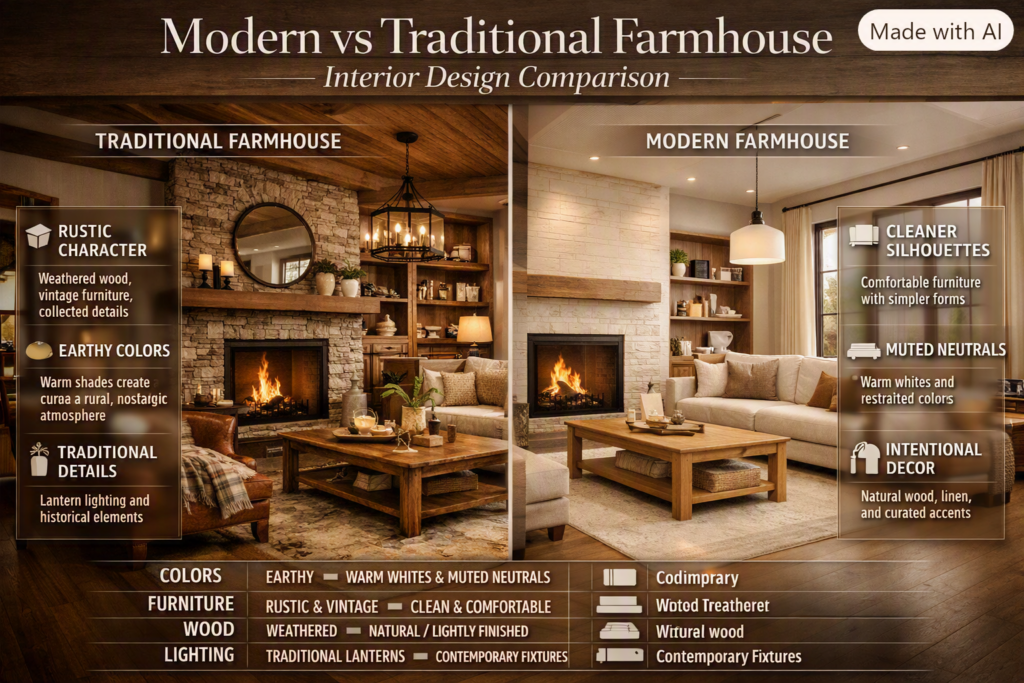
Modern farmhouse is cleaner, simpler, and more restrained than traditional farmhouse design.
| Feature | Traditional Farmhouse | Modern Farmhouse |
|---|---|---|
| Colors | Warm earthy shades | Warm whites and muted neutrals |
| Furniture | Rustic and vintage | Comfortable with cleaner silhouettes |
| Wood | Weathered or reclaimed | Natural or lightly finished |
| Decoration | Collected and rustic | Edited and intentional |
| Lighting | Traditional lantern styles | Contemporary farmhouse fixtures |
| Architecture | Historical details | Clean modern structure |
| Atmosphere | Rural and nostalgic | Warm and sophisticated |
If you live in a modern house, you don’t need to recreate an old farmhouse.
Instead, borrow the qualities that make farmhouse interiors appealing.
Use natural wood, warm lighting, linen, comfortable furniture, and a few vintage details while keeping your existing contemporary architecture.
That approach usually looks more natural.
How Do You Choose a Farmhouse Color Palette?
Color is one of the easiest ways to establish farmhouse character, but it is also one of the easiest areas to get wrong.
The best farmhouse palettes are usually calm rather than overly saturated.
Start with a dominant neutral such as:
- Warm white
- Cream
- Ivory
- Beige
- Taupe
- Greige
- Soft gray
Then introduce muted accent colors such as:
- Sage green
- Olive
- Dusty blue
- Muted navy
- Terracotta
- Warm brown
- Charcoal
- Soft black
The goal isn’t to make the entire room beige.
The goal is to create a background that allows texture and furniture to become more noticeable.
For homeowners choosing paint for a farmhouse room, Paint Color can provide additional inspiration when comparing neutral and accent shades.
Should You Use Warm White or Cool White?
Warm white is usually easier to combine with farmhouse materials.
Cool white can sometimes make wood and natural fabrics look slightly harsh, especially in rooms with limited daylight.
However, there is no universal “best” white.
Natural light, flooring, furniture, and surrounding colors all influence how paint appears.
A color that looks creamy in a south-facing room might appear much more neutral in a darker space.
⭐ Expert Tip: Test paint samples on multiple walls and observe them at different times of day. Don’t select a whole-house color from a tiny screen image or a store card alone.
How Do You Add Color Without Losing the Farmhouse Feel?
Muted colors are usually easier to use than bright ones.
For example, instead of intense green, consider sage or olive.
Instead of bright blue, try dusty blue.
Instead of strong orange, use muted terracotta.
These colors can appear through:
- Cushions
- Curtains
- Rugs
- Artwork
- Ceramic pieces
- Chairs
- Bedding
- Plants
A useful approach is to repeat one accent color in two or three places.
For example, sage green might appear in a cushion, a painting, and a small ceramic vase.
That creates visual connection without making the room look overly coordinated.
What Furniture Works Best in Farmhouse Interiors?
Furniture should feel comfortable, durable, and appropriately scaled.
A farmhouse living room might include:
- Deep neutral sofa
- Upholstered armchair
- Solid wood coffee table
- Wooden side table
- Storage cabinet
- Bench
- Woven ottoman
- Console table
For dining rooms, a substantial wooden table can become the main focal point.
The important thing is to avoid making every furniture piece look identical.
Farmhouse interiors often benefit from variation.
Why Should You Mix Furniture Styles?
A room can feel much more natural when different pieces have different histories.
For example:
Contemporary cream sofa + vintage oak coffee table + black modern lamp + antique mirror
The pieces aren’t identical, but they can still work together because their colors, proportions, and materials relate to one another.
By contrast, purchasing an entire matching furniture collection can make a room look generic.
💡 Pro Tip: Choose furniture according to scale and comfort before style. A beautiful farmhouse chair that blocks a walkway is still a bad choice.
How Do You Mix Old and New Furniture?
Mixing old and new is one of the most effective farmhouse techniques.
A room filled entirely with new furniture can feel sterile.
A room filled entirely with antique pieces can feel dated.
Combining the two creates balance.
Try combinations such as:
- Modern sofa + antique coffee table
- New dining chairs + vintage dining table
- Contemporary bed + old wooden bedside table
- Modern bathroom vanity + traditional mirror
- New kitchen + vintage stools
- Modern lighting + antique cabinet
The old piece provides character.
The new piece provides comfort and practicality.
This relationship is much more interesting than trying to make everything look old.
Which Materials Work Best in Farmhouse Interior Design?
Wood
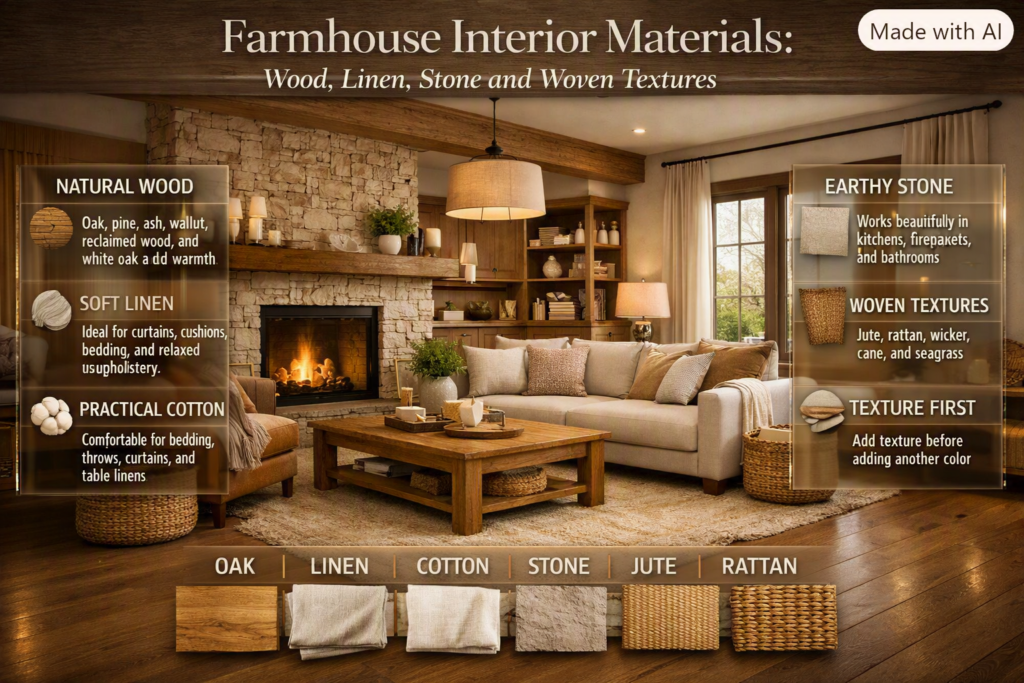
Wood is one of the strongest farmhouse materials because it adds warmth immediately.
Good options include:
- Oak
- Pine
- Ash
- Walnut
- Reclaimed wood
- White oak
You don’t need reclaimed barn wood everywhere.
Natural wood with a simple finish often looks more sophisticated.
Linen
Linen works beautifully for curtains, cushions, bedding, and relaxed upholstery.
Its slightly imperfect texture supports the casual character of farmhouse design.
Cotton
Cotton is practical and easy to maintain.
It works well for:
- Bedding
- Throws
- Curtains
- Cushion covers
- Table linens
Stone
Stone adds an earthy quality and works particularly well in:
- Kitchens
- Fireplaces
- Bathrooms
- Entryways
- Floors
Woven Materials
Jute, rattan, wicker, cane, and seagrass create texture without requiring strong colors.
📌 Quick Tip: If a neutral room looks boring, add texture before adding another color. A woven basket or linen curtain may solve the problem more effectively than another decorative object.
How Do You Design a Farmhouse Living Room?
The living room should be comfortable enough for everyday use.
Start by deciding how people will actually use the room.
If the room is for conversation, position seating toward one another.
If it’s mainly for television, create a clear viewing angle.
If it’s a multi-purpose family room, provide open circulation and practical storage.
A simple conversation layout might look like:
             ART / FIREPLACE

        CHAIR       CHAIR

             COFFEE TABLE

                 SOFA

              AREA RUG
The exact arrangement depends on the room, but furniture should create a functional zone rather than simply line the walls.
What Should You Add to a Farmhouse Living Room?
Consider:
- Neutral sofa
- Wooden coffee table
- Textured area rug
- Woven basket
- Floor lamp
- Table lamps
- Simple artwork
- Plants
- Books
- Throw blankets
- A few meaningful objects
Don’t decorate every corner.
A little empty space makes the furniture and accessories more noticeable.
How Do You Choose a Farmhouse Rug?
A rug should visually connect the furniture.
For a living room, the rug should generally be large enough for at least the front legs of the main seating pieces to sit on it.
Popular farmhouse-friendly choices include:
- Jute rugs
- Wool rugs
- Flatweave rugs
- Vintage-inspired patterns
- Subtle stripes
- Neutral geometric designs
Avoid choosing a rug based only on appearance.
Consider:
- Traffic
- Pets
- Children
- Cleaning requirements
- Furniture size
- Room proportions
A beautiful cream rug may not be practical for a heavily used family room.
How Do You Create a Farmhouse Kitchen?
The kitchen is naturally suited to farmhouse design because the style emphasizes practicality and everyday living.
Common farmhouse kitchen features include:
- Shaker cabinets
- Natural wood
- Simple hardware
- Farmhouse-style sinks
- Pendant lighting
- Open shelving
- Ceramic dishes
- Wooden cutting boards
- Neutral tile
- Natural stone
You don’t need every feature.
A contemporary kitchen can become farmhouse-inspired through only a few strategic changes.
For example:
Modern cabinets + oak island + warm pendant lights + ceramic accessories
That’s enough to introduce farmhouse character without rebuilding the kitchen.
What Cabinet Colors Work Best?
Consider:
- Warm white
- Cream
- Soft gray
- Sage
- Muted blue
- Deep green
- Natural wood
If you choose dark cabinets, balance them with lighter countertops, walls, floors, or upper storage.
Are Open Shelves a Good Idea in a Farmhouse Kitchen?
Open shelves are visually attractive because they allow ceramics, bowls, wooden boards, and everyday objects to become part of the design.
However, they also require maintenance.
Benefits
- Adds openness
- Displays beautiful dishes
- Creates personality
- Makes items accessible
- Can work well in small kitchens
Drawbacks
- Collects dust
- Requires organization
- Can become visually cluttered
- Reduces concealed storage
If you enjoy styling and regular cleaning, open shelves can be excellent.
If you prefer a low-maintenance kitchen, use one small open shelf rather than replacing most cabinets.
How Do You Design a Farmhouse Dining Room?
A farmhouse dining room usually revolves around the dining table.
A substantial wooden table creates immediate warmth.
You can pair it with:
- Upholstered chairs
- Wooden chairs
- Metal chairs
- Bench seating
- Mixed vintage chairs
A linen runner, ceramic centerpiece, simple pendant, and natural centerpiece can complete the room.
The table should still be practical.
Don’t create a decorative arrangement so elaborate that you need to remove everything before dinner.
Should Farmhouse Dining Chairs Match?
They don’t have to.
A wooden table can work with different chair styles as long as the pieces share something visually.
You might repeat:
- Similar wood tones
- Similar fabric
- Similar color
- Similar scale
- Similar shape
This creates cohesion without making the room look mass-produced.
How Do You Create a Farmhouse Bedroom?
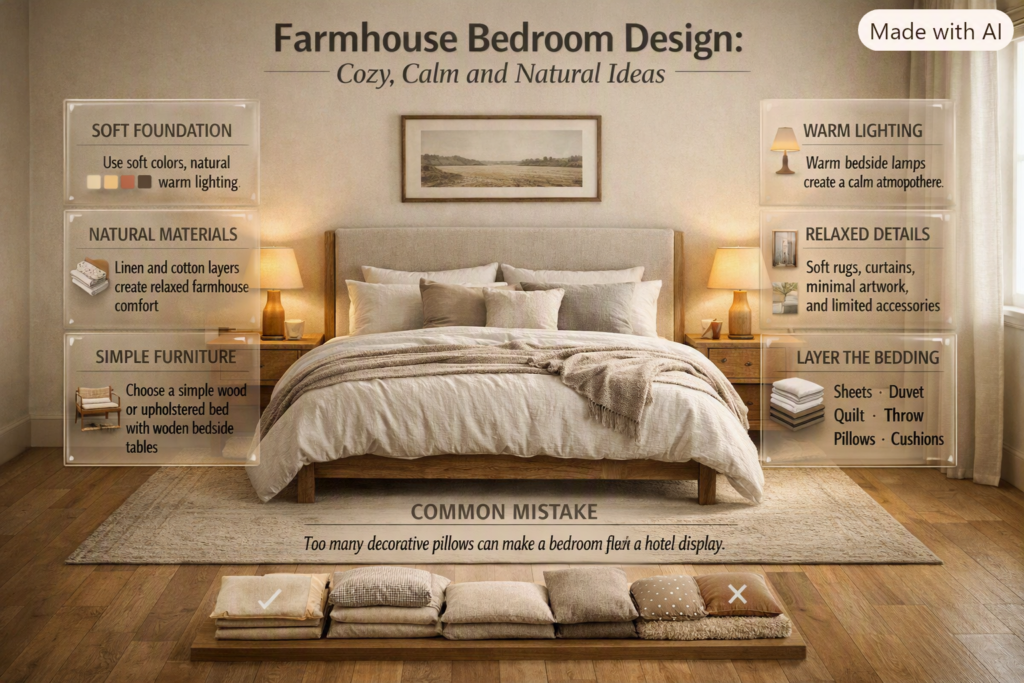
The bedroom should be calmer than the living room.
Use soft colors, natural fabrics, warm lighting, and fewer accessories.
A strong farmhouse bedroom foundation includes:
- Simple wood or upholstered bed
- Neutral bedding
- Linen or cotton layers
- Wooden bedside tables
- Warm bedside lamps
- Soft rug
- Minimal artwork
- Relaxed curtains
Layering bedding is particularly effective.
Try:
Sheets + duvet + quilt + throw + sleeping pillows + two or three decorative cushions
Keep it comfortable rather than overly staged.
⚠ Common Mistake: Adding too many decorative pillows can make a farmhouse bedroom look like a hotel display instead of a room designed for sleep.
How Do You Design a Farmhouse Bathroom?
Farmhouse bathrooms work best when natural warmth is combined with modern functionality.
Good choices include:
- Wood vanity
- Ceramic sink
- Simple mirror
- Vintage-inspired lighting
- Neutral tile
- Aged or brushed metal hardware
- Woven baskets
- Cotton towels
You don’t need rustic finishes everywhere.
A clean contemporary bathroom can feel farmhouse-inspired simply by introducing a natural wood vanity, traditional mirror, and warm lighting.
For a small bathroom, keep the main surfaces light and use darker finishes for hardware and fixtures.
How Can You Use Farmhouse Style in a Small Home?
Farmhouse design can work extremely well in apartments and smaller houses.
The main challenge is scale.
Avoid oversized sofas, huge wooden cabinets, and bulky farmhouse tables if they interfere with circulation.
Instead, choose:
- Slim furniture
- Multipurpose pieces
- Light neutral walls
- Wall-mounted storage
- Small wooden tables
- Woven baskets
- Fewer accessories
- Mirrors
The style comes from the atmosphere, not the size of the furniture.
Small-Space Formula
Warm neutral walls + natural wood + comfortable furniture + woven texture + warm lighting + controlled decoration
That’s enough to communicate farmhouse character.
How Important Is Lighting in Farmhouse Design?
Lighting can completely change a farmhouse interior.
A room with beautiful furniture can still look flat if it depends on one ceiling fixture.
Use three layers.
Ambient Lighting
Provides general illumination.
Examples:
- Ceiling fixtures
- Chandeliers
- Recessed lighting
Task Lighting
Supports specific activities.
Examples:
- Reading lamps
- Desk lamps
- Kitchen pendants
- Bathroom sconces
Accent Lighting
Creates atmosphere and highlights details.
Examples:
- Picture lights
- Shelf lighting
- Decorative lamps
- Fireplace lighting
Farmhouse lighting often uses lantern forms, glass, aged metal, ceramic, or natural materials.
Modern fixtures can also work as long as their proportions and finishes support the rest of the room.
⭐ Expert Tip: Warm lighting usually complements wood and natural fabrics better than extremely cool lighting, particularly in living rooms and bedrooms.
How Do You Decorate Farmhouse Walls?
Farmhouse walls should feel personal rather than overloaded.
Good options include:
- Landscape artwork
- Botanical prints
- Family photographs
- Vintage mirrors
- Simple shelves
- Black-and-white photography
- Handmade art
- Neutral abstract paintings
A gallery wall can work beautifully if the frames have some visual connection.
For example, you might use a combination of black, natural wood, and aged frames.
Avoid covering every wall simply because it feels empty.
Sometimes the empty space is what makes the artwork stand out.
How Do You Style Farmhouse Decor Without Making It Look Themed?
This is one of the most important farmhouse design principles.
A room becomes overly themed when the style is communicated through too many obvious symbols rather than through materials and atmosphere.
Avoid excessive use of:
- Rustic signs
- Farm animal decorations
- Artificially distressed objects
- Repeated farmhouse slogans
- Galvanized accessories
- Decorative lettering
- Matching rustic collections
Instead, focus on:
- Natural wood
- Linen
- Ceramics
- Vintage objects
- Plants
- Artwork
- Practical baskets
- Comfortable furniture
- Warm lighting
A handmade ceramic bowl can communicate farmhouse character more elegantly than a large decorative sign.
The same is true of an old wooden stool or vintage mirror.
How Do Personal Items Fit Into Farmhouse Interiors?
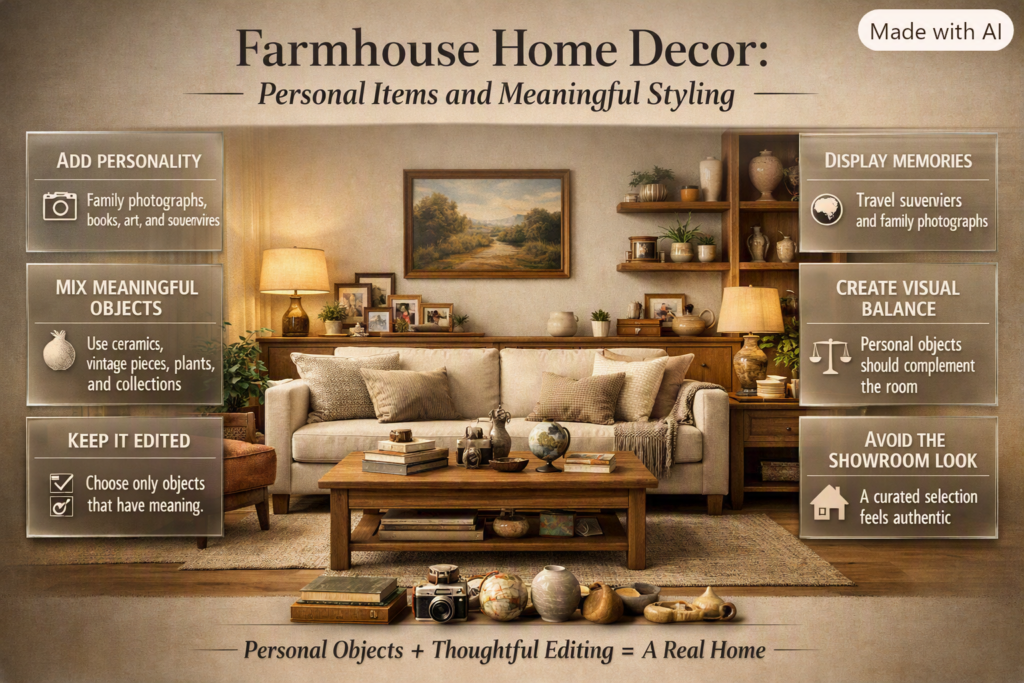
Personal objects are essential because they prevent the room from looking staged.
Include things such as:
- Family photographs
- Books
- Travel souvenirs
- Paintings
- Handmade ceramics
- Vintage objects
- Plants
- Collections
The trick is editing.
Don’t display everything.
Choose objects that have meaning or contribute visually.
This approach makes the room feel like a real home rather than a showroom.
For additional ideas about arranging furniture, accessories, and personal details, Home Styling can be useful when refining the final layer of a room.
How Do You Use Plants in Farmhouse Design?
Plants introduce life into neutral interiors.
Depending on your home’s natural light, you might consider:
- Olive trees
- Ferns
- Snake plants
- Pothos
- Herbs
- Fiddle-leaf figs
- Small flowering plants
Choose planters made from:
- Terracotta
- Ceramic
- Woven materials
- Stone
- Simple neutral finishes
Don’t buy a plant purely because it looks good in a photograph.
Consider whether your actual room provides the light and care conditions it needs.
How Can You Create Farmhouse Style on a Budget?
You don’t need a complete renovation.
Some of the most effective changes are relatively inexpensive.
Start With Paint
Changing a cold wall color to a warm neutral can completely alter the atmosphere.
Replace Hardware
Cabinet handles and drawer pulls can dramatically change kitchens and bathrooms.
Improve Lighting
A better pendant, floor lamp, or table lamp can make a room feel much more refined.
Buy Secondhand
Look for:
- Wooden stools
- Side tables
- Mirrors
- Dining chairs
- Cabinets
- Frames
Secondhand furniture often provides the character that new farmhouse furniture tries to imitate.
Add Textiles
Curtains, bedding, rugs, cushions, and throws introduce softness and texture.
Rearrange Before Buying
Sometimes the room doesn’t need another object.
It needs a better layout.
For practical, budget-conscious improvements, DIY Home Projects can be helpful when deciding which updates can be handled without a major renovation.
How Do You Make Farmhouse Interiors Look Expensive?
An expensive-looking room isn’t necessarily filled with expensive furniture.
It usually has excellent:
- Proportion
- Scale
- Lighting
- Material coordination
- Color balance
- Visual restraint
For example, an inexpensive neutral sofa can look sophisticated when it is paired with a properly sized rug, full curtains, warm lighting, a substantial coffee table, and carefully selected artwork.
The same sofa can look cheap if surrounded by random small accessories.
Use the Editing Rule
Before buying something new, remove three objects from the room.
Then look at the space again.
You may discover that what you thought was missing was actually visual breathing room.
How Can You Combine Farmhouse With Other Interior Styles?
Farmhouse style doesn’t need to exist by itself.
It can blend naturally with several other aesthetics.
Modern Farmhouse
Combine:
- Warm neutral walls
- Clean furniture
- Natural wood
- Black accents
- Contemporary lighting
- Minimal accessories
This is one of the easiest combinations for modern homes.
Scandinavian Farmhouse
Use:
- Light wood
- Soft neutrals
- Natural textiles
- Simple furniture
- Plenty of daylight
The result is lighter and more minimal.
Industrial Farmhouse
Combine:
- Reclaimed wood
- Metal
- Exposed brick
- Black fixtures
- Neutral upholstery
The contrast between rough and soft materials creates character.
Coastal Farmhouse
Use:
- Warm white
- Natural wood
- Linen
- Soft blue
- Woven materials
Avoid excessive nautical accessories.
Farmhouse and Modern Interior Design
Modern furniture can actually make farmhouse materials look more sophisticated.
If you want to understand the cleaner side of this combination, Modern Interior Design provides a useful reference point for comparing contemporary forms with warmer farmhouse materials.
Common Farmhouse Interior Design Mistakes
1. Using Too Much Distressed Wood
Distressed furniture can be attractive, but using it everywhere makes the room feel artificial.
Why it happens: People associate farmhouse style with weathered materials.
Why it’s harmful: The room begins to look themed.
Better approach: Mix aged pieces with natural and contemporary finishes.
2. Making Everything White
White creates brightness, but too much of it can make a room feel flat.
Better approach: Add warm wood, woven materials, plants, darker accents, and texture.
3. Buying Matching Furniture Sets
Matching furniture removes the collected quality that makes farmhouse spaces interesting.
Better approach: Mix pieces that share compatible colors, materials, and proportions.
4. Ignoring Scale
A large rustic coffee table can overwhelm a small living room.
Better approach: Measure the room before buying.
5. Overusing Farmhouse Signs
Decorative signs quickly make a home feel themed.
Better approach: Use artwork, photography, ceramics, and meaningful objects.
6. Filling Every Shelf
Too many objects create visual noise.
Better approach: Leave deliberate empty spaces.
7. Choosing Style Over Function
A room isn’t successful if it looks good but doesn’t work.
Better approach: Consider storage, cleaning, movement, comfort, and everyday routines.
8. Ignoring Lighting
Poor lighting can make warm colors look dull.
Better approach: Use layered lighting and test how the room looks after sunset.
What Are the Best Farmhouse Ideas for Home Improvement?
Farmhouse design doesn’t always require decorative changes. Architectural and functional improvements can create an even stronger result.
Consider:
- Installing simple wall paneling
- Updating interior doors
- Adding built-in storage
- Replacing outdated hardware
- Improving kitchen lighting
- Refinishing suitable wood surfaces
- Adding practical shelving
- Updating old fixtures
- Improving room circulation
When considering these changes, Home Improvement can be useful for thinking beyond decoration and focusing on improvements that actually make the home more functional.
The best farmhouse homes aren’t merely decorated to look good.
They’re designed to work well.
How Do You Make a New House Feel Like a Farmhouse?
New homes sometimes feel visually sterile because every surface is fresh, uniform, and contemporary.
You can soften that feeling with:
- Natural wood
- Vintage furniture
- Handmade ceramics
- Linen curtains
- Warm lamps
- Aged metal
- Textured rugs
- Plants
- Personal artwork
Don’t try to make everything look old.
Instead, introduce a few pieces with history.
For example, a contemporary kitchen can feel much warmer with an old wooden stool, vintage artwork, and handmade ceramic pieces.
The contrast between new architecture and old-looking objects creates depth.
How Do You Make an Older Home Feel Modern Farmhouse?
Older houses often already have the character that modern farmhouse design tries to recreate.
Look for existing features such as:
- Wood floors
- Trim
- Beams
- Brick
- Fireplaces
- Original doors
- Architectural details
If they’re in good condition, consider preserving them.
Then introduce:
- Contemporary sofas
- Simple lighting
- Neutral rugs
- Updated hardware
- Modern storage
- Cleaner artwork
This approach allows the home’s history to remain visible while making the interior feel current.
How Do You Keep Farmhouse Interior Design Timeless?
Timeless design doesn’t mean avoiding every trend.
It means making trends secondary to stronger foundations.
Spend more thought on:
- Comfortable furniture
- Natural materials
- Good lighting
- Appropriate scale
- Storage
- Neutral foundations
- Quality-looking finishes
Then use trends through easier-to-change elements such as:
- Cushions
- Paint
- Artwork
- Small accessories
- Decorative textiles
This means the expensive parts of the room can remain stable while smaller details evolve.
For a broader understanding of how different design elements work together, Interior Design can help when developing a cohesive approach to your home’s rooms, materials, layout, and styling.
A Step-by-Step Farmhouse Interior Design Process
If you’re starting from an empty room, don’t purchase everything at once.
Step 1: Study the Room
Look at:
- Dimensions
- Natural light
- Windows
- Doors
- Ceiling height
- Flooring
- Architectural details
- Existing furniture
Why it matters: You need to understand the room before selecting furniture.
Common mistake: Buying furniture without measuring.
Step 2: Choose Your Color Foundation
Select the main wall color and two or three supporting tones.
Why it matters: This creates visual direction.
Professional advice: Test colors in actual lighting.
Step 3: Choose Major Furniture
Start with the sofa, bed, dining table, or main storage piece.
Why it matters: These pieces determine scale.
Step 4: Add Lighting
Create ambient, task, and accent layers.
Why it matters: Lighting controls atmosphere.
Step 5: Add Texture
Introduce wood, linen, cotton, wool, jute, ceramic, and woven materials.
Step 6: Add Character
Bring in one or two vintage, handmade, or personally meaningful objects.
Step 7: Edit
Remove anything that feels repetitive.
A finished room should feel complete without feeling crowded.
What Should You Buy First for a Farmhouse Room?
If your budget is limited, prioritize purchases logically.
| Priority | Item | Reason |
| 1 | Main furniture | Establishes scale and function |
| 2 | Lighting | Controls atmosphere |
| 3 | Rug | Connects the furniture |
| 4 | Curtains | Adds softness |
| 5 | Textiles | Adds comfort and texture |
| 6 | Artwork | Adds personality |
| 7 | Accessories | Completes the room |
This prevents a common decorating mistake: spending too much money on accessories while the room’s fundamental furniture and lighting remain weak.
Is Farmhouse Interior Design Still Popular in 2026?
Farmhouse interior design is still relevant in 2026, but the look has matured. The older version—bright white walls, excessive shiplap, distressed furniture, black industrial hardware, and farmhouse signs—is becoming less desirable. Today’s farmhouse interiors are warmer, more personal, and more refined, with natural wood, earthy colors, tactile fabrics, vintage pieces, and contemporary comfort taking a bigger role.
The important distinction is between farmhouse as a timeless design philosophy and farmhouse as a short-lived decorating formula. The philosophy of creating a comfortable, practical, natural-looking home is still highly relevant. What has changed is how designers express it.
What works better in 2026:
Warm whites instead of stark white
Natural wood instead of excessive faux-distressed finishes
Sage, olive, taupe, clay, and earthy tones
Vintage furniture mixed with contemporary pieces
Linen, cotton, stone, and other tactile materials
Personal artwork instead of cliché farmhouse signs
Layered lighting instead of relying on one industrial fixture
Professional takeaway: Don’t try to make your home look like a 2018 farmhouse. Use the farmhouse principles—comfort, natural materials, craftsmanship, and practicality—and give them a more contemporary interpretation.
What Colors Are Best for Farmhouse Interior Design in 2026?
The strongest farmhouse color palettes for 2026 are moving beyond the traditional all-white look toward warm neutrals and earthy, nature-inspired shades. Cream, warm beige, taupe, mushroom, soft clay, muted sage, olive, warm brown, and deeper charcoal tones can create a more layered and sophisticated farmhouse interior.
This doesn’t mean white has disappeared. Warm white is still useful as a foundation, particularly in kitchens and smaller rooms. The difference is that designers are increasingly combining it with richer materials and colors instead of allowing white to dominate every surface.
For example, a modern farmhouse living room could use warm ivory walls, an oatmeal sofa, natural oak furniture, muted olive cushions, and a charcoal lamp. The room remains bright but has considerably more depth than an entirely white interior.
Best farmhouse colors to consider:
Warm white
Cream
Taupe
Mushroom
Beige
Soft brown
Sage green
Olive green
Muted blue
Clay or terracotta
Charcoal
Warm black
Professional tip: Choose your paint after considering the flooring, wood tones, natural light, and upholstery. A color that looks warm in a showroom can appear completely different in your own room.
How Do You Make Farmhouse Interior Design Look Modern and Not Outdated?
The easiest way to modernize farmhouse design is to reduce the obvious rustic decoration and improve the quality of the materials, proportions, and styling. Instead of using every traditional farmhouse feature at once, choose a few recognizable elements and combine them with contemporary furniture and finishes.
For example, you could pair a modern cream sofa with a genuine vintage wooden coffee table, contemporary lighting, linen curtains, and a large piece of landscape artwork. The farmhouse character comes from the materials and atmosphere rather than decorative signs.
One of the biggest mistakes is assuming that more farmhouse elements automatically create a better farmhouse interior. In reality, excessive shiplap, faux-distressed furniture, typography signs, barn-door features, and decorative rustic objects can make a room look dated. Current design coverage is specifically pointing toward more personalized, character-rich, and less cluttered farmhouse spaces.
To modernize farmhouse style:
Keep furniture silhouettes simple
Use fewer decorative objects
Choose authentic or natural-looking materials
Mix vintage pieces with contemporary furniture
Replace cliché signs with artwork
Use warm, layered lighting
Introduce richer colors carefully
Avoid distressing every wooden surface
The professional rule: If the room looks like a collection of farmhouse products, edit it. If it feels like a comfortable home with natural materials and subtle rural character, you’re closer to the modern interpretation.
What Materials Work Best in Farmhouse Interior Design?
The most effective farmhouse materials are those that provide natural texture, visible craftsmanship, and a sense of warmth. Wood remains one of the strongest materials, but today’s farmhouse interiors are increasingly using it alongside stone, linen, cotton, ceramic, aged metals, and woven fibers rather than relying on distressed wood alone.
Natural wood is particularly useful because it works across almost every room. You can use oak furniture in the living room, a wood vanity in the bathroom, timber shelving in the kitchen, or a solid dining table as the focal point of the dining area.
Textiles are equally important. Linen curtains and cotton bedding soften hard architectural surfaces, while jute, rattan, wicker, and other woven materials introduce another layer of texture.
High-value farmhouse materials include:
Natural oak
Reclaimed or aged wood
Stone
Linen
Cotton
Wool
Ceramic
Terracotta
Jute
Rattan
Wicker
Aged brass
Bronze
Matte or brushed metal
What to avoid: Using a fake rustic finish on every surface. One genuinely aged or vintage piece usually adds more character than an entire room filled with artificially distressed furniture.
Professional tip: When a neutral farmhouse room feels boring, don’t immediately add more decoration. First ask whether it needs another texture. A linen curtain, wool rug, natural wood table, or handmade ceramic may solve the problem more effectively than another accessory.
How Do You Decorate a Farmhouse Home Without Making It Look Too Rustic or Cluttered?
The secret is editing. Farmhouse interiors should feel collected and comfortable, but they shouldn’t look like every rustic accessory in the store has been placed in one room.
Start with the major elements—walls, flooring, furniture, lighting, and window treatments. Once those are working together, add accessories selectively. Choose objects that either serve a purpose, add texture, or have genuine personal meaning.
Instead of placing several farmhouse signs on a wall, consider one large landscape painting or a collection of family photographs. Instead of filling a kitchen with decorative jars, display a few attractive ceramic pieces or useful wooden boards. Instead of covering every shelf with objects, leave some negative space.
This approach is especially important in 2026 because current farmhouse design is moving toward personal, tactile, character-rich spaces rather than highly themed rooms.
A simple farmhouse editing checklist:
Keep only meaningful accessories
Mix decorative pieces with functional objects
Leave empty space on shelves
Use artwork instead of cliché signs
Combine old and new pieces
Repeat colors subtly rather than matching everything
Prioritize texture over excessive decoration
Keep furniture properly scaled to the room
Professional rule of thumb: Before adding another farmhouse accessory, remove one that doesn’t contribute anything. A well-edited room nearly always looks more sophisticated than a heavily decorated one.
Conclusion
Farmhouse interior design is no longer about filling a home with distressed wood, shiplap, rustic signs, or an endless collection of white furniture. The most successful farmhouse interiors today focus on what made the style appealing in the first place: comfort, natural materials, practical living, warmth, and a genuine sense of home.
The best approach is to start with a calm foundation of warm neutrals, then bring in natural wood, linen, cotton, stone, woven textures, and carefully selected vintage or handmade pieces. From there, modern furniture, contemporary lighting, and subtle colors can keep the space feeling fresh rather than overly traditional.
Most importantly, don’t try to make every room look like a farmhouse showroom. Mix old with new, leave some breathing room, and choose décor that actually reflects your personality. A family photograph, a vintage table, a handmade ceramic bowl, or a well-loved piece of furniture can give a room far more character than dozens of matching accessories.
Whether you’re updating one room or redesigning your entire home, farmhouse style gives you plenty of flexibility. You can make it modern, minimalist, rustic, elegant, colorful, or highly personal while still keeping its welcoming character.

Leave a Reply