
Introduction
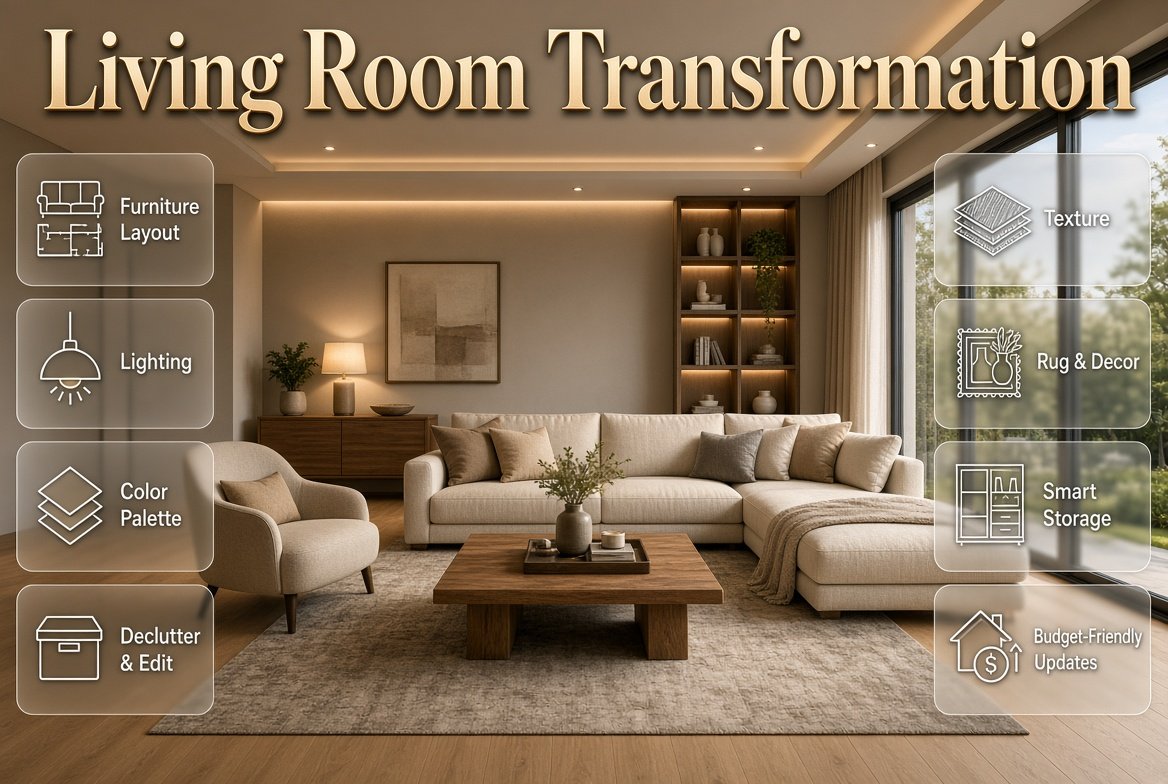
Living Room Transformation | Have you ever looked at your living room and felt that something was wrong, even though you could not identify exactly what it was? The sofa may be perfectly usable, the walls may be freshly painted, and the room may have plenty of furniture, yet the space can still feel flat, crowded, unfinished, or simply uninspiring.
That is where a thoughtful living room transformation can make a remarkable difference.
You do not always need a complete renovation or an expensive furniture replacement. Sometimes the biggest improvement comes from changing the layout, improving lighting, introducing texture, editing clutter, or choosing a more intentional color palette. The goal is not to make your living room look like a showroom. It is to create a space that feels comfortable, balanced, personal, and suitable for the way you actually live.
If you are planning a broader home refresh, DesignMode24 Interior Design can also be a useful starting point for exploring additional interior inspiration and practical design ideas.
This guide explains how to transform a living room from the first assessment to the final styling details, including furniture arrangement, paint, rugs, lighting, wall decor, storage, texture, budget planning, DIY upgrades, and common mistakes to avoid.
What Does a Living Room Transformation Actually Mean?
A living room transformation is the process of improving the appearance, comfort, functionality, and overall atmosphere of a living space through intentional changes to its layout, furniture, colors, lighting, materials, accessories, and organization.
The transformation can be small or extensive. A simple weekend refresh may involve rearranging furniture and changing textiles, while a major transformation could include new flooring, built-in storage, architectural changes, or completely new furniture.
The important point is that transformation does not automatically mean renovation.
Why Does Transforming a Living Room Matter?
The living room is usually one of the most frequently used areas of a home. It may serve as a place for conversation, television, reading, entertaining, relaxing, working, or spending time with family.
A successful transformation therefore needs to balance beauty with everyday practicality.
A room can look impressive in photographs but become frustrating in daily life if the seating is uncomfortable, walking paths are blocked, lighting is harsh, or there is nowhere to store everyday items.
The best transformation improves how the room feels and functions, not just how it photographs.
💡 Pro Tip: Before buying anything, identify the three biggest problems in the room. Fix those first. This prevents unnecessary spending and gives the transformation a clear direction.
How Should You Assess Your Living Room Before Making Changes?
Start by studying the room as it currently exists rather than immediately shopping for new pieces. Walk around the space at different times of day and pay attention to what feels uncomfortable, visually heavy, empty, dark, or impractical.
Ask yourself:
- Is the furniture arrangement easy to use?
- Are walking paths clear?
- Does the sofa face the right focal point?
- Is the room too dark?
- Are the walls visually empty?
- Does the furniture feel too large or too small?
- Is there excessive clutter?
- Does the color palette feel coordinated?
- Is there enough storage?
- Does the room reflect your personality?
Take photographs from several corners. Photos often reveal problems that are difficult to notice when you are standing inside the room.
Which Problems Should You Fix First?
Not every problem deserves the same priority.
| Problem | Priority | Typical Solution |
|---|---|---|
| Poor furniture layout | Very High | Rearrange furniture |
| Insufficient lighting | Very High | Add layered lighting |
| Clutter | Very High | Declutter and organize |
| Wrong rug size | High | Replace or reposition rug |
| Flat color palette | Medium | Add color or contrast |
| Empty walls | Medium | Artwork or wall styling |
| Lack of texture | Medium | Add textiles and natural materials |
| Small decorative details | Low | Accessories and styling |
This approach makes the process more strategic. Instead of trying to change everything simultaneously, you solve the issues that have the greatest visual and functional impact.
How Do You Set a Realistic Budget for a Living Room Transformation?
A good budget begins with priorities rather than a shopping list.
Separate your spending into three categories:
Must-have improvements:
Things that solve genuine functional problems.
High-impact upgrades:
Items that significantly improve the room’s appearance.
Optional accessories:
Decorative additions that can be purchased later.
For example, if your existing sofa is comfortable and structurally sound, replacing it may not be necessary. A new rug, lighting arrangement, curtains, and cushions could completely change the visual character of the space for much less money.
For more ideas that combine practical upgrades with visual improvements, explore these Home Improvement resources.
How Can You Transform a Living Room on a Limited Budget?
Start with changes that require little or no money.
- Rearrange furniture.
- Remove unnecessary objects.
- Reposition artwork.
- Improve natural light.
- Change the arrangement of accessories.
- Rotate cushions and throws from other rooms.
- Reorganize shelves.
- Clean windows and light fixtures.
Then move toward inexpensive improvements:
- Cushion covers
- Throws
- Lampshades
- Decorative baskets
- Curtains
- Small plants
- Mirrors
- Artwork
- Area rugs
⭐ Expert Tip: Spend money on pieces that influence the room every day, such as seating, lighting, rugs, and storage. Spend less on trend-driven decorative objects that can easily be replaced.
How Do You Choose the Right Style for Your Living Room?
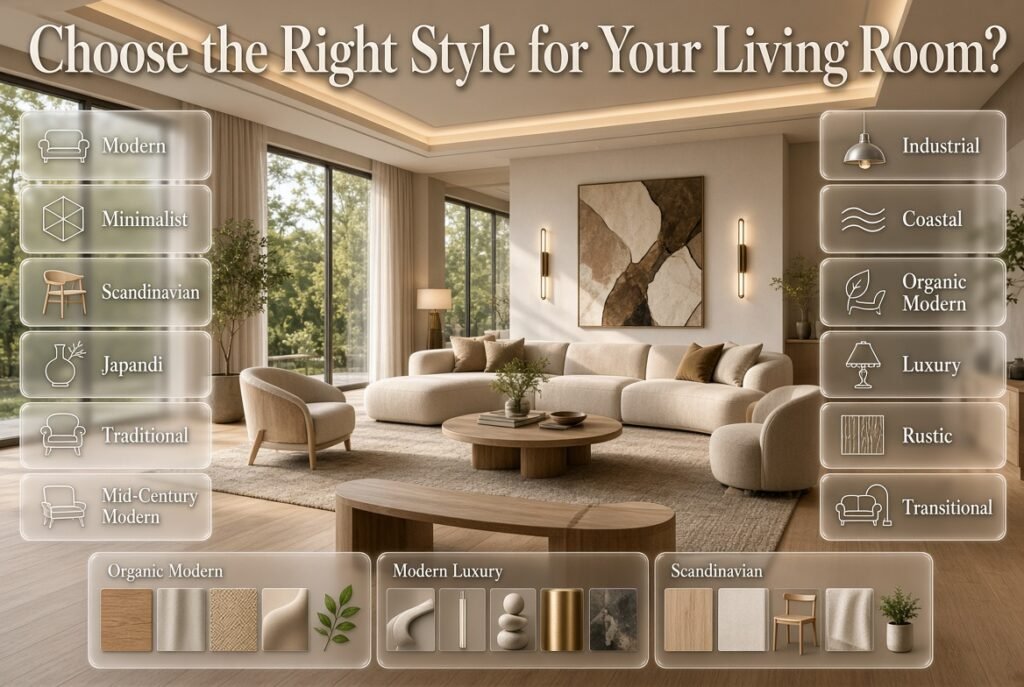
A successful living room should have a recognizable visual direction. That does not mean everything must match. It means the major elements should feel as though they belong together.
You might prefer:
- Modern
- Contemporary
- Minimalist
- Traditional
- Transitional
- Scandinavian
- Japandi
- Mid-century modern
- Industrial
- Coastal
- Organic modern
- Luxury
- Rustic
Before choosing furniture, create a simple style vocabulary.
For example:
Organic modern: warm wood + soft neutrals + natural fibers + curved forms + greenery.
Modern luxury: refined furniture + layered lighting + sophisticated neutrals + metallic accents + statement artwork.
Scandinavian: light wood + pale colors + functional furniture + soft textiles + uncluttered surfaces.
Your goal is not to copy a photograph exactly. Instead, identify the principles that make the style attractive to you.
For broader inspiration and foundational concepts, explore Interior Design ideas before committing to a specific look.
How Should You Arrange Living Room Furniture?
Furniture arrangement is one of the most powerful parts of a living room transformation because it can change the entire feeling of the space without requiring a single new purchase.
Begin with the largest piece, usually the sofa.
Then determine:
- The primary focal point
- The main seating direction
- Walking paths
- Secondary seating
- Coffee table position
- Side table locations
- Lighting positions
A common mistake is pushing every piece against the walls. This can create a large empty area in the center while making the room feel disconnected.
Instead, consider creating a defined conversation zone.
        ART / TV / FOCAL POINT
    ┌─────────────────────────┐
    │                         │
    │   Chair       Chair     │
    │                         │
    │      COFFEE TABLE       │
    │                         │
    │          SOFA           │
    │                         │
    └─────────────────────────┘
The exact arrangement depends on the architecture, but the principle remains the same: furniture should support interaction and movement.
How Much Space Should You Leave Between Furniture?
Walking paths should feel natural rather than forced.
A practical target is approximately 30–36 inches for major walking routes when the room allows it. Around seating, you need enough clearance for people to sit comfortably, move around the coffee table, and access doors.
Do not sacrifice functionality simply to create a symmetrical photograph.
How Do You Choose the Right Sofa?
The sofa is often the visual anchor of a living room, so its scale, shape, color, and comfort deserve careful attention.
Before buying one, measure:
- Wall length
- Door openings
- Stairways
- Elevator dimensions if relevant
- Available floor space
- Distance from other furniture
- TV viewing distance where applicable
A beautiful sofa that cannot comfortably fit through the entrance is an expensive mistake.
What Sofa Shape Works Best?
Straight sofas work well in many layouts.
Sectionals are useful when you want generous seating and have enough floor space.
Curved sofas can create a softer, more social atmosphere but need careful placement.
Apartment-size sofas are useful in compact rooms where a standard deep sofa would dominate the space.
Never choose sofa size based only on the showroom. Judge it according to your actual room dimensions.
How Important Is the Rug in a Living Room Transformation?
A rug can visually connect furniture, define the seating zone, introduce texture, and make a room feel warmer.
One of the most common decorating mistakes is choosing a rug that is too small.
Ideally, at least the front legs of major seating pieces should sit on the rug. In a larger room, placing all major furniture on the rug can create an even stronger sense of cohesion.
What Rug Size Should You Choose?
| Room Situation | Common Approach |
|---|---|
| Small living room | Rug large enough to connect seating |
| Medium room | Sofa and chairs partly on rug |
| Large room | Most seating fully on rug |
| Open-plan room | Large rug to define living zone |
Choose the rug after considering the furniture arrangement, not before.
A rug should make the seating area feel like one intentional composition rather than several unrelated objects.
How Can Paint Change a Living Room?
Paint is one of the fastest ways to change the emotional character of a room.
Light colors can make a space feel brighter and more open. Darker shades can create depth and intimacy. Warm neutrals often create a relaxed atmosphere, while cooler tones can feel crisp and contemporary.
Before choosing a shade, consider:
- Natural daylight
- Artificial lighting
- Flooring
- Furniture colors
- Ceiling height
- Room size
- Adjacent rooms
Explore the Paint Color collection for additional color inspiration.
Should You Paint Every Wall the Same Color?
Not necessarily.
A monochromatic room can look sophisticated when different textures and tones are layered together. Alternatively, one wall can become an accent feature.
Accent colors can be introduced through:
- Paint
- Wallpaper
- Artwork
- Curtains
- Cushions
- Furniture
- Decorative objects
⚠ Common Mistake: Choosing paint from a tiny color card without testing it in the actual room. Lighting can dramatically change how a shade appears.
How Do You Create an Effective Accent Wall?
An accent wall works best when it has a reason to exist.
Good locations include:
- Behind the sofa
- Behind the television
- Around a fireplace
- At the end of a long room
- On a wall containing architectural features
An accent wall should strengthen the room’s focal point rather than compete with everything else.
You can create one using paint, wallpaper, wood slats, textured plaster, paneling, stone, or carefully selected artwork.
If the room already contains several strong visual elements, a subtle accent may work better than an extremely bold wall.
How Can Lighting Transform a Living Room?
Lighting can make an average room feel sophisticated.
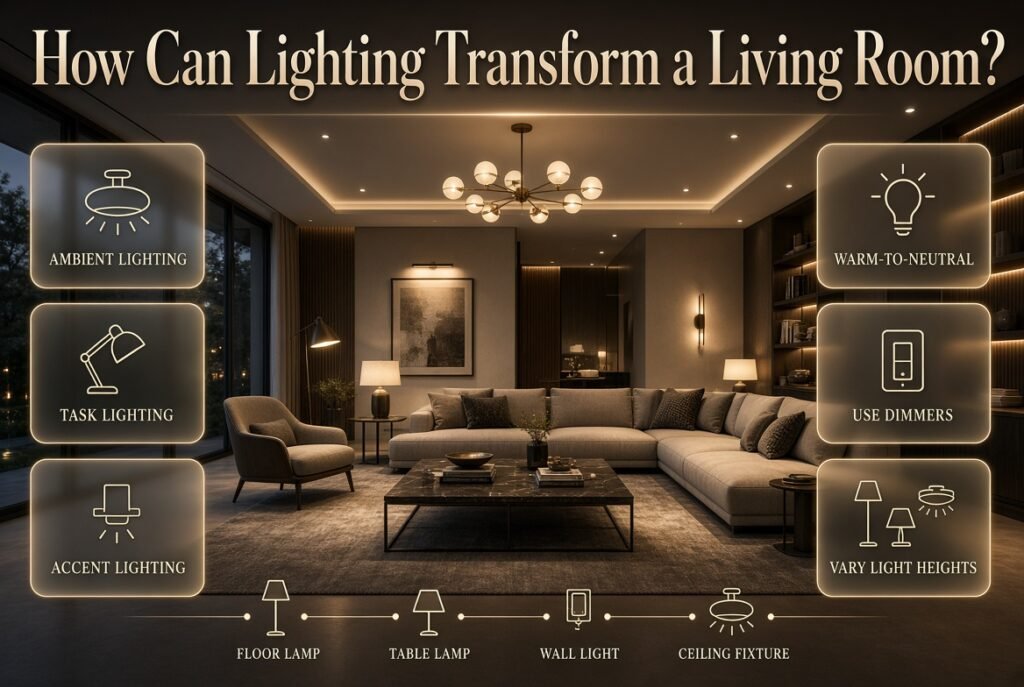
The strongest living rooms typically use three layers:
1. Ambient Lighting
This provides general illumination.
Examples include:
- Ceiling fixtures
- Recessed lights
- Chandeliers
- Flush mounts
2. Task Lighting
This supports specific activities.
Examples include:
- Reading lamps
- Desk lamps
- Adjustable floor lamps
3. Accent Lighting
This creates atmosphere and highlights features.
Examples include:
- Picture lights
- Wall sconces
- Cabinet lighting
- Decorative lamps
- Hidden LED illumination
A room with only one overhead light often feels harsh and flat.
What Color Temperature Works Best?
Warm-to-neutral lighting is usually more comfortable for living areas than very cool, clinical light.
Use dimmers wherever practical. They allow the same room to shift from bright daytime functionality to softer evening relaxation.
💡 Pro Tip: Put lamps at different heights. A floor lamp, table lamp, wall light, and ceiling fixture create a richer visual rhythm than several identical lights.
How Do You Add Texture to a Living Room?
Texture prevents a neutral room from feeling flat.
Imagine a beige living room containing:
- Linen curtains
- A wool rug
- A wooden coffee table
- Ceramic pottery
- A woven basket
- Cotton cushions
- A soft boucle chair
The colors may remain simple, but the materials create visual depth.
Good materials include:
- Wood
- Linen
- Wool
- Cotton
- Ceramic
- Glass
- Metal
- Stone
- Rattan
- Woven fibers
- Leather
The key is variation.
Too much of one material can make the room feel monotonous. Too many competing textures can make it chaotic.
How Can Wall Decor Improve a Living Room?
Blank walls are not automatically a problem. Empty space can be useful when the room already contains strong furniture or architectural details.
But if the walls feel unfinished, consider:
- Large artwork
- Gallery walls
- Mirrors
- Floating shelves
- Sculptural objects
- Wall sconces
- Textured panels
- Photography
- Oversized clocks
Is One Large Artwork Better Than Many Small Pieces?
Often, yes.
One large artwork can create a strong focal point and make a room feel more intentional.
Several small pieces can also work, but they need careful spacing and alignment.
A common mistake is hanging small artwork too high or using many unrelated pieces without a visual connection.
How Can Mirrors Make a Living Room Feel Larger?
Mirrors reflect light and can visually expand a room.
Place a mirror where it reflects something attractive, such as:
- A window
- Artwork
- A decorative light
- Greenery
- An architectural feature
Avoid placing a mirror where it reflects clutter or an unattractive corner.
Large mirrors can become statement pieces. Multiple smaller mirrors can create an artistic composition when carefully arranged.
How Do Curtains Affect the Overall Transformation?
Window treatments can dramatically influence perceived ceiling height and softness.
For a more polished appearance, curtains can often be mounted higher and wider than the actual window frame, provided the architecture allows it.
Long curtains can create vertical movement and make the room feel more finished.
Choose fabrics according to the desired atmosphere:
- Linen for relaxed elegance
- Velvet for richness
- Cotton for simplicity
- Sheer fabric for softness and daylight
- Layered curtains for flexibility
The curtain color does not have to exactly match the sofa. It can instead connect with the rug, artwork, walls, or accent accessories.
How Can Storage Improve a Living Room?
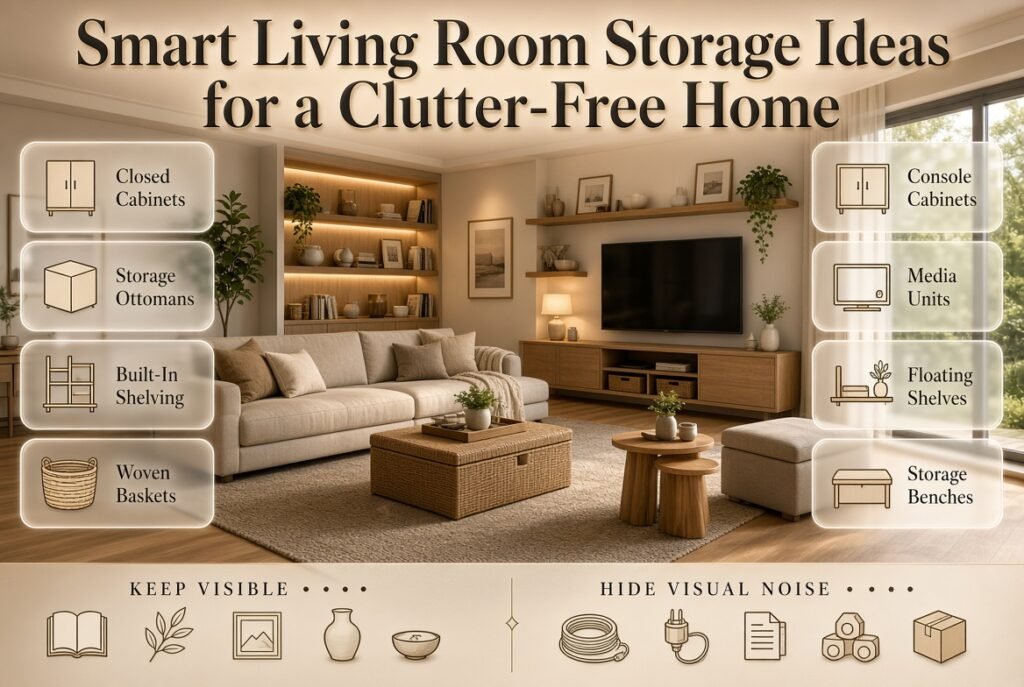
A beautiful room becomes difficult to enjoy when everyday objects have nowhere to go.
Good storage should make organization easier without making the room visually heavy.
Consider:
- Closed cabinets
- Storage ottomans
- Built-in shelving
- Baskets
- Console cabinets
- Media units
- Floating shelves
- Nesting tables
- Storage benches
What Should Stay Visible?
Keep attractive objects visible:
- Books
- Plants
- Art
- Ceramics
- Decorative bowls
- Meaningful objects
Hide visual noise:
- Remote controls
- Cables
- Paperwork
- Toys
- Chargers
- Random packaging
- Unused electronics
The goal is not minimalism for its own sake. It is intentional visibility.
How Can You Transform a Small Living Room?
Small living rooms need discipline rather than excessive decoration.
Start by choosing furniture that fits the room proportionally.
Useful strategies include:
- Select slimmer furniture.
- Use furniture with visible legs.
- Choose multifunctional pieces.
- Use mirrors strategically.
- Keep pathways open.
- Use vertical storage.
- Choose one strong focal point.
- Avoid excessive small accessories.
A compact room can still feel luxurious if every piece has a purpose.
What Colors Work Well in Small Living Rooms?
Light neutrals can help create openness, but you do not have to avoid darker colors completely.
A darker accent wall can actually add depth when used intentionally.
The bigger issue is visual clutter.
A small room filled with pale objects can still feel crowded.
How Do You Transform a Large Living Room Without Making It Feel Empty?
Large rooms present the opposite problem.
Instead of pushing everything against the walls, create zones.
You might have:
Conversation zone
Sofa + chairs + coffee table.
Reading zone
Armchair + floor lamp + small table.
Entertainment zone
Media unit + television + storage.
Display zone
Artwork + console + decorative objects.
The trick is to make each area feel connected.
Large rugs, consistent colors, repeated materials, and coordinated lighting can visually unite separate zones.
How Can You Make a Living Room Feel Cozier?
Comfort comes from layers.
Use:
- Soft throws
- Cushions
- Warm lighting
- Rugs
- Curtains
- Wood
- Natural materials
- Plants
- Comfortable seating
Do not confuse coziness with clutter.
A room can be cozy while remaining visually clean.
The best cozy rooms often contain a restrained palette with plenty of tactile materials.
How Can You Create a Luxury Living Room Without Overspending?
Luxury is not simply about expensive furniture.
It is more closely associated with:
- Good proportions
- Quality materials
- Visual restraint
- Layered lighting
- Strong focal points
- Consistency
- Comfortable furniture
- Thoughtful details
For example, an inexpensive ceramic vase can look sophisticated when placed intentionally beside a beautiful lamp and carefully selected artwork.
The same vase can look ordinary when surrounded by too many unrelated objects.
What Can You Learn From Celebrity Homes?
Celebrity homes often demonstrate the importance of scale, focal points, architectural character, and carefully edited decoration. Looking at examples such as the Mark Cuban house can provide inspiration, but the objective should be to learn design principles rather than copy another person’s lifestyle.
Ask:
- How is space divided?
- Where is the focal point?
- How is lighting layered?
- How are materials combined?
- How is visual clutter controlled?
Use those principles in a way that suits your own home.
How Can Plants Improve a Living Room?
Plants introduce life, movement, and natural color.
Good choices depend on available light and maintenance preferences.
You can use:
- Tall floor plants
- Small tabletop plants
- Hanging plants
- Branch arrangements
- Dried botanicals
- Fresh flowers
Place plants where they enhance the composition rather than simply filling empty corners.
One large plant can often make a stronger statement than many tiny plants scattered everywhere.
How Should You Style a Coffee Table?
A coffee table should remain functional.
A practical arrangement might include:
- One tray
- One decorative object
- A small plant or flowers
- Two or three books
Use different heights to create visual interest.
For example:
Low: books
Medium: tray
High: vase or sculptural object
Leave enough open space for drinks and everyday use.
A coffee table that looks perfect but cannot be used comfortably is not successful design.
How Do You Style Open Shelves Without Creating Clutter?
Start by removing everything.
Then return objects selectively.
Group items by:
- Height
- Material
- Color
- Function
Avoid placing every decorative object in a straight line.
Instead, create small visual groupings with negative space between them.
Books can be stacked horizontally beneath a ceramic object. A plant can soften a group of harder materials. Artwork can add vertical scale.
Think of shelves as a composition rather than storage alone.
How Can You Personalize a Living Room?
A room becomes memorable when it contains evidence of the people who live there.
Use:
- Travel photographs
- Family artwork
- Favorite books
- Handmade objects
- Vintage finds
- Heirlooms
- Collections
- Meaningful souvenirs
Personalization should feel curated rather than random.
You do not need to display everything you own. Choose the objects that genuinely contribute to the story of the room.
For additional ideas on creating a visually appealing space, explore Beautiful Interior inspiration and consider how composition, proportion, and personality work together.
What Are the Most Useful DIY Living Room Upgrades?
DIY projects can deliver significant visual improvements when chosen carefully.
Consider:
- Painting an accent wall
- Creating simple wall paneling
- Refinishing a small table
- Updating cabinet hardware
- Creating a gallery wall
- Making decorative cushions
- Building simple floating shelves
- Refreshing an old mirror
- Creating a custom artwork piece
Explore DIY Home Projects for additional project inspiration.
Before starting a DIY project, consider the time, tools, skill level, and finish quality required.
A badly executed project can make a room look less polished than it did before.
⚠ Common Mistake: Starting a complicated DIY project simply because it looks easy in a short video. Measure twice, research the materials, and understand the full process before committing.
How Do You Make a Living Room Look Expensive?
Focus on visual consistency rather than price.
A more expensive-looking room often has:
- Correct furniture scale
- Coordinated colors
- Layered lighting
- High-quality-looking textiles
- Large-scale artwork
- Minimal visual clutter
- Natural materials
- Carefully chosen accessories
One oversized artwork can sometimes create more impact than ten small decorative items.
Similarly, a well-fitted rug can improve the entire room more than several inexpensive accessories.
How Can You Transform a Living Room Without Replacing the Sofa?
You can dramatically change the room around an existing sofa.
Try:
- New cushion covers
- A textured throw
- A new rug
- Different curtains
- Updated lighting
- New artwork
- Side tables
- Plants
- A large mirror
- Rearranged furniture
If the sofa is neutral, you have even more flexibility.
Instead of treating an old sofa as a limitation, treat it as the foundation for a new color and texture scheme.
How Do You Create a Strong Focal Point?
Every living room benefits from having a visual anchor.
Possible focal points include:
- Fireplace
- Large artwork
- Television wall
- Architectural feature
- Statement sofa
- Large window
- Accent wall
- Sculptural lighting
The focal point should be obvious without being overwhelming.
Arrange furniture toward it when appropriate, then support it with lighting and surrounding negative space.
How Should a Living Room Connect With the Rest of the Home?
A living room should feel connected to nearby spaces without looking identical to them.
Repeat selected elements across rooms:
- Wood tone
- Metal finish
- Accent color
- Flooring
- Textile color
- Design language
For example, if the dining area uses warm oak, the living room might repeat that tone through the coffee table or shelving.
If you are redesigning several areas, the Room-by-Room Design Hub can help you think about the home as a connected design system rather than a collection of unrelated rooms.
How Can You Refresh a Living Room in One Weekend?
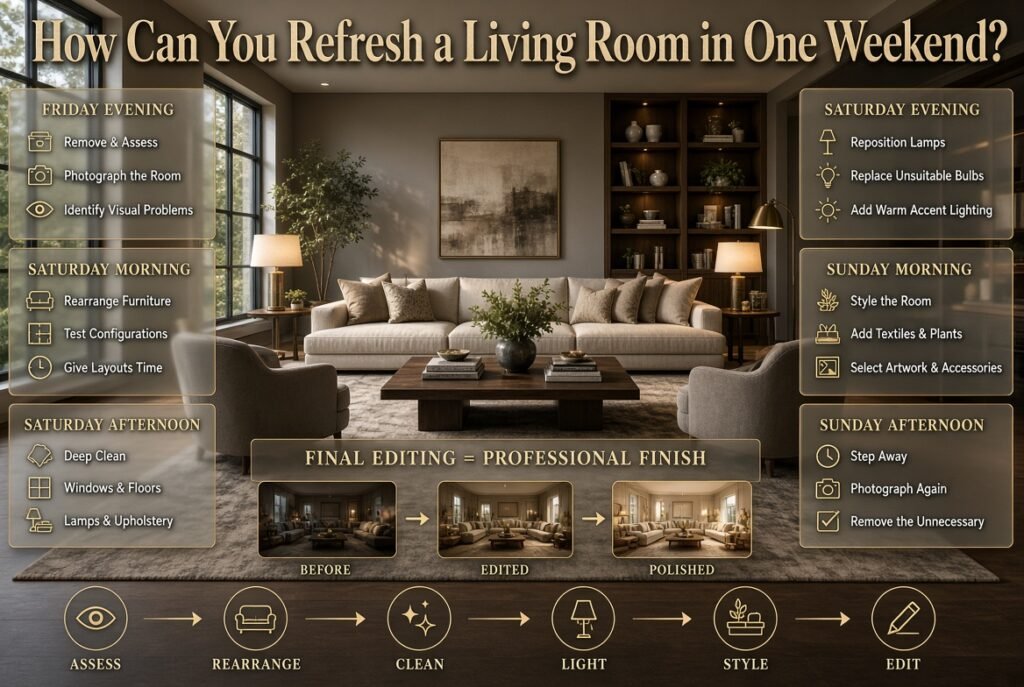
A weekend transformation can be surprisingly effective if you focus on high-impact tasks.
Friday Evening: Remove and Assess
Remove unnecessary objects.
Take photographs.
Identify the biggest visual problems.
Saturday Morning: Rearrange
Move the sofa, chairs, tables, and rug.
Test several configurations.
Do not judge the first arrangement too quickly.
Saturday Afternoon: Deep Clean
Clean:
- Windows
- Floors
- Lamps
- Shelves
- Upholstery
- Decorative objects
Cleanliness can dramatically improve perceived quality.
Saturday Evening: Lighting
Reposition lamps.
Replace unsuitable bulbs.
Add warm accent lighting if needed.
Sunday Morning: Style
Bring back only the objects that support the new composition.
Add textiles, plants, artwork, and accessories.
Sunday Afternoon: Edit
Walk away for an hour.
Return and photograph the room.
Remove anything that feels unnecessary.
📌 Quick Tip: The final editing stage is often what separates a decorated room from a professionally styled room.
How Can You Transform a Living Room at Different Budget Levels?
Under $100
Focus on:
- Decluttering
- Rearranging
- Cushion covers
- Small plants
- DIY artwork
- Styling existing objects
$100–$500
Consider:
- New lighting
- Curtains
- Decorative mirror
- Accent accessories
- Small side tables
- Textiles
$500–$1,500
Consider:
- Quality area rug
- Statement lighting
- Accent chair
- Larger artwork
- Storage furniture
$1,500+
Consider:
- Sofa replacement
- Custom cabinetry
- Premium rug
- Designer lighting
- Built-in storage
- Professional interior design assistance
The correct budget depends on the condition of the existing room. You do not need to spend heavily simply because the room is being transformed.
For more practical ideas across different spending levels, explore Easy Decorating Tips for Every Budget.
What Are the Biggest Living Room Transformation Mistakes?
1. Buying Furniture Before Measuring
A room can quickly become overcrowded when furniture is chosen without measurements.
2. Choosing a Tiny Rug
Small rugs can make otherwise good furniture arrangements feel disconnected.
3. Using Only One Light Source
One ceiling fixture rarely creates a warm, layered atmosphere.
4. Matching Everything
A perfectly matched furniture set can look generic.
5. Adding Too Many Accessories
More decoration does not automatically mean more personality.
6. Ignoring Scale
A tiny lamp beside a huge sofa may look visually insignificant.
7. Copying Trends Blindly
A trend may look excellent online but fail to suit your architecture or lifestyle.
8. Prioritizing Appearance Over Comfort
Your living room should be enjoyable to use.
9. Hanging Artwork Too High
Artwork should relate visually to the furniture and human eye level.
10. Forgetting Negative Space
Rooms need breathing room.
⭐ Expert Tip: If something does not improve function, comfort, beauty, or meaning, question whether it needs to remain.
What Would an Interior Designer Prioritize First?
An experienced designer usually thinks about the room as a whole rather than individual products.
The priority order is often:
Architecture → Layout → Furniture scale → Lighting → Color → Texture → Accessories
This order matters.
There is little value in choosing beautiful cushions if the sofa is blocking the main walkway.
Likewise, expensive artwork will not solve a badly proportioned furniture arrangement.
What Should You Never Compromise On?
Do not compromise heavily on:
- Safety
- Comfortable seating
- Correct furniture scale
- Functional lighting
- Clear circulation
- Quality installation
- Appropriate storage
Decorative trends can change.
Good proportions and practical design remain valuable.
How Do You Know When Your Living Room Transformation Is Finished?
A room is finished when additional changes stop improving it.
Ask yourself:
- Can people move comfortably?
- Is the seating practical?
- Does the room have a clear focal point?
- Is the lighting comfortable?
- Are the colors coordinated?
- Is there enough texture?
- Is clutter controlled?
- Does the room feel personal?
- Can you use every major piece comfortably?
If the answer is yes, resist the temptation to keep adding things.
Sometimes the final design improvement is simply removing one unnecessary object.
How Can You Set Up Your Decor After the Main Transformation?
Once furniture, lighting, rugs, paint, and major elements are settled, the final styling should happen gradually.
Start with functional pieces.
Then add larger decorative elements.
Finally, add small details.
A useful sequence is:
Furniture → Rug → Lighting → Curtains → Artwork → Plants → Textiles → Accessories
This prevents decorative objects from dictating the design.
For a more detailed approach to organizing and arranging decorative elements, see How to Set Up My Home Decor.
The final objective is balance. One side of the room should not feel dramatically heavier than the other unless the asymmetry is intentional.
What is the best way to transform a living room without completely renovating it?
The most effective living room transformation usually starts with layout, lighting, and visual editing rather than construction. Rearranging the sofa and chairs, choosing a properly sized rug, improving lighting, updating curtains, adding texture, and removing unnecessary clutter can completely change how the room feels without replacing everything.
In fact, current designer advice continues to emphasize getting the fundamentals right before spending heavily on decorative pieces. A well-proportioned rug, functional furniture arrangement, layered lighting, and carefully selected accessories can have a much greater effect than simply buying more furniture.
Key improvements to prioritize:
Rearrange furniture to improve movement and conversation.
Use a large enough rug to visually anchor the seating area.
Add floor, table, or wall lighting instead of relying only on one ceiling fixture.
Replace outdated curtains or heavy window treatments.
Introduce cushions, throws, plants, and artwork for texture and personality.
Remove decorative items that make the room feel crowded.
Repaint one or more walls if the existing color is making the room feel dated.
The biggest mistake is assuming that transformation means starting from zero. If your sofa is comfortable and your furniture is structurally sound, there is no reason to replace everything. Transform the elements that are actually holding the room back.
How can I transform a small living room and make it look bigger?
A small living room looks larger when you improve scale, circulation, light, and visual continuity rather than simply filling it with space-saving furniture. Choose appropriately scaled seating, keep pathways open, use a properly sized rug, reduce clutter, and use mirrors or reflective surfaces to distribute available light.
For small rooms, furniture selection matters more than decoration. A sofa that is too deep or a coffee table that is too large can make the entire room feel cramped, even when the individual pieces look attractive.
Use these practical strategies:
Choose a sofa that fits the actual dimensions of the room.
Avoid oversized sectionals unless the layout genuinely supports one.
Use furniture with exposed legs to create visual openness.
Select multifunctional pieces such as storage ottomans or nesting tables.
Use vertical shelving when floor space is limited.
Place a mirror where it can reflect daylight or an attractive part of the room.
Keep the color palette visually connected instead of creating too many separate blocks.
Use lighting at different heights to create depth.
Remove unnecessary small furniture.
A common misconception is that every small room must be painted white. Designers are increasingly using richer colors in small spaces when the lighting and mood support them. The right shade depends on daylight, existing finishes, and the atmosphere you want to create.
The real secret is editing. A small living room often feels larger when you remove one or two unnecessary pieces rather than adding another clever storage solution.
What are the biggest living room design trends for 2026?
The strongest 2026 living room direction is moving away from sterile, showroom-style minimalism toward comfortable, layered, personalized interiors. Designers are highlighting informal layouts, natural materials, vintage and antique pieces, richer colors, textured fabrics, statement lighting, and rooms that feel collected rather than perfectly matched.
This does not mean you need to redesign your living room every time a trend changes. The smarter approach is to borrow the parts of a trend that improve your existing space.
Five useful 2026 directions to consider are:
Warmer color palettes: Brown, earthy neutrals, olive, burgundy, and deeper blue tones are creating richer atmospheres.
Layered textures: Wood, linen, rattan, ceramics, stone, wool, and tactile upholstery add depth.
Vintage and collected furniture: Mixing older pieces with contemporary furniture gives a room more personality.
Flexible layouts: Conversation areas, reading corners, and multifunctional zones are becoming more important.
Statement lighting: Sculptural lamps and oversized fixtures can act as both functional lighting and artwork.
Natural materials and deeper earthy tones are also appearing strongly across 2026 living-room guidance.
The important SEO and design distinction here is trend versus timeless principle. You can introduce a trendy brown accent chair, vintage lamp, patterned cushion, or sculptural light without replacing permanent elements every year.
A well-designed room should still look good after the trend cycle has moved on.
How can I transform my living room on a budget?
A budget-friendly living room transformation should focus on high-impact changes rather than high-cost products. Start with free improvements such as rearranging furniture, decluttering, cleaning, changing artwork positions, and improving the flow of the room. Then spend selectively on paint, lighting, textiles, rugs, or accessories.
Recent designer recommendations similarly highlight rearranging the floor plan, updating paint, improving lighting, adding a rug, and refreshing accessories as practical low-cost ways to make a living room feel new again.
A practical budget sequence is:
Spend nothing: Declutter, clean, rearrange furniture, and reposition existing accessories.
Spend a little: Add cushion covers, throws, plants, lampshades, or simple artwork.
Spend strategically: Upgrade the rug or lighting if either is currently weak.
Invest selectively: Replace the sofa or major furniture only when its size, comfort, or condition genuinely requires it.
Finish gradually: Add decorative objects over time rather than buying everything in one shopping trip.
This approach also makes the room feel more personal. Instead of purchasing an entire matching furniture collection, mix existing pieces with new additions.
A useful rule is simple: spend more on things you use every day and less on things that only occupy a shelf.
For example, a comfortable sofa, quality rug, useful lighting, and functional storage generally deserve more attention than a collection of expensive decorative objects.
What should I change first when my living room feels outdated?
If your living room feels outdated, begin with the largest visual and functional problem, not the smallest decorative detail. In most cases, the first areas worth examining are furniture arrangement, sofa scale, rug size, lighting, window treatments, paint color, and clutter.
Designers increasingly recommend starting with elements that influence the whole composition, particularly the sofa or rug, rather than immediately replacing smaller tables and accessories.
Use this priority order:
First: Fix the furniture layout.
Second: Check whether the sofa and rug are correctly scaled.
Third: Improve lighting.
Fourth: Update curtains or other window treatments.
Fifth: Refresh paint or introduce a stronger color palette.
Sixth: Add artwork, plants, and texture.
Last: Replace small decorative accessories.
This order prevents a common decorating mistake: spending money on accessories while the fundamental layout remains wrong.
For example, if your sofa is pushed against one wall, the rug is too small, and the room depends on one harsh overhead light, buying five new cushions will not solve the underlying problem.
Once the foundation is corrected, even relatively inexpensive accessories can look significantly better.
The best living room transformations are usually built in layers. Fix the structure first, then the atmosphere, and finally the personality.
Conclusion
A successful Living Room Transformation does not require a complete renovation or an expensive collection of new furniture. The most impressive results usually come from making thoughtful changes in the right order—improving the layout, choosing the right focal point, updating color, layering lighting, adding texture, and removing anything that makes the room feel visually heavy.
Start with the fundamentals before buying accessories. Give furniture enough breathing space, select a properly sized rug, balance the room with curtains and lighting, and use artwork, plants, cushions, and personal pieces to create character. Even small adjustments can make an ordinary living room feel more comfortable, polished, and intentional.
The key is to design around how you actually live. A beautiful room should still be practical for relaxing, entertaining, working, reading, or spending time with family. Whether your style is modern, cozy, traditional, minimalist, or eclectic, the strongest living rooms combine functionality with personality rather than simply copying a trend.
Most importantly, transform your space gradually. Begin with the changes that create the biggest visual impact, then refine the details. With a clear plan, realistic budget, and attention to proportion and balance, your living room can become one of the most inviting and memorable spaces in your home.

Leave a Reply