
Introduction
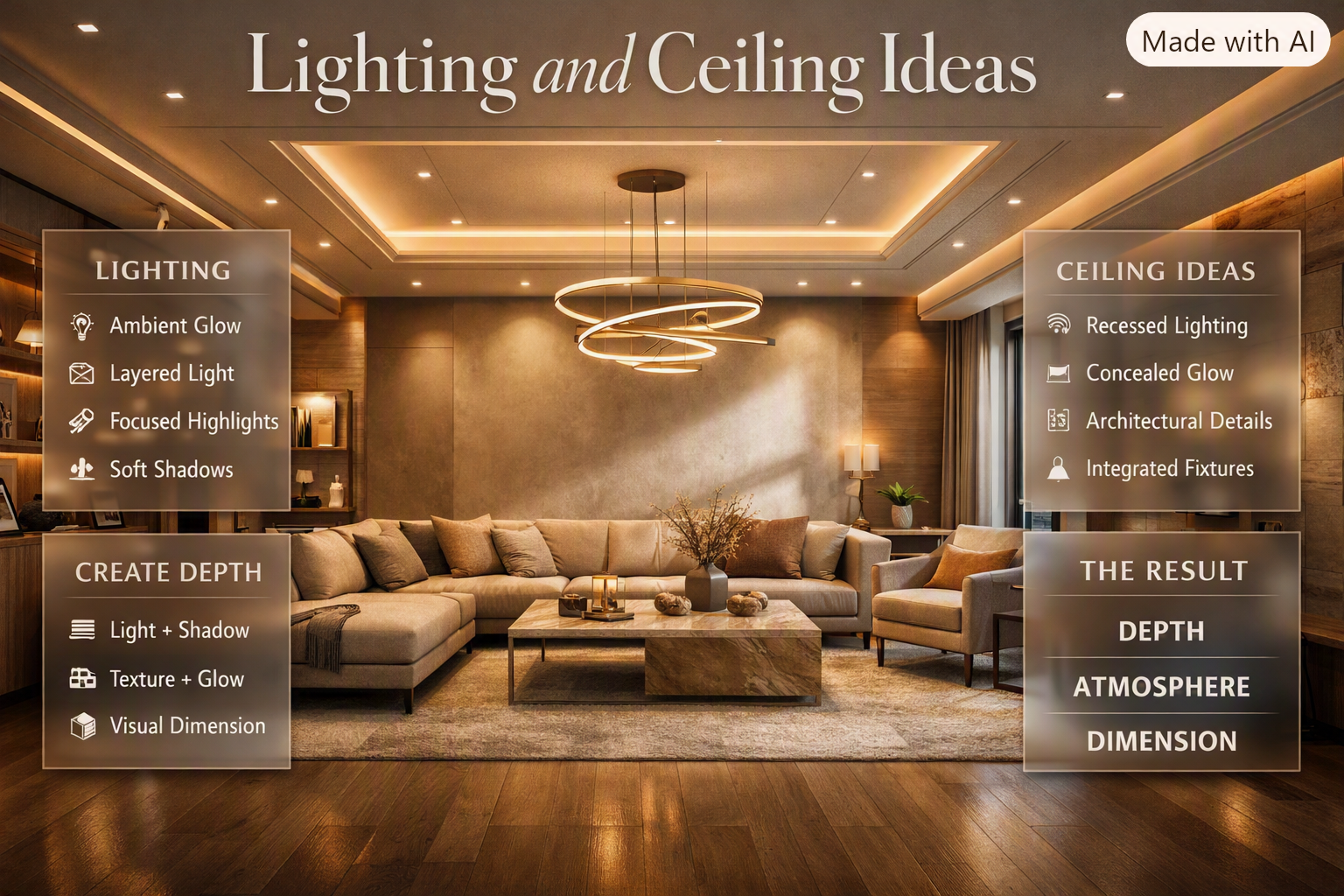
Lighting and Ceiling Ideas | A room can have beautiful furniture, expensive finishes, and carefully chosen paint colors, yet still feel flat, unfinished, or uncomfortable. Often, the problem isn’t the furniture at all. It’s the ceiling and lighting.
The right lighting and ceiling ideas can change how a room looks, feels, and functions without requiring a complete renovation. A well-designed ceiling can add architectural interest, while thoughtful lighting can make a small room feel larger, highlight artwork, create a relaxing atmosphere, or make everyday tasks easier.
For homeowners planning a renovation, decorating a new house, or simply trying to refresh an existing room, the challenge is knowing what actually works. Should you choose recessed lights or a pendant? Is a false ceiling worth the investment? Should the ceiling be white, painted, or wood-toned? How many lights does one room really need?
This guide brings those decisions together in one practical resource. We’ll explore modern ceiling designs, layered lighting, recessed lighting, pendant lights, LED strips, chandeliers, ceiling fans with lights, room-by-room solutions, ceiling colors, lighting mistakes, and professional planning tips.
If you’re working on a broader decorating project, you can also explore Designmode24 Interior Design for additional home design inspiration and practical ideas.
Why Do Lighting and Ceiling Design Matter So Much?
Lighting and ceiling design matter because they influence both the visual character and everyday usability of a room. The ceiling forms the upper architectural layer of the space, while lighting determines how people perceive colors, proportions, textures, furniture, and atmosphere. Together, they can make a room feel spacious, warm, sophisticated, or uncomfortable.
A ceiling isn’t simply the surface above your head, and lighting isn’t merely something you turn on when it gets dark. They are part of the room’s overall design system.
For example, a low ceiling with a large hanging chandelier may make the room feel cramped. The same room could feel significantly more open with recessed lights, concealed LED illumination, and a slim central fixture.
Likewise, a plain ceiling can become a feature with a simple tray detail, subtle perimeter lighting, or carefully placed architectural panels.
The Three Jobs of Good Lighting
A successful lighting plan usually combines three basic functions:
- Ambient lighting: Provides general illumination throughout the room.
- Task lighting: Helps with activities such as cooking, reading, working, grooming, or studying.
- Accent lighting: Draws attention to artwork, architectural details, furniture, shelving, or decorative features.
The strongest interiors rarely depend on only one of these.
💡 Pro Tip: Instead of asking, “Where should I put lights?” ask, “What will people do in this room?” The answer usually makes the lighting plan much easier.
What Are the Best Modern Lighting and Ceiling Ideas?
The best modern lighting and ceiling ideas combine clean architectural details with flexible, layered illumination. Popular approaches include recessed downlights, cove lighting, linear LEDs, minimalist pendants, statement chandeliers, tray ceilings, floating ceilings, wood accents, and simple gypsum-board designs.
Modern design doesn’t necessarily mean complicated design.
In fact, some of the most successful contemporary ceilings are visually quiet. A clean ceiling with concealed lighting can look more expensive and sophisticated than an elaborate ceiling filled with decorative patterns.
1. Recessed Ceiling Lights
Recessed lights sit inside the ceiling rather than hanging below it. They’re especially useful when you want clean lines and unobtrusive illumination.
They work well in:
- Living rooms
- Kitchens
- Hallways
- Bedrooms
- Home offices
- Bathrooms
- Walk-in closets
The biggest advantage is visual simplicity. However, too many recessed lights can make a ceiling look like a grid of dots.
A better approach is to position them according to furniture and activity.
For example, kitchen downlights should illuminate working areas rather than simply being distributed evenly across the ceiling.
2. Cove Lighting
Cove lighting hides the light source inside a ceiling recess, allowing illumination to wash across the ceiling or wall.
This produces a softer effect than exposed fixtures and works particularly well in bedrooms, living rooms, dining areas, and entertainment spaces.
Cove lighting is also useful when you want ambient light without creating strong glare.
3. Tray Ceiling With LED Lighting
A tray ceiling creates a recessed central area surrounded by a raised border.
Adding LED strips around the inner edge can emphasize the architectural shape while creating indirect illumination.
This approach works particularly well in:
- Master bedrooms
- Formal living rooms
- Dining rooms
- Large entryways
The key is restraint. The ceiling should look intentional, not overly decorated.
4. Floating Ceiling Design
A floating ceiling creates the visual impression that one section of the ceiling is separated from the surrounding surface.
Concealed LED lighting placed around the perimeter enhances the floating effect.
This is particularly effective in contemporary interiors because the light becomes part of the architecture instead of looking like a separate decoration.
5. Linear Lighting
Linear LED fixtures are increasingly useful in modern interiors because they create long, continuous lines of light.
They can be:
- Recessed into ceilings
- Suspended above tables
- Installed along corridors
- Integrated into architectural details
- Used to emphasize room geometry
Linear lighting works especially well with minimalist furniture and modern architectural interiors.
6. Statement Pendant Lights
Pendant lights are suspended from the ceiling and can become an important decorative element.
They’re particularly effective over:
- Dining tables
- Kitchen islands
- Bedside areas
- Entry consoles
- Reading corners
The fixture should relate to the scale of the furniture below it.
A tiny pendant over a large dining table can disappear visually, while an oversized fixture in a compact room can dominate the entire space.
How Do You Choose the Right Ceiling Design?
Choose a ceiling design based on the room’s height, size, architectural structure, lighting requirements, maintenance needs, and overall interior style. A ceiling should improve the room rather than simply add decoration. Low rooms generally benefit from simpler designs, while taller spaces can accommodate layered or sculptural ceilings.
Before choosing a ceiling, assess five things:
- Ceiling height
- Room dimensions
- Existing electrical points
- HVAC and ventilation requirements
- Interior design style
A beautiful ceiling that reduces usable height too much isn’t a successful design.
Low Ceiling Rooms
For lower ceilings, consider:
- Slim recessed lights
- Flush-mount fixtures
- Subtle perimeter LEDs
- Light ceiling colors
- Minimal architectural details
Avoid extremely deep false ceilings or oversized hanging fixtures.
High Ceiling Rooms
Higher ceilings offer more freedom.
You can consider:
- Large chandeliers
- Long pendants
- Double-height lighting
- Decorative beams
- Dramatic ceiling details
- Large-scale linear fixtures
The goal is to create visual balance rather than simply filling empty vertical space.
📌 Quick Tip: Before installing a false ceiling, check how much height you’ll lose after accounting for the structure, electrical work, ducting, and lighting fixtures.
False Ceiling Ideas That Work in Real Homes
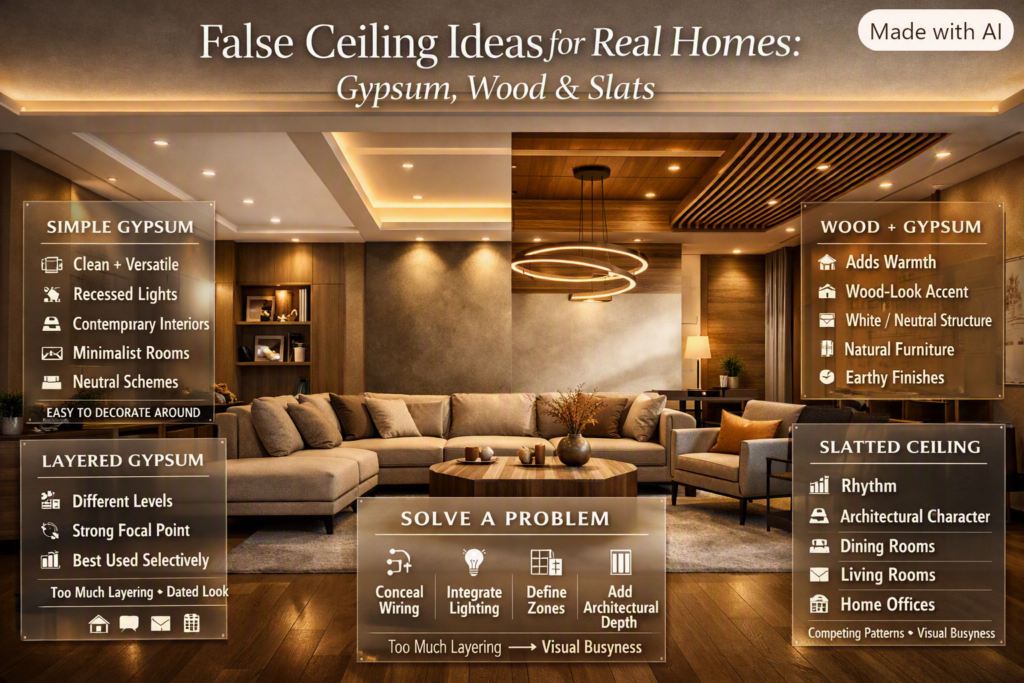
False ceilings can conceal wiring, integrate lighting, define zones, and add architectural depth. But they’re not automatically the best option for every room.
A false ceiling is most useful when it solves a practical or visual problem.
Simple Gypsum Ceiling
A clean gypsum ceiling with recessed lights is one of the most versatile choices.
It works with:
- Contemporary interiors
- Transitional homes
- Minimalist rooms
- Neutral color schemes
- Modern apartments
The simplicity also makes future decorating easier.
Layered Gypsum Ceiling
A layered ceiling introduces different levels and shapes.
It can create a strong focal point in larger rooms, but excessive layering can quickly make a room feel dated.
Use layered ceilings selectively rather than in every room.
Wood and Gypsum Combination
Wood-look panels can bring warmth to an otherwise minimal ceiling.
A common approach is to use wood as an accent inside a white or neutral ceiling structure.
This works particularly well with natural furniture, warm lighting, and earthy finishes.
Slatted Ceiling
Vertical or linear slats can create rhythm and architectural character.
They’re particularly useful in:
- Dining rooms
- Living rooms
- Home offices
- Entryways
However, they should be coordinated with the room’s other lines. If the floor, walls, furniture, and ceiling all have competing patterns, the result can become visually busy.
How Many Lights Should a Room Have?
There is no universal number of lights for every room because lighting requirements depend on room size, ceiling height, fixture output, wall colors, natural daylight, and the room’s function. Instead of counting fixtures first, determine the required lighting layers and then position fixtures according to activities and architectural features.
For example, a living room may need:
- General ceiling lighting
- Floor or table lamps
- Accent lighting
- Wall lighting
- Decorative lighting
A kitchen may need stronger task illumination around:
- Countertops
- Sink
- Cooktop
- Island
- Pantry
This is why simply placing six recessed lights in every room isn’t a professional lighting strategy.
A Simple Planning Formula
Think about the room in zones:
          CEILING
     ○          ○
          ○
  ┌─────────────────┐
  │   SOFA     ART  │
  │                 │
  │  TABLE      ○   │
  │                 │
  └─────────────────┘
       TASK ZONE
Each light should have a reason for being where it is.
Warm or Cool Lighting: Which Is Better?
Warm lighting is generally better for relaxing residential spaces such as bedrooms and living rooms, while cooler or neutral lighting can be useful in kitchens, bathrooms, workspaces, and areas where visual clarity is important. The best choice depends on the room’s function, finishes, and desired atmosphere.
Warm Light
Warm light creates a comfortable and inviting feeling.
It works well in:
- Bedrooms
- Living rooms
- Dining rooms
- Lounges
- Reading areas
Neutral Light
Neutral light provides a balanced appearance and works well for:
- Kitchens
- Bathrooms
- Home offices
- Dressing areas
Cool Light
Cooler lighting can create a crisp, energetic atmosphere, but it can feel harsh if used excessively throughout a home.
⭐ Expert Tip: Don’t choose lighting temperature independently of your paint and materials. Warm light can make beige, cream, wood, and warm gray finishes look richer, while cooler light can shift how some colors appear.
If you’re coordinating lighting with a broader color scheme, our Paint Color Recommendations can help you think through the relationship between wall color and illumination.
Should Ceiling Lights Be Warm White or Daylight?
For most residential interiors, warm white or neutral-white lighting is more comfortable than very cool daylight lighting. Bedrooms and living spaces usually benefit from warmer illumination, while kitchens, bathrooms, and workspaces often work well with neutral white. Consistency within each room is more important than following a single temperature throughout the house.
A useful strategy is:
| Room | Suggested Lighting Character |
|---|---|
| Bedroom | Warm |
| Living Room | Warm to neutral |
| Dining Room | Warm |
| Kitchen | Neutral |
| Bathroom | Neutral |
| Home Office | Neutral to slightly cool |
| Hallway | Warm to neutral |
These aren’t strict rules. Personal preference and natural daylight should always influence the final choice.
What Ceiling Lighting Works Best in a Living Room?
Living rooms benefit most from layered lighting rather than a single central ceiling fixture. Combine ambient ceiling lighting with floor lamps, table lamps, wall lights, concealed LEDs, or accent lighting to create different moods. The arrangement should also respond to seating, artwork, television placement, and architectural features.
A strong living-room lighting plan might include:
- Recessed ceiling lights for general illumination
- Cove lighting for softer evening light
- A pendant or chandelier for visual focus
- Floor lamps beside seating
- Accent lighting for artwork
- LED lighting around shelving
The advantage of layering is flexibility.
You don’t need every light switched on at the same time.
What Ceiling Lighting Works Best in a Bedroom?
Bedrooms generally benefit from soft, indirect lighting rather than bright, evenly distributed illumination. Recessed lights can provide general visibility, while concealed LEDs, bedside lamps, pendant lights, or wall sconces create a more relaxing atmosphere.
A bedroom ceiling should support rest.
Avoid installing extremely bright downlights directly above the pillow area because they can create uncomfortable glare when you’re lying in bed.
A better arrangement places general lighting around the room while using bedside lighting for reading and nighttime activities.
For a more complete room-planning approach, explore Room-by-Room Interior Design Inspiration when coordinating the ceiling with furniture, color, and room function.
What Are the Best Kitchen Ceiling and Lighting Ideas?

Kitchen lighting should prioritize visibility, especially over countertops, sinks, cooking surfaces, and islands. Recessed ceiling lights provide general illumination, while under-cabinet lighting eliminates shadows on work surfaces. Pendant lights can add a decorative focal point above an island or breakfast bar.
A practical kitchen plan includes:
Ambient Lighting
Use ceiling fixtures to illuminate the overall room.
Task Lighting
Place dedicated lighting over work surfaces.
Accent Lighting
Use decorative fixtures or cabinet lighting to add atmosphere.
Pendant Lighting
Pendant fixtures can visually define an island while providing useful illumination.
⚠ Common Mistake: Installing recessed lights behind the person working at the counter. The person’s body can block the light and create shadows exactly where visibility is needed.
What Are the Best Bathroom Ceiling Lighting Ideas?
Bathroom lighting should provide clear, comfortable illumination while accounting for moisture, mirror use, and grooming activities. Recessed fixtures designed for appropriate bathroom locations, vanity lighting, and controlled accent illumination are usually more useful than relying on a single ceiling light.
The mirror deserves special attention.
A ceiling light directly above a mirror can cast shadows under the eyes and chin. Side lighting or carefully positioned vanity lighting often provides more flattering and practical illumination.
For a decorative approach, you can also explore Bathroom Hanging Pendant Lighting for ideas about incorporating hanging fixtures into bathroom interiors.
Always make sure fixtures are suitable for their intended bathroom location and follow applicable electrical safety requirements.
How Can Ceiling Design Make a Small Room Look Bigger?
A small room can appear more spacious when the ceiling remains visually light, uncluttered, and proportionate. Recessed lighting, perimeter illumination, vertical visual lines, light ceiling colors, and carefully scaled fixtures can make the room feel more open. Avoid heavy ceiling details that visually lower the room.
Try these strategies:
- Keep the ceiling visually simple.
- Use light-reflective colors.
- Avoid oversized chandeliers.
- Use concealed perimeter lighting.
- Direct some light toward walls.
- Keep fixture shapes proportional.
- Maintain visual continuity between walls and ceiling.
Lighting the walls can be particularly effective because it expands the perceived boundaries of the room.
Should the Ceiling Be the Same Color as the Walls?
The ceiling can be the same color as the walls when you want a seamless, enveloping appearance, but a lighter ceiling is often easier for creating an open and airy feeling. A contrasting ceiling can also work when the goal is to emphasize architectural character or create a more intimate atmosphere.
Same Color
Creates:
- Visual continuity
- A cocoon-like effect
- A contemporary appearance
Lighter Ceiling
Creates:
- Greater visual height
- An airy feeling
- Traditional contrast
Darker Ceiling
Creates:
- Drama
- Intimacy
- Architectural emphasis
Darker ceilings can be particularly effective in dining rooms, media rooms, and sophisticated entertaining spaces, provided the room has enough visual balance.
For more guidance on coordinating finishes and colors, see Paint Color ideas alongside your ceiling plan.
How Do You Combine Ceiling Lighting With Interior Decor?
The ceiling should complement the furniture, colors, materials, and architectural style instead of competing with them. Choose lighting shapes, finishes, and brightness levels that reinforce the room’s existing design language. A minimalist room usually benefits from restrained fixtures, while a traditional or eclectic interior can support more decorative lighting.
Consider the room as a complete composition.
For example:
Modern room:
Linear LEDs + recessed lights + simple pendant
Warm contemporary room:
Cove lighting + brass pendant + warm lamps
Traditional room:
Chandelier + wall sconces + subtle ceiling lighting
Minimalist room:
Recessed lights + concealed LEDs + limited decorative fixtures
This same principle applies to accessories and furniture. A decorative ceiling shouldn’t be treated as an isolated feature.
If you’re planning other decorative upgrades, Easy Decorating Tips for Every Budget offers useful ideas for balancing improvements without making every element compete for attention.
Lighting and Ceiling Ideas for Different Interior Styles
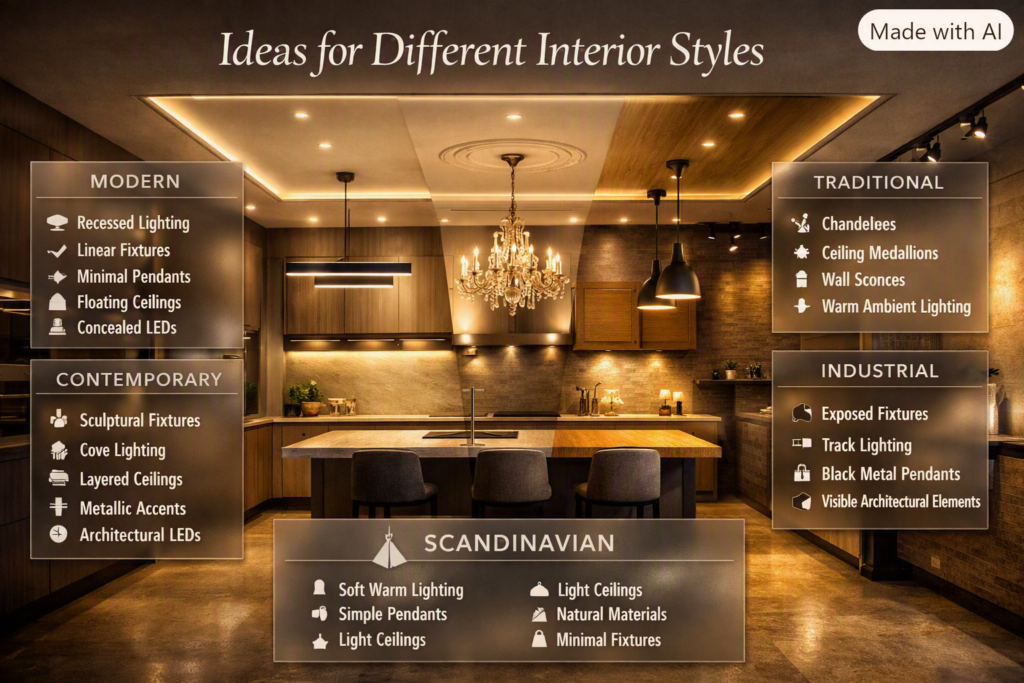
Modern
Modern interiors typically work well with:
- Recessed lighting
- Linear fixtures
- Minimal pendants
- Floating ceilings
- Concealed LEDs
Contemporary
Contemporary spaces can combine:
- Sculptural fixtures
- Cove lighting
- Layered ceilings
- Metallic accents
- Architectural LEDs
Traditional
Traditional rooms often suit:
- Chandeliers
- Decorative ceiling medallions
- Wall sconces
- Warm ambient lighting
Industrial
Industrial interiors can feature:
- Exposed fixtures
- Track lighting
- Black metal pendants
- Visible architectural elements
Scandinavian
Scandinavian interiors generally benefit from:
- Soft warm lighting
- Simple pendants
- Light ceilings
- Natural materials
- Minimal fixtures
The best lighting design isn’t the one that follows a trend most closely. It’s the one that fits the architecture and lifestyle of the people using the space.
How Do You Use LED Strip Lighting on a Ceiling?
LED strip lighting works best when the light source itself is hidden and the illuminated surface becomes the visual focus. It can be installed inside ceiling coves, behind floating panels, along recessed details, or around architectural edges to create indirect ambient illumination.
Avoid exposing the LED strip directly unless the product is specifically designed as a visible linear fixture.
Hidden lighting usually looks more refined.
Good Applications
- Cove ceilings
- Floating ceilings
- Shelving
- Architectural niches
- Bedroom headboards
- Media walls
- Kitchen cabinets
Poor Applications
- Random lines without architectural purpose
- Excessively bright strips
- Visible low-quality LED dots
- Different colors throughout the same room
⭐ Expert Tip: If you want an elegant look, think about where the light lands rather than where the LED strip itself is visible.
Can Lighting Highlight Ceiling Architecture?
Yes. Lighting can dramatically improve ceiling architecture by emphasizing depth, edges, curves, levels, beams, panels, and recessed sections. Indirect lighting is particularly effective because it reveals architectural form without visually overwhelming it.
A simple ceiling can become more interesting when:
- Light grazes a textured surface
- LEDs outline a recessed section
- Spotlights highlight beams
- Pendant lights emphasize a dining zone
- Wall washers make a ceiling appear taller
This is where lighting becomes part of the architecture rather than simply an electrical necessity.
Lighting and Ceiling Ideas for Entryways and Hallways
Hallways often receive less attention than living rooms, but ceiling lighting can make them feel significantly more welcoming.
Use:
- Small recessed lights
- Wall washers
- Linear ceiling lights
- Subtle LED strips
- Decorative flush mounts
Long hallways can benefit from repeated lighting elements that create rhythm.
However, avoid placing fixtures too close together. A corridor doesn’t need to be illuminated like a commercial showroom.
For broader practical renovation planning, see Practical Home Improvement Guides for related home improvement considerations.
Ceiling Lighting for Dining Rooms
Dining rooms are ideal for statement lighting because the dining table naturally creates a focal point.
A chandelier or pendant should generally be centered over the table rather than simply centered within the room.
Consider:
- Table size
- Ceiling height
- Fixture width
- Seating arrangement
- Light direction
- Dimming capability
A dimmable fixture is particularly valuable because dining rooms often serve multiple purposes.
Bright light may be useful for cleaning or setup, while softer light creates a better atmosphere during dinner.
Ceiling Ideas for Home Offices
Home offices need enough illumination for reading and screen-based work without creating distracting glare.
A good office can combine:
- Neutral ambient ceiling lighting
- Desk lighting
- Adjustable task lights
- Indirect LED lighting
- Window daylight
The ceiling fixture should not create strong reflections on a computer monitor.
Positioning matters just as much as brightness.
Ceiling Lighting for Children’s Rooms
Children’s rooms need practical lighting that can adapt as the room’s purpose changes.
A flexible arrangement can include:
- Soft ceiling illumination
- Bedside lighting
- Desk task lighting
- Night lighting
- Decorative accent lights
Avoid making the entire lighting scheme dependent on a short-lived theme. A ceiling designed around a specific cartoon or trend may become outdated quickly.
Instead, keep the architectural elements relatively timeless and use easily replaceable accessories for personality.
For more specialized furniture and room planning ideas, see Children’s Hotel Furniture for additional considerations around child-friendly furniture and design.
How Can You Make a Ceiling Look More Expensive?
An expensive-looking ceiling usually depends more on proportion, material quality, clean installation, and restrained lighting than on elaborate decoration. A simple architectural ceiling with concealed warm illumination can appear more sophisticated than a complicated design filled with excessive moldings and fixtures.
Focus on:
- Clean lines
- Correct proportions
- High-quality finishes
- Hidden wiring
- Consistent lighting
- Appropriate fixture scale
- Good installation
The biggest visual upgrade is often reducing unnecessary elements.
Common Lighting and Ceiling Mistakes to Avoid
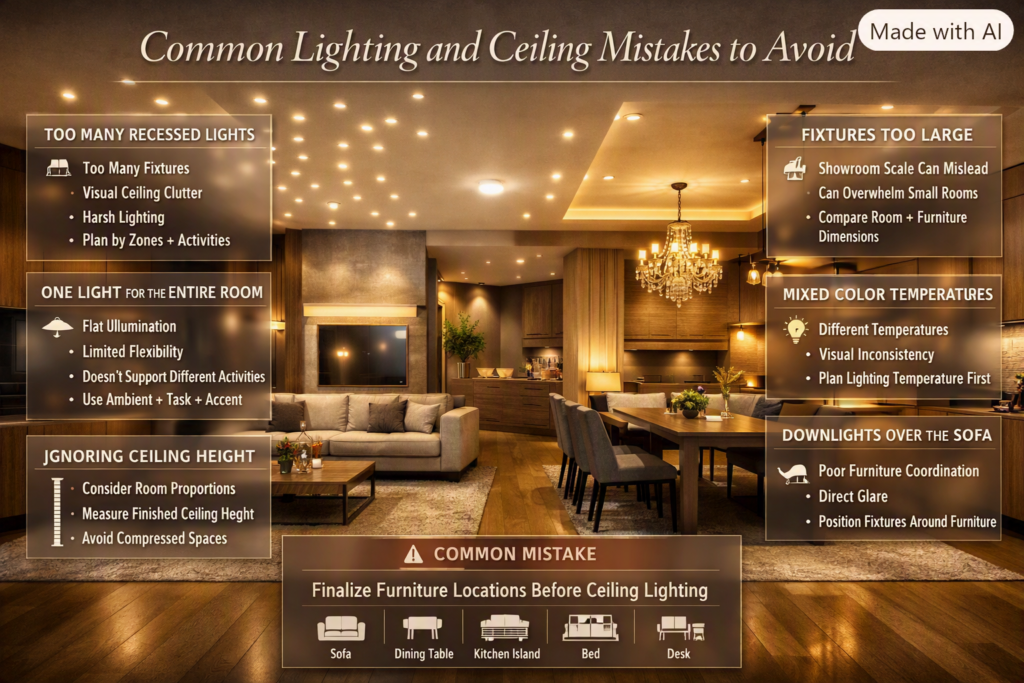
Even attractive lighting products can produce poor results when they’re used without a plan.
Installing Too Many Recessed Lights
Why it happens:
People assume more fixtures automatically mean better lighting.
Why it’s harmful:
The ceiling becomes visually cluttered and the room may feel harsh.
How to avoid it:
Plan fixture locations according to zones and activities.
Using One Light for the Entire Room
Why it happens:
It’s simple and inexpensive.
Why it’s harmful:
It creates flat illumination and doesn’t support different activities.
How to avoid it:
Use ambient, task, and accent lighting where appropriate.
Ignoring Ceiling Height
Why it happens:
Homeowners choose designs from photographs without considering proportions.
Why it’s harmful:
A design that looks beautiful in a high-ceilinged home may make a smaller room feel compressed.
How to avoid it:
Measure the finished ceiling height before selecting the design.
Choosing Fixtures Too Large
Why it happens:
Large fixtures look impressive in showrooms.
Why it’s harmful:
They can overwhelm smaller rooms.
How to avoid it:
Compare fixture dimensions with the room and furniture dimensions.
Using Different Color Temperatures Everywhere
Why it happens:
Fixtures are purchased at different times.
Why it’s harmful:
The home can feel visually inconsistent.
How to avoid it:
Create a lighting temperature plan before buying fixtures.
Putting Downlights Directly Over the Sofa
Why it happens:
Lights are positioned according to ceiling geometry rather than furniture.
Why it’s harmful:
People sitting below can experience glare.
How to avoid it:
Coordinate ceiling fixtures with furniture placement.
⚠ Common Mistake: Don’t finalize the ceiling lighting layout before finalizing major furniture locations. The sofa, dining table, kitchen island, bed, and desk all affect where lighting should go.
How Should You Plan a Ceiling Before Installation?
Plan the ceiling and lighting together before construction begins. Mark furniture locations, electrical points, HVAC components, access requirements, ceiling levels, and fixture positions first. This prevents expensive changes after the gypsum, wiring, or finished ceiling has already been installed.
Step 1: Measure the Room
Record:
- Length
- Width
- Existing ceiling height
- Door positions
- Windows
- Architectural features
Step 2: Mark Furniture
Draw approximate locations for:
- Sofa
- Bed
- Dining table
- Desk
- Kitchen island
- Cabinets
Step 3: Identify Activities
Ask what people will do in each area.
Step 4: Choose Lighting Layers
Decide where ambient, task, and accent lighting are needed.
Step 5: Choose Ceiling Architecture
Only after understanding the lighting requirements should you finalize the ceiling shape.
Step 6: Check Technical Requirements
Coordinate:
- Wiring
- Switches
- Dimmers
- HVAC
- Smoke detectors
- Access panels
- Fans
- Speakers
Step 7: Review at Night
If possible, imagine how the room will look after sunset. A ceiling that looks beautiful in daylight can still fail if the nighttime lighting is poorly distributed.
What Is the Best Lighting Plan for an Open-Plan Home?
Open-plan homes need lighting that creates separate visual zones without making the ceiling feel fragmented. Use different lighting types or fixture arrangements over the living, dining, kitchen, and circulation areas while maintaining a consistent overall design language.
For example:
KITCHEN          DINING            LIVING
○ ○ ○          ─── Pendant ───      ○   ○
○ ○ ○              TABLE             ○
                                     Sofa
                                     ○
The ceiling can remain visually consistent while lighting establishes different functions.
This is especially useful in apartments where one large room serves several purposes.
How Can Smart Lighting Improve Ceiling Design?
Smart lighting can make a ceiling more flexible by allowing homeowners to control brightness, scenes, schedules, and sometimes color temperature. The technology is most useful when it solves a genuine usability problem rather than being added simply because it’s fashionable.
Useful scenes might include:
Morning:
Bright, neutral illumination.
Evening:
Warm, softer lighting.
Movie time:
Minimal ambient light with accent illumination.
Dinner:
Focused warm light over the dining table.
Cleaning:
Higher general brightness.
The key is to keep controls simple enough that everyone in the home can use them.
How Does Natural Light Affect Ceiling Lighting?
Natural daylight should always be considered before designing artificial lighting. A room with large windows may need relatively little daytime illumination but require carefully planned lighting after sunset. Window direction, curtains, wall colors, and surrounding buildings can all affect how much daylight enters the room.
Don’t judge a room’s lighting needs solely from one visit during midday.
Observe it at:
- Morning
- Afternoon
- Evening
A room that seems bright at noon may become surprisingly dark later in the day.
How Can You Coordinate Ceiling Design With Storage?
Ceiling lighting should work with cabinets, shelves, wardrobes, and storage rather than fighting them.
For example, if tall cabinetry reaches close to the ceiling, recessed lights may need to move forward so they don’t disappear into the cabinet line.
Likewise, concealed LEDs can make shelving more functional while adding depth to the room.
If you’re working on storage as part of a wider renovation, explore Smart Storage and Organization Ideas for ways to coordinate storage with the rest of the interior.
How Can You Keep a Decorative Ceiling From Looking Overdone?
The easiest way to prevent an elaborate ceiling from becoming overwhelming is to establish one primary feature and let the other elements support it.
For example:
Feature: Tray ceiling
Support: Recessed lights
Accent: One chandelier
Not:
Feature: Tray ceiling + multiple layers + many spotlights + colorful LEDs + decorative chandelier + patterned panels.
When every element demands attention, none of them feels special.
A professional interior often feels refined because it knows when to stop.
Budget-Friendly Lighting and Ceiling Ideas
You don’t always need a complete false-ceiling renovation to improve a room.
Affordable upgrades can include:
- Replacing outdated fixtures
- Adding floor lamps
- Installing under-cabinet LEDs
- Changing bulb temperatures
- Adding dimmers
- Using wall sconces
- Repositioning existing fixtures
- Painting the ceiling
- Adding one statement pendant
For budget-conscious projects, prioritize improvements that affect both appearance and daily use.
A beautiful fixture that provides poor light isn’t necessarily a good investment.
When Should You Hire a Professional?
Professional assistance is especially valuable when a project involves structural ceiling changes, extensive electrical work, multiple lighting circuits, HVAC coordination, unusual ceiling heights, or complicated architectural details.
You don’t necessarily need a designer for every light fixture.
However, professional planning becomes more important when several systems interact.
A coordinated plan can prevent:
- Poor light placement
- Excessive ceiling drops
- HVAC conflicts
- Awkward switches
- Visible wiring
- Difficult maintenance
- Expensive rework
For homeowners planning several improvements at once, the broader Home Improvement section can provide useful context for approaching renovation decisions systematically.
Lighting and Ceiling Ideas on a Room-by-Room Decision Table
| Room | Best Primary Lighting | Useful Ceiling Idea | Extra Layer |
|---|---|---|---|
| Living Room | Recessed/ambient | Tray or simple ceiling | Floor lamps |
| Bedroom | Soft ambient | Cove/floating ceiling | Bedside lamps |
| Kitchen | Bright task lighting | Simple recessed ceiling | Under-cabinet LEDs |
| Dining Room | Pendant/chandelier | Tray ceiling | Wall lighting |
| Bathroom | Neutral ceiling light | Moisture-appropriate ceiling | Vanity lighting |
| Office | Neutral ambient | Minimal ceiling | Desk lamp |
| Hallway | Recessed/linear | Simple ceiling | Wall washing |
| Children’s Room | Soft ambient | Simple decorative ceiling | Night light |
| Entryway | Pendant/recessed | Statement ceiling | Console lighting |
Can Ceiling Lighting Replace Decorative Accessories?
Ceiling lighting can contribute strongly to the decorative character of a room, but it shouldn’t be expected to replace every other design element. A well-chosen fixture can act as artwork, while concealed lighting can enhance architectural details, but furniture, textiles, artwork, and accessories still provide important layers of personality.
Think of lighting as one part of the design composition.
A beautiful pendant can become the room’s jewelry, but it still needs a well-designed outfit around it.
For inspiration on decorative styling, DIY Home Projects can also be useful when deciding which smaller improvements you can handle without a major renovation.
Lighting and Ceiling Ideas for a More Cohesive Home
A cohesive home doesn’t require every ceiling to look identical.
Instead, repeat certain principles.
For example:
- Similar lighting temperatures
- Consistent fixture finishes
- Related ceiling colors
- Repeated linear details
- Similar switch controls
- Consistent lighting quality
The bedroom can have a different ceiling from the living room while still belonging to the same home.
This is particularly important in larger houses where every room has its own purpose.
How Do Decorative Objects Affect Ceiling Lighting?
Decorative objects, artwork, shelving, furniture, and accessories can change how light is reflected and perceived.
White or light-colored objects reflect more light, while darker surfaces absorb more.
Metallic finishes can create highlights, while textured surfaces produce softer shadows.
This means ceiling lighting should be tested against the actual materials used in the room rather than selected entirely from a catalog.
A lighting plan that looks perfect on a showroom sample may behave differently in a real room.
Expert Recommendations for Better Lighting and Ceiling Design
Professionals usually focus less on the number of fixtures and more on how the entire room behaves.
Think About Light Sources at Different Heights
A room feels more dynamic when light exists at ceiling, eye, and lower levels.
For example:
Ceiling: Recessed lights
Eye level: Wall sconces
Low level: Floor lamps
This creates visual depth.
Use Dimmers Wherever Practical
A light should not always have to operate at full brightness.
Dimmers make the same room more adaptable.
Hide the Light Source When Possible
Indirect lighting often looks more sophisticated because the illuminated surface becomes the focus.
Don’t Ignore Maintenance
Choose fixtures that can be cleaned, replaced, and accessed without major construction.
Plan Switches Carefully
A beautiful lighting plan becomes frustrating if the switches are poorly located.
Test Before Final Installation
If you’re uncertain about fixture positions, temporary testing can reveal glare and shadow problems before the ceiling is closed.
12 Practical Questions to Ask Before Choosing a Ceiling
Before committing to a design, ask:
- How high will the finished ceiling be?
- Where will the furniture sit?
- What activities happen in the room?
- How much natural light enters?
- Which lighting layers are necessary?
- Where will HVAC components go?
- Can fixtures be maintained easily?
- Do I need dimmers?
- Will the ceiling design still look good in five years?
- Does the ceiling complement the walls and floor?
- Is the fixture scale appropriate?
- Is the design solving a problem or simply adding decoration?
These questions can prevent many expensive mistakes.
What are the best lighting and ceiling ideas for a modern home?
The best modern approach is to combine a clean ceiling design with layered lighting rather than relying on one large central fixture. Recessed lights can provide general illumination, concealed LED or cove lighting can create a soft architectural glow, and a pendant or chandelier can act as a focal point. This combination makes the ceiling look intentional while giving you more control over the atmosphere.
For most modern homes, consider:
Recessed LED lights for general illumination
Cove lighting for soft indirect light
A statement pendant over a dining table or kitchen island
Linear lighting for contemporary spaces
Dimmable fixtures for changing the mood
Warm or neutral lighting depending on the room
The important point is not to install every trend at once. A simple tray ceiling with concealed LEDs and one well-scaled decorative fixture can look considerably more sophisticated than an overcrowded ceiling. Current 2026 design coverage also emphasizes layered ceiling lighting and the renewed popularity of statement pendants.
Is cove lighting a good idea for a false ceiling?
Cove lighting is one of the most effective choices for a false ceiling when you want soft, indirect illumination and a more architectural appearance. Because the LED source is concealed, the ceiling itself appears to glow rather than showing a bright fixture directly to the eye. It’s particularly effective in living rooms, bedrooms, dining rooms, and open-plan spaces.
A well-designed cove can:
Make a ceiling feel deeper
Create a softer evening atmosphere
Highlight a tray or floating ceiling
Reduce the harsh appearance of direct overhead lighting
Work as a separate ambient-lighting layer
However, cove lighting shouldn’t automatically become the only light source. A practical room may still need recessed task lighting, a pendant, wall lights, or lamps depending on how the space is used. Current design guidance increasingly treats cove lighting as an ambient layer that works alongside other fixtures rather than replacing the entire lighting plan.
Professional tip: Hide the LED strip completely and use a quality diffuser/profile where appropriate. Visible LED dots can make an otherwise expensive ceiling look unfinished.
What ceiling lighting is best for a low-ceiling room?
Low-ceiling rooms generally look better with slim, low-profile, semi-flush, or carefully integrated lighting rather than large hanging chandeliers or deep multi-level false ceilings. The goal is to preserve as much visual and physical height as possible while still providing enough illumination.
Good options include:
Slim recessed lights
Semi-flush ceiling fixtures
Low-profile decorative lights
Shallow perimeter lighting
Concealed LED strips
Wall-washing or indirect lighting
A common mistake is choosing a dramatic chandelier simply because it looks impressive in a showroom. In a low room, a large hanging fixture can dominate the space and make the ceiling feel even lower.
Semi-flush fixtures can be particularly useful because they sit close to the ceiling while still providing more visual character than a basic recessed downlight. Recent lighting guidance specifically highlights semi-flush fixtures as a practical choice for rooms with lower ceilings.
Professional tip: Before choosing a false-ceiling design, calculate the finished ceiling height, not just the original slab height. Even a visually attractive ceiling can become a poor choice if it removes too much vertical space.
Should I use recessed lights, pendant lights, or both?
For most homes, using both is better than choosing only one because they perform different jobs. Recessed lights are discreet and useful for general or targeted illumination, while pendant lights add visual character and can create a focal point over specific areas such as dining tables, kitchen islands, or seating zones.
Think of them as two different design tools.
Recessed lighting:
Provides practical, distributed illumination and works well when you want the ceiling to remain visually clean.
Pendant lighting:
Adds personality, creates a focal point, and can visually define a particular zone.
Together:
They create a more flexible and layered lighting scheme.
For example, in an open-plan living and dining area, recessed lights can provide general illumination throughout the space while a pendant above the dining table visually anchors that zone. A concealed cove light can then provide softer ambient illumination in the evening.
This layered approach is increasingly recommended because different lighting sources can be controlled independently, allowing the same room to feel bright and functional during the day and softer at night.
Professional tip: Don’t center a pendant according to the room if the furniture isn’t centered there. In a dining room, for example, the pendant should normally relate to the dining table, not simply the geometric center of the ceiling.
What is the best ceiling design for a living room?
For most living rooms, a simple tray, perimeter, or floating ceiling combined with layered lighting offers the best balance of style and practicality. The ceiling should provide enough general illumination while leaving room for decorative and accent lighting.
A strong living-room combination can include:
Cove lighting: soft ambient glow
Recessed LEDs: general or targeted illumination
Statement pendant/chandelier: visual focal point
Floor or table lamps: lower-level lighting
Accent spots: artwork, shelving, or feature walls
The exact design should depend on ceiling height and room size. A larger living room can support a more substantial tray or layered ceiling, while a compact room usually benefits from a simpler perimeter detail.
One of the biggest mistakes is designing the ceiling first and deciding on furniture afterward. The sofa, TV wall, artwork, seating arrangement, and circulation paths should influence where the lights go. Current professional guidance similarly emphasizes coordinating ceiling architecture with the lighting plan rather than treating them as separate decisions.
Conclusion
The right lighting and ceiling design can completely change how a home feels. A well-planned ceiling adds architectural character, while thoughtfully placed lighting improves comfort, highlights important features, and makes everyday spaces more functional. The key is not to choose the most expensive fixture or the most complicated ceiling pattern, but to create a combination that suits the room, its height, natural light, furniture, and overall interior style.
Modern homes often look better when lighting is layered rather than dependent on a single central fixture. Recessed lights can provide general illumination, pendant lights can create a focal point, and cove or concealed lighting can add a softer architectural glow. Similarly, tray ceilings, simple false ceilings, linear details, and subtle ceiling treatments can add depth without making the room feel visually crowded.
Before starting any ceiling or lighting project, consider the practical details first. Think about ceiling height, furniture placement, electrical points, light direction, color temperature, maintenance, and how the room will actually be used. A beautiful design that creates glare, shadows, or insufficient task lighting will not perform well in everyday life.
The best lighting and ceiling ideas are ultimately the ones that balance appearance with function. Whether you are refreshing one bedroom, redesigning a living room, or planning lighting throughout the entire home, a coordinated approach will give you a more comfortable, cohesive, and timeless result. Start with the room’s needs, build the lighting in layers, keep the ceiling design proportional, and let every element contribute to the way the space feels and works.

Leave a Reply