
Introduction
Bathroom Hanging Pendant Lighting | A bathroom can have beautiful tile, a well-designed vanity, and an expensive mirror, yet still feel flat or unfinished because the lighting isn’t doing enough. This is where bathroom hanging pendant lighting can make a surprisingly big difference. A well-chosen pendant adds character, improves the visual balance of the room, and can turn an ordinary vanity or bathtub area into a design feature.
But bathrooms aren’t like bedrooms or dining rooms. They contain moisture, steam, water, reflective surfaces, and electrical fixtures in close proximity. So choosing a pendant isn’t simply about finding a pretty shade that matches your décor.
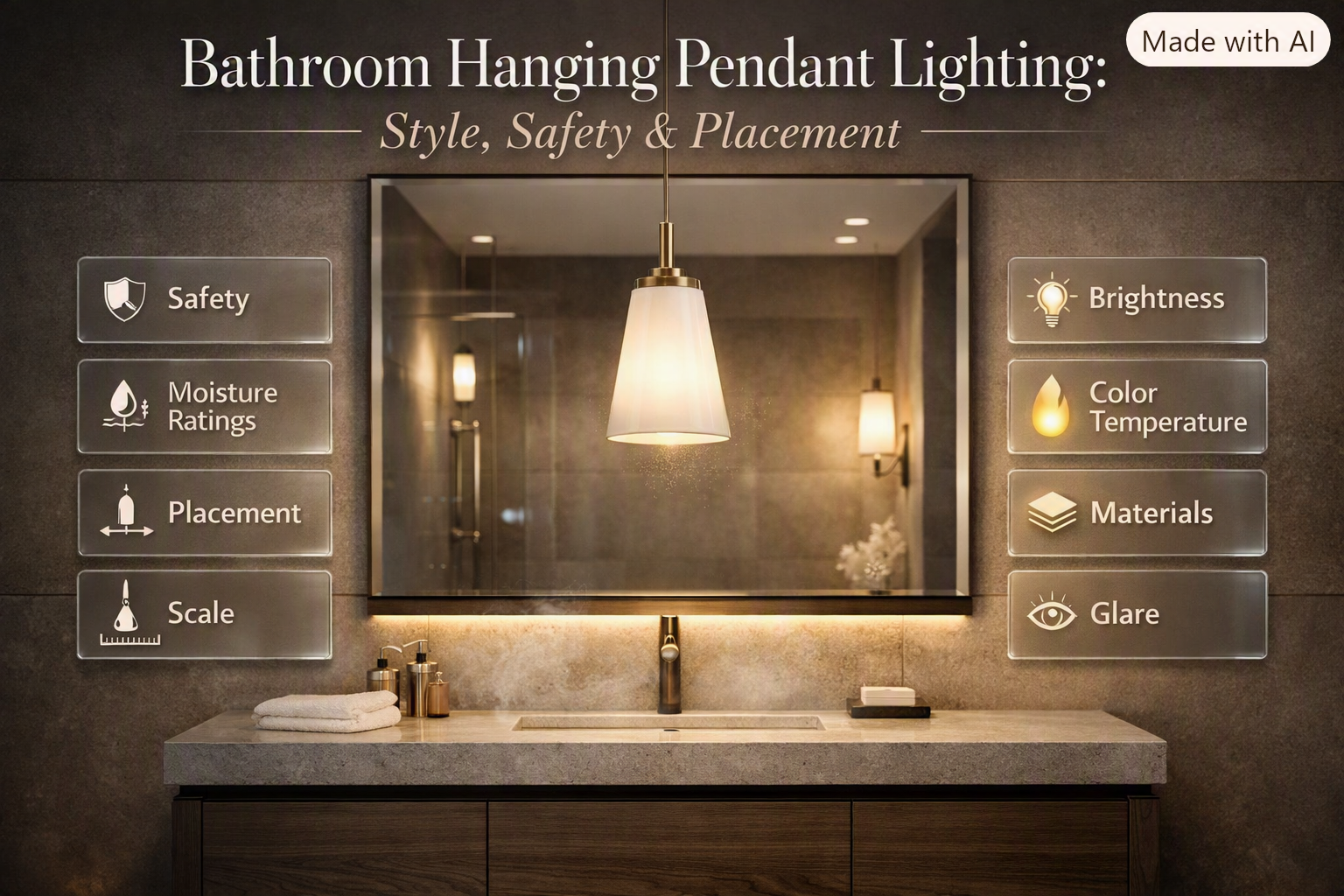
You need to think about safety, moisture ratings, placement, scale, brightness, color temperature, materials, glare, and the other layers of lighting in the room.
In this guide, you’ll learn how to choose bathroom pendant lighting, where to hang it, how high it should be, which styles work best, what mistakes to avoid, and how to create a bathroom that feels both practical and professionally designed.
For broader interior inspiration and home-design ideas, visit DesignMode24 Interior Design.
What Is Bathroom Hanging Pendant Lighting?
Bathroom hanging pendant lighting is a ceiling-mounted light fixture suspended from a cord, stem, rod, or similar support. Instead of sitting flush against the ceiling or being recessed into it, the light hangs visibly into the room.
This makes pendant lighting different from standard ceiling fixtures. It becomes part of the bathroom’s décor rather than simply disappearing into the architecture.
Pendant lights can be used for several purposes:
- Providing ambient illumination
- Supporting vanity task lighting
- Creating a decorative focal point
- Adding visual height to a bathroom
- Highlighting a freestanding bathtub
- Defining a particular zone in a large bathroom
- Introducing metal, glass, or sculptural elements
The most important thing to understand is that a decorative pendant isn’t automatically suitable for bathroom installation. Its electrical and moisture rating must match its intended location.
Are Pendant Lights Suitable for Bathrooms?
Yes, pendant lights can be suitable for bathrooms when the fixture is specifically appropriate for the location and installed according to applicable electrical requirements.
The bathroom’s moisture level and the fixture’s distance from water are especially important. A pendant installed in a relatively dry area may have different requirements from one installed close to a shower or bathtub.
Before buying, check:
- Manufacturer specifications
- Moisture or location rating
- Installation instructions
- Required clearances
- Applicable local electrical regulations
- Whether the fixture is approved for the intended location
A product being described as a “bathroom pendant” by a retailer shouldn’t be treated as the only proof that it is suitable for every bathroom location.
Damp-rated vs. wet-rated lighting
These terms are important when you’re shopping for bathroom lighting.
| Rating | General purpose | Bathroom consideration |
|---|---|---|
| Dry rated | Intended for dry interior locations | Generally not suitable for moisture-exposed locations |
| Damp rated | Designed to tolerate moisture and condensation | Often appropriate for protected bathroom areas |
| Wet rated | Designed for exposure to water | May be required in locations subject to direct water |
The exact requirements depend on the installation location and local regulations.
⚠ Common Mistake: Buying a pendant because it looks perfect online and only checking its appearance. Always check its location rating before thinking about style.
Where Should You Hang a Pendant Light in a Bathroom?
The best position depends on the bathroom layout and the job you want the pendant to perform. Popular locations include beside a mirror, around a vanity, above a freestanding bathtub, or in a large bathroom where the pendant helps define a particular zone.
There isn’t one universal position that works for every room.
Beside the bathroom mirror
One of the most attractive applications is placing matching pendants on either side of a mirror.
This creates symmetry while providing illumination around the face.
       Pendant          Mirror          Pendant
          │          ┌─────────┐          │
          │          │         │          │
          │          │         │          │
          │          └─────────┘          │
                    ┌───────────┐
                    │  Vanity   │
                    └───────────┘
This arrangement works especially well with:
- Double vanities
- Large rectangular mirrors
- Round mirrors
- Contemporary bathrooms
- Transitional interiors
- Boutique-hotel-inspired bathrooms
The exact mounting height and distance from the mirror should be determined according to the fixture, room dimensions, user height, and applicable electrical requirements.
Above a vanity
A pendant can also be used around a vanity as decorative or supplementary lighting.
This works particularly well when the bathroom has:
- A floating vanity
- A wide countertop
- A tall ceiling
- A minimalist mirror
- A strong architectural focal point
However, don’t assume one overhead pendant will provide ideal illumination for shaving or makeup application.
The direction and diffusion of the light matter just as much as the number of lumens.
Above a freestanding bathtub
A dramatic pendant can create a beautiful focal point above or near a freestanding tub.
It can make a large bathroom feel more like a luxury retreat and visually emphasize the bathtub as a centerpiece.
However, the area around a bathtub requires particular attention to electrical safety and clearance requirements.
Never choose the location solely because it looks attractive in a photograph.
In the center of a large bathroom
Large bathrooms often have enough space for a substantial decorative pendant.
Instead of trying to make one fixture illuminate every corner, use the pendant as a central visual element while recessed lights, wall lights, or other fixtures handle the remaining lighting needs.
How High Should Bathroom Pendant Lighting Hang?
There is no single hanging height that works for every bathroom. The correct position depends on the ceiling height, fixture dimensions, vanity or tub location, user height, sightlines, circulation, and electrical safety requirements.
For pendants near a vanity, you want enough illumination without creating an obstruction or placing the fixture in an awkward relationship with the mirror.
For pendants near a bathtub, clearance requirements can be more restrictive.
Before fixing the final position, consider:
- Ceiling height
- Pendant length
- Pendant diameter
- Mirror height
- Vanity height
- Bathtub dimensions
- Head clearance
- Cabinet doors
- Shower location
- Water exposure
- Electrical requirements
⭐ Expert Tip: Use a temporary mock-up before final installation. Even a simple paper or cardboard representation can help you judge whether the pendant feels too low, too high, too large, or too close to the mirror.
How Do You Choose the Right Pendant Size?
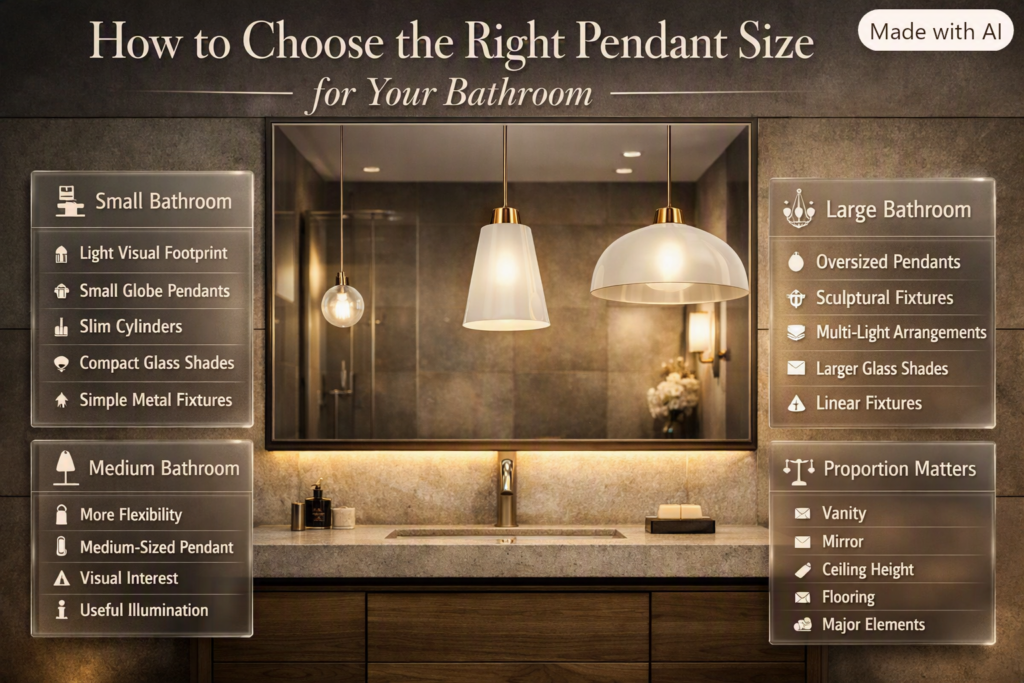
Pendant size should be proportional to the bathroom rather than selected independently.
A small fixture can disappear in a large bathroom, while a large sculptural pendant can overwhelm a compact powder room.
Small bathroom
Choose a fixture with a relatively light visual footprint.
Good choices include:
- Small globe pendants
- Slim cylinders
- Compact glass shades
- Simple metal fixtures
- Minimal geometric designs
Medium bathroom
You have more flexibility. A medium-sized pendant can provide both visual interest and useful illumination.
Large bathroom
A large bathroom can support:
- Oversized pendants
- Sculptural fixtures
- Multi-light arrangements
- Larger glass shades
- Linear fixtures
- Statement designs
The important principle is proportion.
A pendant should relate visually to the vanity, mirror, ceiling height, flooring, and other major elements.
What Pendant Style Looks Best in a Modern Bathroom?
The best pendant style is the one that supports the bathroom’s existing design language.
A modern bathroom generally benefits from clean shapes and controlled detailing.
Popular options include:
Globe pendant lights
Globe pendants have a timeless appearance and work with both modern and transitional interiors.
They can soften bathrooms dominated by:
- Stone
- Porcelain
- Concrete
- Glass
- Sharp geometric lines
Cylinder pendant lights
Slim cylindrical fixtures create a clean architectural appearance.
They’re particularly effective in narrow bathrooms where a bulky shade might feel crowded.
Sculptural pendants
Sculptural fixtures are ideal when you want the lighting to become a design statement.
Use this approach carefully. If the tile, vanity, mirror, and flooring are already visually strong, a highly decorative pendant may create too much competition.
Glass pendants
Glass is one of the most versatile choices.
Clear glass gives a light, almost invisible appearance, while frosted or opal glass creates a softer glow.
Which Materials Are Best for Bathroom Pendant Lighting?
Material selection matters because bathrooms experience moisture and condensation.
Glass
Glass is a popular option because it looks clean and works with almost every interior style.
Clear glass can make a fixture feel visually smaller, which is helpful in compact rooms.
Frosted glass can reduce glare and create a softer atmosphere.
Metal
Metal can give a bathroom a more architectural appearance.
Popular finishes include:
- Matte black
- Brushed brass
- Polished chrome
- Brushed nickel
- Aged brass
- Bronze
Choose finishes that coordinate with the bathroom’s existing hardware.
Natural materials
Rattan, woven fibers, untreated wood, and similar materials require greater caution.
A material that works beautifully in a bedroom may not be appropriate for a humid bathroom.
Always follow the manufacturer’s recommendations regarding moisture exposure.
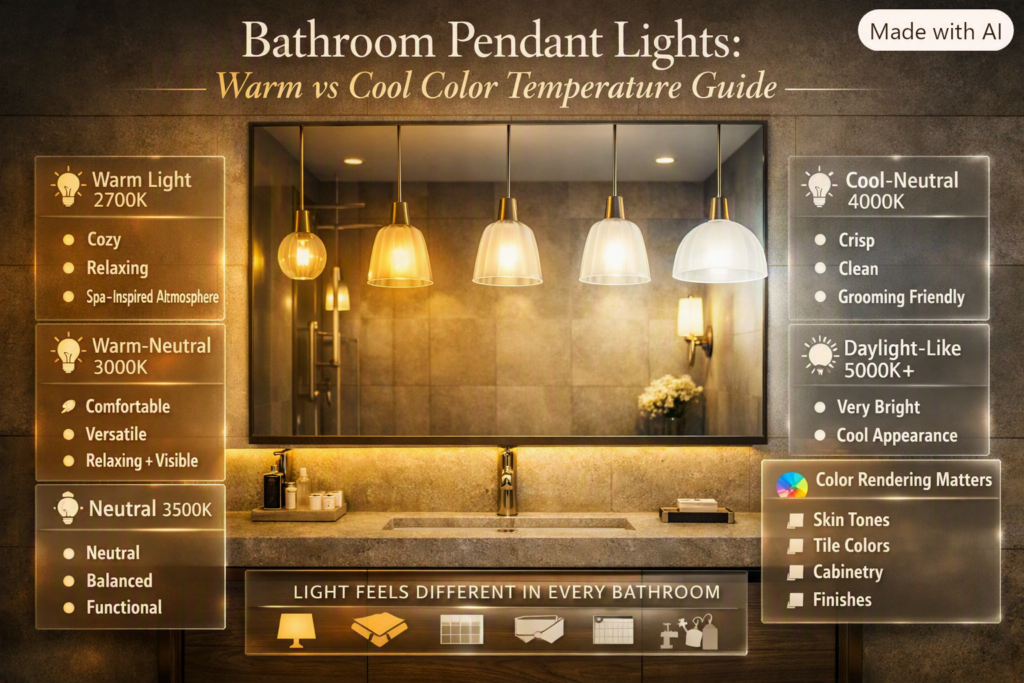
Should Bathroom Pendant Lights Be Warm or Cool?
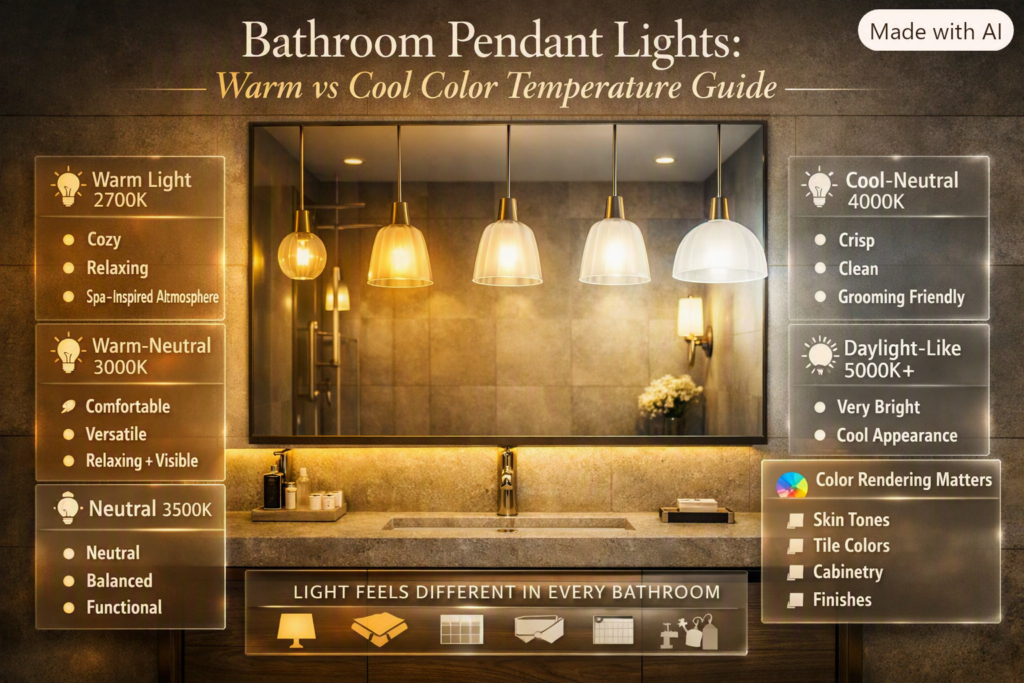
For many bathrooms, a warm-neutral color temperature provides a comfortable balance between relaxation and visibility.
Common color temperatures include:
| Color temperature | Appearance | Typical effect |
|---|---|---|
| 2700K | Warm | Cozy and relaxing |
| 3000K | Warm-neutral | Comfortable and versatile |
| 3500K | Neutral | Balanced and functional |
| 4000K | Cool-neutral | Crisp and clean |
| 5000K+ | Daylight-like | Very bright/cool appearance |
For a spa-inspired bathroom, 2700K–3000K can create a relaxing atmosphere.
For grooming areas, a more neutral light may be preferable.
Color rendering also matters. A high-CRI LED can make skin tones, tile colors, cabinetry, and finishes look more natural.
💡 Pro Tip: Don’t judge color temperature by the bulb alone. The shade material, wall color, mirror, tile, and surrounding fixtures all influence how the finished light feels.
Can Pendant Lighting Provide Enough Bathroom Light?
It can contribute substantially, but whether it provides enough light depends on the fixture, its position, its lamp, and the size of the room.
A common mistake is expecting one decorative pendant to perform every lighting function.
A better bathroom lighting plan uses layers.
Ambient lighting
Ambient lighting provides general illumination.
Examples include:
- Recessed ceiling lights
- Flush-mount fixtures
- Ceiling-mounted fixtures
- Some larger pendants
Task lighting
Task lighting supports activities that require better visibility.
Examples include:
- Vanity lights
- Mirror lights
- Wall sconces
- Properly positioned pendants
Accent lighting
Accent lighting creates atmosphere and highlights features.
Examples include:
- Decorative pendants
- Niche lighting
- Under-vanity lighting
- Architectural lighting
A pendant can perform more than one role, but it shouldn’t automatically be expected to replace every other source.
Bathroom Pendant Lighting Ideas for Different Layouts
Small bathroom pendant lighting
Small bathrooms benefit from restraint.
Choose a pendant that adds personality without visually consuming the room.
Clear glass is particularly useful because it creates less visual blockage.
If the bathroom already has a large mirror, patterned tile, or substantial vanity, a simple pendant may be the better choice.
Double vanity
Two pendants can create excellent symmetry around a double vanity.
They can be aligned with the sink positions or carefully arranged around the mirror.
        ○ Pendant              Pendant ○
             \                  /
              ┌────────────────┐
              │     Mirror     │
              └────────────────┘
           ┌──────────────────────┐
           │     Double Vanity    │
           └──────────────────────┘
The exact arrangement should respond to the actual dimensions rather than following a fixed formula.
Luxury bathroom
Luxury bathrooms can support larger and more sculptural designs.
A dramatic pendant above a freestanding bathtub can establish a focal point while recessed ceiling lights maintain general visibility.
The trick is restraint.
One strong fixture usually looks more sophisticated than several competing statement pieces.
Powder room
Powder rooms are excellent places for decorative lighting because they tend to be smaller and more atmosphere-focused.
A distinctive pendant can become the room’s visual centerpiece.
How Do You Match a Pendant With Bathroom Hardware?
You don’t have to make every finish identical, but there should be a visual relationship.
For example:
Brass faucet + brass pendant + brass cabinet hardware
creates a coordinated appearance.
Alternatively:
Black faucet + black pendant + warm wood vanity
can create a contemporary contrast.
You can also combine finishes, but do so intentionally.
If you already have chrome plumbing fixtures, introducing a black pendant can work beautifully when black is repeated elsewhere.
The goal isn’t perfect matching. It’s visual consistency.
How Can Pendant Lighting Make a Small Bathroom Look Bigger?
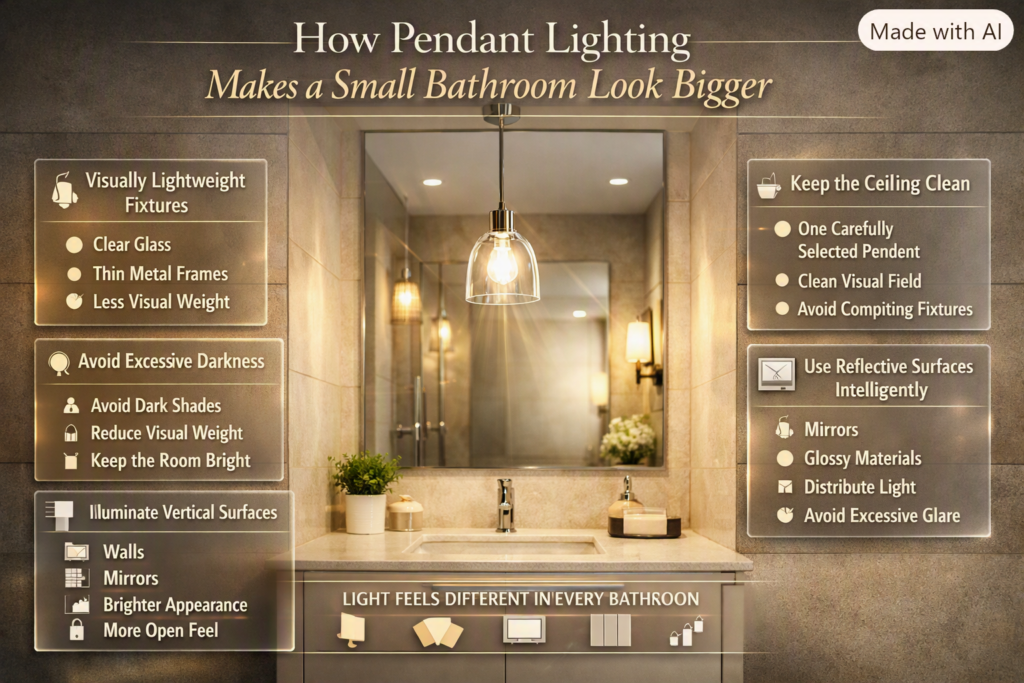
Lighting can influence how spacious a bathroom feels, although it can’t physically increase its dimensions.
A few strategies help.
Use visually lightweight fixtures
Clear glass and thin metal frames tend to occupy less visual space.
Avoid excessive darkness
Very dark shades can create strong visual weight.
Illuminate vertical surfaces
Light that reaches walls and mirrors can make the room feel brighter and more open.
Keep the ceiling visually clean
A single carefully selected pendant may be more effective than several competing fixtures.
Use reflective surfaces intelligently
Mirrors and glossy materials can distribute light, but excessive glare should be avoided.
For more ideas around organizing and visually opening a home, see Smart Storage and Organization Ideas.
What Are the Benefits of Bathroom Hanging Pendant Lighting?
Pendant lighting has several advantages beyond illumination.
It creates a focal point
A beautiful pendant naturally attracts attention.
This can be useful when you want to emphasize:
- A freestanding tub
- A vanity
- A mirror
- A high ceiling
- A particular architectural feature
It adds personality
Bathrooms can contain a lot of hard, functional materials.
A decorative pendant introduces a softer visual element.
It supports layered lighting
When correctly positioned, pendants can complement recessed lighting, sconces, and mirror illumination.
It works with many styles
Pendant lighting isn’t restricted to one design trend.
It can work with:
- Modern
- Contemporary
- Traditional
- Transitional
- Industrial
- Japandi
- Minimalist
- Luxury
- Scandinavian interiors
It uses vertical space
This is especially valuable in bathrooms with tall ceilings.
A pendant can fill vertical space that might otherwise feel empty.
What Are the Disadvantages of Bathroom Pendant Lights?
Pendant lighting isn’t perfect for every bathroom.
Potential disadvantages include:
- More visible dust
- Mineral residue from humidity
- Cleaning requirements
- Possible glare
- More complicated installation
- Limited suitability in some wet locations
- Risk of poor scale
- Potential obstruction
- Greater visual complexity
For a minimalist bathroom, a recessed fixture might be more appropriate.
For a large bathroom with a tall ceiling, however, a pendant can provide exactly the decorative presence the room needs.
What Are the Most Common Bathroom Pendant Lighting Mistakes?
Understanding mistakes before installation can save both money and frustration.
Ignoring the moisture rating
This is one of the most important mistakes.
Why it happens:
The buyer focuses on design and assumes bathroom suitability.
Why it’s a problem:
A fixture intended for dry conditions may not be appropriate for moisture exposure.
How to avoid it:
Check the manufacturer’s specifications and use a qualified electrician when needed.
Hanging the pendant too low
A pendant that looks beautiful in a showroom can become annoying when it interferes with normal movement.
How to avoid it:
- Check head clearance.
- Consider sightlines.
- Check cabinet doors.
- Consider standing and seated positions.
- Follow applicable clearance requirements.
Using the pendant as the only light source
Decorative lighting and effective task lighting aren’t always the same thing.
Better approach:
Use a layered lighting plan.
Choosing the wrong size
An oversized pendant can make a compact bathroom feel crowded.
A tiny pendant can disappear in a large bathroom.
Better approach:
Compare the fixture visually against the vanity and mirror before purchasing.
Creating glare
Bare bulbs or highly reflective shades can be uncomfortable.
Better approach:
Consider frosted glass, diffusers, shaded designs, and lamp positioning.
Using too many finishes
A bathroom can quickly look disorganized if every fixture uses a different finish.
Better approach:
Choose a dominant finish and introduce a secondary finish only when there is a clear reason.
Choosing a difficult-to-clean fixture
Intricate designs can collect dust and moisture residue.
Better approach:
Think about maintenance before buying.
A beautiful fixture that is difficult to clean may become frustrating after a few months.
How Do You Install Bathroom Hanging Pendant Lighting Safely?
Electrical installation should be performed by a qualified professional where required.
The planning process, however, can be understood by any homeowner.
Step 1: Select the location
Decide exactly what the pendant is supposed to illuminate or emphasize.
Why it matters:
The purpose determines the ideal position.
Professional advice:
Don’t buy the fixture before confirming the location.
Step 2: Check the fixture rating
Make sure the pendant is appropriate for the intended environment.
Why it matters:
Bathrooms have different moisture conditions depending on location.
Common mistake:
Assuming every ceiling fixture can be used in a bathroom.
Step 3: Check electrical requirements
Electrical rules vary by jurisdiction.
A professional should determine applicable:
- Bathroom zones
- Clearances
- Grounding requirements
- Circuit protection
- Installation requirements
Step 4: Confirm structural support
The ceiling connection needs to support the fixture securely.
A decorative pendant shouldn’t simply be attached to an unsuitable point in the ceiling.
Step 5: Test the visual height
Before final installation, verify that the fixture looks right from different positions.
Check it from:
- The entrance
- The vanity
- The bathtub
- Standing eye level
- Seated eye level
Step 6: Complete installation
The electrician can then complete the wiring, secure the fixture, install the appropriate lamp, and test the finished installation.
📌 Quick Tip: If you’re remodeling, plan pendant locations before the walls and ceiling are closed. Moving electrical boxes later is far more difficult than deciding their locations during the design stage.
How Can You Make Bathroom Pendant Lighting Look More Expensive?
A premium appearance doesn’t necessarily require an expensive fixture.
The surrounding design matters just as much.
Coordinate the finish
Repeat the pendant’s finish somewhere else in the room.
Choose the right scale
Proportion often looks more expensive than decoration.
Use high-quality light
A good-quality LED with suitable color rendering can make the entire bathroom feel better.
Control clutter
Let the pendant have room to breathe.
Coordinate materials
For example:
- Brass pendant
- Warm stone
- Neutral tile
- Soft wood vanity
can create a cohesive luxury look.
If you’re interested in broader decorating strategies, Easy Decorating Tips for Every Budget offers additional ways to improve a home’s appearance without relying entirely on expensive purchases.
How Does Ceiling Height Affect Pendant Selection?
Ceiling height is one of the most overlooked factors when choosing a pendant.
Low ceiling
Choose a compact fixture or one with a shorter suspension.
You want to avoid making the room feel compressed.
Standard ceiling
Medium-sized pendants often work well.
The fixture can provide visual interest without dominating the room.
High ceiling
You can use:
- Longer pendants
- Larger shades
- Sculptural fixtures
- Multi-light designs
A tall ceiling provides more vertical room for the fixture to breathe.
Should You Use One Pendant or Two?
The answer depends on the layout.
| Situation | Usually worth considering |
|---|---|
| Small powder room | One |
| Small vanity | One compact fixture |
| Double vanity | Two balanced fixtures |
| Large bathroom | One statement fixture or several coordinated fixtures |
| Freestanding tub | One focal pendant |
| Long vanity | Two or more depending on proportions |
Don’t add a second pendant simply because symmetry seems attractive.
Lighting performance and room scale should come first.
How Do Mirrors Affect Pendant Lighting?
Mirrors can dramatically influence how a pendant performs.
A mirror reflects light, which can increase brightness but can also produce glare if the light source is poorly positioned.
When placing pendants around a mirror, consider:
- Reflection angle
- User eye level
- Mirror dimensions
- Pendant shade opacity
- Light direction
- Distance between fixture and mirror
A frosted globe, for example, may produce a softer reflection than a completely exposed bulb.
Bathroom Pendant Lighting and Interior Design
Lighting should never feel like a separate afterthought.
The pendant should communicate with the rest of the bathroom.
If the vanity has rounded edges, a globe pendant can repeat that softness.
If the bathroom uses strong vertical lines, a slim cylindrical pendant can reinforce the architecture.
If the space has warm wood, brass, and stone, a warm-toned metal pendant can tie those elements together.
This is where good interior design differs from simply filling a room with attractive products.
Every major element should have a reason for being there.
For readers who want broader guidance across different areas of the home, DesignMode24 Interior Design provides additional interior-design resources and inspiration.
How Do You Choose Lighting for Different Bathroom Styles?
Modern
Use:
- Black
- Chrome
- Simple glass
- Cylindrical shapes
- Geometric designs
Traditional
Consider:
- Brass
- Decorative glass
- Classic silhouettes
- Lantern-inspired designs
Industrial
Try:
- Black metal
- Exposed-bulb styles
- Structured cages
- Aged finishes
Japandi
Choose:
- Minimal forms
- Soft illumination
- Organic shapes
- Natural-looking materials
Luxury
Consider:
- Sculptural forms
- Brass
- Smoked glass
- Elegant globes
- High-quality finishes
For more ideas that connect individual rooms into a coherent design approach, explore Interior Design.
Bathroom Lighting and Color Psychology
Lighting influences how bathroom colors appear.
A warm light can make beige, cream, taupe, and warm wood appear richer.
Cooler light can make whites and gray surfaces appear crisper.
This means your pendant’s light source should be considered alongside the wall color and tile.
For example, if you’ve designed a bathroom around warm neutral colors, very cool lighting may make the space feel visually disconnected.
If you’re exploring color choices throughout your home, you may also find the Paint Color resources useful.
How Can You Keep Pendant Lighting Clean in a Bathroom?
Bathroom fixtures can accumulate dust, condensation residue, and mineral deposits.
Maintenance depends on the fixture’s material and manufacturer’s cleaning instructions.
Generally:
- Turn the fixture off.
- Allow it to cool.
- Follow the manufacturer’s cleaning instructions.
- Use appropriate materials for glass or metal.
- Avoid harsh chemicals unless the manufacturer approves them.
- Dry surfaces properly.
Don’t spray cleaning products directly onto an electrical fixture.
A simple pendant with smooth surfaces will usually be easier to maintain than a highly detailed design.
Can Bathroom Pendant Lighting Work With Other Decorative Elements?
Absolutely.
The best bathrooms often combine lighting with carefully selected accessories.
For example:
Pendant + mirror + vanity + decorative object
can create a coordinated visual composition.
A minimalist white accessory can provide contrast against darker lighting finishes, while natural materials can soften a bathroom dominated by tile.
If you’re building a cohesive decorative scheme, White Decorative Objects can provide ideas for using lighter decorative elements without making the room feel cluttered.
How Does Storage Affect Pendant Placement?
Storage is another practical consideration.
A pendant that looks good on a drawing may interfere with:
- Medicine cabinets
- Tall storage units
- Open shelving
- Vanity doors
- Bathroom accessories
Always check the complete wall elevation before finalizing a fixture.
This is especially important in compact bathrooms, where every few inches can affect usability.
For more ideas about making limited space work efficiently, explore Practical Home Improvement Guides.
Can Pendant Lighting Work in Children’s Bathrooms?
It can, but practicality and safety should take priority.
In bathrooms used by children, avoid fixtures that hang low enough to be easily reached or bumped.
A simpler, securely installed fixture is generally preferable to an elaborate pendant that creates an unnecessary hazard.
The design can still be playful through color, shape, or surrounding accessories without compromising safe circulation.
For hospitality and family-oriented design inspiration, you can also explore Children’s Hotel Furniture.
Can a Pendant Become the Main Design Feature?
Yes—and sometimes that’s exactly what the bathroom needs.
If the rest of the room is relatively restrained, one distinctive pendant can become the feature that gives the space personality.
For example:
Neutral walls + simple vanity + large mirror + sculptural pendant
creates a very different impression from:
Patterned tile + decorative mirror + ornate vanity + elaborate pendant.
The first combination gives the pendant room to shine.
The second may feel overloaded.
The principle is simple: if everything is a statement, nothing feels like a statement.
Can you use hanging pendant lights in a bathroom?
Yes, hanging pendant lights can work beautifully in a bathroom, but the fixture must be suitable for the environment and installed in an appropriate location. Bathrooms have humidity, steam, condensation, and potential water splashes, so a pendant that is perfectly suitable for a bedroom or living room may not be appropriate for the bathroom.
The first thing to check is the fixture’s location rating and manufacturer instructions. Damp-rated fixtures are generally designed for moisture and condensation, while wet-rated fixtures are intended for areas where direct water exposure is possible. The exact requirement depends on where the pendant will be installed and the electrical regulations that apply to your home.
Important points to remember:
Check the fixture’s moisture/location rating before purchasing.
Don’t assume a product is bathroom-safe simply because it looks suitable.
Keep pendant placement away from areas where it could be exposed to direct water unless specifically approved for that location.
Follow the manufacturer’s installation instructions.
Have electrical work completed by a qualified professional where required.
Consider humidity and corrosion when choosing the fixture’s materials and finish.
A good bathroom pendant should therefore be selected in this order: safety and suitability first, lighting performance second, and appearance third. Once those basics are established, you can choose the shape, finish, glass, size, and style that best complements your bathroom.
Where is the best place to hang pendant lights in a bathroom?
The best location depends on the bathroom layout and what you want the pendant to accomplish. One of the most attractive applications is positioning pendants around a vanity, particularly on either side of a mirror. This arrangement can add symmetry and help create more balanced facial illumination than relying entirely on one overhead light.
Pendant lighting can also become a decorative focal point in a larger bathroom, particularly when there is sufficient ceiling height and open floor space. However, placement around a bathtub or shower requires much greater attention to electrical safety, clearance, and the fixture’s suitability for the environment.
Popular placement ideas include:
Beside a bathroom mirror: Excellent for creating symmetry and supporting vanity lighting.
Around a double vanity: Two coordinated pendants can visually balance the sinks and mirror.
Near a freestanding bathtub: Useful as a decorative statement where the installation location permits it.
In a large bathroom: A statement pendant can help define an open area.
In a powder room: A smaller decorative pendant can become the room’s main design feature.
The important point is not to copy a placement from a photograph without considering your own layout. Mirror size, ceiling height, vanity dimensions, circulation space, water locations, and electrical requirements all influence the correct position.
How high should a bathroom pendant light hang?
There isn’t one universal hanging height that works for every bathroom. The ideal height depends on the pendant’s dimensions, ceiling height, vanity or bathtub position, user height, sightlines, and the specific installation requirements of the fixture.
For pendants used around a vanity, the goal is to provide useful illumination without allowing the fixture to interfere with the mirror, cabinet doors, normal movement, or the user’s line of sight. A pendant that hangs too low can quickly become inconvenient, while one positioned too high may lose much of its decorative and functional impact.
Before finalizing the height, check:
The height of the ceiling.
The size and shape of the pendant.
The height and width of the vanity.
The position of the mirror.
Eye level when standing at the vanity.
Cabinet and medicine-cabinet doors.
Walking and head clearance.
Distance from baths, showers, and other water sources.
Applicable electrical requirements.
Professional tip: Before drilling or permanently installing the fixture, create a temporary mock-up using paper, cardboard, or another lightweight representation. Stand at the vanity and view it from different angles. This simple step can reveal whether the pendant feels too low, too dominant, or visually disconnected from the mirror.
For bathtub and shower locations, don’t rely on a standard decorative height rule. The permissible location can depend on local electrical regulations and the fixture type, so professional verification is particularly important.
What type of pendant light is best for a bathroom vanity?
The best pendant for a bathroom vanity is one that combines appropriate moisture protection, comfortable light, good proportions, and controlled glare. Decorative appearance is important, but vanity lighting has a practical job: it should make everyday grooming easier.
Clear glass globe pendants are popular because they create a light, contemporary appearance, while frosted or opal glass can soften the light and reduce harsh glare. Slim cylindrical pendants are another good choice for modern bathrooms, especially when the vanity or mirror already has a strong horizontal or geometric design.
For vanity areas, don’t depend entirely on a beautiful pendant to provide perfect facial lighting. Current bathroom-lighting design increasingly favors layered lighting, with dedicated vanity illumination working alongside ambient and decorative fixtures.
When choosing a vanity pendant, consider:
Glass: Frosted or opal glass can provide softer illumination.
Shape: Globe and cylinder designs suit many contemporary bathrooms.
Size: The fixture should relate proportionally to the mirror and vanity.
Glare: Avoid exposed bulbs that are uncomfortable when viewed directly.
Color temperature: Around 3000K–3500K can be a practical range for many grooming areas.
Color rendering: Higher-CRI lighting can help skin tones and bathroom finishes appear more natural.
Finish: Coordinate the pendant with faucets, cabinet hardware, mirrors, or other metal details.
Maintenance: Smooth surfaces are generally easier to keep clean in a humid room.
The smartest approach is to think of the pendant as one part of the vanity lighting composition rather than the entire lighting solution.
Are pendant lights a good idea for a small bathroom?
Yes, but scale becomes extremely important in a small bathroom. A pendant can add personality and visual interest without taking up countertop space, but an oversized fixture can make a compact room feel crowded.
For smaller bathrooms, visually lightweight designs usually work best. Clear glass, slim metal frames, compact globes, and simple cylindrical fixtures can introduce a decorative element without creating a heavy visual block.
The pendant should also work with the mirror and vanity rather than competing with them. If the room already contains patterned tile, a large mirror, dark cabinetry, and several decorative accessories, a simple pendant may create a more sophisticated result than another highly detailed statement piece.
For a small bathroom, consider these practical choices:
Choose a pendant with a compact visual footprint.
Avoid unnecessarily long drops in areas with limited clearance.
Use clear or lightly diffused glass when you want the fixture to feel less visually heavy.
Keep the pendant proportional to the mirror and vanity.
Use layered lighting rather than expecting one pendant to illuminate the entire room.
Avoid excessive decorative elements that make the space feel cluttered.
Think about cleaning and maintenance before selecting complicated shapes.
A particularly effective strategy is to let one element become the focal point. For example, a simple vanity, neutral wall treatment, and understated mirror can provide the perfect background for a distinctive pendant. In a small bathroom, thoughtful proportion usually creates a more luxurious result than simply choosing the largest or most decorative fixture.
Conclusion
Bathroom hanging pendant lighting can do far more than simply brighten a room. When chosen thoughtfully, it can become a defining design feature that adds warmth, character, depth, and a more refined atmosphere to the bathroom. The key is to balance style, proportion, light quality, placement, and safety rather than choosing a pendant based on appearance alone.
Whether you are working with a compact powder room, a modern family bathroom, a spacious double vanity, or a luxurious bathroom with a freestanding tub, the right pendant can complement the architecture and strengthen the overall design. Glass shades can keep smaller spaces feeling open, while sculptural metal or statement pendants can create a stronger focal point in larger rooms.
However, bathroom lighting requires more consideration than lighting in a typical living space. Moisture, steam, splashing, electrical requirements, fixture ratings, and local regulations all need to be considered before installation. Always follow the manufacturer’s specifications and use a qualified electrician where electrical work is involved.
The best results also come from layered lighting. A pendant should work alongside task lighting, ambient illumination, and accent lighting instead of being expected to illuminate the entire bathroom by itself. Choosing an appropriate color temperature, minimizing glare, and positioning the fixture at a comfortable height can make the space feel both more functional and more luxurious.
Ultimately, successful bathroom pendant lighting is about creating a fixture that feels intentional. It should suit the scale of the room, complement the vanity and finishes, provide comfortable illumination, and contribute to the atmosphere you want to create.
For more inspiration across different areas of the home, explore designmode24 interior design and discover practical ideas for creating interiors that look beautiful while working naturally for everyday life.
The goal is simple: choose a pendant that looks beautiful, performs well, and feels like it belongs in the space. When those three elements come together, bathroom hanging pendant lighting can turn an ordinary bathroom into a polished and memorable part of the home.

Leave a Reply