

Introduction
Practical Home Improvement Guides | A home doesn’t have to be completely renovated to feel better. Sometimes the biggest difference comes from fixing a layout that never worked, adding storage where clutter keeps building up, repainting a tired wall, improving bedroom comfort, or simply making better use of the space you already have.
The challenge is knowing what to improve first, where to spend your money, and which projects are actually worth doing. Without a plan, even a simple home improvement project can become expensive, frustrating, and difficult to finish.
That is why practical advice matters.
These Practical Home Improvement Guides are designed around real-life decisions homeowners face. Instead of focusing only on attractive rooms or passing design trends, the goal is to explain how to make a home more functional, comfortable, organized, attractive, and easier to maintain.
For a broader collection of room design and improvement ideas, explore DesignMode24 Interior Design. It can be useful when you want to move from a general improvement idea to a more specific design solution.
This guide covers everything from planning a project and controlling costs to painting, storage, bedrooms, bathrooms, layouts, DIY work, and room-by-room improvements. It also explains the mistakes that frequently make home projects more expensive than they need to be.
What Are Practical Home Improvement Guides?
Practical home improvement guides are resources that explain how to identify problems in a home, choose sensible solutions, plan improvements, select appropriate materials, and complete projects successfully.
The word practical is important.
A home improvement idea can look beautiful in a photograph while being completely unsuitable for your actual space. A large sofa may look impressive in a spacious room but make a small living room difficult to walk through. A complicated storage system may look organized but become frustrating if everyday items are difficult to reach.
Practical improvement starts with the way you live.
Before choosing a product, color, material, or furniture piece, ask:
- What problem am I trying to solve?
- How often will I use the improvement?
- How much space does it require?
- How difficult will it be to maintain?
- Does it fit my budget?
- Will it still be useful in several years?
A good improvement should make something better, not simply make something different.
Why Does Practical Planning Matter?
Planning prevents many of the most common home improvement mistakes.
Without planning, homeowners often buy furniture before measuring, select paint without considering lighting, start DIY work without the right tools, or begin several projects simultaneously.
These decisions can create unnecessary expenses.
A better process is:
Problem → Goal → Plan → Budget → Materials → Installation → Review
For example, if a bedroom feels cramped, don’t immediately buy smaller furniture. First determine whether the problem comes from furniture placement, unnecessary items, poor storage, dark colors, inadequate lighting, or an inefficient wardrobe.
Once the actual cause is clear, the right solution becomes much easier to find.
How Do You Decide Which Home Improvement Project to Do First?
The best place to start is with problems that affect safety, maintenance, functionality, and everyday comfort.
Decorative improvements are important, but they should not hide underlying issues.
A practical priority system looks like this:
| Priority | Improvement Type | Typical Examples |
|---|---|---|
| 1 | Safety | Electrical problems, structural concerns, serious damage |
| 2 | Maintenance | Leaks, damaged surfaces, ventilation problems |
| 3 | Function | Storage, lighting, layout, accessibility |
| 4 | Comfort | Furniture, temperature control, privacy |
| 5 | Appearance | Paint, décor, accessories |
This doesn’t mean every homeowner must follow this order rigidly. A room that is structurally sound but visually outdated may benefit enormously from paint.
The point is to understand which problem is most important.
Use the Problem-Before-Product Method
One of the most useful habits in home improvement is avoiding product-first thinking.
Instead of saying:
“I need a new wardrobe.”
Ask:
“Why isn’t my current wardrobe working?”
Perhaps you don’t actually need a new wardrobe. You might need:
- Better shelves
- More hanging space
- Drawer organization
- Shoe storage
- Better lighting
- A different internal configuration
This approach can save hundreds or even thousands of dollars.
💡 Pro Tip: If you can solve a problem by rearranging, repairing, repainting, or reorganizing something you already own, investigate that option before buying something new.
How Should You Plan a Home Improvement Project?
A successful project begins with a clear scope. Decide what you’re changing, why you’re changing it, how much you’re willing to spend, and whether the work is suitable for DIY.
Step 1: Define the Problem
Write the problem in one sentence.
For example:
“The bedroom has enough furniture, but there isn’t enough clear floor space.”
This is much more useful than:
“I want a bedroom makeover.”
The first statement gives you a measurable goal.
You can now evaluate the furniture arrangement, storage, circulation, and room dimensions.
Step 2: Measure the Space
Never rely on assumptions.
Measure:
- Wall lengths
- Ceiling height
- Door openings
- Window positions
- Existing furniture
- Cabinet depth
- Walking areas
- Available wall space
Record the measurements before shopping.
A beautiful cabinet is useless if it cannot pass through the doorway.
Step 3: Establish a Budget
Separate the budget into:
Materials + Labor + Tools + Contingency
Tools are often forgotten in DIY budgets.
If a project requires a drill, levels, saws, protective equipment, sanding tools, or specialty accessories, include those costs before deciding whether DIY is actually cheaper.
Step 4: Decide What You Can Do Yourself
DIY makes sense when the task matches your experience and the consequences of mistakes are manageable.
Painting, decorating, assembling furniture, simple organization, and some basic installation tasks may be suitable.
Electrical systems, gas work, major plumbing, structural modifications, and other specialized tasks may require qualified professionals.
⚠ Common Mistake: Assuming that because a project looks simple online, it is automatically safe or easy in your home. Tutorials don’t account for every property’s wiring, construction, materials, or hidden problems.
How Can You Improve Your Home Without Spending a Fortune?
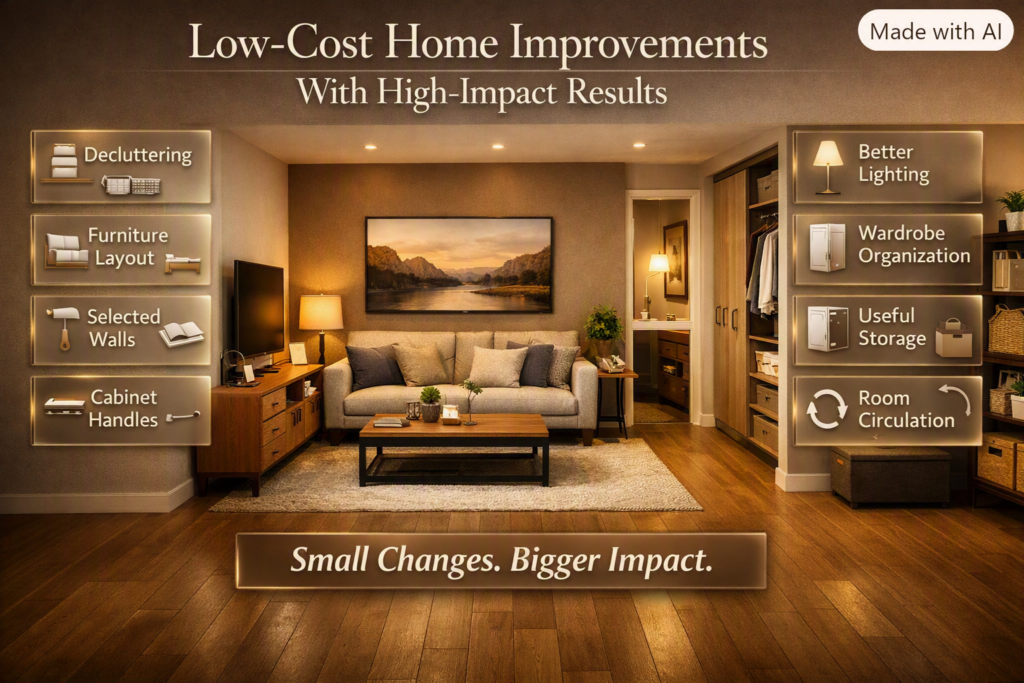
You don’t need a large renovation budget to make a home feel significantly better.
The smartest low-cost improvements usually target things you interact with every day.
Consider:
- Decluttering
- Rearranging furniture
- Repainting selected walls
- Updating cabinet handles
- Improving lighting
- Organizing wardrobes
- Adding useful storage
- Replacing worn textiles
- Repairing damaged surfaces
- Improving room circulation
Focus on High-Impact Changes
A high-impact improvement changes how the room looks or functions without requiring a complete rebuild.
For example, changing the layout of a living room may cost nothing but dramatically improve circulation.
Replacing outdated hardware can modernize cabinets without replacing the cabinets.
Painting a room can alter its entire atmosphere without changing the furniture.
Improving storage can make a home feel larger because fewer objects remain visible.
⭐ Expert Tip: When your budget is limited, prioritize improvements that affect the room every day rather than items that are only occasionally noticed.
How Does Interior Design Support Practical Home Improvement?
Interior design is not simply about making rooms look attractive. Good design connects layout, function, proportion, lighting, color, materials, storage, and personal needs.
A practical interior should answer questions such as:
- Can people move comfortably?
- Is important storage easy to reach?
- Does the lighting suit the room’s activities?
- Are materials appropriate for the space?
- Is the furniture correctly scaled?
- Can the room be maintained easily?
- Does the design reflect how the occupants actually live?
This is why home improvement and interior design often overlap.
If you are planning a larger transformation, the Interior Design section can provide additional ideas for combining function and visual style.
Don’t Confuse More With Better
Adding more furniture, shelves, decorations, and accessories doesn’t automatically improve a room.
Sometimes the best improvement is removing something.
A room can feel more spacious simply because unnecessary furniture has been removed and walking paths have been restored.
Good design creates balance.
How Can Paint Improve a Room?
Paint is one of the most accessible home improvement tools because it can dramatically change a room without altering its architecture.
However, successful painting requires more than choosing a fashionable color.
Consider:
- Natural daylight
- Artificial lighting
- Room size
- Ceiling height
- Flooring
- Furniture
- Existing finishes
- Desired atmosphere
- Cleaning requirements
A color that looks soft and warm in a store can appear much cooler or darker in your home.
Should Small Rooms Always Be Painted White?
No.
Light colors can help create an open feeling, but they are not the only option.
A small room can work beautifully with deeper or warmer colors when the furniture, lighting, and proportions are carefully considered.
The important question isn’t:
“What color makes a room look bigger?”
It’s:
“What color works with this room’s light, furniture, architecture, and purpose?”
For a more focused look at choosing and using colors, explore the Paint Color section.
What About Paint Preparation?
Preparation is one of the biggest differences between a professional-looking paint job and a disappointing one.
Before painting:
- Clean the surface.
- Repair holes and cracks.
- Remove loose or damaged material.
- Sand where appropriate.
- Protect floors and fixtures.
- Prime when necessary.
- Apply suitable coats.
- Allow adequate drying time.
📌 Quick Tip: Don’t judge a color from a tiny digital swatch alone. Test a sample on the actual wall and observe it under different lighting conditions.
How Can DIY Home Improvement Save Money?
DIY can reduce labor costs, but it should be approached realistically.
A successful DIY project requires three things:
Skill + Tools + Time
If one of these is missing, the project may become more expensive than expected.
Good DIY Projects for Beginners
Beginners can often start with projects such as:
- Painting
- Decluttering
- Furniture assembly
- Hardware replacement
- Basic organization
- Decorative updates
- Curtain installation
- Simple storage improvements
More advanced projects such as tiling, flooring, cabinetry, or detailed carpentry require greater accuracy and tool familiarity.
For project ideas and inspiration, explore DIY Home Projects.
When Should You Stop a DIY Project?
Stop and reassess if:
- You discover unexpected structural damage.
- The work involves unfamiliar electrical systems.
- You find significant water damage.
- Materials behave differently than expected.
- You don’t understand an important installation step.
- You don’t have the appropriate safety equipment.
- The consequences of an error could be expensive or dangerous.
There’s no shame in calling a professional.
Knowing when not to DIY is part of practical home improvement.
How Can You Make a Small Bedroom More Functional?

Small bedrooms require careful decisions because every piece of furniture occupies valuable floor area.
The goal isn’t to fill the room efficiently.
The goal is to make the room comfortable while preserving useful space.
Start by identifying the largest objects:
- Bed
- Wardrobe
- Dresser
- Desk
- Bedside tables
Then examine whether each item is necessary and appropriately sized.
Use Vertical Space
Walls can provide storage without consuming much floor area.
Depending on the room, consider:
- Wall-mounted shelves
- Tall wardrobes
- Vertical cabinets
- Hooks
- Floating bedside surfaces
- High storage compartments
Keep the Floor Visually Clear
A room can feel smaller when the floor is crowded.
Where appropriate, use:
- Raised furniture
- Wall-mounted elements
- Under-bed storage
- Slim furniture
- Built-in storage
For additional bedroom inspiration, explore Bedroom Ideas.
Don’t Overdecorate
Small bedrooms don’t need dozens of decorative objects.
One strong artwork, a good lamp, carefully chosen bedding, and a few personal items can create a finished appearance without creating clutter.
How Does Bedroom Layout Affect Everyday Comfort?
Bedroom layout affects how easily you move, sleep, dress, store belongings, and use the room.
The bed is normally the visual and functional anchor.
Before adding accessories, establish a comfortable relationship between:
Door → Bed → Wardrobe → Circulation → Windows
Make sure:
- Doors can open properly.
- Wardrobe doors or drawers have sufficient clearance.
- The bed doesn’t obstruct the main walking route.
- Windows remain usable.
- Lighting reaches important areas.
- Frequently used objects are accessible.
A layout that looks attractive from one angle may still be frustrating to live with.
What Is the Best Layout for a Small Bedroom?
There isn’t one universal layout because the correct arrangement depends on door placement, windows, room dimensions, wardrobe position, and furniture size.
However, a useful principle is to protect the main walking path.
Avoid placing large furniture where it creates a narrow bottleneck.
For more detailed layout ideas, see Bedroom Layouts.
⭐ Expert Tip: Sketch the furniture arrangement on paper before moving heavy furniture. Even a rough floor plan can reveal circulation problems before you spend an afternoon rearranging the room.
How Can Better Wardrobe Design Improve a Bedroom?

A wardrobe should be designed around the clothes and objects it actually needs to store.
Start by separating your belongings into categories:
- Long hanging clothes
- Short hanging clothes
- Folded clothing
- Shoes
- Accessories
- Bags
- Seasonal items
Then assign space according to frequency of use.
Everyday items should be easy to reach.
Seasonal items can occupy higher or less accessible areas.
Built-In vs Freestanding Wardrobes
| Feature | Built-In Wardrobe | Freestanding Wardrobe |
|---|---|---|
| Space efficiency | Excellent | Moderate |
| Flexibility | Lower | Higher |
| Appearance | Integrated | More independent |
| Storage customization | High | Depends on model |
| Relocation | Difficult | Easier |
| Cost | Often higher | Often lower |
Neither is automatically better.
A built-in solution can make excellent use of awkward corners and ceiling height, while a freestanding wardrobe may be better for renters or people who expect to move.
For more ideas, explore Wardrobe Designs.
How Can You Improve a Bathroom Without a Full Renovation?
Bathrooms often feel outdated because of several small details rather than one major problem.
Before planning a full renovation, evaluate:
- Lighting
- Storage
- Mirrors
- Hardware
- Sealant
- Fixtures
- Ventilation
- Surface condition
- Color scheme
Replacing a mirror or improving lighting can sometimes produce a surprisingly large visual improvement.
Fix Problems Before Decorating
Cosmetic work shouldn’t be used to hide:
- Persistent leaks
- Serious moisture damage
- Drainage problems
- Unsafe electrical conditions
- Structural damage
- Poor ventilation
These problems can become more expensive when ignored.
A clean, functional bathroom is more valuable than one that simply photographs well.
For design inspiration, explore Bathroom Inspiration.
💡 Pro Tip: In a bathroom, durability and maintenance matter as much as appearance. A finish that looks beautiful but is difficult to clean may become frustrating very quickly.
How Can Lighting Improve Home Improvement Results?
Lighting is one of the most underestimated parts of home design.
A room’s colors, materials, textures, and furniture can all appear different depending on the light.
Think about three basic lighting functions:
Ambient Lighting
This provides general illumination throughout the room.
Task Lighting
This provides focused light for activities such as reading, cooking, grooming, or working.
Accent Lighting
This can highlight artwork, architectural details, shelves, or other focal points.
A room doesn’t necessarily need expensive lighting equipment.
Sometimes changing the position, intensity, or type of existing lights produces a significant improvement.
Use Natural Light Strategically
Observe how sunlight enters the room throughout the day.
A color or material that works beautifully in morning light may look different at night under artificial lighting.
This is another reason samples and real-world testing are more reliable than making decisions from photographs alone.
How Can Storage Make a Home Feel Larger?
Storage improves perceived space by reducing visible clutter and giving objects a predictable place to live.
However, simply adding cabinets isn’t enough.
Good storage follows the user’s habits.
If something is used every morning, storing it in a difficult-to-reach cabinet is inefficient.
A practical hierarchy is:
Daily-use items → Easy reach
Weekly-use items → Convenient storage
Occasional items → Secondary storage
Rare items → Higher or deeper storage
This principle works in bedrooms, kitchens, bathrooms, hallways, and living spaces.
Open vs Closed Storage
Open shelving provides easy access and can display attractive objects.
Closed storage hides visual clutter and usually creates a calmer appearance.
The right balance depends on the room.
A living room might benefit from some open display space, while a bedroom may benefit from more concealed storage.
What Are the Most Common Home Improvement Mistakes?
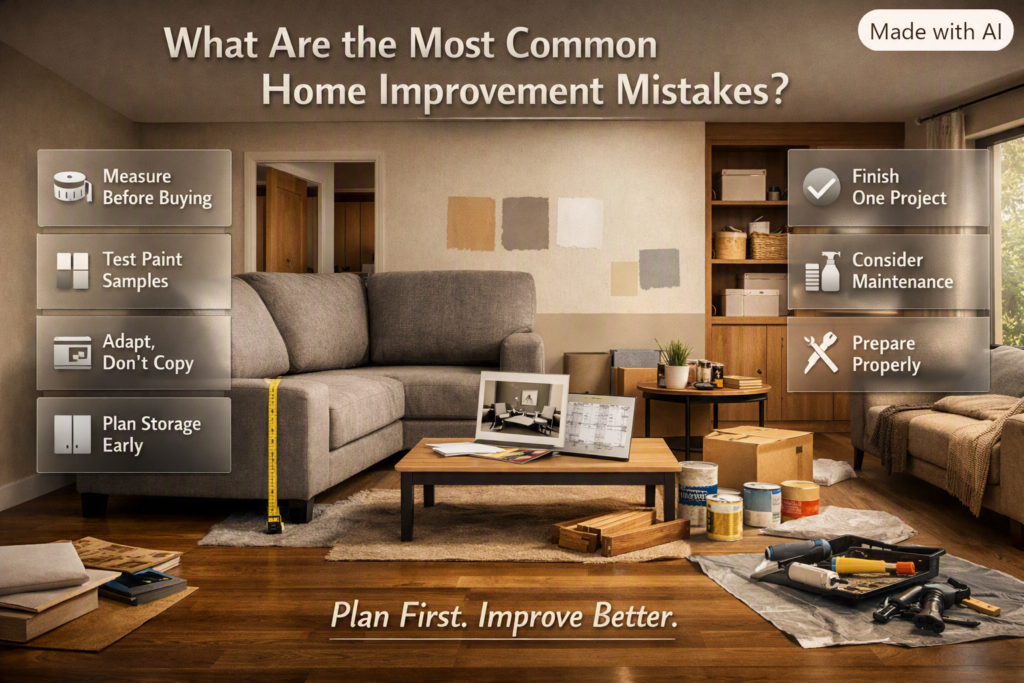
Even well-intentioned projects can go wrong when planning is rushed.
1. Buying Furniture Before Measuring
Why it happens: People become excited about a product.
Why it’s harmful: The item may not fit the room, doorway, or circulation path.
How to avoid it: Measure the room and access route first.
2. Choosing Paint From a Screen
Why it happens: Online color swatches are convenient.
Why it’s harmful: Screens don’t reproduce every real-world lighting condition accurately.
How to avoid it: Test samples in your actual room.
3. Copying a Room Exactly From a Photograph
Why it happens: Inspiration images make design decisions appear simple.
Why it’s harmful: Your room has different dimensions, windows, lighting, and lifestyle requirements.
How to avoid it: Copy the principle rather than the exact arrangement.
4. Ignoring Storage
Why it happens: Storage isn’t always visually exciting.
Why it’s harmful: Beautiful rooms quickly become cluttered when everyday items have nowhere to go.
How to avoid it: Plan storage before finalizing furniture.
5. Starting Too Many Projects
Why it happens: One improvement makes homeowners notice other things.
Why it’s harmful: Money, time, and attention become scattered.
How to avoid it: Finish one meaningful project before starting another.
6. Choosing Trendy Materials Without Considering Maintenance
Why it happens: Trends are visually appealing.
Why it’s harmful: Some materials require more cleaning or care than expected.
How to avoid it: Ask how the material will perform after months and years of everyday use.
7. Underestimating Preparation
Why it happens: Preparation doesn’t feel like progress.
Why it’s harmful: Poor preparation can ruin an otherwise good project.
How to avoid it: Treat preparation as part of the project, not as optional extra work.
Room-by-Room Interior Design Inspiration
How Can You Improve Your Home One Room at a Time?
Trying to redesign an entire home simultaneously can quickly become overwhelming.
A room-by-room approach is easier to budget, execute, and evaluate. This Room-by-Room Interior Design Inspiration approach also helps you focus on the specific function and needs of each space.
Living Room
Focus on:
- Furniture scale
- Conversation areas
- Walking paths
- Lighting
- Storage
- Focal points
Bedroom
Focus on:
- Bed position
- Sleep comfort
- Wardrobe organization
- Lighting
- Clutter control
- Personal atmosphere
Bathroom
Focus on:
- Ventilation
- Lighting
- Storage
- Maintenance
- Durable finishes
Kitchen
Focus on:
- Workflow
- Storage
- Work surfaces
- Lighting
- Frequently used items
Hallway
Focus on:
- Clear circulation
- Entry storage
- Lighting
- Mirrors
- Visual connection with nearby rooms
For a broader approach covering different spaces, the Room-by-Room Design Hub is useful when you’re planning improvements across the entire home.
How Do You Choose Between Repairing, Replacing, and Redesigning?
When something isn’t working, there are usually three possible approaches:
Repair it.
Replace it.
Redesign how it is used.
The cheapest option isn’t always the best, and the newest option isn’t always necessary.
Consider the condition, age, quality, function, and replacement cost.
For example, if a wardrobe is structurally strong but poorly organized, redesigning the internal storage may be smarter than replacing the entire unit.
If a cabinet is damaged beyond reasonable repair, replacement may make more sense.
If a room simply feels awkward, redesigning the layout may solve the problem at almost no material cost.
How Can You Make Home Improvements More Sustainable?
Practical improvement doesn’t always mean buying new products.
One of the simplest sustainable strategies is to improve what already exists.
Consider:
- Repairing furniture
- Reusing materials
- Refinishing suitable surfaces
- Choosing durable products
- Avoiding unnecessary replacements
- Donating usable items
- Buying only what solves a genuine problem
Durability is particularly important.
A product that costs slightly more but lasts significantly longer may be more economical than repeatedly replacing cheaper alternatives.
The same principle applies to paint, flooring, furniture, storage systems, fixtures, and hardware.
How Do Professionals Evaluate a Home Improvement Idea?
Experienced designers and contractors tend to look beyond the immediate visual result.
They consider:
Function
What does the space need to do?
Proportion
Are the furniture and architectural elements appropriately scaled?
Circulation
Can people move comfortably?
Durability
Can the materials tolerate the room’s conditions?
Maintenance
How much effort will cleaning and upkeep require?
Lighting
How will the improvement behave under natural and artificial light?
Long-Term Use
Will the improvement still make sense if the homeowner’s needs change?
This broader evaluation helps prevent decisions that look impressive initially but become inconvenient later.
⭐ Expert Tip: Before approving an expensive improvement, imagine using it every day for five years. If the decision still seems practical, it’s probably stronger than a choice based only on current trends.
What Home Improvements Usually Give the Best Everyday Value?
There isn’t one universal improvement that is best for every home.
However, improvements that solve recurring problems often provide excellent practical value.
These may include:
- Better storage
- Improved lighting
- Functional layouts
- Fresh paint
- Comfortable furniture
- Better organization
- Proper maintenance
- Improved bathroom function
- Efficient wardrobe systems
Think about frequency.
An improvement you experience every day can provide more personal value than something impressive that you notice only occasionally.
A better bedside light may improve your routine every night.
A better wardrobe organization system may save time every morning.
A better layout may improve movement every time you enter the room.
That is practical value.
What home improvement projects should I prioritize first?
The best first project is usually the one that solves an important maintenance, safety, functionality, or comfort problem. Don’t automatically start with the room that looks the most outdated. A leaking bathroom, damaged wall, poor lighting, inefficient storage, or awkward layout may deserve attention before purely decorative upgrades.
A practical priority order is:
Safety: electrical, structural, water, or other serious issues
Maintenance: leaks, damaged surfaces, ventilation, worn fixtures
Function: storage, lighting, room layouts, accessibility
Comfort: furniture, privacy, temperature, usability
Appearance: paint, décor, accessories, styling
This approach also helps control spending. Current renovation research shows that many homeowners are becoming more cautious about budgets, while unexpected costs remain a major challenge.
Professional approach: Before starting any project, write down the actual problem you’re trying to solve. Then ask whether the proposed improvement solves that problem permanently or simply makes it look better temporarily.
How can I improve my home without spending a lot of money?
You don’t necessarily need a major renovation to make a home feel significantly better. Some of the most effective improvements come from better use of existing space, not expensive new products.
Start with changes that affect the room every day:
Rearrange furniture to improve movement
Remove unnecessary furniture and clutter
Improve storage and organization
Repaint tired or damaged walls
Upgrade outdated cabinet or door hardware
Improve lighting
Refresh curtains, rugs, cushions, or bedding
Repair damaged surfaces instead of replacing them
Use vertical wall space more effectively
The important distinction is between adding something new and solving something that isn’t working.
For example, if a bedroom feels crowded, buying another storage cabinet may make the problem worse. Reorganizing the existing wardrobe, removing unnecessary furniture, and improving the layout could create more usable space without a major expense.
Professional approach: Give every potential purchase a job. If you can’t clearly explain what problem an item solves, put it lower on your priority list.
How do I know whether to DIY a home improvement project or hire a professional?
The right question isn’t simply, “Can I do this myself?” It’s “Is doing this myself the safest and most sensible option?”
DIY is often appropriate for relatively straightforward projects such as painting, furniture assembly, basic organization, decorative updates, and some simple installations. More technical work can require specialized knowledge, tools, permits, or safety precautions.
Consider professional help when a project involves:
Electrical systems
Gas connections
Major plumbing
Structural modifications
Significant water damage
Roofing or major exterior work
Complex built-in construction
Work where an installation mistake could cause expensive damage
Also consider the value of your time. A project that saves labor costs but takes several weekends, requires expensive tools, and carries a high risk of rework isn’t necessarily a cheaper project.
The professional decision is sometimes knowing when to stop DIY work.
Professional approach: Before starting, estimate the cost of materials, tools, your time, and the potential cost of correcting a mistake. If the downside is significant, professional expertise can be the more economical choice.
What home improvements are worth investing in for long-term value?
Long-term value doesn’t always mean resale value. A good improvement should ideally provide usefulness, durability, comfort, and easier maintenance for years.
Practical investments often include:
Better storage
Functional room layouts
Quality lighting
Durable flooring
Well-planned wardrobes
Bathroom improvements
Kitchen functionality
Proper maintenance and repairs
Good-quality finishes
Improvements that make the home easier to live in
Current 2026 renovation data shows that homeowners are increasingly thinking about staying in their homes for the long term and adapting spaces to changing needs.
That makes flexibility especially important.
For example, a well-planned storage system may be more valuable to everyday life than an expensive decorative feature. Likewise, a bedroom layout that improves movement and storage can continue providing benefits long after a particular décor trend has disappeared.
Professional approach: Before making an expensive improvement, ask: Will this still be useful five or ten years from now? If the answer is yes, it’s more likely to be a strong long-term decision.
What are the biggest mistakes to avoid when planning a home improvement project?
The biggest mistakes usually happen before the actual work begins. Poor planning can turn a simple project into an expensive one.
The most common problems include:
Starting without a clear goal
Failing to measure the space
Underestimating the total budget
Forgetting a contingency for unexpected costs
Buying materials before finalizing the plan
Choosing products based only on appearance
Ignoring lighting and room proportions
Starting too many projects at once
Copying an online design without adapting it to the home
Attempting technical work without the necessary expertise
Changing the project scope halfway through
Budget overruns are particularly common. Houzz’s 2026 U.S. study found that 37% of homeowners exceeded their initial renovation budget in 2025, with higher-end material choices and expanding project scope among the reasons.
Professional approach: Lock down the project’s scope before spending money. Measure the space, establish priorities, research materials, create a realistic budget, and keep a contingency amount available for surprises. A disciplined plan gives you much more control than trying to fix decisions after the work has already started.
Conclusion
Successful home improvement isn’t about changing everything at once or spending the most money. It’s about making thoughtful improvements that solve real problems and make everyday life easier.
Before starting any project, take time to understand what your home actually needs. Prioritize repairs and maintenance, improve functionality and storage, and then focus on colors, décor, and finishing touches. A well-planned layout, better lighting, fresh paint, or smarter storage can sometimes create a bigger difference than an expensive renovation.
It’s also important to work within your abilities. Simple DIY projects can be rewarding and cost-effective, but technical or high-risk work is better handled by a qualified professional. Good planning, accurate measurements, realistic budgeting, and durable materials will help you avoid many of the mistakes that make home improvements unnecessarily expensive.
Most importantly, don’t improve your home simply because a particular style is trending. Choose changes that fit your space, your lifestyle, your budget, and the way you actually use each room.
Whether you’re making a small bedroom more functional, refreshing a bathroom, improving wardrobe storage, changing a paint color, or gradually updating your entire home, every project should have a clear purpose.
The best home improvement is not the one that looks impressive for a moment—it’s the one that continues making your home more comfortable, practical, and enjoyable for years to come.

Leave a Reply