
Introduction
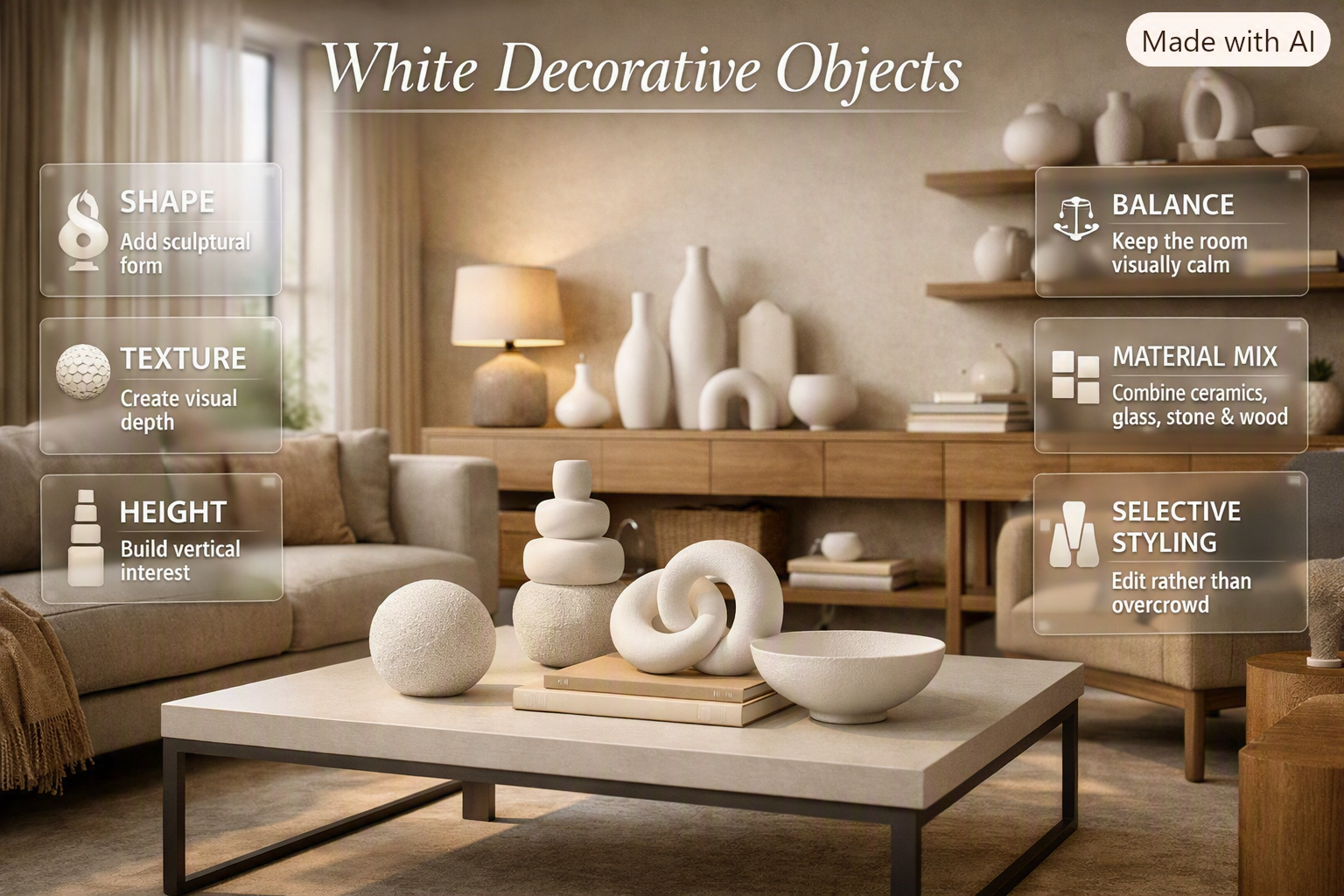
White Decorative Objects | Have you ever looked at a beautifully furnished room and felt that something was still missing? The furniture may be right, the walls may have the perfect color, and the lighting may be carefully planned, yet the space can still feel unfinished. Often, the missing layer is not another piece of furniture. It is the smaller details that give the room personality.
That is where white decorative objects can make a surprisingly strong difference.
White decor is often associated with simplicity, but it is far more versatile than simply placing a few white vases on a shelf. The right objects can add shape, texture, height, contrast, softness, and visual balance without introducing another dominant color. Because white works with almost every interior palette, it can connect different materials and furniture pieces while keeping the overall room calm.
For broader inspiration on creating a cohesive home, explore designmode24 interior design and look at how decorative details can support a larger interior concept.
The key, however, is knowing which white objects to choose, where to place them, how many to use, and what materials to combine with them. A room filled with identical white accessories can look sterile, while a carefully edited collection can look sophisticated and intentional.
This guide explains how to use white decorative objects professionally, from choosing the right materials and shapes to styling living rooms, bedrooms, bathrooms, dining areas, entryways, and shelves.
What Are White Decorative Objects?
White decorative objects are accessories used primarily to enhance the visual character of an interior. They may be purely decorative, or they may combine decoration with a practical function.
Common examples include:
- White ceramic vases
- Sculptural ornaments
- Decorative bowls
- White candleholders
- Ceramic figurines
- White trays
- Decorative boxes
- White planters
- Abstract sculptures
- Textured pottery
- Small architectural objects
- White picture frames
- Decorative jars
- White bookends
- Porcelain accessories
What makes these objects especially useful is their ability to create visual interest without competing strongly with the room’s existing colors.
A white sculpture, for example, can sit against a dark wood console and become a focal point. The same sculpture can work against a beige wall, a gray shelf, or a colorful room because its neutral color allows its shape and texture to become the main visual feature.
White decorative objects are therefore less about color alone and more about form, material, proportion, and placement.
Why White Is More Complicated Than It Looks
Not every white is the same.
You can have:
- Warm white
- Cool white
- Soft white
- Creamy white
- Off-white
- Ivory
- Chalk white
- Pure bright white
- Gray-white
This distinction matters because the surrounding interior affects how the object appears.
A bright cool-white ceramic sculpture may look crisp in a modern gray room but slightly harsh beside warm beige furniture. An ivory ceramic vase, on the other hand, may blend beautifully with natural wood, linen, cream upholstery, and warm stone.
In neutral interiors, the absence of strong color makes texture and material differences more noticeable. Designers therefore often rely on ceramic, stone, glass, wood, fabric, and metal to introduce depth without creating a busy palette.
Why Are White Decorative Objects So Effective?
The biggest advantage of white decor is its flexibility.
You can move a white vase from the living room to the bedroom, change the flowers inside it, place it on a bathroom shelf, or use it as part of a dining-room centerpiece without completely redesigning the room.
White decorative pieces can perform several jobs at once.
They Create Visual Calm
Strong colors attract attention immediately. White usually does not demand the same level of attention.
That makes it useful when a room already contains:
- Patterned upholstery
- Colorful artwork
- Dark furniture
- Decorative flooring
- Bold rugs
- Statement lighting
- Strong architectural details
Instead of adding another competing color, white can provide a visual pause.
They Highlight Shape
When color becomes less dominant, the eye starts noticing silhouette.
This is particularly effective with sculptural accessories.
A twisted ceramic object, curved vase, abstract figure, or geometric bowl can become interesting because of its profile rather than its color.
They Connect Different Colors
Imagine a room containing beige furniture, walnut wood, black metal, green plants, and gray stone.
Adding several bright accent colors might make the space feel fragmented.
White can act as a bridge.
It can repeat across different surfaces and create continuity without forcing every element to match.
They Work With Both Minimalist and Layered Interiors
White accessories can support a minimalist room with only a few carefully selected objects.
They can also work in a more collected interior where shelves contain books, artwork, plants, ceramics, and personal objects.
The difference comes down to quantity, scale, and arrangement.
💡 Pro Tip: Don’t think of white decorative objects as “filler.” Each piece should either create shape, provide contrast, introduce texture, support function, or strengthen the room’s overall design language.
What Types of White Decorative Objects Should You Choose?
Choosing the right category of object is more important than simply choosing something that looks attractive in a store.
The best accessory is one that fits the surface, scale, room function, and design style.
White Ceramic Vases
Ceramic vases are among the most versatile white accessories.
They can be:
- Tall and narrow
- Wide and rounded
- Ribbed
- Hand-shaped
- Matte
- Glossy
- Speckled
- Rough-textured
- Smooth
- Sculptural
A tall white vase can provide height on a console table, while a low rounded vase may work better on a coffee table.
Don’t automatically fill every vase with flowers. Some sculptural ceramic vessels look stronger empty.
When to Use a White Vase
Choose a vase when you need:
- Height
- A vertical focal point
- A soft organic shape
- Texture
- A container for branches or flowers
A textured white vase can be especially effective in neutral interiors because the raised surface creates shadows and visual depth.
White Sculptures and Abstract Objects
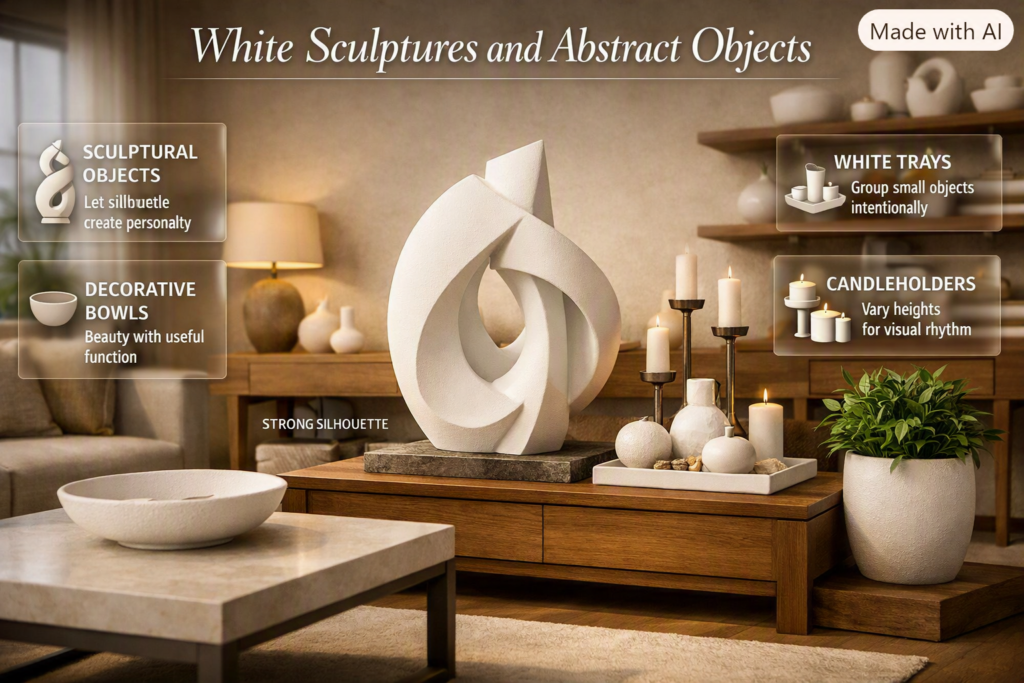
If you want your decor to feel more artistic, consider sculptural objects.
These may include:
- Abstract human forms
- Geometric sculptures
- Arched forms
- Organic shapes
- Twisted structures
- Minimalist figures
- Architectural models
Sculptures are particularly useful when the room already has enough functional accessories.
Instead of adding another tray or bowl, one sculptural piece can create personality without making the surface look busy.
The Rule of Silhouette
Before buying a sculpture, look at its outline.
Ask:
Would this object still look interesting if its color disappeared?
If the answer is yes, the shape is probably strong enough to justify its place.
White Decorative Bowls
Decorative bowls offer a useful combination of beauty and function.
They can hold:
- Keys
- Small objects
- Potpourri
- Decorative stones
- Seasonal accessories
- Nothing at all
A low bowl is particularly effective on coffee tables because it provides visual interest without blocking sightlines.
For everyday surfaces, functional decorative objects often perform better than purely ornamental pieces.
White Trays
A tray is one of the easiest ways to organize several small objects.
Instead of placing:
- A candle
- Small vase
- Remote control
- Decorative stone
- Small sculpture
randomly across a table, place selected pieces on one tray.
The tray visually groups them into a single composition.
This makes the arrangement look more intentional.
White Candleholders
White candleholders work especially well in:
- Dining rooms
- Bedrooms
- Console tables
- Mantels
- Bathroom displays
Try varying their heights instead of buying several identical pieces.
For example:
Tall candleholder + medium candleholder + low decorative object
creates a more natural visual rhythm than three identical objects lined up in a row.
White Planters
Plants introduce natural color, so a white planter can create a clean frame around greenery.
White ceramic planters pair especially well with:
- Olive trees
- Snake plants
- Fiddle-leaf figs
- Pothos
- Herbs
- Small palms
- Branch arrangements
The contrast between green foliage and white ceramic is simple but effective.
The planter should also be proportionate to the plant. Designers commonly emphasize scale, height variation, and grouping when styling plants and decorative containers.
White Decorative Boxes and Objects With Function
Not everything on a shelf needs to be purely ornamental.
A white decorative box can hide:
- Remotes
- Charging cables
- Small stationery
- Everyday accessories
This is particularly useful in homes where you want the room to look tidy without constantly putting everything away.
For more practical ideas, Smart storage and organization ideas can help connect decorative styling with everyday organization.
How Do You Style White Decorative Objects Without Making a Room Look Flat?
The biggest mistake people make with white decor is assuming that matching color automatically creates a good arrangement.
It doesn’t.
If every object is the same shade, same material, same height, and same shape, the display can become visually lifeless.
The solution is variation within a controlled palette.
Mix Different Shapes
Use curved objects beside angular objects.
For example:
- Rounded vase
- Rectangular book
- Organic sculpture
The contrast makes each object easier to notice.
A collection of only round objects can look repetitive. A collection containing completely unrelated shapes can look chaotic.
The goal is controlled contrast.
Mix Textures
Texture becomes extremely important when using white-on-white decor.
Consider combining:
- Smooth ceramic
- Rough stone
- Ribbed pottery
- Matte plaster
- Glossy glass
- Woven fabric
- Natural wood
Even though the colors are similar, the surfaces behave differently when light hits them.
That creates depth.
Current design thinking increasingly emphasizes texture in neutral interiors because quiet palettes need material variation to prevent a space from feeling visually flat.
A Simple Texture Formula
For a small arrangement, try:
1 smooth object + 1 textured object + 1 natural-material object
For example:
Glossy white vase + ribbed ceramic bowl + wooden decorative piece
The colors remain restrained, but the materials create contrast.
Vary Height
Height is one of the easiest ways to improve a decorative arrangement.
If everything sits at the same level, the eye reads the display as a line.
Instead, create a visual hierarchy:
High → Medium → Low
For example:
- Tall white vase
- Medium sculpture
- Low decorative bowl
This creates movement.
It also helps prevent a shelf or console from looking like a showroom display.
Use the Rule of Three Carefully
Groups of three often work well because they create asymmetry while remaining visually organized.
A simple arrangement might contain:
- Tall vase
- Medium sculpture
- Small bowl
But the rule should not become a rigid formula.
Sometimes one large object is stronger than three small objects.
Sometimes five pieces work better on a large built-in shelf.
The principle is not “always use three.”
The principle is group related objects into a composition rather than scattering individual items everywhere.
Leave Negative Space
Negative space is the empty area around objects.
It is not wasted space.
It allows the objects you selected to remain visible.
If every shelf is completely full, no single piece gets enough visual importance.
A professional-looking arrangement usually contains both:
Objects + breathing room
This is especially important in minimalist interiors.
Add Contrast
White decorative objects do not need to sit against white backgrounds.
In fact, contrast often makes them stronger.
Try placing white accessories against:
- Dark wood
- Black metal
- Charcoal walls
- Green foliage
- Warm beige
- Terracotta
- Natural stone
- Deep blue
A white sculpture against a walnut console can be much more visually powerful than the same sculpture against a white shelf.
How Do White Decorative Objects Work in Different Rooms?
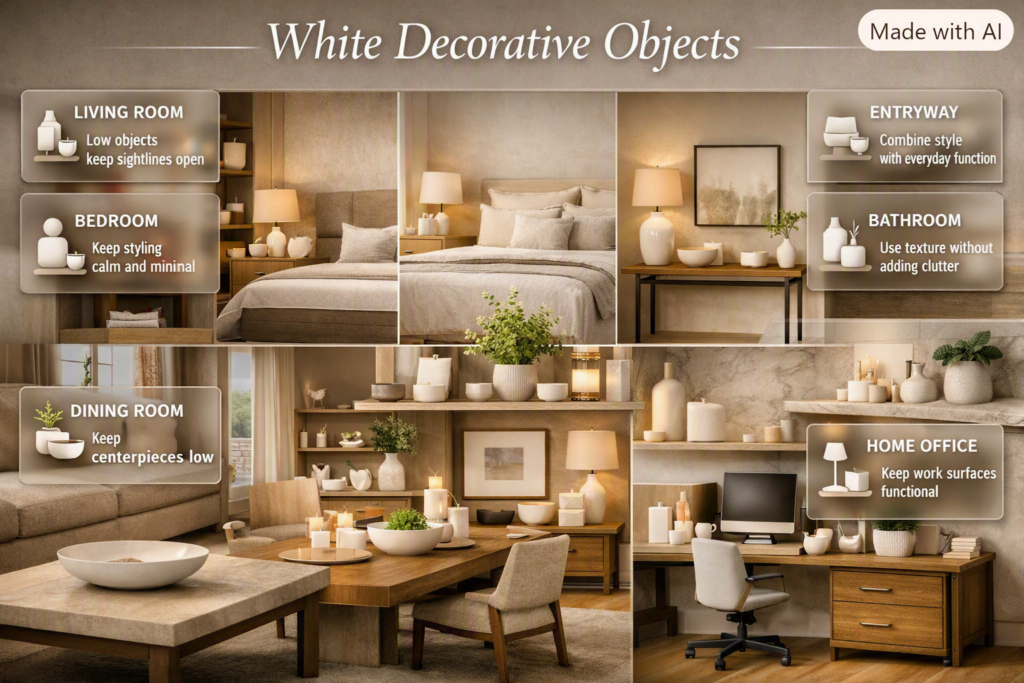
Different rooms have different functional requirements, so decorative styling should change accordingly.
The same accessory arrangement should not simply be copied throughout the house.
Living Room
The living room usually offers several styling opportunities:
- Coffee table
- Console
- Fireplace mantel
- Media unit
- Open shelving
- Side tables
- Built-in cabinetry
Coffee Table Styling
Coffee tables benefit from low or medium-height objects.
Try:
- White decorative tray
- Low bowl
- Small ceramic vase
- Coffee-table books
- One sculptural accent
Avoid extremely tall accessories that interfere with conversation or block the television.
Console Styling
Console tables can support taller pieces.
A strong arrangement might include:
Large white vase + small sculpture + framed artwork
The artwork can act as the background while the objects create depth in front of it.
Bedroom
Bedrooms need calmer styling than living rooms.
You want accessories that reinforce relaxation rather than create visual noise.
Good choices include:
- Small white ceramic vases
- Sculptural bedside objects
- White candleholders
- Decorative bowls
- Minimal trays
- Textured pottery
Avoid covering the nightstand with multiple objects.
One functional item and one decorative accent can often be enough.
For more bedroom-specific planning, explore Bedroom Ideas and consider how accessories support the bed, lighting, textiles, and wall treatment rather than competing with them.
Dining Room
The dining table is a high-use surface, so decorative objects should not interfere with meals.
A low white bowl or sculptural centerpiece usually works better than several tall objects.
For formal dining:
White ceramic centerpiece + candles + natural greenery
For casual dining:
Low white bowl + seasonal branches
Keep sightlines open across the table.
A centerpiece that blocks people’s faces makes the dining experience less comfortable, no matter how beautiful it looks.
Entryway
The entryway is where guests form their first impression.
A white decorative object can soften a console and make the area feel intentional.
Try:
- White ceramic vase
- Small bowl for keys
- Table lamp
- Framed artwork
- One sculptural piece
Here, function matters.
The bowl can be decorative while also giving keys a defined home.
Bathroom
Bathrooms are often overlooked when decorating with accessories.
White decorative objects work naturally here because they complement:
- White tile
- Marble
- Stone
- Chrome
- Brushed metal
- Neutral walls
- Green plants
A textured ceramic vessel beside a basin can add warmth to an otherwise hard, smooth environment.
Use accessories sparingly because bathrooms need to remain easy to clean.
For additional ideas, see Bathroom Inspiration for ways to balance decorative details with practical bathroom design.
Home Office
A home office should feel organized rather than overly decorated.
White objects can help create a clean visual environment.
Useful choices include:
- White bookends
- Small sculpture
- Ceramic pen holder
- White tray
- Small planter
- Decorative box
The important thing is to avoid turning the desk into a display shelf.
Keep work surfaces functional.
Children’s Spaces and Hospitality Areas
White decorative objects can also be used in children’s interiors, but the selection must change according to age, supervision, durability, and safety.
Avoid fragile objects within easy reach of very young children.
In hospitality environments, decorative elements should also be durable, easy to clean, and appropriate to the age group.
For designers working on child-focused hospitality spaces, Children’s Hotel Furniture offers a useful connection between furniture planning, child-friendly design, and practical considerations.
The principle is simple:
Decoration should never compromise safety or usability.
How Do White Decorative Objects Work With Different Interior Styles?
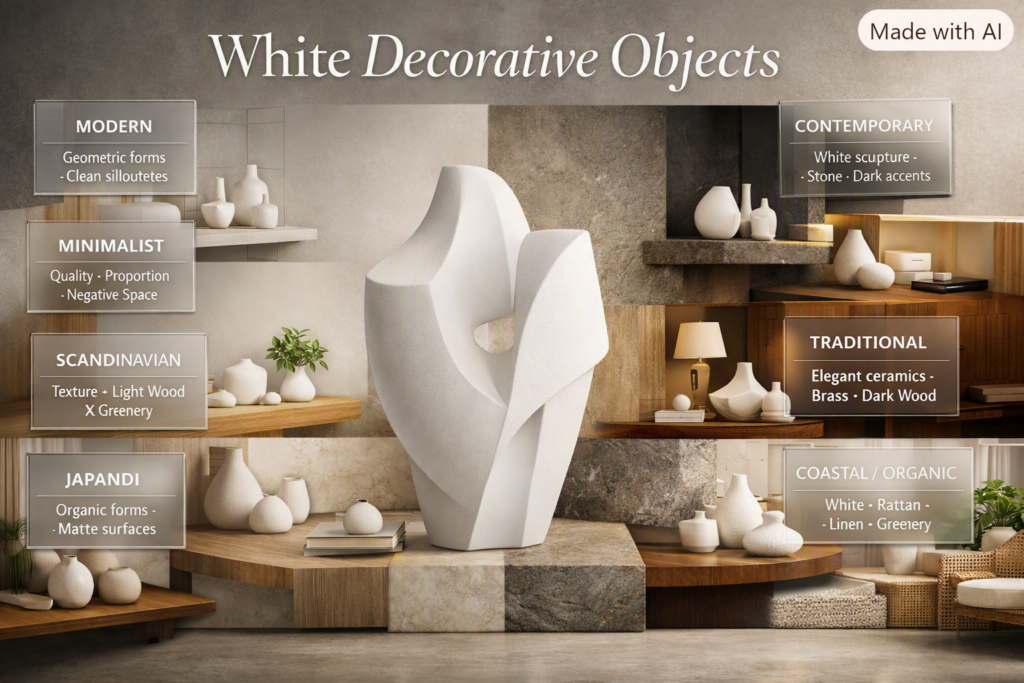
White accessories are unusually adaptable because they can change personality depending on their shape, finish, and surrounding materials.
Modern Interior Design
Modern rooms benefit from:
- Geometric objects
- Smooth ceramics
- Minimal sculptures
- Glossy finishes
- Clean silhouettes
Avoid excessive ornamentation.
Choose fewer pieces with stronger shapes.
Minimalist Interior Design
Minimalism requires discipline.
One large white sculpture may look more sophisticated than ten small accessories.
Focus on:
- Quality
- Proportion
- Negative space
- Simple forms
- Controlled repetition
The goal is not an empty room.
The goal is intentional simplicity.
Scandinavian Interiors
Scandinavian rooms often combine white with:
- Light wood
- Soft gray
- Linen
- Natural fibers
- Greenery
Textured white ceramics work particularly well because they introduce depth without disrupting the calm palette.
Japandi Interiors
Japandi combines Japanese restraint with Scandinavian warmth.
Choose objects with:
- Organic forms
- Matte surfaces
- Handmade character
- Natural materials
- Imperfect shapes
Avoid overly shiny or decorative pieces unless they serve a clear purpose.
Contemporary Interiors
Contemporary interiors give you more freedom.
You can combine:
- White sculpture
- Black accents
- Stone
- Glass
- Metal
- Rich wood
A large sculptural white object can become a focal point against a darker architectural backdrop.
Traditional Interiors
White decorative objects can soften traditional rooms when paired with:
- Brass
- Dark wood
- Linen
- Patterned upholstery
- Classic lamps
- Decorative molding
Choose elegant ceramic forms rather than extremely geometric pieces.
Coastal and Organic Interiors
White is a natural fit for coastal and organic interiors.
Pair it with:
- Rattan
- Cane
- Light oak
- Linen
- Jute
- Natural stone
- Green plants
The result feels relaxed rather than overly formal.
What Colors and Materials Pair Best With White Decorative Objects?
White does not exist in isolation. Its effect depends heavily on what surrounds it.
White and Beige
This combination creates a soft, warm neutral scheme.
Use:
- Cream walls
- Beige upholstery
- White ceramics
- Natural wood
- Linen
If the room feels too similar in tone, add texture rather than immediately introducing a bright color.
White and Black
Black provides strong contrast.
A white sculpture against a black console creates a dramatic focal point.
Use black carefully if you want the room to remain soft.
Small black accents can be enough.
White and Green
Plants are one of the easiest ways to make white decor feel alive.
The combination works because the organic color of foliage breaks the monochromatic palette naturally.
White and Wood
White ceramic and wood are a classic combination.
The white provides crispness while wood introduces warmth.
This pairing is particularly effective in Scandinavian, Japandi, modern organic, and contemporary interiors.
White and Brass
Brass adds warmth and a subtle luxury feel.
A white ceramic vase beside a brass lamp can look more sophisticated than using multiple metallic objects.
The trick is restraint.
White and Stone
Stone adds natural variation.
Try white decorative objects with:
- Marble
- Travertine
- Limestone
- Slate
- Concrete-inspired surfaces
This combination works particularly well in modern and organic interiors.
White With Different Paint Colors
White objects can look completely different depending on wall color.
Warm white objects work beautifully with beige, cream, taupe, and earthy colors.
Cool white objects can work better with gray, blue-gray, charcoal, and cooler modern palettes.
For a deeper understanding of how wall color affects accessories and overall room character, explore Paint Color before choosing the final decorative palette.
How Do You Choose the Right Size, Finish, and Quantity?
A beautiful object can still look wrong if its scale is incorrect.
Consider the Furniture First
A tiny vase on a huge console can disappear.
A massive sculpture on a narrow side table can overwhelm it.
Before buying decor, look at:
- Surface width
- Surface depth
- Furniture height
- Ceiling height
- Nearby artwork
- Existing accessories
- Sightlines
A Practical Scale Test
Take a photo of the surface.
Use your phone to estimate where the object will sit.
Ask:
Does the object have enough visual presence to be noticed without dominating the furniture?
This simple test prevents many poor purchases.
Matte or Glossy?
Matte White
Matte finishes feel:
- Soft
- Contemporary
- Organic
- Understated
- Calm
They work especially well with wood, linen, stone, and natural materials.
Glossy White
Glossy surfaces feel:
- Crisp
- Polished
- Reflective
- Modern
They can work well in contemporary interiors but may appear colder when used excessively.
Textured White
Textured finishes are often the safest choice when you want white decor to have personality.
Ribbing, grooves, handmade marks, and rough ceramic surfaces create shadows and highlights.
How Many White Decorative Objects Should You Use?
There is no universal number.
The correct amount depends on the room and surface.
A small nightstand may need only one or two pieces.
A large built-in shelving system can support many more.
The better question is:
Does every object have enough space to be visually understood?
If removing one piece improves the composition, remove it.
This is one of the easiest ways to improve styling.
⚠ Common Mistake: Buying decorative objects one at a time without considering the collection. Individual pieces may look attractive in a store but feel disconnected when placed together.
Step-by-Step: How to Create a Professional White Decor Arrangement
Step 1: Choose the Surface
Start with the actual location.
Is it:
- Coffee table?
- Console?
- Shelf?
- Mantel?
- Nightstand?
- Dining table?
The surface determines what type of object makes sense.
Step 2: Select One Anchor Piece
Choose the largest or most visually important object first.
This could be:
- Large white vase
- Sculpture
- Bowl
- Lamp
- Artwork
Everything else should support this anchor.
Step 3: Add a Different Shape
If your main object is rounded, add something angular.
If the main object is tall, add something low.
Contrast creates visual rhythm.
Step 4: Add Texture
Introduce one object with a noticeably different surface.
For example:
Smooth ceramic + ribbed ceramic + natural wood
Now the arrangement has material variation.
Step 5: Create Height Variation
Place the tallest object toward one side rather than putting everything at the same height.
Use books, trays, or boxes as subtle risers when appropriate.
Step 6: Remove One Item
This is a professional styling trick worth remembering.
Once everything is arranged, remove one object.
Step back.
If the arrangement feels cleaner, leave it out.
If something important disappeared, put it back.
Step 7: Check It From Different Angles
Don’t judge decor only from directly in front.
Look at it:
- From the doorway
- From the sofa
- From the side
- From standing height
- From sitting height
This matters because objects that look balanced from one angle may look crowded from another.
Common Mistakes When Decorating With White Objects
Using Too Many Matching Pieces
A shelf full of identical white vases can look repetitive.
Why It Happens
Matching sets feel safe when shopping.
Why It Doesn’t Work
There is no variation in shape, scale, or texture.
Better Approach
Keep the color relationship but vary:
- Height
- Form
- Material
- Finish
Making Everything the Same Shade of White
Pure white, ivory, cream, and warm white can create subtle depth when combined intentionally.
But random whites can also clash.
Better Approach
Choose a dominant white temperature and repeat it consistently.
Ignoring the Background
A white object against a white wall may disappear.
Better Approach
Use contrast through:
- Dark wood
- Shadow
- Texture
- Artwork
- Greenery
- Stone
Filling Every Shelf
Full shelves often feel less expensive, not more.
Better Approach
Use negative space.
Allow some shelves to breathe.
Alternate dense and open areas.
Choosing Objects That Are Too Small
Tiny accessories can become visual noise when grouped excessively.
Better Approach
Use fewer, larger pieces when the furniture is substantial.
Blocking Function
A beautiful centerpiece that prevents people from seeing across the dining table isn’t successful design.
Decor should support the room’s purpose.
Copying a Showroom Exactly
Showrooms are designed for display, not necessarily daily living.
Your home needs to accommodate:
- Children
- Pets
- Cleaning
- Guests
- Work
- Storage
- Movement
The best styling is attractive and usable.
How Can You Use White Decorative Objects on a Budget?
You don’t need a large decorating budget to create an elevated look.
Focus on composition rather than quantity.
A small collection of well-selected pieces can outperform a large collection of inexpensive accessories.
Try:
- One textured vase
- One sculptural object
- One low bowl
- A stack of existing books
- A small plant
- A natural wood element
You can also transform existing objects with paint where appropriate.
For simple, affordable projects, explore Diy home projects for ideas that can complement a decorative refresh.
Budget styling becomes especially effective when you focus on what you already own.
Move objects between rooms.
Change the arrangement.
Remove unnecessary pieces.
Introduce greenery.
Change lighting.
Sometimes the room needs editing rather than shopping.
For more practical low-cost decorating strategies, Easy Decorating Tips for Every Budget can help you approach the room as a complete composition instead of buying accessories individually.
How Do White Decorative Objects Support a Larger Interior Design Plan?
Accessories should be considered part of the room’s overall design rather than an isolated final purchase.
Think about the relationship between:
Furniture → Lighting → Walls → Flooring → Textiles → Decorative objects
For example, if the room has warm oak furniture, cream upholstery, and natural stone, bright glossy white accessories may feel disconnected.
A softer textured ceramic might work better.
Likewise, a sleek modern room with black metal and gray surfaces may benefit from crisp white sculptural pieces.
This is where broader Interior Design principles become useful. Decorative objects are most successful when their scale, finish, and visual weight support the architecture and furniture already present.
For larger renovation or room-refresh decisions, Home Improvement can also help connect decorative styling with practical changes such as lighting, surfaces, storage, and furniture placement.
Practical Maintenance Tips for White Decor
White objects look beautiful, but they also reveal dust and marks more easily than darker accessories.
Choose Easy-Care Materials
For high-use areas, consider:
- Glazed ceramic
- Porcelain
- Washable surfaces
- Sealed stone
Highly porous materials may require more care.
Dust Regularly
A soft microfiber cloth is usually enough for routine dusting.
Avoid aggressive cleaning products unless the manufacturer’s instructions allow them.
Protect Fragile Pieces
Use felt pads underneath ceramic or stone objects.
This prevents scratching on:
- Wood
- Glass
- Painted furniture
- Marble
- Lacquered surfaces
Consider the Room’s Conditions
Bathrooms have moisture.
Kitchens have grease.
Entryways have dirt.
Children’s areas require extra safety considerations.
The right object is therefore not simply the prettiest one. It is the one that survives the environment where you intend to use it.
For practical planning beyond accessories, Practical home improvement guides can support a more functional approach to maintaining and improving the home.
Expert Advice: How Designers Make White Decor Look Expensive
The difference between an ordinary decorative arrangement and an expensive-looking one usually isn’t the price of individual objects.
It is editing.
1. Use Fewer Better Pieces
Don’t fill every empty corner.
Choose objects that have strong form or texture.
2. Repeat Materials
If you have white ceramic in the living room, repeat ceramic elsewhere without making everything identical.
Repetition creates continuity.
3. Mix Old and New
A modern white sculpture can work beautifully beside an older wooden box or vintage book.
This makes the room feel collected rather than purchased all at once.
4. Create Visual Hierarchy
Every arrangement should have:
- A dominant piece
- Supporting pieces
- Negative space
Without hierarchy, everything competes.
5. Use Natural Materials
White decor becomes warmer when paired with:
- Wood
- Linen
- Stone
- Woven fibers
- Greenery
6. Don’t Chase Perfect Symmetry
Perfect symmetry can feel formal and predictable.
Slight asymmetry often feels more natural.
7. Think About Light
Morning sunlight, evening lamps, and artificial lighting can dramatically change white objects.
A textured ceramic piece may look almost plain in one light and highly sculptural in another.
Are White Decorative Objects Still in Style in 2026?
White decorative objects are still highly relevant in 2026, but the way they are being used has changed. Instead of creating a room filled with stark white accessories, designers are increasingly using creamy whites, textured ceramics, natural stone, handmade-looking pieces, and sculptural forms to create a warmer and more personal interior. The current direction is less about perfect matching and more about creating a collected, comfortable space with character.
Best ways to use them:
Choose textured or sculptural white pieces instead of generic ornaments.
Mix white with wood, stone, linen, or greenery.
Combine different shapes while keeping the palette controlled.
Use one or two statement pieces instead of filling every surface.
How Do You Decorate With White Objects Without Making a Room Look Boring?
The key is to create contrast through texture, shape, scale, and surrounding materials rather than relying on color. A collection of completely smooth white objects can look flat, especially against white walls or light furniture. Instead, combine a ribbed ceramic vase with a smooth sculpture, a natural wood accessory, and a low stone bowl. The objects remain visually connected, but their different surfaces give the arrangement depth and personality.
A professional styling formula:
Shape: Mix curved and angular forms.
Texture: Combine smooth, ribbed, rough, or handmade surfaces.
Height: Use tall, medium, and low pieces.
Material: Introduce wood, stone, glass, or metal.
Negative space: Leave room around important objects.
This approach makes white decor feel intentional rather than repetitive. Professional accessory styling also emphasizes grouping, proportion, and rearranging existing pieces before automatically buying more.
What Color Goes Best With White Decorative Objects?
White works with almost any interior palette, but the strongest combinations depend on the atmosphere you want to create. Natural wood and beige produce a warm, relaxed look, while black and charcoal create stronger contrast. Greenery brings an organic quality, and brass or aged metal can make white ceramics feel more refined. For a softer interior, pair warm white objects with cream, taupe, sand, and light oak.
The important detail is to match the temperature of the white with the rest of the room.
Good combinations include:
White + walnut = sophisticated contrast
White + beige = warm and calming
White + green = fresh and organic
White + black = dramatic and contemporary
White + brass = elegant and refined
White + stone = modern and natural
Don’t assume every white accessory has to match perfectly. Slight variations in white can actually make a display feel more layered when they are connected through texture and material.
How Many White Decorative Objects Should You Put on a Coffee Table?
There is no fixed number because the right amount depends on the size of the coffee table, the scale of the furniture, and how the room is used. A practical starting point is three related elements: one dominant object, one medium piece, and one low accessory. A decorative tray can be used to visually group them and keep smaller items from appearing scattered.
For example, a large white ceramic vase can act as the anchor, a small textured sculpture can provide visual interest, and a low decorative bowl can complete the arrangement.
For better coffee-table styling:
Keep objects low enough to maintain conversation.
Avoid covering the entire tabletop.
Combine different heights.
Use a tray when several small pieces need visual organization.
Remove an item if the arrangement starts looking crowded.
The goal isn’t to achieve a specific number. The goal is to create a composition where each object has enough space to be appreciated.
How Do You Make White Decorative Objects Look More Expensive?
Expensive-looking decor is usually more about proportion, material, texture, and restraint than the actual price of the object. A simple white ceramic sculpture with a strong silhouette can look far more sophisticated than a shelf packed with inexpensive decorative pieces. Current design advice is also moving toward personalized, collected interiors rather than generic, perfectly coordinated decor.
Start by choosing fewer pieces with stronger visual character. Look for substantial proportions, interesting silhouettes, matte or artisanal finishes, and subtle surface texture. Then place those objects against quality-looking materials such as natural wood, stone, linen, or dark metal.
To create a more refined look:
Choose one statement object per major surface.
Mix old and new pieces where appropriate.
Avoid excessive matching.
Use negative space generously.
Repeat a material or finish subtly throughout the room.
Prefer distinctive shapes over mass-produced-looking ornaments.
Use warm lighting to bring out ceramic and stone textures.
The final result should feel curated rather than decorated. That small distinction is often what separates a polished interior from a room that simply contains a lot of accessories.
Conclusion
White decorative objects remain one of the most versatile ways to refine an interior, but the best results come from treating them as design elements rather than simply white accessories. A sculptural vase, textured ceramic bowl, architectural candleholder, or carefully chosen decorative object can introduce shape, balance, and visual rhythm without competing with the room’s main features.
The key is to avoid creating a perfectly matching collection of white pieces. Instead, combine different forms, heights, textures, finishes, and materials, then give each object enough surrounding space to be appreciated. This approach is particularly relevant in 2026, as interior design continues moving toward warmer, layered, personalized spaces rather than cold, overly perfect interiors.
White also works best when it has something to contrast against. Pair it with natural wood, stone, warm neutrals, greenery, darker furniture, aged metals, or carefully selected accent colors to create depth. A matte ceramic piece beside polished stone will feel very different from the same object placed among several glossy white accessories.
Ultimately, choosing white decorative objects is less about following a trend and more about creating a visual language that feels intentional. Select fewer but better pieces, consider the proportions of your room, and let texture and form do the work. When styled thoughtfully, white décor can make a space feel sophisticated, calm, architectural, and collected—without making it feel sterile or unfinished.

Leave a Reply