
Introduction
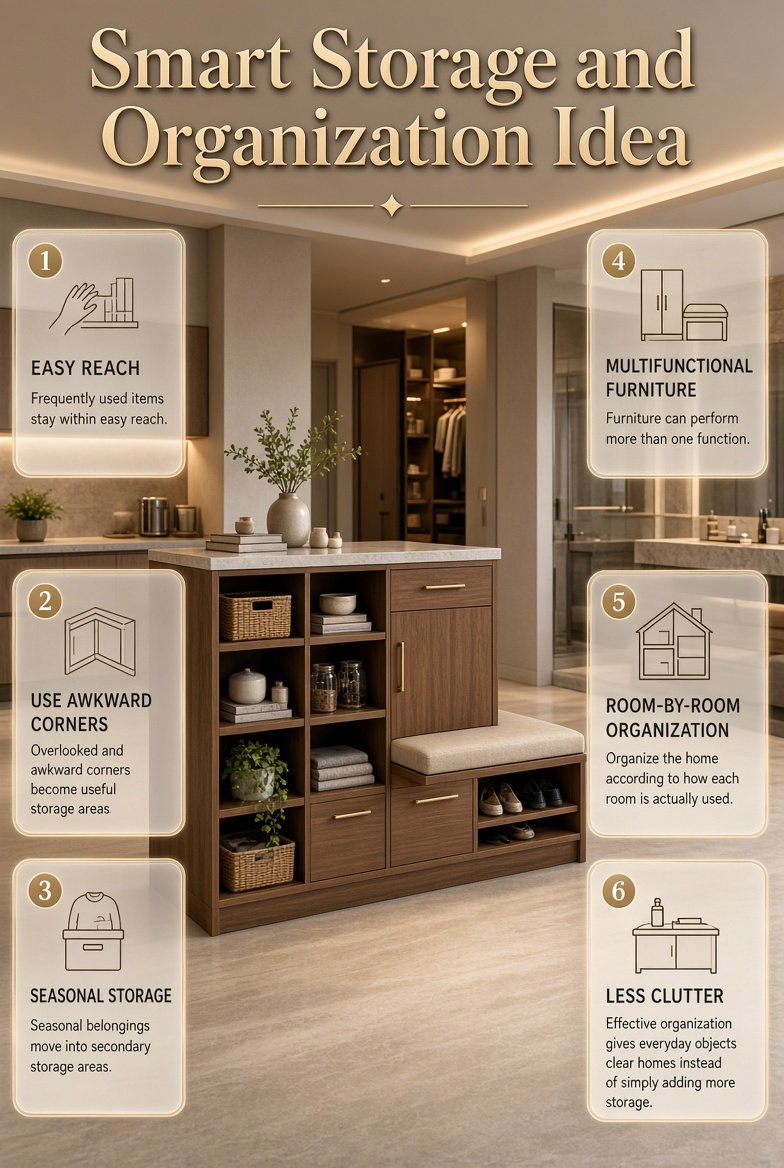
Smart Storage and Organization Idea | A home doesn’t become difficult to manage simply because it is small. Even a large house can feel cramped when belongings don’t have clear homes, cabinets are poorly arranged, and everyday objects constantly end up on tables, counters, and floors.
Maybe your kitchen counter is always covered with appliances. Perhaps your bedroom chair has quietly become a second wardrobe. Your bathroom vanity may be crowded with products, while the entryway collects shoes, bags, keys, and jackets every day.
These problems are rarely solved by simply buying more storage.
The most effective smart storage and organization ideas begin with a different question: How does your household actually use the space?
Once you understand that, storage becomes much easier to plan. Frequently used items can stay within easy reach, seasonal belongings can move into secondary areas, awkward corners can become useful, and furniture can perform more than one function.
This guide explains how to organize your home room by room, maximize small spaces, use overlooked storage opportunities, choose between open and closed storage, avoid expensive mistakes, and build an organization system that remains practical long after the initial cleanup.
For broader inspiration on creating a home that combines appearance with everyday functionality, visit designmode24 interior design.
What Are Smart Storage and Organization Ideas?
Smart storage and organization ideas are methods of arranging belongings according to how often they are used, where they are needed, how much space they require, and how easily they can be returned to their proper place. The goal isn’t simply to fit more things into a room; it’s to make the available space easier and more efficient to use.
Traditional storage often focuses on capacity.
Smart storage focuses on capacity plus convenience.
A cabinet may hold fifty items, but if you have to move ten objects to reach the one you need every morning, that isn’t efficient storage.
Similarly, a large wardrobe isn’t necessarily better than a smaller one with properly divided sections.
Good organization should answer four practical questions:
- What belongs here?
- How often is it used?
- Where is it used?
- How easy is it to put away?
When those questions guide your decisions, organization becomes much more sustainable.
Why Does Smart Storage Matter?
Storage affects how your home looks, but it also affects how your home functions.
A well-planned system can:
- Reduce visible clutter
- Make cleaning easier
- Save time
- Improve access to everyday belongings
- Make small rooms feel more spacious
- Reduce duplicate purchases
- Protect valuable possessions
- Improve household routines
- Make shared spaces easier to maintain
The best systems don’t require constant perfection.
They make the easiest action the correct action.
If a family naturally removes shoes near the entrance, shoe storage should be there. If everyone charges their phones in the living room, a small charging station may be more useful there than inside a remote office drawer.
That’s the foundation of smart organization.
How Do You Start Organizing a Cluttered Home?
Start by identifying where clutter repeatedly appears instead of randomly reorganizing everything you own. Declutter unnecessary belongings first, group the remaining items into logical categories, and then create storage zones based on frequency of use and location.
Trying to organize the entire house in one weekend often creates more frustration than progress.
A better approach is:
Observe → Declutter → Categorize → Zone → Store → Maintain
Step 1: Identify Clutter Hotspots
Walk through your home and notice where things repeatedly accumulate.
Common hotspots include:
- Kitchen counters
- Dining tables
- Entryway floors
- Bathroom vanities
- Bedroom chairs
- Coffee tables
- Office desks
- Laundry areas
- Wardrobe floors
Don’t immediately clean these areas.
First ask why the clutter appears there.
If keys always land on the kitchen counter, perhaps the entrance doesn’t have a convenient key tray.
If clothes always land on a chair, perhaps the wardrobe is too crowded.
If paperwork collects beside the front door, you may need a small paper-management station.
Clutter is often useful information.
Step 2: Declutter Before Organizing
Separate possessions into five basic groups:
Keep → Relocate → Donate → Recycle → Discard
Be honest about what deserves storage space.
A home becomes easier to organize when fewer unnecessary objects compete for limited storage.
Step 3: Group Similar Belongings
Create sensible categories rather than organizing every individual object.
For example:
Bedroom: daily clothing, seasonal clothing, accessories, bedding
Kitchen: cookware, food storage, baking, utensils, cleaning supplies
Bathroom: daily toiletries, backup products, towels, cleaning supplies
Office: stationery, documents, electronics, cables
The categories should be broad enough to maintain but specific enough to find things quickly.
How Do You Decide Where Things Should Go?
The best storage location depends primarily on frequency of use and point of use. Everyday items should stay within easy reach, weekly items can occupy standard cabinets, and seasonal or rarely used possessions can move into higher, deeper, or secondary storage.
A practical hierarchy looks like this:
| Frequency | Ideal storage |
|---|---|
| Several times daily | Counter, top drawer, eye level |
| Daily | Easy-access drawer or cabinet |
| Weekly | Standard shelf or cabinet |
| Monthly | Higher shelf |
| Seasonal | Under-bed or high storage |
| Rarely | Deep storage or labeled containers |
This simple hierarchy prevents an extremely common mistake: using premium storage locations for items you rarely touch.
Your easiest-to-reach drawers and shelves are valuable real estate.
Use them accordingly.
💡 Pro Tip: If you use something every day, don’t store it based on how attractive the storage location looks. Store it where reaching for it feels natural.
What Are the Best Smart Storage Ideas for Small Spaces?
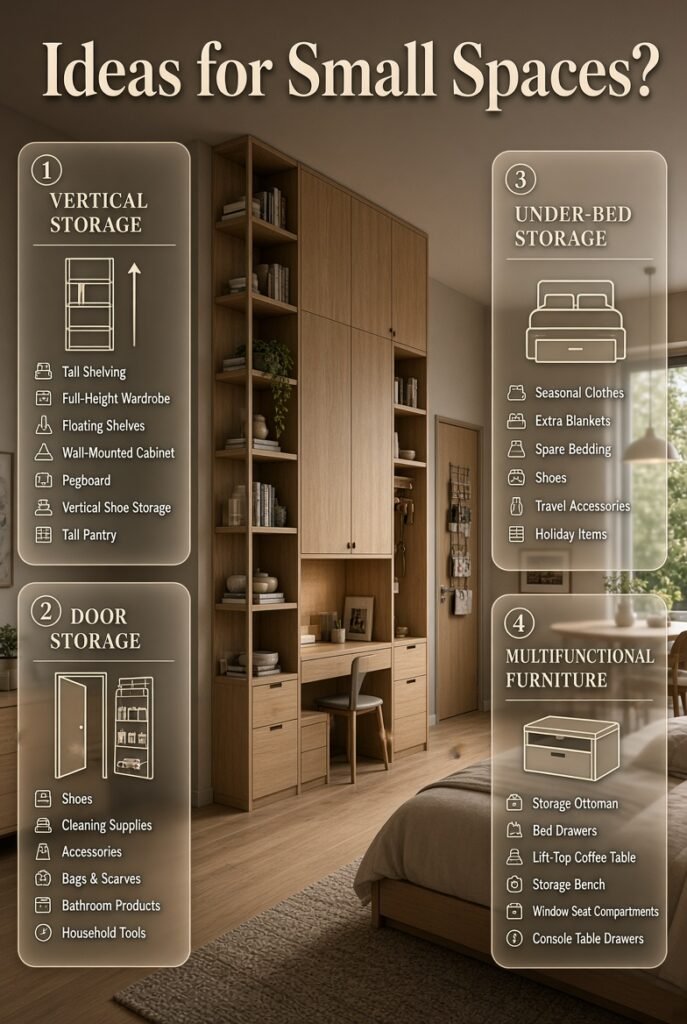
The best small-space storage solutions use vertical walls, hidden areas, corners, doors, under-furniture spaces, and multifunctional furniture. Instead of adding bulky cabinets, look for unused areas that can provide storage without reducing circulation.
Use Vertical Storage
When floor space is limited, walls become extremely valuable.
Consider:
- Tall shelving
- Full-height wardrobes
- Floating shelves
- Wall-mounted cabinets
- Pegboards
- Vertical shoe storage
- Tall pantry units
A tall cabinet can often provide substantially more capacity than a wide low unit while occupying a similar footprint.
Vertical storage is particularly useful in apartments and compact bedrooms.
Use the Back of Doors
Doors are frequently ignored even though they offer convenient vertical surfaces.
Depending on the room, door-mounted storage can hold:
- Shoes
- Cleaning supplies
- Accessories
- Bags
- Scarves
- Small bathroom products
- Household tools
However, don’t overload doors.
Check the door’s clearance and hardware before attaching heavy organizers.
Use Under-Bed Space
The space beneath the bed is ideal for things you don’t need every day.
Store:
- Seasonal clothes
- Extra blankets
- Spare bedding
- Shoes
- Travel accessories
- Holiday items
Choose shallow containers that can slide out easily.
Choose Multifunctional Furniture
When space is limited, furniture can provide storage without adding another dedicated cabinet.
Useful choices include:
- Storage ottomans
- Beds with drawers
- Lift-top coffee tables
- Storage benches
- Window seats with compartments
- Console tables with drawers
This approach is particularly effective in small living rooms and bedrooms.
How Can You Make a Small Bedroom More Organized?
A small bedroom becomes easier to manage when storage uses vertical space, wardrobe interiors, under-bed areas, and multifunctional furniture. Keep everyday clothing accessible and move seasonal belongings into less convenient storage so the most useful areas aren’t overcrowded.
For additional inspiration, explore Bedroom Ideas and Bedroom Layouts.
Make the Wardrobe Work Harder
You don’t always need a new wardrobe.
Improve the interior with:
- Double hanging rails
- Shelf dividers
- Pull-out baskets
- Drawer organizers
- Trouser racks
- Accessory hooks
- Door storage
Think vertically.
A wardrobe has more usable capacity when its full height is considered rather than relying on one long hanging rail.
Use Vertical Folding
Some clothing categories work well when folded vertically inside drawers.
This can make it easier to see:
- T-shirts
- Pajamas
- Workout clothing
- Underwear
- Children’s clothing
The main advantage is visibility.
When everything is visible, you’re less likely to disturb an entire stack looking for one item.
Create a Seasonal Rotation
Don’t let winter coats occupy the most accessible part of your wardrobe during summer.
Rotate seasonal clothing.
Keep current-season belongings at comfortable reach and move the rest into higher shelves, under-bed containers, or secondary storage.
Don’t Overfill the Wardrobe
An overstuffed wardrobe isn’t efficient.
Clothing needs enough space to move.
If hangers are tightly compressed and drawers can’t open properly, organization becomes difficult regardless of how many accessories you add.
📌 Quick Tip: Leave a little unused capacity in the wardrobe. That empty space isn’t wasted; it makes everyday access easier.
For more specialized storage inspiration, explore Wardrobe Designs.
What Are the Best Kitchen Storage and Organization Ideas?
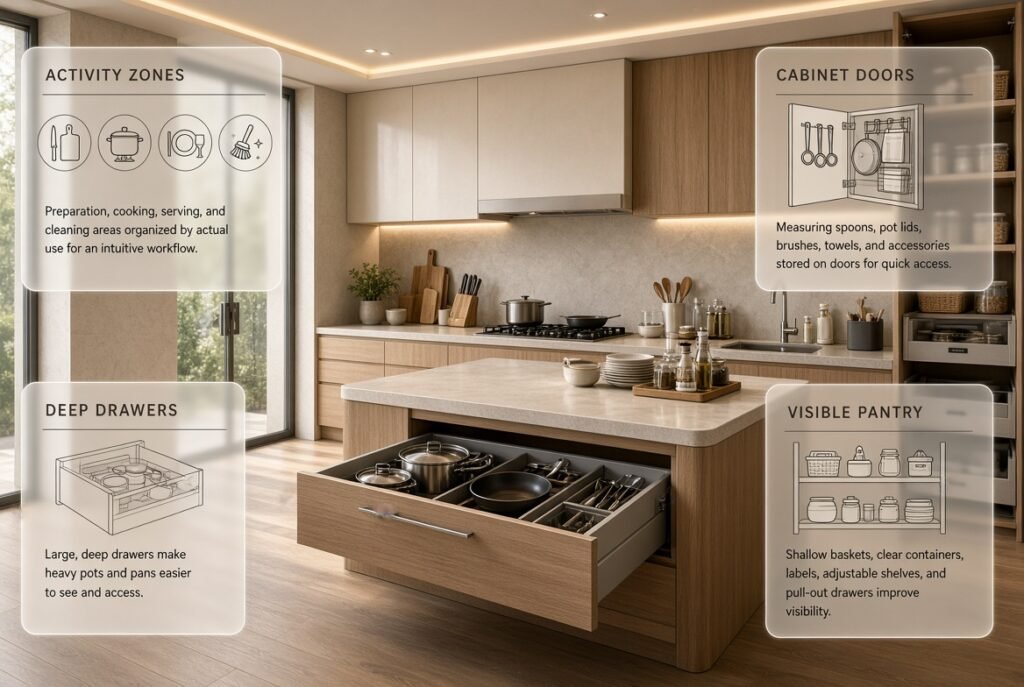
The most effective kitchen organization systems store items near the activities where they are used. Create zones for preparation, cooking, serving, food storage, and cleaning so that frequently repeated tasks require less movement.
Create Kitchen Activity Zones
A practical kitchen can be divided into several functional areas.
Preparation Zone
Store:
- Cutting boards
- Knives
- Mixing bowls
- Measuring tools
Cooking Zone
Store:
- Pots
- Pans
- Cooking utensils
- Oils
- Frequently used spices
Serving Zone
Store:
- Plates
- Bowls
- Glasses
- Serving utensils
Cleaning Zone
Store:
- Dishwashing supplies
- Brushes
- Cloths
- Waste bags
This is much more useful than simply placing everything wherever there happens to be free cabinet space.
Use Deep Drawers for Heavy Kitchen Items
Large drawers are often easier to use than deep base cabinets for cookware.
Instead of kneeling and reaching toward the back of a cabinet, you can pull a drawer open and see the entire category.
Use Cabinet Doors
Cabinet doors can provide additional storage for smaller items.
Consider:
- Measuring spoons
- Pot lids
- Cleaning brushes
- Kitchen towels
- Small accessories
Don’t add so much that the cabinet becomes difficult to close.
Make Pantry Storage Visible
Pantry organization should prioritize visibility.
Use:
- Shallow baskets
- Clear containers where useful
- Labels
- Adjustable shelves
- Pull-out drawers
The objective is to know what you already own before buying more.
⭐ Expert Tip: If you repeatedly buy duplicate pantry items because older products disappear behind newer ones, your problem isn’t inventory—it’s visibility.
How Can You Organize a Small Bathroom?
A small bathroom benefits from vertical, concealed, and compartmentalized storage. Mirrored cabinets, recessed niches, under-sink organizers, wall hooks, drawer dividers, and slim rolling carts can increase storage without consuming much floor area.
For additional bathroom ideas, explore Bathroom Inspiration.
Keep the Vanity Clear
The bathroom can feel significantly cleaner when the countertop contains fewer products.
Separate items into:
Daily products
Keep these accessible.
Occasional products
Store them in drawers or cabinets.
Backup products
Move unopened supplies into secondary storage.
This prevents your vanity from becoming a permanent display of everything you own.
Improve Under-Sink Storage
The area beneath the sink often contains awkward plumbing and deep space.
Use:
- Pull-out baskets
- Stackable bins
- Adjustable shelves
- Small drawers
- Vertical organizers
Measure around the plumbing before buying anything.
Use Wall Space
Hooks, rails, and narrow shelves can provide useful capacity without taking floor space.
They can hold:
- Towels
- Robes
- Small baskets
- Cleaning cloths
- Everyday accessories
How Can You Use Dead Space for Storage?
Dead space includes corners, narrow gaps, areas beneath stairs, spaces above doors, and unused areas beside furniture or appliances. These locations can become practical storage zones when the solution is sized specifically for the available space.
Make Use of Under-Stair Space
Under-stair areas can become:
- Drawers
- Cabinets
- Shelving
- Shoe storage
- Cleaning storage
- Home office space
Because these spaces often have unusual dimensions, custom solutions can work particularly well.
Use Narrow Gaps
A narrow space between appliances or cabinets may be perfect for a rolling storage cart.
Use it for:
- Spices
- Cleaning supplies
- Pantry items
- Bathroom supplies
- Household accessories
Always measure first.
A storage product that’s only slightly too wide can become completely useless.
Don’t Ignore Space Above Doors
A shallow shelf above a door can store occasional-use items without affecting floor area.
This works especially well for:
- Books
- Decorative storage boxes
- Towels
- Seasonal items
Only use it when the ceiling height and accessibility make sense.
What Are the Best Living Room Storage Ideas?
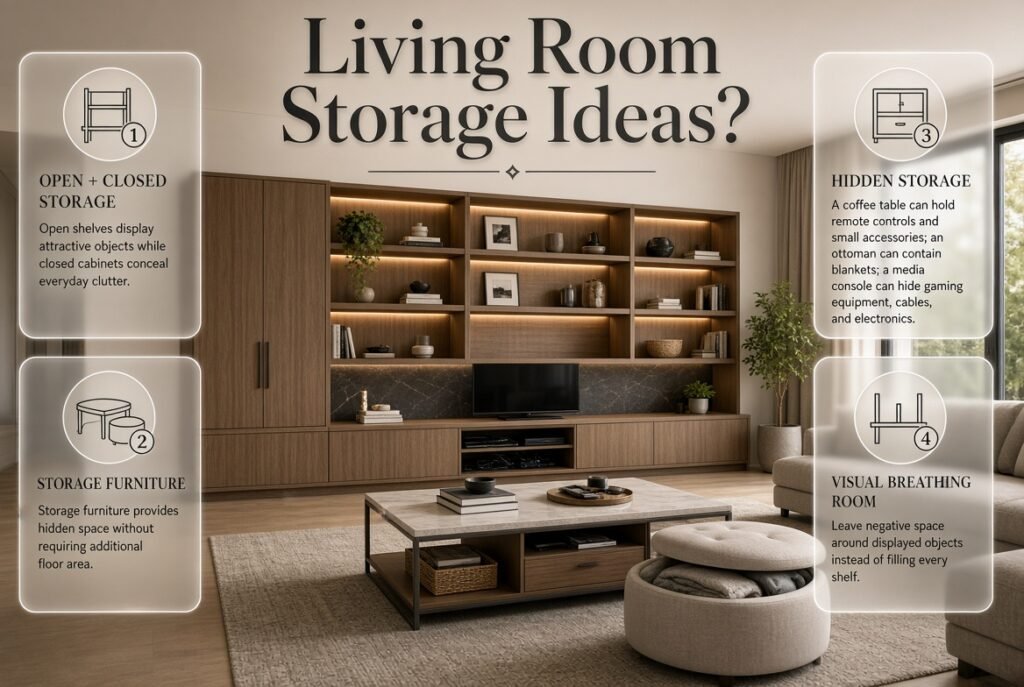
Living room storage should control everyday clutter while preserving the room’s visual balance. A combination of closed cabinets, open shelving, storage furniture, baskets, and built-in units can keep belongings accessible without making the room feel overloaded.
Combine Open and Closed Storage
Open shelves are useful for:
- Books
- Plants
- Artwork
- Decorative objects
- Attractive baskets
Closed storage is better for:
- Cables
- Remote controls
- Toys
- Documents
- Electronics
- Miscellaneous household items
Using both creates balance.
Use Storage Furniture
A coffee table with hidden storage can hold remote controls and small accessories.
A storage ottoman can contain blankets.
A media console can hide gaming equipment, cables, and electronics.
The room becomes easier to maintain without requiring more floor space.
Create Visual Breathing Room
Don’t fill every shelf.
A shelf packed from edge to edge can make the room feel crowded.
Leave some negative space around objects.
Organization is partly physical and partly visual.
How Should You Organize a Home Office?
A home office should keep daily work tools close to the desk while moving backup supplies, archived documents, and rarely used equipment into secondary storage. The goal is to create an active workspace that supports concentration rather than becoming another clutter hotspot.
Useful office storage includes:
- Drawer dividers
- Vertical file holders
- Cable organizers
- Wall shelves
- Closed cabinets
- Document boxes
- Small accessory trays
Create an Active Work Zone
Keep only frequently used items on or immediately around the desk.
These might include:
- Laptop
- Notebook
- Pens
- Headphones
- Charger
Everything else can move into nearby storage.
Control Cable Clutter
Cables are one of the fastest ways to make an office look messy.
Group cables by function and use clips, sleeves, or cable boxes.
Avoid keeping every cable simply because it might belong to something.
If you don’t know what a cable is for and haven’t used it for years, it’s worth reviewing whether it should remain.
Separate Current and Archived Documents
Active documents should remain accessible.
Older documents can move into labeled archive boxes or cabinets.
This keeps your primary workspace manageable.
What Are the Best Entryway Storage Ideas?
The entryway should provide convenient storage for items people naturally carry when leaving and returning home. Hooks, shoe cabinets, benches, baskets, and small trays can prevent everyday belongings from spreading into other parts of the house.
A simple entryway system can look like:
Hooks → Coats and bags
Bench → Shoes
Tray → Keys
Drawer → Small personal items
Closed cabinet → Household supplies
The simpler the system, the easier it is to maintain.
Give Everyone a Defined Zone
In a family home, each person can have:
- One or two hooks
- A shoe section
- A basket
- A small drawer
This prevents the entrance from becoming one shared pile.
How Can Families Keep Their Homes Organized?
Family organization works best when storage is visible, accessible, and simple enough for everyone to understand. Children and adults should be able to return frequently used belongings without needing a complicated system.
Use Broad Categories
Instead of creating extremely specific toy categories, use simple groups:
- Building Toys
- Dolls
- Games
- Books
- Arts & Crafts
- Outdoor Toys
Broad categories make cleanup faster.
Keep Children’s Storage Accessible
Children are more likely to put things away when they can reach their storage.
Low baskets and open shelving can work better than high cabinets.
For valuable or delicate belongings, adult-accessible storage may be appropriate.
The important thing is matching storage to the person who uses it.
What Storage Solutions Work Best Without Renovation?
You can solve many storage problems without remodeling by using freestanding furniture, shelves, hooks, drawer dividers, baskets, rolling carts, over-door organizers, and multifunctional pieces.
Before investing in expensive built-ins, test the problem with a simpler solution.
Start With Existing Resources
Look around your home for:
- Empty drawers
- Unused shelves
- Baskets
- Boxes
- Jars
- Shoe boxes
- Furniture with unused compartments
Repurpose these temporarily.
If the system works, you can later invest in a more polished version.
For more practical home projects, explore DIY Home Projects.
How Do You Make Storage Match Your Interior Design?
Storage works best when it looks intentional rather than added as an afterthought. Coordinate cabinets, shelving, baskets, furniture, colors, materials, and hardware with the room so that organization becomes part of the overall design.
For example, full-height cabinetry in a similar tone to the wall can visually recede.
Natural wood shelves can introduce warmth.
Integrated cabinets can make an entire wall feel architectural.
A storage bench can combine seating with hidden organization.
This is where practical storage becomes an important part of interior design rather than something separate from it.
For more design guidance, explore Interior Design.
Open Storage vs Closed Storage: Which Is Better?
Open storage provides visibility and quick access, while closed storage hides visual clutter and creates a cleaner appearance. Neither is universally better. The right balance depends on the type of belongings, how often they’re used, and how much visual organization you prefer.
| Storage type | Best for | Main benefit | Main limitation |
|---|---|---|---|
| Open shelves | Books, decor, baskets | Easy visibility | Can look cluttered |
| Closed cabinets | Mixed belongings | Hides visual mess | Less visibility |
| Drawers | Small objects | Easy categorization | Limited height |
| Baskets | Flexible categories | Fast cleanup | Can become mixed |
| Built-ins | Long-term needs | Efficient use of space | Higher cost |
| Under-bed storage | Seasonal items | Uses hidden space | Less convenient |
A useful rule is:
Display what you enjoy. Conceal what creates visual noise.
You don’t need to hide everything.
How Can You Organize Seasonal Belongings?
Seasonal belongings should be separated from everyday possessions so they don’t occupy prime storage space throughout the year. Rotate seasonal clothing, decorations, bedding, and equipment as household needs change.
At the end of each season:
- Remove current seasonal items.
- Check whether anything is damaged or unused.
- Clean items before storing them.
- Group them by category.
- Label containers if necessary.
- Move them into secondary storage.
- Bring the next season’s belongings into accessible areas.
This routine prevents seasonal items from slowly taking over everyday storage.
Should You Label Storage Containers?
Labels are most useful when storage contains multiple similar containers, when several people share the space, or when belongings are stored for long periods. Labels aren’t necessary for every basket or drawer.
Good labeling examples include:
- Winter Clothing
- Holiday Decorations
- Extra Bedding
- Travel Accessories
- School Supplies
- Cleaning Products
Avoid vague labels such as:
- Miscellaneous
- Random
- Other Stuff
Those labels usually indicate that the category hasn’t been properly defined.
What Are the Biggest Storage and Organization Mistakes?
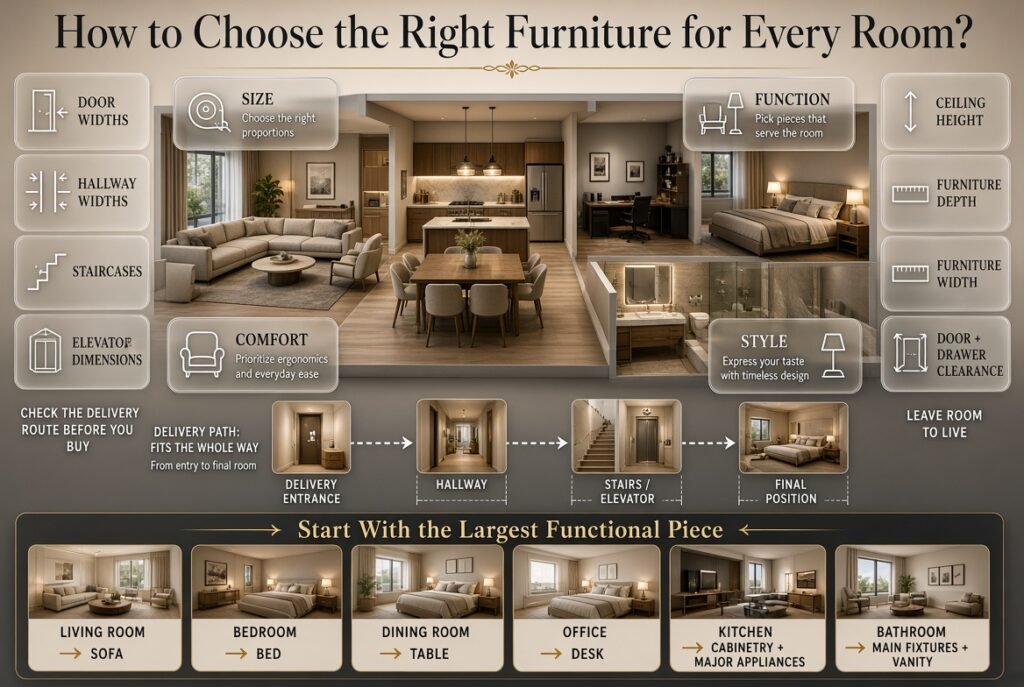
The most common mistakes are buying containers before decluttering, overfilling cabinets, storing daily items in inconvenient places, using too many categories, ignoring vertical space, and choosing storage based only on appearance.
Buying Containers Too Early
Containers don’t solve excess possessions.
They only contain them.
Declutter first.
Over-Categorizing
Too many categories make organization difficult to maintain.
If you need instructions to decide where something belongs, simplify the system.
Ignoring Accessibility
A storage solution isn’t useful if it’s difficult to reach.
Daily belongings should be easy to retrieve.
Filling Every Shelf
A completely full cabinet may look efficient, but it often isn’t.
Leave some breathing room.
Ignoring Vertical Space
Many homes have unused wall height.
Tall storage can provide significant additional capacity without consuming much floor space.
Choosing Appearance Over Function
A beautiful basket isn’t helpful if it doesn’t fit the shelf or makes the contents difficult to access.
Choose storage based on:
Function + Accessibility + Capacity + Appearance
⚠ Common Mistake: Don’t buy an organizer because it looks attractive online. Measure your actual space and the belongings you need to store first.
When Should You Invest in Built-In Storage?
Built-in storage is worth considering when standard furniture can’t efficiently use an awkward space or when you need a long-term solution for a major storage problem. It works particularly well for full-height wardrobes, under-stair areas, media walls, home offices, and unusual room dimensions.
Built-ins can provide:
- Better use of vertical space
- More customized compartments
- Cleaner visual integration
- Better use of awkward corners
- Greater long-term capacity
However, they’re more expensive and less flexible than freestanding furniture.
Don’t install built-ins simply because they’re fashionable.
Install them because they solve a real problem.
How Can You Make Storage Look More Elegant?
Elegant storage usually comes from consistency rather than expensive materials.
Consider:
- Matching finishes
- Repeated proportions
- Consistent hardware
- Coordinated baskets
- Concealed storage
- Limited visible clutter
- Balanced shelving
- Integrated lighting
For example, a wall of cabinets with consistent doors can look more refined than several unrelated storage units placed next to one another.
Organization becomes part of the room’s architecture.
How Can Smart Storage Help a Home Feel Bigger?
Storage can make a room feel larger by reducing visual clutter, protecting walking paths, and moving unnecessary objects away from prominent surfaces. Vertical storage and concealed cabinets can increase capacity without making the floor plan feel crowded.
This is particularly important in small homes.
You can’t physically increase the room’s dimensions through organization.
But you can reduce the number of things competing for attention.
A clear floor.
A less crowded countertop.
A simplified wall.
A tidy entryway.
Together, these changes can create a strong perception of additional space.
How Can You Organize Without Making Your Home Feel Too Minimal?
An organized home doesn’t have to be empty.
You can keep:
- Books
- Artwork
- Plants
- Photographs
- Collections
- Decorative objects
- Textiles
- Personal memorabilia
The difference is intentional placement.
Instead of scattering objects across every available surface, create visual groupings.
For example:
Books → One defined shelf
Photos → Gallery wall
Small objects → Decorative tray
Blankets → One attractive basket
This allows personality to remain visible without allowing belongings to spread everywhere.
How Do You Create an Organization System That Stays Organized?
The best organization systems are easy to maintain. If returning something to its proper place requires too many steps, people will eventually abandon the system.
Use the 30-second principle:
If you can put something away in roughly half a minute, you’re more likely to do it consistently.
For example:
A basket beside the sofa is more practical for blankets than a cabinet across the house.
A key tray near the entrance is more practical than a drawer in a bedroom.
A charging station near the place where devices are used is more practical than a box of chargers stored elsewhere.
Organization should reduce effort.
Give Important Categories One Clear Home
Examples include:
Keys → Entryway tray
Chargers → Electronics drawer
Shoes → Entryway cabinet
Cleaning products → Utility storage
Extra bedding → Bedroom cabinet
When belongings have predictable homes, clutter becomes easier to control.
How Can You Organize a Home on a Small Budget?
You don’t need expensive organizers to create meaningful improvements. Decluttering, rearranging existing furniture, repurposing containers, adding hooks, and improving vertical storage can often produce major results at little cost.
Start with free solutions.
Rearrange Before Buying
A cabinet may be poorly organized simply because its shelves aren’t positioned correctly.
Try changing:
- Shelf heights
- Category placement
- Drawer assignments
- Furniture locations
Repurpose What You Own
Existing boxes and baskets can test an organization system before you spend money on specialized products.
Once you know what works, upgrade only the parts that genuinely need improvement.
This approach reduces waste and prevents buying products that later become clutter themselves.
How Can Storage Improve Everyday Routines?
The best storage systems support routines that already exist.
Think about:
- Getting dressed
- Preparing breakfast
- Cooking dinner
- Doing laundry
- Leaving for work
- Returning home
- Cleaning the bathroom
- Working at a desk
For each routine, ask:
What do I reach for?
Where do I use it?
Where does it currently end up?
What would make putting it away easier?
These questions often reveal better storage solutions than simply searching for “organization products.”
What Do Professionals Recommend for Home Organization?
Professional organization begins with observation, not decoration. Experienced organizers look at what people own, where clutter develops, how frequently objects are used, and how much effort is required to return them to storage.
A practical framework is:
Observe
Identify the real problem.
Declutter
Remove unnecessary possessions.
Categorize
Group related items.
Zone
Assign categories to appropriate areas.
Store
Choose the right storage method.
Label
Clarify shared or long-term storage.
Review
Adjust the system as household needs change.
This process creates organization that supports real life rather than simply looking good immediately after cleaning.
How Can Room-by-Room Planning Improve Storage?
Every room has different storage priorities.
The kitchen needs efficiency.
The bedroom needs clothing organization.
The bathroom needs compact storage.
The living room needs visual balance.
The office needs focus.
The entryway needs fast access.
Because each room behaves differently, using one universal storage method throughout the house rarely works well.
A room-by-room approach allows you to match storage to the actual activities that happen there.
For a broader room-by-room approach, explore Room-by-Room Interior Design Inspiration.
You can also use the Room-by-Room Design Hub to think about storage, layout, and design together.
What Role Does Color Play in Organized Storage?
Color can influence how visually organized a room feels. Storage doesn’t have to be brightly colored or perfectly matched, but coordinated tones can make cabinets, baskets, and shelves feel more cohesive.
For example:
- Similar cabinet and wall colors can create a quieter appearance.
- Natural materials can add warmth.
- Dark storage can create visual weight.
- Light finishes can help compact spaces feel more open.
Color isn’t a substitute for organization, but it can support it.
If you’re planning a complete room makeover, Paint Color ideas can help you coordinate storage finishes with the rest of the interior.
How Often Should You Reorganize Your Home?
You don’t need a complete reorganization every month. Small daily resets, weekly maintenance, monthly clutter checks, and seasonal reviews are usually more sustainable than large-scale reorganizing sessions.
A practical schedule looks like:
Daily: Return items to their homes.
Weekly: Reset high-use areas.
Monthly: Review clutter hotspots.
Seasonally: Rotate clothing and seasonal belongings.
Yearly: Reassess major storage needs.
The purpose isn’t perfection.
It’s prevention.
Small maintenance tasks stop small problems from becoming overwhelming projects.
Smart Storage Checklist
Before considering an organization project complete, ask:
- Have I removed things I don’t use?
- Does every important category have a home?
- Are daily items easy to reach?
- Am I using vertical space?
- Have I considered doors and corners?
- Am I using hidden areas effectively?
- Are storage categories simple?
- Can everyone in the household understand them?
- Did I measure before buying organizers?
- Is there enough flexibility for future needs?
- Does the storage match how I actually live?
- Can I maintain the system without excessive effort?
If several answers are no, don’t immediately buy more storage.
Improve the system first.
What are the smartest storage ideas for a small home?
The smartest storage ideas for a small home are those that increase usable storage without making the room feel more crowded. Instead of simply adding more cabinets or boxes, look for overlooked areas such as walls, the backs of doors, under beds, corners, and the space above existing furniture. Vertical shelving, floating shelves, under-bed drawers, over-door organizers, slim rolling carts, and storage ottomans can all add capacity while preserving valuable floor space. Current small-space organization advice consistently emphasizes using vertical space and multifunctional furniture rather than relying only on conventional cabinets.
A good storage system should also make frequently used belongings easy to reach. Storing everyday items in difficult-to-access boxes may technically create organization, but it usually does not remain practical for long. The best solution combines accessibility, capacity, and visual simplicity.
Useful ways to apply this:
Use tall shelving instead of wide, bulky storage units.
Install floating shelves where floor space is limited.
Use the space underneath beds and sofas for seasonal belongings.
Choose ottomans, benches, beds, or coffee tables with concealed storage.
Add hooks or organizers to the inside of cabinet and closet doors.
Use slim rolling carts in narrow gaps between appliances or cabinets.
Keep everyday essentials at eye level and rarely used items higher up.
The goal is not to make every empty corner hold something. It is to make the available space work harder while keeping the home comfortable and visually calm.
How can I organize my home without making it look cluttered?
The key is to organize before adding more visible storage. A room can have plenty of baskets, shelves, containers, and cabinets and still look chaotic if too many objects remain exposed. Professional organizers increasingly recommend separating decluttering from organizing: first decide what genuinely needs to stay, then create a logical home for what remains.
For a cleaner appearance, use concealed storage for visually busy belongings and reserve open shelving for objects that contribute positively to the room’s appearance. Matching or coordinating containers can also make practical storage feel like part of the interior design rather than an afterthought.
Try these organization principles:
Declutter before purchasing storage products.
Group similar belongings together rather than scattering them around the home.
Use baskets or closed cabinets for small, visually distracting items.
Keep frequently used surfaces as clear as possible.
Avoid filling every shelf to its maximum capacity.
Choose storage containers that fit the dimensions of the cabinet or shelf.
Give frequently used items a permanent, easy-to-reach location.
Use labels where they genuinely improve retrieval rather than labeling everything unnecessarily.
A particularly effective approach is to create visual breathing room. Leaving some empty space on shelves, countertops, and furniture makes the entire room feel more organized. Smart organization is therefore not about hiding everything; it is about controlling what is visible and making sure every visible element has a purpose.
How do I maximize storage space without adding more furniture?
One of the most effective ways to increase storage without adding furniture is to use the space you already have more intelligently. Walls, cabinet interiors, doors, corners, and the areas beneath existing furniture are often underused. This is why vertical storage, over-door solutions, shelf risers, drawer dividers, and under-bed containers are so valuable in compact homes.
For example, a tall cabinet can often accommodate additional shelf risers, while the inside of a cabinet door can hold lightweight organizers. In a kitchen, vertical dividers can store baking trays and cutting boards more efficiently than stacking them horizontally. In a bedroom, under-bed boxes can hold seasonal clothing without taking up wardrobe space.
High-impact ways to reclaim unused space:
Add shelf risers inside tall cabinets.
Use drawer dividers to prevent wasted gaps.
Install hooks on unused wall sections.
Use the back of doors for shoes, accessories, cleaning supplies, or toiletries.
Store seasonal clothing beneath the bed.
Use corner shelving in awkward or unused corners.
Add narrow rolling storage to unused gaps.
Install rails or hooks underneath shelves where appropriate.
Use stackable containers instead of spreading storage horizontally.
The important distinction is between adding storage and recovering storage capacity. Recovering unused space is usually cheaper, less visually intrusive, and more effective because it improves an existing system rather than introducing another bulky object into the room.
What type of storage furniture is best for a small space?
For small spaces, the most useful storage furniture is usually multifunctional furniture that performs two or more jobs. A storage bed can provide sleeping space and concealed storage; an ottoman can function as seating, a footrest, and a container; a bench can provide seating while storing shoes or household items underneath. This approach is becoming increasingly important in current interior design because homeowners want storage to integrate naturally into the architecture and everyday function of a room.
The best choice depends on what the room needs to store. A storage bed is particularly useful for bedrooms with limited wardrobes, while a narrow console with drawers may be more appropriate for an entryway. In a living room, a coffee table with drawers or a lift-top compartment can provide practical storage without requiring another cabinet.
Useful multifunctional options include:
Storage beds with drawers or lift-up compartments
Ottomans with concealed compartments
Benches with internal storage
Coffee tables with drawers or hidden compartments
Modular shelving systems
Storage benches for entryways
Slim cabinets designed for narrow walls
Built-in wardrobes that use the full height of the room
Window seats with integrated storage
When selecting storage furniture, don’t judge it only by how much it can hold. Consider how often you will access it, how much floor area it occupies, whether it visually overwhelms the room, and whether its proportions suit the space.
For long-term organization, the most successful furniture is storage that becomes part of the room’s architecture rather than looking like an extra container placed inside it.
How do I create a smart organization system that stays tidy long-term?
A storage system stays tidy when it is easy enough to maintain during normal daily life. If putting something away requires opening several boxes, moving other belongings, or reaching an inconvenient shelf, people naturally stop following the system. Sustainable organization therefore depends less on perfection and more on creating simple habits and logical storage zones.
Start by assigning each category of belongings a specific “home.” Kitchen appliances should have a defined area, cleaning supplies should stay together, children’s toys should have an accessible storage zone, and seasonal items should be separated from everyday belongings. Clear containers can be particularly useful when you need to see what is inside without opening multiple boxes, while labeled storage can make less frequently accessed categories easier to retrieve.
Build a system that is easy to maintain:
Give every frequently used item a permanent location.
Store similar items together by category.
Keep everyday belongings within easy reach.
Place rarely used items in higher or less accessible storage.
Use clear containers when visibility matters.
Label seasonal or long-term storage.
Avoid overfilling drawers, shelves, and cabinets.
Do a short weekly reset instead of waiting for a major cleanup.
Reassess storage whenever your household’s needs change.
The biggest mistake is designing an organization system for an ideal version of your lifestyle rather than your actual routine. If your family drops keys near the entrance every day, create a designated key station there. If laundry accumulates in one particular bedroom, place a hamper where clothes naturally end up. Smart organization follows behavior instead of fighting it.
Conclusion
The best smart storage and organization ideas aren’t about squeezing the maximum possible number of possessions into every cabinet. They’re about creating a home where the things you use have logical, convenient places to live.
Start by observing where clutter naturally develops. Those problem areas often reveal more than a simple cleaning session ever could. Declutter unnecessary belongings, group what remains, and create storage zones based on real routines.
Use vertical space when the floor is limited. Turn awkward corners into useful areas. Make wardrobes more efficient before replacing them. Keep kitchen tools near the activities they support. Give entryway items convenient homes. Use closed storage where visual clutter becomes distracting, and open storage where visibility and display are valuable.
Most importantly, don’t build a system that only works when everyone is perfectly disciplined. A successful home organization system should make the right behavior easy.
If something is used every day, it should be easy to reach. If something is used once a year, it doesn’t need prime storage space. If an item constantly ends up in the same place, consider whether that place is actually its natural home.
Good storage is ultimately about reducing friction.
When belongings are easy to find, easy to use, and easy to put away, your home becomes calmer without becoming sterile. You don’t need a massive renovation or an expensive collection of organizers. You need thoughtful decisions about space, habits, accessibility, and function.
For more ideas on improving your home’s layout, functionality, and overall design, return to designmode24 interior design.

Leave a Reply