
Introdution
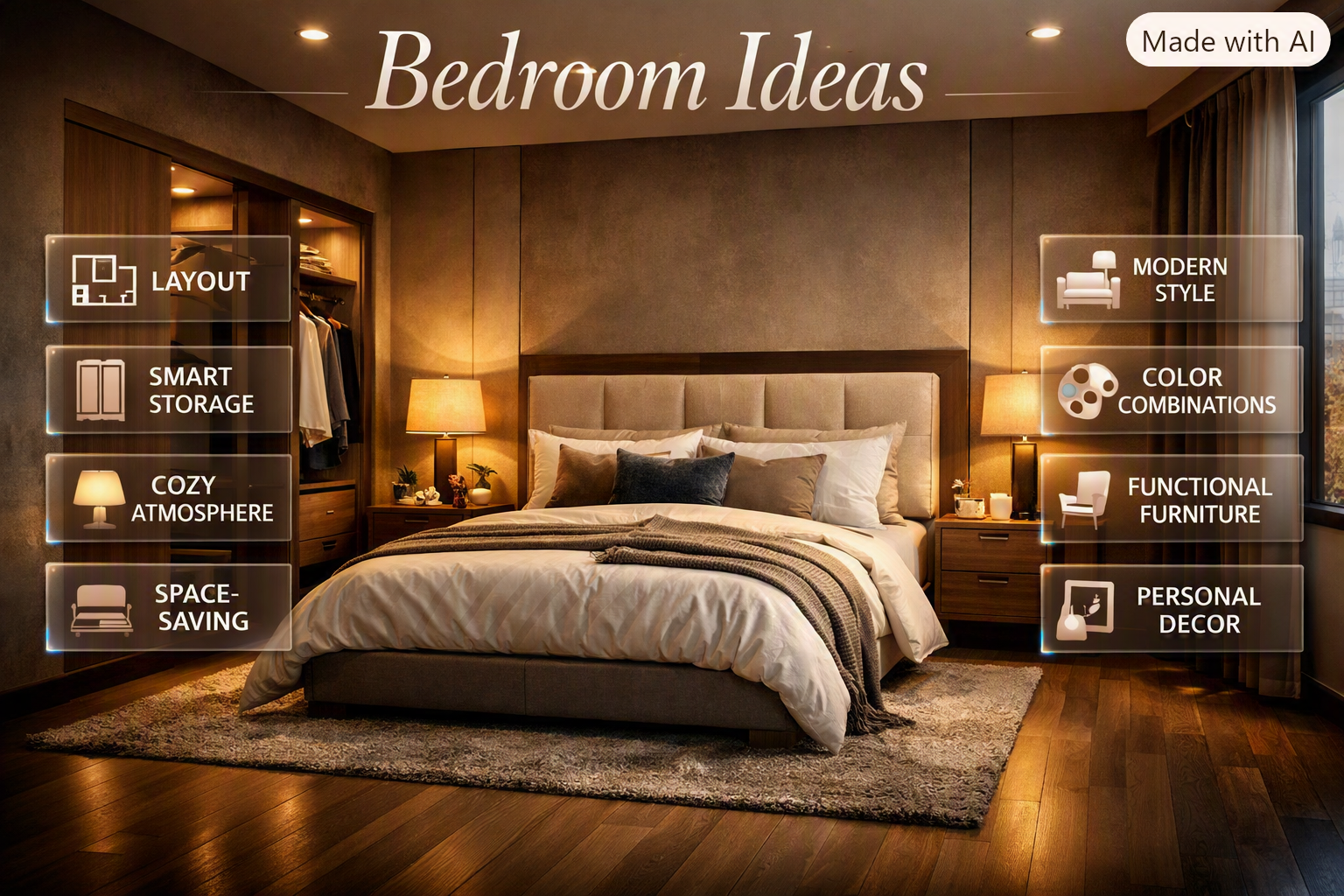
Bedroom Ideas | A bedroom can have expensive furniture, beautiful paint, and stylish accessories and still feel completely wrong. Maybe the bed takes up too much space, the storage isn’t enough, the lighting feels harsh, or the room simply doesn’t feel relaxing. That’s where thoughtful Bedroom Ideas make a real difference.
The best bedroom isn’t the one that looks most impressive in a photograph. It’s the one that works naturally every day. You should be able to move around easily, find what you need, relax at night, keep clutter under control, and still feel that the room reflects your personality.
Whether you’re working with a tiny apartment bedroom, a large master bedroom, a teenager’s room, a guest bedroom, or a simple rental space, good design starts with understanding the room rather than copying a trend.
This guide covers practical bedroom layouts, modern bedroom styles, color combinations, lighting, furniture selection, storage solutions, cozy bedroom ideas, small-room solutions, luxury touches, decorating mistakes, budget improvements, and professional design advice. The goal is simple: help you create a bedroom that looks beautiful and feels right to live in.
What Makes a Good Bedroom Design?
A good bedroom design balances comfort, function, proportion, lighting, storage, and personal style. The room should feel visually calm while still providing everything you need for sleeping, dressing, relaxing, and everyday routines.
Before choosing a decorative theme, think about the room in this order:
- Function – What do you need to do in the room?
- Layout – Where should the major furniture go?
- Storage – Where will clothing, bedding, and personal items be kept?
- Lighting – How will the room work during the evening?
- Color – What atmosphere should the room create?
- Furniture – What sizes and shapes suit the space?
- Decoration – What personal details complete the room?
This order matters because decoration cannot fix a poor layout.
A beautiful bedroom with nowhere to store clothes will quickly become cluttered. An attractive room with only one bright ceiling light may feel uncomfortable at night. A trendy bedroom with furniture that is too large may look crowded within minutes of entering it.
Good design solves practical problems first and then makes the solution beautiful.
For a broader starting point, you can explore the DesignMode24 Interior Design homepage for additional ideas covering different areas of home design.
How Do You Plan a Bedroom Before Decorating?
Start by measuring the bedroom and identifying the room’s fixed elements. Doors, windows, radiators, built-in wardrobes, electrical outlets, and architectural features all influence where furniture can go.
Create a simple list before purchasing anything:
- Room length and width
- Ceiling height
- Window locations
- Door swing
- Existing wardrobes
- Electrical outlets
- Lighting points
- Heating or cooling equipment
- Available wall space
- Existing furniture worth keeping
Then decide what the bedroom needs.
For example, a couple may need a king-size bed, two bedside tables, a large wardrobe, and a dresser. A teenager might need a bed, wardrobe, desk, bookshelves, and a study chair. A guest room may need little more than a comfortable bed, storage, and good lighting.
Start With the Bed
The bed usually occupies the largest amount of floor space, so it should be considered first.
Ask:
- Can both sides of the bed be accessed?
- Is the headboard positioned against a suitable wall?
- Can wardrobe doors open comfortably?
- Is there enough room to walk around?
- Does the bed block a window?
- Does the arrangement create a natural focal point?
The bed doesn’t always have to sit against the longest wall. The architecture of the room should determine the final position.
Think About Movement
A bedroom should have obvious circulation paths.
A useful mental diagram is:
Entrance → clear path → sleeping area → wardrobe/storage
You don’t want to weave between a chair, dresser, bed, and cabinet simply to reach your clothes.
⭐ Expert Tip: Before moving heavy furniture, use masking tape on the floor to mark approximate furniture dimensions. Walk through the room and test the layout physically. This is much easier than discovering the problem after everything has been installed.
What Are the Best Small Bedroom Ideas?
The best small bedroom ideas focus on reducing visual and physical clutter. Use furniture with a smaller footprint, maximize vertical storage, choose light or visually soft colors, and avoid filling every available wall.
Small bedrooms aren’t necessarily difficult to design. They simply require more discipline.
Choose Furniture Based on Scale
A large bed may be necessary, but that doesn’t mean every other piece needs to be large.
Instead of:
- Oversized bedside tables
- Large standalone wardrobes
- Bulky chairs
- Deep dressers
consider:
- Floating bedside shelves
- Tall wardrobes
- Slim cabinets
- Under-bed storage
- Wall-mounted furniture
- Narrow benches
The objective is to preserve usable floor area.
Use Vertical Space
When floor space is limited, look upward.
A full-height wardrobe can provide significantly more storage than a short cabinet occupying the same footprint. Tall shelves can store books and accessories without spreading across the floor.
Vertical furniture also creates a stronger sense of height.
Use Mirrors Carefully
A strategically placed mirror can reflect light and create a stronger sense of depth. A wardrobe with mirrored panels can also combine storage and visual expansion.
However, don’t place mirrors randomly simply because you’ve heard that mirrors make rooms bigger. Their position matters.
A mirror facing a visually unpleasant corner may simply make that corner more noticeable.
Keep the Color Palette Controlled
A small room can handle color, but too many competing colors make it feel busy.
A practical palette might include:
Base: warm white or soft beige
Secondary: muted green or blue
Accent: walnut, black, brass, or another restrained finish
This creates contrast without visual chaos.
💡 Pro Tip: In a very small bedroom, keeping the wall, curtains, and larger furniture within a related tonal family can make the room feel more continuous.
How Can You Make a Large Bedroom Feel Cozy?
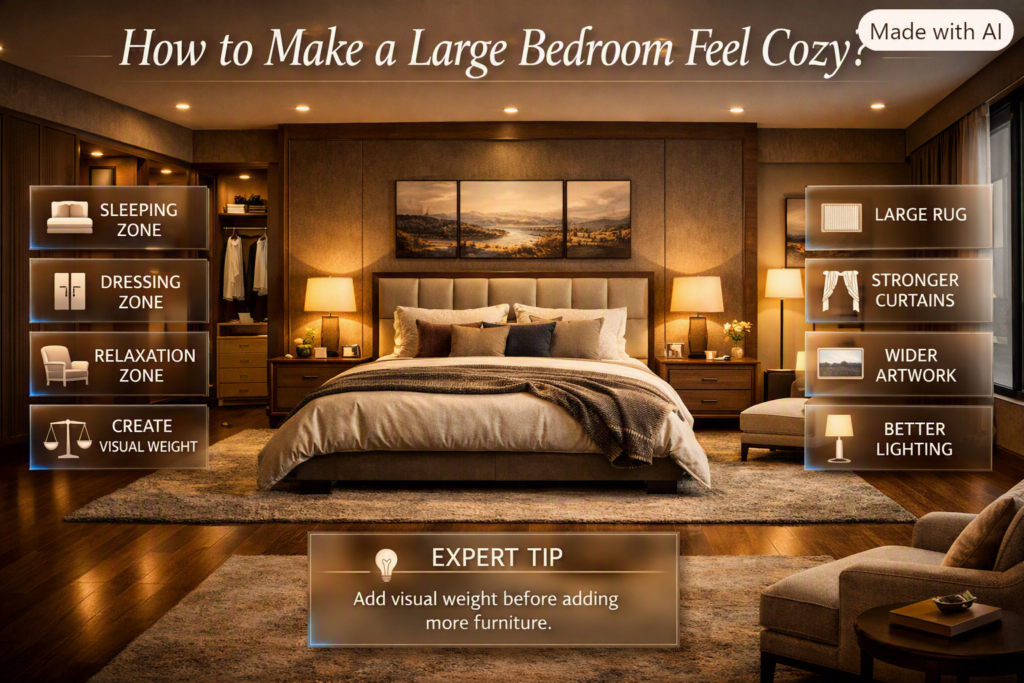
Large bedrooms can have the opposite problem from small rooms. Instead of feeling crowded, they may feel empty, cold, or visually disconnected.
The solution is to create zones.
Sleeping Zone
Keep the bed as the main focal point.
Use:
- A substantial headboard
- Bedside tables
- Table or wall lamps
- A large rug
- Artwork or a feature wall
Dressing Zone
A dresser, wardrobe, full-length mirror, or dressing table can establish a separate area.
Reading or Relaxation Zone
If space allows, add:
- Accent chair
- Small side table
- Floor lamp
- Bench
- Chaise lounge
The goal isn’t to fill the room. It’s to give unused space a purpose.
Create Visual Weight
Large bedrooms need furniture with enough scale.
A tiny bedside table beside a very large bed can look disproportionate. Likewise, several small artworks scattered across a huge wall may disappear visually.
Choose pieces according to the room’s proportions.
⭐ Expert Tip: When a large bedroom feels empty, don’t automatically add more furniture. First consider a larger rug, wider artwork, stronger curtains, or better lighting. These can add visual weight without creating clutter.
What Bedroom Color Ideas Create a Relaxing Atmosphere?
Bedroom colors strongly influence how a room feels, but there isn’t one universally perfect bedroom color. The best choice depends on natural light, room size, furniture finishes, and the mood you want.
Popular calming choices include:
- Warm white
- Beige
- Greige
- Taupe
- Soft blue
- Muted sage
- Dusty green
- Warm gray
- Earthy brown
- Soft terracotta
Warm Neutrals
Warm neutrals create a comfortable and timeless foundation.
They work particularly well with:
- Natural wood
- Cream textiles
- Brass accents
- Soft lighting
- Beige rugs
Soft Greens
Muted green can introduce a natural feeling without becoming overpowering.
Sage, olive, eucalyptus, and other softened greens work well with wood and neutral fabrics.
Blue Bedrooms
Blue can create a calm and restful atmosphere.
Pale blue feels airy, while navy or deeper blue creates a more dramatic bedroom.
Dark Bedroom Colors
Dark colors can be surprisingly effective.
Charcoal, deep green, navy, chocolate brown, and muted plum can create an intimate environment.
The mistake is assuming dark colors always make a room smaller. The result depends on lighting, ceiling height, furniture, and how the color is used.
For more color inspiration, explore the Paint Color category and consider how wall color interacts with the rest of your interior.
How Do You Choose the Right Bedroom Color Combination?
Instead of selecting individual colors independently, build a complete palette.
A simple three-part formula works well:
60% dominant color
30% secondary color
10% accent color
For example:
- 60% warm beige
- 30% soft white and natural wood
- 10% dark green accents
Another option:
- 60% warm white
- 30% light oak
- 10% black metal
The percentages don’t have to be mathematically exact. They’re simply a way to prevent one color from dominating accidentally.
Consider Natural Light
A color can look dramatically different depending on lighting.
A cool gray may feel crisp in strong daylight but cold at night. A warm beige can feel cozy under warm lamps but yellow under certain artificial lighting.
Always test paint samples at different times of day.
What Is the Best Bedroom Lighting?
The best bedroom lighting uses layers rather than depending on one ceiling fixture. Ambient lighting provides overall visibility, task lighting supports activities such as reading, and accent lighting creates atmosphere.
Ambient Lighting
This is the general illumination of the room.
Options include:
- Ceiling fixtures
- Recessed lights
- Flush mounts
- Pendant lights
Bedside Lighting
Bedside lighting is one of the most useful improvements you can make.
It allows you to:
- Read
- Use your phone
- Get out of bed safely
- Create softer evening illumination
Wall sconces are especially useful in small rooms because they free up bedside table space.
Accent Lighting
Accent lighting can highlight:
- Artwork
- Headboards
- Architectural details
- Wardrobes
- Decorative shelving
LED lighting can be useful when installed thoughtfully rather than exposed everywhere.
📌 Quick Tip: Don’t judge bedroom lighting only during the daytime. Turn off the main light in the evening and test each lighting layer independently. This reveals whether the room actually feels relaxing.
What Furniture Should Every Bedroom Have?
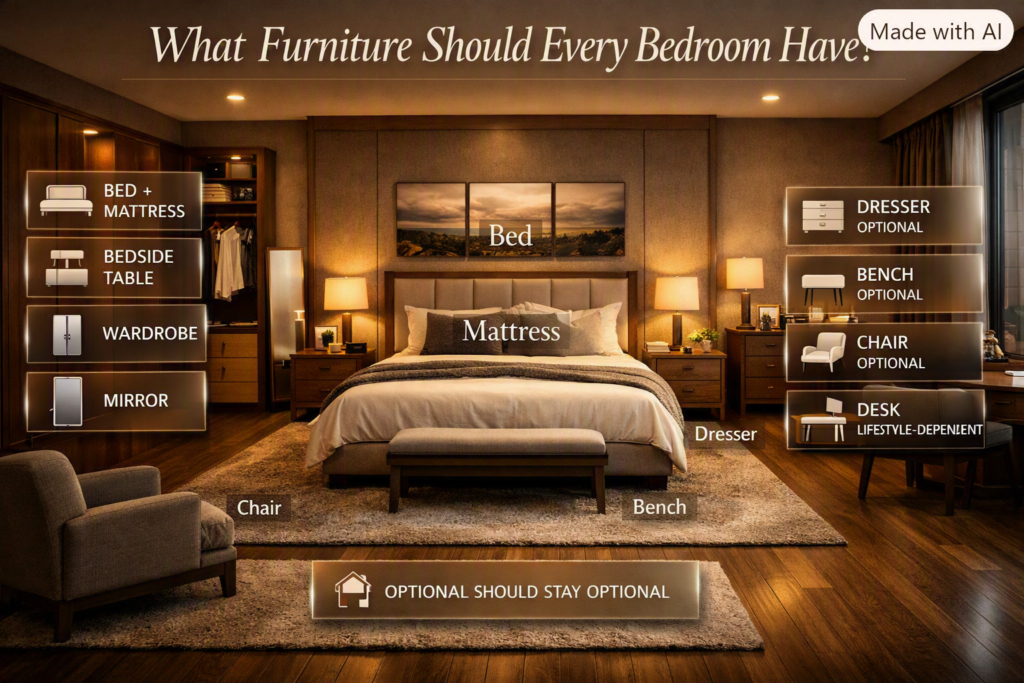
The furniture depends on the room and lifestyle, but most bedrooms need a small group of essential pieces.
| Furniture | Importance | Why |
|---|---|---|
| Bed | Essential | Main sleeping function |
| Mattress | Essential | Comfort and support |
| Bedside table | Highly useful | Storage and easy access |
| Wardrobe | Usually essential | Clothing storage |
| Dresser | Optional | Additional organization |
| Mirror | Useful | Dressing and visual depth |
| Bench | Optional | Comfort and styling |
| Chair | Optional | Reading or relaxation |
| Desk | Lifestyle-dependent | Work or study |
The important point is that optional furniture should remain optional.
If a chair becomes a place for clothes rather than a place to sit, it may not be serving the room well.
How Can You Create Better Bedroom Storage?
Storage should be designed around what you actually own.
Think about:
- Hanging clothes
- Folded clothes
- Shoes
- Bedding
- Towels
- Accessories
- Books
- Seasonal items
- Personal belongings
Then determine where each category should live.
Built-In Wardrobes
Built-in wardrobes are particularly effective because they use wall space efficiently and can be designed around your exact requirements.
Under-Bed Storage
This is excellent for seasonal bedding, luggage, or rarely used clothing.
Floating Shelves
Floating shelves can work well for books and decorative objects, but they shouldn’t become an excuse to display every possession.
Closed Storage
Closed cabinets generally create a calmer appearance than numerous open shelves.
⚠ Common Mistake: Designing storage based on how the bedroom looks when empty rather than how it will look after two weeks of normal use. Real belongings need real storage.
Bedroom Layouts
A well-planned bedroom layout creates a comfortable balance between furniture, movement, storage, and visual space.
Options include:
- Small bedroom layouts
- Master bedroom layouts
- Open bedroom layouts
- Bedroom layouts with wardrobes
- Bedroom layouts with a workspace
- Bedroom layouts with a sitting area
👉 If you want to explore practical arrangements, space-saving solutions, and different ways to organize furniture for a more functional and comfortable room, read our complete guide to Bedroom Layouts for detailed ideas and expert planning tips.
What Are the Best Modern Bedroom Ideas?
Modern bedroom design is less about following a particular trend and more about creating clean, intentional spaces.
Common characteristics include:
- Simple furniture
- Clean lines
- Limited color palettes
- Integrated storage
- Layered lighting
- Natural materials
- Minimal decorative clutter
- Strong proportions
A modern bedroom doesn’t have to be white.
You can create a modern look using warm beige, olive, charcoal, brown, navy, or other sophisticated colors.
Modern Doesn’t Mean Cold
A room can have clean lines while still feeling warm.
Introduce:
- Soft textiles
- Timber
- Upholstered furniture
- Rugs
- Warm lighting
- Natural materials
This creates a modern bedroom with personality rather than a sterile showroom.
For broader guidance on how interior spaces are planned and styled, explore Interior Design.
What Are the Best Cozy Bedroom Ideas?
Cozy bedrooms are created through layers.
Think about the experience of entering the room at night.
You want the eye to see:
- Soft bedding
- Comfortable textures
- Warm light
- Natural materials
- Gentle colors
- A balanced arrangement
Layer Your Textiles
Combine:
- Sheets
- Duvet
- Blanket
- Throw
- Cushions
- Curtains
- Rug
The materials don’t have to match perfectly.
A combination of cotton, linen, wool, velvet, or textured fabrics can create depth.
Use Warm Lighting
A beautiful bedroom can feel uncomfortable if the lighting is too harsh.
Bedside lamps and indirect lighting usually create a more relaxing evening environment.
Add Natural Elements
Wood, woven materials, plants, stone, and natural textiles can prevent a neutral bedroom from feeling flat.
How Can You Make a Bedroom Look Luxurious?
Luxury is often a matter of proportion and detail rather than price.
A bedroom can feel expensive when:
- Curtains are correctly sized
- Lighting is layered
- Furniture proportions are balanced
- Bedding looks substantial
- Materials coordinate
- Hardware is consistent
- The room isn’t overloaded with decoration
Spend on High-Impact Items
If the budget is limited, prioritize:
- Mattress
- Bed
- Lighting
- Curtains
- Bedding
- Storage
- Rug
- Decorative accessories
There’s little value in buying expensive decorative objects while ignoring uncomfortable bedding or poor lighting.
⭐ Expert Tip: Full-length curtains mounted higher and wider than the window can make an ordinary bedroom feel considerably more polished because they visually increase the height and width of the window.
How Do You Choose the Right Bedroom Rug?
A rug should visually connect the bed with the surrounding furniture rather than appearing like a small island underneath it.
Common approaches include:
Large Rug
A larger rug can extend beyond the sides and lower portion of the bed, creating a strong unified sleeping zone.
Runners
Runners can work when the room is narrow or the bed arrangement doesn’t accommodate a large rug.
Layered Rugs
A larger neutral rug with a smaller textured rug can create additional depth, but this works best in larger rooms.
Common mistake: choosing a rug based solely on price or pattern without considering scale.
A beautiful rug that’s too small can make the whole bedroom feel visually disconnected.
How Can You Design a Minimalist Bedroom?
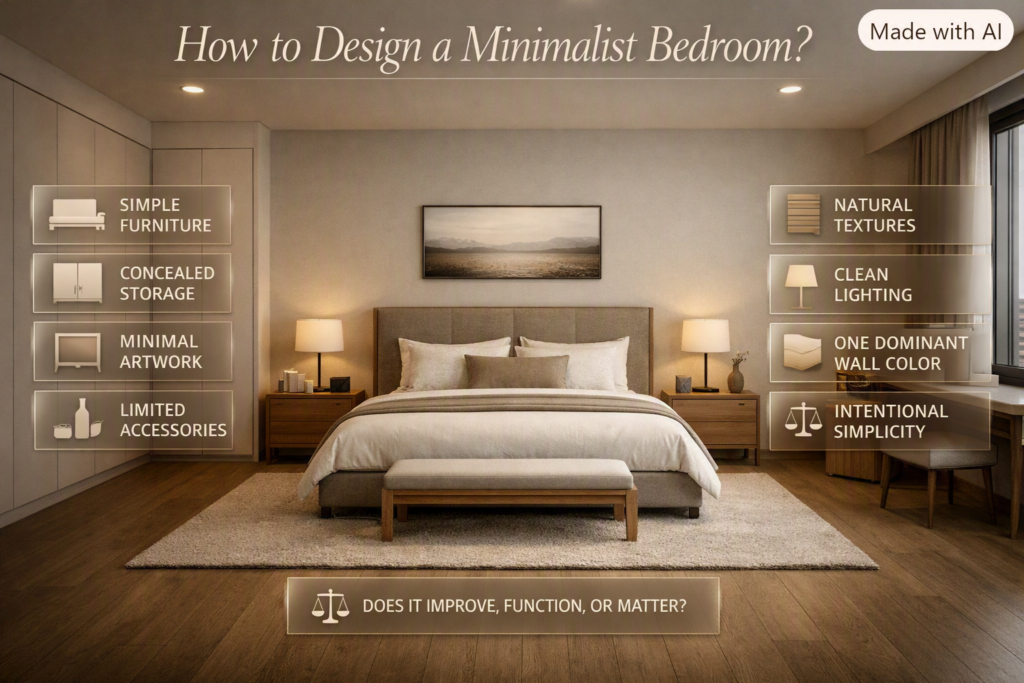
Minimalism works when the room has enough storage to support the lack of visible clutter.
A minimalist bedroom might use:
- One dominant wall color
- Simple furniture
- Concealed storage
- Minimal artwork
- Limited accessories
- Natural textures
- Clean lighting
But minimalism doesn’t mean removing everything.
A completely empty bedroom may feel unfinished rather than sophisticated.
The goal is intentional simplicity.
Ask of every visible object:
Does this improve the room, support a function, or have personal meaning?
If the answer is no, consider removing it.
What Are the Best Scandinavian Bedroom Ideas?
Scandinavian-inspired bedrooms often emphasize simplicity, natural materials, soft colors, practical furniture, and comfortable textiles.
A typical palette might include:
- Warm white
- Pale gray
- Beige
- Light wood
- Soft green
- Muted blue
Use natural textures to prevent the palette from feeling plain.
A wool-style rug, linen bedding, timber bedside table, woven basket, and soft lighting can create a comfortable Scandinavian atmosphere without copying a showroom exactly.
What Is Japandi Bedroom Design?
Japandi combines Japanese-inspired simplicity with Scandinavian warmth. It emphasizes restraint, natural materials, balanced proportions, muted colors, and functional furniture.
Useful materials include:
- Light or medium wood
- Linen
- Stone
- Ceramic
- Bamboo
- Natural woven materials
The strongest Japandi bedrooms don’t contain many objects. Each piece is selected carefully.
How Can You Make an Old Bedroom Look Modern?
You don’t necessarily need to replace every piece of furniture.
Start with the most visually outdated elements.
Refresh the Walls
A new paint color can change the entire mood.
Update Lighting
Replacing an old ceiling fixture or adding modern bedside lights can have an immediate effect.
Replace Hardware
New handles on wardrobes and drawers are inexpensive compared with replacing the entire cabinet.
Simplify Decoration
Remove unnecessary accessories and keep a smaller number of stronger pieces.
Improve Textiles
New curtains, bedding, and rugs can change the visual character dramatically.
For practical home updates and improvement projects, explore the Home Improvement category.
What Are the Best Bedroom Ideas for a Rental?
Renters can still create beautiful bedrooms without making permanent changes.
Try:
- Freestanding furniture
- Removable wallpaper
- Temporary hooks
- Large rugs
- New bedding
- Table lamps
- Floor lamps
- Curtains
- Mirrors
- Artwork with removable hanging solutions
The key is to improve what you can control.
You don’t need to repaint or renovate the entire room to make it feel personal.
How Do You Design a Bedroom for a Teenager?
A teenager’s bedroom often needs to perform several functions at once.
It may need to serve as:
Bedroom + Study Area + Storage + Personal Space
A practical arrangement might include:
- Comfortable bed
- Desk
- Task chair
- Wardrobe
- Bookshelves
- Closed storage
- Pinboard or artwork area
Give the teenager some control over decorative decisions. A room is more likely to remain organized when the person using it feels connected to the design.
What Are the Best Guest Bedroom Ideas?
A guest bedroom should feel welcoming without becoming overloaded.
Prioritize:
- Comfortable bed
- Clean bedding
- Accessible lighting
- Empty wardrobe or drawer space
- Mirror
- Curtains for privacy
- Small bedside table
- Convenient charging point
A guest doesn’t need dozens of decorative objects.
They need comfort and practicality.
📌 Quick Tip: Leave some empty storage space for guests. A beautiful wardrobe that’s completely filled with your belongings isn’t very useful to the person staying in the room.
How Can You Decorate a Bedroom on a Budget?
A bedroom makeover doesn’t have to involve a complete renovation.
Start with high-impact, low-cost changes.
Paint
One of the most powerful budget improvements.
Bedding
Changing the bedding can alter the entire appearance of the bed—the room’s main focal point.
Lighting
A pair of attractive bedside lamps can add both function and style.
Curtains
Good curtains improve privacy, light control, and visual scale.
Rearrangement
Sometimes the best improvement costs nothing.
Try different furniture arrangements before buying anything.
Decluttering
Removing unnecessary objects can make a bedroom look more expensive immediately.
For more practical home projects and affordable updates, explore DIY Home Projects.
What Are the Most Common Bedroom Design Mistakes?
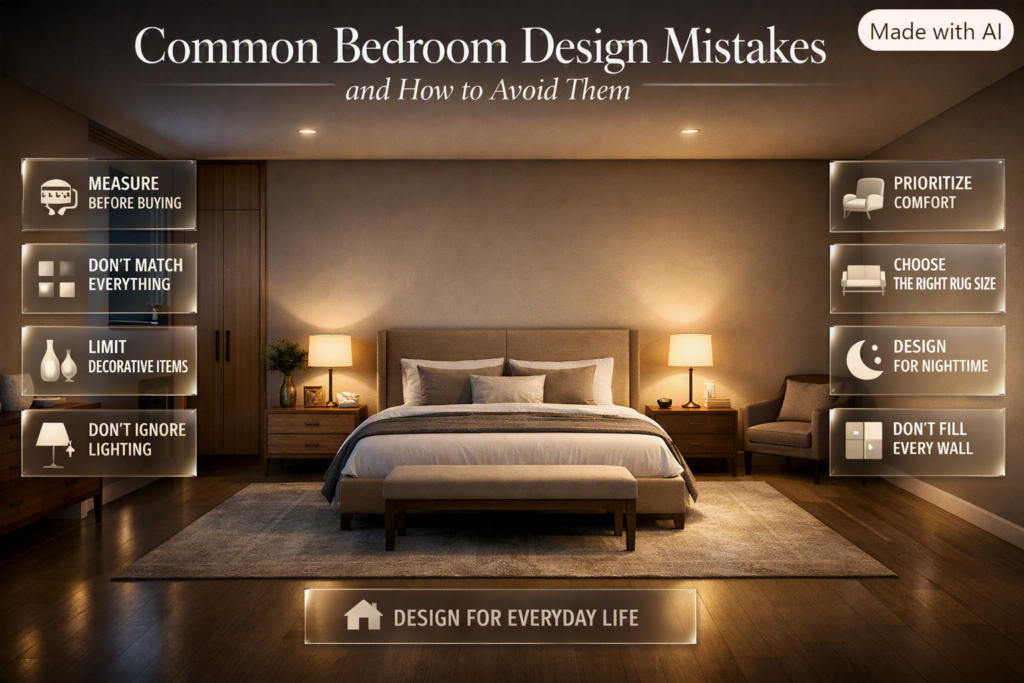
Mistake 1: Buying Furniture Before Measuring
This is one of the most expensive beginner mistakes.
Why it happens: The furniture looks attractive in a showroom or online.
Why it’s harmful: It may block doors, windows, wardrobes, or walking routes.
Better approach: Measure first and record dimensions.
Mistake 2: Making Everything Match
A complete matching bedroom set can feel predictable.
Instead, coordinate pieces through:
- Color
- Material
- Shape
- Hardware
- Proportion
The furniture should relate without looking identical.
Mistake 3: Using Too Many Decorative Items
Every shelf doesn’t need an accessory.
Too many objects create visual noise and increase cleaning time.
Mistake 4: Ignoring Lighting
One ceiling fixture rarely provides enough flexibility.
Add bedside lighting and softer ambient sources.
Mistake 5: Choosing Trends Over Comfort
A trendy bedroom that gives you poor storage or uncomfortable furniture isn’t successful.
Design for everyday life.
Mistake 6: Choosing a Rug That’s Too Small
Scale matters.
Mistake 7: Ignoring the Nighttime Experience
A bedroom is often used most when natural light is absent.
Always evaluate the room at night.
Mistake 8: Filling Every Empty Wall
Empty space is not necessarily wasted space.
It can make a room feel calmer and more sophisticated.
How Can You Create a More Personal Bedroom?
A bedroom shouldn’t feel like a hotel room unless that’s genuinely what you want.
Personal details might include:
- Family photographs
- Favorite artwork
- Travel objects
- Books
- Handmade pieces
- Meaningful textiles
- Collections displayed selectively
The trick is editing.
Instead of displaying twenty personal objects, choose five that matter most.
This keeps personality without creating clutter.
For additional ideas on incorporating personality and character into interiors, see Interior Design MintPalDecor.
How Do You Mix Different Bedroom Furniture Finishes?
Mixing finishes can make a bedroom feel more collected and sophisticated.
The easiest method is to establish one dominant material and one or two supporting finishes.
For example:
Dominant: warm oak
Secondary: cream upholstery
Accent: black metal
Or:
Dominant: walnut
Secondary: beige fabric
Accent: brushed brass
Avoid introducing too many unrelated wood tones unless you’re intentionally creating an eclectic design.
How Do You Choose Bedroom Artwork?
Artwork should be selected according to the room’s scale.
A small piece above a large bed can look lost.
For a wide bed, consider:
- One substantial artwork
- A coordinated pair
- A larger horizontal composition
- A carefully arranged gallery wall
The colors don’t need to match the walls exactly. They simply need to belong to the same visual story.
How Should You Decorate the Wall Behind the Bed?
The wall behind the bed is often the easiest place to create a focal point.
Options include:
- Paint
- Wallpaper
- Wood paneling
- Upholstered headboard
- Decorative molding
- Large artwork
- Textured finish
- Architectural shelving
Don’t combine every option.
If the wall already has strong wallpaper, adding a huge artwork, dramatic headboard, and numerous decorative objects may create competition.
Choose one primary feature.
How Can You Make a Bedroom Feel Bigger Without Renovating?
You can improve the perceived size of a bedroom through several simple changes:
- Reduce furniture
- Use appropriately scaled pieces
- Keep walking routes open
- Use light or continuous colors
- Add strategically placed mirrors
- Use vertical storage
- Improve natural light
- Choose curtains carefully
- Keep the floor visually clear
The goal is to reduce visual interruptions.
This is why floating furniture can be useful. Seeing more floor underneath a piece can make the room feel lighter.
What Bedroom Ideas Work Best for Couples?
A shared bedroom should balance the preferences and routines of both people.
Start with practical questions:
- Does each person have storage?
- Does each person have bedside access?
- Are lighting controls convenient?
- Is there enough space for personal belongings?
- Does the color scheme suit both people?
- Are there different sleeping or reading habits?
Symmetry can help.
Two matching bedside tables and two independent lights provide visual balance and practical independence.
But symmetry isn’t mandatory.
What Bedroom Ideas Work Best for a Master Bedroom?
A master bedroom usually benefits from a stronger sense of hierarchy and comfort.
Consider creating:
- Central bed arrangement
- Large headboard
- Balanced bedside lighting
- Full-height curtains
- Dedicated dressing storage
- Comfortable rug
- Seating area if space permits
- Layered lighting
- Coordinated accessories
Avoid turning the room into a furniture showroom.
The master bedroom should still feel peaceful.
How Can Interior Decoration Tips Improve a Bedroom?
Decoration works best when it supports the room rather than simply filling space.
Useful principles include:
- Repeat colors in small amounts.
- Repeat materials for continuity.
- Mix textures.
- Use odd-number groupings where appropriate.
- Keep decorative objects at different heights.
- Balance empty and occupied areas.
- Choose a clear focal point.
For additional practical guidance, explore Interior Decoration Tips MintPalDecor.
What Role Does House Decoration Advice Play in Bedroom Design?
A bedroom should not necessarily be designed as an isolated room. It should have some relationship with the rest of the home.
If the rest of your home uses warm natural materials, suddenly introducing an unrelated ultra-glossy bedroom may make the house feel disconnected.
That doesn’t mean every room must look identical.
Instead, repeat subtle elements:
- Similar wood tones
- Related neutral colors
- Consistent metal finishes
- Similar flooring
- Complementary textures
For broader guidance on creating consistency throughout your home, explore House Decoration Advice MintPalDecor.
How Can Small Details Improve Bedroom Design?
Small details often determine whether a room feels finished.
Consider:
- Matching light temperatures
- Coordinated hardware
- Hidden cables
- Properly hung curtains
- Clean bedside surfaces
- Balanced artwork
- Comfortable bedding
- Consistent metal finishes
These details aren’t always obvious individually.
Together, they create polish.
💡 Pro Tip: Before considering a bedroom complete, photograph it from the doorway. Photos often reveal imbalance that isn’t obvious when you’re standing inside the room.
How Can You Use Professional Design Principles Without Hiring a Designer?
You can apply several professional principles yourself.
Principle 1: Establish a Focal Point
Usually the bed or wall behind it.
Principle 2: Create Balance
Use furniture and visual weight carefully.
Principle 3: Repeat Elements
Repeat colors, materials, or shapes.
Principle 4: Create Contrast
Combine light and dark, smooth and textured, soft and hard.
Principle 5: Leave Breathing Room
Not every area needs decoration.
Principle 6: Design Around Real Life
Storage, lighting, cleaning, and movement matter just as much as appearance.
If you’re looking for additional practical home and room guidance, the Drhomey Handy Tips resource can provide further ideas for everyday home improvements.
Bedroom Design Decision Table
When you’re unsure what direction to take, use the following guide:
| Your problem | Best design response |
|---|---|
| Room feels too small | Reduce furniture and use vertical storage |
| Bedroom feels cold | Add warm lighting and natural textures |
| Room feels cluttered | Increase concealed storage |
| Large room feels empty | Create functional zones |
| Bedroom looks outdated | Update paint, lighting, hardware, and textiles |
| Design feels chaotic | Reduce colors and decorative objects |
| Room feels dark | Improve layered lighting and reflective surfaces |
| Furniture feels disconnected | Repeat materials and colors |
| Bedroom feels unfinished | Improve curtains, rug, artwork, and lighting |
| Budget is limited | Focus on high-impact changes |
What are the best bedroom ideas for 2026?
The best bedroom ideas for 2026 are moving away from rooms that look overly coordinated or purely decorative. Instead, designers are focusing on bedrooms that feel warm, personal, comfortable, and practical. Warm neutrals, earthy colors, layered lighting, natural materials, larger headboards, reading corners, built-in storage, and personalized artwork are all becoming more prominent.
The important point is not to follow every trend at once. Choose ideas that improve the way you actually use the bedroom.
Useful ways to apply the trend:
Use warm beige, taupe, muted green, or earthy shades instead of relying only on cool gray.
Add different textures through bedding, rugs, curtains, and upholstery.
Replace harsh single-source lighting with layered bedside and ambient lighting.
Use built-in or full-height storage where possible.
Add artwork or personal objects instead of generic decorations.
Create a small reading or relaxation corner if the room has enough space.
A particularly useful 2026 direction is personalization. Designers are seeing more interest in bedrooms that feel authentic and lived-in rather than perfectly matched.
The best approach is therefore to take the trend as inspiration and adapt it to your room size, lifestyle, budget, and existing furniture.
How can I make a small bedroom look bigger and more spacious?
A small bedroom looks larger when you reduce visual interruptions, use the available walls intelligently, choose appropriately scaled furniture, and maintain clear walking space. You don’t necessarily have to use only white walls or tiny furniture; visual continuity, smart storage, and carefully selected larger elements can sometimes work even better.
Start by looking at everything occupying floor space. If a bulky dresser can be replaced with a wall-mounted shelf, floating nightstand, or storage bed, you immediately recover useful space.
Practical small-bedroom improvements:
Choose a bed with built-in storage.
Use floor-to-ceiling wardrobes where possible.
Install wall-mounted bedside lighting.
Replace bulky nightstands with floating shelves.
Keep the floor as visually open as possible.
Hang curtains higher to emphasize ceiling height.
Use mirrors where they reflect useful light or depth.
Keep decorative accessories edited rather than scattered everywhere.
Consider a large, properly proportioned rug instead of several small rugs.
One important mistake is assuming that everything in a small bedroom must be tiny. Current designer advice increasingly favors visual continuity and, in some cases, fewer larger elements rather than many small pieces. A well-sized rug, substantial curtains, or one strong artwork can make the room feel more intentional instead of cramped.
The real objective isn’t simply to make the room look bigger. It is to make every square foot work harder without making the bedroom feel overloaded.
What colors are best for a modern and relaxing bedroom?
The strongest bedroom color choices combine calmness with enough warmth and personality to prevent the room from feeling sterile. In 2026, warm neutrals, earthy tones, muted greens, soft blues, clay-inspired shades, and richer accent colors are gaining attention as alternatives to overly cool or flat neutral schemes.
For a timeless bedroom, start with a flexible base such as:
Warm white
Cream
Beige
Taupe
Soft greige
Muted sage
Then introduce stronger color through the headboard, bedding, artwork, curtains, or a single accent wall.
For a more dramatic bedroom, deeper shades such as olive, chocolate brown, navy, burgundy, or deep teal can work beautifully when balanced with appropriate lighting and lighter textiles. Current 2026 color coverage is also showing greater interest in richer, more expressive bedroom palettes rather than treating neutral colors as the only route to relaxation.
Before choosing your final color:
Test the paint in daylight.
Check it under your bedroom’s artificial lighting.
Look at it beside your flooring.
Compare it with the bed and curtains.
Observe it in the morning and evening.
This matters because the same paint can look completely different depending on natural light and surrounding finishes.
If you’re designing a small bedroom, don’t automatically assume that dark colors are forbidden. A cohesive dark palette can create depth when the walls, trim, and ceiling are visually connected.
The best bedroom color isn’t necessarily the color that’s trending most heavily. It’s the shade that creates the atmosphere you want while working with the actual light and materials in your room.
How can I make my bedroom look expensive without spending too much?
A bedroom looks expensive when its proportions, materials, lighting, and details appear intentional—not simply because every item has a high price tag. You can create a more refined appearance by improving a few high-impact elements instead of replacing the entire room.
Start with the pieces that occupy the most visual space.
Prioritize these upgrades:
A well-made-looking bed or headboard
Quality-looking bedding
Full-length curtains
Warm, layered lighting
A properly sized rug
Coordinated cabinet hardware
A limited and cohesive color palette
One strong piece of artwork
Curtains are particularly important. Very short curtains or poorly positioned rods can make an otherwise attractive bedroom look unfinished. Mounting curtains higher and allowing them to fall properly can improve the room’s proportions.
Lighting is another area where a relatively small change can have a major effect. Instead of relying on one ceiling light, combine a general light source with bedside lamps, wall sconces, or subtle accent lighting.
Avoid these budget mistakes:
Buying lots of small decorative accessories.
Choosing a rug that’s too small.
Using several unrelated wood finishes.
Filling every shelf.
Buying furniture simply because it’s trendy.
Spending heavily on decoration while ignoring storage or lighting.
A more expensive-looking bedroom is usually edited rather than overloaded.
You can also mix affordable and premium-looking elements. For example, a simple bed can look significantly better when paired with good bedding, attractive lamps, full-length curtains, and a carefully selected rug.
The goal isn’t to convince someone that everything cost more than it did. The goal is to make the room feel considered, comfortable, and visually cohesive.
What are the most practical bedroom ideas for better storage and organization?
The most practical bedroom storage ideas use unused vertical and hidden spaces while keeping everyday belongings easy to access. Full-height wardrobes, storage beds, floating shelves, built-in cabinets, drawer nightstands, and multifunctional furniture can help control clutter without sacrificing valuable floor space. Smart storage remains one of the foundations of successful bedroom design in current 2026 trends.
Before buying storage furniture, make a list of what you’re actually storing.
For example:
Daily clothing → easily accessible wardrobe space
Shoes → dedicated shelves or drawers
Bedding → under-bed or high-level storage
Accessories → shallow drawers
Books → bedside or wall shelving
Seasonal items → less accessible upper storage
This approach prevents the common mistake of buying a large wardrobe that technically provides storage but doesn’t organize the right things efficiently.
For small bedrooms
Use:
Floor-to-ceiling wardrobes
Beds with drawers or lift-up storage
Floating bedside tables
Tall shelving
Wall-mounted hooks
Storage benches
For larger bedrooms
You can introduce:
Dedicated dressing areas
Built-in wardrobes
Large dressers
Window seats with storage
Separate accessory cabinets
Reading-zone storage
One of the most useful current design shifts is treating storage as part of the bedroom’s architecture rather than something added afterward. Bold built-ins, color-drenched cabinetry, curved shelving, and integrated storage are increasingly being used to combine organization with visual character.
Professional rule: If storage is difficult to reach, poorly divided, or constantly overfilled, more storage isn’t necessarily the answer. Better organization may be the solution.
A successful bedroom should still look calm after normal daily use. That’s the real test of good storage design.
Conclusion
The best Bedroom Ideas aren’t about following every trend or filling the room with expensive furniture. They’re about creating a space that feels comfortable, organized, personal, and easy to live in every day. A successful bedroom should look beautiful, but it should also support your sleep, storage needs, daily routine, and sense of comfort.
Start with the basics: measure the room, choose the right furniture size, plan clear walking paths, and make sure you have enough storage. Once the layout works, build the atmosphere with a suitable color palette, layered lighting, soft textiles, natural materials, and a few carefully selected decorative pieces.
Whether you’re designing a small bedroom, updating a master suite, creating a cozy retreat, or giving an older room a modern refresh, you don’t need to change everything at once. Focus on the elements that make the biggest difference—layout, lighting, color, storage, comfort, and proportion.
Most importantly, don’t design your bedroom only for how it will look in photographs. Design it for how you’ll experience it every morning and every night. When practical decisions and personal style come together, even a simple bedroom can feel thoughtful, welcoming, and genuinely yours.

Leave a Reply