
Introduction
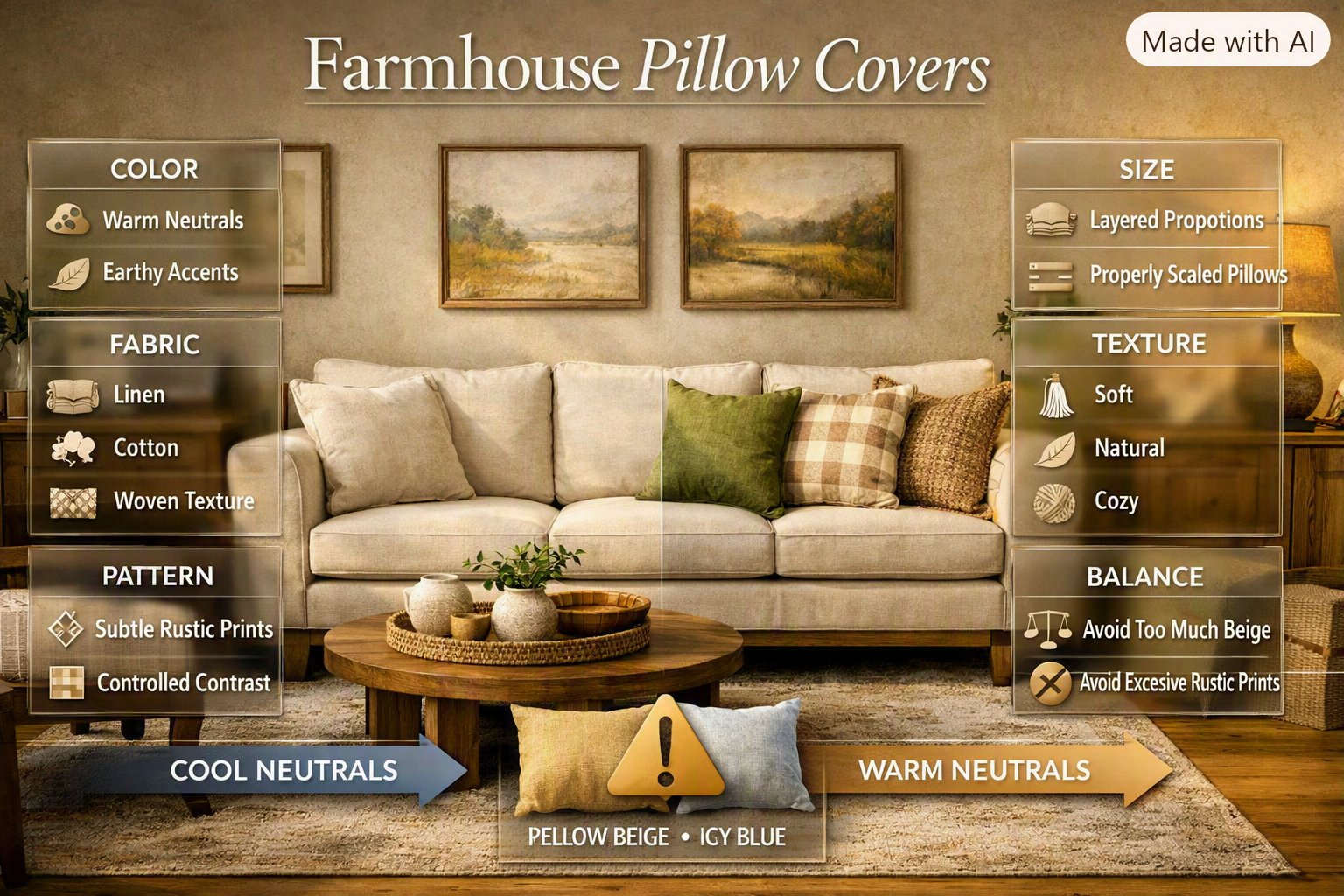
Farmhouse Pillow Covers | A beautiful sofa can still feel unfinished when something is missing from the smaller details. You may have the right furniture, a warm rug, attractive lighting, and carefully chosen wall colors, yet the room can still look a little flat. One of the easiest ways to change that feeling is with the right farmhouse pillow covers.
Farmhouse pillow covers aren’t simply decorative fabric pieces. When chosen thoughtfully, they can introduce texture, soften strong furniture lines, connect different colors in a room, and create the relaxed character that makes farmhouse interiors feel comfortable and lived-in.
The challenge is knowing which colors, fabrics, patterns, sizes, and combinations actually work. Too many rustic prints can make a room feel themed. Too much beige can make it look dull. And pillows that are too small, too flat, or poorly coordinated can make even a beautiful sofa look unfinished.
This guide explains how to choose farmhouse pillow covers for different rooms, how to combine patterns and textures, which colors work best, how many pillows to use, what mistakes to avoid, and how to create a farmhouse look that feels authentic rather than overly decorated.
If you’re building a complete interior rather than making a small pillow update, you can also explore DesignMode24 Interior Design for broader decorating inspiration and room-by-room ideas.
What Are Farmhouse Pillow Covers?
Farmhouse pillow covers are removable decorative covers designed to complement the relaxed, natural, comfortable character of farmhouse interiors. They commonly feature neutral or muted colors, natural-looking materials, simple patterns, rustic textures, vintage-inspired details, checks, stripes, plaid, botanical designs, and understated decorative elements.
The important word is understated.
A farmhouse pillow doesn’t need to show a barn, cow, rooster, or large rustic quote to look farmhouse. In many well-designed interiors, the farmhouse character comes primarily from the combination of material, color, texture, and pattern.
Typical farmhouse pillow covers may include:
- Cotton
- Linen
- Linen blends
- Canvas
- Woven fabrics
- Chenille
- Textured upholstery fabrics
- Buffalo check
- Gingham
- Ticking stripes
- Plaid
- Botanical prints
- Muted floral patterns
- Neutral solids
- Vintage-inspired designs
- Fringe or piping
- Simple embroidery
The best choices depend on the room and the type of farmhouse style you’re trying to create.
Traditional farmhouse tends to be warmer and more rustic, while modern farmhouse usually uses cleaner patterns, stronger contrast, and fewer decorative elements.
Why Are Farmhouse Pillow Covers So Popular?
The popularity of farmhouse pillow covers comes partly from their flexibility.
You don’t need to replace a sofa, repaint a room, or buy an entirely new furniture collection to refresh your space. Changing a few pillow covers can alter the visual character of the room surprisingly quickly.
They are especially useful when:
- Your sofa feels too plain.
- Your living room lacks texture.
- Your neutral furniture needs contrast.
- You want seasonal decoration without buying new furniture.
- You want to soften modern furniture.
- You want to introduce farmhouse character gradually.
- You want an inexpensive room refresh.
- You want removable covers that can be washed or stored.
Another advantage is flexibility. You can keep the same pillow inserts throughout the year and simply change the covers.
For example, a cream linen insert can work with a sage botanical cover in spring, a faded blue stripe during summer, a rust plaid in fall, and a charcoal woven cover in winter.
That makes pillow covers a practical decorating tool rather than a one-season purchase.
What Makes a Farmhouse Pillow Cover Look Authentic?
The strongest farmhouse interiors don’t depend on a single decorative item. Instead, they create a consistent visual language.
A farmhouse pillow cover usually feels authentic when it combines several of these characteristics:
- Natural-looking texture
- Muted colors
- Relaxed fabric
- Simple pattern
- Slightly imperfect or organic appearance
- Comfortable proportions
- Subtle vintage influence
- Connection to other materials in the room
For example, a cream linen pillow with a simple black stripe can feel more authentically farmhouse than a pillow covered in five different rustic symbols.
The reason is simple: farmhouse style is fundamentally about comfort, practicality, natural materials, and understated character.
The Difference Between Rustic and Farmhouse
Rustic and farmhouse styles overlap, but they aren’t identical.
Rustic interiors often emphasize rough wood, rugged materials, darker colors, and visibly aged surfaces.
Farmhouse interiors can be lighter, softer, and more approachable.
A rustic pillow might use:
- Dark brown
- Heavy canvas
- Rough woven fabric
- Leather details
- Strong plaid
A farmhouse pillow might instead use:
- Cream linen
- Soft beige
- Faded blue
- Simple ticking stripe
- Small botanical pattern
Understanding this distinction helps prevent your room from becoming unnecessarily heavy.
Which Colors Work Best With Farmhouse Pillow Covers?
Color is one of the most important decisions because pillows often sit directly against large pieces of furniture.
The most versatile farmhouse palette includes warm neutrals and a few muted accent colors.
Cream and Warm White
Cream is one of the safest farmhouse colors because it works with wood, leather, painted furniture, and neutral upholstery.
Use cream when you want:
- A soft appearance
- A brighter room
- A timeless foundation
- Easy coordination with other colors
Warm white is usually more forgiving than stark white because it feels softer and more natural.
Beige and Oatmeal
Beige and oatmeal are excellent for layered neutral interiors.
They work especially well when combined with:
- Natural wood
- White walls
- Brown leather
- Black accents
- Woven baskets
- Linen curtains
The key is to vary texture.
Three beige pillows in identical smooth fabric may look boring. Three beige pillows in linen, woven fabric, and subtle stripe can look sophisticated.
Black
Black is particularly effective in modern farmhouse interiors.
A black ticking stripe, black piping, or black-and-cream check can give a neutral sofa definition.
However, black works best as an accent.
If every pillow is black and white, the room can start feeling more graphic than relaxed.
Muted Blue
Faded blue, denim blue, dusty blue, and muted navy work beautifully with farmhouse interiors.
Blue is especially effective when your room contains:
- Cream
- White
- Natural oak
- Walnut
- Tan leather
- Beige upholstery
It adds color without destroying the calm quality of the palette.
Sage and Olive
Muted green shades bring an organic feeling into the room.
Sage works particularly well with:
- Linen
- Natural wood
- Cream
- Beige
- Soft brown
- Botanical prints
If your room already contains plants, sage pillow covers can create a subtle connection between the textiles and greenery.
Rust and Terracotta
These warmer colors are particularly useful for fall-inspired farmhouse decorating.
Use them carefully because they are stronger than beige or cream.
One rust lumbar pillow can be enough to warm an otherwise neutral sofa.
How Do You Mix Farmhouse Pillow Patterns?
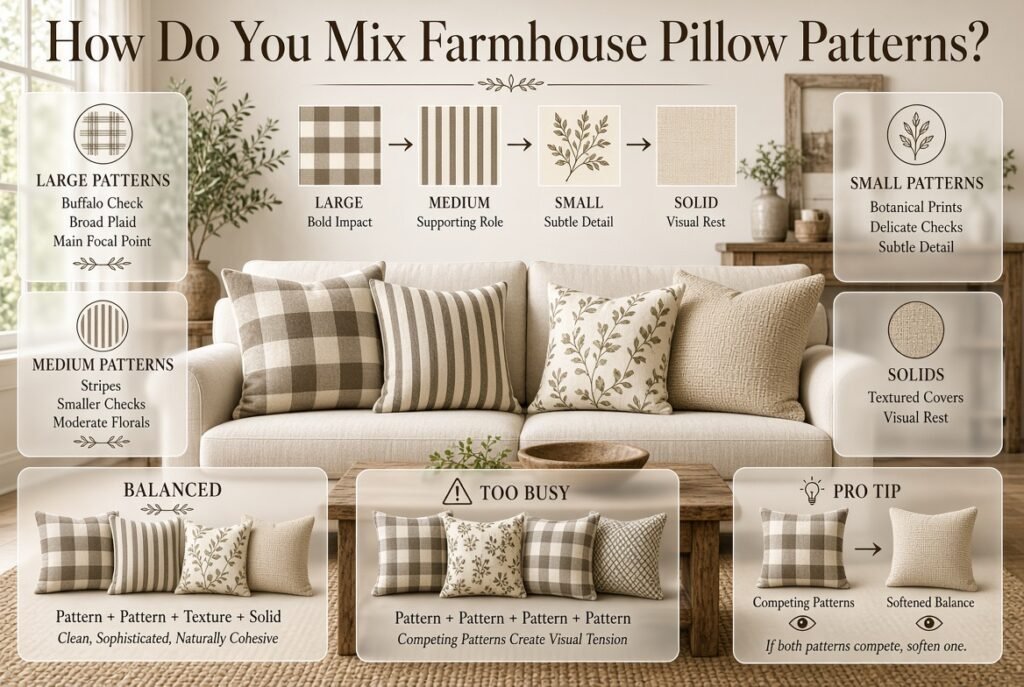
Pattern mixing is where many decorating attempts go wrong.
The easiest professional approach is to vary pattern scale.
Instead of using several large patterns together, create a hierarchy.
For example:
Large check → medium stripe → small botanical → solid texture
This gives the eye different levels of visual activity.
Large Patterns
Large buffalo checks and broad plaid patterns should usually be treated as focal patterns.
Use one as the main visual statement.
Medium Patterns
Medium stripes, smaller checks, or moderate floral designs work well as supporting patterns.
Small Patterns
Small-scale botanical prints or delicate checks provide detail without competing with the main pillow.
Solids
Solid textured covers give the eye somewhere to rest.
This is why a successful arrangement often looks something like:
Pattern + Pattern + Texture + Solid
rather than:
Pattern + Pattern + Pattern + Pattern
💡 Pro Tip: If you’re unsure whether two farmhouse pillow covers work together, place them next to each other in natural light. If your eye immediately jumps between both patterns, one of them is probably too strong.
What Are the Best Farmhouse Pillow Patterns?
Certain patterns have become closely associated with farmhouse decorating because they’re versatile and easy to combine.
Buffalo Check
Buffalo check is bold and recognizable.
It works particularly well on:
- Large sofas
- Farmhouse benches
- Accent chairs
- Fall decorating
Because the pattern is strong, balance it with solid or lightly patterned pillows.
Gingham
Gingham is softer and more delicate than buffalo check.
It works well when you want farmhouse character without a heavy rustic appearance.
Ticking Stripe
Ticking stripe is one of the most useful farmhouse patterns because it is visually simple.
It can be combined with:
- Plaid
- Buffalo check
- Botanical prints
- Solid linen
- Woven textures
Plaid
Plaid creates warmth and works especially well in bedrooms and fall or winter arrangements.
Muted plaid generally looks more sophisticated than very bright plaid.
Botanical Prints
Botanical patterns add an organic quality.
Leaves, branches, grasses, and faded floral motifs can bring softness to a room filled with hard furniture surfaces.
Vintage-Inspired Florals
Small faded floral patterns can work beautifully in cottage farmhouse and traditional farmhouse rooms.
Use them carefully if your furniture is already heavily patterned.
What Fabrics Are Best for Farmhouse Pillow Covers?
The fabric can completely change how a pattern looks.
A bold design printed on smooth synthetic fabric can feel mass-produced, while the same color combination on textured linen or woven cotton can feel much more sophisticated.
Linen
Linen is one of the best choices for relaxed farmhouse interiors.
It provides:
- Natural texture
- Soft visual movement
- Casual elegance
- Breathability
- A slightly imperfect appearance
Linen also works well as a neutral foundation.
Cotton
Cotton is practical and versatile.
It’s particularly useful for:
- Stripes
- Checks
- Botanical prints
- Everyday pillows
- Frequently used seating
Canvas
Canvas has a stronger, more utilitarian appearance.
It works especially well when you want a rustic farmhouse feel.
Because it is relatively structured, canvas can also help pillows maintain their shape.
Woven Fabrics
Woven pillow covers are excellent for adding depth without introducing another strong color.
Look for:
- Ribbed textures
- Basket-weave designs
- Subtle geometric patterns
- Natural fibers
- Chunky woven surfaces
⭐ Expert Tip: When the room already has several patterns, introduce a textured solid rather than another print. Texture can provide visual interest without adding more visual noise.
How Many Farmhouse Pillows Should You Use on a Sofa?
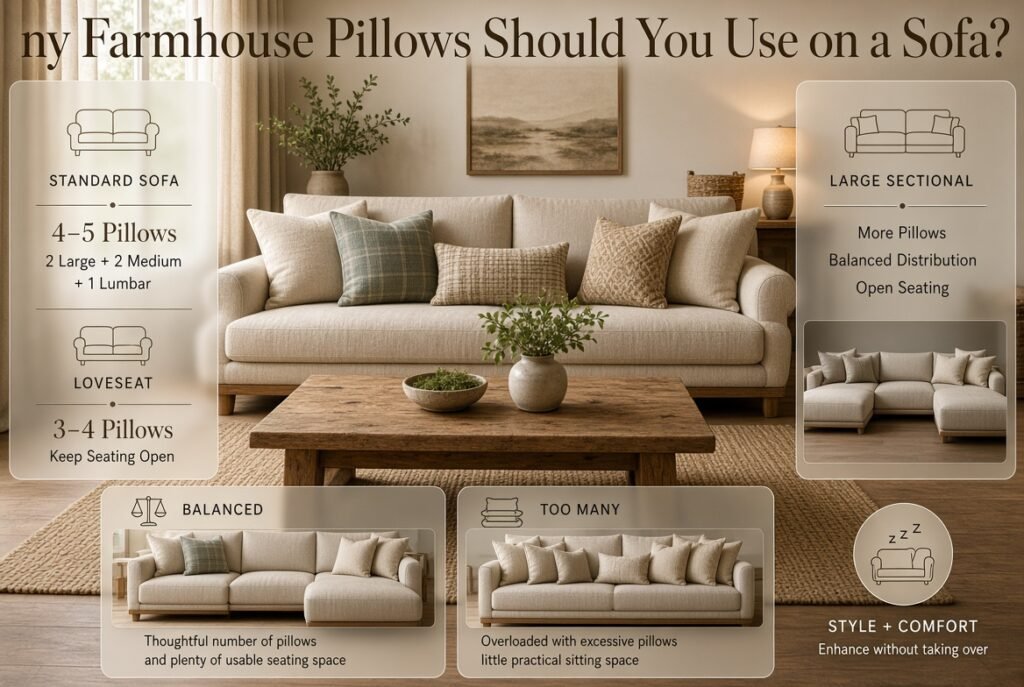
There is no universal number, but a standard sofa often works well with four or five decorative pillows.
A useful starting arrangement is:
- Two large pillows at the back
- Two medium pillows in front
- One smaller lumbar pillow
For a loveseat, three or four may be enough.
For a large sectional, you can use more, but the arrangement should still leave enough open seating.
A common mistake is treating every empty section of the sofa as a place that needs another pillow.
The sofa should remain comfortable.
If guests have to move six pillows every time they sit down, the arrangement is decorative rather than functional.
Which Pillow Sizes Work Best?
Size should relate to the furniture.
For a large sofa, oversized square pillows can create a more substantial and comfortable appearance.
Common sizes include:
- 18 × 18 inches
- 20 × 20 inches
- 22 × 22 inches
- 24 × 24 inches
- Lumbar shapes such as 12 × 20 inches or similar proportions
The exact size isn’t as important as the relationship between sizes.
A useful layering formula is:
Large → medium → small/lumbar
This creates depth.
If every pillow is exactly the same size, the arrangement can look flat and repetitive.
How Do You Style Farmhouse Pillow Covers on a Sofa?
Start with the furniture rather than the pillows.
Look at:
- Sofa color
- Upholstery texture
- Sofa dimensions
- Room size
- Rug pattern
- Curtain color
- Wall color
- Existing accents
Then build your arrangement.
Step 1: Choose a Base Neutral
Start with cream, oatmeal, beige, taupe, or soft gray.
This gives you a foundation.
Step 2: Add One Accent Color
Choose one accent such as:
- Black
- Sage
- Dusty blue
- Brown
- Rust
Don’t introduce several unrelated accent colors immediately.
Step 3: Choose the Main Pattern
Select one pillow that gets the most attention.
A large check or plaid can perform this role.
Step 4: Add a Secondary Pattern
Choose something quieter.
A ticking stripe is ideal because it rarely competes with larger patterns.
Step 5: Add Texture
Finish with a woven, linen, canvas, or textured solid.
Step 6: Evaluate From Across the Room
Don’t judge the arrangement only from close range.
Step back.
The room should read as one composition rather than a collection of individual pillows.
How Do You Style Farmhouse Pillows on a Bed?
A farmhouse bedroom usually benefits from softer layering than a living room.
Begin with the functional sleeping pillows.
Then add larger decorative pillows behind the main arrangement.
A practical structure is:
Sleeping pillows → Euro pillows → decorative squares → lumbar
Keep the colors related to the bedding.
For example, a white or cream duvet can support:
- Oatmeal linen
- Faded blue stripe
- Sage botanical
- Small check
- Natural woven lumbar
This creates depth without making the bed feel excessively decorated.
If you’re redesigning the whole bedroom, the broader Interior Design resources can help you coordinate textiles with furniture, lighting, and color.
Can Farmhouse Pillow Covers Work With a Modern Interior?
Yes, and this is one of the most useful ways to use them.
Modern farmhouse isn’t about filling a contemporary room with rustic objects.
Instead, introduce farmhouse elements through:
- Natural fabrics
- Neutral colors
- Simple patterns
- Warm wood
- Soft textures
- Limited decorative details
For example, a contemporary cream sofa can look excellent with:
- Cream linen
- Black ticking stripe
- Muted sage
- One natural woven pillow
There is no need for multiple distressed signs or rustic typography.
This approach creates warmth while keeping the room clean.
Traditional Farmhouse vs Modern Farmhouse Pillow Covers
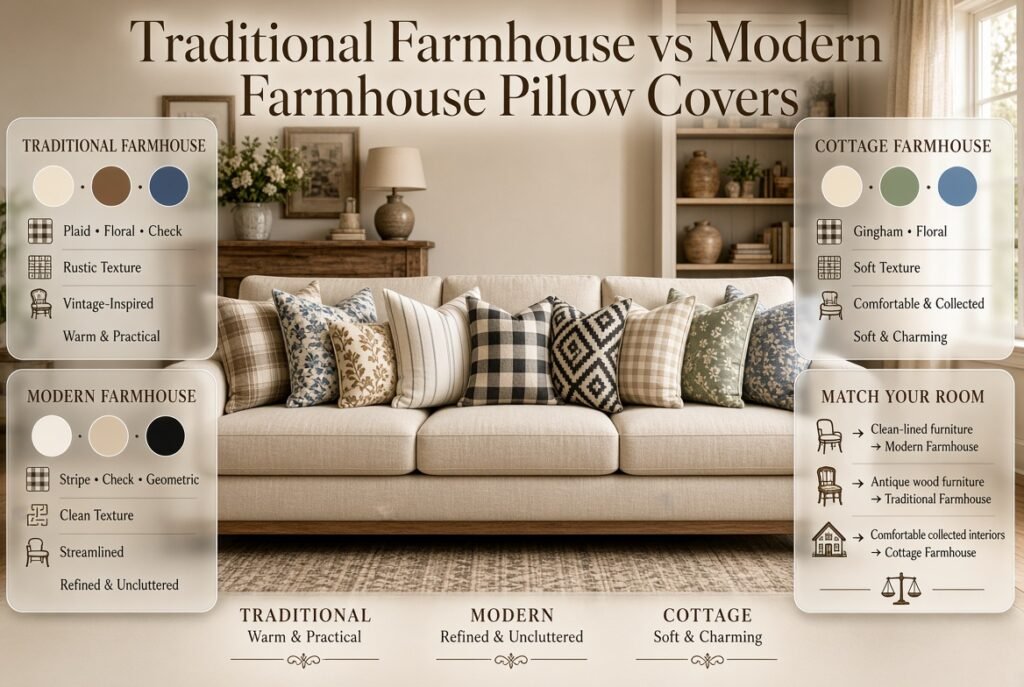
Choosing the right version of farmhouse style makes a major difference.
| Feature | Traditional Farmhouse | Modern Farmhouse | Cottage Farmhouse |
|---|---|---|---|
| Colors | Cream, brown, blue | White, beige, black | Cream, sage, dusty blue |
| Patterns | Plaid, floral, check | Stripe, check, geometric | Gingham, floral |
| Texture | Rustic and tactile | Clean and subtle | Soft and relaxed |
| Furniture | Vintage-inspired | Streamlined | Comfortable and collected |
| Overall feeling | Warm and practical | Refined and uncluttered | Soft and charming |
If your home has clean-lined furniture and minimal accessories, modern farmhouse covers will probably work better.
If you have antique wood furniture and traditional accessories, traditional farmhouse patterns may feel more natural.
How Do You Coordinate Pillow Covers With Rugs and Curtains?
Your pillows don’t need to match the rug or curtains exactly.
They need to relate.
Suppose your rug contains cream, brown, and muted blue.
Your pillows might use:
- Cream linen
- Blue ticking stripe
- Brown woven texture
You haven’t copied the rug.
You’ve simply repeated its colors.
This is a much more sophisticated approach.
The same principle applies to curtains.
If your curtains are solid beige, your pillows can introduce a small check or stripe.
If the curtains are already patterned, keep the pillow patterns quieter.
How Do Neutral Throw Pillows Fit Into Farmhouse Decorating?
Neutral pillows are particularly useful because farmhouse interiors often rely on layered neutrals.
Instead of using five different colors, you can create depth with:
- Cream
- Beige
- Oatmeal
- Taupe
- Soft brown
- Warm gray
The trick is texture.
For additional ideas, the Neutral Throw Pillows guide can help when you’re building a softer neutral arrangement.
Neutral doesn’t mean identical.
A cream linen pillow and a beige woven pillow may be nearly the same color but look completely different because their surfaces interact with light differently.
Can You Mix Blue and Green With Farmhouse Pillow Covers?
Absolutely.
Blue and green can create a fresh, natural farmhouse palette when the tones are controlled.
For example:
- Dusty blue
- Sage green
- Cream
- Natural wood
This combination feels organic without becoming overly colorful.
If the blue is cool and clean, use softer neutral companions such as ivory and cool gray.
If the green is warm and earthy, beige, sand, warm cream, and natural wood will usually feel more harmonious.
For more ideas about balancing these colors, explore Blue and Green Pillows.
How Can You Use Farmhouse Pillow Covers in a Room Refresh?
Pillow covers are particularly effective during a small room refresh because they can change the visual balance without major spending.
Start by identifying what’s currently wrong.
Is the room:
- Too plain?
- Too dark?
- Too cold?
- Too coordinated?
- Missing texture?
- Lacking color?
- Visually cluttered?
Then choose covers that solve the actual problem.
For example, if your room is too cold, don’t automatically add more patterns. Add warmer textures and tones.
If it’s too plain, introduce one pattern and one tactile material.
If it’s too busy, remove patterns and use textured solids.
For a broader approach, see the Room Refresh guide.
How Do You Set Up Farmhouse Pillow Arrangements Without Making Them Look Forced?
A natural-looking arrangement usually contains some variation.
Avoid making every pillow perfectly symmetrical.
For example, on a sofa you might place:
Left: large cream + check
Center: small botanical + lumbar
Right: large cream + stripe
The arrangement feels balanced without appearing mechanically identical.
If you’re working through the larger process of arranging your home, the How to Set Up My Home Decor guide can help you think about pillows as part of the entire room rather than isolated accessories.
What Are the Best Farmhouse Pillow Covers for a Small Living Room?
Small rooms need visual control.
Choose:
- Light neutrals
- Smaller patterns
- Simple stripes
- Light linen
- Soft checks
- One darker accent
Avoid using multiple oversized high-contrast pillows.
For example, a small beige sofa might need only:
- One cream textured pillow
- One small black-and-cream check
- One muted sage lumbar
That’s enough to create personality without crowding the furniture.
The goal isn’t to make a small room look empty.
It’s to prevent decorative elements from competing with one another.
How Can You Make Farmhouse Pillow Covers Look More Expensive?
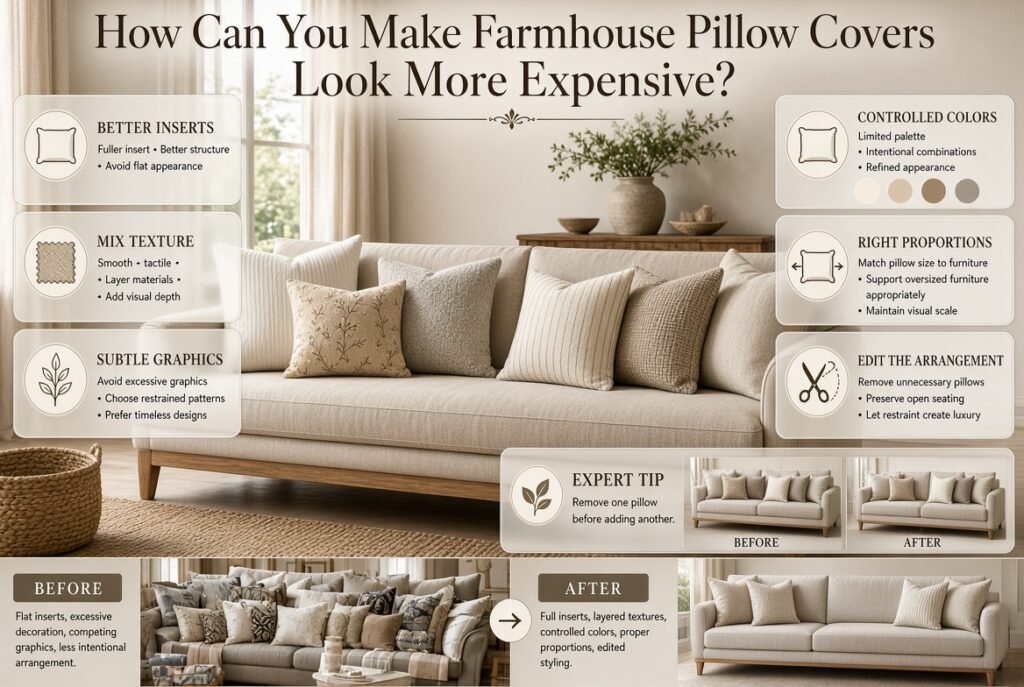
You don’t need designer-priced covers to create an upscale result.
Focus on the details that influence appearance most.
Use Better Inserts
A pillow cover can look cheap when the insert is too small.
A fuller insert gives the pillow structure.
Mix Texture
Combine smooth and tactile materials.
Avoid Excessive Graphics
Subtle patterns usually age better than novelty designs.
Use Controlled Colors
A limited palette feels more intentional.
Choose the Right Proportions
Oversized furniture needs appropriately sized pillows.
Keep the Arrangement Edited
Luxury often comes from restraint.
⭐ Expert Tip: Before buying another pillow, remove one existing pillow from the sofa. If the arrangement suddenly looks cleaner, the problem wasn’t a lack of decoration—it was a lack of editing.
What Farmhouse Pillow Mistakes Should You Avoid?
Mistake 1: Using Too Many Rustic Quotes
One typography pillow can work.
Five of them usually don’t.
The room begins to feel like a themed display instead of an actual home.
Mistake 2: Making Everything Beige
A neutral palette needs contrast.
Introduce texture, black, muted blue, sage, or natural brown.
Mistake 3: Buying Matching Sets
Perfectly matching pillows can make the room look predictable.
Choose coordinated pieces instead.
Mistake 4: Ignoring Pattern Scale
Several large patterns create competition.
Use one dominant pattern and quieter supporting designs.
Mistake 5: Choosing the Wrong Size
Tiny pillows disappear on large furniture.
Huge pillows can overwhelm a small chair.
Mistake 6: Ignoring the Insert
An attractive cover cannot compensate for an undersized, flat insert.
Mistake 7: Prioritizing Decoration Over Comfort
A sofa should still function as a sofa.
Mistake 8: Matching Everything Exactly
Repeating colors is good.
Copying every pattern is not.
⚠ Common Mistake: Many people buy farmhouse pillow covers one at a time because each one looks attractive individually. Always evaluate the complete arrangement before purchasing additional pieces.
How Should You Style Farmhouse Pillows on Accent Chairs?
Accent chairs require fewer pillows.
One substantial pillow may be enough.
For a larger chair, try:
- One 20-inch square
- One smaller lumbar
For a smaller chair, use one lumbar pillow or one medium square.
The chair should remain usable.
If the pillow arrangement pushes the person sitting in the chair forward or reduces back support, the styling has become impractical.
How Do Farmhouse Pillows Work on Benches?
Benches are excellent places for farmhouse textiles.
A long bench can support:
- Two square pillows
- One long lumbar
- A combination of one check and one textured neutral
Because benches are often positioned in entryways, dining spaces, and bedrooms, choose durable fabrics when the area receives heavy traffic.
Canvas and cotton can be particularly practical.
How Do You Use Farmhouse Pillow Covers Seasonally?
You don’t need a completely different collection for every season.
Instead, maintain a permanent neutral base and change one or two accents.
Spring
Use:
- Sage
- Soft blue
- Botanical prints
- Cream linen
Summer
Choose:
- White
- Ivory
- Natural beige
- Lightweight stripes
- Linen
Fall
Introduce:
- Rust
- Camel
- Brown
- Plaid
- Warm oatmeal
Winter
Try:
- Charcoal
- Deep navy
- Cream
- Heavy woven textures
- Muted plaid
This approach saves money and prevents the room from looking like a completely different theme every few months.
How Do You Choose Farmhouse Pillow Covers for Different Sofa Colors?
White Sofa
Almost any farmhouse palette can work.
Try:
- Black and cream
- Beige
- Sage
- Dusty blue
- Natural woven textures
Beige Sofa
Use slightly darker or cooler accents.
Try:
- Charcoal
- Brown
- Faded blue
- Sage
- Cream
Gray Sofa
Consider the gray’s undertone.
Cool gray works well with:
- White
- Blue
- Charcoal
Warm gray works well with:
- Beige
- Cream
- Taupe
- Olive
Brown Leather Sofa
Brown leather looks particularly good with:
- Cream linen
- Oatmeal
- Muted blue
- Sage
- Plaid
- Canvas
The contrast between smooth leather and textured fabric creates visual depth.
How Do Farmhouse Pillow Covers Work With Wood Furniture?
Natural wood is already strongly connected with farmhouse design.
If your room contains oak, pine, reclaimed wood, or walnut, use pillows that support rather than compete with those tones.
Good choices include:
- Cream
- Oatmeal
- Beige
- Olive
- Sage
- Faded blue
- Brown
- Soft black
You can also repeat the wood’s warmth through tan or caramel textiles.
This creates a more unified room.
How Do You Use Farmhouse Pillow Covers Without Overdoing the Theme?
The easiest approach is to let the materials communicate the style.
Instead of buying a pillow with a large farmhouse sign, consider:
- Natural linen
- Woven cotton
- Ticking stripe
- Small check
- Muted botanical
- Neutral canvas
This creates farmhouse character without making the room feel like a themed restaurant or retail display.
The same principle applies to other decorative objects.
A few meaningful pieces usually have more impact than many obvious ones.
If you’re looking for broader decorating ideas, Easy Decorating Tips for Every Budget offers practical ways to refresh a room without relying on expensive changes.
How Can Farmhouse Pillow Covers Support a Complete Interior Design?
Pillows are small, but they shouldn’t be treated as isolated accessories.
Their colors and textures can help connect:
Sofa → Rug → Curtains → Artwork → Lighting → Accessories
For example, if your rug has muted blue, your artwork has warm beige, and your coffee table is natural wood, a farmhouse pillow arrangement can bring those elements together.
This is why a good pillow arrangement can make an entire room feel more cohesive.
If you’re planning a larger design project, DesignMode24 Interior Design provides a useful starting point for exploring broader interior design ideas.
How Can Farmhouse Pillow Covers Be Used in Different Design Styles?
Farmhouse pillows are not restricted to farmhouse interiors.
Modern
Use clean stripes, cream linen, black accents, and simple geometry.
Minimalist
Use fewer pillows and emphasize texture over pattern.
Cottage
Use gingham, faded florals, sage, cream, and soft blue.
Traditional
Use plaid, floral patterns, deeper neutrals, and classic proportions.
Rustic
Choose heavier canvas, brown, charcoal, plaid, and woven materials.
This versatility is one reason farmhouse textiles remain useful even when a homeowner’s style evolves.
How Do You Build a Farmhouse Pillow Collection?
Instead of buying randomly, create a small system.
Start with:
2 neutral solids
Then add:
1 dominant pattern
Then:
1 secondary pattern
Finally:
1 textured accent
For example:
- Cream linen
- Oatmeal woven
- Black buffalo check
- Ticking stripe
- Sage lumbar
These five covers can be rearranged in different ways throughout the year.
This is much more useful than owning ten unrelated decorative pillows.
What Should You Check Before Buying Farmhouse Pillow Covers?
Before purchasing, check:
Size
Make sure the cover fits your insert.
Closure
Zippers generally make changing and washing covers easier.
Fabric
Check whether the material suits the amount of use.
Care Instructions
Don’t assume a decorative cover is machine washable.
Color
Compare the cover with the actual room rather than relying only on an online image.
Pattern Scale
Consider the furniture size.
Insert Quality
A good cover still needs a suitable insert.
Construction
Look for strong seams and a well-finished closure.
These small details can make the difference between a cover that lasts for years and one that quickly loses its shape.
What Makes a Pillow Cover Look Farmhouse?
A farmhouse pillow cover usually combines natural-looking fabric, understated colors, and familiar heritage patterns. The classic choices include linen or cotton textures, ticking stripes, buffalo checks, gingham, windowpane patterns, grain-sack-inspired designs, and muted shades such as cream, beige, oatmeal, soft gray, olive, navy, and warm brown.
The important point is that farmhouse style is not simply about putting a rustic pattern on a pillow. A sophisticated farmhouse room depends on balance. For example, a heavily patterned buffalo-check cover can look attractive when paired with a plain linen cover, but several competing checks and stripes can quickly make the sofa feel visually busy.
Professional styling points:
Choose cotton, linen, linen blends, or visibly textured woven fabrics.
Keep the primary palette warm and relatively restrained.
Use stripes, checks, or plaid as controlled accents rather than covering every pillow.
Mix patterns with solid neutral covers.
Look for subtle texture instead of excessive decorative detailing.
For modern farmhouse interiors, avoid overly literal “country” graphics and novelty slogans.
Expert Tip: The most timeless farmhouse arrangement usually looks collected rather than themed. One distinctive check or stripe can establish the farmhouse character without making the entire room feel like a showroom.
What Colors Are Best for Farmhouse Pillow Covers?
The strongest farmhouse pillow colors are generally warm neutrals and muted earthy tones, including cream, ivory, oatmeal, beige, taupe, soft gray, olive green, muted blue, charcoal, and natural brown. These shades work particularly well because they complement the wood, woven materials, aged finishes, and neutral upholstery commonly associated with farmhouse interiors.
However, you do not need to restrict farmhouse decorating to beige and white. Navy blue, muted green, charcoal, rust, and dusty blue can provide depth while maintaining the relaxed character of the style.
For example, a cream sofa can be layered with:
Cream linen → beige ticking stripe → olive or muted blue accent → textured neutral lumbar
This creates contrast without introducing too many unrelated colors.
Best farmhouse color combinations:
Cream + oatmeal + warm beige
White + natural linen + charcoal
Beige + olive green + ivory
Cream + muted navy + tan
Soft gray + white + natural brown
Warm white + rust + oatmeal
Quick Tip: If your room already contains colorful artwork, rugs, or curtains, use quieter farmhouse pillow covers. If the room is mostly neutral, a muted blue, green, or rust pillow can provide the visual punctuation it needs.
How Do You Style Farmhouse Pillow Covers on a Sofa?
The easiest way to style farmhouse pillow covers is to layer different sizes, textures, and pattern scales while keeping the color palette connected. Start with larger neutral pillows at the back, add one or two patterned farmhouse covers in the middle, and finish with a smaller lumbar or textured accent pillow in front.
A common mistake is treating every pillow as an independent decoration. Instead, think of the arrangement as one composition.
For example:
Back: 22-inch cream or oatmeal pillows
Middle: 20-inch ticking stripe or subtle plaid covers
Front: 12 × 20-inch textured lumbar
Accent: Small muted green, navy, or rust pillow
Current designer guidance on throw-pillow styling also emphasizes scale, proportion, layered textures, and mixing solids with patterns rather than simply adding as many pillows as possible.
Professional styling rules:
Use larger pillows toward the back.
Combine solid, striped, checked, and textured fabrics carefully.
Keep repeated colors throughout the arrangement.
Avoid using multiple large-scale patterns together.
Leave enough seating space for the sofa to remain functional.
Use lumbar pillows to break up an overly symmetrical arrangement.
Common Mistake: Buying four different farmhouse patterns because each one looks attractive individually. Together, they may compete for attention. Usually, one dominant pattern + one secondary pattern + one or two solids creates a more polished result.
What Fabric Is Best for Farmhouse Pillow Covers?
Linen, cotton, and linen-cotton blends are among the best choices for farmhouse pillow covers because they naturally support the relaxed, tactile character associated with farmhouse interiors. Linen brings visible texture and a slightly casual appearance, while cotton is practical, comfortable, and available in a wide range of patterns.
A linen-cotton blend can be particularly useful when you want the visual character of linen with some of the practical qualities of cotton. The right choice ultimately depends on how the pillow will be used.
Fabric
Best For
Main Advantage
Linen
Decorative living rooms
Natural texture
Cotton
Everyday use
Comfortable and practical
Linen-cotton blend
Versatile farmhouse styling
Balance of texture and durability
Woven fabric
Rustic or modern farmhouse
Adds visual depth
Velvet
Refined farmhouse
Introduces softness and contrast
If the pillows are primarily decorative, prioritize texture and appearance. For a busy family room, durability and easy maintenance become equally important.
Expert Tip: Always check the care instructions before buying. A beautiful pillow cover that requires inconvenient cleaning may become frustrating when used in a high-traffic living space.
Are Buffalo Check and Ticking Stripe Pillow Covers Still in Style?
Yes. Buffalo check, ticking stripe, windowpane, gingham, and other restrained heritage patterns remain strong choices for farmhouse interiors, particularly when they are used thoughtfully rather than excessively. Current farmhouse collections continue to feature these patterns alongside neutral linen and woven textures.
The key distinction is between classic pattern language and overly themed décor. A black-and-cream buffalo check can look timeless when balanced with solid linen pillows and natural materials. But covering an entire sofa in identical buffalo-check pillows can make the room feel dated or overly literal.
Ticking stripes are particularly versatile because their narrow, understated lines provide pattern without dominating the composition. They can work with farmhouse, transitional, coastal, and even contemporary interiors.
Best ways to use classic farmhouse patterns:
Pair buffalo check with solid cream or oatmeal.
Combine ticking stripe with textured neutral fabrics.
Use windowpane patterns for a more contemporary farmhouse appearance.
Introduce muted blue or olive instead of relying exclusively on black.
Keep one dominant pattern and let the surrounding pillows support it.
Professional Recommendation: If you want farmhouse décor that will still look attractive several years from now, prioritize natural fabrics, subtle texture, restrained color, and classic patterns over highly literal farmhouse graphics. That approach gives you the warmth of farmhouse style without making the room feel locked into one decorating trend.
Conclusion
Farmhouse pillow covers are one of the easiest ways to introduce warmth, texture, and character into a room without changing major furniture or making an expensive renovation. The best results come from choosing covers that feel natural rather than overly themed—think linen and cotton textures, warm neutrals, muted earthy colors, ticking stripes, subtle checks, and carefully selected rustic patterns.
The key is balance. Instead of filling your sofa with matching farmhouse designs, combine solid neutrals with one or two understated patterns, vary pillow sizes, and repeat a few colors already present in the room. This creates a layered look that feels comfortable and intentional rather than crowded.
Whether your home leans toward traditional farmhouse, modern farmhouse, rustic, or transitional design, the right pillow covers can connect furniture, rugs, curtains, wood finishes, and accessories into one cohesive composition. Choose quality fabrics, consider how the pillows will actually be used, and prioritize timeless texture over short-lived decorative trends. With these principles, farmhouse pillow covers can remain a practical and stylish part of your interior for years to come.

Leave a Reply