
Introduction
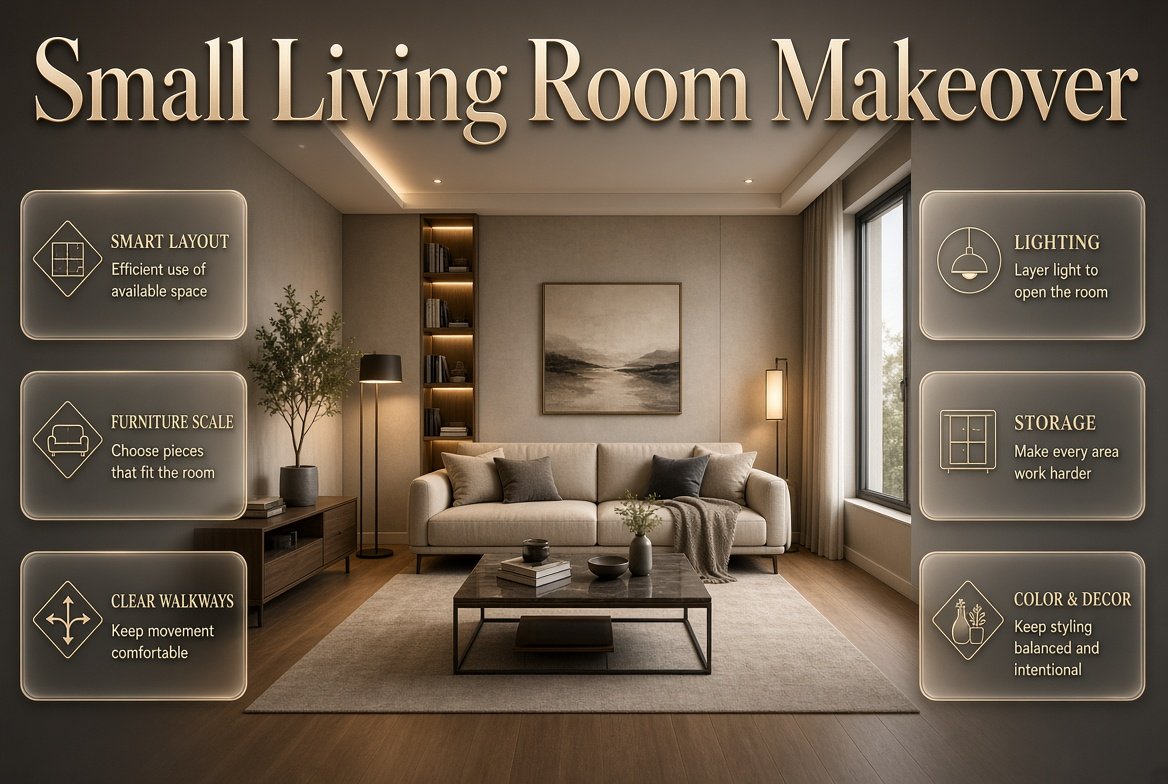
Small Living Room Makeover | A small living room can feel difficult to decorate because every decision has a visible impact. A sofa that’s only slightly too large can block the walkway. A coffee table that’s too bulky can make the room uncomfortable. Even too many decorative objects can make an otherwise attractive space feel crowded.
But a compact room isn’t automatically a design problem.
With a thoughtful small living room makeover, you can create a space that feels open, comfortable, stylish, and genuinely useful. The trick isn’t to make the room look empty. It’s to make the available space work harder.
A good makeover starts with the way you live in the room. From there, furniture proportions, layout, lighting, wall color, storage, textiles, and decoration should support that purpose rather than compete with it.
If you’re looking for broader home design inspiration, the DesignMode24 Interior Design homepage is a useful starting point for exploring different approaches to interiors, decorating, and home improvement.
This guide explains how to plan a small living room makeover from the ground up, including furniture selection, layout ideas, color schemes, lighting, storage, styling, budget improvements, common mistakes, and practical solutions for awkward spaces.
What Is the Best Way to Approach a Small Living Room Makeover?
The best approach is to solve functional problems before making decorative changes. Measure the room, identify how it is used, establish a clear furniture layout, and remove anything that interferes with movement. Then introduce appropriate colors, lighting, storage, textiles, and accessories.
This order matters.
If you buy cushions, artwork, shelves, and decorative objects before solving the layout, you may end up decorating around a problem rather than fixing it.
A practical sequence is:
Measure → Declutter → Plan → Position → Furnish → Light → Organize → Decorate
Each stage should make the next one easier.
How Do You Know What Your Small Living Room Actually Needs?
Before changing anything, spend a few days observing how the room is used.
Ask yourself:
- Where do people normally sit?
- Where do they walk when entering?
- Is the television used every day?
- Do you regularly entertain guests?
- Do children use the room?
- Do you work from the sofa?
- Is additional storage genuinely necessary?
- Does the room need to perform more than one function?
- Which furniture is rarely used?
These questions reveal the difference between what the room contains and what the room actually needs.
For example, a compact living room may contain a sofa, two chairs, a large coffee table, a console, a television cabinet, several baskets, and a floor lamp. If the household mainly uses the sofa and television, removing one chair and replacing the oversized cabinet may improve the room more than buying new decorative accessories.
Start With a Room Audit
Create three categories:
| Keep | Change | Remove |
|---|---|---|
| Comfortable sofa | Oversized table | Unused chair |
| Useful lamp | Bulky cabinet | Excess decor |
| Favorite artwork | Heavy curtains | Duplicate storage |
| Practical storage | Poorly placed rug | Broken accessories |
This simple exercise prevents unnecessary spending.
💡 Pro Tip: Don’t automatically replace furniture just because you’re starting a makeover. Sometimes the most successful transformation comes from repositioning what you already own.
For practical renovation and improvement ideas, you can also explore Practical Home Improvement Guides.
How Should You Measure a Small Living Room?
Measure the full room before choosing furniture. Record the length and width, then note doors, windows, radiators, built-in cabinets, outlets, vents, and other fixed features that influence furniture placement.
Don’t stop at the room dimensions.
Measure:
- Door opening width
- Window height
- Distance between doors and corners
- Available wall length
- Ceiling height
- Existing furniture
- TV location
- Heating or cooling equipment
Also measure the route the furniture must take to reach the room.
A sofa might technically fit inside the living room but fail to pass through a narrow doorway or staircase.
Create a Simple Floor Plan
You can sketch the room on paper.
┌───────────────────────────┐
│          WINDOW           │
│                           │
│       ┌───────────┐       │
│       │   SOFA    │       │
│       └───────────┘       │
│                           │
│      ┌───────────┐        │
│      │   TABLE   │        │
│      └───────────┘        │
│                           │
│ TV / MEDIA          DOOR  │
└───────────────────────────┘
Make several versions before deciding.
A few minutes spent moving rectangles around on paper can prevent an expensive furniture mistake.
How Do You Choose the Right Sofa for a Small Living Room?
Choose the largest sofa that fits the room comfortably without compromising circulation. Pay attention not only to width but also to depth, arm thickness, seat height, and the visual weight of the frame.
A sofa with very thick arms can consume several inches of usable seating width.
A deep sofa can also make a narrow room feel congested.
Look for These Features
For many compact rooms, useful sofa characteristics include:
- Slim arms
- Moderate seat depth
- Raised legs
- Simple silhouettes
- Light or medium visual weight
- Durable upholstery
- Removable or washable covers when appropriate
A compact sofa doesn’t have to look cheap or uncomfortable.
The goal is efficient proportion, not miniature furniture.
Should You Choose a Sectional?
A small sectional can be excellent when the room has a usable corner.
It may provide more seating than a sofa and chair combination while using the corner efficiently.
However, avoid choosing a sectional simply because it offers more seats on paper.
Check:
- Overall width
- Chaise depth
- Walking clearance
- Door opening
- Window access
- TV viewing position
⚠ Common Mistake: Measuring only the sofa’s width. Depth can be the real space killer in a compact living room.
What Is the Best Layout for a Small Living Room?
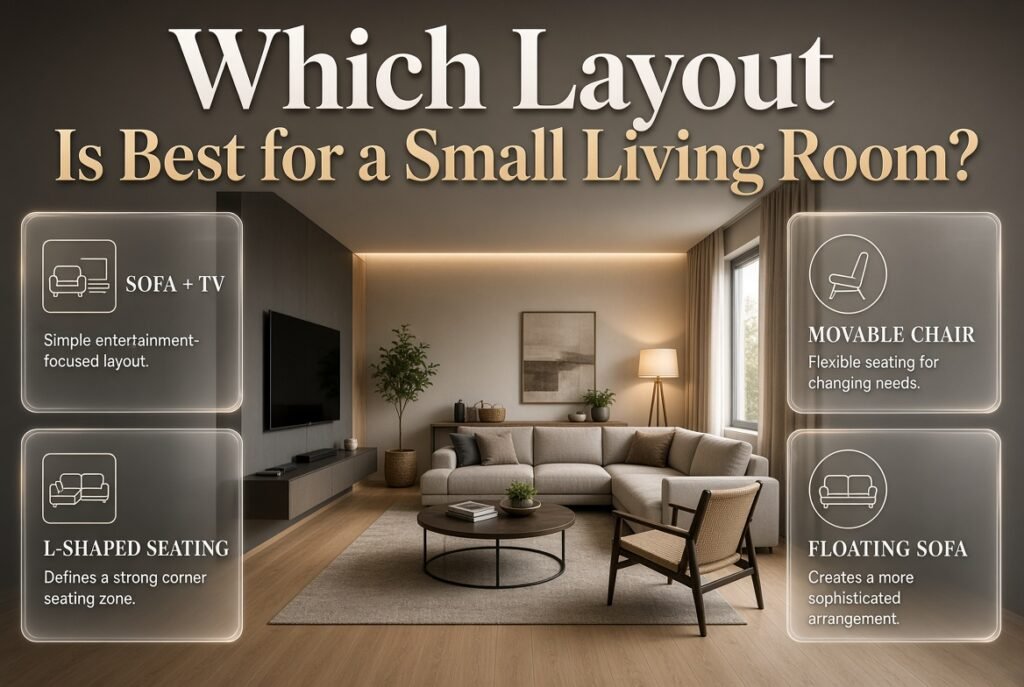
The best layout depends on the room’s shape, entrances, windows, focal point, and how the space is used. In most cases, the priority should be a clear circulation route, comfortable viewing angles, and a seating arrangement that doesn’t force furniture into unnecessary corners.
Layout 1: Sofa Facing the TV
This is the simplest option for households that primarily use the room for entertainment.
WINDOW

┌───────────────┐
│     SOFA      │
└───────────────┘

      TABLE

┌───────────────┐
│      TV       │
└───────────────┘
Keep the coffee table proportionate to the sofa and leave enough room to move around it.
Layout 2: L-Shaped Seating
An L-shaped arrangement can work well when the room has one strong corner.
It creates a defined seating zone without requiring a separate chair.
Layout 3: Sofa + Movable Chair
If flexibility is important, use a sofa with one lightweight occasional chair.
The chair can move when guests arrive or when you need more open floor space.
Layout 4: Floating Sofa
In a slightly larger small living room, pulling the sofa away from the wall can create a more sophisticated arrangement.
The space behind the sofa can accommodate:
- A narrow console
- A floor lamp
- Decorative baskets
- Plants
- Artwork
However, don’t float furniture simply because interior design photographs show it.
If the room is extremely narrow, keeping the sofa against the wall may be more practical.
How Much Walking Space Should a Small Living Room Have?
A living room should have a clear and comfortable route between frequently used areas. Exact clearance depends on the room and furniture, but the practical rule is to avoid forcing people to turn sideways, step over furniture, or squeeze between large pieces.
Think about movement before appearance.
A beautiful coffee table isn’t useful if everyone hits their knees against it.
A stylish chair isn’t helpful if it blocks the doorway.
A decorative basket shouldn’t sit in the natural route from the entrance to the sofa.
📌 Quick Tip: Walk through your proposed layout several times before buying anything. Physically testing the route can reveal problems that a floor plan doesn’t show.
How Can You Make a Small Living Room Look Bigger With Color?
Use a controlled color palette so large surfaces don’t compete visually. Soft neutrals, warm whites, light beige, pale greige, muted greens, and soft blues can create an open appearance, but darker colors can also work when used deliberately.
The important factor isn’t simply choosing white.
It’s creating visual continuity.
For example:
- Warm white walls
- Cream curtains
- Beige sofa
- Light oak furniture
- Soft neutral rug
These elements visually connect rather than creating multiple hard boundaries.
Try a Tonal Color Scheme
A tonal scheme uses several shades from the same family.
For example:
Wall: Soft beige
Sofa: Warm taupe
Rug: Cream
Curtains: Ivory
Accent: Muted brown
This approach creates depth without making the room feel fragmented.
For more ideas about choosing and coordinating colors, explore Paint Color inspiration.
Can You Use Dark Colors in a Small Living Room?
Yes. Dark colors can create depth, sophistication, and a strong focal point. The key is controlling where the darker shade appears and balancing it with lighting and surrounding materials.
A deep navy wall behind the television can make the screen visually blend into the background.
A dark green wall behind a sofa can create a dramatic backdrop.
Charcoal can give a modern living room a sophisticated character.
The mistake is assuming that every surface needs to be dark.
Use contrast intentionally.
Should You Use an Accent Wall in a Small Living Room?
An accent wall can be effective when it gives the room a clear focal point. The strongest candidate is usually a wall that already has an important function, such as the wall behind the sofa, fireplace, or television.
Good accent-wall approaches include:
- Paint
- Subtle wallpaper
- Wood slats
- Limewash-style finishes
- Textured panels
- Decorative molding
Don’t create an accent wall merely because one wall feels empty.
Ask what the wall contributes to the overall composition.
For DIY-friendly decorating projects, DIY Home Projects can provide additional inspiration.
How Can Lighting Improve a Small Living Room?
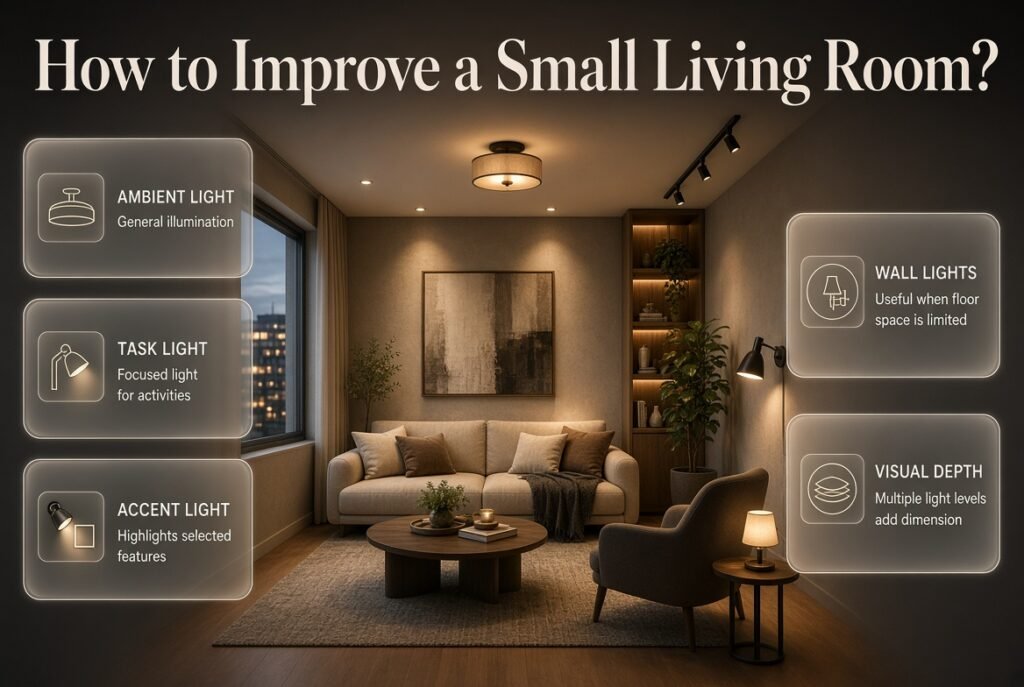
Lighting should create several levels of illumination instead of relying on one central ceiling fixture. A combination of ambient, task, and accent lighting makes the room more comfortable and visually dimensional.
Layer 1: Ambient Light
This provides general illumination.
Examples include:
- Ceiling fixtures
- Recessed lighting
- Track lighting
Layer 2: Task Light
Task lighting helps with specific activities.
Examples include:
- Reading lamps
- Desk lamps
- Adjustable wall lights
Layer 3: Accent Light
Accent lighting draws attention to selected features.
Use it for:
- Artwork
- Shelving
- Architectural details
- Plants
- Textured walls
Use Wall-Mounted Lighting
When floor space is limited, wall lights can be especially useful.
They provide illumination without taking up valuable floor area.
For more ideas, see Lighting and Ceiling Ideas.
Do Mirrors Make a Small Living Room Look Larger?
A well-positioned mirror can make a compact room feel brighter and deeper by reflecting light and parts of the room. Its placement matters more than simply adding a mirror to an empty wall.
Try placing one:
- Opposite a window
- Near a lamp
- Above a console
- Behind a seating area
- Across from an attractive architectural feature
Avoid covering the room with mirrors.
One large, intentional mirror often has more impact than several small decorative ones.
What Is the Best Coffee Table for a Small Living Room?
The best coffee table is one that provides the required surface without disrupting movement. Round and oval tables are useful in tight spaces because their curved edges can make circulation easier.
Round vs. Rectangular
| Feature | Round/Oval | Rectangular |
|---|---|---|
| Movement | Easier around edges | More structured |
| Best shape | Compact or awkward rooms | Long rooms |
| Visual weight | Often lighter | More substantial |
| Seating relationship | Flexible | Strong with sofas |
| Storage | Usually limited | More options |
Nesting tables are another smart option.
Use one table normally and separate the second when guests need additional surfaces.
How Do You Choose the Right Rug?
Choose a rug large enough to visually connect the major seating pieces. A rug that’s too small can make furniture look disconnected and can actually emphasize the room’s limited dimensions.
Ideally, the rug should relate to the front legs of the sofa and chairs.
Avoid choosing a tiny rug simply because the room is small.
Good Rug Choices
Consider:
- Low-pile rugs
- Subtle patterns
- Warm neutrals
- Soft geometric designs
- Natural textures
- Easy-clean materials
If you’re changing the floor at the same time, Flooring and Wall Design Inspiration can help you coordinate the floor with the rest of the room.
How Can Curtains Make a Small Living Room Look Taller?
Install curtains higher than the window frame when practical and allow the fabric to extend close to the floor. This draws attention upward and can create a stronger sense of vertical height.
Choose curtains that complement the wall instead of creating a heavy horizontal division.
For a clean appearance:
- Avoid very short curtains
- Keep patterns controlled
- Use full-length panels
- Let daylight enter when possible
- Avoid bulky curtain hardware
If privacy allows, opening curtains fully during daylight can make a noticeable difference.
How Can You Add Storage Without Making the Room Crowded?
Use storage that occupies vertical or hidden space. Floating cabinets, tall shelving, built-ins, storage ottomans, and furniture with concealed compartments can reduce visible clutter without consuming unnecessary floor area.
Use the Walls
Vertical storage can hold:
- Books
- Small electronics
- Decorative objects
- Baskets
- Games
- Everyday items
But don’t turn every wall into shelving.
Storage should respond to a real need.
Mix Open and Closed Storage
Open shelves are best for things you want to display.
Closed cabinets are better for things you don’t want to see.
This simple distinction makes a huge difference.
For more ideas, explore Smart Storage and Organization Ideas.
How Can You Hide Everyday Clutter?
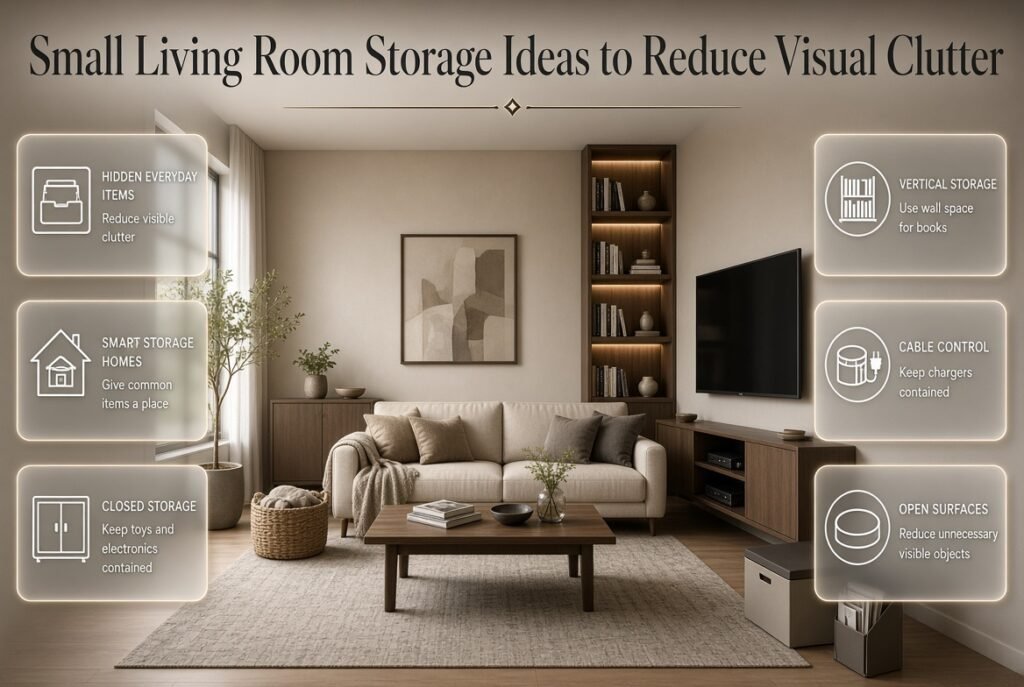
Small rooms become visually messy quickly because there isn’t much empty space to absorb disorder.
Create a home for common items.
For example:
| Item | Storage Solution |
|---|---|
| Remote controls | Small drawer |
| Blankets | Storage basket |
| Toys | Closed cabinet |
| Books | Vertical shelf |
| Chargers | Cable box |
| Magazines | Slim magazine holder |
| Small electronics | Media cabinet |
The goal isn’t perfect organization.
It’s reducing the number of objects that remain visible when the room isn’t being used.
What Furniture Can Serve Multiple Purposes?
Multifunctional furniture is especially valuable when the living room has to perform several jobs.
Consider:
- Storage ottomans
- Sofa beds
- Lift-top coffee tables
- Nesting tables
- Storage benches
- Wall-mounted desks
- Console tables with drawers
A lift-top coffee table, for example, can function as a normal table during the evening and a temporary work surface during the day.
But multifunctionality should be practical.
Don’t buy furniture with complicated mechanisms that you won’t actually use.
How Do You Make a Small Living Room Feel Cozy?
Create coziness through texture, lighting, and comfortable materials rather than filling the room with accessories.
A small room can feel warm with:
- A textured rug
- Soft cushions
- A throw
- Warm lighting
- Natural wood
- Linen or cotton curtains
- One or two plants
- Carefully selected artwork
The trick is controlling quantity.
Three well-chosen textures can create more warmth than twenty decorative objects.
How Can You Make a Small Living Room Look More Expensive?
Luxury comes from consistency and proportion more than the number of expensive items in the room.
Focus on:
- Quality-looking textiles
- Coordinated colors
- Good lighting
- Properly hung curtains
- Clean furniture lines
- Natural materials
- Minimal visual clutter
- One strong focal point
Cheap furniture can look more sophisticated when the surrounding environment is organized.
Likewise, expensive furniture can look disappointing when the room is overcrowded.
⭐ Expert Tip: In compact interiors, negative space has value. Leaving part of a shelf or tabletop empty often makes the entire room look more considered.
For additional ideas, explore Beautiful Interior inspiration.
How Do You Decorate Walls in a Small Living Room?
Choose wall decoration according to scale. One large artwork can often create a stronger effect than a collection of many tiny frames.
Good choices include:
- Large artwork
- Oversized mirror
- Vertical gallery arrangement
- Floating shelves
- Decorative wall molding
- Textured wall treatment
- One large photograph
Avoid placing small artwork too high or spreading tiny objects across every wall.
Create a Visual Anchor
If the sofa is the main feature, artwork above it can establish a relationship between the seating and wall.
If the television dominates the room, a carefully designed media wall can make it feel intentional rather than simply functional.
Should You Use Plants in a Small Living Room?
Yes, but choose plants according to available floor and surface space.
If floor space is limited, consider:
- Hanging plants
- Small shelf plants
- Narrow vertical plants
- Window plants
- One medium-sized floor plant
Avoid filling every corner with greenery.
One healthy, well-positioned plant can create more impact than several struggling plants scattered around the room.
How Do You Make a Small Living Room Work for Guests?
Prioritize flexible seating rather than permanent seating for every possible situation.
A sofa can provide the primary seating.
Then use:
- Lightweight accent chairs
- Poufs
- Ottomans
- Folding stools
- Nesting tables
These pieces can be moved when guests arrive.
If the room is also used for everyday relaxation, flexibility is more valuable than maximizing the theoretical number of seats.
What Should You Do With an Awkward Corner?
An awkward corner doesn’t automatically need furniture.
Possible solutions include:
- A tall plant
- Floor lamp
- Slim shelving
- Reading chair
- Small storage cabinet
- Artwork
- Nothing
Yes, nothing can sometimes be the best choice.
If adding furniture blocks movement or creates visual clutter, leave the corner open.
An empty corner can give the room breathing space.
How Do You Design a Small Living Room on a Budget?

Start with changes that have a large visual effect but don’t require major purchases.
Free Improvements
- Rearrange furniture
- Remove unused pieces
- Declutter shelves
- Change artwork placement
- Reposition lamps
- Open curtains during the day
Low-Cost Improvements
- New cushion covers
- Updated throw
- New lampshades
- Paint
- Plants
- Storage baskets
- Hardware
- Small artwork
Medium Investment
- New rug
- Better lighting
- Compact coffee table
- Improved storage
- New curtains
Major Investment
- Built-in cabinetry
- New flooring
- Custom furniture
- Full furniture replacement
- Renovation work
The best starting point is usually the first category.
For broader budget-friendly inspiration, see Easy Decorating Tips for Every Budget.
What Are the Biggest Small Living Room Makeover Mistakes?
1. Buying Furniture Without Measuring
A showroom doesn’t show you how furniture will behave in your specific room.
Better approach: Measure everything first.
2. Choosing an Oversized Sofa
A large sofa can consume the visual and physical space of the room.
Better approach: Consider depth as seriously as width.
3. Using a Tiny Rug
A tiny rug can make the seating arrangement feel fragmented.
Better approach: Choose a rug that relates properly to the furniture.
4. Filling Empty Corners
Every corner doesn’t need a chair, table, plant, or basket.
Better approach: Keep useful negative space.
5. Using Too Many Colors
Strong contrasts can make a compact room feel visually divided.
Better approach: Build around a controlled palette.
6. Ignoring Lighting
One harsh ceiling fixture rarely creates a comfortable atmosphere.
Better approach: Layer multiple light sources.
7. Displaying Too Much
Open shelves filled with small objects create visual noise.
Better approach: Edit displays regularly.
8. Buying Decorative Items Before Solving Function
A beautiful room that doesn’t work is still a poorly designed room.
Better approach: Solve movement, seating, storage, and lighting first.
How Can You Make a Rental Living Room Look Better Without Major Renovation?
Renters can make substantial changes without permanent construction.
Try:
- Removable wallpaper
- Large rugs
- Freestanding shelving
- Floor lamps
- Plug-in wall lights
- Curtains
- Artwork
- Decorative mirrors
- Cushions
- Plants
- Removable hooks
Furniture arrangement alone can dramatically change the appearance of a rental.
If you’re working on a larger home improvement project, Home Improvement offers additional project ideas.
How Can You Combine a Living Room With a Home Office?
The key is creating visual separation without physically dividing the room.
A compact desk can sit:
- Behind the sofa
- Beside a window
- In an unused corner
- Against a short wall
- Inside a storage unit
Use a consistent material palette so the workspace doesn’t look like a separate room.
A wall-mounted desk can be particularly useful because it takes up little floor space.
At the end of the workday, close storage or clear the desk so the room can return to its primary purpose.
How Do You Make a Small Living Room More Functional for Families?
Choose durable materials and furniture that can tolerate everyday use.
Prioritize:
- Washable fabrics
- Rounded furniture edges
- Closed storage
- Durable rugs
- Easy-clean surfaces
- Accessible storage
A family room should not require constant rearranging just to function.
Keep everyday items within easy reach while providing designated places to put them away.
If you’re exploring design solutions for different users and spaces, Children’s Hotel Furniture provides another perspective on practical, child-focused furniture design.
How Can Seasonal Decorating Work in a Small Living Room?
Seasonal decoration should be temporary and easy to store.
Instead of replacing major furniture, change:
- Cushion covers
- Throws
- Small artwork
- Table accessories
- Decorative branches
- Seasonal textiles
Keep the base palette consistent.
This allows the room to change character without creating storage problems.
For more seasonal inspiration, explore Seasonal Decorating Ideas.
Can Outdoor Inspiration Influence a Small Living Room?
Natural materials can make compact interiors feel calmer and less artificial.
Consider introducing:
- Wood
- Woven textures
- Stone-inspired finishes
- Natural fibers
- Plants
- Organic shapes
You don’t need to turn the living room into an outdoor-themed space.
Instead, borrow the feeling of natural simplicity.
For ideas that connect indoor and outdoor environments, see Garden and Outdoor Living Guides.
How Do You Create a Modern Small Living Room?
Modern design works well in compact spaces because it often relies on clean lines, controlled decoration, and functional furniture.
A modern palette might include:
- Warm white
- Beige
- Greige
- Charcoal
- Natural wood
- Muted green
Use simple silhouettes rather than excessive ornamentation.
But modern doesn’t mean sterile.
Add warmth through:
- Textured fabrics
- Wood
- Soft lighting
- Artwork
- Plants
The result should feel clean but still comfortable.
How Do You Create a Small Living Room That Feels Personal?
Avoid copying an entire showroom.
Instead, identify a few things that genuinely represent your household.
These might include:
- Travel photographs
- Favorite books
- Handmade objects
- Family artwork
- Vintage furniture
- Collected ceramics
- A meaningful rug
The room doesn’t need to be filled with personal objects.
One meaningful piece can tell more of your story than an entire shelf of generic decoration.
For broader ideas tailored to different areas of the home, explore Find Expert Ideas for Every Room in Your Home.
What Is the Professional Order for a Small Living Room Makeover?
A practical professional workflow looks like this:
Step 1: Define the Room’s Main Purpose
Decide whether the room is primarily for:
- Watching TV
- Conversation
- Reading
- Entertaining
- Family activities
- Work
- A combination
Step 2: Measure Everything
Record the room and furniture dimensions.
Step 3: Remove Unnecessary Items
Create visual and physical breathing room.
Step 4: Establish the Main Layout
Position the sofa and largest furniture first.
Step 5: Check Circulation
Walk through the room repeatedly.
Step 6: Add Secondary Furniture
Introduce tables, chairs, cabinets, and storage only where needed.
Step 7: Plan Lighting
Use multiple levels rather than one source.
Step 8: Establish the Color Palette
Choose the wall, furniture, textile, and accent relationships.
Step 9: Add Soft Furnishings
Introduce rugs, curtains, cushions, and throws.
Step 10: Finish With Accessories
Decorate last.
This order reduces mistakes because every later decision responds to an established foundation.
Small Living Room Makeover Checklist
Before you consider the project complete, check each area.
Layout
- Main walking route is clear
- Sofa doesn’t dominate the room
- Furniture proportions feel balanced
- Doors and windows remain accessible
- TV viewing position is comfortable
Furniture
- Sofa depth is appropriate
- Coffee table is practical
- Seating is sufficient
- Furniture has a clear purpose
- Multifunctional pieces are genuinely useful
Color
- Large surfaces coordinate
- Accent colors are controlled
- The room doesn’t feel visually fragmented
- Dark shades are used intentionally
Lighting
- General lighting works
- Reading/task lighting is available
- Accent lighting adds depth
- Evening atmosphere feels comfortable
Storage
- Everyday clutter has a home
- Visible storage is edited
- Vertical space is used intelligently
- Storage doesn’t block movement
Styling
- Rug is appropriately sized
- Curtains are properly hung
- Artwork has appropriate scale
- Accessories aren’t excessive
- Some negative space remains
How can I make a small living room look bigger without renovating?
You don’t need to knock down walls or undertake an expensive renovation to make a small living room feel more spacious. The biggest improvements usually come from correcting the furniture layout, reducing visual clutter, improving lighting, and creating stronger visual continuity between the walls, furniture, and floor.
Start by removing anything that blocks natural walking paths or serves no real purpose. Then reassess the sofa, coffee table, and storage pieces. Furniture that is too deep or visually heavy can make a compact room feel much smaller than it actually is. A properly proportioned sofa, an open-leg coffee table, and streamlined storage can immediately improve the sense of space.
Lighting is equally important. Keep windows as unobstructed as possible during the day and introduce multiple light sources for the evening rather than relying entirely on one ceiling fixture. Mirrors can also help when positioned where they reflect daylight or an attractive part of the room.
Practical improvements to prioritize:
Remove unnecessary furniture before buying anything new.
Keep the main walking route clear.
Choose furniture according to scale, not simply appearance.
Use light or closely related colors across large surfaces.
Add layered lighting for depth.
Use one strategically positioned mirror rather than several small ones.
Keep shelves and tabletops selectively styled rather than completely filled.
The important point is that perceived space comes from how easily the eye and body can move through the room, not simply from the number of square feet available. Designers increasingly recommend editing the room rather than trying to fill every available gap.
What furniture is best for a small living room?
The best furniture for a small living room is furniture that provides the comfort and function you need without creating unnecessary visual or physical weight. This doesn’t always mean buying the smallest sofa or the tiniest coffee table. Instead, focus on proportion, depth, flexibility, and how each piece interacts with the rest of the room.
A sofa with slim arms, moderate depth, and visible legs can provide generous seating while leaving more visual floor area exposed. Depending on the room’s shape, a compact L-shaped sofa can also be highly effective because it uses a corner instead of requiring several separate seating pieces.
For tables, consider round or oval designs if sharp corners interfere with movement. Nesting tables are particularly useful when you occasionally need extra surfaces but don’t want several tables occupying the floor permanently.
Storage furniture should ideally perform more than one job. A storage ottoman, lift-top coffee table, bench with hidden storage, or compact media unit can earn its floor space by solving two problems at once.
Furniture worth considering:
Slim-arm sofa
Compact L-shaped sectional
Storage ottoman
Nesting tables
Round or oval coffee table
Wall-mounted media unit
Storage bench
Lightweight occasional chair
Tall, narrow shelving
Furniture to approach carefully:
Extra-deep sofas
Oversized recliners
Very bulky coffee tables
Large matching sofa sets
Heavy cabinets that consume an entire wall
The strongest small-space design principle is simple: every major piece should justify the space it occupies. Current small-room design advice consistently places appropriate scale, multifunctionality, and clear circulation ahead of simply adding more furniture.
What colors make a small living room look bigger and brighter?
Soft, light-reflective colors are often the easiest way to create an open feeling, but you don’t have to make the entire room white. Warm whites, soft beige, light greige, muted blue, pale green, and other restrained neutrals can make the boundaries between surfaces feel less visually abrupt.
The more important strategy is color continuity.
For example, a warm white wall combined with a cream rug, beige sofa, natural wood furniture, and ivory curtains creates a connected visual field. Because there aren’t many dramatic color changes interrupting the room, the space can feel calmer and more expansive.
That doesn’t mean dark colors are forbidden. A deep green, navy, charcoal, or earthy brown can work beautifully as an accent wall or on selected furniture. The key is controlling the amount of contrast.
For a sophisticated small living room, try the 60-30-10 approach:
60%: dominant neutral such as warm white, beige, or greige
30%: supporting tone such as wood, taupe, muted green, or soft gray
10%: stronger accent through cushions, artwork, ceramics, or a feature wall
Avoid introducing too many unrelated colors across a small footprint because each new contrast creates another visual boundary.
Color choices that often work well:
Warm white
Cream
Soft beige
Mushroom
Light greige
Muted sage
Dusty blue
Soft taupe
Interestingly, 2026 design coverage is moving away from some highly saturated or overly trendy shades toward quieter, more livable earthy and softened tones. That direction works particularly well in compact rooms because it provides personality without overwhelming the limited visual space.
How should I arrange furniture in a small living room?
Start with function and circulation, not decoration. Decide what the room needs to support—watching television, conversation, reading, entertaining, working, or several of these activities—then position the largest piece of furniture first.
In most small living rooms, the sofa establishes the entire arrangement. Place it according to the room’s strongest focal point, such as a television, fireplace, large window, or architectural feature. From there, position the coffee table and additional seating around the sofa.
Don’t automatically push every piece against a wall. In some layouts, pulling a sofa slightly away from the wall can create a more intentional seating zone and improve the relationship between different areas of an open-plan room. On the other hand, a very narrow room may genuinely benefit from keeping the sofa against the longest wall.
The important thing is to test the layout physically.
Walk from the entrance to the sofa. Walk toward the window. Sit down. Stand up. Open doors and drawers. Check whether anyone has to squeeze between furniture.
A practical layout process:
Identify the room’s focal point.
Position the sofa.
Establish the main walking route.
Add the coffee table.
Add only the seating you genuinely need.
Introduce storage where it doesn’t obstruct movement.
Add lighting and accessories last.
For particularly small rooms, don’t be afraid to eliminate the traditional coffee table altogether. A side table, nesting table, or sofa-arm table may provide enough functionality while keeping the central floor area open.
This is one of the most important distinctions between a room that merely contains furniture and one that is actually well designed: good furniture placement allows the room to breathe. Contemporary small-space guidance consistently emphasizes circulation, zoning, and appropriate furniture placement as foundational decisions.
What are the best budget-friendly ideas for a small living room makeover?
The smartest budget makeover begins with changes that improve the room without requiring major furniture purchases. Before spending money, rearrange the existing furniture, remove unnecessary items, and reconsider what is actually making the room feel dated or uncomfortable.
A new layout can completely change the experience of a room at zero cost. After that, focus your budget on one or two elements with strong visual impact rather than buying lots of inexpensive accessories.
A properly sized rug can redefine the seating area. New curtain panels can make the ceiling appear taller. A fresh wall color can change the entire atmosphere. Better lighting can make existing furniture look more attractive. Even replacing cushion covers can introduce a new color palette without replacing the sofa.
If the existing sofa is still comfortable and structurally sound, don’t replace it simply because you’re bored with its appearance. A new rug, updated cushions, better lighting, and carefully selected artwork may provide a much more sensible transformation.
Best low-cost makeover priorities:
Rearrange the furniture.
Declutter shelves and surfaces.
Repaint the walls.
Replace cushion covers.
Add or reposition lighting.
Introduce one appropriately sized rug.
Update curtains.
Add one large mirror or artwork.
Introduce a small number of plants.
Replace outdated hardware or small accessories.
Spend more carefully on:
Sofa replacement
Built-in storage
Flooring
Custom furniture
Major lighting changes
A useful rule is to ask: “Will this purchase change how the room functions or only add another object?”
If it only adds another object, it may not deserve priority.
Recent designer advice also supports this approach: rearranging the floor plan, updating paint, improving lighting, adding a rug, and selectively refreshing accessories can create a meaningful transformation without a major renovation.
Conclusion
A small living room does not have to feel cramped, plain, or difficult to decorate. The right makeover is less about adding more furniture and more about making thoughtful choices about scale, layout, lighting, color, storage, and visual balance.
Start by understanding how you actually use the room. Choose furniture that fits comfortably without blocking movement, keep the floor visually open, and give important pieces enough breathing space. A well-positioned sofa, appropriately sized rug, practical storage, and layered lighting can completely change how the room feels without requiring a major renovation.
Color can also make a noticeable difference. Soft, warm neutrals can create an open and welcoming atmosphere, while carefully chosen darker tones can add depth and personality when used strategically. Mirrors, curtains, vertical elements, and streamlined furniture can further enhance the sense of space without making the room look overdesigned.
Most importantly, do not try to follow every decorating trend at once. A successful small living room makeover should reflect your lifestyle. Keep the pieces you genuinely love, remove what creates unnecessary visual clutter, and invest in a few elements that provide both beauty and everyday function.
The best small living rooms are not necessarily the ones with the most expensive furniture or the largest floor plans. They are the ones where every piece has a purpose, every area feels intentional, and the overall space feels comfortable rather than crowded.
With a little planning and a willingness to rethink the existing layout, even a modest living room can become brighter, more functional, stylish, and genuinely enjoyable to live in.

Leave a Reply