
Introduction
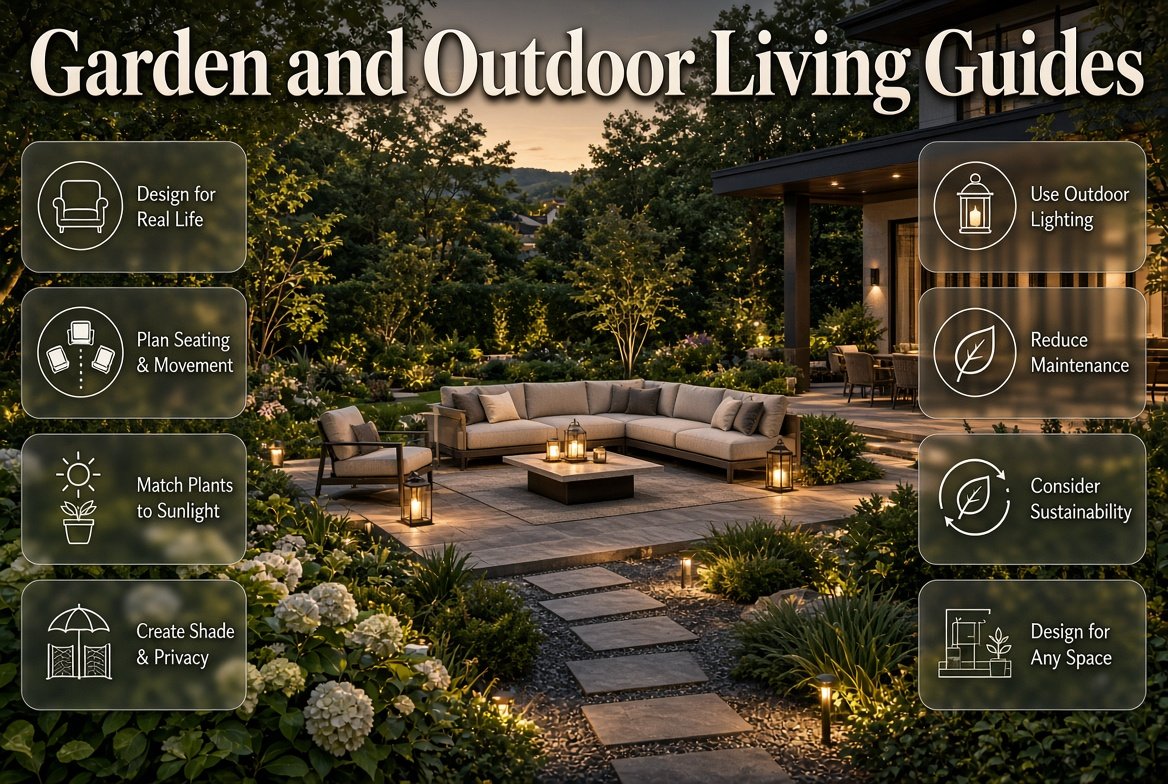
Garden and Outdoor Living Guides | A garden can completely change the way a home feels, but only when it is designed for real life. An outdoor space may look beautiful in a photograph and still be uncomfortable, difficult to maintain, poorly lit, or simply too cluttered to enjoy. A few attractive plants and expensive pieces of furniture aren’t enough to create a successful garden.
The best garden and outdoor living guides focus on the decisions that make an outdoor space genuinely useful: where people sit, how they move through the garden, how much sunlight different areas receive, which plants can actually thrive, where shade is needed, how privacy can be improved, and how the space will work after dark.
For homeowners looking for broader design inspiration, the DesignMode24 Interior Design homepage provides a useful starting point for connecting outdoor ideas with the wider design of the home.
Whether you’re working with a large backyard, a narrow garden, a small patio, a townhouse courtyard, or even a balcony, the same principle applies: design the space around the way you live rather than trying to fill it with as many features as possible.
This guide explains how to plan an outdoor living space from the ground up, choose furniture and plants, create privacy and shade, use lighting effectively, reduce maintenance, improve sustainability, decorate on a budget, and avoid the mistakes that frequently make gardens less practical.
What Makes a Garden and Outdoor Living Space Successful?
A successful outdoor living space balances appearance, comfort, function, durability, and maintenance. It should provide enough room for the activities you enjoy while using plants, furniture, lighting, materials, and privacy features that suit the property and local conditions.
Before choosing individual products or plants, think about the experience you want to create.
Do you want a place for morning coffee? Weekend dinners? Children’s play? Gardening? Reading? Entertaining friends? Relaxing after work?
These answers determine the layout.
A garden designed mainly for entertaining needs a different arrangement from one designed for quiet relaxation. Likewise, a family garden may need open lawn or flexible space, while a small urban patio may benefit more from built-in seating and vertical planting.
Start With Function, Not Decoration
One of the most useful principles in outdoor design is to decide what the space needs to do before deciding what it should look like.
Make a simple list:
- Where will people sit?
- Where will meals be eaten?
- Where will plants grow?
- Where does shade need to be created?
- Where should children or pets have room to move?
- Where will garden tools be stored?
- Which areas need privacy?
- How will people use the garden at night?
Once those questions are answered, the decorative choices become much easier.
💡 Pro Tip: If you’re unsure what to change first, spend several days observing how your household currently uses the garden. The areas you naturally gravitate toward usually reveal where the best improvements should begin.
How Should You Plan a Garden Before Buying Anything?
Start by measuring the available area and drawing a simple overhead plan. You don’t need professional landscaping software. A sheet of paper is enough to mark the house, doors, windows, existing trees, paths, walls, fences, and fixed structures.
Next, divide the outdoor space into functional zones.
A basic layout might look like this:
House → Transition Area → Dining/Lounge → Planting → Garden Boundary
This doesn’t mean every garden should follow the same arrangement. It simply demonstrates how different functions can be connected without making the space feel random.
Observe Sunlight Throughout the Day
Sunlight changes dramatically between morning and afternoon.
A patio that feels pleasant in the morning may become extremely hot later in the day. A planting bed that appears bright during your first inspection might spend most of the afternoon in shade.
Observe the garden at different times and note:
- Morning sun
- Midday sun
- Afternoon sun
- Full shade
- Partial shade
- Wind exposure
- Areas where water collects
- Areas that dry quickly
This information should influence both planting and furniture placement.
Think About Drainage
Drainage is easy to overlook because it isn’t particularly glamorous, but it can determine whether a garden remains healthy.
Poor drainage can lead to:
- Waterlogged soil
- Root problems
- Muddy pathways
- Damaged paving
- Standing water
- Unpleasant odors
- Mosquito problems in some environments
Before installing new surfaces or planting extensively, understand how water moves through the property.
How Do You Divide a Garden Into Useful Outdoor Zones?
Zoning makes an outdoor area easier to understand and use. Instead of treating the entire garden as one large space, assign specific purposes to different areas.
Lounge Zone
A lounge area should be positioned where people can comfortably sit without blocking important routes.
It may include:
- Outdoor sofa
- Armchairs
- Coffee table
- Side tables
- Outdoor rug
- Soft lighting
- Shade
Dining Zone
Dining areas should be relatively close to the kitchen or indoor dining area. This makes carrying food, dishes, and drinks much easier.
Allow enough room to pull chairs away from the table without blocking a pathway.
Planting Zone
Planting areas can soften hard surfaces and add privacy, color, texture, and seasonal interest.
Use plants strategically rather than scattering pots randomly across the garden.
Quiet Zone
If the garden is large enough, consider creating a small retreat for reading, relaxing, or enjoying morning coffee.
A bench beneath a tree or a comfortable chair beside a planting bed can sometimes be more useful than another large furniture set.
Utility Zone
Don’t forget practical equipment.
A garden may need storage for:
- Hoses
- Gardening tools
- Plant food
- Outdoor cushions
- Cleaning equipment
- Children’s outdoor items
- Seasonal accessories
A well-designed utility zone keeps practical objects from taking over the entertaining areas.
What Garden Layout Works Best for Small Outdoor Spaces?
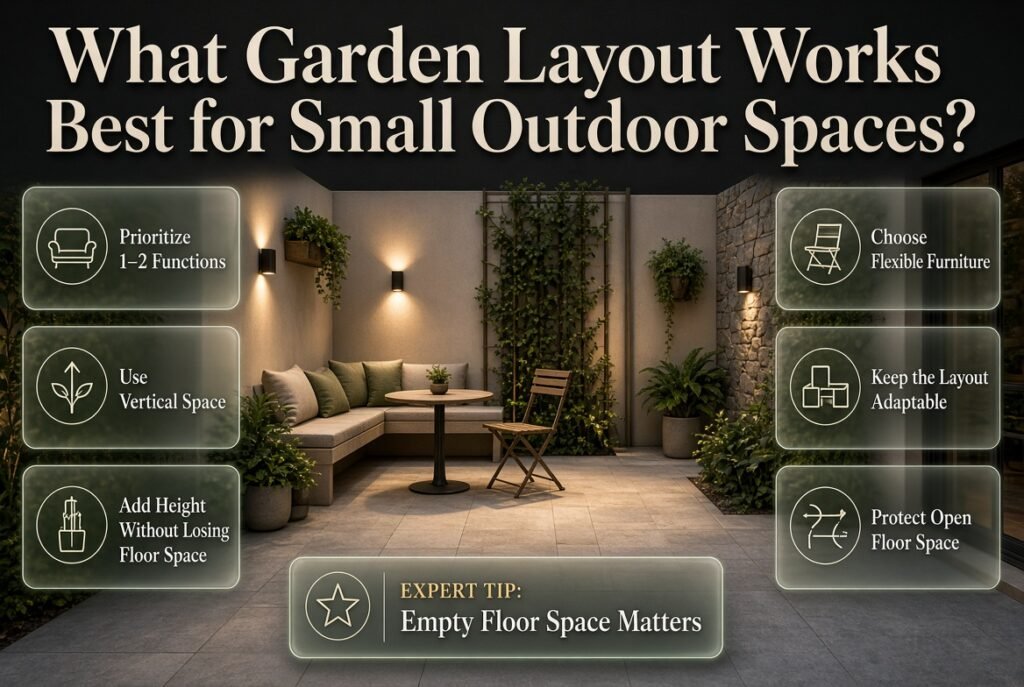
Small gardens benefit from simplicity. Trying to fit a dining table, lounge suite, fire feature, large lawn, multiple planting beds, storage shed, water feature, and decorative accessories into a tiny space usually creates visual and physical congestion.
Instead, give one or two functions priority.
For example, a compact patio could combine:
Built-in bench + small table + vertical plants + wall lighting
This can provide seating, greenery, dining space, and atmosphere without consuming the entire floor area.
Use Vertical Space
When floor space is limited, look upward.
Useful vertical solutions include:
- Trellises
- Climbing plants
- Wall-mounted planters
- Vertical gardens
- Hanging baskets
- Narrow shelving
- Tall containers
Vertical greenery can introduce height and privacy without requiring a large planting bed.
Choose Flexible Furniture
Folding chairs, nesting tables, benches, and lightweight furniture are useful when the same area needs to support different activities.
A small garden should be able to change function quickly.
⭐ Expert Tip: In a compact garden, empty floor space is valuable. Don’t feel that every corner needs to contain furniture or decoration.
How Should You Choose Outdoor Furniture?
Outdoor furniture has to survive more demanding conditions than indoor furniture. Sunlight, rain, humidity, wind, dirt, temperature changes, and frequent cleaning can all affect its appearance and performance.
The right furniture depends on:
- Climate
- Exposure to weather
- Available storage
- Frequency of use
- Maintenance tolerance
- Space
- Budget
- Desired appearance
Outdoor Furniture Material Comparison
| Material | Main Advantage | Maintenance | Best Use |
|---|---|---|---|
| Aluminum | Lightweight and practical | Low | Flexible seating areas |
| Powder-coated metal | Durable finish | Low–moderate | Contemporary gardens |
| Teak | Naturally durable | Moderate | Premium outdoor settings |
| Resin wicker | Comfortable appearance | Moderate | Lounge furniture |
| Plastic/resin | Affordable and easy to clean | Low | Budget spaces |
| Steel | Strong and heavy | Moderate | Stable furniture |
No outdoor material should be treated as completely maintenance-free.
Even durable furniture benefits from regular cleaning and protection.
Cushions deserve particular attention. Choose fabrics designed for exterior conditions and avoid leaving them exposed to prolonged moisture when they can be stored indoors.
How Do You Choose the Right Plants for Your Garden?
Plant selection should begin with the environment.
Instead of asking, “Which plant looks best?” ask, “Which plant will thrive here?”
Consider:
- Sunlight
- Soil
- Drainage
- Temperature
- Rainfall
- Wind
- Humidity
- Mature size
- Maintenance requirements
A plant that thrives in one garden can struggle badly in another.
Consider Mature Size
One of the most common planting mistakes is choosing plants according to the size they are when purchased.
A young tree may fit perfectly beside a patio, but its mature canopy and root system can eventually become a problem.
Always check the expected mature height and spread.
Group Plants With Similar Needs
Plants with similar watering and sunlight requirements should generally be grouped together.
For example, moisture-loving plants should not be mixed indiscriminately with drought-tolerant plants if you’re trying to create an efficient irrigation routine.
Build Planting Layers
A layered garden often looks more natural and visually interesting.
Use:
Tall plants → Medium shrubs → Low plants → Groundcover
Climbing plants can add another vertical layer.
This approach creates depth without requiring an enormous number of plant varieties.
⚠ Common Mistake: Buying plants because they’re attractive individually without considering whether their colors, sizes, growth habits, and environmental requirements work together.
How Can You Create Privacy in a Garden?
Privacy can make an outdoor area dramatically more comfortable, especially when neighboring houses, apartments, roads, or balconies overlook the property.
However, building a tall wall around the entire garden isn’t always necessary.
Consider:
- Hedges
- Trees
- Trellises
- Pergolas
- Slatted screens
- Climbing plants
- Outdoor curtains
- Layered planting
- Strategically positioned furniture
The most effective solution usually targets the actual sightline.
For example, if a neighboring upper-floor window looks directly toward your seating area, a strategically positioned tree or screen may solve the problem without enclosing the whole garden.
Privacy can also be created through layering. A lower hedge combined with medium-height planting and one taller tree can provide screening while still allowing light into the space.
How Do You Add Shade to an Outdoor Living Area?
Shade isn’t simply a decorative feature. It directly affects comfort.
Permanent shade options include:
- Pergolas
- Covered patios
- Roof extensions
- Shade structures
- Large trees
Flexible options include:
- Umbrellas
- Retractable awnings
- Shade sails
- Outdoor curtains
- Canopies
Think about where the sun actually travels.
A shade structure positioned according to the morning sun may offer limited protection during late afternoon. If the garden is used primarily in the evening, afternoon and western exposure may be more important.
Natural shade from trees can be particularly attractive, but trees take time to mature and should therefore be treated as a long-term design investment.
What Outdoor Lighting Should You Use in a Garden?
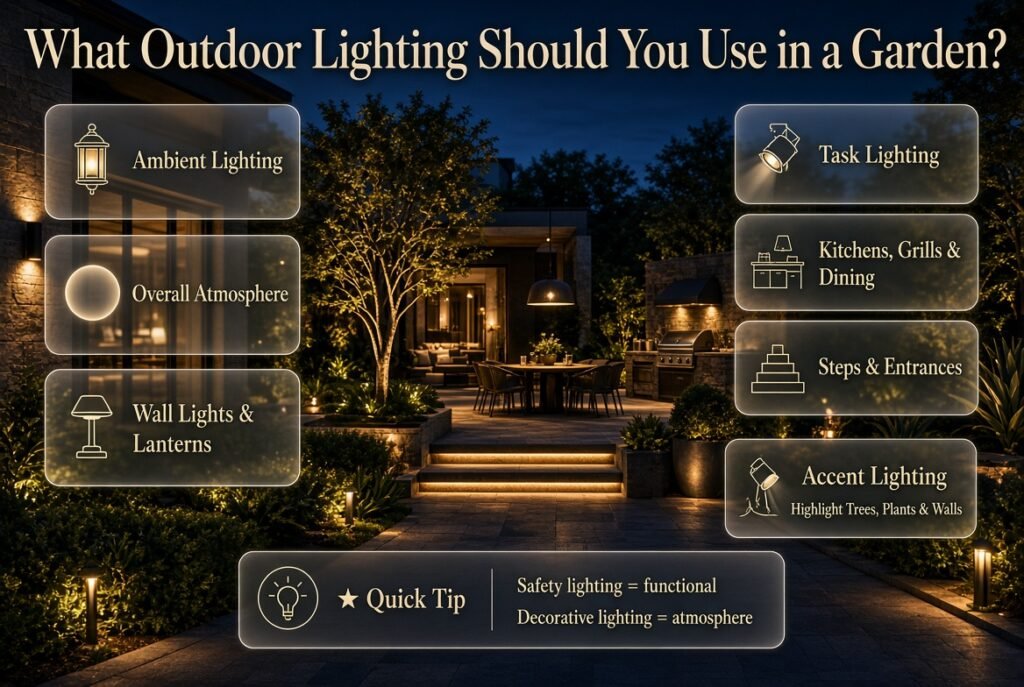
A garden doesn’t need to be illuminated like a parking lot.
Good outdoor lighting uses different levels of illumination for different purposes.
Ambient Lighting
Ambient lighting establishes the overall atmosphere.
Examples include:
- Wall lights
- Lanterns
- Outdoor pendant fixtures
- Decorative lamps
Task Lighting
Task lighting helps people perform specific activities.
Use it around:
- Outdoor kitchens
- Grills
- Dining tables
- Steps
- Entrances
- Food preparation areas
Accent Lighting
Accent lighting draws attention to selected features.
You can highlight:
- Trees
- Sculptures
- Water features
- Architectural walls
- Interesting plants
- Pathway edges
Layering these lighting types creates a more natural result.
For a deeper look at lighting concepts that also work indoors, visit Lighting and Ceiling Ideas.
📌 Quick Tip: Safety lighting should be functional, while decorative lighting should create atmosphere. Don’t make every light equally bright.
How Can You Connect Indoor and Outdoor Design?
A garden often feels more sophisticated when it visually relates to the interior.
This doesn’t mean copying the exact interior design outside.
Instead, repeat selected elements.
For example:
- Warm interior wood → outdoor timber accents
- Neutral interior palette → beige or stone outdoor textiles
- Black window frames → black outdoor furniture
- Natural textures indoors → stone and woven elements outside
- Similar flooring tones → coordinated patio surfaces
This creates a visual transition between the home and garden.
For more ideas on surfaces and material combinations, explore Flooring and Wall Design Inspiration.
The goal is continuity rather than perfect matching.
How Can Color Improve an Outdoor Space?
Color affects how large, calm, energetic, or connected a garden feels.
Natural colors are generally easy to integrate:
- Warm beige
- Cream
- Soft gray
- Terracotta
- Olive
- Sage
- Brown
- Charcoal
- Muted blue
You can then introduce stronger colors through flowers, cushions, pots, umbrellas, or artwork.
If the exterior of your home needs a broader color strategy, Paint Color Recommendations can provide additional inspiration for coordinating interior and exterior palettes.
Don’t Use Too Many Colors
A common problem is introducing too many unrelated shades.
A simple formula works well:
Base color + natural green + one accent color
This gives the garden visual consistency without making it boring.
What Decorative Features Make a Garden Feel Complete?
Once the functional design is established, decoration can add personality.
Useful elements include:
- Outdoor cushions
- Weather-resistant rugs
- Decorative planters
- Lanterns
- Garden sculptures
- Water features
- Outdoor artwork
- Trellises
- Decorative screens
But decoration should support the design rather than compete with it.
A large garden may benefit from one strong focal point. A smaller space might only need a distinctive planter or carefully selected lighting.
Choose Focal Points Carefully
A focal point gives the eye somewhere to rest.
Possible focal points include:
- A specimen tree
- A sculpture
- A water feature
- A fireplace
- A distinctive planter
- An attractive seating arrangement
Avoid creating several equally strong focal points in a small area.
How Can You Create a Low-Maintenance Garden?
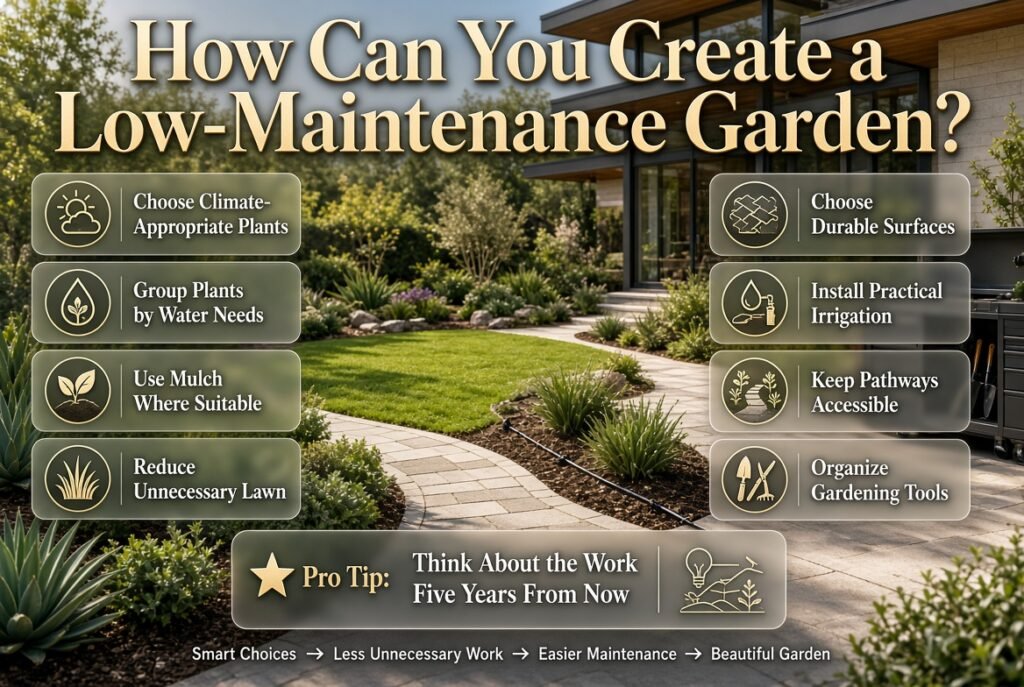
Low-maintenance gardening is not about doing nothing. It’s about avoiding unnecessary work.
The best strategy is to make smart decisions at the beginning.
Choose plants that suit the climate and soil rather than fighting natural conditions. Use durable materials where possible. Keep complicated planting schemes to areas where you’re willing to maintain them.
Practical Low-Maintenance Ideas
- Choose climate-appropriate plants.
- Group plants by water requirements.
- Use mulch where suitable.
- Reduce unnecessary lawn.
- Choose durable outdoor surfaces.
- Install practical irrigation.
- Make pathways easy to access.
- Keep gardening tools organized.
- Avoid excessive numbers of plant varieties.
A small garden can become surprisingly high-maintenance if every plant has different watering, pruning, feeding, and sunlight requirements.
💡 Pro Tip: Before adding a plant, ask yourself not only whether you like it, but also how much work it will require five years from now.
How Can You Make a Garden More Sustainable?
Sustainable outdoor living is about using resources thoughtfully while creating a healthy environment.
You can improve sustainability through:
- Locally appropriate plants
- Composting
- Rainwater collection where suitable
- Efficient irrigation
- Reduced lawn areas
- Reused containers
- Durable materials
- Pollinator-friendly planting
- Healthy soil management
Sustainability should also include product lifespan.
A cheap item that needs frequent replacement may not be more sustainable than a durable product that lasts for many years.
How Can You Add Smart Storage to a Garden?
Outdoor clutter develops quickly.
Hoses, tools, cushions, toys, pots, cleaning equipment, and seasonal decorations all need somewhere to go.
Useful storage options include:
- Weather-resistant cabinets
- Storage benches
- Deck boxes
- Garden sheds
- Wall-mounted systems
- Vertical tool storage
Storage should be positioned according to frequency of use.
Keep everyday tools accessible and seasonal equipment further away.
This same principle works throughout the home. For broader organization strategies, see Smart Storage and Organization Ideas.
How Can You Improve a Garden Without Spending a Fortune?
A garden makeover doesn’t have to begin with construction.
Often, the most noticeable improvements come from cleaning, rearranging, editing, and adding a few carefully selected elements.
Start With Existing Assets
Before buying anything, identify what can stay.
You may already have:
- Healthy mature plants
- Good furniture
- Useful paving
- Attractive walls
- Established trees
- Containers worth reusing
Remove things that don’t work and build around the strongest existing features.
Refresh Outdoor Textiles
New cushions, outdoor rugs, and throws can change the visual character of a seating area without replacing the entire furniture set.
Improve Lighting
Strategically placed lighting can transform a garden after sunset.
Add Containers
Containers are one of the easiest ways to introduce greenery and color.
Create One Strong Feature
Instead of buying ten small decorative objects, consider investing in one element that gives the garden a clear identity.
For wider budget-friendly home improvement ideas, see Easy Decorating Tips for Every Budget.
What Are the Biggest Beginner Garden Design Mistakes?
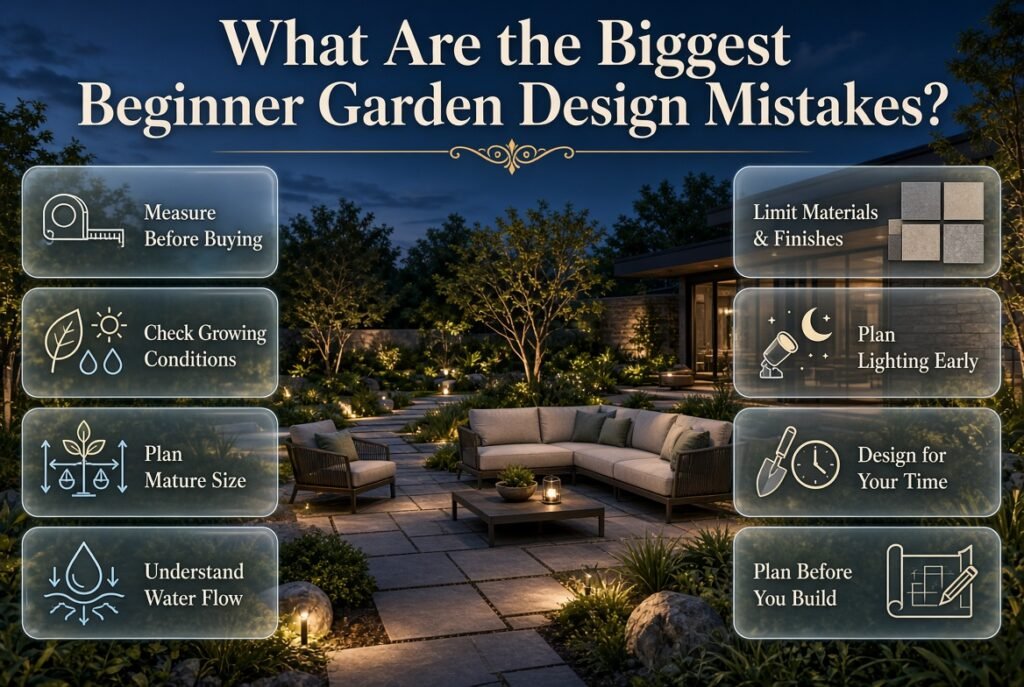
Buying Furniture Before Measuring
Why it happens: Furniture looks smaller in stores and photographs.
Why it’s harmful: Oversized furniture can restrict movement and make the garden feel cramped.
Better approach: Measure the space and draw the furniture footprint before buying.
Choosing Plants Without Checking Conditions
Why it happens: Appearance is often the first consideration.
Why it’s harmful: Plants can fail when they receive unsuitable sunlight or water.
Better approach: Check growing requirements before purchase.
Planting Too Closely
Why it happens: New plants look small and empty spaces feel uncomfortable.
Why it’s harmful: Mature plants compete for light, water, and space.
Better approach: Plan according to mature size.
Ignoring Drainage
Why it happens: Drainage is less visually obvious than furniture or planting.
Why it’s harmful: Water can damage plants, surfaces, and structures.
Better approach: Understand how rainwater moves before changing levels or surfaces.
Using Too Many Materials
Why it happens: Homeowners want the garden to look interesting.
Why it’s harmful: Too many colors and materials create visual noise.
Better approach: Repeat a small number of finishes.
Forgetting Nighttime Use
Why it happens: Gardens are usually planned during daylight.
Why it’s harmful: The space becomes unusable or unsafe after dark.
Better approach: Include lighting in the original plan.
Creating More Maintenance Than You Can Handle
Why it happens: Dense planting and elaborate gardens look impressive initially.
Why it’s harmful: Maintenance becomes exhausting.
Better approach: Design around your actual available time.
How Do Professionals Approach Outdoor Living Design?
Experienced designers don’t normally begin by asking which furniture set should be purchased.
They consider relationships between different elements.
For example, the dining area needs convenient access to the house. The seating area may need shade. Planting can soften the edge of a patio. Lighting can emphasize the architecture. Privacy planting can be positioned exactly where views are problematic.
The garden becomes a connected system.
Before finalizing the design, review:
- Scale
- Proportion
- Circulation
- Sun exposure
- Shade
- Privacy
- Drainage
- Plant maturity
- Furniture durability
- Storage
- Lighting
- Maintenance
- Relationship with the house
This systems-based approach is what separates a garden that merely looks decorated from one that genuinely works.
For readers building a broader home improvement plan, Practical Home Improvement Guides can help connect outdoor upgrades with other property improvements.
How Can You Make the Garden Feel Like a Natural Part of the Home?
The strongest indoor-outdoor designs create a gradual transition rather than a sudden change.
Think of the space as a sequence:
Interior → Threshold → Patio → Planting → Garden
The threshold is especially important.
Large doors, similar flooring tones, coordinated colors, and outdoor furniture positioned close to the house can visually extend the living area.
The garden shouldn’t feel like a completely separate world unless that’s specifically the design intention.
For more comprehensive room-by-room design inspiration, visit Room-by-Room Interior Design Inspiration.
How Should You Maintain an Outdoor Space Throughout the Year?
Garden maintenance becomes much easier when small tasks are handled consistently.
Spring
- Inspect plants for winter damage.
- Clean furniture.
- Refresh suitable mulch.
- Check irrigation.
- Remove damaged growth.
- Inspect outdoor structures.
Summer
- Monitor soil moisture.
- Protect vulnerable plants.
- Clean outdoor surfaces.
- Inspect shade structures.
- Keep cushions dry.
- Watch for pest problems.
Autumn
- Remove fallen debris.
- Check drainage.
- Prepare sensitive plants.
- Clean storage areas.
- Inspect outdoor furniture.
Winter
- Protect plants where necessary.
- Store vulnerable furniture.
- Check structures after storms.
- Clean and organize tools.
- Plan future improvements.
The precise schedule depends on the local climate, so seasonal maintenance should always be adjusted to actual weather and plant requirements.
How Can You Design an Outdoor Space for Entertaining?
An entertaining area needs more than a table and chairs.
Think about the complete movement of food, people, and conversation.
The ideal arrangement often places:
Kitchen → Serving Area → Dining → Lounge
This minimizes unnecessary walking.
Provide enough space for people to move behind seated guests. Keep hot cooking equipment away from crowded circulation routes and ensure outdoor lighting covers food preparation and dining areas.
Side tables are particularly useful because guests need somewhere to place drinks and plates.
Storage is also important. If entertaining accessories have to be carried from a distant shed every time, the garden becomes less convenient.
What Should You Consider When Designing a Family-Friendly Garden?
Family gardens need flexibility.
Avoid filling every square meter with permanent furniture or delicate decorative objects.
Leave some open space for movement.
Consider:
- Durable furniture
- Rounded edges where appropriate
- Easy-to-clean surfaces
- Storage for toys
- Shaded areas
- Open play space
- Safe lighting
- Clear pathways
The garden should be able to change as children grow.
A completely child-focused design may eventually become unnecessary, so flexible spaces generally provide better long-term value.
How Can You Make a Garden More Comfortable in Hot Weather?
Hot weather requires attention to shade, airflow, surfaces, and planting.
Use shade structures where people sit most often. Light-colored surfaces can help reduce the visual and thermal impact of intense sunlight, while trees and planting can introduce natural shade over time.
Comfort also depends on furniture material. Some metal surfaces can become extremely hot in direct sun.
Where appropriate, use breathable outdoor fabrics and arrange seating to take advantage of natural airflow.
How Can You Make a Garden More Attractive at Night?
Nighttime design should reveal the garden gradually.
Instead of illuminating everything, select specific elements.
Try:
- Soft pathway lighting
- Up-lighting for trees
- Low-level planting lights
- Wall lighting
- Dining-area lighting
- Subtle decorative lanterns
The contrast between illuminated and darker areas can create depth.
A completely bright garden often loses the atmosphere created by shadows and layers.
How do I design a garden that feels like an extension of my home?
The most effective approach is to treat the garden as another living space rather than simply an area filled with plants. Start by deciding how you actually want to use it—morning coffee, outdoor dining, entertaining guests, relaxing, gardening, children’s activities, or a combination of these. Then create clear zones for each purpose while maintaining an easy visual and physical connection with the house.
A cohesive outdoor design usually comes from repeating elements already present indoors. Similar colors, natural materials, furniture proportions, textures, and lighting styles can make the transition from interior to garden feel intentional rather than abrupt. This “outdoor room” approach has become increasingly popular as homeowners expect gardens to support everyday living, not just occasional entertaining.
Key points to consider:
Create separate zones for dining, lounging, planting, and entertaining.
Keep the main outdoor seating area close to the house for convenience.
Repeat interior colors or materials outdoors where practical.
Use planting to soften hard boundaries between indoor and outdoor areas.
Plan circulation paths before adding furniture or decorative features.
Consider how the garden will look from the main rooms of the house.
What are the biggest garden and outdoor living trends for 2026?
The biggest shift in 2026 is toward purposeful, multifunctional outdoor spaces rather than gardens designed purely for appearance. Homeowners are creating outdoor rooms with comfortable seating, dining areas, cooking zones, privacy features, layered lighting, and planting designed around everyday routines. Zoned layouts are particularly important because one garden can now serve several different functions without feeling cluttered.
Another noticeable trend is the move toward softer, more natural landscapes. Climate-adapted plants, pollinator-friendly planting, reduced lawn areas, organic shapes, natural textures, and low-maintenance landscaping are becoming more prominent. Wellness spaces are also gaining attention, with quiet corners for reading, meditation, exercise, or simply escaping screens and indoor routines.
Popular 2026 ideas include:
Outdoor living rooms with comfortable furniture.
Dedicated dining and entertaining zones.
Naturalistic and layered planting.
Low-maintenance and climate-conscious gardens.
Privacy planting and shaded retreats.
Outdoor kitchens and cooking areas.
Wellness and relaxation zones.
Warm, atmospheric outdoor lighting.
Wildlife and pollinator-friendly planting.
Curved paths and softer garden layouts.
The important point is not to copy every trend. Choose ideas that genuinely improve the way you use your garden.
How can I make a small garden look bigger and more functional?
A small garden can feel surprisingly spacious when the layout is planned around zones, sightlines, scale, and vertical space. The common mistake is trying to place too many individual features into a limited footprint. Instead, use multifunctional furniture and allow several areas to perform more than one role.
For example, a compact patio can function as both an outdoor dining area and evening lounge. Built-in benches can provide seating while incorporating storage underneath. Wall-mounted planters, trellises, climbing plants, and narrow planting beds can introduce greenery without consuming valuable floor space.
Dividing a small garden into purposeful micro-zones can actually make it feel more interesting and organized. Current outdoor-living research shows growing interest in this type of zoning, particularly where homeowners need dining, relaxation, planting, and storage within a limited area.
Smart ways to maximize a small garden:
Use vertical planting instead of spreading everything across the ground.
Choose furniture with a compact visual footprint.
Avoid oversized sofas and bulky decorative pieces.
Use one continuous paving material to create visual flow.
Place taller plants toward boundaries and lower plants toward the center.
Incorporate benches with hidden storage.
Use mirrors carefully on suitable garden walls.
Keep pathways simple rather than creating unnecessary divisions.
Use lighting to draw attention toward the farthest point of the garden.
A small garden does not need to look empty to feel spacious. It needs better organization.
What plants are best for a low-maintenance outdoor living space?
The best plants depend on your local climate, soil, available sunlight, drainage, and the amount of maintenance you are realistically willing to provide. Instead of selecting plants because they look attractive in a photograph, choose varieties that naturally suit the conditions of your garden.
Low-maintenance landscaping is particularly relevant in current garden design. Recent outdoor-renovation research shows strong homeowner interest in plants that require less maintenance, as well as native, pollinator-friendly, and drought-tolerant choices.
For a practical garden, combine several plant types rather than filling the entire space with one species. Evergreen shrubs can provide structure, ornamental grasses can introduce movement and texture, flowering plants can provide seasonal color, and trees can offer shade and privacy.
For easier garden maintenance:
Select plants suited to your climate rather than forcing unsuitable varieties.
Group plants with similar watering requirements.
Use mulch to help retain soil moisture and reduce weeds.
Choose plants according to their mature size.
Avoid creating large areas of high-maintenance lawn if you rarely use them.
Include evergreen plants for year-round structure.
Consider native or climate-adapted species where appropriate.
Install efficient irrigation where regular watering would otherwise become difficult.
The goal is not a garden that requires zero maintenance. The realistic goal is a garden whose maintenance requirements match your lifestyle.
How can I create a comfortable outdoor living area that I can use day and night?
A successful outdoor living area needs more than attractive furniture. Comfort comes from combining shade, weather protection, seating, lighting, planting, and practical circulation so the space remains enjoyable at different times of the day.
During the daytime, shade is often the first priority. Depending on the climate and garden, this might come from mature trees, pergolas, umbrellas, covered patios, or strategically positioned planting. For evening use, layered lighting becomes essential. Instead of relying on one extremely bright fixture, combine ambient lighting with pathway illumination, subtle accent lights, and task lighting around cooking or dining areas.
Outdoor spaces are increasingly being designed for extended daily use, including morning relaxation, dining, entertaining, and evening socializing.
For a more comfortable outdoor room:
Provide shade where people will sit for the longest periods.
Choose weather-resistant furniture appropriate for your climate.
Add cushions and textiles designed for outdoor conditions.
Keep pathways and seating areas well illuminated at night.
Use plants to create privacy and soften exposed boundaries.
Position seating to take advantage of desirable views.
Include side tables so outdoor seating remains practical.
Consider a fire feature or other appropriate heating solution in cooler climates.
Provide convenient storage for cushions, tools, and outdoor accessories.
Design the space around how you actually spend time outdoors.
The strongest garden designs are not simply beautiful during a daytime photograph—they remain comfortable, useful, and inviting after sunset.
Conclusion
A well-designed garden is no longer simply an attractive space surrounding a home. It can become an extension of everyday living—a place to relax, entertain, dine, spend time with family, grow plants, or enjoy a quiet moment away from indoor routines. The most successful outdoor spaces are created by balancing beauty with practical considerations such as layout, comfort, privacy, lighting, planting, maintenance, weather protection, and budget.
The key is to design around the way you actually use the space rather than following trends blindly. A small garden can feel spacious with thoughtful zoning and vertical planting, while a larger yard can become more useful when it is divided into clearly defined areas for dining, lounging, gardening, and entertaining. Similarly, the right plants, durable furniture, appropriate surfaces, and layered lighting can significantly improve both the appearance and functionality of an outdoor area.
Whether you are planning a complete landscape transformation or making a few affordable improvements, a gradual and purposeful approach usually produces better results. Start with the fundamentals—drainage, circulation, sunlight, shade, planting conditions, and seating—then introduce decorative elements that support the overall design. This prevents the garden from becoming overcrowded and ensures that every feature has a practical reason for being there.
For more ideas that connect outdoor improvements with the wider design of your home, explore DesignMode24 Interior Design for additional inspiration. You can also explore the Room-by-Room Design Hub to develop a more consistent design approach throughout your property.
Ultimately, great garden and outdoor living design is not about creating the most expensive or elaborate space. It is about creating an environment that feels comfortable, purposeful, visually connected to the home, and easy to enjoy. When thoughtful planning comes before decoration, even an ordinary outdoor area can become one of the most valuable and enjoyable parts of the home.

Leave a Reply