
Introduction
Decorative Accessories: 25 Beautiful Ideas to Transform Your Home | A room can have beautiful furniture, attractive flooring, and a carefully chosen wall color and still feel unfinished. Often, the missing element isn’t another major piece of furniture. It’s the smaller details that give the space character.
That’s where decorative accessories make a difference.
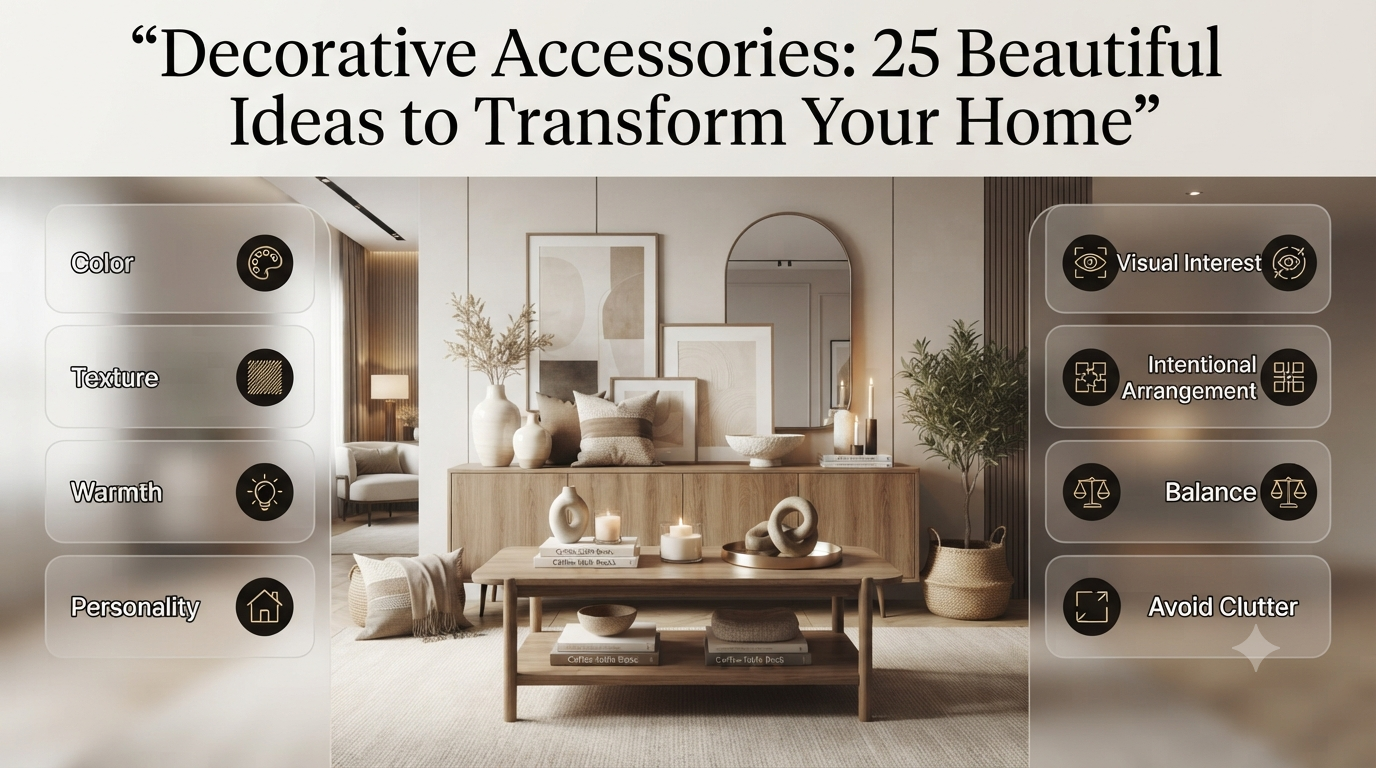
Decorative accessories are the finishing elements that bring color, texture, warmth, personality, and visual interest into an interior. They include vases, cushions, mirrors, artwork, decorative bowls, candles, books, sculptures, trays, plants, baskets, and other carefully selected objects.
However, successful decorating isn’t about filling every empty surface. The goal is to select pieces that complement the room, arrange them with intention, and create a space that feels collected rather than cluttered.
Whether you’re styling a living room, bedroom, entryway, dining area, or small apartment, the right decorative accessories can transform an ordinary interior without requiring a major renovation.
This guide explains how to choose, arrange, and combine decorative accessories while maintaining balance, functionality, and personality.
What Are Decorative Accessories?
Decorative accessories are movable interior elements that enhance the appearance, atmosphere, and personality of a room. Unlike permanent architectural features or large furniture pieces, accessories can usually be rearranged, replaced, or updated easily.
Common examples include:
- Decorative vases
- Throw pillows
- Blankets and throws
- Mirrors
- Artwork
- Sculptures
- Candles
- Decorative trays
- Coffee-table books
- Indoor plants
- Baskets
- Ceramics
- Picture frames
- Decorative boxes
- Table lamps
- Small collectibles
Their purpose isn’t simply to occupy empty spaces. Well-chosen accessories help establish visual hierarchy, reinforce an interior style, introduce contrast, and connect different elements within the room.
For example, a neutral living room might need only a textured throw, a few cushions, a ceramic vase, a wooden tray, and one substantial piece of artwork to feel complete.
The key is intentional selection rather than quantity.
Why Are Decorative Accessories Important in Interior Design?
Furniture establishes the basic function and structure of a room, while accessories help determine how that room feels.
They can introduce:
- Color
- Texture
- Contrast
- Pattern
- Warmth
- Scale
- Personality
- Visual balance
Decorative accessories are also one of the easiest ways to refresh an existing interior. You may not need to replace a sofa simply because it feels dated. Changing the cushions, artwork, throws, decorative objects, and plants can create an entirely different impression.
This makes accessories particularly useful for affordable Home Styling updates.
Accessories Can Solve Common Design Problems
A room may feel flat because it lacks texture. Another may feel chaotic because there are too many unrelated colors. A large wall may appear empty because the artwork is too small.
Accessories can address these problems when chosen according to what the room actually needs.
Before buying anything, ask:
Does this room need color, texture, contrast, height, softness, or personality?
That simple question can prevent unnecessary purchases.
Types of Decorative Accessories
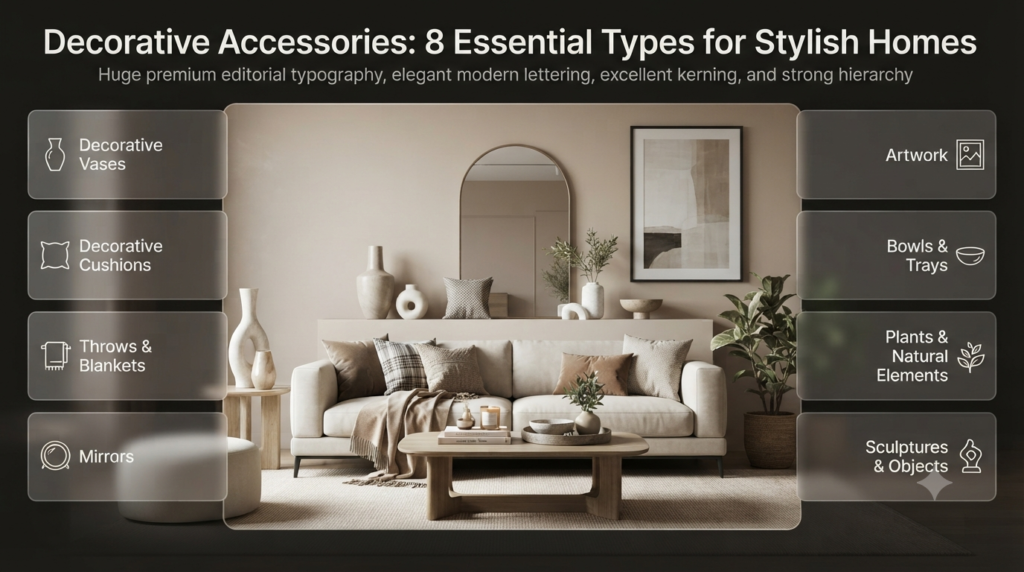
A successful accessory collection usually combines different categories rather than relying on one type of object.
1. Decorative Vases
Vases are among the most versatile decorative accessories. They can be used on consoles, coffee tables, dining tables, shelves, bedroom dressers, and open shelving.
They don’t always need flowers. A sculptural ceramic or glass vase can work as a standalone decorative object.
For a balanced arrangement, combine different heights rather than placing several objects of identical size together.
For example:
Tall vase + medium ceramic object + low bowl
This creates visual movement while keeping the arrangement simple.
2. Decorative Cushions
Cushions provide an easy way to introduce color, pattern, and texture without making permanent changes.
Instead of choosing cushions that all look identical, combine different materials and patterns.
A balanced sofa arrangement might include:
- One solid-color cushion
- One patterned cushion
- One textured cushion
- One smaller accent cushion
The colors don’t need to match perfectly. They should relate to other colors already present in the room.
3. Throws and Blankets
Throws add softness and warmth to sofas, beds, reading chairs, and benches.
A relaxed drape often looks more natural than folding a blanket into a perfectly rigid rectangle. Choose materials and colors that complement the room rather than simply following seasonal trends.
4. Mirrors
Mirrors are both decorative and functional.
A strategically positioned mirror can reflect natural light and create a greater sense of openness, particularly in smaller rooms.
Large mirrors can work well above consoles, fireplaces, dressers, or dining areas, provided their scale is appropriate for the surrounding furniture.
5. Artwork
Artwork gives an interior a visual identity.
You don’t need expensive original pieces to create an attractive display. More important considerations include:
- Appropriate scale
- Suitable framing
- Placement
- Color relationship
- Connection with the room’s style
A single large artwork can often create more impact than several tiny pieces scattered across a large wall.
6. Decorative Bowls and Trays
Trays are useful because they combine organization with decoration.
A coffee-table tray might hold:
- A candle
- Small vase
- Decorative bowl
- Coffee-table book
- Small plant
The tray creates a visual boundary, allowing several small objects to read as one intentional composition.
7. Plants and Natural Elements
Plants introduce natural color, texture, and organic shapes.
Natural wood, stone, rattan, woven fibers, dried branches, and handmade ceramics can also bring organic texture into an interior.
If real plants aren’t practical, high-quality artificial plants can provide greenery, although overly artificial-looking options may reduce the natural effect.
Always choose plants according to available light and maintenance requirements rather than appearance alone.
8. Decorative Sculptures and Objects
Sculptural accessories can create a strong focal point without requiring bright colors.
Abstract forms, handmade ceramics, stone objects, and artistic figures can add personality to consoles, shelves, sideboards, and coffee tables.
Because these objects often have strong visual shapes, they should be used selectively.
How to Choose Decorative Accessories for Your Home
The best place to start isn’t the store. It’s the room.
Look at the furniture, wall colors, flooring, lighting, existing artwork, and architectural features.
Then identify what’s missing.
If the room feels flat
Add texture through:
- Linen
- Wool
- Woven materials
- Wood
- Ceramic
- Stone
If the room feels too neutral
Introduce a controlled accent color through cushions, artwork, plants, or smaller objects.
If everything feels low and horizontal
Add vertical interest with:
- Tall vases
- Plants
- Floor lamps
- Large artwork
- Mirrors
If the room feels cluttered
Don’t add more accessories. Edit what is already there.
This room-first approach is much more effective than buying attractive objects without considering where they will go.
How to Use Color With Decorative Accessories
Color is one of the easiest ways to create visual connection between accessories and larger furnishings.
A commonly used guideline is the 60-30-10 color principle:
- 60% dominant color
- 30% secondary color
- 10% accent color
This isn’t a strict mathematical rule. It’s simply a useful way to think about visual proportion.
For example, a room might use:
- Warm off-white and beige as the dominant colors
- Natural wood and muted brown as secondary tones
- Olive green as an accent
The accent color can then appear in several locations, such as a cushion, artwork, plant pot, or decorative object.
You don’t need every accessory to match. Repeating a color in different forms is usually more sophisticated than using identical objects.
How to Arrange Decorative Accessories
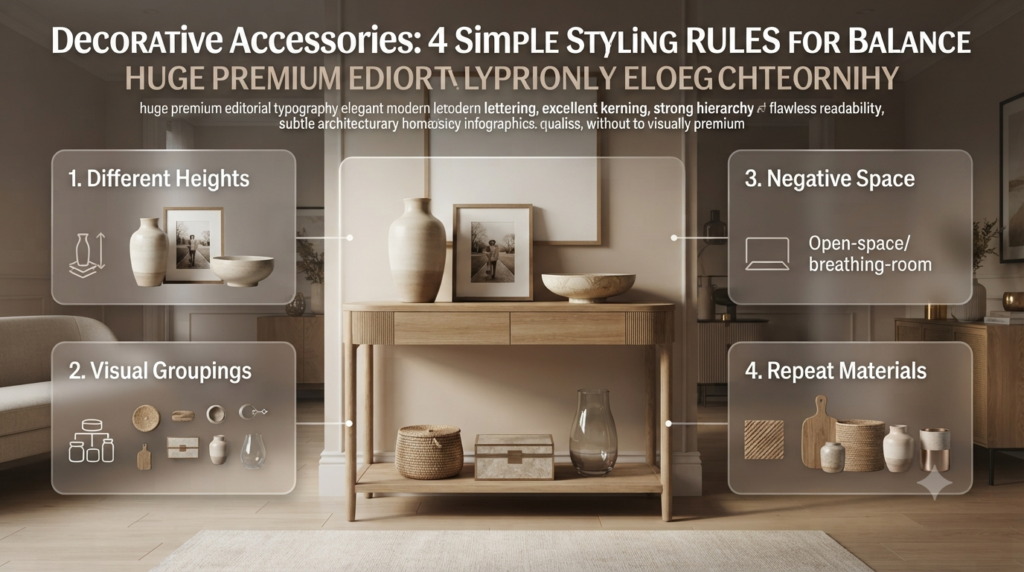
Choosing good accessories is only half the job. Placement determines whether the final arrangement feels balanced or chaotic.
Use Different Heights
Avoid placing objects at exactly the same height.
Instead, combine:
Tall + medium + low
For example:
Tall vase + medium framed photograph + low decorative bowl
Different heights create visual movement and prevent a display from appearing flat.
Create Visual Groupings
Small collections usually look more intentional when they are grouped rather than scattered.
A group might contain three related pieces with different sizes or shapes.
The popular “rule of three” can be useful, but it shouldn’t be treated as an absolute rule. Two carefully balanced objects or a single statement piece can work equally well.
Leave Negative Space
Empty space is an important part of interior design.
When every shelf, console, and tabletop is covered, individual accessories lose their impact.
Negative space allows the eye to rest and gives important objects room to stand out.
This principle is especially valuable in Minimalist Interior Design.
Repeat Materials
Repeating materials can connect different accessories without making them identical.
For example:
- Wooden frame + wooden bowl + woven basket
- Brass lamp + brass frame + small metallic object
- Ceramic vase + ceramic bowl + handmade pottery
The pieces can vary in shape while still sharing a visual relationship.
Decorative Accessories by Room
Different rooms require different accessory strategies because they serve different purposes.
Living Room
The living room usually provides the most opportunities for decorative styling.
Consider:
- Cushions
- Throws
- Coffee-table books
- Vases
- Plants
- Artwork
- Decorative trays
- Sculptures
- Floor baskets
A coffee table should look styled without becoming unusable. Leave enough open space for drinks, books, remotes, and everyday activities.
Bedroom
Bedrooms generally benefit from softer and calmer accessories.
Useful choices include:
- Cushions
- Throws
- Bedside lamps
- Artwork
- Small vases
- Baskets
- Soft textiles
- Decorative books
Keep bedside surfaces relatively simple. A bedroom should support relaxation rather than create excessive visual stimulation.
Dining Room
Dining tables often need a simple centerpiece rather than a large collection of objects.
Suitable options include:
- Low bowl
- Ceramic vase
- Long tray
- Candles
- Seasonal greenery
- Sculptural centerpiece
Keep the arrangement low enough to maintain comfortable sightlines across the table.
Entryway
The entryway creates the first impression of the home.
A console arrangement can combine:
- A mirror or artwork
- One tall decorative object
- A small tray
- A practical bowl for keys
- A plant or natural element
This is a good example of combining decoration with everyday functionality.
For broader room-planning principles, explore Home Design Ideas.
Bathroom
Bathrooms usually need fewer accessories than living spaces.
Consider:
- Small plants
- Decorative soap dispensers
- Trays
- Towel baskets
- Ceramic containers
- Small framed artwork
Choose materials that are suitable for humid conditions and easy to clean.
How Many Decorative Accessories Should You Use?
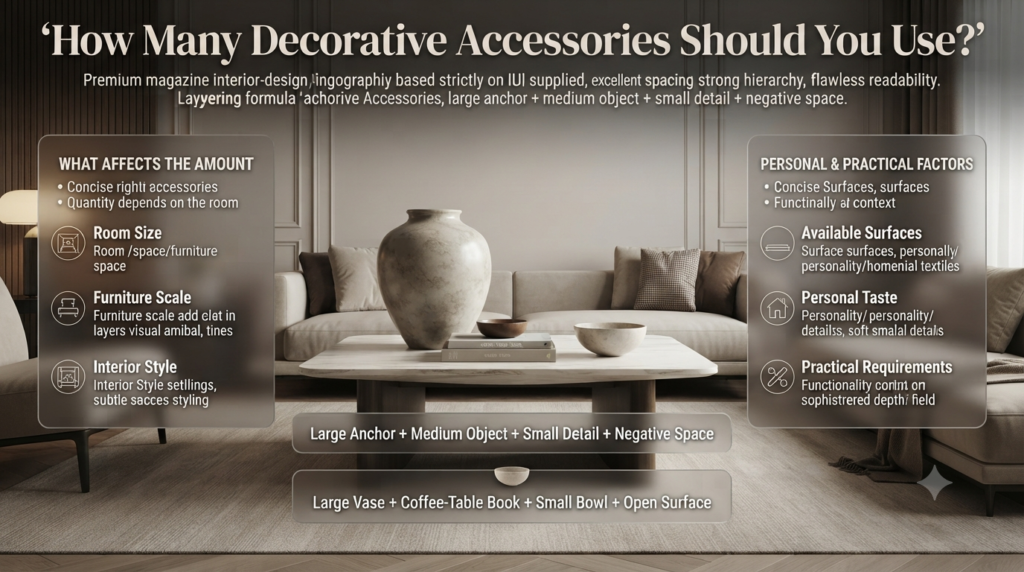
There is no universal number.
The right amount depends on:
- Room size
- Furniture scale
- Interior style
- Available surfaces
- Personal taste
- Practical requirements
Instead of trying to reach a specific number, decorate in layers.
Start with larger visual anchors. Then add medium-sized pieces and finish with smaller personal details.
A useful formula is:
Large anchor + medium object + small detail + negative space
For example:
Large vase + coffee-table book + small bowl + open surface
For many coffee tables, three to five carefully selected elements may be sufficient, but the composition should always remain functional.
Should Decorative Accessories Match?
No. Decorative accessories don’t need to match exactly.
A room often feels more sophisticated when different pieces share relationships without looking identical.
You can coordinate through:
- Color
- Material
- Shape
- Texture
- Finish
- Pattern
At the same time, vary:
- Height
- Scale
- Form
- Surface texture
For example, a smooth ceramic vase can work beautifully beside a rough stone object and a woven basket.
The contrast creates depth.
How to Make Decorative Accessories Look Expensive
A sophisticated interior isn’t necessarily an expensive interior.
What matters most is composition, scale, restraint, and material selection.
Choose Fewer, Stronger Pieces
Ten small objects can easily create more visual noise than three substantial pieces.
Instead of buying accessories simply because they are inexpensive, ask whether each piece improves the room.
Pay Attention to Scale
Scale is one of the most overlooked elements of accessory styling.
A tiny artwork above a large sofa may look lost. Likewise, a huge decorative object can overwhelm a small side table.
Accessories should be proportional to the furniture and surrounding space.
Mix Textures
Texture creates depth, particularly in neutral interiors.
Try combining:
- Linen
- Wood
- Ceramic
- Glass
- Stone
- Metal
- Wool
- Rattan
These combinations work particularly well in contemporary, Scandinavian, Japandi, and minimalist interiors.
For inspiration, Japandi Home Decor demonstrates how natural materials and restrained decoration can work together.
Common Decorative Accessory Mistakes
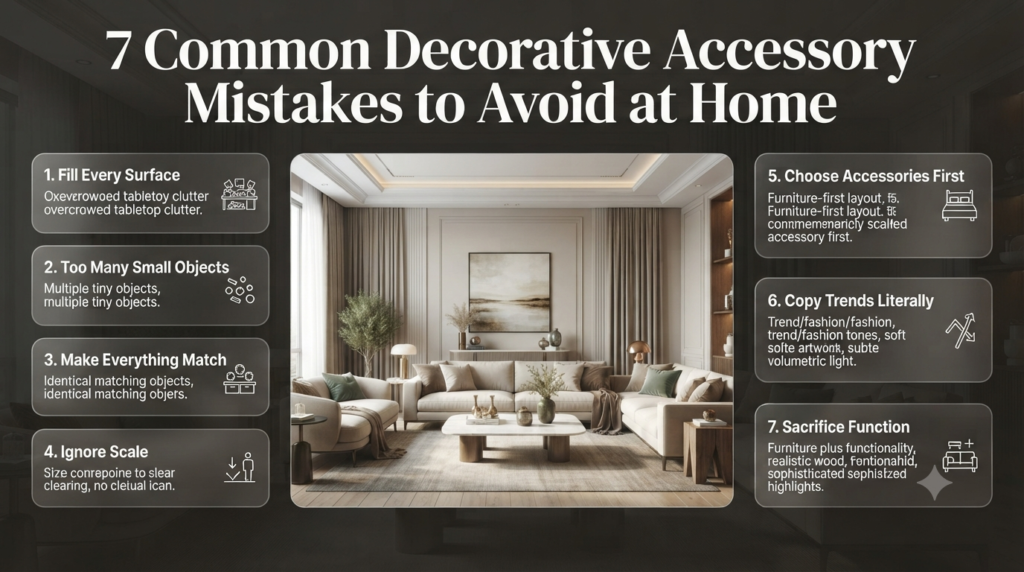
1. Filling Every Empty Surface
An empty surface doesn’t automatically need decoration.
Too many objects create visual noise and reduce the impact of individual pieces.
Better approach: Leave intentional gaps.
2. Using Too Many Small Objects
Small objects can quickly become clutter when used without larger visual anchors.
Mix small accessories with medium and large pieces.
3. Making Everything Match
Matching cushions, vases, artwork, curtains, and rugs can make a room look overly coordinated.
Use complementary relationships instead.
4. Ignoring Scale
Accessories that are too small disappear, while oversized pieces can dominate the room.
Always consider the size of the furniture before selecting decorative objects.
5. Choosing Accessories Before Furniture
Accessories are finishing elements.
Establish the furniture layout, major colors, lighting, and visual anchors first. Then choose accessories that support them.
6. Copying Trends Too Literally
A decorating trend may look excellent in a photograph but feel unsuitable in your home.
Consider your architecture, lifestyle, maintenance needs, and personal taste before following a trend.
7. Sacrificing Function for Decoration
A beautiful coffee table is still meant to be used. A hallway still needs clear circulation.
Good styling should improve the room without making everyday life inconvenient.
How to Style Decorative Accessories on Shelves
Shelves can become visually messy very quickly because multiple objects are displayed together.
For a balanced shelf arrangement:
- Vary heights
- Combine vertical and horizontal objects
- Group related pieces
- Repeat selected colors
- Mix materials
- Leave some empty space
- Avoid placing everything directly in the center
Books can provide both function and height, while ceramics, plants, artwork, and small sculptures add personality.
If you prefer a restrained appearance, Minimalist Home Design provides useful principles for controlling visual clutter.
How to Style a Coffee Table
The coffee table is one of the easiest places to experiment with accessories.
A simple formula is:
Tray + book + organic element + decorative object
For example:
- Wooden tray
- Coffee-table book
- Small plant
- Ceramic bowl
The arrangement should remain practical.
If the table is regularly used for meals, work, or entertaining, leave enough open surface for those activities.
How to Style Decorative Accessories in a Small Room
Small rooms require restraint rather than more decoration.
One of the most common mistakes is assuming that a small room needs many small accessories.
In reality, fewer well-scaled pieces often create a cleaner appearance.
Consider:
- One large mirror
- One strong artwork
- A limited number of cushions
- One substantial plant
- A few carefully selected tabletop objects
Reflective surfaces can also help distribute light and create a greater sense of openness.
If you’re dealing with the overall room layout, start with Interior Design principles before selecting accessories.
Decorative Accessories for Different Interior Styles
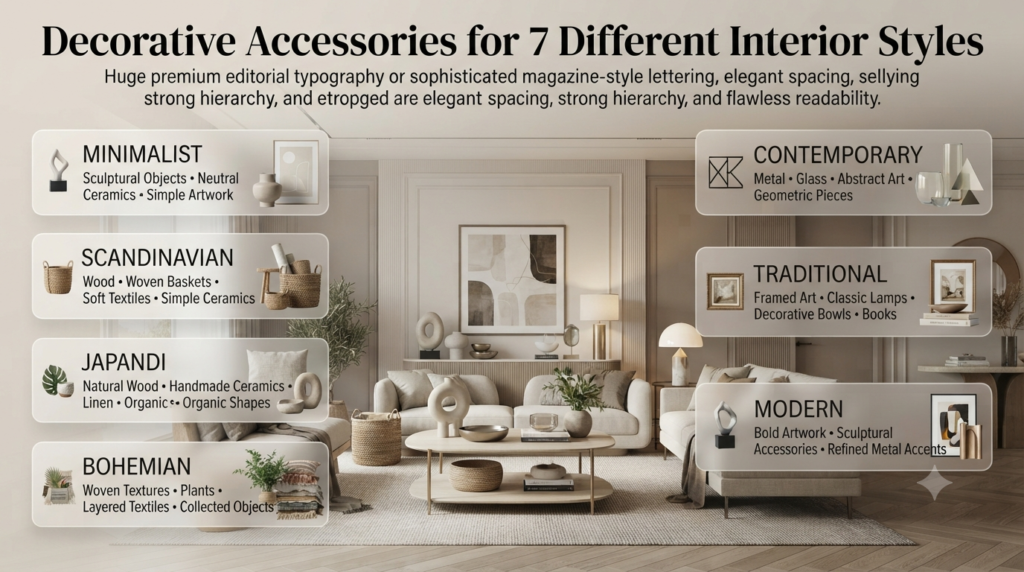
Accessories should reinforce the character of the interior rather than fight against it.
| Interior Style | Suitable Accessories |
|---|---|
| Minimalist | Sculptural objects, neutral ceramics, simple artwork |
| Contemporary | Metal, glass, abstract art, geometric pieces |
| Scandinavian | Wood, woven baskets, soft textiles, simple ceramics |
| Japandi | Natural wood, handmade ceramics, linen, organic shapes |
| Traditional | Framed art, classic lamps, decorative bowls, books |
| Bohemian | Woven textures, plants, layered textiles, collected objects |
| Modern | Bold artwork, sculptural accessories, refined metal accents |
For a broader overview of interior styles, explore Interior Design Styles.
A Practical Decorative Accessories Checklist
Before purchasing an accessory, ask:
- Does it solve a visual problem?
- Does it work with my existing colors?
- Is the scale appropriate?
- Does it add useful texture or contrast?
- Do I already own something similar?
- Can I use it in another room?
- Does it suit my lifestyle?
- Is it easy to maintain?
- Will I still appreciate it if the trend changes?
If you can’t explain why an item belongs in the room, you may not need it.
An Expert Approach to Decorative Styling
Professional-looking interiors rarely come from buying the most expensive objects. They come from making deliberate decisions.
A practical styling process is:
Furniture → layout → color direction → large visual anchors → texture → accessories → editing
Start by establishing the furniture and layout. Determine the dominant and secondary colors. Add larger visual elements such as artwork, mirrors, rugs, and plants. Then introduce smaller decorative pieces.
Finally, edit the arrangement.
A useful professional trick is to photograph the room after styling it.
A room can feel balanced when you’re standing inside it, but photographs often reveal problems that aren’t immediately obvious. You may notice that one side is visually heavier, an artwork is too small, or a surface contains too many objects.
Use the One-Third Editing Method
If a room feels cluttered, temporarily remove approximately one-third of the decorative accessories.
Then step back and look again.
The remaining objects may suddenly have more visual impact because they have more space around them.
Most importantly, decorate for real life.
If children use the living room, fragile objects may need to be positioned out of reach. If you have pets, delicate accessories may need safer locations. If you entertain frequently, tables and circulation areas should remain functional.
Good interior design isn’t just attractive.
It’s livable.
Step-by-Step Method for Decorating With Accessories
Step 1: Assess the Room
Look at the furniture, colors, lighting, walls, flooring, and empty areas.
Identify what the room actually needs before buying anything.
Common mistake: Purchasing accessories simply because they look attractive individually.
Step 2: Establish a Color Direction
Choose one or two accent colors that already exist in the room or intentionally introduce them.
Repeat these colors in different areas to create cohesion.
Example: Olive green can appear in a cushion, plant pot, and artwork.
Step 3: Add Large Visual Anchors
Introduce artwork, mirrors, large plants, or substantial decorative objects.
Solve scale and visual-balance problems before adding small accessories.
Step 4: Layer Texture
Combine materials such as linen, wood, ceramic, stone, wool, metal, or rattan.
Mix smooth and rough surfaces to create depth.
Step 5: Add Personal Details
Introduce books, photographs, handmade pieces, candles, small bowls, or meaningful objects.
Choose items that genuinely reflect your personality rather than filling space for the sake of decoration.
Step 6: Edit the Arrangement
Step back and examine the room from several viewpoints.
Remove anything that feels unnecessary, repetitive, oversized, or disconnected from the overall design.
Photography can help reveal problems that are difficult to notice in person.
How Do You Choose the Right Decorative Accessories for a Room?
Choosing decorative accessories starts with understanding what the room is missing rather than buying items simply because they look attractive. Look at the existing furniture, wall colors, flooring, lighting, and overall interior style. Then decide whether the space needs more texture, color, height, contrast, warmth, or personality. This approach creates a coordinated room instead of a collection of unrelated objects.
For example, if your living room already has patterned furniture, simple ceramic vases and neutral cushions may work better than adding more patterns. If the room feels plain, artwork, textured cushions, natural wood, or greenery can introduce visual interest without changing the furniture.
Key points:
Consider the room’s existing color palette first.
Choose accessories according to furniture scale.
Mix textures such as wood, ceramic, linen, glass, and metal.
Select pieces that support the room’s interior style.
Avoid buying accessories without knowing where they will be placed.
What Decorative Accessories Make a Living Room Look More Stylish?
A stylish living room usually needs a balanced combination of textiles, artwork, natural elements, and carefully selected decorative objects. Cushions and throws add softness, while artwork creates a focal point. Vases, trays, books, sculptures, and plants can then provide smaller layers of detail.
The important part is composition rather than quantity. A coffee table with a beautiful tray, one large book, a ceramic bowl, and a small plant can look considerably more polished than a table covered with ten unrelated decorations.
Useful accessories include:
Decorative cushions for color and comfort
Throws for softness and texture
Artwork for visual focus
Vases for height and shape
Plants for natural color
Coffee-table books for personality
Trays for organizing smaller objects
Sculptural pieces for visual interest
⭐ Expert Tip: Choose one or two statement accessories and let the remaining pieces support them. When everything competes for attention, nothing becomes the focal point.
How Can You Use Decorative Accessories Without Making a Room Look Cluttered?
The key to avoiding clutter is editing. Decorating doesn’t mean using every available surface. Instead, create intentional groupings and leave enough negative space around them. Accessories should have room to breathe so the eye can recognize individual pieces.
A useful method is to vary the height and scale of objects. For example, place a tall vase beside a medium-sized framed piece and a low decorative bowl. This creates visual movement while keeping the arrangement controlled.
To prevent decorative clutter:
Don’t fill every shelf or tabletop.
Combine large, medium, and small objects.
Group related accessories instead of scattering them.
Remove items that don’t contribute to the design.
Keep practical surfaces partially open.
Repeat colors or materials to create visual connection.
⚠ Common Mistake: Buying many small decorative pieces because they appear inexpensive. Several small objects can create more visual noise than one well-chosen statement piece.
How Do You Make Decorative Accessories Look Expensive and High-End?
A high-end look comes more from proportion, material selection, texture, and arrangement than from the price of individual items. Even affordable accessories can look sophisticated when they are properly scaled and grouped.
Natural materials such as wood, stone, ceramic, linen, glass, and woven fibers can add depth. Large-scale artwork, sculptural vases, quality-looking textiles, and restrained metallic accents can also create a more refined appearance.
Instead of placing several inexpensive decorations on one table, choose a smaller number of stronger pieces and give each enough surrounding space.
For a more sophisticated look:
Prioritize quality-looking materials.
Use larger statement pieces where appropriate.
Combine contrasting textures.
Keep the color palette controlled.
Avoid excessive matching.
Leave intentional negative space.
Repeat selected finishes throughout the room.
Example: A neutral sofa can look significantly more refined with textured cream cushions, a dark wood tray, a sculptural ceramic vase, and one carefully chosen artwork than with numerous brightly colored accessories.
What Are the Best Decorative Accessories for Modern and Minimalist Homes?
Modern and minimalist interiors work best with accessories that have a clear purpose within the composition. Instead of using many decorative objects, choose pieces with interesting shapes, textures, or materials. Sculptural ceramics, simple artwork, natural wood, stone objects, neutral cushions, plants, and carefully selected lighting are particularly effective.
The goal isn’t to make the room completely empty. It’s to make every visible object feel intentional.
For a minimalist space, one large ceramic vase may have more impact than a collection of small ornaments. Similarly, a single oversized artwork can create a stronger focal point than several small frames.
Best choices include:
Sculptural ceramic objects
Natural wood accessories
Neutral or textured cushions
Simple artwork
Stone and marble accents
Indoor plants
Linen throws
Minimal decorative trays
Handmade or organic-shaped pieces
📌 Professional Tip: Before adding another accessory, remove one existing item and see whether the room actually looks better. In minimalist design, editing is often more powerful than adding.
Conclusion
Decorative accessories may be small, but they can completely change the way a room looks and feels. The right combination of artwork, cushions, vases, plants, textiles, mirrors, and decorative objects can add personality, warmth, texture, and visual balance without requiring a major renovation.
The key is not to decorate every empty surface. Instead, choose pieces that complement your furniture, repeat meaningful colors and materials, vary scale and height, and leave enough negative space for the room to breathe.
Start with what your space actually needs, then build the look gradually. Choose accessories that reflect your personal style and fit the way you live.
Ultimately, the best decorative accessories aren’t simply beautiful objects. They’re the finishing details that make your home feel balanced, intentional, comfortable, and uniquely yours.

Leave a Reply