

Introduction
Furniture Buying Advice | Buying furniture can look simple until you actually have to choose something.
You see a beautiful sofa online, imagine it in your living room, and feel ready to order. Then you measure the room and discover the sofa is too large. Or the style looks different from the rest of the space. Sometimes the furniture fits perfectly but feels uncomfortable, wears out quickly, or doesn’t provide the storage you expected.
This is why good furniture buying advice isn’t simply about finding attractive pieces at a reasonable price. It’s about understanding your room, measuring correctly, choosing suitable materials, checking comfort, considering durability, and buying pieces that work together.
If you’re furnishing an entire home or replacing just one important piece, this guide will help you make better decisions without wasting money.
For broader inspiration and practical ideas, you can also explore Design Mode 24 Interior Design before making major furniture decisions.
What Should You Consider Before Buying Furniture?
Before buying furniture, consider five things first: the room’s dimensions, the furniture’s measurements, how the piece will be used, the material and construction quality, and whether the style works with your existing interior. Price matters, but it shouldn’t be the only deciding factor.
A good furniture purchase should solve a real need rather than simply fill an empty space.
Start by asking yourself:
- What problem does this furniture need to solve?
- Who will use it?
- How frequently will it be used?
- How much space is actually available?
- How long do I expect it to last?
- Does it work with my existing furniture?
- Is it easy to clean and maintain?
- Can it be moved through my doors, hallways, stairs, or elevators?
- Does the price reflect the quality?
These questions prevent one of the most common furniture-buying mistakes: falling in love with a product before deciding whether it actually belongs in your home.
How Do You Choose Furniture That Fits Your Room?
Choosing correctly starts with measurements, not shopping.
Measure the room’s length and width, but don’t stop there. Measure doorways, windows, radiators, built-in cabinets, staircases, and other fixed features. Then measure the exact furniture you’re considering.
A sofa that technically fits inside a room may still make the space uncomfortable if there isn’t enough walking clearance around it.
Use a simple furniture planning method
Before purchasing a large piece, mark its footprint on the floor using painter’s tape or removable masking tape.
For example, if you’re considering a 90-inch sofa, mark a rectangle approximately 90 inches wide on the floor. Walk around it. Place a coffee table inside the planned arrangement.
This gives you a much better idea of how the furniture will behave in the room than looking at a photograph.
Think about circulation
Furniture should leave comfortable pathways.
As a general planning principle:
Furniture → clearance → furniture
You don’t want every route through the room to feel like an obstacle course.
For living rooms, dining rooms, bedrooms, and home offices, circulation is often more important than adding one extra decorative piece.
💡 Pro Tip: Don’t measure only the room. Measure the route the furniture must take to reach the room. A large sectional might fit perfectly in the living room but fail to pass through the entrance.
Why Is Measuring Furniture So Important?
Furniture measurements help you avoid expensive returns, awkward layouts, and pieces that overwhelm a room. Always compare the product’s width, depth, and height with your available space. Also check door, hallway, staircase, and elevator dimensions before ordering large furniture.
Many buyers check only width.
That’s a mistake.
A sofa’s depth can completely change how much usable space remains in front of it. A tall cabinet can interfere with windows or make a low-ceiling room feel smaller. A dining table can fit dimensionally while leaving insufficient room to pull out chairs.
Check these measurements
| Measurement | Why it matters |
|---|---|
| Width | Determines how much horizontal space the piece occupies |
| Depth | Affects circulation and usable floor area |
| Height | Changes visual scale and may interfere with windows |
| Seat height | Important for comfort and posture |
| Arm height | Can affect the overall appearance |
| Clearance | Determines whether doors and drawers can open |
| Entry dimensions | Determines whether delivery is possible |
⚠ Common Mistake: Measuring the room but not measuring the furniture’s delivery route.
How Do You Decide What Furniture You Actually Need?
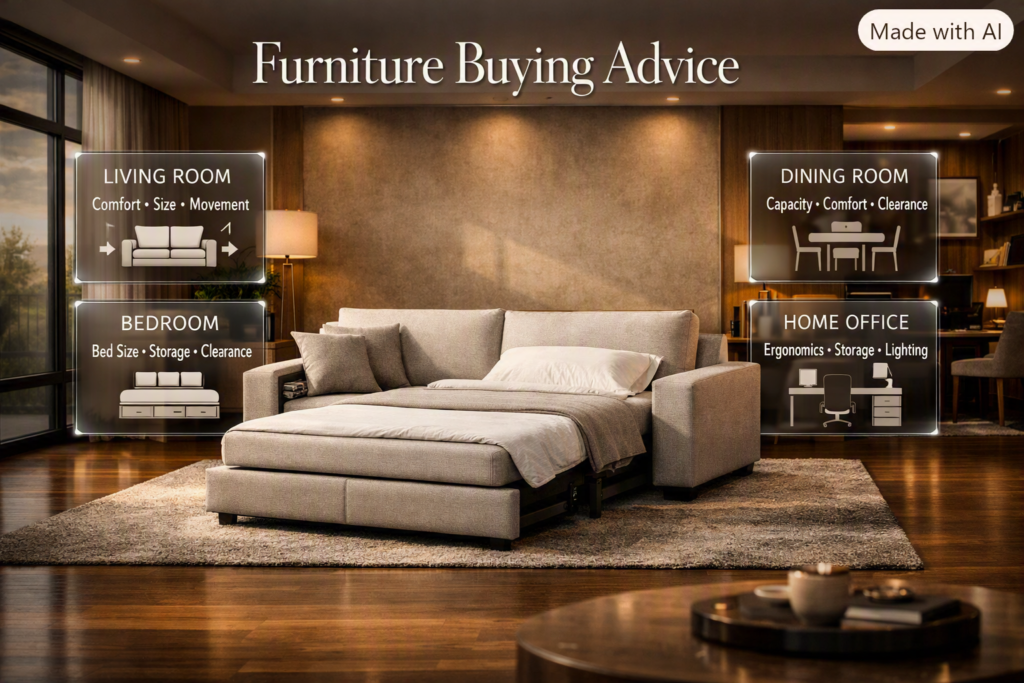
Start with function before style.
A beautiful piece that doesn’t solve a practical problem becomes clutter surprisingly quickly.
For example, a small apartment might need a sofa bed because the living room occasionally functions as a guest room. A family with children may need performance upholstery rather than delicate fabric. A home office may need storage more than another decorative chair.
Think about the room’s primary activity.
Living room
Prioritize:
- Comfortable seating
- Appropriate sofa size
- Coffee table or side table
- Lighting access
- Storage where needed
- Easy movement
A useful reference for smaller functional furniture is Chairside Tables, especially when you need surface space without introducing a large table.
Bedroom
Prioritize:
- Correct bed size
- Mattress compatibility
- Bedside storage
- Wardrobe requirements
- Walking clearance
- Practical lighting
Dining room
Prioritize:
- Table capacity
- Chair comfort
- Chair clearance
- Cleaning requirements
- Room proportions
Home office
Prioritize:
- Desk dimensions
- Ergonomic seating
- Storage
- Cable management
- Lighting
- Screen positioning
The best furniture choices are those that make everyday activities easier.
Should You Buy Furniture as a Matching Set?
Not necessarily.
Matching furniture sets can make shopping easier, but buying every piece from the same collection can sometimes make a room feel predictable or overly coordinated.
A more sophisticated interior usually combines related pieces rather than identical ones.
For example:
- A neutral sofa
- A wooden coffee table
- Two different but compatible accent chairs
- A textured rug
- A simple storage cabinet
The pieces don’t have to match perfectly. They need to relate through color, proportion, material, shape, or style.
When matching sets make sense
A matching bedroom set can be useful when you want:
- A coordinated appearance
- Consistent wood tones
- Simpler shopping
- A traditional or symmetrical look
But you don’t need to match everything.
⭐ Expert Tip: Match the visual language, not necessarily the product collection.
A walnut table doesn’t require walnut chairs. What matters is whether the colors, proportions, and finishes create a coherent room.
How Do You Choose the Right Furniture Style?
Choose a style based on the architecture, existing finishes, lifestyle, and atmosphere you want to create.
Popular furniture styles include:
- Modern
- Contemporary
- Minimalist
- Scandinavian
- Mid-century modern
- Traditional
- Transitional
- Industrial
- Rustic
- Farmhouse
- Japandi
- Eclectic
The important thing is not memorizing every design category.
Instead, identify what you naturally respond to.
Save several rooms you like and look for patterns. Perhaps you repeatedly choose warm woods, curved sofas, neutral upholstery, black accents, or clean-lined furniture.
Those patterns can tell you more about your preferred style than a design quiz.
For additional room-specific inspiration, Room-by-Room Interior Design Inspiration can help you think about furniture choices within the broader design of each space.
How Important Is Furniture Material?

Material affects durability, maintenance, comfort, appearance, and price.
A furniture piece may look excellent in a showroom while requiring more maintenance than you’re willing to provide.
Common furniture materials
| Material | Strengths | Potential drawbacks |
|---|---|---|
| Solid wood | Durable, repairable, timeless | Can be expensive |
| Veneer | Attractive natural appearance | Quality varies |
| MDF | Consistent and affordable | Less repairable than solid wood |
| Particleboard | Budget-friendly | Usually less durable |
| Metal | Strong and modern | Can feel cold visually |
| Glass | Light visual appearance | Shows fingerprints and can break |
| Leather | Durable and easy to wipe | Can be expensive |
| Fabric | Comfortable and versatile | Stains depend on material |
Don’t automatically assume solid wood is always the best choice.
A well-designed piece using quality engineered materials can be perfectly appropriate for certain applications.
The right question is:
Does the material suit the way I will use the furniture?
How Do You Judge Furniture Quality?
Look beyond appearance.
Good furniture usually reveals its quality through construction details.
For upholstered furniture, check:
- Frame stability
- Joinery
- Cushion density
- Stitching
- Fabric quality
- Suspension system
- Weight distribution
For wooden furniture, inspect:
- Joints
- Drawer construction
- Hardware
- Surface finish
- Panel thickness
- Stability
- Alignment
Open drawers.
Sit on the sofa.
Move the chair.
Push gently against the table.
Open and close cabinet doors.
Furniture is a physical product. It should be evaluated physically whenever possible.
A simple quality test
Ask:
Does this piece feel solid when I use it normally?
If a chair rocks, a drawer catches, a table flexes excessively, or a cabinet door doesn’t align correctly before purchase, don’t assume the issue will disappear later.
How Much Should You Spend on Furniture?
There is no universal furniture budget because the right amount depends on your room, lifestyle, expected lifespan, and financial situation.
Instead of dividing furniture into “cheap” and “expensive,” think in terms of value over time.
A $500 chair that lasts two years may provide less value than a $900 chair that remains comfortable and attractive for eight years.
However, expensive doesn’t automatically mean better.
Use a priority-based budget
Spend more on pieces that:
- You use every day.
- Are difficult to replace.
- Receive heavy wear.
- Affect comfort.
- Form the foundation of the room.
For many homes, this could mean prioritizing:
- Mattress
- Sofa
- Dining chairs
- Office chair
- Frequently used storage
You can save more aggressively on decorative side pieces or temporary furniture.
📌 Quick Tip: Don’t spend your entire budget on the first major piece. Leave room for delivery, assembly, lighting, rugs, accessories, and unexpected costs.
What Furniture Should You Buy First?
Large foundational pieces should generally come before decorative furniture.
A practical order might be:
- Measure the room.
- Define the room’s function.
- Choose the largest essential furniture.
- Confirm the layout.
- Add secondary furniture.
- Add lighting and storage.
- Finish with decorative accessories.
This approach prevents you from buying several small pieces that later interfere with the main furniture.
For example, buying three decorative chairs before selecting the sofa can create a layout problem.
Choose the sofa first, establish the seating arrangement, and then select complementary pieces.
How Do You Choose a Sofa?
The sofa is often the visual and functional anchor of a living room, so comfort and proportion matter more than appearance alone.
Before buying, consider:
1. Seat depth
Deep seats can feel luxurious but may be uncomfortable for shorter users.
Shallower seats may offer better upright support.
2. Seat height
Low sofas create a relaxed appearance, while higher seats may be easier to get in and out of.
3. Cushion construction
Ask what is inside the cushions.
Different fillings provide different experiences:
- Foam
- Feather
- Fiber
- Hybrid fillings
4. Frame construction
A sturdy frame contributes to long-term stability.
5. Upholstery
Consider:
- Children
- Pets
- Food and drinks
- Sun exposure
- Cleaning frequency
6. Room scale
A massive sectional can overwhelm a compact living room even if there is technically enough floor space.
⚠ Common Mistake: Choosing a sofa based only on its appearance in a large showroom.
How Do You Choose a Dining Table?
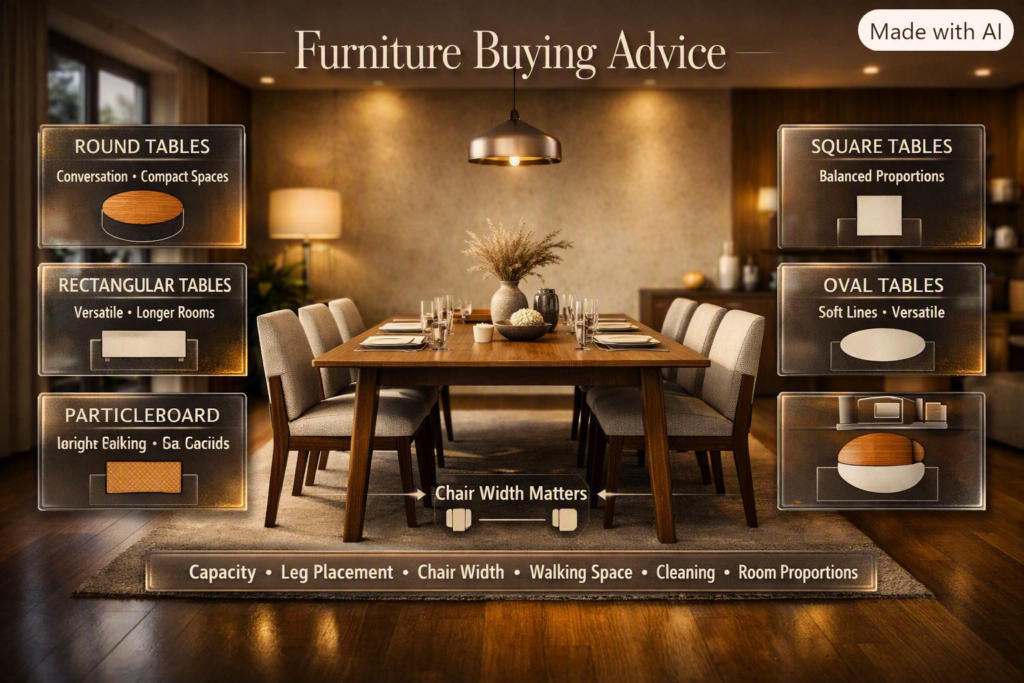
Choose a dining table according to the number of people who regularly use it rather than the maximum number you might host once a year.
Think about:
- Table shape
- Seating capacity
- Leg placement
- Chair width
- Walking space
- Cleaning
- Room proportions
Shape matters
Round tables work well for conversation and can be useful in certain compact spaces.
Rectangular tables are versatile and generally suit longer rooms.
Square tables work best when the room itself supports balanced proportions.
Oval tables provide some of the benefits of rectangular tables while creating softer visual lines.
Don’t forget the chairs.
A table can be the correct size while the chairs are too wide to fit comfortably.
How Do You Choose Bedroom Furniture?
Bedroom furniture should create comfort and storage without making movement difficult.
The bed is usually the starting point.
Then consider:
- Nightstands
- Wardrobe
- Dresser
- Bench
- Accent chair
- Storage furniture
Avoid filling every available wall.
A bedroom needs visual breathing room because its primary purpose is rest.
For children’s spaces, furniture also needs to account for safety, durability, accessibility, and changing needs over time. If you’re designing hospitality or family-oriented spaces, Children’s Hotel Furniture provides useful context around furniture designed for younger users.
How Can Furniture Improve Storage?
Good furniture can solve storage problems without making a room look like a storage area.
Look for multifunctional options such as:
- Ottomans with storage
- Beds with drawers
- Storage benches
- Console cabinets
- Sideboards
- Modular shelving
- Built-in wardrobes
- Nesting tables
However, don’t buy storage furniture simply because it contains storage.
Consider what you’re storing.
A shallow cabinet might be excellent for documents but useless for bulky bedding.
For broader organization strategies, explore Smart Storage and Organization Ideas.
The goal is not maximum storage.
The goal is accessible, useful storage that keeps everyday clutter under control.
How Do Color and Furniture Work Together?
Furniture color should be considered alongside flooring, walls, curtains, lighting, and existing pieces.
A neutral sofa isn’t automatically safe.
Warm beige can clash with cool gray surroundings. Strong wood tones can compete with patterned flooring. Very dark furniture can visually shrink a room when combined with dark walls and limited natural light.
Before committing to a color, evaluate it in the actual room.
This is where paint and furniture decisions overlap.
If you’re changing your room’s color scheme, resources such as Paint Color can help you coordinate furniture with the surrounding palette.
Think in layers
A room usually contains:
Walls → Flooring → Large Furniture → Secondary Furniture → Textiles → Accessories
The colors don’t need to match exactly.
They need to create balance.
Should Furniture Match the Wall Color?
Furniture doesn’t need to match the wall color, but it should work with it.
For example:
- Warm white walls can support natural wood and earthy upholstery.
- Deep blue walls can pair with warm wood and neutral seating.
- Soft beige walls can support both contemporary and traditional furniture.
- Green walls can work beautifully with natural materials and warm neutrals.
If you’re changing your wall color after buying furniture, always test the combination under the lighting conditions used in the room.
For broader renovation planning, Home Improvement offers related ideas that can help you coordinate furniture with larger room improvements.
How Does Lighting Affect Furniture?
Lighting changes how furniture colors and materials appear.
A fabric that looks creamy under warm evening lighting may appear noticeably different in daylight.
Glossy furniture can reflect windows and lamps. Dark finishes may absorb light and appear heavier. Pale upholstery can look brighter under strong daylight.
Evaluate furniture during:
- Morning daylight
- Afternoon light
- Evening lighting
- Ceiling lighting
- Lamps
If you’re furnishing a room while also changing its lighting, don’t evaluate each decision separately.
Furniture, wall color, flooring, and lighting interact.
For example, Bathroom Hanging Pendant Lighting demonstrates how lighting decisions should be considered as part of the overall room environment rather than as an isolated decorative choice.
What Are the Most Common Furniture Buying Mistakes?
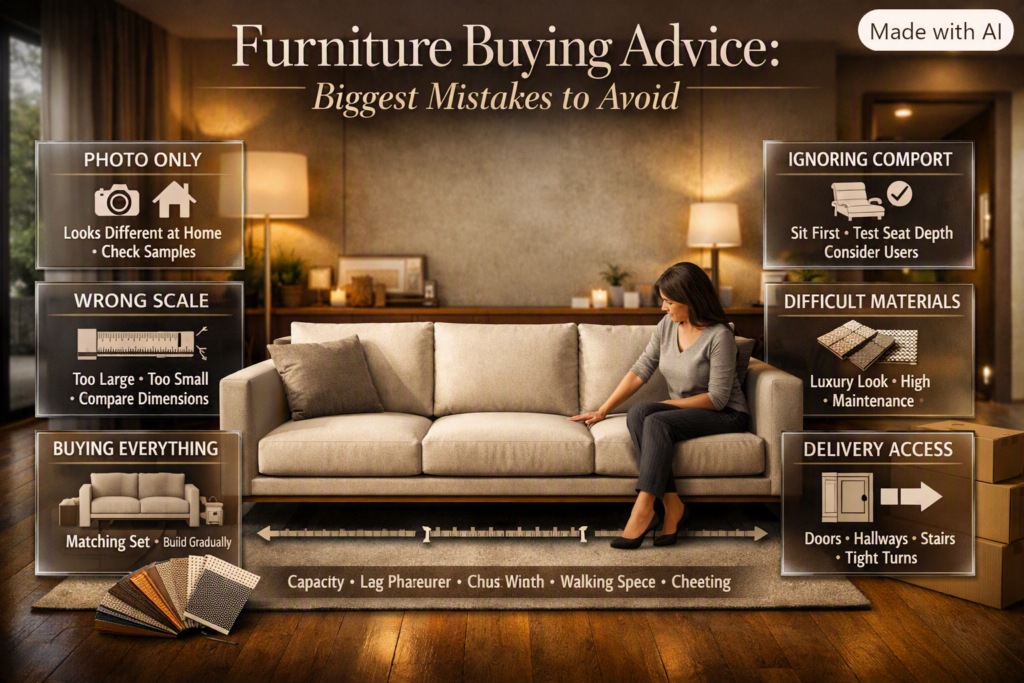
The biggest furniture-buying mistakes usually happen when shoppers focus on appearance and price while ignoring measurements, comfort, quality, maintenance, and long-term use.
Choosing based only on a photograph
Professional photography can make furniture look different from how it appears in an ordinary home.
Why it happens:
The buyer falls in love with the product image.
Why it’s harmful:
The furniture may clash with existing colors, flooring, proportions, or lighting.
How to avoid it:
Use room measurements and samples whenever possible.
Ignoring scale
A piece can be beautiful but completely wrong for the room.
Why it happens:
The buyer focuses on the furniture rather than the relationship between furniture and room.
Why it’s harmful:
Oversized furniture can restrict circulation, while undersized furniture can make a large room feel unfinished.
How to avoid it:
Compare furniture dimensions with the room and other pieces.
Buying everything at once
Why it happens:
A matching collection seems easier.
Why it’s harmful:
You may make several decisions before understanding how the room actually works.
How to avoid it:
Buy foundational pieces first and build gradually.
Ignoring comfort
A chair can look excellent and still be uncomfortable.
Why it happens:
The buyer evaluates appearance before sitting.
Why it’s harmful:
Furniture is used every day, not photographed every day.
How to avoid it:
Sit, lean back, test the seat depth, and consider different users.
Choosing difficult materials
Why it happens:
Delicate materials often look luxurious.
Why it’s harmful:
Maintenance becomes frustrating.
How to avoid it:
Match materials to your lifestyle.
Forgetting delivery access
Why it happens:
The room measurements look correct.
Why it’s harmful:
The furniture can’t physically reach the room.
How to avoid it:
Measure doors, hallways, staircases, elevators, and tight turns.
What Is the Best Way to Buy Furniture Online?
Online furniture shopping can be convenient, but you need to replace the physical inspection process with more detailed research.
Before ordering:
Check the complete dimensions
Don’t rely on “large,” “medium,” or “compact.”
Read the actual measurements.
Look at multiple photographs
Try to find:
- Front view
- Side view
- Back view
- Close-up of materials
- Lifestyle image
- Scale reference
Read reviews intelligently
Don’t look only at the star rating.
Search reviews for recurring comments about:
- Comfort
- Assembly
- Color accuracy
- Durability
- Packaging
- Delivery
- Stability
One negative review doesn’t automatically make a product bad.
Ten independent reviews reporting the same problem deserve attention.
Check return policies
A return policy can matter as much as the product itself.
Understand:
- Return window
- Restocking fees
- Return shipping
- Damage conditions
- Assembly requirements
- Refund process
⭐ Expert Tip: Save screenshots or copies of the product specifications at the time of purchase. Online product pages can change.
How Do You Compare Two Furniture Pieces?
Don’t compare furniture based only on price.
Use a simple decision matrix.
| Factor | Furniture A | Furniture B |
|---|---|---|
| Price | ★★★★ | ★★★ |
| Comfort | ★★★ | ★★★★★ |
| Durability | ★★★★ | ★★★★ |
| Maintenance | ★★★★★ | ★★★ |
| Style compatibility | ★★★★ | ★★★★★ |
| Storage/function | ★★★ | ★★★★ |
| Long-term value | ★★★★ | ★★★★ |
The highest-rated product isn’t automatically the winner.
Your priorities determine the winner.
For example, if you have young children, easy cleaning might matter more than an extra design feature.
If the furniture is for a guest room, appearance may matter more than extreme durability.
When Should You Repair Furniture Instead of Replacing It?
Replacement isn’t always the best solution.
Consider repair when:
- The frame is strong.
- The design still works.
- The piece has sentimental value.
- The material can be refinished.
- Upholstery can be replaced.
- Hardware can be upgraded.
A dated wooden table might need only refinishing.
An old chair might need new upholstery.
A cabinet might become useful again with new hardware and better organization.
This approach can also support more sustainable furnishing because it keeps usable furniture in circulation.
For hands-on projects, DIY Home Projects can provide ideas for improving existing pieces rather than automatically replacing them.
How Do You Make Furniture Work in a Small Room?
Small rooms require discipline.
The biggest mistake is assuming that small furniture is always the answer.
Sometimes a single well-proportioned sofa looks better than several tiny chairs.
Use furniture that provides more than one function where appropriate.
Examples include:
- Sofa beds
- Storage ottomans
- Nesting tables
- Wall-mounted desks
- Slim consoles
- Beds with storage
Use visual weight carefully.
Furniture with exposed legs can sometimes make more floor visible, creating a lighter visual effect.
Mirrors, lighter finishes, and appropriate lighting can also help.
The goal isn’t to make the room look empty.
It’s to make the room feel usable.
How Do You Furnish a Large Room Without Making It Feel Empty?
Large rooms have the opposite problem.
Instead of pushing every piece against the walls, create functional zones.
A large living room might contain:
Zone 1: Main seating area
Zone 2: Reading corner
Zone 3: Media area
Zone 4: Small conversation area
Use rugs, lighting, furniture orientation, and visual anchors to define each zone.
Avoid buying oversized furniture simply because the room is large.
Large furniture can help, but proportion remains important.
How Can Decorative Objects Complement Furniture?
Furniture establishes structure; accessories provide personality.
Decorative objects can help connect different furniture pieces through color, texture, shape, or material.
For example, white accessories can create visual continuity across a room containing darker furniture.
White Decorative Objects can be useful when you’re trying to introduce lighter accents without adding another strong color.
The important thing is restraint.
Accessories should support the furniture rather than compete with it.
How Can You Create a More Personal Furniture Arrangement?
Avoid copying a showroom exactly.
A showroom is designed to sell products.
Your home is designed to support your life.
Place furniture according to how you actually move through the room.
If you read in the evening, create a comfortable reading position near suitable lighting.
If your family gathers around the television, orient seating toward it.
If guests frequently visit, create conversational seating rather than pointing every chair toward one screen.
Your furniture arrangement should reflect behavior.
This is one of the most valuable principles in practical interior design.
For broader professional ideas across different spaces, you can also explore the Room-by-Room Design Hub.
How Can You Make Furniture Buying More Sustainable?
Sustainable furniture buying isn’t simply about purchasing products labeled “eco-friendly.”
Consider the full life of the furniture.
Ask:
- Can it be repaired?
- Can parts be replaced?
- Is the construction durable?
- Will the style remain useful?
- Can it be reused in another room?
- Can it be refinished?
- Is the material appropriate for long-term use?
A timeless piece that lasts ten years can be a better practical decision than a trendy piece that needs replacement after two years.
Durability is one of the simplest forms of sustainable consumption.
What Should You Ask a Furniture Seller?
Don’t hesitate to ask detailed questions.
Useful questions include:
- What material is the frame made from?
- What type of upholstery is used?
- What is the weight capacity?
- How should the furniture be cleaned?
- Are replacement parts available?
- What type of warranty is included?
- Is assembly required?
- What are the exact packaged dimensions?
- Can the cushions or covers be replaced?
- What happens if the furniture arrives damaged?
A good seller should be able to provide clear product information.
If answers are vague, treat that as a reason to investigate further.
A Professional Furniture Buying Checklist
Before you buy, run through this checklist.
Space
- Room measured
- Furniture footprint checked
- Doorways measured
- Hallways checked
- Stairways checked
- Elevator checked if applicable
- Walking clearance confirmed
Function
- Main purpose identified
- Number of users considered
- Frequency of use considered
- Storage needs considered
- Lifestyle considered
Quality
- Frame inspected
- Hardware checked
- Joints checked
- Upholstery evaluated
- Cushions tested
- Stability checked
Style
- Existing furniture considered
- Flooring considered
- Wall color considered
- Lighting considered
- Room proportions considered
Purchase
- Price compared
- Warranty checked
- Return policy checked
- Delivery conditions checked
- Assembly requirements understood
If several boxes remain unchecked, you’re probably not ready to purchase yet.
What Furniture Buying Advice Matters Most for First-Time Buyers?
First-time buyers should focus on measurements, function, comfort, construction quality, and long-term value before worrying about trends. Buy essential pieces gradually, test furniture whenever possible, and avoid furnishing an entire room from a single impulse purchase.
The most useful mindset is simple:
Buy for the life you actually live.
If your household eats on the sofa, prioritize durable upholstery.
If you work from home, prioritize your desk and chair.
If you host frequently, prioritize seating and table capacity.
If storage is constantly a problem, prioritize functional furniture before decorative pieces.
Your furniture should make daily life easier.
How Do You Build a Furniture Budget That Actually Works?
A practical furniture budget should include more than the product price.
Remember to account for:
- Delivery
- Assembly
- Installation
- Protective treatments
- Accessories
- Replacement hardware
- Rugs
- Lighting
- Window treatments
A sofa may fit your furniture budget but create a problem if you have no remaining budget for the rest of the room.
One useful strategy is to divide your budget into three categories:
Essential
Furniture you genuinely need.
Supporting
Furniture that improves function.
Decorative
Furniture or objects that primarily improve appearance.
Buy in that order.
How Can Interior Design Advice Improve Furniture Decisions?
Furniture should never be viewed in isolation.
The most successful rooms consider furniture alongside:
- Color
- Lighting
- Flooring
- Textures
- Architecture
- Storage
- Circulation
- Decorative elements
That’s why broader Interior Design planning can be valuable before making expensive furniture purchases.
You don’t necessarily need a professionally designed room.
You simply need to understand how the different elements influence each other.
For example, a low-profile sofa might look excellent in a modern room with horizontal lines, while a traditional high-back sofa may work better with architectural details and classic proportions.
How Can You Make Furniture Shopping Less Stressful?
Don’t try to make every decision in one afternoon.
Furniture shopping becomes easier when you create a process.
Step 1: Identify the problem
What isn’t working in the room?
Step 2: Measure
Record the room and delivery dimensions.
Step 3: Set priorities
Decide what matters most: comfort, storage, durability, appearance, or flexibility.
Step 4: Research
Compare several products rather than the first attractive option.
Step 5: Test
Sit, open, move, touch, and inspect whenever possible.
Step 6: Confirm
Double-check measurements, materials, warranty, delivery, and return terms.
Step 7: Purchase
Only buy when the product passes both the practical and visual tests.
This process may take longer than impulse shopping, but it dramatically reduces expensive mistakes.
What should I check before buying furniture?
Before buying furniture, don’t judge it by appearance or price alone. Check the dimensions, construction, materials, comfort, finish, functionality, warranty, delivery requirements, and return policy. For upholstered furniture, inspect the frame, cushions and fabric. For wooden furniture, examine joints, drawers, hardware and hidden surfaces. Also make sure the furniture fits both the room and the route used to bring it inside.
A practical pre-purchase check should include:
Measure the room: Check width, depth, height and available floor space.
Measure access points: Don’t forget doors, hallways, stairs and elevators.
Inspect construction: Open drawers, move doors and check joints.
Test comfort: Sit on sofas and chairs rather than judging from photographs.
Ask about materials: Find out exactly what the frame, panels, upholstery and hardware are made from.
Check after-sales terms: Understand warranty, delivery, assembly and returns.
Professional advice: If a seller can’t clearly explain what materials and construction methods are used, don’t assume the furniture is high quality. The information you can’t verify is often where the biggest compromises are hidden.
How can I tell if furniture is good quality?
Good furniture is usually identified by its construction rather than its surface appearance. A polished finish can make an inexpensive piece look impressive, but quality becomes easier to judge when you inspect the frame, joints, hardware, moving parts and materials. For sofas and chairs, also pay attention to cushion support and upholstery.
When inspecting furniture, look for:
Strong and stable frames
Properly aligned joints
Smoothly operating drawers and doors
Reliable hinges and drawer runners
Even finishes without obvious rough areas
Appropriate upholstery for the intended use
Cushions that provide consistent support
Construction details that match the price
For wooden furniture, don’t inspect only the front. Look under tables, inside drawers and behind removable components. These less-visible areas can reveal how carefully the piece was constructed.
⭐ Expert tip: Never assume that heavier furniture is automatically better. Weight can provide a clue, but it doesn’t prove quality. Joinery, material selection, stability and construction are much more useful indicators.
How do I choose the right furniture size for my room?
The right furniture size depends on more than whether the piece technically fits. You need enough space for walking, opening doors and drawers, pulling out chairs, and using the furniture comfortably. Measure both the furniture and the room before purchasing, then consider how the piece relates to the other furniture already in the space.
A simple approach is to create the furniture footprint on the floor using painter’s tape. If you’re considering a large sofa, mark its approximate width and depth. Walk around the marked area and imagine where your coffee table, chairs and other pieces will sit.
Also measure the delivery route.
Check:
Main entrance
Interior doors
Hallways
Staircases
Elevator dimensions
Narrow corners
Ceiling height where necessary
Common mistake: Buyers often measure the living room perfectly but forget the entrance. A sectional can fit beautifully once inside and still be impossible to get through the front door.
Professional advice: Think about space + furniture + circulation, not furniture alone. A slightly smaller piece that leaves comfortable movement can make a room feel much better than a larger piece that technically fits.
Which furniture material is best for long-term use?
There isn’t one material that’s best for every furniture application. The right choice depends on how the furniture will be used, where it will be placed, the expected level of wear, moisture exposure, maintenance requirements and budget. Solid wood can be an excellent choice for structural pieces, while engineered materials can make sense for certain cabinets and storage applications when properly constructed and protected.
Before purchasing, ask exactly what material is used in each major component. A product described simply as “wooden furniture” may contain several different materials in its frame, panels, drawer bottoms and back sections.
Consider the application
Furniture
What to prioritize
Sofa
Frame, suspension, cushion construction and upholstery
Bed
Strong frame, joints and mattress support
Dining table
Stability, tabletop construction and finish
Wardrobe
Panel quality, hardware, edge protection and hinges
Dining chairs
Frame strength, joints and upholstery
Storage cabinet
Panel construction, hardware and load capacity
The most important question isn’t simply “Which material is best?”
It’s:
“Which material is appropriate for the job I’m asking this furniture to perform?”
⚠ Common mistake: Choosing a material because it sounds premium without considering the room’s humidity, daily usage, maintenance requirements or structural demands.
Is buying furniture online a good idea?
Buying furniture online can be convenient and can give you access to a much wider selection, but larger purchases require more research because you can’t physically test the product before ordering. Pay particular attention to exact dimensions, materials, customer reviews, product photographs, warranty, delivery conditions and return policies.
Before placing an online furniture order, use this checklist:
Read the complete product dimensions.
Check the materials used in the frame and visible components.
Look for close-up photographs.
Read reviews for recurring complaints.
Check whether the displayed price includes every component.
Confirm delivery charges.
Understand assembly requirements.
Check the return period and conditions.
Verify warranty coverage.
Measure your doorway and delivery route.
Don’t rely on a five-star rating alone. Read the actual reviews and look for repeated comments about comfort, durability, color accuracy, assembly, packaging and delivery.
📌 Quick tip: Save the product page or specifications when ordering expensive furniture. If the listing changes later, you’ll still have a record of what you originally purchased.
The safest approach is to treat online furniture shopping as a research exercise rather than an impulse purchase. If the seller provides detailed specifications, clear photographs, transparent policies and useful customer feedback, you can make a much more informed decision.
Conclusion
Buying furniture is not simply about choosing something that looks attractive in a showroom or matches a picture online. The right purchase should balance quality, comfort, size, material, functionality, durability, and overall value. A beautiful sofa that is too large for your living room, a dining table made from unsuitable material, or a stylish chair that becomes uncomfortable after a few months can quickly turn an exciting purchase into an expensive mistake.
Good furniture buying advice starts with understanding your actual needs. Measure the available space before shopping, consider how the furniture will be used, inspect construction details, compare materials, and think about maintenance requirements. For larger investments, pay close attention to frames, joints, hardware, upholstery, finishes, warranties, delivery conditions, and return policies rather than judging quality from appearance alone.
Your home should also influence your choices. Furniture needs to work with your existing layout, lighting, flooring, colors, and everyday lifestyle. If you have children, pets, limited space, or a busy household, practicality may matter more than delicate finishes or purely decorative designs.
Most importantly, avoid rushing the decision. Compare several options, ask specific questions, check measurements twice, and consider the long-term cost rather than focusing only on the initial price. A slightly more expensive piece with stronger construction and better materials can provide considerably better value over time.
Whether you are furnishing one room or updating your entire home, thoughtful decisions will help you create a space that feels comfortable, functional, cohesive, and genuinely yours. The best furniture is not necessarily the most expensive or fashionable—it is the furniture that fits your space, serves your needs, and continues to perform well for years to come.

Leave a Reply