
Introduction
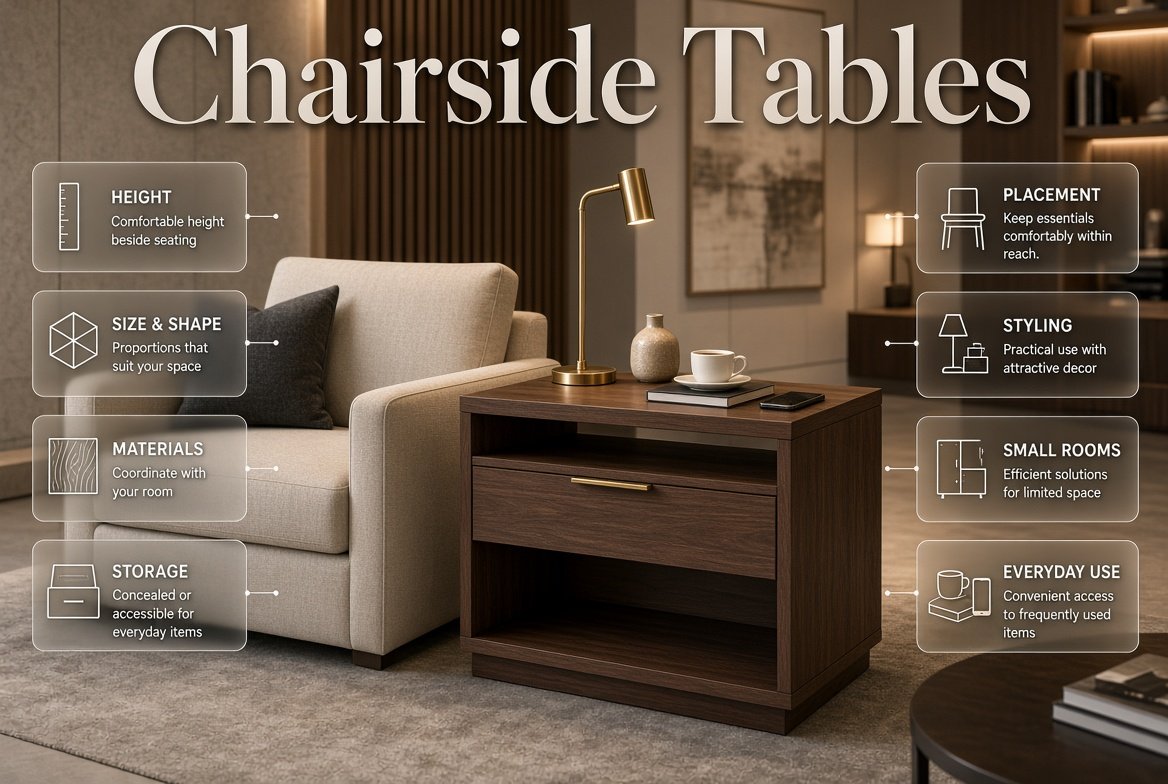
Chairside Tables | A chair can be comfortable, attractive, and perfectly positioned, but something may still feel missing. You sit down with a cup of coffee, a book, your phone, or a remote, only to realize there’s nowhere convenient to put it. Reaching toward the coffee table every few minutes quickly becomes annoying, especially when you’re trying to relax.
That’s where chairside tables make a surprisingly big difference.
These compact pieces of furniture are designed to sit beside chairs, recliners, sofas, and other seating areas, giving you a practical surface within easy reach. They can hold a reading lamp, drink, book, phone, decorative object, or even provide concealed storage for everyday items.
For homeowners who want a room that looks beautiful but also works comfortably in everyday life, a well-chosen side table is more than an accessory. It’s part of the room’s functional design.
If you’re planning a broader interior update, you can also explore DesignMode24 Interior Design for additional furniture, decorating, and home design inspiration.
This guide explains everything you need to know before choosing chairside tables, including the right height, size, shape, materials, storage options, placement, styling techniques, small-room solutions, and common buying mistakes.
What Are Chairside Tables?
Chairside tables are small tables designed to sit beside a chair or another piece of seating. Their main purpose is to provide a convenient, reachable surface for everyday objects while occupying considerably less floor space than larger occasional furniture.
They are commonly used beside:
- Armchairs
- Reading chairs
- Recliners
- Lounge chairs
- Accent chairs
- Sofas
- Loveseats
- Bedroom seating
- Home office lounge chairs
Unlike a conventional coffee table, a chairside table serves a more personal function. It puts useful items directly beside the person using the seat.
A well-positioned table can hold a glass of water, book, lamp, phone, tablet, remote control, or small decorative accessory without requiring you to leave your seat.
The term can overlap with side tables, end tables, accent tables, and occasional tables. Furniture retailers don’t always use these terms consistently, so dimensions and intended use are more important than the product name.
Why Are Chairside Tables Important in Interior Design?
A small table can influence both the functionality and visual balance of a seating arrangement.
Without one, a chair may feel isolated from the rest of the room. With the right table, the chair becomes a complete functional zone.
For example:
Reading chair + chairside table + table lamp + book
creates a natural reading corner.
Likewise:
Recliner + side table + drink + lamp
creates a comfortable relaxation area without requiring additional furniture.
This is why small furniture pieces deserve more attention than their size suggests. Good interior design isn’t simply about filling a room with attractive objects. It’s about creating relationships between furniture, movement, lighting, storage, and everyday activities.
What Should You Consider Before Buying Chairside Tables?
The best chairside table isn’t necessarily the most expensive, largest, or visually impressive option. It should solve a specific problem while fitting naturally into the available space.
Before shopping, consider these seven factors:
- Table height
- Width and depth
- Available floor space
- Purpose and daily use
- Storage requirements
- Material and durability
- Interior design style
The order matters.
Start with function and measurements. Once you know what the table needs to do, choosing a style becomes much easier.
1. Measure the Chair
Measure the height from the floor to the top of the chair arm.
This measurement gives you a useful starting point for selecting a comfortable tabletop height.
Also measure the overall chair width and the available space beside it. Don’t assume that a table shown beside a similar-looking chair online will fit your furniture in the same way.
2. Measure the Floor Space
Measure the distance between the chair and nearby walls, windows, sofas, cabinets, or walking paths.
Then measure how far the table can project into the room without becoming an obstruction.
A simple planning diagram looks like this:
        WALL
────────────────────────

     Chair      Table
    ┌──────┐   ┌─────┐
    │      │   │     │
    │      │   │     │
    └──────┘   └─────┘
       ↓          ↓
    Seating    Easy reach

──────── WALKING AREA ────────
The table should remain accessible without narrowing the room’s main circulation path.
3. Decide What the Table Will Hold
A table intended only for a drink can be much smaller than one expected to support a lamp, books, electronics, and decorative accessories.
Ask yourself:
- Do I need a lamp?
- Will I keep books here?
- Do I regularly drink coffee or tea in this chair?
- Do I need somewhere for my phone?
- Do I need hidden storage?
- Will children use the table?
- Will the table remain mostly decorative?
Your answers should determine the table’s dimensions.
How Tall Should Chairside Tables Be?
The ideal height depends on the seating, but the tabletop is generally most convenient when it sits close to the chair arm. This allows you to reach drinks, books, phones, and other objects without leaning excessively.
A table that’s too low can force you to bend forward. A table that’s too high may feel awkward and visually overpower the chair.
For everyday use, compare the tabletop with the arm height rather than choosing a standard measurement blindly.
Why Does Table Height Matter So Much?
Imagine sitting in a deep lounge chair with a low side table. Every time you want to put down your coffee, you have to lean forward and reach downward.
The table technically works, but it doesn’t work comfortably.
Now imagine a table that’s significantly higher than the arm. The tabletop may be easy to reach, but it can look disproportionate and potentially interfere with the chair’s visual balance.
The best result usually comes from a height that feels naturally connected to the seating.
⭐ Expert Tip: Sit in the chair before finalizing the table whenever possible. Your body will tell you more about usability than a product photograph will.
What Size Should a Chairside Table Be?
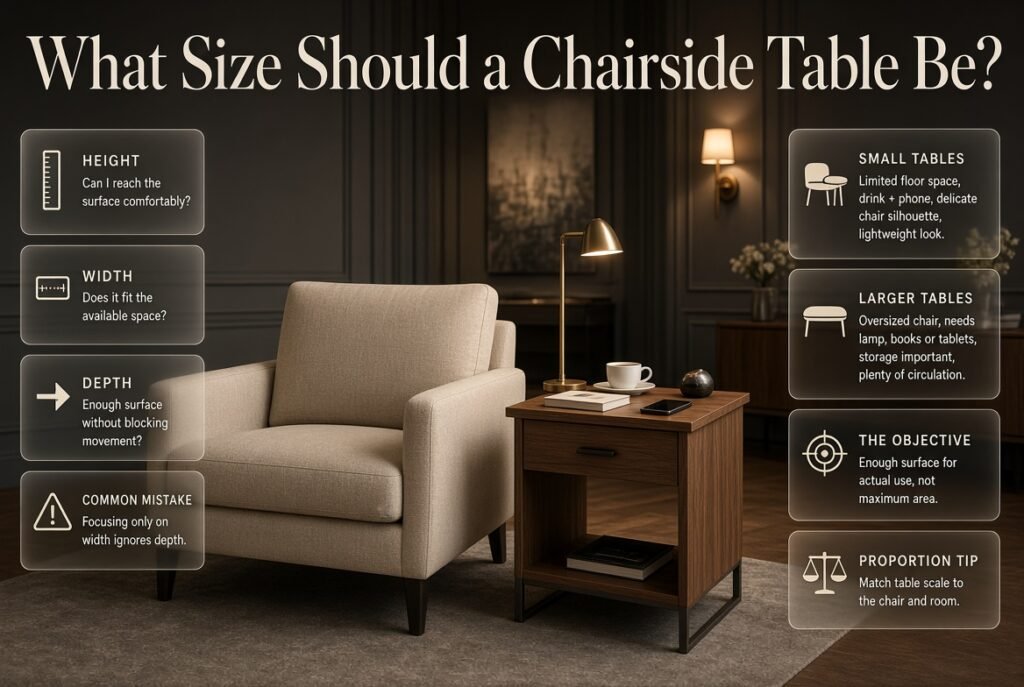
There isn’t one universal size for every chairside table. The correct dimensions depend on the chair, room, and intended use.
A compact table might be appropriate for a narrow reading corner, while a larger table may be needed beside a substantial recliner.
Think about the three primary dimensions separately.
| Dimension | Main Question |
|---|---|
| Height | Can I reach the surface comfortably? |
| Width | Does it fit the available space? |
| Depth | Does it provide enough usable surface without blocking movement? |
A common mistake is to focus only on width.
Depth can be just as important. A table may technically fit beside a chair but extend too far into the walking area.
Small Tables vs. Larger Tables
Small tables are best when:
- Floor space is limited
- You need only a drink and phone
- The chair has a delicate silhouette
- You want a lightweight appearance
- The room already contains substantial furniture
Larger tables can work when:
- The chair is oversized
- You need a table lamp
- You use books or tablets
- Storage is important
- The room has plenty of circulation space
The objective isn’t to maximize tabletop area. It’s to provide enough surface for the way you actually use the chair.
Which Shape Is Best for Chairside Tables?
Shape should respond to both the furniture around it and the amount of available space.
The most common options are square, rectangular, round, oval, and C-shaped designs.
Square Chairside Tables
Square tables offer a balanced footprint and can work particularly well with modern, structured furniture.
They’re useful when the available space has relatively equal width and depth.
A square tabletop can also provide enough room for a lamp and several smaller objects without requiring a long table.
Rectangular Chairside Tables
Rectangular designs are excellent for narrow spaces.
For example, if there is limited room between a chair and a wall but enough length beside the seating, a narrow rectangular table can provide more usable surface than a square alternative.
They’re also easy to coordinate with sofas and furniture featuring straight lines.
Round Chairside Tables
Round tables introduce softer visual movement into a room.
They work especially well beside:
- Curved chairs
- Rounded sofas
- Organic-shaped furniture
- Traditional seating
- Relaxed living spaces
Another advantage is the absence of sharp corners.
In homes where people frequently walk around the seating area, rounded edges can make circulation feel more comfortable.
C-Shaped Tables
C-shaped side tables are especially useful in compact rooms.
Their base can slide partly beneath a chair or sofa while the tabletop extends over the seating area.
They’re useful for:
- Laptops
- Tablets
- Snacks
- Books
- Drinks
- Temporary work surfaces
However, C-shaped tables aren’t always the best choice for a permanent decorative arrangement because their primary strength is flexibility and convenience.
📌 Quick Tip: If your room contains mostly straight furniture, consider a round table to soften the composition. If your furniture already has many curves, a simple rectangular table may provide useful contrast.
Which Material Is Best for Chairside Tables?
Material influences appearance, durability, maintenance, weight, and cost.
There isn’t a single best material. The right option depends on how the table will be used.
Wooden Chairside Tables
Wood remains one of the most versatile choices.
It works well with:
- Traditional interiors
- Contemporary rooms
- Scandinavian design
- Farmhouse interiors
- Transitional spaces
- Rustic rooms
- Modern organic interiors
Natural wood brings warmth and texture into a room.
Solid wood can offer excellent durability, while engineered wood can provide a more affordable option with a wide variety of finishes.
When choosing wood, look at the finish as well as the construction. A beautiful wood surface may require more care than a highly practical laminate or sealed finish.
Metal Chairside Tables
Metal creates a cleaner, more contemporary appearance.
Black metal can support industrial and modern interiors, while brass, bronze, or brushed finishes can introduce a more refined decorative character.
Metal is particularly effective when repeated elsewhere in the room.
For example, a black metal table can visually connect with black window frames, lighting fixtures, or furniture legs.
Glass Chairside Tables
Glass can make a compact room feel more visually open because the surface doesn’t create the same visual weight as a solid wooden top.
It’s useful in:
- Small apartments
- Contemporary rooms
- Minimalist interiors
- Light-filled spaces
The downside is maintenance. Glass shows fingerprints, dust, and smudges more easily.
Marble and Stone
Stone-topped tables can bring a sophisticated, high-end quality to a room.
They pair particularly well with:
- Brass
- Black metal
- Natural wood
- Neutral upholstery
- Contemporary interiors
However, stone can be heavy and may require more care depending on the material.
If the table will be moved frequently, weight is worth considering before buying.
Mixed Materials
Mixed-material chairside tables can be particularly effective when you want to connect several finishes.
For example:
Wood top + metal base
can bridge a warm interior with contemporary furniture.
Likewise:
Stone top + metal frame
can create a polished appearance without becoming overly decorative.
Should Chairside Tables Have Storage?
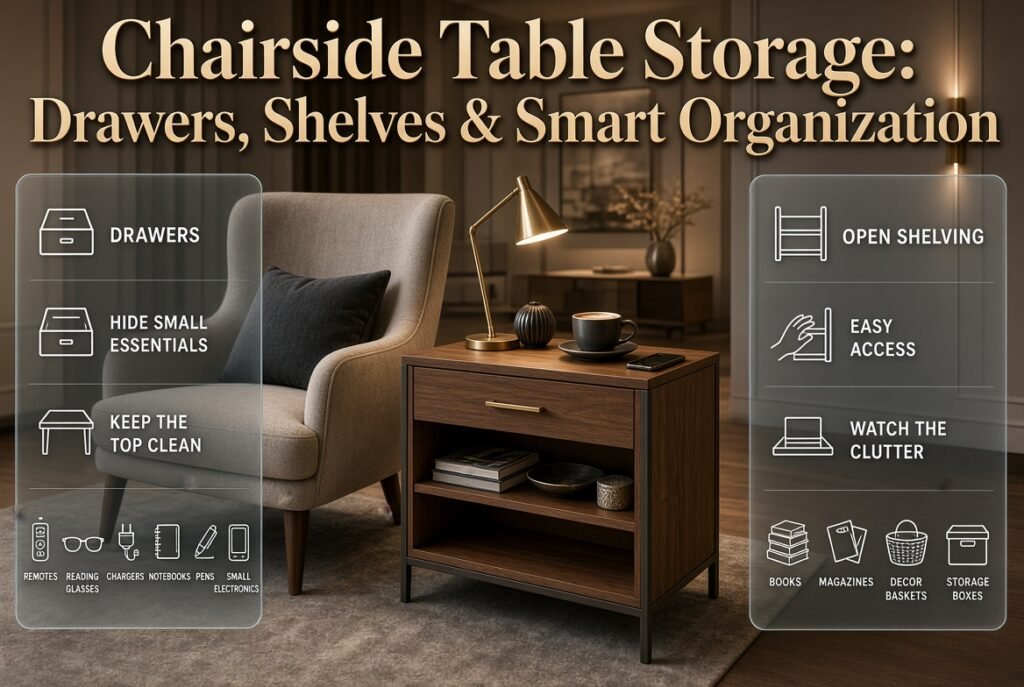
Storage can make a chairside table significantly more useful, especially when the table is beside a frequently used chair.
Common storage options include:
- Drawers
- Cabinets
- Open shelves
- Lower compartments
- Baskets
- Built-in charging areas
When a Drawer Makes Sense
A drawer is useful for small objects that you want nearby but don’t want visible.
You could store:
- Remote controls
- Reading glasses
- Chargers
- Notebooks
- Pens
- Small electronics
This is particularly helpful if you want the tabletop to remain visually clean.
When Open Shelving Is Better
Open shelves make frequently used items easier to access.
They’re useful for:
- Books
- Magazines
- Decorative baskets
- Small storage boxes
- Display objects
The trade-off is visual clutter.
If the shelf becomes a collection of miscellaneous objects, the table can quickly look untidy.
Do You Always Need Storage?
No.
If the table is mainly intended for a lamp and drink, a simple open design may actually be better.
Adding drawers, shelves, and cabinets increases visual weight. In a small room, a minimalist table can sometimes be more effective than a storage-heavy design.
How Do You Style Chairside Tables?
Styling a chairside table should balance beauty with usability.
A common mistake is treating the tabletop like a display shelf and filling every available inch.
Instead, think in terms of function + one or two decorative elements.
A simple arrangement could be:
Lamp + book + small object
Another could be:
Plant + drink + candle
The arrangement should leave enough clear space to put down something you are actually using.
Create Height Variation
Objects with identical heights can make the arrangement feel flat.
Instead, combine:
- One tall object
- One medium object
- One low object
For example:
Tall lamp → stacked book → small ceramic object
This creates visual hierarchy without requiring many accessories.
Don’t Hide the Tabletop
The table itself should remain visible.
If the surface disappears under books, candles, plants, trays, and decorative objects, you’ve turned a useful piece of furniture into a cluttered display.
💡 Pro Tip: Leave at least one clearly usable area on the tabletop. A beautiful chairside table should still have room for the coffee cup you actually drink.
How Can Chairside Tables Improve a Small Living Room?
Small rooms require furniture that performs more than one function.
Chairside tables are useful because they provide a practical surface without consuming as much floor space as larger cabinets or tables.
For a compact room, consider:
- Narrow side tables
- Pedestal tables
- C-shaped designs
- Tables with vertical storage
- Open-leg designs
- Visually lightweight materials
Consider Visual Weight
Physical size isn’t the only issue.
A dark, solid table with thick sides can look much larger than a slim table with open legs even if both occupy similar floor space.
If your room feels crowded, look for designs with:
- Slim legs
- Open bases
- Light finishes
- Glass surfaces
- Smaller silhouettes
The objective is to maintain useful functionality without making the room visually heavy.
For more ideas about organizing limited space, explore Smart Storage and Organization Ideas.
Where Should You Place Chairside Tables?
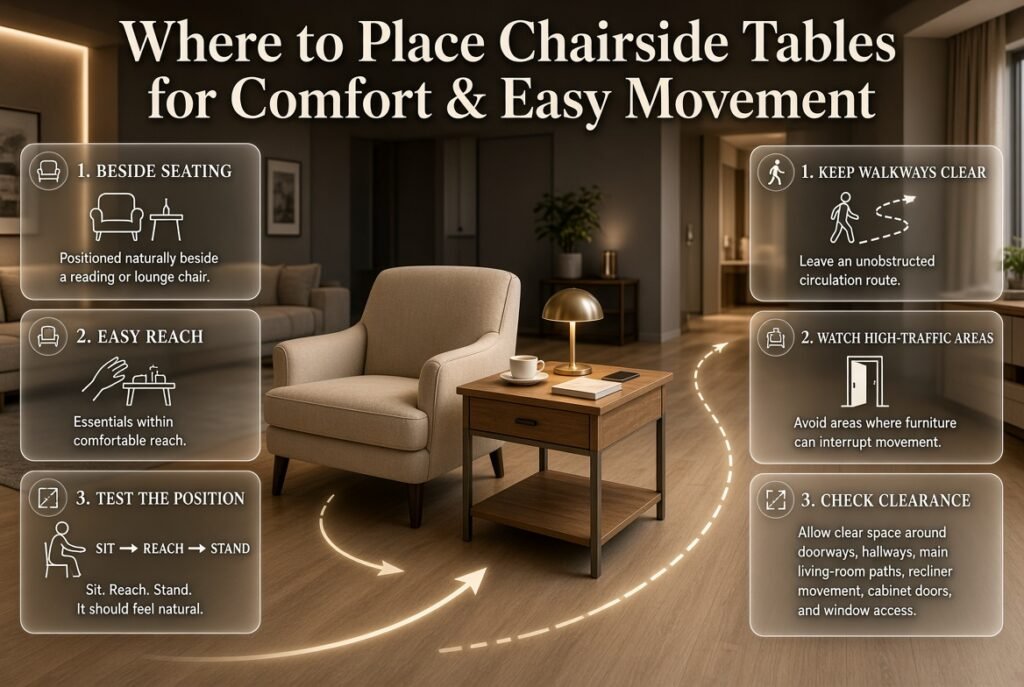
Placement should make the table easy to use without interrupting circulation.
Common locations include:
- Beside reading chairs
- Next to recliners
- Beside sofas
- Between two armchairs
- Beside lounge chairs
- In bedroom seating corners
- Near a home office relaxation area
The easiest test is surprisingly simple.
Sit down.
Reach toward the table.
Then stand up.
If you have to twist, stretch, or move around the table awkwardly, reposition it.
Avoid Blocking Walkways
A side table can create a problem when it’s placed directly in a high-traffic route.
Pay attention to:
- Doorways
- Hallways
- Main living-room paths
- Recliner movement
- Cabinet doors
- Window access
Furniture arrangement should support movement rather than compete with it.
This principle is especially important in practical home planning. For additional guidance, see Practical Home Improvement Guides.
Chairside Tables vs. End Tables: What’s the Difference?
The terms chairside table and end table are often used interchangeably, but they can suggest slightly different proportions or intended uses.
A chairside table is generally associated with compact seating areas, while an end table may be designed for the end of a larger sofa.
| Feature | Chairside Table | End Table |
|---|---|---|
| Typical location | Beside a chair | Beside a sofa |
| Footprint | Often compact | Can be larger |
| Primary purpose | Personal convenience | Seating-area support |
| Storage | Common in some designs | Depends on model |
| Best for small spaces | Often excellent | Depends on size |
There is no strict industry rule separating the two.
If a product marketed as an end table fits your chair, has the right height, and provides the surface you need, there’s no reason you can’t use it as a chairside table.
How Do You Match Chairside Tables With Your Interior Style?
Your side table should belong to the room without necessarily matching every other piece exactly.
Perfectly matching furniture can sometimes make a room look overly coordinated.
Instead, create relationships through:
- Material
- Shape
- Finish
- Scale
- Color
- Hardware
- Leg design
Modern Chairside Tables
Modern rooms usually benefit from clean silhouettes and restrained details.
Consider:
- Metal frames
- Smooth wood
- Glass
- Simple geometric shapes
- Minimal hardware
Traditional Chairside Tables
Traditional rooms can support more detailed furniture.
Look for:
- Wood construction
- Turned legs
- Drawer fronts
- Classic finishes
- Decorative hardware
Scandinavian Chairside Tables
Scandinavian interiors often work well with:
- Light wood
- Slim legs
- Simple shapes
- Natural textures
- Minimal decoration
The furniture should feel useful rather than overly ornamental.
Industrial Chairside Tables
Industrial interiors often benefit from combinations such as:
- Dark metal
- Reclaimed-style wood
- Exposed hardware
- Simple structural forms
Minimalist Chairside Tables
For minimalist rooms, choose a table with a clean silhouette and limited visual detail.
The fewer unnecessary elements it has, the easier it is to keep the room visually calm.
Contemporary Chairside Tables
Contemporary interiors provide more flexibility.
Stone, glass, wood, metal, and mixed materials can all work as long as the proportions feel intentional.
If you’re coordinating a larger interior project, Room-by-Room Interior Design Inspiration can help you think about the relationship between individual furniture pieces and the wider room.
How Do You Choose a Chairside Table for a Reading Corner?
A reading corner has slightly different requirements from a decorative seating area.
The table needs to support the activities associated with reading.
A practical setup might include:
Reading chair + side table + adjustable lamp + books
The table should be large enough for:
- A book
- Drink
- Reading glasses
- Phone
If you’re using a table lamp, make sure the base doesn’t consume the entire surface.
A floor lamp can be an alternative when the tabletop is too small.
Think About Lighting
The table and lamp should work together.
A tall lamp may look attractive but could overwhelm a small chairside table.
Likewise, a tiny lamp may not provide adequate reading light.
Consider the lamp’s base diameter, shade width, and overall height before choosing the table.
How Can Chairside Tables Work in Bedrooms?
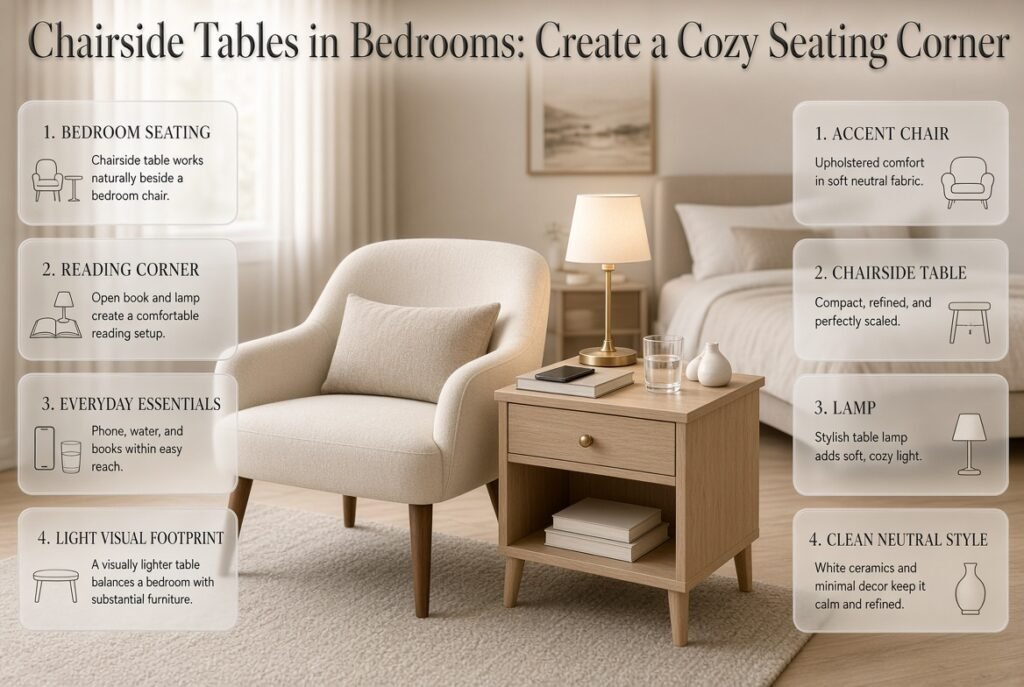
Chairside tables aren’t limited to living rooms.
They can be useful beside an occasional chair in a bedroom.
For example:
Accent chair + chairside table + lamp
can create a comfortable reading or dressing corner.
A bedroom table can hold:
- Books
- Phone
- Water
- Small lamp
- Decorative objects
If the bedroom already has substantial furniture, choose a table with a lighter visual footprint.
For additional decorative inspiration, you may also find ideas in White Decorative Objects, particularly when creating clean, neutral arrangements around smaller furniture.
Can Chairside Tables Be Used in Children’s Spaces?
They can, but durability, stability, and safety should receive more attention than decorative appearance.
Avoid choosing a delicate table simply because it looks attractive.
Instead, consider:
- Stable construction
- Rounded edges
- Easy-clean surfaces
- Appropriate height
- Resistance to everyday wear
The table should suit the age and behavior of the people using the room.
This same principle applies when selecting furniture for hospitality and family-oriented environments. For inspiration around furniture designed specifically for younger users, see Children’s Hotel Furniture.
How Do Colors Affect Chairside Table Selection?
Color should support the room’s existing palette.
You don’t necessarily need the table to match the sofa exactly.
Instead, consider whether the table should:
- Blend into the background
- Create contrast
- Repeat an existing finish
- Introduce a new accent
- Support the room’s overall mood
For a neutral room, a dark wood or black metal table can create definition.
For a darker room, a lighter wood finish can provide contrast.
For a colorful interior, a neutral table can prevent the furniture arrangement from becoming visually overwhelming.
Color also interacts with lighting. A glossy surface may reflect more light, while a matte finish tends to look quieter.
If you’re exploring the relationship between furniture and broader color choices, the Paint Color section offers additional ideas for developing a cohesive interior palette.
Can Chairside Tables Be Used for Home Office Tasks?
Yes, particularly C-shaped or pull-up designs.
A compact table can temporarily support:
- A laptop
- Tablet
- Notebook
- Keyboard
- Coffee
- Phone
However, a chairside table isn’t necessarily a substitute for a proper desk.
If you’re working for several hours, ergonomics, screen height, keyboard position, and posture become more important.
Use a side table as a flexible occasional workstation rather than assuming it can replace purpose-built office furniture.
How Do DIY Chairside Tables Compare With Ready-Made Tables?
A DIY chairside table can be a good option if you have unusual dimensions or want a personalized design.
DIY projects allow you to control:
- Height
- Width
- Depth
- Finish
- Materials
- Storage
- Color
For example, a narrow gap beside a chair might require a table only 8–10 inches wide. Finding exactly that dimension commercially can be difficult.
A custom project can solve the problem.
However, DIY construction requires attention to stability, load-bearing capacity, joinery, finishing, and surface durability.
If you enjoy building or modifying furniture, the DIY Home Projects section can provide broader inspiration for practical home projects.
What Are the Most Common Chairside Table Buying Mistakes?
Buying a small piece of furniture may seem straightforward, but several mistakes can reduce its usefulness.
Mistake 1: Buying Without Measuring
This is probably the most common problem.
A table can look perfect online but become awkward once it reaches the room.
Why it happens: People focus on appearance before dimensions.
Why it’s harmful: The table may block movement or sit at an uncomfortable height.
Solution: Measure the chair and available space first.
Mistake 2: Ignoring Chair Arm Height
A side table should feel connected to the seating.
If the height is significantly different, the table may become uncomfortable to use.
Solution: Measure from the floor to the top of the arm before shopping.
Mistake 3: Choosing a Table That’s Too Deep
A deep tabletop provides more surface but may project too far into the room.
Solution: Measure the circulation area, not just the furniture gap.
Mistake 4: Prioritizing Appearance Over Function
A sculptural table may look fantastic but provide almost no useful surface.
Ask what you actually need the table to do.
Mistake 5: Adding Too Much Storage
Storage sounds useful until it makes the furniture visually heavy.
If you don’t need drawers or cabinets, don’t add them simply because they’re available.
Mistake 6: Overstyling the Table
A table covered with decorative objects isn’t particularly useful.
Leave functional space.
Mistake 7: Matching Everything Too Closely
A chairside table doesn’t have to be identical to the coffee table.
Coordination usually looks more sophisticated than perfect matching.
Mistake 8: Forgetting Traffic Flow
A table can become a permanent obstacle if positioned carelessly.
Walk through the room before finalizing placement.
Mistake 9: Choosing Fragile Materials for Heavy Use
A delicate finish may not be suitable for a household where the table will receive constant daily use.
Match durability to lifestyle.
Mistake 10: Ignoring Maintenance
Glass shows fingerprints. Some woods need care. Certain stone surfaces require protection.
Choose a material you’re genuinely willing to maintain.
What Do Interior Designers Look for in Chairside Tables?
Professionals usually consider the entire seating composition rather than evaluating the table in isolation.
They look at:
Scale
Does the table visually relate to the chair?
Proportion
Is the tabletop appropriately sized for the armchair?
Balance
Does the table make the seating arrangement feel complete?
Circulation
Can people move comfortably around it?
Function
Does it support the activities that happen in the space?
Material Relationship
Does its material connect naturally with other finishes?
Visual Weight
Does it make the room feel heavier or lighter?
This approach is more reliable than simply choosing whatever table looks attractive in a product photograph.
What Is the Best Way to Style Multiple Chairside Tables?
If your room contains several side tables, they don’t all need to look identical.
In fact, using slightly different tables can create a more collected interior.
For example:
- One wooden table beside a reading chair
- One metal table beside a sofa
- One round table beside an accent chair
They can still feel connected through a shared color, finish, shape, or material.
The trick is to create coordination without repetition.
If every table is identical, the room may look like a furniture showroom.
If every table is completely unrelated, the room may feel disconnected.
A controlled mix is usually the strongest approach.
How Can You Make a Chairside Table Look More Expensive?
You don’t necessarily need an expensive table.
Presentation matters.
A few simple choices can make a compact table feel more refined:
- Keep the surface uncluttered.
- Use one quality-looking decorative object.
- Add a well-proportioned lamp.
- Repeat a finish from elsewhere in the room.
- Use books selectively.
- Keep cords hidden.
- Avoid too many small accessories.
- Choose accessories with different heights and textures.
The table itself should remain the foundation rather than disappearing beneath decoration.
For broader affordable styling ideas, Easy Decorating Tips for Every Budget can help you approach small furniture and accessories without relying on expensive changes.
How Can You Use Chairside Tables in Neutral Interiors?
Neutral interiors can sometimes become visually flat when every piece of furniture has the same tone and texture.
A chairside table is a simple opportunity to introduce contrast.
For example:
Cream chair + light wood table + black lamp
creates subtle variation.
Or:
Beige sofa + dark wood side table + brass lamp
adds depth without introducing strong colors.
The important thing is texture.
Natural wood, stone, woven baskets, ceramic objects, and metal finishes can give a neutral room visual interest without making it colorful.
How Do You Choose Between Open and Closed Designs?
The choice depends on whether you want display or concealment.
| Design | Best For | Main Advantage | Potential Drawback |
|---|---|---|---|
| Open | Books and décor | Easy access | Can look cluttered |
| Drawer | Small personal items | Keeps surface clean | Limited capacity |
| Cabinet | Concealed storage | Hides clutter | Visually heavier |
| Shelf | Display and storage | Flexible | Requires organization |
| No storage | Minimal interiors | Lightweight appearance | Less practical storage |
If the room already contains plenty of storage, an open or storage-free table may be the better choice.
If the room lacks storage, a drawer or cabinet can make the table much more valuable.
How Should You Maintain Chairside Tables?
Maintenance depends on the material.
Wood
Dust regularly and clean according to the manufacturer’s finish recommendations. Avoid leaving moisture sitting on untreated surfaces.
Glass
Use a suitable glass cleaner or soft cloth to remove fingerprints and smudges.
Metal
Keep surfaces dry and follow the care instructions for painted, plated, or unfinished finishes.
Stone
Clean spills promptly and use products appropriate for the specific stone.
The biggest maintenance mistake is using the same cleaning method for every material.
A finish that works perfectly on glass may be inappropriate for natural wood or stone.
How Do Chairside Tables Fit Into a Larger Interior Design Plan?
Small furniture should be considered as part of the whole room.
Think about:
Furniture → Lighting → Color → Texture → Storage → Movement
A chairside table can connect several of these elements.
For example, a wood table can repeat the finish of a media console.
A metal frame can echo the lighting fixtures.
A stone top can connect with a fireplace surround.
A round table can repeat curves found in the sofa or decorative mirror.
This is how a small piece becomes part of a cohesive interior rather than looking like something that was added at the last minute.
For more complete design inspiration, you can also visit DesignMode24 Interior Design and explore ideas for combining furniture, color, layout, and decorative details throughout a home.
What height should a chairside table be?
The ideal height for a chairside table depends on the chair it will sit beside, but the safest professional approach is to use the chair armrest as your primary measurement. In most cases, the tabletop should be approximately level with the armrest or slightly lower. A difference of around 1–2 inches is generally comfortable because it allows you to reach a drink, book, phone, lamp, or remote without leaning awkwardly.
Instead of choosing a table simply because its listed height “looks standard,” measure your actual chair. A low lounge chair may need a considerably shorter table, while a traditional high-back armchair may require a taller design.
Points to consider:
Measure from the floor to the top of the chair arm.
Aim for a tabletop close to the armrest height.
A slightly lower table is usually more comfortable than one that is noticeably taller.
For armless chairs, judge the height from your normal seated position.
Always consider how the table will be used—not just how it looks.
Professional tip: Sit in the chair before buying. Imagine placing a coffee cup on the table. If you have to lift your shoulder, bend forward, or twist your body to reach it, the table is probably the wrong height.
What size should a chairside table be?
The right size is determined by available floor space, the chair’s proportions, and what you need the table to hold. A chairside table does not need to be large to be useful, but an extremely small tabletop can quickly become impractical. For example, if you want to keep a lamp, book, phone, and drink beside your chair, you need more surface area than you would for a decorative object alone.
Width and depth should also respect the surrounding furniture. A bulky table can make a reading corner feel cramped, while a very narrow table may look lost beside a large upholstered armchair.
Points to consider:
Measure the available space beside the chair before shopping.
Consider the table’s width, depth, and height together.
Leave enough room for people to sit down and stand up comfortably.
Choose a larger surface if the table will hold a lamp and everyday items.
Choose a compact design when floor space is limited.
Avoid allowing the table to interfere with doors, walkways, footrests, or reclining mechanisms.
A useful rule is to think about function first and visual scale second. The table should look proportional to the chair while still providing enough usable surface for everyday life.
Should a chairside table have drawers or storage?
A chairside table does not necessarily need storage, but a drawer, shelf, cabinet, or concealed compartment can make it considerably more practical when the table is used every day. Storage is particularly valuable beside reading chairs, lounge chairs, and sofas where small items such as remotes, chargers, glasses, books, and coasters tend to accumulate.
An open table often creates a lighter, more contemporary appearance, while a drawer-based design provides a cleaner solution for controlling visual clutter. The best choice depends on what happens around the chair.
Choose a storage chairside table if you regularly need to keep:
Books and magazines
TV remotes
Phone chargers
Reading glasses
Coasters
Small electronics
Personal accessories
Everyday living-room essentials
Choose an open design if:
You prefer a minimalist appearance.
You already have sufficient storage nearby.
The table is mainly decorative.
You want the room to feel visually lighter.
Expert advice: Don’t add storage simply because it is available. Extra drawers and cabinets can make a small chairside table look heavy. If your room already has plenty of closed storage, a simple tabletop with an elegant base may create a more balanced result.
Where should a chairside table be placed next to a chair?
A chairside table should be positioned close enough to reach comfortably without leaning, but far enough away that it does not interfere with sitting, standing, or moving the chair. The exact distance depends on the chair’s arms, base, surrounding furniture, and how the table will be used.
For a reading chair, for example, the table should sit naturally beside the dominant reaching side. If you normally hold a book or drink in your right hand, placing the table on the right can make the arrangement feel more intuitive. With swivel or reclining chairs, movement becomes especially important.
Points to check before final placement:
Can you reach the tabletop while sitting normally?
Can you get in and out of the chair easily?
Does the table obstruct the chair’s legs or base?
Can a recliner extend without hitting the table?
Does a swivel chair have enough room to rotate?
Is there a clear walking route around the furniture?
Does the table feel visually connected to the chair?
A chairside table should feel like part of the seating arrangement rather than an object that has simply been squeezed into an empty corner.
Professional tip: Place the chair first, sit in it, and then position the table. This is much more reliable than measuring the empty floor and buying a table based only on dimensions.
Do chairside tables need to match the chair, sofa, or coffee table?
No. A chairside table does not need to be an exact match. In fact, using a complementary design rather than an identical furniture set can make a room feel more considered and less showroom-like. What matters is creating a visual relationship through materials, finishes, proportions, colors, or shapes.
For example, a warm wood chairside table can work beautifully beside an upholstered neutral chair even if the chair has metal detailing. Likewise, a marble or glass-topped table can introduce contrast next to a heavier fabric sofa.
The goal is coordination rather than duplication.
You can create cohesion through:
Matching or complementary wood tones
Repeating a metal finish
Similar geometric shapes
Related colors
Similar visual weight
Consistent design era
Complementary textures
A useful approach is the “one connection, one contrast” rule. Let the table share at least one noticeable characteristic with the surrounding furniture, then allow another element to be different.
For example, a black metal base could connect with black lighting fixtures, while a natural wood tabletop introduces warmth. This creates a layered interior rather than a room filled with matching pieces.
Conclusion
A well-chosen chairside table can do far more than fill an empty space beside a chair. It can make a seating area more comfortable, keep everyday essentials within easy reach, provide valuable storage, and add another layer of character to the room. The key is to choose the table according to how the space is actually used rather than selecting one based only on appearance.
Before buying, consider the height of the chair, available floor space, tabletop size, storage requirements, material, shape, and overall interior style. A compact table may be ideal for a small reading corner, while a wider design with drawers or shelving may work better beside a larger armchair or sofa.
Most importantly, aim for balance between function and proportion. The best chairside tables feel natural in the room: they are easy to reach, stable enough for everyday use, visually compatible with surrounding furniture, and appropriately scaled to the seating area.
Whether you prefer a minimalist wood design, a sophisticated metal-and-glass table, a traditional storage piece, or something more distinctive, the right choice should support the way you live while complementing your interior.
Take accurate measurements, identify your practical needs, and then choose a design that fits the room—not simply the trend. When those elements come together, a small piece of furniture can make a surprisingly meaningful difference to the comfort, organization, and finished appearance of your living space.

Leave a Reply