
Introduction
Easy Decorating Tips for Every Budget | Decorating a home can quickly become expensive. One new sofa leads to a new rug, the rug makes the curtains look outdated, then the walls suddenly need paint, and before you know it, a simple room refresh has turned into a major shopping project.
But your home doesn’t need a huge budget to look beautiful.
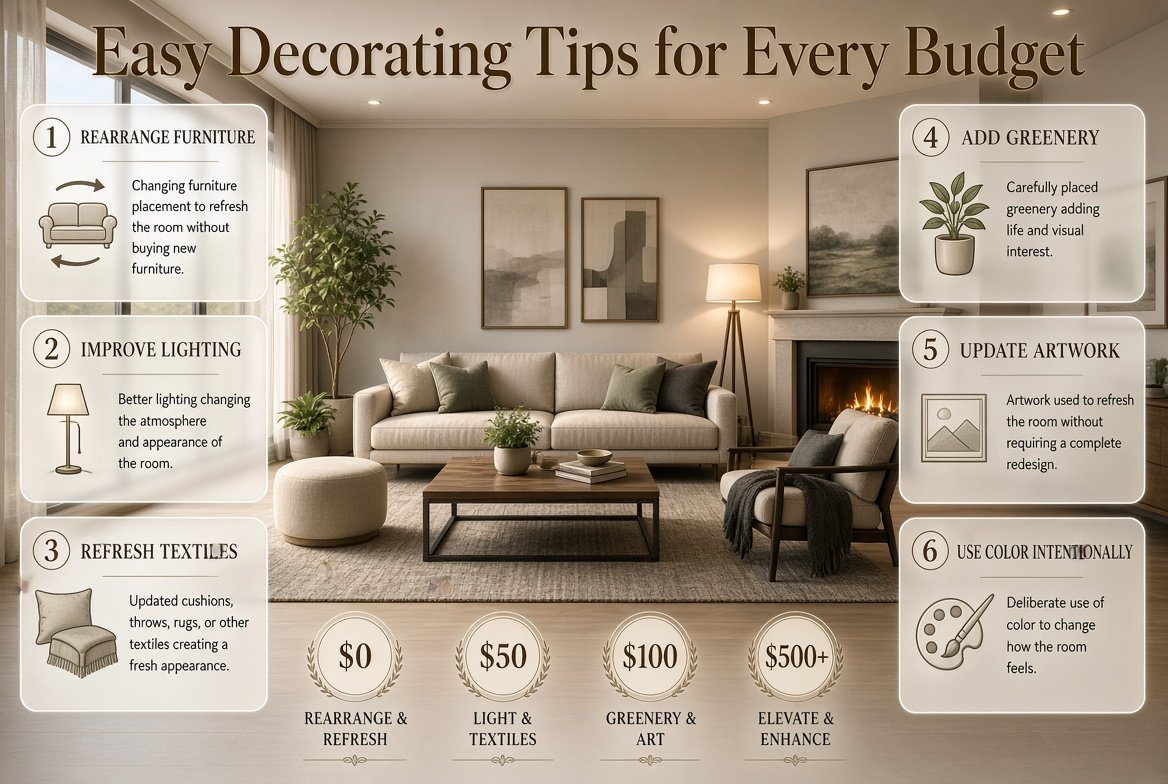
In fact, some of the most effective decorating changes cost very little. Rearranging furniture, reducing clutter, improving lighting, changing textiles, adding greenery, updating artwork, and using color more intentionally can completely change how a room feels.
That’s why these easy decorating tips for every budget focus on decisions rather than shopping lists. Whether you’re decorating with $0, $50, $100, $500, or a larger amount, the goal is to spend money where it actually makes a difference.
If you’re looking for broader inspiration before you begin, Designmode24 Interior Design offers ideas across decorating, interior design, home improvement, paint, storage, and individual rooms.
This guide will show you how to refresh your home without wasting money, how to make inexpensive decor look intentional, where it’s worth spending more, which projects you can do yourself, and how to avoid the decorating mistakes that make even expensive rooms look unfinished.
What Are the Easiest Decorating Tips for Every Budget?
The easiest decorating improvements are usually the ones that change the room’s arrangement, atmosphere, or visual balance without requiring major renovations. Rearranging furniture, decluttering, improving lighting, adding textiles, changing artwork, introducing plants, and coordinating colors can create noticeable results at almost any budget.
The most useful rule is:
Edit first. Rearrange second. Improve third. Shop last.
This simple order prevents one of the biggest decorating mistakes: buying more things when the real problem is poor layout or too much visual clutter.
Before spending money, walk into the room and look at it as if you’ve never seen it before. What do you notice first? Does the furniture feel crowded? Is there an empty corner that needs purpose? Is the lighting harsh? Are too many colors competing? Does the room lack texture?
Those observations tell you what to fix.
A beautiful home isn’t necessarily one filled with expensive objects. It’s one where the furniture, colors, lighting, materials, and decorative details feel as though they belong together.
How Can You Decorate Your Home for Free?
You can make a room look significantly different without buying anything. The easiest free decorating ideas involve rearranging furniture, removing unnecessary objects, moving accessories between rooms, reorganizing displays, and making better use of natural light.
Rearrange the Furniture
Furniture placement has more influence on a room than many homeowners realize.
If everything is pushed against the walls, pull selected pieces inward. Create a conversation area rather than simply placing furniture around the perimeter.
For a living room, try arranging the sofa and chairs around a central point such as a coffee table, fireplace, television, or architectural feature.
For a bedroom, make sure the bed feels visually centered and that the walking paths around it remain comfortable.
For a home office, position the desk where natural light is useful without creating glare on your screen.
You don’t need a new floor plan. Sometimes moving one major piece changes the entire room.
Shop Your Own Home
Before buying a new vase, lamp, mirror, or side table, look around the rest of your home.
A decorative object that feels boring in one room may look completely different somewhere else.
Try moving:
- Lamps from bedrooms into living spaces
- Plants into empty corners
- Books onto coffee tables
- Baskets into entryways
- Artwork between rooms
- Small tables beside chairs
- Decorative trays onto consoles
- Throws between bedrooms and living areas
This technique also helps you discover your actual decorating style.
Remove Instead of Add
One of the cheapest decorating tricks is subtraction.
Remove objects that are broken, outdated, duplicated, rarely used, or simply taking up visual space.
Don’t try to make every shelf full.
Empty space gives important objects more attention and allows the eye to rest.
⚠ Common Mistake: Assuming every empty surface needs decoration. Empty space isn’t wasted space. In many interiors, it is what makes the decoration that remains look intentional.
Restyle Shelves and Surfaces
Take everything off a shelf, console, or coffee table and start again.
Group objects according to height, texture, color, or function. Instead of placing ten small objects individually, create two or three stronger arrangements.
For example:
Large vase + two books + small decorative object
usually looks more deliberate than several unrelated pieces scattered across the same surface.
How Can You Decorate a Home on a $25 Budget?
A $25 budget may seem too small to accomplish anything, but small decorative purchases can create a visible difference when they’re used strategically.
Buy New Cushion Covers
You don’t need a new sofa to refresh a living room.
Cushion covers are inexpensive compared with furniture and allow you to experiment with color, texture, and seasonal changes.
Instead of buying completely different patterns, choose a small palette.
For example:
- Cream
- Warm brown
- Olive green
or:
- White
- Charcoal
- Muted blue
The colors don’t have to match exactly. They simply need to work together.
Buy One Plant
A single plant can introduce life into a room that feels too hard, flat, or neutral.
Place it where an empty corner needs height or where furniture looks visually heavy.
If maintaining real plants isn’t practical, choose realistic artificial greenery rather than filling the room with obviously plastic-looking leaves.
Create a Small Display
A small tray can turn miscellaneous objects into a purposeful arrangement.
Place a candle, small vase, book, or decorative object on the tray. The tray visually groups the items and prevents the surface from looking chaotic.
📌 Quick Tip: When your budget is extremely limited, choose something that changes a large visual area rather than buying several tiny decorative objects.
How Can You Decorate a Room for Under $50?
With around $50, focus on inexpensive items that influence the room’s color, texture, or atmosphere.
Good options include:
- Cushion covers
- Throws
- Small plants
- Affordable artwork
- Decorative baskets
- Table lamps
- Mirrors
- Simple curtains
- Picture frames
You don’t need to buy everything.
Choose the item that addresses your biggest problem.
If the room feels cold, add texture.
If it feels dark, improve lighting.
If it feels empty, add artwork or greenery.
If it feels cluttered, don’t buy anything yet. Organize it.
This problem-first approach is what makes a small decorating budget work.
How Can You Make a Room Look Expensive Without Spending a Lot?
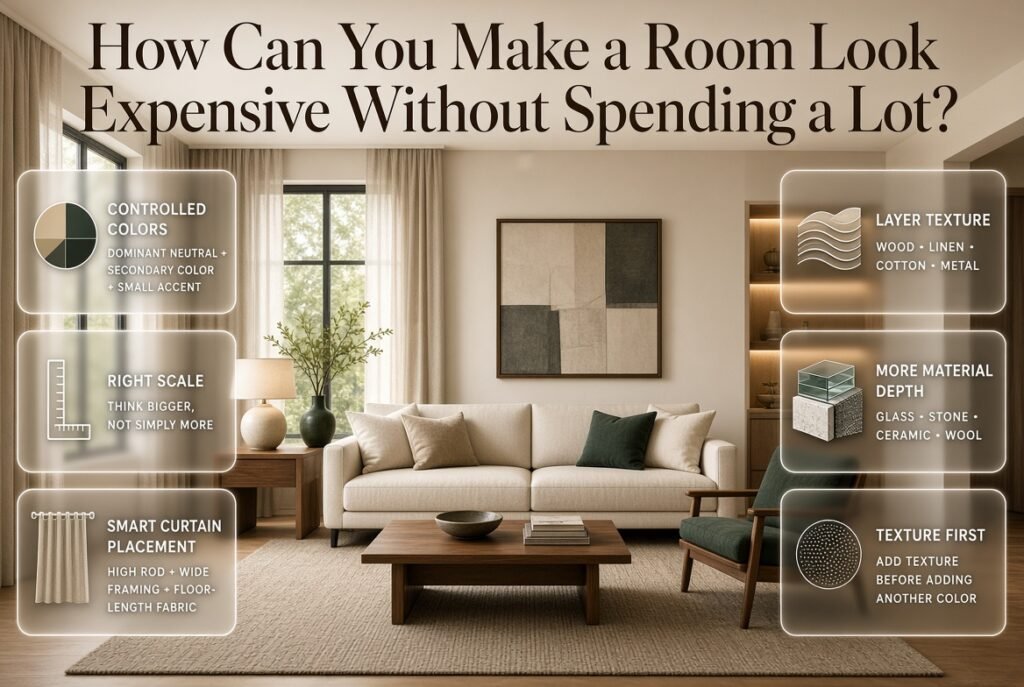
A room can look polished without containing expensive furniture. The biggest factors are proportion, consistency, lighting, material balance, and restraint.
Use a Controlled Color Palette
Rooms often look more sophisticated when they have a limited number of dominant colors.
A simple formula is:
Dominant neutral + secondary color + small accent
For example:
Warm white + natural wood + dark green
or:
Soft beige + walnut + black
The accent doesn’t need to appear everywhere. A few repeated touches are usually enough.
If you’re considering changing your walls, explore the Paint Color section for additional color inspiration.
Choose the Right Scale
One of the most common reasons inexpensive rooms look unfinished is poor scale.
A small artwork above a large sofa may disappear visually.
A tiny rug beneath a large seating arrangement can make the entire room feel disconnected.
Similarly, several miniature accessories can look less sophisticated than one substantial object.
When in doubt, think bigger rather than simply adding more.
Improve Curtain Placement
Curtains have a major effect on the perceived height and width of a room.
Whenever possible, install the rod high enough to visually extend the wall and wide enough to allow the fabric to frame the window rather than cover it completely.
Floor-length curtains generally create a more finished appearance than panels that stop awkwardly above the floor.
Add Texture
Expensive-looking rooms rarely depend on color alone.
They combine materials such as:
- Wood
- Linen
- Cotton
- Metal
- Glass
- Stone
- Woven fibers
- Ceramic
- Wool
You can introduce these textures inexpensively through blankets, baskets, cushions, rugs, artwork, and small accessories.
⭐ Expert Tip: If a neutral room feels boring, don’t immediately add another color. Add texture first.
What Are the Best Decorating Ideas for a $100 Budget?
A $100 decorating budget can make a meaningful difference if you concentrate it on one room rather than spreading it throughout the house.
A simple allocation might look like this:
| Decorating Need | Possible Budget |
|---|---|
| Cushion covers | $15–25 |
| Throw blanket | $15–25 |
| Artwork or prints | $15–25 |
| Plant or vase | $10–20 |
| Small accessories | $10–20 |
These amounts are only a planning example because prices vary by location and retailer.
The important principle is concentration.
If you spend $100 across six rooms, you may barely notice the changes. If you spend $100 improving one living-room wall or one bedroom corner, the result can feel much more complete.
Refresh a Living Room
The living room is usually the easiest place to see a return on decorating money because it often contains large furniture and receives frequent use.
Start with the sofa.
Change the cushions, add a throw, restyle the coffee table, reposition artwork, and improve lighting.
If the room still feels incomplete, add one larger visual element such as a mirror, plant, rug, or artwork.
Refresh an Entryway
The entryway doesn’t need to be large to create a strong first impression.
Consider:
- A mirror
- Small rug
- Basket
- Wall hooks
- Narrow console
- Table lamp
- One decorative object
Keep the area functional. An entryway should make coming home easier, not create another surface for clutter.
How Should You Decorate on a $500 Budget?
A $500 budget gives you more flexibility. Instead of focusing only on accessories, you can consider one substantial upgrade combined with smaller decorative changes.
Spend More Where It Matters
Consider spending more on:
- A quality area rug
- Better lighting
- A substantial mirror
- A comfortable accent chair
- Durable curtains
- A useful storage piece
- Quality bedding
You don’t need all of them.
Pick the item that will remain useful for several years.
Don’t Make Everything Match
A room filled with perfectly matching furniture can look flat.
Instead, combine different but compatible materials.
For example:
Wood + upholstered furniture + metal lighting + woven accessories
This creates depth.
The goal isn’t randomness. It’s controlled variation.
Use the 70-20-10 Color Approach
A practical decorating framework is:
- 70% dominant color
- 20% secondary color
- 10% accent
This isn’t a mathematical requirement. It’s a visual guideline.
Your walls and large furniture might establish the 70%.
Rugs, curtains, or secondary furniture might contribute the 20%.
Accessories, artwork, cushions, or plants can provide the final 10%.
The result is usually more cohesive than choosing every object independently.
What Should You DIY and What Should You Buy?

DIY decorating can save money when the project is simple, safe, and appropriate for your skills. Painting, basic furniture updates, artwork, organization, and styling are often good candidates.
For more project inspiration, explore DIY Home Projects.
Good DIY Decorating Projects
Consider doing these yourself:
- Painting walls
- Painting suitable furniture
- Creating artwork
- Updating cabinet handles
- Building simple decorative arrangements
- Restyling shelves
- Creating gallery walls
- Refinishing suitable furniture
- Sewing simple cushions
- Organizing storage
When Should You Hire a Professional?
Avoid treating every home project as a DIY opportunity.
Electrical, gas, structural, major plumbing, and complex installation work can create safety problems when done incorrectly.
Decorating should save money—not create a much larger repair bill.
💡 Pro Tip: DIY is most valuable when the finished result looks intentional. If a professional finish is important and the project is beyond your skill level, paying for the right help may actually be the economical decision.
How Can You Decorate a Bedroom on a Budget?
A bedroom doesn’t need expensive furniture to feel comfortable. The bed, lighting, textiles, color, and organization have the greatest influence on the atmosphere.
For additional inspiration, browse Bedroom Ideas.
Start With the Bed
The bed usually dominates the room, so improving its appearance can transform the entire space.
Layer:
- Comfortable bedding
- Two sleeping pillows
- A few decorative cushions
- A throw
- One or two complementary colors
Don’t go overboard.
If you need to remove eight cushions every night before going to sleep, the decorating strategy isn’t particularly practical.
Improve the Layout
A good bedroom layout makes everyday movement easier.
The bed should feel visually balanced, while wardrobes, drawers, and other furniture should leave usable walking space.
For more detailed layout inspiration, see Bedroom Layouts.
Add Softer Lighting
One ceiling light rarely creates the best bedroom atmosphere.
Use a combination of general and bedside lighting.
A bedside lamp also makes reading and nighttime routines more comfortable.
Control Bedroom Clutter
A peaceful bedroom needs visual order.
Use baskets, drawers, under-bed storage, bedside organizers, and wardrobes to keep everyday objects from spreading across visible surfaces.
How Can You Decorate a Bathroom on a Budget?
Bathroom decorating doesn’t require replacing tile or installing an entirely new vanity. Small changes to textiles, storage, mirrors, lighting, and accessories can make the room feel cleaner and more current.
For room-specific ideas, explore Bathroom Inspiration.
Replace Worn Textiles
Fresh towels and a coordinated bath mat can immediately improve the room.
Choose colors that work with existing tile and fixtures.
Organize the Counter
A bathroom counter filled with individual bottles can make the room look messy even when it’s clean.
Group everyday products together using a tray or organizer.
Keep only frequently used items visible.
Improve the Mirror Area
The mirror is often one of the largest visual elements in a bathroom.
If the existing mirror is unattractive but functional, consider whether a suitable frame or complementary lighting can improve the area without requiring a full replacement.
How Can You Decorate a Small Home Without Making It Feel Crowded?
Small spaces need decoration that works vertically, visually, and functionally. Instead of filling limited floor space with accessories, use walls, mirrors, lighting, storage, and multi-purpose furniture.
Use Vertical Space
Look upward.
Tall shelving, vertical artwork, high curtains, wall-mounted hooks, and narrow cabinets can make better use of the room’s height.
Choose Furniture Carefully
Measure before purchasing.
Don’t measure only the furniture footprint. Consider doorways, hallways, staircases, wall clearance, and walking paths.
A sofa that technically fits may still make the room uncomfortable.
Use Mirrors Strategically
A well-placed mirror can reflect natural or artificial light and make a small room feel more open.
Avoid placing mirrors randomly.
Think about what the mirror reflects. A beautiful view, window, artwork, or attractive architectural feature can create a much better effect than reflecting clutter.
How Can You Decorate an Entire Home on a Tight Budget?
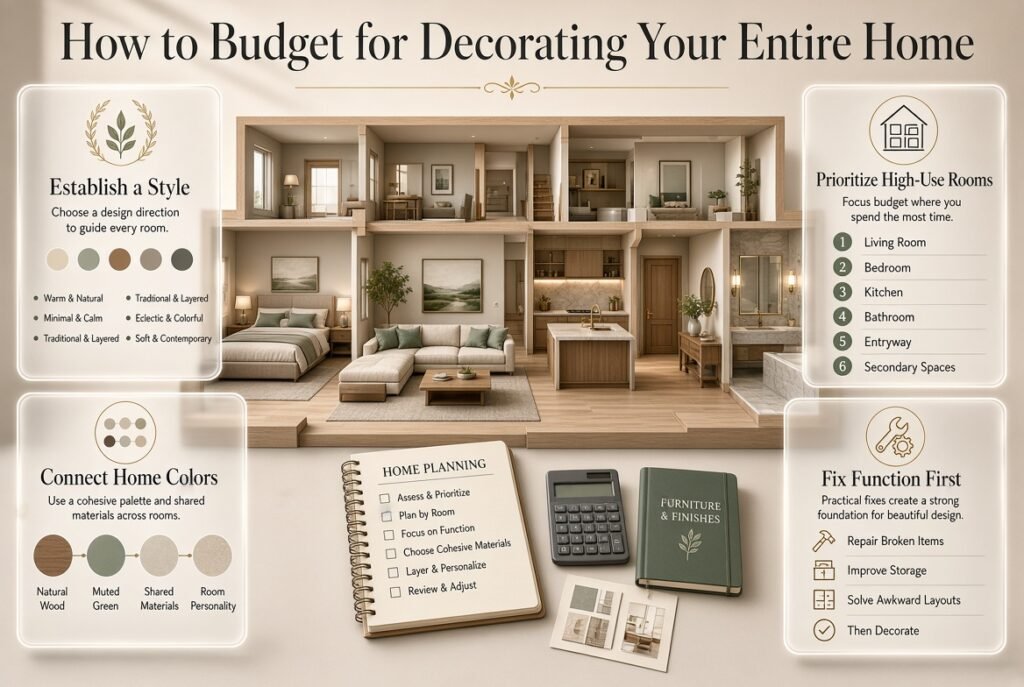
Decorating an entire home at once is one of the easiest ways to overspend.
Instead, work systematically.
Step 1: Establish a General Style
You don’t need a strict design label.
Simply decide whether you prefer:
- Warm and natural
- Minimal and calm
- Traditional and layered
- Modern and clean
- Eclectic and colorful
- Soft and contemporary
This gives your future purchases a direction.
For broader inspiration, explore Interior Design before making major decisions.
Step 2: Create a Whole-Home Color Connection
Different rooms can have different personalities while still sharing a few colors or materials.
For example, natural wood might appear in the living room, bedroom, and hallway.
A muted green might appear in artwork in one room and cushions in another.
This creates continuity without making the house look like a showroom.
Step 3: Prioritize High-Use Rooms
Start with rooms that affect your daily life most.
Usually:
- Living room
- Bedroom
- Kitchen
- Bathroom
- Entryway
- Secondary spaces
But your personal priorities should determine the order.
Step 4: Fix Function Before Decoration
Repair broken items.
Improve storage.
Solve awkward layouts.
Then decorate.
The Home Improvement section can be useful when your decorating plans overlap with practical upgrades.
How Can Smart Storage Improve Your Decorating?
Storage isn’t separate from decorating. Poor storage creates clutter, and clutter changes how a room looks.
Good storage keeps frequently used items accessible without allowing them to dominate the visual environment.
For practical ideas, explore Smart Storage and Organization Ideas.
Use Baskets
Baskets are useful for:
- Blankets
- Toys
- Shoes
- Magazines
- Towels
- Accessories
They also add texture.
Use Closed Storage for Visual Noise
Some things simply don’t need to be visible.
Chargers, paperwork, cleaning products, miscellaneous cables, and spare household items can often live behind doors or inside drawers.
Don’t Over-Organize
Organization should make life easier.
If you create twenty categories for ordinary household items, the system may become difficult to maintain.
Keep categories broad enough that putting things away remains simple.
How Can You Use Paint to Decorate on a Budget?
Paint is one of the most powerful decorating tools because it can change the perceived mood and character of an entire room without replacing furniture.
But don’t choose a color based only on how it looks in a small online image.
Consider:
- Natural light
- Room orientation
- Flooring
- Furniture
- Ceiling height
- Adjacent rooms
- Existing materials
- Desired mood
Test Before Painting
A color can look completely different under morning, afternoon, and evening light.
Use samples before committing.
If you’re unsure whether your room needs a full repaint, consider painting one wall, architectural feature, or smaller area first.
A carefully chosen accent can sometimes create enough change without the cost and effort of repainting the entire room.
How Can You Make Cheap Furniture Look Better?
Affordable furniture can look considerably better when its surroundings are thoughtfully designed.
Start by keeping it clean and well maintained.
Then consider:
- Replacing basic hardware
- Adding better lighting
- Styling with fewer objects
- Pairing it with natural materials
- Adding artwork
- Introducing plants
- Improving surrounding textiles
A simple inexpensive cabinet can look intentional when it has attractive handles and is styled carefully.
The same cabinet can look cheap when surrounded by clutter.
⭐ Expert Tip: Don’t try to hide every inexpensive item. Combine affordable pieces with a few higher-quality elements and allow the entire composition to carry the design.
How Do You Mix Expensive and Affordable Decor?
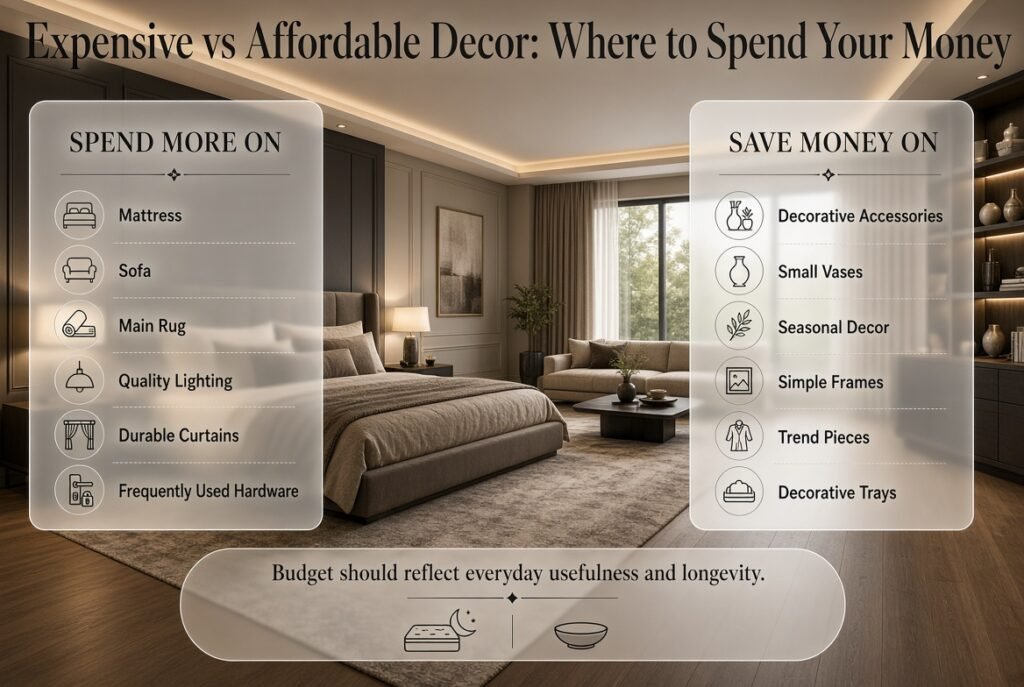
The smartest homes usually don’t spend equally on everything.
Spend more on objects that you touch frequently, rely on daily, or expect to keep for years.
Save on items that are decorative, temporary, seasonal, or easy to replace.
| Spend More On | Save Money On |
|---|---|
| Mattress | Decorative accessories |
| Sofa | Small vases |
| Main rug | Seasonal decor |
| Quality lighting | Simple frames |
| Durable curtains | Trend pieces |
| Frequently used hardware | Decorative trays |
A good mattress affects sleep.
A cheap decorative bowl doesn’t.
That difference should influence your budget.
What Are the Most Common Decorating Mistakes?
Even a generous budget can be wasted when decorating decisions are made without a clear plan.
Buying Before Measuring
This happens constantly.
People fall in love with a rug, sofa, mirror, or cabinet and only later discover that the proportions are wrong.
Always measure first.
Buying Too Many Small Accessories
Small decorative objects are easy to purchase because they’re inexpensive.
But dozens of small pieces can make a room look cluttered.
Use a few stronger pieces instead.
Following Trends Too Closely
A room shouldn’t be designed entirely around what is currently popular online.
Trends change.
Your home should still feel comfortable when the trend disappears.
Ignoring Lighting
A beautifully decorated room with harsh lighting can still feel uncomfortable.
Use multiple light sources where possible.
Choosing Style Over Function
A coffee table that’s too fragile for your family, a chair nobody can comfortably sit in, or an entryway that can’t handle shoes isn’t successful decorating.
Good design has to work in real life.
Decorating Everything at Once
Trying to finish the whole home immediately often leads to rushed purchases.
Give your rooms time.
Live with them.
See what they actually need.
⚠ Common Mistake: Buying an item just because you found an empty corner. Empty space isn’t automatically a decorating problem.
What Should You Do Before Buying Any New Decor?
Before shopping, follow this quick checklist:
- Measure the room
- Measure large furniture
- Photograph the current space
- Remove clutter
- Identify the biggest problem
- Decide on a general color direction
- Check what you already own
- Set a realistic budget
- Make a short shopping list
- Decide what can be DIY
- Prioritize long-term purchases
This process sounds simple, but it prevents impulse spending.
You may also find that after decluttering and rearranging, your shopping list becomes much shorter.
How Can You Decorate With Secondhand Furniture?
Secondhand furniture can be one of the best options for budget decorating because older pieces often have character that inexpensive new furniture lacks.
Look for:
- Solid construction
- Useful proportions
- Good bones
- Quality wood
- Interesting silhouettes
- Functional storage
Don’t buy something simply because it’s cheap.
Check its condition carefully.
A low price isn’t a bargain if the furniture requires expensive repairs.
Refresh Instead of Replace
Suitable secondhand pieces can sometimes be improved through:
- Cleaning
- New hardware
- Paint
- Refinishing
- New upholstery
- Better styling
The result can feel much more personal than a matching furniture set.
How Can You Decorate With Artwork on a Budget?
Artwork gives a room personality, but you don’t need expensive originals.
Affordable options include:
- Personal photography
- Printable artwork
- Vintage posters
- Botanical prints
- Architectural drawings
- Children’s artwork
- Textile pieces
- Thrifted frames
- Handmade pieces
The key is presentation.
Use consistent frames when creating a gallery wall.
Pay attention to spacing.
Choose artwork that’s large enough for the wall.
Don’t Hang Everything Too High
Artwork should relate visually to the furniture beneath it.
A common mistake is hanging artwork too close to the ceiling, which separates it from the furniture and makes the wall feel awkward.
How Can Lighting Change a Room Without a Major Renovation?
Lighting can change the perceived warmth, depth, and comfort of a room more quickly than many decorative purchases.
Try combining three types:
Ambient lighting
Provides general illumination.
Task lighting
Helps with reading, cooking, working, or specific activities.
Accent lighting
Highlights artwork, plants, shelves, or architectural features.
You don’t necessarily need expensive fixtures.
A well-placed lamp can sometimes do more for a room than another decorative object.
📌 Quick Tip: Before buying more decor for a dark room, improve the lighting. The existing furniture and colors may look completely different once they are properly illuminated.
How Can You Decorate a Rental Without Spending Too Much?
Renters can still create a personalized home without making permanent changes.
Focus on:
- Rugs
- Curtains
- Lamps
- Freestanding furniture
- Removable decorative solutions
- Artwork using approved methods
- Cushions
- Throws
- Plants
- Mirrors
- Portable storage
Always follow your rental agreement before modifying walls, fixtures, paint, or other permanent elements.
The best rental decorating choices are portable. When you move, you can take them with you.
How Can You Decorate a Home With Children Without Losing Style?
A family home needs to be practical.
Instead of trying to keep every surface perfectly styled, create storage systems that make cleanup realistic.
Use baskets for toys.
Choose washable textiles where practical.
Keep fragile objects out of high-traffic areas.
Create designated spaces for children’s belongings.
You can still maintain an attractive color palette while choosing materials that tolerate everyday life.
Good decorating doesn’t ignore how people actually live.
It accommodates it.
How Can You Decorate a Home With a Minimal Budget Over Time?
You don’t need to complete your home in a single project.
A gradual approach can actually produce a better result.
Month 1: Declutter and Rearrange
Spend almost nothing.
Remove unnecessary items and improve furniture placement.
Month 2: Improve Lighting
Add or reposition lamps.
Month 3: Refresh Textiles
Update cushions, throws, bedding, or towels.
Month 4: Add Artwork
Choose one or two meaningful pieces.
Month 5: Improve Storage
Solve the clutter that continues to return.
Month 6: Make One Larger Investment
By this point, you’ll understand what the room actually needs.
This is much more effective than buying random items every weekend.
For additional practical planning ideas, explore these Practical Home Improvement Guides.
Why Does Proportion Matter More Than Price?
A moderately priced item with excellent proportions can look better than an expensive item that’s too small or too large.
This is especially important for:
- Rugs
- Artwork
- Sofas
- Coffee tables
- Curtains
- Mirrors
- Dining tables
- Lighting
Before buying, imagine the object in the room.
Will it balance the furniture?
Will it leave enough walking space?
Will it visually anchor the area?
If the answer is no, the price doesn’t matter.
How Can You Create a Beautiful Home Without Making It Look Perfect?
A home shouldn’t look like nobody lives there.
Some of the most inviting spaces contain books, blankets, personal photographs, imperfect vintage pieces, plants, and objects collected over time.
The goal isn’t sterile perfection.
It’s intentional comfort.
Leave room for personality.
Display things that mean something to you.
Mix old and new.
Use practical objects beautifully.
A wooden bowl filled with everyday fruit can be more attractive than an expensive decorative sculpture that has no connection to your life.
How can I decorate my home on a very small budget?
Decorating on a small budget works best when you stop thinking about how many things you can buy and start thinking about which change will make the biggest difference. Before spending anything, rearrange your furniture, remove unnecessary clutter, move accessories between rooms, and restyle shelves or tables. These changes can completely alter the appearance of a room without costing a cent.
Once you’ve used what you already have, put your limited budget toward one noticeable improvement. A better lamp, a properly sized rug, fresh cushion covers, curtains, artwork, or a large plant will usually have more impact than several tiny decorative accessories.
Practical points:
Start with decluttering and furniture placement.
Choose one room instead of decorating the entire house.
Prioritize lighting, textiles, and large visual elements.
Shop your own home before buying anything new.
Avoid spending money simply to fill empty surfaces.
What are the best decorating ideas under $100?
With a $100 decorating budget, the smartest approach is to make one or two high-impact changes rather than spreading the money across lots of inexpensive objects. Current budget-decorating advice increasingly emphasizes changing lighting, scale, textiles, and major visual elements instead of collecting small trinkets.
For example, you could use the money toward warmer lighting, new cushion covers and a throw, a substantial mirror, affordable artwork, or a small but attractive plant arrangement. The exact purchase depends on what’s wrong with the room. If it’s dark, improve lighting. If it feels cold, add texture. If it looks unfinished, consider artwork or a properly scaled rug.
A useful $100 strategy:
$0: Rearrange furniture and declutter first.
$20–30: Refresh cushions or textiles.
$20–30: Improve a lamp or lighting.
$20–40: Add artwork, a mirror, or greenery.
Keep a small amount aside rather than spending every dollar impulsively.
The goal isn’t to buy the most decor for $100. It’s to make the room look noticeably better because of the $100 you spent.
How can I make cheap home decor look expensive?
Affordable decor looks more sophisticated when the room has good proportion, consistency, restraint, and layering. Price alone doesn’t determine whether a room looks expensive. A low-cost lamp can look elegant in the right setting, while an expensive accessory can look ordinary if it’s surrounded by clutter or placed incorrectly.
Start by limiting the color palette and avoiding too many unrelated patterns. Choose fewer decorative objects, but give the important pieces enough space to be noticed. Properly sized artwork, floor-length curtains, layered lighting, natural textures, and coordinated materials can also make a significant difference.
To create a more expensive-looking result:
Use a limited, coordinated color palette.
Choose fewer but larger decorative pieces.
Mix textures such as wood, linen, ceramic, metal, and woven materials.
Hang curtains high and allow them to reach the floor.
Avoid filling every shelf and tabletop.
Use warm, layered lighting instead of relying only on an overhead fixture.
Mix affordable pieces with one or two quality-looking focal points.
A useful rule is quality of presentation over quantity of decoration. This is one reason current budget decorating trends favor editing, thrifted pieces, and thoughtful upgrades rather than simply buying more.
What should I spend more money on when decorating my home?
Spend more on items that you use frequently, depend on for comfort, or expect to keep for many years. These are usually better investments than expensive decorative accessories that can easily be replaced.
For example, a sofa, mattress, durable rug, dining table, quality lighting, or well-made storage furniture may justify a larger portion of your budget. You can then save money on cushions, small artwork, decorative objects, seasonal accessories, and trend-driven pieces.
Recent designer advice around “buy it for life” decorating similarly emphasizes durability and long-term value for frequently used furnishings rather than treating every purchase as disposable decor.
Spend more on:
Comfortable sofas and seating
Mattresses and beds
Durable rugs
Frequently used furniture
Quality lighting
Practical storage
Long-lasting window treatments
Save on:
Small decorative objects
Trendy accessories
Seasonal decor
Simple picture frames
Cushion covers
Temporary styling pieces
The best budget isn’t necessarily the smallest budget. It’s the budget that puts money where it will deliver value for the longest time.
How can I refresh my home without buying new furniture?
You can create a surprisingly dramatic refresh without replacing your furniture. Start by changing the furniture arrangement, then remove clutter, rotate artwork and accessories, update soft furnishings, improve lighting, and introduce a new color or texture. Designers frequently recommend rearranging furniture, changing lampshades, swapping textiles, editing displays, and repainting small areas as relatively inexpensive ways to make an existing room feel new.
Try moving the sofa away from the wall, changing the position of an accent chair, turning a console into a more intentional display, or relocating a side table from another room. Then change the softer layers: cushions, throws, curtains, bedding, rugs, and lampshades.
Try this five-step refresh:
Remove 20–30% of visible clutter.
Rearrange the main furniture.
Move artwork or accessories from another room.
Change cushions, throws, or other textiles.
Improve the lighting before buying additional decor.
This approach is especially useful when your furniture is still functional but the room simply feels tired, cluttered, or visually outdated. You don’t always need a makeover; sometimes the room just needs to be edited and styled differently.
Conclusion
Decorating your home beautifully doesn’t require a large budget or a complete makeover. The biggest difference often comes from making smarter decisions with what you already have. Rearranging furniture, removing clutter, improving lighting, adding texture, refreshing textiles, and displaying meaningful pieces can change the atmosphere of a room without putting unnecessary pressure on your budget.
When you do spend money, spend it intentionally. Choose improvements that solve a real problem, suit your lifestyle, and will continue to look and work well over time. A quality rug, comfortable furniture, better lighting, or well-chosen paint can be a far better investment than filling your home with inexpensive accessories you don’t really need.
The best approach is to decorate gradually. Start with one room, identify what isn’t working, make the simplest improvements first, and then decide what genuinely needs to be purchased. Whether you’re working with no budget, $50, $100, or several hundred dollars, thoughtful decorating can make your home feel more comfortable, personal, and polished.
You don’t need to spend more to decorate better—you need to spend more thoughtfully.

Leave a Reply