
Introduction
Automated Window Treatment Planning | Windows influence how a home looks, feels, and functions throughout the day. They bring in natural light, provide outdoor views, support ventilation, and affect privacy and indoor comfort. However, managing sunlight through several windows can become inconvenient, particularly when coverings are difficult to reach, glare changes throughout the day, or rooms become uncomfortably warm.
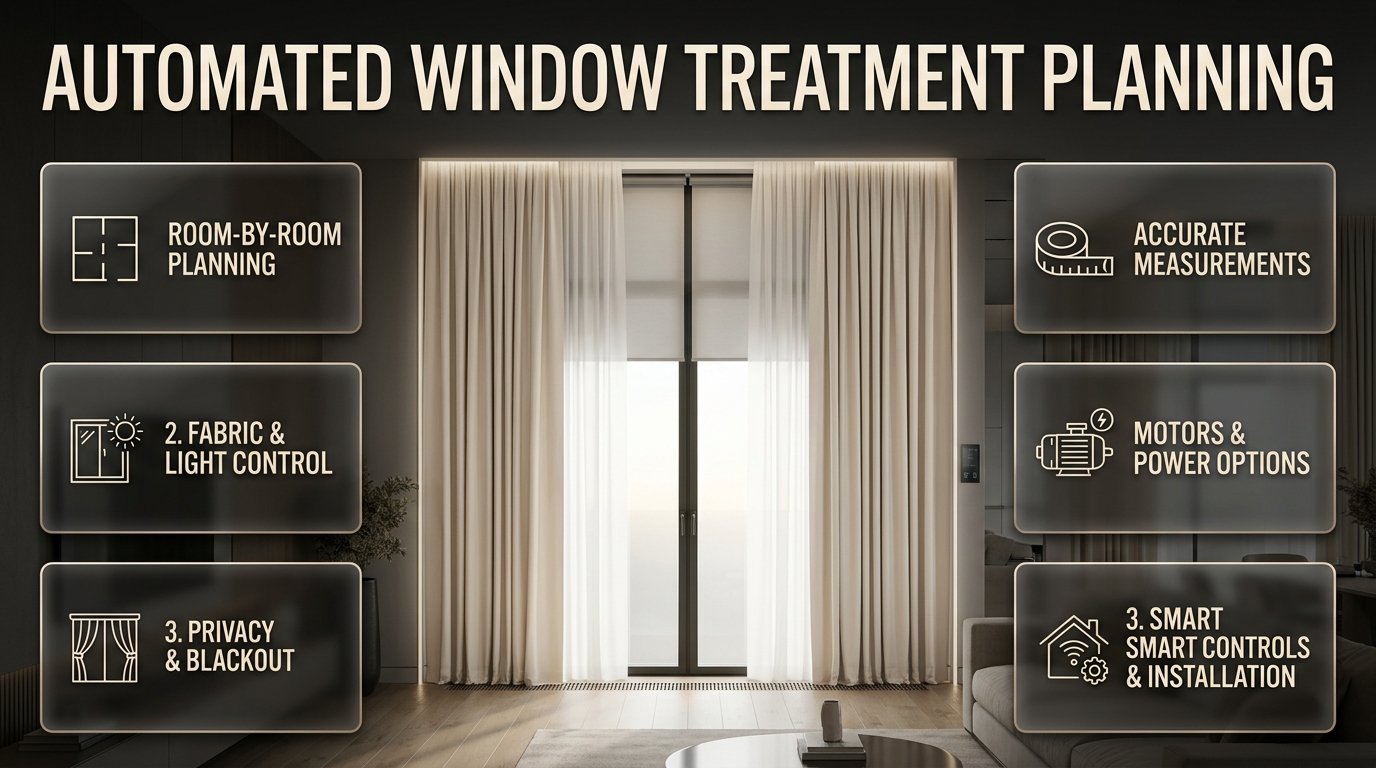
Automated window treatment planning helps homeowners select motorized blinds, smart shades, and automated curtains that fit their windows, interior design, daily routines, and budget. Instead of purchasing products simply because they offer remote control, thoughtful planning considers the entire system, including fabric, measurements, motors, power sources, smart controls, and installation details.
For example, a bedroom may need blackout shades that close at night, while a living room requires adjustable coverings that soften sunlight without blocking the outdoor view. A home office may need glare reduction, and a tall staircase window may benefit from automation because manual operation is inconvenient or unsafe.
In this guide, you’ll learn how to plan automated window treatments room by room, choose the right materials, compare power options, organize smart controls, avoid common installation mistakes, and create a coordinated interior that remains practical for years.
What Is Automated Window Treatment Planning?
Automated window treatment planning is the process of designing a coordinated system of motorized window coverings based on window dimensions, lighting conditions, privacy requirements, room function, and household preferences. It combines interior design decisions with technical planning so that each treatment fits correctly and operates reliably.
The process involves more than selecting a motorized blind. You must decide how the covering will look when open and closed, where the motor will sit, how it will receive power, and whether it needs to communicate with other smart home devices.
Which window treatments can be automated?
Several types of window coverings can be motorized, and each offers different advantages.
Motorized roller shades: These use a continuous fabric panel that rolls around a tube. They suit contemporary interiors, offices, bedrooms, and large window openings. Fabric options range from transparent solar screens to room-darkening and blackout materials.
Automated curtains: Motorized tracks move fabric panels horizontally. They work particularly well for floor-to-ceiling windows, sliding glass doors, and interiors where soft textiles contribute to the overall design.
Motorized cellular shades: Their honeycomb structure creates insulating air pockets that may help reduce heat transfer. They are useful when thermal comfort is an important consideration.
Motorized Venetian blinds: These use adjustable horizontal slats to control the direction and amount of daylight. They can be appropriate for rooms where occupants need both privacy and precise light adjustment.
Motorized Roman shades: These fold into soft horizontal sections when raised. They offer a more decorative appearance while providing powered operation.
The right option depends on the room, the window’s dimensions, the available mounting space, and the desired balance between appearance and performance.
Why should planning happen before purchasing?
A motorized covering must work as a complete system. A shade can have attractive fabric and a reliable motor but still perform poorly if its brackets do not fit, the motor is underpowered, or the control system is incompatible with the rest of the home.
Planning first helps you identify these problems before ordering custom products.
For homeowners exploring broader design improvements, DesignMode24 Interior Design provides a starting point for thinking about how window treatments fit into the appearance and functionality of the entire home.
Why Are Automated Window Treatments Worth Considering?
Automated window treatments can improve everyday convenience, privacy, daylight management, and accessibility. Their value depends on how well the system addresses a real household need rather than the number of smart features it offers.
Consider a home with eight windows. If each covering must be adjusted several times a day, operating them individually can become repetitive. Group controls allow selected coverings to move together, while schedules can handle predictable routines.
The benefits become more noticeable when windows are unusually high, difficult to reach, or exposed to changing sunlight.
1. Convenient everyday operation
Remote controls, wall switches, and compatible apps allow users to adjust coverings without approaching every window. This is particularly helpful for wide windows behind furniture or windows positioned above staircases.
A homeowner can also create routines that open bedroom shades in the morning and close living room coverings in the evening.
2. Better privacy management
Automated coverings can close at predetermined times or respond to supported sensors and routines. This is useful for bedrooms, bathrooms, street-facing living rooms, and properties where neighboring buildings overlook the windows.
However, automation should not replace thoughtful fabric selection. A translucent shade may still reveal silhouettes when interior lights are switched on at night.
3. More comfortable lighting
Strong sunlight can create reflections on television screens, glare on computer monitors, and uncomfortable brightness around seating areas.
Solar shades and adjustable blinds can help manage these conditions without necessarily eliminating natural light.
4. Support for temperature management
Appropriate window coverings can reduce unwanted solar heat gain or limit heat transfer through glazing. Automated schedules help ensure that coverings are adjusted at useful times.
Actual performance depends on the window, glazing, fabric, installation, weather, and operating schedule. Automation by itself does not guarantee lower energy bills.
5. Improved accessibility
Motorization can reduce the need to reach cords, pull heavy curtains, or operate difficult mechanisms. This can make everyday routines easier for older adults, people with limited mobility, and households with high or inaccessible windows.
6. Protection for interior finishes
Direct sunlight can contribute to fading in flooring, upholstery, rugs, artwork, and other materials. Suitable window coverings can reduce exposure, although no fabric eliminates every source of fading.
For additional home improvement ideas that support everyday comfort, explore Home Improvement.
How Do You Choose the Right Window Treatments for Each Room?
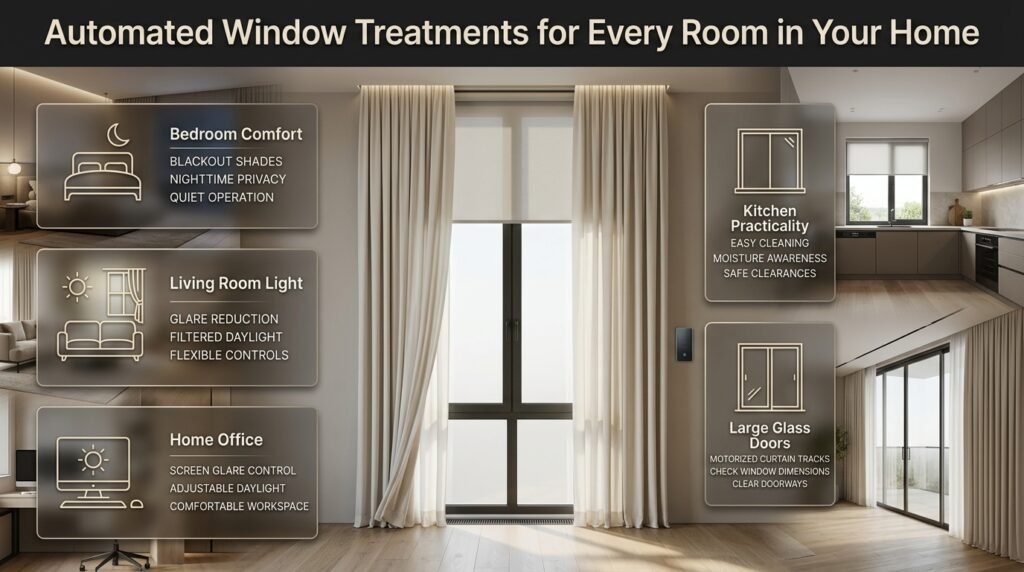
The most effective approach is to select coverings according to the room’s purpose. Bedrooms, kitchens, living rooms, and offices experience different lighting conditions and have different privacy and maintenance requirements.
Using the same product throughout the home may simplify purchasing, but it can leave certain rooms poorly served.
Automated window treatments for bedrooms
Bedrooms generally need privacy, convenient nighttime operation, and suitable control over early morning sunlight.
Blackout roller shades can be useful for people who prefer a dark sleeping environment. Blackout curtains provide another option, especially when fabric fullness and a softer appearance are important.
A layered arrangement may include a motorized blackout shade behind decorative curtains. This allows the room to remain visually warm without sacrificing light control.
When selecting bedroom motors, consider operating noise. A motor that sounds acceptable in a busy living room may be distracting in a quiet bedroom.
Planning checklist:
- Decide how dark the room needs to become.
- Check for light gaps around the window.
- Confirm that the motor can be operated quietly enough for the intended setting.
- Make charging or maintenance access practical.
- Choose a control method that household members can use easily.
Automated window treatments for living rooms
Living rooms often require flexibility rather than complete darkness. Daylight supports a welcoming atmosphere, but direct sunlight can cause glare and affect seating comfort.
Solar shades can reduce glare while preserving some visibility outdoors. Light-filtering shades soften daylight, while curtains introduce color, texture, and visual softness.
For a large living room, consider dividing windows into logical control groups. You might operate the windows near the television together while allowing other coverings to remain open.
This avoids making the entire room dark whenever one seating area needs less sunlight.
Automated window treatments for home offices
A home office requires particular attention to screen glare and changing daylight.
Start by observing when sunlight reaches the desk and monitor. If direct sunlight causes reflections, a solar shade with a suitable openness level may help. If the office also serves as a guest room, a layered arrangement may offer greater flexibility.
Do not assume that the darkest fabric is always the best choice. A very dark room may require more artificial lighting, while a light-filtering covering may provide adequate glare control in less exposed locations.
Automated window treatments for kitchens
Kitchen window coverings should be practical to clean and suitable for their distance from cooking appliances, sinks, and other sources of moisture.
Avoid placing fabrics where they can contact hot surfaces or interfere with ventilation. Consider how the covering will move around taps, handles, countertops, and cabinet doors.
The best choice is not necessarily the most decorative product. Durability, clearance, and cleaning requirements should guide the decision.
Automated window treatments for large glass doors
Wide sliding doors and floor-to-ceiling windows often benefit from motorized curtain tracks or appropriately specified wide shades.
Check the door’s opening path, the curtain stack position, and the available wall space. If the curtain gathers on one side, make sure it will not block a doorway, cabinet, or important view.
Large treatments may require stronger motors or specialized hardware. Confirm the manufacturer’s maximum dimensions and weight limits before ordering.
How Do You Measure Windows for Automated Shades and Curtains?
Accurate measurement ensures that a window treatment fits the opening, clears nearby objects, and operates without obstruction. The correct method depends on the product and whether it will be mounted inside the window recess, outside the frame, or on a ceiling-mounted track.
Step 1: Choose the mounting method
Inside mounting places the treatment within the window recess. This creates a neat, integrated appearance but requires sufficient depth for the brackets, motor, and fabric.
Outside mounting positions the covering over the window frame or surrounding wall. It can be useful when the recess is too shallow or when additional coverage is needed to reduce light gaps.
Curtains often use wall-mounted or ceiling-mounted tracks, depending on the architecture and desired appearance.
Step 2: Measure width and height
For an inside-mounted shade, measure the width at the top, middle, and bottom. Record the height at the left, center, and right.
Check whether the opening is square and whether the frame has any unusual angles or obstructions.
For an outside-mounted covering, first establish the intended coverage area. Then measure the width and height needed to cover it, accounting for the manufacturer’s mounting instructions.
Do not automatically subtract a standard amount from every measurement. Different products use different measurement conventions and factory deductions.
Step 3: Check the mounting depth
The visible window opening does not tell you everything about the available space.
Measure the recess depth and inspect nearby handles, locks, trim, shelves, and ceiling features. Confirm that the motor housing and brackets will fit without interfering with window operation.
For curtains, consider the depth of the track and the amount of space needed for the fabric to hang naturally.
Step 4: Record each window separately
Create a window schedule that includes the room, window identification, width, height, mounting method, selected covering, power source, and control group.
| Window | Main requirement | Treatment to consider | Important check |
|---|---|---|---|
| Bedroom | Darkness | Blackout shade | Side light gaps |
| Living room | Daylight control | Solar shade | Outdoor visibility |
| Office | Glare reduction | Screen fabric | Monitor position |
| Kitchen | Easy maintenance | Suitable easy-clean covering | Moisture and clearance |
| Tall stairwell | Accessibility | Motorized shade | Service access |
These are example specifications. Final selections should follow actual site measurements and product requirements.
Expert advice: If a window is unusually large, angled, arched, or difficult to access, arrange professional measurement before approving a custom order.
Which Power Source Should You Choose?
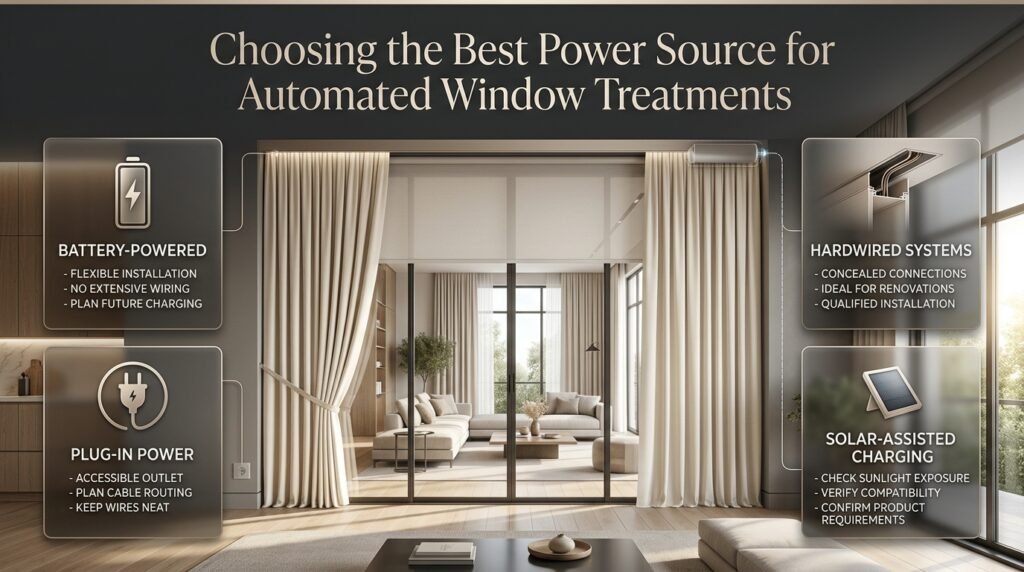
Motorized window treatments may use rechargeable batteries, replaceable batteries, plug-in power supplies, hardwired electrical connections, or compatible solar-assisted charging. The right option depends on the project stage, window location, expected use, and maintenance preferences.
Battery-powered systems
Battery-powered treatments are often convenient for existing homes because they may avoid extensive electrical work.
They are useful for individual windows and smaller projects where concealed wiring would be difficult or expensive.
However, you must plan for future charging or battery replacement. A motor positioned above a tall staircase may be inconvenient if it requires frequent servicing.
Plug-in systems
Plug-in motors receive power from an accessible electrical outlet. They can reduce the need for battery charging, but visible cables may affect the finished appearance.
Plan the cable route before installation. Avoid loose wiring, unsafe extensions, and arrangements that interfere with curtains or window operation.
Hardwired systems
Hardwired systems can be appropriate for new builds and major renovations. Electrical planning allows wiring to be concealed and coordinated with recessed tracks, ceiling pockets, and wall controls.
The decision should happen early enough to coordinate the work with the electrician, builder, and interior designer.
Electrical installation should be completed by a qualified professional according to applicable local requirements.
Solar-assisted charging
Some battery-powered products support compatible solar charging accessories. Their usefulness depends on the available sunlight, window orientation, product requirements, and installation location.
Do not assume that every sunny window provides suitable charging conditions. Confirm compatibility and expected performance with the manufacturer.
How Do Smart Controls and Automation Schedules Work?
A motorized window treatment becomes part of a smart home when its controls support the desired functions and integrations. Depending on the product, users may operate coverings through remotes, wall switches, mobile apps, schedules, voice commands, or supported sensors.
The essential question is not how many control methods are available. It is whether the chosen system is dependable and simple enough for everyday use.
Remote and wall controls
A dedicated remote can be an excellent solution for a single room or a small number of windows.
Wall controls are useful when several household members need a consistent way to operate coverings without using a phone.
Both options can provide straightforward access even when a smart home app is inconvenient.
Mobile apps and smart home integration
Apps can allow users to group coverings, schedule movements, and create scenes. Some systems also integrate with compatible voice assistants or broader home automation platforms.
Before purchasing, verify the exact motor’s communication protocol and supported devices. Depending on the product, it may use Wi-Fi, Bluetooth, Zigbee, Thread, a proprietary radio system, or another connection.
A hub or bridge may be necessary for particular features.
Useful automation schedules
A practical schedule reflects how each room is used.
For example:
- Morning: Open bedroom coverings gradually or at a preferred time.
- Daytime: Adjust living room shades when direct sunlight becomes uncomfortable.
- Working hours: Reduce glare in the home office.
- Evening: Close street-facing coverings for privacy.
- Night: Close bedroom coverings and activate a suitable bedtime scene.
- Away mode: Use selected schedules to maintain normal-looking routines when appropriate.
Avoid creating too many complicated rules. If several routines repeatedly move the same covering in opposite directions, the system can become frustrating.
Keep manual operation available where supported, and test schedules before relying on them every day.
How Can Automated Window Treatments Improve Energy Efficiency?
Automated window treatments can help manage solar heat gain, reduce glare, and improve the performance of suitable window coverings. The outcome depends on the fabric, glazing, climate, installation quality, and the timing of operation.
In warm conditions, closing suitable shades before strong sunlight enters a room may help limit unwanted heat gain. In cooler conditions, insulating shades or lined curtains can reduce heat transfer, while opening coverings during useful sunlight may provide passive warmth.
Match fabric to the window’s exposure
East-facing windows often receive morning sunlight, while west-facing windows can receive intense afternoon sun. South-facing and north-facing windows behave differently depending on the location and hemisphere.
Observe the actual conditions around your home rather than relying on orientation alone. Nearby buildings, trees, balconies, and seasonal changes can alter the amount of direct sunlight.
Understand fabric performance
Solar screen fabric can reduce glare and preserve a degree of outdoor visibility.
Light-filtering fabric softens daylight while maintaining a bright atmosphere.
Blackout fabric blocks most incoming light when properly installed, although gaps around the edges can still allow light through.
Cellular shades can provide insulating benefits through their honeycomb construction.
No single fabric provides every benefit equally. A room that needs privacy at night may require a different solution from a room where preserving the outdoor view is the priority.
Coordinate window coverings with other systems
Window treatments can complement suitable heating, cooling, and lighting routines. For instance, a shade can close during a period of intense sunlight while the room’s lighting adjusts to maintain comfortable visibility.
However, automation should respond to real conditions. Closing every shade at the same time may reduce useful daylight in some rooms and increase reliance on artificial lighting.
For broader ideas on coordinating finishes and functional upgrades, explore DIY Home Projects.
How Do You Coordinate Automated Window Treatments With Interior Design?
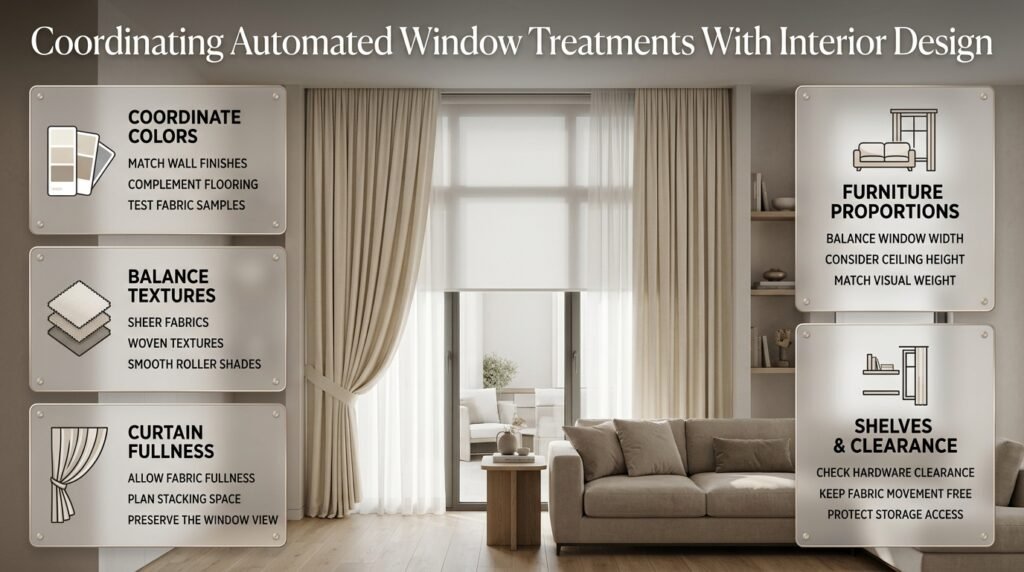
Window treatments are part of the room’s visual composition. Fabric color, texture, mounting height, hardware, and the amount of visible material all influence how the finished interior feels.
A motorized covering should look intentional whether it is open, partially lowered, or fully closed.
Select colors that support the room palette
Neutral fabrics can create a calm background, while contrasting shades can emphasize architectural features.
Warm whites, beige, taupe, and natural linen tones often work well in relaxed interiors. Cooler grays and darker shades can support more contemporary palettes.
The best choice depends on wall color, flooring, upholstery, and the direction of natural light.
Request fabric samples and examine them at different times of day. A color that appears soft in a showroom may look much brighter or cooler beside a large window.
For additional guidance, browse Paint Color.
Use texture without creating visual clutter
Sheer curtains, woven fabrics, smooth roller shades, and heavier drapes each contribute different visual qualities.
A textured curtain can soften a room with hard flooring and clean-lined furniture. A simple roller shade can balance an interior that already contains patterned rugs, decorative upholstery, and detailed accessories.
The aim is to create a useful contrast rather than add texture everywhere.
Read Layering Textures Without Overcrowding for more ideas on balancing fabrics and finishes.
Plan curtain fullness and stacking space
Curtains need enough fabric to create the intended folds. They also need somewhere to gather when open.
A full-length curtain may look beautiful when closed but occupy considerable wall space when stacked to one side. This can obstruct the glass or hide architectural details.
Measure the intended track length and estimate the fabric stack before finalizing the arrangement.
Match window treatments to furniture proportions
A wide window with a narrow, lightweight curtain track may look visually unbalanced. Similarly, heavy drapes can overwhelm a small room with delicate furniture.
Consider the size of the opening, ceiling height, furniture scale, and amount of fabric in the room.
For more detailed guidance, explore Understanding Furniture Proportions and Japandi Furniture Proportions.
Coordinate window treatments with shelves and storage
Motorized coverings need a clear path of movement. Wall shelves, cabinets, window seats, and decorative objects can interfere with the fabric or hardware.
Check the position of nearby shelving before deciding where to mount a shade or curtain track. A covering should remain easy to operate without brushing against objects or blocking storage access.
The Wall Shelves Ideas guide can help when planning storage around windows.
How Should You Plan Automated Window Treatments Room by Room?
A whole-home plan should create visual consistency without forcing every room to use identical coverings.
Start by listing all windows and grouping them according to function, exposure, and importance. Then decide which treatments should share a fabric, motor system, control group, or automation schedule.
Bedrooms and guest rooms
Prioritize privacy, suitable darkness, quiet operation, and easy control.
If multiple bedrooms use similar window sizes, coordinated products may simplify purchasing. However, a guest room that receives little direct sunlight may not require the same specification as a bedroom exposed to early morning sun.
Living and family rooms
Focus on glare, views, flexible daylight, and the relationship between windows and seating areas.
A family room may need different settings for reading, watching television, entertaining, and relaxing. Group controls can make these changes easier.
If the room contains several large windows, avoid automatically closing every covering when only one area needs glare reduction.
Home offices
Plan around the desk, monitor, and direction of daylight. Consider whether video calls require consistent lighting and whether the window creates reflections during working hours.
A shade that reduces glare while preserving a view can be more useful than a fully opaque treatment in many office settings.
Entryways and circulation areas
Tall windows in entryways and staircases may benefit from motorization because they are difficult to reach. Ensure the system remains serviceable and does not interfere with doors, handrails, or circulation.
For storage and organization ideas around the entrance, see Entryway Storage Capacity Planning.
Connected open-plan spaces
Open-plan rooms require particular attention to consistency. The kitchen, dining area, and living room may share one long wall of glazing, but their functional needs may differ.
Coordinate the visible fabric colors and hardware while allowing separate controls where useful. This produces a unified appearance without sacrificing flexibility.
The Room-by-Room Design Hub offers additional inspiration for coordinating individual spaces.
What Should You Know About Installation and Construction?
Installation requirements depend on the treatment, mounting surface, motor, power source, and degree of integration with the architecture.
A simple battery-powered shade may require only suitable mounting hardware. A concealed, hardwired curtain track may involve coordination among the electrician, builder, designer, and installer.
New construction and major renovations
Plan motorized coverings before walls and ceilings are finished.
Discuss the following details early:
- Electrical supply and wiring routes.
- Recessed tracks or shade pockets.
- Motor and bracket dimensions.
- Ceiling and wall construction.
- Access for future maintenance.
- Control locations and cable routes.
- The relationship between window trim and finished surfaces.
Concealed systems can create a clean appearance, but they must be designed with enough space for the hardware and fabric to operate properly.
Existing homes
Battery-powered products can be practical when opening walls or ceilings is undesirable.
Before installation, inspect the mounting surface and verify that it can support the treatment. Check the available recess depth, nearby trim, and access to charging points.
If the installation involves unfamiliar electrical work, structural changes, or unusually heavy coverings, use a qualified professional.
Testing after installation
Do not assume that a treatment is correctly installed simply because the motor responds to a remote.
Test each covering through its full operating range. Check alignment, movement, stopping positions, noise, and clearance from surrounding objects.
For multi-window systems, confirm that the correct coverings respond to each group command and that scheduled routines work as intended.
What Are the Most Common Automated Window Treatment Planning Mistakes?
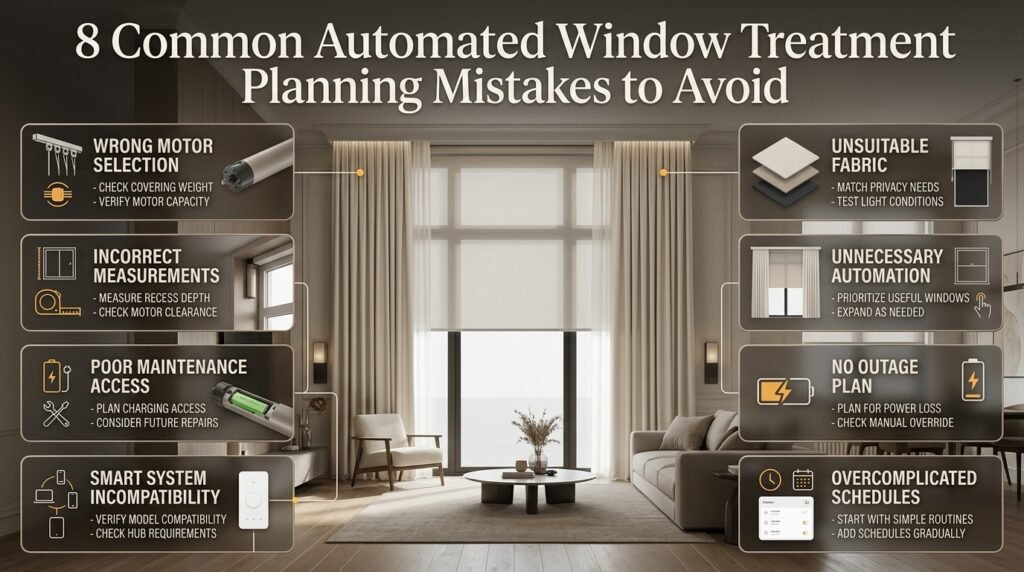
Many installation problems begin with decisions made too early or without checking how the product will work in the room.
Choosing the motor before confirming the covering
A motor must support the dimensions and weight of the selected treatment. An unsuitable motor can result in poor operation or an incompatible installation.
Avoid it: Confirm maximum product dimensions, lifting capacity, fabric weight, and operating requirements before ordering.
Measuring without checking the mounting space
A window opening may be wide enough for a shade but lack sufficient depth for its motor housing.
Avoid it: Measure the recess, inspect handles and trim, and verify the manufacturer’s clearance requirements.
Ignoring maintenance access
A battery-powered motor may seem convenient until charging requires a ladder or awkward access.
Avoid it: Consider where the motor will sit and how charging, replacement, and repairs will be handled.
Assuming all smart products are compatible
Different motors may use different protocols and control systems.
Avoid it: Confirm exact model compatibility, required hubs, app support, and any subscription requirements before purchasing.
Choosing the wrong fabric
A transparent fabric may preserve views but offer insufficient privacy at night. A blackout fabric may provide darkness but remove useful daylight.
Avoid it: Define the room’s primary purpose and examine samples under realistic lighting conditions.
Automating every window without evaluating the benefit
Some windows may rarely need adjustment or may be easy to operate manually.
Avoid it: Prioritize rooms where automation solves a genuine problem and expand the system gradually if necessary.
Forgetting what happens during an outage
Power loss, low batteries, connectivity issues, or controller failures can interrupt normal operation.
Avoid it: Understand the system’s fallback options and retain manual controls where supported.
Creating unnecessarily complicated schedules
Too many overlapping routines can cause unexpected movements.
Avoid it: Begin with a small number of useful schedules, observe their behavior, and add complexity only when it solves a real need.
How Much Should You Budget for Automated Window Treatments?
The total cost depends on the number and size of windows, fabric selection, motor capacity, power source, control equipment, and installation complexity.
A basic battery-powered shade and a custom motorized curtain system with concealed wiring are different projects, so comparing their motor prices alone will not provide a meaningful budget.
Build your estimate around the complete installation.
| Cost category | What to include |
|---|---|
| Window covering | Fabric, material, dimensions, and customization |
| Motor | Capacity, operating noise, and control compatibility |
| Power | Batteries, charging equipment, wiring, or compatible solar accessories |
| Controls | Remotes, wall switches, hubs, and sensors |
| Installation | Mounting, track alignment, and electrical work |
| Maintenance | Charging, replacement parts, and servicing |
How can you control costs without sacrificing quality?
Automate the windows that offer the greatest benefit first.
For example, you might begin with the main bedroom, living room, and home office. These spaces often have clear privacy, lighting, or accessibility needs. You can add secondary rooms later once you understand which features you use most.
Choose standard sizes where they genuinely fit, coordinate compatible controls, and avoid buying sensors or advanced features without a clear purpose.
However, do not compromise on accurate measurements, appropriate motor capacity, safe installation, or the fabric performance required by the room.
What Do Professionals Recommend Before You Finalize the Project?
Professionals generally approach automated window treatment planning as a combination of interior design, product specification, and installation coordination.
Prepare a window schedule
List each window and its requirements. Include measurements, fabric type, mounting method, motor location, power source, control group, and any special access concerns.
This document helps prevent confusion when several similar windows require different specifications.
Separate essential features from optional features
Essential features may include suitable blackout performance, reliable operation, compatible controls, or adequate mounting clearance.
Optional features might include advanced sensors, complex scene programming, or additional app integrations.
Prioritize what affects everyday use before paying for features that may rarely be needed.
Coordinate with the right professionals
For a larger project, consult the installer, interior designer, electrician, and builder as appropriate.
Discuss the installation sequence and confirm who is responsible for measurements, wiring, mounting, programming, and final testing.
Before approving the work, review the written specification and warranty.
For help preparing for design discussions, consult Questions to Ask an Interior Design Consultant.
You can also review Interior Designer Contract Essentials to understand why project scope, responsibilities, deliverables, and installation arrangements should be clearly documented.
Check the overall visual composition
Look at the window coverings alongside furniture, lighting, wall finishes, and decorative elements.
If you are installing curtains near artwork or a gallery wall, check that the fabric stack will not obscure important details. The Gallery Wall Spacing Formula can help when coordinating artwork around the surrounding wall space.
Keep future maintenance in mind
Ask how the motor will be serviced, whether replacement parts are available, and what happens if the control system changes.
A system that remains easy to operate and maintain is generally more valuable than one that offers many advanced features but becomes difficult to support.
A Practical Step-by-Step Plan for Your Home
Use this sequence to turn the initial idea into a workable project.
Step 1: Identify the problem. Determine whether each window needs better privacy, glare control, convenient operation, or temperature management.
Step 2: Prioritize the windows. Begin with the rooms where automation will make the greatest difference.
Step 3: Choose the covering. Select roller shades, cellular shades, Venetian blinds, Roman shades, or curtains according to the room’s requirements.
Step 4: Measure carefully. Record the opening dimensions, mounting depth, hardware clearance, and surrounding obstacles.
Step 5: Choose the motor and power source. Check the product’s capacity and plan how it will receive power.
Step 6: Confirm control compatibility. Verify remotes, wall switches, hubs, apps, and smart home integration.
Step 7: Coordinate the design. Select fabrics and hardware that support the room’s palette, proportions, and architectural features.
Step 8: Review the complete quotation. Check product specifications, installation charges, lead times, warranty, and maintenance requirements.
Step 9: Install and test. Verify movement, alignment, limits, controls, and any programmed routines.
Step 10: Refine the automation. Observe the system during normal daily use and adjust schedules to suit actual sunlight and household routines.
For example, a home with three bedrooms, a large living room, and a sunny office might use blackout shades in sleeping areas, solar shades in the office, and layered curtains in the living room. Compatible controls can simplify operation while each room retains the treatment it needs.
How Do You Plan Automated Window Treatments for Different Rooms in Your Home?
Planning automated window treatments starts with understanding how each room is used, how much sunlight it receives, and what level of privacy it requires. A bedroom, for example, may need blackout shades for better light control, while a living room may benefit from solar shades that reduce glare without completely blocking outdoor views. Choosing the same treatment for every window can overlook these important differences.
Begin by assessing each room individually. Consider the window’s size, direction, accessibility, furniture placement, and daily lighting conditions. Then select a suitable covering, motor, and control method. This approach helps create a coordinated interior without sacrificing the practical needs of individual spaces.
Important planning tips:
Bedrooms: Consider blackout shades or lined motorized curtains for privacy and darkness.
Living rooms: Choose light-filtering or solar shades to balance daylight and outdoor visibility.
Home offices: Prioritize glare reduction to make computer screens easier to use.
Large windows: Check motor capacity, mounting clearance, and power requirements before ordering.
Hard-to-reach windows: Prioritize automation where manual operation is inconvenient.
A room-by-room plan makes it easier to allocate your budget, coordinate fabrics, and select compatible controls throughout the home.
Are Automated Window Treatments Worth the Cost for Modern Homes?
Automated window treatments can be a worthwhile investment when they solve everyday problems, such as difficult-to-reach windows, changing sunlight, or the need to adjust several coverings repeatedly. Their value extends beyond convenience because suitable fabrics can also support privacy, glare management, and indoor comfort. However, the benefits depend on selecting the right system rather than simply choosing the most expensive motor or smart home package.
Before purchasing, compare the complete installed cost, including the coverings, motors, power supply, controls, installation, and future maintenance. If your home has only a few easily accessible windows, automating selected areas may be more practical than upgrading every room at once.
Factors worth considering:
Daily convenience: Remote controls and schedules simplify frequent adjustments.
Lighting management: Appropriate fabrics help control glare and direct sunlight.
Accessibility: Motorization reduces the need to reach high or awkward windows.
Long-term costs: Consider battery charging, replacement parts, servicing, and warranty coverage.
Budget priorities: Start with bedrooms, sunny living spaces, or windows that are difficult to operate manually.
Automated window treatments are most valuable when their features address specific household needs. A carefully selected system can provide meaningful everyday benefits without unnecessary spending.
Which Is Better for Automated Window Treatments: Battery-Powered or Hardwired Systems?
Battery-powered and hardwired window treatments can both perform well, but the better choice depends on your property, installation plans, and maintenance preferences. Battery-powered systems are often suitable for existing homes because they can reduce the need for electrical modifications. Hardwired systems are particularly worth considering during new construction or major renovations, when wiring can be concealed before walls and ceilings are finished.
Battery-powered motors require charging or battery replacement according to the manufacturer’s specifications. This may be straightforward for accessible windows but inconvenient when motors are installed above staircases or behind difficult-to-reach pelmets. Hardwired systems reduce routine battery maintenance but require suitable electrical planning and professional installation.
How to choose the right option:
Choose battery power when you want a less invasive installation in an existing home.
Consider hardwiring when planning concealed wiring during construction or renovation.
Check maintenance access before placing a motor in a high or restricted location.
Plan cable routes carefully if using plug-in power supplies.
Confirm compatibility between the motor, power source, controls, and selected window covering.
Compare the full installation requirements rather than focusing only on the initial purchase price. The most suitable system is one that operates reliably and remains practical to maintain.
Can Automated Window Treatments Help Reduce Heat, Glare, and Energy Use?
Automated window treatments can help manage indoor light and temperature when the selected covering suits the window’s exposure and the local climate. Solar shades can reduce glare and direct sunlight, while cellular shades and appropriately lined curtains may help reduce heat transfer. Automation makes these coverings easier to adjust at useful times, but energy savings are not guaranteed.
Start by identifying which windows receive intense sunlight and when the room becomes uncomfortable. Closing suitable shades before strong sunlight enters may help limit unwanted solar heat gain. In cooler conditions, opening coverings during beneficial sunlight and closing them later may support indoor comfort.
Ways to improve performance:
Choose suitable fabric: Solar screens, blackout materials, and cellular shades serve different purposes.
Consider window orientation: Morning and afternoon sunlight can affect rooms differently.
Use practical schedules: Adjust coverings according to actual sunlight and room use.
Preserve useful daylight: Avoid closing every shade when only one area experiences glare.
Check the installation: Gaps around coverings can reduce privacy and light-control performance.
For the best results, treat automation as one part of a broader comfort strategy that includes appropriate glazing, insulation, and heating or cooling controls.
What Should You Check Before Installing Smart Blinds or Motorized Curtains?
Before installing smart blinds or motorized curtains, confirm that the window measurements, mounting space, motor capacity, power supply, and control system are compatible. A product may look suitable in a catalogue but fail to operate correctly if the recess is too shallow, the motor cannot support the covering, or the selected controls require an incompatible hub.
Begin with accurate measurements and record the requirements for each window. Check nearby handles, shelves, furniture, ceiling features, and curtain stacking space. If you are renovating, coordinate electrical work and concealed tracks before finishing the walls or ceilings. For unusual or oversized windows, professional measurement can help prevent expensive ordering mistakes.
Pre-installation checklist:
Measurements: Verify width, height, mounting depth, and intended coverage.
Motor specifications: Confirm the supported dimensions and covering weight.
Smart compatibility: Check remote, app, hub, and voice-control requirements.
Power access: Plan charging, wiring, and future servicing.
Interior design: Coordinate fabrics, colors, mounting height, and furniture clearance.
Safety and operation: Follow installation instructions and understand how the system behaves during power or connectivity failures.
Warranty: Confirm what is covered for the motor, fabric, controls, and installation.
A proper pre-installation review helps ensure that the finished system looks integrated, operates smoothly, and remains easy to use over time.
Conclusion
Automated window treatment planning is an important part of creating a home that feels comfortable, functional, energy-conscious, and visually balanced. Motorized blinds, smart curtains, and automated shades offer more than convenient remote control. When planned carefully, they can improve privacy, manage natural light, reduce glare, support temperature control, and complement the overall interior design of each room.
The most effective approach begins with understanding how every space is used. Bedrooms may benefit from blackout shades and scheduled operation, living rooms often need flexible light control, and home offices require solutions that minimize screen glare without making the room feel dark. Window measurements, fabric selection, motor compatibility, power sources, smart-home integration, and installation requirements should all be considered before choosing a system.
It is equally important to balance technology with practical design. A sophisticated automation system will only deliver lasting value when it operates reliably, fits the window correctly, and matches the household’s daily routines. Choosing suitable materials, planning wiring or battery access, and considering future maintenance can help prevent unnecessary expenses and installation problems.
For homeowners who want to create a cohesive, modern living environment, thoughtful window planning should work alongside furniture placement, lighting, color selection, and other interior design decisions. Explore more practical ideas and inspiration at DesignMode24 Interior Design to help create spaces that combine style with everyday functionality.
Ultimately, successful automated window treatment planning is not about adding the most technology to a home. It is about selecting the right combination of automation, light control, privacy, and design for each room. With a clear plan and carefully chosen products, homeowners can enjoy a more comfortable, convenient, and beautifully coordinated home for years to come.