

Introduction
Understated Luxury Interior Details | A home can contain beautiful furniture, expensive finishes, and carefully chosen decorations yet still feel unfinished. Perhaps the lighting is too harsh, the furniture doesn’t fit the room, or every surface seems to demand attention. The problem isn’t always a lack of luxury. Often, it’s a lack of thoughtful detail.
Understated luxury interior details are the small, deliberate choices that make a home feel refined without relying on excessive decoration or obvious displays of wealth. They include carefully selected materials, comfortable lighting, balanced furniture proportions, clean architectural finishes, and storage that keeps everyday life organized.
The best part is that you don’t need to renovate your entire home to achieve this look. A few well-planned improvements can make an existing room feel calmer, more comfortable, and more cohesive.
This guide explains how to create understated luxury through materials, lighting, furniture, colors, hardware, textiles, and room-specific details. You’ll also learn how to prioritize upgrades, avoid common design mistakes, and make practical decisions that suit your budget and lifestyle.
For more inspiration and practical decorating guidance, visit DesignMode24 Interior Design.
What Are Understated Luxury Interior Details?
Understated luxury interior details are design features that communicate quality through craftsmanship, proportion, material selection, comfort, and restraint. Instead of making a room look expensive through dramatic decoration, these details create a sense of refinement through the way its individual elements work together.
Think of a wardrobe with evenly aligned doors, a sofa upholstered in a beautiful tactile fabric, a dining table with a carefully finished edge, or a bedroom where the lighting feels comfortable at night.
None of these features needs to attract immediate attention. Their value becomes apparent through everyday use.
Understated luxury usually combines five principles:
- Material integrity: Surfaces look appropriate for what they’re made from and suit their intended use.
- Visual balance: Furniture, lighting, and accessories work together rather than competing.
- Craftsmanship: Visible edges, joints, fittings, and transitions are finished neatly.
- Functional comfort: Rooms support the activities that happen in them.
- Intentional restraint: Every prominent object contributes something useful, beautiful, or meaningful.
Quiet luxury is not exactly the same as minimalism. Minimalism often focuses on reducing the number of elements in a space, whereas understated luxury focuses on making the remaining elements feel carefully chosen and well executed.
A room can contain artwork, books, family photographs, and colorful textiles while still feeling refined. The important question is whether those elements contribute to a coherent interior.
1. Choose Materials That Feel Rich Without Looking Flashy
Materials establish the foundation of an understated luxury interior. Wood introduces warmth, stone adds natural variation, linen softens hard surfaces, and metal provides subtle contrast. The goal is to create depth through material character rather than relying on decorative patterns or glossy finishes.
Why material quality matters
Imagine two living rooms with almost identical furniture layouts. One has flat, reflective surfaces, inconsistent wood tones, and thin-looking upholstery. The other combines a textured rug, warm wood, softly finished walls, and comfortable seating.
Even if the furniture budgets are similar, the second room may feel more considered because its materials create a coherent visual and tactile experience.
You don’t necessarily need expensive natural stone or solid timber. Quality veneer, well-made engineered surfaces, durable upholstery, and carefully selected porcelain can all contribute to a refined result.
Consider these material choices:
| Material | Visual contribution | Where it works well |
|---|---|---|
| Oak or walnut | Warmth and natural grain | Furniture, cabinetry, shelving |
| Limestone or travertine | Subtle variation and depth | Selected walls, vanities, tabletops |
| Porcelain | Practicality and consistent finishes | Kitchens, bathrooms, flooring |
| Linen or linen blends | Softness and relaxed texture | Curtains, cushions, upholstery |
| Wool or wool blends | Comfort and tactile richness | Rugs, throws, upholstery |
| Brushed metal | Restrained highlights | Handles, faucets, light fittings |
| Matte ceramic | Handmade character | Vases, bowls, accessories |
How to combine materials successfully
Start with the largest surfaces. Flooring, wall color, cabinetry, and major upholstered furniture should establish the palette before you introduce smaller accessories.
For example, warm oak flooring can work beautifully with an ivory sofa, a taupe rug, and brushed brass accents. A stone coffee table may add contrast, while linen curtains soften the overall composition.
The materials don’t need to match exactly. They need to share compatible undertones and visual weight.
Follow these steps before purchasing:
- Collect physical samples of the major finishes.
- Place them beside your existing flooring and furniture.
- Examine the samples in daylight and evening lighting.
- Compare textures as well as colors.
- Check cleaning, durability, and maintenance requirements.
Pro tip: Don’t select materials from photographs alone. Screen brightness, photography, and showroom lighting can distort colors. A physical sample gives you a more reliable understanding of how the finish will look in your home.
For rooms where the flooring will remain in place, decorating around existing flooring can help you build a coordinated palette without replacing a major surface unnecessarily.
2. Use Layered Lighting to Create a Calm Atmosphere
Lighting is one of the most influential understated luxury interior details because it changes how every other material appears. The same room can feel welcoming in soft, balanced light and uncomfortable under a single harsh ceiling fixture.
A refined lighting plan combines general illumination, task lighting, and accent lighting so the room works throughout the day and evening.
Understand the three lighting layers
Ambient lighting provides general visibility. It may come from ceiling fixtures, recessed lights, or indirect illumination.
Task lighting supports specific activities, such as reading, cooking, grooming, or working at a desk.
Accent lighting highlights selected features, including artwork, textured walls, shelving, or architectural details.
Consider a living room with recessed ceiling lights, a floor lamp beside the sofa, and a wall light that highlights artwork. Each fixture serves a different purpose, so the room remains practical without depending on one overly bright source.
When should you use concealed lighting?
Concealed lighting works well when you want to emphasize an architectural feature without making the fixture itself the focal point.
LED strips can illuminate ceiling recesses, cabinet undersides, shelves, and selected niches. However, the effect depends on installation quality.
Poorly positioned strips may create visible dots, uneven brightness, glare, or unwanted reflections. Drivers also need suitable ventilation and access for maintenance.
For a cleaner result:
- Use appropriate diffusers or channels where necessary.
- Keep color temperatures consistent within connected areas.
- Add dimmers when the fixtures support them.
- Check that light doesn’t create distracting reflections on television screens or glossy surfaces.
- Plan electrical connections before cabinetry or ceilings are closed.
Warm white lighting around 2700K–3000K is often comfortable in bedrooms and living rooms. Kitchens, bathrooms, and work areas may need different lighting depending on the task and the surrounding finishes.
Common mistake: Installing decorative lighting before deciding where furniture, artwork, and work surfaces will go. A beautiful fixture cannot compensate for a reading chair that remains poorly lit.
Lighting also needs to support the architecture. Rather than adding random strips throughout the home, identify the surfaces or activities that genuinely benefit from additional illumination.
3. Refine Architectural Finishes That People Often Overlook
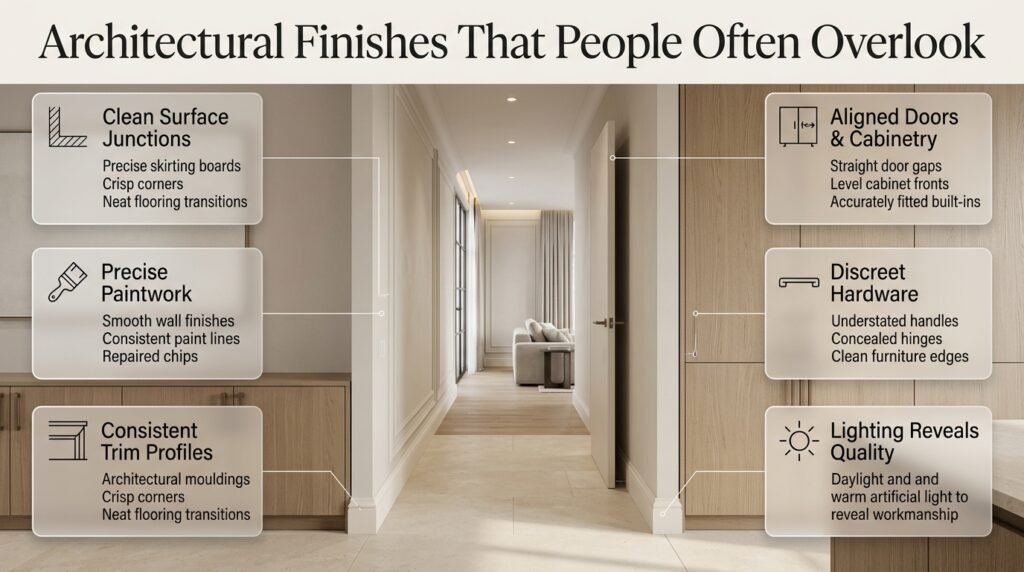
Architectural finishing can make an ordinary room feel more complete because it affects the way different surfaces meet. Clean skirting boards, aligned doors, properly fitted cabinetry, and neat paint transitions create visual consistency without adding unnecessary decoration.
These details are particularly important in restrained interiors, where there are fewer decorative elements to distract from imperfections.
Focus on the points where surfaces meet
Look at the edges of doors, flooring transitions, window frames, built-in cabinets, and wall trim. These are places where poor installation often becomes noticeable.
Improvements might include:
- Repairing chipped or uneven paintwork.
- Correcting misaligned cabinet doors.
- Finishing exposed furniture edges neatly.
- Making flooring transitions clean and safe.
- Concealing unnecessary cables.
- Replacing damaged or poorly fitted handles.
- Using consistent trim profiles in connected rooms.
You don’t need to install elaborate wall mouldings to achieve a premium appearance. Simple architecture can look equally refined when the proportions and workmanship are right.
Should you use concealed or decorative details?
That depends on the character of your home.
A contemporary apartment may suit flush cabinet fronts, simple skirting, and discreet hinges. A traditional home may benefit from panelled doors, carefully proportioned mouldings, and classic hardware.
Problems arise when unrelated styles are combined without a clear reason. Ornate wall trim, ultra-modern furniture, rustic hardware, and highly decorative lighting can compete for attention if they aren’t connected by a consistent design approach.
Expert tip: Inspect finishing details in daylight and under artificial lighting. Small gaps, uneven paint lines, and surface defects can look different under changing conditions.
If you’re planning repairs or larger upgrades, explore Home Improvement ideas before deciding which details deserve your budget.
4. Select Hardware That Feels Good to Use
Cabinet handles, drawer pulls, door levers, hinges, and faucets may occupy relatively little space, but they influence both the appearance and everyday experience of an interior.
Hardware can also be an economical way to refresh existing furniture without replacing an entire cabinet or wardrobe.
Choose a finish that supports the material palette
Brushed brass brings warmth to wood and cream cabinetry. Satin nickel works with many contemporary palettes, while matte black introduces a stronger architectural contrast.
Bronze can complement darker timber and earthy colors. Polished chrome can suit bright, contemporary kitchens and bathrooms.
The important point is not to follow a rigid rule about which metal is luxurious. It’s to choose finishes that make sense together.
A kitchen might feature brushed brass handles, a related faucet finish, and a black pendant light that connects to the window frames. The different metals can coexist because the contrast is deliberate.
Pay attention to dimensions and installation
Before replacing cabinet handles, measure the distance between the existing fixing holes. Matching the original dimensions can save you from drilling new holes, filling old ones, and repainting the cabinet fronts.
Also check the handle’s projection, edge comfort, fixing method, and resistance to corrosion in humid areas.
A beautiful handle that catches clothing, feels uncomfortable, or loosens repeatedly isn’t a successful design choice.
The same principle applies to door hardware. A comfortable grip, smooth operation, and reliable mechanism improve the experience of using the room every day.
Quick tip: If the existing cabinetry is in good condition, try replacing the hardware before considering a more expensive renovation. It won’t fix damaged doors or poor cabinet construction, but it can refresh a sound piece of furniture.
5. Build a Neutral Palette With Depth and Contrast
Neutral colors are popular in quiet luxury interiors because they create a calm background for natural materials and carefully selected furniture. However, a room can feel flat when every surface uses almost the same shade without variation in texture or depth.
A more successful palette combines related colors with distinct roles.
Create a simple color hierarchy
Choose a dominant color for the largest surfaces, a secondary color for furnishings, and one or two accent colors for contrast.
For example:
- Dominant: Warm off-white walls.
- Secondary: Oatmeal upholstery and taupe curtains.
- Natural element: Oak flooring or walnut furniture.
- Accent: Muted olive, chocolate brown, or charcoal.
- Finishing detail: Brushed brass or satin nickel.
This creates visual variety while maintaining a cohesive atmosphere.
Why undertones matter
Two beige paints can look surprisingly different when placed together. One may have a yellow undertone, while another leans pink or gray. These differences become more noticeable beside flooring, stone, and upholstery.
Before committing to a paint color, test it on a sufficiently large sample area and observe it in different lighting conditions.
Consider the amount of daylight, the direction of the windows, and the color of nearby surfaces. A room with limited daylight may benefit from a warmer shade, while a bright room may comfortably accommodate a cooler neutral.
Can understated luxury include bold colors?
Absolutely. Deep green, navy, burgundy, terracotta, and muted blue can all work beautifully.
Use stronger colors where they can add character without overwhelming the entire scheme. An accent chair, artwork, a painted cabinet, or a pair of cushions may provide enough contrast.
The objective is not to remove personality. It’s to make sure each color has a meaningful relationship with the rest of the room.
For practical inspiration, browse Paint and Color ideas.
6. Get Furniture Proportions Right Before Buying Anything
Furniture proportions are central to understated luxury because they determine how comfortably a room can be used and how balanced it appears.
An expensive sofa may look impressive in a showroom but overwhelm a small living room. A beautiful dining table can feel awkward if chairs cannot move comfortably around it.
Measure the room and the furniture together
Start by measuring wall lengths, doorways, windows, circulation routes, and the area available for furniture.
Then check the dimensions of each piece, including the space needed to open drawers, extend chairs, and move around the room.
For a living room, consider the distance between the sofa and coffee table, the relationship between seating and the television, and the walking route from the doorway to adjacent spaces.
A gap of roughly 14–18 inches between a sofa and coffee table often works as a starting point, but comfort and circulation should determine the final distance.
Why scale matters more than brand names
A room feels balanced when furniture has a sensible relationship with the architecture. A substantial sofa may suit a large living room, while a smaller apartment could benefit from a compact sofa and a visually lighter side chair.
Likewise, a large artwork may anchor a wall more effectively than several tiny frames scattered across it.
Use this checklist before buying:
- Measure the complete furniture footprint.
- Confirm delivery dimensions and access routes.
- Check seat depth and height for everyday comfort.
- Allow space for doors, drawers, and movable chairs.
- Consider how the piece looks beside existing furniture.
- Avoid purchasing an item simply because it looks attractive on its own.
A useful starting point is understanding furniture proportions. For practical delivery and access considerations, see choosing furniture delivery dimensions.
7. Layer Textures Instead of Adding More Decorations
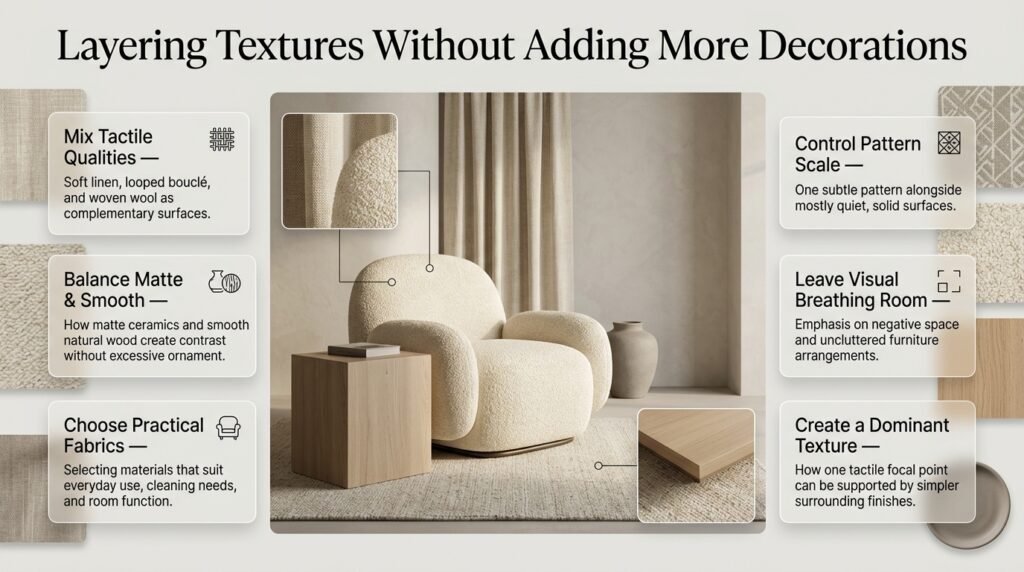
Texture introduces richness without requiring strong colors or elaborate patterns. A linen sofa, wool rug, smooth wood table, and matte ceramic lamp can create a more interesting interior than a collection of decorative objects with competing finishes.
The key is to vary how surfaces feel and reflect light while keeping the overall composition controlled.
Combine different tactile qualities
Try pairing:
- Linen with wool for a relaxed, natural atmosphere.
- Smooth wood with textured upholstery for contrast.
- Matte ceramics with subtle metal accents.
- Cotton bedding with a woven throw for a softer bedroom.
- A low-pile rug with curtains that provide visual softness.
The best combinations depend on how the room is used. A formal sitting room may accommodate delicate fabrics, while a family living room needs materials that tolerate regular cleaning and wear.
How do you avoid overcrowding?
Choose one dominant texture, then introduce supporting materials that complement it.
For example, if your sofa has a strong bouclé texture, a simple woven rug and smooth wooden table may provide enough variation. Adding several heavily patterned cushions, a textured wall, and a busy rug could make the room feel restless.
Also consider scale. Large patterns can dominate small rooms, while several tiny patterns may create visual noise when placed together.
Pro tip: Step back and look at the room from its main entrance. If every surface attracts attention, simplify the combination. A refined room needs some quieter areas where the eye can rest.
For a more detailed guide, read Layering Textures Without Overcrowding.
8. Make Storage Part of the Interior Design
Storage contributes to luxury by allowing a room to remain organized without making everyday belongings difficult to reach. Well-planned cabinets, integrated wardrobes, concealed compartments, and carefully arranged shelves help preserve the visual calm of the interior.
However, concealed storage only works when it matches the household’s actual needs.
Plan around what you own
Before buying storage furniture, identify the items that need a permanent place.
An entryway may require space for shoes, coats, bags, keys, and umbrellas. A bedroom may need hanging space, drawers, folded-clothing shelves, and storage for seasonal bedding.
A kitchen may need dedicated space for small appliances, cleaning products, cookware, and food supplies.
Plan for both volume and accessibility. Frequently used objects should be easy to reach, while occasional items can occupy higher or less accessible storage areas.
Choose storage that suits the architecture
Built-in cabinets can create a streamlined appearance when their dimensions and finishes complement the room. Freestanding furniture can be equally attractive and may be more practical when flexibility or rental restrictions matter.
Open shelves are useful for books and selected display objects, but they require regular editing and cleaning. Closed cupboards work better for items that create visual clutter.
In a narrow entryway, a shallow cabinet or storage bench may provide useful organization without obstructing movement.
Explore entryway storage capacity planning for ways to balance storage volume with usable floor space.
When should you use wall shelves?
Wall shelves work well when they provide genuinely useful storage or create a carefully edited display. Their position should relate to nearby furniture, wall proportions, and the objects they will hold.
Avoid installing shelves so high that everyday items become inconvenient to access. Check wall construction and use appropriate fixings for the intended load.
For more ideas, see Wall Shelves Ideas.
9. Choose Accessories That Have a Clear Purpose
Accessories should complete a room rather than fill every available surface. A sculptural vase, framed artwork, handmade bowl, or meaningful photograph can contribute more character than a large collection of unrelated decorations.
The goal is to make the space feel personal and considered.
Edit before adding anything new
Begin by removing objects that no longer serve a purpose or contribute to the design. Then return items that have practical value, visual interest, or personal meaning.
A coffee table might need a small stack of books, a ceramic bowl, and a vase. A bedside table may need a lamp, a book, and space for everyday essentials.
Keep enough clear surface area for the room to function comfortably.
Use proportion to create visual balance
Accessories should relate to the furniture around them. A tiny picture can look disconnected above a large sofa, while an oversized vase may overwhelm a narrow console.
Group objects in a way that allows each one to be appreciated. Differences in height and shape can create interest, but too many similar objects arranged in a rigid line may feel overly staged.
Personal pieces are especially valuable. Family photographs, handmade ceramics, or objects collected during travel can prevent understated luxury from feeling generic.
Common mistake: Buying matching accessories for every room simply to create consistency. A coordinated home should still have individual character and reflect the people who live there.
10. Upgrade Window Treatments for a Tailored Finish
Window treatments influence the appearance of a room more than many homeowners realize. Curtains soften hard architectural edges, control daylight, provide privacy, and help connect the wall color with the furniture.
A well-fitted curtain can make an ordinary room feel more complete, even when the furniture remains unchanged.
How should luxury curtains be selected?
Start with the practical requirements. Decide whether you need privacy, light control, thermal performance, or simply a softer visual finish.
Linen and linen-blend curtains work well in relaxed interiors, while heavier fabrics can provide a fuller appearance and improved light control. Sheer curtains may diffuse daylight, but they won’t provide complete privacy at night when interior lights are on.
For a tailored result:
- Measure the window and the full intended curtain height.
- Position the track or pole according to the architecture.
- Check that the curtains can open without obstructing furniture.
- Choose a fabric weight that hangs appropriately.
- Consider whether lining is necessary for privacy or light control.
- Coordinate the curtain color with the walls, flooring, and upholstery.
Should curtains always reach the floor?
No. Floor-length curtains can create a continuous, elegant line in many bedrooms and living rooms, but the correct length depends on the window, radiator placement, cleaning needs, and room layout.
In a kitchen or a high-traffic area, shorter window treatments may be more practical. In a bedroom, a lined curtain can improve light control and make the space more comfortable for sleeping.
The important detail is the fit. Curtains that are noticeably too short, uneven, or difficult to operate can make an otherwise refined room look unfinished.
11. Bring Quiet Luxury Into the Bedroom
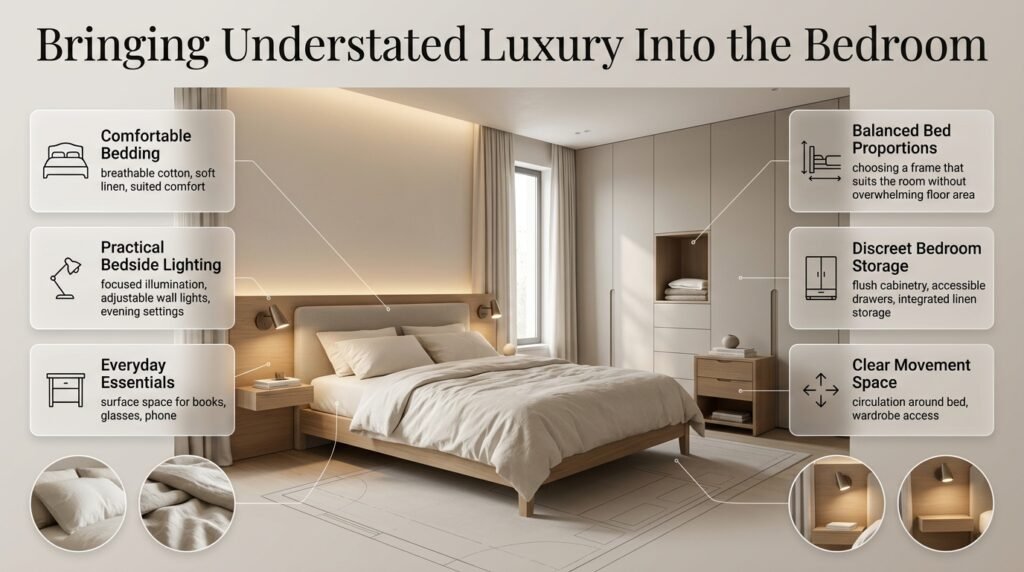
A bedroom should feel comfortable, private, and easy to maintain. Understated luxury here comes from the relationship between bedding, lighting, storage, and furniture rather than from decorative accessories alone.
The most successful bedrooms are designed around how people actually sleep, dress, read, and relax.
Start with the bed and bedding
The bed is usually the room’s main visual feature, so its proportions and position deserve careful attention.
Choose a bed frame that suits the room’s size and architectural style. Upholstered headboards can soften the space, while timber frames introduce natural warmth.
Layer bedding through a controlled combination of textures rather than adding numerous decorative cushions. Quality cotton, linen, and suitable blends can create a comfortable appearance without excessive ornamentation.
Consider:
- Bedding that feels comfortable against the skin.
- A duvet weight suitable for the climate.
- Bedside surfaces large enough for everyday essentials.
- Lighting that supports reading without disturbing another person.
- Accessible storage for clothing and linens.
- Enough clearance to move around the bed comfortably.
Make bedside lighting practical
A bedside lamp should illuminate reading material and provide comfortable evening light without shining directly into the eyes.
Wall-mounted lights can free up bedside table space, while table lamps offer flexibility if the furniture arrangement changes.
If you use dimmable lighting, create a comfortable low-light setting for winding down. Avoid choosing a fixture solely because it looks attractive in a photograph.
Expert tip: Before purchasing a bed or bedside cabinets, mark their dimensions on the floor with removable tape. This simple test helps you see whether the arrangement leaves enough room for movement and storage access.
12. Refine Kitchens and Bathrooms Through Practical Details
Kitchens and bathrooms are particularly sensitive to finishing quality because they combine frequent use, moisture, cleaning, and numerous visible fittings.
Understated luxury in these rooms comes from dependable materials, clean installation, thoughtful lighting, and convenient storage.
Kitchen details that make a difference
A refined kitchen doesn’t need a dramatic stone island or a wall of bespoke cabinetry. Start by improving the elements that influence daily use.
Consider cabinet alignment, drawer organization, under-cabinet lighting, worktop edges, faucet operation, and the relationship between the backsplash and cabinetry.
For example, a kitchen with simple oak cabinets, a pale worktop, and understated hardware can look cohesive when the finishes are carefully coordinated.
Keep frequently used appliances accessible, but give them designated storage when possible. An appliance garage or cupboard can reduce countertop clutter, provided it is ventilated appropriately for the appliances and easy to use.
Bathroom details that improve comfort
In bathrooms, focus on lighting around mirrors, storage for toiletries, well-maintained grout, suitable fittings, and surfaces designed for wet conditions.
A wall-mounted vanity may create a lighter appearance, but it requires appropriate structural support and plumbing planning. A floor-standing vanity can work equally well when its proportions and finish suit the room.
Choose materials according to maintenance requirements. Natural stone may require sealing, while certain metal finishes show water spots more readily than others.
Don’t overlook ventilation. Effective moisture control protects finishes and helps prevent problems that no decorative upgrade can solve.
Quick tip: When renovating a kitchen or bathroom, agree on the location of electrical connections, plumbing, storage, and lighting before installation begins. Changes made after surfaces are finished can become unnecessarily expensive.
13. Improve the Entryway Before Decorating the Rest of the Home
The entryway establishes the first impression of the interior and supports everyday routines. It needs to accommodate shoes, coats, keys, bags, and other essentials without becoming a bottleneck.
A luxurious entryway isn’t necessarily large. It is one where the layout, storage, lighting, and finishes work together.
What makes an entryway feel refined?
Start with the available circulation space. A large console may look attractive, but it can make a narrow entrance difficult to use.
Choose furniture that fits the width of the space and leaves a comfortable route through the doorway. A slim console, compact bench, wall-mounted hooks, or closed shoe cabinet may be sufficient.
Use a mirror when it improves the sense of space or serves a practical purpose. Add a small lamp or suitable overhead lighting to make the entrance welcoming, and keep the surface organized.
A useful arrangement might include a narrow cabinet for shoes, a tray for keys, a mirror, and a single decorative object.
Make everyday storage attractive
Closed storage is useful for items that create visual clutter, while hooks and open compartments keep frequently used belongings accessible.
However, storage should be proportionate to the household’s needs. A family with several daily bags and pairs of shoes will need a different solution from someone living alone.
Think about how people enter the home, where they naturally put things down, and which items need to be available when leaving.
Planning around these habits helps the space remain organized without constant effort.
14. Connect Rooms Through Repeated Design Details
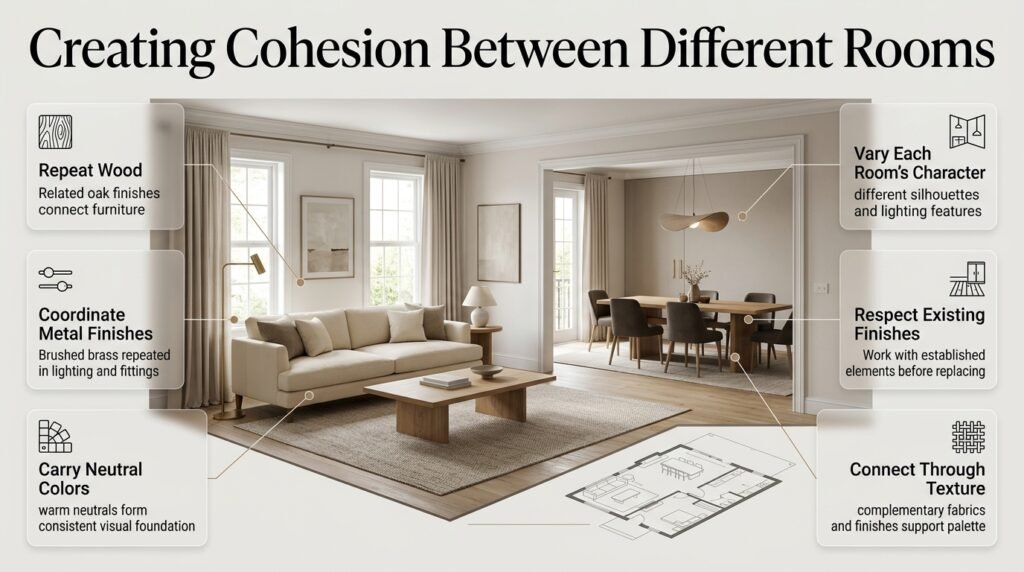
A home feels cohesive when its rooms share a few visual relationships. That doesn’t mean every room should have the same flooring, furniture, wall color, or decorative style.
Instead, repeat selected elements while allowing each space to meet its own needs.
Choose a small number of connecting elements
These might include:
- A consistent wood tone across selected furniture pieces.
- Related metal finishes in lighting and hardware.
- A recurring neutral color in connected spaces.
- Similar trim proportions where the architecture supports them.
- Textures that complement one another without being identical.
For example, a living room may use oak furniture, ivory upholstery, and brushed brass details. The adjoining dining room could continue the oak and brass while introducing darker upholstery and a different pendant light.
The rooms feel related, but they don’t look copied.
What if existing rooms already have different styles?
Start with the elements that are expensive or difficult to change, such as flooring, cabinetry, and architectural features. Then identify a few colors or materials that can connect them.
You don’t need to replace everything that differs. Sometimes, changing the curtains, artwork, or hardware in one room is enough to create a stronger relationship.
The key is to avoid introducing additional materials without considering the existing ones.
If you’re planning several rooms together, explore the room-by-room design hub for ideas that help balance individual room needs with a cohesive overall look.
15. Make the Most of Your Budget With a Clear Improvement Plan
Understated luxury can be achieved at different budget levels, but the most effective improvements depend on what is currently preventing the room from working well.
A new accessory won’t fix an awkward layout. Expensive curtains won’t compensate for inadequate storage. Replacing a perfectly serviceable sofa may be unnecessary if the real problem is poor lighting.
The smartest approach is to identify the issue first and select the upgrade that addresses it.
Which improvements should you prioritize?
| If the room feels… | Investigate first | Consider next |
|---|---|---|
| Dark or uncomfortable | Lighting, glare, window coverings | Wall color and reflective surfaces |
| Crowded | Furniture dimensions and circulation | Storage and accessory editing |
| Flat or lifeless | Texture and material variation | Artwork and restrained accent colors |
| Visually inconsistent | Undertones and competing finishes | Hardware and coordinated textiles |
| Unfinished | Repairs, trim, and installation defects | Decorative details |
| Difficult to maintain | Storage and surface durability | More suitable materials |
This approach avoids spending money on improvements that look attractive but fail to solve the actual problem.
A five-step process for a real home
Step 1: Photograph the room. Take pictures from the doorway and main seating position. Look for clutter, awkward proportions, dark corners, and unfinished surfaces.
Step 2: Write down the three biggest problems. Keep the list specific. For example, “the reading corner is too dark” is more useful than “the room needs luxury.”
Step 3: Establish a budget. Include products, delivery, labor, and a reasonable allowance for unexpected work.
Step 4: Test the proposed changes. Use material samples, temporary furniture layouts, and lighting trials where possible.
Step 5: Review before adding more. Once the main improvements are complete, live with the arrangement for a while. You may discover that you don’t need additional decoration.
For manageable improvements, browse DIY home projects. Choose work that matches your skills, and use qualified professionals for electrical, plumbing, structural, or other work that requires specialist knowledge.
Expert Advice: What Makes the Difference Between Expensive and Refined?
A high budget can expand your material and furniture options, but it doesn’t guarantee a successful interior. The difference often comes down to the quality of the decisions made before products are purchased.
1. Spend on what you touch and use frequently
Comfortable seating, dependable door hardware, well-made drawers, practical lighting, and durable upholstery can improve everyday life. Decorative items may add visual interest, but they shouldn’t take priority over features that are uncomfortable or unreliable.
2. Treat installation as part of the design
A beautiful material can look disappointing when poorly installed. Check measurements, alignment, edge finishing, grout consistency, and the fit of doors and drawers.
If you’re hiring contractors, agree on the expected finish and inspect samples or mock-ups before approving extensive work.
3. Don’t confuse restraint with emptiness
A quiet luxury interior can contain books, artwork, family photographs, colorful objects, and furniture with character. The objective is to give those elements room to contribute, not to remove everything that feels personal.
4. Plan the lighting before finalizing the finishes
Lighting affects how paint, wood, stone, and fabric appear. If possible, test the proposed lighting with material samples before confirming the final palette.
5. Make maintenance part of the purchasing decision
Consider how often a material needs cleaning, whether it is easy to repair, and how it will age. A durable finish that suits your household may be a better long-term choice than a delicate material that requires constant attention.
6. Avoid unnecessary customization
Custom cabinetry and furniture can solve difficult layout problems, but they aren’t automatically better than well-chosen standard products. Compare the cost, fit, durability, lead time, and practical benefit before committing.
7. Keep project decisions documented
For a major renovation, record the approved materials, measurements, scope, costs, and installation responsibilities. Clear documentation reduces misunderstandings and helps maintain consistency when multiple trades are involved.
If you’re working with a professional, review questions to ask an interior design consultant before choosing a service. It’s also worth reviewing interior designer contract essentials so the scope, payment arrangements, and responsibilities are understood before work begins.
Common Mistakes That Undermine Understated Luxury
Mistake 1: Making every surface beige
Why it happens: Neutral colors appear easy to coordinate.
Why it fails: Without variation in texture, undertone, or depth, the room can look flat.
How to avoid it: Combine related shades with wood, textiles, ceramics, and selected darker accents.
Mistake 2: Buying expensive items before planning the room
Why it happens: A beautiful product creates immediate excitement.
Why it fails: It may not fit the layout or coordinate with the materials already in place.
How to avoid it: Measure first, establish the palette, and identify the room’s practical needs.
Mistake 3: Using too many competing finishes
Why it happens: Individual products look attractive on their own.
Why it fails: Different metals, wood tones, patterns, and glossy surfaces may compete for attention.
How to avoid it: Create a material plan and check the proposed combinations together before buying.
Mistake 4: Ignoring everyday comfort
Why it happens: Photographs emphasize appearance rather than use.
Why it fails: Furniture may be uncomfortable, lighting may cause glare, and storage may be inconvenient.
How to avoid it: Test seating, plan movement routes, and choose lighting for the activities performed in the room.
Mistake 5: Overdecorating shelves and tables
Why it happens: Empty surfaces can feel unfinished when viewed in isolation.
Why it fails: Too many objects make the room feel crowded and reduce the impact of individual pieces.
How to avoid it: Group a few meaningful objects together and leave some space around them.
Mistake 6: Choosing materials without considering maintenance
Why it happens: A finish looks beautiful in a showroom or photograph.
Why it fails: It may stain, scratch, corrode, or require more maintenance than expected.
How to avoid it: Review manufacturer guidance and choose finishes suited to the room’s conditions and your household’s routines.
Mistake 7: Forgetting the finishing stage
Why it happens: The budget and attention are focused on major purchases.
Why it fails: Misaligned doors, uneven paint, messy sealant, and exposed wiring can undermine the entire result.
How to avoid it: Inspect the work before adding accessories and resolve installation defects while they are still easy to correct.
What Are the Most Important Understated Luxury Interior Details That Make a Home Look Expensive?
The most important understated luxury interior details are the elements that improve a room’s appearance and everyday experience without drawing unnecessary attention to themselves. These include well-finished cabinetry, layered lighting, tactile materials, properly fitted window treatments, coordinated hardware, and furniture that suits the room’s proportions. The key is to focus on quality and consistency rather than buying expensive decorative products. A simple room can feel sophisticated when its finishes complement one another and every element has a clear purpose.
To achieve this effect, prioritize the following details:
Lighting quality: Combine ambient, task, and accent lighting to create a comfortable atmosphere throughout the day.
Material coordination: Pair wood, stone, linen, wool, and metal finishes that complement one another.
Furniture proportions: Choose pieces that leave enough space for comfortable movement.
Architectural finishing: Pay attention to door alignment, trim, cabinet edges, and clean transitions.
Thoughtful accessories: Display a few meaningful objects instead of filling every surface.
For the best results, improve the room’s basic layout and lighting before purchasing decorative accessories. These foundational decisions usually have a wider visual impact.
How Can You Achieve Understated Luxury Interior Design on a Small Budget?
You can achieve understated luxury on a limited budget by improving the details that have the greatest effect on the room rather than replacing everything. Reorganizing furniture, updating tired hardware, introducing coordinated textiles, improving lamp placement, and repairing visible defects can make an existing interior feel more refined. The goal is to make the room look intentional, not to imitate an expensive showroom.
A practical budget-friendly approach includes:
Refresh existing furniture: Clean, repair, or refinish pieces that remain structurally sound.
Improve lighting: Add suitable table lamps, floor lamps, or dimmable fixtures where practical.
Coordinate soft furnishings: Choose curtains, cushions, and rugs that work with the existing flooring and furniture.
Reduce visual clutter: Organize everyday belongings and keep frequently used surfaces manageable.
Upgrade selected hardware: Replace worn handles when the existing cabinetry is worth keeping.
Buy selectively: Consider secondhand furniture, vintage accessories, and durable standard products instead of paying extra for designer branding.
Before spending money, identify the room’s three biggest problems and rank them by importance. This prevents small decorative purchases from consuming a budget that would be better spent on lighting, repairs, or more practical storage.
Which Colors and Materials Work Best for Understated Luxury Interiors in 2026?
Understated luxury interiors work well with warm neutrals, natural textures, and carefully selected contrasting materials. Shades such as ivory, oatmeal, taupe, soft brown, and muted gray create a calm foundation, while walnut, oak, stone, linen, wool, and brushed metal introduce depth. However, the style isn’t restricted to beige or white. Deep green, burgundy, navy, and earthy colors can add personality when balanced with the rest of the room. Contemporary design coverage also emphasizes tactile materials, comfort, and thoughtful restraint rather than relying on a single color palette. <Cite refs={[“turn305605search0″,”turn305605news18”]}/>
Use these principles when selecting your finishes:
For walls: Test warm white, muted beige, or soft gray against the existing flooring.
For furniture: Consider wood tones and upholstery that complement the room’s natural light.
For textiles: Combine different textures while keeping patterns under control.
For metal details: Choose a dominant finish, such as brushed brass, satin nickel, or bronze.
For accent colors: Introduce stronger shades through artwork, cushions, or a carefully selected chair.
Always test material samples together in the actual room. Daylight, artificial lighting, and neighboring surfaces can change how colors appear, so choosing each finish separately may lead to unexpected clashes.
How Do You Make a Small Living Room Look Luxurious Without Making It Feel Crowded?
A small living room feels more luxurious when the furniture fits the available space, circulation remains clear, and the design uses texture and lighting instead of excessive decoration. Large furniture isn’t automatically more impressive, and a room doesn’t need to be filled to feel complete. The aim is to create a balanced arrangement that supports conversation, relaxation, and everyday activities while allowing the main design features to stand out.
Start with these practical improvements:
Measure before buying: Check sofa depth, coffee table size, doorway access, and available walking space.
Choose visually balanced furniture: Avoid oversized pieces that block windows or make movement difficult.
Use lighting strategically: Add a floor lamp or wall light to brighten darker corners.
Keep storage organized: Use closed cabinets or appropriately sized storage furniture to manage clutter.
Select a controlled palette: Repeat two or three complementary colors and introduce variation through texture.
Edit accessories: Choose a few meaningful objects and leave some surfaces clear.
A compact sofa, appropriately sized coffee table, textured rug, and well-positioned lamp may create a more refined result than several oversized pieces. Before buying anything new, try rearranging your existing furniture and observe how the room feels from the entrance.
Which Understated Luxury Interior Upgrades Are Worth Investing in for Long-Term Value?
The most worthwhile upgrades are those that improve daily comfort, durability, and the overall quality of the room. Well-made seating, dependable hardware, suitable lighting, practical storage, and durable flooring or work surfaces can provide lasting benefits when chosen for the household’s needs. Expensive finishes aren’t always the best investment; a simpler material that performs well and remains easy to maintain may offer greater long-term value.
Consider prioritizing these areas:
Frequently used furniture: Look for comfortable seating, sound construction, suitable dimensions, and replaceable or maintainable components.
Lighting: Invest in reliable fixtures that provide appropriate illumination and suit the room’s activities.
Cabinetry and storage: Improve functionality, drawer operation, and internal organization before replacing serviceable units.
Durable materials: Compare wear resistance, cleaning requirements, and suitability for moisture or heavy use.
Professional installation: Allocate enough budget for accurate measurements and careful finishing where errors would be expensive to correct.
Timeless design choices: Favor materials and forms that work with your home’s architecture rather than upgrades chosen only for short-lived trends.
Before committing to a major project, compare the initial cost, maintenance requirements, expected lifespan, and practical benefit. If you’re hiring a designer or contractor, confirm the scope, material specifications, installation responsibilities, and payment terms in writing. This makes it easier to spend strategically and achieve a refined result without unnecessary expense.
Conclusion: Understated Luxury Interior Details
Understated luxury is not about filling a home with expensive furniture or following every interior design trend. It is about creating a thoughtful, comfortable, and visually balanced environment where every detail has a purpose. From high-quality materials and carefully chosen color palettes to layered lighting, refined hardware, and well-proportioned furniture, small design decisions can make a significant difference to the overall atmosphere of a room.
The key is to focus on quality, consistency, and restraint. Natural textures, warm neutral shades, uncluttered surfaces, and subtle contrasts can help a home feel sophisticated without appearing overly decorated. Even with a limited budget, you can introduce a more luxurious look by improving lighting, replacing dated fixtures, organizing visible clutter, and investing in a few durable, well-made pieces rather than purchasing everything at once.
Ultimately, the most successful understated luxury interiors reflect the people who live in them. They combine beauty with everyday practicality, making each space feel welcoming rather than formal or untouchable. By prioritizing thoughtful choices over unnecessary decoration, you can create a timeless home that feels elegant today and remains appealing for years to come.