
Introduction
Upholstery Durability Rating Guide | Choosing upholstery sounds easy until you start looking at fabric specifications.
One fabric says 15,000 double rubs. Another says 30,000 double rubs. A different supplier lists 50,000 Martindale cycles, while another simply describes its material as “heavy duty” or “commercial grade.”
At that point, the obvious question is: Which fabric is actually going to last?
This upholstery durability rating guide explains what those numbers mean, how abrasion testing works, why Wyzenbeek and Martindale ratings shouldn’t be treated as interchangeable, and how to choose upholstery based on the way your furniture will actually be used.
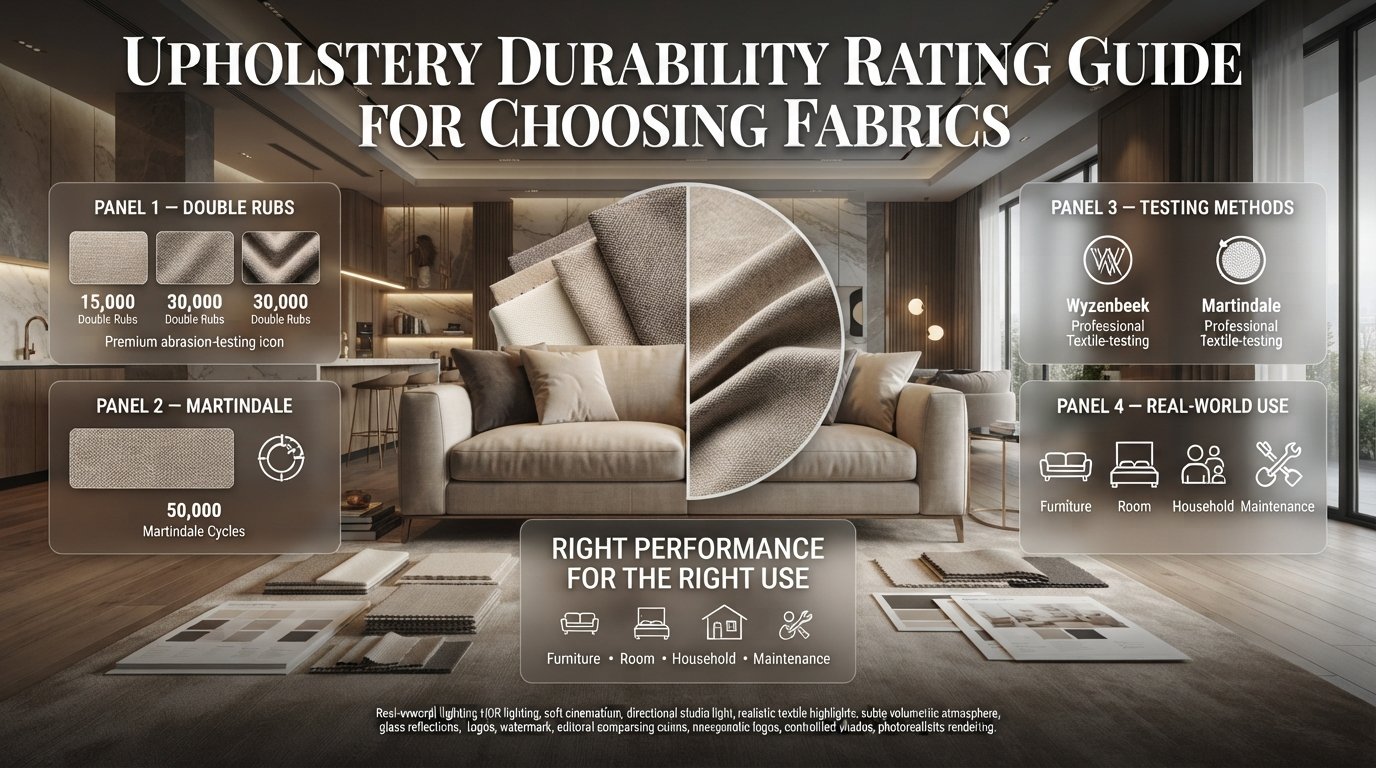
The goal isn’t to find the fabric with the biggest number. It’s to find a fabric with the right performance for the furniture, room, household, and maintenance routine.
You’ll learn how to read upholstery specifications, compare durability ratings, choose fabrics for sofas and chairs, understand what changes when children or pets are involved, and avoid the common mistakes that cause people to overpay for performance they don’t actually need.
If you’re planning a larger interior project at the same time, DesignMode24 Interior Design also provides broader guidance for furniture, rooms, materials, and home design decisions.
What Is an Upholstery Durability Rating?
An upholstery durability rating is a laboratory measurement that indicates how well a fabric resists abrasion caused by repeated rubbing. The two commonly encountered systems are the Wyzenbeek test, which reports double rubs, and the Martindale test, which reports cycles. These tests measure abrasion resistance, not the complete lifespan or overall durability of a finished sofa or chair.
That distinction matters because “durability” sounds like one simple characteristic when it isn’t.
A fabric can perform very well against abrasion and still have other weaknesses.
For example, a textile may have excellent abrasion resistance but:
- Fade quickly in strong sunlight
- Develop pilling
- Be difficult to clean
- Show stains easily
- Have poor seam performance
- Snag easily around pets
- Be unsuitable for a particular furniture construction
- Require professional cleaning
The Association for Contract Textiles specifically cautions against treating abrasion results as a complete prediction of fabric service life. Field failures can also result from inappropriate cleaning, maintenance, physical abuse, and incorrect application.
So, when you see a number such as 30,000 or 50,000, think:
“This tells me something important about abrasion resistance, but it doesn’t tell me everything.”
That’s the right starting point for selecting upholstery.
Why Upholstery Durability Ratings Matter
Upholstery is exposed to repeated physical contact every day.
Think about what happens to a sofa in a busy living room.
Someone sits down.
Someone gets up.
A child climbs onto the cushions.
A pet jumps across the seat.
Someone lies down while watching television.
A person shifts position repeatedly.
Clothing rubs against the fabric.
Cushions move slightly.
Over months and years, all of this creates friction.
That’s why the fabric specification matters.
The wrong upholstery can begin to show wear much sooner than expected. You might notice:
- Flattened texture
- Shiny worn areas
- Broken yarns
- Pilling
- Fading
- Snags
- Loose seams
- Staining
- Surface changes
A suitable upholstery choice doesn’t eliminate wear, but it helps ensure that the fabric is appropriate for the level of use it will receive.
This is particularly important when you’re investing in an expensive sofa, sectional, dining set, custom chair, or professionally designed room.
What Are Double Rubs in Upholstery?
Double rubs are associated with the Wyzenbeek abrasion test.
In this test, a fabric sample is subjected to repeated rubbing against a standardized abradant. The movement occurs across the fabric, and the number of completed double rubs before the defined endpoint is reached is recorded.
You may see specifications such as:
- 10,000 double rubs
- 15,000 double rubs
- 30,000 double rubs
- 50,000 double rubs
- 100,000 double rubs
Generally, a higher number indicates greater resistance to the specific abrasion conditions used in the test.
However, it would be a mistake to say:
“50,000 double rubs means the fabric will last twice as long as 25,000.”
That isn’t how the test works.
ACT notes that higher abrasion numbers don’t necessarily translate into a proportionally longer service life, and results above 100,000 double rubs have not been shown to reliably indicate increased fabric lifespan.
Why the Term “Double Rub” Can Be Confusing
The name makes it sound like the number represents a direct count of how many times a person sits on the fabric.
It doesn’t.
Laboratory abrasion testing creates controlled friction. Real furniture experiences much more complicated wear.
A person doesn’t sit on a sofa with the same pressure and movement every time.
A pet’s claws create a different type of stress.
A cushion edge experiences different friction from the center of the seat.
Cleaning can affect fibers.
Sunlight can affect color.
Therefore, the rating is best used as one piece of evidence when comparing fabrics.
What Are Martindale Cycles?
Martindale is another widely used abrasion-testing method.
Instead of the Wyzenbeek back-and-forth movement, the Martindale machine subjects fabric to a controlled rubbing motion, commonly described as a figure-eight pattern.
The result is normally reported as Martindale cycles.
You may encounter numbers such as:
- 10,000 cycles
- 15,000 cycles
- 20,000 cycles
- 30,000 cycles
- 40,000 cycles
- 50,000 cycles
- 100,000 cycles
Just like Wyzenbeek, a higher number generally indicates stronger abrasion resistance under that test.
But the critical point is this:
Martindale cycles and Wyzenbeek double rubs are not interchangeable.
They use different equipment, movement patterns, testing conditions, and abradants.
ACT states that there is no reliable correlation between the two systems and that one result shouldn’t be used to predict the result of the other.
⭐ Expert Tip: If two fabrics are being compared for the same furniture, try to compare results produced using the same testing method. Don’t choose a fabric simply because its number looks larger.
Wyzenbeek vs. Martindale: Which One Is Better?
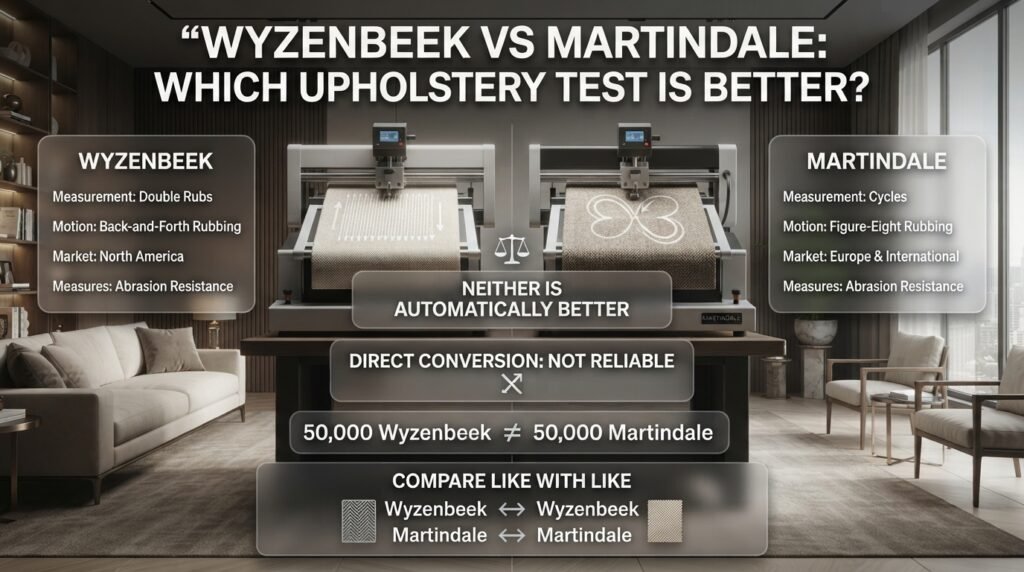
Neither test is automatically “better.”
They are simply different ways of evaluating abrasion resistance.
| Feature | Wyzenbeek | Martindale |
|---|---|---|
| Common measurement | Double rubs | Cycles |
| Typical terminology | Double rubs / rub count | Martindale cycles |
| Testing motion | Repeated back-and-forth rubbing | Figure-eight style rubbing |
| Common market association | North America | Europe and many international markets |
| Measures | Abrasion resistance | Abrasion resistance |
| Direct conversion | Not reliable | Not reliable |
| Best comparison method | Compare Wyzenbeek with Wyzenbeek | Compare Martindale with Martindale |
The important lesson is simple:
Don’t compare the numbers without looking at the test method.
A 50,000 Wyzenbeek result and a 50,000 Martindale result don’t automatically represent identical performance.
Current textile guidance continues to emphasize that the two tests should be treated as separate results rather than converted using a universal formula.
What Is a Good Upholstery Durability Rating?
There isn’t one universal “good” rating because the appropriate level depends on how the furniture will be used.
A decorative chair in a formal room doesn’t experience the same wear as a sectional used every night by a family with children and pets.
As a practical starting point:
| Use Level | General Target | Typical Furniture |
|---|---|---|
| Light / occasional | Around 10,000–15,000+ | Decorative or occasional seating |
| Moderate residential | Around 15,000–30,000+ | Dining chairs, guest seating |
| Heavy residential | Around 30,000–50,000+ | Family sofas, sectionals |
| Very heavy use | 50,000+ | Extremely busy residential or commercial-style environments |
These are planning ranges rather than universal rules.
For example, ACT’s voluntary guidance identifies 15,000 Wyzenbeek double rubs / 20,000 Martindale cycles for certain lower-traffic contract applications and 30,000 Wyzenbeek / 40,000 Martindale for heavy-duty applications.
Residential furniture can have very different requirements depending on actual use.
That’s why you shouldn’t look at a chart and blindly choose the highest category.
How Many Double Rubs Should a Sofa Have?
A frequently used residential sofa can reasonably be specified with a strong abrasion rating, often around the 30,000–50,000 range or higher under the relevant testing method, depending on the household and manufacturer’s intended use.
But the number shouldn’t be the only deciding factor.
Consider your sofa’s actual environment.
A sofa used by one adult
If one person uses the sofa for occasional evening relaxation, extreme commercial-grade abrasion performance may be unnecessary.
A sofa used by a family
If several people sit on it every day, stronger abrasion resistance becomes more valuable.
A sofa used by children
Cleaning performance becomes increasingly important.
A sofa used by pets
Abrasion alone isn’t enough. Snag resistance, weave construction, cleaning, and hair visibility matter too.
A sofa beside a large window
Lightfastness becomes an important part of the decision.
This is why a professional specification process doesn’t ask only:
“How many rubs does it have?”
It asks:
“How is this piece going to be used?”
For a sofa, comfort and proportions also matter. If you’re selecting a new sofa as part of a larger room project, your Sofa Seat Depth Selection guide can help you evaluate seating dimensions separately from fabric performance.
What Durability Rating Is Best for Dining Chairs?
Dining chairs experience repeated use, but their wear pattern is different from a sofa.
People sit down and stand up frequently.
Clothing rubs against the seat.
Food and drinks can spill.
The chair may be pulled across the floor.
Children may climb onto it.
For this reason, dining-chair upholstery should balance:
- Abrasion resistance
- Cleanability
- Stain resistance
- Colorfastness
- Seam performance
- Appropriate texture
A very delicate decorative textile might be beautiful, but if your dining room is used three times every day, maintenance can quickly become frustrating.
For everyday dining chairs, moderate-to-heavy residential performance is often more practical than choosing upholstery based entirely on appearance.
What Durability Rating Is Best for an Accent Chair?
An accent chair doesn’t automatically need extremely high abrasion resistance.
The word accent describes the chair’s role in the room, not necessarily how often someone will sit on it.
A chair in a formal sitting room may receive occasional use.
A chair positioned beside a bookshelf may become the family’s favorite reading seat.
A chair in a bedroom may be used only for dressing or placing clothing.
Therefore, start with the actual use.
Ask:
- Who will use it?
- How frequently?
- For how long?
- Will children use it?
- Are pets allowed near it?
- Is it exposed to sunlight?
A moderate rating may be perfectly reasonable for occasional seating.
Does a Higher Upholstery Rating Mean Better Quality?
No.
A higher abrasion rating means stronger performance in that particular test. It doesn’t automatically mean better quality in every respect.
Imagine two fabrics.
Fabric A
- 30,000 double rubs
- Easy to clean
- Excellent lightfastness
- Good pilling resistance
- Comfortable texture
- Suitable for residential seating
Fabric B
- 100,000 double rubs
- Difficult to clean
- Poorer lightfastness
- Rougher texture
- Not recommended for the furniture application
For a normal family living room, Fabric A may be the more intelligent choice.
This is one of the most important lessons in upholstery selection:
Don’t buy the biggest number. Buy the right performance profile.
The Other Upholstery Tests You Should Check
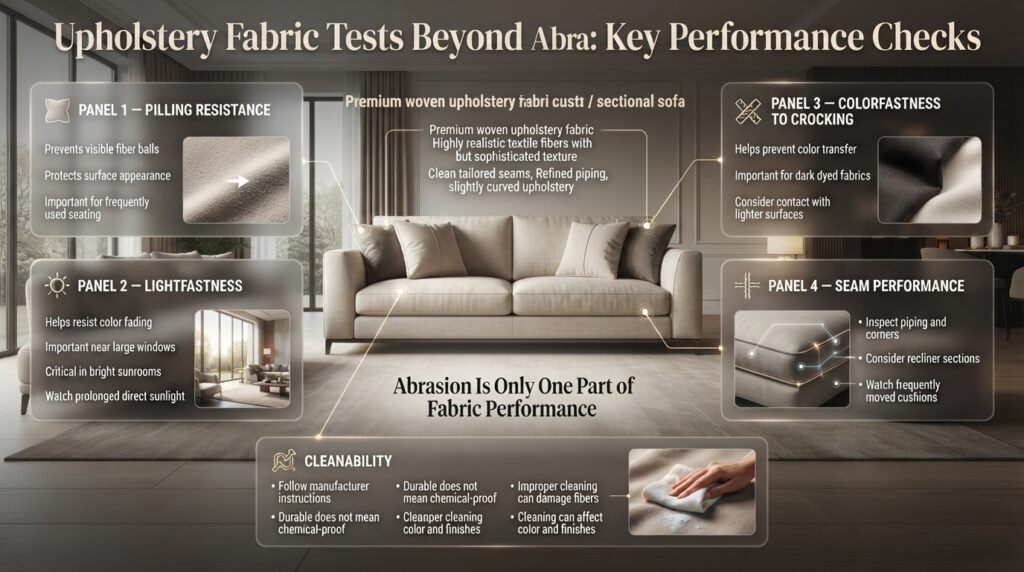
Abrasion is only one part of fabric performance.
When you’re looking at a specification sheet, check the following areas as well.
Pilling Resistance
Pilling happens when fibers become tangled into small balls on the fabric surface.
It can affect the appearance of upholstery even when the textile has good abrasion resistance.
If you’re choosing a fabric for a sofa or frequently used chair, ask about pilling performance where that information is available.
Lightfastness
Lightfastness indicates how well a fabric’s color withstands exposure to light.
This is especially important when furniture sits:
- Beside large windows
- In sunrooms
- Near glass doors
- In bright west-facing rooms
- In rooms with prolonged direct sunlight
A fabric with excellent abrasion resistance can still look disappointing if it fades noticeably.
Colorfastness to Crocking
Crocking describes color transfer caused by rubbing.
This can be relevant when dark or heavily dyed fabrics repeatedly contact lighter clothing or surfaces.
Seam Performance
The fabric surface isn’t the only area receiving stress.
The seams and upholstery construction also matter.
Pay particular attention to:
- Seat corners
- Cushion seams
- Piping
- Tight corners
- Recliner sections
- Frequently moved cushions
A fabric specification cannot guarantee the performance of an entire finished furniture product.
Cleanability
Cleaning requirements should be understood before purchasing.
Depending on the textile and manufacturer’s instructions, you may see different cleaning classifications.
Never assume that a “durable” fabric can be cleaned with any household product.
Improper cleaning can damage fibers, remove finishes, cause discoloration, or shorten the life of the upholstery.
ACT specifically identifies inappropriate cleaning and maintenance among factors associated with fabric failures in actual use.
Why Fabric Construction Matters
Two fabrics with similar abrasion ratings can behave differently because their fiber and construction characteristics aren’t identical.
You may encounter:
- Polyester
- Linen
- Cotton
- Wool
- Acrylic
- Nylon
- Chenille
- Velvet
- Microfiber
- Blends
- Performance-treated textiles
But choosing upholstery by fiber name alone is also a mistake.
For example, saying “polyester is durable” isn’t enough to evaluate a specific polyester upholstery.
The weave, yarn construction, finishing, backing, color, and intended application all influence performance.
That’s why the specification sheet is more useful than a generic statement about a fiber.
What Upholstery Is Best for Children?
When children are involved, durability becomes a broader concept.
You’re not only dealing with friction.
You’re dealing with:
- Juice
- Food
- Crayons
- Dirty hands
- Shoes
- Frequent sitting
- Jumping
- Spills
- Repeated cleaning
In this situation, a practical upholstery selection often prioritizes cleanability and stain management alongside abrasion resistance.
A medium-tone fabric can also be more forgiving than an extremely pale textile.
Texture matters too.
A highly textured surface may hide certain marks but can sometimes make cleaning more complicated.
The right choice depends on the specific textile rather than a simple “family-friendly” label.
What Upholstery Is Best for Pets?
Pet owners should think beyond rub counts.
A cat’s claws, for example, can create a snagging problem that a laboratory abrasion test doesn’t fully represent.
Dogs can introduce:
- Dirt
- Moisture
- Hair
- Odors
- Claw marks
So look at:
- Tightness of the weave
- Snag resistance
- Cleanability
- Stain resistance
- Hair visibility
- Color
- Maintenance requirements
⚠ Common Mistake: Assuming that a high abrasion rating automatically means “pet-proof.” Abrasion resistance and claw resistance are not the same thing.
How Sunlight Affects Upholstery Durability
Sunlight is one of the easiest factors to overlook.
Furniture near a bright window may receive hours of exposure every day.
Over time, this can affect the appearance of upholstery even if the fabric has excellent abrasion performance.
If you’re selecting furniture for a bright room, ask about lightfastness.
You can also reduce exposure through:
- Window treatments
- Curtains
- Blinds
- Solar shades
- Furniture placement
- UV-control glazing
This is one reason upholstery should be considered as part of the room’s overall design rather than as an isolated purchase.
For projects involving lighting and atmosphere, you can also explore Intelligent Lighting as part of a broader approach to controlling how a room feels throughout the day.
How to Read an Upholstery Specification Sheet
If a supplier gives you a technical specification sheet, don’t just search for the biggest number.
Use this process.
Step 1: Find the abrasion test method
Look for terms such as:
- Wyzenbeek
- ASTM D4157
- Martindale
- ISO 12947
- Abrasion resistance
Write down the method.
Step 2: Record the actual result
Note:
- Number
- Unit
- Test method
- Testing conditions where provided
Step 3: Check the intended application
Look for terms such as:
- Residential
- Heavy residential
- Light commercial
- Contract
- Heavy-duty contract
Don’t assume that a high result makes the fabric appropriate for every application.
Step 4: Check cleaning instructions
Ask:
- Can it be spot cleaned?
- Is professional cleaning required?
- Are household cleaners allowed?
- Is the fabric treated for stain resistance?
Step 5: Check lightfastness
This is particularly important for rooms with strong daylight.
Step 6: Check pilling
A beautiful fabric that pills heavily may quickly lose the appearance you wanted.
Step 7: Look at construction
Inspect the weave.
Ask whether the fabric is likely to snag, stretch, or show pressure marks.
Step 8: Order a sample
Never choose expensive upholstery from a small online image alone.
Step 9: Put the sample in the actual room
Look at it in:
- Morning light
- Afternoon light
- Evening lighting
Touch it.
Sit against it.
Place it beside your flooring.
Compare it with the wood, metal, paint, and other materials in the room.
For broader material-selection considerations, your Material and interior planning resources can be useful when upholstery is being chosen as part of a complete room rather than as a standalone item.
A Practical Upholstery Selection Formula
If fabric specifications are starting to become overwhelming, use this six-part formula:
Usage → Abrasion → Cleaning → Light → Lifestyle → Appearance
1. Usage
How often will the furniture be used?
2. Abrasion
What level of abrasion resistance makes sense for that usage?
3. Cleaning
How will the fabric handle real-life spills and maintenance?
4. Light
Will sunlight affect the furniture?
5. Lifestyle
Are children, pets, guests, or frequent entertaining involved?
6. Appearance
Does the material still look and feel right for your room?
This sequence prevents one technical number from controlling the entire decision.
Upholstery Durability by Furniture Type
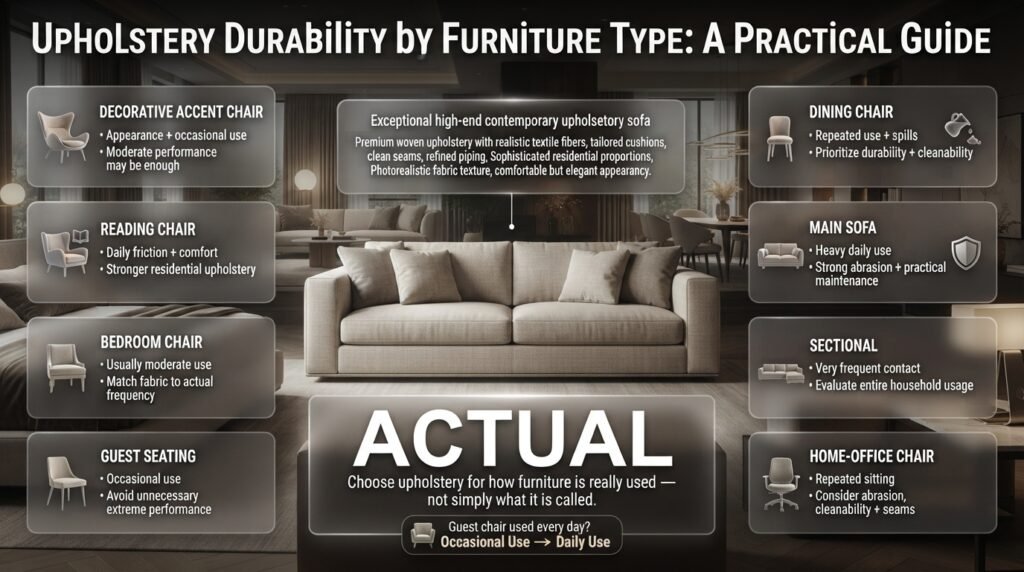
| Furniture | Main Concern | Recommended Approach |
|---|---|---|
| Decorative accent chair | Appearance + occasional use | Moderate performance may be enough |
| Reading chair | Daily friction + comfort | Choose stronger residential upholstery |
| Dining chair | Repeated use + spills | Prioritize durability and cleanability |
| Main sofa | Heavy daily use | Strong abrasion + practical maintenance |
| Sectional | Very frequent contact | Evaluate entire household usage |
| Bedroom chair | Usually moderate use | Match fabric to actual frequency |
| Home-office chair | Repeated sitting | Consider abrasion, cleanability, and seams |
| Guest seating | Occasional use | Avoid paying for unnecessary extreme performance |
The important word in the table is actual.
A “guest chair” used every day isn’t really occasional-use furniture anymore.
Common Upholstery Durability Mistakes
Mistake 1: Choosing the Highest Number
This is probably the most common mistake.
A shopper sees 100,000 and assumes it must be better than 30,000.
But the higher figure may not provide meaningful additional value for that particular application.
How to avoid it: Choose the performance level that matches actual use.
Mistake 2: Treating the Rating as a Lifespan Guarantee
A rub count isn’t a promise that upholstery will last a certain number of years.
Real furniture experiences many variables that laboratory testing doesn’t reproduce.
How to avoid it: Treat the number as a comparative performance indicator.
Mistake 3: Comparing Different Test Methods
A 50,000 Martindale result and 50,000 Wyzenbeek result aren’t automatically equal.
How to avoid it: Compare the same test method whenever possible.
Mistake 4: Ignoring Cleaning
A fabric can be physically durable but difficult to maintain.
How to avoid it: Read the cleaning instructions before ordering.
Mistake 5: Ignoring Sunlight
People often notice fading only after it has already happened.
How to avoid it: Consider lightfastness and furniture placement before buying.
Mistake 6: Forgetting Pets
High abrasion doesn’t necessarily mean high snag resistance.
How to avoid it: Examine weave construction and pet-specific performance.
Mistake 7: Choosing Only by Color
The perfect color isn’t useful if the material doesn’t suit your lifestyle.
How to avoid it: Choose appearance and performance together.
Mistake 8: Ignoring Furniture Construction
The upholstery isn’t the entire furniture product.
How to avoid it: Evaluate the frame, suspension, cushion design, seams, and upholstery together.
How Interior Design Affects Upholstery Selection
Upholstery should support the room rather than exist separately from it.
For example, a heavily textured fabric might work beautifully in a calm, layered interior where the rest of the materials are restrained.
A smoother textile may be better when the room already contains several visual textures.
A darker upholstery can provide contrast against light walls, while a lighter fabric can soften a darker furniture arrangement.
This is where upholstery becomes part of the larger interior design process.
If you’re working on a complete room transformation, the Paint & Color category can help you think about how upholstery interacts with wall color, contrast, and the overall palette.
Likewise, wall-mounted elements can influence how a sofa or chair is positioned. If you’re planning storage or display around seating, these Wall Shelves Ideas can provide useful context without making upholstery selection unnecessarily complicated.
Upholstery and DIY Projects: When Should You Reupholster?
Sometimes the best way to improve furniture isn’t buying something new.
A structurally sound chair or sofa may be worth reupholstering.
Before beginning, assess:
- Frame condition
- Joint stability
- Cushion condition
- Suspension
- Foam quality
- Fabric requirements
- Labor cost
- Expected finished value
If the frame is excellent but the upholstery is outdated, reupholstery can make sense.
If the frame is already failing, spending heavily on premium upholstery may not be worthwhile.
For smaller furniture upgrades, you can explore DIY Home Projects for ideas that complement a larger upholstery refresh.
For simpler weekend improvements around the room, see Easy Weekend DIY Projects for Your Home.
The important distinction is that upholstery work should match your skill level. A small decorative chair can be a reasonable DIY project, while a complicated sectional may require professional experience.
How to Match Upholstery With a Complete Room
Imagine you’re redesigning a living room.
You have:
- A large sectional
- Two accent chairs
- A coffee table
- Wall shelving
- Decorative lighting
- A painted feature wall
- Storage furniture
The sectional is the primary high-use piece.
Therefore, its upholstery deserves the strongest practical consideration.
The accent chairs may use a different textile.
This allows you to create visual variety without forcing every upholstered item to use exactly the same material.
The key is coordination.
You might repeat:
- A color
- A texture
- A neutral tone
- A material
- A pattern
without making every item identical.
This approach creates a more intentional room.
For ideas involving decorative handmade elements, the DIY Home Decor Crafts section can complement the upholstery planning without competing with the main furniture decision.
Can Expensive Upholstery Still Wear Out?
Absolutely.
Price and durability aren’t the same thing.
An expensive luxury fabric may prioritize:
- Exceptional texture
- Natural fibers
- Handcrafted appearance
- Unique weaving
- Design value
- Sophisticated color
- Heritage construction
That doesn’t necessarily mean it has the highest abrasion rating.
Conversely, a comparatively affordable performance textile may be designed specifically for heavy use.
Therefore, price should never be used as a substitute for technical information.
Ask what you’re paying for.
Are you paying for:
- Performance?
- Appearance?
- Fiber quality?
- Craftsmanship?
- Brand?
- Design?
- Construction?
Often, the best furniture combines several of these qualities.
Upholstery and Contract-Grade Fabric
You may see the phrase contract grade when shopping for upholstery.
Contract textiles are generally developed or specified for environments with more demanding use requirements, such as offices, hospitality, public seating, and similar applications.
But “contract grade” shouldn’t automatically be interpreted as “best fabric for a home.”
A home may require different priorities.
A family with young children may care more about cleaning.
A pet owner may care more about snagging.
A sun-filled room may care more about lightfastness.
A formal living room may care more about appearance.
So, don’t choose a commercial specification simply because it sounds stronger.
Choose according to the actual environment.
Why Maintenance Matters More Than Many Buyers Expect
A fabric’s life isn’t determined only at the moment you purchase it.
Maintenance plays a major role.
Simple habits can help:
- Vacuum according to the manufacturer’s guidance.
- Deal with spills promptly.
- Use only approved cleaning products.
- Don’t saturate fabric unnecessarily.
- Avoid harsh chemicals.
- Follow professional-cleaning recommendations.
- Rotate cushions when the manufacturer permits it.
- Reduce excessive direct sunlight when practical.
A poorly maintained high-performance textile can perform worse in practice than a properly maintained moderate-performance textile.
That is why professional recommendations focus on fit for purpose, not simply maximum test numbers.
When Should You Choose Performance Upholstery?
Performance upholstery is particularly attractive when you expect:
- Heavy daily use
- Children
- Pets
- Frequent entertaining
- Food and drinks around furniture
- Frequent cleaning
- Higher maintenance demands
But “performance” isn’t a magic category.
Check the specific product.
Look at:
- Abrasion
- Stain resistance
- Cleaning
- Pilling
- Lightfastness
- Colorfastness
- Fiber content
- Construction
Two performance fabrics can behave very differently.
A Real-Life Example: Choosing Fabric for a Family Sectional
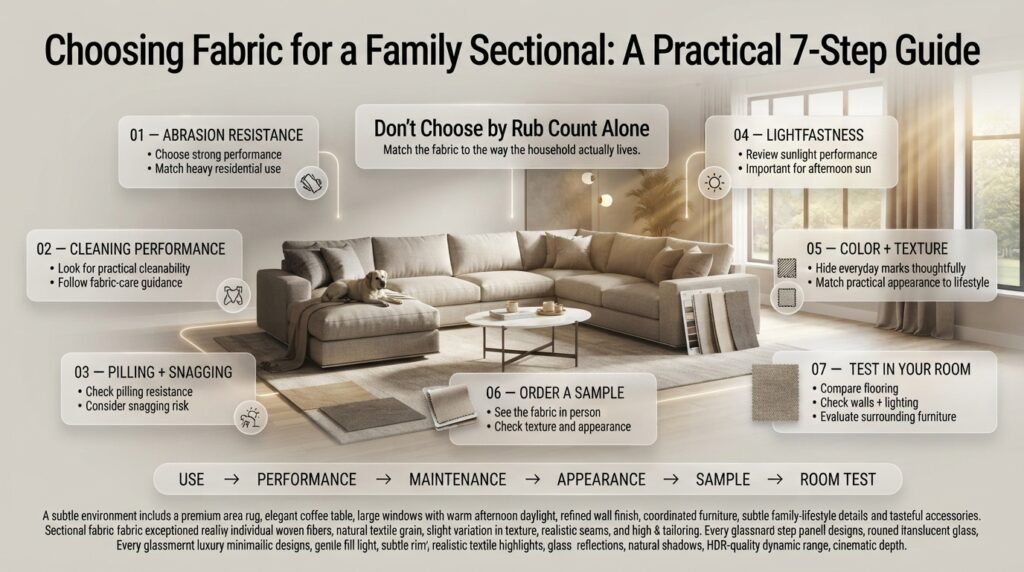
Imagine a family of four buys a large sectional.
The sectional is used every evening.
A dog sleeps on one side.
Children regularly eat snacks nearby.
The room receives afternoon sunlight.
The family wants the sofa to look good for many years.
A poor selection strategy would be:
“Find the fabric with the highest rub count.”
A better strategy would be:
Step 1
Choose strong abrasion resistance appropriate for heavy residential use.
Step 2
Look for practical cleaning performance.
Step 3
Check resistance to pilling and snagging.
Step 4
Review lightfastness because of the afternoon sun.
Step 5
Select a color and texture that won’t make everyday marks excessively obvious.
Step 6
Order a sample.
Step 7
Test the sample against the room’s flooring, walls, lighting, and furniture.
That’s a professional way to think about upholstery.
A Second Example: Occasional Bedroom Chair
Now consider a chair placed in a guest bedroom.
It is mainly decorative.
Guests may use it occasionally.
There are no pets in the room.
There is limited sunlight.
In this situation, selecting extremely high-performance commercial upholstery may be unnecessary.
You might prioritize:
- Comfort
- Appearance
- Color
- Texture
- Moderate abrasion resistance
- Compatibility with the bedroom
The correct fabric isn’t necessarily the strongest one.
It’s the one that makes sense for the application.
Upholstery and Furniture Contracts
If you’re purchasing custom furniture or working with an interior designer on a larger project, the fabric specification should be clear in the agreement.
This becomes particularly important when:
- A specific textile has been selected
- A particular performance rating was promised
- Custom upholstery is being ordered
- Fabric substitutions are possible
- The client expects a specific grade or finish
For professional project documentation, Interior Designer Contract Essentials provides useful context about the importance of clearly defining project expectations.
The goal isn’t to turn upholstery selection into complicated paperwork.
It’s to prevent misunderstandings.
If a client expects a particular textile, color, grade, or performance specification, those details should be clearly documented.
How to Compare Two Upholstery Fabrics
Suppose you have two fabrics.
Fabric A
- 30,000 Wyzenbeek
- Easy clean
- Good lightfastness
- Medium texture
- Neutral color
Fabric B
- 70,000 Wyzenbeek
- Difficult clean
- Moderate lightfastness
- Very delicate surface
- Luxury appearance
For a busy family sofa, Fabric A may be the better overall choice.
For a lightly used formal chair, Fabric B might be completely reasonable.
This is why there is no universal winner.
Use this comparison:
| Question | Fabric A | Fabric B |
|---|---|---|
| Abrasion | Strong | Very strong |
| Cleaning | Excellent | Moderate |
| Sun exposure | Better | Moderate |
| Appearance | Simple | Luxury |
| Heavy family use | Strong candidate | Depends |
| Formal occasional use | Good | Excellent |
The decision becomes much clearer once you stop looking at the abrasion number alone.
What Does “Heavy Duty” Really Mean?
“Heavy duty” is useful marketing language only when supported by actual specifications.
Don’t assume the phrase itself gives you enough information.
Ask:
- Heavy duty according to which standard?
- What abrasion result?
- What test method?
- What other performance tests?
- What intended application?
A professional supplier should be able to explain the specification.
If the only information you’re given is “heavy duty,” ask for the technical data sheet.
Should You Always Choose 100,000+ Rubs?
No.
Extremely high ratings can sound impressive, but more isn’t always more useful.
ACT guidance specifically warns that abrasion results above 100,000 double rubs have not been shown to be a reliable indicator of increased lifespan.
If a fabric with 40,000 or 50,000 performance already comfortably suits your application, chasing a much higher number may not provide meaningful additional value.
You could instead spend that budget on:
- Better furniture construction
- Better cushion materials
- Better frame quality
- Better cleaning performance
- Better lightfastness
- A fabric you actually love
That’s a much more balanced purchasing decision.
Quick Upholstery Decision Checklist
Before ordering, ask yourself:
About usage
- Is this furniture used daily?
- How many people use it?
- Is it a primary or secondary seating piece?
- Will people lie on it?
About household conditions
- Are there children?
- Are there pets?
- Is food regularly consumed nearby?
- Is the furniture exposed to sunlight?
About the fabric
- What is the abrasion test?
- What is the rating?
- What is the cleaning requirement?
- What is the pilling rating?
- What is the lightfastness?
- Is the fabric prone to snagging?
- Is it appropriate for the furniture?
About the purchase
- Have you seen a sample?
- Have you compared it in your room?
- Is the specification documented?
- Does the furniture itself have good construction?
If you can answer all of these questions, you’re making a much stronger decision than someone who simply asks for the highest rub count.
What is a good durability rating for upholstery?
A good upholstery durability rating depends on how frequently the furniture will be used rather than one universal number. For frequently used residential sofas and sectionals, a rating around 30,000–50,000 or more under the relevant abrasion-testing method can be a practical starting point. Lighter-use chairs and decorative furniture may not need such a high rating.
The important detail is that the number describes abrasion resistance under a specific laboratory test. It isn’t a guarantee that the fabric will last a particular number of years. Real-world performance is also affected by sunlight, cleaning, pets, children, fabric construction, seams, and the quality of the furniture itself.
What to check before buying:
Identify whether the rating is Wyzenbeek double rubs or Martindale cycles.
Compare fabrics using the same testing method whenever possible.
Check the manufacturer’s recommended application.
Consider how many hours the furniture will actually be used.
Review cleaning, pilling, and lightfastness information as well.
Professional advice: Don’t automatically choose the fabric with the highest number. Choose the fabric whose complete performance profile matches your lifestyle.
Is 50,000 double rubs good for a sofa?
A 50,000-double-rub rating generally indicates strong abrasion resistance and can be a very practical specification for a frequently used residential sofa. It can make sense for family rooms, sectionals, and seating that receives daily use. However, 50,000 double rubs should be viewed as one performance indicator rather than a guarantee of long-term sofa life.
A sofa can experience many forms of wear that aren’t represented by an abrasion test. Children may spill drinks, pets may scratch the surface, sunlight may fade the color, and improper cleaning can damage the textile. The sofa’s frame, cushion construction, seams, and suspension also influence how well the finished piece performs.
Before choosing a 50,000-rub fabric, check:
Cleaning and stain-resistance specifications
Pilling resistance
Lightfastness if the sofa is near windows
Fabric construction and snag resistance
Manufacturer’s intended-use recommendation
Quality of the sofa’s frame and upholstery construction
Professional advice: If a 30,000-rated fabric has significantly better cleaning and lightfastness performance than a 50,000-rated alternative, the lower-rated fabric may actually be the smarter choice for your room.
What is the difference between Martindale cycles and double rubs?
Martindale cycles and Wyzenbeek double rubs are two different ways of measuring abrasion resistance, and their numbers should not be treated as direct equivalents. Wyzenbeek testing commonly reports double rubs, while Martindale testing reports cycles. Because the testing equipment, movement, and conditions differ, a fabric with 50,000 Martindale cycles cannot simply be assumed to have the same performance as a fabric with 50,000 Wyzenbeek double rubs.
This is one of the biggest mistakes people make when comparing upholstery specifications. A larger-looking number doesn’t necessarily represent better performance if the fabrics were tested using different methods.
When comparing upholstery:
Identify the testing method first.
Compare Wyzenbeek with Wyzenbeek where possible.
Compare Martindale with Martindale where possible.
Don’t rely on unofficial conversion charts as an exact measurement.
Ask the supplier if you’re unsure which testing standard was used.
Professional advice: The test method is just as important as the number. Always read the complete specification instead of comparing two figures in isolation.
Is a higher upholstery durability rating always better?
A higher durability rating means the fabric demonstrated greater abrasion resistance under the particular test, but it doesn’t automatically make the fabric better for every home or furniture application. Once a textile has an appropriate durability level for its intended use, other characteristics can become equally or more important.
For example, imagine two sofa fabrics. One has 100,000 double rubs but is difficult to clean and has only moderate lightfastness. Another has 40,000 double rubs, excellent cleanability, good lightfastness, and a construction that works well for a family with children. The second option may be much more practical.
Look beyond the durability number:
Cleanability: Can everyday spills be handled easily?
Pilling: Will the surface develop visible pills?
Lightfastness: Can it tolerate the room’s natural light?
Construction: Is the weave likely to snag?
Comfort: Does the fabric feel appropriate for the furniture?
Lifestyle: Does it suit children, pets, guests, or frequent use?
Professional advice: Think of upholstery selection as a performance profile, not a competition to find the highest number.
How do I choose the right upholstery fabric for a family with children and pets?
For a busy family home, the best upholstery isn’t necessarily the fabric with the highest abrasion rating. You need to consider abrasion, cleaning, stain resistance, snag resistance, colorfastness, and everyday maintenance together. A practical fabric should tolerate frequent use while still being manageable when real-life spills, dirt, pet hair, and accidental damage occur.
For sofas and sectionals that receive daily use, strong abrasion performance is a good starting point. But pet owners should also inspect the fabric’s weave because loose or highly textured constructions may catch claws. Families with young children should place additional emphasis on cleaning instructions and stain resistance.
For a child- and pet-friendly sofa, prioritize:
Strong abrasion resistance appropriate for heavy residential use
Tight or practical fabric construction
Good cleanability
Stain-resistant performance where available
Suitable pilling resistance
Good colorfastness
Adequate lightfastness for sunny rooms
A color and pattern that don’t highlight every small mark
Professional advice: Order a physical fabric sample before committing. Put it in the actual room, examine it in daylight, feel the texture, and consider how it will look after everyday use. A technically impressive fabric isn’t necessarily the best choice if it doesn’t work with your household or maintenance routine.
Conclusion
Choosing upholstery should never come down to appearance alone. A fabric may look beautiful in a showroom, but its real value depends on how well it handles the daily demands of your home. Understanding an upholstery durability rating guide helps you compare fabrics more intelligently and choose a material that matches your furniture, lifestyle, and expected level of use.
For a frequently used sofa or family seating, consider the fabric’s abrasion rating, weave, fiber composition, cleaning requirements, colorfastness, and overall construction rather than focusing on one number. A very high rub count can be useful, but it does not automatically make one fabric better than another.
The best choice is the one that balances durability, comfort, appearance, maintenance, and practicality. Once you understand what the ratings actually tell you, you can shop with greater confidence and avoid paying extra for performance you may never need.
In the end, durable upholstery is not simply about choosing the strongest fabric available. It is about choosing the right level of performance for the way you actually live—so your furniture continues to look comfortable, attractive, and well cared for years after installation.