
Introduction
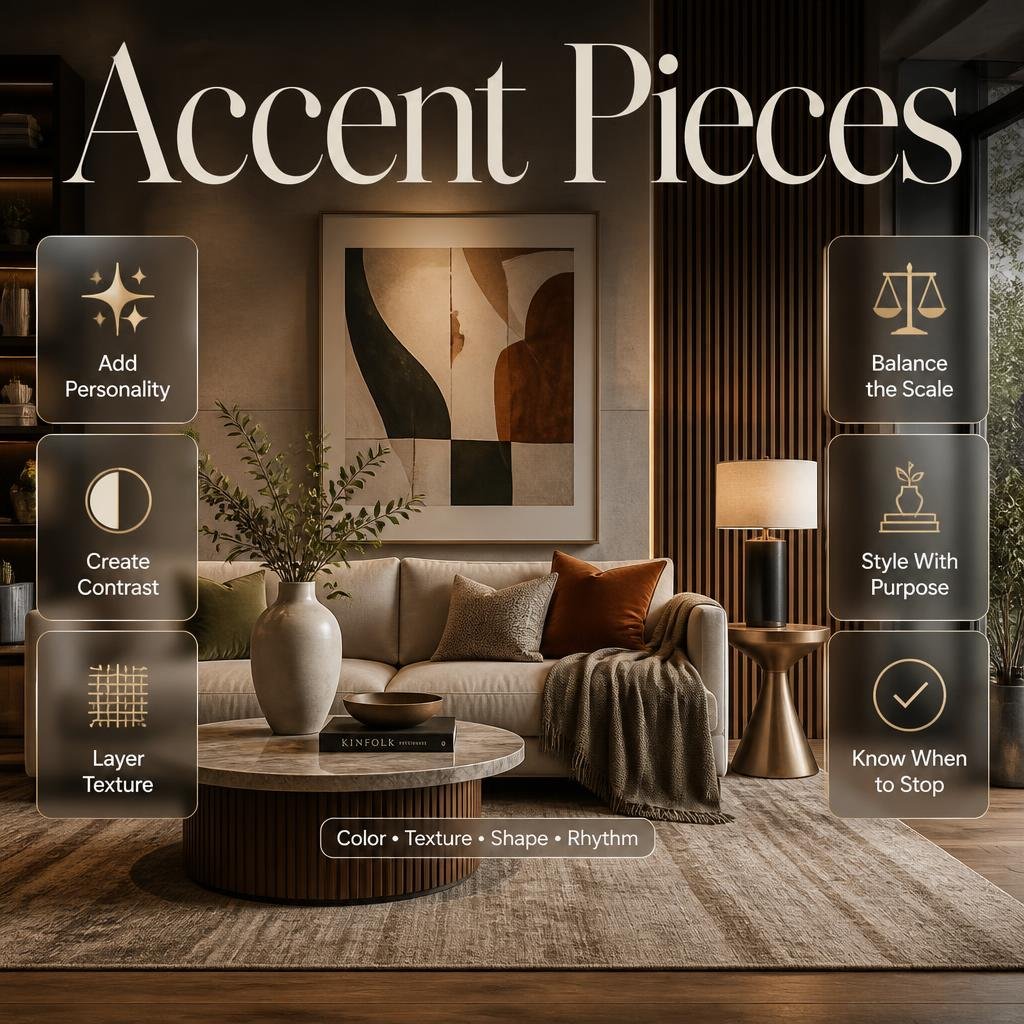
Accent Pieces | You can have the right sofa, attractive flooring, carefully chosen paint, and a sensible furniture layout—and still feel that the room is missing something.
Very often, the missing layer is the accent pieces.
Accent pieces bring personality, contrast, texture, color, shape, and visual rhythm into a room. They can make an ordinary space feel considered and complete, but adding too many can quickly make even a beautiful interior feel cluttered.
The real skill is not simply knowing what accessories to buy. It is knowing what the room needs, where an accent should go, how large it should be, and when to stop adding more.
If you are building or refreshing several rooms, the broader ideas on DesignMode24 Interior Design can help you keep the whole home visually connected while giving individual rooms their own personality.
This guide explains how to choose accent pieces confidently, combine them with existing furniture, style shelves and tables, use accent colors, avoid common mistakes, and create a home that feels personal rather than over-decorated.
What Are Accent Pieces in Interior Design?
Accent pieces are decorative or functional items used to introduce visual interest, personality, contrast, color, texture, or character into a room. They usually support the main furniture and architecture rather than dominate the entire space.
An accent piece does not have to be bright, dramatic, expensive, or unusual.
A charcoal ceramic vase on a light wood console can work as an accent. So can a sculptural lamp, patterned cushion, framed photograph, woven basket, vintage side table, oversized mirror, or indoor plant.
Common accent pieces include:
- Throw pillows
- Blankets and throws
- Artwork
- Mirrors
- Table lamps
- Floor lamps
- Accent chairs
- Side tables
- Vases
- Decorative bowls
- Trays
- Sculptures
- Area rugs
- Planters
- Candlesticks
- Books
- Ottomans
- Small stools
- Personal collections
The key word is accent.
The object should contribute something the space currently needs rather than simply filling an empty surface.
If the entire room still needs a clear design direction before you begin accessorizing, start with the fundamentals of Interior Design before buying decorative pieces.
What Is the Difference Between an Accent Piece and a Statement Piece?
An accent piece supports the room, while a statement piece is intentionally strong enough to attract immediate attention. A statement piece can be an accent, but not every accent should become a statement.
| Element | Main Role | Visual Strength | Typical Examples |
|---|---|---|---|
| Accent piece | Supports the overall design | Low to medium | Vase, cushion, lamp |
| Statement piece | Demands attention | High | Dramatic chair, oversized art |
| Functional decor | Adds beauty while serving a purpose | Low to medium | Basket, mirror, side table |
| Focal point | Creates the main visual destination | High | Fireplace, feature wall, major artwork |
Imagine a neutral living room.
A rust-colored cushion may support the room’s palette without attracting much attention. An oversized sculptural chair in deep rust could become the statement piece.
Both may be accents, but they perform different jobs.
⚠ Common Mistake: Making every accessory a statement piece. If your rug, chair, artwork, lamps, cushions, coffee table, and wall decor all compete for attention, the room loses hierarchy.
Why Do Accent Pieces Matter So Much?
Accent pieces create the small visual connections that make separate furniture, colors, finishes, and architectural features feel like one intentional room.
A beige sofa may already work with warm flooring, but an olive cushion can connect it visually with artwork across the room.
A black lamp can repeat the black trim around a mirror.
A woven basket can soften a room filled with glass, metal, and hard surfaces.
Well-chosen accents usually perform one or more useful jobs:
- Repeat a color
- Introduce contrast
- Add texture
- Create height
- Soften hard furniture
- Connect different materials
- Fill an awkward visual gap
- Make a practical area more attractive
- Introduce personality
- Establish a secondary focal point
A useful way to think about decorating is:
Architecture → Main Furniture → Lighting → Textiles → Accent Pieces → Editing
The final step matters just as much as the others.
Adding is only half of good styling. Knowing what to remove is the other half.
How Do You Choose the Right Accent Pieces?
Choose accent pieces by identifying what the room currently lacks. Then add objects that solve that specific problem through color, texture, height, shape, material, function, or personality.
Avoid beginning with:
“What decoration should I buy?”
Instead ask:
“What does this room need?”
That one change makes shopping far easier.
Step 1: Study the Room Before Shopping
Stand at the entrance and look at the room as a complete composition.
Ask yourself:
- Is the room too flat?
- Are most colors similar?
- Is everything roughly the same height?
- Are there too many straight lines?
- Does one wall feel visually empty?
- Are the surfaces too hard?
- Is there already too much pattern?
- Does the room lack personality?
Your answer tells you what kind of accent piece to look for.
A room that is already colorful may need calmer accessories.
A very neutral room might need texture rather than more color.
💡 Pro Tip: Take a photograph of the room on your phone. Scale problems and awkward empty areas are often easier to notice in a photo.
Step 2: Decide What Feeling the Accent Should Add
Different materials communicate different feelings.
For warmth, try:
- Natural wood
- Aged brass
- Terracotta
- Warm-toned textiles
- Woven fibers
For freshness, try:
- Greenery
- Clear glass
- Light ceramic
- Soft blue or green accents
For contrast, consider:
- Black frames
- Dark lighting
- Bold artwork
- Strong geometric forms
For softness, use:
- Curtains
- Throws
- Cushions
- Rugs
- Upholstery
For personality, consider:
- Travel objects
- Vintage finds
- Handmade pieces
- Family photographs
- Small collections
Step 3: Start With One Visual Anchor
Your first strong accent can guide several smaller choices.
It could be:
- Artwork
- A rug
- An accent chair
- A distinctive lamp
- A console
- A large ceramic vessel
Imagine an abstract painting containing olive, cream, charcoal, and muted rust.
Instead of buying several matching objects, repeat small parts of the painting elsewhere:
- Olive cushion
- Charcoal lamp
- Rust-colored ceramic
- Cream throw
The room feels related without looking like a furniture showroom.
⭐ Expert Tip: Repeat an idea, not necessarily an identical item. Repeating a color, finish, curve, or material usually looks more sophisticated than buying matching sets.
How Should Accent Pieces Work With Wall Color?

Accent pieces should either reinforce the wall palette or create controlled contrast against it. The best choice depends on whether you want the room to feel calm, layered, dramatic, or energetic.
For example, against warm white walls you might use:
- Walnut
- Rust
- Olive
- Black
- Aged brass
Against deep blue walls, lighter accents such as cream, natural wood, glass, or warm metal can provide relief.
Before investing heavily in accessories, make sure the wall color itself works with the room. If the paint is fighting the flooring, furniture, or natural light, accessories will not completely solve the problem.
For more focused color planning, explore the Paint Color guides.
How Can Wall Treatments Become Accent Features?
Wall treatments can function as large-scale accents by adding depth, texture, pattern, or architectural interest without filling the room with more decorative objects.
Examples include:
- Wood slats
- Panel molding
- Wallpaper
- Textured finishes
- Decorative trim
- Feature walls
- Painted architectural details
This is especially useful when you want a strong room identity without covering every table and shelf with accessories.
A textured or paneled wall can sometimes replace several smaller pieces of decor.
If walls are going to carry more of the visual interest, see the dedicated ideas for Wall Treatments.
How Do You Get the Scale of Accent Pieces Right?
Accent pieces should be proportionate to the furniture and space around them. Large surfaces generally need fewer, larger objects, while small surfaces need compact and carefully edited arrangements.
One of the most common styling problems is using decor that is too small.
A long console with a tiny candle in the middle usually looks unfinished.
Adding five more tiny objects rarely fixes the problem.
Instead, use stronger visual weight:
- Larger lamp
- Substantial vase
- Framed artwork
- Mirror
- Stacked books
- Sculptural bowl
Think:
Large surface → fewer, larger objects
Small surface → smaller, carefully edited objects
A large room does not necessarily need more objects. It often needs objects with more appropriate scale.
How Do You Mix Shapes and Heights?
Rooms contain many rectangles naturally:
- Doors
- Windows
- Sofas
- Tables
- Books
- Screens
- Picture frames
Too many similar shapes can make a room feel rigid.
Break them up with:
- Round mirrors
- Curved lamps
- Organic ceramics
- Oval trays
- Soft upholstery
- Plants
- Irregular sculptures
Height also matters.
Instead of lining up several objects at the same level, try:
Tall + medium + low
For example:
- Tall lamp
- Medium framed photo
- Low bowl
The eye naturally moves through the grouping.
Should Accent Pieces Match?
Accent pieces should relate to one another, but they do not need to match exactly. Controlled repetition creates cohesion, while variation adds personality.
Good combinations might include:
- Different ceramics within one color family
- Mixed frames using similar finishes
- Different cushion patterns with related colors
- Multiple wood tones with similar undertones
- Black and brass repeated in several locations
Think of the balance this way:
Everything matching → showroom effect
Everything different → visual chaos
Repetition + variation → collected interior
This principle is particularly useful in polished neutral rooms. For more inspiration around refined finishes and restrained styling, explore Elegant Spaces.
How Many Accent Pieces Should Be in a Room?
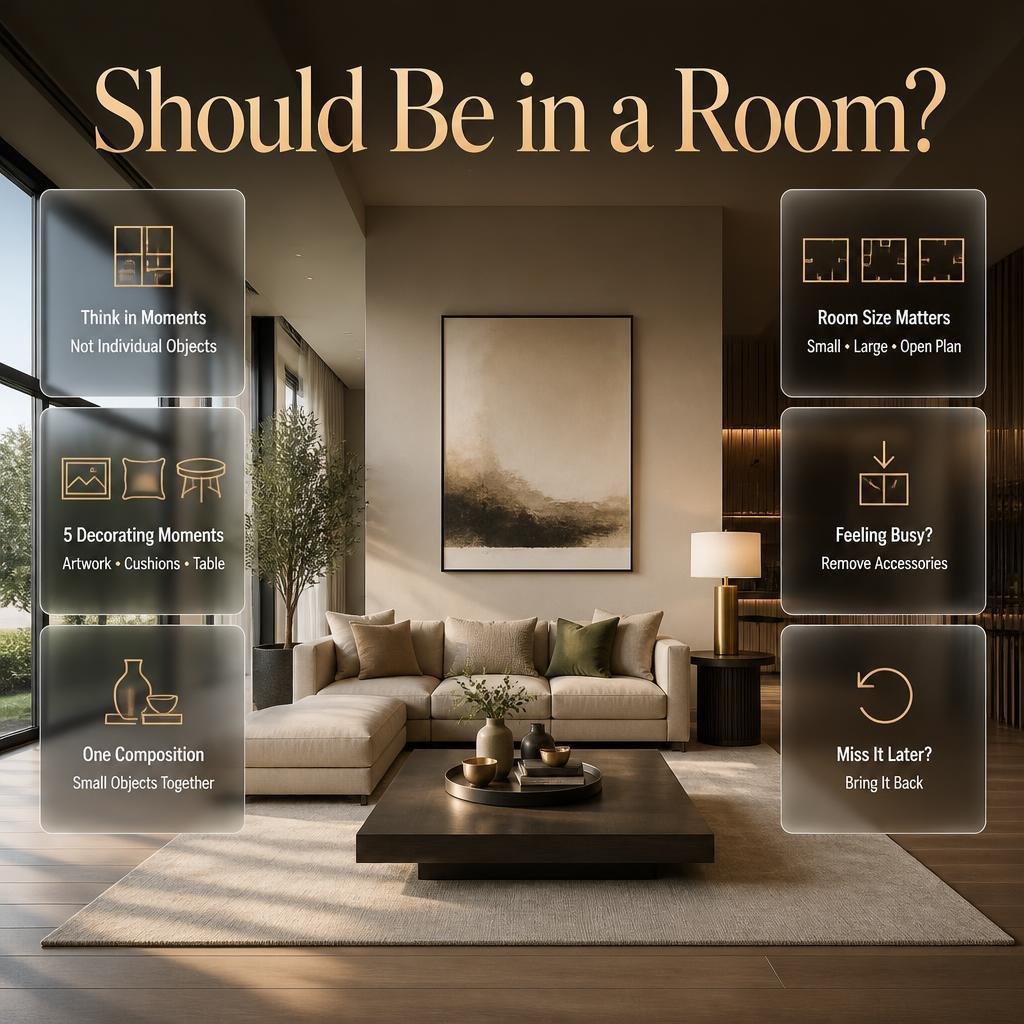
There is no fixed number.
A small bedroom and a large open-plan living space do not have the same visual capacity.
Instead of counting individual objects, count decorating moments.
A living room might have:
- Artwork
- Sofa cushions
- Coffee-table arrangement
- Side-table lamp
- One plant
Those five areas may already be enough.
📌 Quick Tip: Several small objects displayed together should usually be treated as one composition rather than separate decorating opportunities.
When the room begins feeling busy, remove several accessories rather than rearranging all of them.
If you miss something after a day or two, return it.
If you never notice it is gone, the room probably did not need it.
What Are the Best Accent Pieces for a Living Room?
Living rooms benefit from a balance of soft textiles, lighting, wall decor, natural elements, and a small number of tabletop objects.
A practical combination might include:
- Two or three cushions
- One throw
- One coffee-table arrangement
- One or two lamps
- Artwork
- A plant
- One distinctive side table
Avoid decorating every available surface.
A side table does not automatically need three objects.
An empty corner does not automatically need a floor vase.
Negative space helps important pieces look more intentional.
If you are decorating more than one space and need ideas organized room by room, use the Room-by-Room Design Hub.
What Are the Best Accent Pieces for a Bedroom?
Bedroom accent pieces should support relaxation rather than create constant visual stimulation. Focus on softness, lighting, texture, artwork, and a small number of personal details.
Useful bedroom accents include:
- Bedside lamps
- Textured bedding
- One substantial artwork
- Bench or chair
- Throw blanket
- Decorative pillow
- Small plant
- Simple dresser arrangement
The bed already carries significant visual weight.
That means the rest of the room usually benefits from restraint.
For more focused styling ideas, explore Bedroom Interior Design.
If furniture placement still feels wrong, solve the layout before spending money on accessories. The Bedroom Planning and Layout guide can help with that stage.
Lighting can also become part of the accent strategy rather than an afterthought. See the ideas under Modern Bedroom Design for ways lighting can influence atmosphere and visual balance.
Can Functional Technology Work as an Accent?
Yes.
Accent pieces do not need to be purely decorative.
Modern homes contain:
- Speakers
- Charging stations
- Smart lighting
- Displays
- Connected controls
- Media equipment
The goal is to integrate them rather than allow technology to visually dominate the room.
For example, a smart lamp can provide:
- Task lighting
- Mood lighting
- Visual height
- Sculptural interest
A media area can combine technology with wood, shelving, textiles, and lighting so it feels integrated rather than technical.
If you are designing around smart-home features, Connected Living provides a more focused starting point.
How Do You Style Accent Pieces on a Console or Coffee Table?
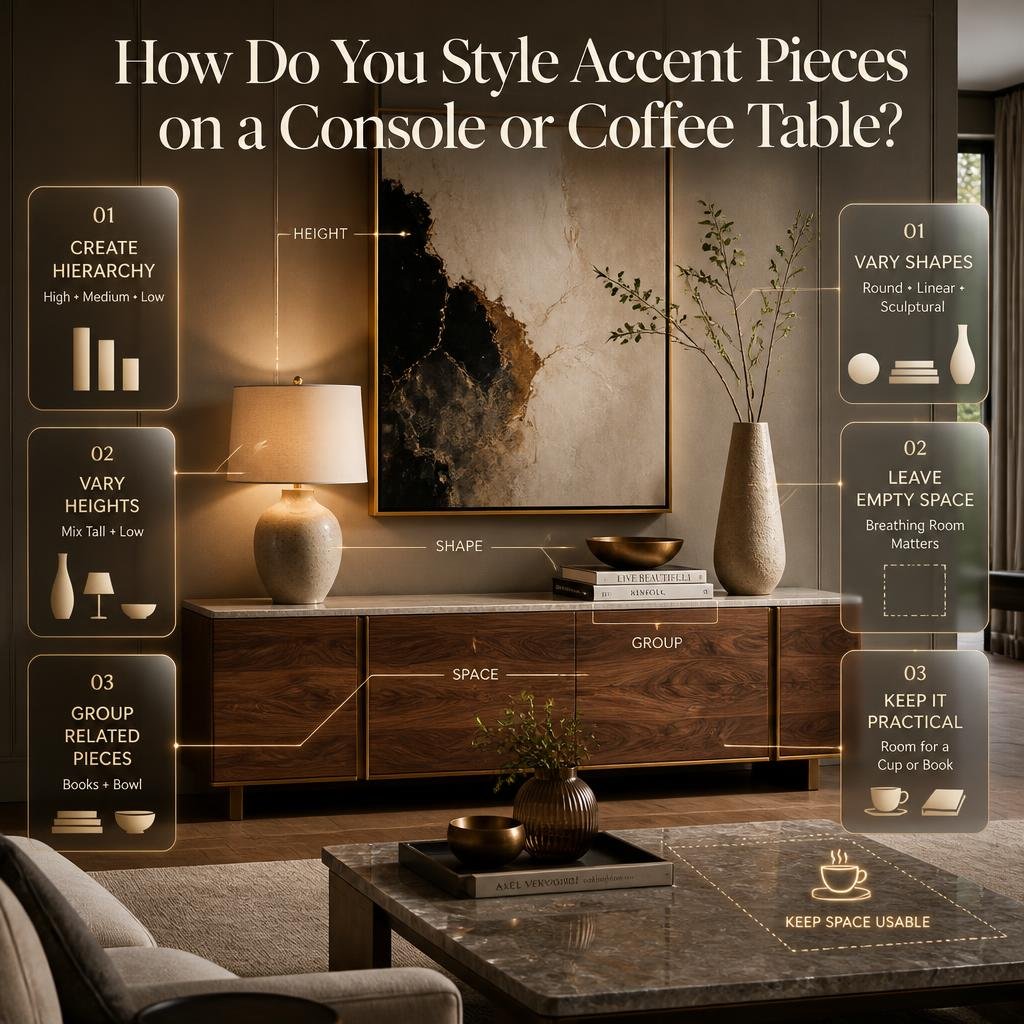
Create visual hierarchy instead of spreading similar objects evenly across the surface. Combine different heights and shapes, group related items, and deliberately leave some empty space.
A console might look like:
          LARGE ART
       ┌────────────┐
       │            │
       └────────────┘

 Lamp          Tall Vase
   │              ╱╲
   │             ╱  ╲
 ──┴──       Books + Bowl
════════════════════════
          CONSOLE
Notice how the objects do not cover every inch.
The empty space is part of the arrangement.
Coffee tables also need practical space.
If you cannot put down a cup or book because the entire surface is decorated, the styling is working against everyday life.
How Do You Style Open Shelves Without Creating Clutter?
Use variation rather than repeating the same formula on every shelf.
One shelf might have:
- Books
- Small ceramic
Another:
- Framed photograph
- Open space
Another:
- One sculptural object
Avoid filling every shelf from edge to edge.
Books can be stacked vertically or horizontally, but do not use decorative books purely to manufacture clutter.
Personal objects often work best because they give shelves a reason to exist beyond decoration.
How Do You Use Accent Colors Without Overdoing Them?
Choose one primary accent color and repeat it in controlled amounts across the room. Supporting colors can be introduced more quietly, but every surface does not need to repeat the accent.
Imagine:
- Warm white walls
- Beige sofa
- Walnut furniture
- Cream rug
You introduce dark green through:
- One pillow
- Detail inside artwork
- Ceramic vase
- Plant foliage
That may be enough.
You do not automatically need:
- Green curtains
- Green chair
- Green lamp
- Green throw
- Green side table
Accent color works because it remains selective.
If everything becomes the accent color, it stops being an accent.
Can Texture Replace Strong Accent Color?
Absolutely.
A room can feel layered and interesting while using very little color.
Imagine a cream and tan interior combining:
- Linen
- Bouclé
- Walnut
- Travertine
- Woven fiber
- Ceramic
- Brushed metal
- Glass
The palette stays controlled, but every material interacts with light differently.
This is particularly useful when you want a calm or timeless space without making it visually flat.
Are DIY Accent Pieces Worth Using?
Yes, when the project produces something that fits the room rather than simply copying a trend.
Useful DIY accent projects include:
- Repainting an old side table
- Making framed artwork
- Recovering cushions
- Building simple shelves
- Refinishing a stool
- Creating decorative wall panels
- Making custom trays
- Updating old frames
DIY is especially useful when store-bought objects do not match the dimensions or finish you need.
For practical project ideas, visit DIY Home Projects.
Should Accent Pieces Be Expensive?
No.
Price alone does not determine whether a room looks polished.
Scale, placement, editing, material combinations, and consistency usually have a stronger visual impact.
Budget-friendly options include:
- Moving artwork from another room
- Reusing pottery
- Framing personal photography
- Rearranging books
- Changing cushion covers
- Bringing in branches or greenery
- Refinishing existing furniture
- Grouping small objects together
- Relocating lamps
⚠ Common Mistake: Buying several cheap objects because a surface looks empty.
One well-chosen object often works better than five pieces purchased simply to fill space.
Can Outdoor Areas Use Accent Pieces Too?
Yes.
Patios, covered outdoor rooms, balconies, and garden seating areas can use the same principles as interior spaces.
Useful outdoor accents include:
- Planters
- Lanterns
- Outdoor cushions
- Small stools
- Decorative pots
- Outdoor rugs
- Sculptural garden objects
- Lighting
- Natural stone or timber details
The main difference is durability.
Anything exposed to weather needs materials appropriate for outdoor use.
For broader home upgrades that go beyond decorating, explore Home Improvement.
Garden-specific inspiration can also be explored through Robert MyGardenAndPatio and Can I Design My Own Garden Kdagardenation if your accent strategy extends outside the house.
What Are the Most Common Accent Piece Mistakes?

Buying Before Understanding the Room
A beautiful object can still be wrong for your space.
Why it happens: The item looks good in the store or online.
Why it hurts: Its scale, material, or color may not connect with anything at home.
Fix: Photograph and measure the intended location before shopping.
Using Too Many Small Objects
Tiny decor is one of the fastest ways to make surfaces feel busy.
Why it happens: Small accessories are inexpensive and easy to collect.
Why it hurts: They create visual noise without enough individual impact.
Fix: Group a few meaningful objects or replace several small pieces with one larger piece.
Matching Everything
Matching furniture sets, lamps, cushions, frames, and decorative objects can make a room feel impersonal.
Fix: Repeat selected elements while varying others.
For example:
- Repeat black
- Vary shapes
- Repeat warm wood
- Vary textures
Ignoring Function
A beautiful room still needs to work.
Do not fill a coffee table so completely that nobody can use it.
Do not add a decorative chair that blocks circulation.
Do not position a vase where it blocks conversation across a dining table.
Following Every Trend
Trends can provide inspiration, but they should not control every purchase.
Use trends selectively through:
- Cushions
- Small art
- Decorative objects
- Throws
- Easily replaced accessories
Keep major purchases aligned with your actual taste.
Decorating Every Empty Space
Empty space is not a design mistake.
Sometimes it is exactly what allows a strong piece to look important.
What Do Professionals Look for Before Adding Another Accent?
Before placing another object, ask these five questions.
Does the room need contrast?
Add something darker, lighter, rougher, smoother, older, or more organic.
Does it need repetition?
Repeat an existing material, finish, shape, or color.
Does it need height?
Consider:
- Tall lamp
- Artwork
- Branches
- Vertical sculpture
Does it need softness?
Consider:
- Textile
- Curtain
- Rug
- Upholstery
- Cushion
Does it need personality?
Add something connected to:
- Travel
- Family
- Art
- Books
- Craft
- Personal interests
⭐ Expert Tip: Once the room feels finished, remove one decorative grouping. If the space becomes calmer and more intentional, leave it out.
Good styling is often an editing exercise.
How do I choose accent pieces that make a room look cohesive instead of cluttered?
The easiest way to choose accent pieces is to stop treating every empty surface as a space that needs decorating. First identify what the room is missing—perhaps warmth, contrast, texture, height, color, or personality—and choose pieces that solve that specific need. A successful room usually has a clear visual relationship between its accents, even when the individual objects are different. For example, an olive cushion, a ceramic vase, and artwork may feel connected because they share similar undertones rather than because they came from the same collection.
Before adding another piece, check whether it contributes something different and useful:
Repeat one element, such as a color, material, curve, or finish.
Mix heights instead of lining up several objects of similar size.
Keep some surfaces partly empty so stronger pieces have room to stand out.
Group smaller objects into one intentional arrangement instead of scattering them around the room.
If removing an accessory makes the room calmer without making it feel unfinished, that piece probably was not necessary.
What accent pieces are trending in 2026 without making a home look dated next year?
The strongest accent-piece direction in 2026 is less about following one fashionable color and more about choosing objects with texture, natural materials, sculptural form, craftsmanship, and a collected feel. Ceramics, stone, warm woods, woven materials, aged metals, interesting lamps, vintage finds, and tactile textiles can feel current while still working long after a short-lived trend disappears. The safest approach is to let trends influence smaller, replaceable accents while keeping expensive furniture and permanent finishes more timeless.
For a current look with better staying power, consider:
Sculptural ceramic or stone objects rather than novelty decorations.
Handmade or imperfect finishes that add visible texture.
Vintage mirrors, lamps, artwork, or small furniture mixed with newer pieces.
Earthy, muted colors used as accents rather than throughout the entire room.
Natural materials such as wood, stone, linen, wool, and woven fibers.
One distinctive object with character instead of several obviously trend-driven accessories.
A useful rule is to ask, “Would I still like this if I stopped seeing it on social media?” If the answer is yes, it has a much better chance of aging well.
How many accent pieces should you have in one room?
There is no professional rule that every room should contain a specific number of accent pieces because scale, furniture quantity, architecture, and room function all change how much visual information a space can comfortably hold. Instead of counting every vase or cushion, think in terms of accent zones. A living room, for example, might only need an artwork moment, sofa textiles, a coffee-table arrangement, one lamp, and a plant. That already creates several layers without making the room feel crowded.
A better way to judge quantity is to look for visual balance:
A small room usually benefits from fewer, stronger accents.
A large room can support more accents, but they should be distributed rather than concentrated everywhere.
Several objects displayed together can count visually as one composition.
Strong statement pieces need more empty space around them.
Functional surfaces should remain functional; decor should not occupy every usable inch.
If your eye does not know where to rest when you enter the room, the problem is often not that you chose the wrong accessories—it is that too many pieces are competing at once.
Should accent pieces match the furniture or create contrast?
Accent pieces should usually connect with the furniture without copying it. Rooms feel more sophisticated when an accent echoes one characteristic of the existing design while introducing something different through texture, shape, tone, age, or material. If everything matches exactly, the room can feel like a furniture set. If nothing relates, it can feel accidental. The goal is controlled contrast.
For example, with a beige linen sofa and warm walnut furniture, you could introduce:
A black sculptural lamp for stronger contrast.
An olive cushion that complements the warm neutral palette.
A stone or ceramic bowl to introduce a harder texture.
A rounded side table to soften the room’s straight furniture lines.
A vintage brass object to add age and character.
Think connection plus contrast. Let the accent share something with the room, then give it one quality that makes it interesting. That creates personality without breaking the overall design.
Which accent pieces can make a room look more expensive without spending a lot?
A room tends to look more refined when its accents have the right scale, placement, texture, and visual weight, not simply when they cost more. One substantial lamp or correctly scaled piece of artwork can improve a room more than a collection of inexpensive decorative objects. Natural-looking materials, good framing, layered textiles, carefully placed mirrors, and personal objects also create a more considered appearance without requiring luxury-brand purchases.
For a higher-end effect on a sensible budget, prioritize:
One larger artwork or properly framed personal print instead of several undersized pieces.
A substantial table or floor lamp with a strong silhouette.
Linen, wool-look, woven, or textured cushions and throws.
Ceramic, wood, stone, or metal objects with simple shapes.
An appropriately sized mirror that also improves light and visual space.
Books, photographs, pottery, or collected objects that give the room genuine personality.
Fewer decorative objects displayed with more breathing room.
The biggest upgrade is often free: remove the weak pieces, reposition the strongest ones, and give them more space. A carefully edited room nearly always feels more polished than one filled with accessories simply because there was room to put them.
Conclusion
Accent pieces work best when they feel intentional, not simply added to fill space. The right artwork, lamp, cushion, mirror, vase, rug, or decorative object can bring together colors, textures, furniture, and materials that might otherwise feel disconnected.
A strong approach is to start with what the room actually needs. If it feels flat, add texture. If it feels too neutral, introduce controlled color. If it feels busy, remove smaller objects and let a few stronger pieces carry more visual weight. Good styling is usually a balance between contrast, repetition, proportion, function, and restraint.
Most importantly, do not feel pressured to decorate every surface. A well-designed room needs breathing space just as much as it needs beautiful objects.
When each accent piece has a clear purpose—whether it adds warmth, personality, function, balance, or visual interest—the room naturally feels more polished and personal.
For more practical ideas for shaping different rooms and improving your overall home style, explore DesignMode24 Interior Design and continue building your space one thoughtful decision at a time.