
Introdution
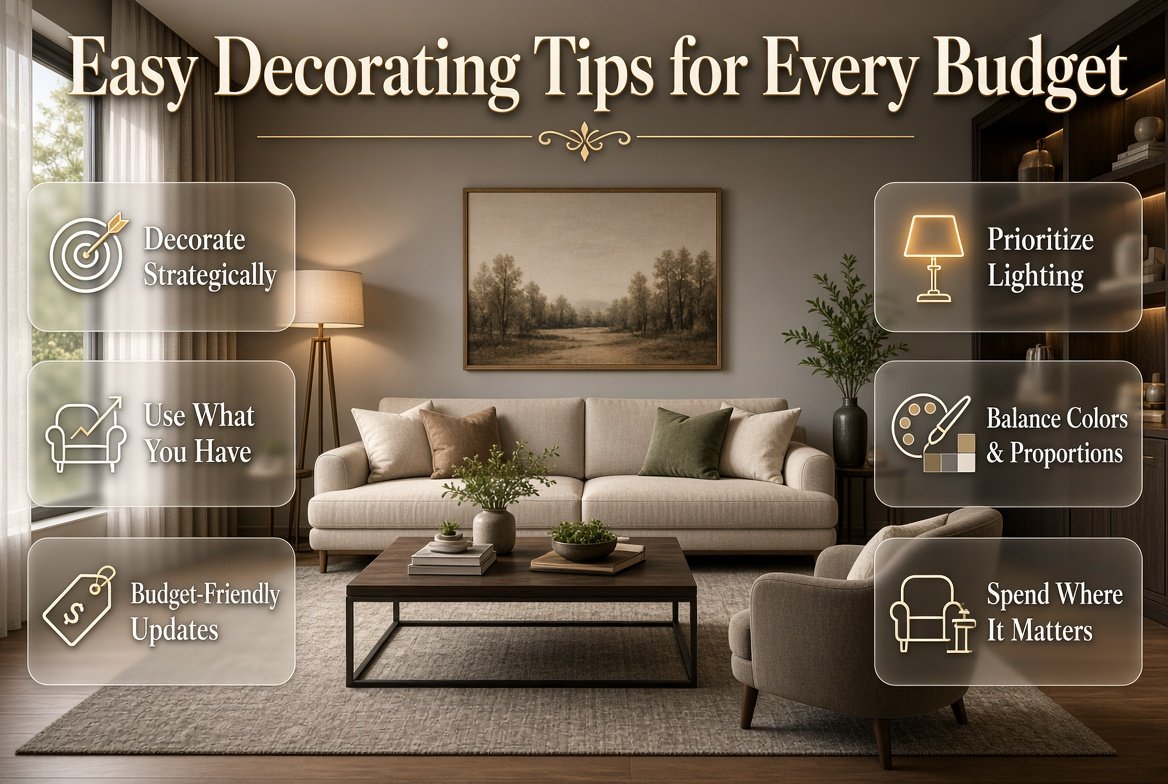
Easy Decorating Tips for Every Budget | Decorating a home can feel expensive when you start looking at furniture, lighting, artwork, rugs, curtains, and accessories. You may have a long list of ideas saved online, but then reality hits: the budget doesn’t always match the vision. The good news is that beautiful interiors aren’t created by spending the most money. They’re created by making thoughtful choices with the space, colors, proportions, lighting, and pieces you already have.
Whether you’re decorating a first apartment, refreshing a tired living room, improving a bedroom, or simply trying to make your home feel more finished, easy decorating tips for every budget can help you make noticeable changes without replacing everything.
The most effective approach is to spend strategically rather than constantly. Some improvements cost almost nothing, while others are worth investing in because they affect the entire room. In this guide, you’ll learn how to decorate on a tight budget, where to spend more when you can, which affordable changes create the biggest visual impact, and how to avoid the common mistakes that make inexpensive decorating look unfinished.
If you’re looking for broader inspiration and practical ideas, you can also explore DesignMode24 Interior Design for additional home design guidance.
How Can You Decorate Your Home Beautifully on Any Budget?
You can decorate beautifully on almost any budget by prioritizing high-impact changes such as furniture arrangement, lighting, color, textiles, artwork, storage, and decluttering before buying expensive decorative items. A room usually feels more polished when its elements work together rather than when it contains a large number of costly pieces.
Start with what you already own. Rearrange furniture, remove unnecessary clutter, change the position of lamps, introduce textiles, and create a stronger focal point. Once you’ve exhausted those free improvements, decide where a small amount of money will make the biggest difference.
A useful decorating principle is:
Improve the room first → shop second.
Buying more things before solving the room’s layout often creates visual clutter rather than better design.
Why Small Changes Can Have a Big Effect
Interior design isn’t only about individual products. It’s about relationships.
A $30 lamp can sometimes improve a room more than a $300 decorative object because lighting changes how everything else appears. Similarly, moving a sofa away from a wall can make a living room feel more intentional without costing anything.
The biggest visual improvements often come from:
- Better furniture placement
- Decluttering
- Improved lighting
- Coordinated colors
- Larger-scale artwork
- Layered textiles
- Plants and natural elements
- Better storage
- Replacing tired hardware
- Creating visual balance
💡 Pro Tip: Before buying anything, take a photo of the room from the doorway. Photos often reveal problems with clutter, spacing, scale, and balance that aren’t obvious when you’re standing inside the room.
What Are the Best Free Decorating Ideas?
The easiest decorating ideas are often completely free. Rearranging furniture, removing unnecessary objects, restyling shelves, changing the room’s focal point, and moving accessories between rooms can make a familiar space feel surprisingly different.
You don’t need a shopping trip to begin decorating.
1. Rearrange Your Furniture
Furniture arrangement is one of the most powerful free decorating tools.
A sofa pushed against a wall isn’t automatically the best arrangement. Try creating a conversation area instead. In a living room, position seating so people can comfortably talk without turning their bodies awkwardly.
Before moving heavy furniture, consider:
- Walking paths
- Door openings
- Window access
- Natural light
- Television position
- Conversation areas
- Furniture proportions
For example, pulling a sofa several inches away from the wall can sometimes make the room feel more intentional and less cramped.
⚠ Common Mistake: Don’t arrange furniture simply around the walls. Rooms need breathing space, and furniture should support how people actually use the room.
2. Remove What Doesn’t Belong
Decluttering is decorating.
A crowded surface makes even beautiful furniture and accessories harder to appreciate. Remove objects that are broken, unused, duplicated, or simply taking up visual space.
Try the three-category method:
Keep → Relocate → Remove
Keep items that are useful or meaningful. Relocate things that belong somewhere else. Remove objects that no longer serve a purpose.
You don’t have to create a minimalist home. The goal is controlled visual variety.
3. Restyle Existing Shelves
Instead of purchasing new décor, take everything off a shelf and start again.
Group objects by:
- Height
- Shape
- Material
- Color
- Function
Leave some empty space between groups. A shelf usually looks more sophisticated when every item isn’t competing for attention.
4. Move Accessories Between Rooms
A decorative vase in the bedroom may work beautifully in the living room. A lamp from a hallway may improve a reading corner. A basket that stores blankets could become useful in another room.
Shopping your own home costs nothing and can give you an entirely new decorating palette.
How Can You Decorate a Home on a Very Small Budget?
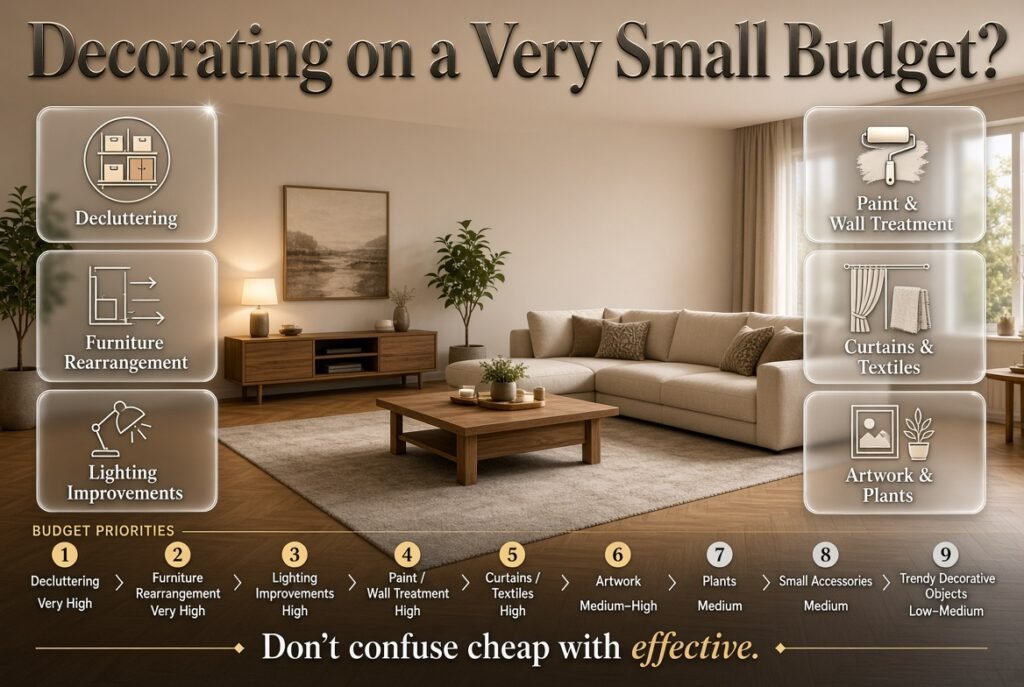
When money is limited, focus on changes that affect large visual areas rather than buying many small accessories. Paint, textiles, lighting, hardware, decluttering, and furniture rearrangement can often create a larger transformation than a collection of inexpensive decorative objects.
A useful low-budget priority list is:
| Priority | Decorating Change | Typical Impact |
|---|---|---|
| 1 | Decluttering | Very High |
| 2 | Furniture rearrangement | Very High |
| 3 | Lighting improvements | High |
| 4 | Paint or wall treatment | High |
| 5 | Curtains and textiles | High |
| 6 | Artwork | Medium–High |
| 7 | Plants | Medium |
| 8 | Small accessories | Medium |
| 9 | Trendy decorative objects | Low–Medium |
The lesson is simple: don’t confuse cheap with effective.
A $10 accessory isn’t automatically good value if it doesn’t improve the room.
What Can You Decorate for Under $50?
A small decorating budget can still produce meaningful results when you concentrate the money in one area. Instead of spreading $50 across ten unrelated accessories, choose one or two improvements that create a visible difference.
Depending on your room, consider:
- New cushion covers
- A table lamp
- Affordable framed artwork
- A mirror
- Decorative baskets
- New cabinet hardware
- A small indoor plant
- A simple throw blanket
- Curtain accessories
- A peel-and-stick wall detail
- Storage containers
The $50 Decorating Strategy
Suppose your living room already has a functional sofa, coffee table, and curtains.
Rather than replacing everything, you could spend your budget on:
- Two coordinated cushion covers
- One throw
- One table lamp
- A simple plant
The room hasn’t received a complete makeover, but the combination creates a stronger visual story.
⭐ Expert Tip: Choose accessories in groups rather than buying individual objects randomly. Repetition of one color, material, or shape makes inexpensive décor feel more intentional.
How Can You Decorate for Under $100?
With around $100, you can begin combining several small improvements into a cohesive room refresh. The key is to choose a visual direction before shopping.
For example, a bedroom could receive:
- New pillow covers
- A warm bedside lamp
- Simple artwork
- A textured throw
- New drawer handles
Another approach is to spend most of the budget on one strong item, such as a larger mirror or statement light, and use existing pieces around it.
Don’t Buy Five Trends
Budget decorating becomes expensive when you repeatedly buy things that don’t work together.
Before purchasing an item, ask:
Does this solve a problem?
Does it fit the room’s scale?
Does it work with what I already own?
Would I still like it next year?
If the answer is no to several of these questions, leave it in the store.
What Are the Best Decorating Ideas for a $250 Budget?
A $250 budget gives you enough flexibility to make a noticeable room refresh, particularly when the basic furniture is already in place. At this level, focus on combining one medium-impact investment with several inexpensive finishing touches.
For a living room, for example:
- $80–$120 for a larger rug or lighting improvement
- $40–$60 for cushions and textiles
- $30–$50 for artwork
- Remaining budget for plants, baskets, or hardware
Exact prices vary considerably by location and retailer, so treat these figures as planning examples rather than fixed costs.
The important concept is budget hierarchy.
Spend more on items you interact with frequently or that occupy significant visual space. Spend less on objects that are easy to replace.
Where Should You Spend More Money When Decorating?
Spend more on pieces that affect comfort, durability, safety, or the overall structure of a room. Sofas, mattresses, quality lighting, frequently used chairs, durable rugs, and well-made storage can justify a higher investment because they are used regularly and may last for years.
You don’t need premium versions of everything.
Worth Investing In
Consider spending more on:
- A comfortable sofa
- A quality mattress
- Frequently used dining chairs
- Durable flooring
- Proper lighting
- Well-made curtains
- Long-lasting storage
- High-use hardware
- Quality rugs in busy areas
Where You Can Save
You can often save on:
- Decorative objects
- Trendy accessories
- Small artwork
- Cushion covers
- Seasonal décor
- Simple baskets
- Temporary styling pieces
📌 Quick Tip: If replacing an inexpensive item every year would eventually cost more than buying a durable version once, calculate the long-term cost before deciding.
How Do You Make Cheap Décor Look Expensive?
Affordable décor looks more sophisticated when you pay attention to scale, repetition, texture, spacing, and presentation. The goal isn’t to make inexpensive products pretend to be luxury products. It’s to create a room where every element appears intentional.
Use Larger Pieces Carefully
Several tiny decorative objects can create visual noise. One appropriately sized artwork or mirror often has greater impact.
Repeat Materials
If you have wood furniture, introduce another wood element. If your room includes black metal, repeat it through lighting or hardware.
Repetition creates cohesion.
Layer Textures
Combine:
- Smooth surfaces
- Woven materials
- Soft textiles
- Natural wood
- Glass
- Ceramic
- Metal
Texture adds depth without requiring expensive decoration.
Leave Empty Space
Empty space isn’t wasted space.
A clear section of a shelf or wall gives the eye somewhere to rest. Overfilled rooms often feel cheaper because every surface is competing for attention.
How Can Paint Transform a Room on a Budget?
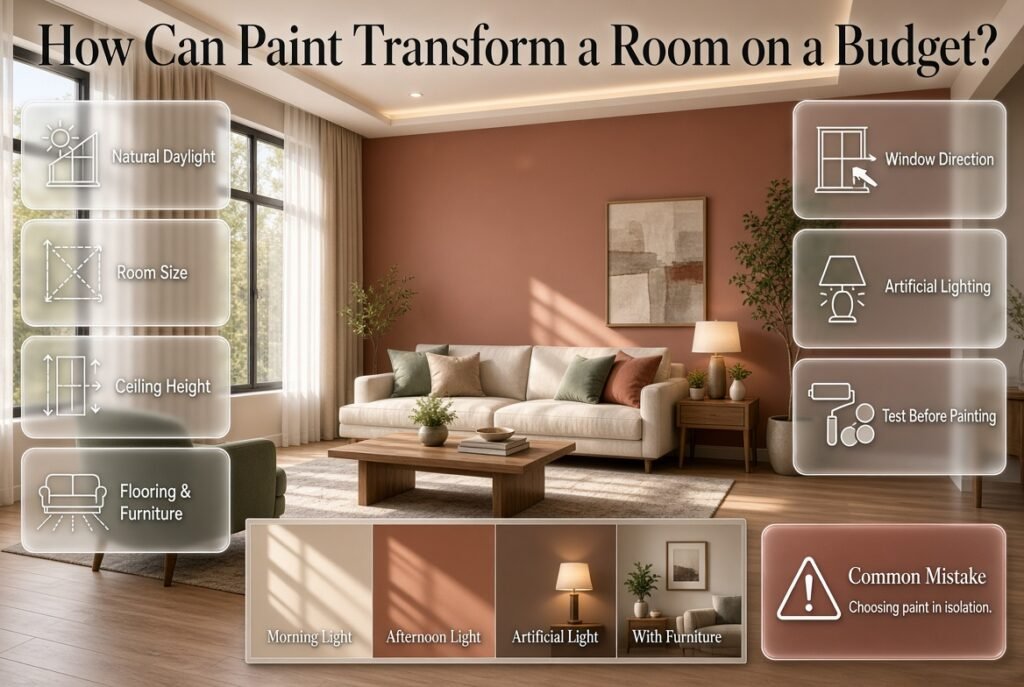
Paint can create one of the largest visual changes for relatively little money, especially when the existing walls are tired or the color doesn’t suit the room.
Before choosing a color, consider:
- Natural daylight
- Room size
- Ceiling height
- Existing flooring
- Furniture colors
- Window direction
- Artificial lighting
A color that looks soft and warm in one room may appear cooler or brighter in another.
For more focused color guidance, explore Paint Color ideas before committing to a full-room color.
Don’t Choose Paint in Isolation
The mistake is choosing a color from a tiny sample and assuming it will look identical across four walls.
Instead:
- Test a larger sample.
- Observe it in morning light.
- Check it during the afternoon.
- Look at it under artificial lighting.
- Compare it with your furniture.
- Live with it for several days.
⚠ Common Mistake: Buying paint before considering the flooring, furniture, and natural light can force you to redesign the rest of the room around an unsuitable color.
What Are the Best Budget Decorating Ideas for a Living Room?
The living room usually benefits most from improvements to seating arrangement, lighting, textiles, wall décor, and clutter control. Because it’s often a central gathering space, even small changes can affect how the entire home feels.
Start with the seating.
Ask:
- Can people comfortably talk?
- Is there a clear walking path?
- Is the coffee table appropriately positioned?
- Does the sofa dominate the room?
- Is the television creating an awkward focal point?
Then improve lighting.
A living room rarely looks its best with one ceiling fixture doing all the work. Combine general lighting with task and accent lighting where possible.
Affordable Living Room Refresh
Try this sequence:
Declutter → Rearrange → Improve lighting → Add textiles → Add artwork → Style surfaces
This order prevents you from spending money before identifying the room’s real problems.
For additional room inspiration, browse Room-by-Room Interior Design Inspiration to see how different spaces can be approached according to their specific functions.
How Can You Decorate a Bedroom Without Spending Much?
A bedroom should feel calm, comfortable, and personal rather than overloaded with decoration. Start with the bed because it usually occupies the largest visual area.
Affordable improvements include:
- Coordinated bedding
- Layered pillows
- A textured throw
- Better bedside lighting
- Simple artwork
- Decluttered nightstands
- Soft curtains
- A small plant
- Improved storage
The bedroom doesn’t need dozens of decorative objects.
A well-made bed, balanced lighting, clean surfaces, and a few meaningful accessories can create a much stronger result.
If your room has awkward furniture placement, review Bedroom Layouts before buying anything new.
What Are Easy Budget Decorating Ideas for Small Bedrooms?
Small bedrooms benefit from visual simplicity and efficient storage. Instead of filling the room with decorative pieces, choose items that provide more than one function.
Useful ideas include:
- Under-bed storage
- Wall-mounted lighting
- Floating shelves
- Mirrors
- Slim bedside tables
- Vertical storage
- Light-colored textiles
- Multipurpose benches
- Coordinated bedding
A mirror can increase the sense of openness by reflecting light and extending visual depth, although placement matters. Avoid positioning mirrors where they create unwanted reflections or visual clutter.
For more bedroom-specific inspiration, explore Bedroom Ideas and focus on solutions that fit the actual size and function of your room.
How Can You Decorate a Bathroom on a Budget?
Bathrooms don’t always need a renovation to feel refreshed. Small changes to hardware, textiles, storage, mirrors, lighting, and organization can create a cleaner and more finished appearance.
Try:
- Replacing worn towels
- Adding coordinated storage
- Updating cabinet handles
- Improving lighting
- Replacing an old shower curtain
- Adding a framed mirror
- Introducing a suitable plant
- Removing unnecessary countertop products
Keep frequently used products organized instead of displaying every bottle.
For additional inspiration, explore Bathroom Inspiration for practical ways to improve the room without automatically committing to a major renovation.
How Can DIY Projects Save Money When Decorating?
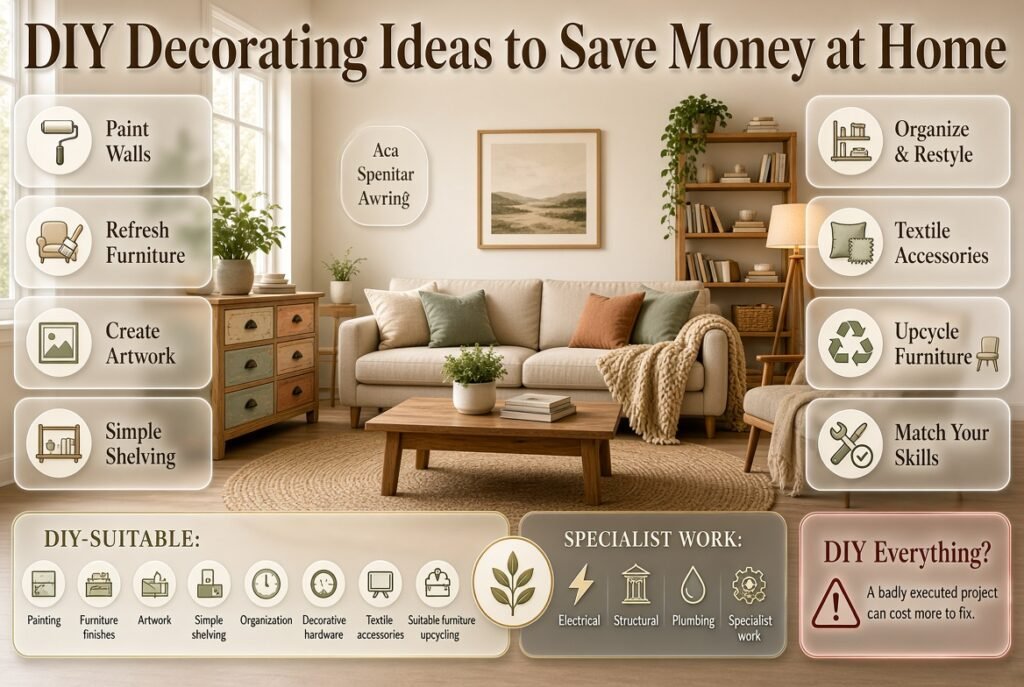
DIY decorating can reduce costs when the project is simple, safe, and appropriate for your skill level. Painting, basic furniture refinishing, artwork, simple shelving, and organization projects are often good candidates, while electrical, structural, plumbing, or specialist work should be handled appropriately by qualified professionals.
Good DIY projects include:
- Painting walls
- Updating furniture finishes
- Creating simple artwork
- Installing basic decorative hardware
- Building simple organization solutions
- Restyling shelves
- Making textile accessories
- Upcycling suitable furniture
The goal isn’t to DIY everything.
A badly executed project can cost more to fix than a professionally completed job would have cost initially.
For practical project ideas, explore DIY Home Projects and choose projects that match your tools, time, skills, and comfort level.
How Can Storage Improve Decorating Without Adding Clutter?
Good storage makes decorating easier because it reduces visual noise. When everyday items have a designated home, decorative elements become more noticeable and rooms feel calmer.
Useful storage strategies include:
- Closed cabinets for visual clutter
- Baskets for flexible organization
- Drawer organizers
- Under-bed containers
- Floating shelves
- Entryway storage
- Multipurpose furniture
- Vertical shelving
Storage should be planned according to what you actually own.
Don’t buy containers first and hope they’ll solve the problem. Measure your items and determine what needs to be stored before purchasing organizers.
For more ideas, see Smart Storage and Organization Ideas.
What Are the Best Decorating Ideas for Renters?
Renters can make significant decorating improvements without permanently altering the property. Focus on reversible changes such as textiles, furniture, lighting, removable wall treatments, artwork, plants, and freestanding storage.
Consider:
- Peel-and-stick products where appropriate
- Removable hooks
- Freestanding lamps
- Large rugs
- Curtains
- Decorative mirrors
- Artwork
- Portable shelving
- Furniture arrangement
Always check your rental agreement before making changes that could affect walls, fixtures, or finishes.
The strongest rental decorating strategy is to use movable elements to create personality rather than relying entirely on permanent architectural changes.
How Can You Decorate With Thrifted and Secondhand Furniture?
Secondhand furniture can provide character and save money, particularly when you focus on quality construction rather than appearance alone.
Look for:
- Solid construction
- Useful dimensions
- Strong joints
- Repairable surfaces
- Timeless shapes
- Quality materials
Don’t buy something simply because it’s cheap.
A $20 table that doesn’t fit your room is still a bad purchase.
Before bringing secondhand furniture home, measure both the furniture and the route it needs to travel through doors, hallways, stairs, and elevators.
⭐ Expert Tip: Look beyond the current finish. An unattractive wood color or outdated hardware may be easy to change, while poor construction is much harder to fix.
How Should You Choose Budget-Friendly Artwork?
Artwork doesn’t have to be expensive to make a room feel personal. What matters most is scale, placement, composition, and whether the piece contributes something meaningful to the room.
Affordable options include:
- Personal photography
- Printable artwork
- Vintage finds
- Children’s artwork
- Simple graphic prints
- Handmade pieces
- Gallery walls using existing frames
One common mistake is hanging artwork that’s too small for the wall.
When in doubt, consider using a larger piece or grouping several smaller works into one visual arrangement.
How Does Lighting Affect Affordable Interior Design?
Lighting can dramatically change how a room feels because it influences brightness, shadows, color perception, atmosphere, and focal points. A room with inexpensive furniture can still feel attractive when its lighting is layered and purposeful.
Think in three levels:
Ambient Lighting
This provides general illumination.
Task Lighting
This supports specific activities such as reading, working, cooking, or grooming.
Accent Lighting
This highlights artwork, plants, architectural details, or decorative areas.
You don’t need expensive fixtures to create layers. A combination of ceiling lighting, floor lamps, table lamps, and strategically placed accent lights can produce a much more comfortable atmosphere.
What Are the Biggest Budget Decorating Mistakes?
Budget decorating becomes difficult when people focus too much on buying and not enough on planning. The most common mistakes include purchasing furniture without measuring, choosing colors without testing them, filling every surface, ignoring lighting, and buying trends that don’t work with the existing room.
Buying Before Measuring
A beautiful piece that doesn’t fit is not a bargain.
Measure:
- Room dimensions
- Doorways
- Hallways
- Furniture footprint
- Ceiling height
- Available wall space
Buying Too Many Small Items
Small accessories can quickly create clutter.
Choose fewer pieces with stronger visual impact.
Ignoring Scale
A tiny rug under a large sofa can make the entire arrangement look disconnected.
Scale matters more than price.
Following Every Trend
Trends can be useful for inspiration, but a home filled entirely with short-lived trends may quickly feel dated.
Use trends through easily replaceable elements such as cushions, artwork, and accessories.
Decorating Without a Color Plan
Every room doesn’t need to use one color, but there should be some relationship between the main tones.
Forgetting Function
A beautiful room that is uncomfortable or difficult to use isn’t successful design.
How Do Professionals Decorate on a Budget?
Professionals usually start by identifying the room’s biggest problem rather than asking what new products should be purchased. They evaluate function, layout, lighting, scale, color, storage, and existing furniture before deciding where money should be spent.
A professional-style process looks like this:
1. Identify the problem
Is the room dark? Crowded? Empty? Disorganized? Visually disconnected?
2. Set the goal
Decide how you want the room to feel and function.
3. Use what you have
Rearrange, remove, repair, clean, and restyle existing pieces.
4. Prioritize spending
Choose the two or three changes that will have the greatest impact.
5. Add layers
Introduce lighting, textiles, artwork, plants, and accessories gradually.
6. Stop before the room becomes crowded
Not every empty corner needs decoration.
For more practical guidance beyond individual decorating ideas, explore Practical Home Improvement Guides.
A Simple Decorating Budget Formula
If you’re unsure how to divide your decorating budget, use a priority-based system rather than a strict percentage.
First Priority: Function
Spend on things that make the room work better.
Second Priority: Comfort
Invest in pieces you use every day.
Third Priority: Visual Impact
Choose one or two elements that significantly change the room’s appearance.
Fourth Priority: Personality
Add artwork, plants, books, accessories, and meaningful objects.
Fifth Priority: Trends
Only spend here if the item genuinely fits your long-term style.
This approach keeps decorating practical while still allowing personality.
How Can You Decorate One Room at a Time?
Trying to redesign an entire home simultaneously can quickly become expensive and overwhelming. A better approach is to complete one room before moving to another.
Use this sequence:
Room 1 → Layout → Declutter → Lighting → Main textiles → Artwork → Accessories
Once that room feels complete, move to the next.
This also helps you discover your decorating style naturally. You may realize that you prefer warm neutrals, natural materials, modern shapes, traditional details, or colorful accents.
Your home doesn’t have to look like a showroom.
It should look like a home designed around your life.
What is the easiest way to decorate a home on a budget?
The easiest way to decorate on a budget is to change the things that have the biggest visual impact before buying lots of small accessories. Start by decluttering, rearranging your furniture, improving lighting, and creating a simple color palette. Once the room feels balanced, use affordable items such as cushions, rugs, artwork, curtains, plants, or decorative storage to add personality.
A common mistake is assuming that budget decorating means buying as many inexpensive items as possible. In reality, a room can look more polished with five carefully chosen pieces than with twenty unrelated decorations. Current budget-design advice increasingly focuses on spending in the right order and prioritizing changes that transform the whole room.
Practical approach:
Declutter before shopping.
Rearrange existing furniture.
Improve the lighting.
Choose two or three main colors.
Add texture through cushions, throws, and rugs.
Introduce one strong decorative focal point.
Buy additional accessories only when the room genuinely needs them.
Professional tip: Take a photograph of the room before purchasing anything. A photo makes problems with clutter, scale, empty space, and furniture placement much easier to notice.
How can I make my home look expensive without spending a lot of money?
A home looks expensive when it feels intentional, balanced, and well-edited, not simply when it contains expensive products. Focus on proportion, lighting, texture, consistency, and negative space. A well-positioned rug, warm layered lighting, properly sized artwork, coordinated textiles, and uncluttered surfaces can create a more sophisticated appearance without requiring a luxury decorating budget.
One of the most effective techniques is to stop treating every decorative item as an individual purchase. Think about how pieces work together. Repeating a material, color, or finish across the room creates visual continuity and makes affordable furniture feel more curated.
Use these techniques:
Choose fewer but stronger decorative pieces.
Avoid artwork that is too small for the wall.
Layer different textures rather than using one fabric everywhere.
Repeat one or two accent colors.
Keep shelves and tables partially uncluttered.
Use warm, layered lighting instead of relying entirely on one ceiling light.
Mix affordable pieces with one or two distinctive items.
Layered lighting is particularly useful because it can change the atmosphere of an entire room without replacing the furniture. Warm, ambient lighting and natural-material shades are also among the decorating directions being highlighted in 2026.
The real secret: Don’t try to make a cheap item look luxurious. Instead, make the whole room feel thoughtfully designed.
What should I buy first when decorating a home on a tight budget?
Start with the item or improvement that solves the room’s biggest problem. If the room is dark, prioritize lighting. If the furniture arrangement feels disconnected, fix the layout first. If the room feels cold, consider textiles and texture. If the walls feel empty, artwork or a carefully chosen paint treatment may have more impact than several small accessories.
This approach prevents one of the most expensive budget-decorating mistakes: buying attractive things that don’t actually solve anything.
Before spending money, divide potential purchases into three categories:
Must Have:
Items that improve function, comfort, or a major visual problem.
Nice to Have:
Items that improve the room but aren’t urgent.
Purely Decorative:
Things you like but don’t currently need.
Spend the majority of your budget on the first category.
A smart buying order is:
Fix the layout.
Declutter.
Address lighting.
Choose major textiles such as rugs or curtains.
Add artwork or a focal point.
Introduce plants and accessories.
Add trend-based décor last.
This is especially useful when your budget is limited because it prevents small purchases from consuming money that could have produced a much bigger improvement.
Professional tip: If you’re decorating several rooms, don’t divide your budget equally between them. Finish one room properly first, then move to the next. You’ll usually get a more noticeable result than spreading a small amount of money across the entire house.
How can I decorate my home if I have almost no budget?
When the decorating budget is close to zero, focus on editing, rearranging, repurposing, and restyling what you already own. These changes may sound simple, but they can dramatically alter how a room feels. Moving furniture into a better arrangement, removing unnecessary objects, changing artwork between rooms, restyling shelves, and improving the placement of lamps can create a fresh look without spending anything.
Start with a complete room reset. Remove decorative objects from shelves, tables, and counters. Move small furniture pieces out temporarily. Then look at the room as an empty composition and rebuild it carefully.
Try these no-cost decorating changes:
Move the sofa into a new position.
Change the direction of your bed.
Swap lamps between rooms.
Move artwork to a different wall.
Group accessories instead of scattering them.
Remove half the objects from open shelving.
Use books to create different heights.
Move plants to areas where they have more visual impact.
Rearrange dining or console-table styling.
Repurpose baskets and containers for visible organization.
You can also create personality by displaying objects that already have meaning to you. Current design advice increasingly emphasizes personal possessions, memories, hobbies, heirlooms, and collected pieces instead of making a home look like a showroom.
The important mindset: Decorating isn’t automatically the act of adding something. Sometimes the best decorating decision is removing something that doesn’t belong.
What are the best budget-friendly decorating trends to try in 2026?
The most useful 2026 decorating trends for a budget-conscious homeowner are the ones that can be introduced gradually rather than requiring a complete redesign. Warm minimalism, layered lighting, natural textures, personalized décor, handcrafted-looking pieces, and expressive accents are particularly practical because you can introduce them through small changes instead of replacing major furniture.
For example, you don’t need to redesign an entire living room to make it feel warmer. Replace harsh lighting with warmer layered sources, add a textured throw, introduce natural materials, and display a few personal objects. Similarly, you can experiment with stronger colors through cushions, artwork, or small accessories rather than repainting the entire house.
Affordable 2026-inspired updates include:
Warm-toned lamps and layered lighting.
Linen, cotton, jute, rattan, and woven textures.
Earthy and warm neutral color combinations.
One bold accent color instead of an entire colorful room.
Vintage or thrifted pieces mixed with modern furniture.
Handmade or locally crafted decorative objects.
Personal photographs, artwork, books, and meaningful collections.
Small DIY furniture upgrades.
Repurposed furniture instead of automatically buying new pieces.
The important distinction is between a trend and a decorating principle. A trend can become outdated, while principles such as good lighting, appropriate scale, personal expression, and functional layouts remain useful for years. Current 2026 coverage is also showing a move toward more personal, expressive interiors rather than spaces that simply copy a social-media aesthetic.
Best professional approach: Use trends on inexpensive, replaceable elements. Keep major furniture, flooring, and other expensive decisions based on your lifestyle and long-term preferences.
Conclusion
Decorating your home beautifully does not have to mean spending a large amount of money. The most successful budget-friendly spaces are rarely created by buying everything at once. They come together through thoughtful decisions, smart prioritization, and a clear understanding of what your home actually needs.
Whether your budget is almost zero or you have a few hundred dollars to work with, start with the changes that create the greatest visual and functional impact. Decluttering, rearranging furniture, improving lighting, refreshing textiles, adding artwork, changing wall color, or giving an old piece of furniture a new purpose can completely change how a room feels without requiring a major investment.
The key is to spend strategically rather than simply spending more. Invest in pieces you use every day, choose quality where durability matters, and use affordable accessories to introduce personality, texture, and seasonal character. A beautiful home should feel collected and intentional—not like a showroom filled with expensive products.
Most importantly, give yourself permission to decorate gradually. Your style can evolve as you discover what colors, materials, layouts, and objects genuinely make you feel comfortable. Instead of chasing every trend, build a home around your lifestyle, your priorities, and the way you want each room to function.
Remember: a limited budget is not a limitation on creativity. With careful planning and a few well-chosen changes, even the simplest home can become comfortable, stylish, personal, and inviting.

Leave a Reply