

Introduction
Outdoor Space Privacy Screening | A garden can have beautiful plants, a comfortable seating area, and stylish outdoor furniture, yet still feel uncomfortable when neighboring windows overlook the space. The same problem affects balconies, rooftop terraces, patios, and small courtyards where people want to relax without feeling exposed. Building a tall fence around the entire area is not always practical, affordable, or visually appealing.
That is where outdoor space privacy screening becomes useful. The right screen can reduce unwanted views, create a more comfortable seating area, improve the appearance of your outdoor space, and provide a sense of separation without making the area feel closed off.
Good screening is not simply about blocking everything around you. It involves understanding where privacy is needed, how much natural light you want to preserve, which materials suit your climate, and how the screen will fit into your existing layout.
For homeowners exploring practical improvements, DesignMode24 Interior Design offers inspiration for making living spaces more functional and attractive. In this guide, you’ll learn how to choose privacy screens, compare materials, use plants effectively, plan small outdoor spaces, manage installation costs, avoid common mistakes, and maintain your screen over time.
1. What Is Outdoor Space Privacy Screening?
Outdoor space privacy screening is a method of reducing unwanted views into a garden, patio, balcony, deck, or terrace by using panels, plants, decorative dividers, curtains, or other suitable barriers. It allows you to create a more private outdoor environment without necessarily building a complete fence or wall around the property.
The most suitable solution depends on the location, the direction of nearby views, the amount of coverage required, and the appearance you want to achieve.
For example, a homeowner whose patio is overlooked by one neighboring window may only need a short screen beside the seating area. An apartment resident whose balcony faces several nearby buildings may need a combination of planters, adjustable screens, and carefully arranged outdoor furniture.
Privacy screening can serve several purposes:
- Reduce direct views from neighboring properties and public pathways.
- Create separate dining, lounging, gardening, or entertainment areas.
- Make exposed outdoor seating more comfortable.
- Introduce decorative texture and architectural interest.
- Provide some protection from wind when the screen is designed for that purpose.
- Establish a visual connection between outdoor furniture, planting, and exterior finishes.
A privacy screen does not automatically provide soundproofing, complete weather protection, or legal protection from overlooking. Its performance depends on the materials, construction, position, and surrounding conditions.
The most effective approach is to identify the specific problem before selecting a product.
2. Why Is Privacy Screening Important for Outdoor Living?
Privacy influences how comfortably people use their outdoor spaces. When a dining table is directly visible from a neighboring property, or a balcony feels exposed to nearby apartments, people may avoid using an area that would otherwise be enjoyable.
A suitable screen can make that space feel more personal and encourage everyday activities such as reading, eating, gardening, or entertaining guests.
Make outdoor seating more comfortable
Start by examining where you sit most often. If a neighboring window overlooks your outdoor sofa, a screen positioned behind or beside the seating may be enough to reduce direct visibility.
You do not necessarily need to enclose the entire garden. Targeted screening can provide privacy while preserving open views elsewhere.
Create separate outdoor zones
Privacy screens can also help organize a large or irregularly shaped space. A decorative divider might distinguish an outdoor dining table from a lounge area, while a planted screen can separate a quiet reading corner from a children’s play area.
This approach is particularly useful in shared gardens and open-plan patios where several activities take place in the same area.
Improve the overall appearance
A well-chosen screen can become an attractive design feature rather than an obstacle. Timber introduces warmth, metal creates a contemporary finish, and plants add softness and natural color.
The screen should complement existing paving, decking, outdoor furniture, and the exterior of the house. When the materials work together, the entire space feels more intentional.
Manage light and exposure
Some screens reduce glare or provide limited wind shelter, depending on their position and construction. However, solid panels can also block useful sunlight, so the layout should be planned carefully.
Practical example: If a patio receives pleasant morning sunlight but becomes exposed to a neighbor’s view in the afternoon, consider screening the exposed side instead of covering the sun-facing boundary. This preserves the benefits of natural light while improving privacy where it matters.
3. Which Types of Outdoor Privacy Screens Are Best?

The best privacy screen depends on the balance you want between coverage, appearance, maintenance, and cost. Timber, metal, composite materials, living plants, and retractable systems each offer different advantages.
Wooden privacy screens
Wooden screens suit gardens, patios, decks, and outdoor dining areas. Their natural grain and warm color work well with timber furniture, stone paving, neutral walls, and green planting.
Horizontal slats can create a contemporary appearance, while vertical boards may make a boundary look taller. Closely spaced boards generally provide more direct visual coverage than widely spaced slats.
Advantages:
- Natural appearance that suits many garden styles.
- Flexible designs, from simple panels to custom arrangements.
- Can be painted or stained when the timber and finish permit it.
- Easy to coordinate with timber decking and outdoor furniture.
Disadvantages:
- Some timber products need regular protective treatment.
- Moisture can contribute to deterioration if water remains trapped.
- Poor-quality installation may lead to movement or loose boards.
Choose timber rated for exterior use and follow the manufacturer’s guidance on treatment, drainage, and maintenance. Leave appropriate clearance from the ground where the design requires it, and inspect the base for signs of moisture damage.
Metal privacy screens
Metal screens are popular in contemporary gardens because they offer precise lines, decorative patterns, and a relatively slim profile.
Aluminum is often chosen for its lower weight and corrosion resistance, while steel can provide a strong, substantial structure when appropriately protected. Actual performance depends on the alloy, coating, fixings, and exposure conditions.
Decorative panels may feature geometric cutouts or botanical patterns. These designs create visual interest, but the openings allow some visibility, so they may not suit situations requiring complete privacy.
Advantages:
- Clean, modern appearance.
- Wide range of finishes and patterns.
- Some products require relatively little routine maintenance.
- Suitable for targeted screening in compact outdoor areas.
Disadvantages:
- Metal surfaces can become hot in direct sunlight.
- Steel may corrode if its protective coating is damaged.
- Decorative openings may reveal more than expected.
- Large panels still require suitable structural support.
Choose an outdoor-rated finish and check the fixing system before installation. A screen should remain stable in the wind rather than relying on appearance alone.
Composite privacy screens
Composite screens commonly combine wood fibers and polymers, although formulations vary between manufacturers. They are designed to provide a consistent finish with less routine wood staining than many traditional timber products.
They can suit homeowners who want a neat, uniform boundary and prefer not to repaint or refinish timber frequently.
Advantages:
- Consistent color and appearance.
- Many products need only routine cleaning.
- Available in different textures and board profiles.
- Can complement contemporary decking and outdoor furniture.
Disadvantages:
- Quality and durability vary considerably.
- Some products expand or contract with temperature changes.
- Dark surfaces can become hot in strong sunlight.
- Damaged sections may be difficult to match or replace.
Before buying, check installation clearances, temperature-related movement, UV resistance, and the manufacturer’s warranty.
Living privacy screens
Plants create a softer boundary and introduce natural texture into an outdoor area. Depending on the species and growing conditions, they can also provide shade and support wildlife.
Suitable options include evergreen shrubs, ornamental grasses, climbing plants, and compact trees. The right choice depends on the available space, local climate, sunlight, and how much maintenance you can provide.
Living screens take time to establish, and some plants lose their leaves during part of the year. Their mature height and spread should be checked before planting.
Outdoor curtains and retractable screens
Outdoor curtains and retractable panels allow you to adjust privacy according to the time of day or activity. They can work well on covered balconies, pergolas, and sheltered patios.
They are particularly useful when you want an open view most of the time but need additional coverage while dining or relaxing.
However, fabric can move in the wind, fade in strong sunlight, and deteriorate when exposed to unsuitable weather. Select outdoor-rated materials and follow the manufacturer’s advice about securing or storing them during severe conditions.
4. How Do You Choose the Right Privacy Screen?
Choosing a screen becomes easier when you work through the practical requirements before comparing designs. A beautiful panel is not useful if it blocks the wrong view, occupies too much space, or cannot be installed safely.
Step 1: Identify the main viewing angles
Stand or sit where you normally use the space. Look toward neighboring windows, balconies, walkways, roads, and adjoining gardens.
Check the view from both seated and standing positions. A screen that hides someone sitting on a sofa may not block the same view when that person stands up.
If the problem comes from above, a simple vertical panel may not solve it. You may need a suitable canopy, overhead screening element, or a different seating arrangement, subject to local rules.
Step 2: Measure the required area
Measure the proposed screen’s length and height. Record nearby doors, windows, steps, drains, and walking routes.
A compact patio may benefit from a single panel near the seating corner. A longer boundary may require several connected sections, but the layout should remain proportionate to the space.
Do not buy materials based only on rough visual estimates. Accurate measurements reduce waste and make installation planning easier.
Step 3: Decide how much privacy you need
There is a difference between reducing direct views and blocking them almost completely.
Open slats allow some light and airflow, but visibility changes with the viewer’s position. Closely spaced boards or opaque panels generally offer more direct coverage. Plants may provide effective screening when mature, but their density varies by species and season.
Decide whether your priority is partial screening, strong visual coverage, or flexible privacy.
Step 4: Consider the available sunlight
Observe how sunlight moves across the area during the day. A solid screen positioned on the wrong side may make a small patio feel dark or reduce light entering nearby rooms.
If preserving daylight is important, consider a carefully positioned panel, a lighter finish, or a design with controlled openings.
Step 5: Evaluate wind and weather exposure
Tall screens can catch wind and transfer substantial forces to their posts, fixings, or supporting structures. This is especially important on balconies, rooftops, exposed decks, and coastal properties.
Choose materials and mounting systems suitable for the conditions. Do not assume a freestanding panel will remain stable simply because it feels heavy when handled.
Step 6: Set a realistic maintenance budget
Consider cleaning, repairs, protective coatings, plant care, and replacement parts.
Timber may need periodic treatment. Plants require watering and pruning. Composite products may reduce certain maintenance tasks but still need cleaning and inspection.
A practical screen should remain attractive and functional without creating more upkeep than you can comfortably manage.
5. Outdoor Privacy Screening Ideas for Small Spaces
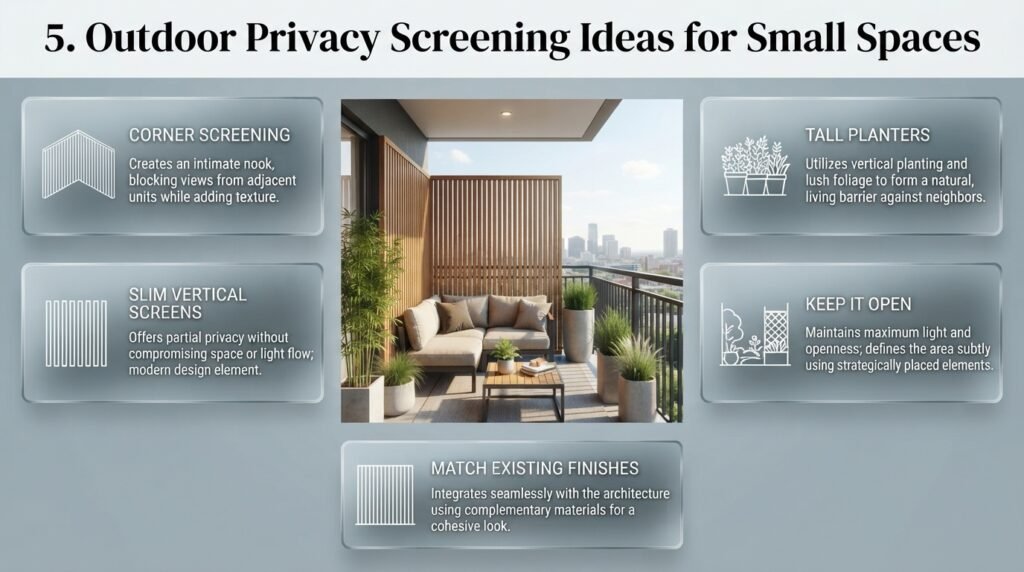
Small balconies, narrow patios, and compact courtyards need a selective approach. A large solid barrier can make the area feel cramped, while a carefully positioned screen may provide the necessary privacy with less visual obstruction.
Use a corner screen behind outdoor seating
An L-shaped arrangement can protect two sides of a seating area without enclosing the whole patio. This works well behind a compact sofa, outdoor bench, or small dining set.
Keep the screen close enough to address the exposed sightlines, but allow comfortable space for sitting, standing, and moving around the furniture.
Add tall planters along an exposed edge
Planters can introduce greenery and help establish a visual boundary. Choose plants that suit the light, wind, container size, and watering conditions.
Large containers can become heavy when filled with wet soil, so balcony residents should confirm the structure’s permitted load before installing multiple planters.
Choose vertical rather than bulky designs
A slim vertical screen or trellis can use limited floor space more efficiently than a wide freestanding divider. Vertical designs can also draw the eye upward, helping a compact space feel more organized.
However, a narrow profile does not automatically mean a screen is safe in wind. Structural stability still matters.
Keep the center visually open
Avoid placing tall panels on every side of a small patio. Concentrate the screening where it is needed and retain an open view in the remaining directions.
For example, a balcony may need coverage along the railing facing a neighboring apartment but not along the side overlooking a garden.
Coordinate the screen with existing finishes
Choose colors and materials that complement the building and outdoor furniture. A dark metal panel may suit contemporary architecture, while natural timber can work well with warm paving and planted containers.
Use a restrained palette to prevent a small space from feeling busy.
For additional ideas about making limited spaces more functional, explore foldaway furniture for sleeping spaces and floating shelf load capacity planning. Although these guides address indoor furniture and storage, the same planning principles apply: measure carefully, understand the intended use, and consider the load and space requirements before installing anything.
6. How Can Plants Create a Natural Privacy Screen?
Plants offer a living alternative to solid panels. They can soften hard boundaries, add color, and create a more relaxed garden atmosphere. Their effectiveness depends on the plant’s mature size, foliage density, growing conditions, and seasonal behavior.
Choose plants suited to the location
Before buying, assess the following:
- Sunlight: Check whether the location receives full sun, partial shade, or mostly shade.
- Mature dimensions: Choose plants that will fit the available width and height when fully grown.
- Water requirements: Match the species to local rainfall and your watering routine.
- Seasonal coverage: Use suitable evergreen species when year-round screening is important.
- Root behavior: Consider the needs of the plant and the restrictions of the planting location.
- Maintenance: Check how often the plant needs pruning, feeding, or repotting.
A plant that looks compact at the garden center may eventually become too wide for a narrow patio. Choosing according to mature size helps prevent overcrowding and repeated cutting.
Use trellises for climbing plants
A suitable trellis provides support for climbing plants and makes use of vertical space. It can be installed beside a patio or used to soften a boundary.
Remember that an empty trellis provides little privacy. Coverage develops as the plant grows, and the result depends on the species, growing season, and care.
If you need immediate coverage, combine the trellis with an appropriately designed screen while the plants establish.
Understand the limitations of bamboo
Bamboo can create a dense green barrier, but some varieties spread through underground rhizomes and may become difficult to control. Growth habits differ between species, so do not assume all bamboo behaves the same way.
Choose a suitable variety, understand its mature size, and use a properly planned containment approach when necessary. Check local planting restrictions before introducing a potentially spreading species.
Plan container planting carefully
Containers offer flexibility for renters and homeowners who do not want to plant directly into the ground. However, plant growth depends on adequate root space, suitable drainage, and consistent watering.
Tall plants can also make containers unstable in wind. Choose appropriately sized planters and secure the arrangement where needed.
💡 Pro Tip: If you need privacy immediately but prefer a green appearance, combine a permanent or approved structural screen with plants. The structure provides initial coverage, while the greenery softens its appearance over time.
For more practical home projects, visit the DIY home projects guide.
7. How Tall Should an Outdoor Privacy Screen Be?
The correct height depends on where the unwanted view originates, the activity taking place, and local restrictions. There is no universal measurement that guarantees privacy for every outdoor space.
A low divider may conceal people sitting behind it, while a taller screen may be required to block a direct view from a neighboring ground-floor window. Upper-floor views can be harder to manage because a vertical screen does not block every angle.
To determine a suitable height:
- Identify the main viewing position.
- Mark the part of the outdoor area that needs protection.
- Test the proposed screen from seated and standing positions.
- Check the view from higher neighboring windows where relevant.
- Confirm local height restrictions and property requirements.
- Evaluate the effect on daylight, airflow, and stability.
Do not assume that the rules for a boundary fence automatically apply to a balcony divider, rooftop screen, or structure attached to a building. Requirements vary according to location and property type.
The goal is to provide enough coverage to solve the problem without introducing unnecessary height, weight, or visual obstruction.
8. Can Privacy Screens Block Wind or Reduce Noise?

Privacy screens can influence wind and sound, but their performance varies. A solid panel may provide shelter from some wind, while a partially open screen allows more airflow. The right arrangement depends on the location and the strength and direction of prevailing winds.
Sound reduction is less predictable. An ordinary decorative screen will not reliably eliminate traffic noise, conversations, or sounds from neighboring properties.
| Screen type | Wind considerations | Noise considerations |
|---|---|---|
| Solid panel | May shelter the seating area but can experience high wind loads | Usually offers limited sound reduction |
| Open slats | Allows airflow and may reduce some gust effects | Limited sound isolation |
| Dense plants | Can filter wind depending on density and placement | May soften the perception of surrounding noise |
| Outdoor curtains | Can provide flexible coverage but may move in strong winds | Generally minimal sound reduction |
If wind protection is important, consider the panel’s area, mounting points, height, and the strength of the supporting structure.
Do not install a large solid panel on a balcony without checking whether the railing and fixings can safely support the additional wind load.
If noise is the main concern, investigate suitable acoustic measures rather than relying on a decorative screen to function as a sound barrier.
9. What Is the Best Material for Low-Maintenance Privacy Screening?
For many homeowners, aluminum and suitable composite panels are attractive low-maintenance options. However, the best choice depends on the product’s quality, local climate, installation method, and expected lifespan.
| Material | Routine care | Main consideration |
|---|---|---|
| Timber | Cleaning and periodic protective treatment as required | Moisture and finish deterioration |
| Aluminum | Cleaning and inspection | Coating quality and fixing compatibility |
| Steel | Cleaning and inspection of protective coating | Corrosion if protection is damaged |
| Composite | Cleaning and inspection | Heat, expansion, and product quality |
| Living plants | Watering, pruning, and plant care | Growth, seasons, and growing conditions |
| Outdoor fabric | Cleaning, drying, and suitable storage | Wind, fading, and moisture |
Avoid judging materials by their advertised maintenance claims alone. Check the manufacturer’s instructions and warranty, particularly if the screen will be exposed to direct sunlight, heavy rain, or salty coastal air.
A low-maintenance product still requires occasional inspection. Loose fixings, damaged coatings, blocked drainage, and unstable supports should be addressed promptly.
10. How Much Does Outdoor Privacy Screening Cost?
The total cost depends on the material, screen dimensions, installation method, supporting structure, and amount of preparation required. A small removable screen can cost considerably less than a long custom-built structure with professional installation.
Rather than relying on one general price estimate, compare complete project costs.
Include the following items in your budget:
- Screen panels or plant materials.
- Posts, brackets, fixings, and suitable foundations.
- Installation labor where needed.
- Surface preparation or repairs.
- Protective coatings or finishing materials.
- Planters, soil, and irrigation if using living screens.
- Future cleaning, maintenance, and replacement components.
Compare the total project, not just the panel price
A low-cost panel may require additional framing or reinforcement. A higher-priced product may include the mounting components needed for installation, but this should be confirmed rather than assumed.
Request a breakdown when comparing installers. Check what is included, whether the supporting structure will be inspected, and how the contractor will handle drainage, access, and finishing.
Where can you save money safely?
You may reduce costs by screening only the necessary area, selecting standard panel sizes, reusing suitable existing structures, or choosing a straightforward design.
However, do not reduce costs by using unsuitable fasteners, unstable bases, or materials not designed for outdoor exposure.
The best budget decision is one that meets the privacy requirement safely and remains practical over time.
11. How Do You Install an Outdoor Privacy Screen Safely?
A successful installation depends on the screen’s weight, height, wind exposure, and supporting surface. A screen attached to a sound masonry wall requires a different approach from a freestanding panel or a screen fixed to a balcony railing.
Before starting, check local regulations, property boundaries, lease conditions, and any building-management requirements. This is especially important for apartment balconies, shared gardens, rooftop terraces, and structures attached to exterior walls.
Step 1: Inspect the supporting structure
Check whether the proposed wall, post, railing, or deck can support the screen. Look for cracks, corrosion, loose connections, water damage, or signs of deterioration.
Do not assume that a railing designed to protect people can also support a large additional panel. If the structural capacity is uncertain, seek professional advice.
Step 2: Choose suitable fixings
Fixings should be appropriate for both the screen material and the supporting surface. Outdoor exposure can accelerate corrosion, so use compatible exterior-rated hardware.
Follow the manufacturer’s specifications for fixing type, spacing, and installation. Avoid improvising connections that may loosen or fail under wind pressure.
Step 3: Plan drainage and access
The installation should not block drains, trap water against walls, obstruct doors, or make maintenance difficult.
Leave appropriate access for cleaning and inspection. If plants are part of the design, allow room to trim them without dismantling the screen.
Step 4: Check the finished installation
Once installed, inspect the panel for movement, loose connections, sharp edges, and unstable supports. Follow the manufacturer’s maintenance instructions and inspect the installation after severe weather.
For substantial panels, elevated installations, or complex structural connections, a qualified installer can help assess the risks and select an appropriate mounting system.
For more practical renovation guidance, explore the Home Improvement section.
12. What Are the Most Common Outdoor Privacy Screening Mistakes?
Many disappointing results come from choosing a screen based on appearance alone. A product may look attractive in a photograph but fail to provide the necessary coverage, fit the available space, or withstand local weather.
Choosing a screen before checking sightlines
A screen may block one view while leaving another completely open. This often happens when homeowners measure the boundary but overlook neighboring windows or elevated viewpoints.
How to avoid it: Test the proposed location from the places where privacy matters most. Check seated and standing positions before purchasing materials.
Installing a barrier that is too large
A tall, solid screen may solve the privacy problem but make the garden feel cramped or reduce useful daylight.
How to avoid it: Start with the smallest practical screening area. Add coverage only where testing shows it is needed.
Ignoring wind exposure
Large panels can create substantial wind loads. Inadequate fixings or unsuitable freestanding bases can result in movement, damage, or injury.
How to avoid it: Assess the installation conditions and use a system designed for the panel dimensions and exposure. Seek professional guidance when necessary.
Selecting unsuitable plants
Fast-growing plants may seem ideal for privacy, but some become too large, spread aggressively, or require more maintenance than expected.
How to avoid it: Check mature dimensions, root behavior, sunlight requirements, and seasonal coverage before planting.
Forgetting about nighttime privacy
Open-pattern screens may appear private during daylight but reveal silhouettes when the space behind them is illuminated.
How to avoid it: Test the design after dark and position outdoor lighting carefully. Consider opaque panels where stronger visual coverage is necessary.
Overlooking maintenance
A screen can become difficult to care for if it sits too close to plants, traps moisture, or blocks access to fixings.
How to avoid it: Plan for cleaning, pruning, inspection, and repairs before finalizing the layout.
Ignoring permissions
A screen that changes a building’s exterior, increases the height of a boundary, or attaches to a shared structure may require approval.
How to avoid it: Confirm applicable rules before buying or installing anything permanent.
13. How Can You Make Privacy Screening Look Stylish?
Privacy screening should feel like a deliberate part of the outdoor design rather than an obstacle added after everything else. A consistent palette, balanced proportions, and carefully chosen materials can make even a simple screen look polished.
Choose a coordinated color palette
Consider the color of your exterior walls, paving, decking, planters, and furniture. Natural timber often works well with greenery and warm neutral surfaces. Dark metal can complement contemporary architecture, while lighter finishes may help compact spaces feel more open.
Avoid introducing too many unrelated colors. One main screening material and one or two complementary finishes are often enough.
For further guidance on coordinating colors and finishes, explore Paint Color.
Balance texture with simplicity
A screen can introduce texture through timber grain, metal patterns, foliage, or composite surfaces. However, combining several strong patterns in a small area can make the design feel busy.
If the screen has a bold geometric pattern, keep nearby furniture and accessories relatively simple. If the screen is plain, plants and textured cushions can provide visual interest.
Add lighting thoughtfully
Outdoor-rated lighting can highlight the screen’s texture and make the surrounding area more inviting. Low-glare fixtures can illuminate a seating area without directing bright light toward neighboring windows.
Check electrical safety requirements and choose products rated for their installation conditions.
Keep the surroundings organized
A screen looks better when it is not crowded by unused furniture, tangled hoses, or too many decorative objects. Maintain clear walking routes and group accessories thoughtfully.
The same principle applies to indoor styling. Styling open shelves without clutter offers related ideas about maintaining visual balance while keeping practical items accessible.
14. How Can You Create Privacy Around an Outdoor Dining Area?
Outdoor dining areas need enough privacy to make meals comfortable while retaining room for people to move around chairs and serving spaces.
Start by positioning the table where it works best for sunlight, access, and the surrounding views. Then identify the side that needs screening.
A short panel beside the table may be enough to block a direct view from a neighboring patio. If the dining area sits beside a busy walkway, a planted divider may create a more comfortable separation.
Keep circulation clear
Allow enough space to pull chairs out and walk behind seated guests. The required clearance depends on the table, chair dimensions, and how people use the area.
Avoid placing a screen so close to a dining chair that guests must squeeze past it. The privacy improvement should not make the dining area inconvenient.
For more detailed planning principles, see dining room circulation clearance. Although it focuses on indoor dining, its attention to usable clearance is equally relevant when arranging outdoor furniture.
Consider sunlight and glare
A screen may provide welcome shade during strong afternoon sun, but it can also make a dining area too dark at other times.
Observe the direction of sunlight before choosing the panel position. If the screen is intended mainly to block views rather than sun, consider a design that maintains more openness.
Choose easy-care materials
Outdoor dining areas experience food spills, dust, moisture, and frequent use. Select a material that can be cleaned without complicated maintenance.
Keep the surrounding area practical, with sufficient room to clean the screen and access nearby doors or storage.
15. How Do You Maintain Outdoor Privacy Screening?
Regular maintenance protects both appearance and performance. The amount of care required depends on the material, climate, and installation conditions.
Maintain timber screens
Inspect timber for loose boards, damaged finishes, moisture retention, and signs of deterioration. Clean it using suitable products and reapply protective treatments according to the manufacturer’s guidance.
Pay particular attention to the lower sections and connections, where moisture can accumulate.
Maintain metal and composite panels
Clean surfaces with products recommended by the manufacturer. Inspect coatings, joints, fixings, and exposed edges for damage.
If a protective coating is scratched or damaged, follow the manufacturer’s repair recommendations. Do not assume that every metal finish can be repaired with the same product.
Maintain living screens
Check plants for adequate water, healthy growth, and overcrowding. Prune when appropriate for the species, and remove dead or damaged growth.
Inspect containers and supports, especially after strong winds. Ensure that water can drain and that containers remain stable.
Maintain retractable systems
Check moving parts, brackets, fabric, and operating mechanisms. Clean and dry components as recommended, and secure or store them during unsuitable weather.
A simple inspection routine can help identify small issues before they require more extensive repairs.
16. How Can Outdoor Privacy Screening Work With the Rest of Your Home?
A well-designed outdoor screen should complement the home’s overall layout rather than operate as an isolated feature. Its materials, proportions, and location can support a consistent approach to practical home improvement.
For example, a garden beside a kitchen may benefit from a screened dining area with easy access to the house. A balcony connected to a bedroom may need a more relaxed arrangement with compact seating and privacy from neighboring windows.
Think about how the outdoor space connects to the rooms beside it. Consider the views from indoor windows, the route through exterior doors, and whether the screen blocks natural light entering the home.
Useful planning principles include:
- Keep access routes clear.
- Avoid blocking drainage or ventilation openings.
- Coordinate outdoor finishes with visible interior colors where appropriate.
- Consider how furniture and storage affect movement.
- Make sure the screen does not create difficult-to-clean gaps.
- Preserve safe access to doors, steps, and shared areas.
If your project also involves changes inside the home, wardrobe hanging rail height and bathroom linen closet planning provide examples of how dimensions and everyday use influence design decisions.
Similarly, entryway storage capacity planning illustrates the importance of allowing enough room for access rather than focusing only on appearance.
When a project involves fixed structural elements, designing around structural walls offers related planning inspiration. For material-conscious indoor projects, low-VOC interior finishes provides additional information about selecting interior finishes with lower volatile organic compound emissions.
These are complementary design resources, not substitutes for outdoor structural guidance or the manufacturer’s installation requirements.
17. Expert Tips for Getting the Best Results
A practical screening plan should solve the privacy problem while remaining safe, comfortable, and easy to maintain. These recommendations help bring the design together.
Prioritize the main problem. Identify whether the issue is a direct view from a window, exposure to a public path, or a lack of separation between outdoor activities. Choose the screen accordingly.
Test before committing. Use temporary markers or a movable divider to explore the proposed location. Observe the result from different positions and at different times of day.
Think about the future. Consider whether plants will grow larger, whether furniture arrangements might change, and whether the screen will remain accessible for repairs.
Check structural safety. Make sure the supporting surface and fixing system are appropriate for the panel’s dimensions and exposure.
Avoid unnecessary enclosure. Privacy does not require blocking every view. Preserving an open side can help the space feel larger and more connected to its surroundings.
Plan for maintenance. Select a design that you can clean, inspect, and repair without excessive effort.
Review the complete design. Consider how the screen works with paving, planting, furniture, lighting, and nearby doors. A balanced layout usually feels more attractive than a collection of unrelated barriers.
For broader inspiration on creating functional and attractive living spaces, return to DesignMode24 Interior Design.
What Is the Best Way to Create Privacy in an Outdoor Space Without Blocking Natural Light?
The best way to create outdoor privacy without losing natural light is to use targeted screening instead of enclosing the entire area. Slatted timber panels, decorative metal screens, carefully positioned planters, and climbing plants can reduce direct views while keeping the space visually open. The right choice depends on the direction of neighboring windows, the amount of sunlight available, and how much privacy you need.
For example, if your patio is overlooked from one side, a screen positioned behind the seating area may provide sufficient coverage without blocking sunlight from the opposite direction. On a balcony, a combination of planters and a partially open screen can offer a practical balance between privacy and openness.
Useful tips:
Position the screen where it blocks the main viewing angle rather than covering every boundary.
Choose slatted or patterned designs when partial visibility is acceptable.
Check how the screen affects sunlight at different times of day.
Use plants to soften the appearance without overcrowding a small space.
Which Outdoor Privacy Screening Material Is the Most Durable and Low-Maintenance?
Aluminum and suitable composite panels are popular choices for homeowners who want durable outdoor privacy screening with relatively little routine maintenance. Aluminum is lightweight and generally resistant to corrosion, while composite materials can provide a consistent finish without the regular staining associated with many timber products. However, durability depends on product quality, installation, climate, and exposure to moisture or strong sunlight.
Timber remains a good option when a natural appearance is important, but it may require periodic sealing or protective treatment. Metal screens also need occasional inspection, particularly where coatings or fixings could deteriorate. Comparing the manufacturer’s maintenance instructions and warranty can help you select a product that suits your outdoor environment.
Useful tips:
Choose exterior-rated materials and fixings.
Check UV resistance and weather suitability before purchasing.
Inspect joints, supports, and protective coatings regularly.
Compare long-term maintenance costs rather than looking only at the initial price.
How Can I Make a Small Balcony or Patio More Private Without Making It Feel Cramped?
A small balcony or patio usually benefits from selective screening, vertical design, and a layout that keeps the center of the space open. Instead of installing large panels around every side, focus on the areas directly exposed to neighboring windows or walkways. Slim screens, suitable planters, and retractable dividers can provide privacy while preserving usable floor space.
The arrangement of outdoor furniture also matters. Placing a sofa or dining set near a carefully positioned screen can create a more sheltered seating area without requiring a complete enclosure. Light, coordinated finishes and a limited color palette help the space feel organized rather than crowded.
Useful tips:
Screen only the exposed sides.
Choose narrow-profile panels or vertical trellises where appropriate.
Use planters that fit the available space and balcony load limits.
Keep doors, walking routes, and access to drainage clear.
Avoid combining too many large panels, bulky furniture, and decorative objects.
How Tall Should an Outdoor Privacy Screen Be to Block Neighbors’ Views?
The appropriate height depends on the position of neighboring windows, the height of your seating area, and the angle from which people can see into your outdoor space. A screen that blocks a view from a nearby garden may not prevent overlooking from an upper-floor window. For this reason, measuring the area alone is not enough; you should also assess the actual sightlines.
Before installation, check the proposed screen from seated and standing positions and consider how its height affects sunlight, airflow, and the overall appearance. Local regulations, property boundaries, lease conditions, and building-management rules may also restrict screen height or installation methods.
Useful tips:
Identify the exact viewing angle you want to block.
Test the proposed height before purchasing materials.
Consider upper-floor views where relevant.
Confirm local height restrictions and property requirements.
Avoid unnecessarily tall panels that may create wind-loading or structural concerns.
Can Plants Provide Effective Year-Round Privacy for Gardens, Balconies, and Patios?
Plants can provide effective natural privacy when the species, growing conditions, and planting arrangement suit the location. Evergreen shrubs are useful when year-round foliage is important, while climbing plants can soften a trellis or screen. However, living screens take time to establish, and their coverage depends on plant maturity, foliage density, sunlight, water, and seasonal growth.
For immediate privacy, plants can be combined with a suitable structural screen. The panel provides initial coverage while the greenery grows, creating a softer appearance over time. When choosing plants, consider their mature height, spread, root behavior, and maintenance needs, especially if they will grow in containers on a balcony.
Useful tips:
Choose plants suited to local weather and sunlight.
Check mature dimensions before planting.
Select suitable evergreen varieties if winter coverage matters.
Provide appropriate drainage, watering, and pruning.
Secure tall containers and consider balcony load limits before installation.
Conclusion
Outdoor space privacy screening is an effective way to make balconies, patios, gardens, and outdoor dining areas feel more comfortable, attractive, and functional. The right screening solution can reduce unwanted views, define separate outdoor zones, soften harsh surroundings, and create a relaxing environment without making the space feel closed off. Whether you choose decorative timber panels, modern metal screens, outdoor curtains, climbing plants, or a combination of materials, the best option is one that suits your space, privacy requirements, climate, and maintenance preferences.
Before installing a screen, consider how sunlight, airflow, wind exposure, drainage, and neighboring sightlines affect your outdoor area. Measure carefully, select weather-resistant materials, and ensure that freestanding or fixed screens are securely installed. In smaller spaces, lighter colors, open patterns, and vertical greenery can provide privacy while maintaining an open appearance. For larger gardens and patios, combining solid panels with plants or trellises can create a more natural and balanced design.
A successful privacy screen should do more than block unwanted views. It should complement your home’s architecture, support your everyday activities, and make outdoor living more enjoyable throughout the year. With thoughtful planning and practical material choices, you can transform an exposed outdoor area into a private, welcoming retreat that balances comfort, style, and functionality.