
Introduction
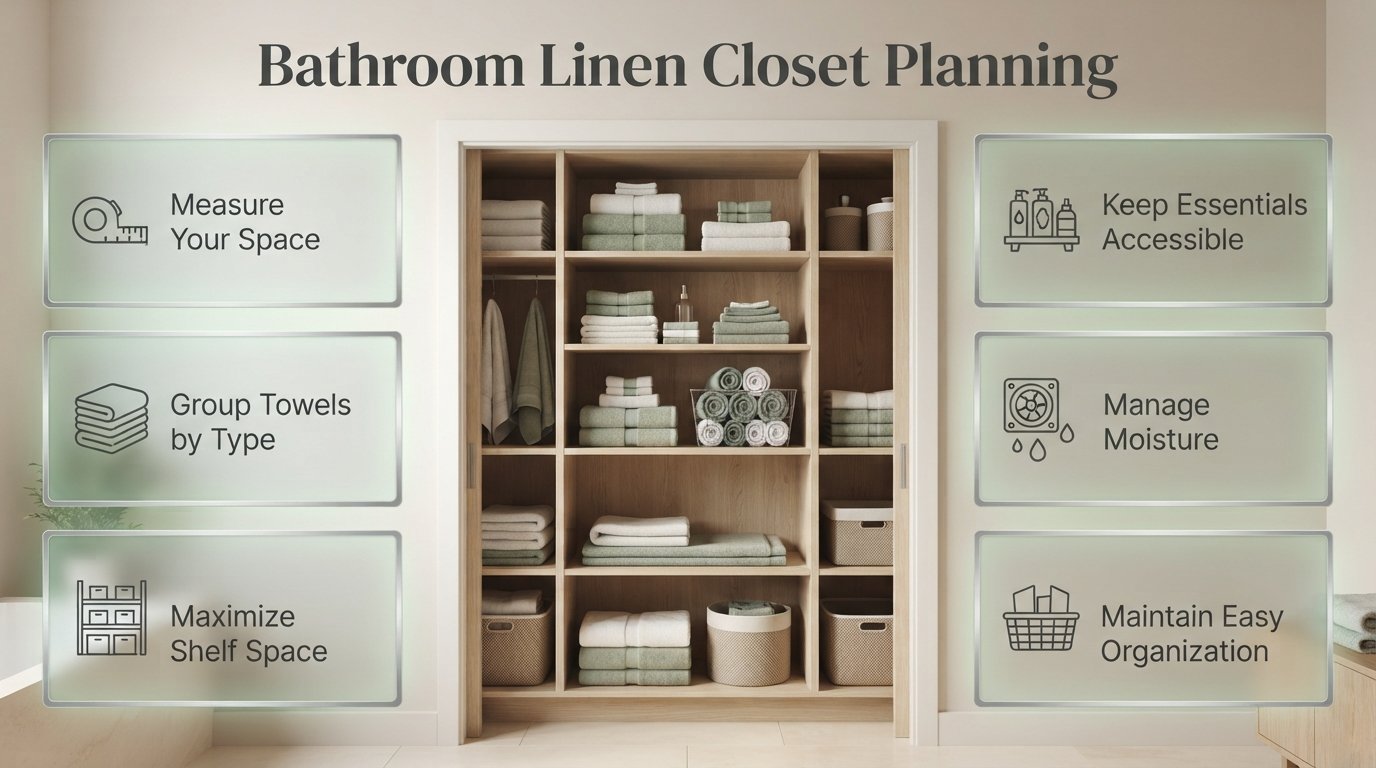
Bathroom Linen Closet Planning | A bathroom linen closet can become cluttered even when it looks spacious. Towels pile up, spare toiletries disappear behind other products, and bath mats take up more room than expected. Before long, finding a clean towel becomes frustrating, and organizing the closet feels like a job that needs to be repeated every week.
Bathroom linen closet planning solves this problem by helping you decide what to store, how much space each category needs, and how to arrange shelves for everyday convenience. A successful plan considers your household size, towel collection, bathroom humidity, available storage, and preferred interior style.
At DesignMode24 Interior Design, practical interior planning focuses on making spaces work as well as they look. The same principle applies to linen closets: you don’t need expensive cabinetry or dozens of matching baskets to achieve an organized result.
This guide explains how to measure your closet, calculate storage capacity, choose shelving, organize towels, manage moisture, improve accessibility, and create a system that remains useful over time. You’ll also learn how to plan a small linen closet, avoid common storage mistakes, and decide when custom shelving is worth the investment.
1. What Is Bathroom Linen Closet Planning, and Why Does It Matter?
Bathroom linen closet planning is the process of designing an efficient storage arrangement for towels, washcloths, bath mats, toiletries, spare bathroom supplies, and other household essentials. It involves measuring the available space, deciding which items belong inside, selecting suitable shelving, and organizing everything according to frequency of use.
The purpose is not simply to fit more items into a cupboard. It’s to make the things you need easy to find, easy to remove, and easy to put back.
A properly planned linen closet offers several practical benefits:
- Better accessibility: Daily towels and essential products remain within comfortable reach.
- Less clutter: Every category has a designated location, reducing random piles.
- More efficient storage: Appropriate shelf spacing makes better use of vertical space.
- Cleaner linens: Proper organization reduces unnecessary handling and helps keep towels away from leaking products.
- Simpler household routines: Family members can find and return items without disturbing the entire closet.
- A more attractive interior: Consistent folding, coordinated containers, and thoughtful finishes create a tidy appearance.
Consider a household of four that uses several towels each day. If every towel is stacked in one large pile, the bottom towels become difficult to reach, and the closet quickly looks disorganized. Separating bath towels, hand towels, and washcloths creates a more useful arrangement without requiring additional floor space.
The best plan is always based on actual needs. A compact guest bathroom does not require the same storage capacity as a family bathroom with multiple users.
2. How Do You Assess Your Bathroom Linen Storage Needs?
Before buying storage accessories or installing new shelves, determine what the closet must accommodate. This step prevents unnecessary purchases and helps you avoid designing a storage system around items you rarely use.
Start by Taking Inventory
Empty the closet and sort everything into logical categories. Remove empty packaging, discard unusable items, and identify products that belong in another room.
Use these categories as a starting point:
- Bath towels and bath sheets
- Hand towels and washcloths
- Bath mats and shower towels
- Guest towels and spare linens
- Toilet paper and tissues
- Backup shampoo, conditioner, soap, and toiletries
- First-aid supplies and personal care products
- Other bathroom essentials
Keep cleaning products separate from clean fabrics. Store chemicals in their original containers, follow their safety instructions, and ensure children cannot access them.
Once everything is sorted, look at how frequently each category is used. Daily essentials deserve convenient storage, while occasional supplies can occupy less accessible shelves.
Calculate How Many Towels You Actually Need
There is no universal number of towels every household should own. The appropriate quantity depends on the number of people, laundry frequency, drying conditions, personal preferences, and whether you regularly host guests.
A useful starting inventory might include:
| Item | Planning consideration |
|---|---|
| Bath towels | Number of regular users and replacement sets |
| Hand towels | Bathroom usage and changing frequency |
| Washcloths | Skincare routines and laundry habits |
| Bath mats | Number of bathrooms and washing frequency |
| Guest towels | Frequency of overnight visitors |
| Spare linens | Available storage and replacement needs |
For example, a household that washes towels every few days may need fewer backups than a household that does laundry once a week. Both arrangements can work well if the storage capacity matches the routine.
Avoid keeping excessive duplicates simply because they’re available. Unused towels occupy space that could make everyday storage more convenient.
Decide Which Items Really Belong in the Closet
A linen closet can easily become a general-purpose cupboard. Spare electronics, unrelated household products, bulky appliances, and miscellaneous packaging gradually take over valuable space.
Keep the closet focused on linens and bathroom essentials. Move unrelated belongings to more suitable storage locations.
This is particularly important when planning a small bathroom. A clear purpose for each shelf makes the entire system easier to maintain.
3. How Do You Measure a Bathroom Linen Closet Correctly?
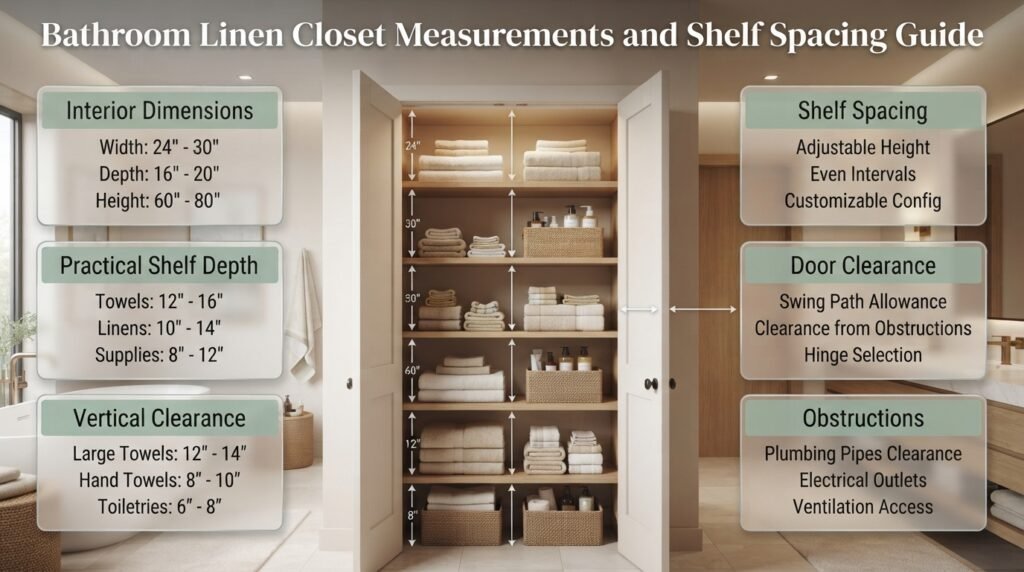
Accurate measurements help determine shelf depth, shelf spacing, organizer dimensions, and the amount of usable storage available. Measure the interior rather than relying on exterior cabinet dimensions, which may include wall thickness, trim, or door framing.
Measure Width, Depth, and Height
Record these dimensions before purchasing anything:
| Measurement | Why it matters |
|---|---|
| Interior width | Determines how many towel stacks or bins fit side by side |
| Usable depth | Helps establish how far folded towels extend into the closet |
| Interior height | Shows whether additional shelves are possible |
| Existing shelf spacing | Identifies areas where vertical space is wasted |
| Door opening | Determines whether baskets and containers can be removed easily |
| Obstructions | Accounts for trim, plumbing, sloped ceilings, or hinges |
Measure at more than one point if the walls are uneven. Older homes may have slight variations that affect fitted shelving.
Also consider how the closet door opens. A container may fit inside the cupboard but still be difficult to remove if the opening is narrow or the door restricts access.
How Deep Should Linen Closet Shelves Be?
For many folded towels, a shelf depth of approximately 12–16 inches is a practical starting point. The ideal depth depends on the size of your towels, how you fold them, and whether you intend to use baskets.
Shallow shelves are often easier to organize because items remain visible and accessible. Deeper shelves can accommodate larger bath sheets, but they may encourage double rows of products that are difficult to reach.
Before installing shelves, fold your largest towels in the intended style and measure the resulting depth. Use a cardboard template if you want to test the layout without purchasing materials.
How Much Space Should You Leave Between Shelves?
Shelf spacing should accommodate the actual height of stored items rather than follow a rigid standard.
| Approximate vertical clearance | Suitable items |
|---|---|
| 6–8 inches | Small towels and washcloths |
| 10–12 inches | Many folded bath towels |
| 12–16 inches | Bulky towels and bath mats |
| Greater clearance | Large baskets and occasional-use supplies |
These are starting estimates, not fixed rules. Thick bath sheets may require more room, while tightly folded hand towels need less.
Professional planning tip: Allow enough clearance to lift the top towel from a stack without scraping your hand against the shelf above. A closet that technically holds more items may be less useful if everything is difficult to retrieve.
If you’re considering floating shelves, review floating shelf load capacity planning before selecting brackets and supports. Shelf depth, wall construction, hardware, and the expected load all influence a safe installation.
4. How Should You Design the Best Linen Closet Shelf Layout?
An effective layout places frequently used items in accessible positions, keeps categories separate, and reserves less convenient shelves for occasional supplies.
Divide the Closet Into Storage Zones
Instead of assigning space randomly, give each shelf or section a clear purpose.
A practical arrangement might include:
- Upper shelves: Guest linens, seasonal items, and lightweight extras.
- Upper-middle shelves: Backup towels and spare bath mats.
- Eye-level shelves: Everyday bath towels and hand towels.
- Lower shelves: Washcloths, toilet paper, and suitable refill supplies.
- Bottom area: Bulky but manageable items, provided they can be lifted safely.
Adapt this arrangement to the people who use the closet. If a household member has limited mobility, frequently used supplies may need to be stored lower or in another accessible location.
Heavy products should not be stored overhead, and shelves must be adequately supported for their intended loads.
Choose Between Fixed and Adjustable Shelves
Fixed shelving works well when the closet dimensions and storage needs are unlikely to change. It can provide a straightforward, economical arrangement.
Adjustable shelving is often more versatile because shelf heights can be changed when you purchase different towels, introduce storage bins, or reorganize supplies.
| Shelf type | Best use | Main consideration |
|---|---|---|
| Fixed shelves | Predictable storage requirements | Limited future flexibility |
| Adjustable shelves | Changing storage needs | Requires suitable support hardware |
| Pull-out shelves | Deep storage spaces | Needs room for hardware and extension |
| Wire shelving | Lightweight items and airflow | Small products may need containers |
| Solid shelving | Towels and small accessories | Moisture management remains important |
For many households, adjustable solid shelves offer a useful balance between flexibility and convenience.
If you’re planning a larger renovation, consider how the closet relates to surrounding walls, doors, and cabinetry. Designing around structural walls provides a useful starting point for thinking about spatial limitations before changing the layout.
Should You Add More Shelves?
Adding shelves can improve storage when there is substantial unused vertical space. However, more shelves do not automatically mean better organization.
Before adding one, check whether your existing items can be arranged more efficiently. If your towel stacks are too tall, another shelf may help. If the closet is already overcrowded with unnecessary products, decluttering is the better solution.
Measure the items that will occupy each section and leave enough room for comfortable retrieval. Secure all new shelves using hardware suitable for the wall construction and expected load.
5. What Are the Best Ways to Organize Towels in a Small Linen Closet?
A small closet benefits from consistent folding, clear categories, and manageable stacks. The objective is to make each towel easy to retrieve without disturbing other items.
Select a Folding Method That Fits Your Shelves
Different folding methods work better in different spaces.
Standard rectangle folding is suitable for conventional shelves. Fold the towel lengthwise and then into a compact rectangle that fits the shelf depth.
Compact folding works well when shelves are shallow or vertical clearance is limited. Fold towels into smaller sections while keeping the final dimensions consistent.
Rolling can be useful for baskets, narrow compartments, or situations where towels are stored vertically. However, rolling is not automatically more space-efficient than folding. Test both approaches before choosing one.
The most important factor is consistency. Towels of similar dimensions stack more neatly and make better use of available space.
Separate Towels by Type
Keep bath towels together, hand towels in their own section, and washcloths in a shallow basket or small stack.
This arrangement prevents smaller items from disappearing beneath larger towels. It also makes it easier to return clean laundry to the correct place.
In a shared bathroom, you may prefer to assign sections to individual household members. Keep the system simple enough that everyone can follow it.
How Many Towels Should You Stack Together?
The ideal stack height depends on shelf clearance, towel thickness, and how comfortably you can reach the top and bottom towels.
Avoid building tall stacks that lean forward or become unstable when a towel is removed. If the stack repeatedly collapses, reduce its height or divide it into two smaller piles.
Quick tip: Keep one guest towel set together rather than mixing it into your everyday collection. This saves time when preparing the bathroom for visitors.
Make the Most of Narrow Storage Spaces
A narrow closet can still work well when the shelf dimensions match the stored items.
Try these strategies:
- Use compact folded towels instead of oversized stacks.
- Keep washcloths in a small, removable container.
- Avoid double rows of items that hide the products behind them.
- Store bulky bath sheets on shelves with sufficient clearance.
- Consider a suitable additional shelf if there is unused vertical space.
If a room has an unusual shape or limited floor area, space-saving ideas from foldaway furniture for sleeping spaces can also encourage a useful design mindset: prioritize flexible solutions that match the available space rather than forcing a standard layout into it.
6. Which Organizers Are Worth Using in a Bathroom Linen Closet?

Storage organizers are most useful when they solve a specific problem. Baskets contain small products, dividers stabilize stacks, and clear bins make backup supplies easier to identify.
You don’t need to buy a matching set of every organizer available.
Baskets for Small Essentials
Baskets work well for toiletries, skincare products, travel-size supplies, and other small items that would otherwise spread across the shelf.
Choose a size that fits the intended category without wasting space. A removable basket should be easy to lift, and its contents should remain visible or clearly labeled.
Useful categories include spare shampoo, dental care products, first-aid supplies, and guest toiletries.
Keep liquids upright and inspect their packaging for leaks. Avoid storing products that could contaminate clean towels.
Clear Bins for Backup Products
Clear bins make it easier to check stock without removing every item from the shelf. They are particularly useful for spare soap, sealed toiletries, and small bathroom accessories.
Don’t pack bins so tightly that products become difficult to remove. Leave enough room to see what’s inside and check quantities before buying replacements.
Shelf Dividers for Towel Stacks
Dividers can keep separate towel piles from leaning into one another. They are particularly useful on wide shelves or when different towel sizes are stored together.
However, dividers may be unnecessary in a narrow closet where the shelf itself naturally limits sideways movement.
Matching Containers or Mixed Organizers?
Matching containers create a coordinated look, while mixed organizers can provide better functionality.
For example, you might use open baskets for towels, clear bins for toiletries, and a larger washable container for bath mats. Choose based on the item being stored rather than appearance alone.
If you want to display a few attractive items on open shelving, styling open shelves without clutter offers relevant ideas for balancing visual appeal with everyday usability.
7. How Can You Protect Bathroom Linens From Moisture?
Moisture management is one of the most important parts of bathroom linen closet planning. Towels stored in a damp environment can develop unpleasant odors, and persistent moisture may contribute to mold growth.
The best storage arrangement keeps clean fabrics dry, allows appropriate air circulation, and addresses the source of excess humidity.
Never Store Damp Towels
Used towels should dry completely before being returned to a linen closet. Even slightly damp fabric can transfer moisture to neighboring towels.
Hang used towels in a suitable drying area rather than placing them directly into a closed cupboard. If the bathroom remains humid long after showering, consider improving ventilation or moving the linen storage to a drier location.
Improve Bathroom Ventilation
Practical measures include:
- Running the exhaust fan during showers and for the recommended period afterward.
- Keeping towels loosely arranged rather than compressing them tightly.
- Checking for condensation, leaks, and damp wall surfaces.
- Leaving space around stored fabrics where practical.
- Cleaning shelves periodically and allowing them to dry completely.
If the closet repeatedly develops a musty smell, investigate the underlying cause instead of relying on fragrance products.
Persistent dampness may indicate inadequate ventilation, a plumbing leak, or moisture entering through a wall. Address the source before returning linens to the affected area.
Which Materials Work Best in Humid Conditions?
| Material | Benefits | Considerations |
|---|---|---|
| Sealed wood | Warm appearance and versatile finishes | Damaged finishes may absorb moisture |
| Moisture-resistant laminate | Smooth, easy-to-clean surfaces | Edges and joints require suitable protection |
| Metal | Durable and straightforward to maintain | Use a finish suitable for the environment |
| Plastic bins | Lightweight and washable | Avoid trapping damp fabrics inside |
| Woven baskets | Natural texture and visual warmth | Need appropriate cleaning and drying |
No material makes a closet immune to moisture. The best choice depends on the bathroom environment, installation quality, and maintenance routine.
When renovating, consider finishes that are appropriate for indoor air quality and the intended application. Low VOC interior finishes provides related information about selecting interior materials. Remember that low VOC content does not, by itself, guarantee water resistance or mold prevention.
8. What Should You Store in a Bathroom Linen Closet?
A linen closet should hold items that support bathroom routines without becoming a catch-all cupboard.
Items That Usually Belong
- Clean bath towels, hand towels, and washcloths.
- Spare bath mats and shower towels.
- Guest linens and selected guest toiletries.
- Toilet paper and tissues.
- Backup personal care products in secure packaging.
- Other lightweight bathroom essentials used regularly.
Items That Should Usually Be Stored Elsewhere
- Damp towels or recently used bath mats.
- Large appliances that make shelves difficult to access.
- Unrelated household supplies.
- Excess products that are rarely used.
- Heavy objects that exceed shelf capacity.
- Cleaning chemicals placed beside clean fabrics.
Cleaning products must remain in their original containers and be stored according to their labels. Keep them separate from towels and inaccessible to children.
If the closet is shared with other household storage, establish clear boundaries. A dedicated section may be reasonable, but unrelated items should not gradually consume the space needed for linens.
9. How Can You Make a Linen Closet Look Stylish Without Spending Too Much?
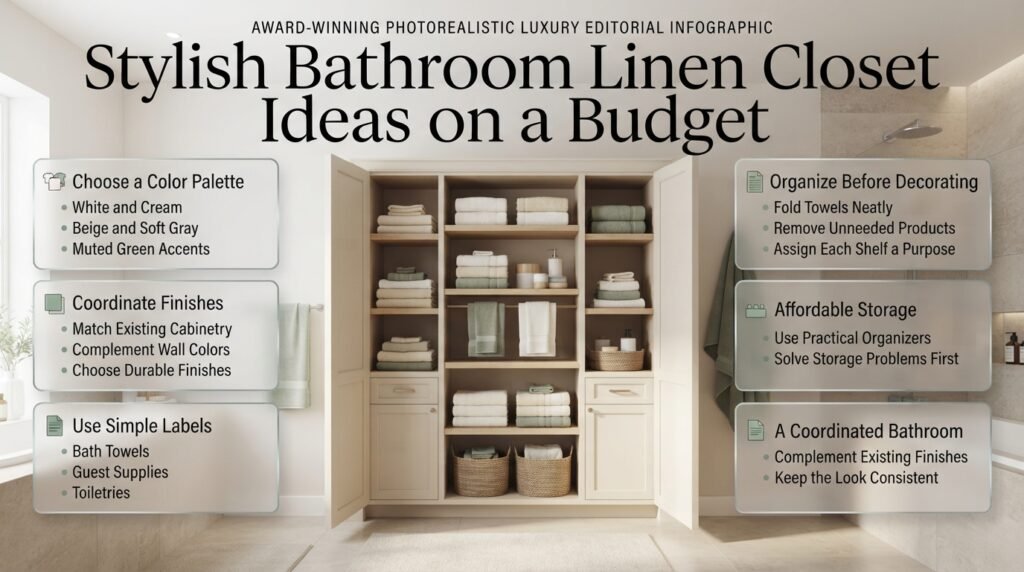
An attractive linen closet doesn’t need expensive baskets or custom cabinetry. Consistent folding, coordinated towel colors, clean shelves, and a few practical organizers can create a polished appearance.
Choose a Simple Color Palette
White, cream, beige, soft gray, and muted green can create a calm, coordinated look. Choose colors that complement the bathroom’s existing tiles, cabinetry, and wall finishes.
You don’t have to replace every towel. Start by grouping similar colors together and using one accent color for guest towels or hand towels.
For additional inspiration, explore the Paint Color section.
Coordinate Shelves With the Rest of the Bathroom
The closet should complement the wider interior rather than look like an unrelated addition.
Consider the existing cabinet finish, hardware, wall color, and flooring. A simple white shelf can look intentional in a light bathroom, while a wood finish may suit a warmer interior.
When choosing finishes, balance appearance with durability and maintenance requirements.
Use Labels Where They Help
Labels are useful when several people share the closet or when containers look similar.
Simple categories such as “Bath Towels,” “Guest Supplies,” and “Toiletries” are generally sufficient. Label every small item only if doing so genuinely makes the storage system easier to use.
Organize First, Decorate Second
Before buying decorative accessories, fold the towels, remove unnecessary products, and assign a purpose to each shelf.
You may find that the closet already looks significantly better. Spend money only on items that solve a remaining problem, such as unstable stacks, inaccessible supplies, or poorly used vertical space.
For wider home improvement projects, the DIY home projects section can provide additional inspiration for practical upgrades around the home.
10. How Do You Plan a Linen Closet During a Bathroom Renovation?
Planning storage during a renovation allows you to consider the closet alongside lighting, cabinetry, plumbing, wall construction, and circulation. This is often easier than trying to solve storage problems after the rest of the bathroom has been completed.
Establish Storage Requirements Before Choosing Finishes
Decide what the closet needs to hold, then determine the dimensions and shelving arrangement. This prevents decorative choices from limiting everyday functionality.
If you are commissioning custom cabinetry, communicate the intended use of each section. Tell the installer whether you need space for large bath sheets, small toiletries, guest towels, or removable baskets.
Consider Door and Drawer Clearances
A closet door should open without striking nearby fixtures or obstructing movement. Pull-out shelves and drawers also require adequate clearance.
Check how the storage interacts with bathroom doors, vanity drawers, shower entrances, and walking routes.
Although fireplace furniture clearance addresses a different part of the home, its broader planning lesson is relevant: furniture and fixtures should be arranged with safe, practical clearances rather than appearance alone.
Decide Whether Professional Help Is Necessary
Simple decluttering and freestanding organizers are usually manageable without professional assistance. Custom cabinetry, difficult wall conditions, electrical work, or changes involving plumbing may require qualified tradespeople.
If you’re hiring an interior designer, establish the scope of work, deliverables, costs, and responsibilities before the project begins. Interior designer contract essentials can help you understand the importance of clear expectations when arranging professional services.
11. How Does a Linen Closet Affect the Overall Bathroom Layout?
A linen closet occupies physical space, so its position should support the bathroom’s layout rather than interfere with everyday movement.
Keep Access Routes Clear
The closet door should not create unnecessary obstruction near the vanity, shower, or bathroom entrance. Consider where someone will stand while retrieving a towel and whether another person can move comfortably through the room.
In a small bathroom, a narrow cupboard or an alternative storage location may be more practical than a large cabinet that restricts movement.
Balance Storage Against Usable Space
More storage is useful only when the room remains comfortable. A large closet that makes the bathroom difficult to navigate may create more problems than it solves.
Review the full layout before increasing cabinet depth or adding shelves outside the closet.
The principles discussed in dining room circulation clearance also illustrate why circulation matters: a room must provide sufficient usable space around its furnishings, not merely accommodate them.
Consider Unusual Wall Shapes
Some homes have angled walls, narrow alcoves, or irregular corners that complicate standard cabinetry. In these situations, custom shelf widths or modular storage may make better use of the available space.
Measure carefully before ordering fitted units. Avoid modifying structural walls or concealing plumbing without appropriate professional advice.
12. What Are the Most Common Bathroom Linen Closet Planning Mistakes?
Many storage problems arise because homeowners focus on appearance before considering capacity, access, and maintenance. Recognizing these mistakes early can save money and make the finished closet easier to use.
Mistake 1: Buying Organizers Before Measuring
Why it happens: Matching baskets look appealing, and buying them feels like progress.
Why it’s harmful: Containers may be too wide, too deep, or too tall for the available shelves.
How to avoid it: Measure the interior and test the proposed arrangement before purchasing organizers.
Mistake 2: Keeping Too Many Towels
Why it happens: Extra towels seem useful for every possible situation.
Why it’s harmful: Unused textiles take up space and make everyday items harder to access.
How to avoid it: Keep a practical quantity based on household size, laundry habits, and genuine guest needs.
Mistake 3: Installing Shelves Too Close Together
Why it happens: More shelves appear to mean more capacity.
Why it’s harmful: Towels become difficult to remove, and bulky items may not fit.
How to avoid it: Measure folded towels and leave enough clearance for comfortable retrieval.
Mistake 4: Ignoring Moisture
Why it happens: The closet is convenient, so damp items are placed inside without considering ventilation.
Why it’s harmful: Persistent dampness can lead to musty odors and mold growth.
How to avoid it: Dry linens completely, improve ventilation, and investigate recurring moisture.
Mistake 5: Making the System Too Complicated
Why it happens: Too many bins, labels, and categories appear to offer better organization.
Why it’s harmful: Household members may find the system difficult to maintain.
How to avoid it: Use simple categories and reserve specialized organizers for specific problems.
Mistake 6: Forgetting Shelf Strength
Why it happens: Attention is focused on dimensions and appearance rather than load capacity.
Why it’s harmful: Overloaded or poorly supported shelves can sag or fail.
How to avoid it: Select appropriate shelf materials, brackets, and fixings for the wall construction and expected weight.
Mistake 7: Overlooking Accessibility
Why it happens: The arrangement is designed for maximum capacity rather than comfortable use.
Why it’s harmful: Everyday items may be difficult to reach, especially for children or people with mobility limitations.
How to avoid it: Put frequently used items in accessible positions and avoid storing heavy objects overhead.
13. What Do Interior Design Professionals Recommend for Better Linen Storage?
Professionals generally prioritize function, access, durability, and visual consistency. These principles can be applied to a small existing cupboard or a complete bathroom renovation.
Design Around Real Habits
Observe how the household uses towels, toiletries, and spare supplies. A family that changes towels frequently may need a different arrangement from a guest bathroom used occasionally.
Design the storage around these habits rather than copying a layout from a photograph.
Leave Some Space Unused
A completely full closet is difficult to maintain. A little spare capacity allows clean laundry to be put away without rearranging every shelf.
It also provides flexibility when you replace towels or need to store additional guest supplies.
Make Maintenance Easy
Choose finishes that can be wiped clean, containers that can be removed, and categories that remain easy to understand.
Avoid organizing systems that require extensive daily effort. The simpler the system, the more likely everyone will maintain it.
Prioritize Function Before Appearance
A visually attractive closet is useful only when it supports daily routines. Choose coordinated finishes and baskets after the layout has been tested.
For broader inspiration, DesignMode24 Interior Design offers a starting point for exploring practical home design ideas.
14. How Can You Maintain an Organized Linen Closet Long Term?
The final step is creating a simple maintenance routine. Without it, even a carefully designed closet can become cluttered as products accumulate and towels are returned to the wrong shelves.
Use a Monthly Maintenance Checklist
Once a month, take a few minutes to:
- Refold towels that have become untidy.
- Return misplaced items to their assigned sections.
- Check toiletry supplies and remove empty packaging.
- Wipe shelves and removable bins as needed.
- Look for signs of dampness, leaks, or musty odors.
- Remove items that no longer serve a useful purpose.
Review Storage Every Few Months
A more thorough review can help you identify changes in household needs. You may discover that guest towels are rarely used or that a particular basket no longer fits the items stored inside it.
Adjust shelf heights or categories when necessary, rather than continuing with an arrangement that no longer works.
Replace Products Only When Needed
Keep a simple inventory of backup toiletries and household essentials. Before purchasing replacements, check what is already available.
This reduces unnecessary accumulation and prevents the closet from becoming crowded with duplicate products.
How Do You Plan a Bathroom Linen Closet for Maximum Storage?
Planning a bathroom linen closet for maximum storage starts with measuring the available space and deciding how much room your towels, toiletries, bath mats, and spare linens actually need. Instead of filling every shelf, focus on creating an arrangement that keeps everyday essentials accessible while making good use of vertical space. Adjustable shelves, consistent towel folding, and appropriately sized storage bins can help you organize more efficiently without making the closet feel overcrowded.
A practical layout places frequently used towels at eye level, backup supplies on higher shelves, and suitable bulky items on lower shelves. Before buying organizers, measure your folded towels and containers to ensure everything fits comfortably.
Useful planning tips:
Measure the closet’s width, depth, and height before installing shelves.
Use adjustable shelving when storage requirements may change.
Keep separate sections for bath towels, hand towels, washcloths, and toiletries.
Leave enough clearance to remove items without disturbing neighboring stacks.
Avoid storing unnecessary products simply because space is available.
What Is the Best Shelf Depth and Spacing for a Bathroom Linen Closet?
The best shelf depth and spacing depend on the size of your towels, the way you fold them, and the type of supplies you intend to store. For many households, shelves approximately 12–16 inches deep provide a useful starting point for folded towels. However, smaller towels and shallow closets may work better with less depth, while bulky bath sheets may require additional room.
Vertical clearance matters just as much as shelf depth. If shelves are too close together, towels become difficult to remove, and larger items may not fit. Before making permanent changes, fold your actual towels and test different shelf arrangements.
Practical measurements to consider:
6–8 inches of clearance: Often suitable for washcloths and smaller folded items.
10–12 inches: A useful starting point for many standard towel stacks.
12–16 inches: May be needed for bulky towels, bath sheets, or bath mats.
12–16 inches of shelf depth: Often works for folded towels, depending on their dimensions.
These measurements are guidelines rather than fixed standards. Always consider the size of your belongings, shelf support, and comfortable access before finalizing the design.
How Can You Keep Bathroom Towels Fresh and Prevent Musty Odors in a Linen Closet?
Keeping towels fresh begins with storing them completely dry and controlling moisture in the surrounding bathroom. When damp fabrics are placed in a closed closet, moisture can spread through the stack and contribute to unpleasant odors or mold growth. Even attractive shelves and expensive organizers cannot compensate for persistent dampness.
Allow used towels to dry fully before returning them to storage. If the bathroom frequently becomes steamy, use the exhaust fan as recommended, check for leaks, and consider moving the linen closet to a drier location. Shelves and storage bins should also be cleaned periodically and allowed to dry before towels are returned.
Ways to protect your linens:
Never place damp towels or bath mats directly into the closet.
Avoid compressing towel stacks so tightly that air circulation is restricted.
Check shelves and nearby walls for condensation or water damage.
Keep toiletries and cleaning products separate from clean fabrics.
Investigate recurring musty smells instead of masking them with fragrances.
If odors persist despite proper cleaning and ventilation, look for hidden moisture or mold. Addressing the underlying cause is more effective than repeatedly washing towels or adding scented products.
How Do You Organize a Small Bathroom Linen Closet Without Spending Too Much?
A small bathroom linen closet can be highly functional when every shelf has a clear purpose and the stored items are arranged according to their size and frequency of use. You don’t necessarily need custom cabinetry, expensive baskets, or a complete set of matching organizers. Decluttering and adjusting the existing arrangement can often produce the biggest improvement.
Begin by removing unnecessary products and keeping only the towels, linens, and bathroom essentials your household regularly uses. Fold towels consistently, group similar items together, and use containers you already own for smaller supplies. If the closet has unused vertical space, consider whether an additional shelf would improve capacity without restricting access.
Budget-friendly organization ideas:
Reuse clean containers instead of immediately buying new organizers.
Fold towels into compact rectangles that match the shelf depth.
Keep small products together in one removable basket.
Store everyday towels in the easiest-to-reach section.
Purchase new storage accessories only when they solve a specific problem.
The goal is to improve accessibility, not to make every shelf look full. A little spare space helps you put away clean laundry more easily and prevents the closet from becoming cluttered again.
What Should You Store in a Bathroom Linen Closet, and How Should You Arrange Everything?
A bathroom linen closet should primarily hold clean towels, washcloths, bath mats, spare linens, and selected bathroom essentials. The exact contents depend on the available space and household routines, but keeping the closet focused on related items makes it easier to maintain. When unrelated belongings and excess products accumulate, even a large closet can become difficult to use.
Arrange the contents by category and frequency of use. Everyday bath towels and hand towels should be easy to reach, while guest linens and occasional-use supplies can occupy higher shelves. Suitable lightweight items can be stored lower down, provided they remain accessible and don’t create a safety concern.
A practical storage arrangement:
Upper shelves: Guest linens, spare bedding, and lightweight extras.
Middle shelves: Everyday bath towels and hand towels.
Small baskets: Washcloths, toiletries, and personal care products.
Lower shelves: Toilet paper, tissues, and suitable backup supplies.
Bottom area: Bulky but manageable bath mats or other appropriate items.
Keep damp fabrics out of the closet and store cleaning chemicals separately from clean linens, following the products’ safety instructions. Review the contents regularly and remove expired, empty, or unnecessary items. This simple approach keeps the closet organized without making the system complicated.
Conclusion
Effective bathroom linen closet planning is about creating storage that makes everyday routines easier while keeping the bathroom organized, comfortable, and visually appealing. By assessing your storage needs, measuring the available space, choosing practical shelf depths, and arranging towels and toiletries according to how often they are used, you can make even a small linen closet more functional. A well-planned layout also helps prevent overcrowding, wasted space, and the frustration of searching for everyday essentials.
The best approach is to prioritize accessibility, moisture control, and long-term convenience rather than simply adding more shelves or storage containers. Keep frequently used towels within easy reach, group similar items together, use baskets for smaller products, and leave enough space for proper airflow. Regularly reviewing stored items will also help maintain order and prevent the closet from becoming cluttered again.
Whether you are improving an existing cabinet or designing a linen closet as part of a larger bathroom renovation, thoughtful planning can make a noticeable difference. Focus on practical measurements, durable materials, and a layout that suits your household’s needs. With these bathroom linen closet planning strategies, you can create a storage area that stays tidy, protects your linens, and supports a more efficient daily routine for years to come.