
Introduction
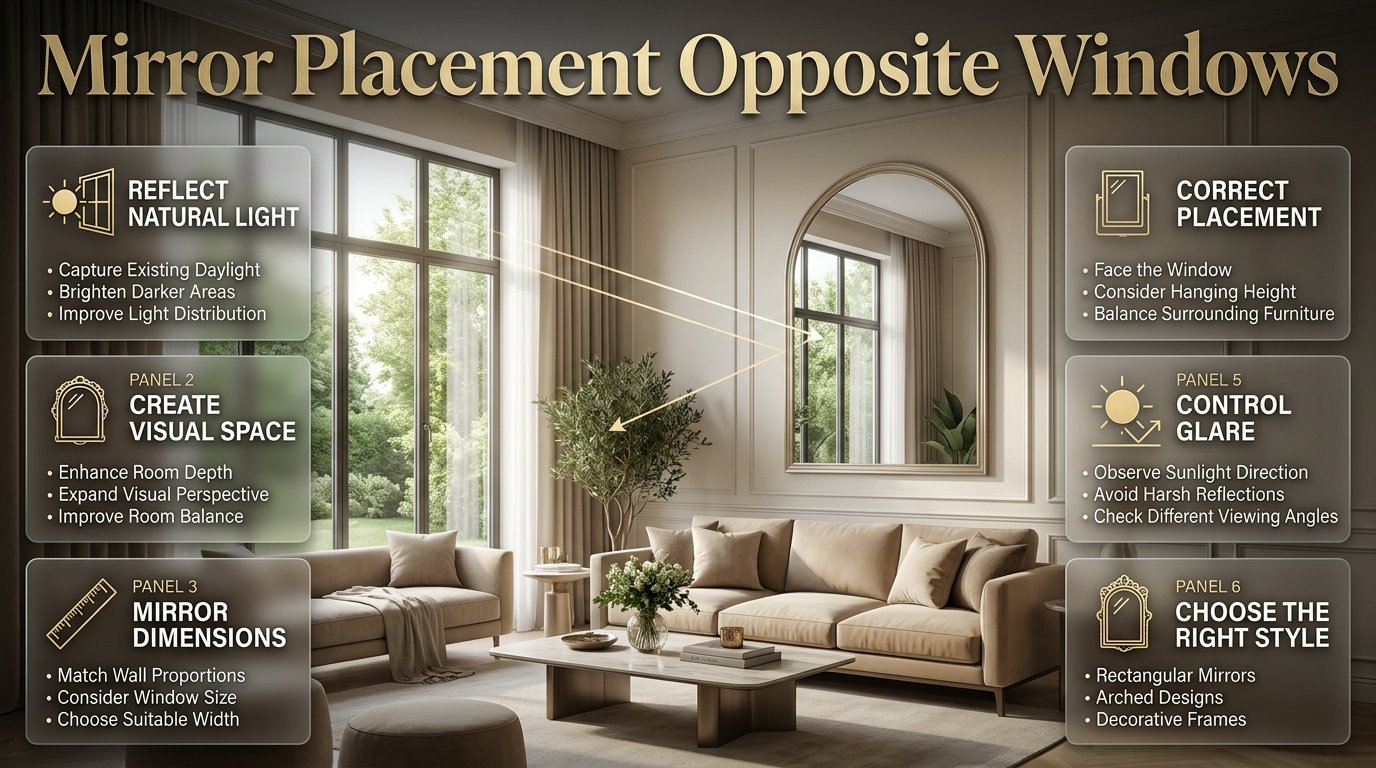
Mirror Placement Opposite Windows | Have you ever walked into a room during the daytime and noticed that one side feels bright and welcoming while the opposite side looks dark, empty, or visually uninteresting? This is a common problem in homes where natural light enters through only one or two windows. Although changing the room’s layout or adding new windows might seem like the obvious solution, there’s a simpler interior design technique worth considering: placing a mirror opposite a window.
Mirror placement opposite windows is a practical way to reflect existing daylight, create an impression of additional space, and improve the visual balance of an interior. A thoughtfully positioned mirror can bring attention to an attractive outdoor view, brighten a darker wall, and make a room feel more connected to its surroundings. It can also become an important decorative feature without requiring expensive furniture or major renovation work.
However, getting the placement right involves more than hanging a mirror on the wall facing a window. Its dimensions, height, reflective quality, surrounding furniture, and relationship with natural sunlight all influence the final result. A mirror that works beautifully in one living room might create uncomfortable glare in another.
Homeowners exploring practical decorating ideas through Design Mode 24 Interior Design can use this approach to improve different spaces without making unnecessary changes to their existing layouts.
This comprehensive guide explains how to choose the right mirror, where to position it, which shapes work best, how window direction affects reflections, and how to avoid common decorating mistakes. You’ll also discover room-specific recommendations, professional design techniques, installation considerations, and practical examples to help you create a brighter and more attractive home.
1. What Does Mirror Placement Opposite Windows Mean?
Mirror placement opposite windows refers to installing a reflective surface on a wall that faces a window so it can capture and redirect some of the natural daylight entering the room. Depending on its position and angle, the mirror may also reflect outdoor scenery, furniture, and other attractive interior details.
This technique is commonly used in residential interior design because it can improve the visual experience of a space without changing its architectural structure.
Imagine a living room with one large window on the front wall and a relatively empty wall directly across from it. During the afternoon, daylight enters through the window but doesn’t make the entire room feel equally bright. Placing a suitable mirror on the opposite wall may help reflect some of that available light toward other areas.
The effect depends on several factors:
- The amount of daylight entering the room.
- The distance between the window and the mirror.
- The mirror’s dimensions and orientation.
- The angle at which light reaches its surface.
- The colors and materials used throughout the interior.
- The objects visible in the mirror’s reflection.
It’s important to understand that mirrors don’t generate additional light. They redirect a portion of the light that reaches their surfaces. Their effectiveness therefore depends on the room’s existing lighting conditions.
Why Is This Technique Popular in Modern Homes?
Modern homeowners often want interiors that feel open, comfortable, and naturally illuminated. However, not every property has large windows, open floor plans, or favorable architectural features.
A strategically positioned mirror offers a relatively simple way to improve the appearance of an existing room.
It can be particularly useful when:
- A living room has one main source of daylight.
- A bedroom feels visually enclosed.
- A hallway receives limited natural illumination.
- A dining area has a dark or empty feature wall.
- A home office feels dull during daytime working hours.
- A small apartment needs better visual depth.
The technique also works with different decorating styles, including contemporary, traditional, minimalist, Scandinavian, and organic modern interiors.
2. What Are the Main Benefits of Placing a Mirror Opposite a Window?
Placing a mirror opposite a window can improve natural light distribution, create a greater impression of space, highlight outdoor scenery, and strengthen the decorative appearance of a room. These benefits are most noticeable when the mirror reflects an attractive view and is positioned to avoid excessive glare.
Understanding the advantages will help you decide whether this arrangement is suitable for your home.
2.1 Reflecting Natural Daylight
One of the biggest reasons homeowners choose this placement is to make better use of existing daylight.
When sunlight or indirect daylight reaches a mirror, part of it reflects toward other surfaces. This can make certain areas appear brighter, especially when the reflected light reaches a previously darker wall.
For example, a room with a window on its eastern side might receive strong morning illumination but become less evenly lit later in the day. A mirror positioned opposite the window may help distribute some of the available light.
However, the effect isn’t the same in every room. A small mirror positioned too far from the main light source may produce only a subtle visual difference.
Professional recommendation: Choose a mirror large enough to reflect a useful portion of the window or its surrounding view, but make sure its dimensions remain appropriate for the wall.
2.2 Making Small Rooms Feel Larger
Mirrors are widely used to create the impression of additional space.
When a mirror reflects a window, furniture arrangement, or another section of the room, the reflection introduces visual depth. The wall no longer appears to be a completely solid surface.
This can be especially helpful in:
- Small living rooms.
- Compact bedrooms.
- Narrow entrance areas.
- Studio apartments.
- Small dining spaces.
For example, a rectangular mirror placed above a narrow console table can make a compact entryway feel more open.
The mirror doesn’t physically increase the room’s dimensions, but it changes how the available space is perceived.
2.3 Bringing Outdoor Scenery Indoors
An attractive reflection can make an interior feel more connected to the outdoors.
If your window overlooks a garden, trees, flowering plants, or an appealing landscape, a mirror may capture some of that scenery.
This can introduce visual interest without adding more decorative objects.
A homeowner with a small garden-facing window, for instance, might position a mirror opposite it so the greenery becomes visible from another part of the living room.
This approach works particularly well when the surrounding interior uses natural materials and understated colors.
2.4 Improving the Appearance of Empty Walls
Large blank walls sometimes make interiors feel unfinished.
A mirror can fill that visual space while also serving a practical purpose. Unlike decorative objects that simply occupy the wall, a mirror introduces changing reflections as daylight and room conditions change.
A carefully selected frame can also complement nearby furniture, wall finishes, and architectural details.
2.5 Creating a Better Visual Balance
A room can feel unbalanced when most of its visual interest is concentrated around one window or one furniture arrangement.
Placing a mirror on the opposite wall can distribute that interest more evenly.
For example, if a living room has a large window and a sofa positioned along the opposite wall, a mirror can help connect the two sides visually.
This doesn’t mean every room needs a symmetrical arrangement. The goal is to create a composition that feels comfortable and intentional.
2.6 Supporting a More Welcoming Atmosphere
A bright and visually open room often feels more inviting than one dominated by dark corners and heavy decorative elements.
A mirror can contribute to this appearance by reflecting daylight and attractive interior details.
However, comfort should remain the priority. Too many reflective surfaces or an excessively bright reflection can make a room feel distracting rather than relaxing.
3. Where Should You Place a Mirror Opposite a Window?
The best location depends on the room’s dimensions, window position, furniture arrangement, and the type of reflection you want to create. A mirror should capture something visually useful rather than simply occupy the available wall.
Before choosing a position, consider what you see when standing in different parts of the room.
3.1 Living Room Mirror Placement
The living room is one of the most suitable places for an opposite-window mirror because it usually contains several decorative and functional elements.
A large mirror can reflect natural light, complement the seating arrangement, and create an attractive focal point.
Consider these placement options:
Above a console table: A mirror above a console creates a balanced decorative arrangement. It works particularly well when the table contains a few carefully selected accessories.
Behind a seating arrangement: A mirror on the wall behind a sofa can add visual depth, provided the reflection is attractive and doesn’t create distracting glare.
On a feature wall: A large framed mirror can become a focal point in a room with relatively simple wall decoration.
Beside a fireplace: Where the room layout allows it, a mirror can balance the fireplace and reflect some of the available daylight.
Avoid positioning a mirror where it reflects television screens, excessive furniture clutter, or bright sunlight directly into the main seating area.
3.2 Bedroom Mirror Placement
Bedrooms require a slightly different approach because relaxation, privacy, and personal comfort are important.
A mirror opposite a window can brighten a bedroom, particularly when the room has a single exterior window and darker furniture.
Suitable options include:
- A full-length mirror near a wardrobe.
- A framed mirror above a dressing table.
- A medium-sized decorative mirror on an empty wall.
- A simple vertical mirror that complements bedroom furniture.
Before installation, consider the direction of morning sunlight. If the mirror reflects strong sunlight toward the bed, it may become uncomfortable.
Also consider whether the reflection affects your privacy, particularly in bedrooms facing neighboring properties.
3.3 Dining Room Mirror Placement
Dining rooms often benefit from mirrors because they can make the space feel more open and visually connected.
A horizontal mirror above a sideboard is a practical option. It can reflect daylight from the window while also capturing the dining table, decorative centerpiece, and other interior details.
For a more coordinated appearance:
- Match the mirror frame with the dining furniture.
- Keep the reflected wall relatively organized.
- Avoid reflecting unattractive storage areas.
- Consider the position of pendant lights.
- Maintain sufficient space around the mirror.
A large mirror can work beautifully in a spacious dining room, but a medium-sized design may be more appropriate in a compact eating area.
3.4 Hallway and Entryway Mirror Placement
Hallways are often narrow and receive less natural light than main living spaces.
A mirror placed opposite a window can help create a greater sense of depth and make the passage feel less enclosed.
If your hallway has an exterior window at one end, consider placing a mirror on the opposite wall where it can capture some of the daylight.
In an entryway, a full-length mirror can also provide a practical place to check your appearance before leaving home.
Keep the surrounding area simple. A narrow console table, a small decorative bowl, or a suitable wall light may be enough to complete the arrangement.
3.5 Home Office Mirror Placement
A home office should feel comfortable and functional.
A mirror can help distribute available daylight, especially when the workspace has one window and a darker opposite wall.
However, its position should be selected carefully.
A mirror that reflects bright sunlight toward a computer screen can create distracting glare. It may also introduce unwanted reflections into video calls.
For a practical office arrangement:
- Test the mirror from your normal working position.
- Avoid reflections directly behind your monitor.
- Keep the desk area visually organized.
- Choose a frame that complements the workspace.
- Consider a medium-sized mirror instead of an oversized design.
3.6 Kitchen and Breakfast Area Mirror Placement
Mirrors can also be used in kitchens, although placement requires more attention to cleaning and safety.
A mirror positioned opposite a kitchen window may reflect daylight and make a compact breakfast area feel more open.
However, avoid placing ordinary decorative mirrors where they are likely to experience excessive heat, moisture, grease, or accidental impact.
A suitable mirror in a dining nook or breakfast corner is generally easier to maintain than one installed close to a cooking area.
4. How to Choose the Right Mirror Size
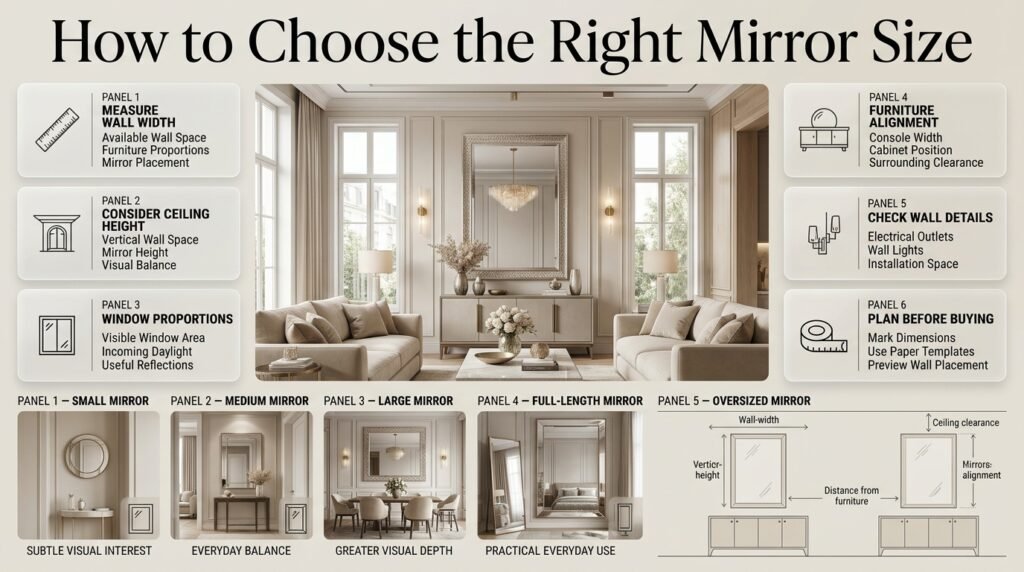
The right mirror size should relate to the dimensions of the wall, the size of the window, and the furniture surrounding it.
A small mirror on a large empty wall may look disconnected, while an oversized mirror can overwhelm a compact room.
There isn’t one universal measurement that works for every home. Instead, consider the overall proportions.
| Mirror size | Suitable location | Main purpose |
|---|---|---|
| Small | Narrow decorative walls | Subtle visual interest |
| Medium | Bedrooms and entryways | Balanced reflection |
| Large | Living and dining rooms | Greater visual depth |
| Full-length | Bedrooms and dressing areas | Practical everyday use |
| Oversized | Spacious feature walls | Strong decorative impact |
Should the Mirror Be the Same Size as the Window?
No. A mirror doesn’t need to match the window’s exact dimensions.
The most important consideration is whether it reflects a useful portion of the incoming light and fits naturally into the interior.
For example, a medium-sized mirror might work perfectly opposite a large window if the room is compact and the furniture is relatively simple.
In a larger living room, a more substantial mirror may provide better visual balance.
How to Measure Before Buying
Before purchasing a mirror, measure the available wall space.
Consider:
- The total width of the wall.
- The distance between the mirror and nearby furniture.
- The height of the ceiling.
- The position of electrical outlets and wall lights.
- The amount of window area visible in the reflection.
If the mirror will hang above a console or cabinet, consider the relationship between the furniture width and mirror width.
A balanced arrangement generally looks more intentional than a mirror selected without considering its surroundings.
Quick Tip: Use paper or removable masking tape to mark the proposed mirror dimensions on the wall. This makes it easier to judge the proportions before purchasing.
5. Which Mirror Shape Works Best Opposite a Window?
Mirror shape influences the overall character of an interior. The best choice depends on your decorating style, architectural details, and the furniture arrangement.
5.1 Rectangular Mirrors
Rectangular mirrors are among the most versatile options.
They work well in traditional, modern, and contemporary interiors.
A horizontal rectangular mirror can emphasize the width of a room, while a vertical design can create a taller visual impression.
They are particularly suitable for:
- Living room feature walls.
- Dining room sideboards.
- Bedroom dressers.
- Hallway walls.
- Home office interiors.
5.2 Round Mirrors
Round mirrors introduce softer lines into rooms containing rectangular windows, cabinets, and furniture.
They are especially useful when you want to create a more relaxed and balanced appearance.
A round mirror can work above a console table, beside a bedroom dresser, or on a smaller feature wall.
Avoid choosing a size that looks too small compared with the surrounding furniture.
5.3 Arched Mirrors
Arched mirrors combine a practical reflective surface with a distinctive architectural appearance.
Their curved upper edges can soften rooms dominated by straight lines.
They are particularly suitable for contemporary, transitional, and organic modern interiors.
An arched mirror with a slim metal or natural wood frame can become an attractive feature without requiring additional decoration.
5.4 Oval Mirrors
Oval mirrors offer a softer alternative to traditional rectangular designs.
They work well in bedrooms, dressing areas, and entryways where a more delicate decorative appearance is preferred.
An oval mirror can also balance angular furniture and geometric wall patterns.
5.5 Full-Length Mirrors
Full-length mirrors are especially useful in bedrooms and dressing areas.
They allow you to check your appearance while also reflecting a larger portion of the surrounding space.
When positioned opposite a window, they may capture more of the daylight entering the room.
Make sure the mirror is securely supported and positioned where it won’t obstruct movement.
5.6 Frameless Mirrors
Frameless mirrors are suitable for minimalist interiors because they have a simple appearance and don’t introduce another decorative material.
They can work well in contemporary homes where clean lines and understated finishes are important.
However, frameless designs may look less visually defined against some wall colors. Consider the wall finish before selecting one.
6. How Does Window Direction Affect Mirror Placement?
The direction a window faces influences the timing and intensity of natural light entering the room.
Understanding this relationship can help you choose a more comfortable mirror position.
6.1 North-Facing Windows
In the Northern Hemisphere, north-facing windows generally receive softer and more consistent daylight.
A mirror opposite this type of window can help distribute the available light across the room.
This arrangement is useful in spaces where direct sunlight is limited.
However, the actual amount of daylight depends on the building’s surroundings, window dimensions, and nearby obstructions.
6.2 South-Facing Windows
South-facing windows generally receive more direct sunlight during parts of the day in the Northern Hemisphere.
This can make opposite-window mirror placement particularly effective for brightening interiors, but it also increases the possibility of glare.
A large mirror should be tested carefully before permanent installation.
If the reflected sunlight reaches seating areas or computer screens, consider changing its height or position.
6.3 East-Facing Windows
East-facing windows receive morning sunlight.
A mirror opposite an eastern window may create an attractive morning reflection, making it suitable for living areas and breakfast spaces.
However, bedroom mirrors should be positioned thoughtfully if early sunlight interferes with comfortable rest.
6.4 West-Facing Windows
West-facing windows often receive stronger afternoon and evening sunlight.
A mirror opposite one may create noticeable reflections later in the day.
Observe the room during the afternoon before finalizing the position.
Consider using window coverings when sunlight becomes too intense.
6.5 Why Local Surroundings Also Matter
Window direction alone doesn’t determine the quality of natural light.
Other factors include:
- Neighboring buildings.
- Trees and outdoor vegetation.
- Balcony overhangs.
- Window tinting.
- Curtains and blinds.
- Seasonal changes.
- The size and height of the window.
For this reason, always evaluate the actual lighting conditions inside your home instead of relying only on compass direction.
7. How to Position a Mirror Opposite a Window: Step-by-Step Guide
A successful arrangement starts with careful observation rather than immediate installation.
Follow these steps to select a suitable position and achieve a balanced result.
Step 1: Study the Room’s Natural Lighting
Observe how daylight enters the room during different periods.
Check the morning, afternoon, and evening conditions.
Notice which walls receive direct sunlight and which areas remain relatively dark.
This will help you identify whether a mirror can improve the room’s overall appearance.
Professional advice: Don’t evaluate the lighting from only one position. Walk around the room and observe how the daylight changes from different viewing angles.
Step 2: Identify the Most Attractive Reflection
Stand near the wall where you are considering installing the mirror.
Imagine what the reflective surface will capture.
A garden, attractive furniture arrangement, indoor plant, or architectural feature can produce a more appealing reflection than a cluttered corner.
The objective isn’t simply to reflect the window. It’s to create a reflection that improves the interior.
Step 3: Choose the Appropriate Mirror Design
Select a mirror that complements the room’s proportions and decorating style.
Consider:
- Shape.
- Dimensions.
- Frame material.
- Reflective quality.
- Weight.
- Installation requirements.
For example, a large rectangular mirror may suit a spacious living room, while a smaller arched mirror may be more appropriate for a compact bedroom.
Step 4: Test the Height
Temporarily position the mirror or mark its outline on the wall.
Check the reflection from normal standing and sitting positions.
If the mirror is too high, it may capture mostly the ceiling. If it’s too low, nearby furniture may block the intended reflection.
Adjust the height until the reflected view looks balanced.
Step 5: Check for Direct Glare
Observe the proposed placement when sunlight is strongest.
Look for reflections that might reach:
- Sofas.
- Beds.
- Dining chairs.
- Television screens.
- Computer monitors.
- Frequently used walkways.
If the reflection becomes uncomfortable, change the position or select a different wall.
Step 6: Install the Mirror Securely
Use suitable wall fixings according to the mirror’s weight and the wall material.
Different surfaces require different installation methods.
For example, plasterboard, masonry, and wooden walls may require different anchors or supporting hardware.
Heavy mirrors should be installed with appropriate mounting systems. If you’re unsure about the wall structure, seek professional assistance.
Step 7: Arrange the Surrounding Decoration
After installation, evaluate the surrounding furniture and accessories.
A console table, indoor plant, or small decorative object may help complete the arrangement.
However, avoid adding too many items. A mirror should remain visually important without making the wall feel crowded.
Step 8: Review the Result Over Several Days
Don’t judge the final arrangement immediately.
Observe it under different lighting conditions and during normal household activities.
Check whether the reflection remains attractive and whether the mirror creates any unwanted glare.
Minor adjustments can make a meaningful difference.
8. How to Decorate Around a Mirror Opposite a Window
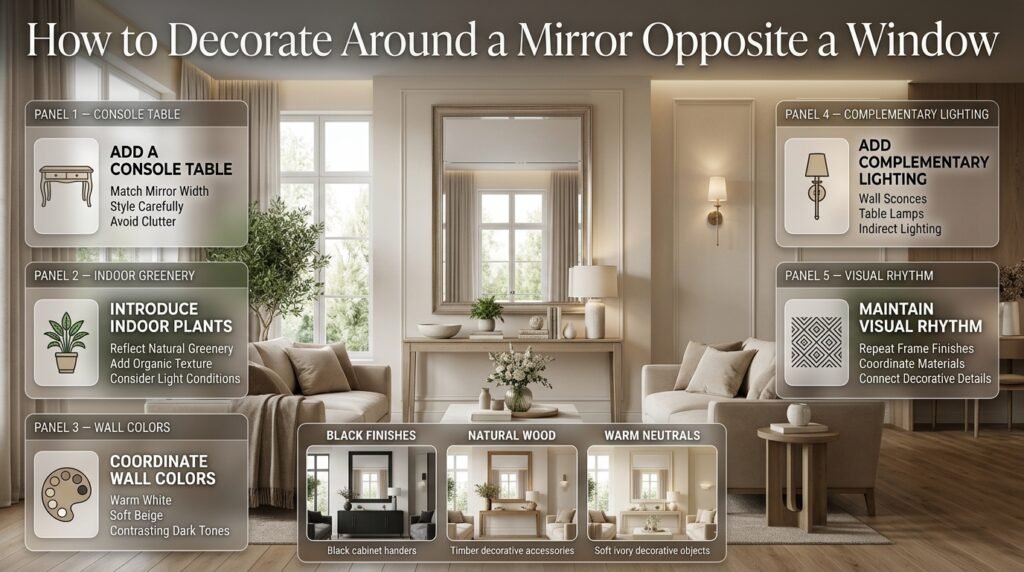
The area surrounding a mirror plays an important role in determining whether it looks like a natural part of the interior.
A thoughtfully decorated wall can improve the mirror’s visual impact while maintaining a balanced appearance.
8.1 Add a Console Table
A console table beneath a wall mirror is a classic interior design arrangement.
It works especially well in living rooms, hallways, and entryways.
Choose a table that complements the mirror’s width and frame.
Keep the surface relatively simple with a few accessories, such as:
- A decorative bowl.
- A small indoor plant.
- A carefully selected book.
- A table lamp.
- A simple ceramic accessory.
The arrangement should look organized rather than overcrowded.
8.2 Introduce Indoor Plants
Indoor plants can make a room feel more connected to nature.
When reflected in a mirror, their greenery introduces another layer of visual interest.
Choose plants according to the actual lighting conditions rather than simply selecting them for appearance.
For additional outdoor and greenery inspiration, explore Decoradhouse Garden Tips by DecoratorAdvice.
8.3 Coordinate the Mirror With Wall Colors
Wall color influences how a mirror looks within a room.
Light neutrals such as warm white, cream, soft beige, and pale gray can create an airy background.
Darker colors can introduce contrast and make a mirror frame stand out.
The best choice depends on the furniture, flooring, natural light, and overall decorating style.
For additional ideas, explore our guide to Paint Color.
8.4 Use Complementary Lighting
Mirrors can also contribute to an attractive nighttime environment by reflecting lamps and decorative lighting.
Consider wall sconces, table lamps, or indirect lighting where appropriate.
However, make sure the light source doesn’t create uncomfortable glare.
8.5 Maintain Visual Rhythm
A well-designed interior often repeats selected colors, materials, shapes, or finishes throughout the room.
For example, a black-framed mirror might complement black cabinet handles and a matching lighting fixture.
A wooden mirror frame could connect with a timber console table and other natural finishes.
This approach helps create visual continuity without making every decorative object identical.
Read more about Rhythm and Repetition in Interiors.
9. Mirror Placement Opposite Windows in Small Rooms
Small rooms require careful decorating because every large object influences the overall appearance.
Mirrors can help create visual depth, but their size and position should be selected thoughtfully.
9.1 Small Living Rooms
A medium or large mirror can make a compact living room feel more open.
Consider placing it on the wall opposite a window where it can reflect daylight and an uncluttered part of the interior.
Avoid reflecting an overcrowded television unit or a busy furniture arrangement.
A simple frame can help maintain a balanced appearance.
9.2 Small Bedrooms
A vertical mirror can create a taller visual impression while providing a practical dressing feature.
If space is limited, consider a mirror attached securely to a suitable wardrobe door.
However, evaluate the reflection before choosing the final position.
9.3 Narrow Hallways
A mirror can make a narrow hallway appear deeper.
A vertical design may suit a tall, narrow wall, while a horizontal mirror may work better where the hallway has more width.
Keep the passage clear and avoid placing the mirror where it creates confusion around stairs or doorways.
9.4 Compact Dining Spaces
A horizontal mirror can visually extend a small dining area.
Position it above a sideboard or on a wall that reflects daylight without creating distracting reflections from overhead lighting.
Keep decorative accessories simple to prevent the area from feeling crowded.
9.5 Small Apartments and Studio Homes
In studio apartments, mirrors can help distinguish visual zones without adding physical partitions.
For example, a mirror positioned opposite a living-area window can make the seating section feel more open.
Choose a location that complements the entire layout rather than improving one small corner at the expense of another.
10. Which Interior Design Styles Work Best With Opposite-Window Mirrors?
One advantage of mirrors is their ability to adapt to different decorating styles.
The important thing is selecting a design that complements the materials, furniture, and overall atmosphere.
10.1 Modern Interior Design
Modern interiors often feature clean lines, simple furniture, and restrained decoration.
A rectangular or frameless mirror can complement these spaces.
Slim black frames and understated metallic finishes are also popular choices.
10.2 Minimalist Interiors
Minimalist rooms benefit from simple shapes and uncluttered surfaces.
A single well-positioned mirror may be more effective than several small decorative mirrors.
Choose a design that supports the room’s simplicity.
10.3 Scandinavian Interiors
Scandinavian-inspired spaces often use light colors, natural wood, simple furniture, and practical accessories.
A mirror with a pale wood frame or clean circular shape can complement this style.
Keep the surrounding decoration understated.
10.4 Traditional Interiors
Traditional rooms may benefit from mirrors with detailed frames, warm finishes, and classic proportions.
Antique-inspired designs can complement wooden furniture and decorative architectural features.
However, the mirror should remain proportionate to the room.
10.5 Organic Modern Interiors
Organic modern design combines contemporary simplicity with natural materials and softer forms.
Arched mirrors, warm wood frames, natural textures, and neutral colors can work particularly well.
If you’re exploring ways to combine these finishes, read Organic Modern Material Combinations.
11. Common Mirror Placement Mistakes and How to Avoid Them
Even a beautiful mirror can look unsuitable when its position hasn’t been considered carefully.
Understanding common mistakes can help you avoid unnecessary purchases and installation work.
Mistake 1: Installing a Mirror Without Checking Its Reflection
This is one of the most common decorating problems.
Homeowners sometimes choose an empty wall without checking what the mirror will reflect.
The result may be an unattractive view of storage areas, cluttered furniture, or an ordinary exterior wall.
How to avoid it: Temporarily hold the mirror in position and evaluate its reflection from several areas of the room.
Mistake 2: Ignoring Sunlight Intensity
A mirror that looks attractive in the morning might produce uncomfortable reflections during the afternoon.
This often happens when homeowners evaluate the position under only one lighting condition.
How to avoid it: Check the mirror at different times and adjust the location if direct sunlight becomes distracting.
Mistake 3: Choosing an Inappropriate Size
A very small mirror can look disconnected from a large wall, while an oversized mirror may dominate a compact room.
How to avoid it: Measure the wall and nearby furniture before purchasing.
Mistake 4: Hanging the Mirror Too High
A mirror placed too high may reflect the ceiling instead of the intended window or interior details.
How to avoid it: Test the height from normal standing and sitting positions.
Mistake 5: Reflecting Too Much Clutter
Mirrors repeat the appearance of whatever is in front of them.
If the reflected area contains too many accessories, furniture pieces, or decorative objects, the room may look busier.
How to avoid it: Organize the reflected area before installing the mirror.
Mistake 6: Using Too Many Mirrors
Multiple mirrors can create excessive reflections and make a room visually complicated.
How to avoid it: Start with one appropriately sized mirror and add more only when the layout genuinely benefits from them.
Mistake 7: Ignoring Furniture Proportions
A mirror can look awkward when its dimensions don’t relate to the furniture below or beside it.
How to avoid it: Consider the width and height of nearby furniture when choosing the mirror.
Mistake 8: Neglecting Installation Safety
Large mirrors can cause serious damage or injury if they fall.
How to avoid it: Use suitable mounting hardware and ensure the wall can support the mirror’s weight.
Mistake 9: Forgetting About Privacy
A mirror may reflect parts of the interior toward windows or neighboring properties in ways that aren’t comfortable.
How to avoid it: Review the reflected view from both inside and outside perspectives where practical.
Mistake 10: Expecting Mirrors to Solve Every Lighting Problem
A mirror can redistribute available daylight, but it cannot replace windows, improve ventilation, or correct every poorly lit area.
How to avoid it: Combine mirrors with appropriate artificial lighting and functional window treatments.
12. Professional Interior Design Advice for Better Mirror Placement
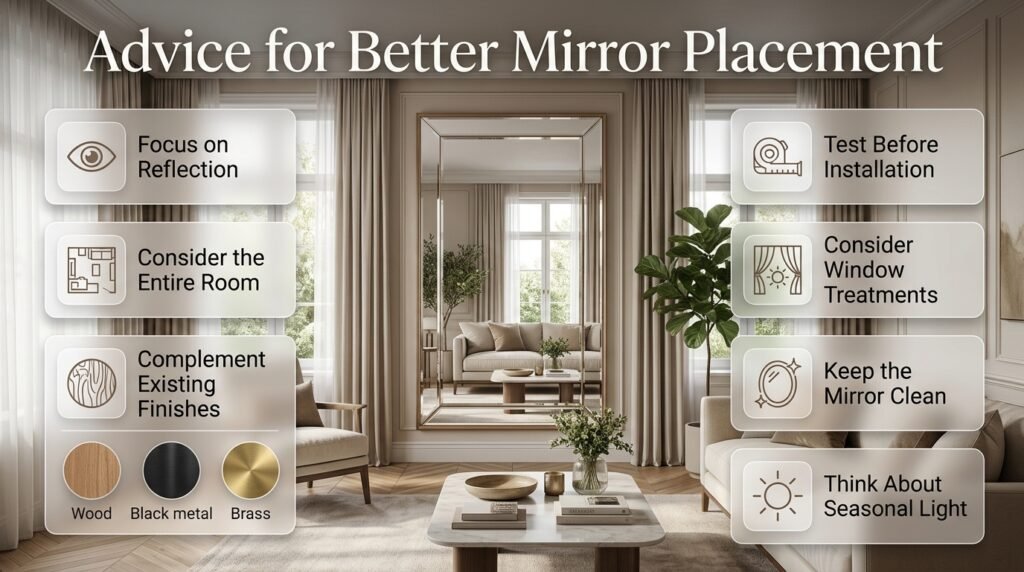
A professional-looking arrangement is usually the result of careful planning rather than expensive accessories.
The following recommendations can help improve your final design.
Focus on the Reflection First
Before thinking about the frame, finish, or decorative style, decide what you want the mirror to reflect.
An attractive view should be the foundation of your placement decision.
Consider the Entire Room
Don’t evaluate the mirror as an isolated decorative object.
Look at its relationship with the sofa, dining table, bed, curtains, flooring, and wall colors.
The mirror should contribute to the overall composition.
Choose Materials That Complement Existing Finishes
A mirror frame can connect different materials throughout the interior.
For example:
- Wood frames complement natural timber furniture.
- Black frames work with modern metal details.
- Brass finishes suit warm and elegant interiors.
- Frameless mirrors complement minimalist rooms.
Test Before Making Permanent Changes
Temporary placement is one of the easiest ways to prevent mistakes.
Use a safe temporary support or mark the proposed dimensions on the wall.
For heavy mirrors, don’t attempt unsupported temporary mounting.
Consider Window Treatments
Curtains and blinds influence the amount of daylight entering the room.
Heavy window coverings may reduce the light available for reflection.
Choose treatments that provide the privacy and light control you need while allowing suitable daylight into the space.
Keep the Mirror Clean
Dust, fingerprints, and streaks can reduce the quality of the reflection.
Clean the mirror using an appropriate glass-cleaning method and avoid harsh products that may damage its frame or backing.
Think About Changing Seasons
Sunlight patterns can change throughout the year.
A mirror that produces a comfortable reflection in one season may receive stronger sunlight during another.
Where possible, choose a position that remains practical under different lighting conditions.
13. How to Combine Mirrors With Other Home Improvements
Mirror placement can become even more effective when considered as part of a wider interior improvement plan.
You don’t necessarily need to renovate the entire room. Small changes to the wall finish, furniture arrangement, and lighting can help create a more coordinated appearance.
Improve the Wall Behind the Mirror
A wall with an attractive finish can make a mirror look more intentional.
Consider:
- Fresh neutral paint.
- A simple textured finish.
- Carefully selected wallpaper.
- Decorative wall molding.
- A clean, understated surface.
For practical ideas that can help you improve your home without unnecessary expense, explore DIY Home Projects.
Coordinate the Mirror With Furniture Upgrades
If you’re updating a room, consider the mirror when choosing new furniture.
A wooden console table, a simple sideboard, or a well-proportioned dressing table can complement an opposite-window mirror.
You can also review LLBlogHome Upgrades by Lovelolablog for additional home improvement inspiration.
Review the Entire Home’s Decorative Consistency
A mirror arrangement should relate naturally to the surrounding home.
If the living room uses warm natural materials, introducing a completely unrelated decorative style may make the mirror feel disconnected.
For additional inspiration on practical improvements and decorative updates, explore Upgrade Tip LLBlogHome.
Plan Larger Renovations Carefully
Sometimes, a mirror highlights an existing issue rather than solving it.
For example, a damaged wall, poorly positioned electrical fixture, or awkward furniture layout may require more than decorative adjustments.
Before making major changes, consider the order of work and the practical requirements of the room.
Our to Renovation Work Order for Homeowners can provide additional planning inspiration.
Consider the Exterior View
The appearance of the outdoor area also influences what a mirror reflects.
A well-maintained entrance, garden, or outdoor seating area can improve the view captured through the window.
For ideas about creating a more balanced exterior, explore Outdoor Entrance Design Proportions.
14. Are Mirrors Opposite Windows Suitable for Feng Shui?
Many homeowners consider Feng Shui when arranging mirrors because traditional interpretations associate reflective surfaces with energy, movement, and the visual expansion of a space.
In some Feng Shui approaches, mirrors facing windows are believed to reflect energy outward. Other interpretations emphasize the positive appearance of reflecting natural scenery and bringing visual brightness into the home.
These ideas are traditional design beliefs rather than scientifically established effects.
If Feng Shui is part of your decorating preferences, consider these points:
- Reflect attractive outdoor scenery.
- Avoid reflecting cluttered areas.
- Choose a position that feels comfortable.
- Keep mirrors clean and in good condition.
- Consider privacy when selecting bedroom locations.
- Avoid placing reflective surfaces where they create unwanted visual distractions.
The most important consideration is creating a room that feels balanced and comfortable for the people using it.
15. How to Maintain and Care for a Mirror Near a Window
Mirrors positioned near windows may experience changing temperatures, dust, sunlight, and moisture.
Proper maintenance helps preserve their appearance and reflective quality.
Clean the Reflective Surface Regularly
Use a suitable glass cleaner or a gentle cleaning solution recommended for mirrors.
A soft microfiber cloth can help remove fingerprints and dust without leaving excessive streaks.
Avoid abrasive materials that may scratch the surface.
Protect the Frame
Different frame materials require different care.
Wood frames should be protected from excessive moisture, while metal finishes may require occasional cleaning to remove dust and fingerprints.
Follow the manufacturer’s care recommendations.
Check the Mounting Hardware
Inspect heavy mirrors occasionally to make sure the mounting system remains secure.
If the mirror begins moving or tilting, address the problem rather than leaving it unsupported.
Avoid Excessive Moisture
Bathrooms and humid spaces require mirrors designed for appropriate conditions.
Ordinary decorative mirrors may deteriorate if their backing is repeatedly exposed to moisture.
Watch for Sunlight-Related Issues
Although many mirrors are designed for everyday indoor use, intense sunlight can affect nearby decorative materials, furniture finishes, and fabrics.
Monitor the area and use suitable window coverings when necessary.
16. Practical Examples of Successful Opposite-Window Mirror Arrangements
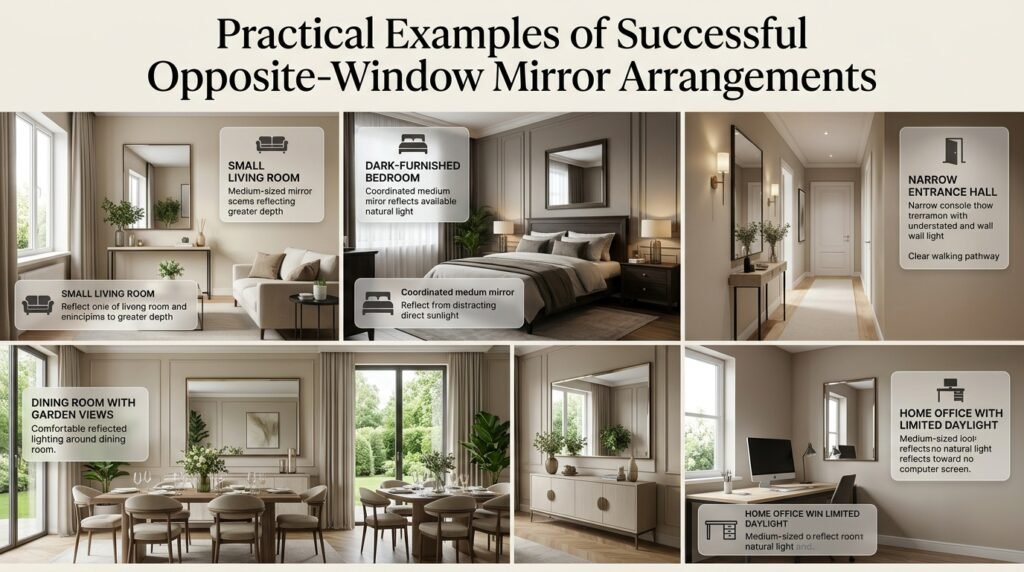
Understanding real-world layouts can make it easier to apply these ideas in your own home.
Example 1: A Small Living Room With One Window
Imagine a compact living room with a single window, a sofa, and a narrow console table.
The wall opposite the window is relatively empty.
A medium-sized rectangular mirror above the console can reflect daylight and create the impression of additional depth.
A small plant and one decorative accessory may complete the arrangement.
The main advantage is that the homeowner can improve the room’s appearance without changing the furniture layout.
Example 2: A Bedroom With Dark Furniture
Consider a bedroom with dark wooden furniture and limited daylight.
A medium-sized mirror opposite the window can help reflect available light toward the darker side of the room.
A simple frame that complements the existing furniture can create a coordinated appearance.
The mirror should be positioned so that direct sunlight doesn’t disturb the sleeping area.
Example 3: A Narrow Entrance Hall
A narrow entrance hall can feel restrictive, particularly when it has limited natural light.
A vertical mirror on a suitable wall can create an impression of greater depth.
A slim console table and a simple wall light may help complete the design.
The arrangement should maintain a clear walking path.
Example 4: A Dining Room With Garden Views
A dining room overlooking a garden offers an opportunity to bring natural scenery into the interior.
A large horizontal mirror opposite the window may reflect greenery and daylight.
A simple frame and a coordinated sideboard can help create a refined appearance.
The mirror should be positioned so that reflected light doesn’t become distracting during meals.
Example 5: A Home Office With Limited Daylight
A home office with one window may have a darker wall behind the desk.
A medium-sized mirror placed on an appropriate opposite wall can help redistribute daylight.
However, it should not reflect strong sunlight toward the computer screen.
Testing the arrangement while seated is particularly important.
17. What Should You Check Before Buying a Mirror?
Choosing a mirror involves more than selecting an attractive shape.
Before making a purchase, review its practical features.
| Buying consideration | What to check |
|---|---|
| Dimensions | Suitable for the available wall |
| Shape | Matches the room’s design |
| Frame | Complements existing materials |
| Weight | Can be supported safely |
| Glass quality | Provides a clear reflection |
| Installation | Includes suitable mounting provisions |
| Maintenance | Easy to clean and care for |
| Safety | Appropriate for its intended location |
Consider the Glass Quality
A mirror should provide a clear and undistorted reflection.
Check the product’s construction and finish before purchasing.
For large decorative mirrors, quality becomes particularly important because imperfections may be more noticeable across a wider surface.
Think About Long-Term Suitability
Trendy designs can be attractive, but a mirror is often a long-term decorative investment.
Choose a style that complements your existing interior and can continue working if you change the furniture later.
For broader home decorating inspiration and practical updates, explore Latest News DecoratorAdvice.
You can also discover additional ideas through How to Set Up My Home Decoradtech.
18. Key Takeaways: Creating the Best Mirror Placement Opposite Windows
Before deciding on the final arrangement, remember these important principles:
- Reflect useful daylight: Place the mirror where it can capture available natural light.
- Choose an attractive reflection: Outdoor scenery and organized interior details can improve the result.
- Select suitable dimensions: The mirror should complement the wall and surrounding furniture.
- Consider window direction: Morning and afternoon sunlight can produce different reflection conditions.
- Avoid excessive glare: Comfort matters more than creating the brightest possible reflection.
- Match the interior style: Choose a frame and shape that work with existing materials.
- Think about room function: Bedrooms, living rooms, offices, and hallways have different requirements.
- Install securely: Always use suitable wall fixings.
- Maintain the surface: Regular cleaning helps preserve a clear reflection.
- Avoid unnecessary decoration: One thoughtfully positioned mirror can be more effective than several poorly arranged ones.
The most successful arrangements combine practical lighting considerations with attractive interior design.
Does Placing a Mirror Opposite a Window Make a Room Look Bigger and Brighter?
Placing a mirror opposite a window is an effective interior design technique for making a room feel brighter and more spacious. A mirror reflects available natural daylight and creates the visual impression of additional depth. When it captures the window, outdoor scenery, or an attractive part of the interior, it makes the wall appear less enclosed and helps the room feel more open.
This technique is particularly useful in small apartments, compact living rooms, narrow hallways, and bedrooms with limited natural light. However, the result depends on the mirror’s dimensions, placement, and the amount of daylight entering the room. A carefully positioned medium-sized mirror can sometimes produce a better result than an oversized mirror installed without considering the room’s layout.
Practical ways to achieve the best results:
Position the mirror where it can reflect a useful portion of the window.
Choose a size that complements the wall and nearby furniture.
Keep the reflected area clean and visually organized.
Use light-colored surrounding finishes to maintain an airy appearance.
Avoid reflections that create uncomfortable glare.
What Is the Best Position for a Mirror Directly Opposite a Window?
The best position for a mirror opposite a window is the location where it can reflect natural light and an attractive view without creating visual discomfort. Instead of automatically placing it in the center of an empty wall, consider the window’s height, the direction of sunlight, furniture placement, and the viewing angles throughout the room.
For example, in a living room, a mirror above a console table can create a balanced decorative arrangement while reflecting daylight toward the seating area. In a bedroom, a mirror near a dressing area may be more practical, provided it doesn’t reflect strong morning sunlight toward the bed. The ideal position should improve both the appearance and everyday functionality of the space.
Important placement considerations:
Check the reflection from different positions before installation.
Avoid placing the mirror where it reflects cluttered storage areas.
Consider the height of nearby furniture and the window.
Test the arrangement during morning and afternoon sunlight.
Make sure the mirror doesn’t interfere with doors, walkways, or everyday activities.
Can a Mirror Opposite a Window Cause Glare or Excessive Sunlight Reflection?
A mirror opposite a window can create glare when direct sunlight reaches its reflective surface and redirects toward seating areas, computer screens, beds, or other frequently used parts of the room. This is particularly noticeable in rooms with large windows or strong afternoon sunlight. Although mirrors can improve the distribution of available daylight, an incorrectly positioned reflective surface may make certain areas uncomfortable.
The solution isn’t necessarily to avoid this placement. Instead, homeowners should evaluate the direction and intensity of sunlight before permanently installing the mirror. Adjusting its height, selecting a different wall, or using suitable curtains and blinds can help control unwanted reflections while preserving the decorative benefits.
Ways to reduce unwanted glare:
Observe the mirror’s reflection during the brightest hours.
Avoid directing reflected sunlight toward television and computer screens.
Consider adjustable curtains or blinds for light control.
Test alternative mirror positions before drilling holes.
Choose a location that provides comfortable illumination throughout the day.
Which Mirror Shape and Size Work Best Opposite a Window?
The best mirror shape and size depend on the room’s dimensions, furniture arrangement, architectural style, and the type of reflection you want to create. Rectangular mirrors are versatile and work particularly well in living rooms and dining areas, while round and arched mirrors introduce softer shapes that can make an interior feel more balanced. Full-length mirrors are especially practical in bedrooms and dressing spaces.
When selecting dimensions, consider the available wall area rather than choosing a mirror simply because it looks attractive in a showroom. A very small mirror may appear disconnected from a large wall, whereas an oversized design can overwhelm a compact room. The objective is to create a balanced arrangement that complements the window and surrounding furniture.
Mirror selection recommendations:
Rectangular mirrors: Suitable for modern living rooms and dining spaces.
Round mirrors: Ideal for softer, balanced decorative arrangements.
Arched mirrors: Work well in contemporary and organic modern interiors.
Full-length mirrors: Practical for bedrooms and dressing areas.
Large framed mirrors: Useful for spacious walls and prominent interior features.
Is Placing a Mirror Opposite a Window a Good Idea for Small Rooms and Apartments?
Placing a mirror opposite a window can be particularly beneficial in small rooms and apartments because it creates an impression of additional depth without requiring structural changes. When the mirror reflects daylight and a visually attractive section of the interior, the space can feel more open and less confined. This makes the technique useful for compact living rooms, narrow entrance halls, small bedrooms, and studio apartments.
However, the mirror should be selected according to the room’s actual dimensions. Installing too many reflective surfaces or choosing an oversized mirror can make a small interior feel visually crowded. A single well-positioned mirror, combined with an organized furniture arrangement and suitable wall colors, often creates a more attractive result.
Professional recommendations for smaller spaces:
Choose a medium or large mirror according to the available wall area.
Reflect the window or an attractive section of the room.
Prefer simple frames that complement existing furniture.
Avoid overcrowding the surrounding wall with accessories.
Keep walkways and furniture arrangements functional.
Combine the mirror with appropriate lighting rather than relying on reflections alone.
Conclusion
Placing a mirror opposite a window is a simple yet effective interior design technique that can transform the way a room looks and feels. When positioned thoughtfully, a mirror reflects natural daylight, creates a stronger sense of openness, highlights attractive outdoor views, and makes smaller spaces feel more welcoming. However, the best results depend on more than simply hanging a mirror across from the nearest window. Its size, shape, height, frame, viewing angle, and relationship with the surrounding furniture all influence the final appearance.
Before choosing a location, consider where sunlight enters the room, what the mirror will reflect, and whether the reflected light will create unwanted glare. A carefully selected mirror can enhance a living room, bedroom, hallway, dining area, or compact apartment without requiring major renovations. For rooms with strong direct sunlight, a slight adjustment in position or angle may create a more comfortable balance between brightness and visual appeal.
The most successful mirror placement is one that supports the room’s natural features rather than competing with them. Choose a design that complements your interior style, maintain a comfortable viewing height, and make sure the reflection contributes something attractive to the space. With these details in mind, a mirror opposite a window can become both a practical decorating feature and a beautiful focal point.
Ultimately, good interior design is about making everyday spaces more functional, balanced, and enjoyable. Whether you are refreshing one room or planning a wider home improvement project, thoughtful mirror placement can help you achieve a brighter and more harmonious home.