
Introduction
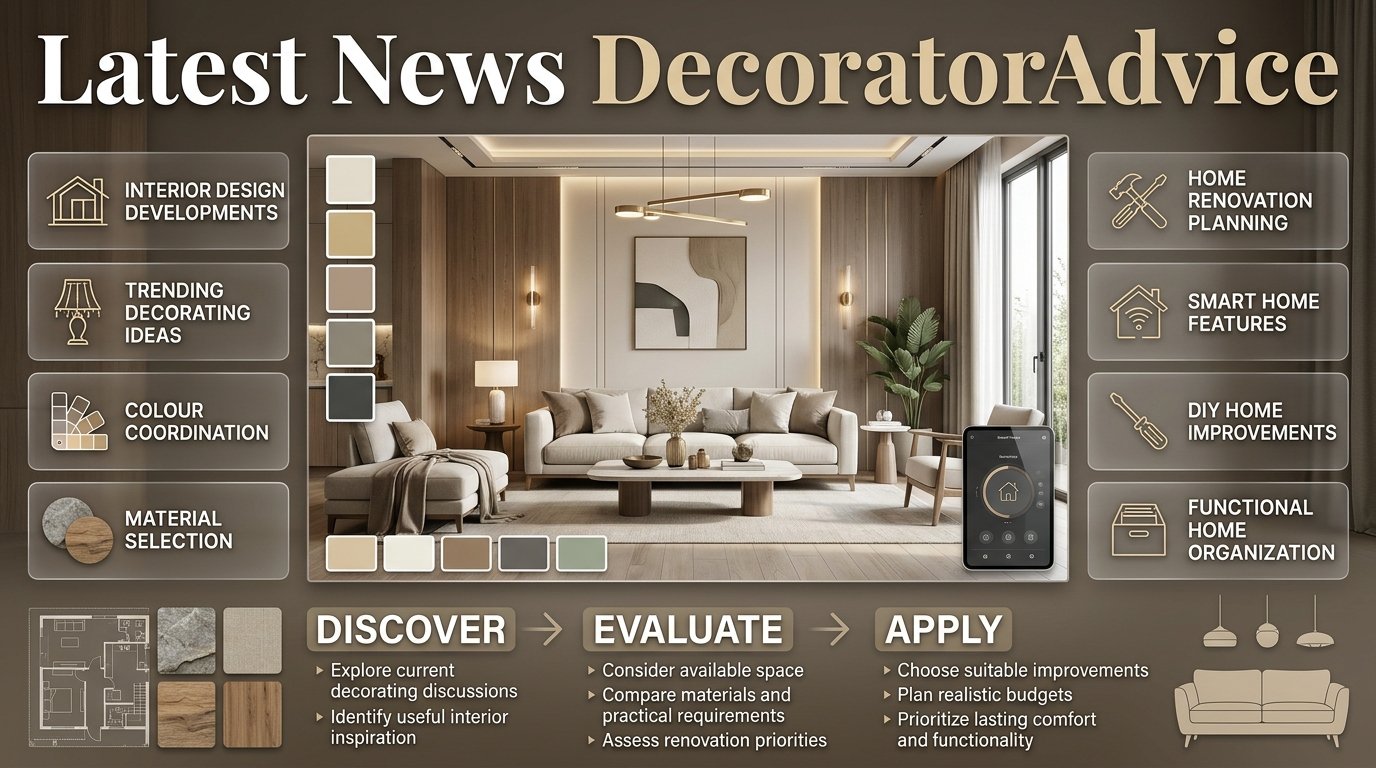
Latest News DecoratorAdvice | Keeping up with home design can be confusing. One week, a particular decorating style seems to be everywhere; the next week, homeowners are discussing different materials, renovation priorities, smart-home features, and ways to make everyday spaces more comfortable. The real challenge isn’t finding new ideas. It’s knowing which information is useful and how to apply it without wasting money.
Latest news DecoratorAdvice is a useful search topic for readers who want to explore current home decorating discussions, interior design developments, renovation guidance, and practical ways to improve their living spaces. However, following every new recommendation doesn’t automatically create a better home. What matters is understanding the purpose behind an idea, checking whether it suits your property, and deciding whether the improvement offers lasting value.
Through DesignMode24 Interior Design, readers can explore practical inspiration covering home styling, renovation planning, materials, lighting, colors, DIY improvements, and room functionality. This guide takes a closer look at how to understand the latest decorating information, evaluate design recommendations, recognize useful developments, and turn inspiration into realistic home improvement decisions.
Whether you’re planning a complete renovation, refreshing one room, researching materials, or simply looking for better ways to organize your home, the aim is to help you make informed decisions rather than follow every passing trend.
What Does Latest News DecoratorAdvice Mean for Homeowners?
Latest news DecoratorAdvice refers to the search for recent decorating information, home improvement discussions, interior design ideas, renovation guidance, and developments associated with DecoratorAdvice. Readers generally want more than attractive room photographs. They want useful information explaining what is changing, why it matters, and how those changes can influence their own homes.
The word “news” can sometimes create the impression that readers are looking for breaking announcements. In home design, however, useful updates can include newly discussed materials, changing homeowner priorities, practical renovation methods, product developments, styling approaches, and professional recommendations.
What information are readers actually looking for?
Most people searching for current decorating information have one or more practical questions:
- Which home design ideas are worth considering?
- What decorating approaches are becoming popular?
- How can I improve my home without undertaking a complete renovation?
- Which materials are suitable for different rooms?
- How can I choose colors that remain attractive over time?
- What should I know before hiring a renovation contractor?
- Which smart-home improvements genuinely make everyday life easier?
- How can I make smaller rooms more functional?
- What mistakes should I avoid before spending money?
These questions reveal an important point: readers are not necessarily looking for the newest product or the most fashionable room. They want information that helps them make better decisions.
Why is this information useful?
A decorating update can introduce an idea that homeowners haven’t considered before. For example, a discussion about improving natural lighting may encourage someone to reconsider heavy window coverings. A renovation article may explain why plumbing and electrical planning should happen before decorative finishes are selected.
The information becomes valuable when it changes how someone approaches a real problem.
A useful way to read design news is to separate three things:
- Inspiration: An idea that introduces a new possibility.
- Education: Information explaining how a design decision works.
- Action: A practical improvement that can be applied to a particular property.
Not every inspiring idea needs to become a purchase. Some are simply useful for understanding different design possibilities.
What Should You Look for in the Latest Home Design Updates?
Not every decorating update deserves equal attention. Some provide practical information, while others mainly present attractive ideas without explaining their limitations. Knowing what to look for helps homeowners avoid confusing visual popularity with genuine usefulness.
Changes in homeowner priorities
Homeowners often reconsider their priorities when their routines change. A family may need more storage, someone working remotely may require a dedicated workspace, or an older property owner may want safer movement between rooms.
These changes influence what people expect from interior design.
Look for information about:
- More practical room arrangements.
- Better storage and organization.
- Comfortable and accessible furniture.
- Improved lighting.
- Easier-to-maintain finishes.
- Flexible rooms for different activities.
- More effective use of available space.
- Better connections between indoor and outdoor areas.
These subjects matter because they address everyday requirements instead of concentrating exclusively on appearance.
New approaches to renovation planning
Renovation information is particularly useful when it explains the order in which work should happen.
For example, replacing a floor before resolving a moisture problem can create unnecessary expense. Installing decorative wall finishes before electrical changes are completed may mean removing newly installed materials.
A good renovation update should explain:
- What needs inspection before work starts.
- Which trades need to coordinate.
- Which materials should be selected early.
- How costs and deadlines should be managed.
- What quality checks are necessary.
- Which decisions can safely wait until later.
This kind of information helps homeowners understand the process instead of simply choosing finishes.
Developments in home technology
Smart-home technology is another subject worth following, particularly when an update explains practical applications rather than listing features.
For instance, automated lighting can help manage different activities, while smart security equipment may provide additional control over entry points.
However, homeowners should investigate compatibility, installation requirements, maintenance, privacy, and long-term costs before purchasing equipment.
A technology feature is useful only when it solves a problem that matters in the household.
How Can You Decide Whether a Decorating Trend Is Worth Following?
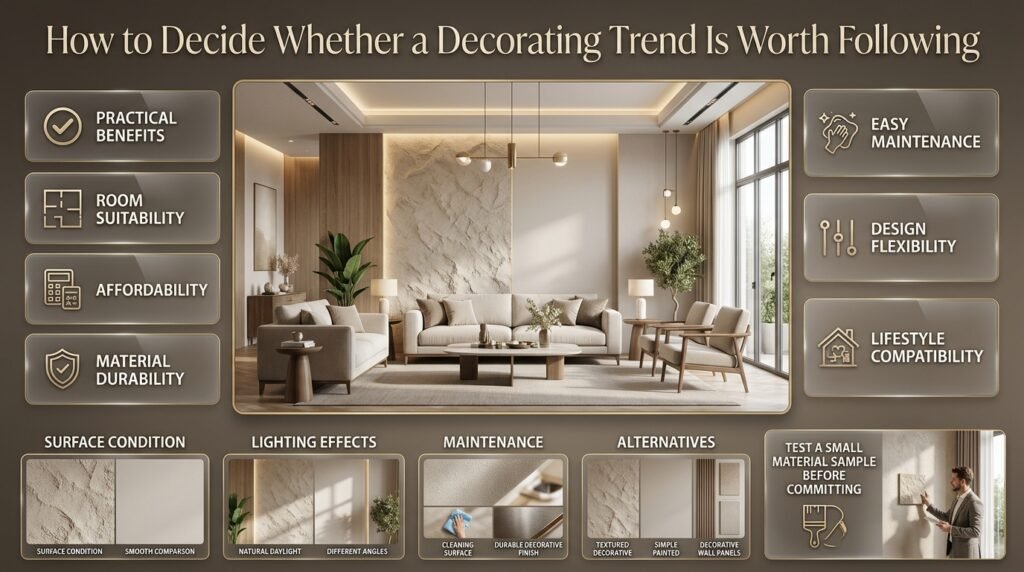
A decorating trend becomes worth considering when it improves a room’s appearance, comfort, functionality, or suitability for everyday life. Popularity alone isn’t enough. Before adopting an idea, evaluate its cost, durability, maintenance, compatibility with your existing interior, and whether you will still appreciate it after the trend becomes less fashionable.
Use a practical evaluation method
Before making a purchase or changing a permanent feature, work through these questions.
| Evaluation question | What to consider |
|---|---|
| Does it solve a problem? | Identify the practical or visual benefit. |
| Does it suit the room? | Consider dimensions, light, and existing finishes. |
| Is it affordable? | Include installation and maintenance costs. |
| Is it durable? | Check material quality and expected use. |
| Is it easy to maintain? | Consider cleaning and repair requirements. |
| Can it be changed? | Understand whether the decision is permanent. |
| Does it fit your lifestyle? | Consider household routines and requirements. |
Example: Considering a new wall finish
Imagine you have seen a textured wall finish featured in recent interior design discussions. It looks attractive, but that doesn’t automatically make it suitable for your living room.
First, consider the wall’s condition. Does it have cracks, moisture, or uneven surfaces? Next, examine the lighting because texture can create shadows that change throughout the day.
Then consider maintenance. Some finishes collect dust more easily or require specialist repairs.
Finally, compare the cost with simpler alternatives such as paint or decorative panels.
This process helps you decide whether the finish offers enough value to justify the investment.
Pro Tip: Test a small sample before committing to an expensive decorative finish. Looking at a material under the actual lighting conditions of your room is more reliable than judging it from an online photograph.
Which Interior Design Developments Deserve Attention in 2026?
The most useful design developments are those that respond to changing household needs. Rather than treating interior design as a competition between fashionable styles, homeowners should pay attention to comfort, flexibility, material quality, lighting, personal expression, and the long-term usefulness of a space.
More attention to functional interiors
A beautiful interior can still be frustrating when furniture blocks movement or frequently used items have no suitable storage.
Functional design begins with understanding how a room is used.
For example, a living room may need to support conversations, television viewing, reading, and family activities. Instead of choosing furniture independently, consider how these activities interact.
A practical layout should provide:
- Clear walking routes.
- Comfortable seating arrangements.
- Convenient access to storage.
- Suitable lighting for different tasks.
- Enough space around doors and windows.
- Appropriate furniture proportions.
A room should look organized without making ordinary activities difficult.
Greater interest in personal interiors
A home doesn’t have to look as if every item came from the same furniture collection.
Personal interiors can combine contemporary furniture, inherited pieces, artwork, handmade accessories, photographs, books, and objects collected over time.
The key is creating visual relationships.
For example, an older wooden cabinet may work beautifully beside a contemporary sofa if their colors, proportions, or materials complement one another.
This approach gives rooms character while allowing homeowners to preserve meaningful belongings.
Better use of natural materials
Wood, stone, ceramic, linen, and other textured materials can introduce warmth and visual depth.
However, natural materials should be selected according to their intended use.
A porous surface may need additional protection in a busy kitchen. Certain wood finishes require regular maintenance. Natural stone can vary in appearance and may need suitable sealing.
Before selecting a material, compare its appearance, durability, maintenance requirements, and installation costs.
Explore Interior Design for additional guidance on creating cohesive and practical living spaces.
Flexible spaces for changing routines
A room may need to serve several purposes throughout the day.
A guest bedroom can also accommodate remote work. A dining table may become a temporary study area. A spare corner can support reading or exercise.
Flexible furniture helps make these arrangements practical.
Consider:
- Foldaway desks.
- Storage benches.
- Extendable dining tables.
- Mobile side tables.
- Modular shelving.
- Furniture with concealed storage.
- Movable screens for temporary privacy.
The best solution depends on how frequently the room changes function.
How Should You Understand New Paint and Color Advice?
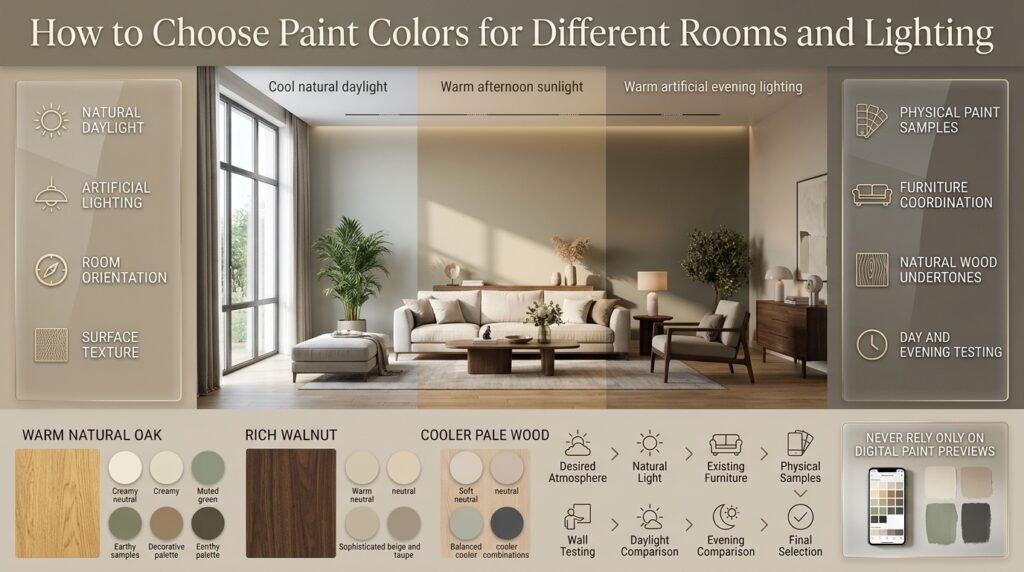
Paint recommendations should be treated as starting points rather than universal instructions. A color that looks attractive in one property may appear completely different in another because of natural light, artificial lighting, surrounding materials, room orientation, and surface texture.
Why does the same paint color look different in different rooms?
Light changes how people perceive color.
A north-facing room may receive cooler natural light, while a room with strong afternoon sunlight can make some shades appear warmer. Artificial lighting also affects how wall colors look after sunset.
The surrounding finishes matter too.
A warm wooden floor can make a neutral wall appear more yellow, while a cool grey surface may make the same paint look less warm.
A reliable process for choosing paint
- Identify the atmosphere you want to create.
- Consider the room’s natural light.
- Compare the color with flooring and furniture.
- Obtain physical paint samples.
- Apply samples to suitable test areas.
- Observe them at different times of day.
- Check the appearance under evening lighting.
- Make the final selection only after comparing the results.
How can you coordinate paint with natural wood?
Natural wood has undertones that influence the appearance of surrounding colors. Oak may appear golden, walnut can look deeper and richer, and some pale woods have cooler or more neutral characteristics.
A successful palette considers these differences instead of treating all wood finishes as identical.
For example, a warm wood floor may work well with creamy neutrals, muted greens, or earthy colors. A cooler wood finish may suit a different combination.
Explore Coordinating Paint With Natural Wood when comparing wall colors with wooden finishes.
Common Mistake: Choosing a paint color because it looks attractive on a phone screen. Digital displays cannot reliably reproduce the exact appearance of paint under your home’s lighting conditions.
Why Is Lighting an Important Part of Current Decorating Advice?
Lighting influences how a room looks, how comfortably people use it, and how different materials appear. A well-planned lighting arrangement considers general illumination, task requirements, decorative emphasis, and the atmosphere people want at different times of day.
Understand the three main lighting functions
Ambient lighting provides general illumination. Ceiling fixtures, recessed lights, and suitable wall fixtures can contribute to this layer.
Task lighting supports specific activities. Examples include desk lamps, reading lights, kitchen worktop lighting, and bathroom mirror lighting.
Accent lighting highlights particular features such as artwork, architectural details, shelving, or textured surfaces.
A room may need all three types, although their importance depends on its size and purpose.
Why does lighting placement matter?
A light fixture can be attractive but ineffective when installed in the wrong position.
A pendant that hangs too low may interfere with movement. A desk lamp placed on the wrong side may create unwanted shadows. Poor bathroom mirror lighting can make everyday grooming more difficult.
Before installation, consider:
- The purpose of the fixture.
- Its height and position.
- The direction of illumination.
- Glare and unwanted shadows.
- Switching arrangements.
- Dimming compatibility.
- Access for maintenance.
Understanding Japandi lighting principles
Japandi-inspired interiors often use simplicity, natural materials, restrained decoration, and comfortable lighting.
The lighting should support the room rather than dominate it.
Paper-inspired shades, understated pendants, warm wood details, and carefully positioned indirect lighting can help create a calm atmosphere.
However, the style should not be copied without considering practical illumination. A beautiful decorative lamp may not provide enough light for reading or working.
Read Japandi Lighting Composition for a closer look at balancing lighting, simplicity, and visual comfort.
How Can Homeowners Make Better Decisions About Smart-Home Improvements?
Smart-home improvements are most valuable when they make daily routines easier, improve control, or support household efficiency. Before buying equipment, identify the problem, check compatibility, understand installation requirements, and consider how the system will be maintained over time.
Start with a specific household problem
Don’t begin by purchasing several smart devices.
Begin by identifying what needs improvement.
For example:
- If lights are frequently left on, consider suitable lighting controls.
- If temperature management is inconvenient, investigate compatible climate controls.
- If entry monitoring is a concern, assess appropriate security equipment.
- If window coverings are difficult to operate, consider automation where practical.
- If energy use is difficult to monitor, explore suitable monitoring solutions.
The purpose should determine the technology.
Check compatibility before installation
Smart devices don’t always work together.
Some depend on specific communication standards, hubs, applications, or internet connections. Others may require compatible wiring or professional installation.
Check:
- Whether the device supports your existing equipment.
- Whether it needs a separate hub.
- Whether internet access is required.
- How software updates are handled.
- Whether the manufacturer provides ongoing support.
- What happens during a power or network interruption.
Plan technology around the interior
Technology should not create unnecessary visual clutter.
Think about where screens, speakers, sensors, switches, charging points, and cables will be located.
If you are planning a media wall, home office, or automated lighting system, coordinate the electrical and interior arrangements before installing decorative finishes.
For practical guidance, read How to Set Up My Home Decoradtech.
Expert Tip: Keep essential manual controls wherever possible. A home should remain usable when an application, wireless connection, or automated feature temporarily stops working.
What Should You Know Before Starting a Home Renovation?
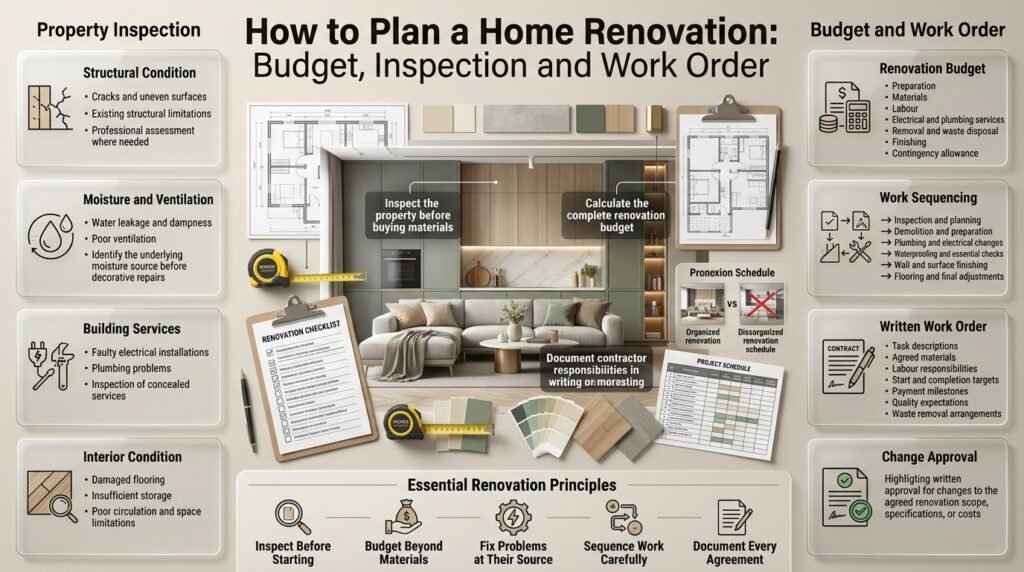
A successful renovation begins with understanding the property’s existing condition, defining the work, establishing a realistic budget, and coordinating the people responsible for completing it. Decorative choices should not take priority over safety, structural requirements, plumbing, electrical work, or moisture-related problems.
Start with an inspection
Before preparing a shopping list, inspect the areas that need improvement.
Look for:
- Cracks that may require professional assessment.
- Water leakage and dampness.
- Damaged flooring.
- Poor ventilation.
- Faulty electrical installations.
- Plumbing problems.
- Uneven surfaces.
- Existing structural limitations.
- Insufficient storage or circulation space.
Some issues are visible, while others require qualified inspection.
Do not cover a recurring moisture problem with decorative paint or wall panels. The underlying cause needs to be addressed first.
Prepare a realistic renovation budget
A renovation budget should include more than the cost of visible materials.
Consider:
| Budget area | What to include |
|---|---|
| Preparation | Inspection, measurements, and planning |
| Materials | Flooring, paint, fixtures, and finishes |
| Labour | Contractor and specialist charges |
| Services | Electrical, plumbing, and installation |
| Removal | Demolition and waste disposal |
| Finishing | Painting, sealing, and final adjustments |
| Contingency | Allowance for unexpected work |
The contingency amount should reflect the property’s condition and the uncertainty involved. Older buildings or projects involving concealed services may require more flexibility.
Why does work sequencing matter?
Renovation tasks depend on one another.
For example, electrical changes may need to happen before wall finishing. Waterproofing must be completed and checked before bathroom tiles are installed. Flooring may need to wait until heavy construction work is finished.
A sensible sequence reduces rework and helps contractors coordinate their responsibilities.
Prepare a renovation work order
A written work order should explain what the contractor is expected to complete.
Include:
- Property and project details.
- Description of each task.
- Agreed materials and specifications.
- Labour responsibilities.
- Project start and completion targets.
- Payment milestones.
- Quality expectations.
- Site protection arrangements.
- Waste removal responsibilities.
- Procedures for approving changes.
Explore Renovation Work Order for Homeowners for more guidance on documenting renovation responsibilities.
Important: Never rely entirely on verbal promises for expensive renovation work. Written specifications help reduce misunderstandings about materials, deadlines, and the agreed scope.
How Can You Improve a Room Without Replacing Everything?
A room makeover doesn’t always require new furniture, expensive finishes, or major construction. Often, the biggest improvement comes from correcting the layout, removing unnecessary objects, improving lighting, and updating a few carefully selected elements.
Begin with the room’s existing problems
Before purchasing anything, observe how the space works.
Ask yourself:
- Is furniture blocking a walking route?
- Are frequently used objects difficult to reach?
- Does the room feel too dark?
- Is there unnecessary visual clutter?
- Are the curtains suitable for the windows?
- Does the room have a clear focal point?
- Is there enough comfortable seating?
These questions help identify improvements that have a practical purpose.
Rearrange before replacing
Furniture arrangement affects the visual balance and usability of a room.
For example, a sofa may be positioned too far from the main seating area. A dining table may block access to a doorway. A desk may be placed where natural light creates screen glare.
Try alternative arrangements before purchasing new furniture.
Measure important distances and make sure doors, drawers, and windows can operate comfortably.
Refresh the room through smaller changes
Depending on the existing condition, consider:
- Changing cushions or throws.
- Updating curtains.
- Introducing a suitable rug.
- Repositioning artwork.
- Adding a reading lamp.
- Organizing visible storage.
- Repainting a selected surface.
- Updating cabinet hardware.
- Removing unnecessary decorations.
These changes can create a noticeable improvement without requiring a complete makeover.
How Do You Create a Clear Focal Point in a Room?
A focal point is the main visual feature that attracts attention and helps organize the surrounding design. It could be a fireplace, a large artwork, a feature wall, a window with an attractive view, or a carefully arranged furniture grouping.
Why does every room benefit from visual direction?
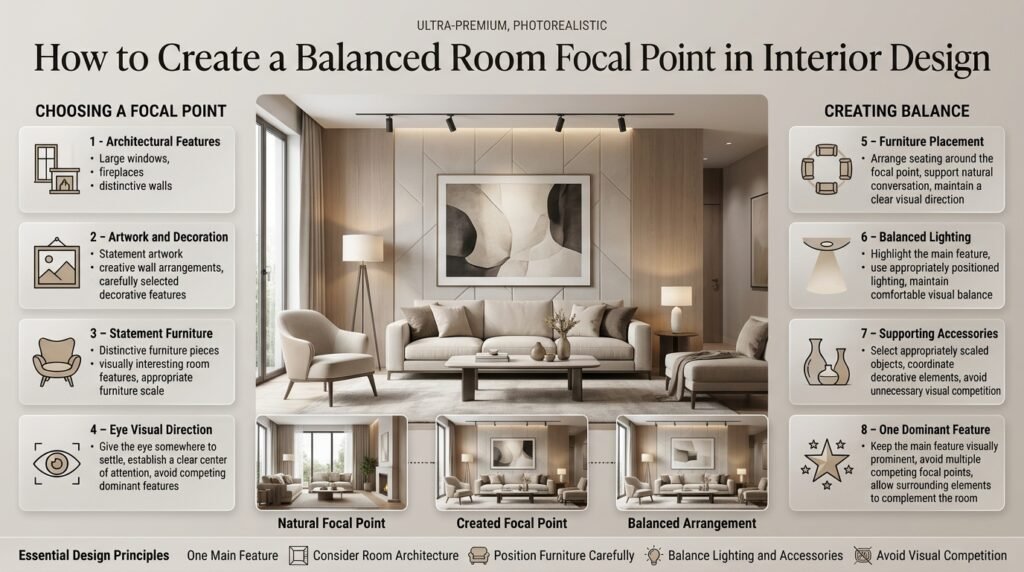
Without a clear visual anchor, a room can feel scattered.
Several decorative objects may compete for attention, or furniture may appear disconnected.
A focal point gives the eye somewhere to settle.
It also helps determine where furniture, lighting, and decorative elements should be positioned.
How should you choose a focal point?
Consider the room’s architecture first.
A large window may already provide a natural feature. In another room, a fireplace or an interesting wall may deserve attention.
If there is no obvious architectural feature, artwork, a distinctive furniture piece, or a carefully designed wall arrangement can create one.
Avoid creating several equally dominant features in a small room.
Keep the surrounding arrangement balanced
Once you choose the main feature, arrange supporting objects carefully.
For example, a large artwork above a sofa may need balanced lighting and appropriately scaled accessories. A fireplace may benefit from a clear furniture arrangement that supports conversation.
The supporting elements should strengthen the focal point instead of competing with it.
Read Room Focal Point Planning Principles for more detailed guidance.
How Have Residential Interiors Changed Over Time?
Residential interiors have changed in response to technology, construction methods, household routines, economic conditions, and cultural preferences. Understanding these changes helps homeowners recognize why particular design approaches become popular and why older design principles can still be useful today.
From formal rooms to flexible living spaces
Many traditional homes used clearly separated rooms for specific activities.
Dining rooms, sitting rooms, studies, and family spaces often had distinct purposes.
Modern households may prefer more flexible arrangements, with spaces supporting several activities.
This doesn’t mean open-plan layouts are automatically better. Separate rooms can still offer privacy, noise control, and clear functional boundaries.
The right arrangement depends on household needs.
Changes in materials and construction
Improved manufacturing methods have expanded the range of flooring, wall finishes, furniture materials, and decorative products available to homeowners.
However, more choices also create a greater need for informed selection.
A material should be evaluated according to performance, maintenance, environmental conditions, appearance, and cost.
The growing importance of personal comfort
Interior design is increasingly understood as more than visual presentation.
Lighting, acoustics, furniture ergonomics, indoor air quality, storage, privacy, and accessibility all influence how a home feels.
A room that photographs beautifully may still be uncomfortable if it has poor ventilation, unsuitable furniture, or inadequate task lighting.
Explore History of Changing Residential Interiors to understand how residential design has developed and how household expectations have influenced interior spaces.
What Makes Open Shelving Practical Instead of Messy?
Open shelving can provide accessible storage and display space, but it requires thoughtful organization. Without a clear arrangement, shelves can quickly become crowded with unrelated objects, making a room appear untidy.
Decide what belongs on display
Open shelves work best when the displayed items have a purpose.
Consider using:
- Frequently used dishes.
- A small selection of books.
- Decorative ceramics.
- A few framed photographs.
- Carefully selected plants.
- Storage containers with consistent finishes.
Not everything needs to be visible.
Items that create visual clutter or require frequent access may be better stored in closed cabinets.
Create visual balance
Avoid filling every shelf completely.
Leave some breathing room around objects and vary the height of displayed pieces.
Group similar items where appropriate, but avoid making every shelf look identical.
For example, a shelf can combine a few books, one decorative object, and a small plant. The arrangement should feel intentional without looking overly staged.
Consider cleaning and maintenance
Open shelves collect dust more easily than closed storage.
In kitchens, grease and cooking residue may also become a concern.
Choose shelf locations and materials according to how the room is used.
Read Styling Open Shelves Without Clutter for practical ideas on maintaining an organized display.
How Can You Make Different Rooms Feel Connected?
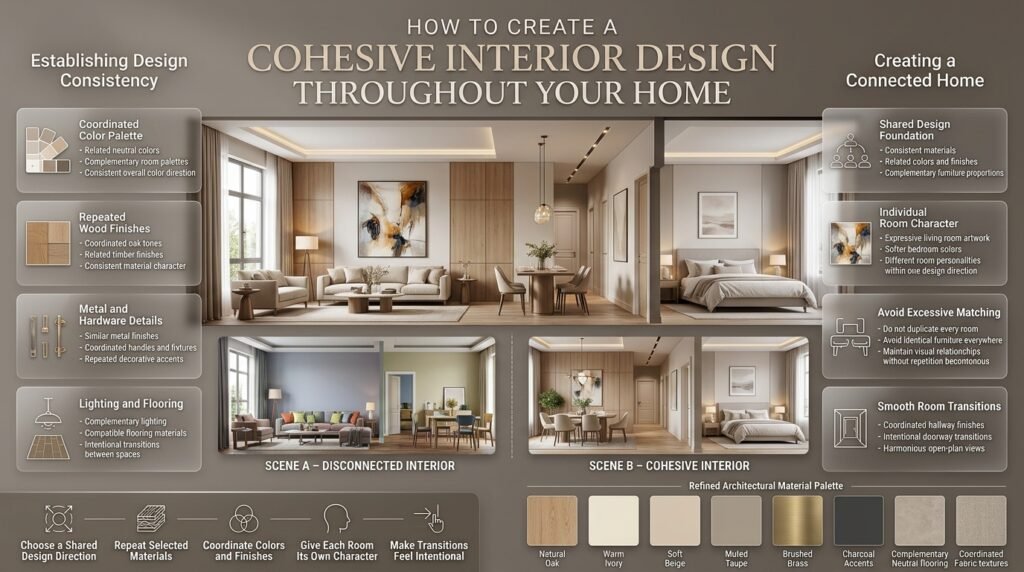
A cohesive home doesn’t require every room to have the same furniture, paint color, or decorating style. Instead, visual consistency comes from repeating selected colors, finishes, materials, proportions, and design details in a controlled way.
Establish a simple design direction
Start by identifying a few elements that will connect the home.
These may include:
- A consistent wood finish.
- Related neutral colors.
- Similar metal finishes.
- Repeated lighting characteristics.
- Complementary flooring materials.
- A shared approach to furniture proportions.
- Consistent decorative details.
The objective is to create a recognizable relationship between spaces.
Avoid excessive matching
A common misunderstanding is that every room needs identical finishes.
This can make the home feel repetitive.
A better approach is to maintain a shared foundation while allowing each room to have its own character.
For example, the living room may use stronger artwork, while the bedroom uses softer colors. Both can still feel connected through their wood finishes, hardware, and overall palette.
Consider transitions between rooms
Hallways, doorways, and open-plan areas are important because they connect different spaces visually.
Changes in flooring, wall colors, and lighting should feel intentional.
When two rooms are visible from the same position, consider how their colors and materials interact.
How Can Homeowners Use DIY Projects to Improve Everyday Living?
DIY projects are useful when they address manageable problems and can be completed safely with appropriate tools and skills. They can improve storage, refresh surfaces, personalize interiors, and reduce the need for expensive replacements.
Choose projects according to skill level
Some projects are relatively straightforward.
Examples include:
- Reorganizing shelves.
- Painting suitable surfaces.
- Updating decorative accessories.
- Installing simple non-structural storage.
- Arranging artwork.
- Refreshing furniture finishes.
- Creating decorative displays.
- Organizing drawers and cabinets.
More complex work requires additional knowledge.
Electrical installations, structural modifications, gas connections, major plumbing, and specialist waterproofing should be handled by qualified professionals.
Plan before purchasing materials
A successful DIY project starts with measurements and a realistic list of requirements.
Check:
- The dimensions of the work area.
- The materials needed.
- The tools required.
- The surface condition.
- The time available.
- The safety precautions.
- The expected final appearance.
Buying materials before understanding the project can create unnecessary expense.
Explore DIY Home Projects for additional practical inspiration.
What Are the Most Common Mistakes When Following Decorating Advice?
The biggest decorating mistakes usually happen when homeowners make decisions too quickly, copy ideas without considering their own properties, or prioritize appearance over everyday functionality. Recognizing these problems early can prevent unnecessary purchases, disappointing results, and expensive corrections.
Mistake 1: Treating every new idea as a requirement
Why it happens: People see attractive rooms and assume their own homes need the same features.
Why it causes problems: Following too many trends can create an inconsistent interior and increase spending.
How to avoid it: Identify the purpose of each change and choose only the ideas that fit your requirements.
Mistake 2: Ignoring measurements
Why it happens: Furniture and decorative products can look smaller or larger in online photographs.
Why it causes problems: Incorrect dimensions may block walkways, doors, drawers, or access to windows.
How to avoid it: Measure the room and the product before ordering. Check delivery access as well.
Mistake 3: Selecting materials without checking maintenance
Why it happens: Appearance receives more attention than practical performance.
Why it causes problems: Some finishes stain, scratch, fade, or require more cleaning than expected.
How to avoid it: Ask about cleaning instructions, durability, moisture resistance, and repair requirements.
Mistake 4: Starting decoration before essential repairs
Why it happens: Visible changes feel more exciting than hidden construction work.
Why it causes problems: Later repairs may damage newly installed finishes.
How to avoid it: Inspect the property and complete necessary structural, electrical, plumbing, and moisture-related work first.
Mistake 5: Using too many decorative accessories
Why it happens: Homeowners assume additional objects automatically create a richer interior.
Why it causes problems: Surfaces become crowded, cleaning becomes harder, and important design features lose attention.
How to avoid it: Display fewer, more meaningful objects and leave sufficient empty space.
Mistake 6: Ignoring natural and artificial light
Why it happens: Colors and materials are selected under showroom lighting or on digital displays.
Why it causes problems: The final result may look different at home.
How to avoid it: Test samples in the actual room and evaluate them throughout the day.
Mistake 7: Making changes without a budget
Why it happens: Small purchases appear inexpensive individually.
Why it causes problems: Multiple upgrades can exceed the original budget.
How to avoid it: Prepare a complete cost estimate, prioritize essential work, and keep a contingency allowance.
Mistake 8: Hiring contractors without clear specifications
Why it happens: Homeowners assume that verbal discussions are sufficient.
Why it causes problems: Disagreements can develop over materials, installation methods, completion dates, and payment.
How to avoid it: Put the agreed scope, specifications, and responsibilities in writing.
Professional Advice for Making Better Home Design Decisions
Professional-quality decorating decisions come from careful observation, realistic planning, and understanding how individual elements work together. You don’t need to be a trained designer to apply these principles, but you do need to look beyond the appearance of an idea.
Start with the people who use the room
Before selecting furniture or finishes, understand who will use the space.
A family room may need durable upholstery and flexible seating. A home office needs suitable task lighting and comfortable working arrangements. A guest bedroom should offer convenient storage without becoming difficult to move around.
Design requirements should come before shopping decisions.
Prioritize the most important improvements
Not every problem deserves the same budget.
Separate improvements into three categories:
Essential: Safety, repairs, leaks, faulty services, and urgent maintenance.
Functional: Storage, circulation, lighting, furniture suitability, and room organization.
Decorative: Artwork, accessories, feature finishes, and styling updates.
This order helps prevent decorative spending from taking money away from important work.
Use a written specification for important purchases
When comparing products or hiring a contractor, document the details that matter.
For example, a flooring specification may include the material type, thickness, finish, installation method, and maintenance instructions.
A lighting specification may identify fixture dimensions, output, color characteristics, controls, and installation requirements.
Clear specifications make comparisons more meaningful.
Don’t ignore visual balance
A room can contain beautiful individual pieces but still feel uncomfortable when their sizes and positions don’t work together.
Look at the relationship between:
- Furniture height.
- Wall space.
- Ceiling height.
- Rug dimensions.
- Window proportions.
- Lighting placement.
- Decorative scale.
A large artwork may suit a spacious wall but overwhelm a narrow area. A small rug may make an otherwise balanced seating arrangement look disconnected.
Make one major decision at a time
When several elements are changed simultaneously, it becomes difficult to understand which decision improved or weakened the room.
For example, if you’re updating a living room, establish the furniture layout before finalizing the rug size and decorative lighting.
A sensible sequence makes each choice easier.
Review the result after installation
A project isn’t finished simply because the contractor has left.
Check whether the work matches the agreed specifications.
Look for:
- Consistent finishing.
- Properly operating doors and drawers.
- Secure fittings.
- Suitable lighting.
- Clean joints and edges.
- Correct material installation.
- Completed repairs.
- Safe electrical and plumbing arrangements.
Raise issues while the project details are still fresh and easy to verify.
How Can You Create a Home Improvement Plan That Actually Works?
A home improvement plan turns general decorating inspiration into an organized sequence of decisions. It identifies what needs to change, how much the work may cost, which tasks depend on others, and what result the homeowner expects.
Step 1: Record the problems
Walk through each room and write down the issues you notice.
Avoid listing products you want to purchase at this stage.
Instead, describe the problems.
For example:
- The bedroom has insufficient bedside storage.
- The kitchen work area is poorly illuminated.
- The living room furniture blocks movement.
- The entrance lacks practical shoe storage.
- The bathroom has inadequate ventilation.
Clear problem descriptions make solutions easier to identify.
Step 2: Rank improvements by importance
Separate urgent repairs from optional decorative updates.
A leaking pipe should receive attention before a new decorative mirror. A damaged electrical fitting should be assessed before installing additional lighting.
Prioritization keeps the project practical.
Step 3: Research suitable solutions
Compare different approaches rather than selecting the first idea you find.
A storage problem might be solved with built-in cabinetry, freestanding furniture, wall shelves, or better organization of existing cupboards.
Each option has different costs, space requirements, and maintenance considerations.
Step 4: Prepare a realistic budget
Include materials, labour, delivery, installation, removal, and additional expenses.
Obtain suitable quotations for specialist work.
Avoid relying on the cheapest estimate without checking the proposed specifications.
Step 5: Schedule the work
Identify which activities need to happen first.
For a typical room renovation, the sequence may involve inspection, repairs, service modifications, surface preparation, installation, decoration, and final checks.
The exact order depends on the project.
Step 6: Evaluate the completed space
Compare the final result with the original problems.
Has storage improved? Is movement easier? Does lighting support the room’s activities? Are the selected materials suitable?
The success of a renovation should be measured by how well it solves the original problems, not simply by how much money was spent.
Where Does DesignMode24 Fit Into Your Decorating Research?
Design information becomes easier to use when readers can explore related subjects in a structured way. Rather than researching every decorating question separately, homeowners can connect ideas about color, materials, lighting, room layouts, renovation planning, and styling.
DesignMode24 Interior Design provides a starting point for exploring these connected subjects.
The most useful approach is to follow a topic according to the decision you’re trying to make.
For example:
- Research color coordination before purchasing paint.
- Understand lighting composition before choosing decorative fixtures.
- Review material suitability before ordering finishes.
- Study renovation planning before agreeing to construction work.
- Learn about furniture arrangement before replacing major pieces.
- Explore styling techniques before adding more accessories.
This creates a more organized research process.
Build a personal home design reference
Instead of saving every attractive room you see, organize your research into useful categories.
Color references: Keep examples of palettes that work with your existing furniture and flooring.
Material references: Record finishes, maintenance instructions, and product specifications.
Layout references: Save arrangements that solve similar space or furniture problems.
Renovation references: Keep measurements, quotations, specifications, and project notes together.
Lighting references: Record suitable fixture types, positions, and illumination requirements.
A well-organized reference collection makes future decorating decisions easier and reduces repeated research.
What Are the Biggest Home Decorating Trends to Follow in 2026?
Home decorating in 2026 is increasingly focused on warmth, individuality, natural materials, and comfortable living spaces. Instead of making every room look perfectly coordinated, homeowners are showing more interest in interiors that reflect their personalities and support their daily routines. Warm earthy colors, textured surfaces, natural wood, handcrafted accessories, and layered lighting are among the notable design directions.
However, following a trend doesn’t mean changing your entire home. The smartest approach is to introduce new ideas through elements that can be updated without major construction.
Practical ideas worth considering:
Use warm neutrals, earthy greens, or deeper brown shades to introduce a more inviting atmosphere.
Combine wood, stone, linen, and other textures for visual depth.
Introduce distinctive lighting fixtures that provide both practical illumination and decorative interest.
Display personal artwork, collected accessories, and meaningful furniture.
Choose comfortable, functional furniture instead of prioritizing appearance alone.
The most successful decorating decisions balance current inspiration with long-term usability.
How Can I Use Latest DecoratorAdvice News to Improve My Home Without Overspending?
The best way to use decorating news is to identify ideas that solve an existing problem before spending money. Many homeowners make unnecessary purchases because they see an attractive interior and assume they need similar furniture, accessories, or finishes. A more practical approach is to assess the existing room and determine which changes would make the biggest difference.
For example, if a living room feels uncomfortable, rearranging the furniture and improving lighting may be more effective than purchasing an expensive sofa. Similarly, better storage organization can make a small bedroom feel more spacious without changing its furniture.
Smart ways to control decorating expenses:
Identify the room’s biggest functional or visual problem.
Reuse furniture that is still in good condition.
Refresh selected surfaces instead of renovating the entire room.
Compare material quality and maintenance costs before purchasing.
Complete essential repairs before buying decorative accessories.
Keep a separate allowance for unexpected expenses.
A well-planned, affordable improvement can deliver a better result than an expensive makeover without a clear purpose.
Which Interior Design Materials Are Worth Considering for Modern Homes in 2026?
Material selection should depend on durability, appearance, maintenance, environmental conditions, and the way each room is used. Natural wood, stone, ceramic, linen, textured finishes, and quality engineered surfaces are all worth considering, but no material is suitable for every application.
For instance, a natural stone surface may create a beautiful kitchen feature, but its maintenance requirements depend on the specific stone and finish. Engineered surfaces may offer different advantages in terms of consistency and care. Similarly, wooden flooring can introduce warmth, while a suitable waterproof flooring product may be more practical in certain moisture-prone areas.
Before selecting any material, check:
Its suitability for the intended room.
Resistance to moisture, scratches, and everyday wear.
Cleaning and maintenance requirements.
Installation complexity and labour costs.
Expected lifespan and repair options.
Compatibility with existing furniture and finishes.
A material should be selected because it performs well in your home, not simply because it appears frequently in decorating discussions.
How Can I Combine Modern Decorating Trends With a Timeless Interior Design Style?
Combining modern trends with timeless design requires a balance between permanent features and easily replaceable decorative elements. Large investments, such as flooring, fitted cabinetry, and major furniture pieces, should generally be selected with long-term usability in mind. More expressive trends can then be introduced through artwork, cushions, lampshades, accessories, and selected paint colors.
For example, a neutral living room with quality wooden furniture can accommodate changing accent colors and decorative styles without requiring a complete redesign. This approach also makes future updates more affordable.
A balanced decorating strategy includes:
Choose practical flooring and furniture that suit long-term needs.
Use a consistent foundation of complementary colors and finishes.
Introduce current trends through smaller decorative details.
Mix contemporary pieces with meaningful older furniture.
Avoid using too many competing patterns or finishes.
Consider how each new purchase will work with existing belongings.
The goal isn’t to avoid trends completely. It’s to enjoy new design ideas without making expensive choices that quickly become difficult to change.
How Do I Know Whether a Home Improvement Idea From DecoratorAdvice Is Right for My Property?
A home improvement recommendation is suitable when it addresses a genuine need, fits the property’s existing conditions, and can be completed within a realistic budget. Before following any advice, consider whether the idea is appropriate for your room dimensions, building structure, climate, household routines, and maintenance expectations.
For example, a decorative wall finish may look impressive in a design feature, but it may not be appropriate for a wall affected by moisture. Similarly, a smart-home upgrade may offer convenience, but compatibility with existing electrical systems and devices should be checked before installation.
Use this evaluation checklist:
Identify the specific problem the recommendation is intended to solve.
Check whether the idea suits your property’s layout and condition.
Measure the available space before ordering products.
Compare material specifications and installation requirements.
Calculate the complete project cost, including labour.
Consult a qualified professional for structural, electrical, plumbing, or other specialist work.
Consider future maintenance before making permanent changes.
The best decorating advice is not necessarily the most fashionable or expensive. It is the advice that helps you improve your property safely, comfortably, and sensibly.
Conclusion
Staying informed about the latest news DecoratorAdvice can help homeowners discover fresh decorating ideas, understand changing interior design preferences, and make smarter decisions about their living spaces. However, creating a beautiful home isn’t about following every new trend or purchasing the latest products. It’s about choosing improvements that offer genuine value, suit your lifestyle, and make everyday living more comfortable.
From selecting suitable materials and coordinating paint colors to improving lighting, organizing furniture, exploring smart-home technology, and planning renovations, every decision should have a clear purpose. Take time to research your options, compare practical benefits, consider maintenance requirements, and establish a realistic budget before starting any project.
Remember that the best interiors combine visual appeal with functionality, comfort, and personal character. Use current decorating advice as inspiration, adapt useful ideas to your property’s needs, and avoid spending money on changes that don’t solve a real problem.
Ultimately, a well-designed home doesn’t need to follow every decorating trend. It needs to work beautifully for the people who live in it, remain practical over time, and reflect their individual preferences. Make thoughtful choices, improve your space step by step, and focus on creating a home that feels as good as it looks.