
Introduction
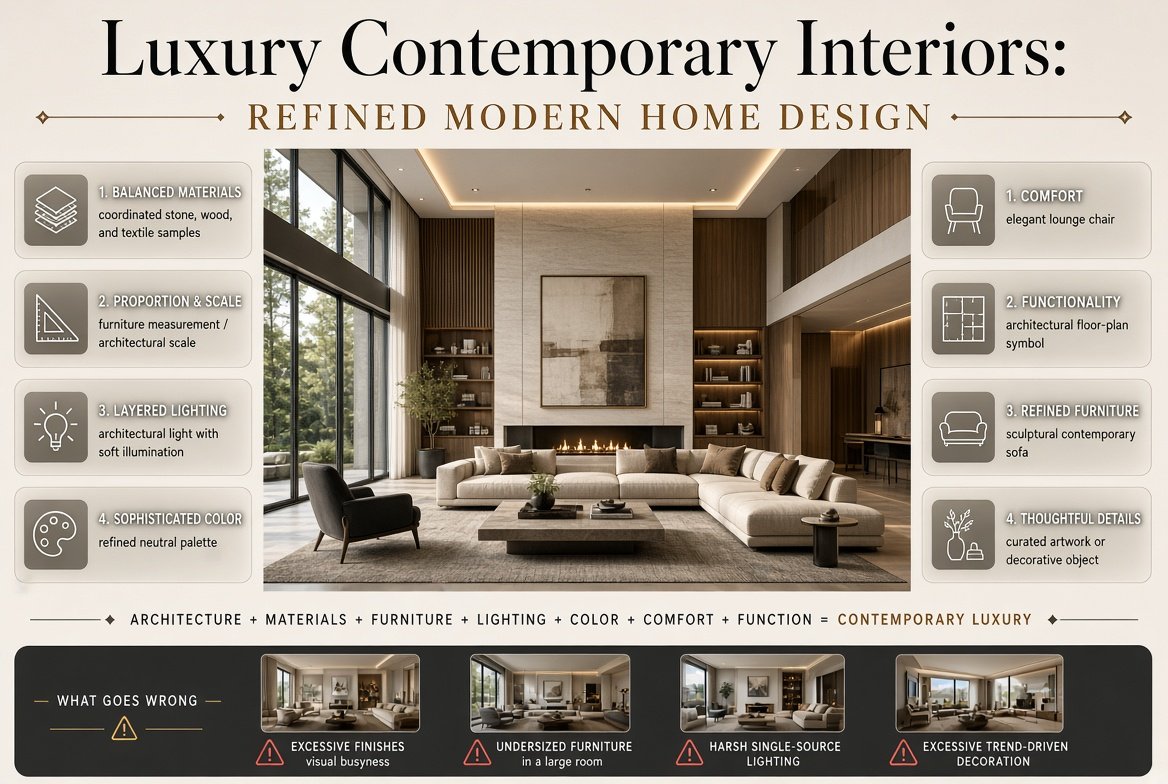
Luxury Contemporary Interiors | A home can have expensive furniture, marble surfaces, designer lighting, custom cabinetry, and beautiful artwork, yet still fail to feel genuinely luxurious. Often, the problem isn’t the quality of the individual pieces. It’s the way everything has been combined.
Too many finishes can make a room feel busy. Furniture that’s too small can make a large space feel unfinished. Harsh lighting can make premium materials look ordinary. And when every room is decorated around the latest trend, the home can quickly lose its personality.
This is where luxury contemporary interiors stand apart.
Contemporary luxury isn’t about showing how much money was spent on a room. It’s about creating an environment where architecture, materials, furniture, lighting, color, comfort, and functionality work together naturally.
The result should feel refined without being formal, modern without being cold, and sophisticated without becoming overdecorated.
If you’re planning a complete renovation, updating one room, or simply trying to make your existing home feel more elevated, this guide will show you how to approach the process professionally—from choosing a color palette and materials to selecting furniture, planning lighting, designing individual rooms, avoiding expensive mistakes, and creating luxury even when the budget isn’t unlimited.
For broader inspiration and practical interior ideas, visit designmode24 interior design.
What Are Luxury Contemporary Interiors?
Luxury contemporary interiors are modern living spaces that combine clean architectural forms with premium materials, sophisticated colors, carefully selected furniture, layered lighting, and thoughtful decorative details. The style emphasizes quality, proportion, comfort, and visual simplicity rather than excessive ornamentation.
A luxury contemporary home may include:
- Natural stone
- Warm wood
- Large-format surfaces
- Custom cabinetry
- Sculptural furniture
- Neutral color schemes
- Architectural lighting
- High-quality textiles
- Statement artwork
- Integrated technology
- Carefully controlled decoration
The word contemporary refers to a design language that feels current and connected to modern lifestyles. The word luxury describes the quality of the experience—how the space looks, feels, functions, and performs.
That distinction matters.
A room doesn’t become luxurious simply because it contains marble or expensive furniture. Luxury comes from the relationship between the elements.
A simple oak cabinet can look more sophisticated than an expensive glossy cabinet if its proportions, hardware, lighting, and surrounding materials have been carefully considered.
Why Does Contemporary Luxury Feel Different?
Traditional luxury often relies on decorative details, symmetry, ornate furniture, and elaborate finishes.
Contemporary luxury is generally more restrained.
It may use:
- Fewer decorative objects
- Larger architectural gestures
- Cleaner furniture silhouettes
- Natural materials
- Controlled color palettes
- Hidden storage
- Integrated lighting
- Stronger negative space
The room therefore has a sense of calm.
You notice the quality of the materials instead of being distracted by the number of things inside the room.
💡 Pro Tip: If you want a room to feel more luxurious, don’t immediately add another expensive object. First ask whether the room needs better proportions, lighting, texture, or editing.
What Makes a Contemporary Interior Look Luxurious?
The most convincing luxury contemporary interiors usually get several fundamentals right at the same time.
1. Proportion
Furniture, lighting, artwork, rugs, and architectural features need to relate to the size of the room.
A massive living room with a tiny sofa and small coffee table will feel incomplete, regardless of how expensive those pieces are.
2. Material Quality
Luxury is often communicated through texture.
Natural stone, timber, linen, wool, leather, brushed metal, and quality upholstery create visual and tactile depth.
3. Controlled Color
A sophisticated palette prevents visual competition.
The most successful contemporary interiors often use a dominant neutral, supporting tones, and one or two carefully selected accents.
4. Lighting
Lighting determines how materials and colors are perceived.
A beautiful stone wall under poor lighting can look dull. The same wall under carefully positioned architectural lighting can become the focal point of the room.
5. Negative Space
Empty space is part of the design.
When important furniture and artwork have breathing room around them, the entire room feels more intentional.
6. Function
True luxury also means convenience.
Storage should be easy to access. Furniture should be comfortable. Lighting should support different activities. Technology should work without visually dominating the room.
This is why contemporary luxury should never be designed only for photographs.
It should work beautifully on an ordinary Tuesday morning.
How Do You Choose a Luxury Contemporary Color Palette?
The easiest way to create a sophisticated contemporary interior is to begin with a controlled color palette rather than choosing colors room by room without an overall plan.
Warm white, cream, taupe, beige, greige, soft gray, charcoal, brown, and muted earth tones are particularly versatile.
However, neutral doesn’t mean flat.
The secret is layering different tones and textures within the same color family.
For example, a living room could combine:
- Warm ivory walls
- Beige linen curtains
- Taupe sofa
- Natural oak
- Cream wool rug
- Dark walnut accents
- Brushed bronze details
The colors are relatively quiet, but the materials keep the room interesting.
Should You Use Dark Colors?
Absolutely.
Dark contemporary interiors can be extremely luxurious when they have sufficient lighting and material variation.
Consider:
- Charcoal walls
- Dark walnut cabinetry
- Deep brown leather
- Bronze lighting
- Cream upholstery
- Natural stone
The contrast prevents the space from becoming visually heavy.
Warm vs. Cool Contemporary Palettes
| Warm Contemporary | Cool Contemporary |
|---|---|
| Cream | White |
| Beige | Cool gray |
| Taupe | Charcoal |
| Walnut | Black |
| Terracotta accents | Blue-gray accents |
| Brass/bronze | Chrome/stainless steel |
| Natural stone | Polished stone |
Warm palettes generally feel more residential and comfortable.
Cool palettes often feel more architectural and dramatic.
Neither is automatically better. The choice should depend on the architecture, daylight, furniture, and atmosphere you want.
⭐ Expert Tip: Always test paint and material samples in the actual room. Natural daylight, artificial lighting, flooring, and nearby finishes can dramatically change how a color appears.
For additional color inspiration, explore the Paint Color collection.
Which Materials Work Best in Luxury Contemporary Interiors?
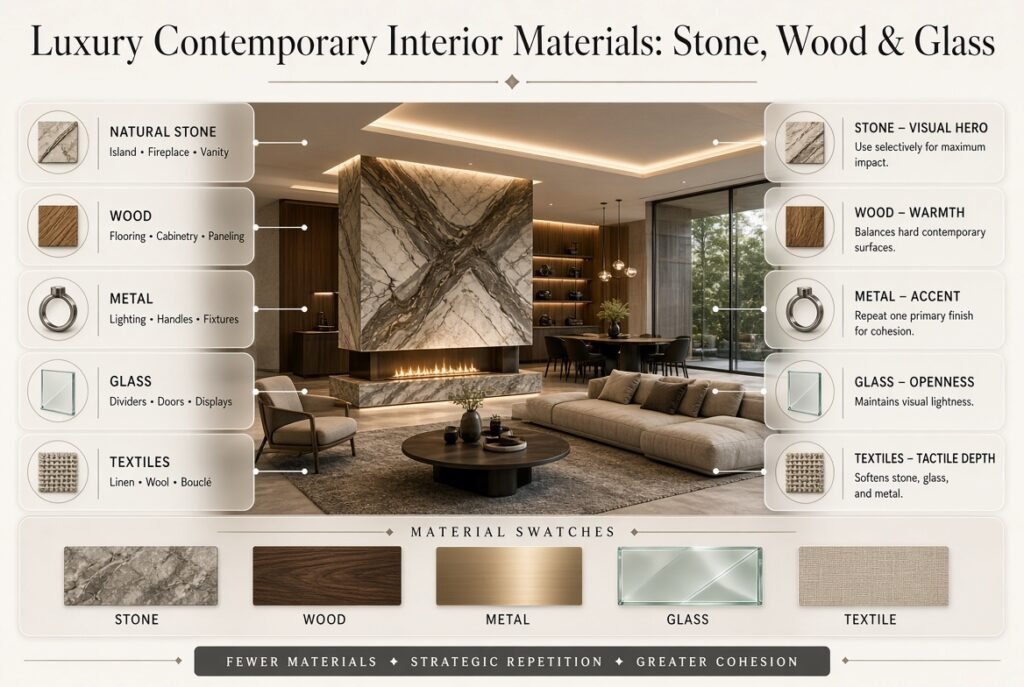
Materials are one of the most important parts of contemporary luxury because they create depth without requiring excessive decoration.
Instead of using ten different premium finishes, choose a small group of materials and repeat them strategically.
Natural Stone
Marble, quartzite, travertine, limestone, and other stones can create an immediate sense of quality.
Use statement stone for:
- Kitchen islands
- Fireplace surrounds
- Bathroom walls
- Vanity tops
- Coffee tables
- Feature walls
- Entryway surfaces
The strongest result usually comes from allowing one stone to become a visual hero.
If the marble has dramatic veining, you don’t necessarily need another dramatic pattern elsewhere.
Wood
Wood is essential when a contemporary interior begins to feel too hard or sterile.
Walnut introduces depth and richness.
Oak feels lighter and more relaxed.
Natural wood can be used for:
- Flooring
- Wall paneling
- Cabinetry
- Doors
- Furniture
- Ceiling details
- Decorative slats
Wood also works particularly well alongside stone because the two materials balance each other.
Metal
Metal should usually be used as an accent rather than the dominant material.
Popular finishes include:
- Brushed brass
- Bronze
- Blackened metal
- Stainless steel
- Polished chrome
Choose a primary metal finish and repeat it in a few places.
For example, brushed brass could appear in:
- Pendant lights
- Cabinet handles
- Bathroom fixtures
- Side tables
This creates cohesion without making the room look overly coordinated.
Glass
Glass is useful when you want to maintain visual openness.
It works particularly well for:
- Shower enclosures
- Interior doors
- Display cabinets
- Room dividers
- Coffee tables
- Balustrades
In smaller homes, transparent materials can help prevent the space from feeling crowded.
Textiles
Luxury should be experienced through touch as well as sight.
Layer:
- Linen
- Wool
- Cotton
- Bouclé
- Velvet
- Leather
- Soft woven fabrics
A room with stone, glass, and metal but no tactile materials can easily feel cold.
How Should You Choose Furniture for a Luxury Contemporary Home?
Furniture selection should begin with the room’s dimensions and function, not with individual products you happen to like.
Before buying anything, determine:
- How people will move through the room.
- Where the primary seating will go.
- What activities the space must support.
- How much storage is required.
- Which piece should become the focal point.
- How much visual weight the room can handle.
What Furniture Shapes Suit Contemporary Luxury?
Look for:
- Clean silhouettes
- Low-profile sofas
- Rounded edges
- Sculptural chairs
- Simple cabinetry
- Substantial coffee tables
- Upholstered headboards
- Minimal hardware
Curves are particularly useful because contemporary architecture can contain many straight lines.
A curved sofa or rounded coffee table can soften a room without making it traditional.
Why Is Furniture Scale So Important?
Imagine a large living room with:
- A small sofa
- A tiny rug
- A narrow coffee table
- Two miniature chairs
Every individual item may be attractive, but the room will feel visually weak.
Now imagine:
- A large sectional
- An appropriately sized rug
- A substantial coffee table
- Two proportionate accent chairs
- A large artwork
The same room immediately feels more complete.
⚠ Common Mistake: Don’t choose furniture simply because it looks good in a showroom. Measure the actual room and consider circulation before purchasing.
For room-specific planning, use the Room-by-Room Design Hub.
How Important Is Lighting in Luxury Contemporary Interiors?
Lighting can completely change the perceived quality of an interior.
A premium room with flat lighting often looks ordinary.
A well-lit room with modest materials can look dramatically more sophisticated.
The best approach is layered lighting.
Ambient Lighting
This provides general illumination.
Examples include:
- Recessed ceiling lights
- Cove lighting
- Architectural LEDs
- Ceiling fixtures
Task Lighting
Task lighting supports specific activities.
Examples include:
- Kitchen worktop lighting
- Reading lamps
- Desk lighting
- Bathroom vanity lighting
Accent Lighting
Accent lighting creates atmosphere and highlights important features.
Use it for:
- Artwork
- Stone walls
- Shelving
- Architectural niches
- Plants
- Decorative objects
A simple lighting concept looks like this:
Ambient → General visibility
Task → Functional activities
Accent → Mood + focal points
When these layers work together, the room becomes more dynamic.
Should You Use Statement Lighting?
Yes, but selectively.
A sculptural pendant above a dining table can become the room’s defining feature.
An oversized chandelier in every room, however, quickly becomes repetitive.
📌 Quick Tip: Install dimmers wherever possible. A room that needs bright light during cleaning may need much softer illumination during dinner or evening relaxation.
How Do You Create a Luxury Contemporary Living Room?
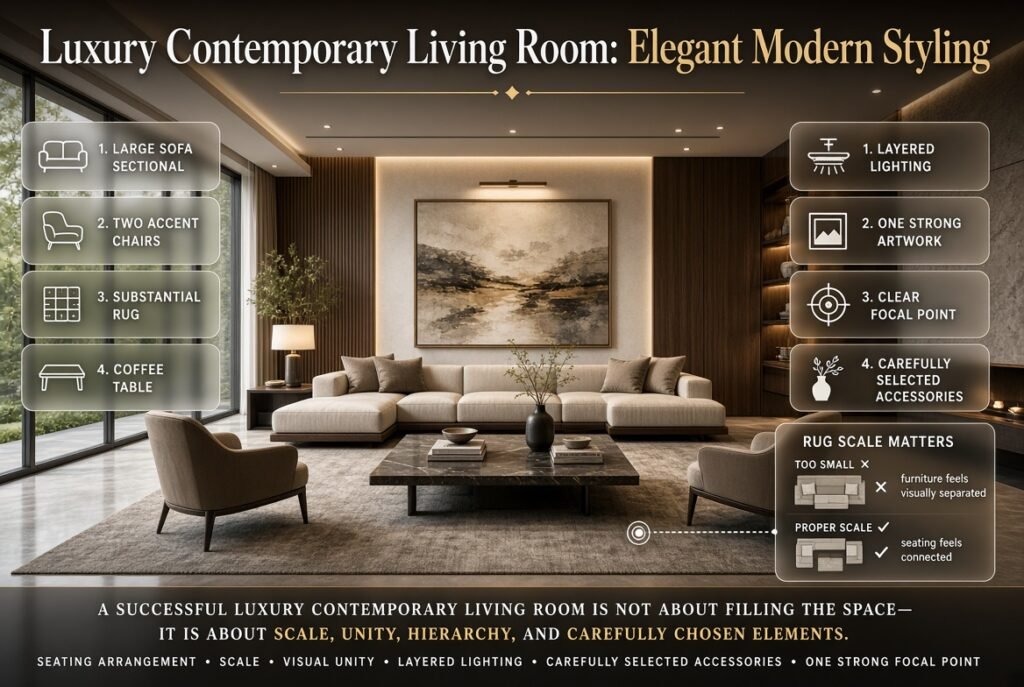
The living room is usually the strongest opportunity to establish the home’s overall design language.
Begin with the seating arrangement.
A successful contemporary living room often includes:
- A large sofa or sectional
- Two accent chairs
- A substantial rug
- A coffee table
- Layered lighting
- One strong artwork
- A few carefully selected accessories
The Rug Matters More Than You Think
A rug that’s too small can visually separate the furniture.
A properly scaled rug connects the seating arrangement and creates a sense of unity.
Ideally, at least the front legs of major seating pieces should relate clearly to the rug.
Create One Strong Focal Point
The focal point might be:
- Fireplace
- Artwork
- Stone wall
- Sculptural light
- Large window
- Feature furniture
Don’t create five focal points and expect them to work equally well.
The eye needs hierarchy.
For more living-room ideas, explore Elegant Living Room Styling.
How Do You Design a Luxury Contemporary Bedroom?
The bedroom should feel quieter than the living room.
Luxury here comes primarily from comfort, texture, proportion, and atmosphere.
Start with the bed.
A substantial upholstered headboard can create architectural presence without requiring an elaborate feature wall.
Then layer:
- High-quality bedding
- Soft throws
- Bedside lighting
- Large curtains
- A substantial rug
- Minimal artwork
- Integrated storage
Why Does Layered Bedding Matter?
A bed made with one flat sheet and a single decorative cushion can make an expensive bedroom feel basic.
Layering creates depth.
You might combine:
- Crisp base bedding
- Textured duvet
- Folded throw
- Two sleeping pillows
- Two larger decorative cushions
Keep the palette restrained.
A calm bedroom doesn’t need ten colors.
For ideas focused on comfort and atmosphere, explore the Cozy Bedroom Makeover guide.
What Does a Luxury Contemporary Kitchen Look Like?
A contemporary luxury kitchen usually combines clean cabinetry, strong material choices, integrated appliances, practical storage, and a carefully proportioned island.
The kitchen should look elegant, but it must also work efficiently.
Consider:
- Work triangle or efficient work zones
- Appliance placement
- Storage
- Counter space
- Island clearance
- Lighting
- Seating
- Material durability
Popular Material Combinations
Wood + stone
Creates warmth and natural sophistication.
Matte cabinetry + natural stone
Feels contemporary and architectural.
Dark cabinetry + light stone
Creates contrast and drama.
Warm white + walnut
Creates a softer, residential luxury.
One important principle is consistency.
If the countertop is highly expressive, let the cabinetry remain relatively quiet.
Explore more planning ideas through Modern Kitchen Design.
How Do You Design a Luxury Contemporary Bathroom?
Bathrooms are naturally suited to contemporary luxury because clean surfaces and minimal detailing create a spa-like atmosphere.
Consider:
- Large-format porcelain
- Natural stone
- Floating vanities
- Frameless glass
- Wall-mounted fixtures
- Integrated niches
- Backlit mirrors
- Under-vanity lighting
Why Are Large-Format Tiles Popular?
Fewer grout lines create a cleaner visual field.
This can make a bathroom appear larger and more architectural.
However, large tiles need appropriate installation and substrate preparation. A premium tile can still look poor if alignment and installation quality are neglected.
Can Luxury Contemporary Interiors Be Minimalist?
Yes.
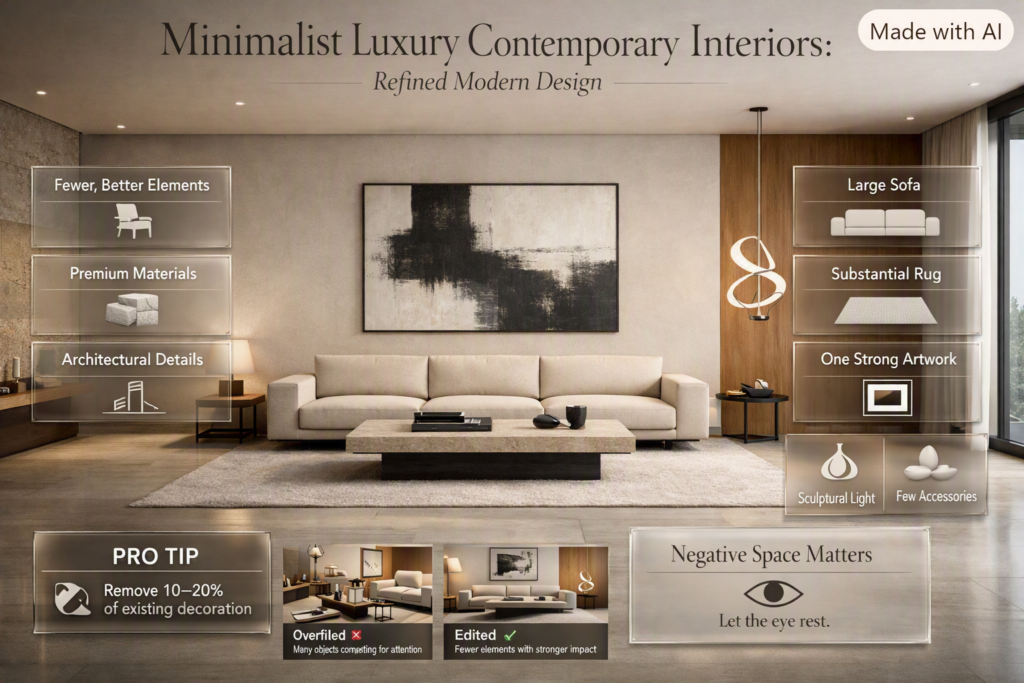
In fact, minimalism can strengthen contemporary luxury because it gives premium materials and architectural details more visual importance.
But luxury minimalism isn’t simply about having fewer possessions.
It’s about having fewer but better-controlled elements.
A sophisticated minimalist living room might contain:
- One large sofa
- One substantial rug
- One coffee table
- One artwork
- One sculptural light
- A few accessories
Nothing feels random.
Why Does Negative Space Matter?
Negative space gives the eye somewhere to rest.
If every shelf, wall, table, and corner contains something, important features lose their impact.
💡 Pro Tip: Before adding decoration, remove 10–20% of what you’ve already placed in the room. The result may look more luxurious immediately.
How Do You Add Personality Without Losing the Luxury Look?
This is one of the most important parts of designing a home that feels genuinely yours.
A neutral contemporary interior can become generic if every item looks like it came from the same showroom.
Introduce personality through:
- Original artwork
- Vintage furniture
- Handmade ceramics
- Books
- Family pieces
- Travel objects
- Sculptural accessories
- Unique textiles
- Plants
The trick is not to make everything special.
Choose a few meaningful elements.
A vintage chair can add history.
A handmade vase can add imperfection.
An original artwork can give the room an identity.
That contrast is often what makes contemporary luxury feel human.
Can Natural Elements Improve Contemporary Luxury?
Absolutely.
Natural materials help soften the harder geometry associated with contemporary architecture.
Wood, stone, plants, natural fibers, daylight, and organic shapes can make a modern space feel warmer.
This approach connects naturally with Biophilic Interior Design, where natural elements are incorporated into interiors to improve visual connection with nature.
You can introduce this philosophy through:
- Indoor plants
- Natural timber
- Stone
- Organic textiles
- Large windows
- Natural daylight
- Earth-inspired colors
- Curved forms
The benefit isn’t only visual.
Natural materials can make a room feel less manufactured and more comfortable.
How Does Sustainable Design Fit Into Luxury Contemporary Interiors?
Luxury and sustainability don’t have to conflict.
In fact, long-lasting materials are often more luxurious because they age well and don’t need frequent replacement.
Prioritize:
- Durable flooring
- Quality furniture
- Responsible timber
- Long-lasting fixtures
- Repairable products
- Energy-efficient lighting
- Natural materials where appropriate
- Timeless architectural finishes
A sustainable approach is discussed in more detail in Sustainable Home Design.
The goal isn’t to make every material perfectly sustainable.
The practical goal is to make better long-term decisions.
Buying one well-made sofa that lasts for years can be more sensible than repeatedly replacing inexpensive furniture.
Luxury Contemporary vs. Modern Interior Design: What’s the Difference?
The terms are closely related, but they aren’t exactly the same.
| Feature | Modern Interior | Luxury Contemporary Interior |
| Main priority | Clean design | Clean design + refinement |
| Materials | Practical and attractive | Premium, tactile, layered |
| Furniture | Functional | Functional + sculptural |
| Lighting | Primarily functional | Architectural + decorative |
| Decoration | Restrained | Restrained + curated |
| Customization | Moderate | Often highly tailored |
| Atmosphere | Clean | Clean + sophisticated |
Contemporary luxury therefore isn’t simply another word for modern design.
It places greater emphasis on material quality, comfort, customization, craftsmanship, and sensory experience.
What Are the Biggest Luxury Contemporary Interior Mistakes?
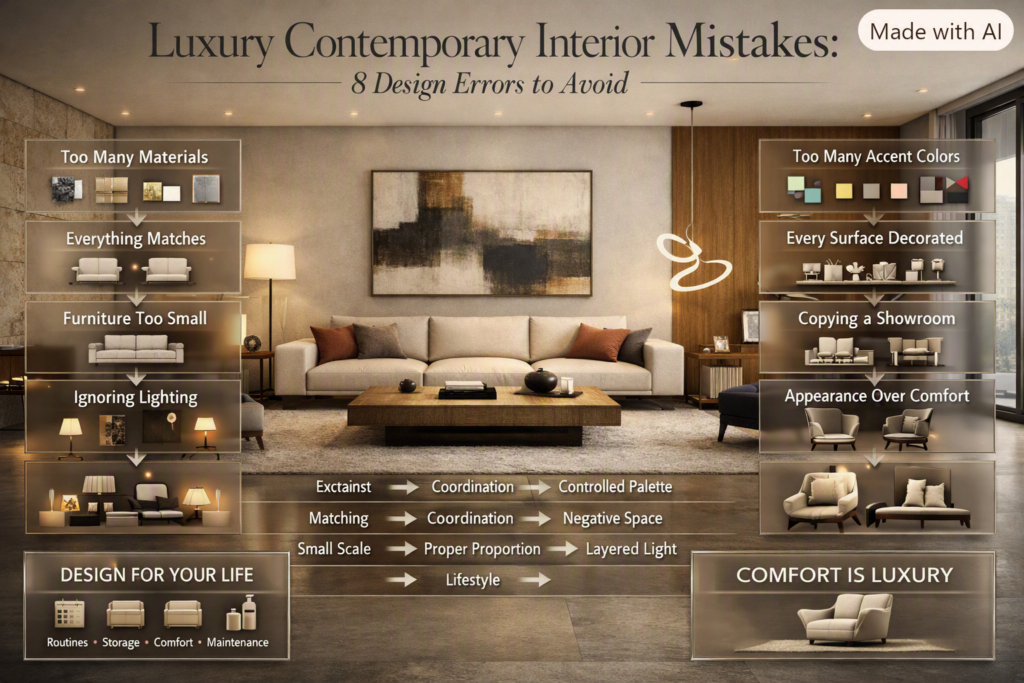
Even expensive renovations can go wrong when basic design principles are ignored.
Using Too Many Expensive Materials
Marble, brass, velvet, mirrors, glossy finishes, crystal, and dramatic lighting may all look impressive separately.
Together, they can become visually exhausting.
Better approach: Choose two or three hero materials and keep supporting finishes quiet.
Making Everything Match
Matching furniture sets can make a home feel like a showroom.
Better approach: Coordinate colors and finishes without duplicating every item.
Choosing Furniture That’s Too Small
This leaves large rooms looking unfinished.
Better approach: Measure the room and choose furniture according to scale.
Ignoring Lighting
A beautiful interior can lose its character under poor illumination.
Better approach: Create three lighting layers and use dimmers.
Using Too Many Accent Colors
Contemporary luxury usually benefits from a controlled palette.
Better approach: Use one or two accent colors repeatedly rather than introducing a new color in every corner.
Decorating Every Surface
This creates visual noise.
Better approach: Let some shelves, tables, and walls remain intentionally quiet.
Copying a Showroom
Showrooms aren’t designed around your lifestyle.
Better approach: Start with your daily routines, storage needs, comfort requirements, and maintenance preferences.
Prioritizing Appearance Over Comfort
An uncomfortable sofa isn’t luxurious.
Neither is a beautiful chair nobody wants to sit in.
Better approach: Treat comfort as part of the design rather than an optional feature.
How Do You Create Luxury on a Limited Budget?
A sophisticated interior doesn’t require every item to be expensive.
If the budget is limited, spend strategically.
Prioritize These Areas
- Layout
- Lighting
- Main furniture
- Flooring
- Curtains
- Kitchen or bathroom focal surfaces
- Hardware
- Artwork
You can save money on:
- Small accessories
- Decorative trays
- Minor side tables
- Trend-based objects
- Replaceable textiles
Why Does This Strategy Work?
Large visual elements have more influence on the room than tiny objects.
A high-quality sofa can affect the entire living room.
A cheap decorative bowl usually cannot.
Similarly, beautiful curtains can dramatically improve a room because they occupy a large visual area.
How Do You Plan a Luxury Contemporary Interior Step by Step?
A professional design process should move from large decisions to small ones.
Step 1: Define the Atmosphere
Before shopping, decide what you want the home to feel like.
For example:
- Warm and organic
- Minimal and calm
- Dark and dramatic
- Bright and architectural
- Soft and sophisticated
Don’t start with individual products.
Start with the experience.
Step 2: Study the Architecture
Look at:
- Ceiling height
- Windows
- Doors
- Natural light
- Columns
- Existing flooring
- Room dimensions
- Architectural focal points
Your design should respond to the building rather than fight it.
Step 3: Build a Material Palette
Choose your major materials first.
For example:
Oak + limestone + linen + bronze
or
Walnut + marble + leather + brushed brass
Once the foundation is established, smaller selections become easier.
Step 4: Choose the Color Scheme
Create a dominant neutral, supporting tone, and controlled accent.
Step 5: Plan Furniture
Measure every important piece.
Check:
- Width
- Depth
- Height
- Door clearance
- Walking paths
- Seating relationships
Step 6: Design Lighting
Determine where ambient, task, and accent lighting are needed.
Step 7: Add Architectural Features
Consider:
- Built-in shelving
- Wall paneling
- Custom cabinetry
- Feature ceilings
- Fireplace surrounds
- Integrated lighting
Step 8: Add Textures
Layer:
- Rugs
- Curtains
- Upholstery
- Throws
- Cushions
- Timber
- Stone
Step 9: Add Personality
Introduce artwork, books, plants, vintage objects, and meaningful pieces.
Step 10: Edit
Remove anything that doesn’t contribute.
This final step is often what separates an attractive room from an exceptional one.
How Can Smart Technology Work With Contemporary Luxury?
Technology should improve the experience without becoming the visual focus.
Useful integrations include:
- Smart lighting
- Automated curtains
- Motorized blinds
- Hidden speakers
- Integrated charging
- Smart climate controls
- Home security
- Scene-based lighting
The best technology is often invisible.
For example, instead of placing multiple devices on a side table, charging points can be integrated into furniture or cabinetry.
Instead of several visible switches, smart controls can simplify the interface.
Luxury is partly about reducing friction in everyday life.
How Can You Make a Home More Functional Without Losing Its Luxury Look?
A beautiful home still needs practical storage.
The most effective contemporary interiors hide everyday clutter through thoughtful planning.
Consider:
- Full-height cabinetry
- Built-in wardrobes
- Concealed storage
- Integrated media units
- Storage benches
- Kitchen organizers
- Entryway cabinets
This is particularly useful in smaller homes.
Use Smart Space-Saving Solutions when you need to increase storage or functionality without making rooms feel crowded.
What Should You Ask Before Finalizing Storage?
Ask:
- Where do keys go?
- Where are shoes stored?
- Where will cleaning supplies live?
- Where will chargers go?
- Where will children’s belongings go?
- Where will seasonal items be stored?
- Which items need daily access?
Good luxury design anticipates these questions before clutter becomes a problem.
How Should a Luxury Contemporary Home Office Be Designed?
A home office needs to balance professional appearance with everyday comfort.
Prioritize:
- Ergonomic seating
- Good desk proportions
- Task lighting
- Cable management
- Storage
- Acoustic comfort
- Natural daylight
- Background appearance for video calls
Avoid turning the office into a decorative showroom.
A sophisticated office should support concentration.
Use the Functional Home Office guide for additional planning ideas.
How Do You Make Luxury Contemporary Interiors Feel Warm?
This is a common challenge.
Contemporary architecture often contains:
- Glass
- Concrete
- Metal
- Stone
- Large windows
- Straight lines
Without balancing elements, the room can feel cold.
Add Warmth Through:
Wood: Adds natural visual warmth.
Textiles: Softens hard surfaces.
Curves: Breaks rigid geometry.
Warm lighting: Creates atmosphere.
Plants: Introduces organic forms.
Artwork: Adds personality.
Warm neutrals: Prevents an overly sterile appearance.
The objective isn’t to make contemporary design less modern.
It’s to make modernity comfortable.
What Is the Best Way to Mix High-End and Affordable Pieces?
A home doesn’t need to be composed entirely of premium products.
Use expensive pieces where they have the greatest visual or functional impact.
For example:
Invest in:
- Sofa
- Dining table
- Kitchen countertop
- Flooring
- Main lighting
- Custom cabinetry
Save on:
- Decorative accessories
- Small side tables
- Replaceable cushions
- Trend-based objects
The key is to avoid making the affordable pieces look randomly chosen.
Keep their colors, proportions, and finishes connected to the overall design.
How Do You Keep Luxury Contemporary Interiors Timeless?
Trends can be useful, but building an entire home around them creates problems.
Instead, divide your design into permanent and changeable layers.
Permanent Layer
Keep relatively timeless:
- Flooring
- Cabinetry
- Major stone
- Built-ins
- Doors
- Architectural details
Flexible Layer
Use trends here:
- Cushions
- Artwork
- Accessories
- Small furniture
- Decorative lighting
- Textiles
This allows the interior to evolve without expensive renovation.
⭐ Expert Tip: If you love a trend, introduce it first through something replaceable. If you still love it after several years, consider using it more permanently.
What makes a luxury contemporary interior look expensive and sophisticated?
A luxury contemporary interior looks expensive when the entire space feels intentional rather than simply filled with expensive products. The strongest results usually come from excellent proportions, premium-looking materials, controlled colors, layered lighting, comfortable furniture, and carefully edited decoration. In other words, luxury is created through how elements work together, not through the price tag of every individual item.
A well-designed room may use only a few major materials—such as natural wood, stone, linen, and brushed metal—but use them consistently enough to create visual continuity. Current luxury interiors are also moving toward warmer, more tactile and lived-in spaces rather than sterile rooms that look untouched.
Key elements to focus on:
Choose furniture according to the room’s scale.
Use two or three dominant materials instead of mixing too many finishes.
Layer different textures to create depth.
Invest in curtains, rugs, and upholstery because they occupy significant visual space.
Use architectural and decorative lighting together.
Leave intentional negative space around important furniture and artwork.
Add a few meaningful objects rather than filling every shelf and tabletop.
Professional advice: If your room doesn’t feel luxurious, don’t immediately buy more décor. First check the furniture scale, lighting, color balance, and clutter. Those four issues are often responsible for a room feeling ordinary.
What colors are trending for luxury contemporary interiors in 2026?
The strongest luxury contemporary color direction in 2026 is moving away from extremely cold whites and flat gray schemes toward warmer neutrals, earthy tones, richer woods, and carefully controlled color. Cream, taupe, sand, warm beige, bone, chocolate brown, terracotta, olive, muted green, and deep natural tones are being used to create interiors that feel more comfortable and sophisticated.
This doesn’t mean neutral interiors have disappeared. Instead, neutrals are becoming more layered. Designers are combining warm wall colors with natural timber, stone, aged metals, textured upholstery, and selected stronger colors.
For example, a contemporary living room could combine warm ivory walls, walnut furniture, a taupe sofa, natural stone, bronze lighting, and a small amount of deep olive or burgundy.
Practical ways to use the 2026 direction:
Use warm white instead of a harsh blue-white.
Pair beige or taupe with walnut or darker wood.
Introduce terracotta through cushions, artwork, or occasional furniture.
Use olive or muted green to bring an organic quality into neutral rooms.
Consider deeper brown tones for cabinetry or statement furniture.
Use stronger colors selectively rather than turning every wall into an accent wall.
Professional advice: Don’t select paint first and then try to force the rest of the room around it. Start with permanent elements such as flooring, stone, cabinetry, and architectural features because their undertones should influence the final color scheme.
Which materials are best for creating a luxury contemporary interior?
The best materials for contemporary luxury are those that provide visual depth, tactile quality, durability, and natural character. Natural stone, walnut, oak, travertine, limestone, linen, wool, leather, plaster, bronze, brass, and textured finishes are particularly effective because they add richness without requiring excessive decoration.
One of the strongest 2026 shifts is toward material honesty—surfaces that show texture, craftsmanship and natural variation rather than relying entirely on glossy or highly manufactured finishes. Honed stone, solid timber, aged metals, plaster and tactile fabrics are increasingly associated with a more sophisticated interpretation of luxury.
The key is material hierarchy. You don’t need every premium material in one room.
A better combination might be:
Walnut + limestone + linen + bronze
rather than:
Marble + mirror + chrome + brass + velvet + glossy lacquer + glass + patterned tile
The first combination gives the eye a clear visual language. The second can quickly become overwhelming.
Materials worth considering:
Natural stone: Excellent for countertops, fireplaces, bathrooms and statement surfaces.
Walnut or oak: Adds warmth and architectural depth.
Linen and wool: Creates softness and tactile contrast.
Leather: Adds structure and sophistication to selected furniture.
Bronze or aged brass: Provides subtle metallic detailing.
Plaster: Creates quiet, seamless wall texture.
Glass: Helps maintain openness and visual lightness.
Professional advice: Choose one hero material for the room, then build supporting materials around it. If the stone has dramatic veining, allow it to be the focal point instead of competing with several other statement finishes.
How do you make a luxury contemporary home feel warm instead of cold or sterile?
The easiest way to warm up a contemporary interior is to balance hard architectural materials with natural textures, softer forms, warmer colors, and layered lighting. Contemporary spaces can feel cold when they rely heavily on white, gray, glass, polished metal, and hard stone without enough fabric, timber, artwork, or personal character.
This is especially important in 2026 because luxury interiors are increasingly moving toward comfort, individuality, tactile materials, and a more lived-in atmosphere rather than perfectly sterile rooms.
Start by introducing warmth through the largest visual elements rather than small decorations.
For example, replace a cold gray sofa with a warm taupe or cream fabric. Add walnut or natural oak. Use a large textured rug. Replace harsh overhead lighting with layered warm illumination. Then introduce plants, artwork, books, ceramics, or vintage pieces.
Simple formula for a warmer contemporary interior:
Clean architecture + natural wood + tactile fabric + warm lighting + personal objects = comfortable luxury
You can also soften straight architectural lines with curved furniture. Rounded sofas, circular coffee tables, curved chairs, and organic accessories help prevent a contemporary room from feeling overly rigid.
Practical improvements:
Add natural timber.
Use textured upholstery instead of only smooth synthetic surfaces.
Introduce linen or wool curtains.
Choose warm-toned lighting.
Add a large area rug.
Use plants or natural branches.
Introduce handmade ceramics or artwork.
Mix contemporary furniture with one or two vintage pieces.
Avoid making every surface glossy.
Professional advice: Don’t try to make the room warm by adding dozens of accessories. Warmth comes primarily from material contrast and lighting. A single walnut wall, textured sofa, and well-designed lighting scheme can do more than an entire shelf of decorative objects.
What are the biggest mistakes to avoid when designing luxury contemporary interiors?
The biggest mistake is assuming that luxury means more. More marble, more gold, more lighting, more furniture, more decoration and more expensive finishes can actually make a contemporary interior look less sophisticated.
Today’s luxury direction is increasingly about restraint, craftsmanship, comfort, personality and materials that feel authentic. Designers are moving away from overly sterile or obviously “showroom” interiors toward spaces with individuality and a sense of having been lived in.
Common mistakes include:
Using too many luxury materials
If every surface competes for attention, nothing becomes the focal point.
Better approach: Select two or three major materials and repeat them thoughtfully.
Choosing furniture that’s too small
Small furniture can make a large room feel unfinished.
Better approach: Measure the room and select pieces according to scale.
Relying on one ceiling light
Flat lighting makes even expensive materials look ordinary.
Better approach: Combine ambient, task, and accent lighting.
Making everything match
A perfectly matched furniture set can make the home feel generic.
Better approach: Coordinate colors and materials while allowing individual pieces to have personality.
Using only cold neutrals
White and gray can become lifeless when there is no textural or color variation.
Better approach: Add warm beige, taupe, brown, timber, stone, and tactile fabrics.
Copying social-media interiors
A room that looks impressive in a photograph may not work for your lifestyle.
Better approach: Design around how you actually use the home—storage, comfort, circulation, maintenance, family needs, and daily routines.
Overdecorating
Luxury needs breathing room.
Better approach: Remove unnecessary objects and allow statement pieces to stand out.
Professional advice: Before buying anything new, photograph your room from several angles and identify its three biggest weaknesses. Fix those problems first. In many cases, rearranging furniture, improving lighting, removing clutter, or changing the rug will create a bigger transformation than purchasing another decorative item.
Conclusion
Creating beautiful luxury contemporary interiors isn’t about filling a home with expensive furniture, dramatic finishes, or the latest design trends. True luxury comes from making thoughtful choices that work together—balanced proportions, refined materials, warm colors, layered lighting, comfortable furniture, and enough open space for every element to breathe.
The most successful contemporary homes also feel personal. Natural wood can soften a modern room, artwork can add character, textured fabrics can bring comfort, and carefully selected decorative pieces can make the space feel lived-in rather than staged.
If you’re planning your own interior, start with the fundamentals before buying accessories. Define your color palette, choose a small group of complementary materials, plan furniture around the room’s scale, and treat lighting as an essential part of the design. From there, add personality gradually and remove anything that creates unnecessary visual noise.
Ultimately, luxury isn’t measured by how much you spend. It’s reflected in how effortlessly your home functions, how comfortable it feels, and how confidently every design decision belongs there. Choose quality over quantity, timelessness over short-lived trends, and thoughtful design over excess—and your contemporary home can feel genuinely luxurious for years to come.
Leave a Reply