
Introduction
Biophilic Interior Design | Have you ever walked into a room that looked perfectly decorated but still felt cold, flat, or strangely uncomfortable? The furniture may be attractive, the walls may have a beautiful color, and every accessory may be carefully chosen, yet something still feels missing. Often, that missing element is a stronger connection with nature.
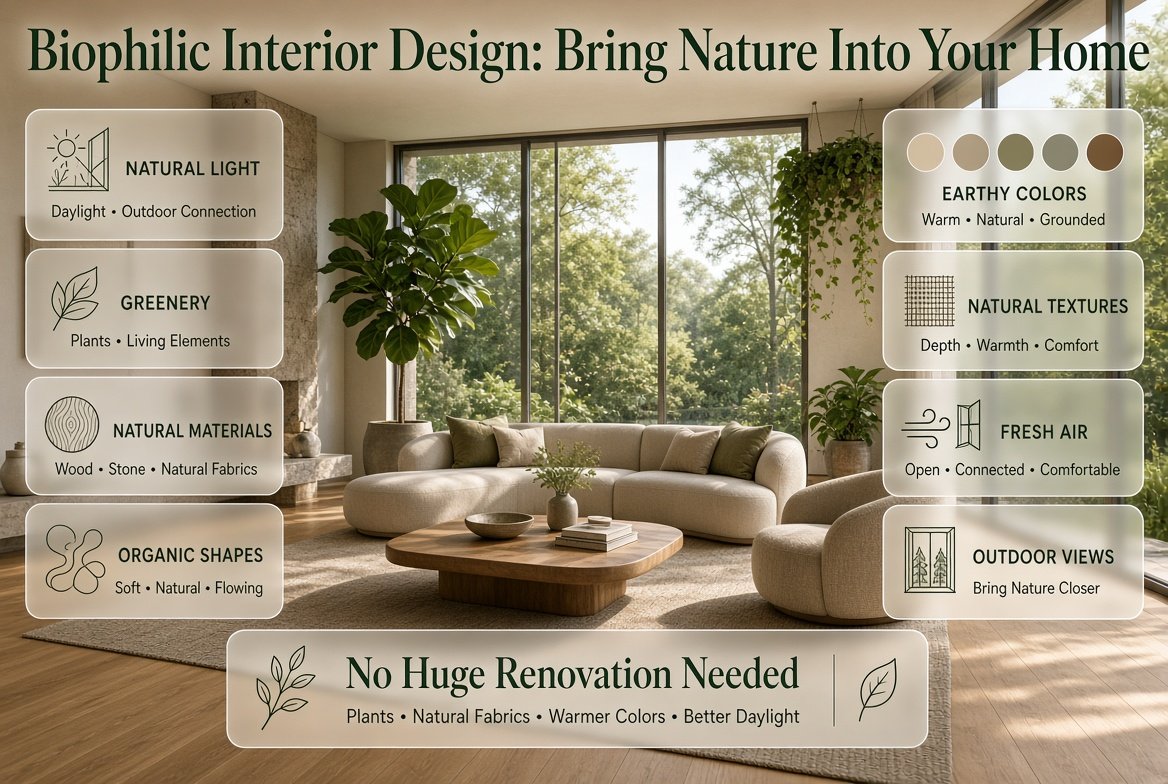
Biophilic Interior Design solves this problem by bringing natural light, greenery, organic shapes, natural materials, earthy colors, textures, fresh air, and views of the outdoors into the spaces where we live and work. It isn’t simply about putting a few plants beside a sofa. Done properly, it changes the way a room looks, feels, and functions.
The good news is that you don’t need a huge renovation budget to create a more biophilic home. A better furniture arrangement, a carefully selected plant, natural fabrics, warmer colors, and improved daylight can make a surprisingly big difference.
In this guide, you’ll learn what biophilic interior design really means, why it has become so popular, the principles behind it, how to apply it room by room, which materials and colors work best, how to create the look on a budget, what mistakes to avoid, and how to make the final result feel sophisticated rather than overly themed.
For broader inspiration before you begin, DesignMode24 Interior Design can help you explore practical ideas for improving the relationship between style, comfort, and everyday function throughout the home.
What Is Biophilic Interior Design?
Biophilic interior design is an approach to designing indoor environments around a stronger connection between people and nature. It uses elements such as natural daylight, plants, wood, stone, natural fabrics, organic shapes, nature-inspired colors, outdoor views, textures, and other sensory experiences to make interiors feel more connected to the natural world.
The important point is that biophilic design is a design philosophy, not a decorating theme.
A room doesn’t become biophilic simply because it contains green cushions and several houseplants. A well-designed biophilic space considers how people experience the room from morning to night.
That means asking practical questions:
- Where does natural light enter?
- Can people see outside?
- Does the furniture encourage comfort and connection?
- Do the materials feel natural?
- Are there different textures to engage the senses?
- Are plants positioned where they’ll actually thrive?
- Does the room feel calm without becoming boring?
- Are natural materials being used where they’re practical?
- Does the design support the way the room is used?
When these decisions work together, the result feels much more authentic.
Why Is Biophilic Design More Than Adding Plants?
Plants are probably the most recognizable part of biophilic interiors, but they’re only one element. Natural light, materials, views, sounds, textures, colors, ventilation, and organic forms can all contribute to the experience.
Imagine two living rooms.
The first has twelve plants but small, heavily covered windows, synthetic furniture, harsh lighting, and lots of clutter.
The second has two healthy plants, large clear windows, warm daylight, oak furniture, linen curtains, natural textures, and a comfortable view toward a garden.
The second room is likely to feel more connected to nature even though it contains fewer plants.
The lesson is simple: don’t count natural elements. Think about how naturally the entire room feels.
What Are the Main Principles of Biophilic Interior Design?
The strongest biophilic interiors usually combine several natural characteristics rather than depending on one feature. Natural light, vegetation, materials, colors, forms, views, textures, and sensory experiences can all work together.
1. Maximize Natural Light
Natural light should be one of your first considerations.
Daylight changes throughout the day, creating subtle variations in brightness and shadow that artificial lighting can’t completely reproduce. It can also make natural materials such as wood and stone look more dimensional.
Start by checking whether your window treatments are unnecessarily blocking light.
Heavy curtains may look elegant, but if they’re permanently closed, you’re losing one of the simplest opportunities to improve the room.
Consider:
- Sheer curtains
- Light-filtering blinds
- Adjustable shades
- Clear window areas
- Mirrors positioned carefully to reflect daylight
- Furniture arrangements that don’t obstruct windows
You don’t necessarily need larger windows. Sometimes the problem is simply how the existing windows are being used.
💡 Pro Tip: Observe the room at morning, afternoon, and evening before making design decisions. A room that looks bright at 10 a.m. may feel completely different at 5 p.m.
2. Bring in Real Vegetation
Living plants create a direct visual connection with nature.
They also introduce shapes and textures that are difficult to replicate perfectly with manufactured décor.
Instead of placing small plants on every surface, think about visual hierarchy.
A tall plant can occupy an empty corner. A trailing plant can soften a shelf. A compact plant can add life to a desk.
Useful locations include:
- Beside sofas
- Near suitable windows
- Empty corners
- Entry consoles
- Open shelving
- Home-office desks
- Bathroom areas with adequate light
- Kitchen windowsills
The right plant depends on the environment.
Before buying one, consider light levels, humidity, temperature, watering needs, mature size, and maintenance requirements.
3. Use Natural Materials
Natural materials bring warmth and tactile interest into interiors.
Common options include:
- Wood
- Stone
- Bamboo
- Rattan
- Cork
- Linen
- Cotton
- Wool
- Jute
- Clay
- Terracotta
- Natural ceramics
You don’t need all of them.
In fact, using too many materials can make a room feel confused. A combination such as oak, linen, and stone can be enough.
The objective is to create a balanced material palette where each element supports the others.
4. Introduce Organic Shapes
Nature is full of irregular curves, flowing forms, and imperfect shapes.
You can introduce this quality without making the room look rustic.
Try:
- Rounded coffee tables
- Curved chairs
- Arched mirrors
- Organic-shaped rugs
- Sculptural lighting
- Rounded ceramics
- Irregular stone accessories
- Soft-edged furniture
Straight architectural lines can remain. The contrast between structured lines and softer natural forms often creates a more sophisticated result.
5. Choose Nature-Inspired Colors
Biophilic color palettes usually draw inspiration from landscapes.
Popular choices include sage green, olive, moss, sand, cream, beige, terracotta, muted blue, warm brown, and earthy gray.
However, you shouldn’t assume every wall needs to be green.
A warm neutral room with natural wood and plants can feel strongly biophilic.
For help coordinating colors throughout your home, Paint Color ideas can provide additional inspiration when you’re deciding between earthy neutrals, greens, blues, and warmer tones.
How Does Biophilic Design Improve a Home?
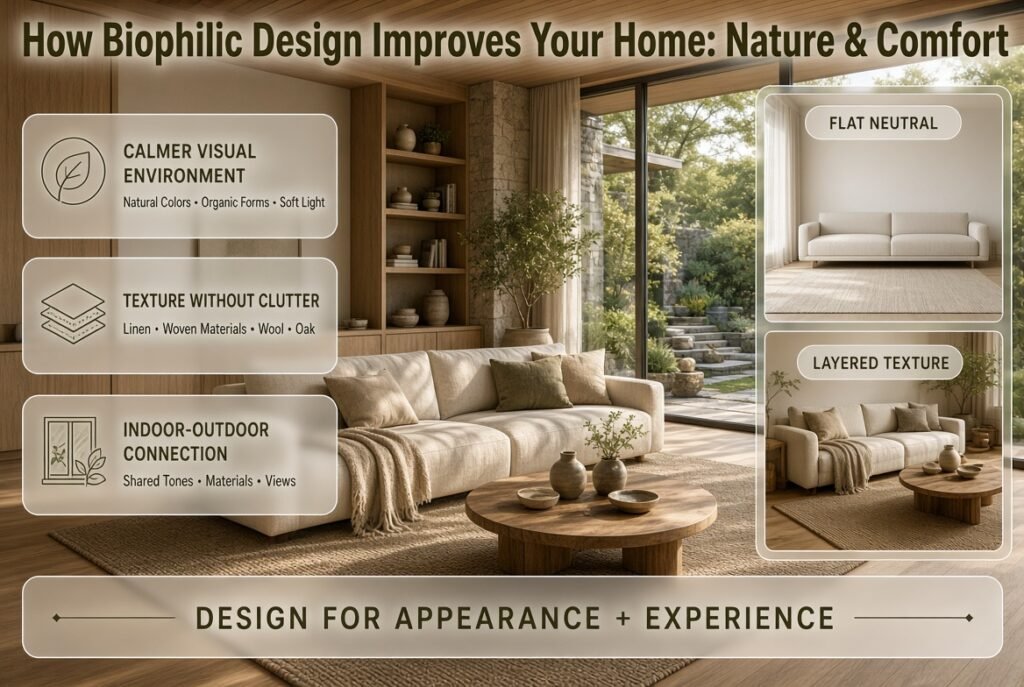
Biophilic design can make a home feel warmer, calmer, more visually interesting, and more connected to its surroundings. Its biggest strength is that it addresses both appearance and experience rather than treating interior design as decoration alone.
It Creates a Calmer Visual Environment
Natural colors, organic forms, greenery, and tactile materials can soften spaces that otherwise feel overly hard or artificial.
This can be particularly useful in rooms where people relax.
A bedroom with harsh lighting, glossy surfaces, strong contrasts, and little texture may feel visually stimulating.
Replacing some of those elements with warm wood, soft textiles, gentle lighting, and muted colors can create a more restful atmosphere.
It Adds Texture Without Clutter
Texture is especially useful when you’re working with neutral colors.
A room doesn’t need bright colors to feel interesting.
Consider the difference between:
Cream wall + cream sofa + cream rug + cream curtains
and:
Warm white wall + linen sofa + woven rug + oak table + wool throw + ceramic accessories
The second room can remain neutral while feeling much richer because the surfaces interact differently with light.
It Strengthens Indoor-Outdoor Connection
If your home has a garden, balcony, courtyard, terrace, or attractive outdoor view, biophilic design can make that relationship stronger.
Use similar tones and materials inside and outside.
For example, warm wood indoors can visually connect with timber decking outside. Green upholstery can echo garden vegetation. Natural stone indoors can relate to an outdoor pathway.
The transition feels more intentional when the two environments share visual characteristics.
How Do You Start a Biophilic Interior Design Project?
You don’t need to buy anything immediately. Start by studying the room you already have.
A common mistake is shopping first and planning later.
Instead, follow this sequence.
Step 1: Analyze the Room
Stand in the center of the room and look around.
Ask:
- Where does my eye naturally go?
- Where is the room darkest?
- Which window has the best view?
- What feels artificial?
- What feels visually cold?
- Where is there unnecessary clutter?
- Which areas are unused?
- What activities happen here?
This gives you a design direction.
Step 2: Improve the Furniture Layout
Before adding décor, fix the layout.
A beautiful plant can’t rescue a badly arranged room.
Furniture should support movement, conversation, work, relaxation, and access to natural light.
If a chair blocks a window, moving it may produce a bigger improvement than buying new curtains.
Step 3: Establish a Material Palette
Select a small group of complementary materials.
For example:
Option A: Oak + linen + ceramic
Option B: Walnut + wool + stone
Option C: Rattan + cotton + terracotta
Repeating these materials throughout the room creates cohesion.
Step 4: Select Your Main Natural Color
Choose one dominant nature-inspired color rather than using several competing shades.
Sage green is popular because it works well with warm neutrals and wood.
Muted blue can create a cooler, calmer feeling.
Terracotta adds warmth.
Olive can produce a richer and more mature atmosphere.
Step 5: Add Greenery Strategically
Choose plants after you’ve identified where they can actually survive.
Think about size and visual weight.
One large plant can become a focal point. Several tiny plants can create unnecessary visual noise if placed randomly.
Step 6: Layer Textures
Add texture gradually.
A woven rug, linen curtains, wood grain, and ceramic accessories may be enough.
You don’t need a different texture on every surface.
Step 7: Edit the Room
Finally, remove anything that doesn’t contribute.
Biophilic design often becomes stronger when you take something away.
⚠ Common Mistake: Don’t assume that adding more natural objects automatically improves the room. If the space feels cluttered, remove items before buying more.
How Can You Use Biophilic Interior Design in the Living Room?
The living room is one of the easiest spaces to transform because it usually has enough room for plants, furniture, textiles, lighting, and artwork.
Start by considering the view.
If you have a garden or balcony, orient seating toward it where practical.
If the view isn’t attractive, position plants or layered curtains to create a more pleasing visual focus.
Best Biophilic Living Room Elements
Consider:
- A wooden coffee table
- Linen or cotton upholstery
- Natural-fiber rugs
- Large leafy plants
- Warm lighting
- Stone or ceramic accessories
- Nature-inspired artwork
- Woven baskets
- Curved furniture
- Earthy accent colors
Avoid making every element rustic.
A contemporary sofa can work beautifully with a reclaimed-looking wooden table and modern lighting.
For more polished living-room ideas, see Elegant Living Room Styling and combine its styling principles with natural materials and greenery.
Example Living Room
Imagine a medium-sized living room with warm white walls.
Place a comfortable neutral sofa opposite the main focal point. Add a round oak coffee table, a textured woven rug, linen curtains, one tall plant near the window, and a ceramic floor lamp.
The palette might include:
- Warm white
- Natural oak
- Sage
- Soft beige
- Small terracotta accents
Nothing is excessive, but the room feels layered and connected to nature.
How Can You Create a Biophilic Bedroom?
A bedroom should be quieter than a living room.
That means using fewer visual elements and focusing on softness.
Natural textiles work especially well.
Try linen bedding, cotton curtains, wool throws, wooden furniture, woven baskets, and muted colors.
A simple combination could be:
Warm white walls + oak bed + linen bedding + soft green accent + one healthy plant + woven rug
You don’t need botanical prints everywhere.
The objective is to create a calm sensory environment rather than a decorative theme.
Lighting also matters.
Use warm bedside lighting instead of relying entirely on bright overhead fixtures.
For additional bedroom styling ideas, explore Cozy Bedroom Makeover.
Should You Put Plants in the Bedroom?
You can, provided the plants suit the room and you can maintain them properly.
Don’t choose plants based purely on appearance.
Check their light and care requirements first.
If the bedroom is dark, consider moving plants to a brighter location rather than trying to force them to survive.
How Can Biophilic Design Work in the Kitchen?
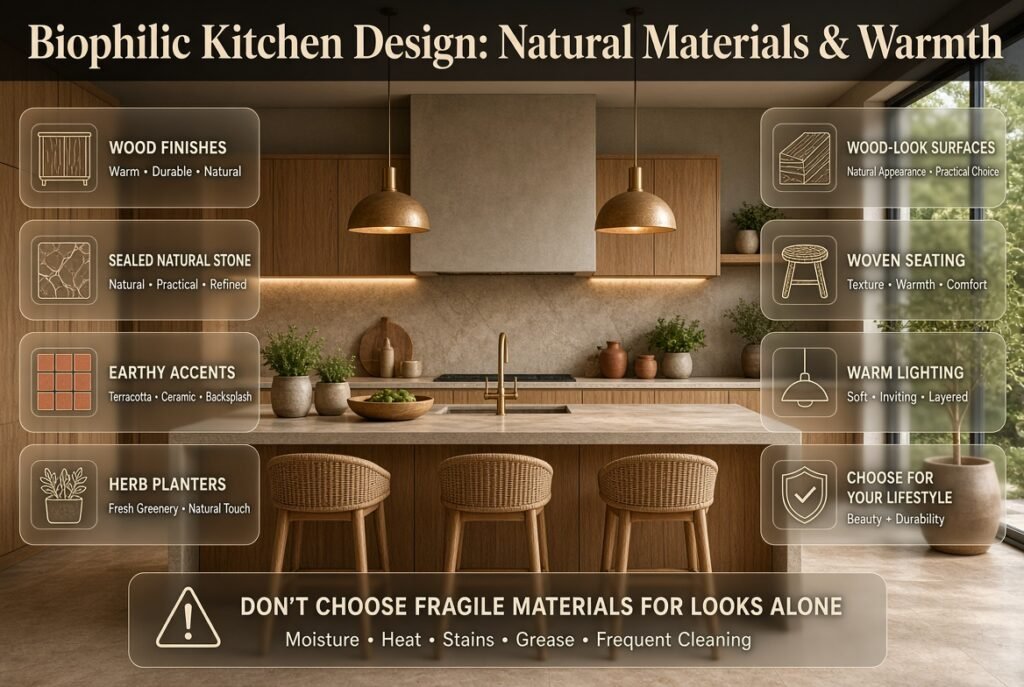
A kitchen needs natural warmth without sacrificing durability.
Wood cabinetry, natural stone, terracotta accessories, woven stools, indoor herbs, and warm lighting can create a strong biophilic effect.
But kitchens are exposed to moisture, heat, stains, grease, and frequent cleaning.
That means every material must be chosen carefully.
Good Kitchen Choices
- Durable wood finishes
- Sealed natural stone
- Wood-look surfaces
- Ceramic accessories
- Terracotta accents
- Herb planters
- Natural-fiber seating
- Warm lighting
- Earthy backsplashes
Don’t use a fragile natural material simply because it looks beautiful.
The best material is one that works with your lifestyle.
For a more complete approach to modern kitchen planning, see Modern Kitchen Design.
How Can You Use Biophilic Design in a Home Office?
A home office should balance natural connection with productivity.
If possible, place the desk close to natural light while avoiding screen glare.
A window view can provide a visual break during long periods of work.
Add:
- A wood desk
- One or two plants
- Natural textiles
- A small ceramic accessory
- Warm task lighting
- Nature-inspired artwork
- Organized storage
Don’t overload the desk with decorative objects.
A biophilic workspace should still be functional.
For practical workspace planning and organization, Functional Home Office is a useful complementary resource.
A Simple Home Office Formula
Natural light + functional desk + comfortable chair + one plant + organized storage + natural texture
This is usually more effective than filling the office with botanical accessories.
How Can You Create a Biophilic Bathroom?
Bathrooms can become excellent spaces for natural materials because stone, greenery, warm colors, and soft lighting work particularly well together.
However, moisture changes the rules.
Use materials that can tolerate humidity and water exposure.
Ideas include:
- Stone-look tile
- Sealed stone
- Wood-look cabinetry
- Terracotta-inspired accessories
- Humidity-tolerant plants
- Warm white lighting
- Natural woven storage where appropriate
- Earthy wall colors
A warm wood vanity paired with muted green walls and stone-effect surfaces can create a natural spa-like feeling without requiring an elaborate renovation.
Which Natural Materials Are Best for Biophilic Interiors?
There isn’t one “best” material. The right choice depends on the room, budget, maintenance requirements, durability, and the visual effect you want.
Wood
Wood is one of the most versatile biophilic materials.
It adds warmth, grain, variation, and visual softness.
Oak works well in lighter interiors, while walnut creates a deeper, more sophisticated atmosphere.
Stone
Stone provides natural variation and a strong tactile quality.
Marble, limestone, slate, granite, and other stones can work in different ways, but maintenance requirements vary considerably.
Rattan and Woven Fibers
Rattan, cane, jute, and similar materials add texture and a relaxed character.
They’re especially effective in furniture, baskets, lighting, and accent pieces.
Linen and Cotton
Natural textiles soften hard surfaces.
Linen curtains can also allow daylight to filter through without making a room feel overly heavy.
Clay and Ceramics
Handcrafted ceramics and terracotta can introduce subtle imperfections that make a room feel less manufactured.
How Do You Choose Colors for Biophilic Interior Design?
The best biophilic color scheme usually starts with a neutral foundation.
Then introduce natural accents.
Light Biophilic Palette
- Warm white
- Cream
- Sand
- Pale oak
- Soft sage
This works well for small or poorly lit spaces.
Earthy Biophilic Palette
- Warm beige
- Olive
- Walnut
- Terracotta
- Cream
This creates a richer and warmer environment.
Cooler Natural Palette
- Soft white
- Muted blue
- Sage
- Light wood
- Gray stone
This can work well where you want a quieter, fresher atmosphere.
⭐ Expert Tip: Don’t choose colors from a palette alone. Test samples in the actual room because daylight, artificial lighting, flooring, and furniture can change how a color appears.
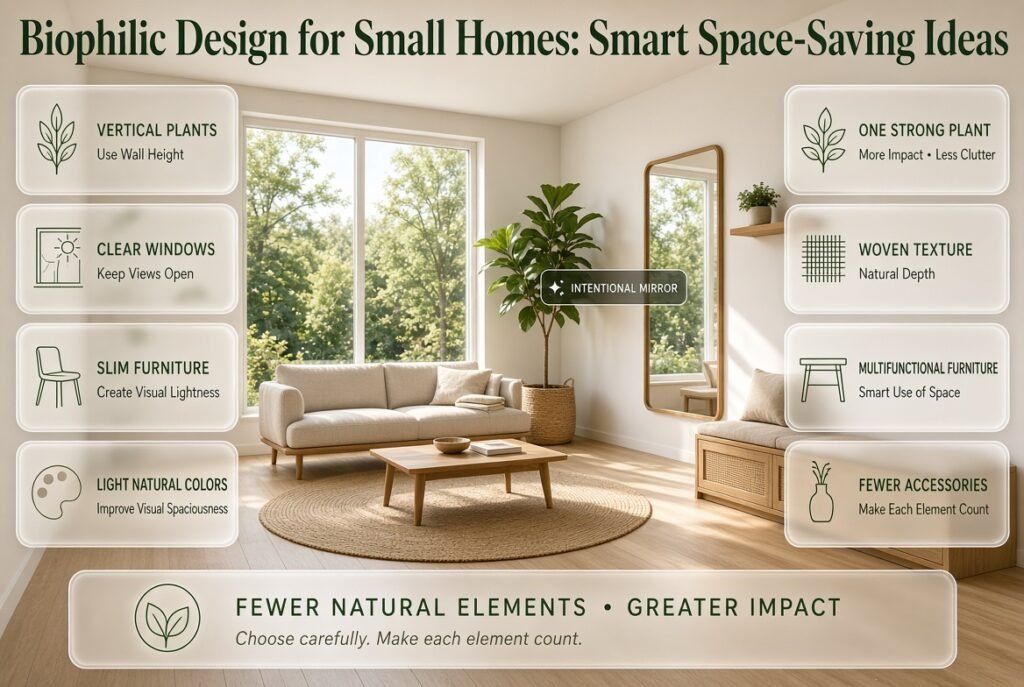
Can Biophilic Interior Design Work in a Small Home?
Absolutely.
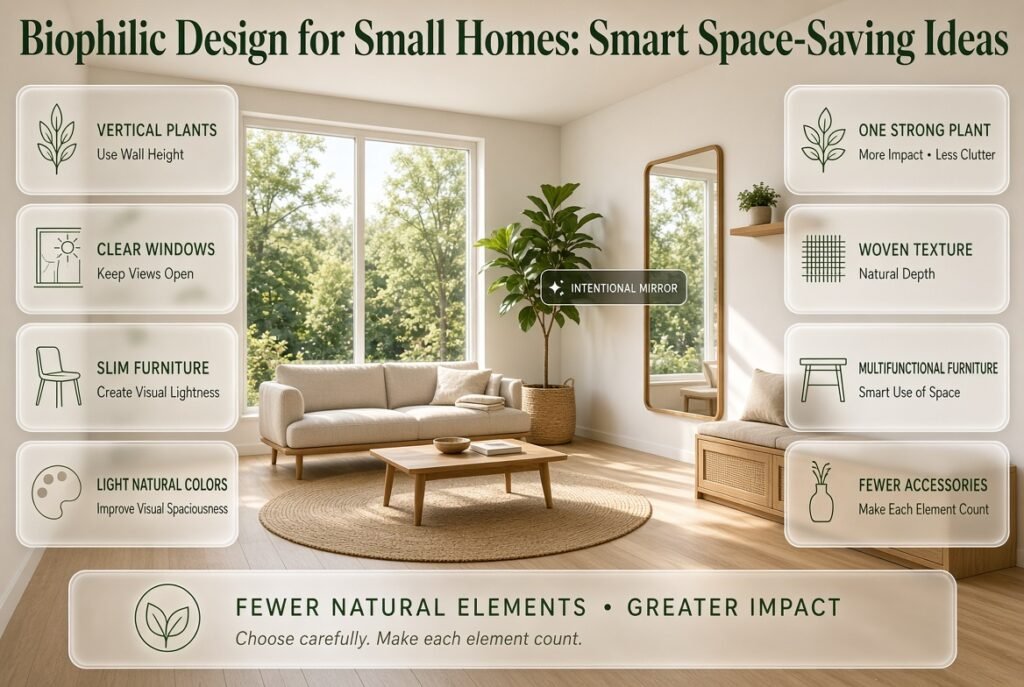
Small spaces don’t need more decoration. They need better visual decisions.
One large plant can often have more impact than five small ones.
A clear window can make a small room feel more open.
Light colors can improve visual spaciousness.
Furniture with visible legs can create a lighter appearance.
Mirrors can help distribute available light, although they should be positioned intentionally rather than covering every wall.
Small-Space Biophilic Ideas
- Use vertical plant placement
- Keep windows visually clear
- Choose slim furniture
- Use natural light colors
- Add one strong plant
- Introduce woven texture
- Use multifunctional furniture
- Avoid excessive accessories
- Repeat one or two natural materials
📌 Quick Tip: In a small room, choose fewer natural elements but make each one count.
How Can You Create Biophilic Design on a Budget?
You don’t need a complete renovation.
In many homes, the most valuable improvements cost little or nothing.
Start with the layout.
Then improve lighting and window treatments.
After that, introduce plants and natural textures.
High-Impact Budget Upgrades
| Upgrade | Approximate investment | Potential visual impact |
|---|---|---|
| Furniture rearrangement | Free | High |
| Decluttering | Free | High |
| Plants | Low–medium | High |
| New cushions | Low | Medium |
| Woven rug | Medium | High |
| Linen curtains | Medium | High |
| Paint | Low–medium | High |
| Wooden accessories | Low–medium | Medium |
| Natural stone | Medium–high | High |
| New windows | High | Very high |
This is why you shouldn’t automatically start with expensive materials.
A room’s biggest problems may be solved through layout, light, and editing.
For homeowners who want to handle smaller upgrades themselves, DIY Home Projects offers additional practical inspiration.
How Does Biophilic Design Compare With Sustainable Home Design?
Biophilic design and sustainable design are closely related, but they’re not identical.
| Biophilic Design | Sustainable Design |
| Focuses on connection with nature | Focuses on environmental impact |
| Uses natural elements | Considers energy and resource efficiency |
| Values daylight and views | May prioritize energy performance |
| Often includes plants | May not include plants |
| Uses natural materials | Considers sourcing and lifecycle |
| Focuses strongly on human experience | Focuses strongly on environmental responsibility |
The two approaches can complement each other.
For example, using durable natural materials, maximizing daylight, selecting responsibly sourced wood, improving ventilation, and reducing unnecessary consumption can support both goals.
For a broader look at environmentally conscious residential design, visit Sustainable Home Design.
What Are the Most Common Biophilic Interior Design Mistakes?
Even a good concept can go wrong when natural elements are added without considering scale, proportion, maintenance, and function.
Mistake 1: Turning the Room Into a Jungle
The easiest biophilic shortcut is buying lots of plants.
It also happens to be one of the most common mistakes.
Too many plants can block movement, overwhelm furniture, reduce usable surfaces, and increase maintenance.
Better approach: Use plants as intentional focal points.
Mistake 2: Using Green Everywhere
Green is strongly associated with nature, but that doesn’t mean every surface should be green.
A sophisticated biophilic interior often uses green sparingly.
Combine it with:
- Cream
- Beige
- Brown
- Warm white
- Terracotta
- Muted blue
- Natural wood
Mistake 3: Ignoring the Existing Architecture
A room’s windows, ceiling height, flooring, proportions, and circulation should influence the design.
Don’t force a visual style that fights the architecture.
Mistake 4: Choosing Plants Without Checking Conditions
A plant that looks perfect in a photograph may fail completely in your home.
Always check light, temperature, humidity, and care requirements.
Mistake 5: Choosing Materials Only for Appearance
Natural materials can have different maintenance requirements.
Some stone surfaces need sealing. Some woods need care. Some natural fabrics stain more easily.
The right choice is one that works for your household.
Mistake 6: Mixing Too Many Natural Materials
Wood, stone, rattan, bamboo, cork, jute, wool, clay, leather, linen, and terracotta can all be beautiful individually.
Together, however, they can become excessive.
Choose a controlled material palette.
Mistake 7: Forgetting Function
A room isn’t successful simply because it looks natural.
Can you walk through it comfortably?
Can you clean it?
Can you sit comfortably?
Can you store what you need?
Can you work there?
Can children or pets use it safely if applicable?
Function should always remain part of the design.
How Can You Make Biophilic Design Look Modern?
Modern biophilic design depends on contrast and restraint.
You don’t need rustic furniture or a farmhouse aesthetic.
Try combining:
Clean architecture + natural materials + organic forms + restrained greenery
For example, imagine a minimalist living room with white walls, a streamlined sofa, a walnut coffee table, one sculptural plant, linen curtains, and a curved floor lamp.
It feels contemporary because the furniture is clean.
It feels natural because the materials and forms aren’t overly artificial.
The Rule of Restraint
When you’re unsure whether to add another natural accessory, don’t.
Step back and look at the whole room.
If the room already has:
- Wood
- Plants
- Texture
- Natural light
- Earthy colors
then another botanical print may not improve it.
Good design often comes from knowing when to stop.
How Can You Combine Biophilic Design With Other Interior Styles?
Biophilic design doesn’t have to replace your existing style.
It can work with modern, minimalist, Scandinavian, traditional, contemporary, rustic, industrial, and even eclectic interiors.
Biophilic + Minimalist
Use fewer objects, warm wood, natural fabrics, one or two plants, and simple organic forms.
Biophilic + Scandinavian
Combine pale wood, soft neutrals, greenery, wool, linen, and abundant daylight.
Biophilic + Contemporary
Use stone, darker wood, curved furniture, sculptural plants, and sophisticated earthy colors.
Biophilic + Rustic
Emphasize natural wood, stone, woven materials, handmade ceramics, and earthy tones.
Biophilic + Industrial
Use greenery and warm wood to soften concrete, metal, and exposed architectural elements.
The key is to use biophilic principles to support your existing style rather than forcing your home into a completely different aesthetic.
How Can You Bring Nature Into a Home Without Plants?
Plants are useful, but they’re not essential.
You can create a natural connection through:
- Daylight
- Outdoor views
- Natural wood
- Stone
- Water
- Natural fabrics
- Organic shapes
- Nature-inspired artwork
- Natural colors
- Fresh air and ventilation
- Nature sounds where appropriate
- Textural variation
This is particularly useful in spaces where plants aren’t practical.
A bright room with a beautiful outdoor view, warm wood furniture, linen curtains, and natural stone may feel highly biophilic without becoming plant-heavy.
What Role Does Texture Play in Biophilic Design?
Texture creates a sensory connection with natural environments.
Think about the difference between touching smooth plastic and textured wood.
Or between a flat synthetic curtain and loosely woven linen.
Or between a perfectly uniform manufactured surface and naturally varied stone.
Biophilic interiors benefit from these differences.
Useful Texture Combinations
Try:
- Smooth wood + rough stone
- Linen + polished ceramic
- Wool + wood
- Woven rattan + glass
- Matte wall + textured rug
The goal isn’t maximum texture.
It’s controlled contrast.
What Role Does Nature-Inspired Artwork Play?
Artwork can reinforce a connection with nature when used thoughtfully.
Landscape photography, botanical illustrations, abstract organic forms, natural textures, and artwork inspired by water or landscapes can all work.
However, artwork shouldn’t be the only natural element.
If the room has no plants, natural materials, daylight, or organic forms, covering the walls with leaf prints won’t necessarily make it biophilic.
Use artwork as one layer of the design rather than the entire strategy.
How Do You Create a Biophilic Entryway?
The entryway sets the tone for the rest of the home.
Keep it simple.
A wood console, ceramic bowl, small plant, natural-fiber runner, and warm lighting can create an inviting first impression.
If the entryway is narrow, avoid large plants that interfere with movement.
Instead, use a small plant, natural artwork, or wooden accessory.
How Can Home Improvement Support Biophilic Design?
Sometimes the biggest biophilic improvements aren’t decorative.
A renovation can improve:
- Window size
- Daylight
- Ventilation
- Indoor-outdoor connection
- Floor materials
- Room layout
- Storage
- Natural finishes
But renovations should solve genuine problems rather than being done simply to follow a trend.
For broader renovation and improvement ideas, Home Improvement can be useful when you’re considering changes that go beyond furniture and décor.
What Should You Do First in a Biophilic Room Makeover?
If you’re unsure where to begin, use this priority order:
Priority 1: Light
Improve access to daylight.
Priority 2: Layout
Position furniture around natural light, views, movement, and function.
Priority 3: Materials
Introduce wood, stone, woven fibers, and natural textiles.
Priority 4: Color
Use earthy and nature-inspired tones.
Priority 5: Plants
Choose greenery that suits the environment.
Priority 6: Texture
Layer natural surfaces without clutter.
Priority 7: Accessories
Add artwork, ceramics, baskets, and small decorative details only after the fundamentals work.
This order prevents you from spending money on accessories while larger design problems remain unresolved.
What is biophilic interior design, and how is it different from simply adding plants?
Biophilic interior design is a broader approach to creating a stronger connection between indoor spaces and nature. Plants are an important part of it, but they’re only one piece of the design. A genuinely biophilic interior can combine natural daylight, outdoor views, wood, stone, natural fabrics, organic shapes, earthy colors, natural ventilation, and sensory details.
This distinction matters because simply filling a room with plants doesn’t automatically make it biophilic. A room with ten plants, harsh artificial lighting, blocked windows, synthetic finishes, and clutter may actually feel less comfortable than a simple room with excellent daylight, one healthy plant, natural wood, and a clear view outside.
What to focus on:
Natural light before decorative greenery
Wood, stone, linen, wool, rattan, and other tactile materials
Views toward gardens, trees, balconies, or outdoor spaces
Organic curves and nature-inspired patterns
A balanced amount of greenery rather than excessive plants
The professional approach is to design the whole experience, not just add nature-themed accessories.
What are the biggest biophilic interior design trends for 2026?
The biggest shift in 2026 is that biophilic design is moving beyond the traditional “plants and green walls” approach toward richer, multisensory and more material-focused interiors. Current design coverage highlights warm natural materials, earthy palettes, organic forms, natural textures, wellness-focused spaces, and lighting that responds more thoughtfully to daily routines.
One particularly noticeable change is the move toward warmer woods and earthy colors instead of extremely cool, sterile minimalism. Richer walnut, warm oak, clay, terracotta, olive, beige, and mineral-inspired tones can make natural interiors feel more mature and sophisticated.
The trends worth watching:
Warm and darker wood tones
Natural stone and mineral finishes
Limewash and subtly textured walls
Organic and curved furniture
Layered greenery instead of identical plant placement
Earthy neutral color schemes
Circadian-conscious and layered lighting
Multisensory design involving texture, sound, scent, and light
Stronger indoor-outdoor connections
Materials that develop character and patina over time
The important point is not to copy every trend. Choose the elements that suit your home’s architecture, climate, maintenance needs, and personal style.
How can I create biophilic interior design on a budget?
Start with changes that improve the room’s relationship with natural light, greenery, layout, and texture rather than immediately spending money on expensive renovations. Furniture rearrangement, better window treatments, a few suitable plants, natural textiles, and earthy paint colors can create a noticeable transformation without a major budget. Current design guidance also emphasizes that high-impact biophilic strategies don’t necessarily require large structural investments.
A smart budget makeover might look like this:
First: Move furniture so windows and outdoor views remain visible.
Second: Replace heavy curtains with lighter ones where privacy allows.
Third: Add one substantial plant rather than buying many small decorative plants.
Fourth: Introduce natural texture through a jute or woven rug, linen curtains, cotton cushions, or a wooden accent.
Fifth: Use a warm, nature-inspired paint color if the walls need refreshing.
Finally: Remove unnecessary décor.
That last step is often overlooked. Biophilic interiors generally benefit from visual breathing room. You don’t need to spend money filling every empty surface.
Best budget priorities:
Free: Decluttering and furniture rearrangement
Low cost: Plants, paint, cushions, ceramics
Medium cost: Rugs, curtains, wooden furniture
Higher cost: Natural stone, new flooring, larger windows, structural indoor-outdoor changes
The professional rule is simple: fix the room’s biggest problem before buying decorative accessories.
Which plants and natural materials work best in a biophilic home?
The best plants and materials are the ones that suit your actual environment, maintenance routine, and room function. There isn’t a single plant or material that works perfectly in every home. Plant selection should consider available light, humidity, temperature, watering requirements, and mature size, while material selection should consider durability, maintenance, moisture, and everyday use.
For lower-maintenance greenery, commonly used options include pothos, snake plants, and ZZ plants, particularly where conditions are appropriate.
For materials, some of the most versatile choices include:
Wood: Adds warmth and visible natural grain
Stone: Provides variation and tactile depth
Linen: Softens windows and upholstery
Wool: Adds warmth and texture
Rattan: Creates lightweight organic texture
Cork: Adds a softer natural surface
Clay and terracotta: Bring earthy character
Bamboo: Useful for furniture and decorative applications
Don’t choose materials purely because they’re “natural.” A material that looks beautiful but requires constant maintenance may be a poor choice for a busy kitchen or family room.
A better professional test is:
Does this material look natural, feel appropriate, perform well in this room, and remain manageable over time?
If the answer is yes, it’s a stronger choice than simply following a trend.
Can biophilic interior design actually make a home feel more relaxing?
Biophilic design can help create a calmer and more restorative-feeling environment by introducing natural cues such as daylight, vegetation, natural materials, organic patterns, and outdoor views. The strongest approach isn’t based on one decorative feature; it combines several environmental qualities so the room feels naturally comfortable rather than visually manufactured.
For example, imagine a bedroom with warm daylight, linen curtains, an oak bedside table, soft green bedding, a small healthy plant, natural textures, and warm evening lighting.
None of these elements is particularly dramatic on its own. Together, however, they create a softer sensory environment.
This is also why multisensory biophilic design is becoming more important in 2026. Designers are increasingly looking beyond what a room looks like and considering light, texture, acoustics, natural scents, airflow, and even water as part of the overall experience.
For a calmer biophilic room, prioritize:
Soft, controllable lighting
Natural daylight during the day
Reduced visual clutter
Comfortable furniture
Natural tactile materials
Muted or earthy colors
Appropriate greenery
Good ventilation where possible
A clear connection to outdoor views
The key is balance. A room doesn’t become more relaxing simply because you keep adding plants, wood, or decorative nature references. Professional biophilic design is about creating the right combination of natural elements while preserving comfort, function, and visual simplicity.
Conclusion
Biophilic interior design is about much more than adding a few plants to a room. It’s a thoughtful way to create interiors that feel warmer, calmer, more natural, and better connected to the world outside. Natural light, greenery, wood, stone, organic shapes, earthy colors, natural fabrics, and outdoor views can all contribute to that feeling when they’re used with purpose.
The best approach is to start with the fundamentals. Look at how much natural light the room receives, improve the furniture layout, reduce unnecessary clutter, and identify where a stronger connection with nature could improve the space. From there, introduce natural materials, suitable plants, tactile textures, and a carefully selected color palette.
You also don’t need a major renovation or a large budget to get started. A healthier plant, lighter curtains, a wooden accent, a textured rug, or even simply repositioning furniture toward a window can make a meaningful difference.
Most importantly, don’t treat biophilic design as a trend that requires copying a particular look. Your home should still reflect your lifestyle, needs, and personality. When natural elements are combined with good proportions, practical materials, comfortable furniture, and thoughtful lighting, the result feels authentic rather than staged.
Ultimately, successful biophilic interior design isn’t about making your home look like a forest. It’s about making everyday indoor spaces feel more naturally comfortable, inviting, and connected to the environment around you.
Leave a Reply