
Introduction
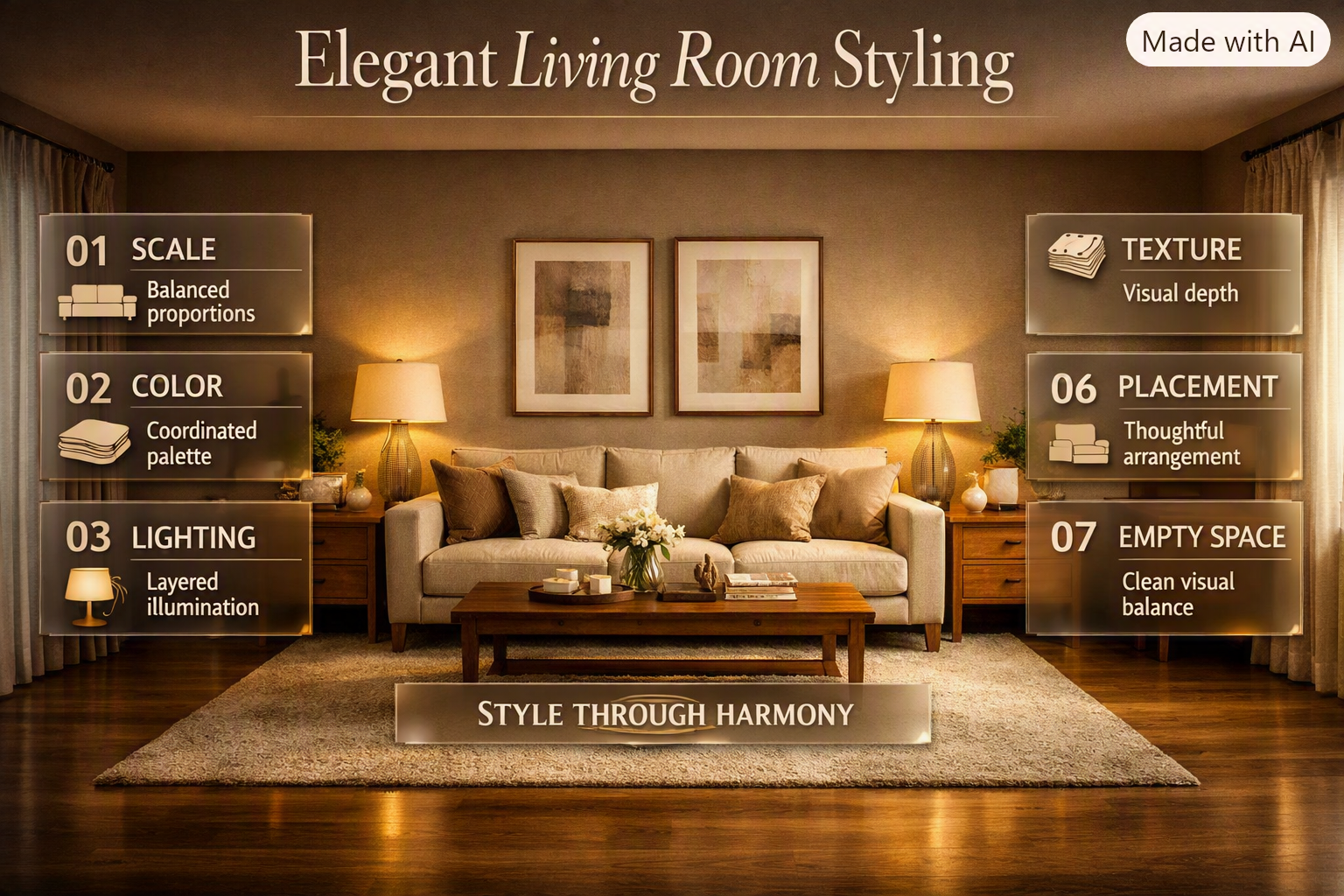
Elegant Living Room Styling | A living room can have beautiful furniture and still feel unfinished. You may have a stylish sofa, attractive curtains, expensive-looking accessories, and a fresh coat of paint, yet something doesn’t quite work. Usually, the problem isn’t one missing decoration. It’s the relationship between everything in the room—scale, color, lighting, texture, furniture placement, and empty space.
Elegant living room styling is about bringing those elements together so the room feels polished without becoming formal or uncomfortable. You don’t need a huge budget or a completely new living room. In many cases, better arrangement and more thoughtful styling can make a bigger difference than buying more things.
This guide explains how to create an elegant living room from the ground up, how to make affordable pieces look sophisticated, how to choose colors and furniture, how to layer lighting and textures, what mistakes to avoid, and how to style both small and large living rooms. You’ll also find practical examples, professional tips, room-planning advice, and answers to common questions homeowners ask before starting a makeover.
If you want a broader starting point for planning your home’s interior, DesignMode24 Interior Design can also help you explore ideas beyond the living room while keeping your overall home style consistent.
What Does Elegant Living Room Styling Actually Mean?
Elegant living room styling means creating a space that looks refined, balanced, comfortable, and intentional through coordinated furniture, colors, materials, lighting, textiles, and accessories. It isn’t defined by expensive furniture or a particular decorating trend. Instead, elegance comes from proportion, restraint, quality-looking finishes, visual harmony, and thoughtful details.
This distinction is important because many people confuse elegance with luxury.
Luxury often emphasizes expensive materials, designer products, large furniture, or highly decorative finishes. Elegance is much broader. A modest living room can look incredibly sophisticated when its furniture is correctly scaled, its color palette is cohesive, and its accessories aren’t competing for attention.
Think about two rooms.
The first contains a large sofa, three different accent colors, a tiny rug, several unrelated wall decorations, bright overhead lighting, and furniture pushed against every wall.
The second contains a simple sofa, a properly sized rug, warm lighting, neutral colors, textured curtains, one strong artwork, natural wood, and a few carefully selected accessories.
The second room may cost considerably less, yet it will probably feel more elegant.
The secret is not adding more. It’s making better decisions with what you already have.
How Do You Make a Living Room Look Elegant?
The fastest way to make a living room look elegant is to establish a clear visual hierarchy. Start with the furniture arrangement, choose a restrained color palette, use a properly sized rug, layer lighting, introduce several complementary textures, and finish with a small number of well-chosen accessories.
Before buying anything, ask five questions:
- What is the room’s main focal point?
- Is the furniture correctly scaled?
- Does the color palette feel connected?
- Is the lighting attractive at night?
- Is there enough empty space?
If you can answer these questions successfully, most of the styling decisions become much easier.
An elegant living room should also feel natural when people actually use it. You should be able to sit comfortably, walk through the room, place a drink somewhere, read, entertain guests, and relax without constantly moving decorative objects out of the way.
That practical quality is what separates a beautiful room from a beautiful home.
Start With the Living Room Layout
Before choosing cushions, vases, artwork, or candles, solve the layout.
Furniture placement determines how the entire room functions. If the arrangement is awkward, even the most expensive decoration won’t make it feel right.
Start by identifying the room’s natural focal point. This could be:
- A fireplace
- A large window
- A feature wall
- A television
- A dramatic piece of artwork
- An architectural feature
- A particularly attractive view
Then position the main seating so that it relates naturally to that focal point.
Why Furniture Placement Matters So Much
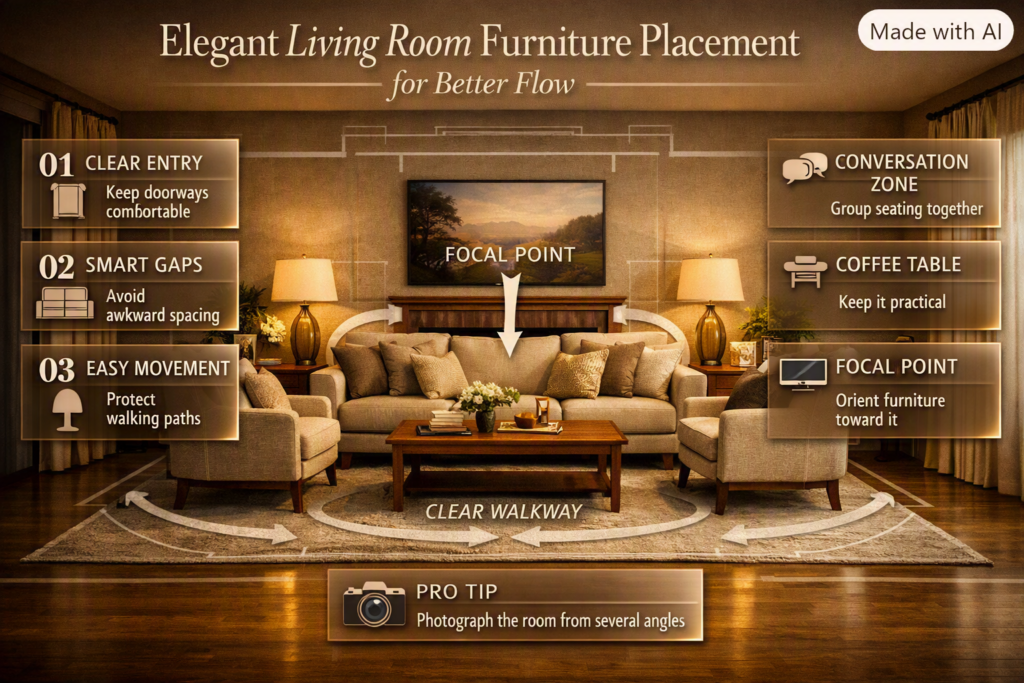
A room can feel cramped even when there is plenty of floor space if furniture blocks movement or creates awkward gaps.
For example, a sofa placed too close to a doorway may make the entrance feel narrow. Two chairs positioned too far apart may make conversation uncomfortable. A coffee table placed too far from the sofa can be impractical, while one positioned too close can make movement difficult.
The goal is to create a conversation zone.
Imagine the main seating as a visual group rather than several individual objects.
          MAIN FOCAL POINT
        ┌──────────────────┐
        │ Artwork / TV /   │
        │ Fireplace / View │
        └──────────────────┘

       Chair            Chair

             ┌───────┐
             │ SOFA  │
             └───────┘

             Coffee
              Table

          Clear walkway
The exact dimensions depend on your room, but the principle is universal: furniture should communicate with other furniture.
💡 Pro Tip: Photograph your room from several angles before rearranging it. Looking at the space through a camera often reveals balance problems that aren’t obvious when you’re standing inside it.
Measure Before You Buy Anything
One of the costliest decorating mistakes is purchasing furniture based entirely on appearance.
A sofa may look perfect online and still overwhelm your living room. A coffee table may look beautiful in a showroom but leave insufficient walking space. A rug may look substantial in a product photograph and appear surprisingly small once placed under your furniture.
Measure:
- Wall length
- Ceiling height
- Door width
- Window placement
- Sofa dimensions
- Chair dimensions
- Coffee table dimensions
- Existing storage
- Walkways
- Radiators and vents
- Television location
Don’t forget the journey from the front door to the living room. A large sofa that technically fits the room isn’t useful if it cannot get through the doorway.
A Simple Furniture Planning Method
Use painter’s tape to mark the approximate footprint of furniture on the floor.
This inexpensive trick lets you test:
- Sofa length
- Coffee table position
- Chair placement
- Walking paths
- Rug boundaries
It’s much easier to move tape than a heavy sofa.
Choose an Elegant Color Palette
Color creates the emotional foundation of the living room.
Elegant spaces don’t necessarily need neutral colors, but they usually benefit from color discipline.
A useful approach is the 60-30-10 principle:
- 60%: dominant color
- 30%: secondary color
- 10%: accent color
The dominant color might be your walls and large furniture. The secondary tone can appear in curtains, rugs, chairs, or larger accessories. Accent colors should be used sparingly.
Elegant Color Combinations to Consider
| Main Palette | Supporting Colors | Atmosphere |
|---|---|---|
| Warm white | Beige, walnut, brass | Soft and timeless |
| Cream | Taupe, brown, ivory | Warm and luxurious |
| Greige | Black, cream, oak | Modern and refined |
| Beige | Chocolate, ivory, bronze | Cozy and sophisticated |
| Navy | Cream, tan, brass | Classic and confident |
| Deep green | Beige, walnut, brass | Rich and natural |
| Charcoal | Ivory, wood, warm metal | Dramatic and contemporary |
The most important factor is not simply selecting an attractive color. You need to understand its undertone.
A beige with a pink undertone behaves differently from a beige with a yellow or gray undertone. The same applies to whites and greiges.
Natural daylight, flooring, existing furniture, and artificial lighting can all change how a paint color appears.
Test Paint Before Committing
Paint sample boards rather than relying entirely on online images.
Move the samples around the room and observe them:
- In morning light
- Around midday
- In the evening
- Under artificial lighting
- Beside the sofa
- Beside the flooring
This small step can prevent a surprisingly expensive mistake.
For more color-focused decorating ideas, you can explore the Paint Color section and compare different approaches before committing to a palette.
Can a Colorful Living Room Still Look Elegant?
Absolutely. Elegance isn’t limited to beige and white.
The key is controlling saturation and repetition.
For example, a deep emerald sofa can look sophisticated when paired with cream walls, walnut furniture, a neutral rug, and restrained brass details. The same sofa surrounded by multiple bright colors may feel much more chaotic.
Rich colors work particularly well when they have enough visual space around them.
You don’t need to make every element colorful.
One strong color can be more elegant than six competing accents.
Select Furniture for Proportion and Comfort
Furniture is the largest visual investment in most living rooms, so it deserves more attention than decorative accessories.
Start with the sofa because it usually determines the scale of the seating arrangement.
When selecting one, consider:
- Overall width
- Seat depth
- Back height
- Arm thickness
- Leg height
- Upholstery
- Durability
- Comfort
- Relationship to the room’s architecture
Don’t choose a sofa purely because it looks luxurious.
If it is uncomfortable, difficult to maintain, or too large for the room, you’ll eventually regret the decision.
Should All Furniture Match?
No.
A completely matching furniture set can sometimes make a room feel generic. Elegant interiors often combine pieces that belong together without being identical.
For example:
- Neutral sofa
- Walnut coffee table
- Textured accent chair
- Brass floor lamp
- Black-framed artwork
These pieces don’t match exactly, but they can share an overall design language.
The trick is to repeat certain elements.
If you use walnut furniture, introduce another small walnut element elsewhere. If you use brass lighting, perhaps repeat that finish in a small decorative object.
This creates continuity without creating a showroom effect.
⭐ Expert Tip: Match the undertones of materials more often than the exact colors. Warm wood generally works better with warm neutrals and warm metals than with several unrelated cool finishes.
How Large Should an Elegant Living Room Rug Be?
The rug should visually anchor the seating arrangement rather than sit like a small island in the middle of the room.
Whenever practical, place at least the front legs of the main seating pieces on the rug. In larger rooms, you can place the entire seating arrangement on it.
A properly sized rug helps connect:
Sofa + Chairs + Coffee Table + Floor Area
Without that connection, each piece can feel isolated.
Common Rug Mistake
People often buy smaller rugs because they’re cheaper.
Unfortunately, the savings can make the entire room look less balanced.
If you have a limited budget, it can be better to buy fewer decorative objects and allocate more money toward a rug with an appropriate scale.
⚠ Common Mistake: Don’t judge rug size by looking at it folded or rolled in a store. Always compare its actual dimensions with your furniture footprint.
Choose Rug Texture Carefully
The rug doesn’t need to be heavily patterned to look interesting.
Consider:
- Low-pile textured rugs
- Subtle geometric designs
- Traditional patterns in muted colors
- Natural fiber textures
- Soft wool-like surfaces
- Tonal patterns
If the sofa is plain and the room feels visually empty, a rug can introduce pattern.
If the room already contains patterned curtains, artwork, and cushions, a quieter rug may create better balance.
Use Curtains to Add Height and Softness
Curtains have a surprisingly strong influence on how elegant a living room feels.
Poorly selected curtains can make expensive furniture look ordinary. Properly proportioned curtains can make an average room feel significantly more polished.
For a sophisticated appearance, consider full-length curtains with a generous, natural drape.
Where appropriate, mount the curtain rod higher than the window frame rather than directly on top of it. This can visually increase the height of the room.
Choose fabrics that complement the room:
- Linen
- Linen blends
- Cotton
- Velvet for a richer appearance
- Substantial polyester blends where practicality matters
The fabric should work with the overall design rather than compete with it.
If your room already contains several patterns, choose quieter curtains.
If the room is very plain, textured curtains can provide subtle interest.
Layer Your Living Room Lighting
Lighting can completely change the personality of a living room.
During the day, natural light does most of the work. At night, the room depends on artificial lighting to create atmosphere.
A single ceiling fixture rarely provides enough flexibility.
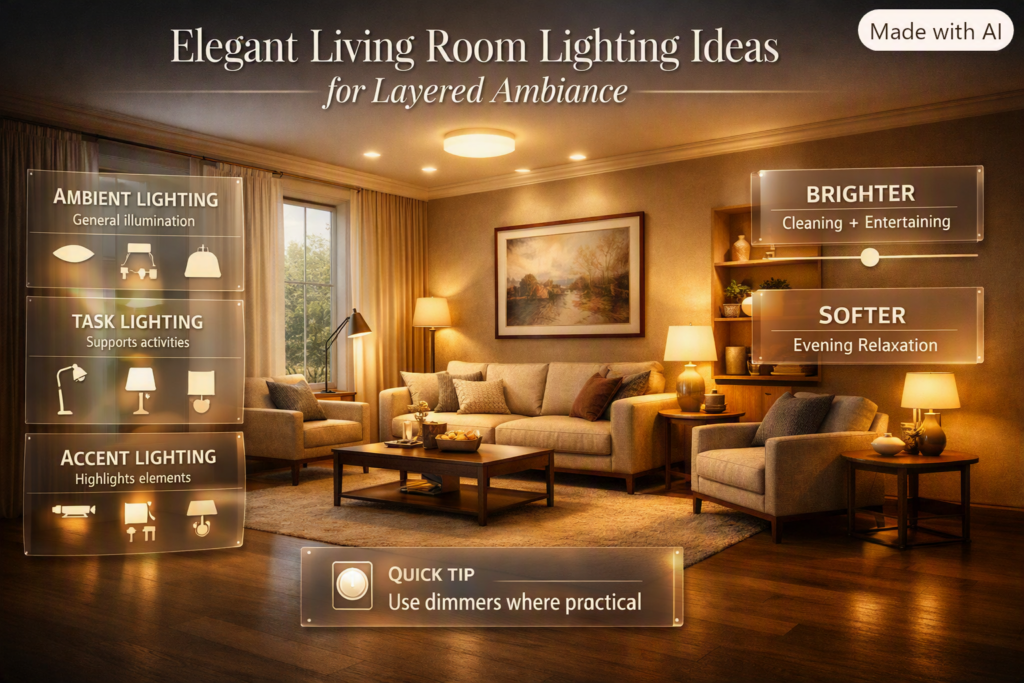
Instead, think in layers:
Ambient Lighting
This provides general illumination.
Examples include:
- Ceiling fixtures
- Recessed lights
- Large central pendants
Task Lighting
This supports specific activities.
Examples include:
- Reading lamps
- Adjustable floor lamps
- Table lamps
Accent Lighting
This draws attention to particular elements.
Examples include:
- Picture lights
- Wall sconces
- Shelf lighting
- Architectural accent lighting
Together, these layers create depth.
You can make the room brighter for cleaning or entertaining and softer for relaxing in the evening.
📌 Quick Tip: Install dimmers wherever practical. Being able to adjust brightness can make the same room feel completely different without changing any furniture.
Select Light Fixtures as Decorative Elements
Lighting isn’t only functional.
A beautiful floor lamp can become part of the room’s visual composition. A sculptural pendant can act as artwork. A pair of matching table lamps can create symmetry.
However, don’t make every lighting fixture dramatic.
If the ceiling fixture is visually strong, keep other lighting quieter. If the lamps are decorative, the ceiling light can be simpler.
Balance is more important than spectacle.
Create Elegance Through Texture
Texture becomes especially important when you use a neutral color palette.
Imagine a living room containing:
- Cream walls
- Beige sofa
- Ivory rug
- Wooden coffee table
- Linen curtains
- Ceramic accessories
- Woven basket
- Soft throw
The colors may be similar, but the materials are different.
That variation creates depth.
Useful materials include:
| Material | Visual Effect |
| Linen | Relaxed sophistication |
| Velvet | Richness |
| Wool | Warmth |
| Wood | Natural character |
| Stone | Refined solidity |
| Glass | Lightness |
| Ceramic | Handmade character |
| Metal | Polish |
| Woven materials | Organic texture |
Don’t introduce every material at once. Choose a few that complement your home’s architecture.
How Do You Make Neutral Decor Look Expensive?
The easiest way is to stop thinking about color alone and start thinking about texture and proportion.
A beige sofa doesn’t look luxurious because it’s beige.
It looks sophisticated when:
- Its proportions suit the room.
- The fabric has attractive texture.
- The rug complements it.
- The lighting is warm and layered.
- The surrounding materials provide contrast.
- The room isn’t cluttered.
This is why an inexpensive room can sometimes look more sophisticated than a high-budget room filled with unrelated objects.
Style the Coffee Table With Restraint
Coffee tables are small but highly visible.
An elegant coffee table arrangement should be attractive without becoming unusable.
Try grouping objects rather than scattering them.
A simple arrangement might contain:
- A decorative tray
- Two books
- A ceramic bowl
- A small vase
- A candle
Vary the heights.
You can use a low tray, medium-height book stack, and taller vase to create a simple visual rhythm.
Leave enough empty surface for everyday use.
A coffee table isn’t a museum display.
Style Shelves Without Creating Clutter
Open shelves can quickly become overwhelming.
Instead of filling every space, create visual breathing room.
Use:
- Books
- Ceramics
- Framed artwork
- Small sculptures
- Plants
- Decorative boxes
- Personal objects
Group similar items together.
You can also create asymmetrical balance.
For example:
Top shelf: artwork + small object
Middle shelf: books + ceramic piece
Lower shelf: larger object + empty space
The exact arrangement isn’t important. What matters is avoiding uniform spacing and excessive quantity.
Use Artwork to Establish Personality
Elegant living rooms should not feel anonymous.
Artwork gives the room personality without requiring dozens of accessories.
A large artwork above a sofa can provide a strong focal point. Alternatively, a gallery arrangement can create a more collected appearance.
When choosing artwork, don’t worry about finding a piece that perfectly matches the sofa.
Instead, look for relationships.
The artwork might repeat:
- A color from the rug
- A tone from the curtains
- A wood finish
- A metal detail
- A particular mood
This is enough to make it feel connected.
How High Should Artwork Be Hung?
Artwork should generally be positioned at a comfortable viewing height rather than simply centered according to the wall.
When hanging artwork above furniture, consider the relationship between the bottom of the frame and the furniture below it.
Too much empty space makes the artwork look disconnected.
Too little space makes the arrangement feel cramped.
For gallery walls, plan the arrangement on the floor first. You can photograph it before transferring it to the wall.
Add Greenery for a Natural Finish
Plants can make an elegant living room feel more alive.
A single large plant may provide stronger impact than several tiny plants.
Consider:
- Plant size
- Light availability
- Maintenance requirements
- Pot design
- Relationship to surrounding furniture
A simple plant in a substantial ceramic or stone-look planter can complement a refined interior beautifully.
Branches, dried arrangements, or seasonal greenery can also provide a natural focal point.
The important thing is that the greenery should look intentional.
Bring in Personal Details
An elegant room shouldn’t look like a hotel lobby.
Personal items give it character.
Display things such as:
- Travel photographs
- Books you actually read
- Handmade ceramics
- Family photographs
- Objects collected over time
- Artwork with personal meaning
The key is editing.
You don’t need to display everything you own.
Choose objects that contribute to the story of the room.
How Can You Make a Small Living Room Look Elegant?
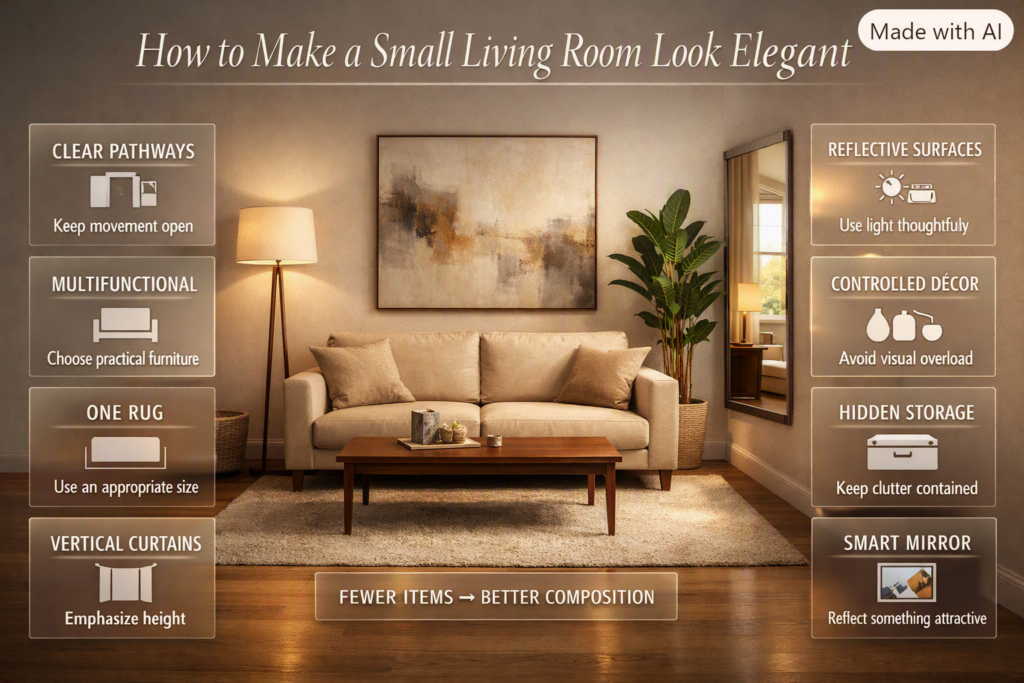
Small rooms benefit from simplicity, proportion, and smart storage.
Don’t assume that small spaces need tiny furniture everywhere. Sometimes one appropriately sized sofa looks better than several miniature pieces.
Focus on:
- Clear pathways
- Multifunctional furniture
- One appropriately sized rug
- Vertical curtains
- Light-reflective surfaces
- Controlled decoration
- Hidden storage
Mirrors can also help when positioned thoughtfully.
Rather than placing a mirror wherever there is an empty wall, consider what it reflects. Reflecting a window, artwork, or attractive light source can add much more value.
Small Room Example
Consider a small apartment with:
- Cream walls
- Compact beige sofa
- Medium-sized textured rug
- Slim walnut coffee table
- Full-length curtains
- One floor lamp
- One large artwork
- Tall plant
There may be fewer items than in a large room, but each item contributes to the overall composition.
That’s what makes the room feel elegant.
How Do You Style a Large Living Room?
Large rooms create a different challenge: they can feel empty rather than crowded.
The solution isn’t necessarily adding furniture everywhere.
Instead, divide the room into purposeful zones.
For example:
Zone 1: Main conversation area
Zone 2: Reading corner
Zone 3: Console or artwork wall
Zone 4: Small seating or drinks area
Large rugs can help define these zones.
Furniture should have enough scale to hold its own against the architecture. A tiny sofa floating in a huge room will often feel lost.
If you’re planning several spaces throughout the home, the Room-by-Room Design Hub can help you think about proportion and styling as part of a wider home design strategy.
Modern Elegant vs. Classic Elegant Living Rooms
Elegant styling can take several directions.
| Feature | Modern Elegant | Classic Elegant |
| Furniture | Clean and simple | Detailed or traditional |
| Colors | Greige, cream, charcoal | Cream, navy, taupe |
| Metals | Black, brass, chrome | Brass, bronze |
| Patterns | Minimal | Traditional |
| Artwork | Abstract/contemporary | Classic or collected |
| Accessories | Sculptural | Layered |
| Overall feel | Clean and refined | Warm and timeless |
There’s no reason to choose only one.
A transitional approach combines modern and traditional elements.
For example, pair a clean-lined sofa with classic artwork, traditional curtains, a contemporary floor lamp, and a vintage-inspired rug.
This creates depth and prevents the room from feeling locked into one period.
How to Make an Elegant Living Room Family-Friendly
Elegance doesn’t mean creating a room nobody is allowed to use.
For busy households, choose materials that tolerate everyday life.
Look for:
- Durable upholstery
- Washable covers
- Stain-resistant fabrics where appropriate
- Closed storage
- Practical coffee tables
- Strong side tables
- Easy-clean rugs
- Rounded edges when useful
You can still have beautiful decorative objects. Simply place fragile pieces in locations where they are less likely to be knocked over.
A family-friendly elegant room should work with real behavior.
If children or pets use the room every day, designing against that reality will only create frustration.
Elegant Living Room Styling on a Budget
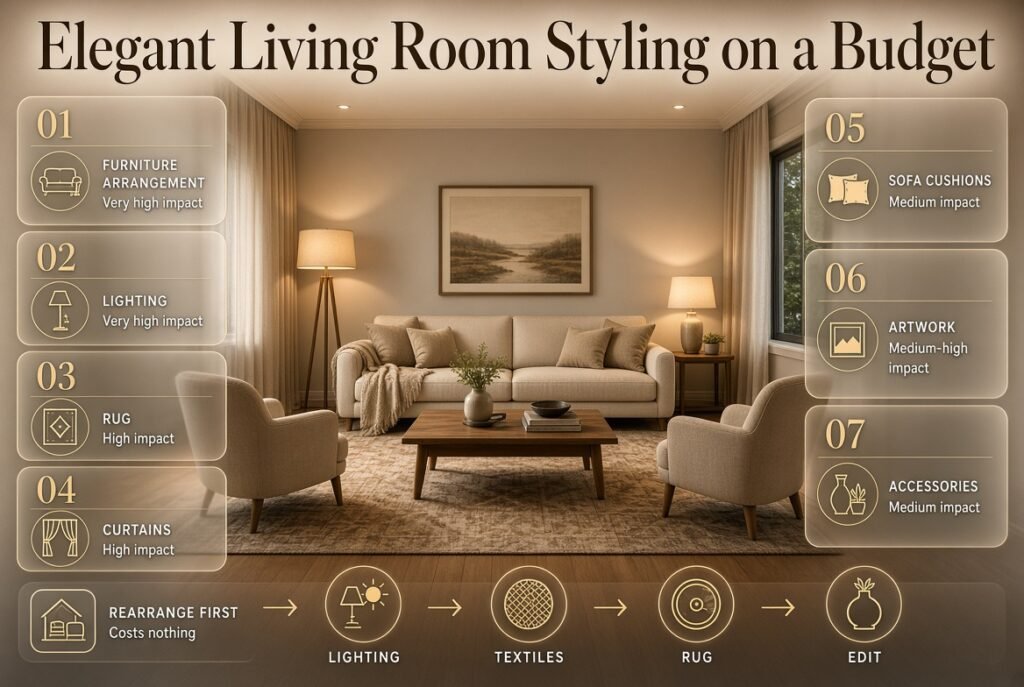
You don’t need to replace everything.
Start by ranking improvements according to visual impact.
| Priority | Upgrade | Impact |
| 1 | Furniture arrangement | Very high |
| 2 | Lighting | Very high |
| 3 | Rug | High |
| 4 | Curtains | High |
| 5 | Sofa cushions | Medium |
| 6 | Artwork | Medium-high |
| 7 | Accessories | Medium |
First: Rearrange
This costs nothing.
Remove unnecessary furniture and experiment with different layouts.
Second: Improve Lighting
A floor lamp or pair of table lamps can completely change the evening atmosphere.
Third: Add Textiles
Curtains, cushions, and throws introduce softness and texture.
Fourth: Improve the Rug
If your current rug is dramatically undersized, this may be one of the most worthwhile upgrades.
Fifth: Edit Accessories
You don’t necessarily need more.
You may simply need better grouping and fewer objects.
For practical upgrades around the rest of the home, you can also explore DIY Home Projects for ideas that can complement your living room styling without requiring a complete professional renovation.
Should You Use Gold in an Elegant Living Room?
Gold can work beautifully, but moderation is essential.
Warm metallic finishes can add sophistication to:
- Lamps
- Picture frames
- Hardware
- Side tables
- Decorative objects
- Mirrors
You don’t need gold everywhere.
A small amount repeated across the room usually feels more intentional than several large metallic pieces.
If you prefer a quieter look, brushed brass or aged bronze can provide warmth without the high-gloss appearance associated with some traditional gold finishes.
Should You Mix Wood and Metal?
Yes.
Mixing materials often creates a richer interior.
For example:
- Walnut coffee table
- Black metal lamp
- Brass accessory
- Cream upholstery
- Glass side table
The key is repetition.
If every item uses a different finish, the room may feel disjointed. Repeat one or two materials enough times to establish visual relationships.
How to Use Black Without Making the Room Dark
Black is an excellent accent in elegant interiors because it creates definition.
Use it selectively through:
- Window frames
- Lighting
- Furniture legs
- Artwork frames
- Side tables
- Decorative objects
In a mostly neutral room, a few black details can act like punctuation.
The mistake is using too much black without considering natural light.
In a darker room, balance black with warm wood, cream textiles, reflective surfaces, and sufficient lighting.
Don’t Ignore the Fifth Wall
The ceiling is often forgotten.
You don’t always need to paint it a different color, but it should relate to the overall palette.
A warm white ceiling can complement warm walls. A subtle ceiling color can create a more enveloping atmosphere in certain interiors.
Architectural details such as beams, molding, or decorative ceiling fixtures can also become important elements in elegant styling.
The Most Common Elegant Living Room Mistakes
1. Buying Everything as a Matching Set
Why it happens: Matching sets feel safe.
Why it’s harmful: The room can lose individuality.
Better approach: Coordinate pieces through color, material, proportion, and style instead of buying identical furniture.
2. Using a Rug That’s Too Small
Why it happens: Smaller rugs are less expensive.
Why it’s harmful: Furniture appears disconnected.
Better approach: Measure the seating arrangement first.
3. Overloading the Room With Accessories
Why it happens: People think luxury means abundance.
Why it’s harmful: Important pieces disappear into visual clutter.
Better approach: Style generously, then remove 10–20% of the objects.
4. Ignoring Nighttime Lighting
Why it happens: Most decorating decisions happen during daylight.
Why it’s harmful: The room may look attractive during the day but flat at night.
Better approach: Test your lighting after sunset.
5. Choosing Furniture Before Measuring
Why it happens: Online shopping encourages impulse purchases.
Why it’s harmful: Proportions can become completely wrong.
Better approach: Measure every major piece before ordering.
6. Making Everything the Same Color
Why it happens: Matching seems sophisticated.
Why it’s harmful: The room becomes visually flat.
Better approach: Use tonal variation and contrasting textures.
7. Following Every Trend
Why it happens: Trendy rooms receive attention online.
Why it’s harmful: The room can quickly feel dated.
Better approach: Keep major furniture timeless and use smaller accessories for current trends.
8. Forgetting Practicality
Why it happens: Styling photographs emphasize appearance.
Why it’s harmful: The room becomes uncomfortable to live in.
Better approach: Design around your actual routines.
⚠ Common Mistake: Never sacrifice everyday comfort simply to make the room look sophisticated. The best living room should look good and make you want to spend time there.
Professional Styling Sequence: What Should You Do First?
If you’re starting from scratch, use this order:
Step 1: Assess the Room
Identify architecture, natural light, focal points, doors, windows, and circulation.
Step 2: Measure
Record room dimensions and furniture sizes.
Step 3: Plan the Layout
Position the major furniture before purchasing accessories.
Step 4: Choose the Color Palette
Select dominant, secondary, and accent colors.
Step 5: Select Major Furniture
Choose the sofa, chairs, storage, and other substantial pieces.
Step 6: Add the Rug
Make sure its dimensions support the furniture arrangement.
Step 7: Add Curtains
Use fabric and height to improve softness and proportion.
Step 8: Layer Lighting
Combine ceiling, floor, table, and accent lighting.
Step 9: Add Artwork
Create focal points without filling every wall.
Step 10: Add Accessories
Use books, ceramics, greenery, cushions, and personal objects.
Step 11: Edit
Remove anything that feels unnecessary.
This sequence prevents a common decorating problem: buying accessories first and then trying to force the entire room to work around them.
How Sustainable Choices Can Still Look Elegant
Elegant design doesn’t have to depend on constantly buying new furniture.
Consider:
- Vintage furniture
- Secondhand pieces
- Refinished wood
- Natural materials
- Durable upholstery
- Repairing rather than replacing
- Reusing existing accessories
- Locally made objects where practical
Older furniture can add character that brand-new matching pieces sometimes lack.
The goal isn’t to make the room look old. It’s to combine useful existing pieces with carefully selected new elements.
If sustainability is part of your broader home strategy, the Sustainable Home Design guide can help you think about materials, longevity, and responsible choices beyond decorative styling.
How Often Should You Change Your Living Room Style?
You don’t need to redesign your living room every season.
A better strategy is to create a timeless foundation and refresh smaller details occasionally.
You can change:
- Cushions
- Throws
- Small accessories
- Flowers
- Artwork
- Decorative books
- Seasonal greenery
This keeps the room feeling fresh without creating unnecessary expense.
Major furniture should ideally be chosen for longevity.
A classic sofa in a durable neutral fabric can work with many different decorative directions over time.
How Does Storage Affect Elegant Styling?
Storage is one of the hidden foundations of an elegant room.
Even a beautifully decorated space will feel messy if everyday objects have nowhere to go.
Think about where you’ll store:
- Remote controls
- Blankets
- Children’s items
- Books
- Chargers
- Magazines
- Games
- Electronics
- Cleaning supplies
Use attractive baskets, cabinets, drawers, ottomans, and consoles to contain clutter.
Good storage allows decorative objects to stand out because they’re no longer competing with everyday necessities.
What Should You Buy First?
If your budget is limited, prioritize based on function and visual impact.
First Priority: Sofa
You use it every day, so comfort and durability matter.
Second Priority: Rug
It anchors the room and influences the overall palette.
Third Priority: Lighting
It changes how everything else looks.
Fourth Priority: Curtains
They add softness and can improve proportions.
Fifth Priority: Accent Furniture
Add chairs and side tables only when the room needs them.
Sixth Priority: Decorative Accessories
These should finish the room rather than define it.
This approach prevents the common situation where someone spends most of their budget on small decorations and has little left for the major elements that actually determine the room’s appearance.
Expert Advice for Creating a Truly Elegant Interior
One of the most useful professional habits is to step back regularly.
Don’t style the entire room while standing close to individual objects.
Walk to the doorway.
Sit on the sofa.
Look at the room from different angles.
Take photographs.
Ask yourself:
- What do I notice first?
- Is anything visually shouting?
- Does one corner feel empty?
- Is another corner overcrowded?
- Do the materials repeat naturally?
- Is the room comfortable?
- Does the lighting work at night?
This process is essentially visual editing.
Another useful technique is to remove one object at a time.
If removing an accessory makes the room look better, it probably wasn’t necessary.
How Can You Make an Elegant Room Feel Cozy?
Elegance shouldn’t come at the expense of warmth.
Use:
- Soft textiles
- Warm lighting
- Comfortable seating
- Natural wood
- Layered rugs where appropriate
- Throws
- Cushions
- Plants
- Personal artwork
- Books
Avoid making every surface glossy and every line perfectly sharp.
A little softness makes the room feel lived-in.
The best elegant living rooms often balance refined elements with relaxed ones.
For example:
Structured sofa + soft throw
Polished lamp + natural wood
Formal artwork + casual books
Clean coffee table + textured ceramic
These contrasts prevent the room from feeling overly staged.
How Can I Make My Living Room Look Elegant Without Spending a Lot of Money?
You don’t need expensive furniture or a complete renovation to create an elegant living room. The biggest difference usually comes from better proportions, cleaner styling, improved lighting, and a coordinated color palette. Before buying anything new, rearrange the existing furniture, remove unnecessary pieces, and create a clear focal point. Then invest selectively in high-impact items such as a properly sized rug, attractive curtains, quality-looking cushions, or a well-designed floor lamp.
Current interior design advice is also moving toward more personal, collected rooms rather than perfectly matched furniture sets, which means you don’t have to replace everything to achieve a sophisticated look.
Focus your budget on:
A comfortable, well-proportioned sofa
A correctly sized area rug
Layered lighting
Full-length curtains
One or two strong artwork pieces
Textured cushions and throws
A few meaningful decorative accessories
Professional tip: Don’t spend most of your budget on small decorations. Large elements such as the sofa, rug, curtains, and lighting determine how the entire room feels.
What Colors Make a Living Room Look Elegant and Expensive?
Elegant living rooms don’t have to be completely white, beige, or gray. The most sophisticated results usually come from a controlled palette with warm neutrals, earthy tones, and carefully chosen deeper accents. In 2026, designers are increasingly favoring warmer, more expressive colors, including earthy browns, olive greens, terracotta, soft blues, and richer accent shades rather than relying exclusively on cool gray interiors.
For a timeless foundation, consider:
Warm white with walnut and brass
Cream with taupe and brown
Greige with black and natural oak
Beige with olive green
Soft blue with cream and warm wood
Terracotta with warm white and natural materials
Deep green with beige and brass
The important part is how the colors relate to one another. A beautiful color can still look wrong if its undertone clashes with the flooring, sofa, or natural light.
For a more professional result:
Choose one dominant color.
Add one supporting color family.
Introduce one controlled accent.
Repeat important colors in at least two or three places.
Test paint samples in both daylight and artificial light.
Expert tip: If you’re nervous about using a bold color, introduce it through cushions, artwork, curtains, or a single accent chair before committing to an entire wall.
How Do I Make My Living Room Look Luxurious Without Making It Feel Cluttered?
The secret is layering without overcrowding. A luxurious living room doesn’t need dozens of decorative objects. In fact, excessive accessories can make an otherwise beautiful space look inexpensive and visually chaotic. Designers increasingly recommend curated, collected interiors where meaningful pieces are given enough negative space to stand out.
Instead of filling every surface, create small intentional groups.
For example, a coffee table might contain:
A decorative tray
Two attractive books
One ceramic bowl
A small vase or natural arrangement
Then leave part of the table empty.
The same principle works on shelves and consoles. Combine different heights and textures, but don’t put something into every available space.
To create a more luxurious appearance:
Mix wood, fabric, ceramic, glass, and metal.
Use fewer but better-looking accessories.
Leave intentional empty space.
Choose artwork with appropriate scale.
Repeat materials throughout the room.
Hide everyday clutter using practical storage.
Common mistake: Assuming that more decoration equals more luxury. Sophisticated interiors usually depend on editing. If a room feels busy, remove a few things before buying anything else.
What Is the Best Lighting for an Elegant Living Room?
The best lighting for an elegant living room is layered lighting, rather than depending entirely on one bright ceiling fixture. Combine ambient lighting with floor lamps, table lamps, wall sconces, or accent lighting so the room can have different levels of brightness throughout the day.
This approach is particularly important because lighting affects how colors, furniture, artwork, and textures appear after sunset. Recent designer advice continues to emphasize decorative and layered lighting instead of relying heavily on recessed ceiling lights alone.
A practical lighting plan can include:
Ambient:
Ceiling fixture or recessed lighting for general illumination.
Task:
Floor lamp beside a reading chair or table lamp near a sofa.
Accent:
Picture light, shelf lighting, or wall lighting to highlight artwork and architectural details.
Atmospheric:
Dimmable lamps or softer decorative lighting for evenings.
Warm, comfortable light is generally more suitable for a relaxed living room than extremely cool, harsh illumination.
Professional tip: Test your living room after dark. A room that looks beautiful in daylight can feel completely different at night if the lighting hasn’t been planned properly.
What Are the Biggest Mistakes That Make a Living Room Look Less Elegant?
The biggest mistakes usually involve poor proportions, excessive matching, inadequate lighting, clutter, and furniture that doesn’t suit the room’s size. These issues can make even expensive interiors feel unfinished. Current designer advice specifically warns against undersized rugs, overly matched furniture, excessive recessed lighting, and decorating trends that don’t suit the architecture of the space.
Watch out for these common problems:
A rug that’s too small: It makes the seating arrangement look disconnected.
Furniture pushed against every wall: It can create an awkward, empty center.
Too many matching pieces: The room may look like a showroom instead of a home.
Excessive accessories: Surfaces become visually noisy.
Only one ceiling light: The room can feel flat and harsh at night.
Curtains that are too short: They can make the windows and ceiling feel smaller.
Too many unrelated colors: The eye has nowhere to rest.
Following trends too literally: A fashionable room can quickly become dated.
Ignoring comfort: Beautiful furniture is useless if nobody wants to sit on it.
The professional solution: Before adding another decorative item, step back and assess the room as a whole. Ask whether the problem is really a lack of decoration—or whether the furniture arrangement, lighting, rug size, or color balance needs to be corrected first.
A truly elegant living room should feel intentional, comfortable, balanced, and personal, not simply expensive.
Conclusion
Elegant living room styling isn’t about filling your space with expensive furniture or following every new decorating trend. True elegance comes from balance, proportion, comfort, and thoughtful choices. When your furniture fits the room, colors work together, lighting creates warmth, and textures add depth, even a simple living room can feel polished and sophisticated.
Start with the basics before worrying about accessories. Improve the furniture arrangement, choose a rug that properly anchors the seating area, add well-fitted curtains, and create layers of lighting for both daytime and evening. From there, introduce artwork, greenery, cushions, books, and personal pieces that make the room feel like yours.
Most importantly, don’t be afraid of empty space. An elegant room doesn’t need something on every wall, table, or shelf. A carefully edited space often feels more luxurious than an overcrowded one.
Whether you’re refreshing a small apartment living room or redesigning a large family space, focus on creating a room that looks beautiful while remaining practical for everyday life. The best elegant living room is ultimately one that feels refined when guests arrive but still feels comfortable, welcoming, and genuinely yours when they’re gone.
Leave a Reply