
Introduction
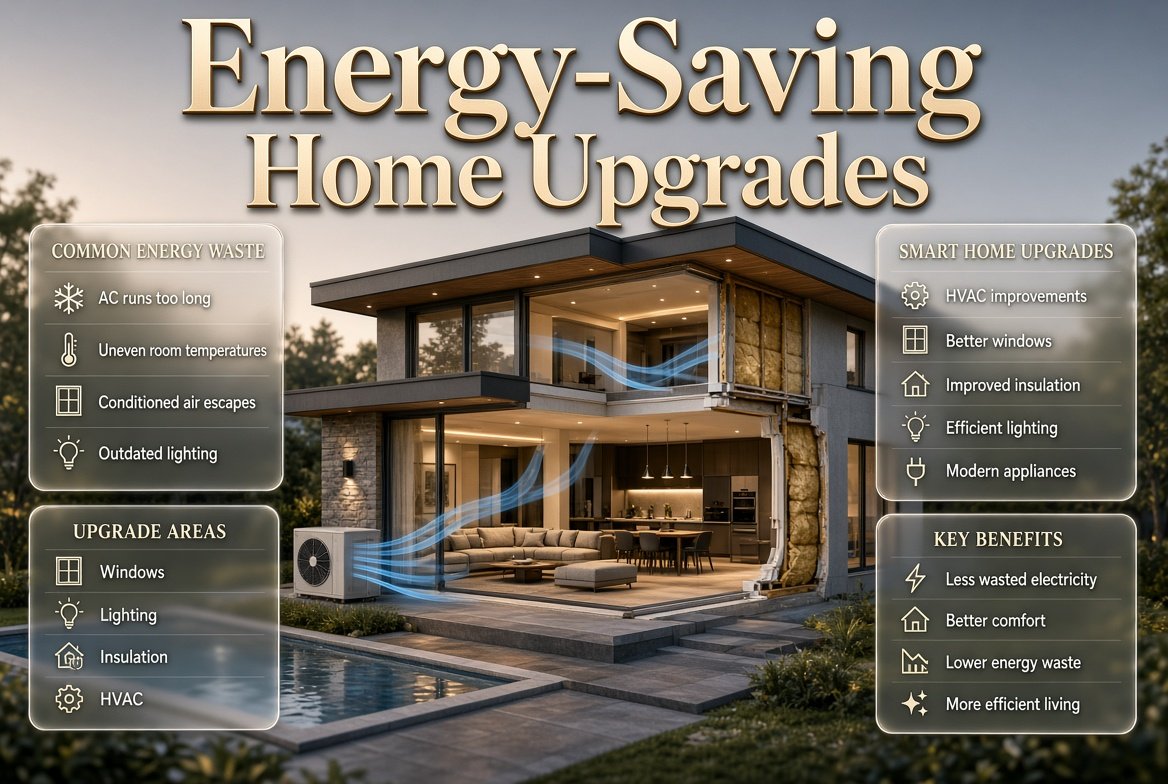
Energy-Saving Home Upgrades | A home can look beautiful, feel comfortable, and still waste a surprising amount of energy every day. Maybe the air conditioner runs longer than it should. Perhaps one bedroom is always colder than the rest of the house. Old windows may let conditioned air escape, while outdated lighting, appliances, insulation, or a poorly maintained HVAC system quietly increase monthly bills.
The good news is that you don’t need to remodel your entire house to improve its energy performance. The right energy-saving home upgrades can reduce wasted electricity, improve indoor comfort, and make everyday living more efficient. The key is knowing which improvements deserve attention first.
If you’re planning a broader home improvement project, the DesignMode24 Interior Design website can also help you connect practical improvements with better interior planning.
This guide takes a practical approach. You’ll learn which upgrades usually have the biggest impact, what you can do on a small budget, when professional help is worthwhile, which improvements are often overrated, and how to build a realistic energy-efficiency plan without wasting money.
What Are Energy-Saving Home Upgrades?
Energy-saving home upgrades are improvements that reduce the amount of energy required to heat, cool, light, ventilate, and operate a home. They can include simple changes such as LED bulbs and weatherstripping, as well as larger investments such as insulation, efficient windows, heat pumps, high-efficiency HVAC systems, and solar energy.
The important distinction is that an energy-saving upgrade should solve a specific source of energy waste.
For example, replacing every light bulb with LEDs can reduce lighting electricity use, but it won’t solve a poorly insulated attic. Similarly, installing a smart thermostat can improve temperature control, but it can’t compensate for a badly leaking duct system.
A high-performing home usually combines several layers:
Stop energy loss → improve equipment → control usage → generate cleaner energy
That sequence is important because reducing unnecessary energy demand should generally come before investing in energy generation.
Why Do Energy-Efficient Upgrades Matter?
Energy efficiency affects more than the monthly utility bill.
A better-performing home can provide:
- More consistent indoor temperatures
- Fewer drafts
- Better HVAC performance
- Lower energy consumption
- Improved indoor comfort
- Reduced equipment workload
- Better control over heating and cooling
- Potentially lower maintenance costs
- Greater resilience to changing energy prices
- A more comfortable living environment
The best upgrades often solve two problems at once. For example, sealing a draft can reduce energy waste while making a room noticeably more comfortable.
Which Energy-Saving Home Upgrades Should You Do First?
The smartest first upgrade isn’t necessarily the newest technology. Start by finding where your home is losing or consuming the most energy.
For many houses, the best sequence is:
- Identify energy waste
- Seal obvious air leaks
- Improve insulation where needed
- Maintain existing HVAC equipment
- Upgrade lighting and controls
- Improve water-heating efficiency
- Replace inefficient appliances when necessary
- Upgrade windows when their condition justifies it
- Replace inefficient HVAC equipment
- Consider heat pumps or renewable energy
This approach prevents a common mistake: spending thousands on a high-tech solution while ignoring a basic building problem.
A Simple Energy-Efficiency Formula
Think of your home as a system rather than a collection of individual products.
Outdoor conditions
↓
Roof / walls / windows / doors
↓
Indoor conditioned space
↓
HVAC + lighting + appliances
↓
Your daily habits
If one part of that system performs poorly, other components may have to work harder.
💡 Pro Tip: Before buying expensive equipment, ask one question: “What is currently causing my home to use more energy than it should?” That question can save more money than a rushed product purchase.
1. Start With an Energy Audit or Home Energy Assessment
One of the most useful energy-saving improvements is actually understanding the problem before fixing it.
An energy audit examines how energy moves through your home and where waste may be occurring. Depending on the assessment, a professional may inspect insulation, air leakage, HVAC equipment, ductwork, windows, doors, lighting, appliances, and other energy-consuming systems.
You can also perform a basic homeowner inspection before paying for a professional assessment.
Look for These Warning Signs
Walk through your home and note:
- Rooms that are consistently too hot or too cold
- Drafts around windows or doors
- Condensation on windows
- Uneven temperatures between floors
- HVAC systems that run almost constantly
- Poor airflow from vents
- Very old heating or cooling equipment
- Missing or thin attic insulation
- High electricity use without an obvious explanation
- Lights that are frequently left on
- Appliances that are old or inefficient
These observations can help you identify where further investigation is needed.
Why an Audit Is Worth Considering
Without an assessment, homeowners often make decisions based on assumptions.
A person might believe that replacing windows is the priority when the actual problem is poor attic insulation. Another homeowner might buy a new air conditioner when the existing system is operating inefficiently because of restricted airflow or leaking ducts.
An energy assessment helps turn a vague problem into a practical project list.
2. Seal Air Leaks Around the Home
Air sealing is one of the most overlooked energy-saving home upgrades.
Conditioned air can escape through tiny gaps around windows, doors, pipes, electrical penetrations, attic access panels, baseboards, and other openings. Outdoor air can enter through the same weak points.
The result is simple: your HVAC system has to work harder to maintain the temperature you want.
Where Should You Look?
Common leakage areas include:
- Exterior doors
- Window frames
- Door thresholds
- Attic hatches
- Plumbing penetrations
- Electrical penetrations
- Recessed lighting openings
- Baseboards
- Wall-to-ceiling joints
- Gaps around utility lines
Caulk can work well for small stationary gaps, while appropriate foam or other sealing materials may be suitable for larger openings.
Weatherstripping is particularly useful around moving doors and windows.
Why Air Sealing Improves Comfort
Imagine a bedroom that always feels colder than the rest of the house. The problem may not be the bedroom’s heater. It could be a draft around a window or exterior wall.
Once uncontrolled airflow is reduced, the room may maintain its temperature more effectively.
⚠ Common Mistake: Never seal vents or openings that are intentionally designed for combustion safety or required ventilation. If you’re unsure whether an opening serves a safety purpose, have it evaluated before sealing it.
3. Upgrade Attic Insulation
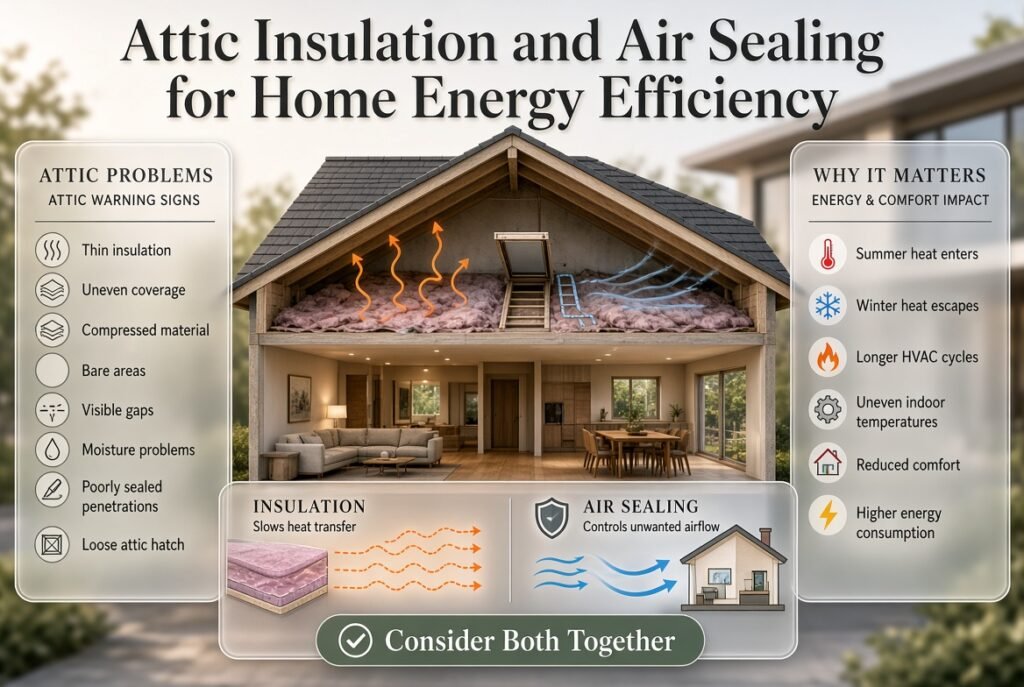
Heat naturally moves from warmer areas toward colder areas. Insulation slows that movement.
The attic is particularly important in many homes because the ceiling separates the conditioned living space from a large area exposed to outdoor temperature changes.
Poor attic insulation can contribute to:
- Summer heat entering the home
- Winter heat escaping
- Longer HVAC operating cycles
- Uneven indoor temperatures
- Reduced comfort
- Higher energy consumption
How to Know If Your Attic Needs Attention
Check for:
- Thin insulation
- Uneven coverage
- Compressed material
- Bare areas
- Visible gaps
- Moisture problems
- Poorly sealed penetrations
- An attic hatch that doesn’t fit tightly
Don’t automatically add more insulation without checking what is already there and whether moisture or air leakage problems exist.
Air Sealing and Insulation Work Together
Insulation slows heat transfer, while air sealing controls unwanted airflow.
That’s why these two improvements are often more effective when considered together.
For example, adding insulation over a ceiling with significant air leakage doesn’t necessarily solve the entire problem. Air can still move through gaps around penetrations and other openings.
4. Make Your Windows More Energy Efficient
Windows are often blamed for high energy bills, and sometimes they’re responsible. But window replacement should be approached carefully because it can be expensive.
Replacing windows makes the most sense when existing units are:
- Single-pane
- Severely drafty
- Damaged
- Difficult to operate
- Poorly sealed
- Showing failed glazing seals
- Contributing to major comfort problems
If windows are structurally sound, lower-cost measures may be enough.
Lower-Cost Window Improvements
Consider:
- Weatherstripping
- Caulking
- Thermal curtains
- Cellular shades
- Exterior shading
- Solar-control window treatments
- Interior blinds
These solutions don’t replace the performance of a high-quality window assembly, but they can improve comfort without the cost of replacing every window.
Don’t Judge Windows by One Specification
Window performance depends on multiple factors, including:
- Glazing
- Frame construction
- Installation quality
- Solar heat gain
- Air leakage
- Orientation
- Local climate
A technically excellent window can perform poorly if it’s badly installed.
📌 Quick Tip: If you’re replacing windows, compare complete performance characteristics rather than choosing solely by the number of glass panes.
5. Improve HVAC Efficiency
Heating and cooling systems can be among the largest energy users in a home.
Before replacing an HVAC system, make sure the existing equipment is actually operating correctly.
A professional inspection may identify:
- Dirty filters
- Restricted airflow
- Duct leakage
- Poor duct insulation
- Incorrect thermostat operation
- Mechanical problems
- Poor maintenance
- Refrigeration issues
- Incorrect system sizing
Sometimes a relatively inexpensive repair can restore performance.
Replace or Repair?
Repairing an HVAC system can make sense when:
- The equipment isn’t very old
- The repair is relatively minor
- The system has a good maintenance history
- Energy performance remains reasonable
Replacement may become more attractive when:
- The system is old
- Repairs are frequent
- Repair costs keep increasing
- Comfort has deteriorated
- Operating costs are unusually high
- The equipment is significantly less efficient than modern alternatives
Don’t Automatically Buy the Largest System
An oversized HVAC system isn’t automatically more efficient.
Correct sizing matters because a system that is too large may cycle on and off frequently instead of operating efficiently for longer periods. It can also affect humidity control and comfort.
⭐ Expert Tip: HVAC replacement should be based on the home’s actual heating and cooling requirements, not simply on replacing the old equipment with a larger model.
6. Consider a Heat Pump
Heat pumps are increasingly popular in energy-efficient homes because they can provide heating and cooling by transferring heat rather than relying on conventional heat generation.
Common options include:
- Air-source heat pumps
- Ductless mini-splits
- Ground-source heat pumps
The right system depends on climate, electricity prices, existing heating equipment, home design, installation requirements, and budget.
When Does a Heat Pump Make Sense?
A heat pump may be worth considering when:
- You’re replacing an aging HVAC system
- You want one system for heating and cooling
- Electricity is reasonably priced in your area
- Your climate is suitable for the chosen system
- You want to reduce dependence on combustion-based heating
However, installation costs can be substantial.
Don’t compare only the sticker price. Look at the expected operating costs and the complete lifecycle of the equipment.
7. Replace Inefficient Lighting With LEDs
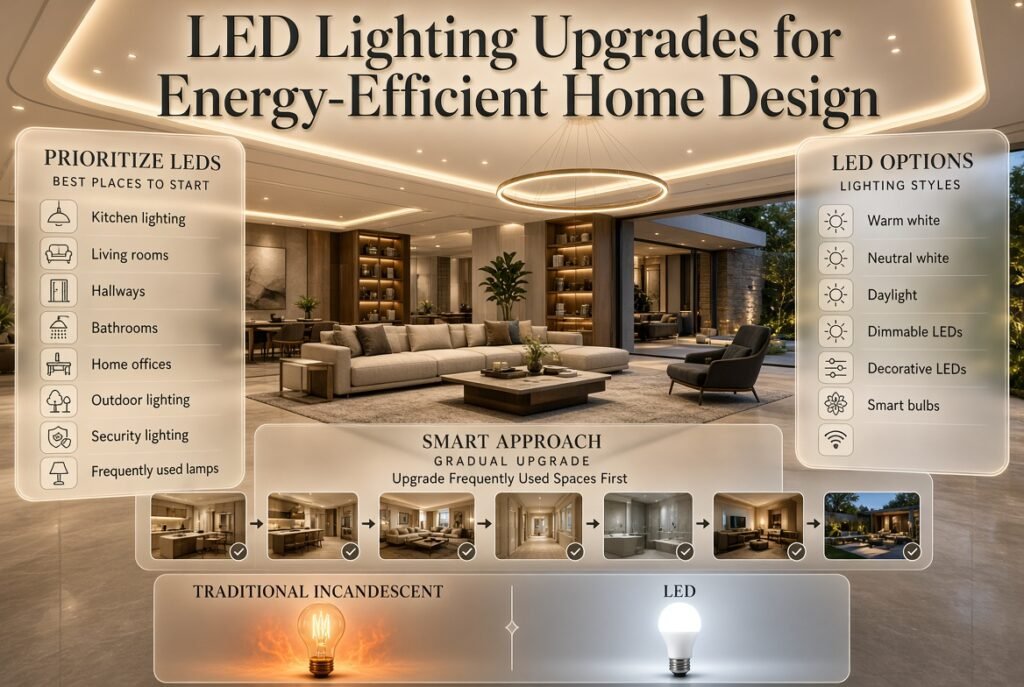
LED lighting is one of the simplest energy-saving home upgrades.
Traditional incandescent bulbs convert a large portion of the electricity they consume into heat. LEDs are much more efficient at producing useful light and generally last significantly longer.
That makes them especially useful in frequently used spaces.
Where Should You Prioritize LEDs?
Start with:
- Kitchen lighting
- Living rooms
- Hallways
- Bathrooms
- Home offices
- Outdoor lighting
- Security lighting
- Frequently used lamps
You don’t necessarily need to replace every bulb in one afternoon.
A gradual approach works perfectly well.
Energy Efficiency Doesn’t Mean Poor Design
Modern LEDs are available in different color temperatures and forms.
You can use:
- Warm white
- Neutral white
- Daylight
- Dimmable LEDs
- Decorative LEDs
- Smart bulbs
The lighting can remain attractive while becoming more efficient.
For design-focused lighting improvements, see Lighting and Ceiling Ideas.
8. Install a Smart or Programmable Thermostat
A thermostat can become an important part of an energy-efficient home because it determines when your heating or cooling system operates.
Instead of maintaining the same temperature all day, a programmable or smart thermostat can adjust settings according to your schedule.
For example:
Morning: comfortable setting
Work hours: energy-saving setting
Evening: comfortable setting
Sleeping: adjusted setting
The biggest benefit comes from avoiding unnecessary HVAC operation.
But Don’t Expect a Thermostat to Fix a Bad House
A smart thermostat can’t solve:
- Poor insulation
- Major air leakage
- Leaking ducts
- Incorrect HVAC sizing
- Mechanical failure
It’s a control tool, not a substitute for building improvements.
9. Improve Water Heater Efficiency
Water heating is another important source of household energy use.
If your water heater is old or you’re already planning a replacement, compare available efficient technologies rather than automatically purchasing the same type again.
Options may include:
- High-efficiency storage water heaters
- Heat pump water heaters
- Tankless systems
- Solar-assisted systems where practical
Don’t Ignore Hot-Water Pipes
Heat can also be lost as hot water travels through pipes.
Insulating appropriate hot-water pipes can help reduce heat loss and may help hot water reach fixtures more efficiently.
However, water-heating upgrades should be selected based on household demand, installation conditions, available space, and local utility costs.
10. Upgrade Appliances When Replacement Makes Sense
A new appliance isn’t automatically a smart energy investment simply because it uses less electricity.
If your existing refrigerator works efficiently and has plenty of useful life left, replacing it immediately may not provide enough savings to justify the purchase.
A better strategy is to prioritize appliances that are:
- Very old
- Used heavily
- Inefficient
- Expensive to operate
- Near the end of their useful life
Appliances Worth Watching
Pay particular attention to:
- Refrigerators
- Freezers
- Clothes washers
- Dryers
- Dishwashers
- Ovens
- HVAC equipment
When shopping, compare estimated energy consumption and operating cost rather than focusing only on the purchase price.
⚠ Common Mistake: Assuming the most expensive appliance is automatically the most economical. Long-term operating costs matter more than the initial price alone.
11. Reduce Standby or Phantom Energy Use
Some electronic devices continue consuming electricity even when they’re not actively being used.
This is commonly called standby power or phantom load.
Potential contributors include:
- Televisions
- Game consoles
- Computers
- Printers
- Streaming devices
- Chargers
- Home entertainment equipment
You don’t have to unplug every electronic device every night.
Instead, group equipment together with smart power strips or accessible switches.
For example, a television, sound system, and streaming equipment can be connected to a controllable power strip so the group can be switched off when nobody is using it.
12. Use Window Treatments as an Energy Tool
Interior design can contribute to energy efficiency more than many homeowners realize.
Curtains, shades, blinds, and other window treatments can influence heat gain and heat loss.
The right treatment depends on the window’s orientation and the local climate.
For sunny rooms, solar-control shades can reduce unwanted heat. In colder conditions, insulating curtains can help reduce heat transfer around windows.
The advantage is that these improvements can combine function and style.
Instead of treating energy efficiency as a technical project, you can incorporate it into your home’s overall design.
For broader inspiration, explore Interior Design.
13. Improve Walls and Floors Where Necessary
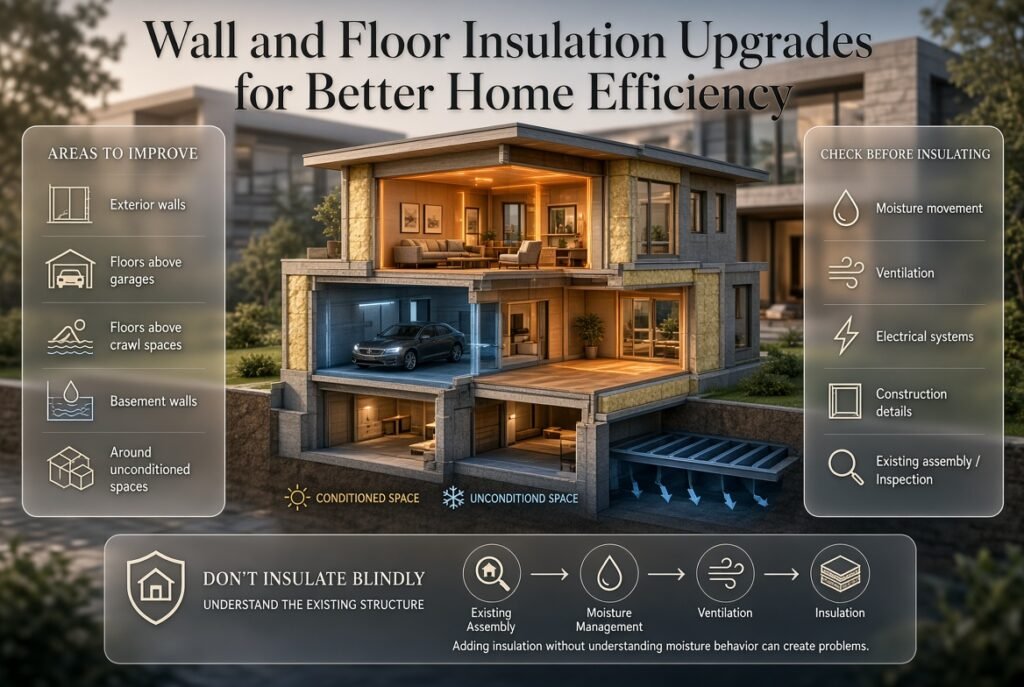
Walls and floors can also affect thermal performance.
Potential areas for improvement include:
- Exterior walls
- Floors above garages
- Floors above crawl spaces
- Basement walls
- Areas surrounding unconditioned spaces
However, insulation projects can become complicated because moisture movement, ventilation, electrical systems, and construction details all matter.
Don’t blindly add insulation to an assembly without understanding how the existing structure handles moisture.
For visual planning around floors and walls, see Flooring and Wall Design Inspiration.
14. Use Natural Light More Effectively
Energy efficiency isn’t only about replacing products.
Good design can reduce the need for artificial lighting during the day.
Consider:
- Keeping windows unobstructed
- Using reflective interior surfaces
- Positioning workspaces near useful daylight
- Using task lighting instead of lighting an entire room
- Choosing lighter finishes where appropriate
- Using mirrors strategically
The goal isn’t to make every room white or eliminate artificial lighting. It’s to use available daylight intelligently.
This is where energy-conscious design and interior design can complement one another.
15. Use Outdoor Shade to Reduce Cooling Demand
Outdoor spaces can influence the temperature inside your home.
Trees, pergolas, exterior shades, awnings, and other forms of shading can reduce direct solar exposure on windows and walls.
This can be especially useful for windows that receive intense afternoon sunlight.
When planning outdoor improvements, explore Garden and Outdoor Living Guides for ideas that can support both aesthetics and practical comfort.
Which Energy-Saving Home Upgrades Give the Best Return?
There is no single upgrade that will deliver the same result in every house.
The best return depends on:
- Climate
- Home age
- Insulation level
- Energy prices
- HVAC type
- Window condition
- Household size
- Daily habits
- Existing equipment
A useful comparison looks like this:
| Upgrade | Typical Investment | Potential Impact | Priority |
|---|---|---|---|
| LED lighting | Low | Medium | High |
| Weatherstripping | Low | Low–Medium | High |
| Air sealing | Low–Medium | Medium–High | High |
| Smart thermostat | Low–Medium | Medium | Medium–High |
| Attic insulation | Medium | High | High |
| Window treatments | Low–Medium | Medium | Medium |
| Efficient appliances | Medium | Medium | Medium |
| Window replacement | Medium–High | Medium–High | Situation-dependent |
| HVAC replacement | High | High | High when system is old |
| Heat pump | High | High | Situation-dependent |
| Solar panels | High | High | Long-term consideration |
The table isn’t a universal investment ranking. It’s a planning framework.
Energy-Saving Upgrades for Different Budgets
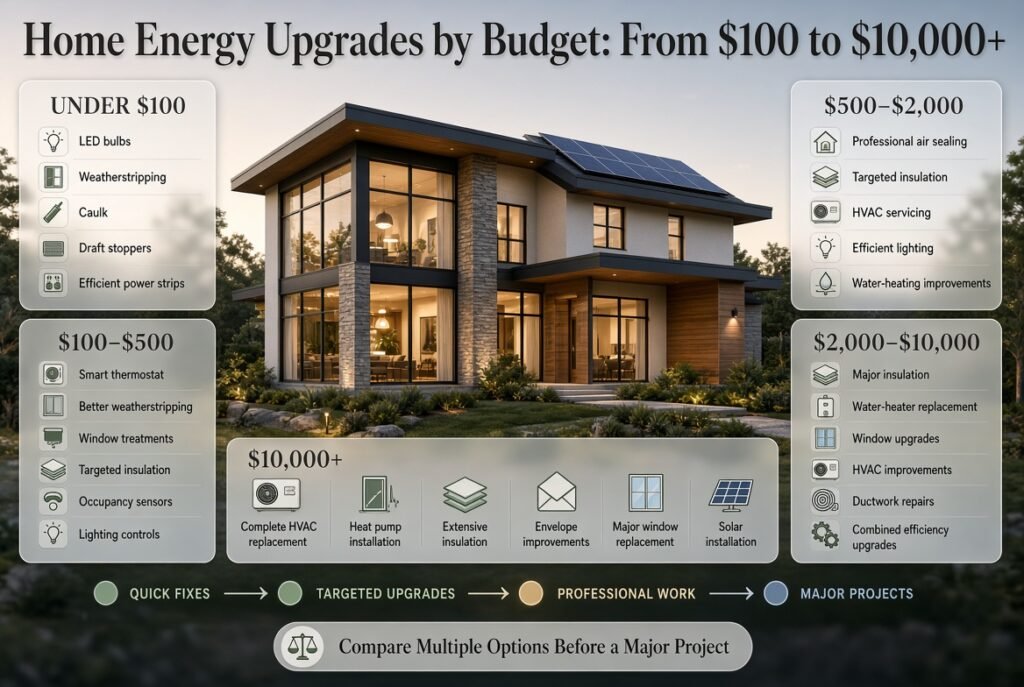
Under $100
Start with:
- LED bulbs
- Basic weatherstripping
- Caulk
- Draft stoppers
- Efficient power strips
These improvements are inexpensive and can be completed quickly.
$100–$500
Consider:
- Smart thermostat
- Better weatherstripping
- Window treatments
- Targeted insulation materials
- Occupancy sensors
- Improved lighting controls
$500–$2,000
You may be able to address:
- Professional air sealing
- Targeted insulation
- HVAC servicing
- Efficient lighting upgrades
- Selected water-heating improvements
$2,000–$10,000
Potential projects include:
- Major insulation work
- Water-heater replacement
- Window upgrades
- HVAC improvements
- Ductwork repairs
- Multiple efficiency improvements combined
$10,000+
This is where larger projects may become realistic:
- Complete HVAC replacement
- Heat pump installation
- Extensive insulation and envelope improvements
- Major window replacement
- Solar installation
Always compare multiple options before committing to a major project.
What Energy-Efficient Upgrades Can You DIY?
Some energy improvements are suitable for confident homeowners.
Good DIY Projects
You can often handle:
- Replacing light bulbs
- Installing weatherstripping
- Applying basic caulk
- Installing certain curtains and shades
- Setting thermostat schedules
- Using smart power strips
- Replacing accessible HVAC filters
Projects Better Left to Professionals
Professional help is usually appropriate for:
- Electrical panel work
- Major electrical modifications
- Refrigerant-related HVAC work
- Gas appliance modifications
- Complex insulation
- Heat-pump installation
- Major ductwork
- Window installation
- Structural changes
DIY can reduce labor costs, but incorrect installation can create safety issues or reduce the expected energy benefit.
For homeowner-friendly projects, see DIY Home Projects.
How Interior Design Can Improve Energy Efficiency
An energy-efficient home doesn’t need to look technical or overly modern.
In fact, many energy-conscious decisions naturally fit good interior design.
Consider:
- Layered lighting
- Daylight optimization
- Thermal curtains
- Efficient ceiling fans
- Furniture zoning
- Comfortable room layouts
- Light-reflective surfaces
- Seasonal textiles
- Appropriate shading
For example, a reading chair positioned near useful daylight can reduce the need for task lighting during the day. A properly fitted curtain can improve window comfort while also adding texture and style.
Good design isn’t separate from energy efficiency. In many cases, the two goals support each other.
How Seasonal Changes Affect Home Energy Use
Your energy strategy should change throughout the year.
Summer Energy Priorities
Focus on:
- Solar shading
- Efficient air conditioning
- Clean HVAC filters
- Ceiling fans
- Window treatments
- Smart thermostat schedules
- Attic insulation
Winter Priorities
Focus on:
- Air sealing
- Insulation
- Efficient heating
- Door weatherstripping
- Window treatments
- HVAC maintenance
Spring and Fall Priorities
These transitional periods are excellent times to:
- Inspect HVAC systems
- Replace filters
- Check windows
- Examine weatherstripping
- Review energy bills
- Plan larger upgrades
Seasonal home planning can also be easier when your home organization follows the same rhythm. See Seasonal Decorating Ideas for ways to organize seasonal changes without letting the home become cluttered.
Common Mistakes Homeowners Make With Energy Upgrades
Replacing Windows Without Checking Insulation
Windows are visible, so they’re easy to blame.
But a poorly insulated attic may have a much greater impact.
Avoid it: investigate the building envelope before committing to expensive window replacement.
Buying an Oversized HVAC System
Homeowners often think more capacity means better performance.
Avoid it: have the home’s actual heating and cooling requirements evaluated.
Adding Insulation Without Air Sealing
More insulation isn’t always enough.
Avoid it: identify major air leakage first and address the two problems together when appropriate.
Replacing Working Appliances Too Early
A newer appliance may be more efficient, but the purchase still has a cost.
Avoid it: prioritize replacements when the old appliance is inefficient, heavily used, or near the end of its life.
Choosing Products Based Only on Price
The lowest purchase price doesn’t necessarily mean the lowest lifetime cost.
Avoid it: consider installation, operating energy, maintenance, durability, and expected lifespan.
Installing Solar Before Reducing Waste
Solar panels can generate renewable electricity, but they don’t make a poorly performing building envelope efficient.
Avoid it: reduce unnecessary energy demand first, then assess renewable generation.
Treating Smart Technology as a Complete Solution
Smart thermostats, smart lights, and connected devices can improve control, but technology can’t repair fundamental building problems.
Avoid it: improve the physical performance of the home before relying on automation.
How to Build an Energy-Saving Home Upgrade Plan
A phased plan is often easier and more affordable than trying to renovate everything at once.
Step 1: Review Your Utility Bills
Look at consumption over several months.
Don’t focus only on the amount you paid because utility rates can change. Look for patterns in actual energy use.
Step 2: Identify Comfort Problems
Write down which rooms are:
- Too hot
- Too cold
- Drafty
- Humid
- Difficult to heat
- Difficult to cool
Comfort problems can provide clues about underlying efficiency issues.
Step 3: Inspect the Building Envelope
Check:
- Attic
- Windows
- Doors
- Walls
- Floors
- Crawl spaces
- Exterior penetrations
Step 4: Review HVAC Performance
Ask:
- How old is the system?
- Has it been maintained?
- Does it run unusually long?
- Are temperatures uneven?
- Is airflow weak?
- Are repairs becoming frequent?
Step 5: Prioritize High-Impact Problems
Create three groups:
Do Now: low-cost, high-value improvements
Do Next: medium-cost improvements
Plan Ahead: major replacements and renovations
Step 6: Compare Costs
Estimate the purchase price, installation cost, maintenance requirements, and expected energy savings.
Step 7: Complete Improvements in Logical Order
For example, don’t replace HVAC equipment before addressing major building-envelope problems if those problems could affect the equipment requirements.
Step 8: Measure the Results
After improvements, compare energy consumption with previous periods while considering weather and changes in household use.
How to Make Energy Efficiency Part of a Larger Home Improvement Plan
Energy efficiency doesn’t need to exist separately from other renovations.
If you’re repainting, remodeling, reorganizing, or redecorating, use the opportunity to look at practical improvements at the same time.
For example:
Bedroom renovation
→ improve window sealing
→ install efficient lighting
→ add thermal window treatments
→ improve furniture layout
→ use appropriate insulation where accessible
Kitchen renovation
→ efficient lighting
→ efficient appliances
→ better ventilation
→ smart controls
Living room renovation
→ daylight optimization
→ efficient lighting
→ window treatments
→ ceiling fan
→ furniture arrangement
This approach makes improvements feel intentional rather than like a collection of unrelated upgrades.
For broader planning, explore Home Improvement.
How Smart Storage and Organization Can Support an Efficient Home
Organization doesn’t directly reduce electricity consumption in the same way insulation or efficient HVAC does, but it can make energy-conscious habits easier to maintain.
For example, keeping:
- HVAC filters accessible
- Maintenance tools organized
- Seasonal window treatments labeled
- Extension cords stored properly
- Lighting supplies together
- Cleaning equipment accessible
can make routine maintenance easier.
A well-organized home also makes it easier to notice problems before they become expensive.
Explore Smart Storage and Organization Ideas for practical organization strategies that can support a more manageable home.
How to Balance Energy Efficiency With Home Aesthetics
A common concern is that energy upgrades will make a home look less attractive.
They don’t have to.
Consider how these improvements can become design elements:
| Efficiency Improvement | Design Opportunity |
|---|---|
| LED lighting | Layered ambient and task lighting |
| Thermal curtains | Decorative fabric and texture |
| Ceiling fans | Architectural focal point |
| Exterior shading | Pergolas and landscaping |
| Efficient windows | Cleaner modern appearance |
| Smart controls | Minimal wall clutter |
| Insulation | Hidden performance improvement |
| Daylight optimization | Brighter interiors |
The best energy improvements are often the ones you don’t notice visually because they’re integrated into the structure or design.
For budget-conscious styling ideas, see Easy Decorating Tips for Every Budget.
What are the most effective energy-saving home upgrades?
The most effective energy-saving home upgrades are usually the ones that reduce heating and cooling demand first, followed by upgrades to major energy-consuming equipment. For many homes, this means improving air sealing and insulation, upgrading HVAC equipment, installing a smart thermostat, replacing inefficient lighting with LEDs, and choosing a more efficient water-heating system.
The important point is that there is no single best upgrade for every home. An older house with air leaks may benefit more from insulation and weatherization, while a home with an outdated air conditioner may see greater value from an efficient HVAC replacement. ENERGY STAR’s current whole-home approach also emphasizes combining improvements rather than treating each upgrade as an isolated project.
Key points to consider:
Start with air sealing and insulation where the building envelope is weak.
Improve HVAC efficiency if your heating or cooling system is old or inefficient.
Use smart temperature controls to avoid unnecessary heating and cooling.
Replace frequently used inefficient bulbs with LEDs.
Consider efficient water heating when replacing an aging system.
Look at the whole house rather than choosing upgrades based only on popularity.
A professional energy assessment can make the decision much easier because it identifies where your home is actually losing energy instead of making you spend money on upgrades that may have little impact.
Which energy-saving home upgrades give the best return on investment?
The best return on investment generally comes from upgrades that are relatively affordable, used frequently, and capable of reducing ongoing energy consumption. Air sealing, insulation improvements, LED lighting, smart thermostats, efficient appliances, and HVAC improvements are often strong candidates, but the actual payback depends heavily on the home’s condition, climate, energy prices, and how long you plan to stay there.
For example, replacing a few light bulbs is inexpensive and simple, while replacing an entire HVAC system requires a much larger investment. That doesn’t mean the HVAC upgrade is less valuable—it may have a much larger long-term effect because heating and cooling can represent a major portion of household energy use.
A practical way to judge an upgrade:
Low cost: weatherstripping, LEDs, smart power controls, basic sealing.
Medium investment: insulation, smart thermostat, efficient appliances.
Major investment: HVAC replacement, heat pump systems, high-performance windows, water-heating upgrades.
Long-term projects: solar and broader whole-home renovations.
Don’t judge an upgrade only by its purchase price. Consider upfront cost + expected energy savings + maintenance + lifespan + comfort + future replacement costs.
That broader calculation gives you a much more realistic picture of whether an upgrade is genuinely worthwhile.
Does insulation really make a difference in an energy-efficient home?
Yes, but good insulation works best when it is paired with proper air sealing. Insulation slows heat transfer, while air sealing prevents conditioned air from escaping through cracks, gaps, joints, and other openings in the building envelope. Together, they help maintain more stable indoor temperatures and reduce the workload placed on heating and cooling equipment. ENERGY STAR identifies a well-sealed and insulated attic as one of its high-impact home upgrades.
This is especially important in older homes where insulation levels may be inadequate or uneven. You can have expensive heating or cooling equipment, but if conditioned air is constantly escaping, the system still has to work harder to maintain the desired temperature.
Areas worth checking include:
Attic insulation
Attic access panels
Exterior doors
Window frames
Plumbing and electrical penetrations
Ductwork
Basement or crawl-space areas
Gaps around vents and utility openings
One common mistake is adding insulation without addressing significant air leaks first. The result may be less effective than expected.
Think of the building envelope as the protective shell of your home. Strengthening that shell before investing in larger mechanical systems can make later upgrades work more effectively.
Are smart thermostats worth it for saving energy?
A smart thermostat can be worthwhile when it is properly matched to your HVAC system and actually used to manage heating and cooling schedules. Its value isn’t that the thermostat itself consumes very little electricity; its real purpose is controlling equipment that can consume substantially more energy. ENERGY STAR notes that certified smart thermostats are evaluated using real-world field data and can automatically adjust temperature settings based on schedules, occupancy, and other features.
A smart thermostat can be particularly useful for households where the heating or cooling system runs unnecessarily while everyone is asleep, away, or in another part of the home.
Useful features include:
Programmable schedules
Remote temperature control
Geofencing
Occupancy or room sensors
Vacation settings
Energy-use monitoring
Automatic temperature adjustments
However, buying a smart thermostat doesn’t automatically guarantee major savings. If your HVAC system is poorly maintained, your home has serious air leaks, or the thermostat is incorrectly installed or programmed, the overall benefit can be limited.
Expert tip: Treat the thermostat as part of a larger energy-efficiency strategy. Combine intelligent temperature control with clean filters, proper insulation, sealed ducts, and efficient HVAC equipment for better results.
What energy-saving upgrades should I do first if I have a limited budget?
If your budget is limited, don’t try to renovate the entire house at once. Start with improvements that are inexpensive, frequently used, and capable of reducing unnecessary energy consumption. This approach lets you build efficiency gradually instead of taking on a large renovation bill immediately.
A sensible starting sequence is identify energy losses → seal obvious leaks → improve insulation where needed → optimize heating and cooling → upgrade lighting and controls → replace major equipment when it reaches the end of its useful life.
A practical low-budget priority list:
Seal drafts and obvious air leaks around doors, windows, and penetrations.
Replace inefficient, frequently used lighting with LEDs.
Improve HVAC maintenance, including regular filter checks.
Install a programmable or smart thermostat if your current controls are outdated.
Use efficient power controls for electronics that remain on standby.
Add insulation where the home is clearly under-insulated.
Replace old appliances strategically, rather than replacing everything at once.
Plan major HVAC or water-heating upgrades when existing equipment approaches replacement age.
This approach is usually more financially sensible than chasing every new energy-saving product on the market.
The biggest mistake is spending your entire budget on a visible upgrade while ignoring hidden problems such as air leakage, poor insulation, inefficient HVAC operation, or unnecessary energy use. A home becomes truly energy efficient when the systems work together, not simply because it contains expensive equipment.
Conclusion
Energy-saving home upgrades are not simply about lowering the next utility bill. Done properly, they make a home more comfortable, easier to maintain, healthier to live in, and more resilient to changing energy costs. The most effective approach is to look at the entire home as a connected system rather than treating insulation, windows, lighting, HVAC, appliances, and smart technology as separate projects.
Start with the areas that are wasting the most energy. Seal unnecessary air leaks, improve insulation where it is needed, maintain or upgrade your heating and cooling system, and use smarter controls to avoid unnecessary energy consumption. From there, improvements such as LED lighting, efficient appliances, better water heating, and thoughtful window treatments can gradually strengthen the home’s overall performance.
Budget should not prevent you from getting started. Some of the most useful improvements are relatively simple and affordable, while larger upgrades can be planned around the natural replacement cycle of major equipment. Instead of replacing everything at once, prioritize projects according to energy impact, cost, comfort, and expected lifespan.
There is also no reason for energy efficiency to come at the expense of good design. Better lighting, thoughtful furniture placement, appropriate window treatments, durable materials, and well-planned spaces can make a home both beautiful and efficient. When efficiency is considered during a renovation rather than added as an afterthought, the results are usually more cohesive and practical.
Ultimately, the best energy-saving home upgrades are the ones that solve real problems in your particular house. Assess where energy is being lost, prioritize the improvements with the greatest potential benefit, and build your upgrades step by step. A smarter home does not necessarily require a complete renovation—it requires better decisions about how the home uses, retains, and manages energy.

Leave a Reply