

Introduction
Coffee Table Styling Proportions | A living room can have a beautiful sofa, attractive flooring, carefully selected wall colors, and expensive furniture, yet something may still feel wrong. Often, the problem is the coffee table. It might look too small beside the sofa, occupy too much walking space, or become crowded with decorative accessories that make the entire seating area feel uncomfortable. These problems usually come down to proportion rather than the quality of the furniture.
Understanding coffee table styling proportions helps you create a living room where furniture, decorations, and available space work together naturally. A well-proportioned coffee table doesn’t simply look attractive. It makes everyday activities easier, creates a comfortable seating arrangement, and gives the room a more organized appearance.
Whether you’re furnishing a small apartment, updating a family living room, or decorating a large open-plan home, the relationship between your coffee table and surrounding furniture deserves attention. The right dimensions, height, shape, and decorative arrangement can make an ordinary seating area feel thoughtfully designed.
At DesignMode24 Interior Design, the focus is on practical interior decisions that improve the way people use their homes, not simply on following decorative trends.
This guide explains how to calculate suitable coffee table dimensions, choose the right shape, maintain comfortable spacing, arrange decorative accessories, avoid common styling mistakes, and create balanced arrangements for different living room layouts. You’ll also find practical measurements, examples, and professional recommendations that make the process easier.
1. What Are Coffee Table Styling Proportions?
Coffee table styling proportions describe how the coffee table’s dimensions and decorative accessories relate to the sofa, surrounding furniture, and overall living room. Good proportions create visual balance while maintaining enough space for comfortable movement and everyday activities.
There are two important parts of coffee table styling.
Furniture proportions involve the physical relationship between the coffee table and other furniture. This includes length, width, height, shape, and clearance.
Decorative proportions involve the size, quantity, placement, and visual weight of objects placed on the tabletop.
Both matter. A perfectly sized coffee table can still look unattractive when covered with oversized decorations. Similarly, beautiful accessories cannot correct a table that is too large for the available space.
For example, imagine a living room with an 84-inch sofa, a 48-inch rectangular coffee table, and a comfortable seating distance. The furniture proportions are likely to work well. However, placing a large flower arrangement, several oversized books, multiple candles, and decorative bowls across the entire surface could make the table feel crowded.
A successful arrangement considers:
- The length and depth of the sofa.
- The height of the seating cushions.
- The coffee table’s overall dimensions.
- Walking clearance around the furniture.
- Decorative object sizes.
- Color and material relationships.
- Available space for everyday use.
The objective is to create a comfortable relationship between these elements rather than making every measurement identical.
2. How Long Should a Coffee Table Be Compared With a Sofa?

A coffee table should generally measure between one-half and two-thirds of the sofa’s length. This creates a balanced appearance and provides enough surface area for practical use without allowing the table to dominate the seating arrangement.
The ideal length depends on the sofa’s design, the room’s dimensions, and the amount of space available around the furniture.
Consider these practical starting measurements:
| Sofa Length | Suggested Coffee Table Length |
|---|---|
| 60 inches | 30–40 inches |
| 66 inches | 33–44 inches |
| 72 inches | 36–48 inches |
| 78 inches | 39–52 inches |
| 84 inches | 42–56 inches |
| 90 inches | 45–60 inches |
| 96 inches | 48–64 inches |
| 108 inches | 54–72 inches |
These ranges are not strict requirements. A narrow oval table and a wide rectangular table may have different visual effects even when their lengths are identical.
Why Does Sofa-to-Table Length Matter?
The sofa is usually the dominant piece of furniture in a living room. The coffee table should complement its visual size rather than appear disconnected.
A table that’s too short may leave the center of the seating arrangement looking empty. It can also provide limited space for drinks, books, and decorative objects.
An oversized table creates the opposite problem. It may overwhelm the sofa, restrict movement, and make the living room feel smaller.
Practical example: Suppose your sofa measures 90 inches. A 54-inch coffee table occupies 60% of its length, creating a reasonable starting proportion. If the room is narrow, however, a slightly shorter table may provide better circulation.
Should the Coffee Table Extend Beyond the Sofa?
Ideally, the coffee table should not extend significantly beyond the sofa’s main seating area. Its ends should remain visually contained within the overall furniture arrangement.
This is particularly important when the sofa is positioned close to side chairs, doorways, or other frequently used pathways.
⭐ Expert Tip: Measure the sofa’s actual usable seating length, not just its advertised product dimensions. Some sofas have oversized arms that change the amount of visually available seating space.
3. What Is the Ideal Coffee Table Height?
The coffee table should generally be approximately the same height as the sofa seat or slightly lower. A table around 1–2 inches below the seat height is a useful starting point for comfortable everyday use.
Height affects both functionality and visual balance.
A table that’s too low can make reaching drinks uncomfortable. A table that’s too high may interfere with the relaxed appearance of the seating arrangement.
| Sofa Seat Height | Suggested Table Height |
|---|---|
| 15 inches | 13–15 inches |
| 16 inches | 14–16 inches |
| 17 inches | 15–17 inches |
| 18 inches | 16–18 inches |
| 19 inches | 17–19 inches |
| 20 inches | 18–20 inches |
How Do You Measure Sofa Seat Height?
Measure vertically from the floor to the top of the seat cushion.
If the sofa has soft cushions that compress significantly when someone sits down, consider the actual sitting experience as well as the showroom measurement.
The table should make it convenient to:
- Place a drink without leaning too far.
- Reach a book or remote control.
- Put down a plate or small serving tray.
- Access decorative objects without awkward movement.
When Can a Higher Coffee Table Work?
A slightly higher coffee table can work with sofas that have unusually high seats or with seating arrangements designed for more upright use.
It can also be appropriate when the table serves several functions, such as occasional dining or working with a laptop.
However, a significantly higher table can feel more like a dining surface than a traditional coffee table.
💡 Pro Tip: Before purchasing, use a temporary box or another stable surface at the proposed table height. Sit on the sofa and test whether reaching the surface feels natural.
4. How Much Space Should Be Between a Sofa and Coffee Table?

A distance of approximately 14–18 inches between the sofa and coffee table is a practical target for many living rooms. It provides enough legroom while keeping drinks and other objects within easy reach.
The available floor space may require adjustments, but comfort should remain the priority.
| Clearance | Practical Consideration |
|---|---|
| 10–12 inches | Very compact arrangements |
| 14–16 inches | Comfortable for many smaller rooms |
| 16–18 inches | Useful everyday spacing |
| 18–20 inches | More open arrangements |
| More than 20 inches | May make reaching the table difficult |
Why Is This Distance Important?
The distance affects how easily people can sit down, stretch their legs, stand up, and reach the tabletop.
If the coffee table is too close, people may repeatedly hit their knees or struggle to move into the seating position.
If it’s too far away, the table becomes inconvenient and the seating arrangement can feel disconnected.
What About Clearance Around the Other Sides?
The sofa-to-table measurement isn’t the only spacing requirement.
Consider the routes people use to enter and leave the seating area.
For example, a coffee table positioned between a sofa and a television console should not block the main circulation route. A side chair should also have enough room for someone to sit down comfortably.
Where possible, preserve approximately 30–36 inches for frequently used walking routes. Smaller rooms may require compromises, but avoid creating narrow obstacles in busy pathways.
⚠ Common Mistake: Measuring only the space between the sofa and table while ignoring the distance between the table and the television unit. Always assess the entire arrangement.
5. Which Coffee Table Shape Is Best for Your Living Room?
The best coffee table shape depends on the sofa design, available floor area, surrounding furniture, and how people move through the room. Rectangular tables suit many long sofas, round designs soften compact arrangements, and square tables often complement large sectionals.
Rectangular Coffee Tables
Rectangular tables are a popular option because they provide a generous surface and work naturally with traditional three-seater sofas.
Their longer shape follows the sofa’s horizontal line, creating a connected appearance.
They are especially useful for:
- Long seating arrangements.
- Large family living rooms.
- Rooms where several people use the table.
- Arrangements requiring books and serving space.
The main disadvantage is that sharp corners can become inconvenient in narrow spaces.
Round Coffee Tables
Round coffee tables introduce curved lines into rooms dominated by rectangular furniture.
They are useful in compact living rooms because their rounded edges can make movement around the table easier.
They work particularly well with:
- Small sofas.
- Compact apartments.
- L-shaped seating arrangements.
- Curved accent chairs.
- Rooms with limited circulation space.
However, a small round table may not provide enough surface area for a large family seating arrangement.
Square Coffee Tables
Square tables work well with deep sofas and large sectionals.
Their balanced dimensions can create a strong central arrangement, particularly when seating is positioned on multiple sides.
The main consideration is floor space. A large square table may feel overwhelming in a narrow room.
Oval Coffee Tables
Oval tables offer the extended surface of rectangular designs with softer edges.
They can be a useful option when you want a substantial tabletop without introducing another sharp rectangular shape.
| Coffee Table Shape | Best Suited To | Main Benefit | Consideration |
|---|---|---|---|
| Rectangular | Long sofas | Generous surface | Corner clearance |
| Round | Small rooms | Easier movement | Limited surface area |
| Square | Large sectionals | Central balance | Requires space |
| Oval | Long seating | Softer appearance | Check overall length |
How Should You Choose Between Round and Rectangular?
Start by examining the existing shapes in your room.
If your sofa, television console, rug, and side tables are all rectangular, a round coffee table can introduce useful visual contrast.
If the room contains several curved furniture pieces, a rectangular table may provide structure.
The goal is not to eliminate one shape but to create a combination that feels intentional.
6. How to Choose the Correct Coffee Table Width and Depth
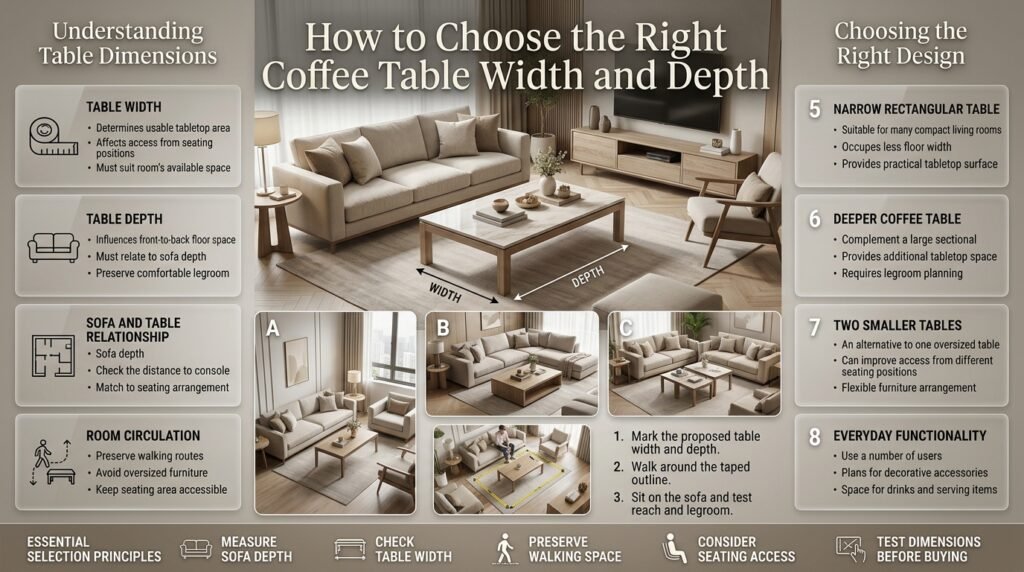
Coffee table width determines how much usable surface space you have and how comfortably the table fits within the seating area. A suitable width should support everyday activities without making the room feel crowded.
Many buyers focus on table length and overlook depth. This can lead to a table that technically matches the sofa but occupies too much floor space.
Before choosing a width, consider:
- Sofa depth.
- Distance to the television console.
- Room width.
- Walking routes.
- Number of people using the seating area.
- Whether the table will hold decorative accessories or serving items.
For example, a narrow rectangular coffee table may work better in a small apartment than a wide square design.
A deeper table can be useful with a large sectional, provided it doesn’t reduce comfortable legroom or block access.
Match Width to the Seating Arrangement
The table should be accessible from the main seating positions.
If people sitting at opposite ends of the sofa cannot comfortably reach the surface, consider a different shape or a more suitable width.
A pair of smaller tables can sometimes solve this problem more effectively than one oversized piece.
📌 Quick Tip: Mark the proposed table dimensions on the floor with removable tape. Walk around the outline and sit on the sofa before making a purchase.
7. How to Style a Coffee Table Without Making It Look Cluttered
A well-styled coffee table combines a few carefully selected accessories with enough open surface space for everyday use. The most effective arrangements use different heights, materials, textures, and shapes without overcrowding the tabletop.
Start with the table itself rather than purchasing decorative objects immediately.
Consider its material, color, shape, and available surface area.
Then choose accessories that support the room’s overall appearance.
Step 1: Start With a Decorative Tray
A decorative tray provides a defined area for smaller objects.
It makes the arrangement look more organized and allows accessories to be moved together when the table is needed for serving.
Useful tray materials include:
- Natural wood.
- Metal.
- Marble.
- Ceramic.
- Woven materials.
Choose a tray that fits comfortably on the tabletop.
A tray that occupies almost the entire surface can make the table look smaller and leave little room for practical activities.
Step 2: Add a Stack of Books
Coffee table books introduce height, color, and personality.
Choose books with attractive covers and subjects that reflect your interests.
A small stack of two or three books is usually sufficient.
The books can also create a stable base for a small decorative object, provided the arrangement remains safe and doesn’t obstruct everyday use.
Step 3: Introduce a Decorative Object
A ceramic bowl, sculptural accessory, or handmade object adds character.
Select something that complements the other materials without repeating every color and shape.
A small contrast often makes the arrangement more interesting.
Step 4: Add a Natural Element
Natural elements create a softer appearance.
Consider a small flower arrangement, a compact plant, or a simple branch in a vase.
Avoid excessively tall arrangements that block conversation or interfere with television viewing.
Step 5: Preserve Empty Space
An attractive coffee table should still be useful.
Leave room for drinks, snacks, remote controls, and other everyday items.
If the table is regularly used by children or family members, keep delicate accessories away from the main activity area.
⭐ Expert Tip: Arrange the accessories first, then remove anything that doesn’t contribute to the overall composition. Professional-looking styling often comes from editing rather than adding more objects.
8. How Many Decorative Accessories Should a Coffee Table Have?
The ideal number of decorative accessories depends on the table’s dimensions, its intended use, and the visual complexity of the surrounding room.
A small coffee table may need only one or two decorative groupings, while a large table can accommodate several separate arrangements.
Use the following as a starting guide:
| Table Size | Suggested Decorative Arrangement |
|---|---|
| Small | One tray and one accessory |
| Medium | Books, vase, and decorative object |
| Large | Two or three grouped arrangements |
| Oversized | Multiple balanced groupings |
These are flexible suggestions rather than strict decorating rules.
Does the Rule of Three Always Work?
The rule of three is a useful styling technique in which three objects are arranged together.
For example:
- A stack of two books.
- A medium ceramic vase.
- A small decorative bowl.
The combination creates variation without requiring a large collection of accessories.
However, not every coffee table needs three objects. A single statement vase can look more effective on a small round table.
The best arrangement depends on visual weight and available space.
How Much Empty Space Should Remain?
As a starting point, reserve approximately one-third to one-half of the tabletop for practical use.
A decorative arrangement should never make it difficult to place a drink or serving plate.
In family homes, functionality may need to take priority over elaborate decoration.
9. How to Create Visual Balance With Coffee Table Decorations

Visual balance is achieved when decorative objects are distributed in a way that makes the tabletop feel harmonious. This can be done through symmetry or asymmetry, depending on the furniture style and the visual weight of individual accessories.
An arrangement doesn’t need identical objects on both sides to feel balanced.
For example, one medium-height vase may balance a lower stack of books and a decorative bowl placed elsewhere.
Understand Visual Weight
Visual weight describes how strongly an object attracts attention.
It depends on several factors:
- Size.
- Color intensity.
- Material.
- Shape.
- Surface texture.
- Height.
- Position.
A dark stone object may attract more attention than a similarly sized transparent glass accessory.
Likewise, a large flower arrangement may dominate a table even if it occupies little surface area.
Create One Main Focal Point
Choose one object that naturally attracts attention.
This might be:
- A distinctive vase.
- A decorative sculpture.
- A beautiful book collection.
- A handmade ceramic piece.
- A natural floral arrangement.
Keep other accessories visually secondary.
For a deeper understanding of how focal elements work across an interior, explore room focal point planning principles.
Use Asymmetrical Styling
Asymmetrical arrangements can make a living room feel relaxed and natural.
Place a larger object on one side and balance it with two smaller objects on the opposite side.
The result can feel more interesting than a perfectly mirrored arrangement.
For additional guidance, read styling principles for visually balanced homes.
10. Coffee Table Styling Proportions for Small Living Rooms
Small living rooms require careful furniture selection because a coffee table occupies valuable floor space. The best solution is usually a compact, appropriately shaped table that supports everyday activities without restricting circulation.
A large table isn’t automatically more useful.
In many apartments, choosing a smaller design can make the entire room feel more open.
Choose Furniture With a Lightweight Appearance
Coffee tables with slim legs and open bases often appear less bulky than solid designs.
Glass and acrylic surfaces can also reduce visual heaviness.
However, the table must still provide enough practical surface area.
Consider Nesting Tables
Nesting tables offer flexibility.
A smaller table can slide underneath a larger one when additional surface space isn’t needed.
They are useful for:
- Compact apartments.
- Occasional entertaining.
- Flexible seating arrangements.
- Rooms with changing furniture requirements.
Try a Round Coffee Table
Round tables can make movement around compact seating areas easier because they don’t have sharp corners.
They are especially useful when the coffee table is positioned near an accent chair or a frequently used pathway.
Keep Accessories Minimal
Avoid using several oversized decorations.
A compact tray, a small book stack, and one decorative object can be enough.
Practical example: A 72-inch sofa may work with a 36–42-inch coffee table, depending on the available depth and circulation space. A round design may be preferable if people frequently walk around the seating area.
For more practical ways to improve limited floor areas, explore the interior design and DIY resources available through your home improvement planning.
11. Coffee Table Styling Proportions for Large Sectional Sofas
Large sectional sofas require coffee tables with enough visual presence and usable surface area to complement the seating arrangement. A table that’s too small can appear disconnected, while an oversized design can make the central area difficult to navigate.
The first step is to measure the usable space inside the sectional.
Consider how far people sit from the table and whether the main seating positions can reach it comfortably.
Choose an Appropriate Shape
Square tables can work well with deep sectionals because they create a strong central arrangement.
Rectangular designs are suitable when the sectional has a longer horizontal seating section.
Round tables can soften the appearance of large L-shaped furniture.
Consider Two Smaller Coffee Tables
Two smaller tables can provide flexibility.
They can be positioned together to create one larger surface or separated when additional space is required.
This arrangement can be particularly useful for entertaining.
Balance the Table’s Visual Weight
Large sectionals often have substantial cushions, deep seats, and thick arms.
A very delicate coffee table may look too small in comparison.
Consider a design with sufficient visual presence, but avoid selecting a table based only on its weight or material.
A carefully proportioned table with open legs can complement a substantial sofa without making the room feel heavy.
12. How Do Materials Affect Coffee Table Proportions?
Coffee table materials influence how visually heavy or light the furniture appears. A solid wooden or stone table may feel substantial, while glass or open-frame designs can appear lighter even when their dimensions are similar.
Material selection should consider both appearance and everyday maintenance.
Wooden Coffee Tables
Wood introduces warmth and natural texture.
Light oak, walnut, and darker timber finishes can complement different interior styles.
Wood works particularly well when the room already contains natural flooring, wooden side tables, or textured furniture.
However, using too many different wood finishes can make the room feel visually inconsistent.
Glass Coffee Tables
Glass creates an open appearance and allows the floor and rug to remain visible.
This makes it useful in compact living rooms.
Its main disadvantage is maintenance. Fingerprints, dust, and smudges are more noticeable.
Marble and Stone Tables
Marble and stone introduce a sophisticated, substantial appearance.
They can become a strong focal point in a modern or traditional living room.
Because these materials often have significant visual weight, balance them with softer accessories and appropriately scaled seating.
Metal Coffee Tables
Metal tables introduce structure and a contemporary character.
Black metal, brushed brass, and stainless steel can work with different furniture styles.
Use warmer accessories if the overall arrangement begins to feel too industrial.
| Material | Visual Character | Maintenance Consideration |
|---|---|---|
| Wood | Warm and natural | Protect from moisture |
| Glass | Light and open | Regular cleaning |
| Marble | Refined and substantial | Use suitable surface care |
| Metal | Structured and modern | Check finish durability |
| Acrylic | Visually lightweight | Avoid abrasive cleaning |
13. How to Coordinate Coffee Table Colors With the Living Room
Coffee table colors should connect with the sofa, flooring, rug, wall finishes, and surrounding furniture. The goal is to create a coordinated interior rather than making every object the same color.
Neutral coffee tables are versatile because they work with many decorating styles.
Beige, cream, gray, white, and natural wood can create a calm foundation.
However, a contrasting finish can also work beautifully.
For example, a dark coffee table in a room with light-colored seating can create a clear focal point.
Repeat Colors Carefully
Choose one or two colors from the surrounding room and repeat them through small decorative objects.
This could include:
- A vase that matches the accent cushions.
- A tray that complements the side table.
- Books that repeat the rug’s secondary colors.
- A decorative bowl that relates to the wall artwork.
This creates visual continuity without making the room look overly coordinated.
Consider Texture Alongside Color
Two accessories can have similar colors but different textures.
A smooth ceramic vase beside a woven tray introduces contrast without requiring additional colors.
For further decorating inspiration, explore Paint Color ideas and the wider Interior Design collection.
14. Coffee Table Styling for Different Interior Design Styles
The coffee table should support the overall character of the living room. A minimalist room benefits from restrained decoration, while a traditional interior may accommodate more detailed accessories.
Minimalist Coffee Table Styling
Minimalist arrangements prioritize simplicity and functionality.
Use:
- One or two decorative objects.
- Neutral materials.
- Clean shapes.
- Open tabletop space.
- Simple color combinations.
Avoid unnecessary accessories that compete with the furniture.
Japandi Coffee Table Styling
Japandi interiors combine Japanese-inspired simplicity with Scandinavian warmth.
Natural materials and understated accessories are especially suitable.
Consider:
- Light or medium-toned wood.
- Handmade ceramic bowls.
- Neutral books.
- Organic decorative shapes.
- Small natural arrangements.
Lighting also contributes to the overall atmosphere. Explore Japandi lighting composition for ideas about creating a calm and balanced interior.
Modern Coffee Table Styling
Modern arrangements often use geometric furniture, contrasting materials, and carefully selected statement pieces.
A marble coffee table with a simple sculptural accessory can create a refined appearance.
Keep the decorative arrangement controlled so the table remains the main furniture feature.
Traditional Coffee Table Styling
Traditional interiors can incorporate decorative trays, floral arrangements, classic books, and warm materials.
A wooden table may work particularly well with upholstered seating and traditional accent furniture.
Contemporary Coffee Table Styling
Contemporary styling allows more experimentation.
You can introduce unusual shapes, contrasting colors, and different materials while maintaining a connection with the surrounding room.
The important thing is to create a deliberate composition rather than combining unrelated accessories.
15. How Should Coffee Table Styling Change With Everyday Use?
A coffee table should reflect the lifestyle of the people using the living room. A formal sitting room may need only a decorative arrangement, while a family living room requires a more practical surface for drinks, snacks, and daily activities.
Consider how the table is actually used.
For Families With Children
Choose a stable table with rounded corners where possible.
Avoid fragile decorative objects and accessories that can easily fall.
A washable tray can help keep smaller items organized.
For Homes Used for Entertaining
Prioritize available serving space.
A table that looks beautiful but cannot accommodate drinks or small plates may not be practical.
Keep decorative accessories grouped toward one side so they can be moved easily.
For People Who Work From the Sofa
Consider whether the table provides enough room for a laptop, notebook, or temporary work setup.
A lift-top design may be more suitable if the coffee table regularly serves as a working surface.
For Minimal Daily Use
A simple decorative arrangement may be sufficient.
You can prioritize a distinctive material or sculptural design because the table won’t need to accommodate many everyday items.
💡 Practical Advice: Don’t style your coffee table for a photograph that represents none of your daily activities. A beautiful arrangement should work in real life.
16. How to Style a Coffee Table Step by Step
Creating an attractive arrangement becomes easier when you follow a clear process. Instead of placing accessories randomly, begin with the furniture proportions and gradually introduce decorative elements.
Step 1: Measure the Furniture
Record the sofa’s length, depth, and seat height.
Measure the available floor space where the coffee table will sit.
This establishes the practical limits for your furniture selection.
Step 2: Select the Table Shape
Consider the room’s existing furniture shapes.
Choose a rectangular, round, square, or oval table based on the seating arrangement and circulation requirements.
Step 3: Check the Clearance
Maintain approximately 14–18 inches between the sofa and table as a starting point.
Check the other sides to ensure that the table doesn’t obstruct walking routes.
Step 4: Select the Main Decorative Element
Choose one focal accessory.
It might be a vase, decorative sculpture, or attractive book arrangement.
Step 5: Introduce Supporting Objects
Add smaller pieces that complement the focal accessory.
Use different heights and textures to create visual interest.
Step 6: Review the Arrangement
Step away from the table and examine it from the sofa and the entrance to the room.
Check whether one side feels too heavy or whether any object looks unnecessarily large.
Step 7: Remove Unnecessary Decorations
Keep only the objects that contribute to the overall appearance.
Make sure there is enough surface space for daily activities.
17. Common Coffee Table Styling Mistakes and How to Avoid Them
Most coffee table styling problems happen when people choose furniture or accessories individually instead of considering the entire room. Understanding these mistakes can save money and prevent unnecessary decorating changes.
Mistake 1: Choosing a Table Without Measuring the Sofa
Why it happens: Buyers fall in love with a design and purchase it without checking the dimensions.
Why it’s harmful: The table may look too small or too large beside the sofa.
How to avoid it: Calculate the approximate half-to-two-thirds length guideline and check the available floor area.
Mistake 2: Ignoring Table Height
Why it happens: The table looks attractive in a product photograph, so its height receives little attention.
Why it’s harmful: The surface becomes inconvenient to reach.
How to avoid it: Compare the table height with the actual sofa seat height before purchasing.
Mistake 3: Placing the Table Too Close to the Sofa
Why it happens: People want to keep the table within easy reach.
Why it’s harmful: The arrangement becomes uncomfortable when people sit down or stretch their legs.
How to avoid it: Begin with 14–18 inches of clearance and adjust according to the room.
Mistake 4: Using Oversized Decorations
Why it happens: Large accessories attract attention and may look impressive individually.
Why it’s harmful: They dominate the tabletop and make the arrangement feel crowded.
How to avoid it: Choose accessories according to the table’s dimensions.
Mistake 5: Matching Every Object
Why it happens: People assume coordinated decorating requires identical colors and materials.
Why it’s harmful: The arrangement can look flat and repetitive.
How to avoid it: Repeat a few colors while introducing subtle differences in texture and shape.
Mistake 6: Ignoring Practical Surface Space
Why it happens: Decoration becomes more important than everyday use.
Why it’s harmful: There’s nowhere convenient to place drinks or snacks.
How to avoid it: Keep a useful portion of the tabletop clear.
Mistake 7: Choosing the Wrong Shape for the Room
Why it happens: Buyers focus on the table’s style rather than its relationship with the furniture.
Why it’s harmful: The table can interrupt movement or create an unbalanced arrangement.
How to avoid it: Assess the entire seating area before selecting the shape.
18. Professional Tips for Better Coffee Table Styling Proportions
Professional-looking interiors are usually created through careful measurements, controlled decoration, and thoughtful furniture selection. These recommendations help achieve a more refined result without unnecessary purchases.
Measure before shopping. Record the sofa dimensions, available table area, and walking clearance.
Consider the rug. The coffee table should sit comfortably within the seating arrangement. Its position should relate naturally to the sofa and other furniture rather than appearing randomly placed.
Balance visual weight. A heavy stone table may need lighter accessories, while a delicate glass table can benefit from a few more substantial decorative objects.
Use contrast intentionally. Combine curved and straight shapes, smooth and textured materials, or light and dark finishes.
Avoid unnecessary matching. A room can look coordinated without every furniture piece sharing the same finish.
Prioritize access. Every major seating position should have reasonable access to the coffee table.
Keep daily habits in mind. If the table is used frequently, its functional surface matters more than elaborate decoration.
Review the room from different angles. A table can look balanced from the sofa but feel awkward when viewed from the entrance.
Update accessories rather than replacing furniture. Seasonal flowers, a different tray, or a new book arrangement can refresh the space affordably.
For more practical decorating and renovation inspiration, explore Home Improvement, Latest News DecoratorAdvice, and History of Changing Residential Interiors.
19. How to Make Coffee Table Styling Work With the Rest of Your Home
The coffee table is only one element of the living room. Its appearance should connect with the rest of the interior, including storage, shelving, lighting, and furniture arrangements.
A table that looks attractive on its own may feel disconnected if the rest of the room follows a completely different design direction.
Coordinate With Open Shelving
If your living room contains open shelves, consider repeating some of the materials or decorative colors used on the coffee table.
For example, a wooden tray can relate to wooden shelf accessories, while neutral ceramic objects can create consistency across both areas.
However, avoid duplicating the same arrangement everywhere.
For ideas about keeping display areas organized, explore styling open shelves without clutter.
Connect With Smart Home Features
A coffee table may also sit near charging accessories, smart speakers, or other technology.
Plan these elements carefully so cables and devices don’t interfere with the decorative arrangement.
If your living room includes connected devices, how to set up my home decoradtech can provide additional inspiration for combining home technology and interior appearance.
Consider Long-Term Furniture Decisions
A coffee table should remain suitable if you change cushions, artwork, or smaller decorative accessories.
Choose a design that works with the main furniture and doesn’t depend on one temporary decorating trend.
When planning larger home changes, renovation work order for homeowners can help you think about the sequence and organization of improvement tasks.
The aim is to create an interior that remains functional and visually connected as your needs change.
20. Practical Coffee Table Styling Proportions Checklist
Before completing your living room arrangement, review the following checklist.
Furniture Dimensions
- Is the coffee table approximately half to two-thirds of the sofa’s length?
- Is its height close to the sofa seat height?
- Does its width suit the room?
- Does the shape complement the seating arrangement?
Room Clearance
- Is there comfortable space between the sofa and table?
- Can people move around the table?
- Are doorways and walking routes clear?
- Can everyone sitting on the sofa reach the tabletop?
Decorative Arrangement
- Are the accessories appropriately sized?
- Does the arrangement include different heights?
- Is there one clear focal element?
- Are the colors and textures coordinated?
- Is enough empty tabletop space available?
Everyday Functionality
- Can the table accommodate drinks and snacks?
- Are delicate accessories positioned safely?
- Is the surface easy to clean?
- Does the arrangement support your household’s daily routine?
If most of these questions have positive answers, your coffee table arrangement is likely to be both attractive and practical.
What Is the Ideal Coffee Table Size Compared to a Sofa?
The ideal coffee table should generally measure between one-half and two-thirds of the sofa’s total length. This proportion creates a comfortable visual relationship between the two furniture pieces without making the table look too small or oversized. For example, if your sofa measures 84 inches, a coffee table between 42 and 56 inches long is a practical starting point.
However, choosing the right size involves more than comparing two measurements. You should also consider the sofa’s depth, the available floor space, and how many people regularly use the seating area. A large sectional may need a wider coffee table, while a compact apartment may benefit from a narrower or round design.
Important points to consider:
Measure the sofa before purchasing a coffee table.
Aim for approximately 50–67% of the sofa’s length.
Avoid tables that extend awkwardly beyond the main seating area.
Consider the room’s available walking space.
Choose a size that provides practical surface area without overwhelming the furniture arrangement.
How Much Space Should Be Between a Coffee Table and Sofa?
The recommended distance between a coffee table and sofa is approximately 14–18 inches. This spacing provides enough room for comfortable leg movement while keeping the tabletop within easy reach. It also helps prevent the seating arrangement from feeling crowded or disconnected.
The correct distance can vary depending on the room’s layout and the depth of the sofa. In a smaller living room, slightly tighter spacing may be necessary, but the table shouldn’t make it difficult to sit down, stand up, or stretch your legs. In larger spaces, additional clearance can create a more open appearance.
Practical spacing recommendations:
12 inches: Suitable for particularly compact arrangements when comfortable.
14–16 inches: A useful option for smaller living rooms.
16–18 inches: Comfortable spacing for many everyday seating arrangements.
18–20 inches: Appropriate when additional floor space is available.
Keep frequently used walking routes clear.
Check the distance between the coffee table and other furniture, not just the sofa.
How Do You Style a Coffee Table Without Making It Look Cluttered?
The best way to style a coffee table without creating clutter is to use a small collection of accessories with different heights, textures, and shapes while leaving enough empty surface space for everyday activities. A decorative tray, a stack of books, a small vase, and one sculptural object can create an attractive arrangement without overcrowding the table.
Start by selecting one main decorative element that attracts attention. Then introduce smaller accessories that complement its color, material, or shape. Avoid placing several large objects together because they can compete visually and make the table feel crowded.
For example, a wooden tray with two design books, a small ceramic bowl, and a simple flower vase can create a balanced arrangement on a medium-sized coffee table.
Professional styling tips:
Use the rule of three to create attractive decorative groupings.
Combine low, medium, and taller accessories.
Choose one main focal point.
Introduce natural materials such as wood, ceramic, or greenery.
Leave approximately one-third to one-half of the tabletop available for practical use.
Remove accessories that don’t contribute to the overall arrangement.
Which Coffee Table Shape Is Best for Different Living Room Layouts?
The best coffee table shape depends on the sofa design, room dimensions, and available walking space. Rectangular coffee tables generally complement long sofas, round designs work particularly well in compact living rooms, and square tables can create a balanced central arrangement with large sectional sofas. Oval tables offer a softer alternative when you want an extended surface without sharp corners.
Choosing the correct shape can improve both the appearance and functionality of your living room. For example, a rectangular table may look natural in front of a traditional three-seater sofa, while a round table can soften a room containing several straight furniture lines.
Choose according to your layout:
Rectangular: Suitable for long sofas and traditional seating arrangements.
Round: Useful for compact spaces and rooms where easier movement is important.
Square: Works well with large L-shaped sectionals.
Oval: Combines generous surface space with softer edges.
Consider existing furniture shapes before making your selection.
Check that the table doesn’t obstruct doorways or walking routes.
How Do You Balance Coffee Table Decorations With the Rest of the Living Room?
Balancing coffee table decorations with the rest of the living room involves coordinating colors, materials, textures, and visual weight. The accessories should complement the sofa, rug, side tables, flooring, and wall decoration without making everything look identical. A well-balanced arrangement connects the coffee table to the wider interior while allowing it to maintain its own character.
For example, if your living room contains a beige sofa, natural wooden furniture, and neutral-colored cushions, you could introduce a wooden tray, a ceramic vase, and a darker decorative bowl. These elements repeat some existing materials while adding enough contrast to keep the arrangement interesting.
Think about the entire room rather than decorating the tabletop in isolation. A coffee table should support the existing design instead of competing with the television unit, artwork, or other focal features.
Important design considerations:
Repeat one or two colors already present in the living room.
Combine different textures to create depth.
Balance large accessories with smaller decorative objects.
Avoid matching every item exactly.
Coordinate the coffee table with the rug and surrounding furniture.
Keep the overall arrangement consistent with your interior design style.
Conclusion
Coffee table styling is most successful when the proportions feel right for the sofa, the room, and the way people use the space every day. A beautifully decorated table cannot create a balanced living room if it is too large, too small, too high, or placed too close to the seating. The right dimensions provide a comfortable foundation, while thoughtful styling brings personality and visual interest to the room.
Before choosing decorations, consider the coffee table’s length, height, shape, and available clearance. Keep the arrangement simple by combining a few carefully selected pieces, such as a decorative tray, a small stack of books, a vase, or a natural accent. Varying their heights and textures creates depth, while leaving some open surface makes the table practical for everyday use.
Remember that good styling is not about filling every empty space or following strict decorating rules. It is about creating a natural connection between the coffee table and the surrounding furniture. Whether your living room is spacious, compact, modern, traditional, or minimalist, balanced proportions and purposeful decoration can make the entire seating area feel more comfortable and complete.
Take time to measure your space, experiment with different arrangements, and adjust the details until everything feels visually balanced. When the size, placement, and styling work together, your coffee table becomes more than a decorative feature—it becomes a functional and attractive part of a welcoming living room.