
Introduction
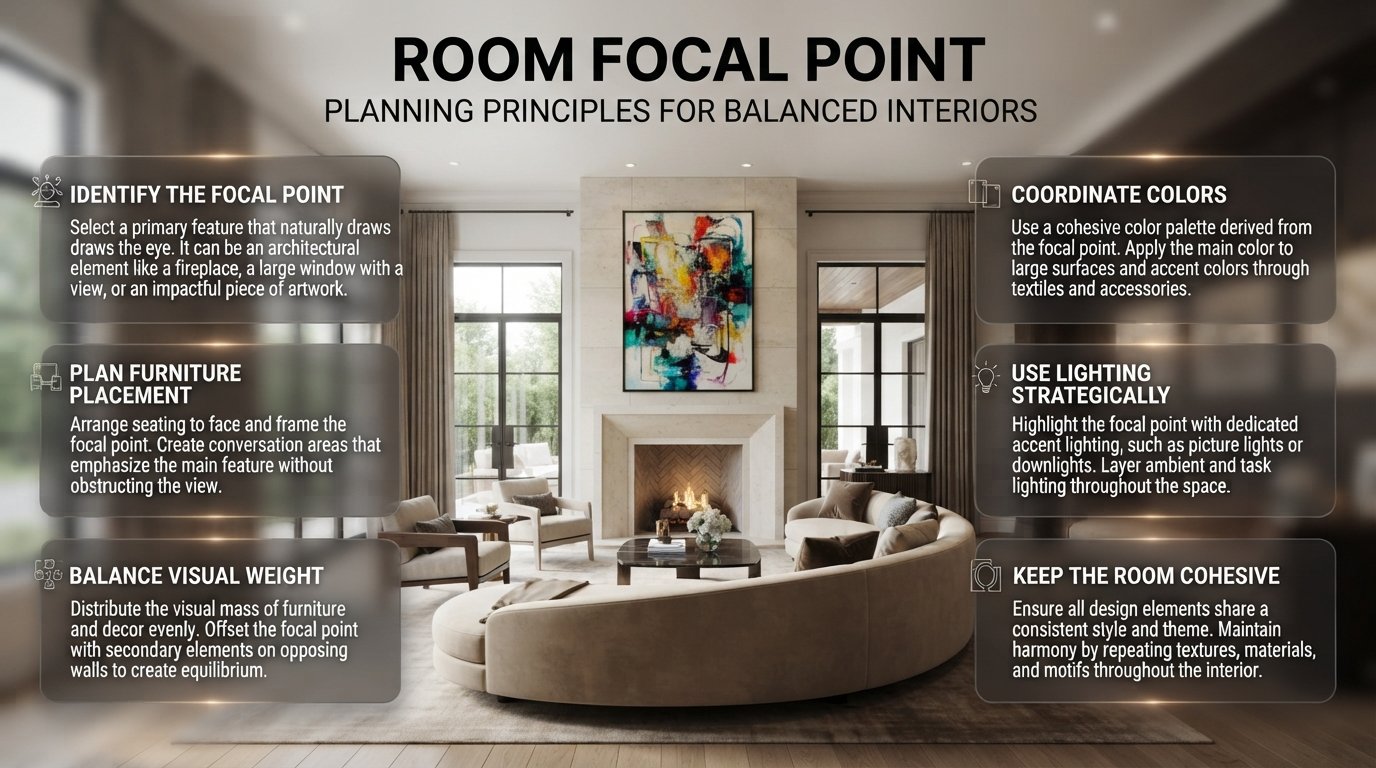
Room Focal Point Planning Principles | Have you ever entered a beautifully decorated room and felt that something was missing? The furniture may be attractive, the colors may complement one another, and the accessories may be carefully selected, yet the room still feels disconnected. Often, the problem isn’t a lack of decoration. It’s the absence of a clear visual direction.
Understanding room focal point planning principles helps you create interiors that feel intentional, balanced, and comfortable to use. A focal point gives the eye a natural place to settle and helps you decide where furniture belongs, which colors deserve attention, how lighting should work, and which decorative elements are worth keeping.
The good news is that creating a focal point doesn’t require an expensive renovation. A fireplace, a large window, a carefully positioned sofa, a statement headboard, or a meaningful piece of artwork can become the visual center of a room. The difference lies in how you arrange the surrounding space.
At DesignMode24 Interior Design, the emphasis is on practical ideas that help homeowners make informed design decisions. This guide explains how to identify the right focal point, plan furniture around it, balance colors and materials, improve lighting, and avoid common mistakes that make interiors feel crowded or unfinished.
Whether you’re decorating a small apartment, refreshing a family living room, or planning an open-plan home, you’ll learn how to create a focal point that supports everyday living rather than simply looking attractive in photographs.
1. What Are Room Focal Point Planning Principles?
Room focal point planning principles are the guidelines used to establish a clear visual center within an interior. They help designers determine which feature should attract attention first and how furniture, lighting, colors, textures, and accessories should support that feature without competing unnecessarily.
A focal point creates visual hierarchy. Instead of every object demanding equal attention, one feature becomes dominant while the surrounding elements contribute to a cohesive composition.
For example, a living room might use a fireplace as its primary focal point, with the sofa, chairs, rug, and lighting arranged to complement it. In a bedroom, the bed and headboard wall may provide the strongest visual anchor.
Why is a focal point important?
A focal point helps people understand a room visually. It creates a sense of order, makes furniture arrangements easier to plan, and gives decorative choices a clear purpose.
Without a defined focal point, a room may contain many attractive objects but still feel unbalanced. A large television, colorful artwork, oversized furniture, and dramatic lighting can compete for attention when none has a clear relationship with the others.
A well-planned focal point can:
- Establish a visual center without overcrowding the room.
- Improve the relationship between furniture and architectural features.
- Help coordinate colors, finishes, and decorative accessories.
- Make a small room feel more organized.
- Highlight a room’s strongest existing feature.
- Reduce unnecessary spending on decorative items.
- Give open-plan interiors a clearer sense of organization.
The objective isn’t to make every room dramatic. It’s to make the space understandable, comfortable, and visually consistent.
What makes a focal point successful?
A successful focal point attracts attention naturally, suits the room’s function, and relates to the space’s proportions.
It should also remain visible from important viewing positions. A beautiful painting hidden behind a tall cabinet won’t work effectively, and a dramatic feature wall may be unsuccessful if furniture blocks most of it.
Before choosing a focal point, consider three questions:
- What should people notice first when entering the room?
- Does that feature support the way the room is used?
- Can the surrounding furniture and decoration reinforce it without creating visual competition?
These questions provide a practical starting point for almost any interior design project.
2. How Do You Identify the Natural Focal Point of a Room?
The natural focal point is the architectural feature, view, or furnishing that attracts attention without requiring substantial decoration. To identify it, observe the room from its entrance, consider its main function, and look for elements with distinctive size, shape, contrast, or visual importance.
Examine the room before buying anything
Start by looking at the space as it currently exists. Don’t immediately assume that you need an accent wall, an expensive painting, or a new furniture arrangement.
Stand at the doorway and notice what attracts your attention first. Then sit in the room’s main seating position and observe which features remain visible.
Look for:
- Large windows and attractive outdoor views.
- Fireplaces and distinctive architectural details.
- Exposed brick, stone, or timber.
- Built-in shelving or cabinetry.
- An existing statement furniture piece.
- Unusual ceiling details or architectural openings.
Sometimes, the strongest feature is already present but has been overlooked because other objects surround it.
Example: A living room with a garden-facing window may benefit from simple curtains, low furniture, and a restrained color palette. Installing a dramatic television wall directly opposite the window might create unnecessary competition.
Distinguish between a strong feature and an appropriate feature
Not everything that attracts attention deserves to become the focal point.
A bright appliance, an awkward structural column, or a television may stand out because of its size or contrast. However, the best design decision depends on the room’s intended use.
In a family living room, a fireplace or conversation area might provide a more welcoming center than a television. In a dedicated media room, the screen may appropriately become the main focal point.
The important question is not simply, “What stands out?” It’s also, “What should stand out?”
When should you create a new focal point?
A new focal point makes sense when the room lacks a distinctive architectural feature or when its existing features don’t support the intended layout.
Consider a plain rental apartment with white walls and standard furniture. A large framed print, an upholstered headboard, or a carefully selected floor lamp can introduce visual interest without permanent alterations.
Similarly, an ordinary dining area can feel more deliberate when the dining table is paired with an appropriately sized pendant light.
Expert tip: Photograph the room from two or three positions before making changes. Reviewing the photographs can reveal visual competition, awkward sightlines, and overlooked architectural features.
3. Which Types of Focal Points Work Best in Different Rooms?
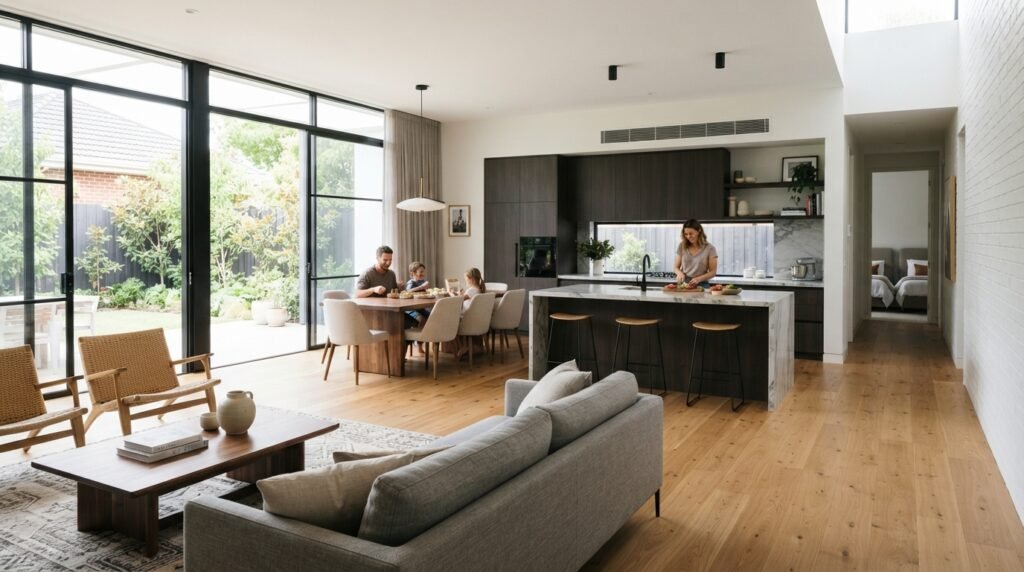
The best focal point depends on the room’s purpose, dimensions, existing architecture, and available furnishings. Architectural features often provide the most natural starting point, while artwork, furniture, color, and lighting can establish a focal point when the room lacks a strong feature of its own.
Architectural focal points
Architectural focal points include fireplaces, large windows, ceiling beams, exposed brick, decorative arches, and built-in shelving.
These features often feel integrated because they belong to the building rather than being added solely for decoration.
Their main advantage is that they can give a room character without requiring numerous accessories. However, their location may restrict furniture placement, and not every architectural feature deserves additional emphasis.
If a fireplace is attractive, you might highlight it with balanced furniture and subtle lighting. If a structural column interrupts the layout, you may prefer to integrate it into the surrounding design rather than make it more prominent.
Decorative focal points
Decorative focal points are introduced through objects such as artwork, mirrors, headboards, statement chairs, and distinctive consoles.
They work particularly well in apartments, rental homes, and rooms with plain architectural backgrounds.
A large artwork above a sofa can establish a visual center, while a sculptural headboard can provide character in an otherwise simple bedroom.
The main consideration is scale. A small decorative object may disappear on a large wall, while an oversized piece can overwhelm a compact room.
Functional focal points
Functional focal points are associated with the room’s primary activity.
Examples include:
- A dining table in a dining room.
- A desk in a home office.
- A kitchen island in an open-plan kitchen.
- A comfortable reading chair in a quiet corner.
- A bed in a bedroom.
These features are useful because they combine visual organization with practical purpose. Their success depends on appropriate lighting, comfortable access, and enough surrounding space for everyday activities.
Color and material focal points
Color, texture, and material contrast can make an ordinary wall or furnishing more noticeable.
A deep green wall behind a neutral sofa, a timber headboard against a pale wall, or a textured surface beside smooth cabinetry can establish visual depth.
However, dramatic materials aren’t always necessary. A modest difference in tone or texture may be enough to make the intended feature stand out.
| Focal point type | Best use | Main consideration |
|---|---|---|
| Architectural | Homes with distinctive built-in features | Work with existing proportions |
| Decorative | Plain walls and flexible layouts | Choose appropriate scale |
| Functional | Rooms organized around an activity | Preserve comfort and access |
| Color-based | Spaces needing visual definition | Coordinate surrounding colors |
| Lighting-based | Artwork, shelving, and architectural details | Avoid glare and excessive brightness |
4. How Do You Choose a Focal Point According to Room Size?
A focal point should have enough visual presence to relate to the room’s dimensions without overwhelming the space. Small rooms generally benefit from a clear, restrained feature, while larger rooms can accommodate substantial artwork, architectural details, or more elaborate compositions.
Planning focal points in small rooms
Small rooms often become crowded when too many decorative elements compete for attention.
Instead of introducing several statement objects, choose one feature that adds character without taking up valuable floor space.
Suitable options include a well-proportioned painting, a distinctive headboard, a compact accent wall, or a carefully positioned mirror.
A mirror can help reflect light and create a greater sense of openness, although its effect depends on what it reflects. Positioning a mirror opposite a cluttered storage area may simply draw attention to the clutter.
Keep furniture proportionate to the available space and avoid placing tall, bulky objects directly in front of the main focal point.
Planning focal points in large rooms
Large rooms often require a stronger visual anchor because small objects can appear disconnected from the surrounding architecture.
A substantial artwork, fireplace, large sofa, or coordinated seating arrangement may provide the necessary presence.
The solution isn’t to fill every empty wall. Instead, establish a strong main feature and use secondary elements to create balance.
For example, a large living room might use a fireplace as its primary focal point, a substantial rug to define the seating area, and a floor lamp to balance the composition.
Consider ceiling height
Ceiling height affects how people perceive the proportions of a room.
In a room with a high ceiling, a small painting positioned too low may feel disconnected from the surrounding wall. A larger artwork or a carefully arranged vertical composition can relate more effectively to the available height.
In a low-ceiling room, an oversized chandelier or visually heavy wall installation may make the space feel compressed.
Use the room’s actual dimensions as your guide rather than following a fixed decorating formula.
Use a comparison before making a decision
| Room condition | Recommended focal point | Avoid |
|---|---|---|
| Small bedroom | Headboard wall or medium-sized artwork | Several competing statement walls |
| Narrow living room | Artwork or a well-positioned sofa | Bulky furniture blocking the main view |
| Large family room | Fireplace or substantial seating arrangement | Scattered, undersized decorative objects |
| Low ceiling | Restrained wall feature | Oversized overhead fixtures |
| High ceiling | Tall artwork or architectural feature | Decorative elements that look too small |
| Window-facing room | Attractive view | Furniture that unnecessarily blocks the window |
These suggestions are starting points. Furniture dimensions, natural light, window placement, and circulation routes should determine the final arrangement.
5. How Should Furniture Be Arranged Around a Focal Point?
Furniture should support the focal point while preserving comfortable movement, practical access, and the room’s intended function. Begin with the largest furniture piece, arrange supporting items around it, and then check sightlines, circulation routes, and the relationship between the furniture and the main feature.
Begin with the largest furniture piece
The largest furniture item usually establishes the room’s basic layout.
In a living room, begin with the sofa. In a bedroom, position the bed. In a dining room, consider the table’s relationship to doors, circulation, and lighting.
Once the main piece is positioned, decide how supporting furniture should relate to the focal point.
For a living room with a fireplace:
- Place the main seating where the fireplace can be seen comfortably.
- Arrange additional chairs to encourage conversation.
- Position the coffee table within comfortable reach.
- Maintain clear routes between doors and frequently used areas.
- Add lighting and accessories only after the layout works.
Not every chair needs to face the fireplace directly. A successful living room should support conversation rather than feel like a row of seats in a waiting area.
Maintain practical clearances
A focal point can look impressive but still create an uncomfortable room if furniture is too tightly arranged.
As general planning guidelines:
- Allow approximately 14–18 inches between a sofa and coffee table when suitable for the furniture and circulation.
- Aim for around 30–36 inches of clear passage along frequently used routes where space allows.
- Check that dining chairs can move backward without blocking doorways.
- Ensure drawers and wardrobe doors can open fully.
- Keep required exits and access routes unobstructed.
These are practical starting points, not universal building-code requirements. Accessibility needs, furniture design, household activities, and local regulations may require different clearances.
Use symmetry or asymmetry intentionally
Symmetry can create a calm, formal appearance. Matching bedside tables, lamps, or chairs can help reinforce a centered focal point.
Asymmetry can produce a more relaxed, contemporary effect.
For example, a large painting above a console may be balanced by a tall plant on one side and a table lamp on the other. The objects don’t match, but their combined visual weight creates a coherent composition.
The goal is not to make every side identical. It’s to make the arrangement feel balanced.
Plan for everyday movement
Furniture should never be arranged solely for a photograph.
A sofa that blocks a main walkway, a chair that prevents access to a window, or a coffee table that makes movement difficult can undermine the room’s usefulness.
Walk through the proposed layout as if you were carrying groceries, serving food, or moving between seating areas. These simple tests can expose practical problems before you commit to the arrangement.
For further guidance on furniture durability and structural choices, explore furniture frame construction comparison.
6. How Do Color and Contrast Help a Focal Point Stand Out?
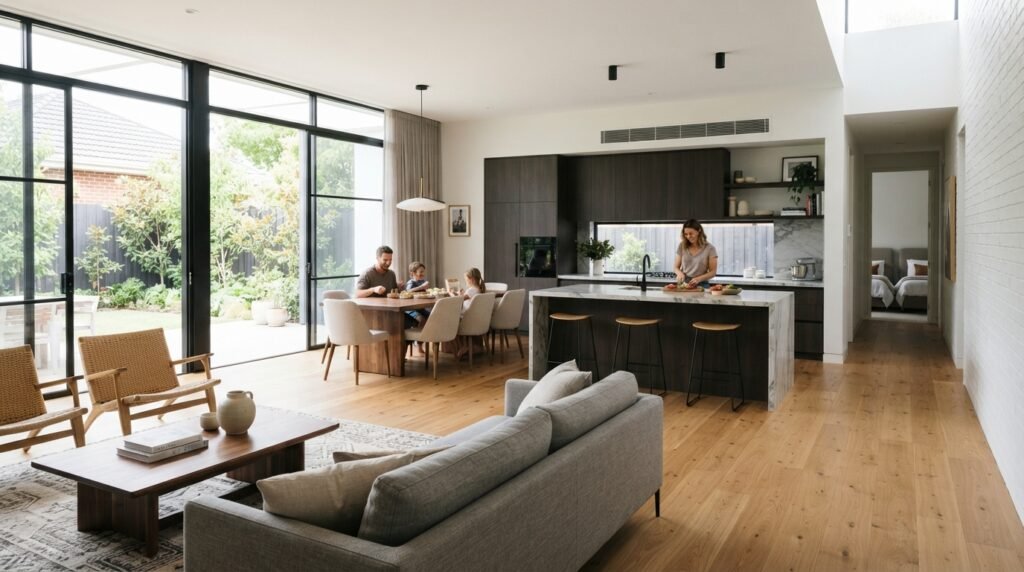
Color and contrast establish visual priority by making one feature appear more noticeable than its surroundings. You can achieve this through differences in color, brightness, texture, shape, or finish, then use complementary details to connect the focal point with the rest of the room.
Choose an accent color with purpose
An accent wall can make a focal point more noticeable, especially when the surrounding walls are relatively quiet.
For example, a muted olive wall behind a cream sofa can introduce depth without overwhelming the room. A deep navy headboard wall can give a neutral bedroom a more defined visual center.
The accent color should relate to the rest of the interior. It might appear again in a cushion, artwork detail, rug, or decorative object.
Repeating a color in a few places creates cohesion, but matching every accessory exactly can make the design feel overly coordinated.
Use contrast beyond color
Contrast also comes from materials, shapes, and textures.
Consider these combinations:
- Natural timber against a smooth painted wall.
- Light artwork against a dark background.
- Soft upholstery beside a hard stone surface.
- Matte finishes combined with restrained reflective details.
- A sculptural pendant against a simple ceiling.
Choose the contrast that best supports the focal point instead of introducing every effect at once.
Understand the role of negative space
Negative space is the relatively empty area surrounding an object or group of objects.
It gives the eye room to recognize important features. Without enough negative space, artwork, shelving, and decorative accessories can appear crowded.
For example, a large painting above a sofa may become more effective when the surrounding wall is relatively uncluttered.
Similarly, open shelving can look more refined when some areas remain empty rather than being filled with objects from end to end.
For ideas on coordinating shades and creating more deliberate color schemes, explore Paint Color.
Select materials that suit the room
Material choices influence both appearance and maintenance.
Timber can introduce warmth, stone can add visual weight, and metal can create a crisp contemporary accent. Textured upholstery can soften a room dominated by smooth surfaces.
Before selecting a finish, consider how it will age and how much maintenance it requires. Glossy surfaces can reveal fingerprints and reflections, while heavily textured finishes may collect dust.
If indoor air quality is important to your project, review low-VOC interior finishes. Product suitability depends on the specific formulation and its intended use, so check manufacturer information rather than assuming every product marketed as low-VOC is identical.
7. How Can Lighting Improve a Room’s Focal Point?
Lighting improves a focal point by controlling visibility, brightness, and contrast. General lighting makes the room usable, task lighting supports specific activities, and accent lighting highlights selected features. Combining these layers helps the focal point remain effective without making the surrounding space uncomfortable or excessively bright.
Understand the three lighting layers
Ambient lighting provides general illumination through suitable ceiling fixtures, recessed lights, or wall lights.
Task lighting supports activities such as reading, cooking, working, or applying makeup. It should be positioned according to the task rather than decorative appearance alone.
Accent lighting draws attention to artwork, architectural details, textured walls, or shelving.
A room doesn’t need the same balance of all three layers. A bedroom may require comfortable ambient lighting and bedside task lights, while an art-focused living room may benefit from additional accent lighting.
Highlight artwork and architectural details
Picture lights and adjustable spotlights can make artwork more noticeable. Wall-washing fixtures can emphasize a broad surface, while grazing light can reveal the texture of stone, brick, or decorative finishes.
However, the direction and intensity of light matter.
Poorly positioned fixtures can create glare, uneven shadows, or distracting reflections on glass and glossy materials. Test the effect from the room’s main viewing positions before finalizing the installation.
Consider lighting color and comfort
Light color affects the appearance of paint, timber, upholstery, and artwork.
Warm lighting often creates a relaxed atmosphere, while neutral or cooler lighting may suit certain work areas. The appropriate choice depends on the room’s purpose and the materials being illuminated.
Avoid selecting bulbs solely by brightness. Consider color rendering, dimming compatibility, glare, and the overall effect on the interior.
Pro tip: Review your focal point in daylight and after sunset. A feature that looks balanced during the afternoon may become visually flat or excessively dramatic under evening lighting.
8. Can a Room Have More Than One Focal Point?
A room can contain multiple focal points, but a single viewing area usually benefits from one dominant feature supported by quieter secondary elements. In open-plan interiors, different functional zones may each have their own focal point, provided the colors, materials, and overall design remain connected.
Understand primary and secondary focal points
The primary focal point receives the most attention. Secondary focal points provide interest without competing with it.
A living room might contain a fireplace as the primary feature, artwork on an adjacent wall, and carefully arranged bookshelves.
The fireplace remains dominant because the surrounding elements support rather than challenge it.
If every wall contains a dramatic finish, oversized artwork, and bold lighting, the room may feel like a collection of separate displays.
Plan focal points in open-plan interiors
Open-plan homes often combine cooking, dining, relaxing, and working within one continuous space.
Each zone needs a clear purpose, but the zones should still feel connected.
For example:
- The kitchen island can anchor the cooking area.
- The dining table and pendant light can define the dining zone.
- The sofa and fireplace can establish the living area.
Consistent materials, complementary colors, and coordinated lighting help create a unified interior.
This is particularly important when a room must support several activities. The principles discussed in multipurpose room planning can help you balance separate functions without creating unnecessary visual clutter.
Control competing sightlines
Imagine entering an open-plan home and immediately seeing colorful kitchen cabinets, a bright television wall, a dramatic chandelier, and a large gallery wall.
Each feature might be attractive on its own, but together they could compete for attention.
Decide which area should dominate the main entrance view. Let other features become more noticeable as people move through the space.
This approach creates visual progression rather than presenting every feature at maximum intensity from a single position.
9. How Do You Create a Focal Point in Different Rooms?
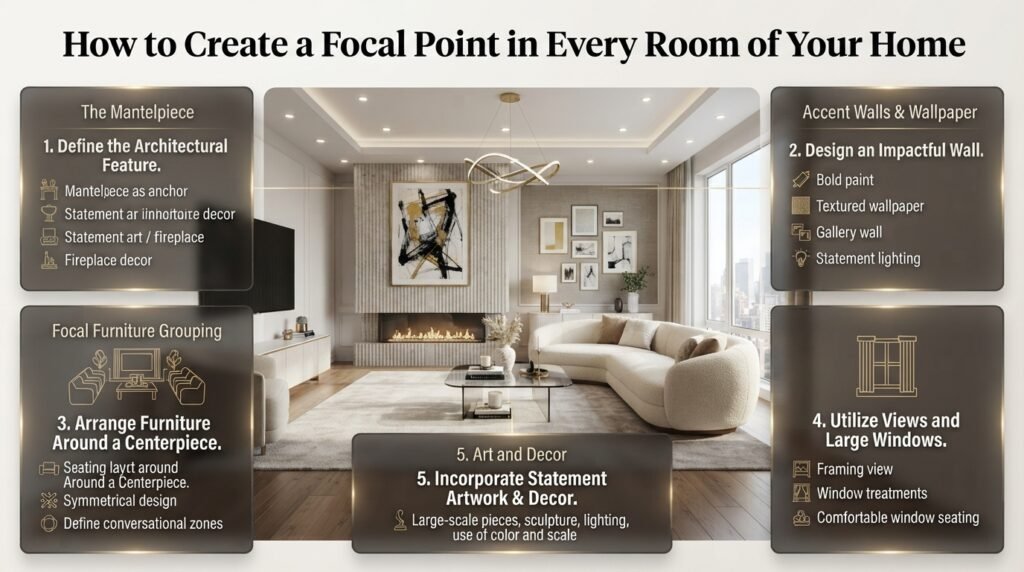
The most effective focal point changes according to the room’s purpose. Living rooms benefit from features that support gathering, bedrooms usually benefit from a calm bed-centered composition, dining rooms need a clear relationship between the table and lighting, and home offices require a balance between visual interest and concentration.
Living rooms
A fireplace, large artwork, statement sofa, or attractive window can provide a natural focal point.
Begin with the main seating arrangement and ensure that the chosen feature is visible from the primary seats.
Avoid placing too many tall objects around the feature. If the room contains a television, decide whether it should dominate or remain visually integrated with the rest of the interior.
Bedrooms
The bed is usually the most practical focal point because it establishes the room’s primary function.
A headboard, coordinated bedside lighting, or a restrained wall treatment can strengthen the arrangement.
Keep the surrounding furniture proportionate and preserve enough space for getting into bed, opening storage, and moving around the room.
Avoid introducing several dramatic wall finishes that compete with the bed.
Dining rooms
The dining table often acts as the main functional anchor.
A pendant light, artwork, or distinctive sideboard can reinforce the arrangement. The light should relate to the table’s position and size while providing suitable illumination for meals.
Make sure chairs can be pulled out comfortably and that people can move around the table without hitting walls or other furniture.
Home offices
In a home office, the desk and work area generally deserve the most attention.
A bookshelf, artwork, or carefully organized background can add character without distracting from the work surface.
Prioritize monitor placement, task lighting, storage, and cable management. A beautiful feature wall isn’t useful if glare makes the computer screen difficult to see.
Entryways
An entryway benefits from a clear first impression.
A console, mirror, artwork, or distinctive light fixture can establish the visual center. However, the feature should not obstruct the door, narrow the passage, or reduce practical storage.
The most successful entryway focal points combine appearance with everyday convenience.
10. How Can You Plan a Focal Point on a Budget?
You can create a focal point on a budget by repositioning existing furniture, displaying appropriately scaled artwork, improving lighting, painting a wall, or reducing unnecessary decoration. The most important step is to identify the feature that deserves attention before spending money on new items.
Start with what you already own
Look around your home for objects that could become more effective in a different position.
An existing painting might work better above a sofa than on a narrow hallway wall. A comfortable accent chair may become more noticeable when placed beside a window with a suitable reading light.
A few carefully arranged books and decorative objects can also improve shelving without requiring new purchases.
Use paint strategically
Paint can establish a focal point without major construction.
A contrasting wall behind a sofa or bed may provide enough definition to make the room feel more deliberate.
Before painting, test a sample under different lighting conditions. Colors can appear substantially different depending on daylight, bulb color, wall texture, and nearby finishes.
Improve the arrangement before replacing furniture
Sometimes the most effective change costs nothing.
Remove accessories that compete for attention, reposition furniture, improve the view of an architectural feature, or move a lamp to create more balanced lighting.
For small, manageable updates, explore DIY home projects. Choose projects appropriate to your skill level and follow relevant safety instructions when using tools, electrical equipment, or wall-mounting hardware.
Avoid spending money on unnecessary features
An expensive accent wall isn’t automatically better than a well-arranged room.
Before investing in decorative panels, built-in shelving, or specialist lighting, determine whether the proposed feature genuinely improves the space.
A restrained design with good proportions often feels more refined than a room filled with expensive but competing elements.
11. How Do Architectural History and Timeless Design Influence Focal Points?
Architectural style influences which features feel natural as focal points, while timeless design emphasizes proportion, quality, and a coherent relationship between materials. Understanding these principles helps you avoid choosing decorative features solely because they’re fashionable at the moment.
Recognize the character of the building
Traditional homes may feature fireplaces, detailed moldings, timber floors, or distinctive windows. Contemporary homes may emphasize clean lines, large openings, and restrained surfaces.
A focal point should respond to these characteristics rather than fight them unnecessarily.
For instance, an elaborate decorative installation may feel disconnected from a minimalist interior, while an extremely plain treatment may fail to acknowledge the character of a traditional room.
The history of residential spaces also helps explain why certain arrangements feel familiar and functional. Explore history of changing residential interiors for additional context on how home layouts and interior preferences have evolved.
Prioritize timeless qualities
Trends can provide inspiration, but the strongest focal points don’t depend entirely on short-lived fashions.
Good proportions, comfortable furniture, suitable lighting, and thoughtful material choices can remain effective even when decorative trends change.
A well-designed fireplace, a carefully selected painting, or a balanced headboard wall can adapt to changing cushions, rugs, and accessories.
For more guidance, read characteristics of timeless interiors.
Make changes that support the whole home
A focal point should work with adjacent rooms, particularly when doors and open-plan layouts create long sightlines.
You don’t need to repeat the same colors everywhere. Instead, maintain a relationship between the materials, visual weight, and overall atmosphere of connected spaces.
This creates continuity without making every room look identical.
12. What Are the Most Common Focal Point Planning Mistakes?
The most common mistakes include creating too many statement features, choosing furniture or artwork at the wrong scale, blocking important sightlines, ignoring circulation, and decorating before establishing a layout. These problems can make even expensive interiors feel uncomfortable or visually disorganized.
Mistake 1: Making everything a statement
Why it happens: Individual products look attractive in stores or photographs, encouraging homeowners to combine several dramatic pieces.
Why it causes problems: The eye has no clear visual priority.
How to avoid it: Choose one primary feature and reduce the intensity of surrounding decorations.
Mistake 2: Choosing artwork that’s too small
Why it happens: People select artwork based on personal preference without considering the wall and furniture dimensions.
Why it causes problems: The artwork can appear disconnected from the furniture beneath it.
How to avoid it: Measure the available wall area and test the proposed dimensions with paper templates before purchasing.
Mistake 3: Blocking windows or architectural features
Why it happens: Furniture is positioned according to convenience without checking the view from different parts of the room.
Why it causes problems: Natural light, attractive views, and distinctive architecture lose their visual impact.
How to avoid it: Check the room from the entrance, seating positions, and main circulation routes.
Mistake 4: Ignoring room proportions
Why it happens: Furniture and decorative objects are chosen individually rather than as part of a complete composition.
Why it causes problems: Oversized items can overwhelm a small room, while small objects may disappear in a large space.
How to avoid it: Measure the room, compare furniture dimensions, and consider the visual weight of each element.
Mistake 5: Forgetting everyday function
Why it happens: The layout is designed for appearance instead of the activities people perform.
Why it causes problems: Walkways become restricted, doors cannot open fully, and furniture becomes difficult to use.
How to avoid it: Test the proposed arrangement by walking through the room and using the furniture as intended.
Mistake 6: Using lighting as an afterthought
Why it happens: Homeowners select decorative features before considering how they will look after sunset.
Why it causes problems: The focal point may become flat, excessively bright, or difficult to see.
How to avoid it: Plan suitable ambient and accent lighting alongside the furniture arrangement.
Mistake 7: Buying accessories too early
Why it happens: Small decorative objects are easier to purchase than making decisions about layout and proportion.
Why it causes problems: The room accumulates items that don’t support a clear design direction.
How to avoid it: Finalize the main furniture placement and focal point first. Add accessories only when they serve a specific purpose.
13. What Practical Techniques Do Interior Design Professionals Use?
Professionals often begin with observation, measurements, sightlines, and visual hierarchy before selecting decorative finishes. They test arrangements, consider the room from multiple viewpoints, and make sure the focal point supports the intended use of the space.
Evaluate visual weight
Visual weight describes how strongly an object attracts attention.
Size matters, but it isn’t the only factor. Dark colors, strong contrast, unusual shapes, reflective surfaces, and intricate patterns can all increase visual weight.
A dark cabinet may appear heavier than a pale cabinet of similar dimensions. A large mirror may attract attention through reflected light, while a sculptural chair may stand out because of its unusual silhouette.
Balance these qualities rather than trying to make every object identical.
Test the arrangement before committing
You can use a simple planning process at home:
- Photograph the room from the entrance and main seating position.
- Identify the strongest existing feature.
- Choose a primary focal point.
- Measure the furniture and available circulation space.
- Move furniture into the proposed arrangement.
- Test artwork dimensions with temporary paper templates.
- Check lighting during the day and evening.
- Remove elements that compete with the main feature.
This approach helps you spot problems before spending money on construction or new furnishings.
Use open space deliberately
Empty space isn’t necessarily wasted space.
A clear wall around artwork, a relatively uncluttered mantel, or a few unoccupied areas on a bookshelf can help important objects stand out.
If your shelves are overloaded, review styling open shelves without clutter for ideas on arranging objects while preserving visual breathing room.
Consider the needs of children and families
A focal point in a family room must withstand everyday use.
Heavy decorative objects should be secured appropriately, fragile accessories should be placed away from active play areas, and furniture arrangements should preserve safe circulation.
If a room includes a children’s play area, distinguish the play zone from the main seating area without introducing barriers that create hazards.
The principles in play zone floor space planning can help you balance visual organization with usable floor space.
Prioritize quality and safety
A focal point should remain practical over time.
Consider cleaning requirements, material durability, replacement costs, and the suitability of wall-mounting systems. Heavy mirrors, shelving, and artwork must be attached using appropriate hardware for the wall construction and the object’s weight.
Electrical installations and structural alterations should be handled by suitably qualified professionals when required.
14. A Simple Room Focal Point Planning Checklist
Before buying furniture or beginning a renovation, work through the following checklist. It helps you establish a clear design direction while keeping the room comfortable and functional.
- Identify the room’s main purpose.
- Observe existing architectural features.
- Select one primary focal point.
- Check visibility from the entrance and main seating area.
- Measure the room and major furniture pieces.
- Plan comfortable circulation routes.
- Choose complementary colors and materials.
- Determine the appropriate ambient, task, and accent lighting.
- Remove objects that compete unnecessarily for attention.
- Review the finished arrangement in daylight and evening light.
- Check storage access, door openings, and practical clearances.
- Confirm that the design supports the way the household actually lives.
The checklist is useful whether you’re making a small decorative change or planning a more substantial interior update.
How Do You Choose the Best Focal Point for a Room?
Choosing the best focal point begins with understanding the room’s purpose, architectural features, and layout. A focal point should attract attention naturally while supporting the way people use the space. In a living room, it might be a fireplace, a large window, or a statement artwork. In a bedroom, the bed and headboard wall usually provide the strongest visual anchor. The right choice depends on which feature creates the most natural sense of balance without making the room feel crowded.
Before introducing a new feature, look at what already exists. An attractive window or distinctive architectural detail may provide enough visual interest without additional decoration. If the room feels plain, you can establish a focal point with artwork, a carefully selected accent color, or a distinctive furniture piece.
Practical points to consider:
Identify the feature people naturally notice when entering the room.
Choose a focal point that reflects the room’s primary function.
Consider the room’s dimensions, ceiling height, and available natural light.
Avoid selecting several equally prominent features that compete for attention.
Check that the focal point remains visible from the main seating area and entrance.
How Can You Create a Focal Point in a Small Living Room Without Making It Feel Crowded?
Creating a focal point in a small living room requires careful attention to scale, placement, and visual clutter. The objective is to give the room a clear visual center without occupying valuable floor space. A well-proportioned artwork, a simple accent wall, a distinctive sofa, or an attractive window can provide enough character without requiring additional furniture.
Start by arranging the main seating and keeping the primary walking routes clear. Instead of decorating every wall, concentrate attention on one feature and allow the surrounding area to remain relatively simple. A limited color palette and carefully positioned lighting can help the focal point stand out without overwhelming the room.
Practical points to consider:
Select one dominant feature rather than several statement pieces.
Choose artwork that relates proportionately to the wall and furniture beneath it.
Keep tall furniture away from important windows and sightlines.
Use mirrors thoughtfully to reflect light and create a greater sense of openness.
Remove unnecessary accessories before purchasing new decorations.
Preserve comfortable access between the sofa, coffee table, doorway, and other frequently used areas.
What Is the Difference Between a Focal Point and an Accent Wall in Interior Design?
A focal point is any feature that attracts the eye first, whereas an accent wall is a wall treated differently from the surrounding surfaces through paint, wallpaper, texture, or decorative materials. An accent wall can become a focal point, but the two terms do not mean the same thing. A fireplace, large window, sculptural light fixture, or statement furniture piece can serve as a focal point without an accent wall.
The decision should depend on the room’s existing features and the atmosphere you want to create. For example, a bedroom with a distinctive upholstered headboard may not need a contrasting wall behind it. In a plain living room, however, a carefully chosen accent color can help define the seating area and create visual depth.
Practical points to consider:
Use an accent wall when the room needs additional visual definition.
Consider existing architecture before introducing a new decorative feature.
Coordinate the accent color with furniture, flooring, and soft furnishings.
Avoid placing several bold finishes together if they compete for attention.
Remember that lighting, texture, and furniture placement can create a focal point without repainting the room.
How Should You Arrange Furniture Around a Room’s Main Focal Point?
Furniture should be arranged to highlight the main feature while maintaining comfortable movement and supporting the room’s intended activities. Begin with the largest furniture piece, such as a sofa in a living room or a bed in a bedroom. Then position the remaining furniture to create a balanced arrangement with clear sightlines and practical access.
In a living room, seating can face a fireplace or artwork while still encouraging conversation between family members and guests. In a bedroom, the bed should remain the primary visual anchor without blocking windows, storage, or walking routes. The best arrangement considers both appearance and everyday convenience rather than forcing every piece of furniture to face the same direction.
Practical points to consider:
Position the main furniture piece before adding smaller items.
Keep the focal point visible from important viewing positions.
Leave approximately 14–18 inches between a sofa and coffee table when suitable for the layout.
Aim for about 30–36 inches of circulation space along frequently used routes where the room allows.
Check that doors, drawers, and dining chairs can move without obstruction.
Use symmetrical arrangements for a formal appearance or asymmetrical arrangements for a more relaxed look.
How Can Lighting, Color, and Texture Make a Room’s Focal Point More Attractive?
Lighting, color, and texture work together to direct attention toward a focal point and connect it with the rest of the interior. Contrast can make a feature stand out, while coordinated materials and supporting colors help the room feel cohesive. For example, artwork against a darker wall may become more noticeable, while a textured timber surface can add warmth to a contemporary living room.
Lighting is equally important because a focal point must remain visually effective during both daytime and evening hours. Ambient lighting provides general illumination, task lighting supports specific activities, and accent lighting highlights selected features. Combining these layers thoughtfully helps reveal the character of the focal point without creating glare or excessive brightness.
Practical points to consider:
Choose one dominant contrast instead of making every surface visually dramatic.
Repeat selected accent colors in a few cushions, accessories, or artwork details.
Use accent lighting to highlight artwork, shelving, fireplaces, or textured walls.
Check for glare and reflections on mirrors, glass, and glossy finishes.
Consider how natural and artificial light affect paint and material colors.
Leave enough uncluttered space around the focal point so it remains the center of attention.
Conclusion: Create a Room That Feels Balanced and Intentional
Successful room focal point planning is about more than choosing an attractive fireplace, statement wall, piece of artwork, or standout furniture item. It is about creating a clear visual direction that helps the entire room feel connected, comfortable, and thoughtfully designed. When the focal point suits the room’s purpose, proportions, natural light, and existing features, it becomes the foundation for furniture placement, color choices, lighting, and decorative details.
The most effective approach is to begin with what the room already offers. A large window, architectural feature, or beautiful piece of furniture may provide a natural starting point. If the room lacks a defining feature, you can introduce one through a carefully selected artwork, an accent wall, a distinctive light fixture, or a well-styled furniture arrangement. The key is to make deliberate choices rather than filling every available space with competing visual elements.
Remember that a focal point should enhance everyday living, not interfere with it. Maintain comfortable walking routes, choose furniture that suits the room’s scale, and use lighting and accessories to support the main feature instead of distracting from it. For more practical ideas on creating cohesive, functional, and timeless spaces, explore DesignMode24 Interior Design and apply these principles to your own home.
Ultimately, the best focal point is one that feels natural within the space and reflects how you want to live. By balancing visual interest with comfort, proportion, and functionality, you can transform an ordinary room into a welcoming interior with a clear sense of purpose and personality.